Such a designation may feel a bit obvious. Aren’t all picture books, by definition, simple?
Short answer: No.
Longer answer: Sure, in the grand scheme of things. But as I will mention to anyone who gets within 10 feet of me, there are a LOT of picture books published in a given year. And within that vast sea of story, there are simple picture books and there are sophisticated picture books. Sophisticated picture books appeal to slightly older readers and, even more importantly, adults. Adults like complexity. They like cleverness. And they like to spend money on complexity and cleverness. You might ask why I don’t do a Sophisticated Picture Books List. The answer is that when you look at Best Book lists released in a given year, 95% of the picture books on them are already sophisticated. I mean, it’s adults doing the selecting after all.
Which brings us to the simple picture books. These are books with easy texts and that appeal to those readers making the transition from board book to longer fiction. They are easier picture books, and (to be frank) a LOT harder to write than their more complicated kin.
Today, we celebrate simplicity.
You can get the full PDF of the list here.
If you’re interested in seeing other lists of simple picture book texts, I only started this category just three years ago. Here’s what we’ve done so far:
2025 Simple Picture Books
FEATURED TITLE
Big Rhinoceros, Little Rhinoceros by Jerrold Connors

The art of the simple picture book finds its natural home in the work of Jerrold Connors. And what a year he has had too! In addition to that STELLAR (and I use my caps with purpose when I write that) picture book bio JIM! (more on that when we get to nonfiction picture books AND biographies) Connors has done a deep dive on two rhinos of varying proportions. The story follows a big rhino and a little rhino after they hear a threatening HONK. Big rhino? It wants nothing to do with it. Little rhino? It’s curious. I don’t want to shock you, but it turns out that the honk comes from a non-threatening source. Cute simple story (with a bit of a killer ending, actually) but I’m also loving what Connors is doing here with his bold, almost construction-papery colors and his flaps. Really good flaps too. Quality I-could-survive-a-small-child’s-enthusiasm flaps. Oddly tactile and satisfying.
Bianca and the Butterfly by Sergio Ruzzier

17 years ago I fell desperately in love with a little Sergio Ruzzier title called Amandina. In the pantheon of Ruzzier titles, Amandina, that little dog with the golden eyes, still shines so brightly in my mind. And as I read Bianca and the Butterfly, I started to feel some of the sensations I felt for Amandina all those years ago. Ruzzier’s art and writing does the ineffable, indescribable thing that all truly great picture books do. They have a tone and a flavor and a feel entirely of their own. In this book, a little polar bear cub named Bianca (which, y’know, right there) sees a lovely butterfly and follows it onto an ice floe. An unexpected adventure carries the two to a tropical isle with new vibrant colors, smells, and flavors. Ruzzier does this amazing thing where he shifts focus so that what once was magical can become nightmarish, depending on your state of mind. The ending says simply, “It feels good to be back among the things she knows. Because Bianca loves the things she knows. But she also loves the things she doesn’t know… yet.” Can’t help but think that this is a lesson we need to get out there to the kids early, yes?
Dawn by Marc Martin

When the sun comes up, what are all the fish, birds, bugs, and mammals up to? A deeply evocative, radiantly lovely ode to the earliest hours of the day. Veeeery simple too. Marc Martin was the fellow behind the art in the book We Are Starlings, so his style may be somewhat familiar to you already. This book is seemingly less ambitious. It’s just dawn on a pond and all the critters that are affected by the rising sun. Yet it’s also big and evocative, peppered with a word here and there but no overarching storyline. The star of the show is clearly the watercolors, which can be jaw-dropping at times. There are action sequences (hope you don’t have a fondness for flies) but for the most part it’s steady and strangely moving. Nature appreciation at its finest.
Go, Sloth, Go! by Toni Yuly
Previously seen on the Readloud List

Our first repeat! Why go fast when you can go slow? Join a single sloth as it seeks out something tasty to eat in this fun readaloud with a simple text. Yes, Yuly’s back at it again with her unique brand of nature and incredible simple texts. Her books are technically fictional, but I suspect that someday she may succumb to the allure of putting a little backmatter in there to spice things up. Like Maxwell Eaton III, her style adapts to nonfiction particularly well. In this book we watch a single sloth go about its day. This is coupled with the nicely opposed dynamic of the text, which keeps encouraging the slow sloth like the cheer section of a football game. “Go, Sloth, go, Sloth, go, sloth, go!” I imagine this would be an incredibly fun preschool readaloud, particularly if you can get the kids to chant along with you. Slow and steady definitely wins this race.
Let’s Be Bees by Shawn Harris
Previously seen on the Readloud List
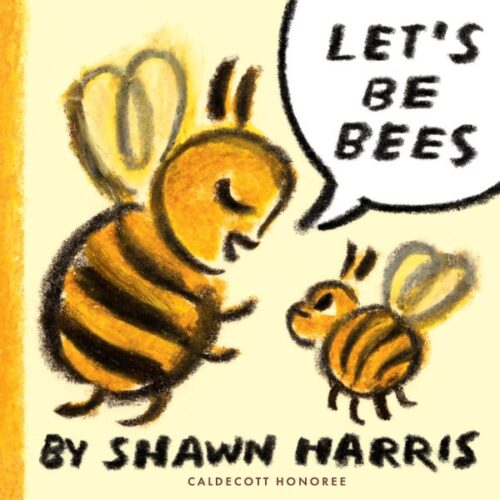
You’re beginning to see now the overlap that often happens between successful simply picture books and the best readaloud texts. Let’s be bees. And what do bees do? “Let’s buzz.” Father and child pretend to be a wide array of things, in this eclectic, colorful, and incredibly fun readaloud for our youngest readers. Give bees a chance. I am so sorry. That terrible pun was inevitable. But it’s also heartfelt because I seriously think that this is a great SIMPLE (the hardest kind of picture book to write) title. The irony here is that when I saw Shawn Harris present this book at ALA back in June, I really wasn’t on board. I think I needed to see the book firsthand for it to hit me just right. What we have here is the ultra-rare and rather beautiful (note the trademark Harris crayon style) readaloud for toddlers and preschoolers. This thing is also terribly interactive. You’re literally telling the kids what to be and what sounds to make. Then, as all truly great picture book readalouds should, it gets weird at the end in a hilarious way. It’s funny, and exceedingly simple, and brilliantly done.
M Is for Mango by Atinuke, ill. Angela Brooksbank
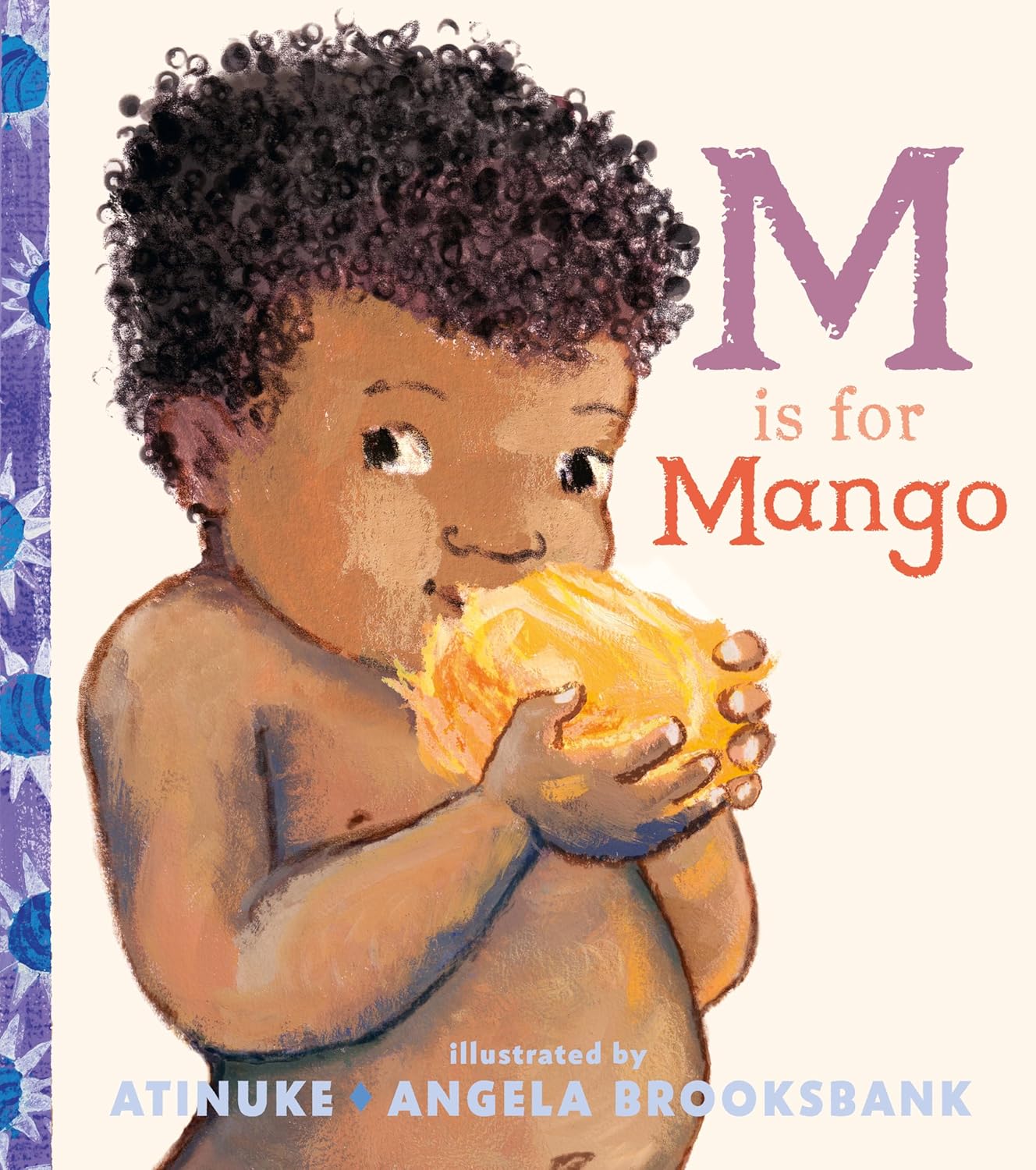
The letter M is the star of this show, alongside little Mo. Will he get a tasty mango from the mischievous monkeys or will he get mad? If it’s simple picture books you seek, who better to provide than Atinuke herself? Aside from the obvious cute factor here (Brooksbank is shameless and we love her for it) this is very much in the same vein as Atinuke’s previous title B Is for Baby. As with that book, here you get an incredible amount of storytelling in a scant number of words. For me, the whole thing gets really interesting when you get to see how cool and rusty and awesome the motorbike in the story is. And after having read last year’s How to Eat a Mango, I have a newfound appreciation for the fruit. This is great younger fare.
Meet the Smushkins by Claudia Rueda

I write the occasional picture book myself, and as a result I know my own limitations. To be perfectly frank, I don’t think I have the skill to go simple. The truest simple picture book is the one that taps into the heart of something, while keeping the ideas and text and art almost ludicrously pure. Like a haiku meant for someone with few fine motor skills. That’s why I’m sort of standing in awe over here in view of Claudia Rueda’s new “Smushkins” series. This is just the first to come out, but I can’t help but marvel over her ability to create ten characters (at least) capable of small adventures. In this first book, the Smushkins are house hunting. They know precisely what they need in the ideal house too. What follows is a dream list of house-related requirements. There should be hills outside for scooters and big windows to let light inside. There should be a library nearby and “walls for doodling and painting.” Of course what small me would have loved about this book the most (and I pointed this out to Claudia in our interview) was the chance to live in a house with all your friends at once. For me, that’s the greatest fun of all. A book for our youngest of readers with the biggest of dreams.
Next to Me by Daniel Salmieri and Sophia Haas

Anyone else get a Karen Carpenter song caught in their head when they read that title? No? Just me? Cool. So that title is a pretty good encapsulation of what this book entails. It’s all about talking about things that are next to other things. Which, when you sit down to think about it, is important but difficult to hang on a plot of any sort. Fear not, Salmieri and Haas are up to the challenge. This is very much a basic concept book, only it’s a concept that I don’t hear discussed very often. The creators have set it in a city neighborhood, and the story is almost as much a celebration of urban living as anything else. The text is interesting to look at too. Certain words are bolded like “I see LINES on the street / Next to the WALKING PERSON / Let’s go!” It’s almost as if the creators want the adults to know precisely what parts of the story they should point out to their young child readers. This makes for an interesting direction for Salmieri. His books are so often reliant on clever concepts and wordplay (Robo-Sauce 4-EVAH!) so it’s nice to see him dip down and do something quite this simple for his younger fans. A rather lovely inclusion in any concept book stack.
Short Dog, Long Dog : A Book of Opposites by Anna Hrachovec


”Hot dog, Cold dog, Cheerful or dour. / Soaking in the tub, Or scrubbing in the shower.” Stand aside Go, Dog. Go! There’s a new rhyming pup book in town, and it’s created entirely out of knitting!! I mean, at what she does, Anna Hrachovec has no peer. She is the da Vinci of knitted animalia. There’s even a shot in this book of a dog knitting (meta much?) and I was so pleased that the knitting needles were correctly positioned (though, admittedly, it would be a cheeky move on her part if they weren’t). Additional Bonus: It’s just as cute and funny as Catside Up, Catside Down was. Hrachovec cannot be matched in what she does (and apparently lives in Chicago?!?).
Waiting and Watching: What Hatches from Nature’s Nurseries by Sara Levine

Because, by gum, I’m going to get at least ONE nonfiction book on this list today!
You don’t need to be a grown-up to be a scientist. Observe the natural world around you (without interfering) with the aid of this incredible catalog of eggs and egg cases in nature. Eye-popping too. In lieu of another Helen Frost book this year, I’m willing to accept this beauty by Sara Levine as a stand-in. The simple text is paired alongside some truly fascinating types of eggs. Who knew slug eggs looked so much like tiny crystal balls? Or that wasps had such a wide array of eggs (the wool sower galls are definitely my favorite). The book gently reminds curious kids that if you force open these egg and egg cases that you find, you’ll kill the creatures inside. I didn’t really know what a gall was prior to reading this title and now I want to go into the wild and find one for myself. The big text is nice and simple, though there is a more complicated smaller text for older readers as well. Absolutely inspirational with great backmatter. And if you were missing the horror show that is seeing baby praying mantasis emerging from their egg case, have I got good news for you!
December 1 – Great Board Books
December 2 – Picture Book Readalouds
December 3 – Simple Picture Book Texts
December 4 – Transcendent Holiday Children’s Books
December 5 – Rhyming Picture Books
December 6 – Funny Picture Books
December 7 – Caldenotts
December 8 – Wordless Picture Books
December 9 – Bilingual Books for Kids
December 10 – Math Books for Kids
December 11 – Books with a Message / Social Emotional Learning
December 12 – Easy Books
December 13 – Translated Children’s Books
December 14 – Fairy Tales / Folktales / Religious Tales
December 15 – Gross Books
December 16 – Poetry Books
December 17 – Unconventional Children’s Books
December 18 – Early Chapter Books
December 19 – Comics & Graphic Novels
December 20 – Older Funny Books
December 21 – Science Fiction Books
December 22 – Fantasy Books
December 23 – Informational Fiction
December 24 – American History
December 25 – Science & Nature Books
December 26 – Unique Biographies
December 27 – Blueberry Award Contenders (Celebrating the Environment)
December 28 – Nonfiction Picture Books
December 29 – Nonfiction Books for Older Readers
December 30 – Middle Grade Novels
December 31 – Picture Books