
31 Days, 31 Lists: 2025 Wordless Children’s Books
Also known as “silent” books in Europe.
What’s your favorite wordless books for kids? Is it Tuesday by David Wiesner, or perhaps The Lion and the Mouse by Jerry Pinkney? Me, I’m a big proponent of The Arrival by Shaun Tan. After all, nobody ever said a wordless book had to be a picture book. And sometimes 32 pages just isn’t enough room for a story. Today we’re celebrating the silent. The books that take a chance and tell their tales with quiet aplomb.
Oh, and worried that wordless books don’t do enough for literacy? Then allow me to direct your attention to a Bookriot article released earlier this year called How Wordless Picture Books Turn Kids Into Readers. The selected titles included? Excellent.
ADVERTISEMENT
ADVERTISEMENT
You can find a full PDF of today’s list here.
Love wordless titles? Then check out some lists from previous years:
2025 Wordless Books for Kids
FEATURED TITLE
The House That Floated by Guojing

Quite the year for Guojing in America, eh? Between this and the heady post-apocalyptic-but-motherly Oasis, she’s having quite the banner 2025. Now Oasis is set in a future made entirely of sand. The House That Floated, in contrast, is a water-based story. It also doesn’t take much imagination to believe that it may also be about rising sea levels since the entire focus is on a man and a woman how they and their child deal with an encroaching sea. Guojing is somewhat cursed to always be compared, on some level, to Shawn Tan in terms of both her artistic style and how she tackles wordless graphic novel-esque sequential storytelling. The tone, however, is all her. In this case, the book plays out like a short film. We see the man and woman working side-by-side fishing and saving dolphins from their nets. In time they have a child, who grows to love the dolphins and even carves a wooden one. After a storm, it is clear to the parents that their formerly safe little home on a cliff has turned into an island. Utilizing what they have, they construct a raft from logs and prop their home on top of it. They then drag their house through the sea towards a new safe cliff and friends. The book somewhat reminded me of that picture book from a couple of years ago Moving the Millers’ Minnie Moore Mine Mansion: A True Story by Dave Eggers. In both cases you’ve a thing that seems static and unmoving setting out on an adventure of its own. As ever, Guojing’s a master, and this book is sweet and satisfying while also involving some mild peril. A perfect combo.
Buzz! Boom! Bang! The Book of Sounds by Benjamin Gottwald
[Previously seen on the Readaloud List]

While there is a little text at the start of this book, I’d argue that the first four pages are purely instructional and are to be disregarded. After all, at least 164 of those pages are wordless. On the opening spread, we are told how to use this book. “It’s easy! 1. Open the book. 2. Make the sound that you see. 3. Giggle, turn the page, repeat. Each time you read this book, have fun making it your own.” What follows is a WIDE array of possible sounds, some of which kids will be able to come up with, and others will take a bit of imagination. What, for example, is the sound of someone licking a sour lemon and experiencing a full-body shudder? What sound does a massive ship make? What do centipedes sound like when they run? I imagine you could make this into an incredible read aloud storytime by just randomly turning to pages. Often the images stand alone on their own pages, but once in a while there’s a before and after aspect to them. You could probably do this book with kids on multiple occasions and never quite get the same set of sounds twice. It’s interactive, brightly colored, and a marvelous antithesis to screens (if that’s what you seek). Audible magic.
Field Trip to Dinosaur Valley by John Hare

I am beginning to have some serious concerns about the safety protocols at this school. If you know John Hare then you know that he has already produced such wordless science fiction titles as Field Trip to the Moon and Field Trip to the Ocean Deep. I suppose one should be relieved at the premise behind Field Trip to Dinosaur Valley, since at least the kids will be able to breathe freely on the trip. Time travel is the name of the game behind this new installment in the series, and I rather like the dial that simply reads, “PAST”, “PRESENT”, and “FUTURE” on the driver’s dashboard. We’re definitely not adhering to the rules stipulated in the old Ray Bradbury story “A Sound of Thunder” in this book, since almost immediately one of our intrepid students gets their lunch stolen by a hungry pterosaur. Attempts to retrieve it means getting left behind by their classmates, which isn’t great news. They then befriend and feed an array of other dinos, before a hungry T.Rex puts an end to their fun. I was amused by the final sequence in which our hero has been retrieved and their classmates share lunch with them since they left their own lunchbox back in the past. Meanwhile, the teacher is getting seriously chewed out by someone over this lapse (and there’s a nice poster instructing people not to feed the dinos hanging quietly on the wall in the back). Hare is a master at wordless storytelling, of course, so you won’t have a lick of difficulty following along in the least.
Pencil by Hye-Eun Kim
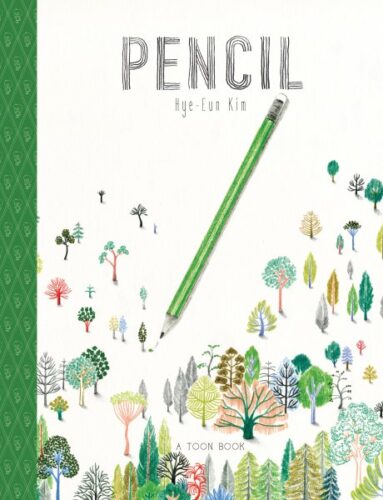

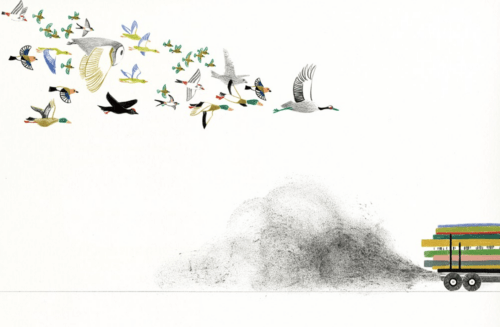

It’s not common to say that a picture book has taken the country “by storm”, but it is something I can almost say about little Pencil here. I mean, think about it. The New York Times/New York Public Library Best Illustrated list only selects a chosen ten books. Plus, this book has made that list as well as countless others, and why not? It’s a bit of a cycle of life story, following an implement that many kids are already familiar with from its origins to its demise and back again. I like how The New York Weekly Times (what the heck is The New York Weekly Times?) said that it “blends the fanciful and the practical”. However it does it, it’s certainly one of the more memorable wordless books of 2025.
A Place for Us by James A. Ransome

While I am certain that there’s a children’s literary scholar out there somewhere who has already written a paper on the unhoused in picture books, I really hope it discussed how their representation has changed over the years. As far as I can determine, in the earliest day such books were mostly about encouraging empathy in kids for men (and pretty much just men) on the streets. Then in 2014 we saw the occasional book like A Shelter in Our Car by Monica Gunning, ill. Elaine Pedlar, where a mom and her child had to live in a car to be safe. That shift from empathizing with a grown adult to a kid like yourself is key. And what A Place for Us by James Ransome does is take that even a step further. The boy in this book lives with his mom on the streets, but during the day none of his friends at school have any clue. It joins the ranks of books like I Know How to Drawn an Owl by Hilary Horder Hippely, illustrated by Matt James, that are unafraid to discuss the subject openly. Ransome’s book, however, is wordless. As such, it may be necessary for an adult reading this book with a kid to explain what precisely is going on. Not that Ransome makes that hard at all. The boy and his mother spend much of their time in the local library, and then, when that closes, they find a park bench. Adults may notice more than kids the fact that as the boy sleeps the mom stands watch, not sleeping at all herself. The book is bound to spark discussions. And, as Ransome himself says so eloquently, “My hope is that this book sparks readers to ask: In a country of vast resources, what is our responsibility to those without access to the basic necessities?”
The Polar Bear and the Ballerina by Eric Velasquez
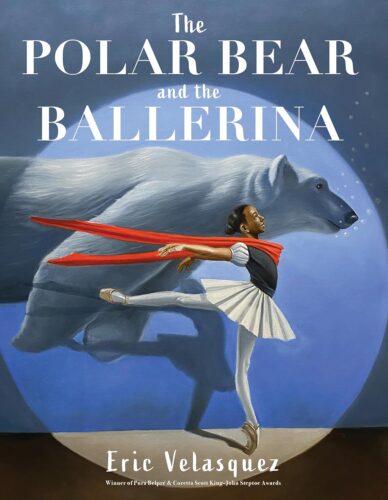
You know how the same puppeteer did voices for both Big Bird and Oscar the Grouch, and how Mr. Rogers was his usual placid self on his show, except for those wild and fiery moments when he got to do the puppet Lady Elaine Fairchild? That’s a weird way to talk about this book, but what I’m trying to get at is that we all need balance in our lives. We have to find ways to even out the sweet and the complicated. Take Eric Velasquez here. Last year he poured his heart, soul, and talents into bringing Carol Boston Weatherford’s deeply complex biography of Paul Robeson, Outspoken, to life. This year he’s gone from depicting electroshock therapy in a picture book format to a fun tale about a polar bear who wants to watch the ballet. See? It’s all about balance. The book itself is a wordless affair (his first?) and in the story a troupe of ballerinas visit a polar bear in the zoo. One girl in particular gets the bear’s attention, and when she leaves and drops her scarf, he dutifully picks it up and starts walking the streets of NYC. The book adheres to a kind of Bolivar trope of adults being too addicted to their cell phones to notice the polar bear walking in their midst (and, to be honest, even if they did notice, it’s New York, baby). Velasquez manages to work in a Ratso Rizzo moment (which I kind of appreciated), and humor as well (like the sign at the box office that reads “No Polar Bears Allowed!”). It’s an easy tale to follow, and I was intrigued by the fact that Velasquez chose to put a gatefold at the front of the book, rather than the back. Again, not something I’ve really seen done before. A fun, dancey title.
A Sound in the Night by María Coco

We’re really going to have to define our terms, one of these days. How wordless is “wordless”? How silent is “silent”? If a book has a single solitary word in it (a word that is used, in total, four times) can it still be wordless? And does it matter if the four words are continuous or are parceled out throughout the text? Whatever the case may be (and yes, this is the kind of conversation I would love to engage in over a nice white wine), I would like to state for the record that in spite of its four “CRACK”s, A Sound in the Night is a beautiful example of just how very nice a wordless book can be. It only has four colors in it (blue, yellow, pink, and orange) and Coco does wonderful things with them too. No one does the pure roundness of a scared eyeball better than she. Though she herself is originally from Mexico, the book is an American original and bound to be beloved by more than a few.

That’s it for today! Be sure to stay tuned for more lists on 2025 titles. The full roster is here:
December 1 – Great Board Books
December 2 – Picture Book Readalouds
December 3 – Simple Picture Book Texts
December 4 – Transcendent Holiday Children’s Books
December 5 – Rhyming Picture Books
December 6 – Funny Picture Books
December 7 – Caldenotts
December 8 – Wordless Picture Books
December 9 – Bilingual Books for Kids
December 10 – Math Books for Kids
December 11 – Books with a Message / Social Emotional Learning
December 12 – Easy Books
December 13 – Translated Children’s Books
December 14 – Fairy Tales / Folktales / Religious Tales
December 15 – Gross Books
December 16 – Poetry Books
December 17 – Unconventional Children’s Books
December 18 – Early Chapter Books
December 19 – Comics & Graphic Novels
December 20 – Older Funny Books
December 21 – Science Fiction Books
December 22 – Fantasy Books
December 23 – Informational Fiction
December 24 – American History
December 25 – Science & Nature Books
December 26 – Unique Biographies
December 27 – Blueberry Award Contenders (Celebrating the Environment)
December 28 – Nonfiction Picture Books
December 29 – Nonfiction Books for Older Readers
December 30 – Middle Grade Novels
December 31 – Picture Books
Filed under: 31 Days 31 Lists, Best Books, Best Books of 2025

About Betsy Bird
Betsy Bird is currently the Collection Development Manager of the Evanston Public Library system and a former Materials Specialist for New York Public Library. She has served on Newbery, written for Kirkus, and has done other lovely little things that she'd love to tell you about but that she's sure you'd find more interesting to hear of in person. Her opinions are her own and do not reflect those of EPL, SLJ, or any of the other acronyms you might be able to name. Follow her on BlueSky at: @fuse8.bsky.social
ADVERTISEMENT
ADVERTISEMENT
SLJ Blog Network
Over on the Yarn: Nancy Hugins and N. West Moss
Papercutz to Publish ‘Three Bee Honey’ | News and Preview
Bring on the JUNE Mock Newbery suggestions!
From Policy Ask to Public Voice: Five Layers of Writing to Advance School Library Policy
ADVERTISEMENT
Another book about a house being moved: https://holidayhouse.com/book/moving-day/. My students love this one.
Also, Eric Velasquez is, imo, very underrated. He should be better known.