
31 Days, 31 Lists: 2025 Books with a Message (Social & Emotional Learning)
Possibly the most difficult books to typify in a given year. What, exactly is a “message” book for kids? What typifies SEL (Social & Emotional Learning) titles? No idea. To be frank with you, when I encounter a book in a given year that defies description but has some wisdom to impart upon the child readership (and isn’t all didactic about it) onto this list it goes. The end result is a list containing some of the most empathetic, compassionate, altruistic books for children out there in a given year. I don’t know how I ever precisely come up with this list, but I’m always happy when I see the final product.
For the full PDF of this list you can find it here.
And if you’d like to see previous years’ message books, look no further than here:
2025 Books with a Message (Social and Emotional Learning)
FEATURED TITLE
Where Are You, Brontë? by Tomie dePaola, ill. Barbara McClintock


An ode to both the dog that brought him so much joy, and the man behind Strega Nona. At its heart, this is a posthumous remembrance of a beloved pet and an acknowledgment of how they never really go away. I sat on this one for a little while before adding it to any lists, but I think that what it’s doing is just so smart and accomplished and needed that it’s well worth considering. And yes. It’s a dead dog book. It is also, by extension, a dead Tomie dePaola book. May be all live such good lives as to be rendered in the style of Barbara McClintock when we pass away. Now the manuscript is by Tomie, but the art is Barbara’s and what she’s doing (which is so very clever) is melding her own style with Tomie’s style to create something wholly new. Now I’ve never been much into airedales as a dog breed, but maybe that’s just because I’ve never seen them as puppies. McClintock? She does puppies real real good. You might come close to actually wanting to own a dog of your own after reading this.
ADVERTISEMENT
ADVERTISEMENT
All the Hulk Feels by Dan Santat

I feel like we’re not talking about this book enough. And I get it. Dan illustrated what might be, conceivably, the best picture book of 2025 (Don’t Trust Fish, of course), and so all the attention got almost unduly weighted towards that remarkable title. I don’t begrudge Fish its due. The book is absolutely remarkable. However, there was a Santat solo effort out this year that really did something completely fun and different but that got a bit subsumed in the overwhelming tide of great picture books of 2025. Dan actually discussed this book on my husband’s podcast, The Marvel Reread Club, long before its publication, and I’m so glad he had or I might have missed it too. Essentially, Santat has written an almost epistolary picture book between The Hulk and Bruce Banner where, remarkably, The Hulk is the one with more emotional maturity. Think about those last few episodes of Severance: Season Two and you’ll get the gist. In the story, Bruce and Hulk leave each other messages (in crayon, naturally) in the pocket of their shared purple pants. While The Leader attempts to make them enemies to one another (and initially succeeds) the two eventually talk out their feelings and work out what’s worth anger, what isn’t, when it’s okay to feel mad, and a lot of other rather fascinating SEL topics. All this within the context of the Marvel universe. It’s a well-thought out story and undeniably the best Marvel picture book that’s ever been concocted. Just don’t get this book angry. You wouldn’t like it when it’s angry.
Big Kids by K.L. Going, ill. Reggie Brown

I think it took me a little while to realize this but I really really like the art style of Reggie Brown. He’s been around for a while but it was last year’s Bros (by Carole Boston Weatherford) that made me really appreciate the man’s upbeat, fun style. Now he’s back with this K.L. Going book and I am here for it! Here for it because the fears in this book are real, man. When you’re starting elementary school, those 5th graders on the playgroynd look like friggin’ giants. Now, I do believe I have discovered the perfect way for this book to be used with kids. You know how younger children are sometimes paired with older children as their reading buddies? Have the younger kids read this book WITH an older buddy! Actually, if a publisher were truly brilliant they’d write an entire line of younger/older reading buddy beginner books and market them to schools (it just makes good economic sense, people). But I get distracted. The point is that if an older kid were to read this story of a small kid paired with the nicest buddy of all time, maybe it’ll encourage real big buddies to be nicer to their littles. And I love how as the little guy in this book gets more and more comfortable with the big guy, their size difference starts to shrink. At the beginning, the Kindergartner is living in a world of giants. By the end, they’re back to normal sizes. This is one big sweet book.
For a Girl Becoming by Joy Harjo, ill. Adriana Garcia

My new baby niece was born this year and so, for my family, the timing of this particular book could not be better. In essence, the title is (as the publisher describes it) “a luminous benediction for a girl’s journey through life, and a celebration of our connections to the world around us.” Now as a general rule, reviewers and publishers alike overuse the word “luminous”. I myself am guilty of this, and I’ve been trying to scale back, but doggone it, sometimes it’s the best possible word to use! Some genius thought to pair Harjo’s book with the art of Adriana Garcia and that was a real smart move. No double you’ve seen Garcia’s work on books like Where Wonder Grows or Remembering. Here she brings to life lines like, “Girl, I wonder what you thought as you paused there in your spirit house / Before you entered into the breathing world to be with us.” Garcia’s art manages to combine the spiritual with the mundane. Great sweeping vistas of thought alongside everyday scenes in the living room where relatives gather (and grandpa is 100% falling asleep in his chair). If you want to give a new mother a picture book, please for the love of all that is holy avoid Love You Forever and consider this beauty instead. Trust me. You’ll be doing the world a favor.
Hilwa’s Gifts by Safa Suleiman, ill. Anait Semirdzhyan

I’m always a bit disappointed when I consider how few Palestinian picture books I include in my annual round-ups. It isn’t that they don’t exist, but there are so very few of them. So it’s a little funny that I’m putting this charmer on my “Message” list, since, aside from showing the importance of olives to Palestinian culture, there’s little else being shown. Yet in a year where Palestine has suffered even more devastation than before, a small book about olives and happiness feels like a work of rebellion in and of itself. The story focuses on Ali, who is visiting his family in Palestine and is baffled by why his Sitty is knocking the blue blazes out of an olive tree. Uncomfortable with the whacking, Ali opts to pick the olives by hand, but it’s slow work and he’s reassured that whacking the trees doesn’t hurt them (they’re too precious). From there we watch them placed in a press, and then there’s feasting and fun. Anait Semirdzhyan is a familiar illustrator, having done a variety of titles set in places like Aremenia or even here in the States. The end result is loving and informative by turns. Well worth a spot on your shelves.
How to Grow a Family Tree by Bea Birdsong, ill. Jasu Hu

The old Make-a-Family-Tree school assignment rears its ugly head yet again. Personally, I rather like those assignments, but I can understand how they can be problematic. Birdsong highlights one such problem in an interesting way. A girl in school realizes that while other kids have large extended families and are able to make their family trees quite extensive, she just lives with her Mama. When she ventures to ask something as simple as her grandmother’s name, her mom gets stiff and makes it very clear to the girl that the name is all that she’ll get. We never learn why Mama had a falling out with her own mother, but boy does it sound realistic to me. Even so, the girl realizes over the course of the tale that while she may not have an extensive family of blood relations, she does have a wide and extended found family. Happily, the teacher seems to accept this explanation (whew!). The story is good at laying out the situation, but it’s the art of Jasu Hu that elevates the piece to a great extent. Found families rejoice.
I Will Not Be Scared by Jean-Francois Senechal, ill. Simone Rea, translated by Nick Frost and Catherine Ostiguy

Sort of puts the lie to the cute-little-bunny expectations some might get from the cover. Then again, if you examine this cover closely enough, you’ll have to agree that there is an ominous air to it. The absolutely beautiful juxtaposition of that stark, burnt umber, factorylike building in the distance and that incredible sky… someone just do me a favor and frame me this book jacket when they get a chance, eh? The story is about fear, which is a pretty basic emotion for kids to grapple with. It might also be about trauma as well, considering the subject matter. A small bunny isn’t sleeping, and when his mama asks him why, he says he’s been thinking about their life from before. Turn the page and there’s a body on the ground, its head in a pool of blood. So, yeah. Not a book that originated in the States (it’s Canadian). The bunny talks about the things it saw. “Hurt people. Dead people”. All part of a war that is far away. But yesterday, in this supposedly safe place, he saw more than one act of bullying at school that brought it all back. At first he can’t even bring himself to tell his mother about it. Instead, he considers what being brave is. After a discussion of what bravery is, the little bunny vows to tell the principal what he’s seen. His mother assures him that this is very brave. But then you get this final image in the book. The bunny is now asleep but his mother, who has changed into what I think may be her own sleepwear, is wide awake. She perches on the edge of his bed looking up at the moon, which is mirrored in her eyes. The only words on the page are, “Tomorrow will soon be here.” This, for the record, is the book that you hand to people that claim that picture books these days are just unicorns and glitter. This is about being brave in a really practical, meaningful, and realistic way. It’ll also gut you. You’ve been warned.
Is It Asleep? by Olivier Tallec, translated by Antony Shugaar


Quick Answer: Mind you, 2025 hasn’t been a particularly good year for interesting bereavement tales. Usually we get our best books on the topic out of overseas publications (Yanks are just a mite bit squeamish about the whole discussing-death-with-a-child thing). This year, I was quite taken with the Norwegian short novella My Brother by Laura Djupvik, ill. Øyvind Torseter. This title is a bit on the younger side, though, and follows the critters we encountered in Tallec’s previous book A Better Best Friend (which still wins hands down for its superb cover illustration). A red squirrel and his friend Pock, a sentient mushroom with limbs, are quite fond of listening to a local blackbird. One day the bird isn’t around, and they search about, only to find it lying on the ground, eyes closed. Not wishing to be rude, they wait for it to wake. And wait. And wait. Eventually, the unavoidable conclusion they reach is that perhaps it is dead. Gunther the mouse has a reaction to this idea that I just found incredibly relatable. “Gunther says no, because anything that sings so well and has such beautiful feathers can’t die. It’s impossible.” As with all his books, Tallec’s title has a tone that soothes even as it approaches something as large and looming as the nature of death.This tone is well aided by the talents of translator Shugaar (who, regrettably, is not named on the cover of this book and therefore cannot win any kind of a Batchelder). Everything in this story is set during a kind of autumnal time period, which is a rather perfect complement to everything. The friends bury the bird under leaves with a pinecone on top, and there’s a lovely two-page spread of them walking alongside a river or stream silently. It doesn’t make any grand statements but just shows a loss and a way to cope and remember. Quietly keen.
Like That Eleanor: The Amazing Power of Being an Ally by Lee Wind, ill. Kelly Mangan

If you read the subtitle of this book and felt a twinge of worry, I hear you. Knowing as we all do how complex topics, like being an ally, can swerve hard into didacticism and, sometimes, downright misinformed writing, one might worry about the storytelling in this book. Will the concept of being an ally be done well or poorly? Well, the first thing that might give you a sense of relief is that the author of this book isn’t an unknown entity. It’s Lee Wind and the focus is on the reality of kids’ everyday lives and the moments they encounter where bravery is called for. The heroine is a girl named Eleanor by her dads, who sees things that are unfair sometimes. For example, some girls might be at the top of a climbing structure and might tell a boy coming up, “Excuuse you! This conversation is JUST FOR GIRLS” (which may be the most realistic sentence I’ve encountered in a picture book this year). So if you see something like that, what do you do? Eleanor Roosevelt’s work as an ally is referenced, even as our Eleanor witnesses well-intentioned teachers ignoring their non-binary students, telling them to separate into boys and girls. The coolest moment is, of course, when Eleanor Roosevelt once attended a segregated meeting and took a folding chair so that she could sit directly into the middle of the aisle. Our heroine replicates this movement when it comes to the whole boys and girls thing. It’s small. It’s brave. It’s said on a level that some kids will really understand. And it’s probably the best book on allyship I’ve seen in a picture book format to date.
The Littlest Drop by Sascha Alper by Jerry Pinkney and Brian Pinkney

The classic parable of the single hummingbird determined to save its nest from a roaring fire. This is a textbook case of a compassionate tale of group effort and individual bravery. This isn’t the first time I’ve seen this particular parable depicted on the page, but I think this telling is, at least, written far better than other versions out there. Brian Pinkney says in his Illustrator’s Note that this was truly the “last creation” of his father Jerry Pinkney. It’s a collaboration that looks far more Brian than Jerry to me, but I’m glad it was done at all. And perhaps I’m feeling a bit downtrodden over the state of American politics today, but I honestly think that this is a message that is valuable to convey to children right now in 2025. The Wangari Maathai connection just drills that home.
Mama Moon: A Story About Love and Mental Health by Noah Grigni

There are picture books that tackle difficult subject matter and there are picture books that tackle downright impossible subject matter. Which isn’t to say that this is the first picture book I’ve ever seen to discuss what happens when one of your parents has a mental illness, but it does show how far we’ve come since Daddy Is a Monster… Sometimes. This book deals more with severe depression and the hurt and betrayal a kid can feel when their parent is under its sway. Noah Grigni’s language here is so key. They have to strike just the right tone throughout, making the kid’s frustrations just as clear as the eventual message that sometimes your mama is going to wax and wane like the moon. Extra points for Mama’s incredibly authentic bedroom, cause that bra on the floor? It freakin’ spoke to me. I also thought that Baba’s role as the caretaker who has to hold down the fort for both Mama and their daughter was beautifully rendered. I dunno, there is a LOT of truth on these pages. Also, Mama’s not magically cured by the end of the book. It finishes on a happy note, but it makes it clear that this is something she has to live with. Great information on bipolar disorder at the end too and extra points for including the mental health emergency line and Crisis Text Line and NAMI HelpLine info in the Resources too.
Marcel with a Splash by Julia Sørensen, translated by Shelley Tanaka

A deeply loving story of a small child with Down syndrome. Coming to us from Switzerland, it’s the tone that sets this book apart. First off, it is dedicated, “To everything that grows in its own time.” It explains how Marcel was born with webbed toes and soon everyone learns that Marcel has Down syndrome. There’s a rather marvelous and very well simplified visualization of chromosomes that never quite makes it into the text, but makes sense all the same. It talks about the fact that it takes him longer to learn things, but the moment that really stood out to me was when Marcel meets Esther, who is a grown-up with Down syndrome. “She has a job, but what she loves most is dancing. And when she dances, everyone else wants to dance too.” And she helps Marcel’s parents understand as well. It’s a very different book from another than I’m fond of called Mallko and Dad by Gusti, but beautiful in its own way. For more on children’s books about Down syndrome you can read my piece from 2018, Down Syndrome and the Great Gaping (Longstanding) Children’s Book Gap.
Mixed Feelings by Liana Finck
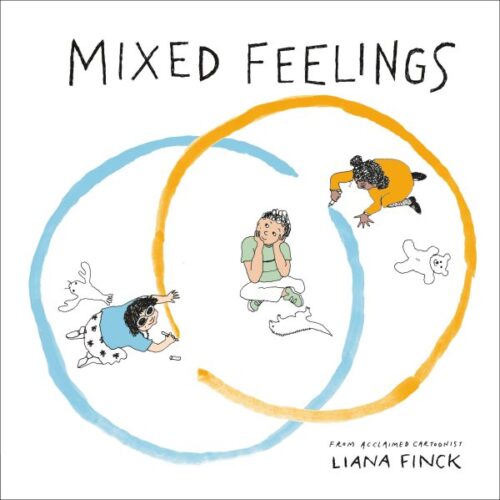

Finck’s interesting. She’s tapping into an old market with books that take new twists. You may have seen her previous picture book You Broke It! which sort of straddled the this-is-fun-for-kids and this-is-fun-for-adults molds. You may have also have seen her New Yorker comics. I think Mixed Feelings is a bit better suited for both kids and adults than its predecessor. As the name says, it’s about feeling more than one thing all at once. My favorite sequence, bar none, is the mad part where a kid in yellow crocs is kicking a chair feeling mad, “… and maybe also a little bit hungry.” Feel that, man. It could be cutesy. It isn’t. I think it pulls off what it’s trying to do.
Old Blue Is My Home by Lita Judge

A kind of companion to this year’s The Couch in the Yard by Kate Hoefler, illustrated by Dena Seiferling, at least in terms of not going about judging other people’s living situations. Lita Judge, author of MANY fine picture books to date, tells us in her Author’s Note that as a child “We lived a nomadic existence in Alaska, Nevada, Utah, Oregon, California, and Wisconsin.” As such, “the dependable home I knew was an old blue van.” In her story, we watch the car driving through urban and rural landscapes with Judge’s lovely watercolors. There’s a distinct coziness to the telling of just a girl, her parents, a sibling, a cat, and a dog in this home. I suspect more than one child might get a yearning akin to what we all felt for The Boxcar Children since it looks like fun way to live. Of course there’s a serious side to it as well, and the text explains that, “sometimes living in Old Blue makes me feel like I’m from everywhere and belong nowhere. Especially when I go to school.” An extra note appears at the end about housing insecurity and what that can look like. I’d say that this is a unique perspective, and not one I see all that often in picture books. The right kind of message told in the right kind of way.
A Place for Us by James A. Ransome
[Previously seen on the Wordless List]

While I am certain that there’s a children’s literary scholar out there somewhere who has already written a paper on the unhoused in picture books, I really hope it discussed how their representation has changed over the years. As far as I can determine, in the earliest day such books were mostly about encouraging empathy in kids for men (and pretty much just men) on the streets. Then in 2014 we saw the occasional book like A Shelter in Our Car by Monica Gunning, ill. Elaine Pedlar, where a mom and her child had to live in a car to be safe. That shift from empathizing with a grown adult to a kid like yourself is key. And what A Place for Us by James Ransome does is take that even a step further. The boy in this book lives with his mom on the streets, but during the day none of his friends at school have any clue. It joins the ranks of books like I Know How to Drawn an Owl by Hilary Horder Hippely, illustrated by Matt James, that are unafraid to discuss the subject openly. Ransome’s book, however, is wordless. As such, it may be necessary for an adult reading this book with a kid to explain what precisely is going on. Not that Ransome makes that hard at all. The boy and his mother spend much of their time in the local library, and then, when that closes, they find a park bench. Adults may notice more than kids the fact that as the boy sleeps the mom stands watch, not sleeping at all herself. The book is bound to spark discussions. And, as Ransome himself says so eloquently, “My hope is that this book sparks readers to ask: In a country of vast resources, what is our responsibility to those without access to the basic necessities?”
A Ring for a King: A Tale of King Solomon by Martha Seif Simpson, ill. D. Yael Bernhard

What does it mean that the stories of King Solomon are often my favorite stories? I’ve been trying to parse what it is about Solomon that I like so much. Maybe it has something to do with the fact that in our current political landscape, there is something inevitably alluring about a wise king who asks the advice of everyday people. I’ll have to ponder this further, but in the meantime a new Solomon book has hit our shelves (and I am HERE for it). In this story a kid named Ezra is just your average servant in the court of King Solomon. One day the king confesses to Ezra that, “I struggle to find the right words to make a sad person hopeful or a proud person humble.” Only when Ezra aids a stranger is he given the words that he can give to the king: gimel, zayin, and yud. Or, put another way, “Gam Zeh Ya’avor’ – This too shall pass.” I suspect this book and its message are going to find a LOT of use in the next few years…
Snow Kid by Jessie Sima

A snow kid starts out just fine, perfectly content to fulfill its snowmanly duties (by the way, if anyone wants to write a picture book now named “Snowmanly”, that’s a freebie). But when the snow kid (named Twig) finds that its hat has blown off, it has a sort of reverse Frosty moment and starts moving and grooving to go get it. As it does, it discovers all sorts of things, like how much fun it is to talk and move around. Interestingly, Twig goes through some introspective, even philosophical, moments where it tries to figure out the world around it as it walks about. It’s rather amazing how succinct Jessie Sima is with these sequences. In a scant number of pages Twig begins to question, “Am I Twig?” since the being known as “Twig” had never walked, talked, or grown like this evolving snowkid has. I mean, honestly, it’s kind of a Ship of Theseus consideration in a picture book form. As more happens, “The snow kid kept getting further and further from the Twig that was frozen and silent.” The happy ending here is discovering a tribe of other snow kids, all completely original and different from one another. By the end, Twig, changes to what Twig wants to be. “It felt like a good thing to be becoming.” I mean, it doesn’t take much of an effort to see this as an LGBTQIA+ title about finding your people alongside finding yourself. Rather elegantly and eloquently done, but all within the trappings of a cute little snowperson tale. Hand this to an Olaf-obsessive who wants a little something more out of their literature. And from the philosophical standpoint, it might actually pair rather beautifully with that snowman sequence in From Memen to Mori by Shinsuke Yoshitake too.
Some of Us: A Story of Citizenship and the United States by Rajani LaRocca, ill. Huy Voun Lee

It’s tricky, this one. Fair play to Rajani LaRocca for putting out a book on citizenship in 2025. With people getting kidnapped off our streets and deported left and right, regardless sometimes of their citizenship, this is a hard one to read through, in some ways. Still, we live in a country where this is supposed to be an achievable goal. And if we cannot have books that show the correct process, and to give kids hope that it’s attainable, then what do we even strive for? LaRocca makes the book exceedingly simple. The first lines in it are, “Some of us are born American. Some choose.” The book shows the importance of immigrants in our country and what they bring us. The book ends with “Some of us are born to it. Some of us choose. And we are all American.” I call this a “message” book because it seems that some of our leaders need to remember this message and stat. Extra points to Rajani for including in the back a page called “Beyond Citizenship: The Rights of All Peoples” in which she states, “all people – regardless of immigration status, country of residence, or country of birth – hold unimpeachable human rights, which have been outlined in the United Nations’ Universal Declaration of Human Rights.” She summarizes them. It is necessary. And heartbreaking.
A Song for Two Homes by Dr. Michael Datcher, ill. Charly Palmer


ADVERTISEMENT
ADVERTISEMENT
I saw that “Dr.” before the first name of the author and came to a screeching halt right there. Doctor of WHAT exactly? Because as many a librarian would agree, when psychologists attempt to write books for kids on topics like, oh say, divorce, it almost never goes well. Welp, turns out Dr. Datcher has a writing doctorate (whew!) and even if I hadn’t looked that up, it would have been evident anyway. The man can WRITE! Considering how common it is, divorce isn’t a topic we see rendered on the picture book page all that often, and when it is, it tends to be written by those well-meaning psychologists I mentioned earlier. Datcher’s different. First off, he’s not afraid to talk about all the problems that Auset’s going through. Reading this book, it’s cleverly laid out. You get the highs and lows, the rollercoaster rides that are your emotions when you’re young and experiencing something as huge as your parents’ divorce. Honestly, the book grabbed me right at the beginning when Auset tells the reader that she’s turned her stuffed dolphin into her therapist because, “he’s smart enough / To NOT start / Writing notes / When I start / To cry.” Foof! Hard truths abound in this book, and Charly Palmer with his thick paints gives the art just the right feel. Undeniably the best divorce picture book I’ve seen in years and years.
Together a Forest: Drawing Connections Between Nature’s Diversity and Our Own by Roz MacLean

Joy’s class is headed to the forest and everyone has to select one thing there for their assignment. Will Joy be able to discover the right one? A clever encapsulation of how systems (whether people or wild in nature) need each other to survive and thrive. What could come across as overly purposeful and awkward is instead done with a great deal of skill and smarts. It doesn’t hurt matters that the book is rather beautiful to look at as well. Each individual in Joy’s class is finding an individual element in the woods that they relate to. The pairings are neat to watch, but what really impressed me was what happened when Joy selects the orchid at the end. I had no idea that orchids can only thrive when fungi share nutrition with them. I’m not ashamed to admit it… this book has me tearing up just a little bit. A book that ties societal compassion to an ecosystem’s interdependence in a way that particularly works.
The Trickster Shadow by Mangeshig Pawis-Steckley


“Zoon was an ordinary boy with a peculiar problem.” That problem? A naughty shadow that constantly follows him and gets him into trouble. But how do you tame something that might actually be inside you? It’s been a day or two since Mangeshig Pawis-Steckley illustrated SHARICE’S BIG VOICE but I can still see the cover of that book clear as crystal when I think about it. And true, he’s done some other beautiful books since then but this is a particularly toothsome treat. The thick black lines and the representation of the shadow as an overexcited dog work so beautifully together. And the colors! I hate to whip this word out (because reviewers tend to overuse it) but “luminous” definitely comes to mind. I love what he’s doing with light and shadow (obviously) here. I thought the story was strong and a pretty nice metaphor for self-care,when you get right down to it. Hoping this will inspire Mangeshig to make more books along these lines in the future!
Wash Day Love by Tanisia Moore, ill. Raissa Figueroa

In the years following the death of George Floyd, We Need Diverse Books came to the fore and the children’s book world responded with a plethora of books celebrating Black voices and creators. A bunch of them discussed hair in particular, many of them picture books. We all have our favorites (Hair Love remains one of mine). Of course, there were a lot of them, and sometimes it could be difficult keeping them all apart. I’ve seen less Black hair books in the last two or three years, making me wonder if publishers have pulled away from the topic. Fortunately, those that make it through are often the most memorable. The thing about Wash Day Love is that it acknowledges something that a bunch of books don’t: some kids can be really creative about avoiding that day in question. “It’s wash day! My least favorite day.” Reading the book, I liked how it acknowledged that some kids just aren’t fans. It reminded me of that first Anna Hibiscus book where she refuses to get her hair done regularly with the family… and comes to severely regret it. The beauty of this particular book is how it recognizes and respects a kid’s reluctance while also managing to make it clear how important the day is in the end. It doesn’t hurt matters any that Raissa Figueroa is the one doing the art. There’s this incredible fluorescent pink image near the end of the book of all the family members walking down the street with their hair looking awesome that may indeed take your breath away. Gorgeous stuff.

That’s it for today! Be sure to stay tuned for more lists on 2025 titles. The full roster is here:
December 1 – Great Board Books
December 2 – Picture Book Readalouds
December 3 – Simple Picture Book Texts
December 4 – Transcendent Holiday Children’s Books
December 5 – Rhyming Picture Books
December 6 – Funny Picture Books
December 7 – Caldenotts
December 8 – Wordless Picture Books
December 9 – Bilingual Books for Kids
December 10 – Math Books for Kids
December 11 – Books with a Message / Social Emotional Learning
December 12 – Easy Books
December 13 – Translated Children’s Books
December 14 – Fairy Tales / Folktales / Religious Tales
December 15 – Gross Books
December 16 – Poetry Books
December 17 – Unconventional Children’s Books
December 18 – Early Chapter Books
December 19 – Comics & Graphic Novels
December 20 – Older Funny Books
December 21 – Science Fiction Books
December 22 – Fantasy Books
December 23 – Informational Fiction
December 24 – American History
December 25 – Science & Nature Books
December 26 – Unique Biographies
December 27 – Blueberry Award Contenders (Celebrating the Environment)
December 28 – Nonfiction Picture Books
December 29 – Nonfiction Books for Older Readers
December 30 – Middle Grade Novels
December 31 – Picture Books
Filed under: 31 Days 31 Lists, Best Books, Best Books of 2025
About Betsy Bird
Betsy Bird is currently the Collection Development Manager of the Evanston Public Library system and a former Materials Specialist for New York Public Library. She has served on Newbery, written for Kirkus, and has done other lovely little things that she'd love to tell you about but that she's sure you'd find more interesting to hear of in person. Her opinions are her own and do not reflect those of EPL, SLJ, or any of the other acronyms you might be able to name. Follow her on BlueSky at: @fuse8.bsky.social
ADVERTISEMENT
ADVERTISEMENT
SLJ Blog Network
And the Astrid Lindgren Memorial Award goes to . . .
Archie’s Movie Mania | Preview
From Policy Ask to Public Voice: Five Layers of Writing to Advance School Library Policy
Fast Five Interview: Melanie Dale
Dan Santat Talks Sashimi
ADVERTISEMENT
What a beautiful list of diverse and fascinating books! You make December extra special!
What a great list, Betsy! At the end of the year when we find so many of the same books on the “best of” lists (not that they aren’t deserving!) it’s fun to see a list with a lot of books I didn’t even hear about this year.
And there are just so many, right?
Liana Finck wrote a beautiful tribute to Steig in one of the yearend (and 100th Ann.) issues of The New Yorker
I saw it! Really beautifully done. But then, I loved everything in that New Yorker issue.