
31 Days, 31 Lists: 2025 Blueberry Award Contenders (Celebrating the Environment)
One of my more recent lists, but one I’m also inordinately fond of.
Started by Martha Meyer at Evanston Public Library, the Blueberry Awards are best described in this manner:
“The Blueberry List, which features books primarily for children ages three to ten, is divided into one overall winner and 34 additional Honor and Changemaker books. Changemaker books recognized for their outstanding achievement in rallying kids to climate action. The Evanston Public Library created the Blueberry Award in 2021 to fill a nationwide vacuum: no other children’s literature awards exclusively celebrate the best nature books that promote climate stewardship.”
So, essentially, you’ve an appreciation of nature, a rallying cry for climate action, and titles that promote climate stewardship. This list is created each year in March or so. As such, the books I’m listing today are just titles that I, personally, think would fit on this list. There is no indication that any of them at all will show up on that list (it’s pretty short, all things considered), but doggone, I like them. Here then are my own personal favs.
ADVERTISEMENT
ADVERTISEMENT
You can find a PDF of today’s list here.
And there’s one other list that you can look at that compares to this year’s. Enjoy!
2025 Blueberry Award Contenders
Picture Books (Fiction)
FEATURED TITLE
The Silver Shadow by Mariesa Dulak, ill. Alea Marley

When a girl finds a young shark stranded in a tide pool she’s initially delighted. However, she quickly realizes that if her brother Sam and his friends find it, they’ll most certainly catch it to sell. A tale of standing up for what is right. This one’s an interesting mixing and melding of a peer pressure/courage story and a tale of environmental concerns. Going into it, I was initially worried that they’d show the girl interacting directly with the shark, but not only does that not happen but there’s a nice note at the end saying what you should do if you find a large creature stranded in a tide pool. The digital art here is lovely, and though I found the older brother conceding to his younger sister’s wishes to be a bit unrealistic, that isn’t to say it couldn’t happen. Original, inspiring, and it certainly reflects the diversity of experiences and people in our world.
Across the Ice: How We Saved the Ojibwe Horse by Darcy Whitecrow and Heather M. O’Connor, ill. Natasha Donovan

When will they get here? Two children await the return of Ojibwe horses to their land, listening to their Nookomis as she recounts their near extinction and new life. One of those books you read and then, upon finishing, immediately makes you want to go out and find more information. I’d never heard of the Ojibwe horse. This does a nice rundown on the creatures, their history, and their connections to indigenous people. This also works better in this fictionalized form than I think it would have as a strict work of nonfiction. There’s a nice storytelling element at work that makes the fact that so much of this book is true all the more interesting.
Beansprout by Sarah Lynne Reul

There’s something deeply realistic about the situation that Sarah Lynne Reul highlights in this book. I have to wonder if this plotline actually happened to her or one of her kids. Essentially, the story follows a class of kids given a marvelous array of multicolored seeds from which to select. Each child will bury their seed in soil and see what kind of plant emerges. Cool idea, right? So what happens when you’re that kid with the seed that refuses to grow? Everyone else is oohing and aahing over their plants and our narrator is stuck staring at dirt for days on end. The “helpful” advice of the fellow classmates (“You probably didn’t take care of it right”) help not at all. All seems dour, until the kid realizes that his teacher plans on just tossing the rest of the seeds. Now he’s determined to plant them all, and it only takes a little ingenuity to get the job done. There’s some lovely backmatter on what a seed is, how it knows when to grow, and (best of all) “What can you do if a seed doesn’t grow?” I feel like this is a situation that happens to a lot of kids in school. Awfully nice of Reul to address it in this manner.
Electric Birds of Pothakudi by Karthika Naïr, ill. Joëlle Jolivet
[Previously Seen on the Informational Fiction List]

You know how sometimes, either in person or online, you’ll run into a person who holds up a copy of a picture book that’s 30+ years old and they’ll start to kvetch about how folks just don’t make longer picture books anymore? It’s all posturing, of course. Anyone who reads widely knows that such books certainly do exist, they just tend to come from smaller publishers. This gorgeous little import from France is a marvelous example. It’s also this incredible celebration of nature AND a fascinating mix of fact and fantasy. Let’s start at the beginning. In July of 2020 there was a 10-line report in an Indian newspaper about the village of Pothakudi and a boy named Karuppu Raja. In this village, electricity doesn’t run to every home, so it’s up to kids like Raja to turn on the switch at the switchboard that’ll turn on thirty-five of the village’s streetlamps. All well and good until the day that Raja found a vannathikuruvi (or magpie-robin) and its mate building a nest in the switchbox. If Raja pulled the electrical switch, the birds would lose their nest, and the mother was clearly about to lay. What proceeds to happen is that the village has the choice of either dwelling in darkness for weeks while the babies hatch and grow, or destroy the birds’ and their chances of nesting. Remarkably, the children made strong enough arguments to keep the birds’ nest intact, and it turned into a learning experience for the whole village. As someone who sometimes has peregrine falcons nest outside her work window, I could relate quite a bit to this tale. The art is, as one might expect from the great and good Joëlle Jolivet, extraordinary. But what makes it so interesting is the ending. This whole story has been framed as a mother telling a true story to her kid, but the kid wants a satisfying ending beyond then-everything-went-back-to-normal. The ending that Naïr chooses to add has all the satisfactory components of the best folktales. It’s beautiful and odd and a marvelous example of how we can take real world stories and weave them into informational fiction tales for our kids.
The Everything Trail by Meg Fleming, ill. Chuck Groenink

The whole point of the Blueberry Award that my library gives out every year is that it is meant to “inspire a love of nature”. A vague concept at its core. “Inspiring” anything is a tricky business. How do you go about inspiring anything these days? Especially when nature is under such attack? The thing is, I was talking to my co-worker about this book and she said to me, “It’s basically the quintessential book about inspiring a love of nature.” How right she is. By all rights, this book should be forgettable. It should sink into the morass of all the other a-tree-is-nice types of titles out there. Instead, Fleming’s words were expertly paired alongside Chuck Groenink’s art. And Chuck Groenink is a master at making a book enticing. In this case, you open the first page and you may notice that the trail the two kids are walking on curves upward. I can imagine an enterprising librarian, bookseller, or parent/guardian turning the book with a mighty swoop during a storytime to reveal that, for most of the read, you’ll be holding the book vertically. Why? All the better to accentuate the grandeur of the trees, my dear. When the kids in the book go through a tunnel, the book tips back. Considering the fact that the recurring phrase of the book is how “steeple”-like trees are, I’m a bit surprised they didn’t name this book “A Forest of Steeples” or something along those lines. Ah well. Marketing teams have a lot of sway. In any case, this is a beauty, subtle in its splendor, and not to be missed.
How to Draw a Tree by David LaRochelle, ill. Colleen Muske

You want an appreciation of nature? Well then you’ve GOT an appreciation of nature! The title is a teeny bit misleading because in many ways this story wants the potential artist to appreciate the tree they’re going to draw, long before they set pencil to paper. I liked the wide variety of kinds of trees (and the understanding that, depending on where you live, you’re going to see a very different kind of tree species) and the tactile sensations invoked. I could see a teacher doing a tree unit taking the kids out and following these instructions to the letter. Worth your peepers.
Living Bridges: The Hidden World of India’s Woven Trees by Sandhya Acharya, ill. Avani Dwivedi
[Previously Seen on the Informational Fiction List]

Imagine walking over a bridge and that bridge is alive! In the mountains of Meghalaya, India, one boy discovers the Jingkieng Jri bridge and learns how to protect it for the future. Information at the end provides a dive into these real bridges and how we can keep them safe. This one charmed me, in part because I’d never heard of the Jingkieng Jri bridge, and in part because I think Acharya and Dwivedi’s choice to make this a fictional story has a stronger emotional punch than if they’d set about to make it a strict work of nonfiction. The book does an excellent job of not just showing what the bridges are but also how to maintain them and the threats they pose. Do I think a bunch of Western tourists would get quite so into cleaning up after themselves if a kid modeled good behavior? That might be a touch optimistic, but for the most part Acharya’s choice to show a kid making a difference in a kid-centric way (while also solving the problem of passing this information on to the next generation) works. If you’d like to see a video of these bridges, the publicist sent me a link here. Pretty neat.
Mighty: The Story of an Oak Tree Ecosystem by Henry Cole

One little acorn, small enough to be plucked from a branch by a blue jay, turns into a massive oak, capable of sustaining countless generations of organisms. How? A beautiful rendering of the interconnectedness of trees. At a certain point you have to wonder if Henry Cole is just showing off for us now. Page after page of this book is so layered and highly detailed that you could spend hours poring over the images. There’s also a bit of a seek-and-find element to it, since sometimes you have to try and spot the growing seedling against the background of a busy forest floor. This book covers the lifespan of a tree, sure, but the tricky part comes in trying to work in the ecosystem as well. Remarkably, Cole is one of the few illustrators working today that can get away with doing entire books in black and white. I love, not simply the ways in which this one tree helps so many other species, but also how the passage of time is portrayed here. 2025 is a good year for ecosystems in books, it seems! Note: Be sure to look under the cover for an additional treat
My Dear Sea by André Carrilho, translated by the Bird of a Feather Agency
[Previously Seen on the Translation List]

How can one “respect the sea”? While it’s a wonderful playmate, it has to be understood and even kept clean if everyone’s to enjoy it. A delightful adventure with the waters we love. Not all that dissimilar from The Wide, Wide Sea by Anna Wilson, albeit without the generational component. This one is BEAUTIFUL. It’s a day at the beach where every rock and stone is rendered in gorgeous watercolors. The focus isn’t squarely on beach clean-up, but rather integrated eloquently into the text. This is a book that I could see a kid returning to over and over again, if only to try to feel like they’re in those waters themselves. Imaginative and gorgeous, you will LOVE the sea after reading this!
Nightsong by Sally Soweol Han

When a bus breaks down on its way to the city, a child passenger takes this as an opportunity to discover a wild world he might never have seen before. A textbook case of a kid discovering nature for themself. I know that my Blueberry committee sometimes prefers it when the kids in these books find nature in the city (city kids have access to nature too!), and this is a case where the kid travels to the country and only discovers it there, but I think there’s a lot to be said for this younger title. After all, the kid is discovering nighttime nature in a very un-scary way. The art is lovely and it appears to read aloud well. An excellent science-y bedtime tale.
Parks by Marc Majewski

What can a park be? A round-the-world glimpse into the incredible variety of parks and all that they entail. This could just as easily slot into the nonfiction as the fiction section. I’m including it in the fiction side of the equation, if only because, for all that the places on these pages are real, the text is ideal for younger readers and doesn’t try to impart any facts beyond a general love for the variety of parks. If the Blueberry is focused on instilling a love of nature and the natural world, this book’s ability to include such a wide range of different kinds of parks is very much aligned with that core mission. Majewski keeps the art bright, colorful, and broad. We’re always on the lookout for younger titles, and I’d say that this fits the bill. My personal favorite is “Parks are sunny” which gives us a glorious glimpse of the Death Valley National Park. Extra points for making these parks as international as they are.
A Pocket Full of Rocks by Kristin Mahoney, ill. E.B. Goodale

What can you do with a pocket full of rocks? Collecting tiny objects means collecting treasures for this child. An ode to the science of loving having your pockets full. We’ve seen a fair number of picture books talking about kids and their love o’ rocks. This book is no exception to the rule. Goodale does interesting things with integrating photography alongside their customary paints. Part of what I like about the book is that the kid collects a wide range of things. Rocks AND petals AND shells AND acorns in a kind of layered system (which could help explain to kids about the striations in rocks, right?). The text is rather strong to boot. I love the repetition of what the other people in your family might say to you when they learn of your pocket finds (with the implicit understanding that you can ignore them).
A Sky That Sings by Anita Sanchez and George Steele, ill. Emily Mendoza

Which senses do you use when you want to appreciate birds? How about your ears? Join Mia and her aunt as they do a little “bird-listening” in nature. Sometimes I feel like I give some books extra points when they could be terrible and aren’t terrible. Now I would have loved it if the authors had worked with someone blind on this project, so I almost wonder if this should be vetted with firsthand experience. From what I can tell it seems to be quite good. The book’s primary purpose is to make it clear that loving nature isn’t ableist. There are ways to appreciate birds beyond seeing them. The only note that rang false for me (no pun intended) is when Tía isn’t freaked out by the redwing blackbird’s call. Me? I’d run! It’s nice that it’s the adult in the book who’s ignorant, allowing the kid to be the teacher here. There’s a link to the website where you can hear these birds for yourself and also backmatter on each type of bird that appears in the book.
Together a Forest: Drawing Connections Between Nature’s Diversity and Our Own by Roz MacLean

Joy’s class is headed to the forest and everyone has to select one thing there for their assignment. Will Joy be able to discover the right find? A clever encapsulation of how systems (whether people or wild in nature) need each other to survive and thrive. What could come across as overly purposeful and awkward is instead done with a great deal of skill and smarts. It doesn’t hurt matters that the book is rather beautiful to look at as well. Each individual in Joy’s class is finding an individual element in the woods that they can personally relate to. The pairings are neat to watch, but what really impressed me was what happened when Joy selects the orchid at the end. I had no idea that orchids can only thrive when fungi share nutrition with them. I’m not ashamed to admit it… this book has me tearing up just a little bit. A book that ties societal compassion to an ecosystem’s interdependence in a way that particularly works.
Trouble Dog: From Shelter Dog to Conservation Hero by Carol A. Foote, ill. Larry Day
[Previously Seen on the Science and Nature List]


Tucker the dog doesn’t mean to be trouble, but he just has too much energy for families. What better way to put it to use than becoming a conservation dog! So sweet! This is a great example of a book that knows how to take a true story and turn it into a fictional picture book that’s friendly to kids and a darn good tale in and of itself. I love the idea of “bad” dogs with too much energy having ways to put that endless love of play to good use. Foote so cleverly works in all the invasive species and other things that Tucker is taught to find. And that backmatter! Heavens above is it cool! Even someone who isn’t an inveterate dog lover like myself can’t help but fall in love with this pup.
What Makes a Bird? by Megan Pomper, ill. Maia Hoekstra

How do you know if the animal before you is a bird? What makes birds birdlike? A sweetly philosophical (but also scientific!) consideration of birds, birdlike qualities, and what we value in animals. I’d read it early in the year and I think that on a first glance I didn’t quite get this book. But giving it a second look with Blueberry in mind, I came to the realization that it’s actually doing some really interesting stuff. I mean, in a way it’s both scientific and existential: What makes a species a member of that particular species? The book is less interested in getting right down to it, and more interested in the sheer variety of birds possible, but it’s still worth pondering. I bet teachers could have a lot of interesting discussions with their classes thanks to this book. It’s pretty neat.
The Wide, Wide Sea by Anna Wilson, ill. Jenny Løvlie

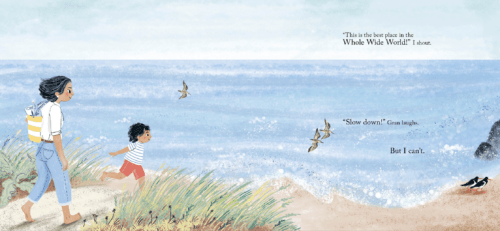
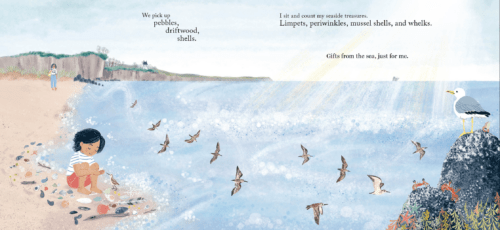

The beach may be “The Best Place in the Whole Wide World”, but will the trash that appears after a storm be a problem for a local seal? A sweet intergenerational tale of rectifying our mistakes and making the future a better place. It isn’t that we haven’t seen stories like this before. The whole idea of learning to love nature and to care for it under the guidance of a grandparent is fairly common. What lets this book stand apart a bit is the writing, which I thought nicely done. That and the fact that the art is rather lovely. It’s not a flashy book, and perhaps we’ll want a title that’s a little more original, but there’s a subtle understanding that not only should people come together to clean up their mistakes, but also that things can get better in the future (or so the kid in this story yells to the seal).
Worm Makes a Sandwich by Brianne Farley

This little worm has a proposition for you: It’s going to make you a sandwich. No, really! It will! A clever introduction to composting from beginning to delicious end. I appear to have a weakness for invertebrates with strong personalities. This is a pretty cute introduction into composting and how it connects food scraps to… well… food! Some composting picture books we’ve seen have had a hard time connecting the process to something practical that a kid can understand. The story attached to this book makes it a lot easier to comprehend when connecting the two. Plus, I was getting some major Cricket Magazine flashbacks with all those chatty little bugs on the margins. Some nice backmatter at the end rounds everything out. Kind of makes me want to buy a worm bin.
Picture Books (Nonfiction)
FEATURED TITLE
Just In Case: Saving Seeds in the Svalbard Global Seed Vault by Megan Clendenan, ill. Brittany Cicchese
[Previously Seen on the Science and Nature List]

This particular book falls into the category of “new information for adults as well as children”, much like that aforementioned A Gift of Dust title. Mind you, I’m always on the alert, remembering that if the information is more interesting to grown-ups than kids, it has failed the most essential test of being a children’s book. Happily, I don’t think that’s something we need to worry about with this title. Savalbard isn’t the only seed vault in the world (as the text is quick to point out) but it has unique features that make this rundown of its history and work interesting. I liked the little sidebars that pepper the book throughout, giving additional information if you want it. There’s an interesting question at hand as to whether or not this book increases climate anxiety (particularly since the last words in it are “Just in case”). I’d argue, however, that it’s the very opposite of anxious. It’s telling kids that there are grown-ups out there protecting seeds, making back-up plans, keeping us safe. Great backmatter too since there’s a small section included on what kids can do.
The Blue Jays That Grew a Forest by Lynn Street, ill. Anne Hunter

Blue jays, in my personal opinion, should be in more picture books. They were some of my favorite birds as a child, and this book brought back many fond memories of those loud little creatures. Lynn Street did a bit of original research to full bring the symbiotic relationship of blue jays and oak trees to life. The backmatter is cool (showing a variety of jays of the blue type) without being more interesting than the frontmatter. I do believe this is one of the nicer titles highlight the interconnectedness of nature.
Families of a Feather: A Celebration of Family Diversity by Fern Wexler, ill. Kelsey Buzzell

There are all kinds of different families in this world, and that goes for the birds in the trees as well! A cool look at everything from single mom hummingbirds to same-sex albatross parents. There’s always a bit of a danger of anthropomorphizing nature, seeing them through a specifically human lens, but after reading this book I don’t think that this is doing that, exactly. It’s a clever pairing of different types of families with different kinds of birds. Now I have a cousin who’s part of a polyamorous family (a kind of family that is never ever ever portrayed in children’s picture books) so imagine my surprise when I saw an acknowledgement of such families here. Subtle, but definitely there in the acorn woodpeckers section. Nice, but not terribly overwhelming backmatter, and I learned something about black swans and laysan albatrosses! Very cool!
Firefly Song: Lynn Frierson Faut and the Great Smoky Mountain Discovery by Colleen Paeff, ill. Ji-Hyuk Kim
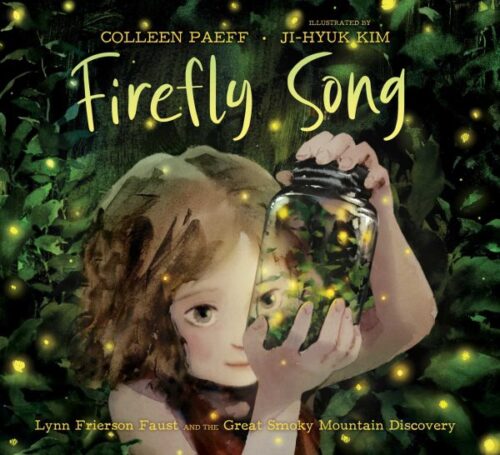
It is, perhaps, telling that when I started reading this book I was under the distinct impression that it was fictional. Then I got to page nine, after learning about how Lynn likes to play in nature and pay attention, and got to the sentence, “… she grows up, goes to college, and marries Edgar Faust…” In retrospect, the name “Lynn” should have tipped me off. No one names a children’s book character “Lynn” these days (oh, you know I’m right). I was really caught off-guard by this title. It bears a great deal of similarities to The Five Sides of Marjorie Rice (also out this year) since one book is about a citizen mathematician and one about a citizen scientist. In this case, it’s a wonderful deep dive into the life of a woman who cared so DEEPLY about fireflies that she was able to help prove that the synchronized variety really do exist in the States, flying in the face of general scientific understanding. I think what Paeff does so well here is that she makes it clear just how passionate Faust was about these bugs. And, of course, if a book about someone passionate is written well enough, it inspires you to be passionate about that same thing as well. Rather delightful.
The Girl Who Tested the Waters: Ellen Swallow, Environmental Scientist by Patricia Daniele, ill. Junyi Wu

In the 1800s, when some women had a hard time getting an education, Ellen Swallow was out there discovering the role of pollutants on the human body. An incredible scientist finally gets her own tale. The earliest parts of this book kind of reminded me of Fire in the Stars. As the narrative continued, I really enjoyed the book’s style. It cites all its quotations amply in the back, so we don’t have to worry about fake dialogue at any moment. There’s something so deeply satisfying about it. First off, the fact that a woman became a scientist in 1871 just kind of blows my mind right there. You’ll finish this book wondering why her name isn’t better known, that’s for sure.
Jellyfish Scientist: Maude Delap and Her Mesmerizing Medusas by Michelle Casulito, ill. Ellen Rooney

It’s 1899 and Maude Delap is embarking on a grand experiment: She’s going to try to keep a jellyfish alive through its whole life cycle while in captivity. Can it be done? Turns out, the end results are more fascinating than anyone might have suspected. I mean, I just didn’t expect the jellyfish to eat one another, let alone for Cusolito to recount the fact! See, this is the kind of nonfiction picture book I want to see more of. It’s exciting and interesting and strange all at once, yet never relies on fake dialogue or deep dives into what the subject thought without sourcing. And was I the only one who didn’t know about strobilization? I think I must have stared at these endpapers for hours, just trying to figure out precisely what it all means. Wonky doesn’t even begin to describe it. You know what this book is capable of doing? Turning all its readers into future jellyfish scientists, that’s what! A title that knows how to keep the fun of discovery intact, even as it relays the facts. Great writing. Great art. Great backmatter. This is the whole package.
Kaho’olawe: The True Story of an Island and Her People by Kamalani Hurley, ill. Harinani Orme
[Previously Seen on the American History List]

I’ll be the first to admit that the art used in this book is not a style that I, personally, gravitate towards. Fortunately, I’ve been in this business long enough to realize when my own biases have to be put aside when I read a new title. As it happens, this is a fascinating take on a Hawaiian island I previously knew nothing about. The story shows the full history of Kaho’olawe, letting the reader get to know her and love her before the American military bombs the bloody heck out of her. I liked that you had a bigger, younger text with bold statements in dark red (“Kaho’olawe is weary”) as well as small boxes of longer text for older readers. Great backmatter, a timeline (!!), a Glossary, info on how kids can help (very important and not said in such a way where it makes it sound like everything is up to them), additional Resources, and Selected References. Whew! Thorough!
Magic in a Drop of Water: How Ruth Patrick Taught the World About Water Pollution by Julie Winterbottom, ill. Susan Reagan
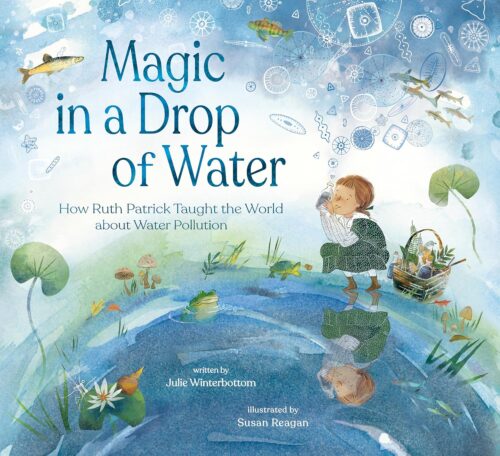
She was only five-years-old when she looked in a drop of water and saw a universe unfold. The fascinating tale of a scientist who preceded Ruth Carson, bringing attention to biodiversity and water pollution. This year we’re seeing a LOT of biographical picture books about women who had some kind of a connection to science. Within this morass, it can be difficult to pluck out the better titles. Now I’ll state right off the bat that the font of this book is tiny. In this day and age, that’s an unfortunate choice on the part of the publisher. That said, Winterbottom does a good job of placing Ruth within the context of her times without hammering home over and over the sexism of the era. Of course, even without going that route, you can’t help but be a little astonished at the sheer amount of things Ruth Patrick was able to accomplish in the course of her life. The book also talks as much about healthy waters and what you find in them in a really clear cut and straightforward way that I’ve never seen before. Add in the legitimately lovely watercolors of Susan Reagan and this book is just… cool. Two pages of backmatter pack everything in as neatly as possible without feeling skimpy. This is how you do it, people.
Meena and the Microbiome by Dr. Majdi Osman, ill. Teresa Martínez

Why is a compost pile like the inside of your stomach? When Meena and her mother go to work in the garden, the young girl is led on a fascinating voyage into the unseen world all around her. I think I might love this thanks to that shot of the microbes in your gut alone. You can win my love pretty easily with googly eyes, it seems. I had no idea that this was written by an actual scientist until a co-worker brought it up. What’s remarkable is that without a co-writer, Osman really knows how to break down (no pun intended) the information into terms that kids can completely understand. It’s a skillful linking between the microbes outside our body and inside our body. And, yes, I definitely learned a thing or two from this book along the way. I also like that the backmatter, while not excessive, is there and gets the job done.
Meet the Mini-Mammals: A Night at the Natural History Museum by Melissa Stewart, ill. Brian Lies
[Previously Seen on the Science and Nature List]

Here’s a question for you: What is the smallest mammal in the world? Let your ferret host take you on a deep dive into the contenders (all displayed at their ACTUAL SIZE!). Sort of reminds me of those old Steve Jenkins Actual Size books, but with a bit more verve and personality. First off, I was delighted to confirm earlier this year from Brian Lies himself that this cover image of the ferret holding back the curtain was, indeed, a direct nod to Charles Willson Peale’s, “The Artist in His Museum.” Thank you, freshman college year art classes! This is a book that expertly balances the cute with the interesting. Don’t be surprised if kids start asking how they could own a southern lesser galago as a pet. I love how it lays out the facts about each critter, just as they get smaller and smaller, and the backmatter is delightful, from the map of where each creature lives to additional facts about them on notebook carts. Finally, it involves a ferret wearing a jacket with leather patches on the elbows. How was I to know that this was what was missing in my life all this time?!?
Pine Cone Regrown: How One Species Thrives After Fire by Lisa Boxer, ill. Kevin & Kristen Howdeshell

Honestly, I thought that this book pretty much did everything right with its topic. You have the concept right from the get go (the effects of a wildfire on the environment), but it’s also written at a young enough level to read this aloud in a storytime. The fire itself is a nice combination of being both an understandable threat without being too scary (hence, how well it works with the younger grades). The art is lovely (though the animals do look like they were cast from the Jon Klassen School of Design) and I thought that altogether the book did this really successful job of showing how a forest repopulates itself with the help of these specific types of pinecones. Extra points for the backmatter that covers “Other Living Things That Require Fire to Thrive”, particularly since it included delicious morels.
Salmon Run: An Epic Journey to the Ocean and Back by Annie Chen
[Previously Seen on the Science and Nature List]


One could hardly say that this is the first book on the journey salmon take that’s out there for kids, but by gum it may be the most memorable I’ve seen to date. This is Annie Chen’s debut children’s book, but you’d really never know it from these pages. The colors practically vibrate off these pages in waves. Chen knows how to create these incredible pops of red and salmon pink in a sea of grays and purples and blues. What’s more, I guess I never really knew all that much about the different stages a salmon must go through to become fully grown. The book does such an amazing job of making you just gobsmacked that any of these little fishies manage to make it to adulthood too. There’s no bibliography in the book but they do have the Life Cycle, additional information on the coho salmon, and there’s a QR code that links you to the Glossary (again – would have liked a Bibliography in there too). All told, a rather gorgeous ode to a rather tasty fish.
Saving Hawai’i’s Honu by Leslie Ann Hayashi, ill. Kelly Pousette
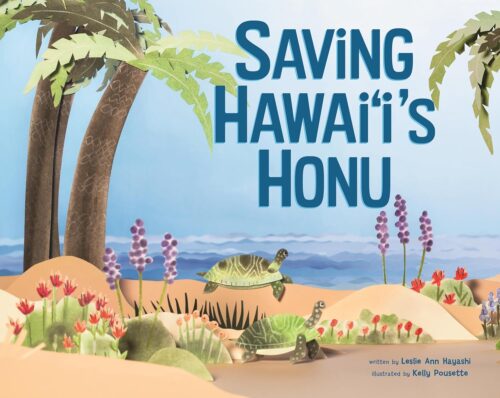
We see a fair number of picture books on the subject of animals threatened by extinction, but part of what I like so much about Hayashi and Pousette’s work here is how well they show just how easy that extinction is when humans aren’t paying attention. Sometimes it just takes a single, solitary guy to look about and say, “Hey! Where have all the turtles gone?” The cut paper illustrations of this book do a marvelous job keeping their center of focus near the reader, and Pousette shows movement impressively (particularly when our hero George Balazs gets attacked by seabirds). The story is about how George, way back in 1973, decided to count the nesting green turtles (or honu) of Hawai’i. When all was said and done, he realized that there were only 67 female turtles left. This book is about grassroots organizing at its very best, and there’s some beautiful photography in the backmatter that offers a timeline of a turtle lifespan. The “Turtle Etiquette” section on how you can help them is keen, though I would have loved at least one teeny-tiny list of Sources for further reading (or websites to visit!). Even so, cool book.
The Secret Life of a Sea Turtle by Maddalena Bearzi, ill. Alex Boersma
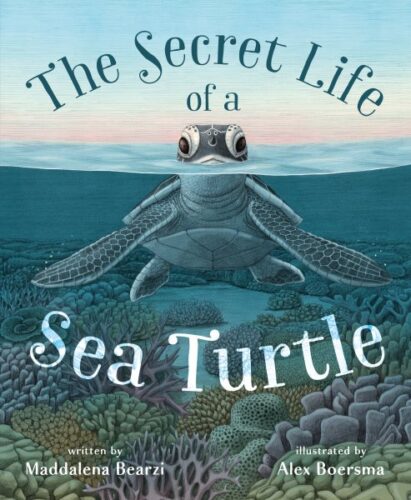
If you tap a scientific artist to do a picture book then you better be prepared for some definite accuracy. We’ve seen a number of sea turtle titles over the last few years, but this one stands out. That’s in large part due to the art, but the text is strong and doesn’t anthropomorphize. It’s also a little more “nature red in tooth and claw” considering how many baby turtles get eaten en route to maturation (so I’d argue this isn’t one for the squeamish). Now there’s a fair amount of text involved, true, but I’d argue that it’s not too overwhelming. I’d be interested in hearing some feedback on the “Five Actions You Can Take to Protect Sea Turtles” at the end.
Whales in the City by Nancy Castaldo, ill. Chuck Groenink

When the whales of New York Harbor were driven away by humans and pollution, no one expected them to return. A heartening tale of how group change for the better can make the world a better place. Unsurprisingly, I was reminded of The Day the River Caught Fire by Barry Wittenstein as I read this book. What’s so nice about it, though, is how Castaldo so effortlessly ties the appearance of the whales around New York City to the different types of pollution and change humans have engaged in over the last century. Best of all, this is a very hopeful book. It shows quite clearly how, when we work together, we can make large scale changes and even bring back populations that might have depleted or left (so maybe read this after The Lorax). The art is interesting as well, since Groenink is doing a looser style, making use of his gouache and graphite in interesting ways. The whales are almost anthropomorphized in the art but not quite, I’d argue. All told it’s a skillful, hopeful tale with some killer backmatter.
What Fish Are Saying: Strange Sounds in the Ocean by Kirsten Pendreigh, ill. Katie Melrose
[Previously Seen on the Rhyming List]

Clever. Teaching new facts to young readers with the aid of rhyme is a fascinating new trend in nonfiction picture books. And as for the subject, I suspect a large number of adults out there are unaware of the sheer variety of sounds fish are capable of producing under the sea. This feels like a book where the author honestly had more information than they knew what to do with and it took a Herculean effort to limit the text as much as they did. I’d argue that this is an excellent example of the front matter being just as interesting as the backmatter, and yet also something you could read aloud in a STEM storytime. The rhymes work, though they may take a bit of practice before reading to a group. “For underwater animals, sound is key. / Sound travels faster, and farther in the sea.” It definitely inspires wonder!
Middle Grade (Fiction)
FEATURED TITLE
Trouble with Heroes by Kate Messner

Living in the shadow of his firefighter dad (a 9/11 hero who died mysteriously during the pandemic) Finn must climb all 46 of the Adirondack mountains to make amends for an act of vandalism. Excellent poetry accompanies this powerful mix of humor and heartbreak. Strong is the word for it. One might even go so far as to say that this is Messner’s best middle grade to date. I’ve been reading a LOT of well-intentioned, likeable kids in book this year, so, for me, snarky Finn is like a breath of fresh air. You kick those gravestones over, Finn! Kick ‘em, I say! It was fun reading this and watching to see how Messner would redeem Finn, and the premise, while odd, actually works. She makes a big revelation at the end that felt too easy, but actually justifies a lot of what came before, so I went for it. If you get a chance, I HIGHLY recommend that you listen to the audiobook read by Mack Gordon. He manages to make his voice tremble at all the right moments so, yes. I got all teary. My sole true objection to the book? That dog on the cover is insufficiently gross and drooly. MORE DROOL NEEDED! Otherwise, no notes.
Into the Rapids by Ann Braden

All her life, Addy’s lived with her mom, without any outside help. But when heavy storms stand in the way of Addy getting to Survival Camp, she’ll put her skills to the test thanks, in part, to a new friend. This book has come up in online conversations of how many middle grades this year are focused on grief. But since Addy’s father died when she was young, it’s her mother’s grief that seems to be more of a focus. This is fast-paced, interesting, and blessedly short. Always nice to see a family integrate into a community (even when some of those community members act like spoiled children). My sole objection? I like to have a word with the Art Director on this cover. Addy is referred to constantly as stocky and strong, which pleased me greatly. This willowy wisp of a girl isn’t the Addy I want to see. Strong girls with muscles deserve covers too!
Norah’s Ark by Victoria Williamson

Knowing, as I did, that this book was an import from the UK (originally published there in 2023) I was curious to see whether or not this book jacket image was the same there as here. Turns out, yep. Same cover and everything. Thing is, I’m not really all that sure that this is a cover designed to appeal to American kids. It’s accurate (you can even make out the book’s cat) but considering how gripping the story inside is, I’d have advocated for a jacket with a little more pizzazz. I am pleased, though, that my co-workers were able to persuade me to read it. I live in an American where SNAP benefits were rescinded, so this tale of Norah and her father just barely getting by (and even then, it’s a close thing) within the social structure of the U.K. (which, as difficult as it is, is still a lot better than what we have here in the States) felt horrendously timely. The story is, as I say, about Norah and her father. Unhoused, they’ve been struggling for a while, her dad unable to hold down a variety of jobs and Norah getting teased by the other kids at school. When she finds a nest of abandoned baby birds, she protects and feeds them constantly. Then a boy she doesn’t know takes them to his tree fort. When the two kids meet, Norah discovers that Adam may have a family with money, but he’s miserable. A cancer survivor, his parents treat him like a delicate vase, and he’s never allowed friends, school, or even to return to the swimming he loved. Williamson’s title apparently won a “Big Issue Book of the Year” award, but it’s much more than that. These kids feel horrendously real, and their parents may try hard, but they are deeply flawed individuals. There’s a deeply satisfying and happy ending, I am pleased to report. A hugely empathetic work.
Supa Nova by Chanté Timothy
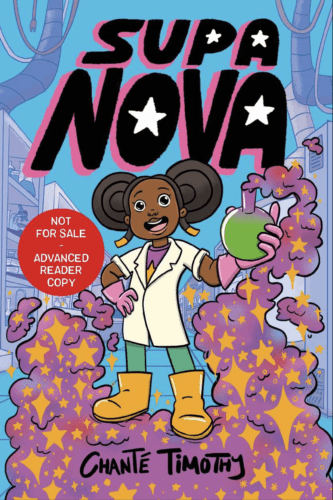


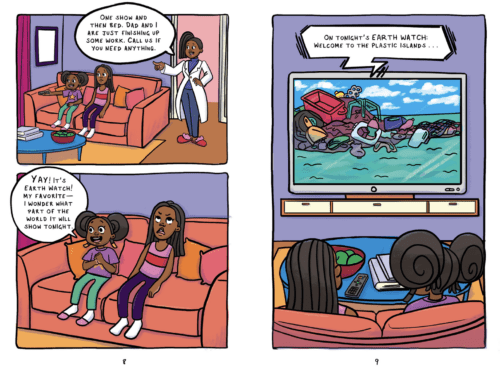
We’ve seen a lot of fun books for kids come up with innovative ways of tackling outsized environmental problems, but too few involve cute monsters. That problem ends now. Nova is her family’s resident scientist (much to the annoyance of her older sister). When she learns that the world’s plastic problem would require a genius solution she immediately deems herself that genius. The obvious solution? Create a small monster that eats plastic, of course! But when the little guy chews through his plastic container (even geniuses have their brain fart moments) and goes on a city-wide rampage, it’s up to Nova to reign in her creation herself. Brightly colored, fun, on the younger end of things, and with a tactile raised cover that’s almost as much fun to feel as to read, ya gotta love any book that includes info about the real science behind the story (which is to say, the microbes out there that eat plastic). Lots of books to sell this alongside, actually. The Snips (as seen on the Comics & Graphic Novel List) is a fellow graphic novel that ALSO involves taming a little creature that got too big and needs to be taken down to a manageable size.
Middle Grade (Nonfiction)
FEATURED TITLE
Bug Snacks: How Eating Insects Can Change the World by Jess French, ill. Zoë Ingram
[Previously Seen on the Science and Nature List]

While a book about eating nature isn’t necessarily the same thing as “appreciating” nature, since the entire gist of this text is to move us away from our reliance on meat, I’m happy to go for it. Personally, I’ve always been fascinated rather than icked out by the concept of eating insects. The recipe for cricket brownies is something I’m definitely going to try (I already have the cricket flour!). This book does a pretty good job of luring kids in with the aforementioned ick factor and then hitting them with serious facts in an amusingly designed package. It’s bright, colorful, fun to look at, and filled with information that will really get you curious about trying some of these delicious creepy crawlies yourself. If I have an objection, it’s to the fact that buying bugs online is actually kind of pricey. They don’t really touch on the economic aspects of all of this, but if we’re really going to make this kind of a cultural shift away from copious cows, then we need to make bugs cheaper than meat.
Detective Dogs: How Working Dogs Sniff Out Invasive Species by Alison Pearce Stevens
[Previously Seen on the Science and Nature List]

Ah! I love it when a cool idea trends. Seems to me this older nonfiction title is an absolutely perfect accompaniment to the aforementioned picture book Trouble Dog by Carol A. Foote. In both cases you learn about dogs that sniff out invasive species. However, what both authors realized is the truly interesting part of the story. Yes, dogs can do this, but only a particular kind of dog. Which is to say, the kind of dog that has way too much energy. That wants to play all day. That gets obsessed with a particular toy. That kind of dog is precisely the kind you want for this job. We follow a whole slew of them in this book as they sniff out mussels, bug eggs, and plants. It’s interesting to see how beautiful some of these invasive species are. Also interesting to hear how often these critters spread because humans just aren’t paying attention. I loved the compact size of the story, as well as the examples of cases where the dogs don’t always get it right. Definitely an eye-opening little title into the inner-workings of some pretty cool pups.
History Smashers: Earth Day and the Environment by Kate Messner, ill. Justin Greenwood

More Kate Messner! More, I say! Sometimes you just want a nice encapsulation in a single book of a single movement. In this case, Messner summarizes the environmental movement with deft aplomb. Reading it, one’s mind is rather blown by the sheer amount of information she had to comb through and choose from in order to write this book. Now the primary concern of the Blueberry Committee is whether or not a book engenders a kind of climate anxiety in kids. Messner’s book, honest-to-goodness, is the only title of its kind that I have ever seen that actually brings UP climate anxiety! In the meantime, she show strides made, steps taken backwards, and everything that has led to the current moment. One might wonder, logically, how this book feels in the contemporary era. After all, books take years to make, and with the current president rolling back so many initiatives (did he remove the solar panels that Obama put up in 2014 on the White House?) this book comes out in a dour time. Even so, it gives some hope, and is certainly the most interesting summary of how humans have tackled the question of what to do about our environmental selves that I’ve seen to date.
Seeds of Discovery: How Barbara McClintock Used Corn and Curiosity to Solve a Science Mystery and Win a Nobel Prize by Lori Alexander, ill. Rebecca Santo
[Previously Seen on the Science and Nature List]

From the minute she began working with genetics, Barbara McClintock was determined to unlock some of the mysteries surrounding genes. A high-spirited and fun explanation of her work and how genetics make us all who we are. I actually read this in Hoopla and found it just a lot of fun. Also, an interesting challenge for Alexander. This is a potentially complex topic with a lot of hurdles in the way of understanding. It’s teaching you all about genetics but through… corn. And corn is generally not considered very interesting. Still, Alexander somehow manages to put all kinds of moments of high emotion (speaking in public and not making yourself clear) as well as fun visuals to accompany the explanations. Will some of this fly high over readers’ heads? Indubitably. But the gist of it will get through, and that’s just really cool. Extra credit for including CRISPR in there near the end!

That’s it for today! Be sure to stay tuned for more lists on 2025 titles. The full roster is here:
December 1 – Great Board Books
December 2 – Picture Book Readalouds
December 3 – Simple Picture Book Texts
December 4 – Transcendent Holiday Children’s Books
December 5 – Rhyming Picture Books
December 6 – Funny Picture Books
December 7 – Caldenotts
December 8 – Wordless Picture Books
December 9 – Bilingual Books for Kids
December 10 – Math Books for Kids
December 11 – Books with a Message / Social Emotional Learning
December 12 – Easy Books
December 13 – Translated Children’s Books
December 14 – Fairy Tales / Folktales / Religious Tales
December 15 – Gross Books
December 16 – Poetry Books
December 17 – Unconventional Children’s Books
December 18 – Early Chapter Books
December 19 – Comics & Graphic Novels
December 20 – Older Funny Books
December 21 – Science Fiction Books
December 22 – Fantasy Books
December 23 – Informational Fiction
December 24 – American History
December 25 – Science & Nature Books
December 26 – Unique Biographies
December 27 – Blueberry Award Contenders (Celebrating the Environment)
December 28 – Nonfiction Picture Books
December 29 – Nonfiction Books for Older Readers
December 30 – Middle Grade Novels
December 31 – Picture Books
Filed under: 31 Days 31 Lists, Best Books, Best Books of 2025

About Betsy Bird
Betsy Bird is currently the Collection Development Manager of the Evanston Public Library system and a former Materials Specialist for New York Public Library. She has served on Newbery, written for Kirkus, and has done other lovely little things that she'd love to tell you about but that she's sure you'd find more interesting to hear of in person. Her opinions are her own and do not reflect those of EPL, SLJ, or any of the other acronyms you might be able to name. Follow her on BlueSky at: @fuse8.bsky.social
ADVERTISEMENT
ADVERTISEMENT
SLJ Blog Network
Over on the Yarn: Nancy Hugins and N. West Moss
Papercutz to Publish ‘Three Bee Honey’ | News and Preview
Bring on the JUNE Mock Newbery suggestions!
From Policy Ask to Public Voice: Five Layers of Writing to Advance School Library Policy
ADVERTISEMENT
I am amazed at how many of these were unfamiliar but so worthy of attention!