
31 Days, 31 Lists: 2025 Unique Biographies for Kids
All right, folks. Get ready. Today’s list is a big one. I always forget just how big until it’s there, standing before me. As I put down the books on this list, I was startled by the number of creators I’ve interviewed about these books (I link through the title whenever that happens). Apparently, I not only find biographies for kids to be fascinating, but I find the choices made by the books’ creators to be of equal interest. A biography is such a complex affair, and that’s true of titles for adults as well as children. The choices you make. What you include. What you excise. This year we saw an incredible number produced. Of that number, these are the books that I felt really stood out. If you’re looking for proof that we are in a Golden Age of Children’s Literature, look no further than this list.
If you’d like a PDF of today’s list, you can find one here.
Curious about previous years’ biography lists? Then check out what’s come before:
2025 Biographies for Kids
Picture Books
FEATURED TITLE
Gabba Gabba We Accept You: The Wondrous Tale of Joey Ramone by Jay Ruttenberg, ill. Lucinda Schreiber


That the awkward boy who loved rock n’ roll, and couldn’t fit in, turned into Joey Ramone, one of the fathers of punk, is a story worth telling. A beautiful and touching look at finding what you love and living it. By all rights this book shouldn’t work. It’s created in the Chicagoland area by a music publisher that doesn’t really know the book business. The author is a New Yorker writer who never wrote a nonfiction work for kids before. The artist, meanwhile, is a fine artist and (likewise) has never tried making a book with kids. And yet, and yet, and yet this book works amazingly well. And part of the reason I think it’s as successful as it is is in large part because it’s not simply an encapsulation of what made Joey Ramone a star, but it’s also an explanation of what “punk” was, and why it was important, written in a way that gets kids excited about it. This is something else. Check it out.
ADVERTISEMENT
ADVERTISEMENT
Alberto Salas Plays Paka Paka con la Papa by Sara Andrea Fajardo, ill. Juana Martinez-Neal


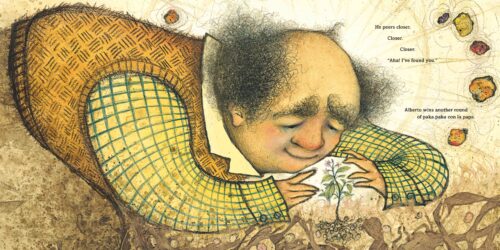
Agricultural scientist Alberto Salas is on the hunt… for potatoes. If he finds them, they could help to feed the world. If he misses them, they might go extinct! A glorious introduction to a little known science told with fun and whimsy. Ach. This is how you do it, people. You take a serious subject and you find the kid-friendly element in it that will make it alluring to them while sneakily teaching them something along the way. Turning the research work of Alberto Salas into a game of seek-and-find isn’t hard at all, and Fajardo really knows how to tap into the fun of it all, while also retaining the serious nature of Salas’s work. Martinez-Neal took a little break and is back better than ever, her art just leaping off the page. And then… there is the backmatter. The glorious glorious backmatter. This is everything that an informational picture book should strive to be. Bonus: Simultaneously available in a Spanish edition as well!
The Boy Who Became a Parrot: A Foolish Biography of Edward Lear, Who Invented Nonsense by Wolverton Hill, il. Laura Carlin


The benefit of being silly and having a fabulous imagination could be no better explained than in this charming retelling of the life of Edward Lear. Beautiful and fun! I think the publisher (and possibly the editor) of this book is on to me. When she sent me this book she included a tiny handwritten note that just said, “The mere facts of a life will never capture and contain the spirit of that life.” Translation: There’s a talking parrot in this book that has a whole conversation with Edward Lear and it’s awesome. So this may be the book that breaks me. You KNOW I’m a hardcore, anti-fake dialogue, stickler, but that’s all because I don’t like the idea of fooling kids into thinking a person actually said one thing or another in the course of their life. How am I supposed to handle a book that’s so blatant when something is untrue? There are flights of fancy here that are clearly not true to life, and are done in Lear’s style. Then there are a ton of facts and, though the backmatter could be better, they sure seem to be direct quotes from different sources. Why am I justifying this? Because the book’s delightful. I knew nothing about Lear, and his life was just as fascinating as one might expect. And there IS backmatter, but it shows his cool paintings made during this lifetime (the dude was GOOD!) more than anything else. I’m just… fond of this strange book. So I’m giving up and putting it here on a nonfiction list.
Dream a Dress, Dream a Poem: Dressmaker and Poet, Myra Viola Wilds by Nancy Johnson James, ill. Diana Ejaita

“What thoughts do you carry when idle with nothing to do?” A deeply beautiful telling of the life of a woman who lived two lives, creating all the while. The older I get, the pickier and pickier I get about my picture book bios. It’s going to get to be a problem someday, but for now I’m lucky enough to live in an era where you occasionally come across a book like Dream a Dress, Dream a Poem. Now I was probably already primed to like this because we saw Diana Ejaita’s art last year in that really cool but hard to categorize Kamau & ZuZu Find a Way (the one about the grandma and her grandson on the moon – remember?). But it’s the writing that’s the true lure here. Ms. James is clever to start the whole affair off with one of Myra Viola Wilds’s poems, but the text of the book itself is poetic in its own way. There are even callbacks to other Wilds poems, and the whole thing ends with another title, bookending the book. Not a fan of the font, but that’s a me problem, I suspect. Definitely worth discovering.
The Glass Pyramid: A Story of the Louvre Museum and Architect I.M. Pei by Jeanne Walker Harvey, ill. Khoa Le

Not the first Pei picture book we’ve seen but the first that focuses squarely on the construction of his work on the Louvre. It’s funny, but 2025 was a year when I was paying a lot more attention to how architects were portrayed in media. The film The Brutalist, for example, (out in 2024) was very much of the Genius Misunderstood type of take, which is a dangerous way to grapple with architecture as a field (think: Atlas Shrugged). So the challenge of Jeanne Walker Harvey here was to portray I.M. Pei not as a stubborn man fighting a corrupt system, but simply of someone placed in a difficult position (an “outsider” to the French working on their beloved Louvre) who has to stick to their guns on their vision while also working to persuade people to see things his way. But gently. At one point Harvey writes, “So, during difficult newspaper and TV interviews, he focuses his energy on the Confucian teachings his grandfather taught him. Never show anger. Express oneself calmly and clearly. Be patient.” Lessons I’d love to see utilized a lot more in discussions these days. The art of Khoa Le adapts perfectly, never shying away from the more geometrical structures at work. But, being me, my favorite part is undeniably when the Pei introduces a model of his pyramid to the French for the first time. “A cheap-looking tacky diamond!” Great writing.
Go Tell It: How James Baldwin Became a Writer by Quartez Harris, ill. Gordon C. James


“The first time James Baldwin read a book, the words clung to him like glitter.” The early life of one of America’s greatest writers comes to vibrant life in this incredible peek into his earliest inspirations. This is one of those cases where you read a picture book biography from a first-time children’s author and can’t help but say, “This guy has never written a book for kids before?!? Seriously???” Quartez Harris has a natural feel for the form, that’s for sure. Here we have yet another example of just the right text being paired with just the right illustrator. Like a lot of artists, Gordon C. James is at his best when he has a text worthy of his art. Not since Crown: Ode to a Fresh Cut have I been so delighted by one of his books. This isn’t the first picture book bio of Baldwin, but it’s the one that’s gonna live rent-free in my head for a long long time. Incredible writing, gorgeous art, and a book worthy of its subject.
Harriet Tubman: Force of Nature, a Biography in Poems by Caroline Brewer

To my mind, if life were fair, we’d have constant Harriet Tubman biographies flying at us from all sides. We’d have twenty movies about her life to choose between (so say nothing of the series on TV). What are my own personal children’s book favorites? That would be The Underground Abductor by Nathan Hale, and maybe Before She Was Harriet by Lesa Cline-Ransome. This year the Tubman bio of note is one written entirely in poems and illustrated with what appears to be a cut paper and mixed-media style. It covers the accident of the iron weight that hit her in the skull when she was young, and the visions that came after. It shows how she first escaped and then her subsequent rescues, though it didn’t give quite as much time to that aspect as I would have thought. It does, I was relieved to see, focus quite a bit on her spying during the Civil War. And then you get this glorious collection of backmatter at the end. A Glossary, A Note on the Illustrations, a rather impressive Map of significant areas, Historical Photos (I wish MORE historical children’s books included something like this), Source Notes, a Selected Bibliography, AND an Index! Whew! Impressive work.
Imogen: The Life and Work of Imogen Cunningham by Elizabeth Partridge, ill. Yuko Shimizu

Born in 1883 as one of ten kids, Imogen spent so much of her time trying to find just the right art. When it turned out to be photography, her fame was sure to follow. A loving encapsulation of a life. By gum, they sure do like to release books illustrated by Yuko Simizu near the end of the year, don’t they? Imogen is such a lovely example of how you can take a subject that most would treat with a bland encapsulation of facts and turn it into a story about someone you learn to care about in a scant number of pages. Imogen Cunningham may be Elizabeth Partridge’s grandmother (a fact that still blows my mind, since I was a photography major in college and knew the woman’s work well) but there’s nothing cloying or rote about this writing. The Imogen in this book is passionate about finding precisely the kind of art that suited her best. You just walk away adoring her (and wanting to see more and more of her work). As for Yuko Shimizu, there’s a reason that woman won a Caldecott Honor recently. This is a fireball of a book.
Jim! Six True Stories About One Great Artist: James Marshall by Jerrold Connors

This gentle and delightful paean to picture book creator James Marshall plucks stories from his life and tells them entirely in his style. Clever and touching all at once. Considering the sheer amount of difficulty inherent in writing picture book biographies and not making them all samey-samey, I have nothing but praise for Jerrold Connors’s methodology here. First off, picture book bios of picture book creators are almost impossible to write. The reason is simply because while the librarians and teachers might care about that person, kids won’t necessarily. Connors had the clever notion to be inspired by, but not try to replicate, Marshall’s style. The format of the book, however, is set up very much like a George and Martha book, with small stories written with simple words. Including cameos from famous people (Maurice Sendak and Arnold Lobel), the stories read like true vignettes of a life, capturing the heart of who James was without sacrificing kid-friendly interest. So it’s a delicate balancing act in the end, but one that, remarkably, works. A book that took a big swing and got away with it!
Joan Mitchell Paints a Symphony by Lisa Rogers, ill. Stacy Innerst

Truth be told, I usually do these little write ups when I’m working the Reader’s Advisory Desk at my library for two hours every week. One day I had these book on a cart next to me when a woman came up and asked for an adult collection of Joan Mitchell’s artworks. While we didn’t have the specific book she wanted on hand, I had the unique pleasure of showing her a copy of this unique Biography-ish title. I call it “Biography-ish” since it’s not really a bio in the classic sense of the term. We’re not looking at baby Joan at any point. We’re not seeing old Joan. We’re just meeting the rather deadpan Joan creating a piece from start to finish. In that way, this is less a biography than it is a study of a moment in a single human’s history. It is also, in many ways, the kind of book that one suspects Joan herself might have approved of. Innerst isn’t interested in doing anything but rendering an artist at work in the purest sense on the page. Joan is black and white and almost sketchy. Her art is where the book’s color comes from. Best of all, the book explains why a person might like her art. As the book ends it says, “In Joan’s La Grande Vallée, you cannot glimpse butterflies, hear frogs’ splish and squeak, or sense warm sunbeams on your skin. But as you explore her great, grand valley, you might imagine that you can.” Love that “great, grand valley” there. This is a class act. Beautiful backmatter as well (a Timeline!!).
Lady of the Lines: How Maria Reiche Saved the Nazca Lines by Sweeping the Desert by Michaela MacColl, ill. Elisa Chavarri

Armed with a broom, Maria Reiche not only revealed the Nazca Lines in the desert but saved them numerous times. The tale of a one-woman-powerhouse who gave her all for the preservation of the past. Just the facts, ma’am. I like a good picture book bio that doesn’t spend an inordinate amount of time trying to figure out WHY its subject made the choices that they did. Maria Reiche is a nicely grumpy protagonist. She’s got some real Get Off My Lawn vibes going on in this book and I am here for them! Aside from definitely being the BEST Nazca Lines children’s picture book I’ve ever seen, it gives them context while still preserving their mystery. The backmatter is great, but the front matter is what slowly sucked me in. Initially, I wasn’t entirely on board with the writing, but as it went on I really began to appreciate the ways in which MacColl chose to dole out the information. Maria just hits roadblock after roadblock in her mission and by the end you’re just stunned that the Lines haven’t been utterly destroyed at this point. And that backmatter? A thing of beauty to behold.
Let’s Fly! Barrington Irving’s Record-Breaking Flight Around the World by Barrington Irving and Chana Stiefel, ill. Shamar Knight-Justice

In 2007, Barrington Irving took off to fly solo around the world. It didn’t come out of nowhere either. Since he’d earned his first pilot’s license at the age of nineteen, he’d always been in the sky. This book is one of those rare picture book autobiographies we sometimes see (and it hits all the right marks) where the hero who rises above the odds to break world records. Excitement. Disappointment. And you know what it has in the backmatter? Facts facts facts! Timelines, direct quotes, a Bibliography, and additional information! And for the record, the writing is really good (thanks in large part to Chana Stiefel). Let’s face it. Sometimes kids want to read books about people who are young, alive, and awesome. This fits the bill.
A Line Can Go Anywhere: The Brilliant, Resilient Life of Artist Ruth Asawa

From barbed wire to wire sculpture, the life of artist Ruth Asawa is told with clear-eyed clarity. A beautiful focus on her life, her art, and the meaning behind her work. Not the first Ruth Asawa picture book bio I’ve seen, but probably the first to make the insightful connection between different stages of her life and the art she would go on to become famous for. The book is constantly bringing up interesting details about Ruth’s life (did you know that when she was in a Japanese internment camp she was taught art by the Disney artists Tom Okamoto, Chris Ishii, and James Tanaka?). But the most impressive detail, both in the text and in the art, is that push and pull between, not just the lines of her earliest home, but of the barbed wire of the internment camps. The fact that she would go on to twist wire, specifically, into beautiful things is a link (forgive me) that some kids will pick up on right away. For the record, the art of Jamie Green is on fire here. Definitely a gorgeous book in both writing and illustration together.
Make a Pretty Sound: A Story of Ella Jenkins-The First Lady of Children’s Music by Traci N. Todd, ill. Eleanor Davis

Learn about what inspired legendary Chicago-based children’s musician Ella Jenkins to perform such terrific music. Lively, energetic prose teams up with dynamic, colorful art. So I adore the art of Eleanor Davis to begin with, and paired with Traci N. Todd’s standout writing, that’s just about a perfect duo. Even for those unfamiliar with the work of Jenkins, Todd does a standout job of getting readers to appreciate her as a person first and a force of nature second. I had to go back and remember WHY I loved Eleanor Davis so much, and then I realized that I’ve been reading her books since she did Stinky with Toon Books way back in 2008 (and her Secret Science Alliance should be reprinted and STAT). In any case, this is a textbook case of how everyone should write their picture book bios.
Make Your Mark: The Empowering True Story of the First Known Black Female Tattoo Artist by Jacci Gresham with Sherry Fellores, ill. David Wilkerson
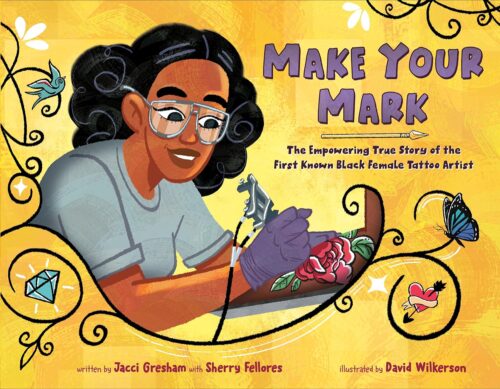
A good use of the term “first known” in that subtitle there. If you’ve kids wandering into your classroom/library/bookstore in search of picture book autobiographies, this story of Jacci Gresham is precisely what the doctor ordered. Tattoos make periodic appearances in picture books, but almost always on the fictional side. They tend to be about teachers or parents with tats. The idea of celebrating a woman who blazed a wholly original trail entirely of her own in a field that gets almost no discussion, is extraordinary! Best of all, the book considers not just Jacci and her work, but also thoughtful considerations of how tattoos on darker skin need knowledge and understanding of the best possible pigments to work. It’s a cool story rendered cleverly on the page, and the art of David Wilkerson really brings it to life. We need more bios out there like this, please!
Mariam’s Dream: The Story of Mariam Al-Shaar and Her Food Truck of Hope by Leila Boukarim, ill. Sona Avedikian

We’ve seen a couple food truck titles in picture book form for kids before, but I think it’s fair to say that Mariam’s story stands out. One does not usually think of food trucks as coming via refugee camps. To be frank, I didn’t know that a person could even start a food truck business within a camp as a refugee. Boukarim manages to synthesize Mariam’s certainly complex story into a remarkably simple text. And, to be frank, it is a straightforward story. Mariam was born in the Bourj Al-Barajneh refugee camp in Beirut, Lebanon. “She is Palestinian but may never go to Palestine. Mariam is the daughter of refugees – people who live between worlds.” After forming a group with other women to cook, she dreamed of creating a food truck. Of course, that sort of thing requires money, a driver’s license, and the right papers. After being told that her truck couldn’t travel outside the camp, she fights for two years and gets the right paperwork. This is the part of the story that sort of glosses over how precisely that happened, and unfortunately the backmatter doesn’t shed any additional light on the matter. It does, however, offer an Author’s Note on Mariam, a Food Glossary (a yummy yummy Food Glossary, I should say), further information on Refugees and Refugee Camps, and a Selected Bibliography. Pair this alongside your Chef Roy Choi picture book for a delightful compare and contrast.
Monster Maker: The Strange Creatures of Mark Nagata by Debbi Michiko Florence, ill. Inko Ai Takita

YES!!! Thank you! We have GOT to break ourselves out of boring picture book bios. There’s no reason they should even exist. If you’re going to write about someone and their life, then it is your obligation and duty to do everything you can to make that person interesting to a child reader (while, let’s be clear, avoiding slipping into fiction and fake dialogue). Debbi Michiko Florence gets it. Granted, I can hear you pointing out that the life of a friggin’ toymaker should be inherently interesting to kids anyway. I counter with informing you that it doesn’t matter the subject. Bad writing, design, and illustration can make anyone dull. Fortunately, everyone associated with Monster Maker clearly understood the assignment. I mean, just look at that cover. Now, if you have a copy (and it isn’t a library copy), take off the cover and let the eye-popping colors of the conglomeration of toys there blow you away (and if you feel inclined to frame it, I wouldn’t hold it against you). Mark Nagata grew up in California and one Christmas he got some toys from Japan. Only these weren’t He-Man or G.I. Joe or anything. These action figures were different and cool. Immediately he got obsessed with Japanese kaiju, eventually turning that love into art. But as an adult, he couldn’t help but collect those toys he’d loved, and so many more besides. When jobs for his art dried up thanks to digital art, he decided to start his own toy company making kaiju toys in the States. The book includes copious photographs of the actual toys alongside the cartoonish art of Inko Ai Takita and the juxtaposition works so well. More of this publishers, please!
The Prince of Stars: Ulugh Beg’s Quest to Map the Stars and Seasons by M.O. Yuksel, ill. Zelma Firdauzia
[Previously Seen on the Science and Nature List]
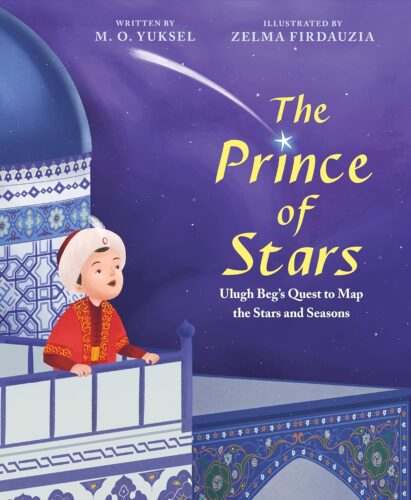
Often we are told that the Islamic world made scientific discoveries long before the Western world, but it helps to have some children’s titles on hand to make these statements feel more comprehensible. And few things are more comprehensible than a good picture book biography. Not only had I not heard of Ulugh Beg/Muhammad Taraghay bin Shahrukh and his works, I hadn’t even heard of the Timurid Empire. The backmatter tells us that Ulugh Beg was born in Sultaniyeh, a city in what is now Iran. What’s so cool about the book is how it not only lays out his own life, but his discoveries as well. And boy, was it a lot. Everything from the fact that there are 365 days in a year to the reasons for the seasons changing. And all this in the 14th-15th century! Great backmatter as well. If one were to collect all the children’s books published in America in 2025 that contained Iranian history (like Daniel Nyeri’s The Teacher in Nomad Land, which is a WWII Iranian-set middle grade novel) you could have a VERY interesting list. In any case, don’t be missing this one.
The Spider Lady: Nan Songer and Her Arachnid WWII Army by Penny Parker Klostermann, ill. Anne Lambelet

Sometimes doing what you love can help win a war. Nan Songer adored spiders. Watch how she coaxed out their secrets to aid the Allies in WWII. After reading a particular egregiously bad picture biography (that shall remain nameless), this one came like a vast relief. First off, it’s incredibly cool that Klostermann did all her own original research to bring us the story of Nan. It reminds me of the work Chris Barton did years ago on Day-Glo Brothers. Then there’s the fact that the book is laid out in a really interesting way. Sure, you learn a bit about Nan and her life, but the real key here is how scientific, curious, and systematic she was about gathering spider silk. It’s downright fascinating as a science, and there’s even a little natural tension, like when she realizes that the black widow spiders give the best silk. Klostermann walks you through this story expertly, and it does that clever thing where direct quotes (nicely sourced at the end) appear throughout the text for spice. Would pair swimmingly with the aforementioned book about the other fiercely focused woman from around that time, Lady of the Lines.
The Spy in the Museum: How Rose Valland Saved Art from the Nazis by Erin McGuire

A rather good pairing alongside fellow WWII picture book bio The World Entire (seen below) about Aristides de Sousa Mendes, actually. Surprisingly this is Erin McGuire’s first book for kids, and she’s chosen to come out of the gate swinging and swinging hard. We would have also accepted an alternate title “Beware the Quiet Ones” since that’s the lesson one could definitely take from this title. There are advantages to being small, female, mousey, and unassuming. Rose Vallard worked in Paris as curator of the Jeu de Paum Museum in Paris. When the Nazis invaded they allowed her to stay on at the museum as they transported all their stolen art into the space. She spoke German and seemed harmless enough. What they didn’t realize was that she was keeping meticulous notes on all the art that came through the space. Very much at risk to her own life, she kept finding ways to get back into the museum. Eventually she even sent word to the French Resistance to stop a train filled with 148 crates of paintings from leaving the city. It would have been cool to learn in the text itself how Rose recorded the locations of twenty thousand words of art, but at least it’s mentioned in the backmatter (along with a nice piece of art showing her receiving the Legion of Honour for her service). McGuire’s art is graphite, mixed media, and painted digitally and just glows on the page. Very much looking forward to more books by her in the future now.
The World Entire: A True Story of an Extraordinary World War II Rescue by Elizabeth Brown, ill. Melissa Castrilló

2025 was hard on my town of Evanston. We had a lot of ICE invasions, and naturally this brought up thoughts of the Gestapo and the entire history of terrorizing of innocent people. One would wish that a book like The World Entire, with its thoughts on the bravery of average people wouldn’t feel quite so timely, but you can’t pick your era to live through, I suppose. I never heard of the story of Aristides de Sousa Mendes, and I found it very interesting to pair his story by Elizabeth Brown alongside the art of Melissa Castrillón specifically. Why? Because it’s preternaturally beautiful art, that’s why. Castrillón utilizes a pencil and digitally colored style unlike anyone else I’ve seen. It places Aristides’s early days in a halcyon pink and green golden glow. When things turn bad, those colors are still there, but look at how the artist reduces them. The world is dark and grayish blue, but the people retain their bits of color here and there. Aristides himself is portrayed in yellow, and his story is interesting. Against the wishes of his superior, he signed as many visas as possible to get refugees out of Portugal in order to escape the Nazis. And the picture book text itself doesn’t pussyfoot around what happened as a result. “He lost his home. His children were not permitted to go to university or work in Portugal. Now, his family went to soup kitchen for their supper.” But the book makes it clear that “it may have been the greatest individual act of rescue in all of World War II.” Plus the backmatter makes it clear that he was honored in his lifetime for his heroism (though the Portuguese Parliament only promoted him posthumously to the rank of Ambassador). A good book on a good man.
Biographies for Older Readers
FEATURED TITLE
Malcolm Lives! by Ibram X. Kendi

History comes to vibrant life in this eclectic and incredible biography. The past and the present mix and meld in a beautiful encapsulation of his days. It’s been a decade or two since I read The Autobiography of Malcolm X, but I could remember enough to really appreciate what Kendi does here. He’s continually drawing ties between events in Malcolm’s life and what’s going on in America today. This has SO much context, and done in an incredibly appealing way. For a children’s book there are an awful lot of references to rape without much in the way of explanation, so that’s something to take into consideration. Even so, it’s fast-paced, interesting, and really makes his life comprehensible to kids. I particularly recommend the audiobook as well. This is one biography where boredom is never an option.
Jella Lepman and Her Library of Dreams: The Woman Who Rescued a Generation of Children and Founded the World’s Largest Children’s Library by Katherine Paterson, ill. Sally Deng

ADVERTISEMENT
ADVERTISEMENT
And here we have the winner of The Longest Subtitle for a 2025 Children’s Book. Congratulations to Katherine Paterson then. Now I know that way way back in the day I read some of her nonfiction. She wrote an autobiographical title Stories of My Life, but hasn’t really dabbled much in informational texts for the children’s book market recently. It does seem fitting that she should be the one to present the life of Jella Lepman. What’s so interesting to me is that this story could potentially have been a picture book biography. Indeed, with the sheer amount of illustrations at work here (all thanks to the hard work of Sally Deng) it feels like maybe that was once a consideration. However, Paterson doesn’t believe in going halfsies on this story. She is going to tell you not just in little drips and drabs of Lepman’s life, but the whole kerschmozzle. Now a person might ask who the audience of this book is, and I would reply that if you are a good enough writer, you can literally write a book about anything in the world and make it interesting. This an excellent example of that mantra. It also helps that Lepman’s life is rather fascinating to kids. True, Jella was a bit of a prickly pear and could be hard to work with, but you can’t argue with her results. You know that great big castle in Munich full of children’s books? That’s the International Youth Library and it graces the cover of this book. Artfully explained and researched, if you’ve a kid assigned an older biography but they still need a fair number of illustrations to help them through, this is an ideal title to hand over. Granted, it could have used a Bibliography at the end, in addition to those Photo Credits (it’s a really weird thing for them to have left out), but otherwise no notes.
The Sky Was My Blanket: A Young Man’s Journey Across Wartime Europe by Uri Schulevitz

The gripping, true story of Shulevitz’s uncle and everything he had to do to survive as a Jewish man during WWII. Simply told, quick, and unforgettable. Since Shulevitz chose to tell this story in the first person from his uncle’s p.o.v. (after interviews and other research) I was initially under the impression that this was Schulevitz’s story. Which, in retrospect, didn’t make a lot of sense since I still well recall his picture book autobiography How I Learned Geography lo these many years ago. What’s marvelous about this story is, in part, its length. It’s exceedingly short, clocking in at a mere 160 pages with copious illustrations. It’s funny, but I’m so used to stories of people trying to escape to America and making it there, that when I reach a book where someone tries repeatedly and fails and gives up, it feels mind-blowing. This actually pairs incredibly well with Daniel Nayeri’s The Teacher of Nomad Land since Yehiel in this story and Ben in that story have similar goals and similar stories. This is a survival tale, pure and simple, and many kids will have a hard time putting it down.
Smash, Crash, Topple, Roll! The Inventive Rube Goldberg, A Life in Comics, Contraptions, and Six Simple Machines by Catherine Thimmesh

Why make something simple when you can make it hilariously complicated? The life of Rube Goldberg and his incredible devices is coupled with a fun explanation of simple physics in the real world. First and foremost, I would like to make it clear that this looks, for all the world, like a picture book and it is not. Ignore its size. Ignore its page count. The text inside is some seriously complicated stuff, and while I would never say that it wasn’t kid-appropriate, neither would I hand this to a four-year-old. Thimmesh seems to have taken Rube Goldberg to heart when she decided to create a book about him that is slightly more complicated than it needs to be. That said, I thought she did a good job at really making it clear from the get-go what a Rube Goldberg device really and truly is. Other books on the man haven’t ever been as clear as this. More to the point, she takes the clever next step of applying the “six simple machines” to his creations, explaining that without them, nothing he drew would make sense. There’s an extensive mention of an OK GO video at the start (which I am HERE for!) and some good tips on creating a real-life Rube Goldberg device of your own.
Whale Eyes: A Memoir About Seeing and Being Seen by James Robinson, ill. Brian Rea

How do you write a book about yourself when growing up you hated to read? A clever and original memoir about James Robinson’s misaligned eyes and how he became the filmmaker he is today. A shoo-in for a Schneider Family award certainly. First off, this ain’t your usual memoir. 75% of it is an original and interesting take on slowly introducing you to James’s condition. You don’t even really know that he has one at the story’s start. He walks you through the different ways to fake reading in class (which was vibrantly realistic). When you start to understand his condition, the art of Brian Rea makes for a perfect complement. Then he starts getting into filmmaking and the clear intention is to show how empowering it was for him. It’s an interesting memoir technique.

That’s it for today! Be sure to stay tuned for more lists on 2025 titles. The full roster is here:
December 1 – Great Board Books
December 2 – Picture Book Readalouds
December 3 – Simple Picture Book Texts
December 4 – Transcendent Holiday Children’s Books
December 5 – Rhyming Picture Books
December 6 – Funny Picture Books
December 7 – Caldenotts
December 8 – Wordless Picture Books
December 9 – Bilingual Books for Kids
December 10 – Math Books for Kids
December 11 – Books with a Message / Social Emotional Learning
December 12 – Easy Books
December 13 – Translated Children’s Books
December 14 – Fairy Tales / Folktales / Religious Tales
December 15 – Gross Books
December 16 – Poetry Books
December 17 – Unconventional Children’s Books
December 18 – Early Chapter Books
December 19 – Comics & Graphic Novels
December 20 – Older Funny Books
December 21 – Science Fiction Books
December 22 – Fantasy Books
December 23 – Informational Fiction
December 24 – American History
December 25 – Science & Nature Books
December 26 – Unique Biographies
December 27 – Blueberry Award Contenders (Celebrating the Environment)
December 28 – Nonfiction Picture Books
December 29 – Nonfiction Books for Older Readers
December 30 – Middle Grade Novels
December 31 – Picture Books
Filed under: 31 Days 31 Lists, Best Books, Best Books of 2025

About Betsy Bird
Betsy Bird is currently the Collection Development Manager of the Evanston Public Library system and a former Materials Specialist for New York Public Library. She has served on Newbery, written for Kirkus, and has done other lovely little things that she'd love to tell you about but that she's sure you'd find more interesting to hear of in person. Her opinions are her own and do not reflect those of EPL, SLJ, or any of the other acronyms you might be able to name. Follow her on BlueSky at: @fuse8.bsky.social
ADVERTISEMENT
ADVERTISEMENT
SLJ Blog Network
2026 Books from Schneider Winners
Science Comics: Prehistoric Mammals: From the Jurassic to the Ice Age | Review
Early May Update: Our list of possible Newbery contenders according to Heavy Medal readers
From Policy Ask to Public Voice: Five Layers of Writing to Advance School Library Policy
Heartdrum Authors Byron Graves and Brian Lee Young in Conversation
ADVERTISEMENT
Oh my goodness, thank you for the delightful write-up of Paka Paka. I could not agree more about Juana’s gorgeous work! She truly honored the spirit of Alberto. So appreciate your sharing our book with others.