
31 Days, 31 Lists: 2025 Fairy Tales, Folk Tales, and Religious Tales

I don’t have a favorite 31 Days, 31 Lists list… but if I did, today’s would be a definite contender. Who doesn’t love myths and legends? Particularly when they’re done in eclectic, interesting, and (sometimes) downright odd ways? Though they don’t hold sway over the children’s book field like they used to, there were still quite a few 2025 titles in this category worth noting. You wouldn’t want to miss any of these.
If you’d like a PDF of this year’s list, you can find it here.
And are you interested in seeing past lists of these titles? Then check these out!
2025 Fairy Tales, Folk Tales, and Religious Tales
FEATURED TITLE
Big Enough by Regina Linke
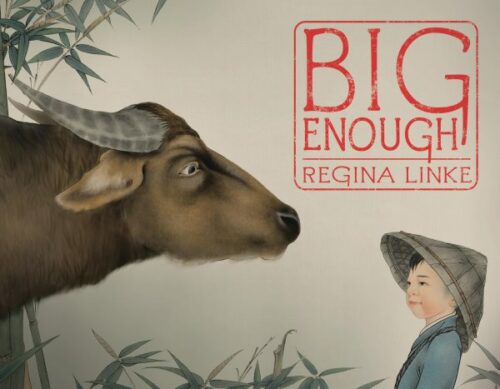
When his father is delayed in the village, little Ah-Fu is informed that he is to fetch home the family’s gigantic ox from the woods. A clever parable about trusting yourself when in doubt. Traditional ink and digital painting is what Taiwanese American author/artist Regina Linke is using to make her illustrations look so very much like Chinese gongbi painting in this book. It’s hugely distinctive, not really looking like any other picture book out this year. I’m placing it in this category since Linke calls it a parable and the flap copy says that it’s inspired by traditional Chinese philosophy. It certainly has all the trappings of a traditional folktale, what with the boy getting three pieces of advice and then having to use his smarts to know when to abandon each one. The star of the show, in many ways, is the ox itself. Linke wrings so much pathos out of this huge scaredy-cat of an animal. I love how its eyebrows give way when it’s anxious about something. Plus that two-page spread of the boy coming across the ox unexpectedly is just so beautiful. For sheer loveliness alone, this is worth considering.
ADVERTISEMENT
ADVERTISEMENT
Bear and the Three Goldilocks by Patrick Horne, ill. Dan Yaccarino
[Previously Seen on the Funny Picture Books List]
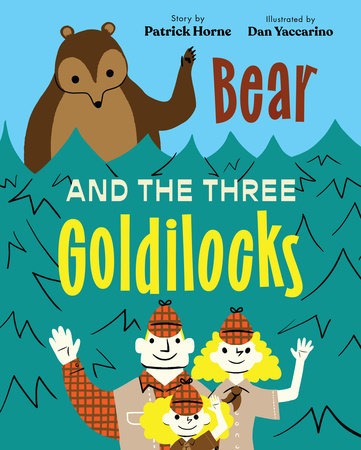
The Goldilocks family wants to enjoy a camp-out, but along comes a bear who munches on their s’mores, wrecks their musical instruments, and treats their car like a scratching post. This is completely delightful. Also, it proves to be a wonderful example of how you can take an old idea and turn it completely on its head. Clearly, just the right combination of fantastic text and funny art can combine to make the perfect picture book. Horne’s writing is droll and Yaccarino’s art is seemingly simple, but with this understated complexity that knows PRECISELY which jokes to lean into. Dang. What a great book.
Days of Awe: Stories for Rosh Hashanah and Yom Kippur by Eric A. Kimmel, ill. Sarah Green

Technically this book was release previously in 1991. This new edition has a more updated illustrative style, plus a designer ‘s hand, somewhere in the process. Three classic tales of the Jewish High Holy Days are retold by an expert folklorist, making them fun and accessible and inspirational for all readers. Opinion: Eric A. Kimmel is a national treasure and should be venerated as such. For those non-Jewish readers who may get the two holidays a bit mixed up, a book like this is a godsend. There’s a great introduction by Kimmel, giving adults like myself a bit of background. Then we get into the three stories: The Samovar, The Shepherd, and Rabbi Eleazar and the Beggar. And because it’s Kimmel telling the tales, they’re all just great! Evocative and interesting, with fun art by Sarah Green to keep things interesting. And it isn’t just the selection of the stories but the ways in which Kimmel is capable of retaining what made them great from the start, while also adapting them for a modern audience, that makes the book work so well. A great example of how to take tales from the past and highlight the elements that make them so relevant today.
The Greedy Wolf by Timothy Knapman, ill. Jean Jullien

When a greedy wolf decides to devour a slew of baby goats, he has no idea what he’s gotten himself into. A hilarious take on “The Wolf and the Seven Young Goats” by the Brothers Grimm, with an ending you WON’T see coming! Ah ha! I know the original folktale that this is based on! I’ve always kind of enjoyed “The Wolf and the Seven Young Goats” since it always kind of reminded me of a goat-based version of Lon Po Po. This version is WACKY and I am on board. It has a twist that I wasn’t ready for either. I’ve certainly seen stories where there are similar endings (the Mo Willems book That Is Not a Good Idea comes to mind) but there’s usually a big lead up. This one… wow. It takes a hard right turn that the kids are NOT going to see coming. I was expecting a happy dappy ending where the wolf is so full it befriends the goats. NOPE! Full credit to the author and illustrator on this one. It’s not precisely the original story but it sure as heck feels like some kind of a fairytale to me!
Grimms’ Fairy Tales by Sandra Dieckmann

Dieckmann was born in Germany, so it seems only appropriate that she’d try her hand at some Grimm tales. As she explains in her Afterword, “I have embellished and twisted the tales to my taste and morals. Inescapably, my childhood and experience as a woman, artist, and mother in the world today are woven into them – though I try to stay faithful to the fairy tales as they were when first collected in their written form.” This note appears in the back of the book, and so I read the book in full before realizing the degree to which Dieckman tweaked the stories we know so well. This can be something as minor as the prince in Sleeping Beauty just stroking her cheek rather than kissing her awake, or as grand as killing Snow White’s witch, not with red hot shoes, but hearing that Snow White’s still alive after that whole glass coffin incident. Genders get played with (it’s a huntress rather than a hunter sent to kill Snow, for example) and I found myself quite fond of the art. There are some tales that we Americans know, and some that are a little more obscure (everyone familiar with “Mother Holle”?). Interestingly, a lot of the gross stuff, like chopping off heels or Rumpelstiltskin pulling himself into two pieces, that is still in there. I’d say that if you’re a purist, this is probably not the collection for you, but if you want to instill in your kids the general gist of the original tales, and you’d rather not have to explain why it’s gross to kiss sleeping women, this is the one for you. Just don’t expect the Frog Prince’s gal to be much more sympathetic than she usually is.
Hansel and Gretel by Stephen King, ill. Maurice Sendak

The classic Grimm Brothers fairytale takes on a new life when seen through the lens of Stephen King, with Sendak’s never-before-printed-art. I do have to wonder if this is the start of a larger trend. Which is to say, bestselling adult authors write the text for dead. equally famous, picture book illustrators’ unfinished (or in this case, previously nonexistent) stories. In this particular case, Stephen King wasn’t a bad way to go. I was impressed by how very accurate he was to the original story (going so far as to apologize in his Intro that he decided to excise the understandably forgotten magical duckling at the end). This isn’t a reimagining in the style of, say, Mac Barnett, however, so what you’re going to get with this is a very faithful, straightforward retelling of the original Hansel and Gretel tale. As for Sendak’s art, it was never meant for a picture book, so there’s a bit of inconsistency to the kids themselves. Sometimes Hansel and Gretel look like they’re teens and sometimes small children (uncharitably I was reminded of what happens when people try to write picture books with AI art inside). For a far more in-depth (and funnier, honestly) take on the experience of a writer coming up with a tale to accompany free-flowing art, you best be reading the Mac Barnett/Jon Klassen New York Times review of this same book. It contains the line, “Look, Mac, kids aren’t a monolith. Don’t discount the tree proscenium kids.” Well put, Jon.
Jack and the Beanstalk, retold by Michael Rosen, ill. Talleen Hacikyan

I don’t know why this shocked me as much as it did, but when I had a son of my own and I named him Jack, I was appalled to discover that there is a real lack of decent Jack and the Beanstalk picture books in the world. You either get something like the rather peculiar Paul Galdone version, or something long like the egregiously ample E. Nesbit version. It seems fitting that Michael Rosen would try his hand at a version. What’s so interesting about this version is just how straightforward it is. Other Beanstalks tend to go in new or different directions. I discovered on my own that just finding the original story by itself, and not in a collection of some sort, is a difficult proposition. Here, Rosen is doing the very very classic story. Hacikyan, meanwhile, gives the book some flair, but your focus is on the tale itself. So, honestly, this is filling a surprising gap in the marketplace. If you’ve been looking for the most straightforward version of this tale imaginable, this is kind of the only (recent) game in town. Of course, if you think I’m wrong, let me know in the comments. I’m curious!
Japanese Yokai: Explore the Magical World of Monsters, Demons and Mythical Creatures by Fleur Daugey, ill. Sande Thommen

From nine-tailed foxes to demons, kappas, and all manner of creatures you’ve never heard of, this collection is bound to introduce you to someone (or someTHING) new! My personal experience with Japanese yokai comes primarily from Shigeru Mizuki’s Kitaro graphic novel series. Those were the books that let me know about these otherworldly creatures in Japanese mythology, that sort of straddle “ghost” and “monster” along with what you can only just call the weird. Reading this book, you’ll notice the influence of the yokai on all kinds of pop culture (the futakuchi onna remind me a LOT of one particular creature from Spirited Away, for example, and don’t think for a moment that K-Pop Demon Hunters doesn’t owe some allegiance to this book). I like very much how this is part guidebook and part collection of stories about some of these creatures. It sort of reminded me of urban legends but, y’know, with more monsters worked in there. Just a bit of a warning for American readers: Hope you like testicles. Cause there’s an image of a tanuki in this book that is… ah… ballsy, let’s say.
The Littlest Drop by Sascha Alper by Jerry Pinkney and Brian Pinkney

The classic parable of the single hummingbird determined to save its nest from a roaring fire. A compassionate tale of group effort and individual bravery. This isn’t the first time I’ve seen this particular parable depicted on the page for kids, but I think this telling is, at least, written far better than other versions out there. Brian Pinkney says in his Illustrator’s Note that this was truly the “last creation” of his father Jerry Pinkney. It’s a collaboration that looks far more Brian than Jerry to me, but I’m glad it was done at all. And perhaps I’m feeling a bit downtrodden over the state of American politics today, but I honestly think that this is a message that is valuable to convey to children right now in 2025. The Wangari Maathai connection just drills that feeling home.
The Moon Rabbit: A Celebration of the Mid-Autumn Festival by Eva Wong Nava, ill. Jason Chuang

The story of the Mid-Autumn Fest is retold with sweeping illustrations and a tragic love story at its core. As odd as this may sound, I have a hard time separating out in my mind this folktale from the plot of the animated film Over the Moon. Now what I like about this book is that while it does begin in the present day, it launches straight into the story of Chang’e and the moon rabbit almost immediately. I was particularly taken with the art of Jason Chuang, who has done a couple picture books before. There’s this shot of Houyi having shot down nine suns that’s particularly fantastic. Probably one of the nicest encapsulations of this tale I’ve seen on paper to date. Well worth checking out.
More Than Enough: Inspired by Maimonides’s Golden Ladder of Giving by Richard Michelson, ill. Joe Cepeda


Cleverly incorporating the eight rungs of Maimonides’s “Golden Ladder of Giving” into its story, Moses doesn’t want to give change to the man he sees on the street. Still as time goes on, he comes to learn how “Little enough is more than enough to share.” So placing this in the folktale section is a deliberate action on my part, since the story is a pretty careful breakdown of the Golden Ladder alluded to in the title. The story cleverly separates itself into eight stories that symbolize the eight rungs. What it really reminded me of was a nice book from 2024 that didn’t get a lot of attention but had similar attitudes towards charity and respecting the pride of the people receiving that charity (The Midnight Mitzvah by Ruth Horowitz, ill. Jenny Meilihove). Maybe it’ll strike some folks as purposeful, and maybe the fact that people seem to instantly get on their feet again after such a short duration isn’t realistic, but this is a picture book illustrating a personal principle, not an adult text on systems that keep people unhoused and unemployed. Definitely worth some eyeballs.
Night: A Children’s Fable by Katherine L. Jumbe, ill. Shana Dixon

After the world’s people and animals complain endlessly about the nighttime, the Night itself picks up and leaves. Can they convince it to return and cool the world down again? So this has all the trappings of a very nice and classic folktale to it. Pissy personified concept? Check. Hubris on the part of animals and humans? Check. So my objections were more that Jumbe and Dixon don’t really clarify whether or not this is an original fable or not. I guess we can just assume that, based on the fact that it never really sites any specific area, though there are quite a lot of Chichewa words (a Bantu language spoken in Malawi and a recognized minority in Zambia and Mozambique) which narrows the field. I do like it, though. I thought the storytelling was fresh and fun and the art, while a little digital, according to the publication page, was based the setting on the illustrator’s childhood experiences in Malawi.
Persian Mythology: Epic Stories of Gods, Heroes, and Monsters by Ryan Bani Tahmaseb, ill. Reza Dalvand
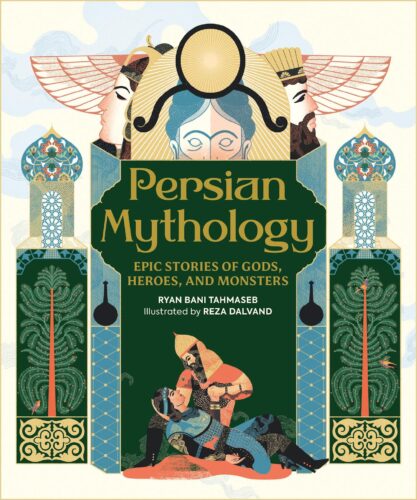


You ask me for the best collection of Persian myths and tales on the market today? I hand you this book and, really, only this book. As with many of my favorite compendiums of tales, Tahmaseb has found a way to take the heart of what has made these stories so compelling over the centuries, while also imbuing them with the kind of language that kids would gravitate towards today. In his introduction, he talks about growing up in America with an Iranian dad, wondering more and more about Iran as he aged. It was the stories and myths that particularly intrigued him. When he writes that, “Persians are some of the greatest storytellers around,” I was reminded of Daniel Nayeri’s recent National Book Award winner The Teacher of Nomad Land also out this year. One might make quite the incredible unit, pairing that book alongside this one. Here you’ll find twenty tales. Some stand alone. Others continue into the stories that follow. My personal favorite? Zahak. That’s a story of a good, if a little vain, man dragged into true demonic awfulness, with snakes coming out of his shoulders and everything. Ooo! It’s delightful. I imagine you’ll have a LOT of fun reading these aloud at bedtime, particularly with the art by Reza Dalvand to keep you occupied. I’d even go so far as to call this a necessary purchase. See if I’m wrong! Find it!
A Ring for a King: A Tale of King Solomon by Martha Seif Simpson, ill. D. Yael Bernhard
[Previously seen on the Message List]

What does it mean that the stories of King Solomon are often my favorite stories? I’ve been trying to parse what it is about Solomon that I like so much. Maybe it has something to do with the fact that in our current political landscape, there is something inevitably alluring about a wise king who asks the advice of everyday people. I’ll have to ponder this further, but in the meantime a new Solomon book has hit our shelves (and I am HERE for it). In this story a kid named Ezra is just your average servant in the court of King Solomon. One day the king confesses to Ezra that, “I struggle to find the right words to make a sad person hopeful or a proud person humble.” Only when Ezra aids a stranger is he given the words that he can give to the king: gimel, zayin, and yud. Or, put another way, “Gam Zeh Ya’avor’ – This too shall pass.” I suspect this book and its message are going to find a LOT of use in the next few years…
The Runaway Pancake by Tiny Fisscher, ill. Sophie Pluim, translated by Polly Lawson

There are a lot of things running away this year, did you notice? Over in the Easy Book section you’ll see that I mention Joanathan Fenske’s Stop That Mop! while over here in the fairytale/folktale section we’ve a naughty pancake also making a break for it. It got me to thinking a bit about the old Gingerbread Boy story. Why aren’t kids more upset when he gets eaten? And the answer, logically enough, is because he’s full of himself. He’s just sooooo pleased that he’s so fast. So even though he has a legitimate reason for escape, by teasing the creatures that would want to eat him, we don’t have as much sympathy for him. And in the original story, the trickster is then eaten by… another trickster. I’m sure that in the Aarne-Thompson-Uther Index of tale types there’s gotta be a Trickster Tricked by Trickster subgenre in there somewhere. Now for this book, it’s a pancake, but a lot of the fun happens even before it makes a break for freedom. I loved that first, it’s Dad making the pancakes (woohoo for cooking men!), that he has a freakin’ ton of kids, and that they keep one-upping one another to give him the most compliments (“Can I eat it, dear, kind, clever, sweet, funny, lovely, handsome Dad?”). Now the pancake does mock its pursuers, which is sort of required if your cheeky protagonist is going to end up eaten. I appreciate the devouring myself. In keeping with the original (but yummy in its own way).
Tales From Beyond the Rainbow:Ten LGBTQ+ Fairy Tales Proudly Reclaimed, collected and adapted by Pete Jordi Wood


A dedicated folklore researcher collects and adapts ten stories from around the world with queer themes and characters. Proof positive that LGBTQ+ folktales and fairytales have always been with us. I’m a bit of a folktale/fairytale nerd. I like it when a book pays the proper respect to the history of collected folktales and fairytales, but even more than that? I like the weirdness of the stories themselves. I like how some have been amended over the years into the versions we all know now, but that there are loads more out there that are just doggone… weird. Pete Jordi Wood knows all of this and his self-proclaimed title as a “fairy tale detective” of queer folktales, myths, and legends is legit. The man KNOWS how to find them. I mean, I have never, in all my days, seen a book for kids reference the Aarne-Thompson-Uther Index of tale types. All this is to say that you’re in capable hands when he gathers these tales together. He’s amended some, and there are definitely a couple that work better than others, but the inescapable fact is that this collection is incredible. There are also ten different illustrators in here, which you might not notice since their styles gel so beautifully with the tales. But this isn’t just an object. It’s a legitimately and HIGHLY needed collection, and the stories are really fascinating. A lot of them retain their original weirdness, even as they upend our understanding of the kinds of stories people used to tell one another in the past. NECESSARY!
The Three-Year Tumble: Based on a Korean Folktale by Dayeon Auh, translated by Tim Mohr

ADVERTISEMENT
ADVERTISEMENT
I love a clever folktale. I particularly like a clever folktale that I’ve never heard before AND that surprises me with its twist ending. Dayeon Auh is a muralist and artist born in Seoul and who is currently living in Berlin and Lepzig. Originally published in Switzerland, we are told on the publication page that this folktale is read to kindergartens and primary schools in Korea all the time. It adds, “Around seventy percent of Korea’s terrain is mountainous, which lends itself to many tales of traversing mountains in Korean folklore.” The mountain in this book isn’t one you’d want to cross, though. In this story we meet Misfortune Mountain. Anyone who falls while hiking it has only three years left to live (or so people say). One day a grandfather starts up the mountain only to fall. “Oh no! There were so many beautiful things the grandfather still hoped to experience.” Bereft, three years pass and as the anniversary comes up he feels unwell. With his last strength he visits a doctor, who tells him he’s actually pretty healthy. Then the man’s granddaughter shows up and when he tells her what’s wrong she thinks about it then asks why he doesn’t just fall down the mountain right now and get three more years? And heck, why not fall ten more times and get thirty? One gets the distinct impression that there’s more than a drop of wisdom to this insane logic, but it ends happily enough for the grandfather. Auh’s art is quiet interesting in this book too, mixing past and present, and having this blue goose following everyone about. Parts look like mixed media and cut paper while others seem fully painted. It’s wild and wacky and would certainly make for a fun readaloud!
Vida: The Mice, the Cat and the Alebrije by Duncan Tonatiuh

A clever and strikingly illustrated fable about a group of artistic mice saving their city from a menacing cat. A colorful tour de force from an award-winning artist. I was particularly taken with Tonatiuh’s note at the end of this book about how he took the old Aesop fable of the mice and the cat and found an answer to the question “But who will bell the cat?” with this story. He also makes mention of the fact that there are towns across Mexico that have fallen victim to “cats” of their own. The use of colors in this book is absolutely magnificent. He’s doing such clever things by graying everything out and then presenting you with the fluorescent alebrije. I particularly enjoyed how you only see the silhouette of the cat until the end. It’s fun and kid friendly and one cannot help but pity the current poor poor Pura Belpre committee. Wouldn’t want to be you this year! You have too much to choose between!
Why the Turtle Walks So Slowly: A Cuban Folktale Adapted and Retold by Sandra Martín Denis, ill. Arístides Hernández

If you know me then you know that I like odd trends in my children’s books. For example, 2025 has clearly been the Year of the Banana. There’s another, much smaller, trend that I’ve enjoyed just as much, though: Stories in which slow animals are actually alarmingly fast. We saw it with the hyperactive jogging sloth in The Tree That Was a World by Yorick Goldewijk, illustrated by Jeska Verstegen (and recently seen on the 2025 translation list). Now, to accompany it, we’ve a story about how a long time ago turtles didn’t have shells and a river turtle, named Tortuga, used to love running. Not only is he fast, he’s ambitious. Tortuga wants to be the leader of the village. Spying on the person already in charge (a woman named Mabella) he sees that she owns a magic drum that dissipates conflict with food. After tricking Mabella out of her drum, Tortuga invites all his friends to a feast with music. Unfortunately, during his dancing, he drops the drum and “Three hundred men jumped out of the drum, beat up everyone. Then, they disappeared.” This is not a good way to win an election. It’s also that key, essential bit of weirdness that I like to discover when I read a folktale. When he attempts to return the drum, Mabella informs Tortuga that whosoever lets out the men has to carry the drum forever. As such, now he carries it on his back, moving slowly so he won’t stumble and fall again. Martín utilizes some nice repetitive terms throughout the book that really aid in the readaloud experience (someone running makes the sounds “Repeke peke peke. / Repeke peke pa”). Meanwhile, the fun and colorful art of Arístides Hernández pops off the page. I mean, who wouldn’t have fun painting loads of weird, angry men fighting animals for no good reason? Awesome and weird in the best way.
Xolo by Donna Barba Higuera, ill. Mariana Ruiz Johnson


Think you know the Aztec myth of how the serpent god Quetzalcoatl helped create humans? Hear the real story and meet the dog-headed god that gave the world man’s best friend. Trust a Newbery winner to take a stab at turning an Aztec myth of human origins into a sweet tale of dogs and how awesome they are. Warning: If you’re a fan of Quetzalcoatl then I should tell you that he does NOT come off looking that great in this story. My read of this tale (which, in spite of its page count, just ZIPS by at lightning speed) was aided and abetted by a fellow 2025 children’s book release this year: Popo the Xolo. Apparently everything’s just coming up Xolo this year. This particular book has all the trappings of a graphic novel but is, instead, just a heavily full-color illustrated bedtime book. Not quite a novel, not quite an early chapter book, thank goodness it’s a folktale! Now we have somewhere to safely put it!

That’s it for today! Be sure to stay tuned for more lists on 2025 titles. The full roster is here:
December 1 – Great Board Books
December 2 – Picture Book Readalouds
December 3 – Simple Picture Book Texts
December 4 – Transcendent Holiday Children’s Books
December 5 – Rhyming Picture Books
December 6 – Funny Picture Books
December 7 – Caldenotts
December 8 – Wordless Picture Books
December 9 – Bilingual Books for Kids
December 10 – Math Books for Kids
December 11 – Books with a Message / Social Emotional Learning
December 12 – Easy Books
December 13 – Translated Children’s Books
December 14 – Fairy Tales / Folktales / Religious Tales
December 15 – Gross Books
December 16 – Poetry Books
December 17 – Unconventional Children’s Books
December 18 – Early Chapter Books
December 19 – Comics & Graphic Novels
December 20 – Older Funny Books
December 21 – Science Fiction Books
December 22 – Fantasy Books
December 23 – Informational Fiction
December 24 – American History
December 25 – Science & Nature Books
December 26 – Unique Biographies
December 27 – Blueberry Award Contenders (Celebrating the Environment)
December 28 – Nonfiction Picture Books
December 29 – Nonfiction Books for Older Readers
December 30 – Middle Grade Novels
December 31 – Picture Books
Filed under: 31 Days 31 Lists, Best Books, Best Books of 2025

About Betsy Bird
Betsy Bird is currently the Collection Development Manager of the Evanston Public Library system and a former Materials Specialist for New York Public Library. She has served on Newbery, written for Kirkus, and has done other lovely little things that she'd love to tell you about but that she's sure you'd find more interesting to hear of in person. Her opinions are her own and do not reflect those of EPL, SLJ, or any of the other acronyms you might be able to name. Follow her on BlueSky at: @fuse8.bsky.social
ADVERTISEMENT
ADVERTISEMENT
SLJ Blog Network
Cover Re-Reveal: 1000 HORSES FOR THE KING by Gracey Zhang and Me
Spider-Man Mighty Mayhem | This Week’s Comics
From Policy Ask to Public Voice: Five Layers of Writing to Advance School Library Policy
The Artsy Kid: Finding Fierceness Beneath the Surface, a guest post by Katherine Wolff
ADVERTISEMENT
I love folk tales – the art is so diverse and creative!