
The Original Dog Man: A Talk with Donna Barba Higuera and Mariana Ruiz Johnson About Xolo

Recently someone asked me for unexpected children’s book trends in 2025. For a moment there, I was stumped. Hm. Poop is having a bit of a field day in a variety of books, but is that particularly trend-worthy? I dunno. And, of course, we’re seeing an interesting increase in science fiction, both on the middle grade and picture book side.
But the #1 trend of 2025? Don’t ask me why, but it is inarguably heroes who lead other people through the underworld after death. You don’t believe me? Between The Undead Fox of Deadwood Forest by Aubrey Hartman, Graciela in the Abyss by Meg Medina, or Popo the Xolo by Paloma Angelina Lopez, we’re looking at a genuine trend.
ADVERTISEMENT
ADVERTISEMENT
Of course, very much along the same lines as Popo the Xolo is a book that seeks to do something a little different. Imagine a book that’s as bright and colorful as a graphic novel, and also so enticing that you almost don’t notice that it’s pure prose. Xolo by Donna Barba Higuera, illustrated by Mariana Ruiz Johnson (out November 4th), is most certainly that book. Higuera takes an Aztec myth, then rounds it out. She gives it nuance and feeling and character. She also presents a hero who is a literal hangdog type at the start, and then turns into a hero to beat all heroes by the end.
Do you want a companion to Dog Man with a bit of authentic Latinx myths and a healthy dose of humor? Then here’s the description:
“It is said the mighty feathered serpent god, Quetzalcoatl, helped create the earth. He is the hero who stole back the bones of humanity from the evil god of the Underworld. In his quest to bring humans to the earth, Quetzalcoatl’s dog-headed twin brother, Xolotl, was present. Not much is known of Xolotl, the god of lightning, death, and misfortune. A monster.
This is what really happened.
From Newbery Medalist Donna Barba Higuera and illustrator Mariana Ruiz Johnson comes a singular reimagining of the Aztec myth of the origin of man—and man’s best friend—that is nothing short of a modern masterpiece.”
Oh yeah. Y’all need to see this book. But before you do, you need to hear from its creators:
Betsy Bird: Donna! Such a delight to get a chance to talk to you today. And what a shift you’ve made from your novels to the mythology of Xolo. I’ve certainly heard the myth and seen it referenced in a couple different children’s books before, but the character of Xolo has always been excluded in those versions. What was your first introduction to this origin story and why did you think it might make a good book in and of itself?
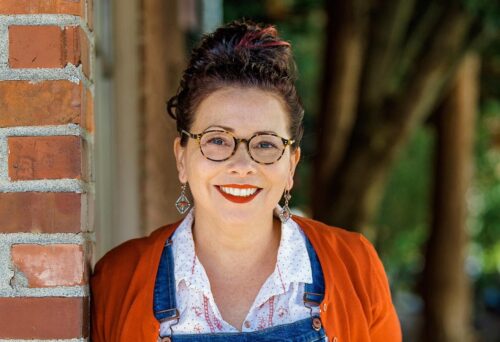
Donna Barba Higuera: Great to chat with you too! You’re right. Xolo is quite different than my other novels. I have loved writing it. There is just so much “story behind the story” with this book.
I have always been obsessed with folklore and mythology from all cultures. But with Mexican roots, I’ve always taken special note of Aztec myths. I’ve visited Aztec ruins, and thought of my ancestors of long ago walking in those same places and how the mythology was so integral to their everyday lives. Like most people, I knew well the myth of the great feathered serpent god, Quetzalcoatl, for a very long time. But his lesser known twin brother, Xolotl, the dog-headed “monstrosity” god, (referred to in my book by a nickname, Xolo) is lesser known, and doesn’t get the attention that Quetzalcoatl receives. I was aware Xolotl was the god of lightning and escorted the sun through the underworld each night. But like a lot of mythology and folklore running around in my mind, I have no idea where I first read or heard of Xolotl.
The origin of this book didn’t originate with a depiction of the god, Xolotl. The first spark began with an incident closer to home with my elderly dog, Filson.
My family and I went camping to a very remote part of the Nevada desert to take my rockhound daughter on a dig. While on the side of a mountain, a sudden lightning storm rolled in. We hurriedly packed up our equipment and did what all great explorers do in a crisis. We took a nap. My dog Filson was nervous, so I put him at the foot of the bed, and we slept out the storm. But with each flash of lightning, and boom of thunder, I would crack open an eye to see Filson had crept further up the bed, until by the end of the storm, Filson’s cold, wet nose was buried in my neck.
I couldn’t help but draw the humorous juxtaposition between the burly dog-headed god of lightning, Xolotl, and my strapping dog, who was petrified of lightning. I grabbed my journal, and started jotting down a story idea.
BB: Man! Now THAT is an origin story! Well, let’s turn our attention to Mariana as well. Thank you so much for talking with me today, Mariana! XOLO is just a delight of a book in every possible way. Tell us a little bit about how you were introduced to the project in the first place. What drew you to it?
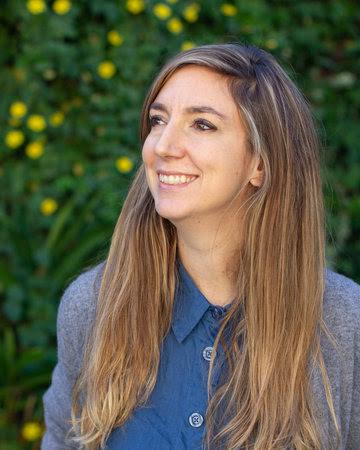
Mariana Ruiz Johnson: It’s a pleasure to talk with you! This project came to me through an agent, Valentina Colombo, who introduced me to Nick Thomas, the editor at Levine Querido. When I heard it would be a free retelling of an Aztec myth, and although the story wasn’t finished at that stage I was immediately drawn to the idea of illustrating a story told in the first person by a god. The editor was already familiar with my work, and the project promised a lot of creative freedom, so I jumped on board without hesitation!
BB: Part of what makes this book so memorable is that it’s highly illustrated, almost like a graphic novel, but it’s all text. No panels or speech balloons or sequential storytelling. Donna, how did you envision it as you were writing it? Did you see it as something similar to its final form or did you have another vision for it?
Donna: So, after that incident in the desert with the lightning storm, I envisioned this book first as a picture book. The first draft was seven words of onomatopoeia (black pages with a lightning strike illuminating the word), showing a cowardly dog creeping up a bed during a lightning storm, alternating with the legend of Xolotl, bravely escorting the sun through the dark, ominous underworld, called Mictlan.
The book evolved from that initial picture book to a graphic novel format of a modern-day superhero (a reluctant dog chosen by Xolotl to defend mankind). My mind was all over the place. Then, my editor Nick Thomas at Levine Querido helped wrangle my overactive imagination. He asked the questions that brought the story back to our main character, Xolo, and what the book is now, Xolotl’s reimagined myth.
I did have illustration notes. Still, I had no idea what to expect from the art. When Mariana’s first sketches came in, I was blown away. In no way, could I have envisioned an outcome so beautiful and dynamic. It’s the perfect example for writers to take a step back and let the artist tell their own story in the way only they can. Mariana’s art is so innovative and original, I think it’s why it’s hard to categorize this book.
BB: I mean, that’s fair. It is a little difficult to categorize. Mariana, you’ve worked on a number of picture books over the years. XOLO, like we were just saying, is a bit different as it’s a middle grade novel just shy of being a graphic novel. It’s a bit unique in that way. Was the book always envisioned in this way from the start or was it something that evolved over time into its current form?
Mariana: Nick had a very clear vision: he wanted a heavily illustrated novel where the images would carry a strong narrative role and interact deeply with the text. Before I began, he showed me many examples of this kind of book, since I had never illustrated one in this style. He encouraged me to work with great freedom and even to resolve some spreads in a comic-book language. The art director, Maya T., was also fundamental—she prepared an initial layout that made my work much easier and more fluid. The three of us worked closely together so that the image-text relationship would feel as dynamic as possible. It was truly a team effort!

BB: That then brings us to the story itself. Donna, in any culture, stories of the gods can be difficult if they stray too far from human experience. In Xolo we find the ultimate, and literal, underdog. But writing a hangdog character requires making them sympathetic rather than pitiful. When you write a character of this sort, how do you maintain this balance? What elements do you include to make sure he’s relatable rather than pitiable?
Donna: What a great question!
This was a worry of mine. The ancient myths are sacred. The codices should be respected. So, if I created an entirely new storyline for Xolo that has never existed, is it an injustice to the original myth? I guess I thought about how in the original codex, Quetzalcoatl gets all the glory. But what if Xolotl was the real hero? This would be a complete reimagining, one which gives Xolo a more prominent voice.
But I think that for as long as humans have been storytellers, that is what we do. We imagine and reimagine. We “what if?”
As I was writing, Xolo became a character I sympathized with. He struggled with very human-like dilemmas and emotions, things we all, including young readers can relate to. Acceptance. Familial strife. Sibling rivalries. Just wanting to fit in. Things I understood myself all too well.
So while the book begins with a very “god-like” event, a sacrificial jump into a volcano to save the Earth, the feelings and motivations behind Xolo’s reluctance are very human. Haven’t we all have heard, “Would you jump off a cliff just because your friends did?”
Every child knows that feeling. Even if I’m scared, or this feels wrong, do I do this thing to fit in with everyone else? How do I become myself?
This story is filled with those moments. And it was not forced. The struggles arose naturally with this character’s journey to feel wanted and loved. That universal need to love and be loved is the greatest need for both humans and dogs. It is what connects us.
So what makes Xolo sympathetic vs pitiful?
He doesn’t give up on his quest to love and care for others. He carries hope that he can both love, and is ultimately deserving of love. This is his strength. And in the end, when Xolo finds companionship . . . when that love is returned to him, he comes into his true power.
Sorry for my wordiness, but I have to end this question by explaining how this ending came to me. It’s always emotional for me to speak this part.
I wrote the ending of this version of Xolotl’s story with my dog, Filson, by my side. Many years had passed since that lightning storm in the desert. I thought a lot about that first day we brought him home from the Seattle Human Society, and how he must have felt, so uncertain of what was happening. Filson was an older dog of ten years then. His owner had just died. He’d lost his best friend. But we did our best, and in a short time, Filson became family. He and I were growing older together. Six years later, as I was completing Xolo, Filson died. He was the best friend and companion one could hope for. It was one of the saddest times in my life. But I imagined his previous owner, the elderly man, or maybe Xolotl, greeting Filson to escort him safely to what is next. Thus, the ending of the book as it is now. This story became a tribute to the bond between humans and dogs, and imagining of what Xolo’s role could have played in fostering that connection.

BB: I want to keep going with this. Donna, what elements of the original myth did you prefer not to keep in this retelling? What didn’t quite fit in with the story you were writing?
Donna: I think I kept nearly all of the elements of the original myth. Because this is a sacred text, I’m trying to be careful to call this a “reimagining” vs a “retelling.” There are various versions of the Quetzalcoatl/Xolotl legend, variations of who their god parents were, etc. But the entire myth itself is rather sparse in comparison to this reimagining. We know Xolotl and Quetzalcoatl were twins. Quetzalcoatl was considered beautiful, escorting the sun across the morning sky, while Xolotl was a monstrosity, escorting the sun through the underworld of Mictlan. Aside from that, and Xolotl failing to jump into the volcano, I made most everything up. Even those original elements of him failing to jump into the volcano, and escorting the sun through the underworld, I spun in a way to show that all was not as it seemed in the original codex. As I’m answering you now, I realize most of the original myth just didn’t fit in with the story I was writing.
I added all the underlying elements; motivations of the other gods, including Xolo’s own family, personal storyline, conflicts, etc. These were my reimaginings to create a sympathetic character readers could relate to. I hoped this would give an inside view into who this Xolo really was, to see the story through a different lens. I wanted to create a version of the “god of monstrosities” and show what made him beautiful. But also what made him a hero.
BB: Mariana, as I recall, one of your previous books, RUN LITTLE CHASKI, was set during the Inka empire. Now you’ve illustrated an Aztec myth. What is it about these ancient empires that draws you to these books and projects?

Mariana: I’ve always loved myths in general, but especially those from pre-Columbian cultures. These were the original peoples of Latin America, who built great empires with rich and complex cultures that still permeate today’s beliefs and traditions. I’m Argentine, living far to the south of the continent, but I’ve traveled extensively through the region, including Inka ruins that deeply inspired me while illustrating Run Little Chaski. I’ve also had the chance to visit Mayan and Aztec ruins in Mexico, as well as museums with stelae, temples, sculptures, and ceramics. I’ve always been fascinated by the monumental and ornamental qualities of their visual forms. This book gave me the chance to approach that world through formal research. I tried to do it with a great deal of respect for those cultures and their worldviews.
BB: And Donna, since I brought up Mariana’s art, were you familiar with her books before you were paired with her on your own? And how do you feel about the final product?
Donna: I had seen her work. I loved it! But even when my editor first mentioned Mariana by name, I’ll admit, I didn’t realize who it was until he sent me some images. I might have jumped. It is very humbling as a writer when you are teamed with such talent. I am just so glad she accepted.
BB: Mariana, was there any particular image or spread that you created for this book that stands out for you in any way (for good or for ill)?
Mariana: I loved working from the representations of gods I saw at the National Museum of Anthropology in Mexico City and in the Codex Borgia. The challenge was to bring expressiveness and animation to these figures so they wouldn’t look rigid, but instead speak to today’s young readers. Giving them life and personality was made easier thanks to Donna’s sensitive text, which describes the characters so vividly. My favorite was Mictlantecuthli, along with his whole entourage of monsters and demons in the Mictlan. I absolutely loved building that underworld.

BB: Donna, at its heart, this is a love letter to dogs everywhere. Would you agree with that assessment?
Donna: It is absolutely a love letter. My dogs have been some of the most cherished relationships in my life. The times in my life when I felt lonely, they gave me companionship. When I felt unaccepted, they loved me unconditionally. This book also speaks of what comes next after we all leave this Earth. If we do join those who we loved the most during our time on Earth, I will have so many dogs waiting for me on the other side. And if you don’t believe dogs and cats will be there, well . . . you’re wrong.
I’ve had too many dogs of various breeds (mostly mixes) to mention. Most recently, in addition to losing Filson (sixteen), we lost Mack (seventeen), and Castro (eighteen) in the span of a year. My husband and I were heartbroken. We said we needed time to grieve so much loss. But shortly after, we both caught one another searching elderly dog rescue sites. It didn’t last long. A dear friend and fellow writer, Martha Brockenbrough, was fostering a solemn Golden Retriever rescue, a breeding mom who only knew litter after litter and life confined to a crate, without even a name. She looked sad. But we were too. We said, “Why don’t we just go meet her?”
Well, you know what happened next.
Now named Poppy, her only job is to bask in the sun, sniff the pine trees and saltwater, and snuggle with us when she feels like it, which is a lot. She stays close to my side always. Then recently . . . we “just went to meet” a very elderly Mabel, another Golden, whose owner had died. While Poppy is an elegant, dainty, grand dame, Mabel is an erratic typhoon, think the dog from Up. Poppy and Mabel have become good friends, are hilarious and entertaining together, and I think we have all helped each other fill the void of our recent losses.
BB: Sorry, I just love the term “erratic typhoon” so so much. Finally, what’s next for the two of you? What else are you working on these days?
Mariana: I just finished a medieval castles search-and-find book, which was a big undertaking, and now I’m beginning a new picture book project. I always have several projects going on at once!
Donna: I have a few projects in the works. I’m finishing edits on two books at the moment; The Unlikely Aventuras of Ramón and El Cucuy chapter book series.
I am also finishing the third and final book in the Cuentista series, called Firesnake. With two very different characters and worlds than book one, The Last Cuentista, and book two, Alebrijes. Now I’m bringing together those two worlds that have an entire universe in between. The task hasn’t been easy. There are so many strange creatures and concepts in each of the first two books, but for the final book, I’m trusting what I’ve discovered. The more bizarre my ideas are, the wilder directions my imagination travels, the more those stories attract young readers.
BB: I literally cannot wait!

Wow. Such big thanks to Donna and Mariana for taking the time to answer my questions with such expansive loquaciousness today. I might have mentioned before that Xolo is on shelves November 4th and you will NOT want to miss it. Thanks too to Gina Gagliano who helped to put this whole thing together.
Now go out there and HUG A DOG!
Filed under: Best Books, Best Books of 2025, Interviews

About Betsy Bird
Betsy Bird is currently the Collection Development Manager of the Evanston Public Library system and a former Materials Specialist for New York Public Library. She has served on Newbery, written for Kirkus, and has done other lovely little things that she'd love to tell you about but that she's sure you'd find more interesting to hear of in person. Her opinions are her own and do not reflect those of EPL, SLJ, or any of the other acronyms you might be able to name. Follow her on BlueSky at: @fuse8.bsky.social
ADVERTISEMENT
ADVERTISEMENT
SLJ Blog Network
Film Nerds | Review
Top of the Mocks: Mock Newbery 2027 Contenders
From Policy Ask to Public Voice: Five Layers of Writing to Advance School Library Policy
The Case of Ambition v. Heart, a guest post by Elba Luz
ADVERTISEMENT