
“… good and evil, life and death, order and chaos.” We’re Talking Persian Mythology Today with Ryan Bani Tahmaseb
My love of folktales, fairy tales, world tales, religious tales, etc. is without limit. And while there is no denying that the era of such tales on our library shelves has passed, this isn’t to say that such tales aren’t still being published out there today. The trick simply lies in finding them.
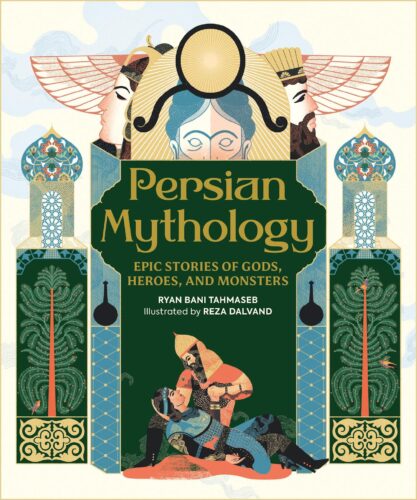
In Persian Mythology: Epic Stories of Gods, Heroes, and Monsters (out today), author Ryan Bani Tahmaseb writes in his Introduction, “Persians are some of the greatest storytellers around.” When I read that, I was reminded of Daniel Nayeri, and his incredible WWII Iranian historical fiction novel The Teacher of Nomad Land. Seems to me that an enterprising teacher or parent would do well to consider pairing this book with that one for a full-fledged Iranian unit in literature.
ADVERTISEMENT
ADVERTISEMENT
But what precisely is this collection? From the publisher it’s described as:
“An unforgettable collection of twenty dramatic tales of Persian deities and heroes, both mortal and immortal, fighting in the name of goodness, chaos, beauty, love, and evil.
You’ve heard of mythological characters like Theseus, Medusa, and Thor, but have you heard about Anahita, Jamshid, and Rostam? In this engrossing anthology of twenty stories, middle grade readers will be introduced to the strongest heroes, most legendary creatures, and most vicious demons of Persian mythology. From Atar, the god of fire, going head-to-head with the three-headed demon-dragon Azhi Dahaka, to Anahita, the goddess of war and water, rescuing mortals from monstrous divs, Persian Mythology retells some of the most intense sagas that served as the foundation of early Persian religion, passed down from one generation to the next in the form of oral traditions. Persia is the area in West Asia known today as modern Iran. Author Ryan Bani Tahmaseb and award-winning illustrator Reza Dalvand celebrate the rich history and incredible tradition of Persian storytelling in this epic collection.”
Today, it is my honor and privilege to speak with Ryan Bani Tahmaseb himself about where this book came from, why it’s important, and how one goes about creating a folklore collection in the early 21st century at all:
Betsy Bird: Ryan! Great to get a chance to talk to you today about PERSIAN MYTHOLOGY! In the book’s Introduction you discuss the degree to which you were into Greek myths as a kid. Certainly Percy Jackson and books along those lines take a lot of credit today. It’s well worth remembering, though, that this is only one kind of mythology out there. Could you talk about your own path to discovering Persian myths and the canon? And also, why you decided to create this book?

Ryan Bani Tahmaseb: Thank you so much, Betsy! I’ve been following your blog, articles, and books since my days as a school librarian, so it’s pretty special for me to be here now talking with you about a book I’ve written.
While I may not work in schools anymore, I still work with students as an academic coach, and it’s my work with K–8 students over the years that really sparked the idea to write a book centered around Persian myths and legends. As you know, books about mythology are perennially popular with kids and teens. In my school library, mythology books were always favorites—not only Percy Jackson and the Olympians and the fantastic series that are part of Rick Riordan Presents, but also the larger collections of Greek and Norse myths. I really loved Greek myths as a kid. I mean, those stories were so wild and scandalous and dramatic, and the time we spent learning about them is one of the few things I actually remember loving in elementary school.
Anyway, soon after I started writing books for kids, I kind of naturally found myself wanting to learn more about Persian mythology. My aha-moment came during my research, when I realized there were no traditionally published books about Persian mythology for kids.
So I had my students in mind when I made the decision to try my hand at a book like this, along with my younger self, who would have been shocked and thrilled to see a book about Persian myths, Persian anything!
BB: So what, to your mind, is the value of having kids know about mythology in this 21st century day and age in which we live? What do they say to us today that we still need to hear (and our kids need to know)?
Ryan: The first thing that comes to mind is how our modern fascination with superheroes feels like a continuation of our age-old fascination with stories of gods: larger-than-life beings with abilities far beyond our own. And so for any kids today who like superhero stories, there’s a pretty good chance they’ll be into mythology too.

There’s also the fact that in many mythologies, including Persian mythology, we see origin stories for the way the world is—the way it looks, why certain creatures and landscapes exist—and kids really love these kinds of stories.
Mythological stories hit you on some kind of deep, instinctual, existential level, probably because they’re often centered around huge concepts like good and evil, life and death, order and chaos. I think this speaks to the last part of your question regarding what myths say to kids today that they still need to hear: they’re big, complex stories that grapple with life’s biggest questions. After all, in their original contexts, and in many cultures still today, myths are rooted in religion and often inseparable from spiritual beliefs and practices. They’re deeply fascinating stories that try to explain the unexplainable.
BB: If I know one thing about mythology it’s that no matter how much you want to include everything, there’s just no possible way to get it all into one book (unless, of course, your book is 500+ pages long). Talk to us a bit about selection. Why did you select the myths that you did? Was there a particular order you wanted to put them in? And what did you want to include but, for one reason or another, couldn’t?
Ryan: You’re totally right—selection was hard!
Early on, though, I knew I wanted to balance stories about the gods and stories about the legendary human heroes, and that ended up being a limitation since so few complete stories about the gods have survived. I also tried to balance the myths and legends that I found most interesting personally with the better-known ones that I thought would resonate with middle-grade readers, like the tragic story of Rostam and Sohrab (a scene of which is pictured on the cover) and the rise of the Serpent King, Zahak.
In terms of order and structure, I knew it made sense to start with the creation of the world and end with, well, the end of the world. Along with that, I also saw that each story could stand on its own while still being interconnected, so that—in the tradition of Persian storytelling—there’s a larger narrative made up of many smaller ones.
And yes, there were definitely stories I could have included but didn’t for various reasons! There’s the story of Layla and Majnun, which is like a Persian Romeo and Juliet, the tale of Esfandiyar, another epic hero, and I also love the Huma, a mythical bird that never touches the ground. There are so many good ones, and hopefully readers who enjoy this book will seek some of them out after they read!

BB: Oh, Zahak. Let’s change the subject since that guy gives me the serious creeps. Okay, I know that this is a potentially impossible question, but I have to ask it: Who’s your favorite Persian god? And, follow-up question, what’s your favorite myth?
Ryan: Of those I included in the book, Vayu, the god of wind, is probably my favorite. When I read in my research that Vayu was simultaneously a beloved protector god and feared god of death, I was immediately drawn to him. I find this kind of duality fascinating. In fact, in my research I learned that some ancient Persian sects even believed that Vayu held power over Ahura Mazda, the “Wise Lord” whom he eventually came to be seen as subordinate to.
My favorite myth is probably the story of Zahak. He’s actually based on the three-headed demon-dragon, Azhi Dahaka, from Persian mythology, whom I’ve established as a separate character in the book. Anyway, Zahak is a legendary character from Abolqasem Ferdowsi’s Shahnameh, the Persian “Book of Kings” and the national epic of Iran (and the longest epic poem written by a single person!), and he’s also known as the Serpent King because he’s been tricked and cursed by Ahriman, the lord of the Underworld, who causes two hungry, hissing snakes to grow from his shoulders—snakes he learns can only be sated by eating the brains of young men. It’s a horror story, basically. And it’s so, so good.
BB: Yeah, it was completely my favorite story in the book too. Soooooo creepy. Now you mentioned in the intro that a myth is entirely reliant on the person telling it and that you, yourself, took a couple liberties with the material yourself. What kinds of changes did you make to the originals?
Ryan: Yeah, I had to take a lot of liberties with this book. When it comes to stories about the gods, many only survive in fragments—sometimes just a few lines from prayers—so I had to fill in the gaps. And ancient Persia wasn’t a monolith. Different communities had different beliefs and versions of the stories. Since I was drawing from pre- and post-Zoroastrian myths, plus the legendary tales from Ferdowsi’s Shahnameh, it took some creativity to weave it all into a somewhat cohesive cosmology.
I also had middle-grade readers in mind, so especially with the Shahnameh stories, which are mostly about humans, I emphasized certain details and minimized or left out others. Ancient Persia was largely patriarchal. Most of the gods were male (the major exception being Anahita, goddess of war and the waters), and some female figures in the Shahnameh are unnamed or sidelined. So I gave them names and agency.
One big thing I had to navigate was the transition from polytheism to Zoroastrianism. Before Zoroastrianism, ancient Persians worshiped many gods. Afterward, Ahura Mazda, AKA the “Wise Lord,” was elevated as the supreme being. The other gods weren’t erased but became lesser divine beings called yazatas. In the book, I addressed this difference by framing Ahura Mazda as the father and creator of the other gods.

When I first started drafting, I definitely felt imposter syndrome. But then I realized all myths are retellings. For a very long time, they were passed down orally, and of course they changed depending on who was telling them, and to whom. Even the legendary Ferdowsi was retelling older myths, legends, and history! Once I accepted that, I was able to relax and enjoy telling the stories my way, while still trying to stay true to their essence.
BB: That’s an excellent way of putting it. And the art in this book is created by Reza Dalvand. Were you aware of Reza’s work prior to this book? What are your thoughts on the final product?
Ryan: Oh my goodness. Reza. His work is incredible. I wasn’t familiar with his art before this book, but he’s an award-winning illustrator from Iran who’s published many books internationally before starting to do so here in the U.S. It’s been such an honor to collaborate with him in this way.
In this book, I love how he modeled his illustrations after Persian miniature paintings, including the decorative frames around each image. There’s also this fascinating performative quality to the art. Many of the scenes look like theater sets. Stylistically, he does so many beautiful things with color, space, texture, and contrast that really heighten the drama of the stories.
When writing the book, I tried to strike a balance between a classic mythological narrator and my own contemporary voice. I think Reza does something similar with the artwork. His illustrations are rooted in the tradition of Persian miniatures, but they also feel bold and modern, while offering new details and suggestions about who these characters are.
BB: Iran’s been in the news a lot lately, and for some kids that conversation is the only conversation they’ve ever heard about the country. Getting Iranian stories into their hands could do something positive for them. Do you have any specific thoughts about what it means to release this book at this precise moment in history?
Ryan: My dad, who was born in Tehran, moved to the U.S. when he was in elementary school. He’s never been back. But over the past year or so, he’d started talking for the first time about maybe returning for a visit. And then, last month, during the “12-Day War” between Israel and Iran, when the U.S. bombed three Iranian nuclear sites, that possibility disappeared. So yeah, that’s been weighing on me, on top of everything else going on. Honestly, any human being with even an ounce of empathy is being asked to carry a lot these days.
This book is coming out during a year when U.S.–Iran relations are at an all-time low. I’m aware of the significance of that timing, and I hope the book offers kids a different lens through which to view Iran. After all, the conflict is between two oppressive regimes, not between the everyday people living in each country. Iran has an incredibly rich, vibrant cultural history, including its mythology, and maybe this book will help young readers see beyond the one-dimensional caricature that’s so often presented in American media and politics.

Also, one pattern that’s pretty clear in these myths and legends is how chaos always follows violence, and how conflict breeds more conflict. There’s that, too.
BB: Well put. Finally, is this a one-off for you, or would you like to do more books along these lines? And what else do you have coming out these days?
Ryan: While researching for this book, I came across all kinds of wild, fascinating folk and fairy tales from Iran and other Middle Eastern countries, which obviously couldn’t go in a book specifically about Persian mythology. But I realized there’s so much potential there, from lesser-known stories in The 1,001 Nights and beyond, to create a collection of Middle Eastern folktales. I’m especially excited about shaping these for middle-grade readers, since they’re exactly the kinds of stories that light up their imaginations. So that project is in the works.
My next two books, though, are picture books, and they’re both coming in 2027. The first is I Want to Eat (With) You, inspired by a monster from Persian mythology that I first read about in Daniel Nayeri’s Everything Sad Is Untrue, about an impulsive Persian demon who really wants to eat an impulsive Persian boy. It will be illustrated by Parastou Haghi and published by Eerdmans Books for Young Readers, a publisher you seem to love as much as I do. (I really enjoyed your recent preview of their spring 2026 list!)
I’m also thrilled to be working again with Karen Boss at Charlesbridge, who edited my debut picture book, Rostam’s Picture-Day Pusteen, illustrated by Fateme Mokhles. The new book hasn’t been announced yet, but it’s about an Iranian-American boy whose maman arrives in the U.S. sometime after him and his baba. When he sees that she’s feeling sad and a little lost in their new home, he decides to help by making her a map.
Otherwise, I’m currently working on an early reader graphic novel that’s essentially a modern folktale, and my first middle-grade novel, which is, perhaps not surprisingly, inspired by Persian mythology.
Thanks again for having me, Betsy! It’s been a real honor.
Ye gods! That’s an incredible line-up of future projects. I’d like to thank Ryan profusely for taking all that time and attention with answering my questions today. Thanks too to Rebecca Matheson and the team at Running Press Kids for connecting us.

Persian Mythology: Epic Stories of Gods, Heroes, and Monsters is out, as I mentioned, as of right now. Find it, give it a read, and enjoy it for what it truly is: engrossing and unforgettable.
Filed under: Interviews

About Betsy Bird
Betsy Bird is currently the Collection Development Manager of the Evanston Public Library system and a former Materials Specialist for New York Public Library. She has served on Newbery, written for Kirkus, and has done other lovely little things that she'd love to tell you about but that she's sure you'd find more interesting to hear of in person. Her opinions are her own and do not reflect those of EPL, SLJ, or any of the other acronyms you might be able to name. Follow her on BlueSky at: @fuse8.bsky.social
ADVERTISEMENT
ADVERTISEMENT
SLJ Blog Network
Where Are All the Caldecott Winner Sequels?
The Haunted Mansion Stray Spirits | This Week’s Comics
From Policy Ask to Public Voice: Five Layers of Writing to Advance School Library Policy
Getting at the “Root” of Stories, a guest post by Barbara Perez Marquez
ADVERTISEMENT
As a storyteller, I’ve been telling the story of Zahak for many years–my source was Barbara Leonie Picard’s TALES OF ANCIENT PERSIA. It’s a great story to tell, because you can watch the audience get completely creeped out by the snakes. It’s brilliant and unexpected when the demon kisses the king’s shoulders, and snakes grow out of his skin. One of the Spiderman movies features a villain with gigantic chomping cables growing out of his shoulders, and I’ve always suspected that the script writer knew Firdausi.
YES! It was the kissing-turned-snakes that just creeped the heck out of me. And until you mentioned Doctor Octopus I had completely forgotten how the movie version of Spiderman is so very similar. The snakes come, in a way, to control the man. There’s also a touch of Little Shop of Horrors in there as well (Feed me, Seymour).
The more we understand about people and their belief systems, the better chance we have to find common ground. The book is beautiful!
Oooh… This might be the answer to wondering about the characters on an old Persian necklace given to me 50 years ago! Looking forward to reading this one!