
31 Days, 31 Lists: 2025 Translated Children’s Books for Older and Younger Readers

Just yesterday I was on Threads and someone started to complain about how complex and interesting children’s books “used to be” as opposed to the stuff coming out today. Such statements are almost chemically calibrated to raise my blood pressure. So you’ve seen ALL the books coming out for kids right now and you can make a blanket statement about them ALL being simplistic? Yeah. No. You know what I can guaran-damn-tee you didn’t look at? Small publishers and books brought here from other countries. Most of the time they don’t have the publicity dollars to grab the eye of the average consumer. That’s where today’s list comes in.
Look, you can rant all day long about the state of children’s literature in 2025, but unless you can look me in the eye and tell me that you’ve read even half of these titles, you’re just barking in the wind, my friend. The state of children’s literature is strong and it’s in large part due to the INCREDIBLE books hitting our shores right this very minute. So take a look. You are sure to find something mindblowing and that defies your expectations (and, sometimes, the very definition of what a book for kids can do) on this list.
ADVERTISEMENT
ADVERTISEMENT
You can find the full PDF of today’s titles here.
Interested in other lists of translated children’s books? Then check out these lists from previous years:
2024 Translated Picture Books
FEATURED TITLE
Octavio and His Glasses by Marc González Rossell, translated by Susan Ouriou
[Translation – Spanish]

Before, Octavio couldn’t see so well. Now, thanks to his glasses, the world has opened up for him. Incredible art and a playful story show how glasses can be the key to truly experiencing our world. Now this title has no chance of winning a Batchelder and I weep for the loss. After all, this is a book that works on so many levels. There’s the practical story of Octavio getting his glasses, but then there are the dreamlike implications of what those glasses can now allow him to do. Spanish Rossell works entirely in yellow, white, and black, the blocks coming in thick and charcoal-like. In fact I’d say that this book is probably the closest thing you’ll find to magical realism in a picture book for kids this year. But the yellow, man, the yellow. It vibrates off the page. It entices. The art in this story is so strangely satisfying. Just seeing the rows and rows of glasses frames on display quells the soul. I adore the monsters, cheaters, and liars that Octavio will now be able to see with his new glasses. Reality and fairy tale logic combine in this extraordinary title.
All Around a Year by Mariana Ruiz Johnson, translated by Avi Silberstein
[Translation – Spanish]

Seasons. Cyclical cyclical seasons. “When this story ends, it will begin again. That’s how it works.” Comforting, yes? We begin in winter, where there are warm drinks, blankets, snow creatures, and messes indoors. We’re essentially following the routines and tiny adventures of a mouse family, which includes everything from small children to grandparents. Argentinian artist Johnson, however, likes to pack in the details, so you also get to see the neighborhood that they live in and their animal neighbors as well. Each season brings different things to enjoy and look forward to, but also annoyances and mundane elements as well. This sort of looks at an all-encompassing take on life itself, through the lens of the seasons. It reminded me of a book that it doesn’t resemble much at first, called A Time to Keep by Tasha Tudor. In both cases you’ve a family doing wonderful things each season. I wonder if kids will look at the different activities and yearn for the ones they don’t have access to. It avoids holidays too (except possibly Christmas at the end), which allows it to be applicable to a lot of different countries. Love that there are gay couples, characters in hijabs, and other small moments of diversity, even if everyone is is a beast or bird of some sort.
Blue Sky Morning by Kim Jihyun, translated by Polly Lawson
[Translation – Korean]

When The Depth of the Lake and the Height of the Sky was released in America, it sort of blew away whole swaths of reviewers. Understandably as it’s a rather beautiful little picture book. Jihyun’s follow up is a different type of tale, though it too has a great love and appreciation for nature. However, this time nature is appearing within the context of a busy neighborhood. What’s so cool about this story is that even as it shows us the everyday life of a morning of a family in Korea, it’s also tapping into something universal. If you’ve ever walked a kid to school and found them lagging behind because they’ve spotted something cool in nature, you’re gonna understand this book. The girl in this title is entranced by the blue of the sky, the colors of the changing leaves, even the air’s temperature. A great book celebrating the fact that sometimes it’s the kids who can find what’s important, even in the places where streets are busy and lives are fast.
Clara and the Man With Books in His Window by María Teresa Andruetto, ill. Martina Trach, translated by Elisa Amado
[Translation – Spanish]

One of those titles that will strike a child differently than an adult. Written by the Argentinian Hans Christian Anderson Award winner María Teresa Andruetto, the book focuses on a young girl who lives in rural 1920s Argentina. Close by lives a man in a house who never comes out. This isn’t exactly a Boo Radley situation, though, since he’s a perfect well-educated, even rich, dude. He just has a debilitating fear of … something. The book says it’s a fear of being himself, but there’s definitely something deeper at work (that’s where the adult side of me reads into it all). And when he does tell us, it’s because he loved another man but was too afraid to go away with him. The girl delivers his laundry and the two strike up a friendship, where he lends her books to read. 21st century parents everywhere will recoil at the idea of a girl of this age entering a strange man’s house on her own, but this is a picture book we’re talking about and everything ends up okay. The man is drawn without color, like an unfinished sketch, which perfectly conveys his mood. In the end he’s able to leave his house by following Clara to give her a book she forgot. She leaves him repeating, “Courage. Courage” to herself, but the moment I love is on the publication page at the back. It’s just a shot of him standing there looking up at a bird, high above. Subtle and smart.
Croco by Azul López, translated by Kit Maude
[Translation – Spanish]


I feel as if there may have been a quiet uptick in vertical picture books this year. Nothing too huge and fancy, mind you. Just a couple (The Everything Trail, this book, etc.) that quietly insist on playing against expectations. Now first and foremost, this book has some of the prettiest endpapers of 2025. Behold:
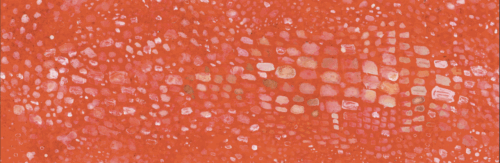
Right? Azul López is a trans Mexican children’s book creator, probably best known in this country at this point for books like Giant on the Shore and Look Up. This book marks a sharp deviation for her, away from those more serious or thoughtful titles. After all, the central plot here is about a bright red crocodile who accidentally gets trapped at the bottom of a pit and calls upon other animals for help. I was rather surprised that the entire opening sequence began with Croco making an attempt to eat what is most clearly an opossum. Until seeing that, I had no idea that opossums were living in Mexico. Extra points to translator Kit Maude, who seems to have a firm finger on the pulse of what makes this text so charming. “Croco tried all fifty ways that crocodiles know to get out of a hole, but none of them worked.” Extra points for the ending where Croco has successfully emerged (I won’t spoil how) only to start pursuing that darned opossum yet again. Gorgeous deep greens and reds make this a real standout.
Downpour: Splish! Splash! Ker-Spash! by Yuko Ohnari, ill. Koshiro Hata, translated by Emily Balistrieri
[Translation – Japanese]
[Previously Seen on the Readaloud List]


Bada-Bada-Bada! Plip! Plip! Plam-Pl-Plam! Noisy raindrops sound like a song, causing our main character to do a distinctive dance and splash in the rain! A WARNING: What we have right here is the ultimate readaloud picture book challenge. Only true professionals need apply. Why would I say such a thing about such a fun book? My friends, it all comes down to this page:

This page, folks, is not for the faint of heart. It requires practice. It requires diligence. In short, when you find yourself sitting in front of that room full of kids, I want you to put your heart and soul into this onomatopoetic cacophony of noise!
In this book, Ohnari and Hata work together to change the point of view, angles, and attitude of this kid in such fun and eclectic ways. A rainstorm, when it gets really really heavy, can definitely be an adventure, and this book leans into that feeling hard. Plus I totally love that shot where you’re the kid yourself and you’re looking straight up as the droplets hurdle towards your face. If you’ve a storytime on a wet and stormy day, I can’t think of a better book to read to a sopping group. Extra points to translator Emily Balistrieri who really knew how to bring that aforementioned onomatopoeia to life.
Dragon Flower by Chen Jiang Hong, translated by Alyson Waters
[Translation – French]
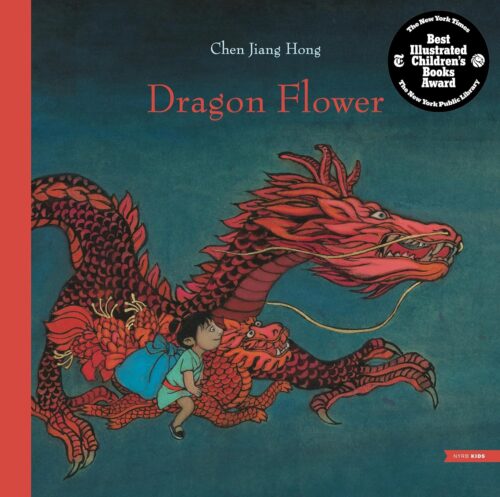
You clever educators, librarians, and booksellers out there probably thought of this already, but have any of you ever done a display or round-up of picture books featuring spunky little girls determined to save the day? I’m quite enamored of this theme, and surprisingly it doesn’t come up quite as often these days as I think it used to. This French import is the work of an artist born in Tianjin, China who now lives in Paris, I believe. Ostensibly, this book is a companion to that lovely THE TIGER PRINCE which came out in America way way back in 2018 (not that long ago, I suppose, but it wasn’t precisely yesterday). Like that book, this features a relationship between a child and a magnificent creature with a reddish hue. The story itself, however, reminded me quite a bit of the stories of Grace Lin. In this tale Mae’s mother suffers from an illness that can only be cured by a single, specific magical flower. When Mae and her parents actually manage to find said flower, they see that it’s guarded by a dragon. Not great. Mae’s such an expressive and determined kid, which is part of the reason I took to this book as much as I did. And who can’t identify with a child determined to save her own parent’s life? The watercolors are so engaging and endearing (Mae is just riddled with personality). One of the more enjoyable original tales set in a kind of Chinese folklore heritage I’ve seen.
The Expedition by Tuvalisa Rangstrom, ill. Klara Bartilsson, translated Saskia Vogel
[Translation – Swedish]
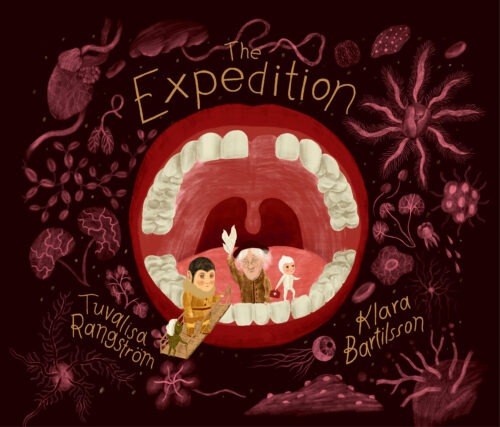

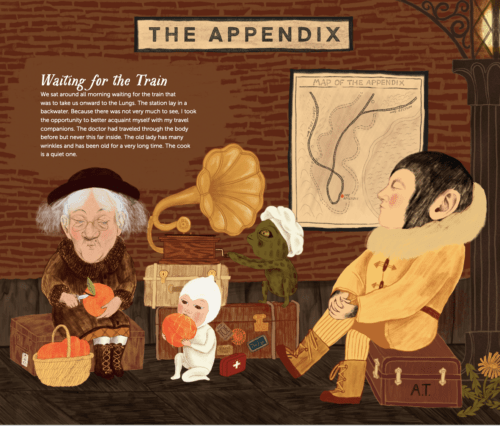
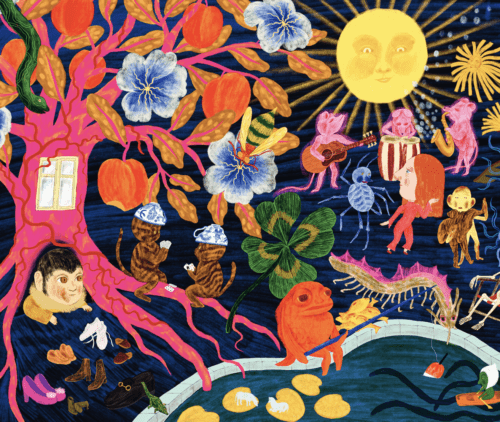
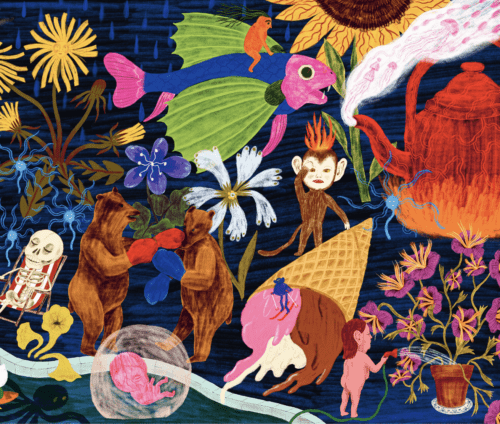
Transit Editions (the American publisher of this book) once told me that when they were at the Bologna Book Fair a couple years ago, they asked one of the fellow publishers there to tell them which title they were most surprised hadn’t yet been brought to America. The publisher replied that this book was without a doubt the one to take. Little wonder that when it was published here, Transit Editions went all out. The title and creators are displayed in beautiful gold lettering on a cover awash in deep pinks and this massive mouth. In a way, the story of this book begins on the cover. There, you can see our four characters as they embark on an epic journey into the body itself. Though they appear to go in through the mouth, things really beg in when they’re taking a boat ride in the stomach and small intestine. The book does amazing things with details, colors, and something a little more ineffable. There is a feeling to this book. It exudes a funny kind of calm, even as the people go through a series of fun adventures. Then there’s that psychedelic ending when our hero makes it to the brain, and that final two-page fever dream of a spread is worth the entire price of admission right there.
Freya and the Snake by Fredrik Sonck, ill. Jenny Lucander, translated by B.J. Woodstein
[Translation – Finnish]

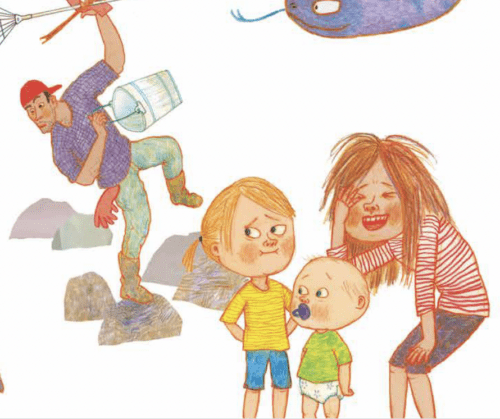
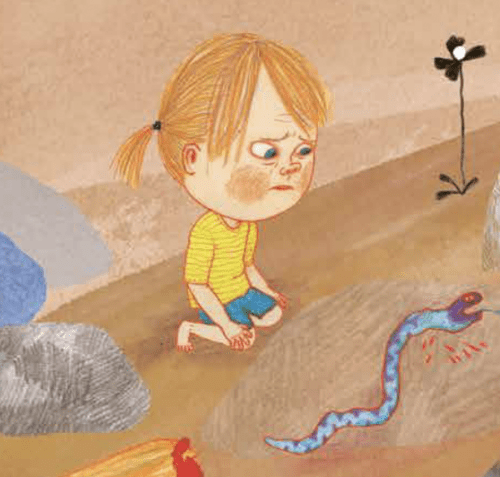
When Freya’s father’s attempts to remove a snake from their property ends with him taking the creature’s life, Freya has to come to terms with her dad’s choices and whether or not she can ever forgive him. Folks, you don’t know how many weird European imports I read and then decide not to include on my best of the best of the best lists. Tons! So when one slips in, you know I’m only including it because it made me really think. I’d have given this book a slightly different cover, had I been in charge of it in any way, but that’s my only gripe. There’s a surplus of reality imbued on these pages. The kind of reality that American picture books for kids tend to eschew. At its heart, this is a story about a girl losing faith in her father. Rightfully? Wrongly? Kids can make their own decisions. Now I know for a fact they cleaned up some of the gore in the dead snake image for North American readers, but the blood is definitely still there, so it’s not for the squeamish. For me, Freya is the heart and soul of this story. That look of entrenched anger when everyone else has moved on and her dad, the “snake-murderer”, has seemingly bought them off with ice cream? The bags under her eyes should get an award alone. It also has, what has to be, the best last page of a picture book I’ve seen in years. Incredible.
How to Reach the Moon by Nicolas Schuff, ill. Ana Sender, translated by Lawrence Schimel
[Translation – Spanish]

When my daughter was quite small I recall reading her a picture book that I had loved as a child myself. When I got to the end, though, she was teary eyed and demanded to know why I had read her a book full of cool things that she would never be able to do herself. The concept of living vicariously through a book never sat well with her. So if you’ve a child who reacts to books in a similar fashion, you may wish to eschew a read of How to Reach the Moon. After all, this little Argentinian import is full of some VERY cool ideas. Like traveling each summer to stay with your grandfather (who, for whatever reason, seems prone to wearing vaguely Tyrolean hats for fun). Or having a huge forest to play in and explore. When Emilio, the kid in this book, tells his Abuelo that he’d love to meet the moon, there’s only one thing for it. They’re off to the moon! But this isn’t some wild fantasy or anything. Instead, they hike to a place where they can find a cool, clear pond. The moon reflects beautifully inside of it, and when the two dive in the text says “Ready for takeoff?” Schimel’s translation reads smooth, retaining all the fun of the text, making you yearn for an abuelo like this of your own.
Is It Asleep? by Olivier Tallec, translated by Antony Shugaar
[Translation – French]


Now 2025 hasn’t been a particularly good year for interesting bereavement tales. Usually we get our best books on the topic out of overseas publications (Yanks are just a mite bit squeamish about the whole discussing-death-with-a-child thing). This year, I was quite taken with the Norwegian short novella My Brother by Laura Djupvik, ill. Øyvind Torseter (seen below0. This Olivia Tallect title, however is a bit on the younger side, though, and follows the critters we encountered in Tallec’s previous book A Better Best Friend (which still wins hands down for its superb cover illustration). A red squirrel and his friend Pock, a sentient mushroom with limbs, are quite fond of listening to a local blackbird. One day the bird isn’t around, and they search about, only to find it lying on the ground, eyes closed. Not wishing to be rude, they wait for it to wake. And wait. And wait. Eventually, the unavoidable conclusion they reach is that perhaps it is dead. Gunther the mouse has a reaction to this idea that I just found incredibly relatable. “Gunther says no, because anything that sings so well and has such beautiful feathers can’t die. It’s impossible.” As with all his books, Tallec’s title has a tone that soothes even as it approaches something as large and looming as the nature of death.This tone is well aided by the talents of translator Shugaar (who, regrettably, is not named on the cover of this book and therefore cannot win any kind of a Batchelder, alas). Everything in this story is set during a kind of autumnal time period, which is a rather perfect complement to everything. The friends bury the bird under leaves with a pinecone on top, and there’s a lovely two-page spread of them walking alongside a river or stream silently. It doesn’t make any grand statements but just shows a loss and a way to cope and remember. Quietly keen.
Late Today by Jungyoon Huh, ill. Myungae Lee, translated by Aerin Park
[Translation – Korean]


When I decided to write this book up as part of an Eerdmans publisher preview back in June of this year, this title sounded awfully familiar to me. I mean, like, really really familiar. Then it struck me. On March 15, 2023, I wrote a post from the Bologna Book Fair called Titles I’d Love to See in America. And for this particular book I wrote, “Last year the picture books of South Korea were my absolute favorites I adored finding so many of them, though alas I have yet to see Battery Daddy or My Father’s Hands on any shelves here in the States yet (come on, people!!). This year, the book I liked the best was Late Today.” For Eerdmans, this is their first Korean translation. Why did I like this book so much when I first saw it? Quite frankly, even before I read the translation, its topics of compassion and sacrifice and busyness were already compelling. In the story a kitten is stuck in a traffic jam. How did it get there? Nobody knows. Will it get killed? Possibly. The kitten, for the record, is able to jump through the different panels. And while everyone wants to help, no one wants to get out of their car. It’s a sort of rush hour book. Better still, the bridge featured is a real one and the author actually lives close to it (it’s in Seoul). On top of everything else, the book makes for great conversation fodder. You can use it to ask young readers, “What would you do? What would you say? What would the people around you say in this kind of a situation?” My favorite line in the whole thing is actually the line at the end. “We all were late. But it’s okay. Today was a good day to be late.” Now kids KNOW all about being late, after all, but the point of this book is that being late is less important than being kind. So get your priorities straight, people.
The Lighthouse Keeper by Eugenio Fernandez Vazquez and Mariana Villanueva Segovia, translated by Kit Maude
[Translation – Spanish]


When I featured this book as part of my Tapioca Stories round-up I mentioned at the time that, “Though originally written in Spanish, they’re publishing it first for English readers, and will release the Spanish edition afterwards. This book was also a Sharjah Children’s Books Illustrations Exhibition 2024 Selection (the Sharjah Children’s Reading Festival is a HUGE international children’s book festival held annually in the United Arab Emirates).” Since that mention I had a chance to read the book for myself and what a wild title it is. Now for a while there I read my children the strange and wonderful Fog Island by Tomi Ungerer, and this book reminded me considerably of that evocative oddity. Of course, the Ungerer book always carried the light threat of possible danger at every turn. This Lighthouse Keeper is an odd looking fellow, but in spite of the Guernica-esque images of sailors near drowning in the sea, this isn’t a book about death but about rescues. This lighthouse keeper is one “the sailors adore”. He fishes them out, sometimes climbing down his hot pink tower in a natty yellow suit with green stripes to save them. But he’s not just saving them physically either. “He embraces everyone he finds floating lost and alone,” and you see him giving a great big hug to a guy in a pink Hawaiian shirt. But, of course, it’s the wild and so strangely beautiful art that’s the greatest draw. From enormous two-page spreads of a single eye, to seas teeming with blue, pink,and yellow sea creatures, this book is a sheer delight to eye and ear alike.
A Magician’s Flower by Marika Maijala, translated by Mia Spangenberg
[Translation – Finnish]

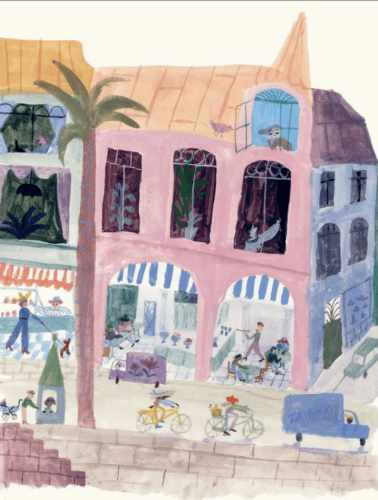

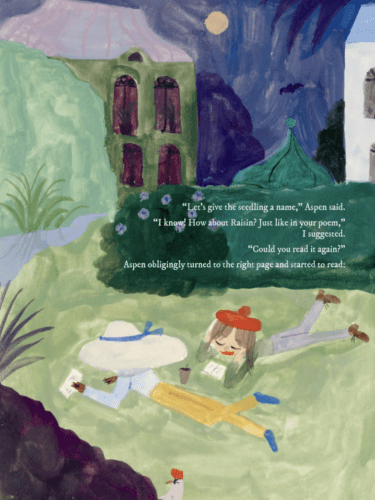

Sometimes we all need that little extra nudge from our friends. This Finnish import follows Willow, a brown-skinned girl with an impressive sunhat, her chicken assistant Eulalia (described as having a “regal red comb”), and her poet friend Aspen, who is white with a red beret. One day, while sweeping up the greenhouse, Willow discovers a very small sprout. Not really certain what kind of plant it is, she gives it a little water and then tries different methods of making it grow, including a trip to the seashore and a little moonlight. That said, until Willow reassures Raisin (she’s named the plant,after a character in one of Aspen’s poems) that she is perfectly welcome to stay small, only then, the next day, does it bloom. When it does, the girls discover that it is a magician’s flower. “Indeed it is said that magicians are the only ones who can create the right conditions for the flower to bloom.” Because the art style is not the kind I, myself, naturally gravitate towards, it took me a little while to cozy up to this book. Once I did, however, I grew so very fond of it. The translation by Mia Spangenberg is delightful, and I credit it with much of the pleasure a kid might have in following Raisin’s sometimes inadvertent adventures. The true relationship at the book’s core, however, is Willow and Raisin. And after all, aren’t all truly great gardeners magicians in their own right?
Mayhem at the Museum by Hannah Brückner, translated by Laura Watkinson
[Translation – German]

*sigh* There really are too many picture books coming out this year. I’m not talking about the schlock. I’m talking about really and truly good books that, for whatever reason, don’t get the same levels of notice or attention. If Mayhem at the Museum had the publicity money of, say, your average celebrity picture book, you’d find it stocked in every museum gift shop in the country, to say nothing of the hearts and minds of countless children. Lucky you, you get to have the 411 on this little treasure (I’m trying to purposefully avoid the overtired term “gem”, but it’s hard, folks… it’s hard). Brückner utilizes this thin pen-lined style to talk about a good old fiasco, in the classical sense. We’re warned of this at the start when the book kicks off with, “People say that really big catastrophes happen completely out of the blue. And sadly, that’s absolutely true. For example, a catastrophe could happen right now, on a very ordinary Thursday afternoon, just before closing time, at the Dinosaur Museum.” Beautiful foreshadowing. The nature of the disaster? Let’s just say it involves a small bird, a phobia, a dinosaur skeleton, and a gatefold gag that may be one of my favorite twist endings in a picture book this year. This book kind of turns on its head the old the-whole-community-works-together-to-solve-a-problem genre. Not that they don’t work together. They’re just… awful at it. Now I’m no Batchelder committee member or anything, but when I read lines like, “When the fluttering little parakeet collides with Yuri’s colossal fear of birds, then… it happens,” it makes me really respect the art of translation. Man. This book’s a delight.
Me and the Magic Cube by Daniel Fehr, ill. Golden Cosmos, translated by Marshall Yarbrough
[Translation – German]
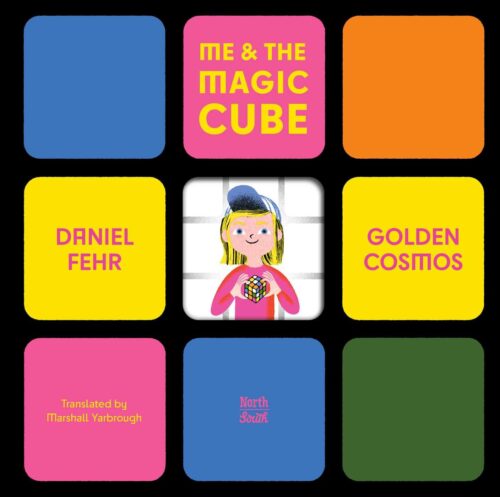
The Rubik’s Cube has enjoyed a bit of a children’s literature renaissance in the last few years. Whether the focus of the graphic novel Lucky Scramble by Peter Raymundo or spotlighting its creator in the picture book biography Ernő Rubik and His Magic Cube by Kerry Aradhya, cube lovers are getting their fill. One might be justified in believing that all the cubes have said all the things, but clearly this is not the case. Enter, Swiss import Me and the Magic Cube, which takes an innovative mix of fact and fiction and melds them into a vibrantly colored tale of Cube discovery. Please note how amused I was by the color choices of the book. While there is a bit of a trend in Europe to use fluorescent colors in picture books (so much so that the Bologna Book Fair once had an entire display on the subject) the colors of this book are not the traditional colors of a Cube. But who cares?? Golden Cosmos (a.k.a. graphic designers Doris Freigofas and Daniel Dolz) bend over backwards to make each and every image in this book eye-popping. I’m actually a bit disappointed that this book wasn’t praised properly by the New York Times/New York Public Library Best Illustrated Awards this year. Seems like it’s doing incredible work. In the tale, a kid finds a Cube in a box and starts to get into it. There are incredible diagrams of the Cube (it’s never called a Rubik’s Cube) and its innermost workings. There’s also info on Rubik himself, an explanation of how to solve it, competitions, moves, and more. The sole flaw, as I see it, is the font size. It’s odd and small, sometimes downright miniscule. A single fly in the ointment, as it were. Otherwise, this is fairly incredible.
The Monster in the Lake by Leo Timmers, translated by Bill Nagelkerke
[Translation – French]

America’s favorite Belgian picture book creator is back!
*runs and quickly confirms that there isn’t another Belgian picture book creator somewhere that I’ve forgotten about … don’t think so.*
Timmers occupies this funny space in the picture book sphere. His books are outlandish and invigorating by turns. Threats appear (sometimes dire ones) but they never quite seem to touch the hearts and minds of the protagonists. Granted, sometimes that’s just because the heroes have their attention fixated elsewhere. In the case of this book our hero is a mallard, just one of four ducks. When they decide to go swim in the lake, he’s a bit stressed out. After all, there’s supposed to be a monster lurking in there. At this point Timmers divides his pages so that 60% is underwater and 40% above. Spoiler alert, there is a monster in the lake: A blasé fellow sporting a striped umbrella (let’s not get into the logistics of why one might have an umbrella underwater), goofy red top hat, bows, and even a pocketwatch on a chain. Chipper and friendly, he and the duck dive down below where a gatefold opens into this marvelously ludicrous world of wackadoodle monsters and fish (at this point the ocean now takes up a good 90% of the pages). About this time the ducks realize that Eric (500 points for naming the mallard “Eric”, by the way) has disappeared and their freakout begins. Timmers nails the landing at the end of this book and fills the pages with so many details and critters that one could easily spend a LONG amount of time poring through the pages. Lord, this man’s books are a delight. See for yourself.
My Dear Sea by André Carrilho, translated by the Bird of a Feather Agency
[Translation – Portuguese]

How can one “respect the sea”? While it’s a wonderful playmate, it has to be understood and even kept clean if everyone’s to enjoy it. A delightful adventure with the waters we love. Not all that dissimilar from The Wide, Wide Sea by Anna Wilson, albeit without the generational component. This one is BEAUTIFUL. It’s a day at the beach where every rock and stone is rendered in gorgeous watercolors. The focus isn’t squarely on beach clean-up, but rather integrated eloquently into the text. This is a book that I could see a kid returning to over and over again, if only to try to feel like they’re in those waters themselves. Imaginative and gorgeous, you will LOVE the sea after reading this!
The Mystery of the Thinking Rabbit by Clarice Lispector, ill. Kammal João, translated by Benjamin Moser
[Translation – Portuguese]
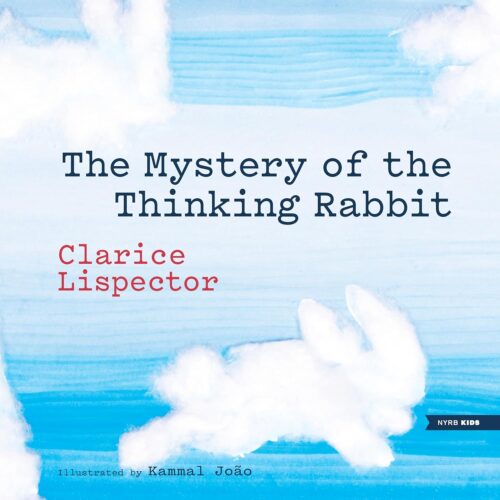
This year NYRB Kids decided to publish two Clarice Lispector picture books for the American masses. The Brazilian Lispector is far better known for her adult short stories and novels, so I came to these books with a gimlet eye. To be frank, I don’t trust adult authors that try writing for kids. 9 times out of 10 they can’t shift gears appropriately and end up talking down to their audiences. And indeed, one of the Lispector books didn’t do much for me at all. Then I read The Mystery of the Thinking Rabbit and found that because she rooted the story in a real experience involving her sons Pedro and Paolo and their peculiar rabbit, it has this remarkable charm. Naturally, if you’re reading this to kids you’re going to want to skip the tiny type author’s note at the start (it’s not labeled as such, but that’s clearly what it is). Any kid that has ever owned a rabbit as a pet is going to appreciate the fine details of rabbit ownership that Lispector recounts. In the story, the rabbit Joãozihno has a tendency to escape his cage. How? Literally no one can work it out, but escape he does and on the regular. It’s a sweet, strange tale, and the type is in a font oddly reminiscent of that of a typewriter, as if you’re reading this directly from Lispector’s own p.o.v.
The Playdate by Uje Brandelius, ill. Clara Dackenberg, translated by Nichola Smalley
[Translation – Swedish]


Getting to have a playdate with Henry is a special treat for one little girl, but when she takes something that doesn’t belong to her, it has the potential to change everything. A clever book of privilege and envy. Maybe it’s a bit on the subtle side, but for sheer slow dawning comprehension, this book has no twin. As you read through it you come to the realization of what is actually going on here. So maybe this is a bit sophisticated for kids, but I honestly feel like you can read it on different levels. From a young child’s point of view there’s just the basic story about doing something wrong and feeling bad about it, then making it right. But, of course, there are going to be other readers with parents in similar situations who know all too well the larger implications of what might be going on here (I mean, this mom could easily be fired for this). And what really is fascinating is the depiction of the boy’s mom. I really felt like I knew that woman, and she wasn’t portrayed as mean or snobby or anything like that. The Swedes, man. They make some clever books.
The Slightly Spooky Tale of Fox and Mole by Cecilia Heikkilä, translated by Polly Lawson
[Translation – Swedish]


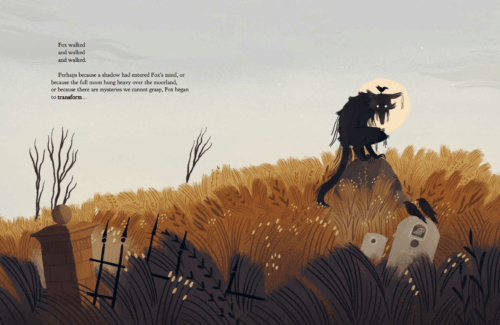
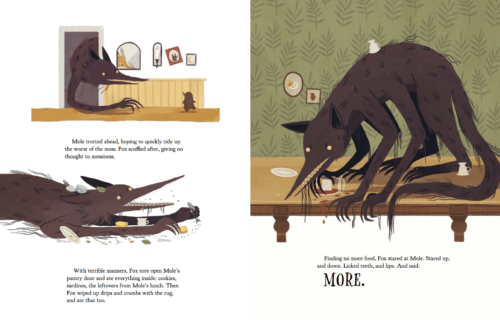
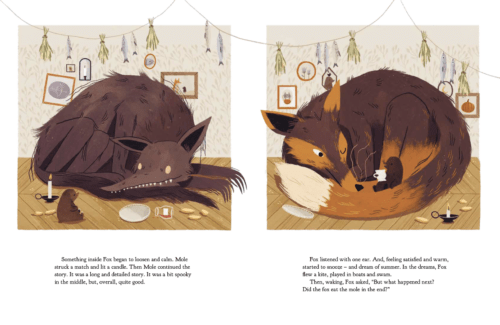
That title isn’t wrong: This truly is slightly spooky. Maybe even a little more than spooky at times, since it involves a trusted friend turning into a monster (which is scary for kids in an entirely different kind of way). The story also involves something I haven’t seen much in a picture book before: Sheer horrifying ingratitude. Fox and Mole are friends and that would be fine except that Mole is the kind of guy who takes and takes and it just never occurs to him to give. He’s not mean about it. He just has zero interest in his friend’s wants or needs. And Fox is a great guy but this is the kind of thing that wears a person down. One evening Fox is reading a book called “The Legend of the Scuffling Monster” (and I’m going to give translator Polly Lawson 30 points here for making that word “scuffling”) aloud to Mole. The story is about a raccoon who turns at midnight into a scuffling monster. Mole’s a little freaked out, then arranges to come back (and eat all of Fox’s stuff because “I don’t have any storybooks” at his place). When Fox’s birthday arrives Mole is … well, he’s an even bigger jerk this time than ever and you are just SO on Fox’s side when his anger transforms him into a beast. And, oh man, oh man. There is this two-page spread that is just the EYES of beast that will haunt your children’s dreams for the rest of their natural born lives… in a GOOD way! So strangely, enticingly, satisfying.
Take a Walk With the Wind by Xiong Liang, translated by Chloe Garcia Roberts
[Translation – Chinese]
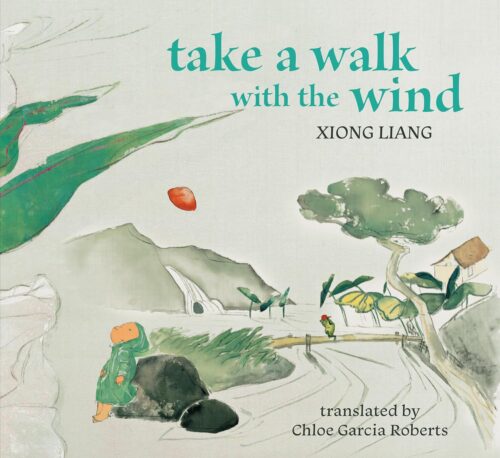
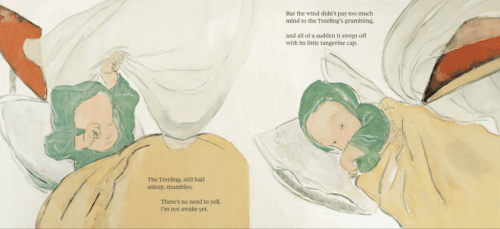


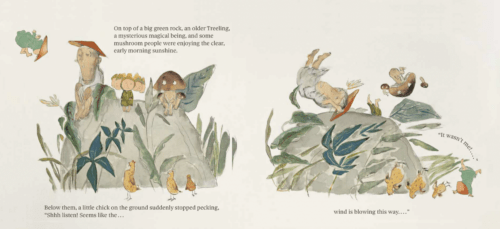

Though written in 2016, Xiong Liang’s story of a little Treeling and a naughty wind has all the hallmarks of a very old and classic tale. One could well imagine this book coming out at the same time as in the days of Beatrix Potter. Some of that has to do with the quality of the watercolors, but there’s a tonal similarity as well. The book opens with a rather wordy full page of text explaining that, “If an ancient mountain forest is left alone and not damaged or disturbed for a period of at least several hundred years, it will then spontaneously produce a kind of miniature being known as the Mu Ke, or the Treelings.” Hard not to love an opening like that. In this tale, one such Treeling is apparently friends with the wind. The wind would like to go on a walk, and when the Treeling is a bit slow to agree, the wind not only steals its hat but bodily picks up the Treeling itself and whisks it into all kinds of mischievous situations. The poor little Treeling is often left calling back to the creatures it disturbs, “It wasn’t me.” One particularly charming two-page spread has the words, “I really did not have anything to do with this,” which is a translation that I found particularly fun. All resolves itself in the end, but for readers the journey is far more fun than the destination.
2025 Translated Books for Older Readers
FEATURED TITLE
My Trip with Drip by Josephine Mark, translated by Andrew Shields
[Translation – German]

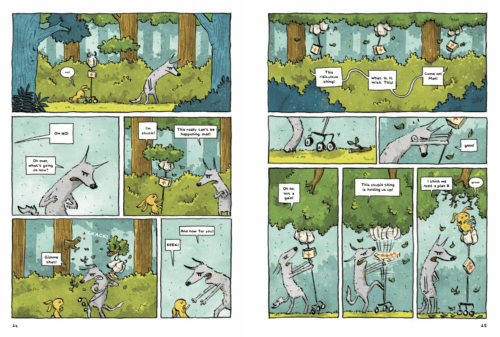


Optional Alternate Title: They Just Don’t Make ‘Em Like This In America! It’s the Germans this time, and let this be yet another poked hole in American belief that the “Germans aren’t funny”. Maybe the stuff for adults isn’t, but the children’s stuff is fantastic! Case in point, a graphic novel with more guts than you’re going to see all year (and a serious Batchelder contender, by the way). The story focuses on a small rabbit who is taking some kind of medicine. He’s pretty much permanently attached to an IV, his gums are bleeding, and he’s losing his fur. But all that is almost secondary to the adventure he finds himself on when his IV stand accidentally repels a bullet and saves a wolf’s life. Now the wolf is honor bound to the bunny (whether the bunny wants it or not) and the next thing you know they’re stealing cars, kicking over the motorcycles at a biker bar, gambling, and escaping an Inspector Javert-like hunter who is determined to get them in his sights. Yet the heart of the piece (and it has a lot of heart) is the increasingly tender relationship between the bunny and wolf. As the bunny spends time with the wolf he finds himself growing braver and more confident, while the wolf begins to come to terms with not being alone anymore and finding a pack. Personally, I always have a problem with books where someone needs to take medication regularly and doesn’t, but that is NOT this book. The wolf himself takes the bunny’s medication plan very seriously. I don’t know that we see a lot of books with heroes disabled in this particular way, but if this story is any indication, we could use a lot more.
Earhart: The Incredible Flight of a Field Mouse Around the World by Torben Kuhlmann, translated by David Henry Wilson
[Translation – German]

When a little field mouse sees the image of a lion on a stamp her mind reels. Where could such a beast live? And how can you get there? A round-the-world adventure starring a one-of-a-kind aviatrix. While technically this is a companion to Torben’s first transportation-rodent title Lindbergh, it stands entirely on its own. I’ve always considered him the lovechild of Beatrix Potter and Brian Floca (with just a hint of Steampunk mixed in there for spice). So far, Torben has covered Lindbergh, Armstrong, Edison, and Einstein. Nice to get a woman in there for once, and I daresay this is his first female mouse protagonist as well. She’s also a bit of a rocket scientist, so it’s STEM-girl strong! I don’t know if Torben’s translators are getting better or his writing is, but this just felt a lot more kid-friendly and fun than some of the more technical titles he’s done. Mind you, I saw that ending where our heroine joins with Earhart and couldn’t help hoping that that little jetpack of hers keeps working. Fun bedtime reading.
From Memen to Mori by Shinsuke Yoshitake, translated by Ajani Oloye
[Translation – Japanese]

In strange and sweet little sequences, a brother and a sister question the world around them in this gently philosophical title. I know that I keep putting weird European books into this category, but I’m not doing that now. No. No, now I’m putting weird Japanese books into this category. Improvement! So I’ve loved Shinsuke Yoshitake for years and years, but he’s never done anything quite as long as this book. It’s separated into little stories that really and truly do embody the spirit of Memento Mori (remembering that you will die). That sounds dire, but they’re sad and sweet. I loved particularly the story of the snowman who wishes for just a little bit of remembrance, even as it melts. Absolutely pitch perfect.
Lamberto Lamberto Lamberto by Gianni Rodari, ill. Roman Muradov, translated by Antony Shugaar
[Translation – Italian]


Well, that was the darndest thing. Charming too. Okay, so this is a book that, insofar as I can determine, was never released in the United States before. And since I was rather fond of the Rodari/Shugaar team title The Book of Whys (to say nothing of the picture book Telling Stories Wrong), I figured that it would make for an interesting read. Interesting doesn’t even get into it, though! The whole story is about the Baron Lamberto. This guy is rich. We’re talking Uncle Scrooge levels of rich. He is also old, with twenty-four maladies to keep track of. So when he discovers a way to reverse the effects of aging (let’s just say it’s the original talking cure) he pounces on it. Along the way we also meet the six people he’s employed to say his name on a nonstop loop, his scheming nephew, and a troupe of robbers also named Lamberto. It’s wonky, wacky, utterly bizarre, and charming. Extra points to Rodari for creating the feminist icon Delfina who refuses to be girlfriend, wife, or mother to any of the dingbat men in this story. The art by Muradov is a lot of fun (in spite of his seeming inability to understand in which direction the ends of knitting needles are supposed to point) because as he explains in his Artist’s Note, the previous illustrator of the book was the great Bruno Munari, and he was more inclined to create pictures of “semi-abstract images”. This style seems a lovely compromise. Lots of geographic shapes but also recognizable figures. A charmer at its core.
My Brother by Laura Djupvik, ill. Øyvind Torseter, translated by Martin Aitkin
[Translation – Norwegian]

A daughter and father miss her brother, who is dead and gone. When they fish him up from the deep in a fjord, they finally can start to talk about him and move past their grief. I just have such an odd feeling of affection towards this sweet and weird and heartbreaking and weird and cathartic and WEIRD little book. I mean, I can’t think of that many stories off the top of my head where someone is dead, emerges from a fjord, and that becomes a sweet rather than creepy situation. This book is shouldering a LOT of different interpretations, and I can’t help but think of all the conversations you might have with kids about what precisely it all means. Not your usual American fare, that’s for certain.
The Ordinary Life of Jacominus Gainsborough by Rébecca Dautremer, translated by Charis Ainslie
[Translation – French]


In this utterly unique telling with sumptuous art, we see the entire life of Jacominus Gainsborough from birth to death and consider what it is that makes a life worth living. While I think that technically one would call this an older picture book rather than an early chapter book, this is one of those titles that straddle a couple different genres simultaneously. Its theme, also, is distinctly on the mature side. In essence, it’s a person’s life from the beginning to the end, only in this case it’s an anthropomorphized rabbit. The story is good (and it’s a crime and a shame that Post Wave didn’t put the translator on the cover since this would be an EXCELLENT Bachelder Award contender) but the art is the true lure. It took me a little while to realize that once you identify the characters at the start, you see them over and over and over again throughout the storyline. Some images are like seek-and-find books (just try to locate Jacominus at the seashore). It’s introspective and philosophical but I truly do believe that for the kid that loves Animalia, they’re just gonna pore over these images and figure out entire plotlines in the art that are never mentioned in the text.
The Tree That Was a World by Yorick Goldewijk, ill. Jeska Verstegen, translated by Laura Watkinson
[Translation – Dutch]


Do you know how the good people at Eerdmans sold me on this book? They read me a chapter from it aloud. It wasn’t a particularly long chapter, but it was one in which an aphid sister finds herself inexorably drawn to the idea of eating her siblings. Now cannibalism is a whole thing. It can be done right. It can be done wrong. But in this particular weirdo little story, it is done very very well. The book is a series of eighteen short stories centered on the animals that live around and about a single tree in a forest. Some of these tales are funny, like the sloth that loves to run like the wind at night (but only if nobody’s watching). Others are strangely poignant, like the two pikes that share a pond. One pike is convinced that the other is stuck up and snobby. The other pike is desperately in love with the first pike and scared to death of showing it at all. Laura Watkinson’s translations are so keen (and Batchelder-worthy) and often very beautiful in their lyricism. The art by Jeska Verstegen is a funny blend of beautiful, sometimes creepy, and always interesting. Honestly, this is an IDEAL pairing with My Presentation Today Is About the Anaconda (which is also Dutch, so apparently people in the Netherlands have a thing for opinionated animalia). It’s also a slim little book. It might make for a fascinating read by a teacher to a class. But is it normal? Not in the slightest. Maybe that’s its edge.
The Village Beyond the Mist by Sachiko Kashiwaba, ill. Miho Satake, translated by Avery Fischer Udagawa
[Translation – Japanese]

You can’t do much better as a translation in the American children’s book market than to proclaim loudly and proudly that your book was the “Inspiration for the film Spirited Away”. One might look upon such a statement skeptically, but the fact of the matter is that it’s true. Sachiko Kashiwaba isn’t a household name here in the States, but in Japan she’s one of the greats. A children’s and young adult fantasy writer who has been working for five decades, we’re not entirely unaware of her work here in the States. I mean, her books Temple Alley Summer and The House of the Lost on the Cape (both of which, to my chagrin, I missed reading) won Batchelder Awards and Honors, respectively. This particular book (originally published in Japan in 1975 or so, which is how Miyazaki knew it) is so friggin’ charming that once you’ve read it you’re convinced that you must have known it your whole life. You know when parents or grandparents come into the library asking for something “classic” or a good readaloud bedtime story? Give ‘em this. The illustrations by Miho Satake, for starters, are a great match. But then the tale itself is also fantastic. A girl is sent for the summer to “friends” in the country, but when she gets to the train stop no one is there to meet her and no one has heard of where she’s supposed to go. She soon finds herself in the strangest little village where she befriends a wild array of people, all the descendants of wizards. Magic and fun, tons of sweets and toys, enchanted princes and cowardly tigers, this book has it all. Best of all? It’s a sweet little 146 pages.

That’s it for today! Be sure to stay tuned for more lists on 2025 titles. The full roster is here:
December 1 – Great Board Books
December 2 – Picture Book Readalouds
December 3 – Simple Picture Book Texts
December 4 – Transcendent Holiday Children’s Books
December 5 – Rhyming Picture Books
December 6 – Funny Picture Books
December 7 – Caldenotts
December 8 – Wordless Picture Books
December 9 – Bilingual Books for Kids
December 10 – Math Books for Kids
December 11 – Books with a Message / Social Emotional Learning
December 12 – Easy Books
December 13 – Translated Children’s Books
December 14 – Fairy Tales / Folktales / Religious Tales
December 15 – Gross Books
December 16 – Poetry Books
December 17 – Unconventional Children’s Books
December 18 – Early Chapter Books
December 19 – Comics & Graphic Novels
December 20 – Older Funny Books
December 21 – Science Fiction Books
December 22 – Fantasy Books
December 23 – Informational Fiction
December 24 – American History
December 25 – Science & Nature Books
December 26 – Unique Biographies
December 27 – Blueberry Award Contenders (Celebrating the Environment)
December 28 – Nonfiction Picture Books
December 29 – Nonfiction Books for Older Readers
December 30 – Middle Grade Novels
December 31 – Picture Books
Filed under: 31 Days 31 Lists, Best Books, Best Books of 2025

About Betsy Bird
Betsy Bird is currently the Collection Development Manager of the Evanston Public Library system and a former Materials Specialist for New York Public Library. She has served on Newbery, written for Kirkus, and has done other lovely little things that she'd love to tell you about but that she's sure you'd find more interesting to hear of in person. Her opinions are her own and do not reflect those of EPL, SLJ, or any of the other acronyms you might be able to name. Follow her on BlueSky at: @fuse8.bsky.social
ADVERTISEMENT
ADVERTISEMENT
SLJ Blog Network
Top 10 Circulated Picture Books of the ’25-’26 School Year
Pancake Trap | This Week’s Comics
From Policy Ask to Public Voice: Five Layers of Writing to Advance School Library Policy
Making the Truth Bearable, a guest post by Kristine Rudolph
ADVERTISEMENT
So many of my favorite pictures books of the year on this list. Good luck to the Batchelder committee. They have quite the task in front of them.
Ask a group of kids the moral of Croco.
My favorite answer so far “when you’re in trouble you should just start crying”. I couldn’t agree more.
I think you under sold the art with in Clara. I find it absolutely stunning.
Thanks so much for such glowing reviews, Betsy! And thank you for honoring translated titles and the translators who bring these works of art to readers in English.
The Expedition also has a small font size and the color of the text is often hard to read against the dark backgrounds. Fine for kids to read to themselves. Not so good for the adults who might want to read to them.
Font size is also an issue (for me!) in a lot of graphic novels.