31 Days, 31 Lists: 2025 Nonfiction Picture Books
The creme de la creme! The top of the pops! Titles I won’t be able to forget, no matter how the years roll by. This list consists of a lot of books you’ve seen before on other lists, along with a couple new ones that didn’t quite fit in anywhere else. These are my particular favorites. Enjoy them as I have.
Would you like a PDF of today’s list? You can find one here!
And interested in previous years’ Nonfiction Picture Book titles? Try these:
2025 Nonfiction Picture Books
FEATURED TITLE
The Black Mambas: The World’s First All-Woman Anti-Poaching Unit by Kelly Crull
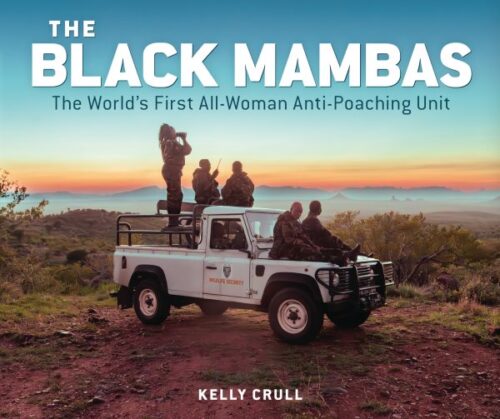


What do you think of when you think of poaching? Rare and endangered animals hunted to death, perhaps? An impossible problem that can’t be overcome? Now what do you think of when you think of anti-poaching teams? Better yet, an all-woman anti-poaching team? Meet the Black Mambas. These rangers work in a nature reserve in South Africa’s Greater Kruger National Park, protecting critically endangered species alike black rhinos, ground pangolins, and more. How do they do it, what does it take, and what does an average day look like for them? Join them as they spot snares, educate kids, and make the world a better place. A book that gives you hope in bleak times. Backmatter includes a NATO Phonetic Alphabet, the animals featured (and a pronunciation guide for teach animal in the Black Mambas language of Sepedi), an Author’s Note, and a bibliography of Books and Websites. To read this book is to understand that no matter what it is that you ever do with your life, you will never, ever, be as cool as The Black Mambas. You just have to be okay with that. This book looks like it would normally be in an older nonfiction section, and I think it would fit in there just fine, but the fact of the matter is that this text manages to be short, sweet, and to the point. It also manages to pack in a ton of information in a relatively short amount of time. You get a very clear, and surprisingly sympathetic, understanding about why it is that people poach. You get hard numbers about the animals that get hurt the most. And then you have these just incredible photographs. I LOVE the endpapers that show each Mamba and says, “Meet the rangers. Can you find all of us in the book?” But take the cover off this book and it’s even cooler! I never knew they could make a book where the kids reading it become desperate to grow up to be anti-poachers themselves, but this is it. Do I even need to mention the amazing backmatter? It goes without saying.
ADVERTISEMENT
ADVERTISEMENT
Alberto Salas Plays Paka Paka con la Papa by Sara Andrea Fajardo, ill. Juana Martinez-Neal
[Previously Seen on the Biography List]


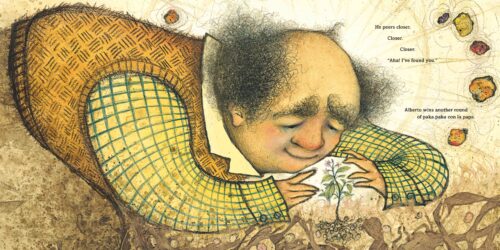
Agricultural scientist Alberto Salas is on the hunt… for potatoes. If he finds them, they could help to feed the world. If he misses them, they might go extinct! A glorious introduction to a little known science told with fun and whimsy. Ach. This is how you do it, people. You take a serious subject and you find the kid-friendly element in it that will make it alluring to them while sneakily teaching them something along the way. Turning the research work of Alberto Salas into a game of seek-and-find isn’t hard at all, and Fajardo really knows how to tap into the fun of it all, while also retaining the serious nature of Salas’s work. Martinez-Neal took a little break and is back better than ever, her art just leaping off the page. And then… there is the backmatter. The glorious glorious backmatter. This is everything that an informational picture book should strive to be. Bonus: Simultaneously available in a Spanish edition as well!
Are You a Friend of Dorothy?: The True Story of an Imaginary Woman and the Real People She Helped by Kyle Lukoff, ill. Levi Hastings
[Previously Seen on the American History List]
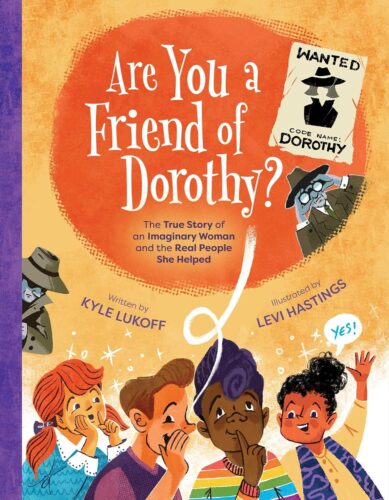
How could LGBTQ+ people be safe in an era when being queer was a crime? A book that spotlights and uplifts people who have always wanted, and remain wanting, to be themselves. Sticking it to the man 1950s style. You know, one thing that I really like about Kyle Lukoff is that he doesn’t go for the obvious. When people do nonfiction picture book on queer history, they tend to go for topics like Stonewall, the creation of the Pride flag, or bios of famous folk. Lukoff isn’t afraid to find topics that have a bit of playfulness to them but that also tell a part of history that can be construed as awful, without depressing the children. That’s a fine line for any author to walk. Telling the truth while keeping things kid-friendly. In this book, Lukoff focuses on government surveillance of queer people through the lens of folks calling themselves “friends of Dorothy”. What’s keen is how much joy he’s able to spotlight. There’s a particularly adept section that shows gay people dancing and having parties and weddings on one brightly colored page, while on the opposite page you’ve these muted browns and greens of the government workers listening in on them. A big swing that connects.
The Boy Who Became a Parrot: A Foolish Biography of Edward Lear, Who Invented Nonsense by Wolverton Hill, il. Laura Carlin
[Previously Seen on the Biography List]


The benefit of being silly and having a fabulous imagination could be no better explained than in this charming retelling of the life of Edward Lear. Beautiful and fun! I think the publisher (and possibly the editor) of this book is on to me. When she sent me this book she included a tiny handwritten note that just said, “The mere facts of a life will never capture and contain the spirit of that life.” Translation: There’s a talking parrot in this book that has a whole conversation with Edward Lear and it’s awesome. So this may be the book that breaks me. You KNOW I’m a hardcore, anti-fake dialogue, stickler, but that’s all because I don’t like the idea of fooling kids into thinking a person actually said one thing or another in the course of their life. How am I supposed to handle a book that’s so blatant when something is untrue? There are flights of fancy here that are clearly not true to life, and are done in Lear’s style. Then there are a ton of facts and, though the backmatter could be better, they sure seem to be direct quotes from different sources. Why am I justifying this? Because the book’s delightful. I knew nothing about Lear, and his life was just as fascinating as one might expect. And there IS backmatter, but it shows his cool paintings made during this lifetime (the dude was GOOD!) more than anything else. I’m just… fond of this strange book. So I’m giving up and putting it here on a nonfiction list.
The Buzz on Wild Bees: The Little-Known Pollinators that Keep Our Planet Humming by Kira Vermond, ill. June Steube
[Previously Seen on the Science and Nature List]

Meet my current obsession. Do you know how rare it is to encounter a picture book that causes you to make actual changes in your life? I suppose I’d sort of known about wild bees before, but this book really breaks them down. Not only are they particularly cool to look at (the blue ones are my favorite) they’re responsible for a LOT more than I thought. For example, I’m a fan of tomatoes. I love to grow them. And, apparently, honeybees are not a tomato’s best friend. Nope. Only wild bees vibrate at the correct frequency to pollinate those puppies. And though I retain my childhood hatred of sweat bees, I must acknowledge some of their cooler aspects as well. I’m so thrilled by learning all of this that I’m determined to get some bee hotels for my backyard and soon! Great informative writing, a fun cluster of facts, and a nice break from those honeybee titles taking up all the shelf space.
Cassini’s Mission: A Spacecraft, a Tiny Moon, and the Search for Life Beyond Earth by Katie Venit, ill. Julia Blattman
[Previously Seen on the Science and Nature List]

Is there life in outer space? And if there is… is it closer than we think? When the spacecraft Cassini was sent to explore Saturn and its moons, no one expected it to send back the information that it did. Seems to me that any book that teaches kids the fact that science is constantly learning new things is a good thing. But what really makes this particular title stand out is how it shows how scientists often have to correct their own assumptions when they encounter new facts in the course of their research. I really enjoyed how Venit laid out the information in this book. First, right from the get-go she explains very clearly the three things you need for life (Water, Chemicals, Energy). But though I’ve heard lots of people talking about the possibility of Juno (one of Jupiter’s moons) having life, this is the very first time I’ve ever heard Enceladus (“the shiniest moon in the solar system”) mentioned at all. And I love that the scientist’s assumptions were completely understandable, and then had to be corrected. A clever title that really makes you, not only think, but dream.
Don’t Eat the Cleaners: Tiny Fish with a Big Job by Susan Stockdale
[Previously Seen on the Science and Nature List]

If fish swim in water all day, do they need to get clean? They do! And who cleans them? Meet the tiny helper fish. They have a job to do and they are more than happy to do it! There was something about this title and subject matter that drew me in right from the start. Then, lo and behold, I discovered just how incredibly cool it was. I knew that there were fish that were “cleaners” of other fish, but what I didn’t know was the sheer variety or the logistics behind the whole process. Stockdale’s book is absolutely engrossing, covering everything from whether or not these little fish would clean YOUR teeth (they would) to what happens when they make a mistake and have to make amends with the host fish. It’s a little paltry on the backmatter (there’s just an “Ocean Animals: Can you find them in the book” section at the end) but aside from a small Bibliography there’s not much I’d ask of this book. It’s just a really cool take on a too little lauded topic.
Families of a Feather: A Celebration of Family Diversity by Fern Wexler, ill. Kelsey Buzzell
[Previously Seen on the Blueberry Award List]

There are all kinds of different families in this world, and that goes for the birds in the trees as well! A cool look at everything from single mom hummingbirds to same-sex albatross parents. There’s always a bit of a danger of anthropomorphizing nature, seeing them through a specifically human lens, but after reading this book I don’t think that this is doing that, exactly. It’s a clever pairing of different types of families with different kinds of birds. Now I have a cousin who’s part of a polyamorous family (a kind of family that is never ever ever portrayed in children’s picture books) so imagine my surprise when I saw an acknowledgement of such families here. Subtle, but definitely there in the acorn woodpeckers section. Nice, but not terribly overwhelming backmatter, and I learned something about black swans and laysan albatrosses! Very cool!
The Five Sides of Marjorie Rice: How to Discover a Shape by Amy Alznauer, ill. Anna Bron
[Previously Seen on the Math List]

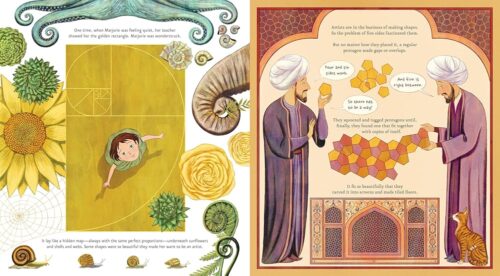


What does it mean to “discover” a brand new shape? Meet Marjorie Rice, an ordinary woman who discovered shapes no one had ever found before. I just want to state for the record that while I adore math-related children’s books, I very rarely bring them to the attention of my library’s 101 Great Books for Kids committee. This is one of the rare exceptions, possibly because it’s a fun topic that I was pretty much unaware of. Can you discover a new shape? You can when there are rules in place governing how to do so. Marjorie Rice wasn’t a mathematician and, thanks to the times in which she lived, she spent most of her time in her home. Still, she got hung up on the idea of discovering a new five-sided shape that would fit into a pattern without gaps. There’s a lot of text here but the book gets away with it because it’s fascinating, and paired with the incredible art by Anna Bron, which makes everything just so doggone interesting. The backmatter? Impressive. Now I know this isn’t the point of the book, but I feel like there’s a subtly subversive message here about how friggin’ boring it is to be a housewife. Add in the fact that the book will actually inspire kids to notice the shapes around them, and I’d say that this book is really one-of-a-kind.
Gabba Gabba We Accept You: The Wondrous Tale of Joey Ramone by Jay Ruttenberg, ill. Lucinda Schreiber
[Previously Seen on the Biography List]


That the awkward boy who loved rock n’ roll, and couldn’t fit in, turned into Joey Ramone, one of the fathers of punk, is a story worth telling. A beautiful and touching look at finding what you love and living it. By all rights this book shouldn’t work. It’s created in the Chicagoland area by a music publisher that doesn’t really know the book business. The author is a New Yorker writer who never wrote a nonfiction work for kids before. The artist, meanwhile, is a fine artist and (likewise) has never tried making a book with kids. And yet, and yet, and yet this book works amazingly well. And part of the reason I think it’s as successful as it is is in large part because it’s not simply an encapsulation of what made Joey Ramone a star, but it’s also an explanation of what “punk” was, and why it was important, written in a way that gets kids excited about it. This is something else. Check it out.
A Gift of Dust: How Saharan Plumes Feed the Planet by Martha Brockenbrough, ill. Juana Martinez-Neal
[Previously Seen on the Science and Nature List]
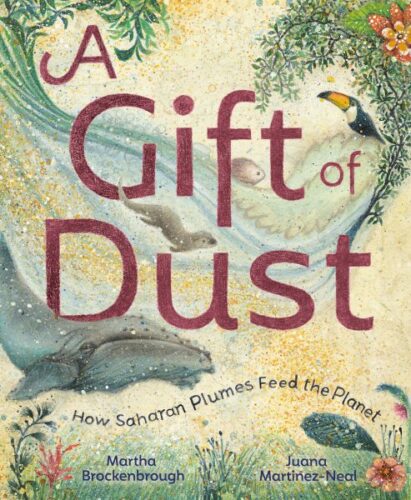
How does an ancient fish control the raindrops that fall from the sky? Learn about the Saharan plumes that affect living things all over the Earth. Doggone it, Juana Martinez-Neal. She disappears for years on us, and then when she comes back she has the doggone nerve to work on MULTIPLE amazing nonfiction picture books IN THE SAME PUBLICATION YEAR?!? How dare she. Alongside the utterly wonderful Alberto Salas Plays Paka Paka con la Papa is this book about the debt we, as a planet, owe to the Saharan plumes. Now, like a lot of adults that read children’s nonfiction, I may be overly laudatory to the informational topics that I’ve never personally encountered before. That said, I think Brockenbrough’s text here is precisely the right length and is of more than sufficient interest to child readers. And somehow (and this shouldn’t even be possible) Martinez-Neal is making the color brown interesting. Brown! The most impossible color to make fun! So yeah, it’s a great topic with great information (and bee-you-tiful two-page backmatter) but it’s also just a cool book for kids.
Go Tell It: How James Baldwin Became a Writer by Quartez Harris, ill. Gordon C. James
[Previously Seen on the Biography List]


“The first time James Baldwin read a book, the words clung to him like glitter.” The early life of one of America’s greatest writers comes to vibrant life in this incredible peek into his earliest inspirations. This is one of those cases where you read a picture book biography from a first-time children’s author and can’t help but say, “This guy has never written a book for kids before?!? Seriously???” Quartez Harris has a natural feel for the form, that’s for sure. Here we have yet another example of just the right text being paired with just the right illustrator. Like a lot of artists, Gordon C. James is at his best when he has a text worthy of his art. Not since Crown: Ode to a Fresh Cut have I been so delighted by one of his books. This isn’t the first picture book bio of Baldwin, but it’s the one that’s gonna live rent-free in my head for a long long time. Incredible writing, gorgeous art, and a book worthy of its subject.
The History of We by Nikkolas Smith

Take a trip back in time to our earliest ancestors. Nikkolas Smith delves deep into humanity’s past and shows how much has changed and how much has stayed the same. I’ve been advocating for Nikkolas Smith to win ALL THE THINGS for years now, ever since I saw his work on the 1619 Project. This might be his best book yet, though. In a country where DEI initiatives are being rolled back en masse, a book that explains that all humanity began in Africa feels downright subversive. The art is, as ever, incredible, but his text matches it as well, proving that Smith is one to watch on both fronts. There’s really nothing else like this on our shelves. Now we need to demand more!
Here’s a video of me talking with Nikkolas about this book:
If You Like Butterflies by Lola M. Schaefer, ill. Gabi Swiatkowska
[Previously Seen on the Science and Nature List]
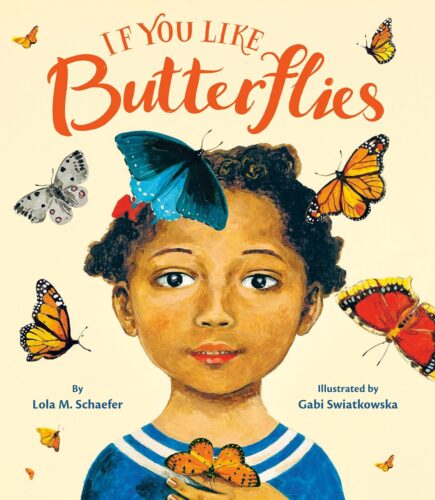
If you like butterflies… you’ll probably want to read this book. Conversational writing explores the world of these odd and beautiful creatures. Another butterfly book? One begins to wonder if there is such a thing as too many butterfly books. But in a year where we have books like Papilio, maybe it’s okay to have a slew of them if they’re all as good as this one by Schaefer. I can’t imagine how difficult it is to try and write a book about butterflies that doesn’t sound exactly like every other dang book out there. This one has a very friendly conversational style that starts with the title and doesn’t change much after that. It keeps things really friendly and basic, which is nice for the kids (and nice for the adults reading this book aloud to the kids). One element that in all my livelong days I’ve never seen anyone do in a butterfly book before is this gorgeous two-page spread of what different kinds of butterfly eggs look like. Some resemble jewels and some aliens, but all of them are fascinating. Swiatkowska really outdid herself with this one.
Imogen: The Life and Work of Imogen Cunningham by Elizabeth Partridge, ill. Yuko Shimizu
[Previously Seen on the Biography List]

Born in 1883 as one of ten kids, Imogen spent so much of her time trying to find just the right art. When it turned out to be photography, her fame was sure to follow. A loving encapsulation of a life. By gum, they sure do like to release books illustrated by Yuko Simizu near the end of the year, don’t they? Imogen is such a lovely example of how you can take a subject that most would treat with a bland encapsulation of facts and turn it into a story about someone you learn to care about in a scant number of pages. Imogen Cunningham may be Elizabeth Partridge’s grandmother (a fact that still blows my mind, since I was a photography major in college and knew the woman’s work well) but there’s nothing cloying or rote about this writing. The Imogen in this book is passionate about finding precisely the kind of art that suited her best. You just walk away adoring her (and wanting to see more and more of her work). As for Yuko Shimizu, there’s a reason that woman won a Caldecott Honor recently. This is a fireball of a book.
Jellyfish Scientist: Maude Delap and Her Mesmerizing Medusas by Michelle Casulito, ill. Ellen Rooney
[Previously Seen on the Blueberry Award List]

It’s 1899 and Maude Delap is embarking on a grand experiment: She’s going to try to keep a jellyfish alive through its whole life cycle while in captivity. Can it be done? Turns out, the end results are more fascinating than anyone might have suspected. I mean, I just didn’t expect the jellyfish to eat one another, let alone for Cusolito to recount the fact! See, this is the kind of nonfiction picture book I want to see more of. It’s exciting and interesting and strange all at once, yet never relies on fake dialogue or deep dives into what the subject thought without sourcing. And was I the only one who didn’t know about strobilization? I think I must have stared at these endpapers for hours, just trying to figure out precisely what it all means. Wonky doesn’t even begin to describe it. You know what this book is capable of doing? Turning all its readers into future jellyfish scientists, that’s what! A title that knows how to keep the fun of discovery intact, even as it relays the facts. Great writing. Great art. Great backmatter. This is the whole package.
Jim! Six True Stories About One Great Artist: James Marshall by Jerrold Connors
[Previously Seen on the Biography List]

This gentle and delightful paean to picture book creator James Marshall plucks stories from his life and tells them entirely in his style. Clever and touching all at once. Considering the sheer amount of difficulty inherent in writing picture book biographies and not making them all samey-samey, I have nothing but praise for Jerrold Connors’s methodology here. First off, picture book bios of picture book creators are almost impossible to write. The reason is simply because while the librarians and teachers might care about that person, kids won’t necessarily. Connors had the clever notion to be inspired by, but not try to replicate, Marshall’s style. The format of the book, however, is set up very much like a George and Martha book, with small stories written with simple words. Including cameos from famous people (Maurice Sendak and Arnold Lobel), the stories read like true vignettes of a life, capturing the heart of who James was without sacrificing kid-friendly interest. So it’s a delicate balancing act in the end, but one that, remarkably, works. A book that took a big swing and got away with it!
Lady of the Lines: How Maria Reiche Saved the Nazca Lines by Sweeping the Desert by Michaela MacColl, ill. Elisa Chavarri
[Previously Seen on the Biography List]

Armed with a broom, Maria Reiche not only revealed the Nazca Lines in the desert but saved them numerous times. The tale of a one-woman-powerhouse who gave her all for the preservation of the past. Just the facts, ma’am. I like a good picture book bio that doesn’t spend an inordinate amount of time trying to figure out WHY its subject made the choices that they did. Maria Reiche is a nicely grumpy protagonist. She’s got some real Get Off My Lawn vibes going on in this book and I am here for them! Aside from definitely being the BEST Nazca Lines children’s picture book I’ve ever seen, it gives them context while still preserving their mystery. The backmatter is great, but the front matter is what slowly sucked me in. Initially, I wasn’t entirely on board with the writing, but as it went on I really began to appreciate the ways in which MacColl chose to dole out the information. Maria just hits roadblock after roadblock in her mission and by the end you’re just stunned that the Lines haven’t been utterly destroyed at this point. And that backmatter? A thing of beauty to behold.
Make a Pretty Sound: A Story of Ella Jenkins-The First Lady of Children’s Music by Traci N. Todd, ill. Eleanor Davis
[Previously Seen on the Biography List]

Learn about what inspired legendary Chicago-based children’s musician Ella Jenkins to perform such terrific music. Lively, energetic prose teams up with dynamic, colorful art. So I adore the art of Eleanor Davis to begin with, and paired with Traci N. Todd’s standout writing, that’s just about a perfect duo. Even for those unfamiliar with the work of Jenkins, Todd does a standout job of getting readers to appreciate her as a person first and a force of nature second. I had to go back and remember WHY I loved Eleanor Davis so much, and then I realized that I’ve been reading her books since she did Stinky with Toon Books way back in 2008 (and her Secret Science Alliance should be reprinted and STAT). In any case, this is a textbook case of how everyone should write their picture book bios.
Our Air by G. Brian Karas
[Previously Seen on the Science and Nature List]

Lest we forget, it is exceedingly difficult to create an original book on a concept as simple as something like “Air”. This book reminded me considerably of the Henry Herz title I Am Gravity and pairs beautifully with this year’s A Gift of Dust (which, apparently, I just can’t stop talking about). Prime Karas, the title covers a wide range of air-related concepts. The fact you can’t smell it (just what’s in it). How the air currents travel over the earth. Atmosphere. Wind power. It’s rather beautifully positioned in terms of its reading audience as well. For example, we talk a lot on my library’s Blueberry Award committee about being honest about the state of the world while remaining developmentally appropriate in terms of climate anxiety. Karas, you can see, knows just how to evoke a sense of wonder about something so very common but also necessary. It’s enviable and admirable, proving he’s just as adept a writer as he is an artist. A necessary inclusion in your collection.
Poo Pile on the Prairie by Amy Hevron
[Previously Seen on the Science and Nature List]

How can one little poop pile influence life in the prairie? Watch the incredible ecosystem that occurs when a key species does something as simple as poo. We had a bit of a problem last year with Amy Hevron cranking out two remarkable books at the same time. We then had the same problem in 2025. Mind you, this one’s a bit more excrement-related than her usual fare. Between this and a slew of other books (like the new Brendan Wenzel Good Golden Sun), poop is having a moment [enter joke about state of the world here]. In this case, Hevron is using a single buffalo pile to show, on a very simple level, how interconnected this particular habitat is (and, by extension, the problems that arise when you remove those buffalo). It’s a complex idea broken down into its simplest parts. Very clever. Very poopy.
The Spider Lady: Nan Songer and Her Arachnid WWII Army by Penny Parker Klostermann, ill. Anne Lambelet
[Previously Seen on the Biography List]

Sometimes doing what you love can help win a war. Nan Songer adored spiders. Watch how she coaxed out their secrets to aid the Allies in WWII. After reading a particular egregiously bad picture biography (that shall remain nameless), this one came like a vast relief. First off, it’s incredibly cool that Klostermann did all her own original research to bring us the story of Nan. It reminds me of the work Chris Barton did years ago on Day-Glo Brothers. Then there’s the fact that the book is laid out in a really interesting way. Sure, you learn a bit about Nan and her life, but the real key here is how scientific, curious, and systematic she was about gathering spider silk. It’s downright fascinating as a science, and there’s even a little natural tension, like when she realizes that the black widow spiders give the best silk. Klostermann walks you through this story expertly, and it does that clever thing where direct quotes (nicely sourced at the end) appear throughout the text for spice. Would pair swimmingly with the aforementioned book about the other fiercely focused woman from around that time, Lady of the Lines.
The Spy in the Museum: How Rose Valland Saved Art from the Nazis by Erin McGuire
[Previously Seen on the Biography List]

A rather good pairing alongside fellow WWII picture book bio The World Entire (seen below) about Aristides de Sousa Mendes, actually. Surprisingly this is Erin McGuire’s first book for kids, and she’s chosen to come out of the gate swinging and swinging hard. We would have also accepted an alternate title “Beware the Quiet Ones” since that’s the lesson one could definitely take from this title. There are advantages to being small, female, mousey, and unassuming. Rose Vallard worked in Paris as curator of the Jeu de Paum Museum in Paris. When the Nazis invaded they allowed her to stay on at the museum as they transported all their stolen art into the space. She spoke German and seemed harmless enough. What they didn’t realize was that she was keeping meticulous notes on all the art that came through the space. Very much at risk to her own life, she kept finding ways to get back into the museum. Eventually she even sent word to the French Resistance to stop a train filled with 148 crates of paintings from leaving the city. It would have been cool to learn in the text itself how Rose recorded the locations of twenty thousand words of art, but at least it’s mentioned in the backmatter (along with a nice piece of art showing her receiving the Legion of Honour for her service). McGuire’s art is graphite, mixed media, and painted digitally and just glows on the page. Very much looking forward to more books by her in the future now.
This Is Orange: A Field Trip Through Color by Rachel Poliquin, ill. Julie Morstad

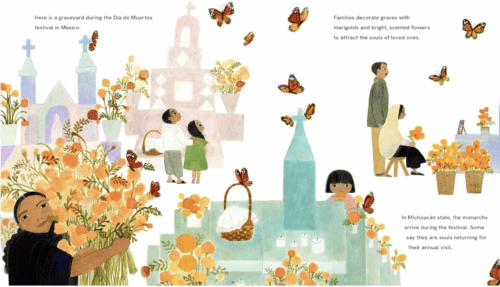
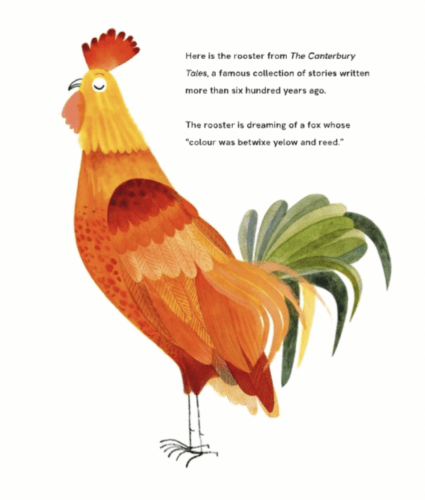

Why do we call orange orange? Who loves it? How many ways can you see orange in our world? Take a trip around the globe and appreciate the myriad ways that orange works its way into our lives. My first thought upon realizing that this was a work of nonfiction was, “Oh, yay! Now Blue by Nana Ekua Brew-Hammond has a friend!” The books have a fair amount in common, after all. Like that title, this is not simply a history of a color, but it’s also this awe-inspiring span across continents and nations to look at how it’s important to a variety of different cultures. Makes me want to grab that Steve Weinberg book from last year What Is Color? and compare their “orange” facts. Morstad, I should note, could illustrate almost anything and I’d read it, but she really was the most perfect person to tackle this. Somehow this manages to be simultaneously gorgeous and informative. I found myself, after I put it down, looking all around me for examples of orange in the world. Kids are bound to do the same.
The True and Lucky Life of a Turtle by Sy Montgomery, ill. Matt Patterson
[Previously Seen on the Science and Nature List]

Gorgeous, daringly realistic illustrations tell the tale of Fire Chief. From luck (finding a pond of his own) to unlucky (getting hit by a car) to luck again (getting help from the humans around him), Montgomery and Patterson highlight our shelled neighbors and the ways we can help them survive and thrive. Sy Montgomery appears to be our primary children’s book turtle advocate these days. Having already created the gorgeous The Book of Turtles (also with Matt Patterson and winner of a Sibert Honor), she now zeroes in on a single turtle’s tale. Best of all (from my persnickety perspective) she’s able to show (with evidence) the path he initially took from birth to his eventual home in a pond next to a firehouse. The story is gripping in its own, slow, turtleish way (watching that car barreling down on poor Fire Chief may have taken a year off of my own life) and a lovely, loving testament to people who truly care about animals. Great info in the back on what to do if you have to move a snapping turtle of your own, as well as resources for helping injured ones.
We Carry the Sun by Tae Keller, ill. Rachel Wada
[Previously Seen on the Science and Nature List]

ADVERTISEMENT
ADVERTISEMENT
What if the Sun could be a source of power here on Earth? This book follows humanity across the globe, and the many scientists and clever thinkers that are making solar power a possibility today. I sort of loved walking into this one cold. I had no idea what it was about, whether it was nonfiction or fiction (it’s nonfiction), or any of that. I sort of figured it might have something to do with fire, but solar power? That’s not something I’ve seen covered before. And Keller’s admission at the end that solar power took, “many incredible people, across the globe, across decades, all coming together,” is a great thing to show kids. Even better, the book makes it clear that there are still improvements to be made and things to be discovered. The art is gorgeous and the writing top notch. This is a standout.
When Science Stood Still: How S. Chandrasekhar Predicted the Existence of Black Holes by Shruthi Rao, ill. Srinidhi Srinivasan
[Previously Seen on the Science and Nature List]

It must be so frustrating working on a book as good as When Science Stood Still only to find that when the end of year “Best” lists come out, it kind of got forgotten. I mean, I get that editors see a LOT of science-related picture books in a given year. It’s easy to miss the really good ones like Rao’s, so allow me to take my own spotlight and turn it full-blast on this incredibly well-done (and so shiny!) book. First off, the title has a killer opening statement, before you even get to the title page. “When scientists get things right, science leaps forward. When they get things wrong, they learn from their mistakes, and science still marches forward. But sometimes, even when scientists get it right, nobody pays attention. Then, for a while, science stands still.” Yep. This is a book about what happens when racism trumps science. Subrahmanyan Chandrasekhar was so adept at his studies that the government of India gave him a scholarship to study astrophysics in England. In 1931 he published a paper proving that, “large/heavy stars end their lives in a very different way than everybody thought.” He presented his findings and was subsequently laughed off. It would take fifty years before he won the Nobel Prize for his work, and the book provides an invaluable example (framed perfectly) of how people who claim to believe only in facts can be swayed by their own prejudices. I can’t think of another informational picture book for kids that outlines this idea any better than this. Chandrasekhar was a great man, but credit Rao for realizing that you can’t separate his work from a history we can all learn from.
The World Entire: The True Story of an Extraordinary World War II Rescue by Elizabeth Brown, ill. Melissa Castrillón
[Previously Seen on the Biography List]

2025 was hard on my town of Evanston. We had a lot of ICE invasions, and naturally this brought up thoughts of the Gestapo and the entire history of terrorizing of innocent people. One would wish that a book like The World Entire, with its thoughts on the bravery of average people wouldn’t feel quite so timely, but you can’t pick your era to live through, I suppose. I never heard of the story of Aristides de Sousa Mendes, and I found it very interesting to pair his story by Elizabeth Brown alongside the art of Melissa Castrillón specifically. Why? Because it’s preternaturally beautiful art, that’s why. Castrillón utilizes a pencil and digitally colored style unlike anyone else I’ve seen. It places Aristides’s early days in a halcyon pink and green golden glow. When things turn bad, those colors are still there, but look at how the artist reduces them. The world is dark and grayish blue, but the people retain their bits of color here and there. Aristides himself is portrayed in yellow, and his story is interesting. Against the wishes of his superior, he signed as many visas as possible to get refugees out of Portugal in order to escape the Nazis. And the picture book text itself doesn’t pussyfoot around what happened as a result. “He lost his home. His children were not permitted to go to university or work in Portugal. Now, his family went to soup kitchen for their supper.” But the book makes it clear that “it may have been the greatest individual act of rescue in all of World War II.” Plus the backmatter makes it clear that he was honored in his lifetime for his heroism (though the Portuguese Parliament only promoted him posthumously to the rank of Ambassador). A good book on a good man.
Zero! The Number That Almost Wasn’t by Sarah Albee, ill. Chris Hsu
[Previously Seen on the Math List]

Can you really do math without the number zero? You can but it’s super complicated. Learn the history of this elusive number and why it took us so long to discover it in the first place. I guess I’m just all about the math in 2025. I was also particularly drawn to this title since it covers a topic that I’ve always struggled with. Mainly, the fact that zero had to be discovered in some fashion. That always seemed sort of odd, but Albee does a fantastic job of breaking down not only why humans wouldn’t necessarily need zero for a while, but also why they wouldn’t be writing it down even if they had it. You’ve gotta take a kind of big leap to get from using zero to hold the place for tens and hundreds to algebra, but it’s not impossible. I was particularly fond of how the book mention that the “Dark Ages” were really just a European thing (“But things weren’t so dark in other parts of the world”). Good backmatter, including a nice little Bibliography or two. And the Timeline! A work of art. I particularly enjoyed the Notes About the Art (“Isaac Newton: Yes, he was left-handed!”).

That’s it for today! Be sure to stay tuned for more lists on 2025 titles. The full roster is here:
December 1 – Great Board Books
December 2 – Picture Book Readalouds
December 3 – Simple Picture Book Texts
December 4 – Transcendent Holiday Children’s Books
December 5 – Rhyming Picture Books
December 6 – Funny Picture Books
December 7 – Caldenotts
December 8 – Wordless Picture Books
December 9 – Bilingual Books for Kids
December 10 – Math Books for Kids
December 11 – Books with a Message / Social Emotional Learning
December 12 – Easy Books
December 13 – Translated Children’s Books
December 14 – Fairy Tales / Folktales / Religious Tales
December 15 – Gross Books
December 16 – Poetry Books
December 17 – Unconventional Children’s Books
December 18 – Early Chapter Books
December 19 – Comics & Graphic Novels
December 20 – Older Funny Books
December 21 – Science Fiction Books
December 22 – Fantasy Books
December 23 – Informational Fiction
December 24 – American History
December 25 – Science & Nature Books
December 26 – Unique Biographies
December 27 – Blueberry Award Contenders (Celebrating the Environment)
December 28 – Nonfiction Picture Books
December 29 – Nonfiction Books for Older Readers
December 30 – Middle Grade Novels
December 31 – Picture Books
Filed under: 31 Days 31 Lists, Best Books, Best Books of 2025
About Betsy Bird
Betsy Bird is currently the Collection Development Manager of the Evanston Public Library system and a former Materials Specialist for New York Public Library. She has served on Newbery, written for Kirkus, and has done other lovely little things that she'd love to tell you about but that she's sure you'd find more interesting to hear of in person. Her opinions are her own and do not reflect those of EPL, SLJ, or any of the other acronyms you might be able to name. Follow her on BlueSky at: @fuse8.bsky.social
ADVERTISEMENT
ADVERTISEMENT
SLJ Blog Network
Cover Re-Reveal: 1000 HORSES FOR THE KING by Gracey Zhang and Me
Spider-Man Mighty Mayhem | This Week’s Comics
From Policy Ask to Public Voice: Five Layers of Writing to Advance School Library Policy
Let Them Make Mistakes, a guest post by Christine Hartman Derr
ADVERTISEMENT
THE BLACK MAMBAS for Sibert 2026!!!
From your lips to the committee’s ears.