31 Days, 31 Lists: 2025 Science & Nature Books for Kids
We are now in the thick of the nonfiction books of this year. By this point in the list process there can be no escaping the sheer number of incredible books on science and nature that fill our shelves. This is but a smallish sampling, but they’re the books I found myself thinking about the most. Each one does its job with incredible aplomb. We librarians have a tendency to favor fiction when it comes to books for kids. Let the next few lists honor the informational texts they also so richly deserve (and that get far fewer awards).
You can find a PDF of today’s list here.
Interested in seeing other books for kids about science and nature? Then check out these previous lists:
2025 Science and Nature Books for Kids
Picture Books
FEATURED TITLE
The Buzz on Wild Bees: The Little-Known Pollinators that Keep Our Planet Humming by Kira Vermond, ill. June Steube

Meet my current obsession. Do you know how rare it is to encounter a picture book that causes you to make actual changes in your life? I suppose I’d sort of known about wild bees before, but this book really breaks them down. Not only are they particularly cool to look at (the blue ones are my favorite) they’re responsible for a LOT more than I thought. For example, I’m a fan of tomatoes. I love to grow them. And, apparently, honeybees are not a tomato’s best friend. Nope. Only wild bees vibrate at the correct frequency to pollinate those puppies. And though I retain my childhood hatred of sweat bees, I must acknowledge some of their cooler aspects as well. I’m so thrilled by learning all of this that I’m determined to get some bee hotels for my backyard and soon! Great informative writing, a fun cluster of facts, and a nice break from those honeybee titles taking up all the shelf space.
ADVERTISEMENT
ADVERTISEMENT
Cassini’s Mission: A Spacecraft, a Tiny Moon, and the Search for Life Beyond Earth by Katie Venit, ill. Julia Blattman

Is there life in outer space? And if there is… is it closer than we think? When the spacecraft Cassini was sent to explore Saturn and its moons, no one expected it to send back the information that it did. Seems to me that any book that teaches kids the fact that science is constantly learning new things is a good thing. But what really makes this particular title stand out is how it shows how scientists often have to correct their own assumptions when they encounter new facts in the course of their research. I really enjoyed how Venit laid out the information in this book. First, right from the get-go she explains very clearly the three things you need for life (Water, Chemicals, Energy). But though I’ve heard lots of people talking about the possibility of Juno (one of Jupiter’s moons) having life, this is the very first time I’ve ever heard Enceladus (“the shiniest moon in the solar system”) mentioned at all. And I love that the scientist’s assumptions were completely understandable, and then had to be corrected. A clever title that really makes you, not only think, but dream.
The Crane and the Keeper: How an Endangered Crane Chose a Human As Her Mate by Meeg Pincus, ill. Gillian Eilidh O’Mara

Walnut the white-naped crane thought she was a human. The problem with that? How do you breed a crane when she thinks other cranes are monsters? A clever true life tale of a crane and human she loved. Welp, I did not have an interspecies love story on my bingo card for 2025 science children’s books, but here we are. I had the vaguest of feelings that I remembered hearing about this story before as I read this, but as I went through it I found myself really admiring how Meeg Pincus introduces all these important details about this odd situation while keeping everything interesting and kid-friendly along the way. Thanks to Walnut’s story, kids get a full crash course on imprinting, the genetics involved in breeding endangered species, and more. The art on the cover is impressive but inside it’s just really kid-friendly. At no point does O’Mara ever anthropomorphize the birds, and I greatly appreciated that. A smart take on a cool, but potentially difficult, tale to tell.
Don’t Eat the Cleaners: Tiny Fish with a Big Job by Susan Stockdale

If fish swim in water all day, do they need to get clean? They do! And who cleans them? Meet the tiny helper fish. They have a job to do and they are more than happy to do it! There was something about this title and subject matter that drew me in right from the start. Then, lo and behold, I discovered just how incredibly cool it was. I knew that there were fish that were “cleaners” of other fish, but what I didn’t know was the sheer variety or the logistics behind the whole process. Stockdale’s book is absolutely engrossing, covering everything from whether or not these little fish would clean YOUR teeth (they would) to what happens when they make a mistake and have to make amends with the host fish. It’s a little paltry on the backmatter (there’s just an “Ocean Animals: Can you find them in the book” section at the end) but aside from a small Bibliography there’s not much I’d ask of this book. It’s just a really cool take on a too little lauded topic.
Flick: The Truth About Lizards by Annette Whipple, ill. JuanbJuan Oliver

Check out this bad boy on the cover here. Isn’t that just a gorgeous image? Well, gorgeous images of lizards is the name of the game with this photo-rific collection of lizard facts and fancies. There are a lot of Shutterstock and Getty images here, but kudos on the selection. You get a real clear-cut sense of that right at the beginning when you see one particular lizard (the common blue-tongued skink) and its vibrant azure tongue. Each section covers some lizardy aspect, be it their toes, where they live, their colors, and more. These are often accompanied by illustrations by JuanbJuan Oliver, who gives the book a keen sense of humor. There’s a really nice section at the end that covers the things you need to know if you want a lizard for a pet (“Some lizards have big personalities and show interest in their humans – but not all of them”). And a Glossary and a small section of helpful websites makes my little backmatter-loving heart go pitter-pat.
From Bam! to Burp!: A Carbon Atom’s Never-Ending Journey Through Space and Time and YOU by Melissa Stewart, ill. Marta Álvarez Miguéns

I love it when books make apparent the things I’ve heard about but wasn’t completely able to visualize in my head. Take the planet Theia, for example. I knew that it slammed into Earth once and created the Moon. And sure, Stewart and Miguéns make that moment apparent, but then they go a bit farther, talking about how this contributed to increasing the number of carbon atoms on our planet. The carbon atoms in this book, by the way, look like little bodyless Princess Leias, the carbon wearing the two oxygen atoms like her hair thingies. There are even more moments of clarification, showing how the atom we’re following got sucked into the leaves of a tree where it yanked the atoms apart and built new combos. Extra points for working dinos into this storyline as well, by the way. Ending with an average kid eating the atom and then expelling it later (don’t worry, it’s a burp, not something else) adeptly ties humans to ancient planets, plant, and dinos, in a rather elegant way. If you’re looking for a title that takes a complicated idea and breaks it down into simple, understandable parts that sacrifice none of the awe, this book has your number.
A Gift of Dust: How Saharan Plumes Feed the Planet by Martha Brockenbrough, ill. Juana Martinez-Neal
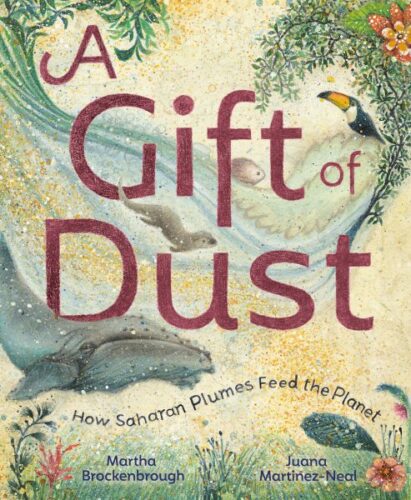
How does an ancient fish control the raindrops that fall from the sky? Learn about the Saharan plumes that affect living things all over the Earth. Doggone it, Juana Martinez-Neal. She disappears for years on us, and then when she comes back she has the doggone nerve to work on MULTIPLE amazing nonfiction picture books IN THE SAME PUBLICATION YEAR?!? How dare she. Alongside the utterly wonderful Alberto Salas Plays Paka Paka con la Papa is this book about the debt we, as a planet, owe to the Saharan plumes. Now, like a lot of adults that read children’s nonfiction, I may be overly laudatory to the informational topics that I’ve never personally encountered before. That said, I think Brockenbrough’s text here is precisely the right length and is of more than sufficient interest to child readers. And somehow (and this shouldn’t even be possible) Martinez-Neal is making the color brown interesting. Brown! The most impossible color to make fun! So yeah, it’s a great topic with great information (and bee-you-tiful two-page backmatter) but it’s also just a cool book for kids.
If You Like Butterflies by Lola M. Schaefer, ill. Gabi Swiatkowska
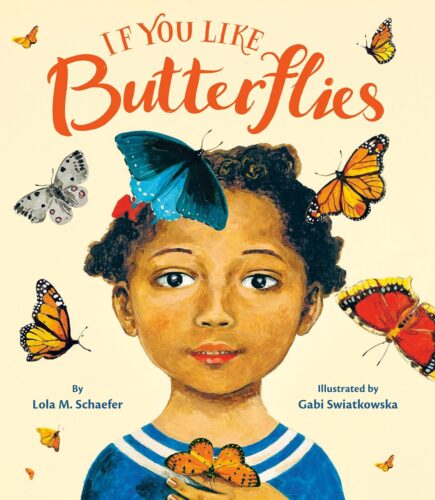
If you like butterflies… you’ll probably want to read this book. Conversational writing explores the world of these odd and beautiful creatures. Another butterfly book? One begins to wonder if there is such a thing as too many butterfly books. But in a year where we have books like Papilio, maybe it’s okay to have a slew of them if they’re all as good as this one by Schaefer. I can’t imagine how difficult it is to try and write a book about butterflies that doesn’t sound exactly like every other dang book out there. This one has a very friendly conversational style that starts with the title and doesn’t change much after that. It keeps things really friendly and basic, which is nice for the kids (and nice for the adults reading this book aloud to the kids). One element that in all my livelong days I’ve never seen anyone do in a butterfly book before is this gorgeous two-page spread of what different kinds of butterfly eggs look like. Some resemble jewels and some aliens, but all of them are fascinating. Swiatkowska really outdid herself with this one.
In the World of Whales by Michelle Cusalito ill. Jessica Lanan

A freediver watches a newly birthed whale calf as its family protects, guides, and helps it to breathe. A stirring true story of human/whale interactions on a peaceable level. I wasn’t initially on board with this one but as I read through it I began to get a true appreciation for what Cusolito and Lanan are doing here. It does an admirable job of showing humans interacting with the whales, insofar as they’re in their presence but trying not to interfere in any way. Lanan’s doing subtle things with the art, and the story is incredibly compelling considering that not a ton ton happens. This is a book that engenders love as you read through it.
Just In Case: Saving Seeds in the Svalbard Global Seed Vault by Megan Clendenan, ill. Brittany Cicchese

This particular book falls into the category of “new information for adults as well as children”, much like that aforementioned A Gift of Dust title. Mind you, I’m always on the alert, remembering that if the information is more interesting to grown-ups than kids, it has failed the most essential test of being a children’s book. Happily, I don’t think that’s something we need to worry about with this title. Savalbard isn’t the only seed vault in the world (as the text is quick to point out) but it has unique features that make this rundown of its history and work interesting. I liked the little sidebars that pepper the book throughout, giving additional information if you want it. There’s an interesting question at hand as to whether or not this book increases climate anxiety (particularly since the last words in it are “Just in case”). I’d argue, however, that it’s the very opposite of anxious. It’s telling kids that there are grown-ups out there protecting seeds, making back-up plans, keeping us safe. Great backmatter too since there’s a small section included on what kids can do.
Meet the Mini-Mammals: A Night at the Natural History Museum by Melissa Stewart, ill. Brian Lies

Here’s a question for you: What is the smallest mammal in the world? Let your ferret host take you on a deep dive into the contenders (all displayed at their ACTUAL SIZE!). Sort of reminds me of those old Steve Jenkins Actual Size books, but with a bit more verve and personality. First off, I was delighted to confirm earlier this year from Brian Lies himself that this cover image of the ferret holding back the curtain was, indeed, a direct nod to Charles Willson Peale’s, “The Artist in His Museum.” Thank you, freshman college year art classes! This is a book that expertly balances the cute with the interesting. Don’t be surprised if kids start asking how they could own a southern lesser galago as a pet. I love how it lays out the facts about each critter, just as they get smaller and smaller, and the backmatter is delightful, from the map of where each creature lives to additional facts about them on notebook carts. Finally, it involves a ferret wearing a jacket with leather patches on the elbows. How was I to know that this was what was missing in my life all this time?!?
Our Air by G. Brian Karas

Lest we forget, it is exceedingly difficult to create an original book on a concept as simple as something like “Air”. This book reminded me considerably of the Henry Herz title I Am Gravity and pairs beautifully with this year’s A Gift of Dust (which, apparently, I just can’t stop talking about). Prime Karas, the title covers a wide range of air-related concepts. The fact you can’t smell it (just what’s in it). How the air currents travel over the earth. Atmosphere. Wind power. It’s rather beautifully positioned in terms of its reading audience as well. For example, we talk a lot on my library’s Blueberry Award committee about being honest about the state of the world while remaining developmentally appropriate in terms of climate anxiety. Karas, you can see, knows just how to evoke a sense of wonder about something so very common but also necessary. It’s enviable and admirable, proving he’s just as adept a writer as he is an artist. A necessary inclusion in your collection.
Poo Pile on the Prairie by Amy Hevron

How can one little poop pile influence life in the prairie? Watch the incredible ecosystem that occurs when a key species does something as simple as poo. We had a bit of a problem last year with Amy Hevron cranking out two remarkable books at the same time. We then had the same problem in 2025. Mind you, this one’s a bit more excrement-related than her usual fare. Between this and a slew of other books (like the new Brendan Wenzel Good Golden Sun), poop is having a moment [enter joke about state of the world here]. In this case, Hevron is using a single buffalo pile to show, on a very simple level, how interconnected this particular habitat is (and, by extension, the problems that arise when you remove those buffalo). It’s a complex idea broken down into its simplest parts. Very clever. Very poopy.
The Prince of Stars: Ulugh Beg’s Quest to Map the Stars and Seasons by M.O. Yuksel, ill. Zelma Firdauzia
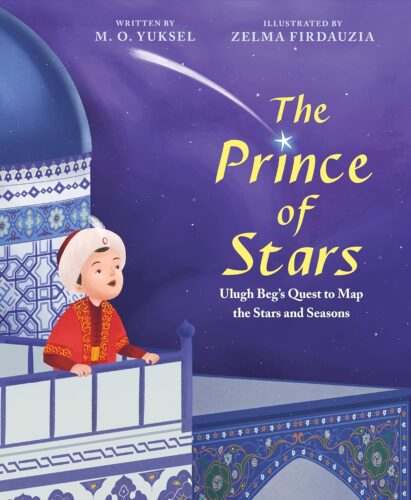
Often we are told that the Islamic world made scientific discoveries long before the Western world, but it helps to have some children’s titles on hand to make these statements feel more comprehensible. And few things are more comprehensible than a good picture book biography. Not only had I not heard of Ulugh Beg/Muhammad Taraghay bin Shahrukh and his works, I hadn’t even heard of the Timurid Empire. The backmatter tells us that Ulugh Beg was born in Sultaniyeh, a city in what is now Iran. What’s so cool about the book is how it not only lays out his own life, but his discoveries as well. And boy, was it a lot. Everything from the fact that there are 365 days in a year to the reasons for the seasons changing. And all this in the 14th-15th century! Great backmatter as well. If one were to collect all the children’s books published in America in 2025 that contained Iranian history (like Daniel Nyeri’s The Teacher in Nomad Land, which is a WWII Iranian-set middle grade novel) you could have a VERY interesting list. In any case, don’t be missing this one.
Salmon Run: An Epic Journey to the Ocean and Back by Annie Chen


One could hardly say that this is the first book on the journey salmon take that’s out there for kids, but by gum it may be the most memorable I’ve seen to date. This is Annie Chen’s debut children’s book, but you’d really never know it from these pages. The colors practically vibrate off these pages in waves. Chen knows how to create these incredible pops of red and salmon pink in a sea of grays and purples and blues. What’s more, I guess I never really knew all that much about the different stages a salmon must go through to become fully grown. The book does such an amazing job of making you just gobsmacked that any of these little fishies manage to make it to adulthood too. There’s no bibliography in the book but they do have the Life Cycle, additional information on the coho salmon, and there’s a QR code that links you to the Glossary (again – would have liked a Bibliography in there too). All told, a rather gorgeous ode to a rather tasty fish.
Sun Bird: The Amazing Journey of the Arctic Tern by Lindsay Moore

“An arctic tern, no heavier than a handful of sand, hovers above the waves.” Join these incredible, tiny birds, as they journey from the north to south pole and back again. Not the first tern book we’ve ever seen, but quite possibly the best. First and foremost, I’m a literary gal by trade, so when Lindsay Moore writes sentences like, “With bodies home to hollow bones, and wings like sails, they soar on the wind,” I am pretty much just pumping my fist in the air. The book shows the life of terns, where they go, and why. There are exciting moments (how has no animated movie ever made a skua the villain?) and some real reflective points of beauty, both in the text and the art. And, as ever, you gotta love that backmatter. I did find it kind of funny that the polar bear looks akin to the one Moore wrote about in Sea Bear, only here you’re desperately hoping it doesn’t find a meal. Ah, food cycle. You’re complicated.
Toes, Teeth, and Tentacles: A Curious Counting Book by Steve Jenkins & Robin Page
[Previously Seen on the Math List]

He may no longer be with us, but the books of Steve Jenkins soldier on. Now I’m counting this book as a math book as well as a regular old science and nature title, but not because it counts in the usual way. The charm of this title is its desire to upend the expectations of the reader. It does this from the very start. For the number “One” we see a praying mantis, which has only one ear and that ear is located in the center of its body. There’s also the male hooded seal which has one sac in its nose which it blows up like a bright red party balloon. For the number two the animals include moray eels with their two sets of jaws, the slow loris with its two tongues, and the Noble pygmy frog who lays just two eggs. Not convinced? What about the tripod fish with its “three” leg-like fins or the three eyes of the tuatara? If you’ve a kid completely entranced by weird animal facts, then this is the place to be. Everything counts up to ten, and then after that the book gets even wilder, the number going up almost randomly. Happily, when it tells you that the ring-tailed lemur has twenty-six stripes and you count them, you know that Jenkins & Page took the time and effort to work all of them in there. Eventually the numbers get up to 18,000 (teeth of a giant African land snail), and then in the backmatter are even more facts about these animals and their numbers. So is it also a math book? Considering the fact that the creators had to make sure that they included 98 centipede legs or 90 nautilus tentacles just so that enterprising kids could check for themselves, I’m going to say yes.
Trouble Dog: From Shelter Dog to Conservation Hero by Carol A. Foote, ill. Larry Day


Okay, fine. I snuck a fictional picture book on here. Stay with me, though. This book is worth including. Tucker the dog doesn’t mean to be trouble, but he just has too much energy for families. What better way to put it to use than becoming a conservation dog! So sweet! This is a great example of a book that knows how to take a true story and turn it into a fictional picture book that’s friendly to kids and a darn good tale in and of itself. I love the idea of “bad” dogs with too much energy having ways to put that endless love of play to good use. Foote so cleverly works in all the invasive species and other things that Tucker is taught to find. And that backmatter! Heavens above is it cool! Even someone who isn’t an inveterate dog lover like myself can’t help but fall in love with this pup.
The True and Lucky Life of a Turtle by Sy Montgomery, ill. Matt Patterson

Gorgeous, daringly realistic illustrations tell the tale of Fire Chief. From luck (finding a pond of his own) to unlucky (getting hit by a car) to luck again (getting help from the humans around him), Montgomery and Patterson highlight our shelled neighbors and the ways we can help them survive and thrive. Sy Montgomery appears to be our primary children’s book turtle advocate these days. Having already created the gorgeous The Book of Turtles (also with Matt Patterson and winner of a Sibert Honor), she now zeroes in on a single turtle’s tale. Best of all (from my persnickety perspective) she’s able to show (with evidence) the path he initially took from birth to his eventual home in a pond next to a firehouse. The story is gripping in its own, slow, turtleish way (watching that car barreling down on poor Fire Chief may have taken a year off of my own life) and a lovely, loving testament to people who truly care about animals. Great info in the back on what to do if you have to move a snapping turtle of your own, as well as resources for helping injured ones.
Waiting and Watching: What Hatches from Nature’s Nurseries by Sara Levine
[Previously Seen on the Simple List]

You don’t need to be a grown-up to be a scientist. Observe the natural world around you (without interfering) with the aid of this incredible catalog of eggs and egg cases in nature. Eye-popping too. In lieu of another Helen Frost book this year, I’m willing to accept this beauty by Sara Levine as a stand-in. The simple text is paired alongside some truly fascinating types of eggs. Who knew slug eggs looked so much like tiny crystal balls? Or that wasps had such a wide array of eggs (the wool sower galls are definitely my favorite). The book gently reminds curious kids that if you force open these egg and egg cases that you find, you’ll kill the creatures inside. I didn’t really know what a gall was prior to reading this title and now I want to go into the wild and find one for myself. The big text is nice and simple, though there is a more complicated smaller text for older readers as well. Absolutely inspirational with great backmatter. And if you were missing the horror show that is seeing baby praying mantasis emerging from their egg case, have I got good news for you!
We Carry the Sun by Tae Keller, ill. Rachel Wada

What if the Sun could be a source of power here on Earth? This book follows humanity across the globe, and the many scientists and clever thinkers that are making solar power a possibility today. I sort of loved walking into this one cold. I had no idea what it was about, whether it was nonfiction or fiction (it’s nonfiction), or any of that. I sort of figured it might have something to do with fire, but solar power? That’s not something I’ve seen covered before. And Keller’s admission at the end that solar power took, “many incredible people, across the globe, across decades, all coming together,” is a great thing to show kids. Even better, the book makes it clear that there are still improvements to be made and things to be discovered. The art is gorgeous and the writing top notch. This is a standout.
When Science Stood Still: How S. Chandrasekhar Predicted the Existence of Black Holes by Shruthi Rao, ill. Srinidhi Srinivasan

It must be so frustrating working on a book as good as When Science Stood Still only to find that when the end of year “Best” lists come out, it kind of got forgotten. I mean, I get that editors see a LOT of science-related picture books in a given year. It’s easy to miss the really good ones like Rao’s, so allow me to take my own spotlight and turn it full-blast on this incredibly well-done (and so shiny!) book. First off, the title has a killer opening statement, before you even get to the title page. “When scientists get things right, science leaps forward. When they get things wrong, they learn from their mistakes, and science still marches forward. But sometimes, even when scientists get it right, nobody pays attention. Then, for a while, science stands still.” Yep. This is a book about what happens when racism trumps science. Subrahmanyan Chandrasekhar was so adept at his studies that the government of India gave him a scholarship to study astrophysics in England. In 1931 he published a paper proving that, “large/heavy stars end their lives in a very different way than everybody thought.” He presented his findings and was subsequently laughed off. It would take fifty years before he won the Nobel Prize for his work, and the book provides an invaluable example (framed perfectly) of how people who claim to believe only in facts can be swayed by their own prejudices. I can’t think of another informational picture book for kids that outlines this idea any better than this. Chandrasekhar was a great man, but credit Rao for realizing that you can’t separate his work from a history we can all learn from.
Books for Older Readers
FEATURED TITLE
Bug Snacks: How Eating Insects Can Change the World by Jess French, ill. Zoë Ingram

ADVERTISEMENT
ADVERTISEMENT
While a book about eating nature isn’t necessarily the same thing as “appreciating” nature, since the entire gist of this text is to move us away from our reliance on meat, I’m happy to go for it. Personally, I’ve always been fascinated rather than icked out by the concept of eating insects. The recipe for cricket brownies is something I’m definitely going to try (I already have the cricket flour!). This book does a pretty good job of luring kids in with the aforementioned ick factor and then hitting them with serious facts in an amusingly designed package. It’s bright, colorful, fun to look at, and filled with information that will really get you curious about trying some of these delicious creepy crawlies yourself. If I have an objection, it’s to the fact that buying bugs online is actually kind of pricey. They don’t really touch on the economic aspects of all of this, but if we’re really going to make this kind of a cultural shift away from copious cows, then we need to make bugs cheaper than meat.
Detective Dogs: How Working Dogs Sniff Out Invasive Species by Alison Pearce Stevens

Ah! I love it when a cool idea trends. Seems to me this older nonfiction title is an absolutely perfect accompaniment to the aforementioned picture book Trouble Dog by Carol A. Foote. In both cases you learn about dogs that sniff out invasive species. However, what both authors realized is the truly interesting part of the story. Yes, dogs can do this, but only a particular kind of dog. Which is to say, the kind of dog that has way too much energy. That wants to play all day. That gets obsessed with a particular toy. That kind of dog is precisely the kind you want for this job. We follow a whole slew of them in this book as they sniff out mussels, bug eggs, and plants. It’s interesting to see how beautiful some of these invasive species are. Also interesting to hear how often these critters spread because humans just aren’t paying attention. I loved the compact size of the story, as well as the examples of cases where the dogs don’t always get it right. Definitely an eye-opening little title into the inner-workings of some pretty cool pups.
An Immense World: How Animals Sense Earth’s Amazing Secrets by Ed Yong, adapted by Annmarie Anderson, ill. Rebecca Mills

How do animals see, hear, and feel the world? In more ways than you think. A colorful, fact-packed adaptation of a celebrated science writer’s award-winning tour de force. When the adult version of this book came out, it was one of the few that seriously tempted me to read in my own time. Fortunately, sometimes all you have to do is to wait long enough and eventually a young reader’s edition will make itself known. Now there are young reader’s editions that do a poor job and there are those that actually try to appeal to kids rather than just cut out a few sentences here and there. This book does a lovely job of making itself kid-friendly. There’s the fact that it’s so wonderfully colorful, making each section a different color and including these beautiful images from Rebecca Mills. Then there’s the opening, with the conceit of being in a room with several animals and how they would fare vs. how you would fare if you were all together. I was a little surprised to see that the book was just adapted and Yong didn’t rewrite the whole thing. It feels tapered to kids a lot of the time. And my takeaway? Now I know how to kill flies more efficiently. True story.
Seeds of Discovery: How Barbara McClintock Used Corn and Curiosity to Solve a Science Mystery and Win a Nobel Prize by Lori Alexander, ill. Rebecca Santo

From the minute she began working with genetics, Barbara McClintock was determined to unlock some of the mysteries surrounding genes. A high-spirited and fun explanation of her work and how genetics make us all who we are. I actually read this in Hoopla and found it just a lot of fun. Also, an interesting challenge for Alexander. This is a potentially complex topic with a lot of hurdles in the way of understanding. It’s teaching you all about genetics but through… corn. And corn is generally not considered very interesting. Still, Alexander somehow manages to put all kinds of moments of high emotion (speaking in public and not making yourself clear) as well as fun visuals to accompany the explanations. Will some of this fly high over readers’ heads? Indubitably. But the gist of it will get through, and that’s just really cool. Extra credit for including CRISPR in there near the end!

That’s it for today! Be sure to stay tuned for more lists on 2025 titles. The full roster is here:
December 1 – Great Board Books
December 2 – Picture Book Readalouds
December 3 – Simple Picture Book Texts
December 4 – Transcendent Holiday Children’s Books
December 5 – Rhyming Picture Books
December 6 – Funny Picture Books
December 7 – Caldenotts
December 8 – Wordless Picture Books
December 9 – Bilingual Books for Kids
December 10 – Math Books for Kids
December 11 – Books with a Message / Social Emotional Learning
December 12 – Easy Books
December 13 – Translated Children’s Books
December 14 – Fairy Tales / Folktales / Religious Tales
December 15 – Gross Books
December 16 – Poetry Books
December 17 – Unconventional Children’s Books
December 18 – Early Chapter Books
December 19 – Comics & Graphic Novels
December 20 – Older Funny Books
December 21 – Science Fiction Books
December 22 – Fantasy Books
December 23 – Informational Fiction
December 24 – American History
December 25 – Science & Nature Books
December 26 – Unique Biographies
December 27 – Blueberry Award Contenders (Celebrating the Environment)
December 28 – Nonfiction Picture Books
December 29 – Nonfiction Books for Older Readers
December 30 – Middle Grade Novels
December 31 – Picture Books
Filed under: 31 Days 31 Lists, Best Books, Best Books of 2025

About Betsy Bird
Betsy Bird is currently the Collection Development Manager of the Evanston Public Library system and a former Materials Specialist for New York Public Library. She has served on Newbery, written for Kirkus, and has done other lovely little things that she'd love to tell you about but that she's sure you'd find more interesting to hear of in person. Her opinions are her own and do not reflect those of EPL, SLJ, or any of the other acronyms you might be able to name. Follow her on BlueSky at: @fuse8.bsky.social
ADVERTISEMENT
ADVERTISEMENT
SLJ Blog Network
Over on the Yarn: Nancy Hugins and N. West Moss
Papercutz to Publish ‘Three Bee Honey’ | News and Preview
Bring on the JUNE Mock Newbery suggestions!
From Policy Ask to Public Voice: Five Layers of Writing to Advance School Library Policy
ADVERTISEMENT