
31 Days, 31 Lists: 2025 Math Books for Kids
Math! It’s out there! Some love it. Some most certainly and most definitely do not. To the latter group I extend my sympathies. I was once as you are now, but then I saw the array of incredible, remarkable, and mighty varied math books out there, and my mind was blown. You don’t have to adore numbers to adore what it is that they can do. Let this year’s crop of incredible mathy titles turn you in the right direction. Books to inspire a love of reading? Sure. That’s a thing. But a little math along the way couldn’t hurt either.
You can find a PDF of today’s list here. And here are previous math book lists to peruse and enjoy:
2025 Math Books for Kids
FEATURED TITLE
Zero ! The Number That Almost Wasn’t by Sarah Albee, ill. Chris Hsu

Can you really do math without the number zero? You can but it’s super complicated. Learn the history of this elusive number and why it took us so long to discover it in the first place. I guess I’m just all about the math in 2025. I was also particularly drawn to this title since it covers a topic that I’ve always struggled with. Mainly, the fact that zero had to be discovered in some fashion. That always seemed sort of odd, but Albee does a fantastic job of breaking down not only why humans wouldn’t necessarily need zero for a while, but also why they wouldn’t be writing it down even if they had it. You’ve gotta take a kind of big leap to get from using zero to hold the place for tens and hundreds to algebra, but it’s not impossible. I was particularly fond of how the book mention that the “Dark Ages” were really just a European thing (“But things weren’t so dark in other parts of the world”). Good backmatter, including a nice little Bibliography or two. And the Timeline! A work of art. I particularly enjoyed the Notes About the Art (“Isaac Newton: Yes, he was left-handed!”).
ADVERTISEMENT
ADVERTISEMENT
All About Patterns by Elizabeth Rusch, ill. Elizabeth Goss

Part of the “All About Noticing” series. Until now the team of Rusch and Goss have covered such disparate subject areas as nothingness and color. It’s kind of funny to me that it took them this long to get around to shapes, but I am glad they got there at all. Patterns are, of course, some of the simplest forms of math that you can teach to kids. Now I’ve seen papercut picture books before, but Goss’s style is so smooth and so unique, a person could be forgiven for not realizing that it’s papercutting at all. With their luminous colors and thick black outlines, sometimes these pictures appear to be more akin to stained glass windows than picture book illustrations. Rusch explains what a pattern is and shows where you might find one. She connects patterns not simply to music and nature, but to our own bodies and even the patterns of our lives. Some might argue that this means that the book is a little more personal than mathy, but I don’t think it wise to necessarily separate the two. Plus, there’s some delicious backmatter at the end.
I’m Longer Than You! An Epic Contest of Measurement by Carolyn Fisher

One-uppmanship, taken to its natural extreme. Kids love asking whether one thing is bigger, stronger, tougher, taller, faster, higher, etc. than another thing. When this book opens, a Supersaurus declares that it’s the world’s longest animal. Immediately a Blue Whale interjects that this cannot possibly be true. They keep debating but they don’t have a standard of measurement so they keep saying things like, “I’m as long as 3 school buses” or “I’m longer than 21 hockey sticks.” To the rescue comes….. an inchworm! Why don’t they just measure themselves? Because they haven’t invented measuring yet. Duh. Inchworm is willing to measure them but unfortunately measuring the whale takes so long that the worm now has to go into a cocoon. A centipede takes over, but instead of being one inch long it’s one centimeter long. And even though it finishes, centimeters and inches are different units of measurement. Looks like it’s gonna have to be math to the rescue now. Visually eye-popping, continually fun, and incredibly informative, this is the kind of math book that I just WISH we saw more of on our shelves. Extra points for the backmatter that includes “Some Non-Standard Measurements” including Donkeypower, Light-Years, Zeptoseconds, and Barleycorn.
Menudo Sunday by María Dolores Águila, ill. Erika Meza

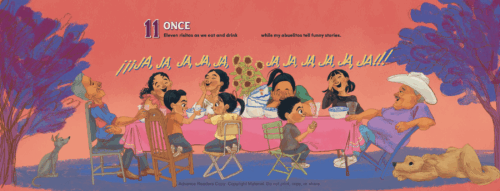


Two abuelitos, four tias, a slew of kids and pets, and one big Sunday dinner make up this clever counting book. As the book itself is quick to tell you, this is a Spanglish affair, more than anything else. English and Spanish words mix and mingle effortlessly on the page. Now what I like so much about the book is partly the gay grandparents (please name me ANY other gay grandparent books where their relationship is not the focus), and partly the clever use of counting up to fifteen, but mostly the art of Erika Meza. I could read her picture books all the livelong day (and if you folks haven’t seen To the Other Side recently, THAT is the picture book everyone should own in 2025). In this story, the kids and dog are messing around a bit too wildly before dinner, causing the menudo (a “traditional Mexican soup made from beef honeycomb (tripe) and hominy”) and its container to crash and create the mess to beat all other messes. I love how the numbers count down in that slow motion way that happens when you see some accident happening in real time and you can do nothing to prevent it. Backmatter includes a Glossary and tip for hosting your own Menudo Sunday (tip #1 says to make sure your animal friends are somewhere safe and away from the food).
The Museum of Shapes by Sven Völker


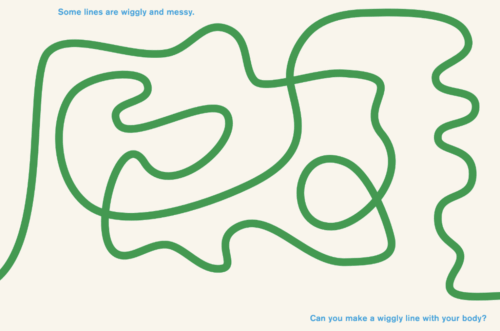

Shapes! Such a lovely math concept for younger readers. And naturally Sven Völker is just the fellow to bring them to life. What other author/illustrator, after all, has written math picture books in the past and gotten them on the New York Times/New York Public Library Best Illustrated list (for A Million Dots, if you will recall) This book is a bit esoteric but no less fun. First, we meet Alma. She’s the curator of the Museum of Shapes. Her job? Choosing which shapes get to be placed on display. Which, when it comes to fake jobs in children’s books, may be my favorite of the year. Now these shapes vary quite widely. She might add a point (the simplest shape of all), a line, a semi-circle, cones, you name it. In describing all the possible shapes Völker is essentially just doing some straight up nonfiction work here, but shhhh! I won’t tell if you don’t! Much cooler to think that there’s a whole museum dedicated to this stuff (which, the book tells us at the end, exists at the Museum of Concrete Art and Design in Ingolstadt, Germany). There are even little moments that encourage interaction, like when kids are asked which of an array of wackadoodle shapes they like best or, even better, how they’d prefer to arrange them. I can easily see teachers giving a slew of possible shapes to kids after reading this and letting their little analytical minds go wild.
Very Bad at Math by Hope Larsen

Middle grade graphic novel alert! Verity has it all at her school. Popularity and friends galore! But she has a secret. Math makes no sense! If she doesn’t do better, she will have to give up things that mean everything to her. Will she prevail? It’s good and it includes a nice bit of info about dyscalculia that I haven’t seen discussed in children’s books much before. I also really liked that Very is the rare popular, nice character. I knew kids like her when I was a kid but we almost never seen them on the page. And, naturally, I love the math connection here. True, Very’s not a huge fan of it, but she comes around once she realizes that her problems stem from a disability, not a lack of trying. I wouldn’t call it the MOST positive portrayal of math this year, but at least it doesn’t demonize it. Plus, it takes some time to explain how math is useful in the real world (which is good stuff). All told, this is enticing and new in ways I haven’t seen before.
The Five Sides of Marjorie Rice: How to Discover a Shape by Amy Alznauer, ill. Anna Bron

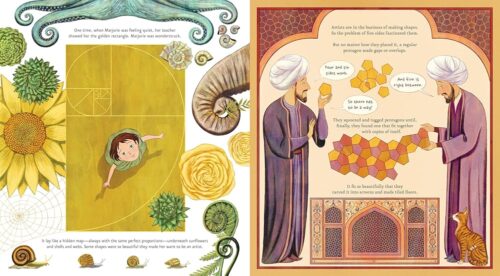


What does it mean to “discover” a brand new shape? Meet Marjorie Rice, an ordinary woman who discovered shapes no one had ever found before. I just want to state for the record that while I adore math-related children’s books, I very rarely bring them to the attention of my library’s 101 Great Books for Kids committee. This is one of the rare exceptions, possibly because it’s a fun topic that I was pretty much unaware of. Can you discover a new shape? You can when there are rules in place governing how to do so. Marjorie Rice wasn’t a mathematician and, thanks to the times in which she lived, she spent most of her time in her home. Still, she got hung up on the idea of discovering a new five-sided shape that would fit into a pattern without gaps. There’s a lot of text here but the book gets away with it because it’s fascinating, and paired with the incredible art by Anna Bron, which makes everything just so doggone interesting. The backmatter? Impressive. Now I know this isn’t the point of the book, but I feel like there’s a subtly subversive message here about how friggin’ boring it is to be a housewife. Add in the fact that the book will actually inspire kids to notice the shapes around them, and I’d say that this book is really one-of-a-kind.
Toes, Teeth, and Tentacles: A Curious Counting Book by Steve Jenkins & Robin Page

He may no longer be with us, but the books of Steve Jenkins soldier on. Now I’m counting this book as a math book as well as a regular old science and nature title, but not because it counts in the usual way. The charm of this title is its desire to upend the expectations of the reader. It does this from the very start. For the number “One” we see a praying mantis, which has only one ear and that ear is located in the center of its body. There’s also the male hooded seal which has one sac in its nose which it blows up like a bright red party balloon. For the number two the animals include moray eels with their two sets of jaws, the slow loris with its two tongues, and the Noble pygmy frog who lays just two eggs. Not convinced? What about the tripod fish with its “three” leg-like fins or the three eyes of the tuatara? If you’ve a kid completely entranced by weird animal facts, then this is the place to be. Everything counts up to ten, and then after that the book gets even wilder, the number going up almost randomly. Happily, when it tells you that the ring-tailed lemur has twenty-six stripes and you count them, you know that Jenkins & Page took the time and effort to work all of them in there. Eventually the numbers get up to 18,000 (teeth of a giant African land snail), and then in the backmatter are even more facts about these animals and their numbers. So is it a math book? Considering the fact that the creators had to make sure that they included 98 centipede legs or 90 nautilus tentacles just so that enterprising kids could check for themselves, I’m going to say yes.

That’s it for today! Be sure to stay tuned for more lists on 2025 titles. The full roster is here:
December 1 – Great Board Books
December 2 – Picture Book Readalouds
December 3 – Simple Picture Book Texts
December 4 – Transcendent Holiday Children’s Books
December 5 – Rhyming Picture Books
December 6 – Funny Picture Books
December 7 – Caldenotts
December 8 – Wordless Picture Books
December 9 – Bilingual Books for Kids
December 10 – Math Books for Kids
December 11 – Books with a Message / Social Emotional Learning
December 12 – Easy Books
December 13 – Translated Children’s Books
December 14 – Fairy Tales / Folktales / Religious Tales
December 15 – Gross Books
December 16 – Poetry Books
December 17 – Unconventional Children’s Books
December 18 – Early Chapter Books
December 19 – Comics & Graphic Novels
December 20 – Older Funny Books
December 21 – Science Fiction Books
December 22 – Fantasy Books
December 23 – Informational Fiction
December 24 – American History
December 25 – Science & Nature Books
December 26 – Unique Biographies
December 27 – Blueberry Award Contenders (Celebrating the Environment)
December 28 – Nonfiction Picture Books
December 29 – Nonfiction Books for Older Readers
December 30 – Middle Grade Novels
December 31 – Picture Books
Filed under: 31 Days 31 Lists, Best Books, Best Books of 2025

About Betsy Bird
Betsy Bird is currently the Collection Development Manager of the Evanston Public Library system and a former Materials Specialist for New York Public Library. She has served on Newbery, written for Kirkus, and has done other lovely little things that she'd love to tell you about but that she's sure you'd find more interesting to hear of in person. Her opinions are her own and do not reflect those of EPL, SLJ, or any of the other acronyms you might be able to name. Follow her on BlueSky at: @fuse8.bsky.social
ADVERTISEMENT
ADVERTISEMENT
SLJ Blog Network
I Need to Stop Pretending Roald Dahl Wasn’t Problematic
Papercutz to Publish ‘Midnight Island’ | News and Preview
From Policy Ask to Public Voice: Five Layers of Writing to Advance School Library Policy
Fast Five Interview: Candace Lee and Eric Newman
ADVERTISEMENT
Was just talking about Marjorie Rice this weekend. It really is beautiful. And that Menudo Sunday is beyond charming. I love the wrinkled faces so much!