31 Days, 31 Lists: 2025 Nonfiction Books for Older Readers
Meet the category that I have the hardest time getting other librarians to read. It’s not their fault, really. A lot of us grew up with some pretty crummy nonfiction in our youth. It’s natural to distrust that the books for kids now are any good. What’s incredible, though, is the sheer number, variety, and delightful array of nonfiction available to kids these days. Forget the picture books. Older nonfiction, that nebulous but ultimately satisfying genre, is where the action is. This list today just proves it.
… and now here’s my dirty little secret: I’m no better. Not really. I mean, I bemoan how other librarians won’t read enough long-form nonfiction, but look at me! This is just a small sampling of the books published in 2025. So while I will stand by every title on this list, please understand that there are scads more out there worthy of your attention that I never personally saw. If you, dear readers, loved a longer nonfiction book for kids in 2025, please add it to the comments below so that everyone can benefit!
ADVERTISEMENT
ADVERTISEMENT
If you’d like a PDF of today’s list, you can find one here.
Interested in similar titles? Check out the Older Nonfiction lists of years past:
2025 Nonfiction for Older Readers
FEATURED TITLE
The Vanishing of Lake Peigneur by Allan Wolf, ill. Jose Pimienta
[Previously Seen on the Comics & Graphic Novels List]

Nonfiction time! On November 20, 1980 an entire 1,100 acre lake disappeared. How did it happens? Action packed graphic novel storytelling relays this forgotten piece of Louisiana history. BLAST! This is amazing!!! Last year we had that rip-roaring nonfiction about people escaping Mt. St. Helens. This year? A Louisiana disaster, utterly lost to history, from 1980 that is so gripping you’ll be on the edge of your seat. Characters probably spend a little too much time talking about what an “ordinary day” it is for my liking, but once the disaster begins you wonder how anyone ever forgot about it. This has everything! Trapped miners. Deadly whirlpools. Equally deadly waterfalls. Dogs in peril! People in peril! Geyers! I love the note at the end that says that maybe the reason this wasn’t better reported and remembered is that no one died, everyone was focused on the hostages in Iran, and on Dallas, who shot J.R.? Whatever the reason, this is gripping, and a great mystery to boot.
Bug Snacks: How Eating Insects Can Change the World by Jess French, ill. Zoë Ingram
[Previously Seen on the Blueberry AND Science and Nature Lists]

A rare book to appear on THREE 31 Days, 31 Lists lists! Personally, I’ve always been fascinated rather than icked out by the concept of eating insects. The recipe for cricket brownies is something I’m definitely going to try (I already have the cricket flour!). This book does a pretty good job of luring kids in with the aforementioned ick factor and then hitting them with serious facts in an amusingly designed package. It’s bright, colorful, fun to look at, and filled with information that will really get you curious about trying some of these delicious creepy crawlies yourself. If I have an objection, it’s to the fact that buying bugs online is actually kind of pricey. They don’t really touch on the economic aspects of all of this, but if we’re really going to make this kind of a cultural shift away from copious cows, then we need to make bugs cheaper than meat.
Detective Dogs: How Working Dogs Sniff Out Invasive Species by Alison Pearce Stevens
[Previously Seen on the Blueberry AND Science and Nature Lists]

Ah! I love it when a cool idea trends. Seems to me this older nonfiction title is an absolutely perfect accompaniment to the aforementioned picture book Trouble Dog by Carol A. Foote. In both cases you learn about dogs that sniff out invasive species. However, what both authors realized is the truly interesting part of the story. Yes, dogs can do this, but only a particular kind of dog. Which is to say, the kind of dog that has way too much energy. That wants to play all day. That gets obsessed with a particular toy. That kind of dog is precisely the kind you want for this job. We follow a whole slew of them in this book as they sniff out mussels, bug eggs, and plants. It’s interesting to see how beautiful some of these invasive species are. Also interesting to hear how often these critters spread because humans just aren’t paying attention. I loved the compact size of the story, as well as the examples of cases where the dogs don’t always get it right. Definitely an eye-opening little title into the inner-workings of some pretty cool pups.
I’m a Dumbo Octopus: A Graphic Guide to Cephalopods by Anne Lambelet
[Previously Seen on the Funny Books for Older Readers List]

What makes the dumbo octopus so special? That’s the question it wants to know! And it’s going to tell you about all the cool cephalopods it can in order to find out. All right, here’s the question for you today: Do you put this in the older nonfiction or the graphic novel section of your library/bookstore? I only ask because this book (which is highly amusing from start to finish) is so stuffed full o’ facts that even if you think you know everything about deep sea creatures, you are bound to learn something new. Like, blanket octopuses rip off man o’ war tentacles and use them like whips? And Japanese flying squid launch themselves into the air? And flamboyant cuttlefish have 75 different color combinations? See, this is precisely the kind of book that’s going to make a kid follow their parents around saying, “Did you know that…” “Hey, did you know…?” “Ohmigosh! Guess what?” It’s got all the kid-friendly fact-friendly fun you’d expect AND great backmatter (a Glossary, a Selected Bibliography, and section for Further Reading) AND it’s hilarious but best of all? They were clever and put a photograph of a real Grimpoteuthis at the end. Smarties.
An Immense World: How Animals Sense Earth’s Amazing Secrets by Ed Yong, adapted by Annmarie Anderson, ill. Rebecca Mills
[Previously Seen on the Science & Nature List]

How do animals see, hear, and feel the world? In more ways than you think. A colorful, fact-packed adaptation of a celebrated science writer’s award-winning tour de force. When the adult version of this book came out, it was one of the few that seriously tempted me to read in my own time. Fortunately, sometimes all you have to do is to wait long enough and eventually a young reader’s edition will make itself known. Now there are young reader’s editions that do a poor job and there are those that actually try to appeal to kids rather than just cut out a few sentences here and there. This book does a lovely job of making itself kid-friendly. There’s the fact that it’s so wonderfully colorful, making each section a different color and including these beautiful images from Rebecca Mills. Then there’s the opening, with the conceit of being in a room with several animals and how they would fare vs. how you would fare. I was a little surprised to see that the book was just adapted and Yong didn’t rewrite the whole thing. It feels tapered to kids a lot of the time. And my takeaway? Now I know how to kill flies more efficiently. True story.
Jella Lepman and Her Library of Dreams: The Woman Who Rescued a Generation of Children and Founded the World’s Largest Children’s Library by Katherine Paterson, ill. Sally Deng
[Previously Seen on the Biography List]

And here we have the winner of The Longest Subtitle for a 2025 Children’s Book. Congratulations to Katherine Paterson then. Now I know that way way back in the day I read some of her nonfiction. She wrote an autobiographical title Stories of My Life, but hasn’t really dabbled much in informational texts for the children’s book market recently. It does seem fitting that she should be the one to present the life of Jella Lepman. What’s so interesting to me is that this story could potentially have been a picture book biography. Indeed, with the sheer amount of illustrations at work here (all thanks to the hard work of Sally Deng) it feels like maybe that was once a consideration. However, Paterson doesn’t believe in going halfsies on this story. She is going to tell you not just in little drips and drabs of Lepman’s life, but the whole kerschmozzle. Now a person might ask who the audience of this book is, and I would reply that if you are a good enough writer, you can literally write a book about anything in the world and make it interesting. This an excellent example of that mantra. It also helps that Lepman’s life is rather fascinating to kids. True, Jella was a bit of a prickly pear and could be hard to work with, but you can’t argue with her results. You know that great big castle in Munich full of children’s books? That’s the International Youth Library and it graces the cover of this book. Artfully explained and researched, if you’ve a kid assigned an older biography but they still need a fair number of illustrations to help them through, this is an ideal title to hand over. Granted, it could have used a Bibliography at the end, in addition to those Photo Credits (it’s a really weird thing for them to have left out), but otherwise no notes.
Lice: How to Survive on Humans by Berta Paramo, translated by Marc Correa Haro
[Previously Seen on the Gross List]

Are you a louse that lives on a human head? Then this book is for you! A delightfully hilarious and disgusting tour of everything you need to know about lice, told for the discerning parasite. Gross in the best possible way! Kinda. For all that we have to deal with lice on a regular basis (and have since the beginning of humanity itself) it’s odd that most of us know so little about our tiny head denizens. This guidebook is a delight, pure and simple. Disgusting and so very strange, but a delight. I learned loads, from the fact that lice can, potentially, make it to your eyebrows and eyelashes, to the fact that now I finally have an answer for why you can’t just kill them with hot water. As this is a translation from Portugal the author, sadly, eschews backmatter, but I might forgive them. Just don’t be surprised if your head starts itching while you read.
Malcolm Lives! by Ibram X. Kendi
[Previously Seen on the Biography List]

History comes to vibrant life in this eclectic and incredible biography. The past and the present mix and meld in a beautiful encapsulation of his days. It’s been a decade or two since I read The Autobiography of Malcolm X, but I could remember enough to really appreciate what Kendi does here. He’s continually drawing ties between events in Malcolm’s life and what’s going on in America today. This has SO much context, and done in an incredibly appealing way. For a children’s book there are an awful lot of references to rape without much in the way of explanation, so that’s something to take into consideration. Even so, it’s fast-paced, interesting, and really makes his life comprehensible to kids. I particularly recommend the audiobook as well. This is one biography where boredom is never an option.
My Presentation Today is About the Anaconda by Bibi Dumon Tak, ill. AnneMarie Van Haeringen, translated by Nancy Forest-Flier
[Previously Seen on the Unconventional and Funny Book Lists]
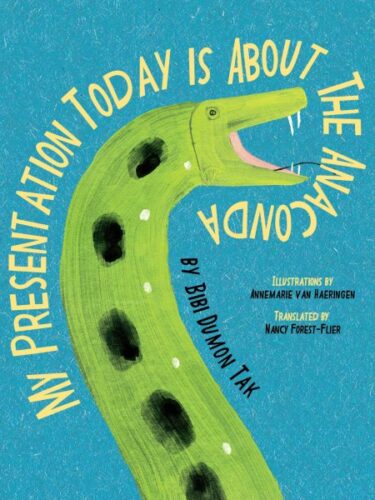
Welcome! Today we have gathered to listen to animals give oral presentations about one another. Hear what the southern cassowary has to say about the hummingbird or the rhino of the shoebill. Hilarity and fun facts mix and meld in this truly original collection. So apparently 2025 is the year when I have to relax some of my more draconian just-the-facts-ma’am takes on nonfiction for kids. As such, I’ve amended my stance. I don’t particularly mind a book like this one, which is chock full of animals talking to one another about… well, animals. I don’t mind it because there’s no child alive that’s going to pick this book up and think that foxes are that obnoxious in person (they would be that hungry, though). The book itself is just kinda, sorta a delight. And it very cleverly shows how animals (human ones included) really only see other animals through their own lenses. It’ll teach you a thing or two (I did NOT know all that info about koalas’ sex lives), the art is delightful, and if Nancy Forest-Flier doesn’t get some kind of a Batchelder Award for her translation, I’ll eat my bloomin’ hat. One of the most enjoyable nonfiction titles of the year, that’s for sure.
One Day: A True Story of Survival in the Holocaust by Michael Rosen, ill. Benjamin Phillips

Holocaust literature for children has inspired countless articles, studies, contemplative articles, and schools for thought. Much of the debate boils down to this: How much to do tell, when do you tell it, and what is right to tell? There are no correct answers, but there seem to be a whole host of wrong ones. For example, if you’re going to tell children a Holocaust story, it is best to be as honest as possible (and perhaps don’t try to wrap it all up in some smarmy “parable”). Michael Rosen tells the story of Eugène Handschuh, who escaped with this father from a convoy headed from Paris to Auschwitz, with grace and care. It is not a tale I would tell to a six-year-old. Aside from anything else, watching men attempt something and fail (in this case, digging a tunnel out of a prison camp) is hard. Now I was already quite fond of the art of Benjamin Phillips from his graphic novel Alte Zachen from a couple years ago. Here, he mutes the colors so that they all come across as muddied. It’s a way of giving the book a patina of the past, highlighting the pall of misery cast over the actions on the page. Rosen’s writing is also exemplary. “Remember: Get through one day and then on to the next. One day at a time. One day after another.” Writing a new Holocaust story must be exceedingly difficult. This book is how you do it.
Seeds of Discovery: How Barbara McClintock Used Corn and Curiosity to Solve a Science Mystery and Win a Nobel Prize by Lori Alexander, ill. Rebecca Santo
[Previously Seen on the Blueberry & the Science and Nature Lists]

From the minute she began working with genetics, Barbara McClintock was determined to unlock some of the mysteries surrounding genes. A high-spirited and fun explanation of her work and how genetics make us all who we are. I actually read this in Hoopla and found it just a lot of fun. Also, an interesting challenge for Alexander. This is a potentially complex topic with a lot of hurdles in the way of understanding. It’s teaching you all about genetics but through… corn. And corn is generally not considered very interesting. Still, Alexander somehow manages to put all kinds of moments of high emotion (speaking in public and not making yourself clear) as well as fun visuals to accompany the explanations. Will some of this fly high over readers’ heads? Indubitably. But the gist of it will get through, and that’s just really cool. Extra credit for including CRISPR in there near the end!
The Sky Was My Blanket: A Young Man’s Journey Across Wartime Europe by Uri Schulevitz
[Previously Seen on the Biography List]

The gripping, true story of Shulevitz’s uncle and everything he had to do to survive as a Jewish man during WWII. Simply told, quick, and unforgettable. Since Shulevitz chose to tell this story in the first person from his uncle’s p.o.v. (after interviews and other research) I was initially under the impression that this was Schulevitz’s story. Which, in retrospect, didn’t make a lot of sense since I still well recall his picture book autobiography How I Learned Geography lo these many years ago. What’s marvelous about this story is, in part, its length. It’s exceedingly short, clocking in at a mere 160 pages with copious illustrations. It’s funny, but I’m so used to stories of people trying to escape to America and making it there, that when I reach a book where someone tries repeatedly and fails and gives up, it feels mind-blowing. This actually pairs incredibly well with Daniel Nayeri’s The Teacher of Nomad Land since Yehiel in this story and Ben in that story have similar goals and similar stories. This is a survival tale, pure and simple, and many kids will have a hard time putting it down.
Ultrawild: An Audacious Plan for Rewilding Every City on Earth by Steve Mushin
[Previously on the Gross and Funny for Older Readers Lists]

When I think how close I came to not seeing this book before the end of the year came, it gives me chills. Folks, please meet my favorite older nonfiction book for kids. I almost never do this, but I think a trip to its website might be a good way to at least get a start on understanding what it is that Mushin has created here. Imagine if someone were to mix Where’s Waldo with David Macaulay and then add in every insane (but possible!) scientific invention and solution to our current environmental crisis. That’s this book. It’s an import from Australia where, I should note, it won Best Designed Children’s Non-Fiction book (2024 Australian Book Design Awards), and the 2024 Elsie Locke Award For Best Nonfiction (NZ). It was also shortlisted for The 2025 NSW Literary Awards, Patricia Wrightson Prize for Children’s Literature, The 2025 NSW Literary Awards UTS Glenda Adams Award for New Writing, and the 2025 Spark! School Book Awards (UK). It should win more. Honestly, it should have appeared on ALL the best books lists that came out this year. So why hasn’t it? Probably because, like myself, the committees didn’t hear about it in time. You can bet that I would have fought tooth and nail to put it on my library’s 101 Great Books for Kids list if I’d known about it. Fortunately, my library’s Blueberry Awards come out later, so it has a chance to appear there.
ADVERTISEMENT
ADVERTISEMENT
Why’s it so good? Two words: Poop cannons. I mean, come on. I’m not made of stone. In this book Mushin offers extreme (and I do mean extreme) solutions to rewilding cities. He also faces a dark moment of the soul mid-book, but then he comes roaring back with even MORE ideas! I’ve never seen a book as hugely inspirational to kids as this. It’s tall (sorry, library shelves) and made for young eyes with pages packed with type and graphic novel elements. And yes, the man has a bit of an odd obsession with us eating our own legs (it makes sense in context) but I am HERE FOR IT. Seriously. Get on this thing. You’ll be glad you did. You’ll also want to hand it to the first kid you see.
Whale Eyes: A Memoir About Seeing and Being Seen by James Robinson, ill. Brian Rea
[Previously Seen on the Biography List]

How do you write a book about yourself when growing up you hated to read? A clever and original memoir about James Robinson’s misaligned eyes and how he became the filmmaker he is today. A shoo-in for a Schneider Family award certainly. First off, this ain’t your usual memoir. 75% of it is an original and interesting take on slowly introducing you to James’s condition. You don’t even really know that he has one at the story’s start. He walks you through the different ways to fake reading in class (which was vibrantly realistic). When you start to understand his condition, the art of Brian Rea makes for a perfect complement. Then he starts getting into filmmaking and the clear intention is to show how empowering it was for him. It’s an interesting memoir technique.
Words Matter: The Story of Hans and Sophie Scholl, and the White Rose Resistance by Anita Fitch Pazner, ill. Sophie Casson

How do you resist when your entire country is in the wrong? The story of two brave siblings who found ways to fight back against the rise of Hitler. How do you make history, particularly the sad parts, interesting and accessible to kids? This book may hold the answer. First, look at that sweet page count. It’s clocking in at 72, and a lot of that consists of the copious illustrations, expertly rendered by Sophie Casson. Then you have the difficulty of the subject matter and how Pazner chooses to tackle that. I’d say that making it clear that there was a resistance movement inside Germany during the time of Hitler is AWFULLY useful for kids to see right now, so there’s that. But Pazner does a great job of humanizing Hans and Sophie, showing how they started off as “good” Hitler youth, then showing how they saw the terrible cracks in the facade of their society. Their rebellion came slowly and over time. It’s such a remarkable piece, and I truly believe you could read this with even fourth graders and they’d get a lot out of it. I was gripped from start to finish (and was shocked how quickly I was able to read it). Telling and necessary.
A World Without Summer by Nicholas Day, ill. Yas Imamura

If a volcano erupts in Indonesia, can it starve cows in Switzerland? Tambora did. Nicholas Day bears down on the year 1816 to show how a single, incredible natural event caused everything from the birth of Frankenstein to mass starvation. From the man who brought us The Mona Lisa Vanishes comes a book with a far grander scope. Day’s talent lies in taking a multitude of historical details, tying them together, then showing why they have importance and implications to those of us today. I confess that prior to reading this book, if you’d told me that the greatest recorded volcano of the human age was Tambora, I would have blinked and confessed that I had no idea what you were talking about. And the fact that it made 1816 and 1817 The Worst Years To Be Alive Ever (emphasis mine)? I had no idea. Somehow Frankenstein, a volcano, and everything from people tearing down their lightning rods to the creation of Silent Night, comes together in this book. Then, to top it all off, Day rounds it everything out with a cry for us to pay attention to global warming. Dear lord, this is an ambitious book… and a bit of a genius one as well.

That’s it for today! Be sure to stay tuned for more lists on 2025 titles. The full roster is here:
December 1 – Great Board Books
December 2 – Picture Book Readalouds
December 3 – Simple Picture Book Texts
December 4 – Transcendent Holiday Children’s Books
December 5 – Rhyming Picture Books
December 6 – Funny Picture Books
December 7 – Caldenotts
December 8 – Wordless Picture Books
December 9 – Bilingual Books for Kids
December 10 – Math Books for Kids
December 11 – Books with a Message / Social Emotional Learning
December 12 – Easy Books
December 13 – Translated Children’s Books
December 14 – Fairy Tales / Folktales / Religious Tales
December 15 – Gross Books
December 16 – Poetry Books
December 17 – Unconventional Children’s Books
December 18 – Early Chapter Books
December 19 – Comics & Graphic Novels
December 20 – Older Funny Books
December 21 – Science Fiction Books
December 22 – Fantasy Books
December 23 – Informational Fiction
December 24 – American History
December 25 – Science & Nature Books
December 26 – Unique Biographies
December 27 – Blueberry Award Contenders (Celebrating the Environment)
December 28 – Nonfiction Picture Books
December 29 – Nonfiction Books for Older Readers
December 30 – Middle Grade Novels
December 31 – Picture Books
Filed under: 31 Days 31 Lists, Best Books, Best Books of 2025
About Betsy Bird
Betsy Bird is currently the Collection Development Manager of the Evanston Public Library system and a former Materials Specialist for New York Public Library. She has served on Newbery, written for Kirkus, and has done other lovely little things that she'd love to tell you about but that she's sure you'd find more interesting to hear of in person. Her opinions are her own and do not reflect those of EPL, SLJ, or any of the other acronyms you might be able to name. Follow her on BlueSky at: @fuse8.bsky.social
ADVERTISEMENT
ADVERTISEMENT
SLJ Blog Network
Cover Re-Reveal: 1000 HORSES FOR THE KING by Gracey Zhang and Me
Spider-Man Mighty Mayhem | This Week’s Comics
From Policy Ask to Public Voice: Five Layers of Writing to Advance School Library Policy
Let Them Make Mistakes, a guest post by Christine Hartman Derr
ADVERTISEMENT
I was hoping you’d include Ultra Wild. It’s astonishing!
I also really enjoyed Who Owns the Moon? by Cynthia Levinson and Jennifer Swanson.
Death in the Jungle by Candy Fleming is a must-read!
Ah, but marketed as YA, which is why I missed it.
I saw that the folks over at Heavy Medal had a spirited debate about whether that one could be a Newbery contender. Having read it, I do feel like while there are some 13 year-old kids who would be into the book, its primary audience is really 14+. Lots of psychological manipulation, physical abuse, and, well, death!