
Indigenous Resistance and Resilience: A Trickster Shadow Q&A with Mangeshig Pawis-Steckley
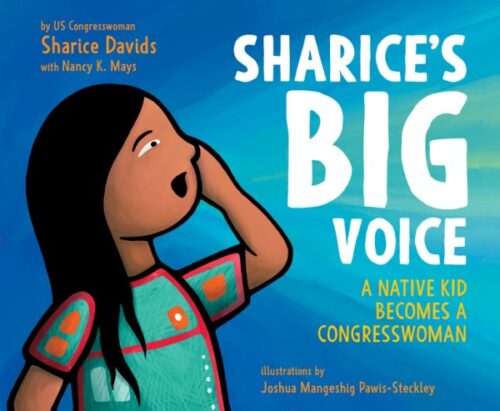
Pair the right artist with the right book and the result is unforgettable. Here’s an example of that: Four years ago I first laid eyes on a picture book biography called Sharice’s Big Voice: A Native Kid Becomes a Congresswoman. The writing was great, but there was just something about the art that stood out and lodged itself firmly in my brain. I hadn’t heard of artist Mangeshig Pawis-Steckley before but I certainly hoped he’d keep creating more books.
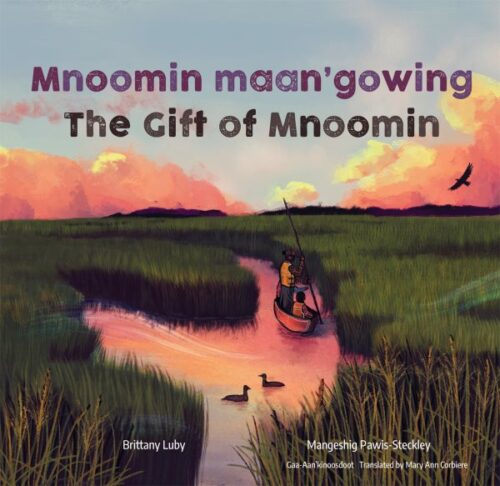
That style… it’s impossible not to recognize. That would be the style of Mr. Pawis-Stickley. A multi-disciplinary Anishinaabe artist from Barrie, Ontario and a member of Wasauksing First Nation, nothing he does ever looks like anyone else. And he can change it! Here’s another book of his that I loved:
ADVERTISEMENT
ADVERTISEMENT
Fast forward to 2025 and this beauty lands in my in-box:

The Trickster Shadow (out September 9th) is one of those incredible mixes of fun alongside a pretty serious issue all turned into a great grand metaphor (with tricksters!)
Or, put another way, here’s how the publisher likes to describe it:
Zoon’s shadow is always in his way. It makes a mess of his room, disrupts his class at school, and trips him on the soccer field. Zoon doesn’t know what to do! Until he tells his grandmother about it, and she gives him his grandfather’s drum. Its rhythm is like a heartbeat. If only Zoon can listen to the drum’s song, and ultimately to his own heart, he may yet find a way to thrive alongside his shadow.
Pawis‑Steckley’s striking, graphic art brings to vibrant life both the challenges of controlling our trickster impulses and the luminosity of ancestral and inner wisdom, paving the way for us all to listen to our hearts.
Today, I’m delighted to speak to Mangeshig about his latest.
Betsy Bird: Mangeshig! Thank you so much for speaking with us today! THE TRICKSTER SHADOW is easily one of my favorite picture books of 2025, and is this rather remarkable mix of social emotional learning and storytelling elements, both ancient and contemporary all at once. Where on earth did this book come from then?
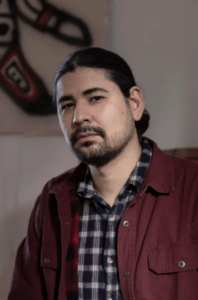
Mangeshig Pawis-Steckley: First of all, I am so happy to hear this is one of your favourite titles of 2025! I put so much love into this book, it means so much to me.
The Trickster Shadow has been a long time coming. I’ve been thinking through the idea, wrestling with it, putting it down and coming back to it for the last decade now. I remember drawing this little boy and his shadow back in high school. I had never found the proper outlet to tell the story until I wrote this manuscript. Thankfully — in the process — I had my agent, Jackie Kaiser, and editor, Susan Rich, really push me to develop this story properly. I couldn’t have done it without their support and encouragement.
This story is a fairly personal one. It really came from my struggles growing up. I struggled with depression and anxiety most of my childhood, it was really difficult getting through that. A lot of what helped me on my healing journey was developing a deeper connection with my identity and Indigenous culture. I developed the ideas for this story while learning about my own culture’s stories and mythologies. Nanaboozhoo stories. Carl Jung’s ideas on dream psychology, specifically the shadow archetype also played a big part in influencing the character development of the trickster shadow.
BB: That may be the first time Carl Jung has been so casually referenced on my site. So my library was absolutely blown away by your work on THE GIFT OF MOOMIN, awarding it our annual Blueberry Award in 2024. The style of that book, right down to the tone, is unbelievably different from what you’re doing with TRICKSTER SHADOW here. While both sport dark outlines and these luminous gem-like colors, the human figures vary widely. How did you decide on the right style for this particular title? Did you have a sense of how you wanted it to look from the start or did you slowly ease into it as you worked?
Mangeshig: I think a lot of what shaped this book was the fact that it is a story of my own. I feel like I can freely explore my creative ideas a little more when it’s my own project. With the main character, Zoon, I wanted him to resemble a figure you’d see in woodland art, like Norval Morrisseau’s portrait work. I’m always trying to incorporate traditional woodland elements into my illustrations.

Despite this being my tenth book, I still consider myself new to the Children’s book world. Which means every new book is a challenge to me and an opportunity to continue developing a distinct style. You’ll notice similarities across my books, like certain woodland elements, or patterning details. But to me, each book is an opportunity to explore different techniques. For The Trickster Shadow a lot of that came in the form of playing with colours and lighting. In this way each of my books has their own personality, they really grow with me as an artist.
BB: This is more a question just for me. I had to reread the book to make sure, but the shadow never takes on any colors of its own. It takes on patterns, yes, but remains essentially colorless throughout. I half-wondered as I read whether or not it would be colorful at the finish, but I think it’s a lot more powerful if it isn’t. What were some of your intentions with the colors of this book, both in terms of the shadow and outside of it?
Mangeshig: The colours in this book were very thought out with the shadows’ presence in mind. You’ll notice that pages without the shadow will have a warmer tone with the oranges and golds, then as the shadow gets larger and overtakes the pages the purples take over and consume the page as well. The purple in this book acts as negative emotions, it is most apparent when Zoon is feeling so overcome with feeling that he can’t control. The shadow keeps a neutral grey tone mainly to resemble a shadow in real life. It is more transparent when calm, and gets darker and more opaque as it gets angrier and out of control. When Zoon connects with his cultural teachings gifted to him by his Nookomis those teachings are outwardly reflected in a dramatic shift in colours. The bright vibrant colours moving forward symbolize a strength that comes from his culture and ancestral knowledge. After this pivotal moment there is a certain harmony between Zoon and his shadow which is reflected in a balance of colours for the continuation of the book.
BB: Talk to me a little bit about the use of a trickster to both infuriate and teach at the same time. Your trickster in this book has all the same properties as a poorly trained, overly enthusiastic dog. Indeed, you mention in your Note at the end that it was inspired by a real one that you knew. Did you know from the beginning when you wrote this book that that dog was the trickster your story needed, or did it happen slowly as you worked on the title?

Mangeshig: The original trickster shadow was planned to be a coyote as that is usually who the trickster is in traditional Anishinaabe stories. But trickster is a shapeshifter, and I felt it was more apt to be a rez dog in this book. This transition happened as I was working through developing the manuscript and I was thinking of this trickster’s personality. I didn’t want it to be a one-dimensional scary being that represented trauma or repressed emotions. I wanted it to have this goofy, child-like presence that has a tendency to fool around and play games. My family dog came to mind. The idea that this creature, being a part of Zoon, drives him crazy and never listens to him. It’s really frustrating for him. That is a big part of what these emotions entail. There’s this push and pull there. This to me really brought the characters together.
BB: I’d like you to speak a little to the more personal aspects of the book. The shadow in this story is never specifically named as any particular mental challenge for Zoon. That, in turn, allows the reader to interpret it as any number of things. Was this an intentional choice on your part? Also, ideally how would you like best for this book to be used with the kids who need it most?
ADVERTISEMENT
ADVERTISEMENT
Mangeshig: Yes, not naming what the trickster symbolizes was intentional so that it has more of a universal reach. There is a wide spectrum of emotions and they all bleed into each other. The trickster shadow could represent any mixture of fear, anger, sadness, guilt or shame. When I was writing this book though, I specifically wanted it to represent the generational trauma that indigenous people hold within themselves from years of our ancestors being colonized and repressed. Everything we’ve known has been taken from us and that trauma is manifested in each and every one of us. As indigenous people we grow up with these intense feelings of shame when we are born. It being something we have always known, how are we to know what it feels like living without that? I wanted to visualize this and show that even though it is within us, there is a separation there and it can be overcome through love and understanding. As a new dad, this is something that’s really important to me. I have an opportunity to create complex stories that speak to the truth of growing up Anishinaabe. I want my daughter to see herself reflected in these stories — to not only be represented in the canon of children’s literature — but also in these beautiful multi-dimensional stories of indigenous resistance and resilience.
BB: Finally, what else are you working on these days? What’s next for you?
Mangeshig: I’m currently working on illustrating a storybook written by Joy Harjo and published by Penguin Random House, Gathering The Light. A book I’ve written titled MOOZ/ MOOSE, with Groundwood Books. This is a book in a continuing Anishinaabe language series alongside BOOZHOO/HELLO. I’m also illustrating my first Graphic Novel. This is a very moving story. A survivor-centered visual narrative of a residential school survivor and his son. Duncan McCue has conducted interviews with the survivors and written the manuscript based on their story. This is titled Indians Do Cry, to be published with Tundra Books. Aside from that I’m developing a new manuscript about my grandmother and quill-box making.
Indians Do Cry is slated for Fall 2027. Gathering The Light and MOOZ/MOOSE will be published next year.

I can’t thank Mangeshig enough for talking to me today. Mangeshig Pawis‑Steckley is a multi‑disciplinary Anishinaabe award‑winning author, artist, and illustrator and a member of Wasauksing First Nation. He has illustrated several picture books, including Mii maanda ezhi‑gkendmaanh / This Is How I Know by Brittany Luby and Sharice’s Big Voice by Sharice Davids and Nancy K. Mays, which was an ALA Notable Children’s Book, a CCBC Choice, and a Bank Street College of Education’s Best Children’s Book. Mangeshig spends his time living between Vancouver and Wasauksing First Nation. He invites you to visit him online at mangeshig.com.

Thanks too to Victoria Stapleton and the team at Little, Brown for helping to put this all together today. The Trickster Shadow is, as I say, out September 9th so be sure to look for it soon!
Filed under: Best Books, Best Books of 2025, Interviews

About Betsy Bird
Betsy Bird is currently the Collection Development Manager of the Evanston Public Library system and a former Materials Specialist for New York Public Library. She has served on Newbery, written for Kirkus, and has done other lovely little things that she'd love to tell you about but that she's sure you'd find more interesting to hear of in person. Her opinions are her own and do not reflect those of EPL, SLJ, or any of the other acronyms you might be able to name. Follow her on BlueSky at: @fuse8.bsky.social
ADVERTISEMENT
ADVERTISEMENT
SLJ Blog Network
Cover Re-Reveal: 1000 HORSES FOR THE KING by Gracey Zhang and Me
Exclusive: New Middle-Grade Fantasy from Nakama Press | News
From Policy Ask to Public Voice: Five Layers of Writing to Advance School Library Policy
ADVERTISEMENT