
31 Days, 31 Lists: The Great Board Books of 2025
All right, all right, all right! Let’s start this month off with a bang! A board book bang, that is.
When you think about it, board books are a relatively new inclusion in the pantheon of children’s literature. For a long time (and, sadly, continuing to this day) parents were under the impression that reading to babies, toddlers, and preschoolers was a relative waste of time. Little did they suspect that the very seeds of literature love sometimes lie in these early engagements with books.
As usual, today’s list is split into three parts.
First: Board Books for Babies
Second: Board Books for Toddlers/Preschoolers
Third: Board Book Reprints (either old board books back in print, or picture books adapted into board books)
Here’s the PDF of this year’s Board Book List, if you’re interested in downloading it in a nice and easy format.
Additionally, in case you need more suggestions, be sure to check out my previous years’ board book lists:
2025 Board Books for Babies
FEATURED TITLE
Baby Faces by Steph Stilwell

You mean to tell me they made an accordion book that has baby faces AND a mirror on one side and then has some killer high contrast, very simple, black, white, and red illustrated faces on the other side? And no one’s ever done this before? Well, that’s just nutty. This 100% is perfect for those young young babies out there. And because babies love faces for quite some time, you could start with the high contrast side when their eyes are still forming, and then move on to the face side when they get a little older. So in a way, this is a board book that ages WITH the babies. How cool is that?
ADVERTISEMENT
ADVERTISEMENT
Animals at Home by Xavier Deneux

The triumphant return of Xavier Deneux! I don’t know how many of you are so familiar with your board book creators that you’ve set up little mental fandoms for them, but if you’re anything like me then a new Xavier Deneux is always a happy occasion. This board book, originally published in France, is a clever little dingus. Now I will be the first to admit that its very cool design is also a potentially rippable design. But considering how high contrast it is, at least for a little while those itty itty bitty babies won’t have the hand-eye coordination in place yet to tear it asunder. Each high contrast animal in the book is viewed in its own “home”. A bear in a den. An owl in a tree. But the homes pop out at the reader, giving the book a three-dimensionality that’s really enticing. The mice in the holes of cheese (is that a home? Sure) and the ants in their tunnels are particularly keen to see. The publisher calls these, “peekaboo holes”. You can’t copyright a phrase, though, so excuse me while I use this one continually!
Cuddly Sheep by Ingela P. Arrhenius

Cuddly Sheep for the win!! With my new baby niece born just this year, I had the opportunity to gain a new appreciation for those high contrast books just perfect for itty-bitty eyeballs. Now I’m wracking my brain a little but can you think of many high contrast cloth books with felt flaps AND a mirror? It feels like we should have seen a plethora of these already, but the fact of the matter is that in spite of all those obvious details, I think this is the very first book of its kind that I’ve ever encountered. Happily, it’s coming to us from board book superstar Ingela P. Arrhenius as well. Now I can’t hope to try to understand the logistics that go into making books of this sort. All I can say is that I love this combination, and so a hat tip to Nosy Crow for figuring out how to make a book so good, it feels like it should have been in our collections all along.
Meow! (What’s That Noise?) by Pui Lee
Moo! (What’s That Noise?) by Pui Lee

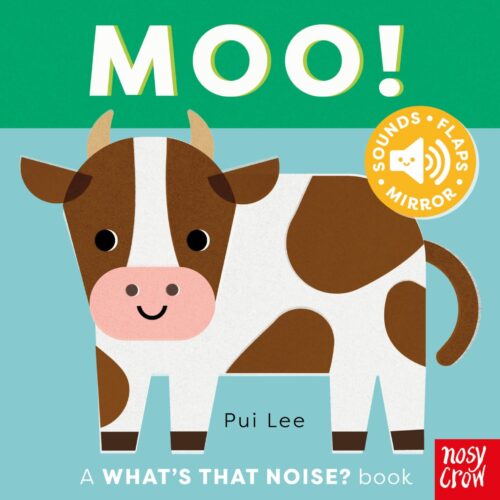
I wonder if there’s an unspoken competition between different board book editors and the titles they help bring to life. Your board book has flaps revealing different animals? Well, our board book has flaps revealing different animals AND animal sounds!! Historically, books like MEOW! and MOO! would have been accompanied by onomatopoeic words on one page and flaps on the other. These days, however, thanks to the wonders of sound-in-board-books technology (I’m serious, people, someone tell me what I should call it) all you need to do is flip the On switch on your board book’s back, press the tiny button (made for tiny fingertips) on the page, and now you’ve the sounds of an actual puppy or actual pig to accompany your illustrations. Once again, Nosy Crow leads the way.
My Animal Sounds by Xavier Deneux

There was a time, oh best beloved, when I believed that the French had thoroughly cornered the market on board books here in the States. And while I do believe that there must be something in the French publishing industry that causes them to know how to make them just a hair better than everyone else, they no longer dominate quite as much as they once did (as evidenced by today’s list). Nevertheless, there are some names out there that I have grown to trust instinctively over the years as they never really let me down. Once again I call upon Xavier Deneux. Here we’re appealing to the younger set with high-contrast black and white images of animals. The only color on each page is a small bright circle that surrounds the button one must press to hear the oinks, moos, baas, and what have you. It’s not flashy. It doesn’t really have a plot. It’s just a great book for enticing both the eyes and the ears of the youngest of readers. So this is similar to the aforementioned What’s That Noise books but the high contrast visuals are meant for the youngest of young readers.
Together Time: Animal Rhymes by Ailie Busby
Together Time: Bedtime Rhymes by Ailie Busby
Together Time: Playtime Rhymes by Ailie Busby
Together Time: Weather Rhymes by Ailie Busby


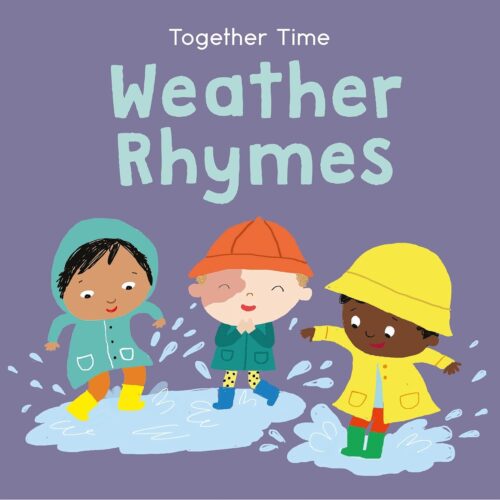
With my own nursery rhyme-related picture book Pop! Goes the Nursery Rhyme out this year, I kept a particularly spry eye peeled for other books that delve into the same sphere. Of course, due to their young readership, nursery rhymes have almost entirely swerved into the world of board books these days. And who can blame them? This little collection includes a nicely diverse cast, and often includes instructions in italics for how to do one rhyme or another with your tiny kiddo. More books like this, please!
Play! by Pascale Estellon
Touch! by Pascale Estellon


If you know me then you know that I cannot CANNOT resist a good accordion board book. And this little tummy time series called “My First Black and White Book” is just what the doctor ordered for those growing eyeballs and brains. It’s not only high contrast but filled with an array of different types of patterns for small fingertips to feel. There are other bright colors on occasion as well, but the star of the show is definitely those sheer black and white tones more than anything else. Feeling it myself, I was surprised by how many of these, which look completely two-dimensional, had textures. Seems simple. Sucks you in.
Tummy Time: Park by Louise Lockhart

Question: Can one ever have enough tummy time books?
Answer: NOPE!! Never ever ever. Now as I mentioned I’ve a new baby niece this year, and that means tummy time board books are the name of the game in 2025. This book is definitely for the baby around 4+ months since the colors are more pastels than high contrast colors. It’s also the kind of tummy time book where you plop it around your child and then a parent or caregiver can read the words in whatever direction the child happens to face. Is there also a mirror? Heck yes, there’s a mirror! Best of all are the faces of different animals you can look at on the other side of the pages. So vibrant, I half wondered if it was meant for 3D glasses. Check it out.
Who Ate the Little Bug? by Hector Dexet
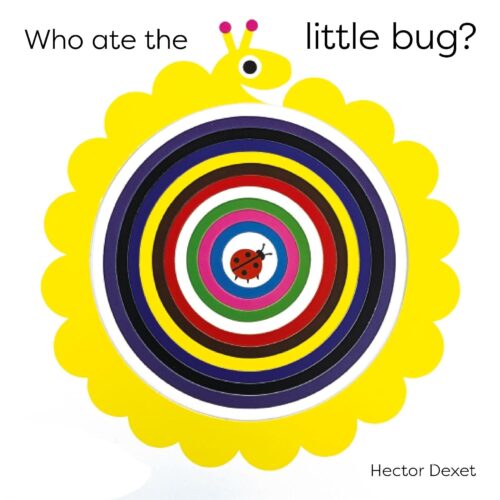
I am going to have SO much fun reading my niece this book. I imagine reading the title with a thick Inspector Clouseau accent. Why? I dunno. The book just sort of lends itself to that interpretation. Now don’t go into this expecting an answer to this mystery. The last line is “I don’t know but it wasn’t me!” (which makes me think the speaker doth protest too much). Of course, it’s the sheer design of this book that makes it so cool. If you look at the cover here then you can see that it’s a series of concentric circles that get smaller and smaller as the book goes on. Some of the circles are in the stomachs of various creatures, as one might expect, but others are cleverly wrapped in the trunk of an elephant or the center of an acorn held by a squirrel. There are twelve colorful outer circles in total, which is far more than you’d usually expect from a board book. Big and beautiful and just a little bit weird (just the way I like it).
Whose Eyes? by Kristina Jones
Whose Nose? by Kristina Jones

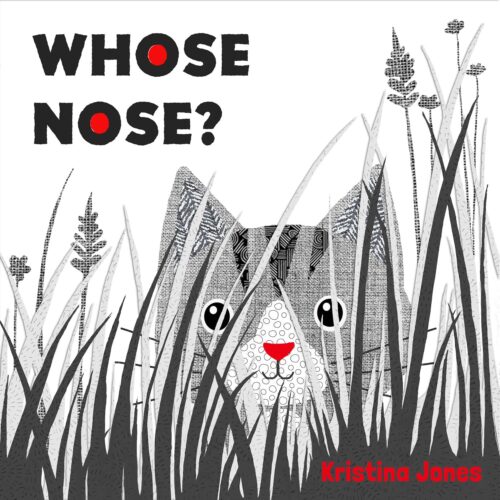
Clever little high-contrast board books, these. And part of what I like so much about them is the fact that they knew to do the blue color for “Whose Eyes?” and the red color for “Whose Nose?” You might see the potential problems had those been switched. Now these aren’t straight high-contrast titles in the sense that yes, there is black and there is white, but the lines aren’t simple. Indeed, Jones has worked a lot of delicate details into the landscapes surrounding each animal. A multitude of patterns make up the leaves or grass or even the insides of an animal’s delicate ear. As a result, it’s an artsier black-and-white-plus-one-color series of titles. They’re the kinds of books that you can hand to a parent and feel good about giving them away because they’re legitimately beautiful titles while ALSO knowing that the parents will like them for their artistic flourishes. Cool stuff. Extra points if you sing their titles to the tune of “These Eyes” by The Guess Who.
2025 Board Books for Toddlers and Preschoolers
FEATURED TITLE:
3*2*1 To the Moon! A Counting Book by Stacy McAnulty, ill. Joey Chou

Okay. That cover. That cover is maybe my favorite board book cover of the year (though the gay pride book I’m going to mention later is giving it a run for its money). I’m going to have to describe it to you, though you can see a video if this on Amazon (loathe though I am to recommend you go there). Essentially, you put your finger in the hole and then you can see the moon’s different phases as it travels around the Earth. This is such a simple design, but so clever in its construct. You want to instill in small children the understanding that the moon travels around the Earth? Badda bing. Note that the shadow on the moon at different places indicates what parts we can see on Earth as well. And that’s just the cover!! Open it up and you get this incredible sciencey story where you count down from 10 cruising comets to 1 moon. I would like to point out that #2 is the “2 golf balls” on the moon (“We were left behind”) and then on the last page you get to do a countdown ending in a blastoff, which will be particularly fun if you pick up your little person at the “Blast Off!” part. This is beautiful and funny and an incredible melding of text and numbers and science for our youngest of readers. Amazing work!!
Baby Pterosaur by Julie Abery, ill. Gavin Scott
Baby Spinosaurus by Julie Abery, ill. Gavin Scott


The series that, by all rights, should be the usual pablum continues to wow. I’ve been fond of this Baby Dinosaurs series from the get-go, impressed from day one by its adept rhymes and remarkable ability to pack a rather large amount of plot into a scant 20 pages. We do not usually associate peril with board books. But this is dinosaurs we’re talking about. Baby dinos, undoubtedly, had to deal with the possibility of getting eaten. And that’s not even taking into account the danger of updrafts (as with Baby Pterosaur) or grabby root systems (Baby Spinosaurus’s issue). The rhymes in these board books never let the reader down. I imagine that if you got the whole set of these books you’d probably be able to have the most mind-bogglingly exciting reading session with some lucky preschoolers imaginable. Warning: May turn small children into dinosaur fans. But what are the odds of that happening?
Banana, Banana, Banana! by Sarah Finan


2025 is the Year of the Banana which means that Finan’s board book, with its thick paints and clever cut-outs, is perfectly positioned to conquer the world. Gentle rhyming text explains precisely to babies why bananas are the be-all and end-all of early foods. “Bananas are my favorite treat! / I eat them up because they’re sweet.” The art, brightly colored but with a style entirely of its own, is great, but the cut-outs in the pages are clearly the star of the show. For example, in one sequence you’ve the smile on a toddler’s face perfectly outline the banana’s shape, so that when you turn the page, they fit together. I give extra points to the part of the book that asks that you not leave a peel on the ground for fear of slipping on it. With its limited color scheme, this is truly a visual feast of a board book. One, I think, a parent wouldn’t mind reading repeatedly (and, let’s face it, they probably will).
Bundle Up, Penelope Rex! by Ryan T. Higgins

Ryan T. Higgins is a properties man. Which is to say, he creates successful characters that go on to become properties, capable of populating a wide range of books. Bruce the bear and his adopted family of goslings are probably the best known, but my heart and soul have always belonged to Penelope Rex. We Don’t Eat Our Classmates, in the pantheon of first day of school books, stands out (and, I would argue, is THE best funny first day of school book to ever exist). I’d encountered Penelope’s sequels but not her board book spinoffs, and I eyed this one with a bit of trepidation. Would it be capable of capturing that Higgins humor adequately? Would it make more sense as a picture book? In this case, I think we’re looking at the upper upper reaches of preschooldom, but that’s okay. If your kids aren’t pooh-poohing the notion of board books in favor of the more sophisticated picture books then I could see them just gazing rapt at the illustrations in this book. Higgins rewards close readings because he fills his books with such delightful minutiae. The story is that Penelope wants to go outside. What ensues is the world’s longest bundling up (parents in cold climates will feel a cathartic sense of appreciation that Higgins knows what they go through). For the record, Penelope was asked at the beginning of the process if she needed to pee. She did not. You can see where this is going. I could stare at a image from this guy for years. Penelope, you’re all right in my book.
Busy Builders: Dinos at Work by Stacie Bradley, ill. Damien Barlow

When my son was just a little bitty bit of a guy, he went through the construction equipment phase demanded of his age group. He did not, as it happen, go through a similar dinosaur phase. However, over the years clever publishers have figured out that the way to maximize your sales is to combine obsessions. That’s why you get so many Princess + Dinosaur or Ballerina + Construction Equipment books (I’m making that second one up, but just wait half a day and I’ll bet anything you’ll see one on a store shelf somewhere). This is a Dinosaur + Construction Equipment book, but a far far cleverer one than I’ve seen before. It is also the first board book I’ve seen to use transparencies to maximum effect. Before you pull the sliding tab you’ll see a black ink dino against a colored background. After you pull the tab, that outline is superimposed on a colorful image of that same dino, now combined with some form of construction equipment. The triceratops becomes a digger, a stegosaurus becomes a wrecking ball, etc. While the equipment doesn’t have the sophistication and detail of some of the other books out this year (check out the picture book Diggers, Dozers & Dumpers: Small Stories About Big Machines by the German Ole Könnecke, if that is what you seek) it’s definitely best for the younger crowd. The sheer beauty of the colors that erupt on each dino is also, and I mean this in my professional opinion, a rollicking riot of color.
Count to 10 and Back Again by Hui Skipp

To create an original, interesting counting board book, you need to consider a couple things first. How bold should the art be? How colorful (or it is high contrast for babies?). What about the presentation? Is it just going to be a regular book experience or are you going to shake things up somehow? Part of the allure of this particular title is both what you’re reading and how you’re reading it. You open the pages by taking turns with them. The cover opens to the left, but the next page opens to the right. Left, right, left, right. And each time you turn a page you reveal a number and another star. Now admittedly, there’s a flaw built in here. Once the whole book is opened, it’s going to be up to the guardian in charge to flip everything back into place. But since it really only gets up to 10, that doesn’t take all that long. The smiling stars on the pages are also perfectly nice, but I was personally very drawn to the illustrated numbers. Their decorations are a distinct pleasure to the eye to behold. And, as the book is quick to point out, you can count in reverse too and “put the stars to bed” (thereby getting the book back in order in the process). A rather clever solution to making counting original to both parent and child alike.
Day in the Forest (Animal Adventures) by Alexandra Claire, images from Shutterstock, designed by Andrea Kelly
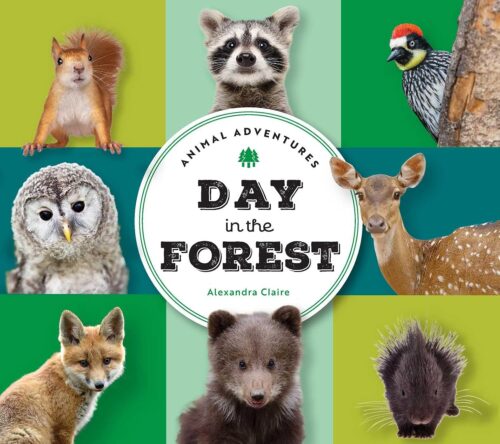
Foof! Look at THAT beauty! You know, photography seems to be all the rage these days. Between The Eric Carle Museum’s exhibit on photography (CLICK! Photographers Make Picture Books will run from January – June 2026) to Mac Barnett and Jon Klassen’s many thoughts on the medium (here and here), one rarely sees them discussed this often or this well. Board books are no stranger to photos, of course. They are the bedrock upon which so many of today’s titles on this list rely. It’s just that you can’t help but enjoy the different methods of using them. Alexandra Claire’s “Animal Adventures” series just kicked off this year (next year we’ll be seeing Day in the Bay, which looks particularly toothsome) and it’s a charmer. These may be Shutterstock images, but they are crisp, clear, colorful, and fun. There’s a bit of anthropomorphism here since each animal gets a name, but beyond that they just act like the animals that they are. For anyone looking to to fill their shelves with amazing nature photography, this one is the one to beat in 2025.
Dinosaur’s Wobbly Bottom by Kit Frost, ill. Sam Rennocks, paper engineered by Paper Engine, Ltd.
Puppy’s Wobbly Bottom by Kit Frost, ill. Sam Rennocks, paper engineered by Paper Engine, Ltd.
Santa’s Wobbly Bottom by Kit Frost, ill. Sam Rennocks, paper engineered by Paper Engine, Ltd.
Unicorn’s Wobbly Bottom by Kit Frost, ill. Sam Rennocks, paper engineered by Paper Engine, Ltd.


Remember DJ Baby? I made a TikTok video about it once but it seems to have disappeared into the ether. In any case, the whole reason I adored that book as much as I did was its interactive element. And then I went and I saw this new series and I started getting all these other ideas. There are so many possibilities with these four books. First, just to get the basics out of the way- there are no plots in these titles. And it’s not all bottoms either! On these pages you can make the T.rex stomp its feet or a rainbooted unicorn splash in some puddles. However, it all leads up to the ending. That’s where you get to control the wobbly bottoms of four animals or people or what have you all at once. And it is… highly amusing. Like, way more fun than it should be. Just imagine me sitting at the adult reference desk at my library, operating those butts in a circular manner with all the seriousness of the most prestigious scholar. Now, of course, I need to figure out what music would accompany THEM in the ideal TikTok video…
Get Dressed Belly Button! by Lucie Brunellière, translated by Linda Burgess

She’s back! Last year Lucie Brunellière burst onto the American board book scene with the adorable Good Night, Belly Button. This book is much like that one. It’s read in a vertical format and you are traveling upward with the help of flaps. In this case, though, you’re not tucking the child on the page in, but getting them dressed, piece by piece. Each flap adds a new part to the outfit. By the end, the kid is nigh bursting with a thick coat, boots, the whole kerschmozzle. It also ends with “a great big kiss” which is a wonderful excuse to either kiss your own kiddo or kiss the child in the book. Either way, kisstastic.
If It’s Pride and You Know It… by Andy Passchier

All right, man. We are doing this. So Nosy Crow rules the interactive board book genre in a number of ways. One of them just comes down to sheer cardboard technology. They call them “chunky sliders to push and pull”. I call them genius. Now usually you see this kind of thing on a Bizzy Bear book or something like that. Incorporating it into a book on Pride is brilliant, and making it something you can actually sing? Even better. But the true reason I’m as excited as I am about this book also has to do with the way in which Passchier utilizes color. The cover of this book, when you turn the wheel, becomes this psychedelic whirligig of rainbow colors. I mean… it’s a dance party. They put a dance party in a board book and it’s the most gorgeous little thing. Without a doubt, this is the best Pride board book you will ever ever encounter.
Kitty-Corn Club:Parts of Us by Shannon Hale, ill. LeUyen Pham

This book seriously cracked me up, but maybe not in the way it meant to. So, I don’t want to shock anyone, but I’m kind of a hard case when it comes to children’s books. My standards? Possibly too high. Possibly way too high. Now this is a board book, yes? It is intended for preschoolers, correct? Maybe even toddlers. The cover? It is unapologetically sparkly. The contents? Fun. So what do I, a 47-year-old woman, find myself obsessing over as I read it? Well, to be perfectly frank, Shannon Hale wrote it knowing full well that the word “tentacles” is funny. Which it is. So listen to this exchange: “Teeny-tiny mini moo / Kitty-corns will read with you. / Silly-willy hardy-hars / Let’s all look at body parts! / Long tail, short tail / Fat tail, feathery tale / Tentacles!” You get it right? How funny that is? And even more brilliantly, it’s after a page turn. A two-page spread of an orange bespectacled octopus. I know for a fact that there is GREAT humor to be taken from this book. I can already seen loads of small children helpless with mirth because they know the word “tentacles” is coming up. I also know that whatever editor worked on this book took one look at the manuscript, loved it, and then thought about people like me. Literal people. People who would have the gall to take issue with an adorable, hilarious board book. Because you know what else I was thinking as I read it? That’s right. If all those octopus informational books I’ve read over the last two years have taught me anything (including this year’s delightful I’m a Dumbo Octopus) it’s that octopuses have arms, not tentacles. So some editor somewhere knew that I,or someone like me, would pitch a hissy fit over the fact that this octopus thinks it has tentacles. When it got pointed out it was probably too late to turn the octopus into a squid. So what did they do? They literally put a little tiny caveat on the back of the board book. It reads, and I quote, “Did you know octopus ‘tentacles’ are actually called ‘arms’?” Yeah, cause they’re not tentacles, people. But you know what? Kitty-corn has been through a lot this year. She’s getting banned in places because empathy with the pink and sparkly is NOT cool to certain factions of our country. So let them have their tentacles, I say! It’s a hilarious book and that goes a long way in the current political era. And you can read my interview with Shannon and LeUyen here if you’re curious to know more.
Let’s Find Yaya & Boo: On the Go! by Andrew Knapp

Look, are the photographs in this book Photoshopped? Undeniably. I mean, about the time you see Yaya’s head poking out of the excavator’s shovel, you’re fairly certain that not all is as it might be. Regardless, can we just pause for a moment to admire how Knapp sets up these shots, both in reality and in the context of his Wes Anderson-esque hide and seek pages? Following in the footsteps of folks like Walter Wick, Knapp’s books are legitimately difficult, and that’s why I love them. I know that in previous titles (possibly the first Let’s Find Yaya & Boo) there was at least one image that legitimately stumped me. In this book I took all the pride that a grown woman can take in finding those darn dogs on each and every spread. And whatta bunch of spreads they are too! Each vehicle poses like a supermodel on the page, not a rust spot or speck of dust visible on their shiny chassis. For any kid obsessed with vehicles, this is the book to get. You have never seen more beautiful cars, trucks, fire engines, construction vehicles, what have you, than you have here. And yes, the dogs are also cute, and the seek-and-find aspects fun. But c’mon man. Revel in some of this beauty.
Look! What Is That? by Tristan Mory

Okay, I’m not an idiot. Still, I’m afraid I’m going to have to confess to you that it took two tries before I quite understood how to use this book to its maximum effect. So basically, if you don’t want to look dumb in front of your toddler or preschooler you, ah, might want to practice this one alone for a little while before introducing it. Strange words to say about a book that pretty much just involves turning pages and pulling tabs? Well, it’s the tabs, my friends, that were my undoing. Essentially, you are in the presence of a baby. As you read, you will find these tiny indentations on the edges of the pages. Pull out the tabs when you see them! They correspond to the animals talking in the text. That’s where I got all kinds of confused. Use the book correctly and it’s a delight. I was particularly pleased with the baby’s side-eye that it gives to the wolf. Very cool and very original but don’t go into it cold! You have been warned.
Make Tracks: In the Sky by Johnny Dyrander

Every year I swear, I SWEAR, I’m not going to let another Dyrander book onto my lists. I’ve already included him so many times before, and doesn’t he just do the same book over and over again? Would that it were so simple. The trouble is that what Dyrander does, he does better than anyone else. Take, for example, this book, which is full of different kinds of things that fly. Thanks to that clever design of little free floating pieces held within the confines of the thick cardboard pages, you can make an airliner take off, fly a hot-air balloon over the mountains, zoom a somewhat erratic helicopter over a city, and even orbit the friggin’ earth with a spacecraft. *sigh* I can’t help it. It’s too much fun not to include. Johnny Dyrander, you win again. Consider handing this to the screaming toddler on the plane seat next to you.
My Busy Art Book! by Lizzy Doyle

Warning: Children WILL lick this book. Repeatedly. Possibly one after another. For this reason, this may be more of a home-board-book than a library-board-book. And why, you may ask, are tongues getting in on the action? Well, this is truly interactive in every sense of the word. On one page you are told you can “dip your finger in water and swirl it around and around” on a page in the book, releasing the patterns. Cool, but if you know kids then you know that they’re smart enough to find alternative wet surfaces, if inclined to do so. The rest of the book is a little less… slippery, let’s say. There are pull tabs for mixing colors, picture puzzles, and shapes and lines to trace with your finger. Definitely for our slightly older kids, but sophisticated enough that I have little doubt some of them would turn to it again and again.
My First Story Orchestra: Four Seasons in One Day by Jessica Courtney-Tickle

Under the usual circumstances I can be a hard sell on board books that sing. No doubt you too have seen a variety of them, trying to introduce kids to Mozart, or The Nutcracker, or Wagner (I might be making that last one up) by sharing small snatches of music on a scant number of thick pages. Over the last few years, though, board book sound technology has been getting wildly impressive. When I came across this little ode to Vivaldi, I discovered what might be one of the cleverest uses of sound on a limited number of pages I’ve seen in a while. Since he already wrote pieces for the four seasons, why not show them alongside small descriptions of what the seasons entail AND play a little bit of Vivaldi as well? The end result is immersive. I even found myself wishing that the portions of Vivaldi could be longer so that we could listen to them in full. Kids and parents may feel the same way, making it a marvelous gateway drug to a classical music education.
My Little Music Book: I Love Music by Marion Billet

MORE music! All right, folks. I need you to help me out. Clearly this technology that allows for this onslaught of music-related board books out this year has a name. If you haven’t seen the books in question, on each page of this title is a small circle. You turn the book on at the back and put your finger on the circle and voila. Some kind of sound appears. I first fell in love with the technology last year with that incredible birdsong title, Songs of the Birds: A Guide to North American Bird Calls and Songs by Isabel Otter (and if you haven’t seen it, you’re in for a real treat). This year, there’s been a tiny explosion of similar titles on our shelves. Some know the best way to use the technology. Some do not. Interestingly, this particular book, I Love Music, isn’t all that new. It was released in 2011 in France under the title Les instruments vol. 1. One has to assume it didn’t have the same technology back then. Credit, then, to whatever enterprising soul realized that if you turned this into a board book with this technology, you’d have a much more practical way of introducing kids to these titles. Billet’s art is fun and is seemingly set in some kind of Tyrolean circus tent or something (check out the cat’s outfit on the cover and you’ll see what I mean). Useful, but also just a bit weird, which is something I always appreciate.
Nosy! by Seymour Chwast


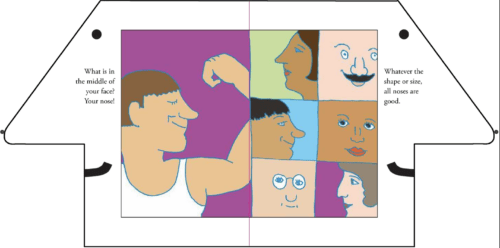

Damndest thing. So I took the liberty of asking the folks at Creative Editions what precisely the deal was with this Seymour Chwast board book. I mean, has he ever done one before? Not quite like this, they said. Until now, Chwast has never published a book originally as a board book in its first run. And considering that the man is now a mere 94 years of age, this “ode to the node” is as delightfully odd as you might expect from the legendary graphic designer. The shape of the book is bound to raise a couple eyebrows in the library setting, but it sets it apart from all those dull square-shaped items. Inside you’ve an array of nosey-goodness. And after all, as it’s quick to point out, “Whatever the shape or size, all noses are good.”
One, Two, Grandma Loves You by Shelley Becker, ill. Dan Yaccarino

Very smart. Very clever. I love a board book that knows precisely what it’s doing every step of the way. Let’s zoom in on some of the choices Becker was making here for a start. She takes the old “One, Two, Buckle My Shoe” concept from the get-go, but rather than make this a super short board book, she rewrites the words and repeats them on a loop. Why? Because this is a story about a grandchild visiting a grandmother who clearly doesn’t live in town but is also within a reasonable driving distance. By repeating the old “One, two, Grandma loves you” line, it shows the cyclical nature of these visits. How they happen over and over again. It’s up-to-date (cell phones exist in this world, which we cannot say for every board book out there) and the rhymes, I am happy to report, scan nicely. Then there’s the work of Dan Yaccarino. God, the man is good at what he does. Grandma lives in this mod 60s-inspired home full of cool design elements and even the occasional lava lamp. She wears big thick glasses that I intend to replicate when I acquire my own grandchildren someday, and Dan is working all kinds of cool details in here. There’s a shot of Grandma chatting on the phone with her granddaughter, where she’s stylishly dressed alongside some seriously keen furniture, with a picture of a woman and a cat in the background that I 100% believe is of her in her younger days. And the lamp in that scene! Gah! So gorgeous! Finally, there’s even humor in this book, accompanying the sweet love of grandma and grandchild. At one point the kid literally blocks the door with furniture to prevent their separation. Grandma is, appropriately, charmed. A supremely cool book that is still absolutely something a kid would enjoy.
Our Gorgeous Baby by Smriti Prasadam-Halls, ill. Eve Coy

Did anyone else read the first sentence of this picture book and immediately wonder if Prasadam-Halls wasn’t riffing on Shakespeare’s Sonnet 130? Listen to it: “Our baby’s eyes are not brighter than the sun.” I mean… come on. And for that reason right there, I was hooked. For the record, none of the ad copy is playing up that fact, which I feel is too bad. In 2025, I’ve grown very fond of children’s books where the kids are complaining, like in Wash Day Love by Tanisia Moore, for example. These are books that tell children that it is okay to say when you’re upset about something, but that maybe there’s more to the story too. In this case, an older sibling explains that there are a lot of issues with this baby, but it’s important to note that this is all mentioned very lovingly. The art by Eve Coy makes the affection between the siblings clear as crystal, and it would be hard-hearted individual indeed who didn’t fall in love with this family along the way. This book is no Shakespeare… but we think it’s pretty awesome anyway.
Say Cheese! by Sophie Aggett, ill. Pauline Gregory

You know, just when you think folks have determined all the ways to write a board book, someone like Sophie Aggett comes along with an idea that I’ve literally never seen before. Now maybe part of my deep and abiding affection for this book stems from the fact that in some ways it reminds me of another 2025 release (a certain Pop! Goes the Nursery Rhyme by a certain Betsy Bird). In this case you’ve mischievous animals photobombing one another whenever they try to take some shots. These moments are done with flaps, which is a smart way to do it since once the kids get the premise, they’re really going to enjoy the tension that comes before that flap gets turned. I’m a little embarrassed to mention that it took more than one read for me to realize that the photobomb-er always becomes the photobomb-ee in the next spread. A goofball of a book.
A Seed in the Universe by Elyon Liu

Probably as philosophical a board book as ever you will find. Wanna expand some preschooler’s mind? First off, this really is a good book for their age range since it’s one of those books that straddles “board book” and “picture book” with equal ease. It’s slightly larger than a board book with covers and everything, but inside the die-cut pages are very thick. The art, for its part, is lovely. Just three colors in total (yellow, red, and green) but strangely sumptuous. As for the concept, it begins with a seed. “A seed is growing inside an apple.” Turn the page. “Which is eaten by a caterpillar.” Turn the page. “Which is hiding from a bird.” And all this expands and expands and expands until you find yourself in space looking at Earth from a distance, “Which looks like a seed in the universe.” Minds. Blown.
Shabbat Shalom: Let’s Rest and Reset by Suzy Ultman

Let us, for just a moment, praise a board book and its adept, succinct use of limited language. Listen to this: “On Monday, Tuesday, Wednesday, Thursday, and Friday, we do all the doing. On Friday night, Shabbat begins, and we pause the doing to enjoy just being.” I have literally never heard Shabbat described any better than this. Every element on the tables, as they are prepared, contains a plethora of smiley-faced objects scattered hither and yon. The attendees at the meal are an eclectic and wide array of critters, people, and the occasional walking talking piece of fruit. The book isn’t preachy in the least. Its explanation of why Shabbat is a necessary time is so straightforward and lovely that you’ll want to partake in it right away. This is, to my mind, is the most successful kind of holiday or religious ceremony-centric board book. It gives you what you want to know while also containing amazing eye-catching art and a text that outdoes itself. Find this!
Upside Down: Animals by Danielle McLean, ill. Matt Hun
Upside Down: Opposites by Danielle McLean, ill. Matt Hunt
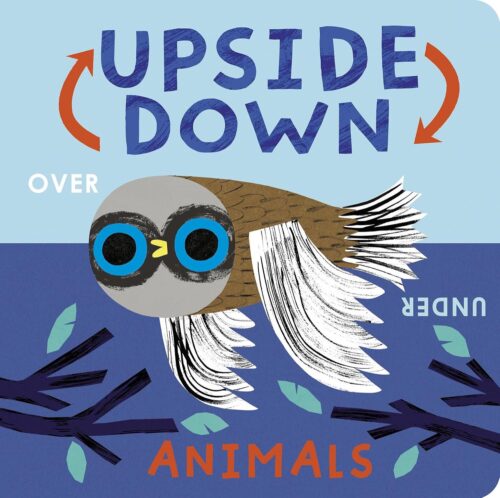
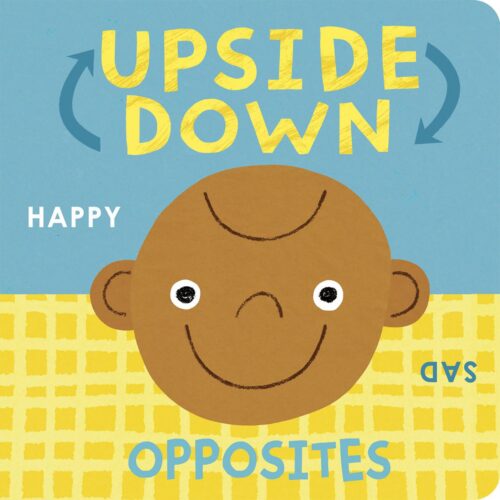
Perhaps the highest praise one could place upon this tiny book is to say that the first thing I thought of when I saw it was the work of Peter Newell. Are you familiar with his books where you could turn them upside down like Topsys and Turveys? Same idea here, but much younger and clever in its own way. There are any number of ways to read this book, of course. You could go through it entirely one way and then turn it upside down to read it the other way OR you could keep flipping it back and forth as you read. Personally, I would opt for the latter version. I imagine it could be a lot of fun to read this book to a group of preschoolers, blowing their small minds with every flip. Oo! Maybe you could even say the word, “FLIP!” when you do it! I bet they’d get a huge kick out of that. Bonus points for the art of Matt Hunt being so fun and visually appealing as it is too.
Walk With Me: A Counting Adventure by Nancy E. Uslan
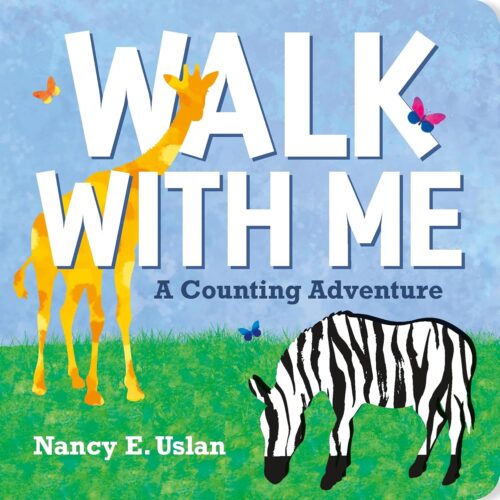
Few picture books reminds me in their art of the work of Daniel Minter, but that’s the surprise you’ll find when you open up this seemingly innocuous counting book. Uslan explains in her Author’s Note (the rare board book Author’s Note) how she visited Rwanda in 2005 and the ways in which it influenced her work. “The illustrations in this book were inspired by artwork made by the talented art students at the Philadelphia Performing Arts String Theory charter school.” However she came to make them, apparently all proceeds from the book support NEU Global’s initiatives (the nonprofit that Uslan founded to “foster global literacy and critical thinking by engaging ‘American students in the development of English-language learning materials”). Mind you, you can have all the best intentions in the world and still end up with a boring book. This book? Not boring. The simple rhymes and numbers are certainly supporting the art, which features a range of different animals and creatures. Due to the types of wildlife present, one can make the assumption that it’s set in Rwanda, though Uslan isn’t beating you over the head with the fact. It’s one of those books of casual diversity that strikes you as accomplished without making a big show about it. A little surprise treasure of a book.
Your Farm by Jon Klassen
Your Forest by Jon Klassen
Your Island by Jon Klassen

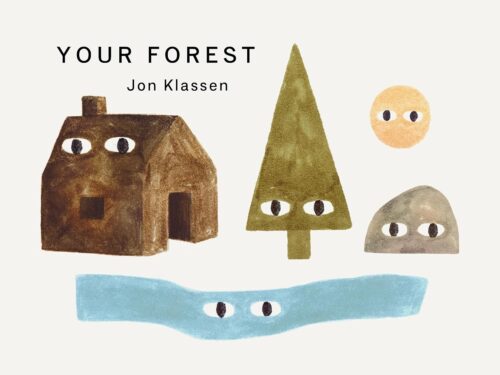

Jon Klassen continues his favorite activity of weirding us out a little bit, even as we are utterly charmed. This year he has dipped his toe into the world of board books. Caldecott winners do this on occasion, but usually they do it along the lines of Brendan Wenzel’s critters n’ such. Klassen is rather more fond of eyeballs. Eyeballs on a barn. Eyeballs on a fire. Eyeballs on a stool. He eschews jokes for adults in these three little board books, preferring instead to directly talk the talk with his readers. “This is your sun. It is coming up for you.” And since small children rather think the world revolves around them anyway, they’re hardly going to correct him. In each of these small scenes, Jon is giving the power to the child reader. He tells them that all the things in these places are theirs, much as you would tell someone who owned toys of these things. Though the child cannot move these objects, there’s a strange sense of comfort in the notion of ownership and power. Does much happen in these books? Not really. The sun has a tendency to go up and down. You get a small ghost in one of them. Really, these are the kinds of board books that are quiet and unassuming. Some folks will inevitably say that they are for adults trying to look cool to other adults. To that I say, why can’t they be all ages?
2025 Board Book Reprints
FEATURED TITLE
Say Zoop! A Book of Sound by Hervé Tullet
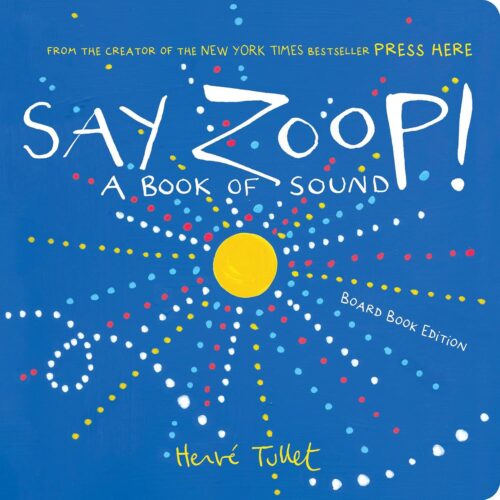
Like most Americans, my first introduction to the work of Hervé Tullet began with the book Press Here, but after that, I discovered an entirely different kind of book he’d mastered. For a while there, Tullet excelled in doing board books with names like The Game of Lines or The Game of Light (and if you are looking for gifts for a small child, I couldn’t recommend this whole series enough). My daughter was enthralled by these books, and why not? Tullet knew how to do incredible things with the board book format. These days, I’m much more likely to run into his picture books adapted into a board book format, but even so he’s not half-assing these adaptations. I think we’re all familiar with cases where the publisher sort of slapped together the board book in a cash grab, completely ignoring the fact that board books have different needs than their older kin. Tullet must have a hand in adaptations like Say Zoop! though because it’s perfectly positioned for the tiniest of fingers. The fact that it also happens to be abjectly beautiful to look at with its red, white, blue, and yellow color scheme, doesn’t hurt matters much either. Interactive and enthralling. Classic Tullet.
Día de Muertos Números: A Day of the Dead Counting Book by Duncan Tonatiuh

One of those rare cases where you stare in vain at the board book, trying to puzzle out how it began its life as a picture book in the first place. Some books lend themselves a little more easily to the transfer process than others. In the case of this 2023 Tonatiuh book turned into a 2025 board book, the word “seamless” comes to mind. As a family places objects on an ofrenda, the book counts each and every one of them in both English and Spanish. Now in an interesting move (and I’d have to get my hands on the original picture book to see if this was the case with that book as well) there is a double page spread gatefold that opens up to show ten family members and friends singing and remembering the single loved one featured on the altar. Tonatiuh’s style is the classic one we’re all familiar with, and it puts it to excellent use here. Honestly, if you’d told me that this was originally a board book and not a picture book, I’d have been inclined to believe you. Beautiful work.
Watch This by Hilary Walker, Jane Godwin, and Beci Orpin
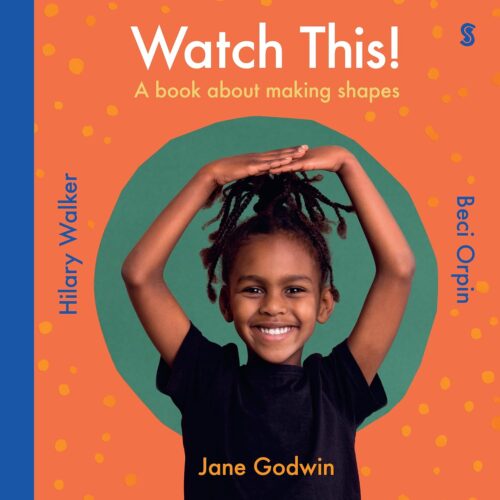
Say hello to your new favorite Australian import! First off, I love any board book with photos that says on its publication page, “The background sets were made using large cardboard sheets, cut-paper, and paint.” Shape books in board book form are common enough, so why am I unable to conjure up another board book that’s taken the time to combine photography of kids with the shapes they make with their bodies? This book is utterly charming but there’s a cleverness at its core that I really enjoyed. It isn’t just one or two kids making a single shape. The book goes out of its way to show a variety of different ways to make the same shapes. For example, right at the start you’ve one girl making her straight body look like a triangle. Then, on the opposite page, three kids lying on the ground also making a triangle (with Isaac looking particularly pleased about putting his feet on Izzy’s face). One more page turn and here’s Jasmine making a triangle out of her hands. The kids are all wearing black t-shirts and pants, making them look like a very small jazz dance ensemble. At the end, they start to make original shapes, which (again) isn’t something I’ve seen a shape book do before. Brightly colored, continually reinforcing what the shapes are and how anyone can make them, this is highly original and worth everyone’s time, money, and attention.
We’re Going On a Bear Hunt by Michael Rosen, ill. Helen Oxenbury
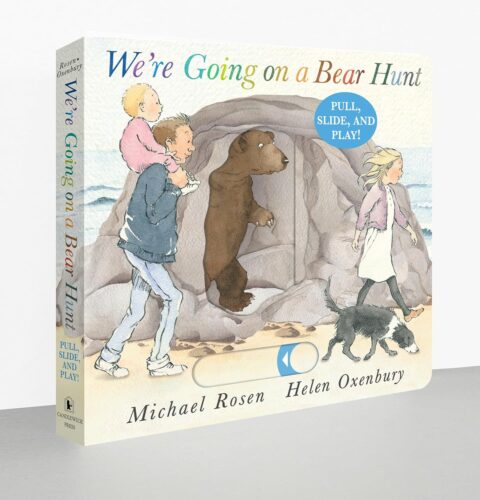
A recommendation with a small caveat. So I’ve been a huge fan of this particular book for years and years. Pairing Rosen and Oxenbury was a brilliant notion, after all. And to use that old classic hand rhyme? Many is the storytime I did with it. For more of a laptime experience, though, this board book is a nice, small title. You can move little slides back and forth to the rhythm of the words. Are these tabs at a Nosy Crow level of cardboard complexity? They are not, but they work for the most part (spinning the wheel to make the snow move is particularly fun). Now you might be asking how the book ends since board books are rarely as long as their picture book counterparts. This one actually ends with a pop-up discovery of the bear itself with the line, “We’re never going on a bear hunt again.” I suppose toddlers are less concerned about what happens next, but at least for adults that final line has a kind of eerie foreshadowing to it. But who cares? Toddlers don’t care. Toddlers just like the rhythm, the tabs, and the fun of it all.
Whose Egg Is That? by Darrin Lunde, ill. Kelsey Oseid
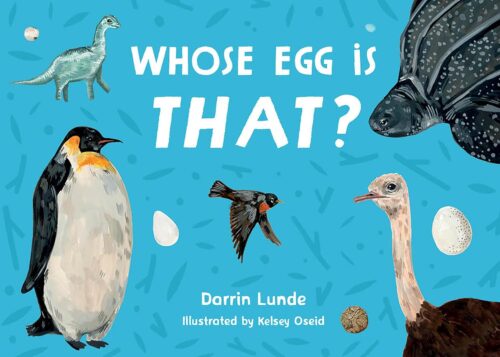
Can you identify the eggs and who they belong to? Birds and beasts from today and long ago abound in this delightful array of egg origins. Some books fit so naturally into the board book format that you have a hard time believing that wasn’t their natural original state. With its simple text and big beautiful thick paints, this is a supremely simple but also lovely series of questions, answers, and gentle facts about different kinds of animals and their eggs. It begins with birds, transitions to turtles, then makes a surprising right-hand turn into fossilized dinosaur eggs, which I thought was an interesting way to go. Works!

That’s it for today! Be sure to stay tuned for more lists on 2025 titles. The full roster is here:
December 1 – Great Board Books
December 2 – Picture Book Readalouds
December 3 – Simple Picture Book Texts
December 4 – Transcendent Holiday Children’s Books
December 5 – Rhyming Picture Books
December 6 – Funny Picture Books
December 7 – Caldenotts
December 8 – Wordless Picture Books
December 9 – Bilingual Books for Kids
December 10 – Math Books for Kids
December 11 – Books with a Message / Social Emotional Learning
December 12 – Easy Books
December 13 – Translated Children’s Books
December 14 – Fairy Tales / Folktales / Religious Tales
December 15 – Gross Books
December 16 – Poetry Books
December 17 – Unconventional Children’s Books
December 18 – Early Chapter Books
December 19 – Comics & Graphic Novels
December 20 – Older Funny Books
December 21 – Science Fiction Books
December 22 – Fantasy Books
December 23 – Informational Fiction
December 24 – American History
December 25 – Science & Nature Books
December 26 – Unique Biographies
December 27 – Blueberry Award Contenders (Celebrating the Environment)
December 28 – Nonfiction Picture Books
December 29 – Nonfiction Books for Older Readers
December 30 – Middle Grade Novels
December 31 – Picture Books
Filed under: 31 Days 31 Lists, Best Books, Best Books of 2025

About Betsy Bird
Betsy Bird is currently the Collection Development Manager of the Evanston Public Library system and a former Materials Specialist for New York Public Library. She has served on Newbery, written for Kirkus, and has done other lovely little things that she'd love to tell you about but that she's sure you'd find more interesting to hear of in person. Her opinions are her own and do not reflect those of EPL, SLJ, or any of the other acronyms you might be able to name. Follow her on BlueSky at: @fuse8.bsky.social
ADVERTISEMENT
ADVERTISEMENT
SLJ Blog Network
Cover Re-Reveal: 1000 HORSES FOR THE KING by Gracey Zhang and Me
Exclusive: New Middle-Grade Fantasy from Nakama Press | News
From Policy Ask to Public Voice: Five Layers of Writing to Advance School Library Policy
ADVERTISEMENT
I’m going to have to work “clever little dingus” into my vocabulary and use it as often as possible.
Question: Who actually wrote “Count to 10 and Back Again”? The credits above are unclear.
I do believe Hui Skipp is the creator of that book. If you try looking it up online it’s unclear, but the tiny publication type credited him as the person behind it, so that’s what I wrote down.
And thank you. I am inordinately proud any time I can work the word “dingus” into a sentence.
Hooray! I have been looking forward to your 2025 lists pretty much since I read the final one last year. Such a joy reading your prose and seeing a whole lot of new-to-me books. Thank you, Betsy.