
Taking Play and Whimsy Very Seriously: Meet the Smushkins and Claudia Rueda

You know what’s going to save us from AI? Specifically, AI picture books?
Weirdness.
I’m not talking uncanny valley, AI hallucination-type stuff. I’m talking books that no machine could have thought up. Books that fill the gaps that our brains didn’t even know were there.
I’m talking Smushkins, people. The kind of creations that only people like creator Claudia Rueda could come up with.
Now I know I’m going to sound like a bit of a broken record to some of you when I begin to wax eloquent on the fine art of the simplest picture books. I’m an adult. You (probably) are an adult. Consequently, we like it when our picture books show a little wit and sophistication. All well and good except that it completely forgets about our youngest of picture book readers. Whence the books for them? That’s where the Smushkins come in. They’re multicolored and just a bit… odd. Not in a bad way. More in a way where you tilt your head at them and wonder what brain could have come up with such a pack of oddities.
ADVERTISEMENT
ADVERTISEMENT
That brain? It’s Claudia Rueda’s. And we’re talking to her today:
Betsy Bird: Claudia! Congrats and hooray for the appearance of The Smushkins into the world!

Claudia Rueda: Thank you, Betsy. And thanks for inviting me to have this conversation!
BB: So I’m just going to take you back to the very beginning. Where did the idea for this book come from in the first place? Whence the Smushkins?
Claudia: I was doodling for fun one day, and these creatures simply emerged on the page. I loved them at first sight because they embodied the playfulness and curiosity I often see in children, but I had no idea what to do with them. I saved those drawings until I was preparing my portfolio to submit to editors. I selected some of the characters, created two concept books, and named them The Smushkins. Candlewick acquired the two books and suggested adding a picture book to introduce The Smushkins. Around that time, I was in the middle of a discouraging apartment search in New York City. Thinking of the Smushkins while working at the library, I began imagining the kind of place they would love to live in, and that was the beginning of the first story. Once I started creating stories for them, I realized how kind, open-minded, curious, joyful, and creative they were and how inspiring that can be.

BB: Shoot, I should have asked you which library branches you tended to hang out in. No matter. Moving on.
I’m asking this question as both a librarian who reads books for kids and as an author myself. Coming up with a single character is always a big deal for me. You, however, have come up with a CREW of characters. Each one is distinct. Each one with its own personality. There’s no elegant way for me to ask this, so I’ll just say it: How do you do that?
Claudia: The initial sketches were already revealing their personalities. I’m aware it might sound unusual because we’re accustomed to the authoritative role of the text in matters like these, but it happened quite naturally. When I’m not working on a specific book project, my sketches are free of purpose, and my dormant memories and recollections emerge on the paper in an unusual manner. In a way, I believe I was recalling a celebration of childhood.
Later on, I created a visual “manual” for each of my characters and compiled a list of the personality traits revealed by the images. However, it was only when I began creating scenarios for these creatures and making them interact in the books that I came to know them much better. I would answer questions like What would each of them do if they were at the beach? What do they do on their own? How do they face danger? The process lasted more than a year.
BB: Let’s dig a little more into that and talk about the look of the Smushkins. And I don’t just mean their physical appearance, but also the choices you made with the colors and design of the book itself. Was there a lot of trial and error when figuring out their precise look? Do you have sketchbooks full of ideas, or did they come to you fairly quickly?

BB: The evolution from the initial pencil drawings to the final illustration took many months and tons of sketches, as is always the case for me. I first need to familiarize myself with the character in a way that allows me to draw it spontaneously. I also enjoy trying a variety of different options. I have hundreds of sketches, a pile of sketchbooks, and more than 20 different storyboards. Once I had chosen my main characters, I began to develop their traits and bring them to life. Rendering also takes time, and you have to be careful not to lose the initial spirit of the sketch. The color choice was very intuitive. I wanted the characters to have different colors as a celebration of diversity and also be bright with an organic tone. At that point, I was already working on the picture book with Candlewick, and they helped me refine and improve its coherence.
BB: Recently I’ve been hyper-focused on how difficult it is to create a simpler picture book for younger readers. Adult reviewers seem to prefer complexity, which can be hard when you want to get something for the littlest littles. What is your general attitude when writing picture books for kids just out of board books?
Claudia: I’m so glad you are asking this question. I agree with you on the preference for complexity – and I would add realism– coming from reviewers and how this approach might not be a good fit for small children. The minds and perceptions of small children are extraordinary and quite different from those of adults. Some very serious grown-ups might not be aware that childhood playfulness is what makes us creative and open-minded as adults. Imagination and learning are a child’s job and allow them to think about possibilities and not just the facts. Our human capacities for imagination and adaptation stem from our childhood. That’s why we have to take play and whimsy very seriously.
I’ve been quite inspired by developmental psychologist Alison Gopnik, who suggests that in the past, we thought young children were irrational, egocentric, and amoral, when in fact they are smarter, more imaginative, more caring, and more conscious than adults. That’s what the Smushkins books wish to celebrate.
BB: I love that. You know, when I was a kid, I always gravitated towards stories where a bunch of friends all lived together. I completely see that in MEET THE SMUSHKINS! What, to your mind, is the appeal of characters that exhibit childlike sensibilities but also get that whiff of independence as well?

Claudia: I love that you noticed that. I’m a big fan of empowered and curious characters like Alice in Wonderland and Pippi Longstocking, both symbols of child independence. But most importantly, the Smushkin’s world is mainly related to children’s play; they create a parallel universe where adults cannot get in. That’s the world of The Smushkins. In their free play, they are totally independent, but they also face challenges that require them to be creative, make choices, and care for one another.
BB: The Smushkins do seem poised to do so much more in this world. Can we hope to see more of them in the future?
ADVERTISEMENT
ADVERTISEMENT
Claudia: Oh yes! As I mentioned earlier, creating the first books in the series has allowed me to get to know each of them much better, and that’s such a great advantage when developing new stories for them. There are two concept books coming out next March – a book on colors, and an onomatopoeic alphabet book – and also two more fun and whimsical board books for the following season.
Additionally, I have already written and created the dummy for four new picture book stories. Now, the Smushkins must face obstacles, fear, and challenges. I can’t wait to share those stories with all of you, but I will have to wait.
BB: Finally, what else are you working on these days? What else is in your future?
Claudia: I’m writing a nonfiction book on the art of picture book writing, which is something I’ve taught for several years. I want to write -and illustrate- how crucial the role of an evocative picture is for creating meaning when combined with the text and how powerful that is to promote active reading.

Well, that certainly sounds like a plan to me. Happily, you’ll be able to pick up a copy of Meet the Smushkins quite soon indeed. The first book will be released December 2nd for one and all to see. Special thanks to Claudia for answering my questions and to Anna Abell and the team at Candlewick for helping to put this together today.

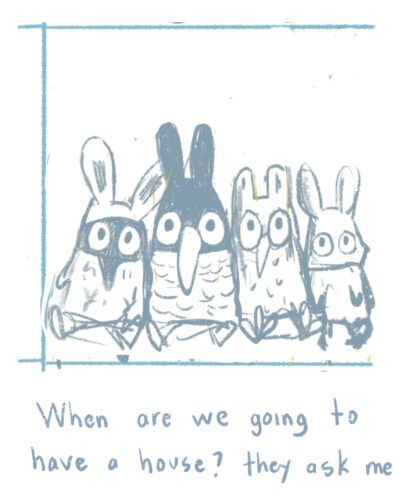
Let’s end with a slew of sketches Claudia made for the Smushkins early on. Big thanks to her and the team for sharing them with us today:




Filed under: Interviews
About Betsy Bird
Betsy Bird is currently the Collection Development Manager of the Evanston Public Library system and a former Materials Specialist for New York Public Library. She has served on Newbery, written for Kirkus, and has done other lovely little things that she'd love to tell you about but that she's sure you'd find more interesting to hear of in person. Her opinions are her own and do not reflect those of EPL, SLJ, or any of the other acronyms you might be able to name. Follow her on BlueSky at: @fuse8.bsky.social
ADVERTISEMENT
ADVERTISEMENT
SLJ Blog Network
Name That LEGO Book Cover! (#75)
The Delinquent and the Transfer Student, vol. 1 | Review
From Policy Ask to Public Voice: Five Layers of Writing to Advance School Library Policy
Fast Five Interview: Shreya Davies and Vanessa Wong
ADVERTISEMENT