
31 Days, 31 Lists: 2025 Unconventional Children’s Books
Today’s post is one of the most enjoyable of the month. There are children’s books that come out every year that defy easy categorization. And in a world in which, this very holiday season, loads of schlock AI picture book titles crowd the virtual shelves, fooling well-meaning relatives to buy them for kids, this list stands as the antithesis of everything AI. There’s not a book on this list today that a computer could ever dream up, because each one defies algorithms. They are original. Eclectic. And, as ever, I must mention that this list has a sibling over at 100 Scope Notes called The Most Astonishingly Unconventional Children’s Books of 2025. He has impeccable taste, so you’re certain to see some overlap. It was also from him that I once stole the descriptive “unconventional”. It lacks the judgemental quality of so many other terms, after all.
You can find a full PDF of today’s choices here.
Curious about other unconventional titles? Then check out these previous lists:
2025 Unconventional Children’s Books
FEATURED TITLE
Astro by Manuel Marsol, translated by Lizzie Davis


Naturally I start with this one. How could I not? In it, a sweet alien recounts his time befriending a curious spaceman. A bittersweet tale of love, loss, friendship, and the fragility of life. Boy, they just don’t make ‘em like this in America, do they? I think I can faithfully say that this is one of the very few picture books I’ve encountered where the plot is recounted by a deceased narrator. But before we get to any of that, let’s just take a moment to admire the art itself. So many picture books try to show alien worlds, but this one really committed to the bit. Things don’t just look alien to us. This world seems to operate on an internal logic that it’s not particularly interested in catching up the reader on. Then there’s the story, which is so sweetly recounted and told. I adored the relationship between the alien and Astro. And that was before I reached that 2001 Space Odyssey-styled ending. Wowza. This is the kind of book that is going to wiggle its way deep into some young readers’ minds so that they spend the rest of their natural born lives asking people, “Do you know that picture book? That one about the spaceman and the alien and the alien dies? I think it’s orange?”
ADVERTISEMENT
ADVERTISEMENT
All the Stars in the Sky by Art Coulson, ill. Winona Nelson

One can be unconventional in their storytelling, but why don’t we include a book or two on this list that’s unconventional in terms of illustration styles. Artist Winona Nelson identifies as queer and Two-Spirit (pronouns she/her) and is a member of the Leech Lake Band of Minnesota Ojibwe. If you read the publication page of this book, you’ll see that this art has been created “with colored pencil, watercolor, and glass beads.” It’s the beads that struck me as most interesting. So I looked her up and found that beadwork is just one of the many tools at her disposal. She includes a note at the beginning of this book (the only note I could find about her work) that “There’s an indigneous beadwork tradition of making a bead the ‘wrong’ color in every piece as a reminder to keep us humans humble, which I’ve incorporated into the art throughout. It’s kind of fun to look for them too!” Hope you have good eyesight, though, because the beads themselves are minuscule. In this story, a kid wants to be the star of the week in his class, but runs into his grandmother’s pretty straightforward statement that, “I love you, chooch, but I have news for you: you will never be the most important person at your school. No one person is more important than his family and his community.” Sort of turns the whole Star of the Week idea (which tends to be a lovely way of creating conflict in books for kids) on its head. So the writing and story is fresh, but the beadwork, man, the beadwork. Illustration and beads are seemingly seamlessly integrated and it’s fairly incredible. Nothing else looks like this book.
Art’bracadabra by Raphaël Garnier

A show of hands: How many of you are singing that Lady Gaga song in your head right now? Yeah, I thought so. Honestly, I think that’s a point in Garnier’s favor. This book’s a funny beastie, that’s for sure. There are flaps and cut-outs and see-through pages, all of which might make an older kid hesitant to consider this anything more than a baby board book. But the size is too large for that to be the case, and the ideas inside become increasingly sophisticated as you read. Soon you realize that the point of the interactive elements is to better illustrate the book’s points about things like contrast, scale, composition, and more. I was personally quite taken with the perspective section. Due to its originality, it may well be punished for not falling into the usual rote understanding of what an art book is supposed to do. Who cares? Get this in the vicinity of those artsy kids that pick up books at random. Before they know it, they might learn a thing or two.
Brain Train: An Off-the-Rails Journey from A to ZZZ by Charlie Mylie
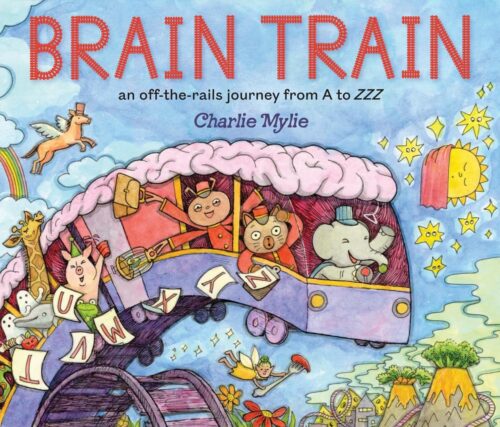
This book almost single-handedly made me want to revivify the old Alphabet Books List I haven’t done since 2018. Almost. The thing is, Mylie’s book looks normal on the outset. It’s just a cute little alphabet book, right? My advice to you with this title is to read it to a group or a kid after two or three other fairly standard (but good!) abecedarian titles. Then read them this book and watch their little heads explode (in a nice way). The premise just seems sooooo normal at first. It’s an alphabet train! Yay! “We’re going all the way to the Memory Palace to visit the queen”. And since this is the “Brain Train” then we must be in the brain in some way, right? Sure. Maybe. Don’t overthink it. Everything starts out very standard. You see that this is the kind of alphabet book where you can identify things on the page that begin with those letters. And if you’re not paying attention you might miss that on the A page there’s an alien angel (I certainly did) or that there’s a devil duck on the D page. Then things literally go off the rails around “F” and suddenly the book goes I, G, H, J… T?!? For the kid that absolutely needs things to be in the correct order, this book will prove to be pure torture. For others, madcap, chaotic, insanity. Just the way I like my alphabet books!
Cabin Head and Tree Head by Scott Campbell


Meet Cabin Head and Tree Head! Two great buddies helping one another through a series of small adventures. Join them and all their friends as they enjoy portraiture, leafcuts (both good and bad), treasure hunts, and more! I want to dive deep into whatever world this is that Scott Campbell has conjured up and just live there for a while. Apparently the man hasn’t produced a picture book since 2019 and decided to celebrate his own return with a book that perfectly combines the sweet and strange. His publisher is selling this with the description that it’s, “like Bill and Ted crossed with Frog and Toad.” Not sure I entirely agree with that, but it’s more on-the-nose than you might think. In this world, everything is on somebody’s head somewhere. This gets taken to its logical extreme when we pan back at one point and see that Cabin Head and Tree Head and all their friends live on an Earth Head (the Satellite Heads delight me). The fact that all these Heads have tiny people who occasionally come out and do stuff is just adorable. I had a lot of fun watching the little people swinging on Tree Head’s tire swing from time to time. I guess you could put this in your graphic novel section OR your early chapter book section, depending on your mood. There are six main stories and then three additional bonus stories about some of the other Heads. Obviously, I’m a fan of Library Head, but that was probably a given. The tone in these stories is so sweet and strange that you’ll have a hard time putting this down. I want to go to there!
It also happened to have the BEST promotional video of the year. Watch all the way to the end, if you’d like to see the surprise cameo:
The Couch in the Yard by Kate Hoefler, ill. Dena Seiferling

There are big, brassy, loud and colorful books that are unconventional, and then there are books like this one. Unassuming. Understated. Quietly subversive. The title pretty much tells you what you need to know too. If ever you’ve driven somewhere and passed a home with a couch in the front yard, you might understand the knee-jerk reaction a lot of people might have to that image. Not kids, though. Kids might see a couch in a yard and wish they had one of their own. Why is the couch there? Does it stay there always? Author Kate Hoefler includes a Note from the Author at the end of this book says as much. She used to drive around Ohio’s Appalachia with her kids, and they were the ones who called out the couches when they saw them. As she says, “there is beauty, magic, and meaning around us all, and a more tender way of seeing – a way that can perhaps serve as a reminder that all of us have people and ‘junk’ we can literally love to the moon and back.” Pairing the text with Seiferling, an artist that has a direct current of dreamlike fantasy running throughout everything that she does, is a masterstroke.
The Coziest Place on the Moon by Maria Popova, ill. Sarah Jacoby


There’s a particular talent to making your picture book feel like an import. Considering its plot and art, Maria Popova’s latest picture book would fit the bill… were it not for the language. I’ve nothing but respect for translators but the sentences that Popova conjures up in this odd little brew are the kind of thing that makes a person feel confident that AI will never pose a true threat so long as we have Popovas in the world. Listen to this: “At exactly 7:26— a pretty number, a pretty hour— Re mounted a beam of light and sailed into space.” That’s the plot of the book, by the way. A small furry creature resembling a blue be-hatted hedgehog, wakes up feeling lonely and so decides to go to the coziest place on the moon instead. When it gets there and finds it, it discovers another creature. What happens next isn’t that they decide to spend all their time together. They are adjacent, nearish, but in their own separate spaces. This would be the kind of book that distinguishes between loneliness and happy solitude. Of course the story in the book is based on science (as is Popova’s wont), particularly the fact that scientists truly have found places on the moon where the temperature averages in at about 63 degrees Fahrenheit. Not too shabby.
The Expedition by Tuvalisa Rangstrom, ill. Klara Bartilsson, translated Saskia Vogel
[Previously seen on the Translation List]
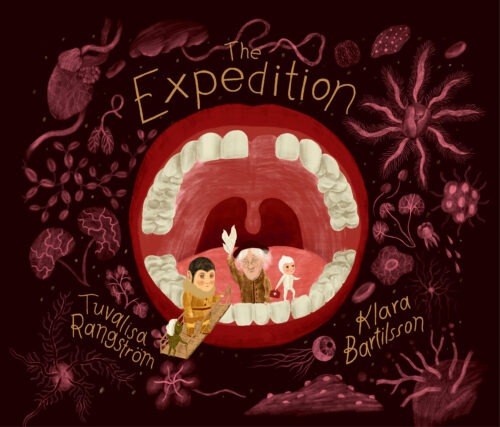

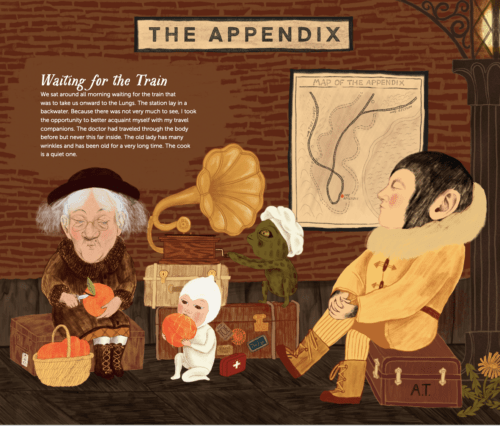
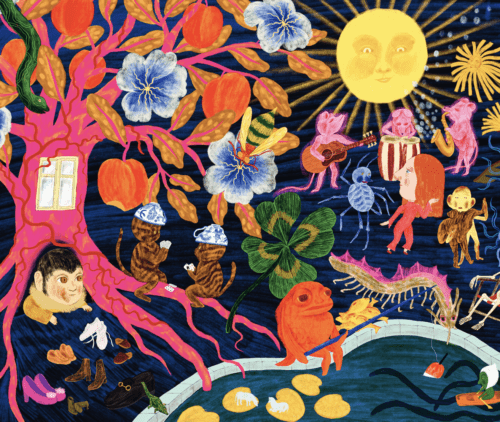
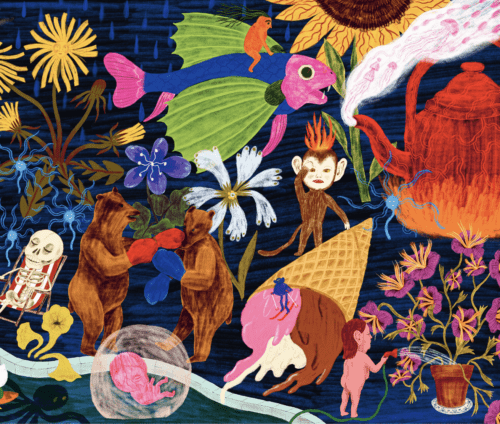
Hope you like translations because you’re about to swallow a slew of them. Transit Editions (the American publisher of this book) once told me that when they were at the Bologna Book Fair a couple years ago, they asked one of the fellow publishers there to tell them which title they were most surprised hadn’t yet been brought to America. The publisher replied that this book was without a doubt the one to take. Little wonder that when it was published here, Transit Editions went all out. The title and creators are displayed in beautiful gold lettering on a cover awash in deep pinks and this massive mouth. In a way, the story of this book begins on the cover. There, you can see our four characters as they embark on an epic journey into the body itself. Though they appear to go in through the mouth, things really beg in when they’re taking a boat ride in the stomach and small intestine. The book does amazing things with details, colors, and something a little more ineffable. There is a feeling to this book. It exudes a funny kind of calm, even as the people go through a series of fun adventures. Then there’s that psychedelic ending when our hero makes it to the brain, and that final two-page fever dream of a spread is worth the entire price of admission right there. I will note that when I posted this book previously, a commenter correctly noted that the font is awfully difficult for some eyes to read. Note that.
Lamberto Lamberto Lamberto by Gianni Rodari, ill. Roman Muradov, translated by Antony Shugaar
[Previously seen on the Translation List]


Well, that was the darndest thing. Charming too. Okay, so this is a book that, insofar as I can determine, was never released in the United States before. And since I was rather fond of the Rodari/Shugaar team title The Book of Whys (to say nothing of the picture book Telling Stories Wrong), I figured that it would make for an interesting read. Interesting doesn’t even get into it, though! The whole story is about the Baron Lamberto. This guy is rich. We’re talking Uncle Scrooge levels of rich. He is also old, with twenty-four maladies to keep track of. So when he discovers a way to reverse the effects of aging (let’s just say it’s the original talking cure) he pounces on it. Along the way we also meet the six people he’s employed to say his name on a nonstop loop, his scheming nephew, and a troupe of robbers also named Lamberto. It’s wonky, wacky, utterly bizarre, and charming. Extra points to Rodari for creating the feminist icon Delfina who refuses to be girlfriend, wife, or mother to any of the dingbat men in this story. The art by Muradov is a lot of fun (in spite of his seeming inability to understand in which direction the ends of knitting needles are supposed to point) because as he explains in his Artist’s Note, the previous illustrator of the book was the great Bruno Munari, and he was more inclined to create pictures of “semi-abstract images”. This style seems a lovely compromise. Lots of geographic shapes but also recognizable figures. A charmer at its core.
The Lighthouse Keeper by Eugenio Fernandez Vazquez and Mariana Villanueva Segovia, translated by Kit Maude
[Previously seen on the Translation List]


When I featured this book as part of my Tapioca Stories round-up I mentioned at the time that, “Though originally written in Spanish, they’re publishing it first for English readers, and will release the Spanish edition afterwards. This book was also a Sharjah Children’s Books Illustrations Exhibition 2024 Selection (the Sharjah Children’s Reading Festival is a HUGE international children’s book festival held annually in the United Arab Emirates).” Since that mention I had a chance to read the book for myself and what a wild title it is. Now for a while there I read my children the strange and wonderful Fog Island by Tomi Ungerer, and this book reminded me considerably of that evocative oddity. Of course, the Ungerer book always carried the light threat of possible danger at every turn. This Lighthouse Keeper is an odd looking fellow, but in spite of the Guernica-esque images of sailors near drowning in the sea, this isn’t a book about death but about rescues. This lighthouse keeper is one “the sailors adore”. He fishes them out, sometimes climbing down his hot pink tower in a natty yellow suit with green stripes to save them. But he’s not just saving them physically either. “He embraces everyone he finds floating lost and alone,” and you see him giving a great big hug to a guy in a pink Hawaiian shirt. But, of course, it’s the wild and so strangely beautiful art that’s the greatest draw. From enormous two-page spreads of a single eye, to seas teeming with blue, pink,and yellow sea creatures, this book is a sheer delight to eye and ear alike.
My Brother by Laura Djupvik, ill. Øyvind Torseter, translated by Martin Aitkin
[Previously seen on the Translation List]

A daughter and father miss her brother, who is dead and gone. When they fish him up from the deep in a fjord, they finally can start to talk about him and move past their grief. I just have such an odd feeling of affection towards this sweet and weird and heartbreaking and weird and cathartic and WEIRD little book. I mean, I can’t think of that many stories off the top of my head where someone is dead, emerges from a fjord, and that becomes a sweet rather than creepy situation. This book is shouldering a LOT of different interpretations, and I can’t help but think of all the conversations you might have with kids about what precisely it all means. Not your usual American fare, that’s for certain.
Nosy! by Seymour Chwast
[Previously seen on the Board Book List]


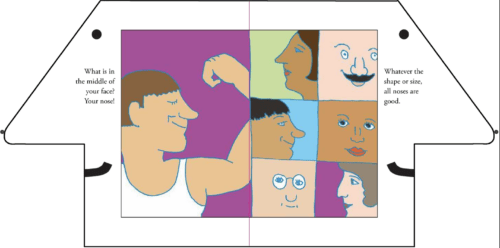

Damndest thing. So I took the liberty of asking the folks at Creative Editions what precisely the deal was with this Seymour Chwast board book. I mean, has he ever done one before? Not quite like this, they said. Until now, Chwast has never published a book originally as a board book in its first run. And considering that the man is now a mere 94 years of age, this “ode to the node” is as delightfully odd as you might expect from the legendary graphic designer. The shape of the book is bound to raise a couple eyebrows in the library setting, but it sets it apart from all those dull square-shaped items. Inside you’ve an array of nosey-goodness. And after all, as it’s quick to point out, “Whatever the shape or size, all noses are good.”
One Little Goat: A Passover Catastrophe by Dara Horn, ill. Theo Ellsworth

In retrospect, this graphic novel probably should have gone on the Holiday list as well. Remember the books of Mark Alan Stamaty? Well, I’m getting some serious Stamaty vibes with this eclectic deep dive into Passovers past and present. There are very few children’s books that you can slap with the “magical realism” label in 2025. Either they get slotted into fantasy/science fiction or they’re most definitely realistic. When we encounter a true magical realism work, it makes us uncomfortable. And by “us” I mean “Americans”. Now you might huff and say that’s not true of you, and I believe you, but for a great many people we are unnerved when a book doesn’t catalog itself neatly somewhere. The entire premise of One Little Goat is that because the hidden half of the afikoman got lost during the Passover Seder, Passover can never end. So this family has been at this same seder for six months. Where did the afikoman go? That’s for the time-traveling goat, who just showed up, to show us. It’s not a G.O.A.T. in the Greatest Of All Time sense. More a goat in the scapegoat sense (and it often deserves the blame). The Lemony Snicket blurb on the back says, “At long last, here is the time-traveling, goat-centric Passover adventure my people have been awaiting for thousands of years,” which I can’t really top, so I won’t even try. I will say, though, that Jewish graphic novels these days can be so much more creative and interesting than their peers. Pair this with Hereville: How Mirka Got Her Sword and last year’s Mendel the Mess-Up and stat.
The Ordinary Life of Jacominus Gainsborough by Rébecca Dautremer, translated by Charis Ainslie
[Previously seen on the Translation List]


In this utterly unique telling with sumptuous art, we see the entire life of Jacominus Gainsborough from birth to death and consider what it is that makes a life worth living. While I think that technically one would call this an older picture book rather than an early chapter book, this is one of those titles that straddle a couple different genres simultaneously. Its theme, also, is distinctly on the mature side. In essence, it’s a person’s life from the beginning to the end, only in this case it’s an anthropomorphized rabbit. The story is good (and it’s a crime and a shame that Post Wave didn’t put the translator on the cover since this would be an EXCELLENT Bachelder Award contender) but the art is the true lure. It took me a little while to realize that once you identify the characters at the start, you see them over and over and over again throughout the text. Some images are like seek-and-find books (just try to locate Jacominus at the seashore). It’s introspective and philosophical but I truly do believe that for the kid that loves ANIMALIA, they’re just gonna pore over these images and figure out entirely plotlines in the art that are never mentioned in the text.
The Paper Bridge by Joelle Veyrenc, ill. Seng Soun Ratanavanh, translated by Katy Lockwood-Holmes
[Previously seen on the Caldenott List]
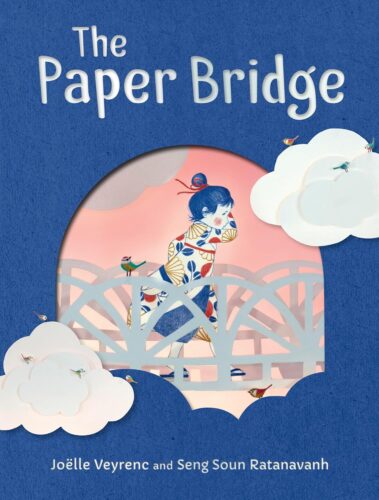
What, to your mind, is the greatest picture book that incorporates cut paper in a three-dimensional way? For me, there are any number of them, and how could you possibly choose between them (though when pressed I might go with Fox’s Garden by Princess Camcam, but that’s neither here nor there). Sometimes the best picture books are the ones where the format is justified by the text. And the best example of this that I’ve seen in 2025 in terms of cut paper is The Paper Bridge. Originally published in France, the publication page informs us that the illustrations were created “using the art of kirigami (paper cutting and folding). Artwork was hand-crafted with pencil and watercolour on paper and cardboard, which was hand-cut and arranged into scenes and these were then photographed.” Whew! The end result is undeniably lovely. In this story, on the top of a jagged mountain, is the village of Paperlee where everything and everyone is made of paper. All well and good until huge winds come and start wrecking havoc. It turns out that the winds are being caused by the people not made of paper on the neighboring mountain. Will the people of Paperlee be able to plead their case? They will, but only with the help of one small child. You might consider pairing it with another beautiful book that uses paper in new ways (only, in its case, die-cuts) The Glasshouse by Helene Druvert.
People Are Weird by Victor D.O. Santos and Catarina Sobral

Okay. So the word “weird” doesn’t engender quite the same knee-jerk response that the word “hate” in a book for kids, but I wouldn’t be surprised to find people a bit perturbed by this story’s rather clever messaging. To read this title correctly, you have to trust that kids have the intelligence to understand what it is saying. The very first sentence, after all, is “Have you ever noticed the world is full of weird people?” What follows is a somewhat judgemental assessment of all kinds of folks. The kid at school who says he’s a magician all the time? The guy who wants to make his lawn perfect? The woman who closed her eyes on a flight because she was so scared? Weird. But the kid is making points along the way. Like, if the woman was afraid, wouldn’t she want her eyes to be open? The thing is, as you read more and more of the book, both the child reader and the kid reader start to realize that everyone, in some way, is weird. “Could it be normal to be weird. If so, would it be weird to be normal?” The last line is, “Huh… weird,” as we watch the kid unicycling to school with their dad and dog. This is all accompanied by the truly fun and incredible art of Catarina Sobral, a Portuguese book creator that I certainly HOPE we see more of on our shores in the future! Weirdly good. Just make sure you read the whole thing.
Pilgrim Codex by Vivian Mansour, ill. Emmanuel Valtierra, translated by Carlos Rodríguez Cortez
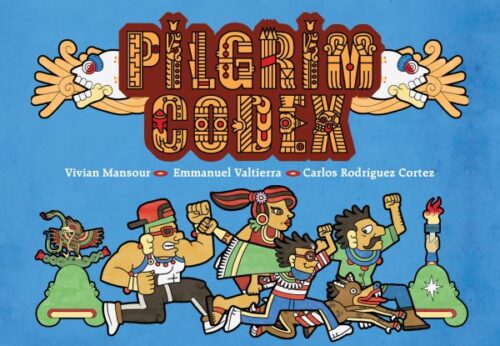


This story of people desperately try to get to America, and facing untold dangers along the way, draws upon Mesoamerican mythology while drawn in the style of an ancient codex! Oh boy. Oh boy, oh boy. I think it’s going to take me a while here to parse precisely what it was that I read. So the subject matter and the art (the ART!!!) are both absolutely incredible. The storytelling… it could have used a couple tweaks. For instance, you never have a clear sense of WHY these people are going to America precisely. Considering the epic things they run into (harrowing doesn’t even begin to encompass it) I would have liked a little clearer sense about why it was so important to keep going and not get sent back. But some elements are really strong. Shoes! The woman in bare feet and then our hero getting his own shoes stolen… I’ve never read a book where shoes were so important. I thought it really picked up as it went. It’s completely original and unique.
Ra! Ta! Ma! Cue! by Howie Shia


ADVERTISEMENT
ADVERTISEMENT
Back in November I interviewed Howie Shia about this eclectic picture book. I asked him a whole slew of questions about the book’s origins. And at one point Howie said, “Picture books are a really special medium because they not only enjoy endless varieties in style, subject, and tone, but they also have a wide audience that advocates that variety. Nobody I know who reads picture books only reads one kind of picture book (whereas lots of people only read crime novels or superhero comics or histories).” Here, the man goes out of his way to find his own particular style and look. The story takes place in a land where the adults have all been kidnapped away from the children. Determined to get their grown-ups back, the children march and, to the beat of their own drums, chant the titular “Ra! Ta! Ma! Cue!” Whence that phrase? Howie said, “Ratamacue is one of forty patterns that drummers learn when they first start drumming. The patterns – called “rudiments” – are basically the equivalent of scales for other musicians (although drummers should learn those too) and they all have really great names that reflect how they sound. Paradiddle, Flam, Pataflafla, etc.” With its epic storytelling, visually eye-popping art, and lesson our 21st century children need NOW, this one stands apart from the pack.
Sketch by Jacques Goldstyn, translated by Helen Mixter

Is this a picture book? Sure. Maybe. I dunno. Clocking in at 88 pages, it’s just a bit longer than you’d expect, sort of defying the usual categories libraries here in the States ascribe to. Goldstyn had two books out this year, you know. One involved feeding stray cats, and this one involves a sketchy child (in the literal sense). What we have here is a big, beautiful metaphor of a book, and you wouldn’t have it any other way. When Sketch is born (this book is French Canadian so they don’t skimp on the reality of birth, baby parts, and breastfeeding here) he literally looks like a preliminary sketch of a person. The trouble isn’t with Sketch, it’s with other people. People don’t want their kids to hang out with him and teachers dislike how original he is in class. Only his art teacher sees his potential. Now in any other children’s book the kid would either find other kids like himself or he’d grow up and we’d get the full scope of his life and the wonderful things he does then. This book goes in a slightly different direction and we end up in high school. There he finds kids as different as he is. They’re all drawn differently and they wonder if they should all leave. Sketch’s response? “No. We mustn’t go. We have to draw ourselves in.” And then on the last page, “The world needs us.” Shoot, it’s good.
The Tree That Was a World by Yorick Goldewijk, ill. Jeska Verstegen, translated by Laura Watkinson
[Previously seen on the Translation List]


Do you know how the good people at Eerdmans sold me on this book? They read me a chapter from it aloud. It wasn’t a particularly long chapter, but it was one in which an aphid sister finds herself inexorably drawn to the idea of eating her siblings. Now cannibalism is a whole thing. It can be done right. It can be done wrong. But in this particular weirdo little story, it is done very very well. The book is a series of eighteen short stories centered on the animals that live around and about a single tree in a forest. Some of these tales are funny, like the sloth that loves to run like the wind at night (but only if nobody’s watching). Others are strangely poignant, like the two pikes that share a pond. One pike is convinced that the other is stuck up and snobby. The other pike is desperately in love with the first pike and scared to death of showing it at all. Laura Watkinson’s translations are so keen (and Batchelder-worthy) and often very beautiful in their lyricism. The art by Jeska Verstegen is a funny blend of beautiful, sometimes creepy, and always interesting. Honestly, this is an IDEAL pairing with My Presentation Today Is About the Anaconda (which is also Dutch, so apparently people in the Netherlands have a thing for opinionated animalia). It’s also a slim little book. It might make for a fascinating read by a teacher to a class. But is it normal? Not in the slightest. Maybe that’s its edge.
A Winter’s Morning by Angélique Leone & Grégoire Solotareff


French? Perhaps. No translator is mentioned on the publication page, but one might assume from the nationalities of its creators. I’m going to level with you. This book? It’s not quite as “unconventional” as some of the others on this list. I mean, it is a little odd. It features a seemingly sentient teddy bear and the wolf that falls in love with her (friendly-like, not romancey-like). But what this truly is, is heartfelt and I don’t actually have a Heartfelt List on my 31 Days, 31 Lists round-ups. Ah well. Into this sort of miscellaneous category it goes then. In this tale we meet Sylvester the wolf, who has been alone as long as he can recall. When he spots a patch of red in the snow, he finds a small teddy bear. Swiftly he names her Poppy and she reveals herself (in the subtlest way possible) to be capable of moving about. They have grand times, but one day Poppy is spotted by the human that lost her. Then you get this heckuva twist. Sylvester is reaching for Poppy, “He can’t be left alone, he wouldn’t be able to bear it. Not again…” and you get this huge twist when the dad of the little girl says, “Sylvester! I can’t believe it! I lost him when I was a boy, even younger than you, Alix!” So suddenly that moment when Sylvester said before that Poppy was “just like him” makes so much more sense. Now they’re all together again, though you do get this kind of hilarious last image of Sylvester reading a book in bed with Poppy while she gives him, what I would describe, as a definite “You’re seriously going to ignore me right now?” kind of look. Okay, I take it back. This is hella unconventional. And I love it.

That’s it for today! Be sure to stay tuned for more lists on 2025 titles. The full roster is here:
December 1 – Great Board Books
December 2 – Picture Book Readalouds
December 3 – Simple Picture Book Texts
December 4 – Transcendent Holiday Children’s Books
December 5 – Rhyming Picture Books
December 6 – Funny Picture Books
December 7 – Caldenotts
December 8 – Wordless Picture Books
December 9 – Bilingual Books for Kids
December 10 – Math Books for Kids
December 11 – Books with a Message / Social Emotional Learning
December 12 – Easy Books
December 13 – Translated Children’s Books
December 14 – Fairy Tales / Folktales / Religious Tales
December 15 – Gross Books
December 16 – Poetry Books
December 17 – Unconventional Children’s Books
December 18 – Early Chapter Books
December 19 – Comics & Graphic Novels
December 20 – Older Funny Books
December 21 – Science Fiction Books
December 22 – Fantasy Books
December 23 – Informational Fiction
December 24 – American History
December 25 – Science & Nature Books
December 26 – Unique Biographies
December 27 – Blueberry Award Contenders (Celebrating the Environment)
December 28 – Nonfiction Picture Books
December 29 – Nonfiction Books for Older Readers
December 30 – Middle Grade Novels
December 31 – Picture Books
Filed under: 31 Days 31 Lists, Best Books, Best Books of 2025

About Betsy Bird
Betsy Bird is currently the Collection Development Manager of the Evanston Public Library system and a former Materials Specialist for New York Public Library. She has served on Newbery, written for Kirkus, and has done other lovely little things that she'd love to tell you about but that she's sure you'd find more interesting to hear of in person. Her opinions are her own and do not reflect those of EPL, SLJ, or any of the other acronyms you might be able to name. Follow her on BlueSky at: @fuse8.bsky.social
ADVERTISEMENT
ADVERTISEMENT
SLJ Blog Network
Books on Film: Jeff Kinney on TODAY
Papercutz to Publish ‘Midnight Island’ | News and Preview
From Policy Ask to Public Voice: Five Layers of Writing to Advance School Library Policy
Taking Risks On The Page, a guest post by Jennifer Dickinson
Dan Santat Talks Sashimi
ADVERTISEMENT
Unlike AI, when a picture book includes someone with six fingers, it’s done on purpose.
Fantastic list!
Wow – this was not a list to glance at! I took 30 min to study all the pictures and stories – what amazing unconventional boos are being made – and how lucky we are to get them translated to English!
This is so interesting. My school is lucky enough to be participating in the Children’s Book Council’s Favorites List voting this year (highly recommend all school librarians apply for this opportunity).
This means we received almost 600 picture books published in 2025. None of the titles on this list were mailed to us. While not all publishers participate in this project, Simon, Greystone, Floris, Eerdmans, Annick, and Holiday House sent us the all or almost all of their 2025 picturebooks, but they didn’t send us the books that made this list.
Does this mean that the publishers themselves know of “unconventional” or niche these titles are?
Very curious. Also now I have some new picture books to actually purchase!
VERY interesting. It makes me a bit sad that not a single book here came into your hands. My poor little books. I’ve thought about mentioning publishers with each book. Maybe that’s something I can do next year. It’ll give a better sense of what is and isn’t getting seen.