Pilgrim Codex: Let’s Talk Migration, Translation, and Why This Book is Far Too Timely with Vivian Mansour and Carlos Rodríguez Cortez
If you’ve been following the news at all then you probably know that my town of Evanston, Illinois has been dealing with ICE for the past month or so. Rachel Maddow discussed it. Our mayor has been all over the news. My Little Free Library has been found, more than once, to be full of whistles. We’ve been trained at the library on what to do if ICE comes in. It’s affected so many parts of my city.
So I looked at the books out for kids in 2025. Do any of them touch on what migration from Mexico and other countries looks like? There’s the middle grade novel The Freedom Seeker by Ruchira Gupta, of course, but what is there on the picture book side of things? Not much. Really, only one title stands out.
ADVERTISEMENT
ADVERTISEMENT
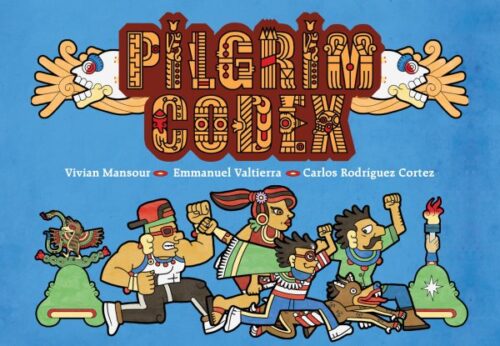
The first time I ever heard of Pilgrim Codex it was in the context of a Levine Querido publisher preview. It was unlike anything else I’d seen. I’d describe it to you, but I’d be doing it a disservice to say anything apart from its publisher’s own words on the matter:
“For fans of Duncan Tonatiuh and Yuyi Morales’ Dreamers, a one-of-a-kind picture book about one immigrant family’s journey north, illustrated in the vein of an ancient codex and drawing upon Mesoamerican mythology.
We, the Vargas Ramírez family, come from a faraway place north of Tenochtitlan called Iztapalapa, Land of Clay Upon Water. A land surrounded by cars and dry grass; a place where the pieces of our small world were scattered. For some time we lived there, but then one day my father heard a beautiful birdsong that rose up and appeared to say tihui, tihui, tihui: let’s go, let’s go, let’s go. And so we gathered up our friends who made up that small world and decided to head north, for the other side, and a better life.
Together the Boy and his family will journey from the Land of the Frogs to The Place Where Feet Cry to the River Where the Waters Tangle, fleeing Gunmen and braving Coyotes and plunging darknesses as black as an obsidian forest. Originally published in Mexico, Pilgrim Codex (Códice peregrino) captures through the eyes of a child one family’s part in the ever-changing and fleeting story of the brave migrant warriors who search for a better place to live.”
Today, it is my very great honor to be speaking with author Vivian Mansour and translator Carlos Rodríguez Cortez. Breaking with my usual format, we’ll speak first with Vivian and then with Carlos.
Betsy Bird: Vivian! Thank you so much for speaking with us today. Pilgrim Codex is a book that feels very present and very necessary, considering everything happening in the U.S. right now. Please tell us a little about where the book came from and how you came up with the idea for it.

Vivian Mansour: My maternal grandparents came from a village not shown on the map, called Gargúa. I never knew them: they only left behind a shroud, a handful of photos, some hand-painted paintings, some embroidered wooden trays, and a large, faded brown trunk. When I was a child, that trunk seemed very large. Now, as an adult, it seems small when I think about how she carried inside all her possessions, her dreams, her fears, her uncertainties, and above all, among the tightly folded clothes and sheets.
My father, originally from Egypt, arrived in Mexico with only his engineering degrees and a coat he was very proud of because it was made of camel hair. My grandparents and my father were received in Mexico with respect and welcomed in a warm and tolerant manner. Today’s migration has nothing to do with that kind of repatriation, which meant adaptation, but not death.
In the 1970s, Mexico was a well-mannered host. Now, in this century, everything has become so convulsed that migrants no longer carry a trunk full of sentimental and symbolic objects, but the dreams and desires of yesterday’s immigrants and today’s migrants are the same. At that time, it was rare for children to travel alone. In my grandparents’ case, the entire family migrated—on a boat that may have been filthy, but all together. They didn’t have to swim across the Rio Grande to reach the other side of the world. They didn’t have to camp for months in front of immigration offices.
I feel indebted to the migrants and to the children who have to experience this type of migration.
BB: Was the idea of fashioning the book in the form of an ancient codex part of the plan from the start, or did it come up naturally in the writing process?

Vivian: I wanted to tell the story of this migration in a different way, for young readers with a child protagonist, who suffers the ravages and dangers of this forced migration, motivated by poverty, reviving the symbols and aesthetics of pre-Hispanic codices as part of a fascinating visual and literary heritage. I was fortunate to encounter Emmanuel Valtierra online, who, from the United States, understood the concept and, with his dazzling mastery and talent, achieved an extraordinary work.
BB: This book was originally published in Mexico then brought here to the U.S. What was the reception to the book when it was first published?
Vivian: Fortunately, this book has won many awards, including the White Ravens in Germany. But the most rewarding part has been reading it in migrant shelters and schools. We have all made some kind of pilgrimage in our lives; we are all in transit, searching for the best path to a life full of opportunities and shared happiness.
BB: The book utilizes the art of Emmanuel Valtierra to great effect. What were your thoughts about the final visual presentation?
Vivian: Pre-Hispanic codices follow certain very characteristic rules and visualizations. Emmanuel is an expert on this subject, and I contributed with the poetic and narrative style of the ancient Mexicans. It’s a book that can be enjoyed in three ways: the text alone, the image alone, and a combination of both. It’s also a book that has multiple readings. Any reader can read and understand it, capturing the symbols and situations according to their own biography and life path.

BB: And what are your hopes for this book?
Vivian: It’s a challenging book in every sense: both in its format and its subject matter. There is no topic more pertinent today than migration. It should be a fundamental subject in schools. All over the planet, populations are on the move for various reasons: political, economic, climatic, and due to violent and warlike environments. It’s impossible to remain on the sidelines of this issue. I understand that migrant caravans can disrupt the daily lives of residents in their wake, but I’m also interested in this book provoking a sense of empathy in readers: no one leaves their home of their own free will in the face of these harsh environments.
BB: Finally, what are you working on now? What’s next for you?
Vivian: I’m fortunate to have a creative writing grant. Therefore, I’m developing two projects: one is a highly visual book about prehistoric art. The other is a novel for young people about a difficult but necessary topic: sexual harassment of minors. As you can see, I like to explore taboo subjects, but always with respect and relevant information.
And now, a discussion with Carlos Rodríguez Cortez, the translator of Pilgrim Codex.
BB: Thank you, Carlos, for talking to me as well. Just to start us off, how did you first hear of this project? And what were your first thoughts upon seeing it?

Carlos Rodríguez Cortez: I heard about Pilgrim Codex from a friend who works at Levine Querido, who thought of me when reading the original book in Spanish. I read it and was immediately captivated by the story and illustrations. As an immigrant from Mexico, the story was deeply personal. In particular, the use of ancient Mesoamerican cultures as a medium for the story highlighted the long history of people immigrating and moving locations to build homes and develop new bonds. Unlike many of the other immigrant narratives (especially today), Vivian’s story felt unmistakably human even through all the metaphors and allegories.
When my friend offered me the job of translating the book, it was a no-brainer.
BB: And was it a straightforward translation, or did you find some challenges in the language?
Carlos: As a Mexican, the language and history of certain areas discussed in the original books wasn’t too difficult to translate at face value. However, the real crux of my work came from researching the language of ancient Mesoamerican codexes and their translations to English. Given Vivian’s Spanish version so beautifully called back to those codexes, I wanted English readers to also have that experience. As a result, much of my translation derives from words found in those translated ancient codexes. Some other challenges came from some of the slang that didn’t have direct translations, or trying to authentically match the rhythm and cadence of Vivian’s passages in those magical descriptions of Mexico’s terrain.
Interestingly, one of my other challenges came from translating how the children (including the narrator) talk! Keeping dialogues not only true to the original but also in the tone of a child required some lengthy internal, mental debates on word choices.
BB: Tell us a little bit about translating books in Spanish from Mexico versus Spain. What are some of the differences that you’ve encountered over the years?

ADVERTISEMENT
ADVERTISEMENT
Carlos: Frankly, translating to Mexican Spanish is so much easier to me as a Mexican. It comes natural to me as so much of the media and literature I’ve consumed all my life has been Mexican Spanish. That experience has also meant that when I have consumed media in Spain Spanish, it has felt like a completely different language. Slang, word choices, or even humor can shift between the two countries. For example, Vivian wrote “tortas de huevo” in one of the early passages describing food. In Mexico, omelettes are referred to as “tortas de huevo” whereas in Spain they’re just called “tortas.” Had Vivian written this in Spain Spanish, I would have had to catch myself here before making a mistake. In Mexico, a “torta” is a type of sandwich. In that sense, translating from Spain Spanish often means having to ignore some of my linguistic instincts, whereas Mexican Spanish flows more naturally.
BB: Makes a lot of sense. Finally, what else are you translating these days?
Carlos: I like to think I’m always translating! It’s almost second nature to me to translate media to English or Spanish in my head. For example, I initially watched the new Superman movie in English and came out excited to discuss how I would have translated parts of the movie for Latin American audiences in the U.S. to keep and elevate those not-so-subtle immigrant narratives (especially the use of the word “alien” in English, given its dehumanizing nature in immigration law). Unfortunately, when I saw the Latin American dub, they just kept “alien” which was disappointing rather than something like “extranjero,” which isn’t a direct translation, but would have kept that subliminal immigrant narrative intact for the audience.
However, in terms of published translations, Pilgrim Codex is my latest work. I have a full-time job which takes most of my time and energy nowadays, but I’m always excited and open to new translating work.I love helping new audiences discover and enjoy work in the language they feel most comfortable but without sacrificing the narrative, feel, and emotions of the original.


Loads of thanks to both Vivian and Carlos for taking such time, thought, and attention to my questions here today. Thanks too to Antonio Gonzalez Cerna and the team at Levine Querido for helping me put this together today. Pilgrim Codex is out now and is like nothing else you’ve seen.
Filed under: Interviews

About Betsy Bird
Betsy Bird is currently the Collection Development Manager of the Evanston Public Library system and a former Materials Specialist for New York Public Library. She has served on Newbery, written for Kirkus, and has done other lovely little things that she'd love to tell you about but that she's sure you'd find more interesting to hear of in person. Her opinions are her own and do not reflect those of EPL, SLJ, or any of the other acronyms you might be able to name. Follow her on BlueSky at: @fuse8.bsky.social
ADVERTISEMENT
ADVERTISEMENT
SLJ Blog Network
Name That LEGO Book Cover! (#81)
Nathan Hale’s Hazardous Tales: The Web of War | Review
Friday Exercise: READ THIS BOOK!
From Policy Ask to Public Voice: Five Layers of Writing to Advance School Library Policy
Teens Read YA: Scout Jensen reviews the latest entry into The Natural series by Jennifer Lynn Barnes
Luke Pearson Made a Picture Book!
ADVERTISEMENT
Wow – this is so authentic and important. I wonder, as a Chicago suburban public librarian, how I can best use it.
Curious about your protocols regarding ICE in the library.. I’m in Indiana and our management haven’t addressed it despite staff asking.
Oh sure! Good question. So if they have a court ordered search warrant, that’s when we have to allow them into our staff areas. But without that they can’t come in, so we’ve papered over all the windows to those areas and made sure the locks are secure. If they enter the first thing we do is alert our Library Director and our Assistant Library Director. Our management has been very on top of things. But the key is that search warrant. You have to make it clear to the staff that that is the only way you allow them into the backroom areas.