
31 Days, 31 Lists: 2025 Informational Fiction for Kids
I was reading a recent New Yorker piece the other day that just broke my little heart. Mind Over Matter: Did Oliver Sacks insert himself into his case studies by Rachel Aviv is exceedingly well written. It also made it very clear that, at least in his early works, Sacks had a tendency to extemporize upon the facts. Oh, Oliver. Et tu? For someone who rails against the inclusion of fake dialogue in children’s books, this was gutting. Not, I should say, that I mind it when authors mix fact and fiction together. It’s perfectly fine as long as they’re not claiming to be nonfiction texts. Melissa Stewart was the woman who first coined the term “Informational Fiction” to account for these eclectic, inventive skewings of reality, and when they’re done well they can be truly delightful and edifying. Today, I honor those books that are unafraid to use the best of both the fictional and nonfictional world together.
And if you’d like a PDF of today’s list you can find one here.
Curious about other books that mix their fact and fiction together? Then check out some previous years’ lists:
2025 Informational Fiction for Kids
Informational Fiction Picture Books
FEATURED TITLE
Electric Birds of Pothakudi by Karthika Naïr, ill. Joëlle Jolivet

You know how sometimes, either in person or online, you’ll run into a person who holds up a copy of a picture book that’s 30+ years old and they’ll start to kvetch about how folks just don’t make longer picture books anymore? It’s all posturing, of course. Anyone who reads widely knows that such books certainly do exist, they just tend to come from smaller publishers. This gorgeous little import from France is a marvelous example. It’s also this incredible celebration of nature AND a fascinating mix of fact and fantasy. Let’s start at the beginning. In July of 2020 there was a 10-line report in an Indian newspaper about the village of Pothakudi and a boy named Karuppu Raja. In this village, electricity doesn’t run to every home, so it’s up to kids like Raja to turn on the switch at the switchboard that’ll turn on thirty-five of the village’s streetlamps. All well and good until the day that Raja found a vannathikuruvi (or magpie-robin) and its mate building a nest in the switchbox. If Raja pulled the electrical switch, the birds would lose their nest, and the mother was clearly about to lay. What proceeds to happen is that the village has the choice of either dwelling in darkness for weeks while the babies hatch and grow, or destroy the birds’ and their chances of nesting. Remarkably, the children made strong enough arguments to keep the birds’ nest intact, and it turned into a learning experience for the whole village. As someone who sometimes has peregrine falcons nest outside her work window, I could relate quite a bit to this tale. The art is, as one might expect from the great and good Joëlle Jolivet, extraordinary. But what makes it so interesting is the ending. This whole story has been framed as a mother telling a true story to her kid, but the kid wants a satisfying ending beyond then-everything-went-back-to-normal. The ending that Naïr chooses to add has all the satisfactory components of the best folktales. It’s beautiful and odd and a marvelous example of how we can take real world stories and weave them into informational fiction tales for our kids.
ADVERTISEMENT
ADVERTISEMENT
Diggers, Dozers & Dumpers:Small Stories About Big Machines by Ole Könnecke, translated by Melody Shaw
[Previously seen on the Funny Picture Books List]
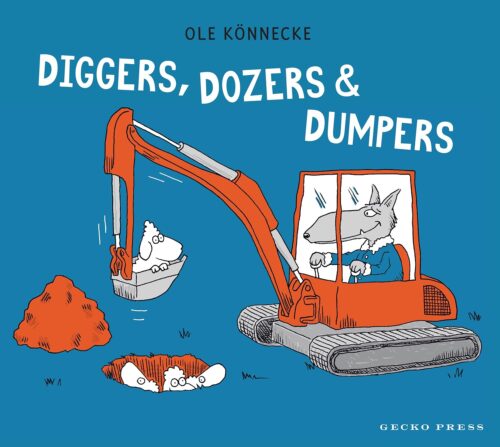
I have been a steadfast and true blue fan of Ole Könnecke for (checks watch) decades now. Whenever folks try to tell me the Germans aren’t funny, he’s the guy I pull out to correct them. This book, at first, appears to be your standard large machinery fare. What’s so interesting about it, though, are a couple unique elements. First, there are the machines themselves. You have the usual tractor and cement mixers, sure, but then there are also telescopic cranes and the awe-inspiring straddle carrier. Then there’s the fact that each machine warrants its own little small storyline. You get tales of chickens and the one-upmanship that leads from a push mower to a combine harvester. You get a crane who buys a cherry picker to tend to a tiny cherry sapling. There’s even a funny tale of a farmer who loves his small red tractor but ends up with a super charged monster tracker as a gift that he does not want. Hand this to those parents that are burnt out on all the mindless vehicular titles and want something a little funny for their cranium instead. Heck, hand this to those kids that demand stranger vehicles and a bit of a story to boot.
Don’t Eat Me! The Almost True Story of Belladonna by Kate Finney, ill. Esmé Shapiro
[Previously seen on the Funny Picture Books List]


Meet the poster child of informational fiction! This little beauty (and it is a surprisingly lovely, funny, AND informative book) comes to us via Enchanted Lion Books. Essentially, this title is tailor-made for science units since it follows the experiences not of a single flower, but of a flower species. The belladonna plant is visually lovely but also (and unfortunately for her) delicious. In the Author’s Note at the beginning of the book, Finney explains that we eat plants all the time, but if we could eat every plant we saw (“We could walk outside and rip up handfuls of grass for breakfast and have a tasty daffodil and pine needle pie for lunch”) there soon wouldn’t be any left. As a result, plants have had to adapt in ways that make them delicious to only a couple species. That’s what happens in this story when Belladonna realizes that she’d better evolve over, y’know, a LONG period of time, or she won’t exist anymore. Shapiro, for the record, is the ideal illustrator to pair with this since her images of animals gnawing on Belladonna’s leaves (there’s a deranged frog in particular that makes me happy every time I see it) is downright hilarious. It’s written like a fairy tale, but there’s some serious information to be found here, particularly in the info at the end “About the Belladonna Plant”. Consider pairing with the omnipresent and very successful Millie Fleur’s Poison Garden (perhaps as an explanation of how all those plants got so very poisonous in the first place).
I Am We: How Crows Come Together to Survive by Leslie Barnard Booth, ill. Alexandra Finkeldey
[Previously seen on the Caldenotts List]

You may have seen them. You may have heard them. But how well do you know them? Crows introduce themselves to you, and you may never be the same. This book is a classic case of informational fiction. Now Booth’s text is just fantastic. Accurate but with just the right hints of creepy and wild. Never scary, I’d say. Just vaguely unnerving and eerie. Meanwhile this Alexandra Finkeldey character needs to pack her bags and move to America ASAP, or else how are we going to give her a Caldecott? It chaps my hide that this book is ineligible, when it has these incredible otherworldly two-page spreads and evocative colors. This book would also, I would like to note, be an incredible readaloud to a group. The pictures just pop from a distance. The colors! The sense of place and season! And then all this lovely backmatter (including a Selected Sources section that’s better than at least half the straight nonfiction we see in a given year). Irresistible.
I’m Longer Than You! An Epic Contest of Measurement by Carolyn Fisher
[Previously seen on the Math List]

One-uppmanship, taken to its natural extreme. Kids love asking whether one thing is bigger, stronger, tougher, taller, faster, higher, etc. than another thing. When this book opens, a Supersaurus declares that it’s the world’s longest animal. Immediately a Blue Whale interjects that this cannot possibly be true. They keep debating but they don’t have a standard of measurement so they keep saying things like, “I’m as long as 3 school buses” or “I’m longer than 21 hockey sticks.” To the rescue comes….. an inchworm! Why don’t they just measure themselves? Because they haven’t invented measuring yet. Duh. Inchworm is willing to measure them but unfortunately measuring the whale takes so long that the worm now has to go into a cocoon. A centipede takes over, but instead of being one inch long it’s one centimeter long. And even though it finishes, centimeters and inches are different units of measurement. Looks like it’s gonna have to be math to the rescue now. Visually eye-popping, continually fun, and incredibly informative, this is the kind of math book that I just WISH we saw more of on our shelves. Extra points for the backmatter that includes “Some Non-Standard Measurements” including Donkeypower, Light-Years, Zeptoseconds, and Barleycorn.
Living Bridges: The Hidden World of India’s Woven Trees by Sandhya Acharya, ill. Avani Dwivedi

Imagine walking over a bridge and that bridge is alive! In the mountains of Meghalaya, India, one boy discovers the Jingkieng Jri bridge and learns how to protect it for the future. Information at the end provides a dive into these real bridges and how we can keep them safe. This one charmed me, in part because I’d never heard of the Jingkieng Jri bridge, and in part because I think Acharya and Dwivedi’s choice to make this a fictional story has a stronger emotional punch than if they’d set about to make it a strict work of nonfiction. The book does an excellent job of not just showing what the bridges are but also how to maintain them and the threats they pose. Do I think a bunch of Western tourists would get quite so into cleaning up after themselves if a kid modeled good behavior? That might be a touch optimistic, but for the most part Acharya’s choice to show a kid making a difference in a kid-centric way (while also solving the problem of passing this information on to the next generation) works. If you’d like to see a video of these bridges, the publicist sent me a link here. Pretty neat.
Me and the Magic Cube by Daniel Fehr, ill. Golden Cosmos, translated by Marshall Yarbrough
[Previously on the Translated List]
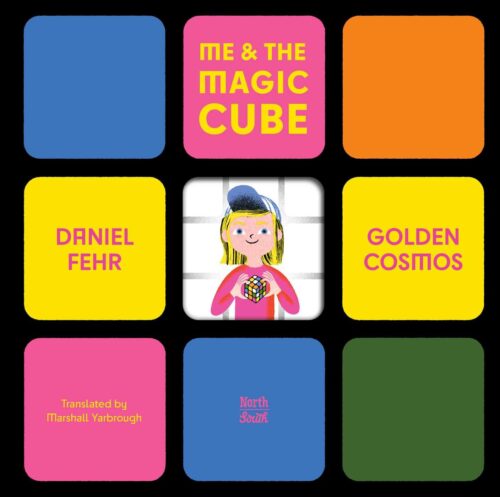
The Rubik’s Cube has enjoyed a bit of a children’s literature renaissance in the last few years. Whether the focus of the graphic novel Lucky Scramble by Peter Raymundo or spotlighting its creator in the picture book biography Ernő Rubik and His Magic Cube by Kerry Aradhya, cube lovers are getting their fill. One might be justified in believing that all the cubes have said all the things, but clearly this is not the case. Enter, Swiss import Me and the Magic Cube, which takes an innovative mix of fact and fiction and melds them into a vibrantly colored tale of Cube discovery. Please note how amused I was by the color choices of the book. While there is a bit of a trend in Europe to use fluorescent colors in picture books (so much so that the Bologna Book Fair once had an entire display on the subject) the colors of this book are not the traditional colors of a Cube. But who cares?? Golden Cosmos (a.k.a. graphic designers Doris Freigofas and Daniel Dolz) bend over backwards to make each and every image in this book eye-popping. I’m actually a bit disappointed that this book wasn’t praised properly by the New York Times/New York Public Library Best Illustrated Awards this year. Seems like it’s doing incredible work. In the tale, a kid finds a Cube in a box and starts to get into it. There are incredible diagrams of the Cube (it’s never called a Rubik’s Cube) and its innermost workings. There’s also info on Rubik himself, an explanation of how to solve it, competitions, moves, and more. The sole flaw, as I see it, is the font size. It’s odd and small, sometimes downright miniscule. A single fly in the ointment, as it were. Otherwise, this is fairly incredible.
Miffy and the Artists by Dick Bruna

Miffy. She baffles us. She’s not Hello, Kitty, though the two bear some striking similarities. She’s Dutch. Simple. Cute but off-putting somehow. She also turned 70 this year, so she seems pretty spry for all that she’s a septuagenarian. Now her creator Dick Bruna died in 2017 (at 90, so well done there), but the Miffy books just keep on coming. What’s intriguing about this one is that this is kind of a Miffy thought experiment of a book more than anything else. Essentially, what happens when you combine the clean cut simplicity of Miffy with an array of different kinds of artists and their styles? Now I walked into this with a certain set of assumptions about what artists would be selected, but was pleasantly surprised to see a couple names that I didn’t expect. Alice Neel, Keith Haring, Nick Cave, and a very cool piece of art by Shibata Zeshin, are just some examples. Sure, you have your Vermeer, Matisse, and Warhol, but the new names and styles are a welcome addition. Twenty-four artists appear in this book altogether, and it’s a nice intro to what makes each of them special, in the simplest possible terms. Take a gander. I think you’ll be pleasantly surprised.
The Museum of Shapes by Sven Völker
[Previously seen on the Math List]


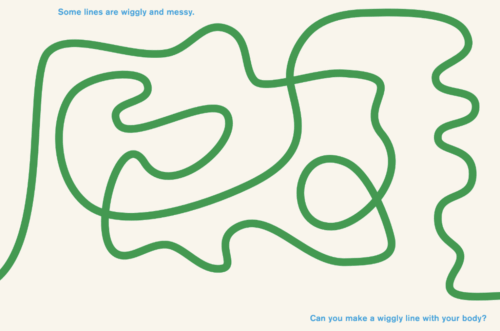

Shapes! Such a lovely math concept for younger readers. And naturally Sven Völker is just the fellow to bring them to life. What other author/illustrator, after all, has written math picture books in the past and gotten them on the New York Times/New York Public Library Best Illustrated list (for A Million Dots, if you will recall) This book is a bit esoteric but no less fun. First, we meet Alma. She’s the curator of the Museum of Shapes. Her job? Choosing which shapes get to be placed on display. Which, when it comes to fake jobs in children’s books, may be my favorite of the year. Now these shapes vary quite widely. She might add a point (the simplest shape of all), a line, a semi-circle, cones, you name it. In describing all the possible shapes Völker is essentially just doing some straight up nonfiction work here, but shhhh! I won’t tell if you don’t! Much cooler to think that there’s a whole museum dedicated to this stuff (which, the book tells us at the end, exists at the Museum of Concrete Art and Design in Ingolstadt, Germany). There are even little moments that encourage interaction, like when kids are asked which of an array of wackadoodle shapes they like best or, even better, how they’d prefer to arrange them. I can easily see teachers giving a slew of possible shapes to kids after reading this and letting their little analytical minds go wild.
Polecat Has a Superpower by Jill Esbaum, ill. Bob Shea

I’m just such a huge fan of this goofy little series. This would be the third so far (the first two being my personal favorite, Stinkbird Has a Superpower and Parrotfish Has a Superpower). The third is about the polecat and, fun fact, a polecat is a very specific kind of skunk. I was under the impression, prior to reading this book, that all skunks could interchangeably be called polecats. Not so! This particular creatures is the spotted skunk, which is about the size of a squirrel. That may be why its particular superpower here (which I’m not going to give away, but if I saw it in person I’d run screaming from the woods) is so impressive. Esbaum brings the gags, Shea brings his signature style, and the book follows the already prescribed pattern of the main character explaining their powers to an animal that has no clue what they’re in for. Consider this a sort of younger version of the Superpowered Field Guide series by Rachel Poliquin.
The Riding Lesson by Jennifer K. Mann

A child’s fantasy of what riding a horse is like meets reality, but doesn’t get crushed in the process. Frances is booksmart when it comes to horses. She’s fairly certain she knows everything about them and is ready to gallop across the plains on a stallion of her own. When she arrives at her friend Mae’s house, she gets to have her very first riding lesson. But that means knowing the right clothes to wear, the right gear for the horse, and, of course, the right horse. That would be Snowball, a pony that is perhaps more wide than tall. Even so, there’s still a lot to learn, from brushing the horse to picking dirt out of her hooves. There are some fears and some uncertainty, but in the end Frances is riding a horse of her very own all by herself. There’s no backmatter, so this is probably a less comprehensive book than last year’s horse fact o’ rific If You Want to Ride a Horse by Amy Novesky. What it is, is a really nice intro for those kids who may never have ridden before and are about to. The graphic novel format makes it fun to read, and just a tiny bit longer than your average picture book. A great intro to all things horsey, poop and all.
Safe Crossing by Kari Percival
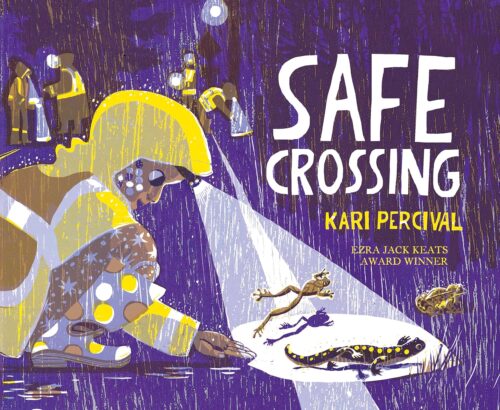
Each year in the spring, humans help a vast array of amphibians cross busy roads to get to their spawning grounds. Is there a better way to help them? Fabulous art and an ecological message are the hallmarks of this tale. You may remember Kari Percival from her previous title How to Say Hello to a Worm. This book feels like she took that same style and applied it in this really cool way to a tale of roads, critters, rain, and the dark. The purple/yellow colors really pop off the page, and even if you take the message of creating animal crossings away, you’d probably still be floored by the sheer beauty of the art. Informational fiction is the best way to describe this. Other words that might apply: Eclectic. Fascinating. Eye-popping.
Stalactite & Stalagmite by Drew Beckmeyer

ADVERTISEMENT
ADVERTISEMENT
Yup. It’s a official. I can never figure out what it is that Drew Beckmeyer is going to do next. Let’s see, he starts with a tornado readaloud picture book, follows it up with a crazed science fiction picture book title about an alien going to school, then doubles back to that science-y instinct he had in the first place to tell the tale of two buddies becoming one. There’s a blurb on the back of this book from Jon Klassen that says, “There has never been a book about stalactites and stalagmites that is this good…” which is absolutely accurate. I suppose when I think about it, this book does have some similarities to The First Week of School (the aforementioned alien title) if only because the man is unafraid of tackling long swaths of time in a picture book format. Creatures come and go in this book but our two buddies are here to stay. Extra points go to the fact that it goes forward into the future (I love it when that happens), which is an ambitious move. And he basically kills off a miner in the course of this story, which is a bold stroke as well. I’m putting this in informational fiction because it has a lot of nice information about the history of evolution, with endpapers that break down the different eras swimmingly. Cool stuff.
Informational Fiction for Older Readers
FEATURED TITLE
Akeem Keeps Bees! A CLOSE UP LOOK at the Honey Makers and Pollinators at Sankofa Farms by Kamal E Bell with Akeem Bell, ill. Darnell Johnson
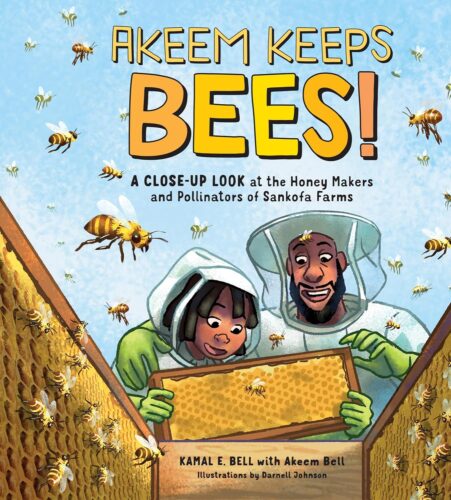
Akeem knows that his father keeps bees, and there are so many things to learn about them. How do you get new bees? When do you take their honey? How do you keep them safe? A cool story set at the real life Sankofa Farms in North Carolina. You know, I rather liked this one. It’s true that we get broadsided with bee books A LOT, but I feel that the information presented here was done in an original way that I hadn’t really seen before. The design is strong, with the comic book panels interacting very nicely with the nonfiction information. Plus there were things in here I’d never really seen before, like how to cure your bees of mites and how to protect them when rival bees try to invade. Great backmatter and a cool family story. I’m a fan.
Survival of the Fittest: Who’s Got the Best Medicine? by Rebecca Donnelly, ill. Misa Saburi

This would be the second book in this series, but honestly any book series that includes cool animal facts AND a Shark Tank-style reality show format is a-okay in my book. It’s different enough from its predecessor to stand out as well. The whole conceit of this tale is that different animals are pitching designs for products based on their unique talents and abilities. As such, you might have a mosquito suggesting syringes for shots designed on its own serrated proboscis, thereby getting rid of the pain. Or you might have a Darwin’s bark spider suggesting surgical thread based on their dragline silk that is safe to leave inside the human body. There’s certainly humor and Saburi’s art is consistently fun and eclectic to watch, but I just love those doggone facts. The backmatter isn’t extensive but it is clever. There you can learn about the real-life designs mentioned in the book, and there’s a “Read More” URL for each one of the inventions (though I must dock a couple points for the yellow font on some of them since it is egregiously difficult to read).
Survival Scout: Lost at Sea by Maxwell Eaton III
[Previously seen on the Comics & Graphic Novels List]

It wouldn’t be a true year-end roundup without as many Maxwell Eaton III titles as I can cram into my lists. This isn’t exactly the first in a series either. As the third Survival Scout title, we’ve already figured out how to survive in the wilderness AND how to survive a tsunami (of the two, pick the wilderness). Now let’s talk about being stranded at sea without any particular idea where land is or how far it might be. First and foremost, Scout’s mom needs to stop sending her daughter out with her eldest son. That dude is a certifiable menace. Still, the scrapes he leaves his younger sibling in are always absolutely fascinating. With her snarky skunk friend at her side, Scout covers a WIDE range of scientific concepts in the course of explaining how to find your way back to land. You learn how to steer a sailboat (I literally did not know you could sail into the wind until this title explained it to me how), navigate with maps, charts, and satellite phones, and everything! Plus they’re funny! These books are a friggin’ delight (though I’m increasingly worried that Scout’s going to get herself stranded in space at some point).

That’s it for today! Be sure to stay tuned for more lists on 2025 titles. The full roster is here:
December 1 – Great Board Books
December 2 – Picture Book Readalouds
December 3 – Simple Picture Book Texts
December 4 – Transcendent Holiday Children’s Books
December 5 – Rhyming Picture Books
December 6 – Funny Picture Books
December 7 – Caldenotts
December 8 – Wordless Picture Books
December 9 – Bilingual Books for Kids
December 10 – Math Books for Kids
December 11 – Books with a Message / Social Emotional Learning
December 12 – Easy Books
December 13 – Translated Children’s Books
December 14 – Fairy Tales / Folktales / Religious Tales
December 15 – Gross Books
December 16 – Poetry Books
December 17 – Unconventional Children’s Books
December 18 – Early Chapter Books
December 19 – Comics & Graphic Novels
December 20 – Older Funny Books
December 21 – Science Fiction Books
December 22 – Fantasy Books
December 23 – Informational Fiction
December 24 – American History
December 25 – Science & Nature Books
December 26 – Unique Biographies
December 27 – Blueberry Award Contenders (Celebrating the Environment)
December 28 – Nonfiction Picture Books
December 29 – Nonfiction Books for Older Readers
December 30 – Middle Grade Novels
December 31 – Picture Books
Filed under: 31 Days 31 Lists, Best Books, Best Books of 2025

About Betsy Bird
Betsy Bird is currently the Collection Development Manager of the Evanston Public Library system and a former Materials Specialist for New York Public Library. She has served on Newbery, written for Kirkus, and has done other lovely little things that she'd love to tell you about but that she's sure you'd find more interesting to hear of in person. Her opinions are her own and do not reflect those of EPL, SLJ, or any of the other acronyms you might be able to name. Follow her on BlueSky at: @fuse8.bsky.social
ADVERTISEMENT
ADVERTISEMENT
SLJ Blog Network
Books to Celebrate National Poetry Month 2026
Born in the USA | Review
From Policy Ask to Public Voice: Five Layers of Writing to Advance School Library Policy
Different Kinds of Funny: Character Humor for Middle Grade Readers, a guest post by Laurie Morrison
Sara Pennypacker visits The Yarn
ADVERTISEMENT
Thank you for including LIVING BRIDGES! Love the collection