Newbery/Caldecott 2027: Summer Prediction Edition
Ha HAAA!
I swear to you that I didn’t plan for this summer prediction post to come out a mere day after the Boston Globe Horn Book Award announcements, but you can hardly blame me for being thrilled with the timing. And for the record, can we all agree that BGHB hit it out of the park this year? Look at those miraculous choices! My full love and respect goes out to the committee that came up with these selections (Kari Emiko Brabander, Kitty Flynn, and Adrienne L. Pettinelli). Well done!
Of course the overlap between BGHB and the Newbery/Caldecott is far from perfect. Because the BGHB announcements come out halfway through the year, they can consider both the previous year and the current one, which always makes for an interesting array of choices. I include some of their choices, but not all. Instead, today you’ll see some of the books already mentioned during my Spring Prediction post, but I like to think you’ll notice a few additional surprises as well.
ADVERTISEMENT
ADVERTISEMENT
Also, it is pertinent to remember that at this point I probably haven’t seen the bulk of the Fall releases. Those October books have a tendency to throw things off (for example, there’s a new Lois Lowry and I’m chomping at the bit to read it). So at the upcoming ALA Conference, you bet I’ll be snuffling around the publishers’ booths for goodies like a truffle seeking piggy.
Now let’s get to what we know!
2027 Caldecott Predictions
Bing’s Cherries by Livia Blackburne, ill. Julie Kuo

This Summer Prediction Post is where I reassess my earlier enthusiasms and determine if they were justified or not. For example, when I interviewed Kuo and Blackburne about this tall tale update to not simply Paul Bunyan but the legacy of Chinese immigrant workers in America, I was wowed by the context. Now a little time has passed and I can reassess. And you know what? I was doggone right the first time. Kuo is doing her best work here, being creative and interesting with the subject matter. Blackburne, meanwhile, is able to make this story a keen amalgamation of history, fiction, myth, and legend, while at the same time keeping it interesting for kids. AND there’s a recipe at the end! Literally, what more could a committee want?
Fourteen Ways of Looking at Jellyfish by Carole Boston Weatherford, ill. Bagram Ibatoulline

Bagram Ibatoulline. Always the bridesmaid, never the bride. Pop over to his website and you’ll see this impressive line-up of his awards. What’s the notable exception? The Caldecott. Why? Well, to be perfectly frank his work has always conjured up a sort of classic feel. You look at his images and you know they’ll stay fresh for literally hundreds of years. They won’t date. And that, my friends, is Caldecott death. Caldecott committees like it when artists do new things (or ARE new things). So with this jellyfish book, I get the impression that Ibatoulline figured he might as well go a little nutty. And why not use a nonfiction poetry book as an excuse? What the Caldecott committee is going to have to ascertain with this is, in a way, technicalities. Do the text and images relate to one another? How well do these images flow from page turn to page turn? Lots of other factors come in to play, but I at least hope that this book proves worthy of serious discussion.
Goldfinches by Mary Oliver, ill. Melissa Sweet

Like Ibatoulline, Sweet doesn’t carry the element of surprise with her. She’s even won Caldecott Honors before. Plus this isn’t even her only poem-turned-picture-book of 2026 (the other being the fall release of Duck Can’t Sleep by E.B. White). Yet for all that, this book was a successful surprise in and of itself. The Caldecott doesn’t take text into serious account, except insofar as how it interacts with the art itself. Here, the two seem almost inseparable. Sweet is deft, linking notebook musings and observations to a funny kind of dual relationship (thistles and goldfinches). It’s a bit more sophisticated than some of our other contenders, and that may hurt its chances in the end, but I do feel it has a leg up in this category. You can read my discussion with Melissa about the book here.
I Am a Mountain by Steven Weinberg

Weinberg comes into his own. Of the books I’ve mentioned so far, this is the title that I still feel has a best chance. Aside from the inevitable art projects it may inspire, it’s got something that a lot of books have a hard time attaining: awe. That is to say, the literal ability to inspire awe in not just its older readers, but the actual intended audience as well. It’s seasonal, fun, practical, and beautiful. It also just screams “DISTINGUISHED!!!” when you look at it. I mean… right? This is the book you think about when you think about Caldecott winners. Now if the committee has more of a penchant for whimsy then this will probably get relegated a mere Honor. But you know what? I’ll take it. You can read my interview with Steven about the book here.
The Muéganos by Jaque Jours

Confused? I don’t blame you. I was a bit befuddled by the eligibility of this book myself. From what I understood, creator Jaque Jours lived in NYC while making this book. However, I was given to understand that she moved to Mexico just before its publication, thereby making her ineligible for the Caldecott. NOW I hear (from the publisher itself) that she’s back in the States. As such, the Caldecott committee is going to have to play the fun game of Find the Creator, if they want to seriously consider this. And seriously consider this book they should! Aside from the very fun metaphor of the book working brilliantly (you can read my review here if you want to know more about that) the art is incredible. At one point, Jours actually smashed a ceramic plate and then painted small scenes on it that are pertinent to the storyline. I do fear that the committee will look at the brown on its cover (sepia is, for whatever reason, a color that librarians seem to fear to read) and discount it. Still I have faith that the discerning members (who, I have no doubt, are also highly attractive individuals with incredible taste in furniture… pander pander) will get past that initial thought and see this for the gem it truly is.
The New Cat by Stephanie V.W. Lucianovic, ill. Chris Park

I had such high award hopes for the previous Lucianovic/Park picture book Touch the Sky, but that didn’t quite pan out. No matter. That book was funny and brilliant but you know what this one has? HEART, BABY! Heart and cute cats. Heart and cute cats and Park doing some wildly inventive things with color / how he encapsulates certain scenes / the angular nature of felines, etc. There are a lot of cat picture books out in 2026 and not a single one of them looks anything like this. Of all the books I’ve mentioned so far, this one might make people cry a little (ALWAYS a plus when it comes to being distinguished). And, as I’m sure you well remember, sometimes cats and mortality do very well Caldecott-wise (Big Cat, Little Cat by Elisha Cooper, anyone?). You can read my interview with both Stephanie and Chris about this book here.
While We’re Here by Anne Wynter, ill. Micha Archer

But this book? This is my frontrunner. It has been since the moment I opened it up. A Caldecott Award winning book has to do a certain number of things in a certain kind of balance. First, it needs to contain fabulous art. Archer, who has gotten an Honor before but never the gold, is perfectly positioned in this way. Her art in this title astounds. Next, the text has to be good enough. I’m sorry, but even though the committee can’t really consider the text, they do pay attention when it doesn’t meld well with the illustrations. After that it gets a little tricky. Archer’s still new enough to shock people when she does a book this gorgeous (and that’s a good thing). It features Black heroines at a time when the publishing industry is putting out fewer and fewer brown faces in their catalogues. It’s fun to read, with all kinds of interactive ideas and elements, it appreciates nature, it appreciates mommy/daughter time, AND it has heart. Remember, a Caldecott contender does best when heart is involved. Heart means that people on the committee will fight for the book because it hooked more than their brains. Nothing in life is certain, but I would be very surprised if this didn’t at least get an Honor this year. You can read my review of the book here (it may strike you as funny but I actually have a lot more to say about it).
2027 Newbery Predictions
Life on the Moon by Matthew Swanson and Robbi Behr

What is life without a few surprises along the way? So at the upcoming ALA Conference in Chicago, I will be interviewing last year’s Newbery winners (Monday, June 29th at 10:30 on the Pop Top Stage, Booth 1756). In formatting my questions for them, I could not help but notice that most were historical fiction and only one was fantasy. I don’t see it heading in that same direction this year (thought I do have at least two historical fictions that could make the cut). Now is Life on the Moon a wild card? Absolutely. In fact, it wasn’t until one of my readers proposed it to me as a Newbery contender that I even thought to give it a closer read. But you know what… there’s something there. Swanson and Behr start silly with this book, then deepen the read significantly as you go on. There’s a lot to be said in this little title about the act of choice, false narratives from powerful authority figures, personal responsibility, and accepting that sometimes you are 100% in the wrong. There is, in fact, so much to chew on here that I hope the Newbery committee looks beyond the silly premise and takes it into consideration. It deserves that chance. You can read my interview with Matthew and Robbi here.
The Lions’ Run by Sara Pennypacker

So I hopped on over to the Heavy Medals blog just now to see how, halfway through the year, Pennypacker is faring in terms of votes. Unsurprisingly, this comes in as the title with the second most votes (just under a title that I’ll mention in a second here). But Pennypacker has played this game before. A decade ago her book Pax was widely considered a shoo-in for some kind of Newbery love, then was unjustly forgotten when the time came (you can read my final predication post that included it here). At least it got on a National Book Award longlist, and that may well be the fate of her latest as well. I dunno, though. Pax took place in an America in a fictional war. The Lions’ Run, in contrast, takes place during a very realistic war indeed. It’s also a tight little novel. No fat on it. It’s consistently interesting, and you will be biting the nubs of your nails with that tense ending. It is perhaps one of the best edited books on this list today. Something to consider. You can read my interview with Sara about the book here.
The Moon Without Stars by Chanel Miller

There is a possibility that this little star burned too bright early in the year and that it will be a little more forgotten near the end. Maybe. In spite of its cover, this is a YA novel, though it straddles middle school and high school more effectively than most. The Newbery goes to 14, and this book is 100% for 14-year-olds. It doesn’t look like it from that cover (unless you notice the menstrual pad, perhaps). For all of that, the Newbery in recent years has been more than happy to push the envelope on age. Then again, it all depends on the committee. If the committee truly believes in keeping the Newbery for kids rather than young teens, they may eschew Miller. But the book contains some incredible writing and character development. I wouldn’t discount it so easily. You can read my review of it here.
A Potion, a Powder, a Little Bit of Magic Or, Like Lightning in an Umbrella Storm by Philip Stead

Yeah, I didn’t think this book would work. I didn’t. I can admit that now, having finished it. This is what I like to call a Big Swing Book. They’re the titles that decide to do something completely different from everybody else. Sometimes they pull it off. A lot of the time they do not. Stead? I’ll be damned, but he pulled it off. Now Philip’s the kind of writer can sometimes go a bit above the heads of his young readers. And you would think that in a book with as many Latin phrases as this one contains, he would fall into that trap. He doesn’t. He mucks with the narrative (placing the first chapter at the end where it explains everything), is self-referential, has an intrusive narrator, flirts with politics (but never so much so that he dates the book), and probably does some of the best art he’s ever done in a children’s book in his life. There is also a grumpy goat in this book named Lancelot, and some genius decided he should be featured on the cover. I approve of this choice. This book is one of the very few that manages to feel like a future classic in the vein of The Phantom Tollbooth and all that, and it does so without getting all cute on us. Dang. This is good. And you can read a conversation between Phil and his editor Taylor Norman about this book here.
A Scar Like a River by Lisa Graff

The star of the hour! You are looking at the brand new Fiction Award Winner of the Boston Globe Horn Book Award! I can’t tell you how deeply gratified I felt to see that win. Lisa more than deserves it. With this book she juggles so many elements together with a seeming effortlessness. For full disclosure, I was asked to blurb this book, but you have to understand that I don’t just blurb any old books these days. I really and truly have to believe in a title. I believe in this title. I believe in its ability to take what should be an impossible topic and turn it into something difficult but necessary for the oeuvre of middle grade fiction. I think it’s beautiful and hard and full of horrors, but also (and this is key) real heart. Again, as with the Caldecott, heart is what makes committees fight for books. We’ve just seen the BGHB folks go for it. I’ll eat my hat if it isn’t on the National Book Award longlist as well. Is it any wonder it’s the top book on Heavy Medals with the most votes? You can read my review of the book here.
A Year Without Home by V.T. Bidania

Gotta credit my co-workers for alerting me to this one. This is one of those quiet titles. The ones you pay inadequate attention to until they slip in and win it all in the end. So if you don’t want to be the person saying, “Wait… what won the Newbery Award?” I’d advise you to give this a read. Or a listen. I did the audiobook and it was a marvelous way to experience the text. Bidania’s done early chapter book and series fare in the past, so this is a big step for her. It’s a fictionalized accounting of her Hmong family’s escape from Laos to (eventually) America. But the reason it’s going to catch the Newbery committee’s eye comes down to two things: 1. The writing in this book is damned lyrical. The main character Gao Sheng is deft with a metaphor, but each one is intricately tied into the world is knows and loves. 2. It doesn’t cheat with what happens to its heroine. Her family doesn’t miraculously change and decide she’s just as good as a boy at the end. Yet somehow the story still feels triumphant by the story’s close. I dunno, man. Keep your eyes on Bidania. I think she’s one to watch.
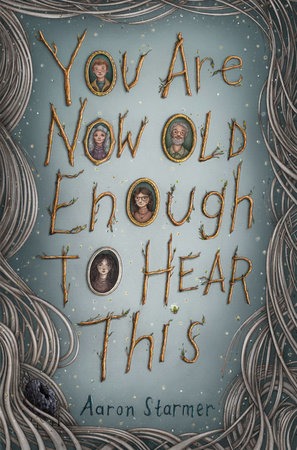
You Are Now Old Enough to Hear This by Aaron Starmer
ADVERTISEMENT
ADVERTISEMENT
I’m just so pleased that people are finally beginning to clamor to this brilliant and disturbing little novel now. According to Heavy Medal it received the most votes in the last round. Well that it should. Now two years ago the Newbery committee had a penchant for weird winners. How weird? Let’s just say that M.T. Anderson won an Honor and his book was the least peculiar of the lot (IYKYK). I just took a gander at this year’s Newbery committee. Turns out, I know at least three of the members. Are they going to be inclined to the weird and wonderful? No idea. But at the very least, I hope that they give this book some serious consideration. “Distinguished” can mean any number of things, but highly intelligent writing coupled with different styles (he friggin’ changes the book from third to first person at one point!?!) is deserving of rewards. You can read my review of the book here.
And now, for the first time, I would like to pay homage to a CALDENOTT (a book that cannot win a Caldecott because its creator is inconveniently not in or of America). This time I doff my cap to:
Goodbye, Koi by Jack Wong

I think I might have been the only person in America that wasn’t quite as enamored with Jack Wong’s When You Can Swim as everyone else was. I felt like it was good but that it was building up to something. Lo and behold, now we know what that build up was for. In his Author’s Note at the end, Wong states that not a lot of kids reading this book would relate to freeing your pet koi or moving from Hong Kong to America. But the themes are so deftly conveyed here (change and making friends and worrying about feeling lonely when you think of your old home) that any young reader would understand. Add in the fact that Wong went out and learned two entirely different kinds of Chinese brush painting (gongbi and xieyi) to convey the koi parts and the human parts, and what you have on your hands is a book that would totally win a Caldecott… if Wong weren’t inconveniently Canadian. Doggone Canada. They get all the good stuff.

Okay. That’s what I’m seeing. Tell me what you’re enjoying. I should note that there are at least two picture books that people are going to wonder why I didn’t include. For me, they are perfectly decent but they don’t quite do it for me award-wise. Now tell me I’m wrong! What has earned your adoration?
Filed under: Best Books, Best Books of 2026, Newbery / Caldecott Predictions

About Betsy Bird
Betsy Bird is currently the Collection Development Manager of the Evanston Public Library system and a former Materials Specialist for New York Public Library. She has served on Newbery, written for Kirkus, and has done other lovely little things that she'd love to tell you about but that she's sure you'd find more interesting to hear of in person. Her opinions are her own and do not reflect those of EPL, SLJ, or any of the other acronyms you might be able to name. Follow her on BlueSky at: @fuse8.bsky.social
ADVERTISEMENT
ADVERTISEMENT
SLJ Blog Network
Odd Bookmarks
Detective Baby Dance Team Drama | This Week’s Comics
From Policy Ask to Public Voice: Five Layers of Writing to Advance School Library Policy
Fast Five Interview: Stephan Pastis and Will Henry
Rex Ogle on His New Book Absent
ADVERTISEMENT
For the Caldecott my vote goes to Because of a Shoe by Marla Frazee and Julie Fogliano.
That’s a fascinating one. Frazee’s art reminded me a lot of the work she did years ago on Mrs. Biddlebox: Her Bad Day and What She Did About It.
Have you seen “The Not So Quiet Life of Marcel Marceau” by Jenn Bailey and Sherry Bushue? The illustrations by Pamela Zagarenski are absolutely stunning!
It’s a fascinating piece. So Zagarenski adapts her style in a different direction… almost. She just can’t resist keeping those crowns in there, and I find that such an interesting decision on her part. I’m certainly including this book in my bios round-up. I loved her work on an Aesop book from a couple years ago.
For a Newbery….Styx and Stones by Schmidt and Koertge
On my To Be Read pile.
Micha Archer’s art is always Caldecott-worthy, and WHILE WE’RE HERE had a moment that made me actually gasp out loud the first time I read it. It’s also a great storytime book, which not every Caldecott is. And I wish the Caldecott rules would change so that GOODBYE, KOI could have a shot! (And whatever Sydney Smith does next, of course. O Canada!)