

Review of the Day: You Are Now Old Enough to Hear This by Aaron Starmer, ill. Jaime Zollars
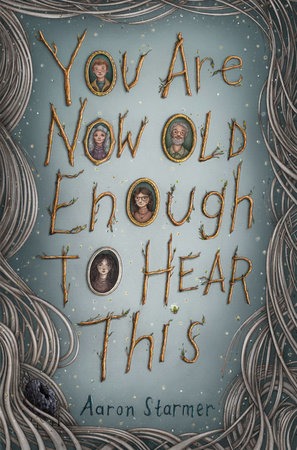
Safety is not usually considered a bad thing. But safety, particularly as it pertains to children’s books, is a dangerous thing. I’m eyeing the children’s publishing industry at a squint right now. It doesn’t take much looking to see that in the last year or two we’ve seen a distinct downturn in publishers’ willingness to put out books by BIPOC creators, as well as queer titles and books by people from a wider religious spectrum. Then there’s the fact that long hallowed publishing imprints that are practically institutions (specifically Dial and Roaring Brook) have been summarily disappeared without so much as a by-your-leave. Publishers, most particularly BIG publishers with a lot of money, want cash cows. They want easy picks. Books that are guaranteed to do well on the market. And when that happens you see them pulling away from the titles that are actually interesting. The ones that show a wide variety of perspectives and opinions. You also see an avoidance of anything that might be perceived as “too weird.” International imports take a particular blow when that happens. So too do books of homegrown weirdness. But sometimes, even when things look their dullest, there is hope. Hope in the form of Aaron Starmer. He’s the type of children’s author that writes books that wiggle and undulate their way into the crevices and folds of a child’s trusting brain. The Riverman will probably haunt whole generations of children for decades to come. And The Riverman was good, no question, but it now appears that that series was just the warm-up. You Are Now Old Enough to Hear This leans so hard into its own internal logic that it manages to turn its weirdnesses into strengths. Let me put it this way. If you want your child to read books that they’ll forget in a month’s time, hand them pablum. If you want them to think, rethink, and return to a book for the rest of their life? This is what you give.
ADVERTISEMENT
ADVERTISEMENT
When you’re the youngest in both your immediate family and out of all your five cousins (not to mention your brother) you hear things. Things you might not want to hear. Roman may be twelve, but for a lot of his life, whenever his grandfather would start to tell the story about “The Toe Beast,” Roman would leave the room. He doesn’t know what a Toe Beast is, and he doesn’t want to know. And when his grandpa dies under somewhat mysterious circumstances, it’s Roman’s job to tidy up and organize the old man’s house over the summer. Only what starts as a fairly routine job keeps turning up mystery after mystery. Why did his grandfather tell him to never open the locked shed in the backyard? What’s with the jar full of formaldehyde and nothing else? Why was there a strange story in the attic about a girl and some dogs? And that’s all before the rusty bucket appears. The one that seems to seriously freak out his mother. As the mysteries start to link and connect, Roman begins to understand that sometimes your family doesn’t tell you everything because you aren’t old enough. And sometimes your family doesn’t tell you everything because it’s up to you to link their secrets yourself.
There is a line near the beginning of the book which, in its way, explains what Starmer is doing here far better than I ever could. He writes, “For quite some time, Roman had been aware that his mom and dad didn’t know everything, but it was only recently that he had begun to realize that many complicated adult ideas were actually accessible to a boy his age.” Eh voila. The point of it all. What’s curious is that most of that idea is told via metaphor and creepy stories in this book, sure. But there’s also a lot of stark realism. One of those “complicated adult ideas” concerns an incident that happened to his mother when he was young. At the start of the book we learn that she cut herself rather severely and had to be taken to the hospital. It’s only slowly revealed, and never too overtly, that what happened was a lot sadder and, for a small child, scarier than that. That Starmer is capable of balancing both family secrets that involve Toe Beasts on the one hand and self-harm on the other, without either coming in conflict with the other tonally, is a testament to his skill.
I don’t get shocked by middle grade novels for 9-12 year olds all that often these days. As I mentioned before, “safety first” may as well be the American publishing industry’s unofficial motto right now. So I don’t expect much. And I wasn’t all that surprised when this book went from a third-person narrative into a kind of script format and then back again. What DID surprise me, unnervingly so, was when, without warning, the book went from that third-person p.o.v. into a first person narrative. I can’t ever remember a book for kids doing that without telegraphing from a mile away that it was going to happen. We’ve been merrily accompanying Roman through his investigations, and then all of a sudden you’re in his head. And, miraculously, there’s no confusion about whose head you are in. Starmer’s storytelling is so seamless that you seem to morph from one type of writing into another almost without noticing the change. In fact, I would bet good money that some kids won’t even register the shift. Yet it changes absolutely everything about the read, including the urgency and, to a certain extent, the conclusion.
I also greatly appreciated that Starmer doesn’t explain absolutely everything, but leaves enough clues in the book for kids to draw their own conclusions and feel smart about it. There’s a particular mystery involving an immoral science experience and two scientists that at first seems to be left open-ended, but is beautifully explained in the background all the time. But that’s not all. Like a lot of people from my generation, I suffered a severe blow to my faith that entertainment could be capable of tying up loose mysterious ends after watching the television show LOST (bear with me here). That show gleefully introduced mystery after mystery after mystery, without ever having any kind of intention of explaining what it was all about. As a result, any movie, television show, or book that seems to be doing something similar, rouses an immediate wary side-eye from me. Now I’d read The Riverman, and it ended well, but it wasn’t like this book. The mystery in that was present but singular and sustained. This book is different. It introduces a beast, a bucket, a girl, even a magic eight ball, and by the time you’re even halfway through, you start to figure that there isn’t a way in the world that Starmer will pull off explaining it all. Then, like a magician, he explains his tricks. Only unlike a magician you don’t feel disappointed at all. You’re thrilled and a little bit horrified, which is the best possible response.
By the way, let’s give a big hand to the work Jaime Zollars did with the interstitial illustrations in this book. Zollars isn’t credited on the title page (a fact that surprised me) but her style hits just the right notes with this book. The family tree is innocuous. The Toe Beast’s jar is jarring. The bucket has something desperately wrong with it. And the girl with the dogs? Boy, you just know that there’s something going on there and it cannot be good. Cannot be right. Zollars got the tone of this book right from the start, and deserved a rousing pat on the back for that. Her work actually reminded me of Sophie Blackall’s in When You Reach Me. In fact, this book’s best possible companion is probably that Rebecca Stead classic. In both cases you’ve mysteries that tie-up so beautifully that you want to reread the book the minute you get to the end. Few titles for kids hold such power.

I began this review saying that you should hand this book over to kids, but you know what? I rescind that statement. That’s not the proper way to share this book. You know what you should actually do? Forbid children to read it. Look at them skeptically if they see you with the book and say, “I dunno, kid. This one’s probably a little too much for you.” If they ask too much what?, just shake your head and sigh regretfully, “Maybe when you’re a little older.” Speculate out loud that an older sibling/cousin is probably a better fit. Don’t out-and-out forbid it. Just indicate that maybe they’d be happier with that cheery book about the girl in the lighthouse or that sweet tale of the boy who time travels back to the 80s. Then leave this creepy little number around the house. Maybe they’ll pick it up and just glance at the first page. Maybe they’ll get to Chapter One, with its Gammell-esque illustration of a toe in a jar and the sentence, “Roman’s cousins weren’t afraid of the Toe Beast.” Maybe they’ll read further, and you’ll walk in the room, see them, and say, “Okay… just don’t come running to me if you get nightmares.” Yeah. That might do it. Because for the right kind of kid in the right kind of mindframe, sick of the books that feed them the cute and the squishy, this book is precisely what they need.
I mean, it’s squishy too. Just in… another way.
On shelves now.
Filed under: Best Books, Best Books of 2026, Reviews, Reviews 2026

About Betsy Bird
Betsy Bird is currently the Collection Development Manager of the Evanston Public Library system and a former Materials Specialist for New York Public Library. She has served on Newbery, written for Kirkus, and has done other lovely little things that she'd love to tell you about but that she's sure you'd find more interesting to hear of in person. Her opinions are her own and do not reflect those of EPL, SLJ, or any of the other acronyms you might be able to name. Follow her on BlueSky at: @fuse8.bsky.social
ADVERTISEMENT
ADVERTISEMENT
SLJ Blog Network
Cover Re-Reveal: 1000 HORSES FOR THE KING by Gracey Zhang and Me
Spider-Man Mighty Mayhem | This Week’s Comics
From Policy Ask to Public Voice: Five Layers of Writing to Advance School Library Policy
ADVERTISEMENT
Couldn’t agree more with your review! I would also say that anyone who love Small Spaces by Katherine Arden would love this too.
Small Spaces!!!! Yes yes yes! Tonally, you’re completely correct. That is a dead on comparison. I’m going to quote you during my next Newbery/Caldecott prediction post. Small Spaces was worthy of Newbery love (I mean, look at Doll Bones) but never received bupkiss. This will, in a small way, be an homage to what it accomplished.