
Of Capricious Kings and Other Things: A Philip Stead/Taylor Norman Conversation About A Potion, a Powder, a Little Bit of Magic

Okay. Time to class the joint up a jot.
Philip Stead? You know him. Wins Caldecotts n’ such. Has a middle grade novel out this year, actually. A little something by the name of A Potion, a Powder, a Little Bit of Magic, Or, Like Lightning in an Umbrella Storm. His editor? That would be Taylor Norman. If you don’t know her, you should. Tends to go about doing things like being the editorial director of Neal Porter Books. The books she publishes? They win Newberys, Caldecotts, Pura Belprés, and more. So yes. This is a force to be reckoned with.
You would be right in wondering why they are here today. Well, folks, in spite of my efforts to keep this place base and low, they’ve arrived to engage one another in ribald conversation. Today, Phil and Taylor talk about that aforementioned book of Phil’s. And if you’ve only the haziest of understandings about what it entails, allow me to give you a bit of a plot description straight from the publisher:
ADVERTISEMENT
ADVERTISEMENT
“In a kingdom ruled by a capricious king, the castle rests on the backs of twenty-four goats, and the welfare of those goats rests on the back of a girl called Bernadette. So when one goat escapes, it’s up to her—with the help of a very forgetful wizard and a Boat That Does Not Grant Wishes—to bring it back safely.
Her task may be straightforward, but this book is anything but. Like a swirling herd of restless goats, the chapters are all out of order. The ending may prove to have been the beginning all along. All the while, the author of Bernadette’s saga—a character himself—hurries to write her a resolution, with very mixed results. And if you’re feeling lost, don’t worry; the story has twenty-four morals, of varying advisability, to edify you along the way.
Award-winning picture book author and illustrator Philip Stead makes a confident debut as a novelist in this laugh-out-loud, one-of-a-kind illustrated tale, chock-full of running gags, broken fourth walls, and underdog triumph.”
It’s new. It’s different. It doesn’t slot into our usual categories. Best that you hear from its creators about why that is for yourself:
PHIL: Hey, Taylor! I’m hoping you can help jog my memory of how you and I got mixed up with each other on this insane project. I seem to remember a late-night conversation in a loud smoky bar room somewhere, wherein I hit you with an elevator pitch for a post-modern fractured fairy tale about a kingdom built on the back of a herd of goats. At that point it mostly just existed in my head. What do you remember about how it all went down at the beginning?

TAYLOR: Oh I’m glad you remembered that part! The start that I always remember is me haranguing you for many years every time I reread one of your picture books, sending you increasingly more strident texts to beg you to someday please write a novel. So when we were in Denver for MPIBA, yes, I believe pizza in hand at a bar, and you raised this idea, nothing could have sounded better. I had no idea how the project was going to turn out, but I trust your abilities more than you yourself trust them, I think, so I couldn’t say YES fast enough.
Right, the fractured nature of the story was part of the vision from the start. As it turned out, the book works like this: The reader begins in Chapter Thirteen (after 23 pages of wordless character portraits and a brief introduction to the character of the author from the book’s narrator). Then we read through Chapter Fifteen, before going back to Chapter Two, reading forward (with a detour to Sixteen) until we catch up with Thirteen, hopscotching to Seventeen—while all along Chapter One is missing (it’s the last Chapter). Fractured and post-modern to say the least! So I think the big question is . . . how do you begin a book with this kind of unusual structure? What was the first thing you wrote?

PHIL: I’m pretty sure our fateful Denver meeting was in Fall 2022. The first bit of writing goes all the way back to 2018, though. You can still find that original bit on page ninety of the finished book. It’s a paragraph-long description of the king:
The king was not a nice man. He was vulgar and vain. He imagined himself good-looking, but his hair was heaped atop his head like a stack of soiled linens and his clothes hung like fruit, rotten on the vine. He abhorred sunlight and rarely took exercise. He was frequently gassy. He was loud. He was cruel. He was incurious, and uninterested in figuring out why . . .
It goes on and on from there. At the time I was just free writing, with no particular story in mind. I got to roughly ten thousand words and decided (against my better judgment) to show what I had to a trusted friend. It’s fair to say she wasn’t impressed. Her biggest problem was that it took me about seven thousand words to introduce my main character, Bernadette, and another three thousand before anything of interest even happened to her. Weirdly, it had not occurred to me that these delays would be a problem. I was a little depressed until an idea struck: I could just take Bernadette’s first interesting bit of action, stick it at the front, and start from there instead—hence, beginning at Chapter Thirteen.
From that point on I wrote the book in exactly the order in which you read it. I didn’t do what many might assume would make more sense (because, of course, it does) and write it all in order, Chapter One through Twenty-Four, then rearrange it later. Pretty soon I realized I was actually writing two books at the same time. There was one book about a goatkeeper named Bernadette, and another book about a hapless, unnamed author struggling to keep up with the events of his own story. The two stories were running parallel, but I knew that eventually they’d have to collide (which they do at about the two-thirds mark). The reason Chapter One comes at the end, by the way, is because it really was missing to me. I knew how I wanted things to end (in the chronological sense), but didn’t know what events had transpired at the start to put the whole story in motion. As the rest of the story developed there were more and more questions popping up about what was actually going on. So, once I’d finished Chapters Two through Twenty-Four, I took the dozens of unanswered questions and loose ends and used them essentially as a writing prompt to create Chapter One. The thing that was so satisfying to me was how the events of Chapter One all seemed inevitable once I began to set them down on paper, as if they’d existed all along.

So that’s how the writing happened. Editing a book like this must’ve been an extraordinary headache for you. You had to read the book not just in the order I wrote it, but also again (several times) in the “proper order,” one through twenty-four in order to look for errors in chronology. What was that like? I readily admit that I have not, even to this day, read my own book in chronological order. The whole time I was just keeping the plates spinning in my head and relying on you (and Erin) to catch the ones that fell!
TAYLOR: I have to say, as a reader, I really love books that teach me to read in a new way while I’m reading them—Riddley Walker; Ducks, Newburyport; Infinite Jest; The Ambassadors. Solving a puzzle in order to read a story makes the story all the more rewarding, I find. The more you have to work for it, the more it means, and the more it matters. The editing process of this book was similarly groundbreaking, at least for my own personal plot of earth. I have never worked on a book like this before: a statement that is true for all books I edit, but never more radically than for this one.
When you delivered me the full first draft, I read it three times to put together my first set of notes to you: Once for plot, twice for editing, and thrice for chronology. The first time through I was honestly smiling through tears a lot because it made me so happy: how clever the book is, how exciting, how much I loved all these idiosyncratic characters, how proud of you I was. (I am getting teary just typing this.)
Then I got down to business and read the book as an editor, extremely carefully. I kept track of EVERYTHING: the morals and their numbers, the rules of the world, the instances of Latin, the characters—I had a lot of lists. Most crucial, though, was the list of things that needed answers. As I read, I had so many references that needed to be cross checked against the book itself: What was the deal with that smell of skunk? Where and when had Bernadette met Adelbert before? What was the eighth moral? As your process affirms, so many of these answers came in Chapter One. Encountering each answer was precisely akin to how it feels to solve a crossword clue. A little leap of yesssss.

Then finally I read it starting at the end of the book, Chapter One, skipping over any interstitials (while still taking them into account) to ensure that, in the order of time, each plot point picked up where the previous one had left off—and that all of those internal cross-checks arrived on time, so that you didn’t find out an answer before the point at which it would have been revealed in the correct chronology. I think I gained like three years of life just from the brain exercise I got editing this book.
But here is the thing I keep telling people and that is why the book works so well: It is NOT just clever. It’s not just a marvel of organization and writerly tricks and ideas. The reason I compare it to something like Riddley Walker (even more, to me, than Phantom Tollbooth) is because there is such heart to it. We care so very much for our protagonist, the capable and caring and unstintingly brave Bernadette. We are so caught up in the quest. And we have such affection for all the strange and specific citizens of this world, even the many self-serving ones. All that is to say: This book is simply an incredible story, even before you get to its unusual construction (and even after that, too). Can I ask which characters you loved writing the most? To my eye, you have such affection for all of them too; even the petty ones are written with such appreciation and understanding of these people as full, whole people.
PHIL: Aside from Bernadette, our main character, and Adelbert, her de facto sidekick, pretty much all of the human figures in the book are awful. Each one, really, is the manifestation of some common negative trait easily found in the personalities that populate any broken/corrupt political system. The castle dwellers are a mix of sycophants, ignoramuses, schemers, backstabbers, charlatans, incompetents, and humorless bureaucrats (I’m looking at you, Janet). Still, aside from the king, and Ned, the king’s closet advisor, I couldn’t help but grow fond of the cast over time. Some of that fondness definitely developed during the art making. It’s hard to draw someone, to put them in an imperfect physical body and stand them up on two legs and not feel some kind of empathy for them in the process. After all, it wasn’t their fault I chose to put them in such an unpleasant situation. Most of them are probably just doing the best they can and coming up short. I think when I started out I intended to make the castle dwellers into flat caricatures, like actors in a comic morality play. Doing that would have made it easy for me to dispatch them one by one in Dahlian fashion (the original plan was to toss them all into the alligator moat!). But by the time I got to the moment of truth at the start of Chapter Twenty-One, I just couldn’t do it. I wanted to give them a second chance. Most of them anyway.

TAYLOR: Hmm, you sound a lot like the author. 🙂 I have to agree—I feel love for every one of these characters, with the exception of the king, who I still appreciate for being a great character and a wonderful catalyst for so much disaster and calamity. I also feel derision for these people, disappointment in them, shock at their self-centeredness—but those are feelings that humans often evoke, which makes it a very realistic portrayal of many bureaucratic systems, no matter how corrupt.
This book has 24 morals, each sandwiched between two small goat icons. Many of them are seriously good life advice. I am obviously a huge fan of “Details matter!” but “You are who you choose to be” has really stuck with me. If I was a tattoo person, I’d put it on my left wrist. If I was an embroidery person, I’d put it on a pillow. Don’t ask me what I’d do if I were a bumper sticker person. What about you Phil, which of these morals will you take with you into the rest of your life?
PHIL: It’s funny you mention that moral in particular because You are who you choose to be is the only one of the 24 that wasn’t spontaneous. I knew pretty much all along that that one had to make it into the story somehow, that it distilled something essential about what the book meant to me. The other morals all occurred naturally in the course of the writing. Something would pop up in the prose and it would just seem necessary to set it apart, whether because it had actual deep meaning, or just for comedic effect, like, for example: Never hold your umbrella aloft in a rainstorm. Of all the morals though, my favorite is the simplest: There’s always tomorrow. These three words, offered to Bernadette by Adelbert in a low moment, punctuate one of my favorite bits of writing in the whole book. It’s a section that I must’ve reworked at least a dozen times or more, trying to nail the exact rhythm of the whole set-up. It became a bit of a mantra for me in my own low moments while writing the book (and in many moments since). It’s such a common throwaway phrase. But it’s also the best definition of hope I’ve got.

ADVERTISEMENT
ADVERTISEMENT
Taylor: I think the idea of tomorrow, particularly as something meant to inspire hope, gets treated as unserious. Why? Sometimes because common things get conflated with easy things, I guess (parenting, the color of the sky, how you’re doing today, etc.). To me, that is what this book is truly about: the quiet ember of unsnuffable certainty inherent in the truly good, and that little ember’s ability to long outlast any flash flame of greed, bombast, or performance. And so I’m with you; I was raised on Annie: belief in your future self is the most powerful way out of a bad situation. In other words, don’t look at the jump in front of you, set your gaze between the horses’ ears and look out to the rest of the arena. Can we sandwich that between some goats, please?
PHIL: I’d love to! But then we’d have twenty-five morals. Which, I think you’ll agree, is exactly one too many.
TAYLOR: Oh you’re so right, anything but an odd number! (Twenty-five is one of my favorite numbers, actually, but you know what they say, kill your darlings.) Last question, my friend. Phil, you are your own harshest critic, so when you told me that this book was “pretty close” to the novel you’d pictured writing for years, that felt like an A+ result. Not to dwell on the negative, but what in this book—a book that features black and white illustrations throughout, 24 morals, 24 chapters, 24 goats, a tree that turns into a boat that turns into a wheelbarrow that turns into . . . I won’t spoil further, chapters out of order, an author as a character, inside jokes with itself, a castle full of unforgettable characters, airtight world-building, absolutely gorgeous writing, and lines that crack you up on every page—is lacking for you? How is this not quite The Novel?
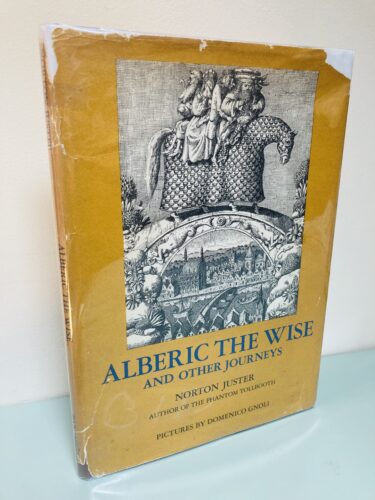
PHIL: I think one of the daily tragedies of trying to make a creative life is that you can only ever be who you are. You get inspired by one masterpiece or another and think to yourself: I could do that, too! But of course you can’t. You can only do what you do. At different times in my career (or different times of the day) I’ve wanted to be Ellen Raskin, Eric Carle, Evaline Ness, Lois Ehlert, Ellen Raskin (yes, she deserves to be mentioned twice), Norton Juster, Jules Feiffer, William Steig, Alice and/or Martin Provensen, Jerry Pinkney, Kurt Vonnegut, M.B. Goffstein, or any number of other book geniuses. One book in particular that’s had an outsized role in my desire to be someone else is Alberic the Wise and Other Stories, written by Norton Juster, illustrated by Domenico Gnoli. For as long as I’ve been making books (longer, even) I’ve wanted to make a book just like that one. It’s playful but sophisticated, familiar but totally original. It’s musical and complex. Potion was my final, definitive attempt to make my own Alberic. Did I succeed? In a way, maybe. My book can’t quite help looking and sounding like I made it, though. It’s very frustrating. But you know what? There’s always tomorrow!

Can I top that? I cannot. Thanks to Phil and Taylor for elevating the conversation. Thanks too to Tracy Miracle for bringing this all together. A Potion, a Powder, a Little Bit of Magic, Or, Like Lightning in an Umbrella Storm is out April 7th. It really and truly isn’t like anything else out there today. Find out why for yourself and soon.
Filed under: Conversations, Interviews

About Betsy Bird
Betsy Bird is currently the Collection Development Manager of the Evanston Public Library system and a former Materials Specialist for New York Public Library. She has served on Newbery, written for Kirkus, and has done other lovely little things that she'd love to tell you about but that she's sure you'd find more interesting to hear of in person. Her opinions are her own and do not reflect those of EPL, SLJ, or any of the other acronyms you might be able to name. Follow her on BlueSky at: @fuse8.bsky.social
ADVERTISEMENT
ADVERTISEMENT
SLJ Blog Network
Books on Film: Mo Willems Today Show
As Yubooh Slumbers | This Week’s Comics
Top of the Mocks: Mock Newbery 2027 Contenders
From Policy Ask to Public Voice: Five Layers of Writing to Advance School Library Policy
The Case of Ambition v. Heart, a guest post by Elba Luz
ADVERTISEMENT