
“A giant, homesick man who bred tiny, famously delicious fruit?” We Discuss Bing’s Cherries with Julia Kuo and Livia Blackburne
The problem with having so many incredible books coming out in 2026 is that I tend to sound a bit like a broken record when I tell you, every single day, about yet another great title to consider. But you know what today’s book has that no other in 2026 does? It’s a tall tale. And not simply a tall tale but a tall tale focused on a historical Chinese immigrant story that is only gradually coming to light today. This is one of those rare cases where I read the book and then prostrated myself before the publisher, begging to interview the creators because I thought their title was so original and important. And believe me when I say that this is not something I do very often.
My first encounter with Bing’s Cherries (out now) happened when I saw this cover:

I had many questions. Questions like, who is/was Bing? Why is he taller than a tree? And why, oh why, is the illustrator credited before the author on this cover?
ADVERTISEMENT
ADVERTISEMENT
The publisher description only served to intrigue further:
A modern American tall tale woven by a girl and her father about Ah Bing, the Chinese immigrant behind the Pacific Northwest’s most delicious cherries.
You’ve heard of a Bing cherry, but did you know the story of the Chinese American immigrant for whom the dark, luscious cherry is named?
Long ago, Ah Bing was a father who traveled across the sea from China looking for work. It was in Oregon where he met a man who hired him to work in his orchards, where eventually, Bing cultivated the delicious cherries we know of today.
But what was it that made this man and the cherries he made so special? a young girl wonders as she sits together with her father, enjoying cherries from their backyard. Weaving together cultural memory, historical fact, and her own imagination, the young girl imagines a narrative of Ah Bing that is as larger than life and as sweet as his namesake.
With touching text and lush illustrations, Livia Blackburne and Julia Kuo forge an unforgettable Chinese American folktale that has largely been untold. The backmatter includes a letter from the author and illustrator, as well as a recipe!
Then I read the book and it just blew me away. So yes. You’re beginning to see why I had to talk to both Julia and Livia (last on this blog during an interview about her book Dreams to Ashes) as soon as possible. Here’s what that discussion yielded:
Betsy Bird: Julia! From the moment I laid eyes on Bing’s Cherries I was blown away. We’ll get into what makes it so inviting and original, but before any of that, this may be one of the rare times where the illustrator came up with the idea and presented it to the author (in this case, Livia Blackburne). Could you give us a bit of a rundown on where you got the idea for this book and how it came to be?
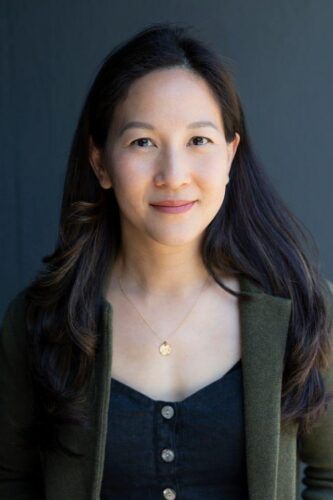
Julia Kuo: I was reading Erika Lee’s book The Making of Asian America and she had a paragraph on Chinese people in agriculture. There was one line that said: “One was Ah Bing, who bred the famous Bing cherry in Oregon.” That was it, but it was enough to stop me in my tracks! I had never thought about the origin or name of the Bing cherry, but once I heard the very Chinese sounding name “Ah Bing”, something clicked for me.
I looked him up and initially read that he was over 7 feet tall and sang a “sad, mournful song” – it was all perfect fodder for a folktale hero. All this time, there could have been an Ah Bing on the shelf next to Johnny Appleseed and Paul Bunyan. I realized that as a picture book maker, I could make this happen! I messaged Livia right away to see if she would be interested in writing the book.
BB: Livia, let’s pick up from there. From what I gather, this book is a true collaboration between yourself and Julia. In the backmatter, you mention that Julia sent you an article about Ah Bing years ago. How did that article turn into the book we see today?
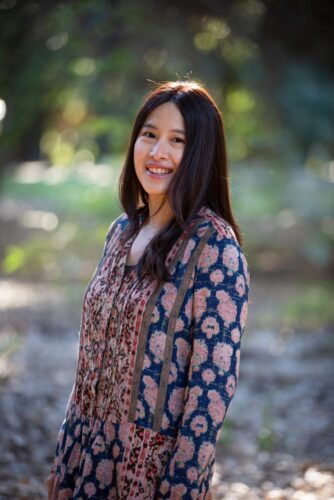
Livia Blackburne: I guess I can start off where Julia left off! The initial texts from her were pretty short, just screenshots from an Instagram story she had posted about the topic, plus an article. I was immediately intrigued and dived into research. As I investigated, we also texted back and forth about vision. I originally imagined writing a narrative that was pretty close to the historical Bing, perhaps with some old-timey folktale wording. But then Julia sent examples of comp titles, and those were all highly imaginative tall tales. (I think Doña Flor was one of them.) It took me a little while to figure out how a tall tale format would work, but once I did, the story flowed very naturally from our brainstorming and discussions. Julia put together some illustrations to go with that initial draft and the rest is history.
BB: A true collaboration then. You know, Julia, I think a lot of children’s book creators can sympathize with discovering a great fact or historical figure and then finding that there’s just not enough information to make a whole book. Your solution of turning Bing’s life into a tall tale is a solution that I’ve rarely seen, but it works beautifully. Livia touched on this a little already but was it an immediate leap from scant facts to tall tale, or did you have to ruminate a little before the idea took shape?
Julia: Yes, it was immediate! I think I was on a plane and had to wait for wifi, but that would have been the only obstacle between learning about Ah Bing and asking Livia to collaborate on a folktale. The nature of the scant facts (a giant, homesick man who bred tiny, famously delicious fruit?) felt so folkloric that I don’t think I even considered a more straight telling of the story.
As an Asian American growing up in the 90s, everything felt very binary, either white or Asian but rarely a mix of both. The tall tales and myths that I loved to read were either set in colonial America or ancient China. Young me would have loved to have an Asian American folkhero to proclaim: not only do we belong, but we have always been here, making a difference. Perhaps that’s why the idea felt so immediate and obvious – maybe I have been waiting for someone like Ah Bing this whole time.
BB: We may all have. And the tall tale aspect of the story here is such a key to its success. Livia, to tell it that way, you’ve employed the clever tactic of using the framing sequence of a child narrator imagining Bing’s life based on the scant information her father told her about him. Did you know from the start that you wanted to couch the story in that way, or did it take some trial and error to land on that storytelling technique?
Livia: Yes! The story was framed this way from the beginning, but it was very deliberately done. I loved the idea of a tall tale, but I wanted to be respectful of Bing as a real historical person. I didn’t want to simply co-opt his life history as a canvas for our art. By framing it so that the little girl is our storyteller, I hope to put the focus more on the act of imaginative play while establishing that Bing is still his own person. A happy side effect is that it encourages kids to tell their own stories!
BB: I’m sorry I keep harping on the folktale aspects, but I’m really and truly enthralled by what you’ve done here. Julia, you mention some truly amazing things about the role that tall tales play in our histories in your backmatter. You say, “I loved the idea of a tall tale to capture the way my community’s stories have been passed down from generation to generation with reverence, admiration, and perhaps a bit of well-intended exaggeration.” Please tell us a little bit more about what you mean by that. What can a tall tale do that another kind of story cannot?
Julia: Something I have always felt strongly about not concealing, even in children’s books, is how ugly history can be. Tall tales are great for recognizing the darkness and coupling it with hope and a bit of wonder! They also create larger-than-life heroes
When I wrote that sentence in the backmatter, I was thinking about my parents’ and grandparents’ histories. When I get the facts of their life stories wrong, I seem to fill in the blanks with some thread about hard work, filial piety, or immigrant courage. Maybe we tell ourselves certain stories, truthful or not, for a reason – because we want and need heroes in our lives.

BB: Livia, we can see that Julia has strong feelings about the role of tall tales in our country’s vernacular. Can you speak a bit about why you yourself think that they’re a useful method of storytelling, even now in the 21st century?
Livia: Stories in general are great for encouraging empathy and getting past people’s preconceptions, which can be very valuable in today’s often divided society. As for tall tales, there’s something about the exaggeration and larger than life characters that demands your attention. Plus, they’re fun!
BB: Julia, considering how much of the book was your own idea, you could have opted to write the book yourself, as well as illustrate it. Instead you collaborated with Livia. What unique perspective does Livia bring to the book? And what was your process working together like?
Julia: I’m still fairly new to writing! That may sound odd as my 4th book is coming out this year, but so far I can only handle short poetic concepts or sciencey nonfiction. I’ve never tackled the kind of fictional narrative this story would require. I had become good friends with Livia after I Dream of Popo came out, and I knew this would be well within her wheelhouse (she’s so versatile and has even written a Mulan spinoff!). I threw a lot of big picture opinions and ideas at Livia, and she came back with a manuscript that’s pretty darn close to what you are seeing with the published book. I am in awe of how she built out the story and connected the pairs and groupings of cherries to the family that Ah Bing was missing. Magic!
Also, when it comes to putting books out in the world, I always prefer having a partner in crime rather than being solo. It is so much more fun to do events together! So I don’t always prefer the role of author/illustrator over just illustrator.
BB: With all of that in mind, Livia how much of the actual Ah Bing’s life was it important to you to include? And did you have to do any research on him before beginning this project?
Livia: I tried to include as much of Ah Bing’s story as I could, which wasn’t much, given how little is known about him. But details about him being tall, enjoying to sing, and having many adopted sons at home were all things I found out through my research.
BB: Well, and I was intrigued by the choice of the two recipes you include at the end of the book. You have one for syrupy cherries and one for almond jelly. How did you come to decide what recipes to include in this book?
Livia: It was our editor who initially suggested a cherry-themed dessert, perhaps a baked good. The problem was, cherries tend to be eaten fresh in Chinese cuisine. The only Chinese cherry dessert we could think of was almond jelly, which is often topped with canned fruit and maraschino cherries. For the book, it felt more apt to focus on the cherries, and I wanted to use fresh ones. I found some recipes online that were close to what I wanted, but not exactly, which led to a bit of experimentation in the kitchen. Does the inclusion of my recipe in a trade book make me a professional chef?
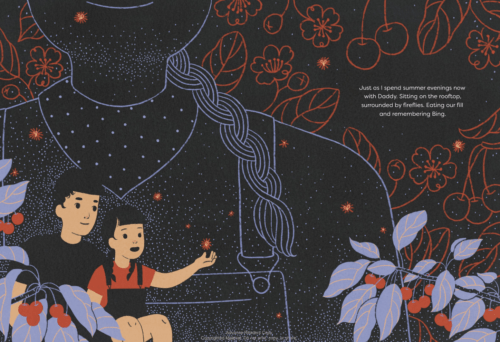
BB: Julia, I would be amiss if we didn’t talk about your art here. With a limited color palette of red, blue, black, white, and yellow, you give this book a sweeping folkloric feel, but I can’t help but feel that you’re sometimes making specific references to art styles or graphics. What was your inspiration for how you created the look of this book?

ADVERTISEMENT
ADVERTISEMENT
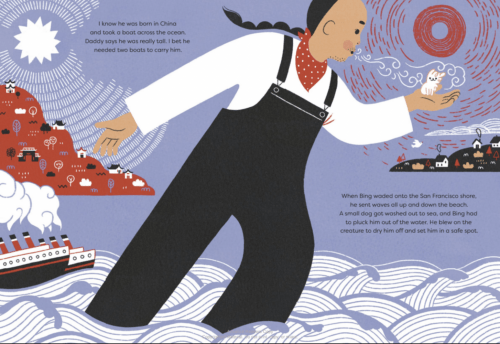
Julia: I appreciate you picking up on that! With most of the books I illustrate, I sit down and decide that the book should have a style that is more sophisticated or more naive, more Asian or more western, whatever the story needs. My job is to adjust my artwork to make that happen. The illustrations for Bing’s Cherries needed to be simple, charming, and Asian American. I think there was a moment where I realized: wait, I don’t need reference. If the goal is Asian American, that should by definition be how I naturally draw. The illustrations reflect my bicultural influences: the way I draw ocean waves and clouds is more Asian, but there’s a bit of mid century modern sprinkled in the shapes and design. For example, the little dog that Bing picks up has a 1950s American cartoon look (see: Gerald McBoingBoing).
BB: I love everything about that. Finally, then, what’s next for you two? What else are you working on these days?
Julia: What’s new is that I’m painting! This is something I’ve been itching to do for a long time, as almost all of my books have been digitally drawn. So I’m putting the finishing touches on my first hand-painted book, Seen: The Story of Corky Lee and his Photography of Asian America, written by Julie Leung and published by Dial.
My 4th author-illustrated book, Mountainous, will come out this fall with Greystone Books. It’s a follow-up to Luminous: Living Things That Light Up The Night.
And I’m gearing up to start finished art on our follow up to Bing, Chrysanthemum’s Glow!
Livia: My debut middle grade Echoes Across the Water, set in post-civil-war China and Taiwan, comes out next year. And in addition to Chrysanthemum’s Glow, I have another picture book in the works that I hope to announce soon.

Huge thanks to both Julia and Livia for taking the time to discuss this book, as well as so many other topics, with me today. Thanks too to Cynthia Lliguichuzhca and the team at Random House Children’s Books for helping to put this interview together. As I mentioned before, Bing’s Cherries is out now, and you really and truly won’t want to miss it. Find yourself a copy today!
Filed under: Best Books, Best Books of 2026, Interviews
About Betsy Bird
Betsy Bird is currently the Collection Development Manager of the Evanston Public Library system and a former Materials Specialist for New York Public Library. She has served on Newbery, written for Kirkus, and has done other lovely little things that she'd love to tell you about but that she's sure you'd find more interesting to hear of in person. Her opinions are her own and do not reflect those of EPL, SLJ, or any of the other acronyms you might be able to name. Follow her on BlueSky at: @fuse8.bsky.social
ADVERTISEMENT
ADVERTISEMENT
SLJ Blog Network
Top 10 Circulated Graphic Novels of the ’25-’26 School Year
Bug Ego, vol. 1 | Review
Early May Update: Our list of possible Newbery contenders according to Heavy Medal readers
From Policy Ask to Public Voice: Five Layers of Writing to Advance School Library Policy
Trading Card Game strategy & The Last Best Quest Ever, a guest post by F.T. Lukens
ADVERTISEMENT