
Review of the Day: While We’re Here by Anne Wynter, ill. Micha Archer

Oh, gatekeepers. Ours is a tricky lot to live. Imagine that you are in a position where you can see hundreds and hundreds and hundreds of new picture books published in a given year. You want to make sure that the future recipients of these books are just seeing the best stuff, right? I mean, in a sea of completely okay books, there’s always some remarkable little glorious gem worth discovering. The trouble is that you have to do this while also keeping in mind that YOU are not the intended audience here. It is awfully easy for adults to find certain topics or art styles of interest, while the child readers’ eyes slowly glaze over during a read. Similarly, what if a book displays a realistic moment that you, the grown-up, identify with while your kid doesn’t at all? Who is the book really for then? Such were the thoughts coagulating in my cranium as I read While We’re Here. Just to give away the game, I love this book deeply and thoroughly. But do I love it because I’m a parent and this storyline is SO relatable or because I think it’s a high-quality book that a kid will really enjoy? Or can both things be true at the same time?
“Hurry, hurry, jackets zipped. Hurry, hurry, out the door.” A mom and daughter dressed to the nines, toting a white present wrapped in a red ribbon, travel at top speed. They’re clearly late for some kind of a party, and so they zip through subway tunnels and run down park lanes. Yet when they arrive, not only is no one there, but it clearly looks like someone used to be. Where are the people? A quick look about and it turns out the party was yesterday. Do they wallow in their misery? They could, but mom adeptly distracts her daughter with the wonders of the park. There are ducks, and tunnels. There are hills to roll down and trails to explore. By the end, they slow down and take everything in. Hurry? Nah. They have nowhere to be.
ADVERTISEMENT
ADVERTISEMENT

I have to credit my children’s librarian co-workers. They were the ones a year or two ago that clued me into the important role that picture books with simple texts play in our world. I’m an adult. I love sophistication. I like cleverness. When a text is simple, I can’t use my usual methodology to gauge its success. I have to read the book in an entirely new way. But then Anne Wynter comes along with a very simple text, but also a situation that both kids and their guardians are going to understand entirely: your grown-up messed up. You had a fun thing you were going to, and now you have no fun thing at all. And it’s not because of you, kid. It’s because of your parent. Now the logical response to this is anger at the parent and sadness for the loss. Wynter’s book becomes this phenomenal mentor text because she acknowledges the sadness, but rather than wait to have the kid work herself up into a screaming catfit of some sort, the mom has this fascinating technique. Until the party, the repeated lines have been “Hurry, hurry”, all culminating in that final sentence before the reveal of, “Hurry, hurry, up the hill. We have somewhere to be!” After that, mom exchanges the “Hurry, hurry” to “We’ll head back home, but while we’re here…” which is a fascinating distraction. In the art you can see that she is the only rolling down a nearby hill in her fancy dress. She is the one leading the two of them under a stone bridge to explore. She is the one reaching out to the ducklings. The practicality of heading back home is continually usurped, so that it feels like mom and kid are getting away with something (thereby appeasing the child). It’s a parenting method I can relate to since I truly believe that distraction with small children is more art than science.
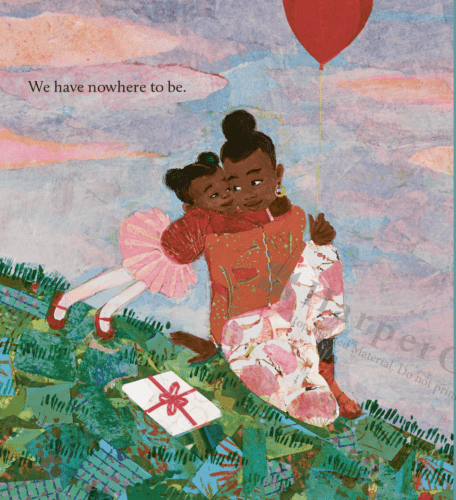
I would be amiss in not touching on some of the cadences chosen for the text as well. It doesn’t rhyme, at the beginning, did you notice? “Hurry, hurry” is rhythmic, absolutely, but as easy as it might be to do some kind of a rhyme (the missing shoe sequence, in particular, almost begs for it). By not rhyming, Wynter almost increases the tension of getting to the party on time. Then, when everything has gone down, and the daughter isn’t as upset anymore, and they’re taking their time, listen to what the text does at the end. “We’ll head back home, eventually. / We’ll sit awhile, beneath a tree. / We’ll wander off, just you and me. / We have nowhere to be.” Aside from the “nowhere to be” acting as a flip of the earlier “We have somewhere to be!” when they’re running to the party, that four sentence rhyming sequence slows the read, and then ends the entire book with this satisfying thump. I tried to describe it some other way, but “satisfying thump” is, I will maintain, still the best way to say what this book does. Thump. So satisfying!

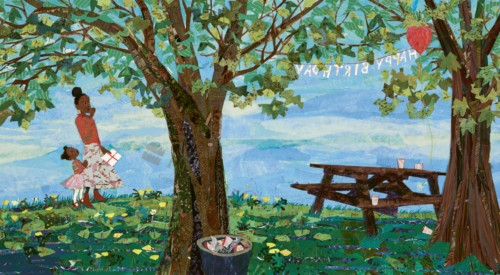
There’s collage and then there’s COLLAGE (all caps, bold as brass). Think of Eric Carle’s collage art. Meticulously hand-painted papers, cut to size, often placed against pure white backgrounds. How pretty. This is not the Micha Archer way. Micha’s collages crowd the pages. They hustle up to her human figures leaving not so much as a millimeter of pure white to be found. Just to clarify, I’ve no special insights into how Micha makes her books. I don’t even know the order of her process. Does she paint her characters first and then collage around their painted parts? Does she collage first and then paint on top of the papers? Beats the friggin’ heck out of me, but what works, works. Winner of the Caldecott Honor for Wonder Walkers, Archer has previously done books with relatively calm levels of emotional content. I’m not saying they don’t have plots, but those plots do anything but keep at an even keel. The parental betrayal we witness in this book is a wholly new thing for me to encounter in a Micha Archer title. Look at that wordless two-page spread of the party picnic table, empty, abandoned, paper cups left to rot in the sun. A nearby trashcan overflows with wrapping paper, a sole sad balloon floats, and in a bold move that shows the artist’s expertise, the hanging words “Happy Birthday” are backwards. Why did Archer make them backwards? Because it makes the two pages feel just a little bit… wrong. And part of what I love so much about this moment is that adult reader and child reader can come into this scene and be just as baffled as the main characters, until all is explained. Now look at the pages. Until now the white parts of the pages that contain the text have been in bands on the bottom of the pages. Once this moment of revelation happens, the world is compacted into circles. Only when mom finds ways of using nature and play to cheer up her kid do the collages explode again and you end with a full page, no white space at all, in a final image of mom and daughter. Brilliant choices from start to finish.
I mean, are we gonna talk at this point about the book’s use of red? Might as well. Red balloons are classic picture book staples (even if the original Red Balloon picture book consisted of movie stills). Take a moment to admire this cover too. Red on mom’s top, red on the daughter’s top, those red shoes the kid is wearing, and then, almost subtle, red balloon that floats over their heads. There’s just this one yellow string bisecting mom’s face, matching the earrings of both mom and child, literally tying the whole image together. As we read the book, there is also the red ribbon around the present that never gets delivered (and that, to my infinite satisfaction, makes it into the final image of the book). Red is present in other pictures as well, but Archer keeps the two main characters foregrounded, their reds making them easy to spot, even when they’re far away from the reader. In the two-page spread of the missed party, they stand in red on the left, and that abandoned balloon floats morosely on the right. Then, in the last image in the book, the sky is a pink color, the closest it can get to matching their outfits (and, indeed, the pinks of their tutu and pants echo it). So much care. So much thought. So much attention goes into a book of this sort.

So yes, this is a book for both gatekeepers and children. It’s fun for both. It appeals to both. And it also features Black characters. This fact might not have been quite so notable, even as recently as four years ago, but in recent times our children’s publishing industry has experienced a cool down. Black creators like Wynter aren’t getting published at the same rate as they used to be. When they do, their books tend to be about meaningful topics, like believing in yourself, which, while completely necessary, is rather limited. So apart from everything else that I like about this book, I just like that it’s a book about a mom and kid bonding, and they happen to be Black. I would kill for a hundred more books like this one. Books that have this much thought and time and attention by Black creators like Wynter and speak to universal topics that we haven’t seen in picture books before. While We’re Here is a masterclass in cohesive storytelling, where the simple text is doing more work than you initially notice, and the art is matching it beat for beat. Looks simple. Ain’t. And I love that for it.
On shelves now.
Source: Final copy sent from publisher for review.
Filed under: Best Books, Best Books of 2026, Reviews, Reviews 2026

About Betsy Bird
Betsy Bird is currently the Collection Development Manager of the Evanston Public Library system and a former Materials Specialist for New York Public Library. She has served on Newbery, written for Kirkus, and has done other lovely little things that she'd love to tell you about but that she's sure you'd find more interesting to hear of in person. Her opinions are her own and do not reflect those of EPL, SLJ, or any of the other acronyms you might be able to name. Follow her on BlueSky at: @fuse8.bsky.social
ADVERTISEMENT
ADVERTISEMENT
SLJ Blog Network
ALA Annual 2026 Photo Dump (Part II: People)
Publishers Announce Manga for Young Readers at Anime Expo | News
From Policy Ask to Public Voice: Five Layers of Writing to Advance School Library Policy
The Artsy Kid: Finding Fierceness Beneath the Surface, a guest post by Katherine Wolff
ADVERTISEMENT
This review is so very thoughtful and nuanced, just what we need at this moment. While We’re Here looks and sounds lovely. Agree that Micha Archer’s collages are at Eric Carle level of excellence. Betsy Bird for National Ambassador for Young People’s Literature!
Ach, you are too kind. As for that ambassador gig, call me in 17 years and I’ll consider it!
Anne Wynter shared a sneak preview of this book last November in a webinar and I’m so grateful you shared it today because I wanted to know when it came out! It looks magnificent. I just shared your review post in the 12×12 Facebook group so that others who has seen the webinar will know of the book’s release.
Ah, that is so kind of you. It truly is a wonder. One of those books that I decide to review and then, in the course of doing so, I just realize even more how incredible it really it.
Thematically, this really reminds my of “Saturday” by Oge Mora where mother/child plans go awry.
I have the book “Saturday” by Oge Mora (2019) and it’s also about a black mother and daughter with mishaps not only by Mom – the tickets for the puppet play were missing, and before that, the library story time is cancelled, a gust of wind ruins their hairdos and it’s noisy in the park. Still it’s a been a delightful day, ending with creating their own puppets at home. And yes, the simple text is lovingly enhanced with collage illustrations. These two books sound like fraternal twins. Perhaps someone could write a story about a Dad and son day that goes awry?
Here’s SLJ’s review – perfection, I agree.
VERDICT A story that weaves mindfulness, appreciation of family time, and the lesson that parents are human, into a gorgeously produced package. Perfection.
https://www.slj.com/review/saturday
You folks are all more than correct. The natural predecessor to this is undeniably Saturday. Many speculated that that book too would win itself some Caldecott love. Maybe Wynter and Archer’s book can avenge it!
(I don’t use the word “avenge” in my reviews or comments enough)
Throughout Micha Archer’s illustrations there is the pleasure of moments of truth in the gestures. Whether listening for the wind and rain, rock hopping or leaning on mom, we see and feel the weight or the lightness or the anticipation in the in the pose. Brilliant illustrator!
Your review led me to the buy button on Bookshop. What a beautiful book.