• Skip to primary navigation
  • Skip to main content
  • Skip to primary sidebar
  • About/Contact
  • Fusenews
  • Reviews
  • Librarian Previews
  • Best Books
    • Top 100
    • Best Books of 2022
    • Best Books of 2021
    • Best Books of 2020
    • Best Books of 2019
    • Best Books of 2018
    • Best Books of 2017
    • Best Books of 2016
    • Best Books of 2015
    • Best Books of 2014
    • Best Books of 2013
  • Fuse 8 n’ Kate
  • Videos
  • Press Release Fun

31 Days, 31 Lists: 2023 Nonfiction Books for Older Readers

31 Days, 31 Lists: 2023 Nonfiction Books for Older Readers

December 28, 2023 by Betsy Bird

While serving on various book committees made up of librarians, the subject area that may be the most difficult to get folks to read is, sadly, older nonfiction for kids. For those of my generation (and earlier, certainly) older nonfiction for kids meant one thing: adult nonfiction. We simply didn’t have a well-established system for conveying this kind of info for older readers. All that changed around 15-20 years ago, but old habits die hard. If you grew up reading fiction, it can be hard to switch to nonfiction. All this is to say that I am certain that I’ve missed some fantastic titles on today’s list, and for that I am sorry. Consider this, then, a jumping off point for some of the best informational texts for older kids coming out in 2023.

If you’d like a PDF of today’s list, you can find one here.

Interested in similar titles? Check out the Older Nonfiction lists of years past:

  • 2022
  • 2021
  • 2020
  • 2019
  • 2018
  • 2017
  • 2016

2023 Nonfiction for Older Readers

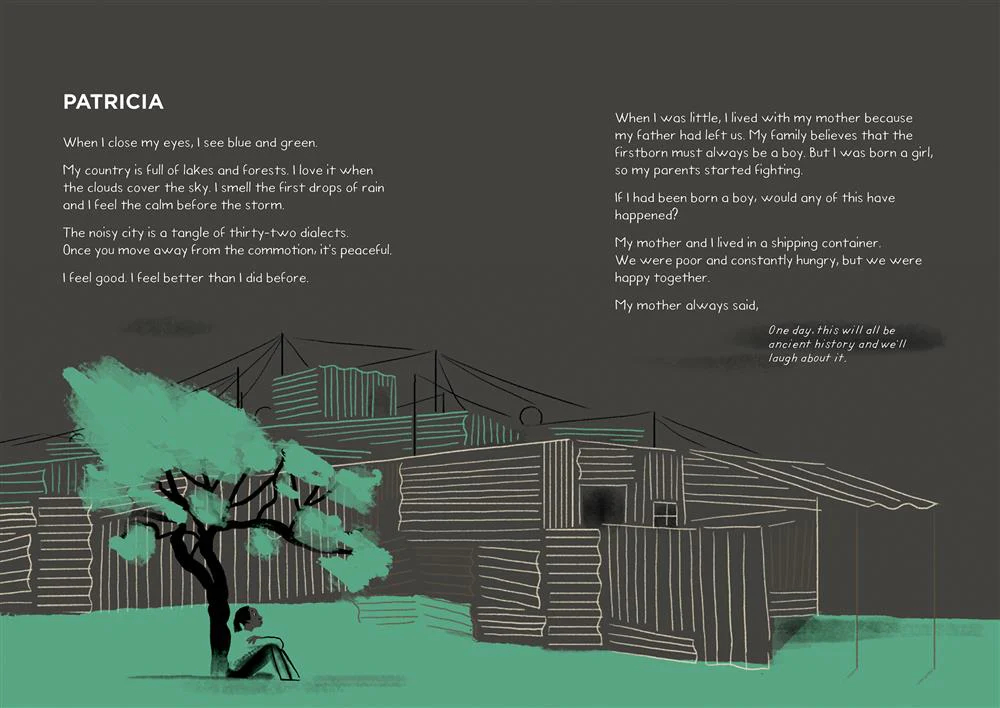
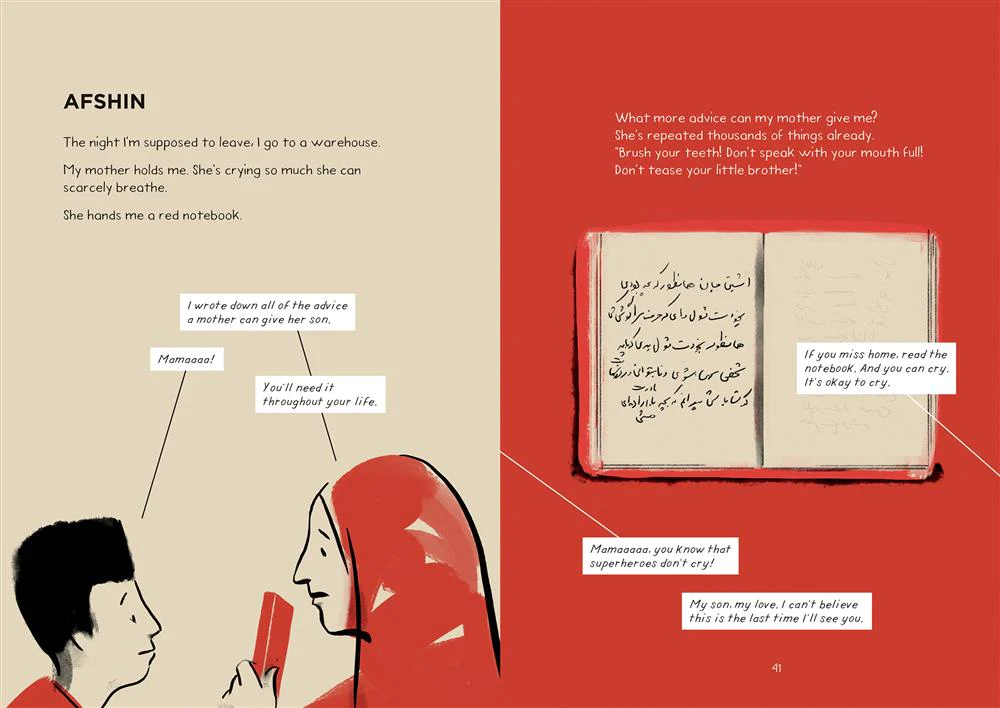
Alone: The Journey of Three Young Refugees by Paul Tom, ill. Mélanie Baillairgé, translated by Arielle Aaronson
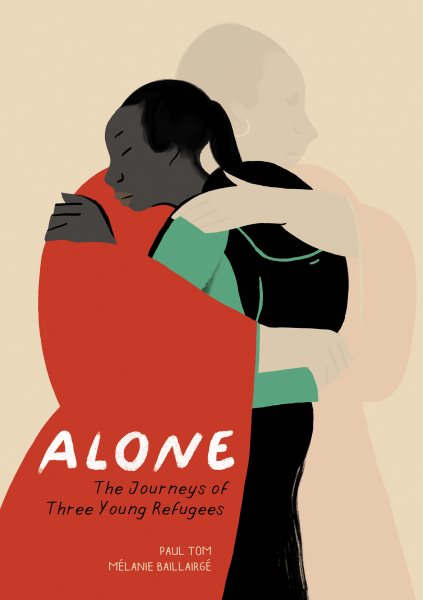
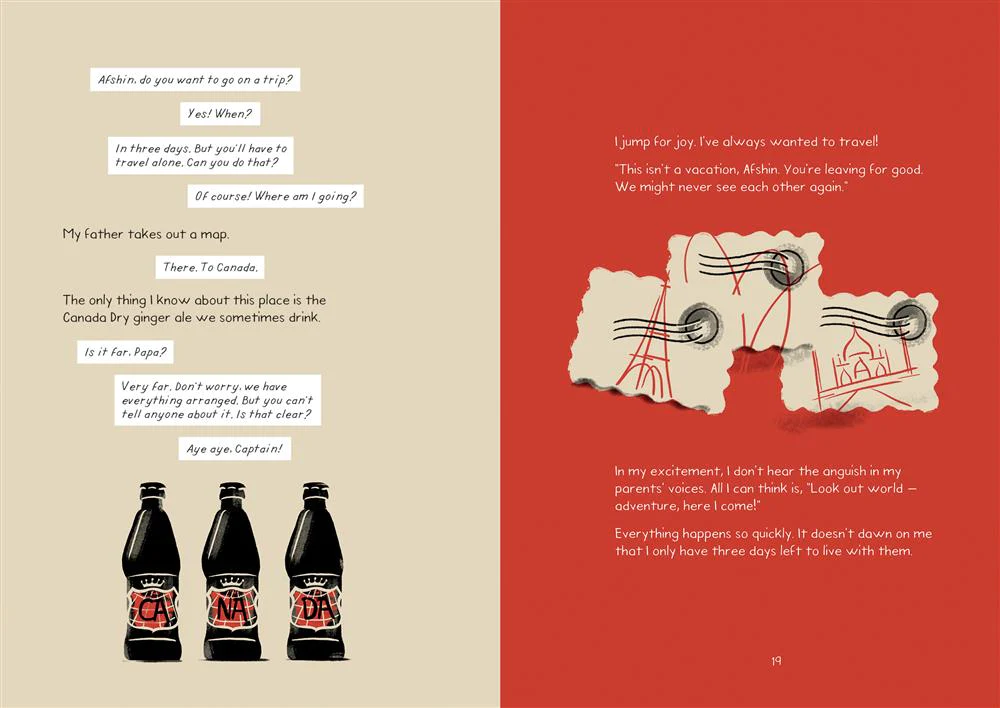
What is it like to leave your family, and even your country, to travel to a new life completely on your own? Follow the stories of three kids who did just that in this powerful and uplifting collection. This book is honestly so gripping that I forgot I was reading nonfiction. When I got to the end and encountered the three photographs of the three kids featured I was honestly shocked. The question with this book is not so much whether or not it’s worthy of this list (which it most certainly is) and more whether, with its young teens that grow to adulthood, it is for kids. I happen to think that it is. Though they go through some harrowing trials I was relieved to see that there no physical violence or abuse of any kind. That allows the story to focus more on the concept of leaving your family behind at such a young age. I loved how different the three kids were in terms of personalities too. Well worth your eyeballs.

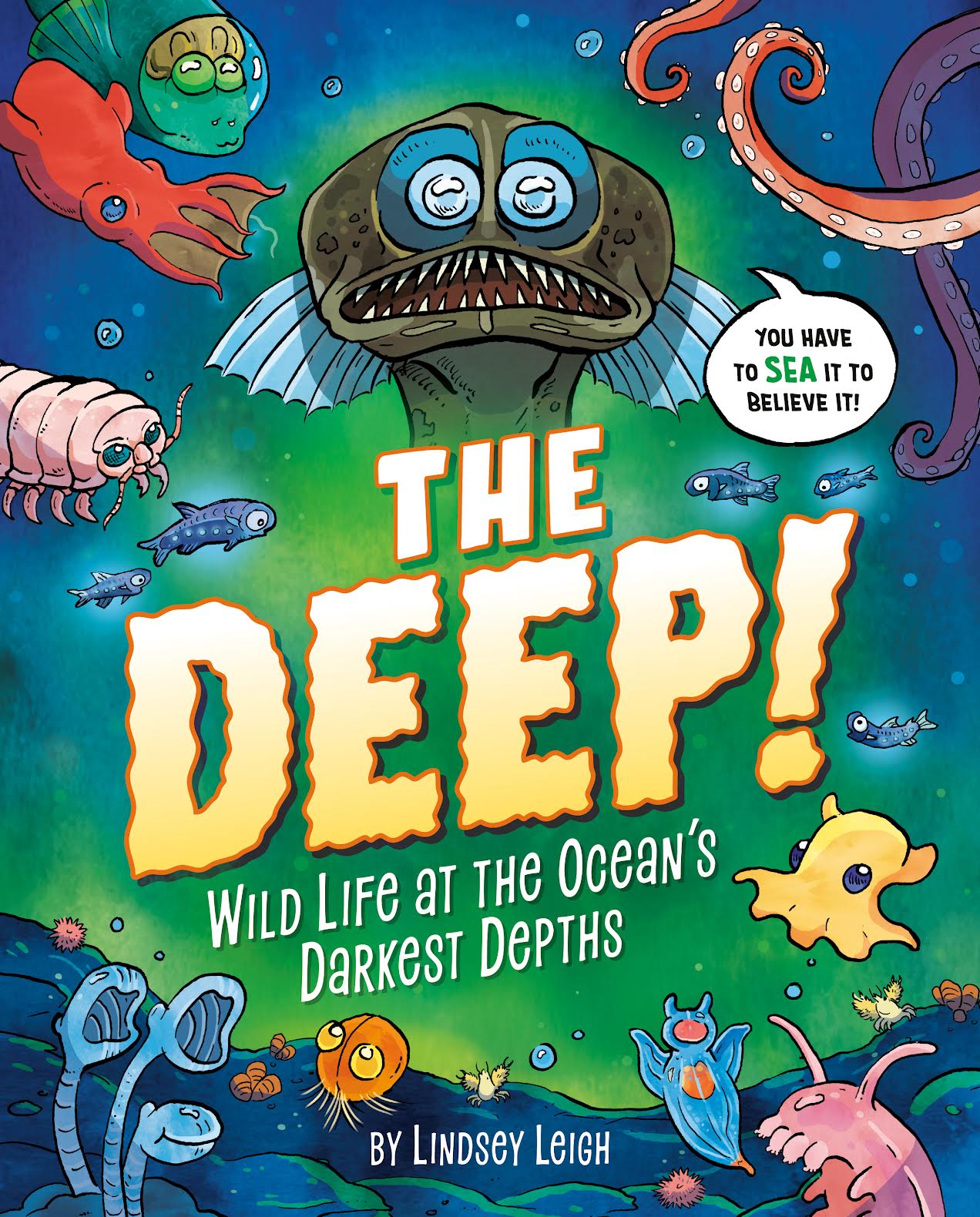
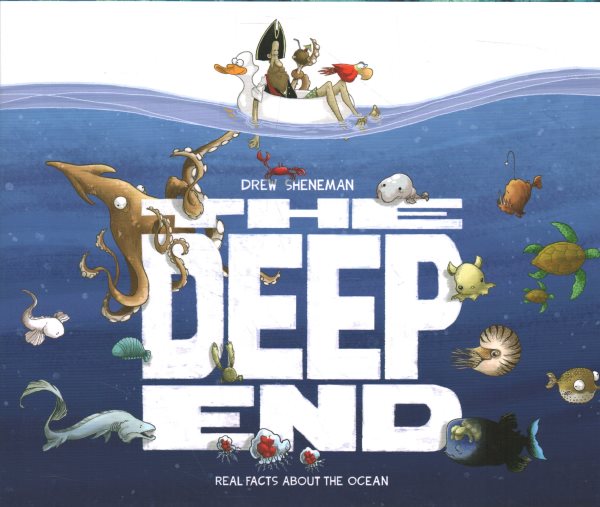
The Deep! Wild Life at the Ocean’s Darkest Depths by Lindsey Leigh
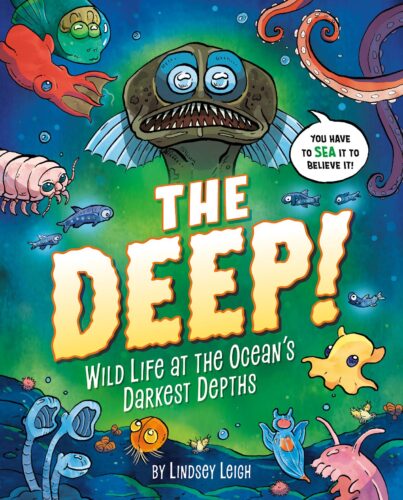
Sink deep deep below the waves to meet the creatures that dwell where nothing else can live. A fantastic voyage filled with humor and facts we can guarantee you never knew before! Ahhh. So this is what I’ve always wanted in a deep sea book for older kids. And no shade on the other whale fall book out this year, but I guess I had sort of hoped that that book would have the sheer levels of excitement and interest that this one has. Fashioning her style on old 1950s B-movie posters, Lindsey Leigh packs her book with hilarity and solid factual information. I learned a LOT from this title. Somehow, Leigh manages to sandwich the less interesting info between the fascinating and funny (as well as gross) stuff so beautifully that it’s irresistible. A must read! Previously Seen On: The Older Funny Books List

The Great Giraffe Rescue: Saving the Nubian Giraffes by Sandra Markle

So very well done! It’s certainly a title for older readers, but it doesn’t bog you down with endless pages, coming in instead at a handsome 40. I was particularly intrigued by the fact that the efforts in this book weren’t focused on moving ALL the giraffes out of a region, but a significant number that could increase their numbers over time. LOTS of lovely photographs, which I always enjoy, and Markle even managed to include a kind of giraffe hero into her story (Melman, the giraffe with a kind of wonky jaw). Accessible and cool with a larger message about how we have a tendency to ignore danger to different species until it’s too late. Previously Seen On: The Science and Nature List

Hidden Systems: Water, Electricity, the Internet and the Secrets Behind the Systems We Use Every Day by Dan Nott

“Huh, I actually have no idea how the internet works.” “And wait… is there really enough water for everyone all the time?” “And what’s really powering this light? What even IS electricity?” If you’ve ever found yourself asking even one of these questions, Dan Nott has provided a book that is nothing but answers. As he mentions early on, a hidden system is something we don’t notice until it breaks. They’re also supremely hard to visualize, so a graphic novel format actually makes for the perfect vehicle for explaining not simply the mechanics, but also the history, the inequities, and how these systems must be updated in the future if we want to sustain them. I’ve been joking to folks recently that David Macaulay must have retired this year or something since the man has been on a blurbing bender. That said, this book is the PERFECT vehicle for a Macaulay a.k.a. “The Way Things Work” blurb. Just as Macaulay broke down the construction of cathedrals, pyramids, and more, so too does Nott break down whole systems we rely on. And I don’t care how much you think you know about these three things. You’re bound to learn something incredible on almost every page. For example, did you know that the lines that carry our internet follow the exact same paths as the lines that carried telegraph messages originally? An utterly fantastic and fascinating book. Definitely on the upper end of middle grade, but for a savvy reader there’s a lot to be interested in. Previously Seen On: The Science and Nature List

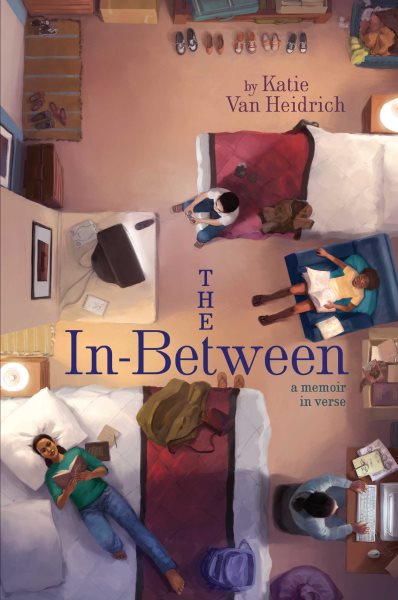
The In-Between by Katie Van Heidrich

The verse memoir. That’s a tricky one. For a nonfiction stickler like me I want so badly to shove it in either a fiction category or a nonfiction category, but here’s where the problem with memory plays a part. If Van Heidrich says this is her memory then it is her memory. There’s dialogue but it’s dialogue as she remembers it. So even if it comes across as a VERY accomplished verse novel, we have to take it on face value that it technically belongs in my older nonfiction category. All that being said, this is an amazingly written title. The premise and the cover? It took me a long time to get past them, which I regret because the writing that I found inside is remarkable. In this story, a single mom with three kids is forced to live for a time in a hotel while she searches for a job. The sheer soul-sucking nature of this situation comes through like an air horn. And it doesn’t help that their dad, with whom they spend every other weekend, has a home with a bunch of empty bedrooms, yet he makes the kids all share a pull away bed together. It’s sparse and spare and manages to deliver so much with so few pages. You are in this room. You feel this story. I also highly recommend that if you are able, listen to the audiobook read by Angel Pean. I love a narrator capable of highlighting just how amazing the language in a book is. And this book? Incredible. 

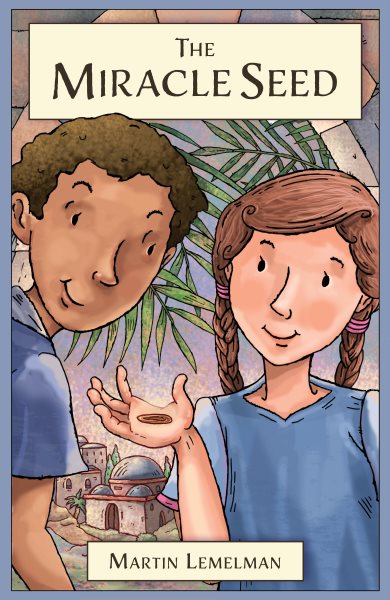
The Miracle Seed by Martin Lemelman

Everyone knows that the Judean date palm went extinct long ago, right? But when scientists were given 2,000 year old seeds, they decided to see if they’d grow. A tale of history, science, and delicious dates. Sometimes you gotta sit on a book a while to understand what you think about it. I’ll confess that I wasn’t originally going to put this book on this list when I received it. I liked it, but was it memorable? So I put it down for a week or two  . . . and kept on thinking about it. Seriously, it’s amazing how many times I’ve found myself thinking about its implications. For example, I recently was listening to a podcast that was discussing the now extinct plant silphium and found myself wondering what would happen if someone managed to find some silphium seeds. With its panels, speech balloons, and other elements you might find in a comic book, the information here is incredibly accessible for kids. I like how Mr. Lemelman also managed to work in Jewish history as well as the science necessary to understand WHY a seed this old could still be viable. Absolutely fascinating. Previously Seen On: The Science and Nature List

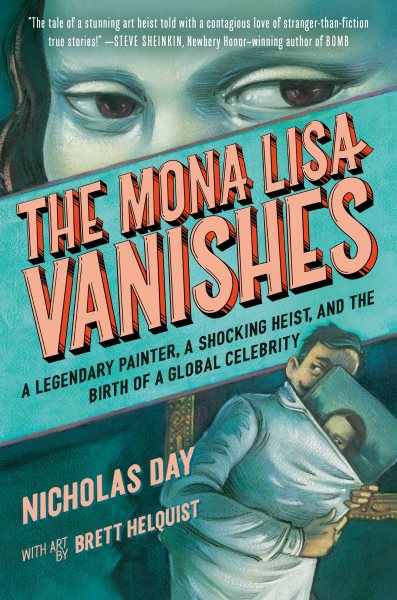
The Mona Lisa Vanishes: A Legendary Painter, a Shocking Heist, and the Birth of a Global Celebrity by Nicholas Day, ill. Brett Helquist

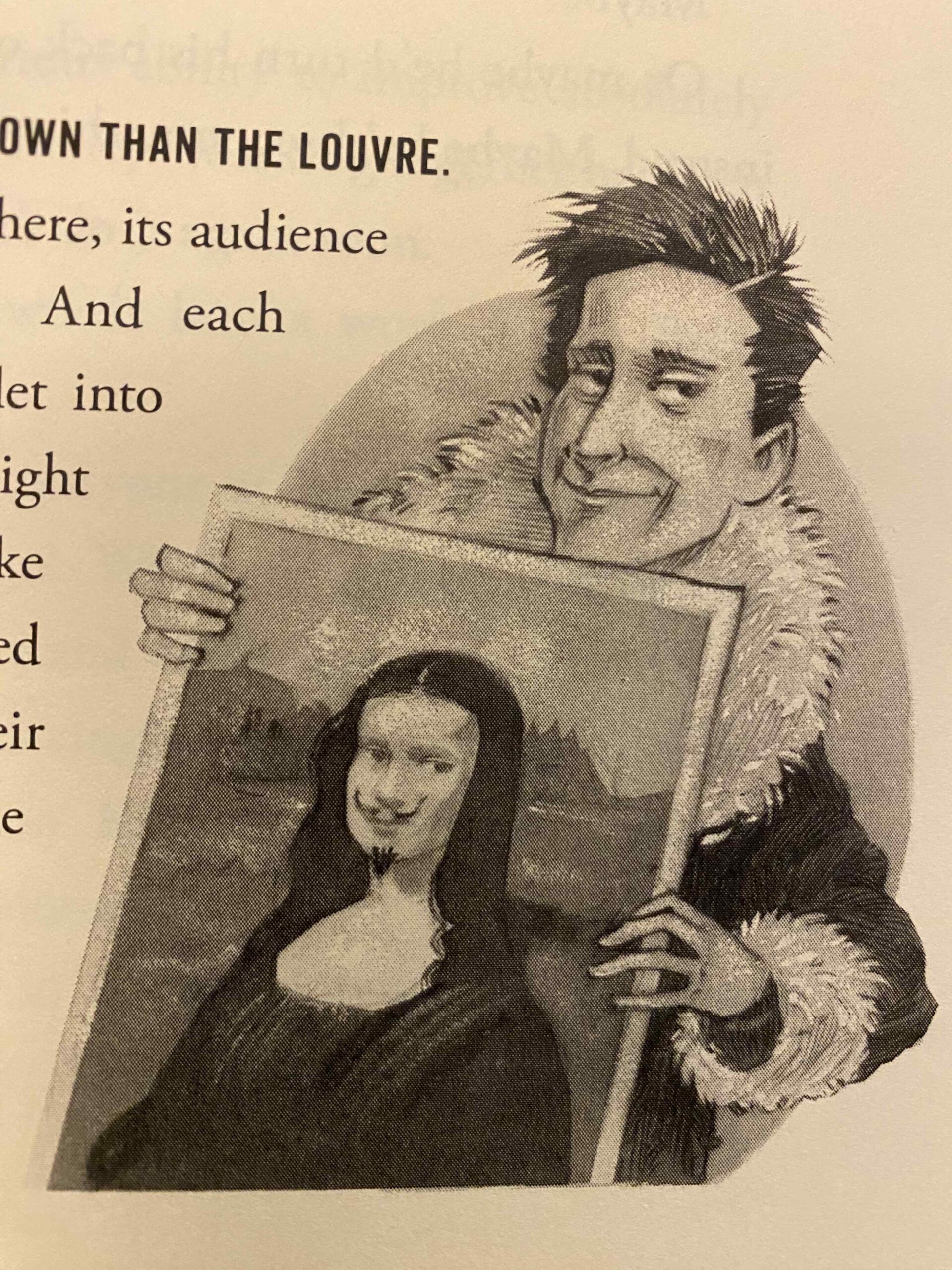
How did the world’s most famous painting just get casually stolen on a Monday morning? Easy: She wasn’t famous yet. Take a trip into the past and witness the Mona Lisa heist in this funny and fantastic work of narrative nonfiction. What can I do or say to convince you that this book is one of the most enjoyable you’ll read all year? I’ve always liked the Steve Sheinkin version of narrative nonfiction you’ll sometimes find in a given year, but aside from him and the occasional Deborah Heiligman, few folks take the time to be simultaneously accurate AND amusing. Now we meet Nicholas Day. Amusing? Oh yes. Accurate? Yes, that too. This is a heist like no other and a story you’ve probably only been vaguely aware of. For my part, it all comes down to how he keeps bringing it back to how a person brings their assumptions to the facts, and the dangers that kind of thinking poses today. Expertly crafted and so much fun!

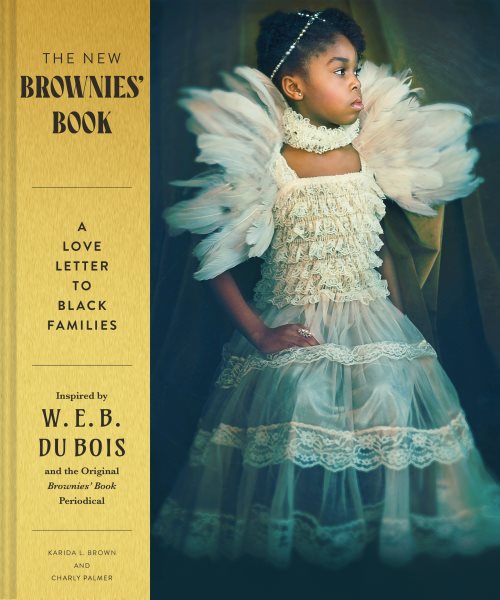
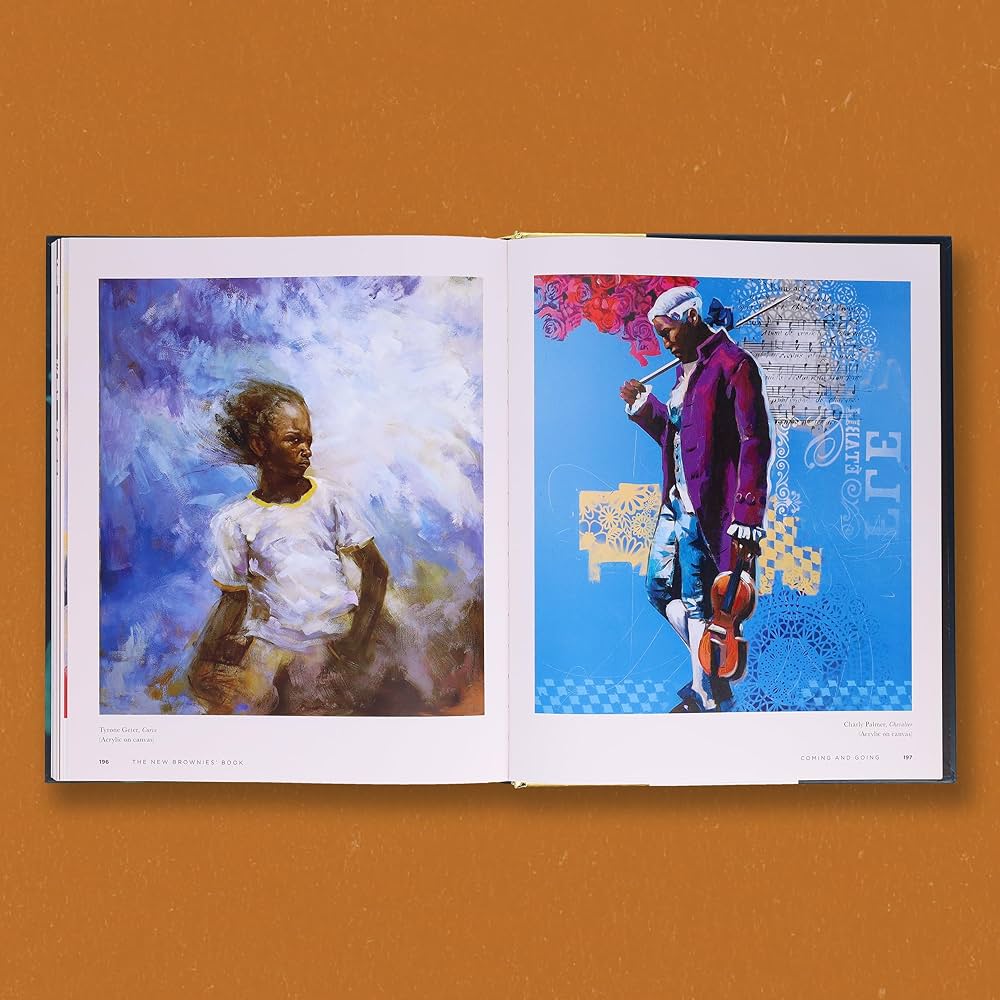
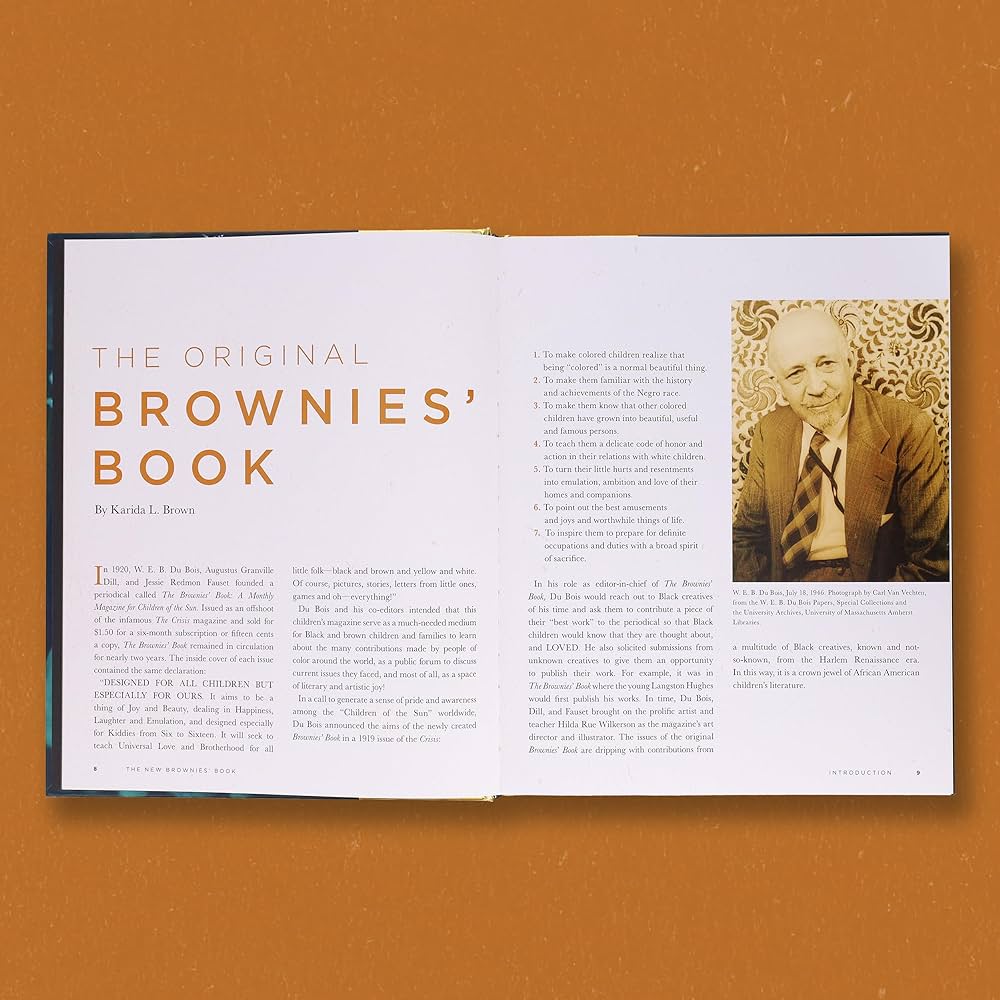
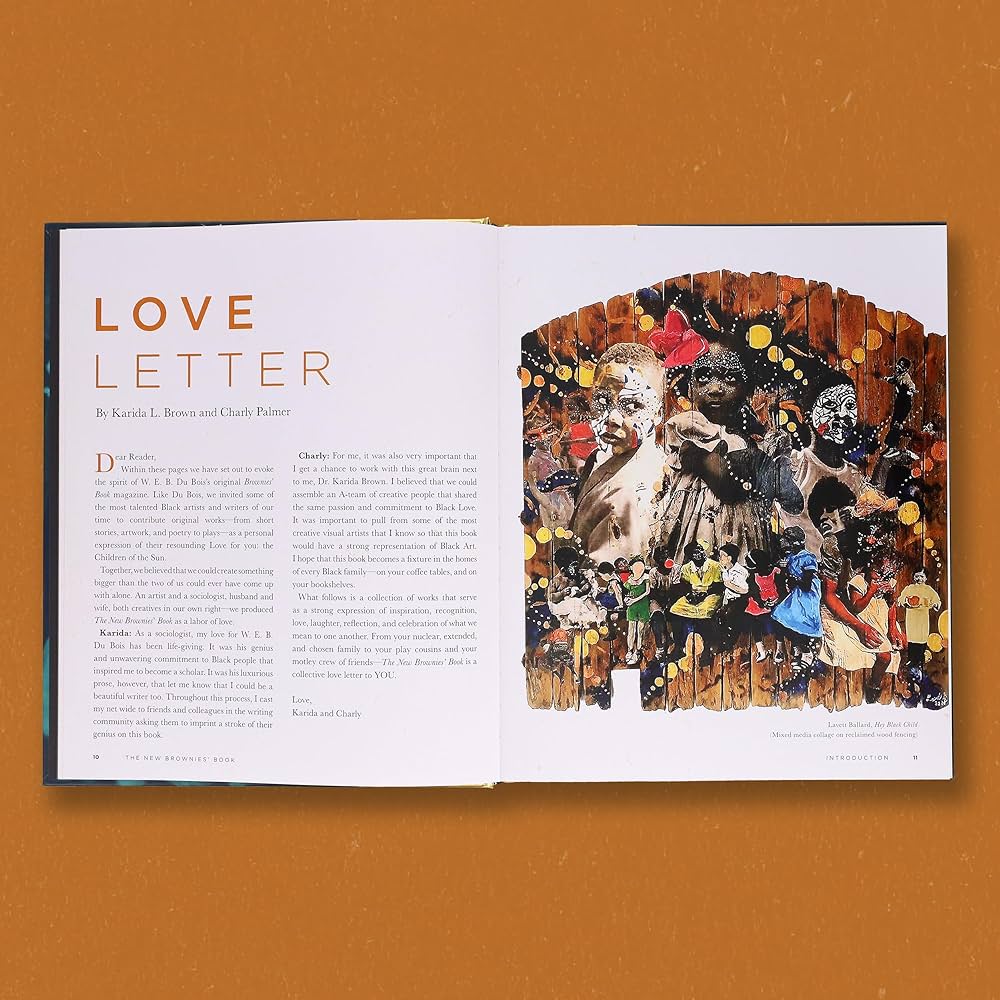
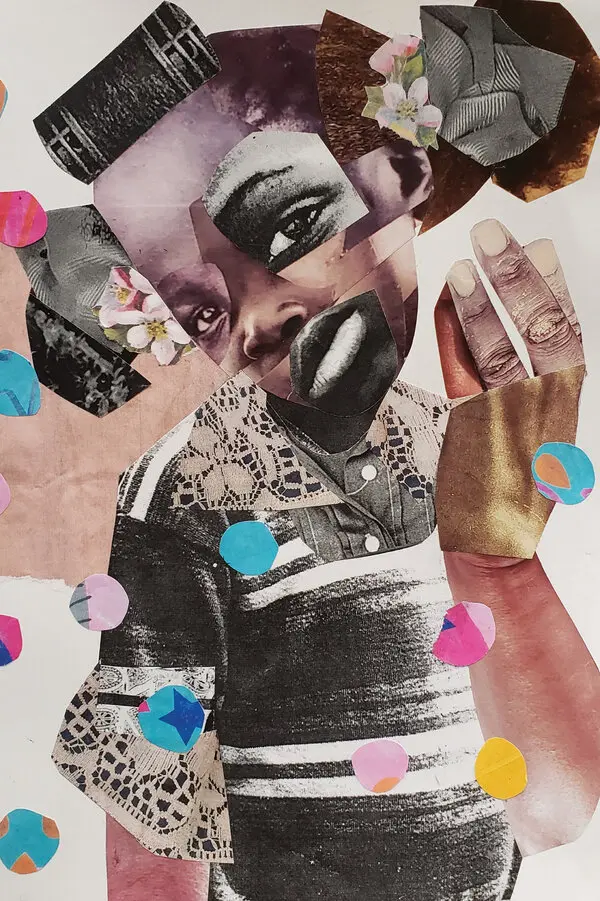
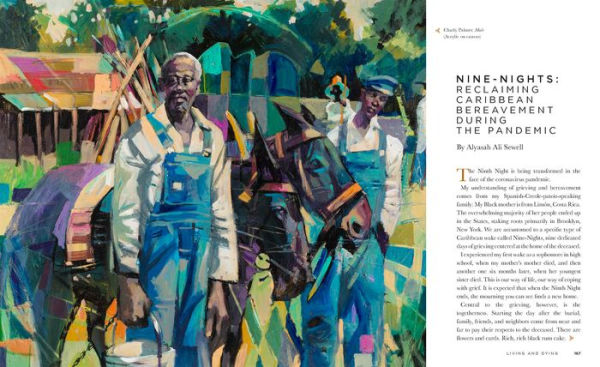
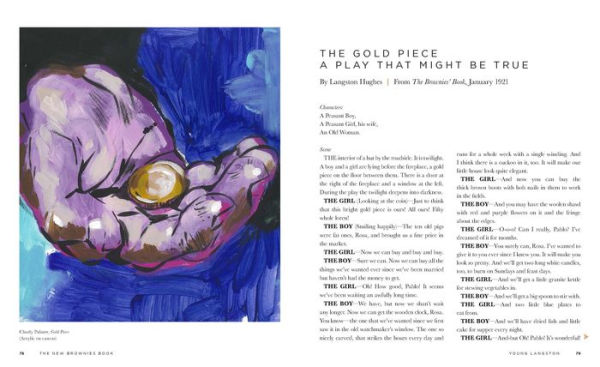
The New Brownies’ Book: A Love Letter to Black Families, edited by Karida L. Brown and Charly Palmer

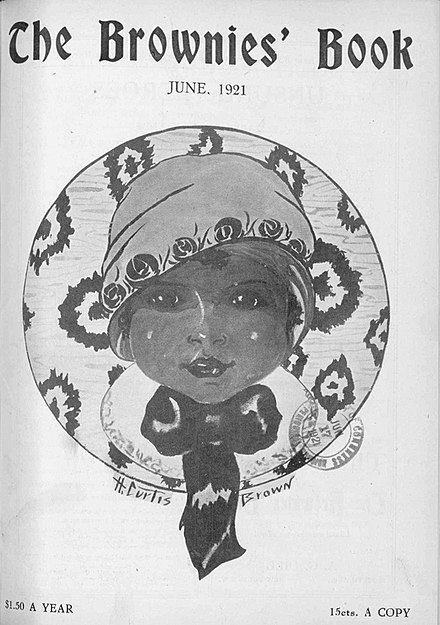
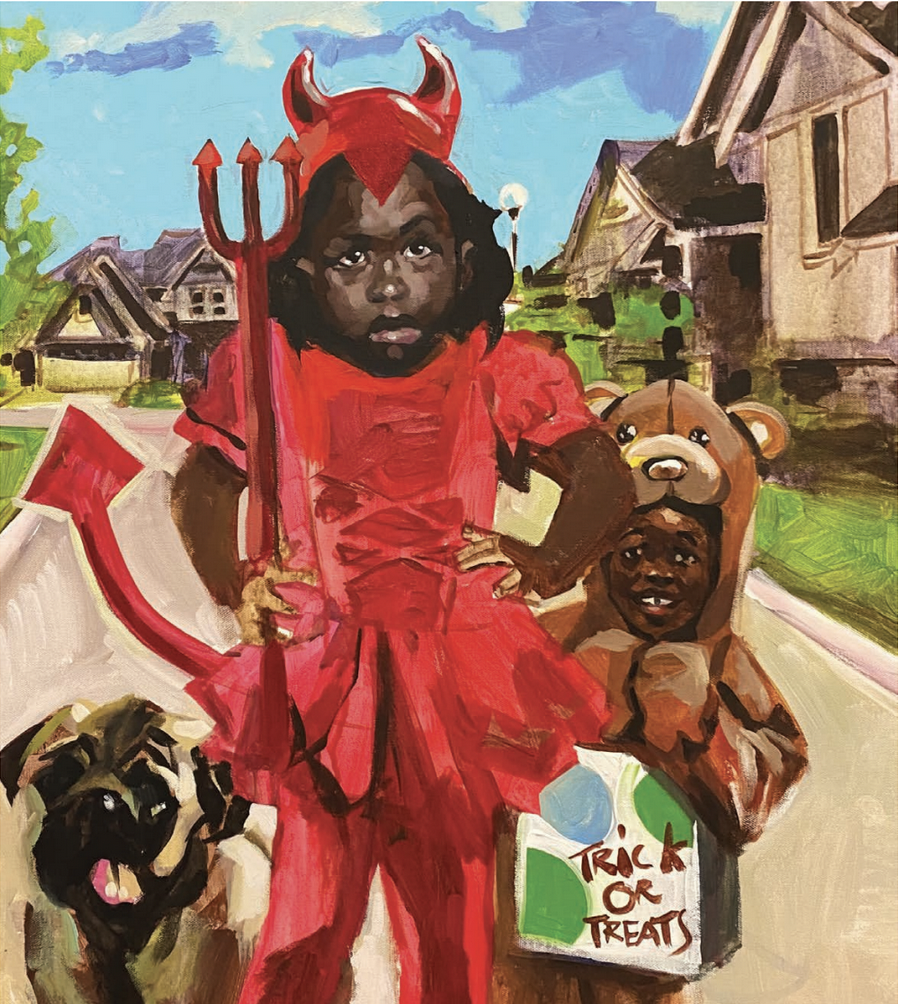
A gorgeous compendium of Black authors and artists appear in this collection of stories, art, comics, and poems. And now it’s time to talk about something a little more complicated. So what do you like to do with “keepsake” books? Which is to say, books that are meant to be read to children but are primarily aimed at the adults that can judge and appreciate their existence in this world? This book is an update to The Brownies’ Book, which was a children’s magazine started by W.E.B. Du Bois and Jessie Fauset (who rarely gets enough credit) in 1920. I actually remember learning about it in my Harlem Renaissance class in college. Now it’s been updated by a Du Bois scholar and artist for the modern age in book form and it is, quite frankly, gorgeous. It’s also clearly a gift book. That doesn’t mean it doesn’t get on my list, though. Plus, I just love that early story in it, “Nobody Loves the Debbil.”

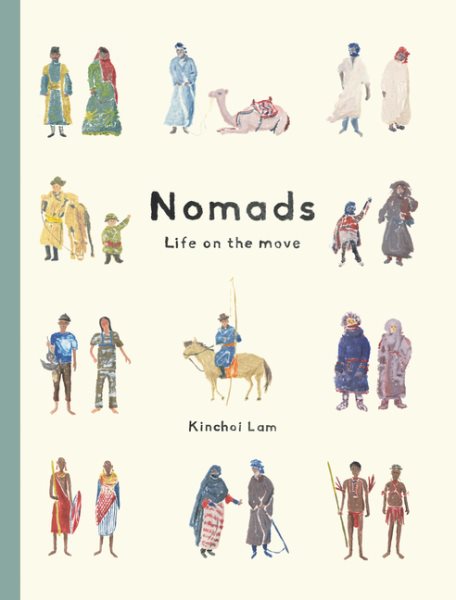
Nomads: Life on the Move by Kinchoi Lam

The difficulty of the adult reviewer of children’s books is separating out what you, as a grown-up, find fascinating in your children’s literature and what a kid, reading the same book, would actually find interesting. I try to keep my finger on the pulse of such things, but with a book like Nomads it’s a little difficult to determine. Personally, I think this topic is enthralling. It’s about eight different groups on what looks to be five to six different continents and how they maintain their nomadic traditions in the modern world. There’s some history and a lot of logistics worked in there which is neat, and Kinchoi Lam works with this fun style that renders the people quite small most of the time. I think that there is some kid appeal, if the reader is interested in learning about how different folks live all over the world. My real objection is to the fact that since this is a British import there’s really no backmatter to be seen. No list of the resources Lam used to come up with these facts. A Glossary, sure, but not much beyond that. Ah well. Still an interesting book and concept. 

Unseen Jungle by Eleanor Spicer Rice, ill. Rob Wilson

Whether you’re an up-and-coming young scientist or just want a book with the grossest stuff in it, there’s a lot to love in this compendium of microbes and their unseen, highly disgusting, world. Sorry, folks. I hate to be the one to break the news but I found myself a nice super gross book for 2023 and I’m loving it. What’s the name of the game this time? Microbes! Specifically bacteria, fungi, protozoa, archaea, algae, super-tiny animals, and viruses (though Rice acknowledges that some scientists would say they don’t count). The book then systematically goes through every possible place you might encounter them. It gets two germ-encrusted thumbs up from me on the “yuck” factor, but you also learn a TON of info. For example, this may be the first time I’ve ever felt bad for flies. Read the book. You’ll see why. Previously Seen On: The Science and Nature List

We Need to Talk About Vaginas: An Important Book About Vulvas, Periods, Puberty, and Sex! by Allison K. Rodgers, ill. Annika Le Large

Straightforward information about everything from puberty and pregnancy to consent, presented by a gynecologist who knows exactly what questions people with vulvas might have about their changing bodies. And here we come to the complicated question of what to do with a book that is more of a straightforward informational text than anything else. A necessary book? And how! Lord, I don’t think I saw any of this stuff in a book until I went to college and my roommate handed me Our Bodies, Our Selves (am I dating myself much?). Kids today are so lucky. This book does a pretty good job of remaining aware of bodies along the LGBTQIA+ spectrum, while also offering straightforward information in a clear cut way. It’s not a particularly creative book or pretty book in that way, but boy am I glad that it’s now in this collection! Previously Seen On: Science and Nature List


Hope you enjoyed these! Here are the lists you can expect for the rest of this month:

December 1 – Great Board Books

December 2 – Picture Book Readaloud

December 3 – Simple Picture Book Texts

December 4 – Transcendent Holiday Picture Books

December 5 – Rhyming Picture Books

December 6 – Funny Picture Books

December 7 – CaldeNotts

December 8 – Picture Book Reprints

December 9 – Math Books for Kids

December 10 – Gross Books

December 11 – Books with a Message

December 12 – Fabulous Photography

December 13 – Translated Picture Books

December 14 – Fairy Tales / Folktales / Religious Tales

December 15 – Wordless Picture Books

December 16 – Poetry Books

December 17 – Unconventional Children’s Books

December 18 – Easy Books & Early Chapter Books

December 19 – Older Funny Books

December 20 – Science Fiction Books

December 21 – Fantasy Books

December 22 – Comics & Graphic Novels

December 23 – Informational Fiction

December 24 – American History

December 25 – Science & Nature Books

December 26 – Unique Biographies

December 27 – Nonfiction Picture Books

December 28 – Nonfiction Books for Older Readers

December 29 – Audiobooks for Kids

December 30 – Middle Grade Novels

December 31 – Picture Books

Filed Under: 31 Days 31 Lists, Best Books, Best Books of 2023 Tagged With: 2023 older nonfiction, 31 days 31 lists, Best Books of 2023, nonfiction

31 Days, 31 Lists: 2023 Nonfiction Picture Books

December 27, 2023 by Betsy Bird

I make this list for me.

So far this month you’ve seen an array of different kinds of nonfiction titles. With this list, however, we embark upon my favorites of the favorites. These are the nonfiction picture books closest to my heart. The ones that I truly feel did their jobs the best. A lot of these you’ll have seen before, but there are a couple new inclusions, simply because they didn’t neatly slot into any other categories. Agree! Disagree! Debate! It’s wide open.

Would you like a PDF of today’s list? You can find one here!

Interested in previous years’ Nonfiction Picture Book titles? Try these:

  • 2022
  • 2021
  • 2020
  • 2019
  • 2018
  • 2017
  • 2016

2023 Nonfiction Picture Books

An American Story by Kwame Alexander, ill. Dare Coulter

You can’t tell the story of America by just telling the happy parts. A look at early slavery in America and a consideration of what we teach our kids at school. Holy moly! You know, every author, no matter how good they are, has their ups and downs. They simply can’t knock it out of the park every time. So when I pick up a Kwame Alexander book, I don’t care how many starred reviews it has. I want it to surprise me. Well, apparently after working with Kadir Nelson, Kwame must have thought to himself, “Hey, winning a Caldecott Award was fun. I wonder if I can do it again?” because the art of Dare Coulter here is jaw-dropping. Seriously, I’m already mentally writing articles about what it might mean for this to be the first Caldecott Award winner to use modelwork on the page (though, of course, we’ve had Honors like Frida by Yuyi Morales). Inspired by his kid’s school’s egregious teaching of slavery when discussing colonial America, Kwame sets the record straight. The title is on point, but it’s the art of Coulter that blows you away. When you get to that shot of the girls by the fire, that’s when you know you’re in for something amazing. It’s rough but it’s honest. The anti-CRT crowd ain’t gonna like this . . . Previously Seen On: The American History List

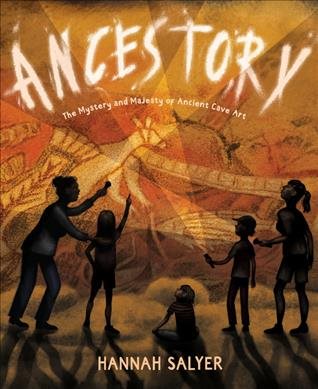
Ancestory: The Mystery and Majesty of Ancient Cave Art by Hannah Salyer

Art by our ancestors exists all over the world, and can say something to us even today. Take a visually beautiful and fascinating deep dive into not just any history, but our history, and what we can do to protect it today. It’s like I’ve been saying all along. The Pleistocene is HOT in 2023. If you’re going to write a book about art created by humans in the ancient past, it is imperative that you do so with grace and consideration for indigenous communities. Figuring out how to do that correctly, in addition to working out the best way to lay out the information in this book, is a tall order, but Salyer is more than up to the challenge. I was deeply impressed not simply by the care with which she presented this material, but for things like double gatefold spreads, typographical changes, and thoughtful art. The fact that people in the past are not depicted clearly, but as outlines and shapes is key to this book’s success. The Site Map at the end of art found around the world should be turned into a poster that people can frame. Additional points for getting into not simply visual but audible art of the past. I have never ever seen anyone account for that before. Beautifully sourced and respectfully done.  

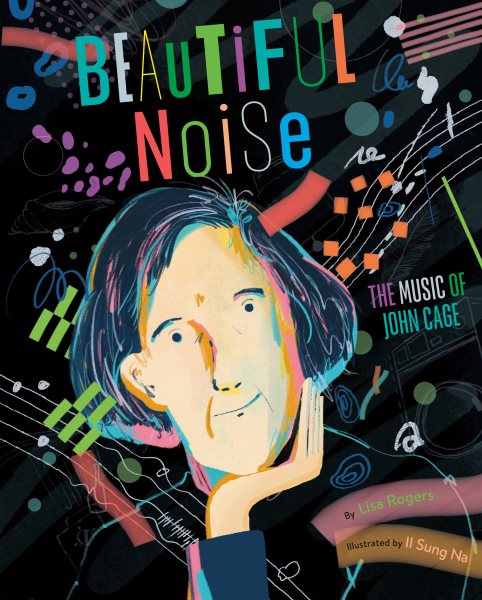
Beautiful Noise: The Music of John Cage by Lisa Rogers, ill. Il Sung Na

Boy, it sure does make a difference what illustrator is paired with a given book at a given time. I’m not saying that writer Lisa Rogers hasn’t done a stand up and cheer job here. She has! I’m just saying that if these words had been paired with so-so art, I’m not so sure the final product would be anything to write home about. Fortunately, a good editor knows when to make the call and hire a great artist. Il Sung Na was always been better known to me personally for his work on The Book of Sleep and such. I’ve never seen him try his hand at a picture book bio, and he does not disappoint. First off, let’s talk endpapers! Using shapes and colors to represent different sounds, you could have an extended conversation with a kid over whether or not “Miffed” or “Murmuring” look the way Na has depicted them here. The book itself is my favorite kind of picture book bio. Which is to say, the kind that doesn’t go the “Such n’ so was born on [blank] to [blank] and when his mother saw him she said [blank]”. Booooring! Instead, Rogers had to think long and hard about what the point of a John Cage picture book bio would have to be. Her answer? How all sound, or even lack thereof, can be music. Do you want to get a clear cut explanation about why Cage wrote a four minute and thirty-three second piece where the pianist didn’t play a single note? It’s a beautiful dual bio of Cage and of Cage’s music equally. The best book to pair this with might actually be The Noisy Paint Box by Barb Rosenstock about Kadinsky. Worth discovering.  Previously Seen On: The Biography List

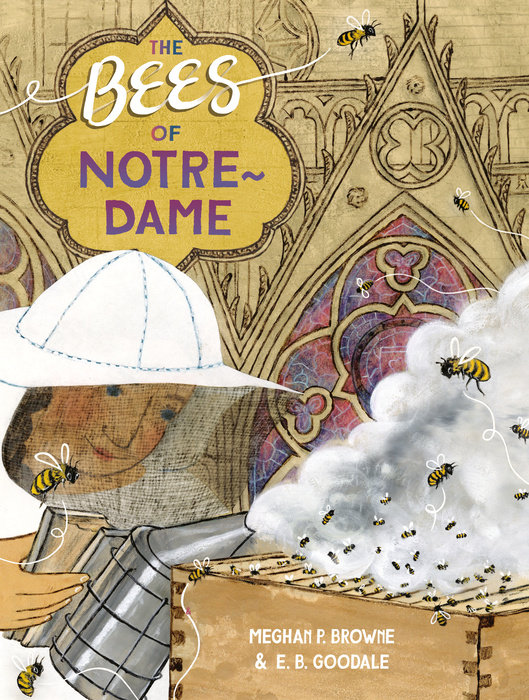
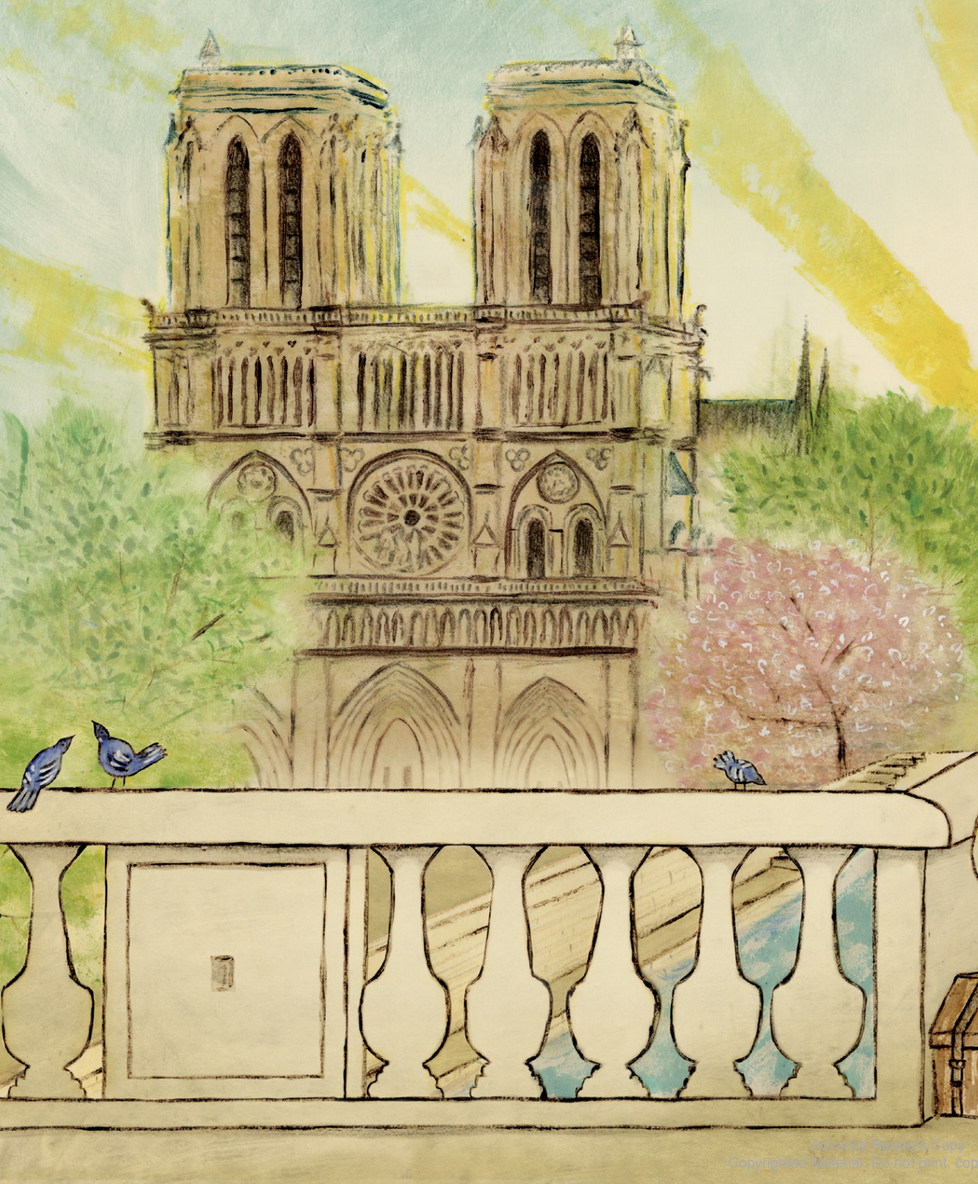
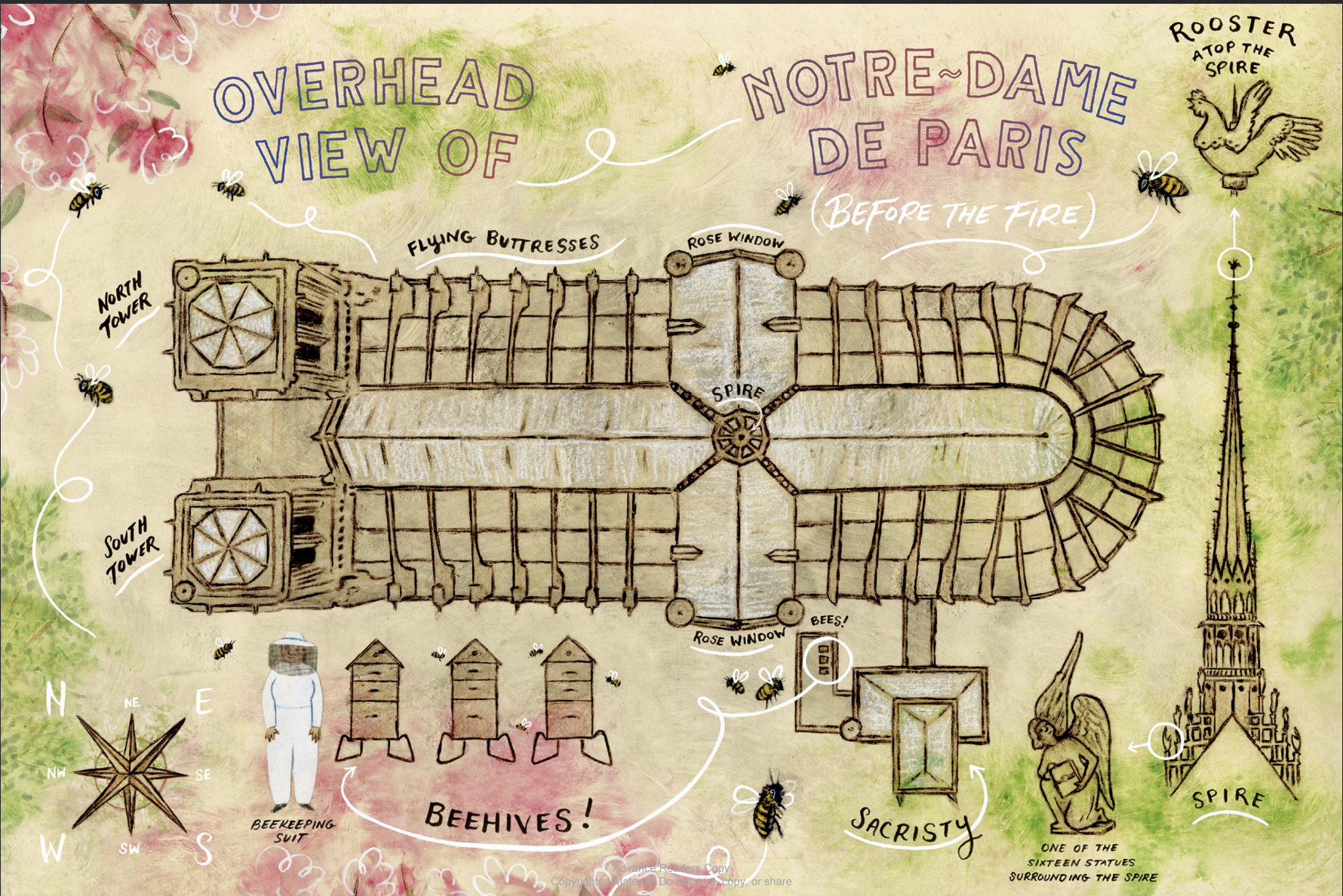
The Bees of Notre Dame by Meghan P. Browne, ill. E.B. Goodale

High above the rooftops of Paris, it isn’t Quasimodo on the roofs of Notre Dame, but beekeepers and bees! But when the fire of Notre Dame destroys so much of the cathedral, what will happen to the insects? Though it ends a little abruptly, I think this is just the loveliest look at what is, for me, the second Notre Dame fire book I’ve seen yet. I’m really enjoying how picture book artists that haven’t previously done much nonfiction are making the shift. Goodale’s art is filled with such beauty. The sudden fire really does give the reader a gut-punch. I do wish that the book itself mentioned (rather than just showed) in the text that the bees survived, but check out the front and back endpapers. I love all the little details there. I like books that have original takes on interesting topics, and the team of Browne & Goodale readily falls into that category.

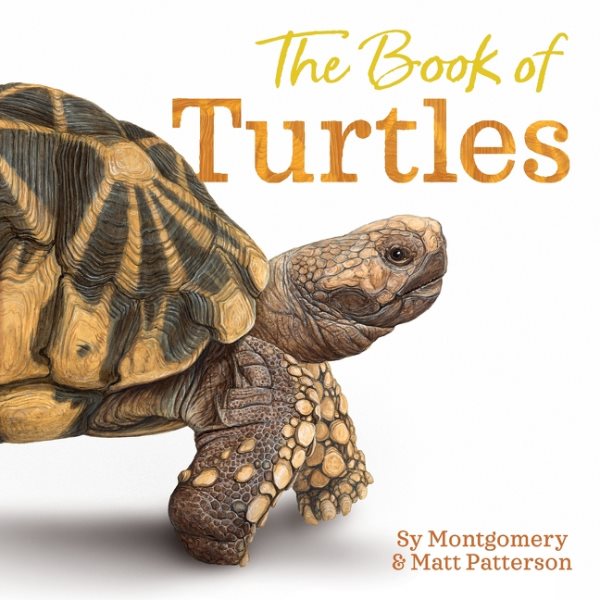
The Book of Turtles by Sy Montgomery, ill. Matt Patterson

Think you know turtles? Think again! An up-close-and-personal deep dive into a species and all its weird and wonderful qualities. Best. Turtle. Book. Ever. It’s the mark of a great author when they can take a subject that’s been done many times before for kids and reintroduce it in such a way as to make it not just interesting but fascinating. I sort of knew before reading this that a turtle was essentially fused into its shell, but Montgomery gets up close and personal with these creatures, telling you new facts next to old, but remaining consistently interesting throughout. I also knew that some turtles breathed through their butts. I just didn’t know that some peed through their mouths(!!!). Plus the art by Patterson is remarkable. Even if you aren’t a turtle lover, you’re going to be delving deep into this one. Previously Seen On: The Science and Nature List

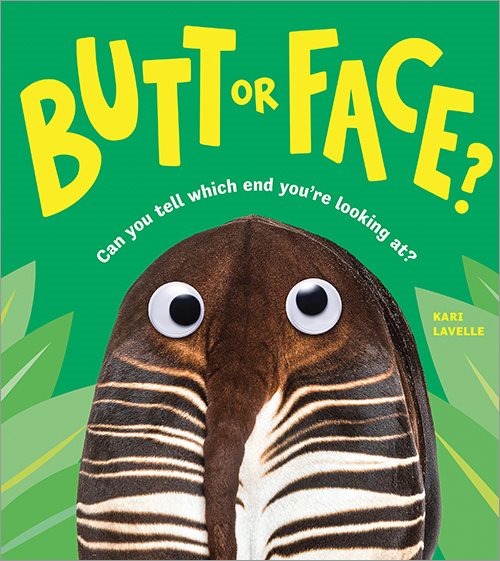
Butt or Face? by Kari Lavelle

Think you can tell a butt from a face? Test your skills against an array of insects, amphibians, birds and beasts. We bet at least one of them fools you! Normally I don’t get overly fond of titles where the entire premise is right there in the title. But as I read through this cacophony of buttocks and kissers I had to admit that Lavelle knows what she’s doing. There are an awful lot of difficult-to-distinguish butts v. faces. Admittedly she cheats a little, sometimes just showing a section of an animal’s anatomy, but by the point she starts doing it, you really don’t care. I like the design of it too and the way in which the little facts are added along the sides  for fun. Maybe not the most deep and insightful book up for consideration, but there is something to be said for fun (plus doesn’t that cover just invoke Everything Everywhere All At Once?). Previously Seen On: The Gross List

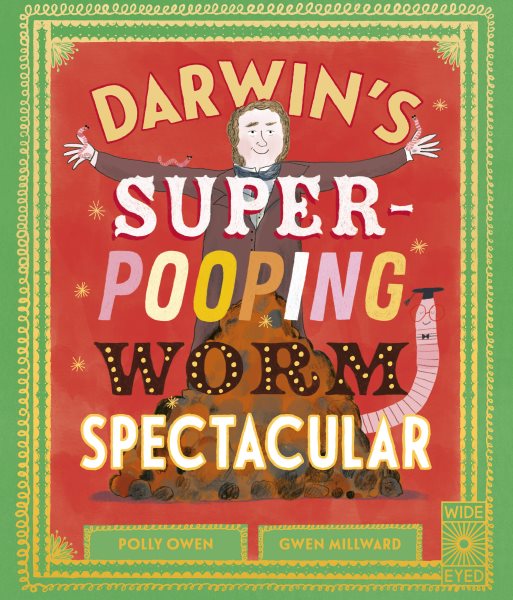
Darwin’s Super-Pooping Worm Spectacular by Polly Owen, ill. Gwen Millward


The Victorians were pretty sure that worms weren’t just gross, but utterly useless as well. It took Charles Darwin’s obsessive nature to prove that not only are worms important, but their poop is vital to nature! The most fun you can have with an invertebrate. Man. Polly Owen is toying with me. I’m this hard-nosed stickler for picture book nonfiction, right? I hate fake dialogue. I like my facts to be facts and not suppositions. All that stuff. So she goes and writes a book that is technically all-factual by skirting around the very edge of all my rules. For example, I don’t mind it when dialogue in speech bubbles is fake. Now in this book, Darwin is conducting experiments on the worms. I thought I could safely deem this book Informational Fiction when it showed him playing the piano, fife, and bassoon for the worms. But on the opposite page you actually see this little worm clarifying that, yes indeed, Darwin really did try out all those instruments with his invertebrates. The end result of this is a compelling (and oddly excrement-heavy) bit of good science wrapped in a gross-out package. Gwen Millward is also just going wacky with the art (the bassoon sequence is accompanied by what looks to be a disco floor complete with mirror ball). This is utterly ridiculous and, I’ll admit it, completely within the realm of fact. Kids will dig it (forgive me). Previously Seen On: The Gross List

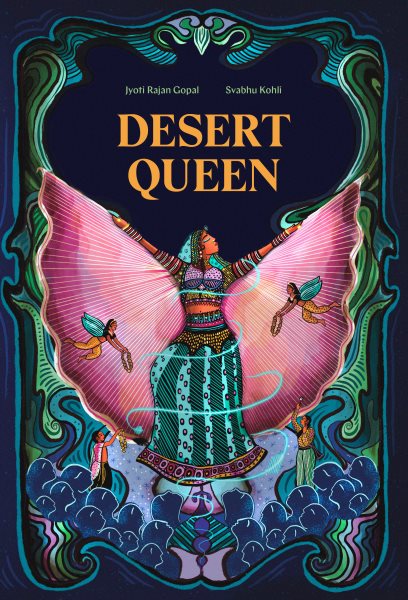
Desert Queen by Jyoti Rajan Gopal, ill. Svabhu Kohli

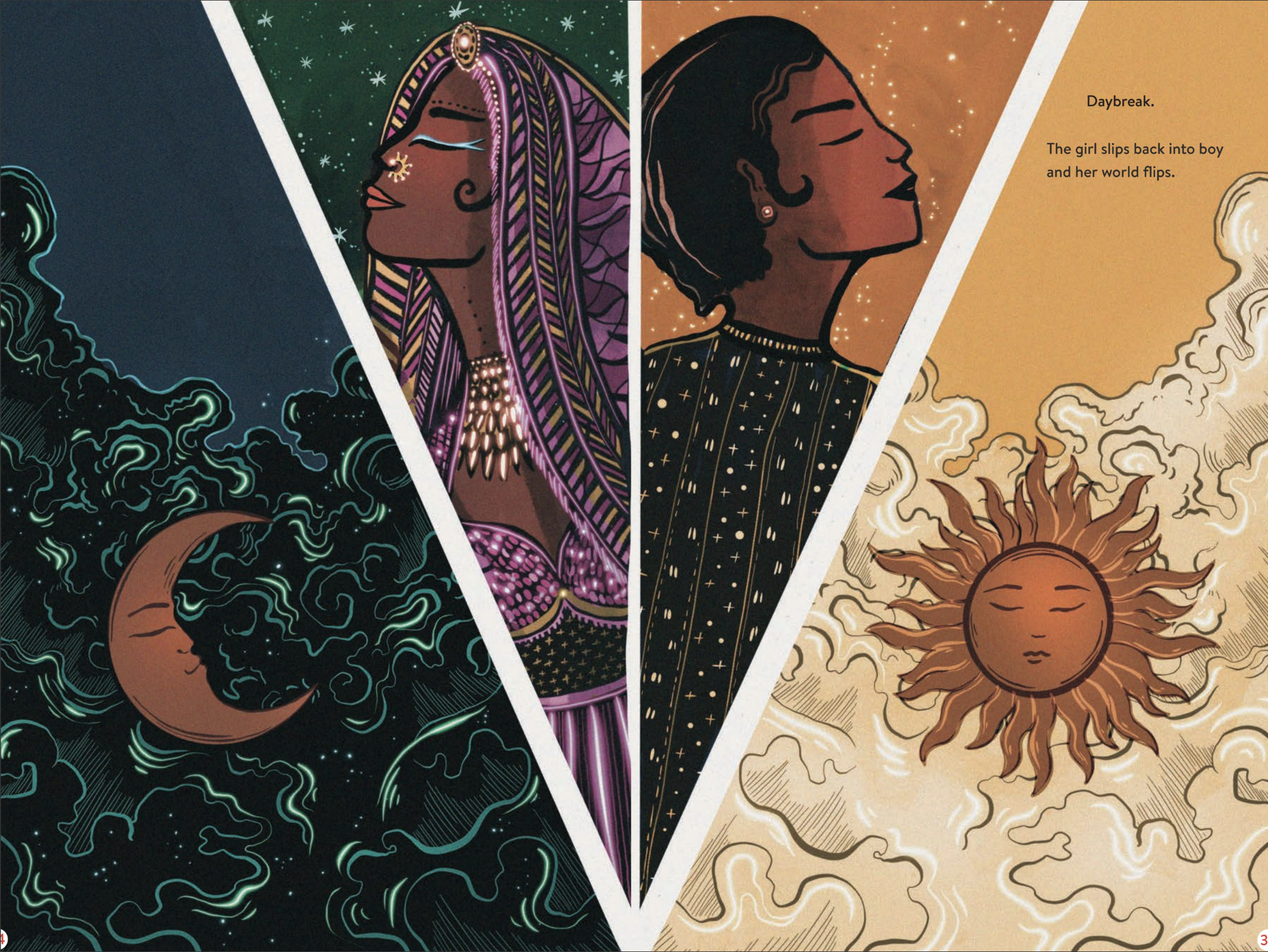
This one’s cool. It’s probably safe to say that this is the first picture book biography on Harish Kumar/Queen Harish to ever come out, and how nice that when it has it’s as beautiful as it is. It’s difficult to know where to begin to tell this story, but Gopal takes a steady hand to the story of how Kumar became the Rajasthani folk dancer and drag performer Queen Harish:

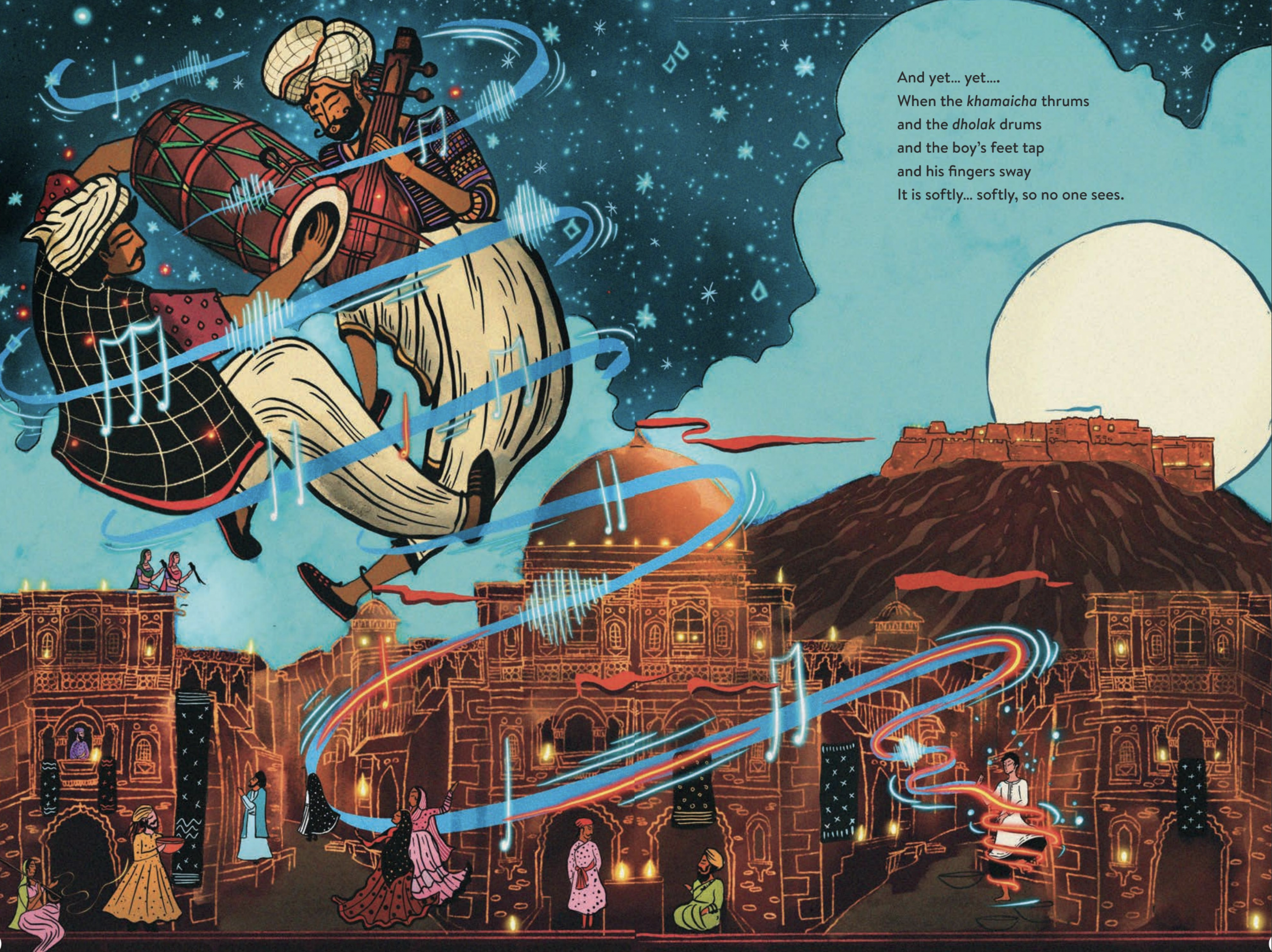
A biography has a number of different ways that it can convey the life of its subject. Here, Gopal eschews a standard this-to-this-to-this methodology, preferring instead to tap into the emotions of the subject. The text is fairly simple and, compared to some picture book bios I’ve seen this year, downright sparse. Kumar’s transformation into Queen Harish is also remarkable, thanks in large part to the art by Svabhu Kohli. When the text reads, “The boy is shiny and glittery and NEW” that just feels like the mildest description for the art on the opposite page. There, Queen Harish is emerging from a universe in the shape of a man splitting down the center, great lines of light weaving around her, and a new universe forming. And when she dances? Remarkable. Would I have liked a little more backmatter? Heck yes. Always. But there’s an author’s note there with further information on Kumar, so at least we’re not left hanging entirely. The most beautiful drag picture book bio I’ve ever had the chance to see.

And yes. When I read this title I do get “Dancing Queen” stuck in my head. *sigh* Previously Seen On: The Biography List

Dogs: A History of Our Best Friends by Lita Judge

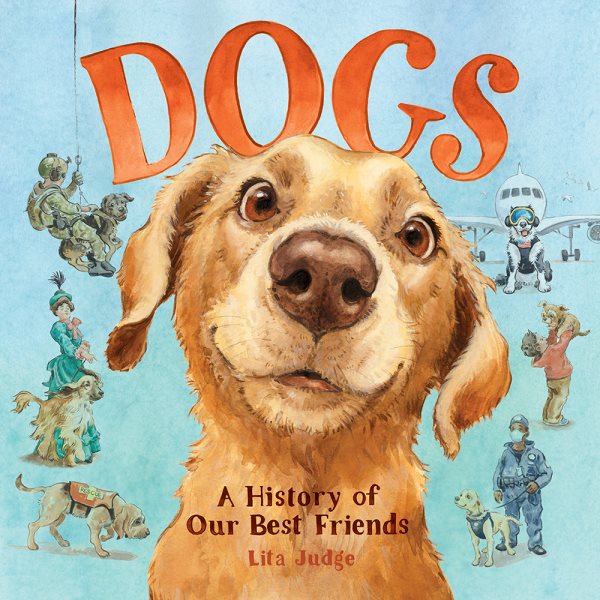
Take a trip back in time to 50,000 years ago and follow the path of humanity’s best friend. From cleaning infectious wounds to clearing birds off of runways, this fact-filled readaloud is a perfect paean to one of our favorite animals. I’ll just throw in the usual caveats. If you know me then you know that I’m completely dog book neutral. Don’t love ‘em. Don’t hate ‘em. Just sorta take ‘em on a case-by-case basis. And this particular case? Probably Lita Judge’s strongest book in years and years. She’s outdone herself here. Like a weirdly large amount of books this year it begins, you guessed it, in the Pleistocene and then goes from there. But the way in which the information is laid out (with longer sections for older dog lovers and shorter sections for reading aloud) is impressive. Plus, I always love it when I learn something from a book. This one taught me that a dog is the only animal that will follow a human’s gaze. Who knew? Previously Seen On: The Science and Nature List

Emperor of the Ice: How a Changing Climate Affects a Penguin Colony by Nicola Davies, ill. Catherine Rayner

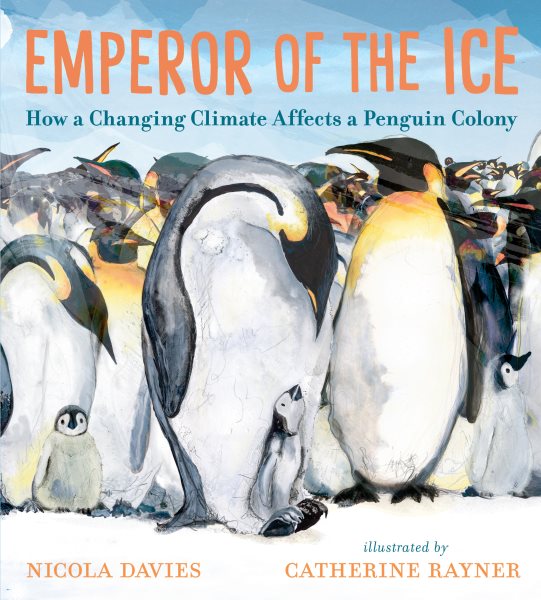
Dang. This is a pretty book. A pretty book and a bit of a departure for Kate Greenaway Medalist Catherine Rayner too. I don’t know that I’ve ever seen her tackle nonfiction before but she does a heckuva gorgeous job rendering the Arctic environment in all its harsh beauty. Now, I know you’ve seen penguin books before. Quite frankly, you may feel a little penguined out. Folks, I’m here to tell you that you have room in that cranium for at least one more penguin book and that penguin book is THIS penguin book. Do you remember how Candace Fleming made us care about bees in a way we’d never cared before in her book Honeybee? This is the Honeybee of penguins. Davies does a brilliant job of putting emotion into the book without cheating or overdoing it. Meantime, Rayner’s watercolors are sumptuous. There’s a particular shot I’m thinking of where you see the line of penguins silhouetted against a blood red sky, and it took all my willpower not to rip out of the book and frame on my wall. A stunner (and there’s even some backmatter to boot!).  Previously Seen On: The Science and Nature List

The Fire of Stars: The Life and Brilliance of the Woman Who Discovered What Stars Are Made Of by Kirsten W. Larson, ill. Katherine Roy

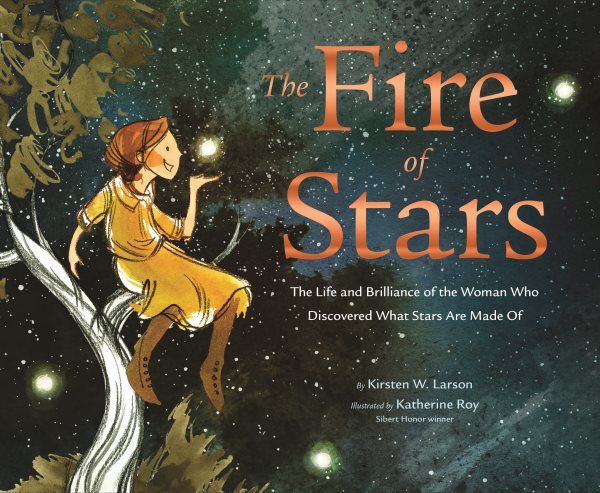
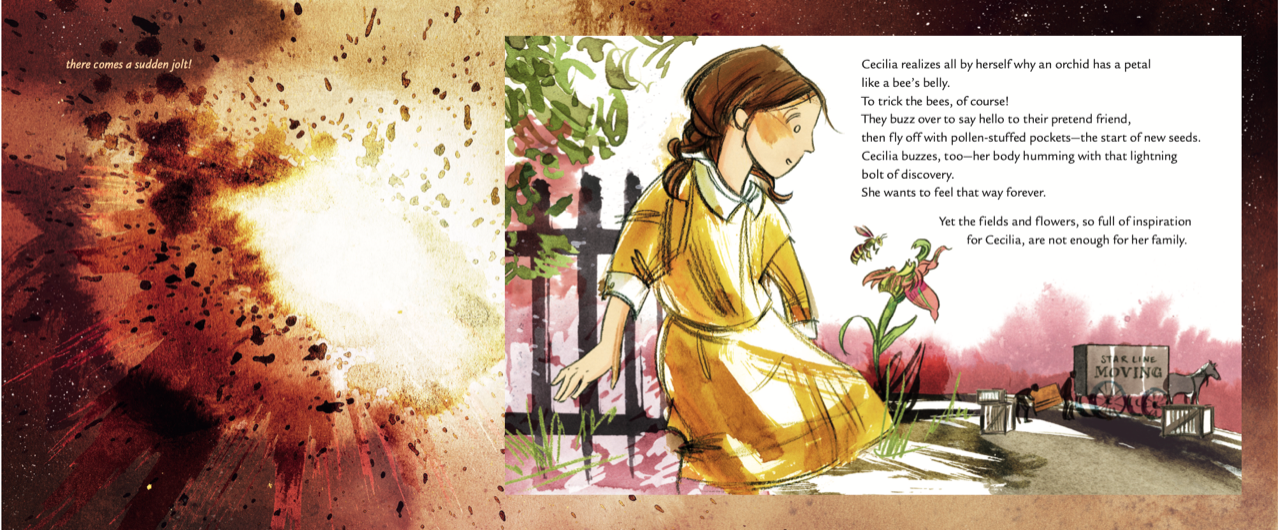
What burns at the heart of a star? The story of Cecilia Payne, ground-breaking scientist, is brought to life in this scintillating picture biography riddled with the mysteries of the universe. In spite of the fact that the subtitle of this book ends with a preposition and completely fails to name its biographical subject on the cover (the longer I look at it, the weirder it gets) this is a stand up and cheer example of how you can take a biographical subject and eschew the rote categorization of their life when you write a book about them. While most picture bios of female astronomers do a dull play-by-play of their life. Larson shakes things up by pairing Cecilia Payne’s discoveries alongside the birth of a star. She has Katherine Roy, science illustrator extraordinaire, there to help her. If you want to have some fun, play attention to how the star information slowly consumes everything behind Cecilia’s biographical history. Also look at how Roy plays with the color yellow in Cecilia’s clothing. No fake dialogue, a surprising story, and great backmatter. Better, by far, than a good chunk of what’s already out there.  Previously Seen On: The Biography List

Fungi Grow by Maria Gianferrari, ill. Diana Sudyka

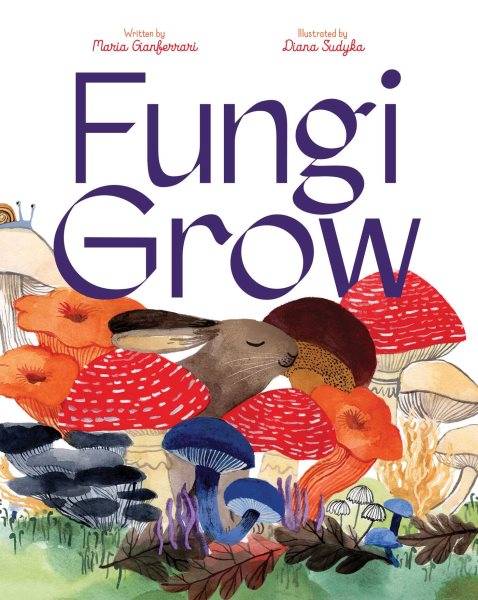
Delve deep into the mysterious world of fungi and all their amazing applications. Their gripping story is paired with the sumptuous, jewel-like watercolors of Evanston artist Diana Sudyka! We’ve seen so many books that talk about tree communication from the trees’ p.o.v. but so few from that of the fungi. This feels like a natural companion to Elise Gravel’s The Mushroom Fan Club, albeit with the beautiful watercolors of Ms. Sudyka. It took me a little while to get into this one since I felt that a lot of the early simple text leans a little too heavily on the more complex small older text portions, but as it continued I thought it really picked up. I was also swayed by all the amazing sections on fungi that can devour plastics and oil. This is a very cool book. Previously Seen On: The Science and Nature List

The Gentle Genius of Trees by Philip Bunting

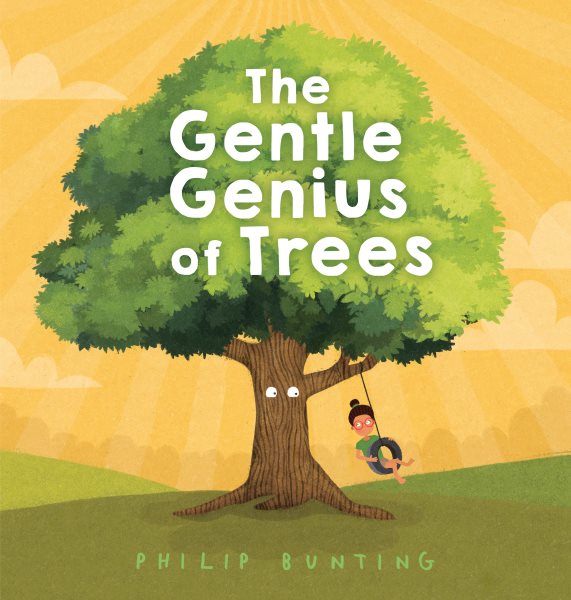
Trees give us so much here on earth but how much do we know about them? Take an irreverent trip into their communication, likes, dislikes, and more. Not the only Phil Bunting book on today’s list, by the way! So I know I was all gaga about a lovely tree-talking book last year (Listen to the Language of the Trees by Tera Kelley, illustrated by Marie Hermansson). Well, that was close to what I was hoping for in a book, but this sort of clinches it. It really makes tree communication a lot more visually clear and clean. Plus the humor just makes it entirely my bag (a tree overreacting to the message that its leaves might be eaten by screaming, “I’m too beautiful to die!”). I sort of adore this. Previously Seen On: Science and Nature Books

Glitter Everywhere! Where It Came From, Where It’s Found, and Where It’s Going by Chris Barton, ill. Chaaya Prabhat

Do you love glitter? Hate it? Then this book is for you! Find out its history, its science, its importance, and what we can do to be more responsible with it so it won’t hurt the environment. If I had the power, I would possibly declare Chris Barton, right here and now, to be the official arbitrator on what does or does not make a conscientious nonfiction picture book. I’ve railed in the past against nonfiction books for kids that skimp on the research, to say nothing of showing their work, but finding examples of the BEST kinds of nonfiction books can be hard. This, however, may fit the bill. In this book Chris doesn’t just give you a rundown of the history of glitter and its problems today, but lets kids in on his research as he goes. When he calls someone by their first names vs. their full names, you find out why. If he can’t find enough evidence to back up a claim, he makes a note of it. He works in science and environmentalism, history and how it relates to Drag performers, and even a bit of math as well. There’s even a note on the front bookflap that reads, “Spoiler alert! Traditional glitter is bad for the planet. That’s why the jacket of this book uses a glitter lookalike.” I’m just blown away. A seemingly silly subject yields one of the best books of the year. Previously Seen On: The Science and Nature List

The Green Piano: How Little Me Found Music by Roberta Flack with Tonya Bolden, ill. Hayden Goodman

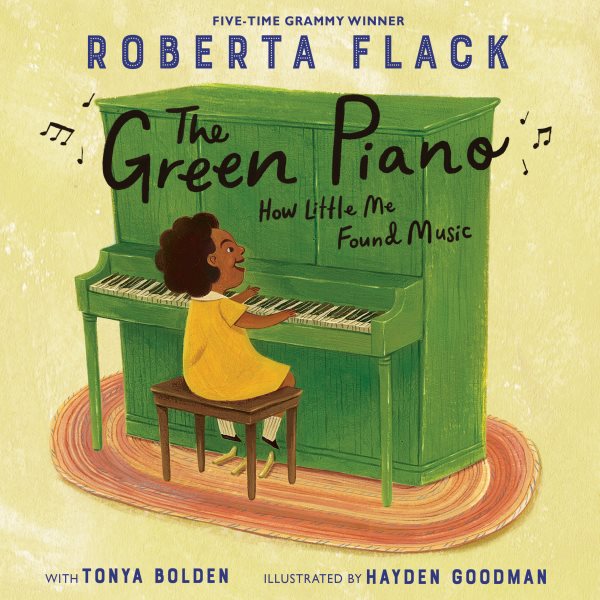
A five-time Grammy Award winner tells the story of how she came to love music and how her family got its very first piano. Loads of personality and fun infuse this delightful tale. Oh, I liked this! I was really worried at the start because initially I missed the fact that Ms. Flack was the actual author of the book. As a result I started getting really huffy about the fact that it was written in the first person. Shows what I know. Here, Roberta’s voice comes through with so much zip and pizzaz and pop! Plus the nerd in me just got really excited watching her dad fix up that old piano. A picture book bio that actually feels like kids would enjoy reading it. Fun!  Previously Seen On: The Biography List

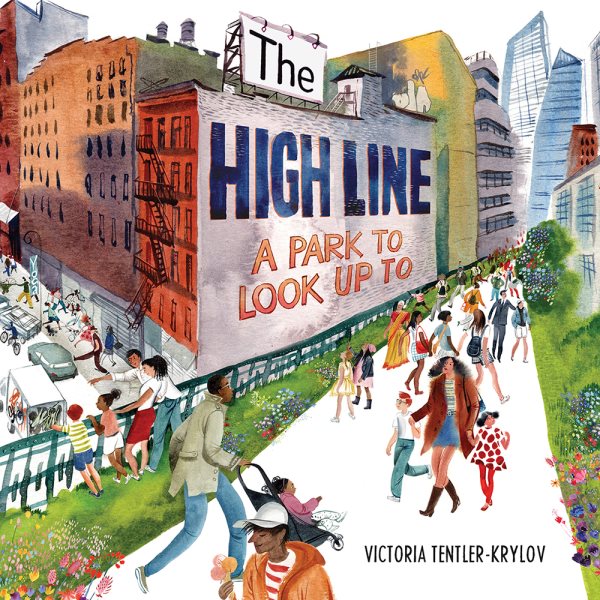
The High Line: A Park to Look Up to by Victoria Tentler-Krylov

A park in a sky! Sounds crazy, no? But the High Line in NYC is precisely that. See how it came to be, what it’s inspired, and what its future may hold. I may have to recuse myself when it comes to this book since I lived in New York during the early days of the High Line park, and remember many of the details from the time. This isn’t, I believe, the first High Line picture book title we’ve seen, but it is undoubtedly the best. It does its history, sure, but then it goes on beyond that. It discusses other urban park projects inspired by the High Line’s success. And critically, it talks about the problems with the High Line and how it has adversely affected some of the people living alongside its route, which isn’t something you’d see in a lot books of this sort. The watercolors are, for the record, enticing, accurate, and very beautiful. Love the maps, love the backmatter, the Time Line, and really the whole production. You can sometimes tell when a book is a labor of love. This one clearly was. Previously Seen On: The Science and Nature List

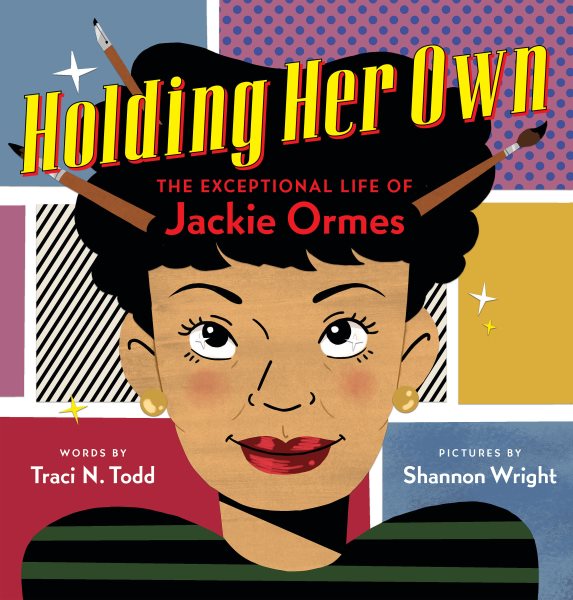
Holding Her Own: The Exceptional Life of Jackie Ormes by Traci N. Todd, ill. Shannon Wright

The life of reporter, cartoonist, dollmaker, artist Jackie Ormes is brought to rip-roaring life in this fun and fantastic biography. Learn as much as you can about the first Black woman to become a nationally syndicated cartoonist! This is a unicorn! A picture book biography about a funny Black woman who broke into the comic strip business. My husband’s a real comics history guy so when I asked him about Jackie Ormes he knew who she was but was unaware of how much she did. Sure, he’d heard about her Torchy series but not her Patty-Jo. The book’s written with a lot of humor and then Traci N. Todd (possibly best known to us for illustrating Varian Johnson’s graphic novel Twins) just goes above and beyond the call of duty to make the art as interesting as possible. My favorite two-page spread is the Family Circus-esque look at her travels as a reporter. This is top notch, original, and worthy of its subject. No small feat. Previously Seen On: The Biography List

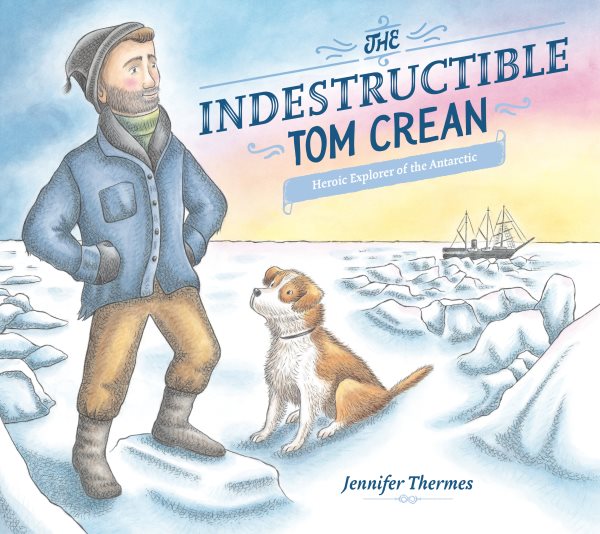
The Indestructible Tom Crean: Heroic Explorer of the Antarctic by Jennifer Thermes

Sail with explorer Tom Crean on the ships Discovery, Terra Nova, and Endurance and watch as the man not only manages to stay alive but also saves the lives of his fellow crewmen time and time again. A gripping, wonderful look at a heroic man. First up, I’d like to mention how much nicer it is to read books about Antarctic exploration than Arctic exploration, since at least on Antarctica they didn’t have any native populations to exploit. This is a gutsy, gripping story of a regular guy who just happened to have exactly what was needed to survive over and over and over in impossible situations. It’s nutty to think how he just kept on going back to that frozen wasteland. It doesn’t shy away from the less pleasant stuff (like the fate of his dogs on one of the trips) and reading about that last trip to try and save Shackleton’s crew had me on the edge of my seat. Thermes did a book about Manhattan a year or two ago that I liked (Manhattan: Mapping the Story of an Island) but honestly, I like this one far more. You’ve gotta see it for yourself.  Previously Seen On: The Biography List

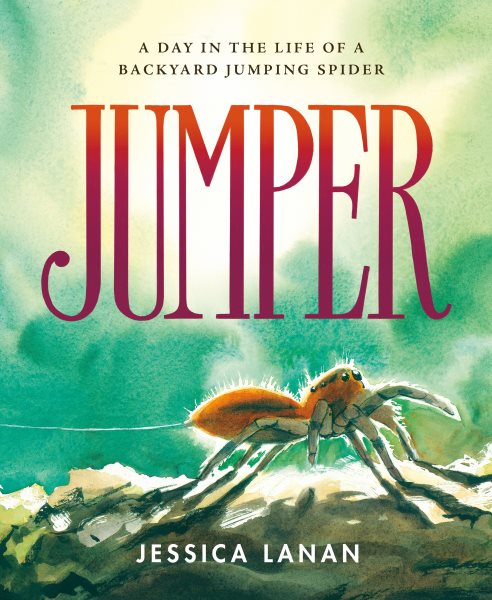
Jumper: A Day in the Life of a Backyard Jumping Spider by Jessica Lanan

What’s it like to be a spider in the grass? Enter the world of a jumping spider and experience the danger and excitement happening just under your nose. Does anyone remember the picture book The Lost Package that came out a year or two ago? I was just so taken with Jessica Lanan’s watercolors there. Of course, she’d been doing nonfiction for a while anyway (Just Right: Searching for the Goldilocks Planet was great too) but I truly feel that Jumper is a standout in the field. First up, some spider identification backmatter, to say nothing of the Glossary and Resources and general info on spiders themselves. I love how she’s laid out the story so that you get that spider’s eye view through the lens of how it moves, feels, jumps, hears (I always wondered how they heard without ears), and (most gloriously of all) sees. There’s a pull-out double fold spread in this puppy that will blow you away. If I had my way, this would be a Caldecott winner. Fantastic. And you haven’t see what a book looks like under its cover until you’ve seen this Tiktok video by Ms. Lanan. Previously Seen On: The Science and Nature List

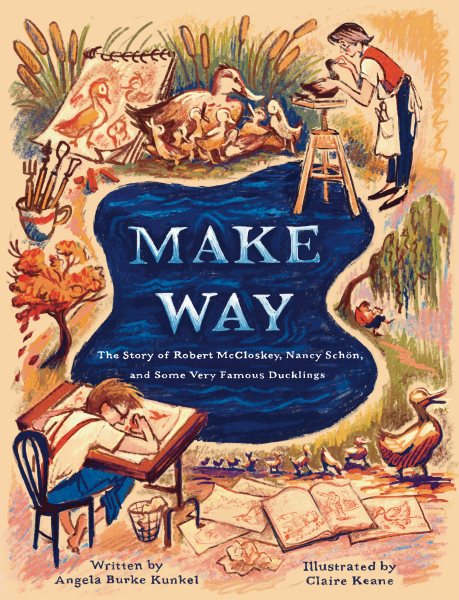
Make Way: The Story of Robert McCloskey, Nancy Schön, and Some Very Famous Ducklings by Angela Burke Kunkel, ill. Claire Keane

One man created a story of ducks that became a picture book classic. One woman created sculptures from the book that became beloved Boston icons. But how the two came to be? That’s the story you haven’t heard. Color me impressed. Last year we saw a picture book bio of McCloskey and his creation of Make Way for Ducklings and it was just that. A kind of cute story behind a story. Angela Burke Kunkel takes a different and (quite frankly) smarter approach. She pairs McCloskey alongside artist Nancy Schön and then the two of them come together in an honestly tense scene near the end. Claire Keane’s always had such a great style to her art, but this is the first time I’ve seen the text match her illustrations. I loved her waterlogged McCloskey and the vibrancy she gives these characters. No fake dialogue. Lots of good backmatter. And best of all it’s a picture book dual biography that I honestly think a kid would want to hear again and again. That’s rare! Previously Seen On: The Biography List

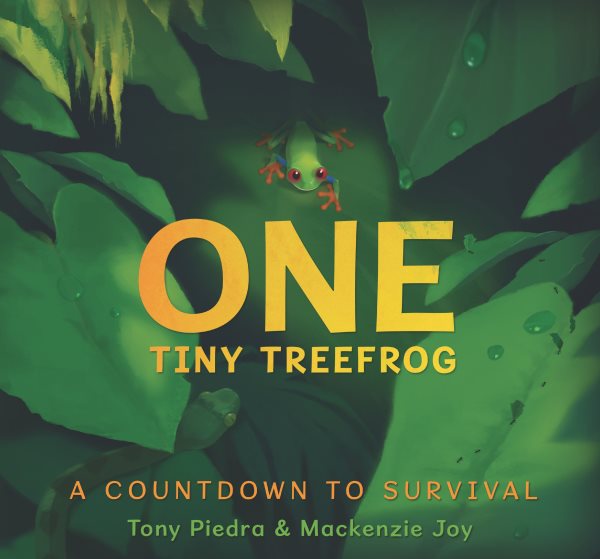
One Tiny Treefrog: A Countdown to Survival by Tony Piedra, ill. Mackenzie Joy

“Ten tiny tadpoles grow in their eggs.” Count down as each tadpole falls prey to hungry nature in this eye-opening look at not just treefrogs but survival of the fittest as well. Nature red in tooth and claw, indeed. This book effectively combines two of my favorite things: picture books in which the protagonist gets eaten and nonfiction titles that show nature being nature. And while I wouldn’t want to necessarily read a book that discusses how mama hamsters sometimes eat their own young, this book about a rapidly diminishing number of baby treefrog tadpoles explains quite efficiently why it is that a great number of animals in the world create as many babies as possible. You really don’t actually see any of these froglets die (though there is one moment that comes close) and I love the surprise ending. I wouldn’t give it to one of the more tenderhearted children out there, but I love the backmatter, and animals included, and the way in which it chooses to convey its material. Previously Seen On: The Science and Nature List

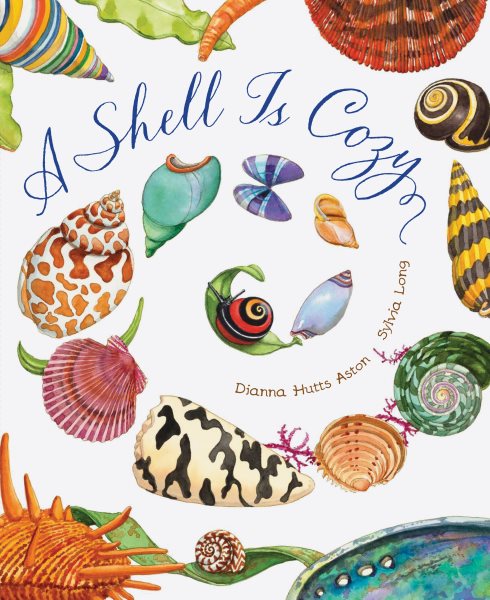
A Shell Is Cozy by Dianna Hutts Aston, ill. Sylvia Long

You know, if a format works, it makes a lot of sense to stick with it. I remember way back in 2006 when An Egg Is Quiet by this duo first came out. It was just the nicest little look at. The white background allowed Sylvia Long’s delicate watercolor illustrations the chance to really show all kinds of seeds waking up, doing their thing. Aston & Long followed it up with A Seed Is Sleepy (200&7), A Butterfly Is Patient (2011), A Rock Is Lively (2012), A Nest Is Noisy (2015) and A Beetle is Shy back in 2016 and that, pretty much, was the end of that. Now after a number of years they’ve returned with a look at shells. And doggone it if it isn’t just as good as everything else. Better even, maybe. There are cool interior looks at what the inside of a mollusk’s shell looks like. There are deep vibrant colors and unusual details (love the candy cane snails in the trees). I’d just listened to a podcast about the terrifying poisonous snails, like the marveled cone, that may hold the keys to multiple cures to human diseases, so this fit in well. Long gone are the days when the pages were pure white. Long is having a lot of fun with beautiful sunrises and sunsets, blue seas, and pink skies. I particularly adored the rendition of Watts Towers in L.A. as shown here. It may be part of a series, but this is a true standalone winner. Previously Seen On: The Science and Nature List

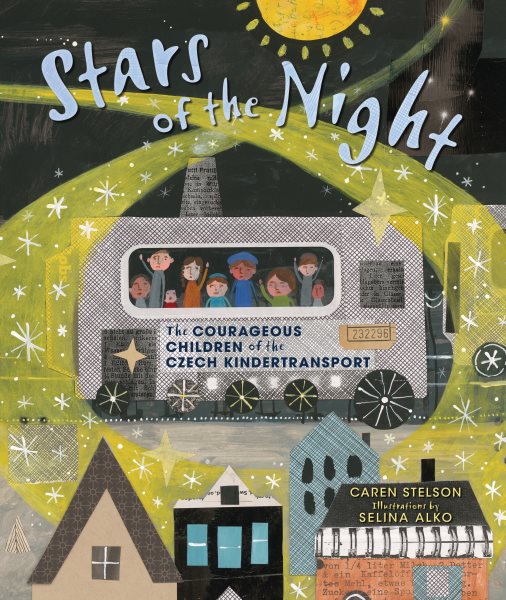
Stars of the Night: The Courageous Children of the Czech Kindertransport by Caren Stelson, ill. Selina Alko

When 669 young Jewish people were saved during WWII by a trip from Prague to Britain, they never knew the man behind their rescue. The remarkable story of how they found him fifty years later. Pretty sure I’ve seen a picture book on Nicholas Winston before, but this one does a good strong job with the subject matter, and in an innovative way worth discussing. Stelson has decided to tell the story of the 669 children saved via the Czech Kindertransport from their point of view in a single voice. It’s a bit of a liberty, but I might argue that it’s not overused in any way. In fact, it really puts you in the shoes of these kids quite effectively. Sometimes nonfiction titles struggle to make their stories pertinent to kids. This one doesn’t suffer that problem, and it’s got some good strong backmatter at the end. I particularly enjoyed hearing about why the author and illustrator took on the project.

Stranded! A Mostly True Story from Iceland by Ævar Þór Benediktsson, ill. Anne Wilson

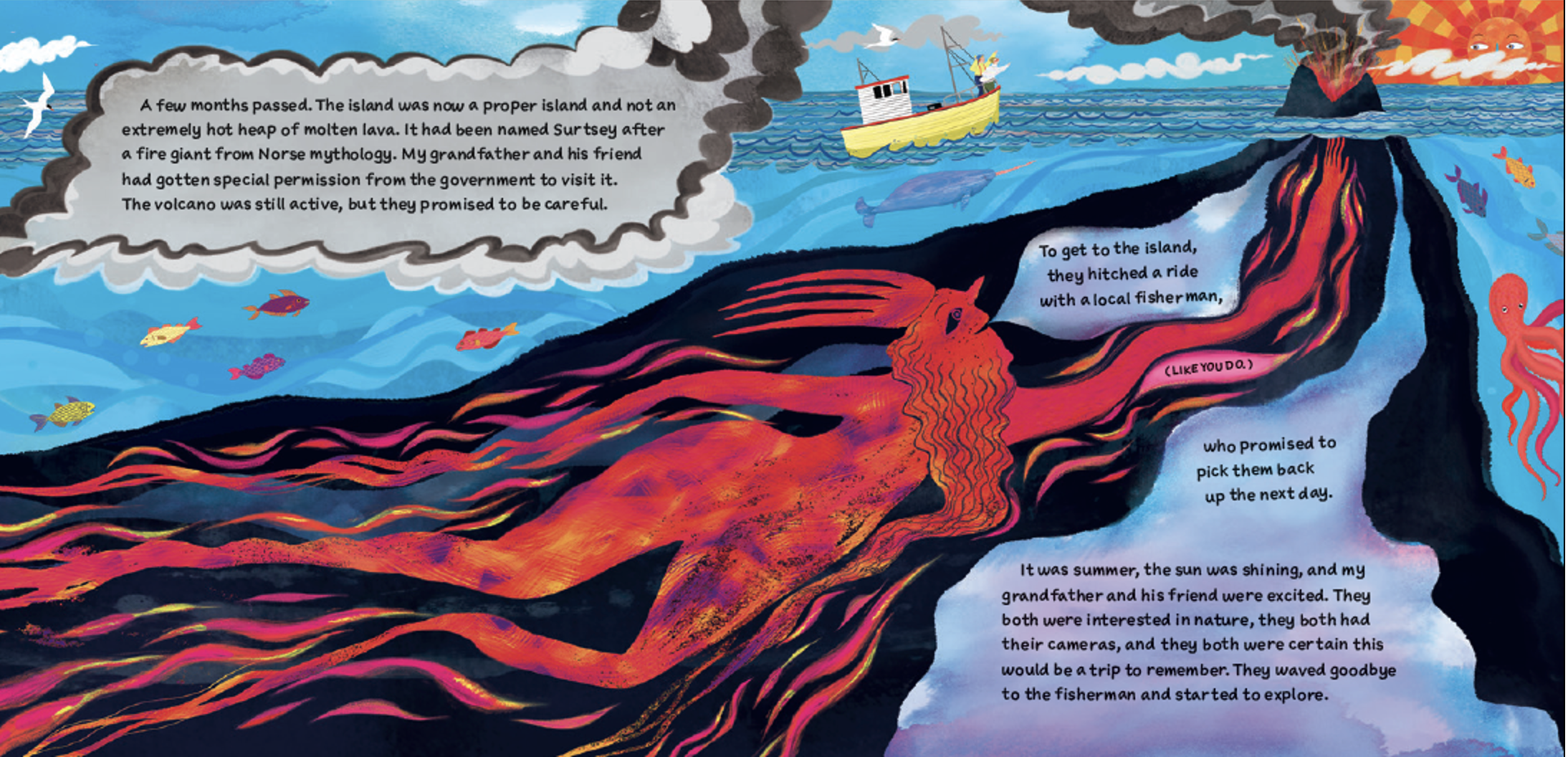
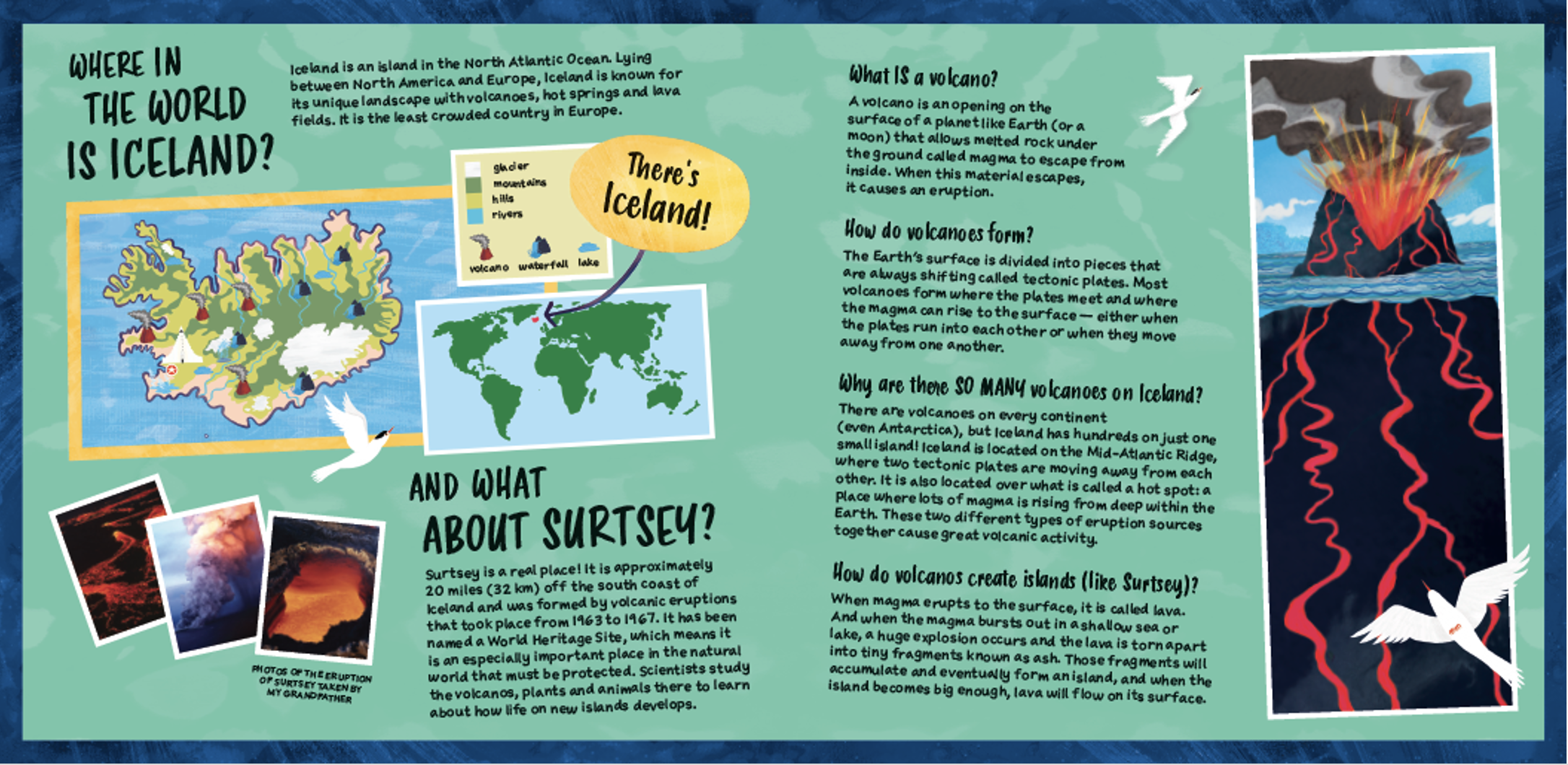
Almost all the facts in this book are true. Can you find the single lie? When the author’s grandfather got stranded on an active volcanic island with this friend their survival was NOT guaranteed. An unexpectedly hilarious and harrowing tale. Kooky little bit of writing, but I think it’s that kookiness that makes it work. First and foremost, this is really very funny. I think that there’s a lot to be said for authors writing stories about their grandparents’ stupid stupid decisions. About the point the glasses have melted, you are ON BOARD with this book. And the fact that you just happen to learn a lot about volcanoes and Iceland (and I’m grateful for now always knowing how to pronounce “Ævar”) is just the icing on the cake. A delightful read! Previously Seen On: The Science and Nature List

There Was a Party for Langston, King of Letters by Jason Reynolds, ill. Jerome Pumphrey & Jarrett Pumphrey

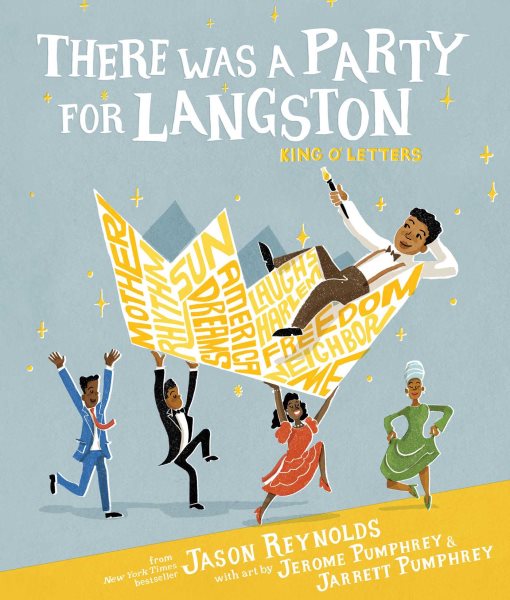
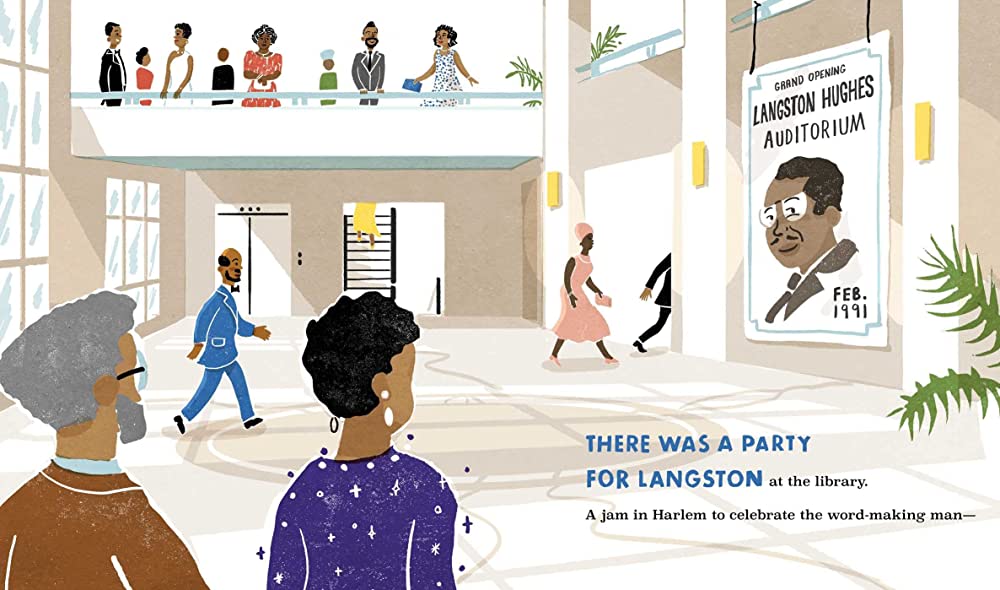
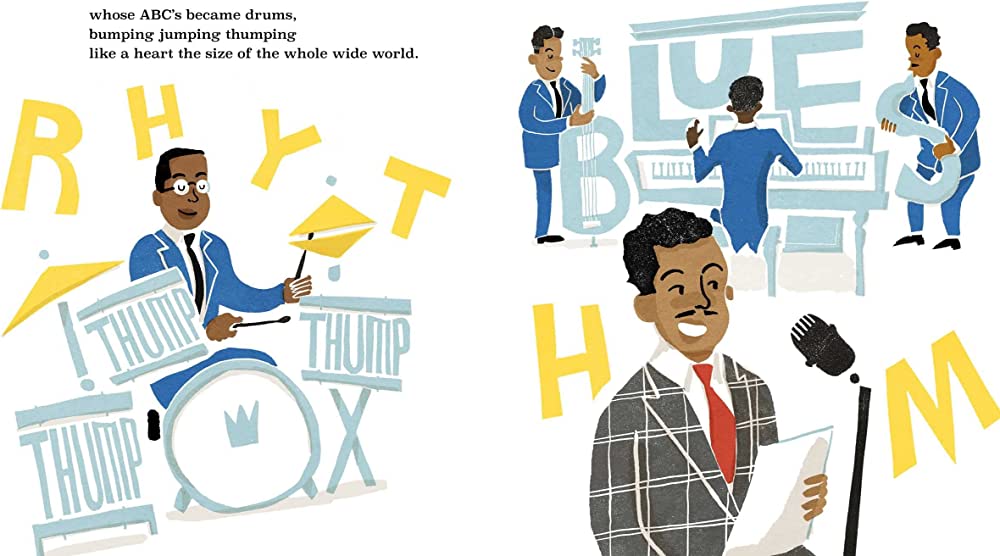
“There was a party for Langston at the library” Langston Hughes, that is. A marvelous recounting of one man’s legacy and a vibrant visual praise of Black American writers. This text sings. Oh, happy day! I like this book by the Pumphreys! I like this book by the Pumphreys so much that I honestly think that this book has some serious Caldecott contender cache surrounding it. Woohoo! This is a marvelous example of how a good writer (and they don’t get much better than Jason Reynolds) can do a bit of nonfiction without faking anything AND making it a fun read for kids! Gone are the rote bios that dully recount a person’s life without viv or flair. And the typography! I hope someone interviews the Pumphreys and Jason together so that we can hear about how this collaboration actually occurred. How much influence did he have over their art? Was it their idea to turn the first names of Maya Angelou and Amiri Baraka (I’m assuming that’s the Amiri Jason means) into their bodies? Bonus: 500 extra points to Jason Reynolds for the line, “rickety radio heart”. Previously Seen On: The American History List

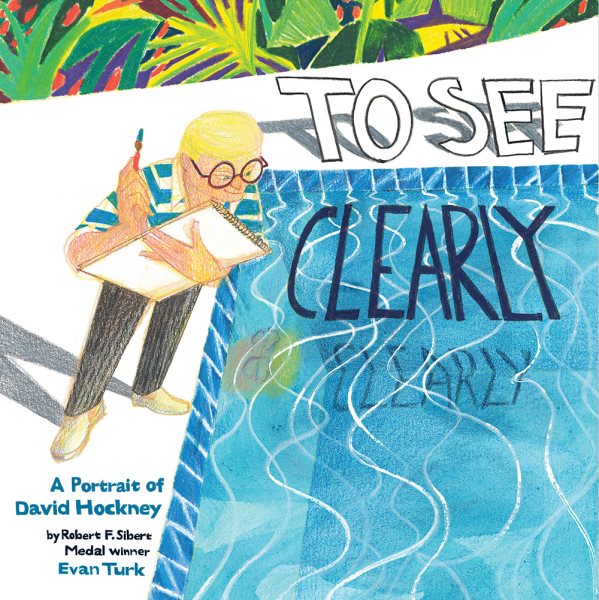
To See Clearly: A Portrait of David Hockney by Evan Turk

We’re doing the whole artist telling the story of an artist thing again, but I don’t think I would have predicted Turk doing Hockney on my own. After all, they’ve rather different styles when you think about it. Turk has illustrated bios of different artists before, but the last time he did one on Ben Shahn he wasn’t the author. Turns out, the man is quite good at synthesizing a life into a picture book format. Turk isn’t trying to replicate Hockney’s style with this book (a technique that has served some biographer illustrators well but that isn’t a strict requirement). Instead he pulls out his customary colored pencils, gouache, and crayons and goes to town on the whole enterprise. One cannot help but wonder if Hockney will ever see the book himself and, if so, what he’ll think of it. But you know what? Who cares! It’s a dang good biography, making his life not merely pertinent to young readers but interesting as well. Extra points for not eliding over his life as a gay man but for leaning into it as an essential part of his being. Great, grand, and beautiful. Previously Seen On: The Biography List

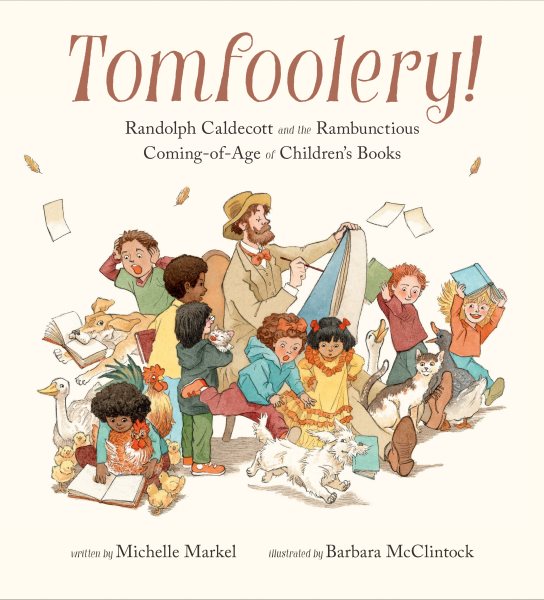
Tomfoolery! Randolph Caldecott and the Rambunctious Coming-of-Age of Children’s Books by Michelle Markel, ill. Barbara McClintock

 Meet Randolph Caldecott! The children’s book illustrator unafraid to put fun, action, and loads of animals on the page. A marvelous look at the artist our picture books owe so much to today. Both Markel and McClintock are having a lot of fun with this subject. What they both do so well is stress this change from the solid, staid, stultifying children’s books that preceded Caldecott and what he brought to the form. It never cheats, and yet still manages to have so much fun. Extra points to McClintock for including actual shots of early dull titles (“In Adam’s fall / We Sinned all” and all that). I don’t know that I’ve ever seen her integrate mixed media like this into her art, but she’s a natural. I’m always so happy when she does nonfiction. She’s like a breath of fresh air to the page. And be sure to check out the two-page spread where she’s included a lot of contemporary Caldecott winners (I needed help with the two on the far left, but I know them now). An amazing ode that actually ends up being a really good book of its own. Not easy! Previously Seen On: The Biography List

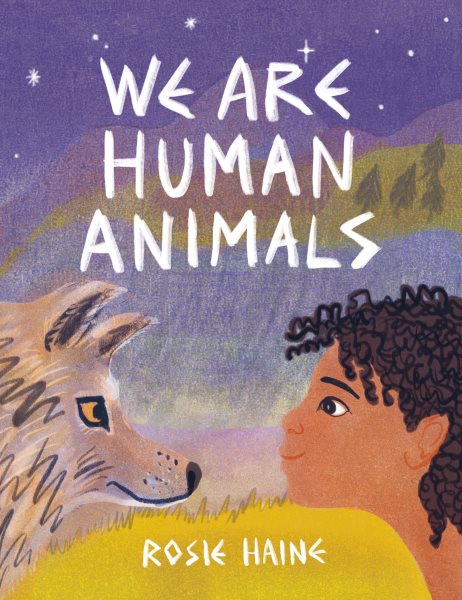
We Are Human Animals by Rosie Haine

What were the early human animals like? What was their world? A beautiful look at what we have in common with our ancestors, where we differ, and how we are all, still, animals. When I was a kid I remember watching this brief section of Sesame Street that was going through different animals. At the end, it shows a group of people at a picnic or something and declares that we are “human animals”. This shocked my tiny little mind. Until that moment, I was fairly certain that humans were something above animals. Not many books really explore this idea, so I was intrigued by this title alone. Inside it’s a particularly nice simplified encapsulation of early humanity. The text is so sparse and spare and good. Then you get to the incredible backmatter, which is lovely but this isn’t one of those cases where the stuff in the back eclipses the quality of the stuff in the front. I adore how much research Rosie Haine has done here. This is just really cool.

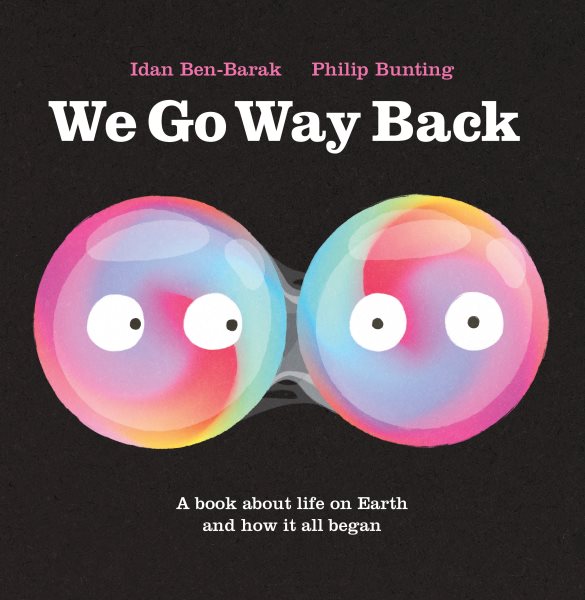
We Go Way Back by Idan Ben-Barak, ill. Philip Bunting

What is life? Where did you get yours from? And how did it all start? A funny but accurate look at the beginnings of life, from atoms and elements to the creatures we have today. You know how sometimes rock stars form supergroups together? I feel like picture book authors and illustrators sometimes do the same thing. This book’s a good example of that. You have Idan Ben-Barak, who was one of the authors of Do Not Lick This Book and then you have Philip Bunting who’s behind the aforementioned The Gentle Genius of Trees, together for a story about how life began. And believe me, I’ve read a lot of books on the subject, but this is the first I’ve seen to show the elements forming the molecules and the molecules forming the bubbles that became cells. I love how visual this is! Bunting should get extra credit for that family tree fold-out section. Examine it for a while, if you can. He had to make a lot of distinct choices there. And, as is right, I love the googly eyes on everything. Everything is better with googly eyes. Previously Seen On: The Science and Nature List

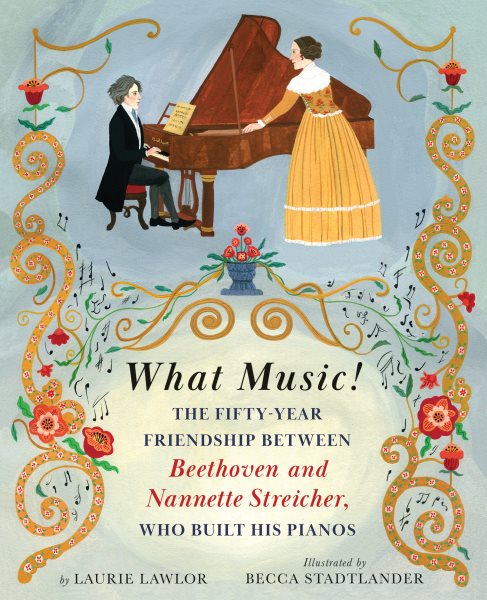
What Music! The Fifty-Year Friendship Between Beethoven and Nannette Streicher, Who Built His Pianos by Laurie Lawlor, ill. Becca Stadtlander

Who the heck says women and men can’t be friends? Now that title, I’ll be the first to admit, is a bit of a mouthful, but ultimately I think Holiday House made the right choice with it. After all, what it does is establish that Nannette Streicher was, almost impossibly, a business woman at a time when that wasn’t really a thing. And let me tell you, after reading countless books about women like Mozart’s sister, who were brilliant but ultimately thwarted, there’s something so deeply satisfying about learning Nannette’s story. Evanston-based author Lawlor herself had to do a slew of original research to get to the gist of this story. As she explains it, “I was inspired to investigate the friendship between Ludwig and Nannette when I discovered more than 60 letters and notes penned between 1817 and 1818. These were all addressed to Nannette. None of her replies survived.” So she dug in and discovered that Nannette tweaked, improved, built, and sold pianos. She managed a family, a business, and designed and refined instruments. But is it actually fun for kids to read? Well, actually, yes. Lawlor cleverly figured out that the heart of this story is Beethoven and Nannette’s relationship. They just really do come off like buddies (and we all know how difficult he was as a person to know). Love the amount of work that Lawlor clearly poured into this book. A great female entrepreneur book and music title AND friendship book all in one. Previously On: The Biography List

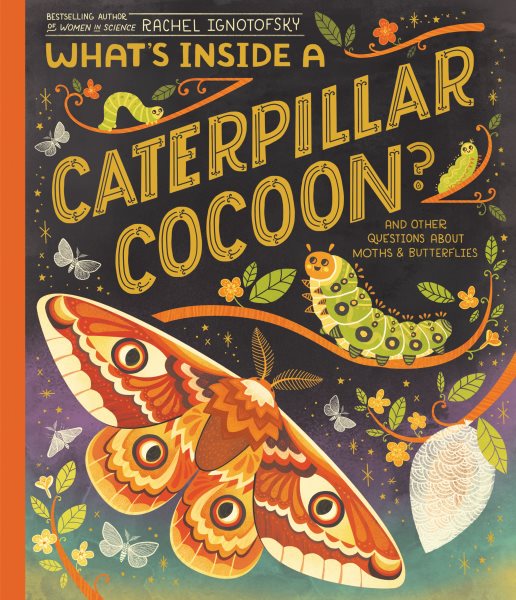
What’s Inside a Caterpillar Cocoon? And Other Questions About Moths and Butterflies by Rachel Ignotofsky

How are moths and butterflies related? What goes on in a cocoon or chrysalis? Immerse yourself in this gorgeous and informative deep dive into what makes these creatures some of the most fascinating in the world. Beautiful books have burned me before, so I didn’t necessarily trust this book when I first encountered it. I mean, sure, its cover glows with pretty gold foil and the art inside is nothing short of amazing, but usually this kind of book has huge chunks of immovable text that is so hard for a kid to want to read, unless they’re friggin’ obsessed with the subject matter. But this book? The perfect amount of text! What’s more, a very systematic and informative series of pages about the differences between moths and butterflies. That art really is as beautiful, as I mentioned before, and then at the end you get a small bibliography of sources, and resources for kids to help butterflies and moths on their own. It’s informative and, best of all, has a lot to say about helping the Earth. I kinda love it. Previously Seen On: The Science and Nature List

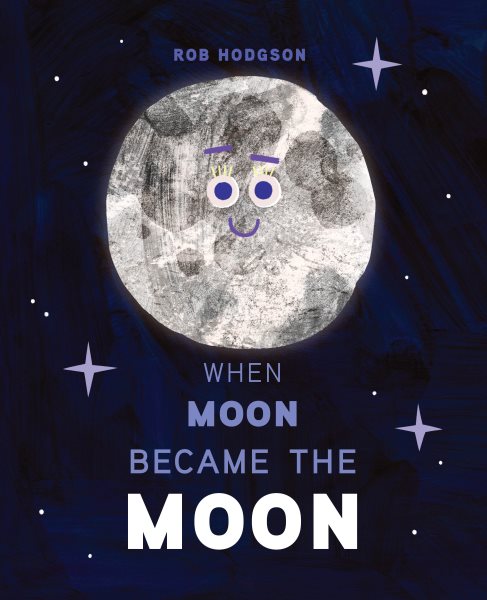
When Moon Became Moon by Rob Hodgson

As he did for clouds, so too shall he do for the moon. Rob Hodgson first appeared on my radar when he created the greatest water cycle picture book of all time, When Cloud Became a Cloud. He just has this way of turning complicated science concepts into ideas so simple a young elementary school reader can understand them. With his sights now resting entirely on the skies, Rob does something right at the start of this book that I really appreciated. He manages to show how the moon formed in a concrete and understandable way. First, he shows how Earth crashed into “another early planet”. The rocks that came out of this zoom around her gravity. Then, “Some of the rocks were so excited to be together that they got closer and closer, and hotter and hotter, until… They came together to form a moon.” This is shown so simply and clearly and I really appreciated its inclusion (other books on this subject sometimes elide this part of the process or skip over it entirely). I also appreciated that throughout all of this, the Earth is not depicted as blue or anything. You’d be amazed how many books discussing early Earth do this. The rest of the book covers the tides, keeping the Earth steady, seasons, eclipses, you name it. If you could have only one book for younger kids on the moon, I think you’d want it to be this one.  Previously Seen On: The Science and Nature List

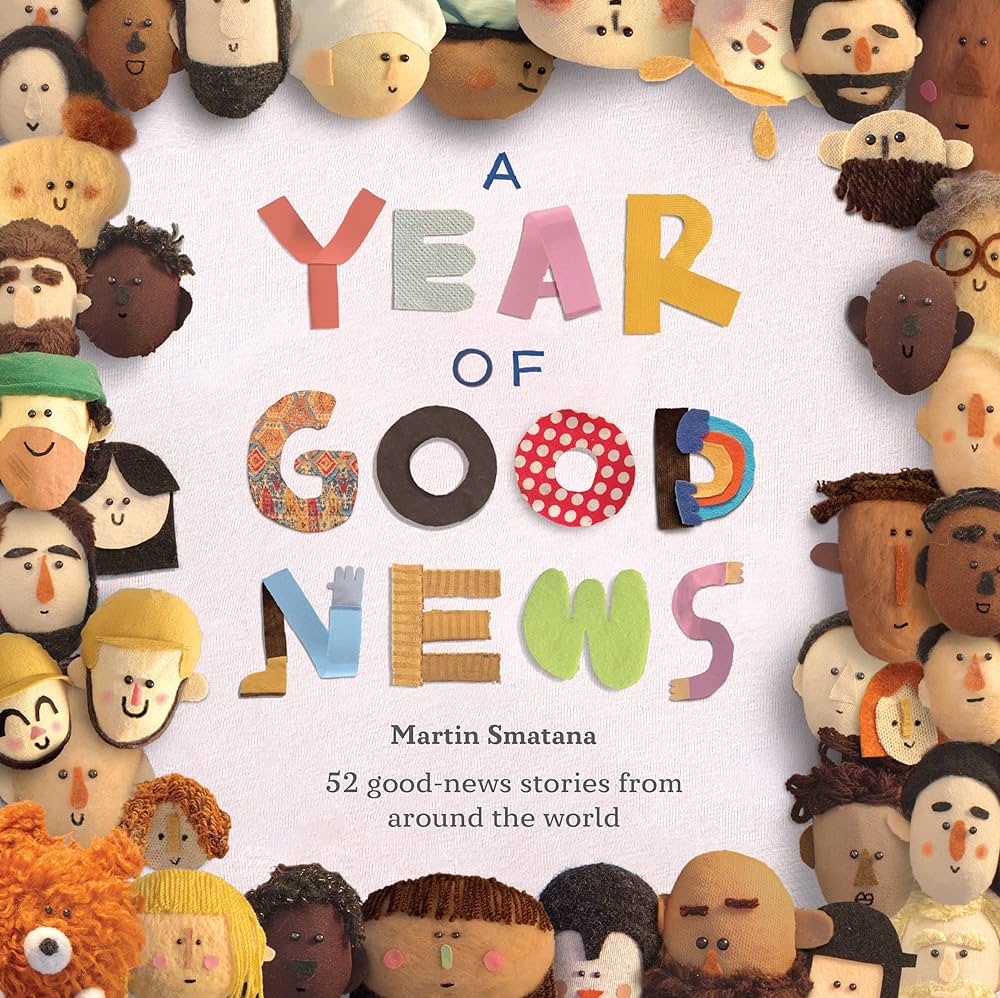
A Year of Good News by Martin Smatana

Need a pick-me-up? During the first year of the pandemic, artist Martin Smatana started illustrating one piece of good news every week. Now his creations are a book. Like a hug for your eyeballs. Admittedly, there is something awfully relaxing about this book. It’s quick, to the point, and cheery. The standout here is the art, though. Without it, the book might feel more like a page-a-day calendar than anything else. It is funny to read Martin Smatana say “I’m not very good at drawing” only to create these remarkable images with mixed media. Some of these have an amazing sense of depth to them. It makes for an oddly good companion to this year’s Desert Jungle by Jeannie Baker. Very cool.

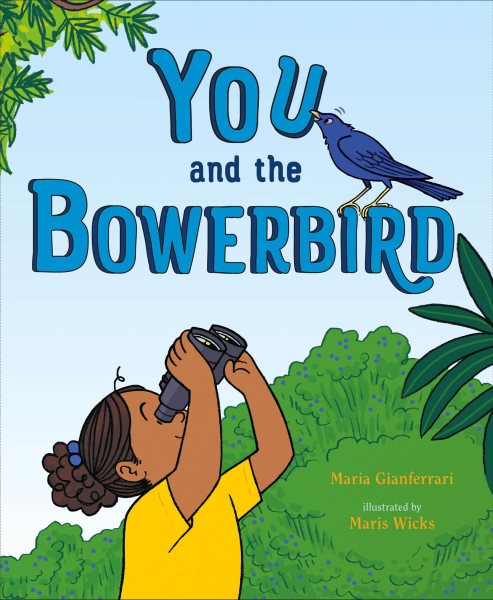
You and the Bowerbird by Maria Gianferrari, ill. Maris Wicks

What bird designs its bower with objects that are a favorite shade of blue? The bowerbird, of course! Watch it design, arrange, and defend its creation, all in the name of love. I’ve been a huge fan of Maris Wicks since I first stumbled on her independently published picture book comic Yes, Let’s more than a decade ago back in NYC at MOCCA. She’s done a lot since then, but pairing with Gianferrari is not the career move I would have predicted. Gianferrari is usually writing alongside the hyper-realistic Bagram Ibatoulline types. Still, Wicks’ silly, almost cartoonist, style is a perfect accompaniment for this explanation of how bowerbirds design their bowers. I like it when nature gets silly on me. This book is silly, and then some!  Previously Seen On: The Science and Nature List

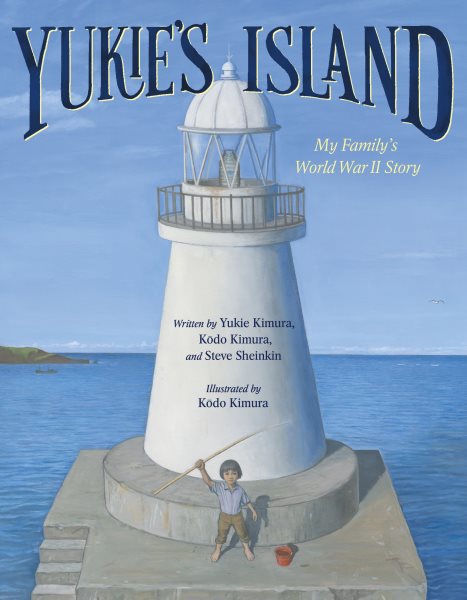
Yukie’s Island: My Family’s World War II Story by Yukie Kimura, Kōdo Kimura and Steve Sheinkin, ill. Kōdo Kimura

Imagine having a whole island to yourself! Yukie collects seagull eggs, explores caves, and loves her father’s lighthouse, but when war comes to her island, she and her family must make it through together.  I’m seeing a plethora of nonfiction titles by authors about their grandparents (I read this and the aforementioned Stranded! in the same sitting). I love how the information in this particular book was laid out, as well as some of the phrasings from scene to scene. For example, “Time is slow when you’re waiting. Even for something bad.” Or when Yukie’s father is playing his flute. “The music sounded like things he was afraid to say,” and later, “The music sounded like things I wished I didn’t know.” An honest portrait of wartime Japan does feel filled with authenticity but is not so harsh that it’s going to traumatize kids. And hard to believe that this is Kimura’s first picture book! Excellent art and a great story that really leans into the fun of the island as well as the important war bits.


Hope you enjoyed these! Here are the lists you can expect for the rest of this month:

December 1 – Great Board Books

December 2 – Picture Book Readaloud

December 3 – Simple Picture Book Texts

December 4 – Transcendent Holiday Picture Books

December 5 – Rhyming Picture Books

December 6 – Funny Picture Books

December 7 – CaldeNotts

December 8 – Picture Book Reprints

December 9 – Math Books for Kids

December 10 – Gross Books

December 11 – Books with a Message

December 12 – Fabulous Photography

December 13 – Translated Picture Books

December 14 – Fairy Tales / Folktales / Religious Tales

December 15 – Wordless Picture Books

December 16 – Poetry Books

December 17 – Unconventional Children’s Books

December 18 – Easy Books & Early Chapter Books

December 19 – Older Funny Books

December 20 – Science Fiction Books

December 21 – Fantasy Books

December 22 – Comics & Graphic Novels

December 23 – Informational Fiction

December 24 – American History

December 25 – Science & Nature Books

December 26 – Unique Biographies

December 27 – Nonfiction Picture Books

December 28 – Nonfiction Books for Older Readers

December 29 – Audiobooks for Kids

December 30 – Middle Grade Novels

December 31 – Picture Books

Filed Under: 31 Days 31 Lists, Best Books, Best Books of 2023 Tagged With: 2023 nonfiction, 2023 nonfiction picture books, 31 days 31 lists, Best Books of 2023, nonfiction picture books

31 Days, 31 Lists: 2023 Unique Biographies for Kids

December 26, 2023 by Betsy Bird

A good biography is one thing. A unique biography is another thing entirely. A great many of the darn thing are published every year, and it can be just a touch difficult to wade through them. I like a good one, though. I like a biography that makes you interested in another person’s life on the one hand, while also opening their story up in some larger way on the other. Today, I’m celebrating those biographies that focus on their subjects with a bit of creativity. The ones that could only tell their tales their own particular ways. Biographies for the masses! Biographies for the kids.

If you’d like a PDF of today’s list, you can find one here.

Curious about previous years’ biography lists? Then check out what’s come before:

  • 2022
  • 2021
  • 2020
  • 2019
  • 2018
  • 2017
  • 2016

2023 Unique Biographies for Kids

Beautiful Noise: The Music of John Cage by Lisa Rogers, ill. Il Sung Na

Boy, it sure does make a difference what illustrator is paired with a given book at a given time. I’m not saying that writer Lisa Rogers hasn’t done a stand up and cheer job here. She has! I’m just saying that if these words had been paired with so-so art, I’m not so sure the final product would be anything to write home about. Fortunately, a good editor knows when to make the call and hire a great artist. Il Sung Na was always been better known to me personally for his work on The Book of Sleep and such. I’ve never seen him try his hand at a picture book bio, and he does not disappoint. First off, let’s talk endpapers! Using shapes and colors to represent different sounds, you could have an extended conversation with a kid over whether or not “Miffed” or “Murmuring” look the way Na has depicted them here. The book itself is my favorite kind of picture book bio. Which is to say, the kind that doesn’t go the “Such n’ so was born on [blank] to [blank] and when his mother saw him she said [blank]”. Booooring! Instead, Rogers had to think long and hard about what the point of a John Cage picture book bio would have to be. Her answer? How all sound, or even lack thereof, can be music. Do you want to get a clear cut explanation about why Cage wrote a four minute and thirty-three second piece where the pianist didn’t play a single note? It’s a beautiful dual bio of Cage and of Cage’s music equally. The best book to pair this with might actually be The Noisy Paint Box by Barb Rosenstock about Kadinsky. Worth discovering. 

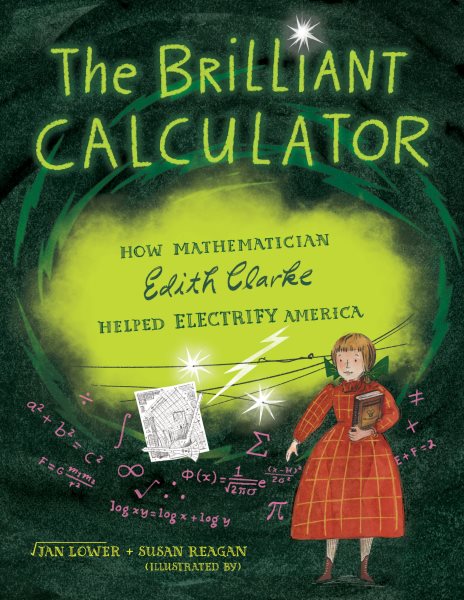
The Brilliant Calculator: How Mathematician Edith Clarke Helped Electrify America by Jan Lower, ill. Susan Reagan

Oh, me oh my, I DO so love a good picture book biography when it has something to do with math. And as I mentioned before, over the last 10 or so odd years there’s been a notable uptick in the marketplace. I wonder, though, if you were to look at which publishers create such books, would the same names come up time and again? For example, the Calkins Creek imprint appears to be better suited to publishing a book of this sort. Why do I say such things? Because when I read a book like The Brilliant Calculator about Edith Clarke I notice several smart choices throughout. Fake dialogue? Not present. Is the story itself more fun than the backmatter? You betcha. Plus this is a smart duo of author and artist to pair together. Lower’s A Song for the Cosmos: Blind Willie Johnson and Voyager’s Golden Record was an accurate but dreamy take on its subject matter, while Reagan’s work on Revolutionary Prudence Wright elevated a book that might not have gotten attention otherwise. Here they have to prove their mettle in one specific way: Are they afraid of numbers? I’m not kidding about this. Many is the mathematician bio that eschews almost any mention of actual math (check out the bulk of books on Katherine Johnson if you don’t believe me). Ms. Reagan does include math in the details of the art, though the equations reminded me of the year I served on the Mathical Prize committee and the mathematicians there started trying to solve the math in the art that they found in such borders. But with her accurate rendition of the Clarke Calculator patent, I am certain everything checks out. Great writing, an interesting person to learn about, and some truly awesome art. A winner! Previously Seen On: The Math List

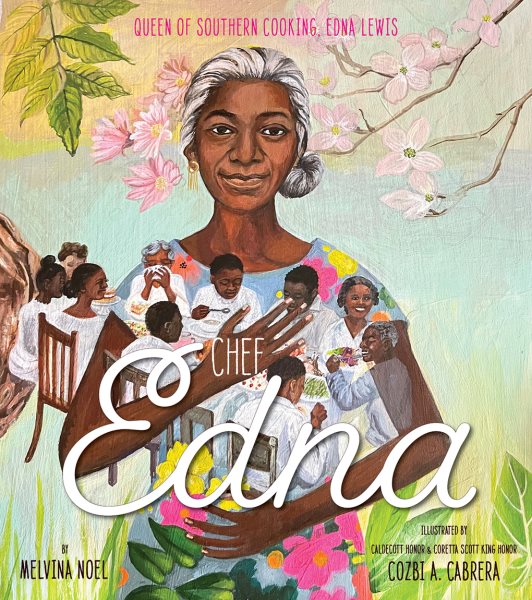
Chef Edna: Queen of Southern Cooking, Edna Lewis by Melvina Noel, ill. Cozbi A. Cabrera

How did one southern woman manage to charm the whole of New York City with her cooking? The triumphant tale of family, home, and delicious biscuits. Cozbi’s back! Evanston’s very own Cozbi A. Cabrera has a new picture book bio she’s illustrated, though I admit that when I saw this striking cover I didn’t immediately recognize that it was her. I’ve actually purchased some of Edna Lewis’s cookbooks for my library’s collections before, so her face here was instantly recognizable. Like a lot of picture books about cooks, it’s important to see how the author frames their subject’s life. Here, Melvina Noel has chosen to fixate primarily on Edna’s family and southern home. She doesn’t elide the hardship but she also makes it clear how closely Edna is tied to that part of the country, even after she moves to New York and becomes a success. I thought the writing worked beautifully but it’s Cozbi’s art that makes this more of a standout than your usual bio.

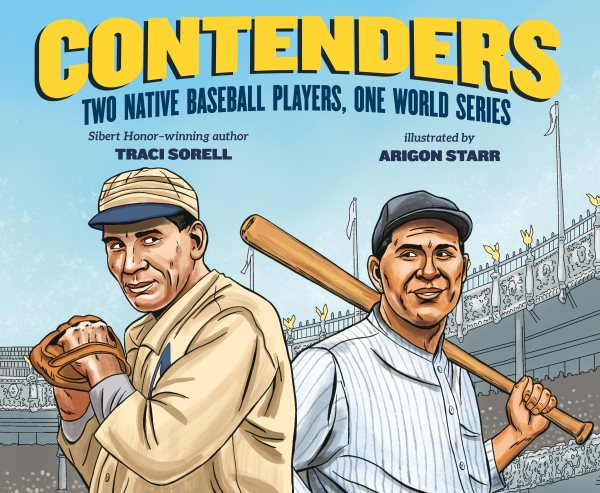
Contenders: Two Native Baseball Players, One World Series by Traci Sorell, ill. Arigon Starr

I’m just trying to remember the publishing scene even ten years ago and how likely it is that a book like Contenders would have even (A) come out and (B) been as beautifully lauded and advertised as this particular book has been. The name “Traci Sorell” undoubtedly sounds familiar to you. That’s probably because she’s done such critically acclaimed titles as We Are Grateful: Otsaliheliga and We Are Still Here! Native American Truths Everyone Should Know. Here she creates a dual biography that starts with a big moment, then pulls back to fill in some biographical info. In the 1911 World Series, the only two Indigenous baseball players in the major leagues faced off against one another. Naturally, the press at the time was just awful about it. Never alleging or filling in with fake dialogue or committing really any of the usual bio sins, Sorell tells the background stories of Charles Bender and John Meyers adeptly. They had a couple things in common, but in many ways they led incredibly different lives. I was particularly pleased when I saw the eight additional Native players listed since 1911 that have played in the majors. Artist Arigon Star presents them like baseball cards, while at the bottom of the page you have depictions of racist white fans with tomahawks and facepaint facing off against Native activists, their fists raised high. A powerful telling with fantastic backmatter. Previously Seen On: The American History List

Desert Queen by Jyoti Rajan Gopal, ill. Svabhu Kohli

This one’s cool. It’s probably safe to say that this is the first picture book biography on Harish Kumar/Queen Harish to ever come out, and how nice that when it has it’s as beautiful as it is. It’s difficult to know where to begin to tell this story, but Gopal takes a steady hand to the story of how Kumar became the Rajasthani folk dancer and drag performer Queen Harish:

A biography has a number of different ways that it can convey the life of its subject. Here, Gopal eschews a standard this-to-this-to-this methodology, preferring instead to tap into the emotions of the subject. The text is fairly simple and, compared to some picture book bios I’ve seen this year, downright sparse. Kumar’s transformation into Queen Harish is also remarkable, thanks in large part to the art by Svabhu Kohli. When the text reads, “The boy is shiny and glittery and NEW” that just feels like the mildest description for the art on the opposite page. There, Queen Harish is emerging from a universe in the shape of a man splitting down the center, great lines of light weaving around her, and a new universe forming. And when she dances? Remarkable. Would I have liked a little more backmatter? Heck yes. Always. But there’s an author’s note there with further information on Kumar, so at least we’re not left hanging entirely. The most beautiful drag picture book bio I’ve ever had the chance to see.

And yes. When I read this title I do get “Dancing Queen” stuck in my head. *sigh*

The Fire of Stars: The Life and Brilliance of the Woman Who Discovered What Stars Are Made Of by Kirsten W. Larson, ill. Katherine Roy

What burns at the heart of a star? The story of Cecilia Payne, ground-breaking scientist, is brought to life in this scintillating picture biography riddled with the mysteries of the universe. In spite of the fact that the subtitle of this book ends with a preposition and completely fails to name its biographical subject on the cover (the longer I look at it, the weirder it gets) this is a stand up and cheer example of how you can take a biographical subject and eschew the rote categorization of their life when you write a book about them. While most picture bios of female astronomers do a dull play-by-play of their life. Larson shakes things up by pairing Cecilia Payne’s discoveries alongside the birth of a star. She has Katherine Roy, science illustrator extraordinaire, there to help her. If you want to have some fun, play attention to how the star information slowly consumes everything behind Cecilia’s biographical history. Also look at how Roy plays with the color yellow in Cecilia’s clothing. No fake dialogue, a surprising story, and great backmatter. Better, by far, than a good chunk of what’s already out there. Previously Seen On: The Science and Nature List

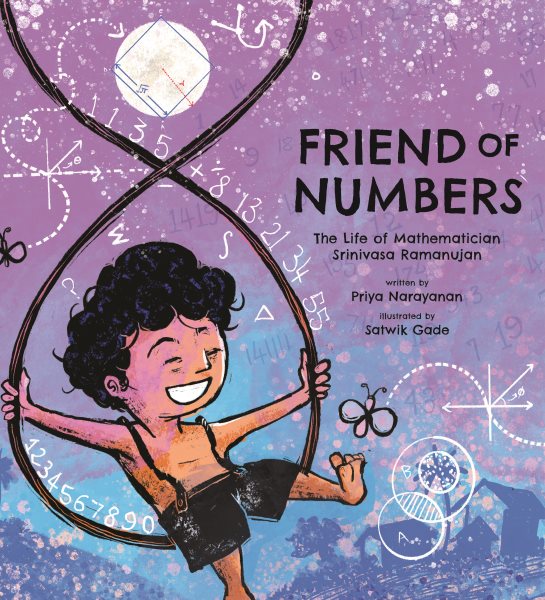
Friend of Numbers: The Life of Mathematician Srinivasa Ramanujan by Priya Narayanan, ill. Satwik Gade

Every single picture book biography out there is a challenge in an entirely different way. The author of such a book must determine the best possible way in which to introduce their subject without going the rote, “Mr. [Blank] was born on [Blank] in the country of [Blank].” You see what I’m getting at. Now add in an additional terrifying factor: Math. Math complicates things for authors. Very few children’s book creators have degrees in it. Many retain fears of it dating back to their own school age years. So when some of them write picture book bios of mathematicians they try to avoid the math in any way that they can. They may, for example, lean heavily on the illustrator to put numbers, charts, and graphs in the art (though, as I mentioned before, I’ve been with mathematicians who have looked at these art pieces and said, “This is just gobblety-gook!”). So one of the differences with Friend of Numbers is the the fact that not only does Priya Narayanan have a good grasp on how to tell the story of Srinivasa Ramanujan, but she also isn’t afraid to put math into the text itself. I was reminded of The Boy Who Loved Math by Deborah Heiligman, another book that understood innately how not to shy away from numbers. Satwik Gade’s art is just as enticing, and I was delighted to discover that this edition we’re seeing here in America is a reprint of a book that originally came out in India. In the front it says, “The author’s note, glossary, and mathematical content were created in collaboration with the author for the Eerdmans edition of this book.” You know what that means, don’t you? In other countries there isn’t a focus on backmatter, but here in the States we rather insist on it. And this book’s backmatter is INCREDIBLE! From the Author’s Note to different types of patterns that kids can practice on their own to a Glossary, this book is one of the best math-related titles for kids I’ve seen in a long long time. A glorious example for other publishers importing nonfiction from overseas. Previously Seen On: The Math List

The Green Piano: How Little Me Found Music by Roberta Flack with Tonya Bolden, ill. Hayden Goodman

A five-time Grammy Award winner tells the story of how she came to love music and how her family got its very first piano. Loads of personality and fun infuse this delightful tale. Oh, I liked this! I was really worried at the start because initially I missed the fact that Ms. Flack was the actual author of the book. As a result I started getting really huffy about the fact that it was written in the first person. Shows what I know. Here, Roberta’s voice comes through with so much zip and pizzaz and pop! Plus the nerd in me just got really excited watching her dad fix up that old piano. A picture book bio that actually feels like kids would enjoy reading it. Fun! 

Holding Her Own: The Exceptional Life of Jackie Ormes by Traci N. Todd, ill. Shannon Wright

The life of reporter, cartoonist, dollmaker, artist Jackie Ormes is brought to rip-roaring life in this fun and fantastic biography. Learn as much as you can about the first Black woman to become a nationally syndicated cartoonist! This is a unicorn! A picture book biography about a funny Black woman who broke into the comic strip business. My husband’s a real comics history guy so when I asked him about Jackie Ormes he knew who she was but was unaware of how much she did. Sure, he’d heard about her Torchy series but not her Patty-Jo. The book’s written with a lot of humor and then Traci N. Todd (possibly best known to us for illustrating Varian Johnson’s graphic novel Twins) just goes above and beyond the call of duty to make the art as interesting as possible. My favorite two-page spread is the Family Circus-esque look at her travels as a reporter. This is top notch, original, and worthy of its subject. No small feat.

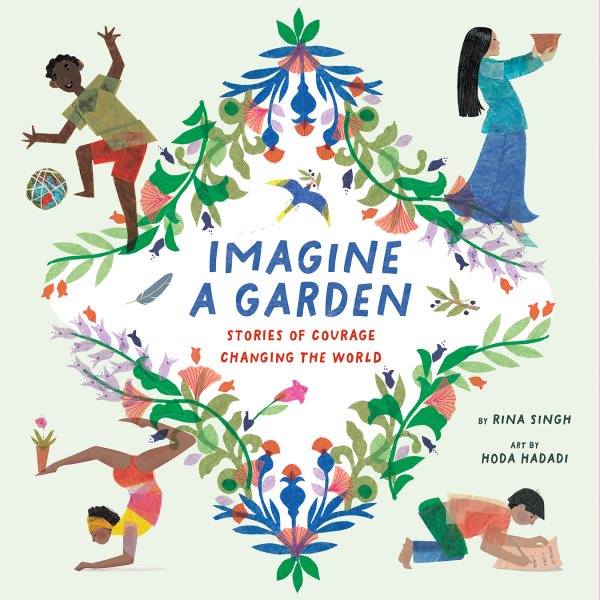
Imagine a Garden: Stories of Courage Changing the World by Rina Singh, ill. Hoda Hadadi

A rather clever set up for a relatively simple creation. On its bookflap you’ll see that the book describes itself as “a collection of seven vignettes from around the world.” What’s remarkable, though, is that each of the people featured is, indeed, a real person. Cut paper art is what helps to tell their stories, which are presented as free-verse poems. I know. That sounds dangerously close to precious. I assure you, though, that Rina Singh is very good at hitting the right tone with each of these tales. Part of what I like about them is how small each one is. The teacher in Delhi who has class under the trains’ bridges. The artist that turns weapons into instruments in Mexico City. And Autumn Peltier is having a particularly good year, appearing in both this book and Autumn Peltier, Water Warrior by Carole Lindstrom. Don’t look for any bibliography in the back. There is some backmatter in the end that gives further information about each person, as well as an Author’s Note that talks more personally about the reason for this book. It’s a quieter kind of collection bio than we usually see (and shorter!) but it’s one of the few I could actually see you reading aloud to a group. 

The Indestructible Tom Crean: Heroic Explorer of the Antarctic by Jennifer Thermes

Sail with explorer Tom Crean on the ships Discovery, Terra Nova, and Endurance and watch as the man not only manages to stay alive but also saves the lives of his fellow crewmen time and time again. A gripping, wonderful look at a heroic man. First up, I’d like to mention how much nicer it is to read books about Antarctic exploration than Arctic exploration, since at least on Antarctica they didn’t have any native populations to exploit. This is a gutsy, gripping story of a regular guy who just happened to have exactly what was needed to survive over and over and over in impossible situations. It’s nutty to think how he just kept on going back to that frozen wasteland. It doesn’t shy away from the less pleasant stuff (like the fate of his dogs on one of the trips) and reading about that last trip to try and save Shackleton’s crew had me on the edge of my seat. Thermes did a book about Manhattan a year or two ago that I liked (Manhattan: Mapping the Story of an Island) but honestly, I like this one far more. You’ve gotta see it for yourself. 

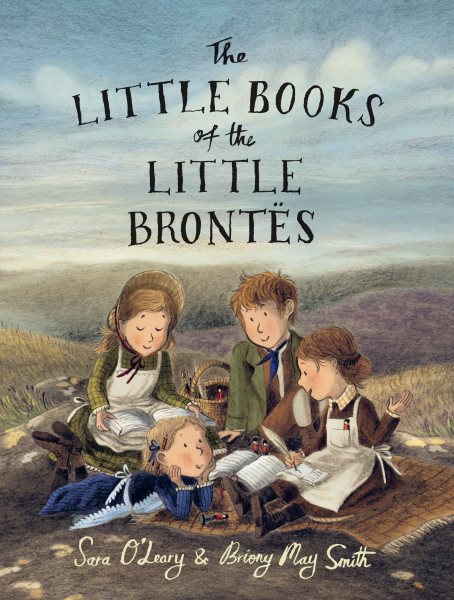
The Little Books of the Little Brontës by Sara O’Leary, ill. Briony May Smith

A biography written for children does not have to follow a set path. This is not to say that there aren’t rules. A good picture book biographer ideally does not rely on fake dialogue or start making up scenes that did not occur, just because it gives the story a little more oomph. An author is more than allowed to do this, but if they do then the book becomes “informational fiction” and shouldn’t really be considered nonfiction at all. At the end of this book, author Sara O’Leary states that, “There is much material of their [the Brontës ] later lives, but we can only imagine what their early years were really like. I choose to believe that theirs was a childhood not so much marked by poverty and deprivation but one that was rich in both stories and love. They had each other. They had their books.” Those little books that the Brontës made for one another are the catalyst for the storytelling taking place here today. Now I once sat in on a panel where a fine author of children’s nonfiction stated that while the writing of a book for children may adhere close to the facts, the art never can. We can never truly know if this person stood in this particular way at this particular time at that particular place. Maybe a photograph indicates that they did, but you could never get every detail completely correct. With that in mind, all illustration in nonfiction is, after a sense, an untruth. So it is that some may see the kids in this book having a good time with one another and disapprove, but I think that O’Leary has plenty of evidence on her side to back up the theory that they had a bit of fun in their lives. Besides, it’s rather nice to see four siblings enjoying one another’s company, against a backdrop of gloomy moors and skies. And if you learn a thing or two about them along the way, and get a sense of how writing for fun may lead to being a real author someday? All to the good!

Make Way: The Story of Robert McCloskey, Nancy Schön, and Some Very Famous Ducklings by Angela Burke Kunkel, ill. Claire Keane

One man created a story of ducks that became a picture book classic. One woman created sculptures from the book that became beloved Boston icons. But how the two came to be? That’s the story you haven’t heard. Color me impressed. Last year we saw a picture book bio of McCloskey and his creation of Make Way for Ducklings and it was just that. A kind of cute story behind a story. Angela Burke Kunkel takes a different and (quite frankly) smarter approach. She pairs McCloskey alongside artist Nancy Schön and then the two of them come together in an honestly tense scene near the end. Claire Keane’s always had such a great style to her art, but this is the first time I’ve seen the text match her illustrations. I loved her waterlogged McCloskey and the vibrancy she gives these characters. No fake dialogue. Lots of good backmatter. And best of all it’s a picture book dual biography that I honestly think a kid would want to hear again and again. That’s rare! 

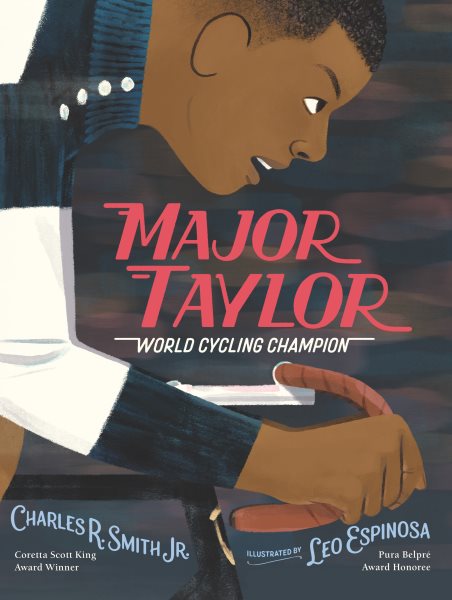
Major Taylor: World Cycling Champion by Charles R. Smith Jr., ill. Leo Espinosa

You just have to hand it to Charles R. Smith Jr. The man never tries to take the easy way out. We’ve seen picture book bios of Major Taylor before, but I think this has to be my favorite. Not simply because it does clever things with flashing back and forth between one particular race and the earlier parts of his life, but because Smith makes the whole thing rhyme. Talk about a challenge! And the kicker is that he’s particularly good at it. I mean, of course he is. He’s a poet for crying out loud. But Smith’s other superpower is his ability to make rhyming nonfiction really plunge you into the action. So here we have Major Taylor neck and neck with these white guys on their bikes (Espinosa is really pulling out all the stops with their handlebar moustaches) and the action reads, “Go faster go faster / so they can’t catch you – / GO, MAJOR, GO, / don’t let them crash you!” I can envision a teacher really getting into this, pulling the listening audience into the action, as the bikes careen around and around and around. And Espinosa is doing some amazing work with the art here as well. This is a very different style from the one we saw with the incredible The World Belonged to Us by Jacqueline Woodson. Here it’s less stylized and more realistic. I wouldn’t change it for anything in the world. A bright star in the pantheon of sports picture book bios. 

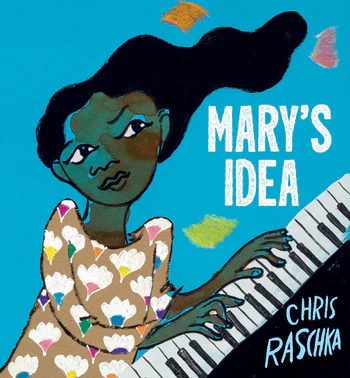
Mary’s Idea by Chris Raschka

“It was Mary’s idea to play the piano at three.” A visually clever encapsulation of the life of Mary Lou Williams, told with Chris Raschka’s inimitable style. A rather good complementary title to the aforementioned The Green Piano, as it happens. Raschka has always had a weakness for picture book bios (but not standard, rote ones) of jazz greats. Looks like Mary Lou Williams fits the same bill. But what’s so interesting here is how he focuses so entirely on her hands. It reminded me of a variation on his book New Shoes he put out a couple years ago that was all foot p.o.v. related. I like how this one is laid out. The way the hands reach out, it’s like her hands are your hands.  It melds his artistic inclinations pretty neatly with something a kid would enjoy. 

Santiago Saw Things Differently: Santiago Ramón y Cajal, Artist, Doctor, Father of Neuroscience by Christine Iverson, ill. Luciano Lozano

Now, to be perfectly fair, any book that has to follow the graphic biography Santiago! Santiago Ramón y Cajal – Artist, Scientist, Troublemaker by Jay Hosler has a tough road to hoe. The advantage that Iverson and Lozano have here is that while that book was a comic for older readers, this is quite clearly a picture book biography. As such, it eschews some of the violence of Santiago’s life (and does not begin, as Hosler did, with its titular hero getting kicked in the head by a horse… or was it a mule?). Here, it’s a rather visually stunning encapsulation of the life of a boy who was able to combine art and science in a way that made difficult concepts clear to others. Forced by his father to study to become a doctor rather than an artist, it was Santiago who figured out how to sketch nerve fibers. Lozano does a beautiful job of incorporating Santiago’s own art into the art of the book, while Iverson deftly synthesizes his sometimes wacky life into something clear and concise. Gotta say, it’s a pretty good looking book. Previously Seen On: The Science and Nature List

Sisters in Science: Marie Curie, Bronia Dłuska, and the Atomic Power of Sisterhood by Linda Elovitz Marshall, ill. Anna and Elena Balbusso

I could live a nice long time without phrases like “the atomic power of sisterhood” but we’ll give it a pass this time. It seems fitting that a sister pair like Anna and Elena Balbusso would work together on a book celebrating another sisterly pair. In this book we learn that Marie Curie’s education was based on a deal. Essentially, there was no way for both Marie and her sister Bronia to simultaneously attend a university, due to lack of funds. The solution? Bronia would go to school first and Marie would work as a tutor to pay for her education. Then Bronia would work while Marie went to school. Were this a fictional story, you just know that Bronia would forget her side of the deal, but as history shows, in this particular case it worked out. As a biography I think it does an excellent job of diverting the focus of Marie Curie away from her relationship with her husband and squarely on her relationship with her sister. As a science text it is perhaps slightly less useful, since at no point is the radiation Marie, Pierre, and Henri discover seen as anything but rah-rah wonderful. Come for the sisterly bond instead. It makes for a great tale. 

The Snow Man by Jonah Winter, ill. Jeanette Winter

I imagine a person could probably do an entire reclusive-gent-who-likes-snow biography storytime if you combined this book with Snowflake Bentley. That’s a little specific, but it’s true! Odds are you probably haven’t heard of bill barr and odds are that’s how he’d prefer it. Jonah Winter doesn’t name him in the text, even as his tells his story. You’ll have to read the Author’s Note to figure out the true details of the man’s life. You see, back in 1972 billy (lowercase spelling) came to the Rocky Mountains when he was a twenty-one-year-old college student. He holed up in a cabin and started tracking the wildlife. If this sounds a little familiar, that may be because this story isn’t that dissimilar from the one we heard in 2022’s I Begin With Spring: The Life and Seasons of Henry David Thoreau. In both cases a man tracks information about nature for fun and, years later, scientists use those notes to track climate change. Jonah keeps the storytelling lyric and lovely, and the art most certainly helps. It’s an unconventional story of an unconventional citizen scientist. Previously Seen On: The Unconventional List

A Take-Charge Girl Blazes a Trail to Congress by Gretchen Woelfle, ill. Rebecca Gibbon

Jeannette Rankin was always a take-charge girl. Whether taking care of horses or her little brothers and sisters—Jeannette knew what to do and got the job done. That’s why, when she saw poor children living in bad conditions in San Francisco, she knew she had to take charge and change things. But in the early twentieth century, women like Jeannette couldn’t vote to change the laws that failed to protect children. Jeannette became an activist and led the charge, campaigning for women’s right to vote. And when her home state, Montana, gave women that right, Jeannette ran for Congress and became America’s first congressWOMAN! One of the better picture bios of Rankin I’ve seen, that’s for sure, and a pretty good example of how you can make a book fun and peppy without having to make up stuff. The backmatter’s pretty darn good but it’s the stuff in the front that will strike you as particularly engaging.

To See Clearly: A Portrait of David Hockney by Evan Turk

We’re doing the whole artist telling the story of an artist thing again, but I don’t think I would have predicted Turk doing Hockney on my own. After all, they’ve rather different styles when you think about it. Turk has illustrated bios of different artists before, but the last time he did one on Ben Shahn he wasn’t the author. Turns out, the man is quite good at synthesizing a life into a picture book format. Turk isn’t trying to replicate Hockney’s style with this book (a technique that has served some biographer illustrators well but that isn’t a strict requirement). Instead he pulls out his customary colored pencils, gouache, and crayons and goes to town on the whole enterprise. One cannot help but wonder if Hockney will ever see the book himself and, if so, what he’ll think of it. But you know what? Who cares! It’s a dang good biography, making his life not merely pertinent to young readers but interesting as well. Extra points for not eliding over his life as a gay man but for leaning into it as an essential part of his being. Great, grand, and beautiful. 

Tomfoolery! Randolph Caldecott and the Rambunctious Coming-of-Age of Children’s Books by Michelle Markel, ill. Barbara McClintock

Meet Randolph Caldecott! The children’s book illustrator unafraid to put fun, action, and loads of animals on the page. A marvelous look at the artist our picture books owe so much to today. Both Markel and McClintock are having a lot of fun with this subject. What they both do so well is stress this change from the solid, staid, stultifying children’s books that preceded Caldecott and what he brought to the form. It never cheats, and yet still manages to have so much fun. Extra points to McClintock for including actual shots of early dull titles (“In Adam’s fall / We Sinned all” and all that). I don’t know that I’ve ever seen her integrate mixed media like this into her art, but she’s a natural. I’m always so happy when she does nonfiction. She’s like a breath of fresh air to the page. And be sure to check out the two-page spread where she’s included a lot of contemporary Caldecott winners (I needed help with the two on the far left, but I know them now). An amazing ode that actually ends up being a really good book of its own. Not easy!

The Van Buren Sisters Vs. The Pants Police by J.F. Fox, ill. Anna Kwan

Not the first time Fox and Kwan have pared together on a book. Some of you might recall their Napoleon vs. the Bunnies from a couple years ago. That book was fun, but I’d say this is the more accomplished of the two at the moment. This particular story looks at two motorcycle women from 1916 that kept running into trouble because they preferred to wear pants on their bikes. This certainly falls into the more “fun” category of picture book bios out there, and it eludes one of my usual bugaboos with skill. If you know me then you know that I can’t stand fake dialogue in the text of bios for kids. You know what’s okay, though? Fake dialogue in speech balloons. I think probably because no one expects a cartoon to be strictly factual. Fox and Kwan are clever with this technique too. They make sure to relegate all the statements that people would have made at the time to those balloons, leaving the actual text of the book accurate as all get out. It’s a pretty light and lighthearted little tale, but that backmatter isn’t messing around. We’re talking Glossary, Sources (Print and Digital), Notes, and additional historical information to book. It’s packed! A fun frolicsome look at some very silly laws and the women who enjoyed breaking them. 

Virginia Wouldn’t Slow Down: The Unstoppable Dr. Apgar and Her Life-Saving Invention by Carrie A. Pearson, ill. Nancy Carpenter

Oh, what a delightful book this is! If you haven’t heard of it, don’t worry. It was just released on August 7th of this year, but it’s great. Author Carrie Pearson has gone above and beyond the call of duty to make Dr. Apgar’s life as fun and interesting as possible. It helps that Nancy Carpenter became the illustrator for this book. She just has a naturally kid-friendly style to her art, though I should mention that she’s changed that style up a little bit for this book. This is a tiny bit broader than her previous titles. That’s not a criticism, just an observation. The story about Apgar and her invention is amazing, mentioning the barriers she faced without allowing them to overwhelm the overarching story. Make sure to also check out the backmatter, which includes not just an Author’s Note but also a Professional Timeline and a mention of Sources (most of which were firsthand, which is impressive in a whole different way).

What Music! The Fifty-Year Friendship Between Beethoven and Nannette Streicher, Who Built His Pianos by Laurie Lawlor, ill. Becca Stadtlander

Who the heck says women and men can’t be friends? Now that title, I’ll be the first to admit, is a bit of a mouthful, but ultimately I think Holiday House made the right choice with it. After all, what it does is establish that Nannette Streicher was, almost impossibly, a business woman at a time when that wasn’t really a thing. And let me tell you, after reading countless books about women like Mozart’s sister, who were brilliant but ultimately thwarted, there’s something so deeply satisfying about learning Nannette’s story. Evanston-based author Lawlor herself had to do a slew of original research to get to the gist of this story. As she explains it, “I was inspired to investigate the friendship between Ludwig and Nannette when I discovered more than 60 letters and notes penned between 1817 and 1818. These were all addressed to Nannette. None of her replies survived.” So she dug in and discovered that Nannette tweaked, improved, built, and sold pianos. She managed a family, a business, and designed and refined instruments. But is it actually fun for kids to read? Well, actually, yes. Lawlor cleverly figured out that the heart of this story is Beethoven and Nannette’s relationship. They just really do come off like buddies (and we all know how difficult he was as a person to know). Love the amount of work that Lawlor clearly poured into this book. A great female entrepreneur book and music title AND friendship book all in one. 


Hope you enjoyed these! Here are the lists you can expect for the rest of this month:

December 1 – Great Board Books

December 2 – Picture Book Readaloud

December 3 – Simple Picture Book Texts

December 4 – Transcendent Holiday Picture Books

December 5 – Rhyming Picture Books

December 6 – Funny Picture Books

December 7 – CaldeNotts

December 8 – Picture Book Reprints

December 9 – Math Books for Kids

December 10 – Gross Books

December 11 – Books with a Message

December 12 – Fabulous Photography

December 13 – Translated Picture Books

December 14 – Fairy Tales / Folktales / Religious Tales

December 15 – Wordless Picture Books

December 16 – Poetry Books

December 17 – Unconventional Children’s Books

December 18 – Easy Books & Early Chapter Books

December 19 – Older Funny Books

December 20 – Science Fiction Books

December 21 – Fantasy Books

December 22 – Comics & Graphic Novels

December 23 – Informational Fiction

December 24 – American History

December 25 – Science & Nature Books

December 26 – Unique Biographies

December 27 – Nonfiction Picture Books

December 28 – Nonfiction Books for Older Readers

December 29 – Audiobooks for Kids

December 30 – Middle Grade Novels

December 31 – Picture Books

Filed Under: 31 Days 31 Lists, Best Books, Best Books of 2023 Tagged With: 2023 picture book biographies, 31 days 31 lists, biographies, picture book biographies

31 Days, 31 Lists: 2023 Science and Nature Books

December 25, 2023 by Betsy Bird

Ooog. This is my bad. When I decided to post this list on Christmas Day, I forgot how long it was going to be. Blame my library’s Blueberry Committee for that. Each year I read as many books as I can for my 101 Great Books for Kids Committee. Then, when that’s done, I switch focus and start reading the science and nature books. A LOT of science and nature books. In spite of the sheer length of this list, I assure you that this is just a tiny sliver of the total number of titles being produced these days. Honest.

For convenience, I’m splitting this up by age ranges. So first you’ll find the picture books and then, after that, the books for older readers. Please note as well that these are not strictly nonfiction lists. If a work of fiction has significant science or nature elements in it, I’m including it. I’ll note when that is the case as well.

Would you like a PDF of today’s list? You can find one here!

Interested in seeing other books for kids about science and nature? Then check out these previous lists:

  • 2022
  • 2021
  • 2020
  • 2019
  • 2018
  • 2017
  • 2016

2023 Science and Nature Picture Books

Animal Heroes: Supermoms! by Heather Lang and Jamie Harper, ill. Jamie Harper

Which animal has the most awesome mom in the world? Penguins or bearded capuchin monkeys? Polar bears or octopuses? With hilarious illustrations and surprising facts, vote for your own favorite! This one slowly grew on me. I think I was ready to jump lump it in with all the other nonfiction animal-related picture books that recount facts under a single overall theme, but something about this particular book stood out for me. Maybe it was the art, and the fact that it does some legit funny jokes in there. Maybe it was the choice of what constitutes a remarkable mom. And maybe it was the additional information in the back, which contains a slew of facts I didn’t know before. Dunno. Whatever the case, it’s distinctly appealing.

Behold the Octopus! by Suzanne Slade, ill. Thomas Gonzalez

Take a deep dive (literally!) into the wild and wonderful world of the octopus. Sumptuous art pairs with information about everyone’s favorite tentacled ocean dweller. I confess to being rather in love with octopuses from the beginning, so I may not be the most impartial reader of this book. Still, I think Slade does a great job in breaking down all the different kids of octopuses (octopi?) out there in the world. Thomas Gonzalez has always had this lovely style, created with his pastels, colored pencils, and airbrush techniques, and here I really think his talents have been brought to the fore by the subject matter. I like that you can read the big text with younger readers and the little text with their octopus-obsessed older siblings. Plus isn’t that cover great? The octopus shooting past you at lightning speed? This is fantastic. You’ll never get them mixed up with squid again.

Bompa’s Insect Expedition by David Suzuki with Tanya Lloyd Kyi, ill. Qin Leng

Fictional picture book alert! Twins Nakiina and Kaoru love going on nature expeditions with Bompa but when he suggests they look for insects they’re not so sure it’s a great plan. Haven’t they seen it all? A world of surprises just under your nose. There you go! Young kids who think they’ve seen it all get their eyes opened by their Bompa. I’d cross hot bricks to get my hands on another Qin Leng book, and here she is giving it her all. It’s a truly wonderful title on finding critters in your own backyard (even the sneaky ones). Love the watercolors and the visualizations for some of the kookier ideas (love the ant carrying a stack of backpacks, for example). Extra points for the good strong  backmatter and its section on what kids can do to find insects on their own. So cool! 

The Book of Turtles by Sy Montgomery, ill. Matt Patterson

Think you know turtles? Think again! An up-close-and-personal deep dive into a species and all its weird and wonderful qualities. Best. Turtle. Book. Ever. It’s the mark of a great author when they can take a subject that’s been done many times before for kids and reintroduce it in such a way as to make it not just interesting but fascinating. I sort of knew before reading this that a turtle was essentially fused into its shell, but Montgomery gets up close and personal with these creatures, telling you new facts next to old, but remaining consistently interesting throughout. I also knew that some turtles breathed through their butts. I just didn’t know that some peed through their mouths(!!!). Plus the art by Patterson is remarkable. Even if you aren’t a turtle lover, you’re going to be delving deep into this one.

Border Crossings by Sneed B. Collard III, ill. Howard Gray

As two endangered ocelots attempt to cross the border, they face obstacles that drive home the catastrophic effects of the Wall–and the many benefits of keeping the border barrier-free. Powerful storytelling introduces young readers to the wildlife that thrives along the border and urges budding nature buffs to value and protect our environment. This is an interesting one. I think Mr. Collard (who’s been in this business for a great many years already) does an excellent job of showing how a wide range of different kinds of animals are inconvenienced at best and have their lives uprooted at worst by border walls between the States and Mexico. He’s an expert at making sure that he ends on a hopeful note, all the while acknowledging the tough facts of the matter.

Can I Recycle This? A Kids’ Guide to Better Recycling and how to Reduce Single-Use Plastics by Jennie Romer, ill. by Christie Young 

A very pleasant surprise! By gum, you just never know what you’re gonna get when you sign up for reading a picture book about recycling, do you? I mean, this could have gone any which way. As it stands, it really deep dives but in a simple manner, into explaining precisely how recycling works. You get to see the sorting machines and you come to understand that anything that doesn’t fit goes into the trash anyway. I did wish that they’d have shown more human beings involved in the process. As it stands, it does a good job in an area where we just do not hear a lot about logistics. So I’m on board, and I solemnly swear never to try to recycle a plastic fork ever again

Caterpillars: What Will I Be When I Get to Be Me? by Kevin McCloskey

Whether it’s bound to be a moth or a butterfly, the life cycle of these backyard bugs is told with both humor and downright pretty pictures. While normally I’m a heckuva stickler for backmatter, because these TOON Books are meant for earlier readers, I give ‘em a little more slack. Plus, it’s just cute and funny, and we could use a little more cute and funny on these lists these days. This just gives kids a basic Caterpillar 101. The art is a fantastic mix of hyper-realism and a more cartoony style. If we’re talking about finding books that instill a love of nature (and we are) then this instills a sense of curiosity with these particular creepy crawlies. Pairs rather well with the older title What’s Inside a Caterpillar Cocoon? by Rachel Ignotofsky too (which you can see later on this list).

Darwin’s Super-Pooping Worm Spectacular by Polly Owen, ill. Gwen Millward

The Victorians were pretty sure that worms weren’t just gross, but utterly useless as well. It took Charles Darwin’s obsessive nature to prove that not only are worms important, but their poop is vital to nature! The most fun you can have with an invertebrate. Man. Polly Owen is toying with me. I’m this hard-nosed stickler for picture book nonfiction, right? I hate fake dialogue. I like my facts to be facts and not suppositions. All that stuff. So she goes and writes a book that is technically all-factual by skirting around the very edge of all my rules. For example, I don’t mind it when dialogue in speech bubbles is fake. Now in this book, Darwin is conducting experiments on the worms. I thought I could safely deem this book Informational Fiction when it showed him playing the piano, fife, and bassoon for the worms. But on the opposite page you actually see this little worm clarifying that, yes indeed, Darwin really did try out all those instruments with his invertebrates. The end result of this is a compelling (and oddly excrement-heavy) bit of good science wrapped in a gross-out package. Gwen Millward is also just going wacky with the art (the bassoon sequence is accompanied by what looks to be a disco floor complete with mirror ball). This is utterly ridiculous and, I’ll admit it, completely within the realm of fact. Kids will dig it (forgive me). Previously Seen On: The Gross List

The Day the River Caught Fire: How the Cuyahoga River Exploded and Ignited the Earth Day Movement by Barry Wittenstein, ill. Jessie Hartland

“Wake up, this is not a drill!” By the 1960s the Cuyahoga River in Cleveland caught fire . . . again! Learn how its clean-up helped inspire the first Earth Day in this strange, stinky, (sometimes explosive) tale. And how’s that for an eye-catching title? The joke is that when you read this, there wasn’t just one time the river caught fire but MULTIPLE times that it happened! And people just sort of wrote it off like, “Huh. Guess the river’s on fire again.” Wittenstein and Hartland are having a ball with this book. How could they not? It’s the ultimate example of pollution that’s gotten way out of hand. The kicker is seeing how having a fiery river was normalized until folks finally decided to do something about it. Jessie Hartland’s art style is a perfect companion to this storytelling as well. A fun bit of kooky storytelling about a very real event. Previously Seen On: The American History List

Destiny Finds Her Way: How a Rescued Baby Sloth Learned To Be Wild by Margarita Engle, photos by Sam Trull

The “Baby Animal Tales” series from National Geographic Kids relies, to a certain extent, on two things: The subject matter and the author. That there will be copious photographs? That’s a given. Of course, it helps each book a great deal if there’s a bit of a story to go along with the cute critters (and up until this moment each one really has been conventionally adorable). Here, Margarita Engle was not present when Destiny’s story was been lived out, but she’s gotten all her information from the people who knew her, as well as this plethora of great photos by Sam Trull. The end result is that you’ve the story of a twin baby sloth who was found at the base of a tree alone, and taken in by an animal rescue center in Costa Rica. The photos are a great lure, but I was particularly impressed by how Engle kept the words concise and limited, to a certain extent. There aren’t big blocks of overwhelming text here. Instead, the font is actually relatively large and the storyline beautifully rendered. As exciting as fiction, but more so because you know that it’s real. Come for the writing. Stay for the photos of little Destiny hugging other rescued sloths because she likes hugging so much. Previously Seen On: The Photography List

Dogs: A History of Our Best Friends by Lita Judge

Take a trip back in time to 50,000 years ago and follow the path of humanity’s best friend. From cleaning infectious wounds to clearing birds off of runways, this fact-filled readaloud is a perfect paean to one of our favorite animals. I’ll just throw in the usual caveats. If you know me then you know that I’m completely dog book neutral. Don’t love ‘em. Don’t hate ‘em. Just sorta take ‘em on a case-by-case basis. And this particular case? Probably Lita Judge’s strongest book in years and years. She’s outdone herself here. Like a weirdly large amount of books this year it begins, you guessed it, in the Pleistocene and then goes from there. But the way in which the information is laid out (with longer sections for older dog lovers and shorter sections for reading aloud) is impressive. Plus, I always love it when I learn something from a book. This one taught me that a dog is the only animal that will follow a human’s gaze. Who knew? 

Emperor of the Ice: How a Changing Climate Affects a Penguin Colony by Nicola Davies, ill. Catherine Rayner

Dang. This is a pretty book. A pretty book and a bit of a departure for Kate Greenaway Medalist Catherine Rayner too. I don’t know that I’ve ever seen her tackle nonfiction before but she does a heckuva gorgeous job rendering the Arctic environment in all its harsh beauty. Now, I know you’ve seen penguin books before. Quite frankly, you may feel a little penguined out. Folks, I’m here to tell you that you have room in that cranium for at least one more penguin book and that penguin book is THIS penguin book. Do you remember how Candace Fleming made us care about bees in a way we’d never cared before in her book Honeybee? This is the Honeybee of penguins. Davies does a brilliant job of putting emotion into the book without cheating or overdoing it. Meantime, Rayner’s watercolors are sumptuous. There’s a particular shot I’m thinking of where you see the line of penguins silhouetted against a blood red sky, and it took all my willpower not to rip out of the book and frame on my wall. A stunner (and there’s even some backmatter to boot!). 

Finding Family: The Duckling Raised by Loons by Laura Purdie Salas, ill. Alexandria Neonakis

Loons and ducks are natural competitors in the wild, so why did a pair of loon parents raise an orphaned duckling all on their own? A true life story of an unusual family. That the book is well done, there can be no question. I’m beginning to realize that every time I stumble upon a particularly well-written book on a nonfiction subject, I inevitably discover that Laura Purdie was the author in question. The woman just has a skill for making true stories interesting to child readers. I know from experience too how hard it is to take a real life event (loon raises duckling against the odds) and turn it into a comprehensible storyline. This book never cheats, and manages to get a satisfying finish even when no one really knows what happened at the end.

The Fire of Stars: The Life and Brilliance of the Woman Who Discovered What Stars Are Made Of by Kirsten W. Larson, ill. Katherine Roy

What burns at the heart of a star? The story of Cecilia Payne, ground-breaking scientist, is brought to life in this scintillating picture biography riddled with the mysteries of the universe. In spite of the fact that the subtitle of this book ends with a preposition and completely fails to name its biographical subject on the cover (the longer I look at it, the weirder it gets) this is a stand up and cheer example of how you can take a biographical subject and eschew the rote categorization of their life when you write a book about them. While most picture bios of female astronomers do a dull play-by-play of their life. Larson shakes things up by pairing Cecilia Payne’s discoveries alongside the birth of a star. She has Katherine Roy, science illustrator extraordinaire, there to help her. If you want to have some fun, play attention to how the star information slowly consumes everything behind Cecilia’s biographical history. Also look at how Roy plays with the color yellow in Cecilia’s clothing. No fake dialogue, a surprising story, and great backmatter. Better, by far, than a good chunk of what’s already out there. 

Fungi Grow by Maria Gianferrari, ill. Diana Sudyka

Delve deep into the mysterious world of fungi and all their amazing applications. Their gripping story is paired with the sumptuous, jewel-like watercolors of Evanston artist Diana Sudyka! We’ve seen so many books that talk about tree communication from the trees’ p.o.v. but so few from that of the fungi. This feels like a natural companion to Elise Gravel’s The Mushroom Fan Club, albeit with the beautiful watercolors of Ms. Sudyka. It took me a little while to get into this one since I felt that a lot of the early simple text leans a little too heavily on the more complex small older text portions, but as it continued I thought it really picked up. I was also swayed by all the amazing sections on fungi that can devour plastics and oil. This is a very cool book.

The Gentle Genius of Trees by Philip Bunting

Trees give us so much here on earth but how much do we know about them? Take an irreverent trip into their communication, likes, dislikes, and more. Not the only Phil Bunting book on today’s list, by the way! So I know I was all gaga about a lovely tree-talking book last year (Listen to the Language of the Trees by Tera Kelley, illustrated by Marie Hermansson). Well, that was close to what I was hoping for in a book, but this sort of clinches it. It really makes tree communication a lot more visually clear and clean. Plus the humor just makes it entirely my bag (a tree overreacting to the message that its leaves might be eaten by screaming, “I’m too beautiful to die!”). I sort of adore this.

Glitter Everywhere! Where It Came From, Where It’s Found, and Where It’s Going by Chris Barton, ill. Chaaya Prabhat

Do you love glitter? Hate it? Then this book is for you! Find out its history, its science, its importance, and what we can do to be more responsible with it so it won’t hurt the environment. If I had the power, I would possibly declare Chris Barton, right here and now, to be the official arbitrator on what does or does not make a conscientious nonfiction picture book. I’ve railed in the past against nonfiction books for kids that skimp on the research, to say nothing of showing their work, but finding examples of the BEST kinds of nonfiction books can be hard. This, however, may fit the bill. In this book Chris doesn’t just give you a rundown of the history of glitter and its problems today, but lets kids in on his research as he goes. When he calls someone by their first names vs. their full names, you find out why. If he can’t find enough evidence to back up a claim, he makes a note of it. He works in science and environmentalism, history and how it relates to Drag performers, and even a bit of math as well. There’s even a note on the front bookflap that reads, “Spoiler alert! Traditional glitter is bad for the planet. That’s why the jacket of this book uses a glitter lookalike.” I’m just blown away. A seemingly silly subject yields one of the best books of the year. 

Hidden Creature Features by Jane Park

Last year Jane Park blew us all away with her incredible Hidden Animal Colors. By necessity this book can’t quite pack the same visual punch as that title, but it more than makes up for it in other ways. It covers different kinds of adaptations that animals have made due to their environments, eating habits, defense needs, etc. Right off the bat it begins with this incredible shot of a penguin’s tongue that will give me nightmares for years (I knew the tongues had bristles but I think the term “bristles” is insufficient to what that tongue entails). Plus how can you help but love a book that includes a large photo of a “sarcastic fringehead”. It’s like I always say. If you’re going to fill your book with stock Getty images then make sure you get the BEST Getty images. Park delivers and then some. 

The High Line: A Park to Look Up to by Victoria Tentler-Krylov

A park in a sky! Sounds crazy, no? But the High Line in NYC is precisely that. See how it came to be, what it’s inspired, and what its future may hold.  I may have to recuse myself when it comes to this book since I lived in New York during the early days of the High Line park, and remember many of the details from the time. This isn’t, I believe, the first High Line picture book title we’ve seen, but it is undoubtedly the best. It does its history, sure, but then it goes on beyond that. It discusses other urban park projects inspired by the High Line’s success. And critically, it talks about the problems with the High Line and how it has adversely affected some of the people living alongside its route, which isn’t something you’d see in a lot books of this sort. The watercolors are, for the record, enticing, accurate, and very beautiful. Love the maps, love the backmatter, the Time Line, and really the whole production. You can sometimes tell when a book is a labor of love. This one clearly was.

Hooray for DNA! How a Bear and a Bug Are a Lot Like Us by Pauline Thompson, ill. Greg Pizzoli

I actually do get asked sometimes to conjure up a list of rhyming nonfiction picture books on a regular basis. It’s not something we talk about a lot in children’s literature, but when it comes to making science and math accessible, I think it really helps adults out. Not kids. I honestly believe that they’re a lot more open to those subjects than their gatekeepers. So add a little cadence and a little rhyme and boom! Instant adult interest. Now I love DNA and I love the art of Greg Pizzoli, so getting the two together here seems equally logical and inevitable by turns. Thompson, for her part, does a great job at trying to break down this concept into its simplest terms. But I know what you’re thinking. You’re wondering, “Betsy, I’m happy to hear that the rhymes are strong and the science sound, but what’s the backmatter like?” You’re probably not actually asking me that, but you should because this backmatter (all of two pages) is fantastic! Info on DNA for older readers, a Bibliography of books, videos, and websites, and even a little “DNA Scavenger Hunt” where you can find out how much shared DNA we have with a range of critters and other living things. Worth the price!  Previously Seen On: The Rhyming List

How the Sea Came to Be: And All the Creatures In It by Jennifer Berne, ill. Amanda Hall

Boy, you could make an amazing list of books discussing the early beginnings of life this year if you really wanted to. Consider a unit that included this book and We Go Way Back by Idan Ben-Barak (found later on this list). In this case, Hall leans hard into depicting the beauty of an early Earth, forming out of heat and explosions. The watercolor, gouache, pencil crayon, pastels, and digital materials really do a marvelous job of bringing that boiling, hissing and then cooling and raining world to life. Here the tiny stirrings of life are depicted as white against a variety of different kinds of blue. Further on, the colors just pop on the page, looking strange and wonderful and alien. Extra points for a gatefold backmatter (never seen THAT before!) depicting a kind of pie chart, sorta, of the eons from Hadean to Cenozoic. Not to say that the rest of the backmatter (and it’s a LOT) isn’t great too. It’s just an original way of tackling a subject that needs  little creativity on the page to make it pop. 

How to Bird by Rasha Hamid

“Are you a birder?” Good news. Anyone can bird! Let this joyful little book be your guide with vibrant photographs and a heaping helping of enthusiasm! Folks, I just seem to keep finding great books. This latest is no exception. Here we have a book that makes it clear that any kid, anywhere (but particularly if you’re in the city) can be a birder. The birds that they show are indeed of the city (though I might take issue with the fact that they call the sparrows in the book “house sparrows” which are an entirely different breed). The photographs are a ton of fun, a mix of photos takes by Ms. Hamid and some other folks and iStock photos. But really I just love the energy of this book. If any book is going to make you want to run out the door to spot a birdie, this is the one. Previously Seen On: The Photography List

How to Eat in Space by Helen Taylor, ill. Stevie Lewis

Think eating in space is easy? Think again. Use this guidebook to food in space. What works, what doesn’t, and how to make more. Reminds me a bit of last year’s wonderful (and wonderfully gross) young reader’s edition of Packing for Mars. The art gets the job done, and I really like the text and the layout of the information here. It goes through a practical understanding of what it would take to eat in space in a clear and realistic way. The book probably missed a couple opportunities for fun facts (example: the whole reason we even know that tortillas are perfect space food is that we started sending someone other than white men into space). But I just really think kids are going to get a kick out of this. It’s fun and funny at the photos at the end are a thrill. And yes. It’s also gross. Previously Seen On: The Gross List

I’m Trying to Love Germs by Bethany Barton

Some nonfiction with your picture books? Absolutely. Any book that can claim to be “infested with germy facts” by a virus wearing red sunglasses is probably going to be worth your time and investment. Not that this is Barton’s first time at a rodeo. Or second. As it happens this is the sixth entry in the “I’m Trying to Love” series, following books dedicated to spiders, rocks, math, garbage and bees. But as a small microbe at the beginning of the book is quick to point out, the title of this book is all wrong. It should be called “I’m Trying to Love Microbes”. Aside from teaching me things that I actually did not already know (I’m particularly interested in bacteriophages now, as it happens), the book’s a hoot. Extra points for the moment when it compares germs to glitter (“Imagine if when you coughed or sneezed a whole bunch of glitter came out”). Funny and informative, but not in a gross way. Previously Seen On: The Funny List

If the Rivers Run Free by Andrea Debbink, ill. Nicole Wong

Could a river be running just under your feet and you don’t even know it? Come see how cities have trapped rivers for years and are only now allowing them to be free.  Such a neat concept for a book. I grew up in Kalamazoo, Michigan (which gets a shout out at one point in this text) and while I was there I do remember learning that the city was partially built over a river. But that’s just such a weird concept for a kid to even try to understand. How do you build over water? The idea that a large body of it might be moving under your sidewalk is difficult to visualize. Debbink, much to her credit, figured out that my childhood confusion could indeed be the confusion of other kids as well. Plus, since I was a kid, a number of cities have “released” these rivers, so to speak, and let them free. This book explains why they were trapped in the first place, the environmental problems that came with those choices, and which cities have made strategic plans to allow them to be free. I would have liked a slightly more rigorous bit of backmatter (the book includes some additional river info but is utterly bereft of a bibliography or sources). Otherwise, it’s a neat title, helped in no small part by the art of Nicole Wong. 

Jumper: A Day in the Life of a Backyard Jumping Spider by Jessica Lanan

What’s it like to be a spider in the grass? Enter the world of a jumping spider and experience the danger and excitement happening just under your nose. Does anyone remember the picture book The Lost Package that came out a year or two ago? I was just so taken with Jessica Lanan’s watercolors there. Of course, she’d been doing nonfiction for a while anyway (Just Right: Searching for the Goldilocks Planet was great too) but I truly feel that Jumper is a standout in the field. First up, some spider identification backmatter, to say nothing of the Glossary and Resources and general info on spiders themselves. I love how she’s laid out the story so that you get that spider’s eye view through the lens of how it moves, feels, jumps, hears (I always wondered how they heard without ears), and (most gloriously of all) sees. There’s a pull-out double fold spread in this puppy that will blow you away. If I had my way, this would be a Caldecott winner. Fantastic. And you haven’t see what a book looks like under its cover until you’ve seen this Tiktok video by Ms. Lanan.

The Last Plastic Straw: A Plastic Problem and Finding Ways to Fix It by Dee Romito, ill. Ziyue Chen

Dive deep into the history of straws to see where they came from, the problems they create, and what you can do to help save the environment from them. I’m seeing a really nice trend this year in our environmental picture books. They seem to be following a fairly standard form, but within their borders they can go any number of creative ways. As per usual, this book goes through the history of straws themselves, offering a worldwide tour of them from Sumer to South America to China. The art is a fascinating mix of illustration with the odd jolt of photography in there sometimes as well. By the time it gets to the environmental impact of straws, you see this nice combination of nods to kid activists, alternative sustainable straws, and some fantastic backmatter. A smart take that I’m a little surprised no one’s done in a picture book before.

Matter (Hands-On Science) by Lola M. Schaefer, ill. Druscilla Santiago

Considering how long ago Press Here came out, it’s funny to me that only this year did we finally see some books that took the “interactive picture book” model and started to have a little more creative fun with it. One book out this year was This Book Is Banned, on the fiction side. And on the nonfiction side we’ve a title that takes interacting with science and puts it on the page. Set in a chemistry lab, the book says “Here you can have fun exploring matter.” This means doing some amazing work with cherries. These solid substances are squished and tilted, jiggled and blown, and in the course of things you get to examine gasses and liquids as well. Schaefer’s an old hand at the picture book game, and I think that experience is part of what makes this book work as well as it does. There’s even a little science experiment you can do with your adult that involves baking soda and lemons. It’s a pretty neat intro to science and experimentation, and a heckuva lot more fun than just reading about it on the static page. 

The Mellons Build an Eco House by Robin Jacobs, ill. Nik Neves

When the Mellon family can’t find the right house they decide to build their own! And with the help of architect Masha, this is going to be the most sustainable house you’ve ever seen. I have to say straight off the bat that I do have to approach this book with some mild trepidation since I worry that part of the reason that I like it so much is that I’m an adult. Would a kid be quite as into this tale of building a house as me? Maybe! I remember years ago the Jonathan Bean book Building Our House and how into it my kids were. Plus there’s something really cool about getting to plan your own room, or ask for stuff like a pool (which, to the book’s credit, they don’t exactly get). The one thing about the story that makes me nervous is that the architect decided it would be a good idea for these folks to keep bees. Sure hope they had a conversation about this before the beehives arrived! Otherwise, this may be one of the MOST forward thinking eco-friendly titles I’ve ever seen.

Moon’s Ramadan by Natasha Khan Kazi

This year I started doing a little freelance work for an educational organization that likes to find science books for a range of ages that also show a range of experiences. And let me tell you, if they ever ask me to recommend books for younger ages that discuss the moon’s cycles alongside holiday celebrations, I know precisely what book to bring up. In this story the moon watches as her cycle influences worldwide celebrations of the month of Ramadan. As she waxes and wanes, we learn a little more about how people celebrate in a wide range of different countries. It all ends with Chaand Raat and the beginning of Eid. Copious backmatter includes an Author’s Note, info on the Lunar Cycle (WITH a small Bibliography, thank you very much), and then a Glossary of Ramadan terms. It’s just an exceedingly clever way to talk about the holiday with a little bit of science mixed in there. A friend of mine saw this book and asked if there was any book that talked about how important the moon is to so many different holiday celebrations around the world. Not yet, but I’d say this book is a pretty good start. Previously Seen On: The Holiday List

Nature Is a Sculptor: Weathering and Erosion by Heather Ferranti Kinser

Take a trip to national parks and landmarks to learn about all the different ways that nature designs some of the most beautiful landscapes. My sole objection to this book is that every time I see this title I start singing “Rhythm is a Dancer” for some reason. Not the book’s fault, I suppose. I’m a sucker for gorgeous photography and how can you possibly resist the shots they’ve included here? More to the point, Kinser has taken this mass of information about weathering and erosion and organized it into a comprehensible and understandable format. The rhymes are also accomplished (which is always a relief). “The ocean is a hammer / pounding shorelines into bits. / Ice – a chilly chisel – finds a crack, / expands, and splits.” Very cool. Previously Seen On: The Photography List

Nature’s Rule Breakers: Creatures That Don’t Fit In by Jessica Fries-Gaither

I’m the not only one who hears an x-treme guitar riff when I read this title to myself, right? Thought so. And you know, in spite of a title font that feels like it escaped from a 1988 Just Say No campaign t-shirt, I do believe that Milbrook knows what it’s doing when it combines a design that’s inviting with facts that many kids (and more than a few adults) won’t know. For example, were you aware that giraffes chew on bones? I only did because there was an internet meme about it a couple months ago, but this book covers the facts (we don’t have carnivorous giraffes taking down animals, they just need the minerals in the bones to stay healthy). Or how about the fact that the sockeye salmon can live in both fresh water and salt water over the course of its life? This is a book that shows that every time we come up with a “rule” for animals (like you have to be either male or female) there’s going to be an exception (like the garden snail, the bearded dragon, and the clown fish). And I don’t think I need to tell you how important it is to teach kids that there are few absolutes when it comes to biology. Nature? It finds a way. 

Night Owl Night by Susan Edwards Richmond, ill. Maribel Lechuga

All Sova wants is to finally see a saw-whet owl. Her mom’s a scientist and they’re hoping to measure, weigh, and mark one, but this is when Sova must learn an important truth: A scientist must learn to wait. If ever I decide to create a picture book list of books that teach patience, this may be right up there at the top. No kid could read this book and not sympathize with Sova. We get these ideas of what scientists do and how exciting it all is, but nature doesn’t follow our schedules. Richmond nails that feeling, while Lechuga does a stellar job with the art. There’s this shot of Sova reflected in the eyes of the owl which may be one of my favorite illustrations of 2023 too. A lovely paean to both patience and science in equal measures. 

Not a Monster by Claudia Guadalupe Martínez, ill. Laura González

Young nonfiction. It’s easy to overlook. We adults gets so enamored of stories where the text is long and complex, but what about the little nonfiction lovers? Where are their books? They’re out there but too often they just don’t get the same amount of attention. Now this duo of Martínez and González previous did a rather charming book a couple years ago called Not a Bean. I sort of love that the natural successor to beans is, of course, monsters. Axolotls, if we’re being precise. The watercolors in this? González outdoes herself. Luminous is an overused word by reviewers like myself (I may have already used it earlier on this list today) but doggone it. This thing is filled with luminosity! Cute backbatter, though I could have used a tiny bibliography. Otherwise, no notes. This is one of the best axolotl books I’ve seen in a long time. 

One World: 24 Hours on Planet Earth by Nicola Davies, ill. Jenni Desmond

Take a trip through the time zones! When it turns midnight in London, what’s happening at the exact same time in wildlife all over the world? A call to action for our beautiful worldwide environments. I’ve seen books that show different time zones all around the world before, but this is the first time I’ve seen one that does it strictly through the eyes of wildlife. The environmental message is worked into many of the images, and Davies & Desmond do a good job of changing up the landscapes and ecosystems from page to page. The danger with a book of this sort is that it may come across as a bit preachy, but that’s where the time zone conceit is so helpful. By using that as the method of traveling around the world at the same bong of the bell, you’re able to show how all this change is happening at once. Plus I liked that in the backmatter at the end there’s a section on “What Can People Do to Help?” It’s purposeful, but it works within its own conceit.

One Tiny Treefrog: A Countdown to Survival by Tony Piedra, ill. Mackenzie Joy

“Ten tiny tadpoles grow in their eggs.” Count down as each tadpole falls prey to hungry nature in this eye-opening look at not just treefrogs but survival of the fittest as well. Nature red in tooth and claw, indeed. This book effectively combines two of my favorite things: picture books in which the protagonist gets eaten and nonfiction titles that show nature being nature. And while I wouldn’t want to necessarily read a book that discusses how mama hamsters sometimes eat their own young, this book about a rapidly diminishing number of baby treefrog tadpoles explains quite efficiently why it is that a great number of animals in the world create as many babies as possible. You really don’t actually see any of these froglets die (though there is one moment that comes close) and I love the surprise ending. I wouldn’t give it to one of the more tenderhearted children out there, but I love the backmatter, and animals included, and the way in which it chooses to convey its material.

Santiago Saw Things Differently: Santiago Ramón y Cajal, Artist, Doctor, Father of Neuroscience by Christine Iverson, ill. Luciano Lozano

Now, to be perfectly fair, any book that has to follow the graphic biography Santiago! Santiago Ramón y Cajal – Artist, Scientist, Troublemaker by Jay Hosler has a tough road to hoe. The advantage that Iverson and Lozano have here is that while that book was a comic for older readers, this is quite clearly a picture book biography. As such, it eschews some of the violence of Santiago’s life (and does not begin, as Hosler did, with its titular hero getting kicked in the head by a horse… or was it a mule?). Here, it’s a rather visually stunning encapsulation of the life of a boy who was able to combine art and science in a way that made difficult concepts clear to others. Forced by his father to study to become a doctor rather than an artist, it was Santiago who figured out how to sketch nerve fibers. Lozano does a beautiful job of incorporating Santiago’s own art into the art of the book, while Iverson deftly synthesizes his sometimes wacky life into something clear and concise. Gotta say, it’s a pretty good looking book. 

A Shell Is Cozy by Dianna Hutts Aston, ill. Sylvia Long

You know, if a format works, it makes a lot of sense to stick with it. I remember way back in 2006 when An Egg Is Quiet by this duo first came out. It was just the nicest little look at. The white background allowed Sylvia Long’s delicate watercolor illustrations the chance to really show all kinds of seeds waking up, doing their thing. Aston & Long followed it up with A Seed Is Sleepy (200&7), A Butterfly Is Patient (2011), A Rock Is Lively (2012), A Nest Is Noisy (2015) and A Beetle is Shy back in 2016 and that, pretty much, was the end of that. Now after a number of years they’ve returned with a look at shells. And doggone it if it isn’t just as good as everything else. Better even, maybe. There are cool interior looks at what the inside of a mollusk’s shell looks like. There are deep vibrant colors and unusual details (love the candy cane snails in the trees). I’d just listened to a podcast about the terrifying poisonous snails, like the marveled cone, that may hold the keys to multiple cures to human diseases, so this fit in well. Long gone are the days when the pages were pure white. Long is having a lot of fun with beautiful sunrises and sunsets, blue seas, and pink skies. I particularly adored the rendition of Watts Towers in L.A. as shown here. It may be part of a series, but this is a true standalone winner. 

Stone Age Beasts by Ben Lerwill, ill. Grahame Baker-Smith

Oo! I like this move on Grahame Baker-Smith’s part towards nonfiction. Granted, this is an English import, and you know how the Europeans are about backmatter (which is to say, they don’t really believe in it). But this is a little better than the norm! We at least have a Glossary of Terms. No timeline. No Bibliography. But hey, baby steps, people. We’ll take what we can get. Besides, the trade-off is getting to see how Baker-Smith renders a giant short-faced bear, a giant short-faced kangaroo (what was it with huge ancient animals and short faces?) or, my personal favorite, the gigantopithecus (which I don’t think I’ve ever seen in a book for kids before). Each page has one of those fun sidebars showing how tall an average human was when compared to each of these animals, plus info on where they lived, how much they weighed, and when they became extinct. And believe me when I say that we might be very glad indeed that some of these critters aren’t around anymore (I’m looking at you, European hippo). 

A Stone is a Story by Leslie Barnard Booth, ill. Marc Martin

“Where do rocks come from?” The answer may be more incredible than you think! Embark on a journey across time to see how one stone can change and transform, from magma under Earth’s crust to the sand swept up by a rushing river to the very heart of the tallest mountain. Oh yeah. Yeah, this is a pretty one. Just a great use of watercolors to bring out the sheer beauty of rocks, of all things. Love those watercolor striations in the valleys. Plus, this is a great example of everyday science for kids that aren’t necessarily living in the country. Anyone can find a rock after all, right? Love the info and, yes indeed, adore that beautiful backmatter. This one’s a keeper.

Stranded! A Mostly True Story from Iceland by Ævar Þór Benediktsson, ill. Anne Wilson

Almost all the facts in this book are true. Can you find the single lie? When the author’s grandfather got stranded on an active volcanic island with this friend their survival was NOT guaranteed. An unexpectedly hilarious and harrowing tale. Kooky little bit of writing, but I think it’s that kookiness that makes it work. First and foremost, this is really very funny. I think that there’s a lot to be said for authors writing stories about their grandparents’ stupid stupid decisions. About the point the glasses have melted, you are ON BOARD with this book. And the fact that you just happen to learn a lot about volcanoes and Iceland (and I’m grateful for now always knowing how to pronounce “Ævar”) is just the icing on the cake. A delightful read! Previously Seen On: The Funny List

Super Small: Miniature Marvels of the Natural World by Tiffany Stone, ill. Ashley Spires

So many choices must be made when someone wishes to set critters of any type to verse. In this case, we’re getting downright wee, and it’s a pleasure to mark the return of Ashley Spires (who knows how to depict creepies and crawlies expertly). I appreciated that the title included lesser known creatures, like the ageless hydra, as well as some of the better known, like (once more) the axolotl. But considering how often I learned something in this book, you can bet that kids will too. The verses explain what each creature’s super ability is. I was just a bit sad that there wasn’t any additional backmatter to give more info on these critters (or sources to check if you wanted to learn more). Still, I’ll forgive a lot for Ashley Spires. Wouldn’t put it in your poetry section, though. Be sure you catalog this one in the 500s.

Thank You, Moon: Celebrating Nature’s Nightlight by Melissa Stewart, ill. Jessica Lanan

A clever look at what the moon does and how it affects different kinds of life on Earth in different ways. From fish to fowl, bugs to zooplankton, this is a charming look at how everyone needs our closest neighbor in the sky. Stewart does a great job of peppering the text with all these little facts that I simply didn’t know. I mean, I knew that the moon kept Earth’s rotation steady. What I did not know was that without the moon the Earth would grow too hot or too cold for life to be sustained. Fun! It does a great job of varying all the different animals, plants, insects, fish, etc. that rely upon the moon in different ways. Lovely art (it’s Jessica Lanan again, so what else could you possibly get?) and a cool premise.

Tumble by Adriana Hernandez Bergstrom

This is a pretty good example of a book that I dismissed out of hand the first time I read it, then did a complete 180 on later. Credit my co-worker Martha Meyer with that little turnaround. First off, this is one of those incredibly rare simple picture books. I often find that such books are incredibly difficult to find. So it has some real readaloud potential, but then there’s the science behind the story. How much do you actually know about tumbleweeds? As a Midwesterner, I’d never encountered one in real life, but watching their eerie life cycle is really eye-opening. I had a co-worker say that they particularly enjoyed it as someone who has tried to move a tumbleweed in the past. Science and simplicity all in one. Previously Seen On: The Simple List

We Go Way Back by Idan Ben-Barak, ill. Philip Bunting

What is life? Where did you get yours from? And how did it all start? A funny but accurate look at the beginnings of life, from atoms and elements to the creatures we have today. You know how sometimes rock stars form supergroups together? I feel like picture book authors and illustrators sometimes do the same thing. This book’s a good example of that. You have Idan Ben-Barak, who was one of the authors of Do Not Lick This Book and then you have Philip Bunting who’s behind the aforementioned The Gentle Genius of Trees, together for a story about how life began. And believe me, I’ve read a lot of books on the subject, but this is the first I’ve seen to show the elements forming the molecules and the molecules forming the bubbles that became cells. I love how visual this is! Bunting should get extra credit for that family tree fold-out section. Examine it for a while, if you can. He had to make a lot of distinct choices there. And, as is right, I love the googly eyes on everything. Everything is better with googly eyes.

What’s Inside a Caterpillar Cocoon? And Other Questions About Moths and Butterflies by Rachel Ignotofsky

How are moths and butterflies related? What goes on in a cocoon or chrysalis? Immerse yourself in this gorgeous and informative deep dive into what makes these creatures some of the most fascinating in the world. Beautiful books have burned me before, so I didn’t necessarily trust this book when I first encountered it. I mean, sure, its cover glows with pretty gold foil and the art inside is nothing short of amazing, but usually this kind of book has huge chunks of immovable text that is so hard for a kid to want to read, unless they’re friggin’ obsessed with the subject matter. But this book? The perfect amount of text! What’s more, a very systematic and informative series of pages about the differences between moths and butterflies. That art really is as beautiful, as I mentioned before, and then at the end you get a small bibliography of sources, and resources for kids to help butterflies and moths on their own. It’s informative and, best of all, has a lot to say about helping the Earth. I kinda love it.

When Moon Became Moon by Rob Hodgson

As he did for clouds, so too shall he do for the moon. Rob Hodgson first appeared on my radar when he created the greatest water cycle picture book of all time, When Cloud Became a Cloud. He just has this way of turning complicated science concepts into ideas so simple a young elementary school reader can understand them. With his sights now resting entirely on the skies, Rob does something right at the start of this book that I really appreciated. He manages to show how the moon formed in a concrete and understandable way. First, he shows how Earth crashed into “another early planet”. The rocks that came out of this zoom around her gravity. Then, “Some of the rocks were so excited to be together that they got closer and closer, and hotter and hotter, until… They came together to form a moon.” This is shown so simply and clearly and I really appreciated its inclusion (other books on this subject sometimes elide this part of the process or skip over it entirely). I also appreciated that throughout all of this, the Earth is not depicted as blue or anything. You’d be amazed how many books discussing early Earth do this. The rest of the book covers the tides, keeping the Earth steady, seasons, eclipses, you name it. If you could have only one book for younger kids on the moon, I think you’d want it to be this one. 

Whose Prints? by Kari Allen, ill. Kim Smith

There are lots of tracks in the freshly fallen snow, but who made those tracks? See if you can identify them in this bouncy, rhythmic, tactile and early introduction for the youngest of readers. I see a lot of science-y board books in a given year and they always seem to make the same mistakes. Either the text is too wordy or there aren’t any interactive elements or the facts are a bit squidgey. And I sympathize, because it must be very difficult making informational books for our youngest of readers. What I like so very much about Whose Prints?, though, is that it manages to maintain that simple text and simple concept (identifying different animal tracks in the snow) while also giving little kids a tactile, physical thing to do (the tracks are all die-cuts in the page). It’s fun, simple, and allows the parent to make fun sounds like, “Slink, slink, slink,” or “Hop, Hop, Bounce, Burrow,” as well. A winner! Previously Seen On: The Board Book List

Why Do Elephants Have Big Ears? Questions – and Surprising Answers – About Animals by Steve Jenkins and Robin Page

Aw, Steve. We miss you, dude. Nobody made a book like Steve Jenkins (except, of course, Robin Page) and so it’s nice to see the last of his titles trickling out here. It also helps that his books remain just the best at what they do. This particular outing explains a couple animal adaptations, some of which you adults may already know about (why do camels have humps?) and some may strike you as original (why do wombats even have cube-shaped poop?). It’s always interesting to consider the fact that if this were the very first Jenkins/Page book out there, it would be praised and hallo-ballooed to the hills. As it stands, he was just too good at what he did, and too prolific. Like his other books, you’ve the cut paper critters, a size comparison silhouette to show how much larger or smaller each creature is compared to humans, and then extensive backmatter that gives you even more information. PLUS a Bibliography. A class act, through and through. 

You and the Bowerbird by Maria Gianferrari, ill. Maris Wicks

What bird designs its bower with objects that are a favorite shade of blue? The bowerbird, of course! Watch it design, arrange, and defend its creation, all in the name of love. I’ve been a huge fan of Maris Wicks since I first stumbled on her independently published picture book comic Yes, Let’s more than a decade ago back in NYC at MOCCA. She’s done a lot since then, but pairing with Gianferrari is not the career move I would have predicted. Gianferrari is usually writing alongside the hyper-realistic Bagram Ibatoulline types. Still, Wicks’ silly, almost cartoonist, style is a perfect accompaniment for this explanation of how bowerbirds design their bowers. I like it when nature gets silly on me. This book is silly, and then some! 


2023 Science and Nature Books for Older Readers

At Home with the Prairie Dog: The Story of a Keystone Species by Dorothy Hinshaw Patent, photographs by William Muñoz

What’s a keystone species and why are prairie dogs so incredibly important to the prairielands? Take a trip down into their burrows and learn how these necessary animals keep at least 150 species healthy and thriving. This is great. I wasn’t in love with the font, but that’s the harshest thing I can say about the book. If you’re looking for a picture book that really defines what a “keystone species” is by showing rather than telling, this is the book you want to have in hand. Patent cleverly intertwines a prairie dog’s everyday existence with the lives of so many other critters and species in the prairielands. I also appreciated the photography at work here, and completely understand why they had to supplement Mr. Muñoz’s work with shots of other Getty images n’ such. All told, this takes something cute and makes it pertinent.

Big Tree by Brian Selzick

Fiction Alert! Two little seeds set forth to find their destiny in a great big world. But how can creatures so tiny expect to save life itself? A cinematic plunge into a whole new world. Well, it’s quite the thing all right. Honestly, my bar for it was pretty low since I’d heard some mixed things about it late last year. As it happens, it’s rather nice. It’s essentially what would happen if Steven Spielberg read this year’s The Gentle Genius of Trees and tried to turn it into a cinematic epic. Selznick works his magic too. I liked his art (as ever) and I liked the main characters in the story. It’s definitely a bit of a quixotic journey, and it gets a little bit much for me near the end, but generally speaking there’s a lot to enjoy.

Breaking the Mold: Changing the Face of Climate Science by Dana Alison Levy

Join more than 16 scientists, some BIPOC, some differently abled, but all working to fight climate change, as they tell about their personal journeys and how they “broke the mold” on who gets to work in science.  Hey, this book is pretty darn good! Mind you, it’s definitely on the upper end of my spectrum. Feels a bit like it’s best intended for high schoolers, but a kid worried about what occupation they might have someday could get something out of it as well. They did a much better job at the design of this book than some other similar ones I’ve seen. I’m all for it. A win! 

Chloe’s Nature Journal by Miri Leshem-Pelly

Think that there aren’t any animals in your backyard? Think again! Join Chloe as she uses patience and observation to locate and draw the myriad wonders working hard where no one else is looking. Okay, folks. You want a hand-on early chapter book about a girl getting up close and personal with nature itself? This is burgeoning scientist matter at its best. In fact, it almost feels calculated to get kids to follow in Chloe’s footsteps, recording their own observations in the mini wild. I like the design that feels a mix of notebook novels and fun science. It’s not what I would call a plot forward book, but that’s not really its point. Extra points for “The Seven Principles of ‘Leave No Trace’” found in the back of the book. I’d encourage parents to purchase this and give it as a gift alongside an empty journal. Previously Seen On: The Early Chapter Book List

The Deep! Wild Life at the Ocean’s Darkest Depths by Lindsey Leigh
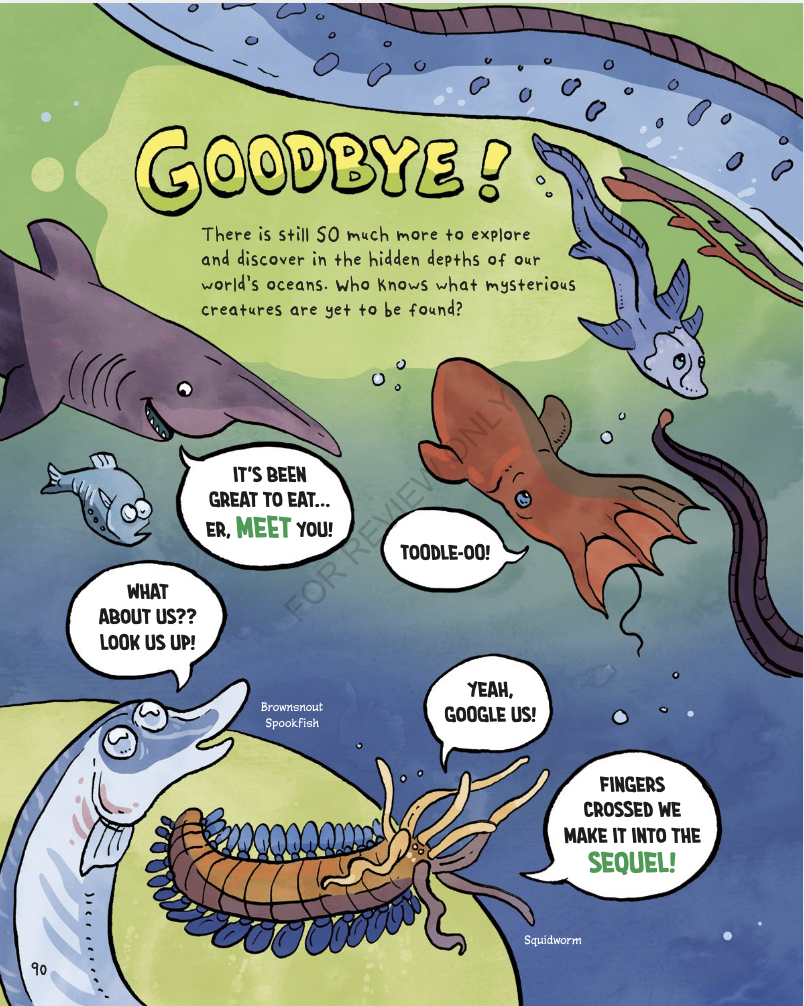
Sink deep deep below the waves to meet the creatures that dwell where nothing else can live. A fantastic voyage filled with humor and facts we can guarantee you never knew before! Ahhh. So this is what I’ve always wanted in a deep sea book for older kids. And no shade on the other whale fall book out this year, but I guess I had sort of hoped that that book would have the sheer levels of excitement and interest that this one has. Fashioning her style on old 1950s B-movie posters, Lindsey Leigh packs her book with hilarity and solid factual information. I learned a LOT from this title. Somehow, Leigh manages to sandwich the less interesting info between the fascinating and funny (as well as gross) stuff so beautifully that it’s irresistible. A must read! Previously Seen On: The Funny List

Drawn to Change the World: 16 Youth Climate Activists, 16 Artists by Emma Reynolds

Can young people make a difference for the environment? These 16 kids did. Watch via these comics their struggles, beliefs, and triumphs in this unique group biography.  I suppose we could debate at length whether or not this book goes into the nonfiction section or the graphic novel section, but I’ll put it here. This shows kids taking charge without, I think, instilling in them any particular fear. Even when awful things happen to them (like getting arrested by the Chinese government) the book sees no need to dwell on those moments. Now I did find myself wishing that there had been 16 authors as well as 16 artists at work here, but I guess for the sake of continuity it makes sense. Even so, I feel like Reynolds definitely put more time into some of these activists (like Dara McAnulty) than others (like Leah Namugerwa). Overall, however, it’s strong and it does one thing that I have never seen an environmental book for kids do: It shows that the whole “your Carbon footprint” idea was started by corporations who wanted to distract people from the fact that they are the world’s biggest polluters. That’s huge! So there’s a lot to love here.

The Forest in the Sea: Seaweed Solutions to Planetary Problems by Anita Sanchez

It seems ridiculous that the slimy seaweed you see wash up on beaches could be key in fighting climate change, but it’s true! Find out its numerous amazing (and often delicious) uses! It’s interesting! But, as so often happens, I have to figure out if it’s interesting to me as an adult or interesting to kids. The book’s job is to lure in child readers that might not come to its pages already kooky for seaweed. It starts off strong, no question, but does bog down a little from time to time. Fortunately they break up the text with the little sidebars. I liked the focus on the farming and the uses of seaweed. It has some really strong pages. Deserves to be seen by those kids with an eye to solutions for the future.

The Great Giraffe Rescue: Saving the Nubian Giraffes by Sandra Markle
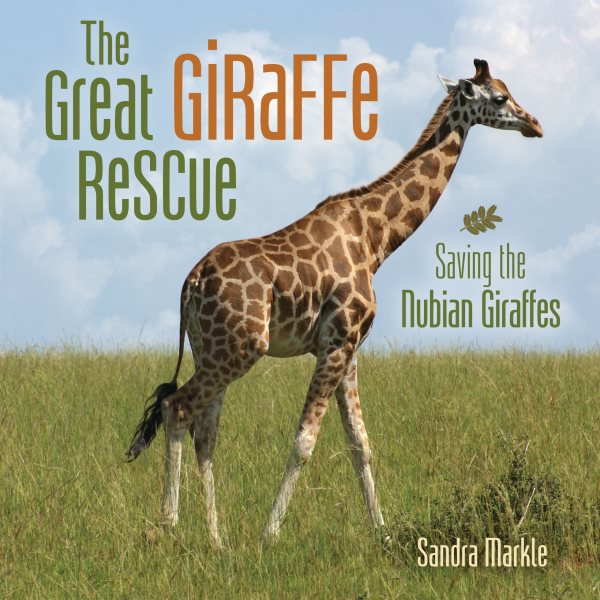
So very well done! It’s certainly a title for older readers, but it doesn’t bog you down with endless pages, coming in instead at a handsome 40. I was particularly intrigued by the fact that the efforts in this book weren’t focused on moving ALL the giraffes out of a region, but a significant number that could increase their numbers over time. LOTS of lovely photographs, which I always enjoy, and Markle even managed to include a kind of giraffe hero into her story (Melman, the giraffe with a kind of wonky jaw). Accessible and cool with a larger message about how we have a tendency to ignore danger to different species until it’s too late.

Hidden Systems: Water, Electricity, the Internet and the Secrets Behind the Systems We Use Every Day by Dan Nott
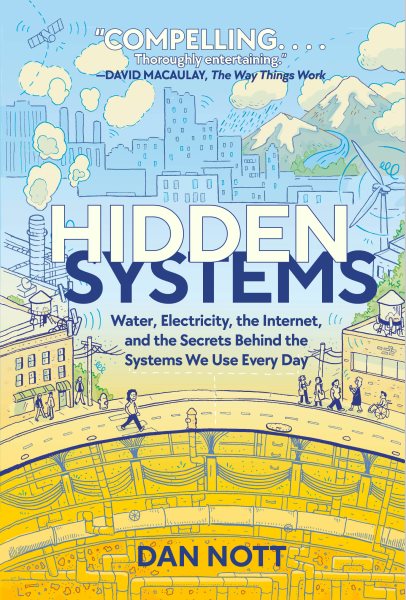
“Huh, I actually have no idea how the internet works.” “And wait… is there really enough water for everyone all the time?” “And what’s really powering this light? What even IS electricity?” If you’ve ever found yourself asking even one of these questions, Dan Nott has provided a book that is nothing but answers. As he mentions early on, a hidden system is something we don’t notice until it breaks. They’re also supremely hard to visualize, so a graphic novel format actually makes for the perfect vehicle for explaining not simply the mechanics, but also the history, the inequities, and how these systems must be updated in the future if we want to sustain them. I’ve been joking to folks recently that David Macaulay must have retired this year or something since the man has been on a blurbing bender. That said, this book is the PERFECT vehicle for a Macaulay a.k.a. “The Way Things Work” blurb. Just as Macaulay broke down the construction of cathedrals, pyramids, and more, so too does Nott break down whole systems we rely on. And I don’t care how much you think you know about these three things. You’re bound to learn something incredible on almost every page. For example, did you know that the lines that carry our internet follow the exact same paths as the lines that carried telegraph messages originally? An utterly fantastic and fascinating book. Definitely on the upper end of middle grade, but for a savvy reader there’s a lot to be interested in.

The Language of Plants: Understanding How Plants Communicate by Darya Beklemesheva, ill. Helena Haraštová, translated by Mark Worthington, edited by Scott Alexander Jones

While I’m not the biggest fan of its design, there’s no denying that Russian Beklemesheva knows how to pluck out the most interesting facts for kids on a topic they may or may not have encountered before. The book is separated into interesting sounding sections with names like “Life-or-Death Struggle” and “No Stress”. Within those sections, the Table of Contents show how they are broken down even further. For example, under the chapter heading “Mighty Scents” are the three sections “Can a plant kill an antelope?”, “How do plants warn each other?”, and “Why do caterpillars get upset tummies?” Extra points to translator Mark Worthington for getting some nice nuances of language in there. Meanwhile there are some truly gripping stories inside. The antelope section, for example, reads like a murder mystery. In the 1990s, kudu antelopes were dying in large numbers on South African wildlife reserves? The culprit? Their acacia trees had become toxic, and trapped as they were on the reserve, the antelopes couldn’t get far enough away to avoid the leaves. Full of fun facts, this is for the plant nerd (but with clever booktalking I bet you could get other kids interested as well). 

The Miracle Seed by Martin Lemelman

Everyone knows that the Judean date palm went extinct long ago, right? But when scientists were given 2,000 year old seeds, they decided to see if they’d grow. A tale of history, science, and delicious dates.  Sometimes you gotta sit on a book a while to understand what you think about it. I’ll confess that I wasn’t originally going to put this book on this list when I received it. I liked it, but was it memorable? So I put it down for a week or two  . . . and kept on thinking about it. Seriously, it’s amazing how many times I’ve found myself thinking about its implications. For example, I recently was listening to a podcast that was discussing the now extinct plant silphium and found myself wondering what would happen if someone managed to find some silphium seeds. With its panels, speech balloons, and other elements you might find in a comic book, the information here is incredibly accessible for kids. I like how Mr. Lemelman also managed to work in Jewish history as well as the science necessary to understand WHY a seed this old could still be viable. Absolutely fascinating. 

Unseen Jungle by Eleanor Spicer Rice, ill. Rob Wilson
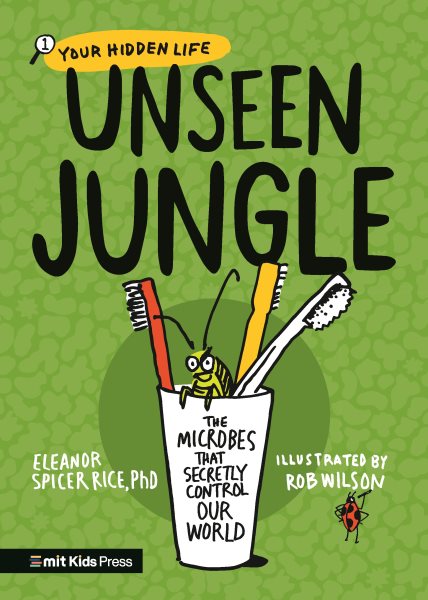
Whether you’re an up-and-coming young scientist or just want a book with the grossest stuff in it, there’s a lot to love in this compendium of microbes and their unseen, highly disgusting, world. Sorry, folks. I hate to be the one to break the news but I found myself a nice super gross book for 2023 and I’m loving it. What’s the name of the game this time? Microbes! Specifically bacteria, fungi, protozoa, archaea, algae, super-tiny animals, and viruses (though Rice acknowledges that some scientists would say they don’t count). The book then systematically goes through every possible place you might encounter them. It gets two germ-encrusted thumbs up from me on the “yuck” factor, but you also learn a TON of info. For example, this may be the first time I’ve ever felt bad for flies. Read the book. You’ll see why. Previously Seen On: The Gross List

We Need to Talk About Vaginas: An Important Book About Vulvas, Periods, Puberty, and Sex! by Allison K. Rodgers, ill. Annika Le Large
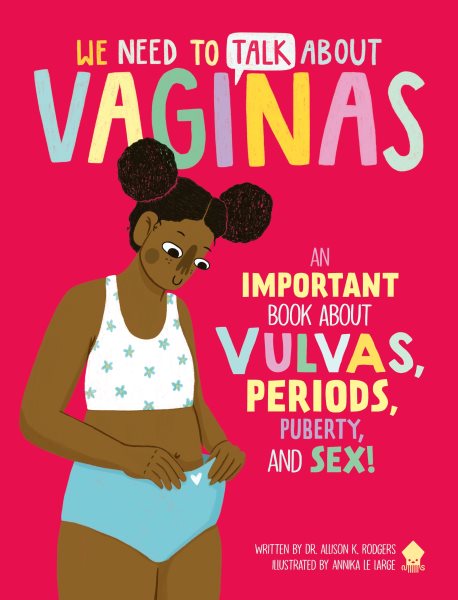
Straightforward information about everything from puberty and pregnancy to consent, presented by a gynecologist who knows exactly what questions people with vulvas might have about their changing bodies. And here we come to the complicated question of what to do with a book that is more of a straightforward informational text than anything else. A necessary book? And how! Lord, I don’t think I saw any of this stuff in a book until I went to college and my roommate handed me Our Bodies, Our Selves (am I dating myself much?). Kids today are so lucky. This book does a pretty good job of remaining aware of bodies along the LGBTQIA+ spectrum, while also offering straightforward information in a clear cut way. It’s not a particularly creative book or pretty book in that way, but boy am I glad that it’s now in this collection!


Hope you enjoyed these! Here are the lists you can expect for the rest of this month:

December 1 – Great Board Books

December 2 – Picture Book Readaloud

December 3 – Simple Picture Book Texts

December 4 – Transcendent Holiday Picture Books

December 5 – Rhyming Picture Books

December 6 – Funny Picture Books

December 7 – CaldeNotts

December 8 – Picture Book Reprints

December 9 – Math Books for Kids

December 10 – Gross Books

December 11 – Books with a Message

December 12 – Fabulous Photography

December 13 – Translated Picture Books

December 14 – Fairy Tales / Folktales / Religious Tales

December 15 – Wordless Picture Books

December 16 – Poetry Books

December 17 – Unconventional Children’s Books

December 18 – Easy Books & Early Chapter Books

December 19 – Older Funny Books

December 20 – Science Fiction Books

December 21 – Fantasy Books

December 22 – Comics & Graphic Novels

December 23 – Informational Fiction

December 24 – American History

December 25 – Science & Nature Books

December 26 – Unique Biographies

December 27 – Nonfiction Picture Books

December 28 – Nonfiction Books for Older Readers

December 29 – Audiobooks for Kids

December 30 – Middle Grade Novels

December 31 – Picture Books
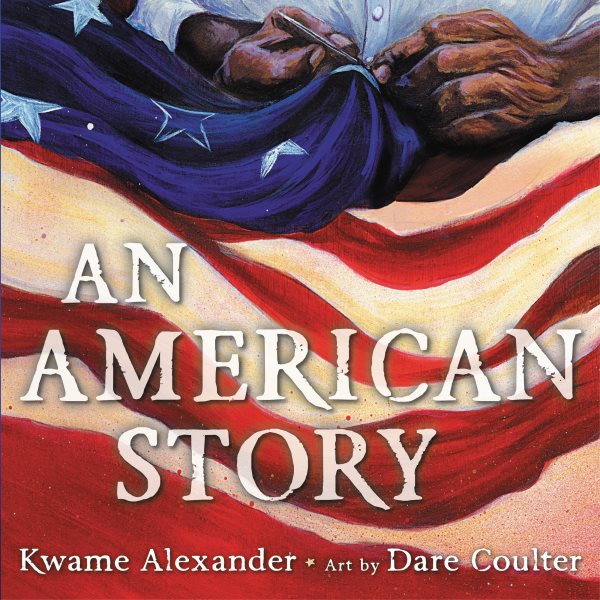
Filed Under: 31 Days 31 Lists, Best Books, Best Books of 2023 Tagged With: 31 days 31 lists, science, science and nature, science books

31 Days, 31 Lists: 2023 American History for Kids

December 23, 2023 by Betsy Bird

Hm. It can sometimes be difficult for me to determine what’s a trend in books for kids vs. what I actually get off my butt and read. I just went through all the titles that I read this year that I’d call “American history” related, and to my surprise I read surprisingly few middle grade novels that would fall into that category. That’s on me, I think. Surely there were a slew published in 2023 out there that I entirely missed. Then again, historical fiction used to be a much bigger percentage of titles published for kids. It used to win all the major literary awards. These days? I think a lot of it gets discounted as “boring” or “educational”. Fortunately, as you will see from the books on today’s list, these are titles that may do a lot of things, but bore you? Never but ever. And for fun, I’m just putting it all together here. The picture books, the older fiction, the nonfiction, the comics, you name it. Enjoy!

If you’d like a PDF of today’s list, you can find one here.

And if you are interested in reading past “American history” booklists that I’ve compiled, please consider the following:

  • 2022
  • 2021
  • 2020
  • 2019
  • 2018
  • 2017
  • 2016

2023 American History for Kids

An American Story by Kwame Alexander, ill. Dare Coulter

You can’t tell the story of America by just telling the happy parts. A look at early slavery in America and a consideration of what we teach our kids at school. Holy moly! You know, every author, no matter how good they are, has their ups and downs. They simply can’t knock it out of the park every time. So when I pick up a Kwame Alexander book, I don’t care how many starred reviews it has. I want it to surprise me. Well, apparently after working with Kadir Nelson, Kwame must have thought to himself, “Hey, winning a Caldecott Award was fun. I wonder if I can do it again?” because the art of Dare Coulter here is jaw-dropping. Seriously, I’m already mentally writing articles about what it might mean for this to be the first Caldecott Award winner to use modelwork on the page (though, of course, we’ve had Honors like Frida by Yuyi Morales). Inspired by his kid’s school’s egregious teaching of slavery when discussing colonial America, Kwame sets the record straight. The title is on point, but it’s the art of Coulter that blows you away. When you get to that shot of the girls by the fire, that’s when you know you’re in for something amazing. It’s rough but it’s honest. The anti-CRT crowd ain’t gonna like this . . .

Bomb: Graphic Novel by Steve Sheinkin, ill. Nick Bertozzi

The adaptation of Sheinkin’s multi-award winning history of the race to create the atomic bomb during WWII gets a visual makeover in this graphic novel adaptation. Already a pretty gripping book, there are places where this book will fill a definite need. For any kid (or adult, let’s face it) still struggling to understand how an atom bomb even works, Bertozzi’s clear-cut illustrations help a lot. I read Bomb back in the day and I actually thought that the explanation about heavy water here was superior to that in the original. The action sequences work fairly well, and I was reminded that Sheinkin is no stranger to comics. After all, he published The Adventures of Rabbi Harvey back in the day (look it up sometime) as well as the Walking and Talking series here on Fuse 8 where he would interview famous children’s book creators. I did have a couple moments of confusion once in a while when reading the book. For example, the moment when Dr. Oppenheimer meets his new secretary at Los Alamos and has to be introduced by a new name, I pretty much had to read the exchange several times to figure out what was going on. For the most part, though, it’s a rip-roaring bit of history. Hand it to the Nathan Hale’s Hazardous Tales fans who are hungry for more. And be sure to check out this interview with Steve and illustrator Nick Bertozzi for more background information into this title. Previously Seen On: The Graphic Novel list

Contenders: Two Native Baseball Players, One World Series by Traci Sorell, ill. Arigon Starr

I’m just trying to remember the publishing scene even ten years ago and how likely it is that a book like Contenders would have even (A) come out and (B) been as beautifully lauded and advertised as this particular book has been. The name “Traci Sorell” undoubtedly sounds familiar to you. That’s probably because she’s done such critically acclaimed titles as We Are Grateful: Otsaliheliga and We Are Still Here! Native American Truths Everyone Should Know. Here she creates a dual biography that starts with a big moment, then pulls back to fill in some biographical info. In the 1911 World Series, the only two Indigenous baseball players in the major leagues faced off against one another. Naturally, the press at the time was just awful about it. Never alleging or filling in with fake dialogue or committing really any of the usual bio sins, Sorell tells the background stories of Charles Bender and John Meyers adeptly. They had a couple things in common, but in many ways they led incredibly different lives. I was particularly pleased when I saw the eight additional Native players listed since 1911 that have played in the majors. Artist Arigon Star presents them like baseball cards, while at the bottom of the page you have depictions of racist white fans with tomahawks and facepaint facing off against Native activists, their fists raised high. A powerful telling with fantastic backmatter.

The Day the River Caught Fire: How the Cuyahoga River Exploded and Ignited the Earth Day Movement by Barry Wittenstein, ill. Jessie Hartland

“Wake up, this is not a drill!” By the 1960s the Cuyahoga River in Cleveland caught fire . . . again! Learn how its clean-up helped inspire the first Earth Day in this strange, stinky, (sometimes explosive) tale. And how’s that for an eye-catching title? The joke is that when you read this, there wasn’t just one time the river caught fire but MULTIPLE times that it happened! And people just sort of wrote it off like, “Huh. Guess the river’s on fire again.” Wittenstein and Hartland are having a ball with this book. How could they not? It’s the ultimate example of pollution that’s gotten way out of hand. The kicker is seeing how having a fiery river was normalized until folks finally decided to do something about it. Jessie Hartland’s art style is a perfect companion to this storytelling as well. A fun bit of kooky storytelling about a very real event.

Dear Yesteryear by Kimberly Annece Henderson

When I was a teenager, I had a secret passion. It was a little odd, but I loved going to antique shops and looking through the old photographs they had on sale there. These were forgotten photos from the late 19th early 20th century, and often I would buy the ones that I thought were the most interesting and take them home. There, I’d make up stories about them and what their lives might have been. Photography has always been something that’s fascinated me. Little wonder that when I heard about Dear Yesteryear I was instantly intrigued. What I did as a kid as a hobby, historical curator and researcher Kimberly Annece Henderson does as a calling. In this book she takes historical photographs of Black people and their families from the 19th and early 20th century and weaves poetry around them. In her Note from the Author she says, “Trees have roots, and we each come from a long line of people who play a role in our unique life story.” When I interviewed Ms. Henderson about the book this year, she said, “this book acts as a figurative family photo album for Black Americans who might not have done their ancestry research yet, or if they’re like me, and they have hit roadblocks researching their ancestry due to American Slavery, these portraits represent this idea of collective Black ancestry in a sense. That’s what makes it feel special in my opinion.” Beautifully put and beautifully put together. Previously Seen On: The Photography List

The Lost Year by Katherine Marsh

A 13-year-old boy trapped indoors by Covid-19 uncovers a dark family secret leading back to the Holodomor, the early 1930s Ukrainian famine caused by Stalin’s policies. This is a unicorn. It’s one of those books with three narratives that actually works. I’ve noticed a slight increase in adult nonfiction focusing on the Ukrainian famine recently, but we hadn’t really seen anything on the children’s side of things. The reason I’ve included it on the American History list is that two of the narratives focus on our American history, both the early days of the pandemic and an America that wrestled with how to acknowledge (or fail to do so) what was happening in the Ukraine. I’m not ashamed to say that as a 45-year-old woman I was inordinately proud of myself for figuring out the twist in the story. Some kids may see it coming, but not all will. Additionally, its audiobook is WELL worth listening to. Multiple narrators tackle the three kids in the book, and it’s incredible to consider that they needed each of those narrators to not only be good at acting itself but to also correctly pronounce both Ukrainian and Russian terms with aplomb. I wouldn’t have considering pairing a pandemic storyline alongside a Ukrainian famine one, but it makes a LOT of sense. A kid stuck with his great-grandmother for weeks on end is going to be more inclined to hear her story than one able to leave the house. Gorgeously written and cleverly plotted (something I personally find so hard to do). I was entranced.

Nathan Hale’s Hazardous Tales: Above the Trenches by Nathan Hale

Nobody is doing anything even slightly close to what Nathan Hale is doing these days. Let’s say you’re a children’s librarian sitting at a reference desk. Kid comes up to you and asks for a book that shows battles in war. Now regardless of your own pacifism instincts, you want to give that kid what they want. Trouble is, if your library is anything like mine, the books you have for kids on the subject are going to be old. We just don’t have a lot of books on historical wars for children these days. And the best possible exception to this? Nathan Hale’s Hazardous Tales. Now they’re not all about war, but the ones that are have no equal. I went into his latest installment thinking it would be about The Red Baron. I mean, it’s fighter pilots in WWI, right? But since our narrator, Nathan Hale, was eaten by a big book of Americanhistory in the first book of this series, the focus of this book is the Americans who volunteered to fly for France long before America entered the war. It is also playing with fire, this book. Right from the start Nathan Hale warns the reader that the pilots in this book will be drinking alcohol and smoking. We then get a glorious shot of the Hangman and Provost doing precisely that (much to the alarm and fury of Hale). But even better, EVEN BETTER, is the fact that the planes flown at a certain point of the war were, and this is true, called Fokkers. Oh. Oh. The jokes, my friends, the jokes. Absolutely one of his finest. If you’re searching for enormously well-researched deep dive into WWI planes that’s also the funniest stuff being written today in comics, you can find no better book than this. Previously Seen On: The Graphic Novels List

Remember Us by Jacqueline Woodson

In a summer where the houses on Sage’s block go up in flames regularly, everything from her friendships to her relationship to basketball is bound to change. A nostalgic tale from a magnificent author. This is going to sound strange, but I think that this is Woodson’s Dandelion Wine. Which is to say, she’s steeped every page in a great deal of nostalgia. The focus is on a moment in history when Bushwick in Brooklyn kept catching on fire in the 1970s. Woodson indulges in some slow storytelling, but that doesn’t mean she’s abandoned its emotional resonance. And like the characters in this book, I do remember being a kid and feeling like I was already looking back at a memory, just as Sage does here. It’s great writing.

There Was a Party for Langston, King of Letters by Jason Reynolds, ill. Jerome Pumphrey & Jarrett Pumphrey

“There was a party for Langston at the library” Langston Hughes, that is. A marvelous recounting of one man’s legacy and a vibrant visual praise of Black American writers. This text sings. Oh, happy day! I like this book by the Pumphreys! I like this book by the Pumphreys so much that I honestly think that this book has some serious Caldecott contender cache surrounding it. Woohoo! This is a marvelous example of how a good writer (and they don’t get much better than Jason Reynolds) can do a bit of nonfiction without faking anything AND making it a fun read for kids! Gone are the rote bios that dully recount a person’s life without viv or flair. And the typography! I hope someone interviews the Pumphreys and Jason together so that we can hear about how this collaboration actually occurred. How much influence did he have over their art? Was it their idea to turn the first names of Maya Angelou and Amiri Baraka (I’m assuming that’s the Amiri Jason means) into their bodies? Bonus: 500 extra points to Jason Reynolds for the line, “rickety radio heart”. 

World Made of Glass by Ami Polonsky

Iris has a secret and its eating her up inside. Her Dad is dying of AIDS and in mid-80s NYC, that’s the kind of thing people don’t understand. Only through activism does she begin to come to terms with a world on fire. I listened to the audiobook of this, which I think was the right way to approach it. Honestly, it got me to thinking about middle grade historical fiction in other countries, and I wondered if other nations spend as much time dissecting recent history for kids today. This book (by Evanston native Ami Polonsky) is a dead dad book to its core, which isn’t usually my bag. It also requires the heroine to do a complete 180 on her dad’s partner in a relatively short amount of time. But that said, it’s not like she’s just met the guy and the anger is new. This was an old anger that she was just sort of holding onto since she didn’t know the guy very well. Once they start hanging out more, I found her ability to let it go reasonable and believable. As for her vocabulary, Iris is a poet with a poet dad. All told, this is a pretty good introduction to the AIDS crisis at its peak.


Hope you enjoyed these! Here are the lists you can expect for the rest of this month:

December 1 – Great Board Books

December 2 – Picture Book Readaloud

December 3 – Simple Picture Book Texts

December 4 – Transcendent Holiday Picture Books

December 5 – Rhyming Picture Books

December 6 – Funny Picture Books

December 7 – CaldeNotts

December 8 – Picture Book Reprints

December 9 – Math Books for Kids

December 10 – Gross Books

December 11 – Books with a Message

December 12 – Fabulous Photography

December 13 – Translated Picture Books

December 14 – Fairy Tales / Folktales / Religious Tales

December 15 – Wordless Picture Books

December 16 – Poetry Books

December 17 – Unconventional Children’s Books

December 18 – Easy Books & Early Chapter Books

December 19 – Older Funny Books

December 20 – Science Fiction Books

December 21 – Fantasy Books

December 22 – Comics & Graphic Novels

December 23 – Informational Fiction

December 24 – American History

December 25 – Science & Nature Books

December 26 – Unique Biographies

December 27 – Nonfiction Picture Books

December 28 – Nonfiction Books for Older Readers

December 29 – Audiobooks for Kids

December 30 – Middle Grade Novels

December 31 – Picture Books
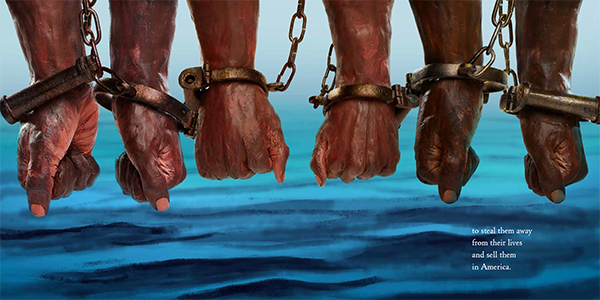
Filed Under: 31 Days 31 Lists, Best Books, Best Books of 2024 Tagged With: 31 days 31 lists, American history

31 Days, 31 Lists: 2023 Informational Fiction for Kids

December 23, 2023 by Betsy Bird

Creativity deserves commendation, wouldn’t you say? And when it comes to conveying nonfiction topics to children, such creativity isn’t just interesting. It’s downright necessary. My favorite nonfiction titles are the ones that find new ways to get kids engaged and interested in something they might not have cared about before.

But there’s a catch.

On the one hand, I adore thinking and acting in new ways. On the other hand, there’s a moment when that creativity goes from factual to fanciful. Nothing wrong with that, except that you can’t really call it “nonfiction” anymore. Pity the members of my library’s 101 Great Books for Kids committee. Whenever the subject of nonfiction comes up (and it comes up a lot) I become this shrewish harridan, railing against the sins of fake dialogue and books that speculate on the thoughts of people (or, almost more commonly, animals) without sufficient evidence. I decry those titles without backmatter. As you can tell, I am truly a joy to work with. Fortunately, there’s a term (coined, I do believe, by the inestimable doyenne of nonfiction herself, Melissa Stewart) that allows books that mix fiction and fact together to have their own moment in the sun: Informational Fiction. And to that end, I salute those very books today. You won’t see me putting them on any of the straight-up Nonfiction lists for 2023, but I want you to acknowledge how nicely they do the job of making their subject matter bright, fun, and always always interesting.

And if you’d like a PDF of today’s list you can find one here.

Curious about other books that mix their fact and fiction together? Then check out some previous years’ lists:

  • 2022
  • 2021
  • 2020
  • 2019
  • 2018
  • 2017
  • 2016

2023 Informational Fiction for Kids

AlphaBot by Vicky Fang

Fine. I’m a sucker for the mix and match books. So sue. This is actually a STEM board book/mix and match title, which puts it in the company of . . . no other books out there. So it’s definitely on the older side, but these robotic terms aren’t pushy at all. They just gently suggest themselves. As you flip through your robot’s head, middle, and lower extremities, on the right hand side is what they look like and on the left hand side are little vocabulary terms like “Android”, “LED”, or “Neural Network” (which I kind of love because in that case you’ve just given your robot some freaky deaky brain legs). As you flip through with your kid you can just say the terms and hope that in some small corner of their brains the terms will lodge there. It’s science done gentle and fun, and isn’t that what we’re all hoping for with these books? Previously Seen On: The Board Book List

Burt the Beetle Lives Here by Ashley Spires

Burt! He’s back! He’s back and he’s by Ashley Spires, so you’d do well to sit up and take notice. Good old Burt. If you saw Burt’s previous outing in Burt the Beetle Doesn’t Bite then you’ll be familiar with this general format. Essentially, Burt is a june beetle who lives alongside a fair number of other bugs. His antagonist is the informational nonfiction narrator that makes his life difficult and gives him a reality check when often that’s the last thing he wants. In this particular book, Burt is on the lookout for a home, and he’s soliciting ideas from the other insects. Trouble is, what works for, say, a termite or a bee does not work for a june beetle. The jokes? They land. And the comic book format and panels make for a rather lovely way of getting some factual information into kids’ brains. Add in the “Awesome Insect Builder Facts” and you have yourself a highly enjoyable science info conveyance system. 

The Deep End: Real Facts About the Ocean by Drew Sheneman

Doggone it. You know, throughout the year I try to read through my piles and piles and piles of books with the single purpose of weeding a bunch of them out. But when a book is as funny AND informative as this, I’m up a tree. How can I resist it? Our captain narrator here serves as our avatar as we learn more and more about the creatures of the deep deep deep. He’s a bit of a dork, but you grow to love him as he pairs up with an actual scientist in his quest to learn what exists at the bottom of the sea. If you have a penchant for manatees wearing seashell bras when explaining how some sailors mistook them for mermaids (“I make this look good”) and some new facts that I hadn’t actually encountered in any of the other 500 deep sea books this year, this is the book for you! It has some really delightful lines in it as well (“We’re just glossing over the whole dissolving bones thing?”). And for the record, any book that seems to contain any tangential Simpsons references in its pages instantly gets an additional 30 points in my book (I can’t prove it but the line “I sleep in a bed that looks like a race car” seemed awfully familiar).

I Am a Tornado by Drew Beckmeyer

Often I read a picture book and instantly know what category to slot it into. Then, once in a great while, I meet a book that sort of defies my expectations and understandings. I thought, going into this book, that it was going to be funny. And it was! And I thought it might have a bit of a message, and there’s some of that too. So, a job well done, right? We’ll just put this book on the Funny list and the Message list. But then I actually read the whole thing cover to cover and found that it becomes downright poignant at the end. Beckmeyer makes this seemingly silly story of a tornado wrecking havoc into a gentler tale of why people with power cling to it so tightly, and the loneliness that can be their real fear. That final shot of the winds blowing through the windmills really got to me. Then there’s also the fact that Beckmeyer has sneakily worked in all kinds of science information here discussing the formation of tornadoes and where they come from. By the end, I realized that while there are humorous parts to this book, what it really is is a fantastic readaloud for kids. A strange, wonderful one. Like a picture book version of the Neko Case song “This Tornado Loves You”. Never thought I’d write that in a picture book summary before. Previously Seen On: The Readaloud List

Ice Cream Man: How Augustus Jackson Made a Sweet Treat Better by Glenda Armand and Kim Freeman, ill. Keith Mallett

We see, in our time, a number of children’s books about new heroes, hitherto unsung in their time. In many ways, picture book biographies are the place where new heroes can now, finally, find their place in the sun. No better example of this exists than this marvelously fun new bio of Augustus Jackson. Granted, the book contains at its start the following caveat: “This story is true to the known facts of Augustus Jackson’s life and the realities of society during the time he lived. However, in crafting this biography, we included some imagined scenes, people, and dialogue. These parts of the story are dramatic extensions of historically documented events and interactions.” Hence its inclusion on this particular list today. Even so, aside from the occasional imagined thought on Mr. Jackson’s part, by and large this book sticks fairly closely to the truth. What really threw me was the idea that Augustus Jackson was the one who came up with the notion of using rock salt to create ice cream at a faster rate. As any child that has ever attempted to create their own handmade ice cream will tell you, that ingredient is essential to its creation. This book does a marvelous job of making Augustus and his world completely relatable and understandable. This, in spite of the fact that he lived in the early 19th century. The art of Keith Mallett helps in bringing this story into a context that kids today will understand. And who doesn’t understand ice cream? A marvelous choice of subject and final product all around!

Ready, Set, Run! The Amazing New York City Marathon by Leslie Kimmelman, ill. Jessie Hartland

What’s it like to run in a real marathon? Stretch, get a good night’s sleep, and join the 50,000+ runners for a fun look at this amazing race! It was a co-worker of mine who pointed out to me that this book is one of the rare sports-related titles that I could add to this list. Admittedly, I was already very fond of it. If you remember the old book The Philharmonic Gets Dressed, this has a lot of similarities. You get to follow not simply the route of the New York City Marathon (I adore the map in this book) but also so many of the details. I used to live right along the route in Manhattan so this felt so true to me (particularly those darn bananas they hand out). And I Iove how fun little facts are snuck in along the way. But the best thing about this book? When you read it you suddenly want to join in and give the marathon a whirl. I hate running and I started thinking to myself how fun that could be. Now THAT is a sign of a successful book! 

Seals Are Jerks by Jared Chapman

It’s that moment in a child’s life when they realize that nature is red in tooth and claw. A kid is utterly enamored of seals, who are, admittedly, just adorable. Then the truth about what they eat comes out. I mean, it’s penguins, y’all. They eat penguins. Of course when our heroine makes it all the way to the Antarctic to grill a seal on its eating habits, it also is revealed that penguins eat fish. And orcas eat seals! This is less a circle of life discovery moment and more the fact that morality and what you eat don’t really go hand in hand in nature. Loved the “Facts about Antarctica” backmatter here, which doesn’t drill down into a Bibliography or anything (this isn’t strictly a nonfiction book, after all) but does offer such tidbits as, “Since they only have ear canals, leopard seals are considered earless seals, which means they have to work really hard to be good listeners.” 

The Search for the Giant Arctic Jellyfish by Chloe Savage

Dr. Morley and her superb crew are embarking on an adventure to finally see a giant arctic jellyfish. Will they succeed or is the jellyfish more elusive than they think? The best description of this book that I can come up with is probably something along the lines of Where’s Waldo meets The Life Aquatic with Steve Zissou. I loved the tiny details and characters’ relationships to one another (which two are the ones getting engaged under the Northern Lights?). I’m also quite fond of the matter-of-fact statement that a woman scientist is leading this expedition. It reads aloud brilliantly (you really have to punch the words “giant. arctic. jellyfish,” when they come up) and, of course, the jellyfish itself is just so sweet. And those colors! It’s a kooky little thing, but I’m awfully fond of it. You know who else is fond of it? Actual scientists! My library has an award (The Blueberry) that we give out for Nature and Environmental books for kids, and we always make sure to have a couple naturalists, scientists, and experts to round out the committee. What book do they overwhelmingly love this year? This one, baby.

Stinkbird Has a Superpower by Jill Esbaum, ill. Bob Shea

Every time I see an artist that normally works in the realm of fiction switch it up and do a little nonfiction, my heart sings. It sang last year when Steve Light illustrated Larissa Theule’s Concrete: From the Ground Up and it’s singing like a stinky little bird thanks to Bob Shea illustrating Jill Esbaum’s Stinkbird Has a Secret. I’m just gonna say it: This may be my favorite kind of book. It’s a title that tells a range of bizarre facts about an animal, ending with the strangest of them all. And no, if you’re assuming that the final fact about the hoatzin is that it stinks like poop, you could not be more wrong. That’s literally the first weird fact they mention. After that, it manages to come up with an even wider range of weirdnesses, from the fact that they build their nests precariously over rushing rivers, to a baby hoatzin’s ability to swim. But I ain’t giving away that final fact. No, sir. Bob Shea pulls out all his most expressive technicolor talents here, making him the perfect person to bring this tale to life. Thanks to the talking birds and plot, you can’t quite call this straight nonfiction, so I’m calling this a perfect example of informational fiction instead. A smelly old delight. 

Team Trash: A Time Traveler’s Guide to Sustainability by Kate Wheeler and Trent Huntington

If you’d like a large dose of science with your science fiction then this time traveling adventure is your cup of tea. When Charlie and Oliver get paired up on a recycling project together, they accidentally find themselves traveling through time, discovering the different ways people have handled their own trash in the past. Delightful! I’ve literally never seen any book for kids take a systematic look at how sustainability isn’t just a 21st century idea. This does a great job of looking through a simultaneous worldwide and historical lens at the whole “reduce, reuse, recycle” concept as it’s applied to materials in the past. I also particularly enjoyed the discussion of what plastics can and cannot be recycled. Previously Seen On: The Science Fiction List

A Tulip in Winter: A Story About Folk Artist Maud Lewis by Kathy Stinson, ill. Lauren Soloy

My heart. It broke into two completely equal portions when I realized that this book, this truly lovely, utterly original biography, contained fake dialogue. As such, I won’t be able to put it on my Biography list this month, but don’t let that stop YOU from discovering it for yourself. Maud Lewis was an artist in what may be the truest sense of the word. Throughout her life she had rheumatoid arthritis, and as a child this meant she couldn’t play the piano anymore. What she could do, though, was hold a paintbrush. Eventually she became the live-in housekeeper to fish peddler Everett Lewis. Next thing you know, she’s painting his house, proceeding to create a magnificent piece of outsider art that does your heart good. In essence, she painted her own home, and did an incredible job of it. I adored the art from Lauren Soloy, which invokes Lewis’s art rather perfectly, as well as Stinson’s telling of her story. Had it not been for that dialogue (utterly unnecessary in the end) I suspect it would be making a slew of lists out there. As it stands, it got rave professional review after rave review.

Yoshi, Sea Turtle Genius: A True Story About an Amazing Swimmer by Lynne Cox, ill.  Richard Jones

I’ve definitely seen children’s picture books about Yoshi before, and this one is by far my favorite of the bunch. Cox has done a lovely job not simply relaying the facts of Yoshi’s life but also explaining why that particular story is remarkable and (best of all for me) tracing her path as she swam in the ocean. She’s such a cool turtle! The element that threw me was how the book showed what the turtle was thinking . It’s a great story, then, reliant on a fictional tropes. The art is quite lovely as well, and I thought Cox did a great job of turning the facts into a story you can root for. So as a piece of Informational Fiction, two thumbs way up.

Zero Waste: How One Community is Leading a World Recycling Revolution by Allan Drummond

What happened when Kamikatsu, Japan ran out of space for its trash? Meet the community that has nearly achieved its goal of Zero Waste and what it took to get there. You read enough Allan Drummond books and you begin to recognize that they very wildly. This book? Utterly entrancing, and I think I can say that as both an adult and as someone with a kid’s perspective in mind. It’s always a problem when these environmental books for kids just leave you feeling helpless. This book, in contrast, is just bursting with hope. I know on some level that maybe this is a cheery version of a more complicated tale, but on a rudimentary we-can-make-change level I think it has a lot going for it. Plus, I’ve found myself thinking of it every time I recycle (or don’t!). Like Drummond’s other books there’s a fictional story that serves as the framework for the factual information. Whatever works, man. Just keep churning out these books!


Hope you enjoyed these! Here are the lists you can expect for the rest of this month:

December 1 – Great Board Books

December 2 – Picture Book Readaloud

December 3 – Simple Picture Book Texts

December 4 – Transcendent Holiday Picture Books

December 5 – Rhyming Picture Books

December 6 – Funny Picture Books

December 7 – CaldeNotts

December 8 – Picture Book Reprints

December 9 – Math Books for Kids

December 10 – Gross Books

December 11 – Books with a Message

December 12 – Fabulous Photography

December 13 – Translated Picture Books

December 14 – Fairy Tales / Folktales / Religious Tales

December 15 – Wordless Picture Books

December 16 – Poetry Books

December 17 – Unconventional Children’s Books

December 18 – Easy Books & Early Chapter Books

December 19 – Older Funny Books

December 20 – Science Fiction Books

December 21 – Fantasy Books

December 22 – Comics & Graphic Novels

December 23 – Informational Fiction

December 24 – American History

December 25 – Science & Nature Books

December 26 – Unique Biographies

December 27 – Nonfiction Picture Books

December 28 – Nonfiction Books for Older Readers

December 29 – Audiobooks for Kids

December 30 – Middle Grade Novels

December 31 – Picture Books
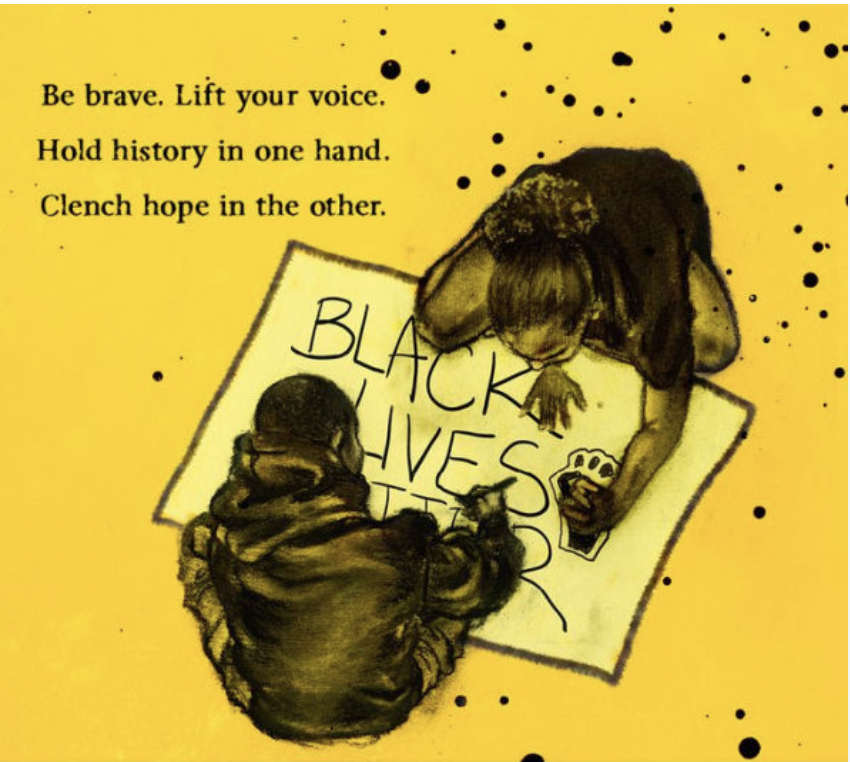
Filed Under: 31 Days 31 Lists Tagged With: 31 days 31 lists, informational fiction
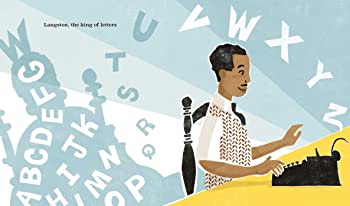
  • « Go to Previous Page
  • Page 1
  • Interim pages omitted …
  • Page 101
  • Page 102
  • Page 103
  • Page 104
  • Page 105
  • Interim pages omitted …
  • Page 1046
  • Go to Next Page »

Primary Sidebar