• Skip to primary navigation
  • Skip to main content
  • Skip to primary sidebar
  • About/Contact
  • Fusenews
  • Reviews
  • Librarian Previews
  • Best Books
    • Top 100
    • Best Books of 2022
    • Best Books of 2021
    • Best Books of 2020
    • Best Books of 2019
    • Best Books of 2018
    • Best Books of 2017
    • Best Books of 2016
    • Best Books of 2015
    • Best Books of 2014
    • Best Books of 2013
  • Fuse 8 n’ Kate
  • Videos
  • Press Release Fun

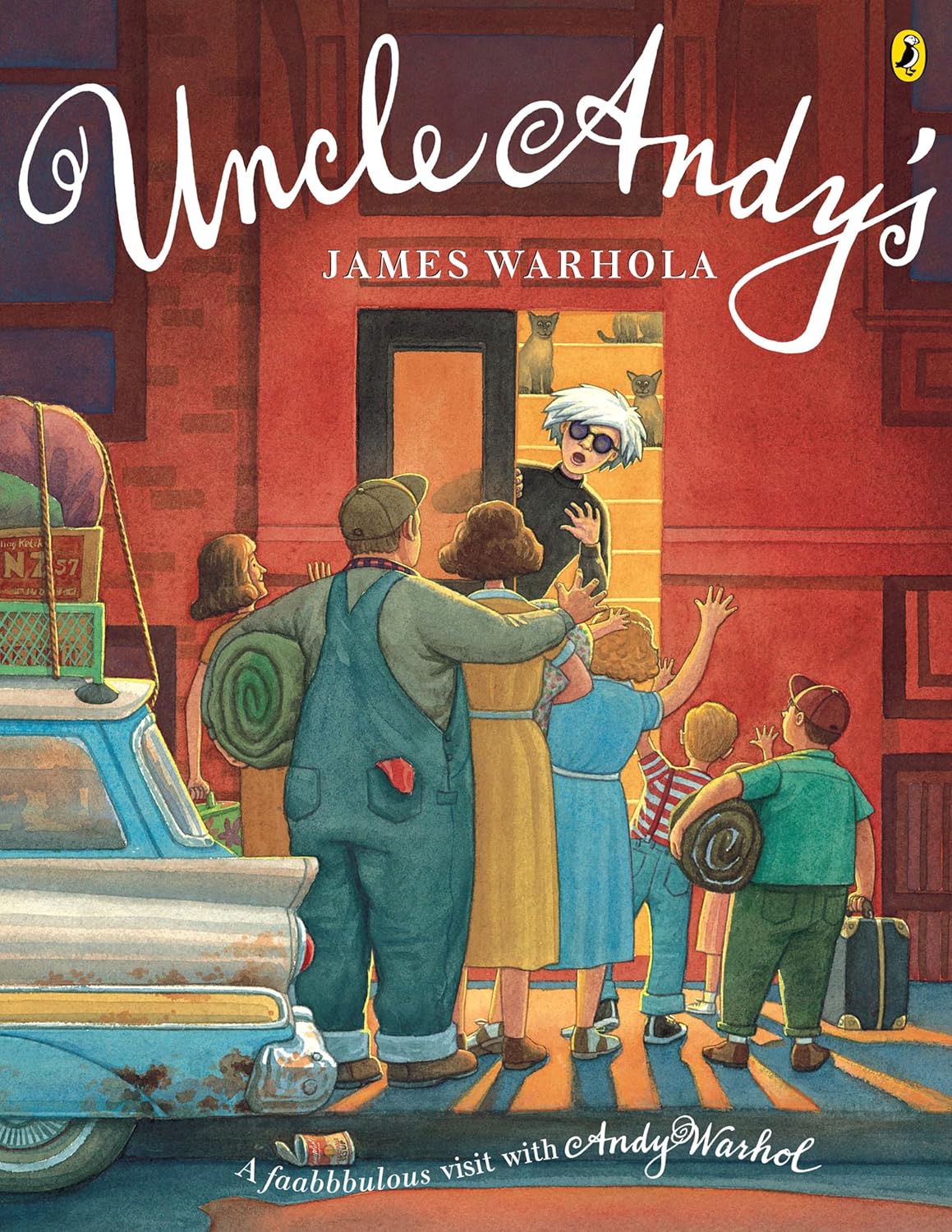
Fuse 8 n’ Kate: Uncle Andy’s by James Warhola

Fuse 8 n’ Kate: Uncle Andy’s by James Warhola

May 11, 2026 by Betsy Bird Leave a Comment

Before we go any further, I would like to clarify that we recorded this episode about 2 weeks ago. If you’re wondering why we’re not alluding in any way to the Mac Barnett situation, that is why.

So folks ask me to do more nonfiction on this podcast, and while I admit that it is a bit of a stretch to call today’s book pure nonfiction, I at least think that it’s closely aligned. It’s not a biography, though. Consider it more of a personal memoir from 1962. In essence, it’s the true story of Andy Warhol’s extended family, written by one of his nephews. Sadly, James Warhola didn’t continue to make much in the way of children’s books (though he did make a sequel to this book called Uncle Andy’s Cats). We discuss everything from David Bowie’s depiction of Andy in the film Basquiat, to creepy ventriloquist dummies, to what you should do if roughly a dozen members of your extended family show up at your door (answer: put them to work).

Listen to the whole show here on Soundcloud or download it through iTunes, Stitcher, Spotify, Google Play, PlayerFM, Audible, Amazon Music, or your preferred method of podcast selection.

Show Notes:

The brand names throughout the book threw Kate off a little bit. Here’s a question: How many Camel cigarette ads in picture books can you name off the top of your head. AMAZING no one got mad about that!

Speaking of stuff you probably couldn’t put in a book today without a separate author’s note: Kids in cars not wearing seatbelts.

And these were New York prices!!

My husband has this neat trick where you can show him a comic and he’ll tell you info on it. So I showed him these. He informs me that is Fantastic Four #4. The year it came out? 1962. You have to give my husband credit. He’s good at this stuff.

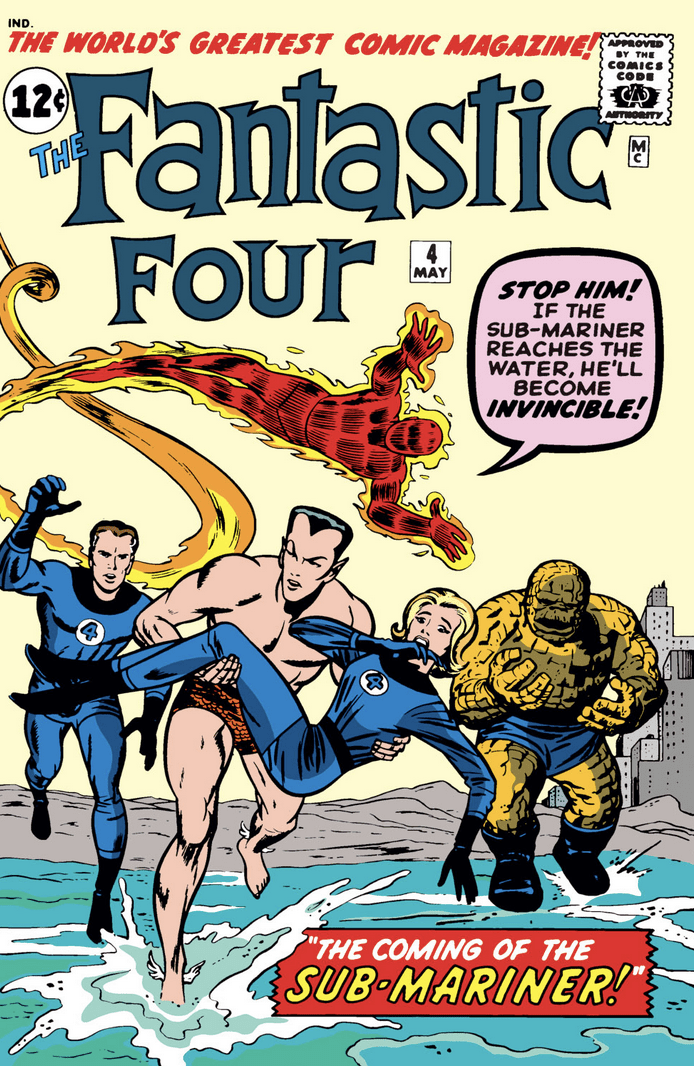
We love that the kids in this image are less realistically depicted than the ventriloquist dummy on the floor.

Steve Martin, by the way, was fully gray by the age of 32.

Ah! The Grandma Poss and Hush statues that I alluded to in the episode? See them here!

Betsy Recommends: J.D. Amato (recent creator of The Endless Summer)

Kate Recommends: My Favorite Murder is now on Netflix

Filed Under: Fuse 8 n' Kate Tagged With: Fuse 8 n' Kate, James Warhola, Uncle Andy's

Review of the Day: While We’re Here by Anne Wynter, ill. Micha Archer

May 8, 2026 by Betsy Bird 7 Comments

While We’re Here
By Anne Wynter
Illustrated by Micha Archer
Clarion Books (an imprint of Harper Collins)
ISBN: 9780063238299
$19.99
On shelves now

Oh, gatekeepers. Ours is a tricky lot to live. Imagine that you are in a position where you can see hundreds and hundreds and hundreds of new picture books published in a given year. You want to make sure that the future recipients of these books are just seeing the best stuff, right? I mean, in a sea of completely okay books, there’s always some remarkable little glorious gem worth discovering. The trouble is that you have to do this while also keeping in mind that YOU are not the intended audience here. It is awfully easy for adults to find certain topics or art styles of interest, while the child readers’ eyes slowly glaze over during a read. Similarly, what if a book displays a realistic moment that you, the grown-up, identify with while your kid doesn’t at all? Who is the book really for then? Such were the thoughts coagulating in my cranium as I read While We’re Here. Just to give away the game, I love this book deeply and thoroughly. But do I love it because I’m a parent and this storyline is SO relatable or because I think it’s a high-quality book that a kid will really enjoy? Or can both things be true at the same time?

“Hurry, hurry, jackets zipped. Hurry, hurry, out the door.” A mom and daughter dressed to the nines, toting a white present wrapped in a red ribbon, travel at top speed. They’re clearly late for some kind of a party, and so they zip through subway tunnels and run down park lanes. Yet when they arrive, not only is no one there, but it clearly looks like someone used to be. Where are the people? A quick look about and it turns out the party was yesterday. Do they wallow in their misery? They could, but mom adeptly distracts her daughter with the wonders of the park. There are ducks, and tunnels. There are hills to roll down and trails to explore. By the end, they slow down and take everything in. Hurry? Nah. They have nowhere to be.

I have to credit my children’s librarian co-workers. They were the ones a year or two ago that clued me into the important role that picture books with simple texts play in our world. I’m an adult. I love sophistication. I like cleverness. When a text is simple, I can’t use my usual methodology to gauge its success. I have to read the book in an entirely new way. But then Anne Wynter comes along with a very simple text, but also a situation that both kids and their guardians are going to understand entirely: your grown-up messed up. You had a fun thing you were going to, and now you have no fun thing at all. And it’s not because of you, kid. It’s because of your parent. Now the logical response to this is anger at the parent and sadness for the loss. Wynter’s book becomes this phenomenal mentor text because she acknowledges the sadness, but rather than wait to have the kid work herself up into a screaming catfit of some sort, the mom has this fascinating technique. Until the party, the repeated lines have been “Hurry, hurry”, all culminating in that final sentence before the reveal of, “Hurry, hurry, up the hill. We have somewhere to be!” After that, mom exchanges the “Hurry, hurry” to “We’ll head back home, but while we’re here…” which is a fascinating distraction. In the art you can see that she is the only rolling down a nearby hill in her fancy dress. She is the one leading the two of them under a stone bridge to explore. She is the one reaching out to the ducklings. The practicality of heading back home is continually usurped, so that it feels like mom and kid are getting away with something (thereby appeasing the child). It’s a parenting method I can relate to since I truly believe that distraction with small children is more art than science.

I would be amiss in not touching on some of the cadences chosen for the text as well. It doesn’t rhyme, at the beginning, did you notice? “Hurry, hurry” is rhythmic, absolutely, but as easy as it might be to do some kind of a rhyme (the missing shoe sequence, in particular, almost begs for it). By not rhyming, Wynter almost increases the tension of getting to the party on time. Then, when everything has gone down, and the daughter isn’t as upset anymore, and they’re taking their time, listen to what the text does at the end. “We’ll head back home, eventually. / We’ll sit awhile, beneath a tree. / We’ll wander off, just you and me. / We have nowhere to be.” Aside from the “nowhere to be” acting as a flip of the earlier “We have somewhere to be!” when they’re running to the party, that four sentence rhyming sequence slows the read, and then ends the entire book with this satisfying thump. I tried to describe it some other way, but “satisfying thump” is, I will maintain, still the best way to say what this book does. Thump. So satisfying!

There’s collage and then there’s COLLAGE (all caps, bold as brass). Think of Eric Carle’s collage art. Meticulously hand-painted papers, cut to size, often placed against pure white backgrounds. How pretty. This is not the Micha Archer way. Micha’s collages crowd the pages. They hustle up to her human figures leaving not so much as a millimeter of pure white to be found. Just to clarify, I’ve no special insights into how Micha makes her books. I don’t even know the order of her process. Does she paint her characters first and then collage around their painted parts? Does she collage first and then paint on top of the papers? Beats the friggin’ heck out of me, but what works, works. Winner of the Caldecott Honor for Wonder Walkers, Archer has previously done books with relatively calm levels of emotional content. I’m not saying they don’t have plots, but those plots do anything but keep at an even keel. The parental betrayal we witness in this book is a wholly new thing for me to encounter in a Micha Archer title. Look at that wordless two-page spread of the party picnic table, empty, abandoned, paper cups left to rot in the sun. A nearby trashcan overflows with wrapping paper, a sole sad balloon floats, and in a bold move that shows the artist’s expertise, the hanging words “Happy Birthday” are backwards. Why did Archer make them backwards? Because it makes the two pages feel just a little bit… wrong. And part of what I love so much about this moment is that adult reader and child reader can come into this scene and be just as baffled as the main characters, until all is explained. Now look at the pages. Until now the white parts of the pages that contain the text have been in bands on the bottom of the pages. Once this moment of revelation happens, the world is compacted into circles. Only when mom finds ways of using nature and play to cheer up her kid do the collages explode again and you end with a full page, no white space at all, in a final image of mom and daughter. Brilliant choices from start to finish.

I mean, are we gonna talk at this point about the book’s use of red? Might as well. Red balloons are classic picture book staples (even if the original Red Balloon picture book consisted of movie stills). Take a moment to admire this cover too. Red on mom’s top, red on the daughter’s top, those red shoes the kid is wearing, and then, almost subtle, red balloon that floats over their heads. There’s just this one yellow string bisecting mom’s face, matching the earrings of both mom and child, literally tying the whole image together. As we read the book, there is also the red ribbon around the present that never gets delivered (and that, to my infinite satisfaction, makes it into the final image of the book). Red is present in other pictures as well, but Archer keeps the two main characters foregrounded, their reds making them easy to spot, even when they’re far away from the reader. In the two-page spread of the missed party, they stand in red on the left, and that abandoned balloon floats morosely on the right. Then, in the last image in the book, the sky is a pink color, the closest it can get to matching their outfits (and, indeed, the pinks of their tutu and pants echo it). So much care. So much thought. So much attention goes into a book of this sort.

So yes, this is a book for both gatekeepers and children. It’s fun for both. It appeals to both. And it also features Black characters. This fact might not have been quite so notable, even as recently as four years ago, but in recent times our children’s publishing industry has experienced a cool down. Black creators like Wynter aren’t getting published at the same rate as they used to be. When they do, their books tend to be about meaningful topics, like believing in yourself, which, while completely necessary, is rather limited. So apart from everything else that I like about this book, I just like that it’s a book about a mom and kid bonding, and they happen to be Black. I would kill for a hundred more books like this one. Books that have this much thought and time and attention by Black creators like Wynter and speak to universal topics that we haven’t seen in picture books before. While We’re Here is a masterclass in cohesive storytelling, where the simple text is doing more work than you initially notice, and the art is matching it beat for beat. Looks simple. Ain’t. And I love that for it.

On shelves now.

Source: Final copy sent from publisher for review.

Filed Under: Best Books, Best Books of 2026, Reviews, Reviews 2026 Tagged With: 2026 picture books, 2026 reviews, Anne Wynter, Best Books of 2026, Caldecott 2027 contender, Caldecott contender, Clarion Books, Harper Collins, Micha Archer

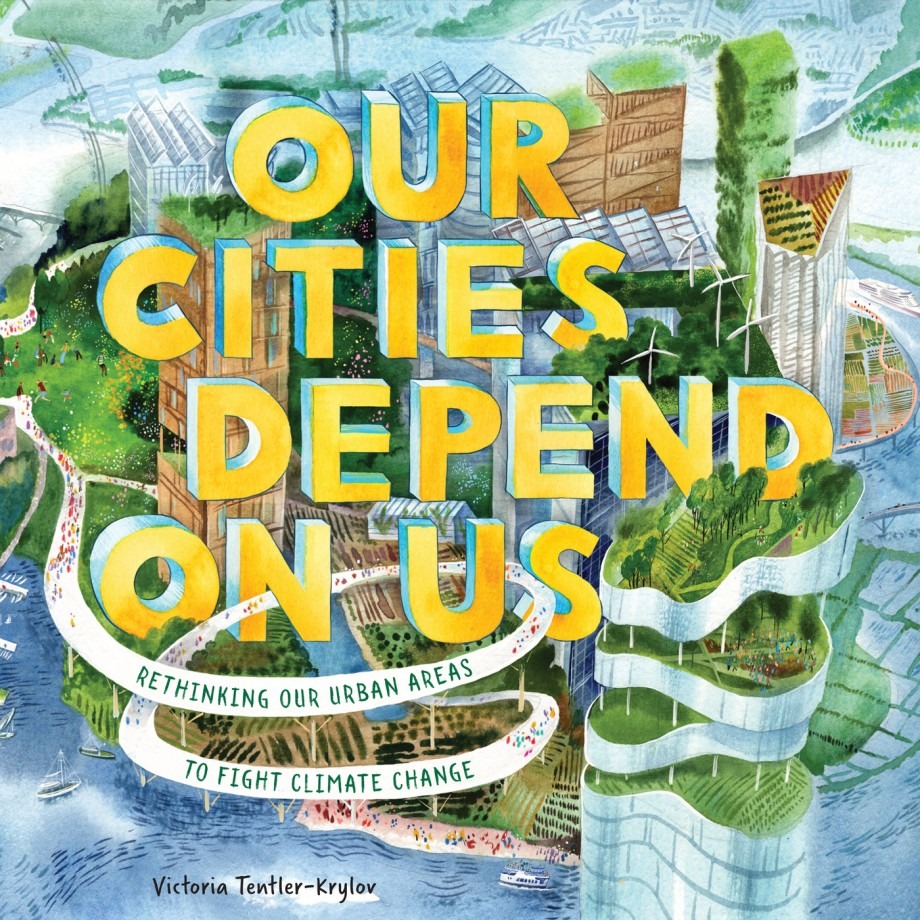
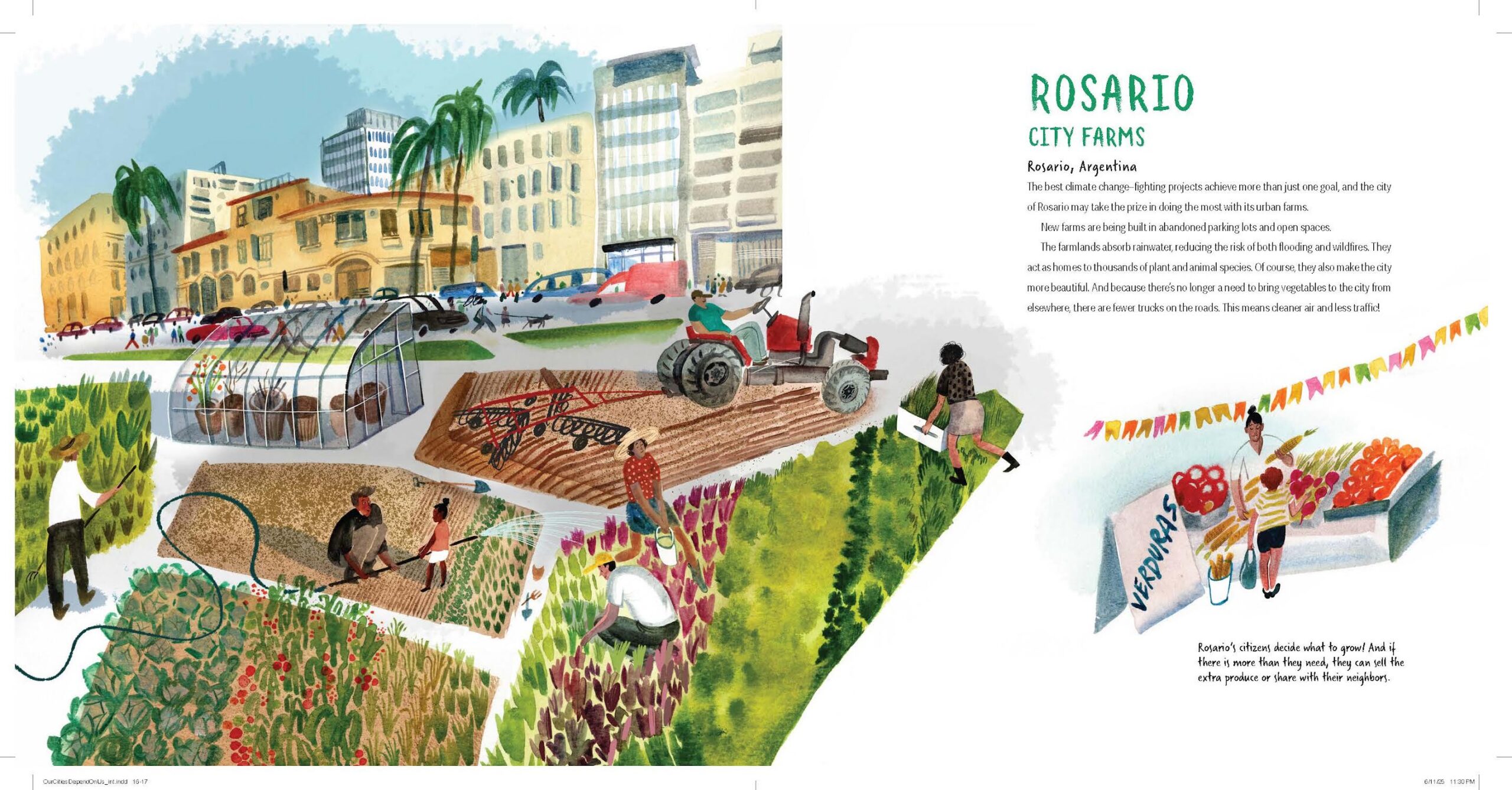
Green Roofs Galore: It’s an OUR CITIES DEPEND ON US Q&A with Victoria Tentler-Kryov

May 7, 2026 by Betsy Bird Leave a Comment

It’s no secret that the Evanston Public Library has been at the forefront of climate action children’s literature awards thanks, in large part, to its Blueberry Awards. Full credit for its creation goes to staff member Martha Meyer who works tirelessly to both find new titles for the list and to promote them. Because of her work, I pay far more attention these days to books that have a conservationist bent to them. And with a title like Our Cities Depend on Us: Rethinking Our Urban Areas to Fight Climate Change, who was I to resist?

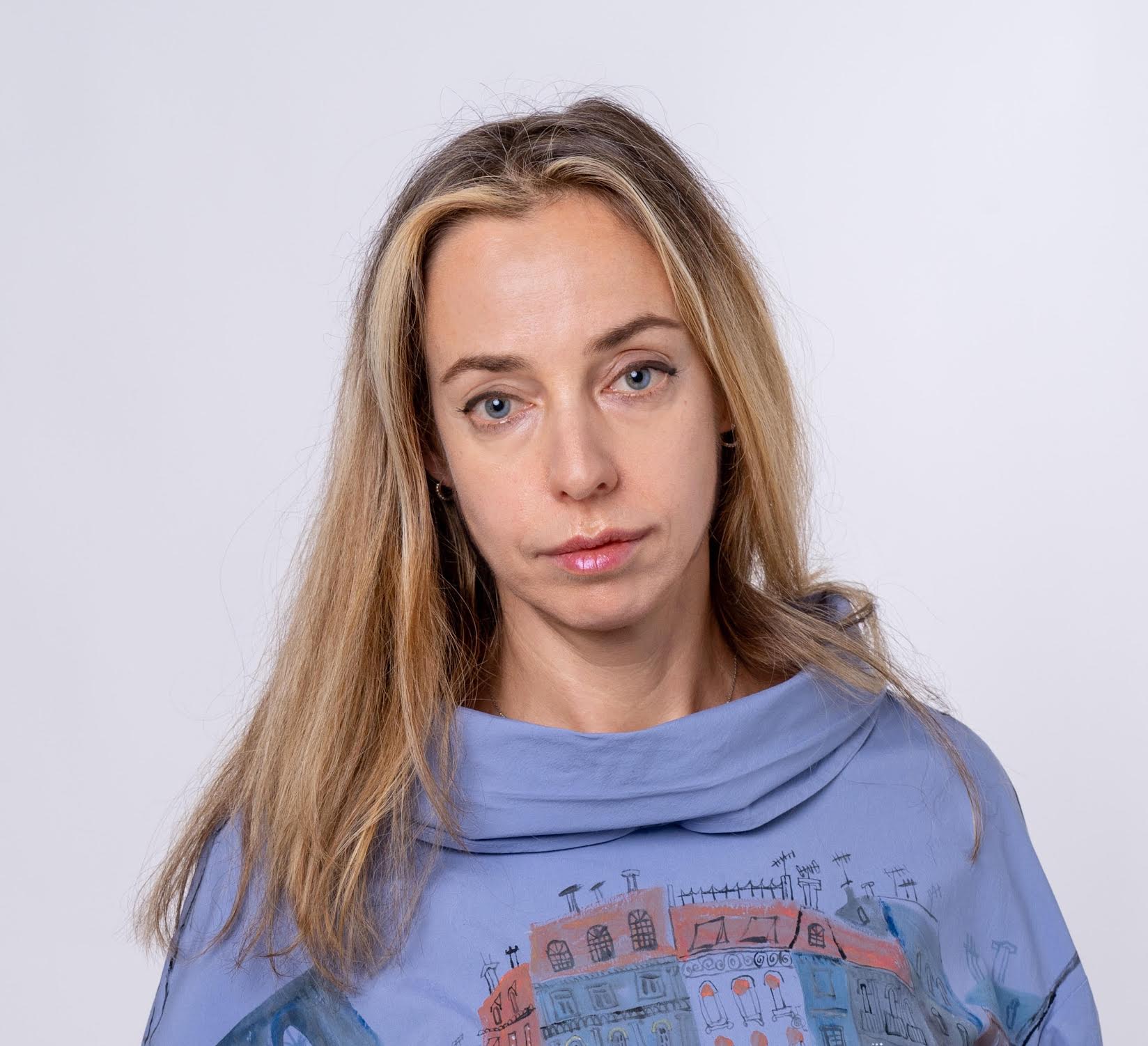
One reason I was so lured to this book has a great deal to do with its creator. Victoria Tentler-Krylov has been working specifically (though not exclusively) in the field of informational children’s books for years. And that distinctive watercolor technique of hers is what drew me to these titles from the start. Today, I’ve a chance to talk to her about her latest work. Our Cities Depend on Us (out now) is a compendium of green building. Or, put another way by the publisher:

“As people, animals, and even plants all over the world face environmental changes—rising sea levels, droughts, frequent and intense hurricanes and floods, and more—our cities must adapt.

We hear the terms “greenhouse effect” and “global warming,” but what do they mean? And can cities be rethought to not only fight climate change but to become more sustainable and meet the varying needs of their populations?

From the living roofs of Singapore to the Netherlands’ floating parks made of recycled trash, and innovative environmental efforts like transforming the Chicago River and saving the sinking city of Venice, many cities around the world have been incorporating new ways to fight these issues head-on. In Our Cities Depend on Us, author-illustrator and architect Victoria Tentler-Krylov shows young readers how cities around the world are taking action and how we must reimagine our urban areas to protect their history and more importantly provide them and us a future.”

Victoria was kind enough to answer a couple questions from me on the topic:


Betsy Bird: Victoria! Thank you so much for taking the time to talk to us today about OUR CITIES DEPEND ON US. You’ve created such a keen concept with this title. It’s a book that identifies the problems and then shows the solutions that come about when communities and people work together. Can you tell us a little about where this book came from?

Victoria Tentler-Krylov

Victoria Tentler-Krylov: This book actually came out of my fascination with Venice and the lengths Italy has gone to in order to preserve this incredible place for all of humanity. Namely, it’s a project called  MOSE (Modulo Sperimentale Elettromeccanico). It’s a massive underwater barrier system designed to protect Venice and its lagoon from flooding. I really wanted to focus on the engineering brilliance of the project. But the more information I collected about the project, the clearer it became that the book should expand and include other places around the world that are also doing amazing, innovative things to counteract climate change. 

BB: I’ll be visiting Venice this summer, and I know this book will already be topmost in my mind when I do. I also serve on the committee that determines the Blueberry Awards, given annually to titles that inspire a love of nature. One of the key components of this award is the fact that the books we consider must avoid climate anxiety and show a modicum of hope. Hope is so key when considering titles that tackle environmental changes. A book like your own is a very clear cut and practical book to hand to a child worried about what people are doing to help today. Was that on your mind at all as you wrote this?

Victoria: Climate anxiety that children experience these days was certainly on my mind. I saw it firsthand in my own children! It was very clear to me that children need tools and frameworks to shift away from all that anxiety and fear to feeling empowered and inspired to come up with their own ideas, to look forward to doing things and coming up with solutions, not just being frightened and hopeless. This focus on ideas and action, to me, is key in how we talk to kids about the changing climate. My book, hopefully, will inspire young readers by showing examples of creative, innovative climate action.

BB: Tell us a little bit about how you went about selecting the cities that you did. How did you find places to include in this book? Did you have a specific number in mind? And since you include thirteen places, was there a fourteenth (or even fifteenth?) that almost made the cut?

Victoria: As I mentioned, I started with Venice. I didn’t have a specific number of places in mind, but I definitely wanted to include different continents and diverse climates and cultures. There were a few that I knew I wanted to highlight because I was so enamored with them: the urban farming concept in Argentina, the sustainable clinic in Kyabirwa, the green roofs of Singapore. I learned about others from my research. To my disappointment, we didn’t have space for everything I wanted to include, so I had to cut many amazing projects: the high rises of Hong Kong, the floating villages of Makoko in Nigeria, and many others.

BB: In the course of your research for this book, did you encounter any facts that surprised you? Anything that caught you off-guard?

Victoria: One thing that is always interesting with these climate projects is how long they’re really meant to last. The most successful ones, I think, are designed to evolve and adapt as the climate changes. Unfortunately, the trouble with complicated and expensive projects such as MOSE in Venice or the Thames Barrier in London is that they may not be able to withstand the floods that increase with time. For example, I learned (and was definitely caught off-guard) that we are already seeing the limitations of MOSE in the face of particularly violent storms. Fortunately, this is recognized by the planners, so the projects are continuously updated and expanded, which is crucial.  

BB: Out of all the cities featured in this book, which one strikes you as most impressive? Which city should stand as a beacon for others?

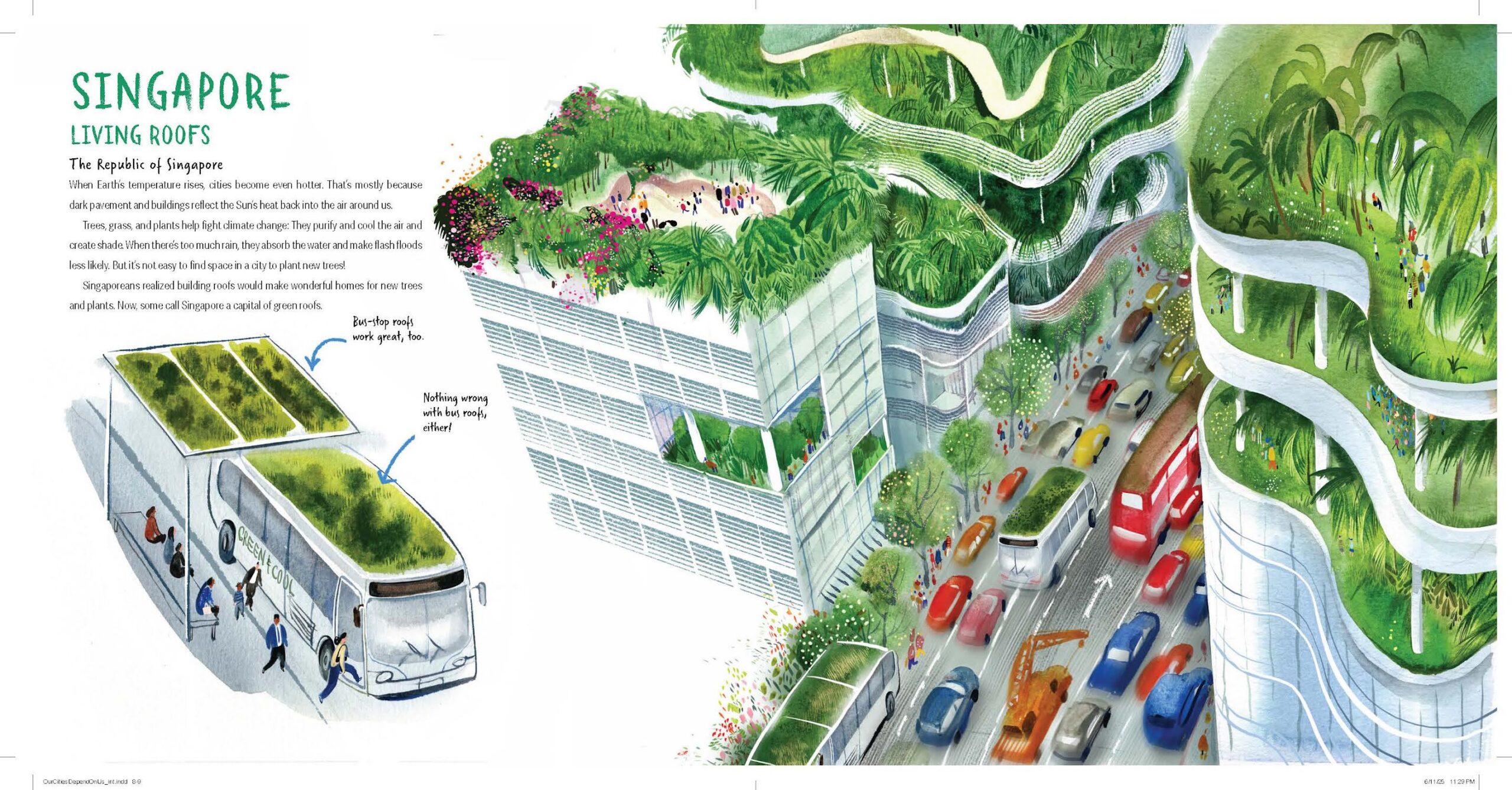
Victoria: I really love the concept of green roofs, so to me, Singapore is particularly inspirational. I absolutely love the fact that they look for green roof opportunities everywhere, including bus stops and even buses! But what I think is most impressive is the fact that countries worldwide collaborate, exchange climate action ideas, and help one another find solutions. This really does fill me with hope for us, for humanity as a whole.

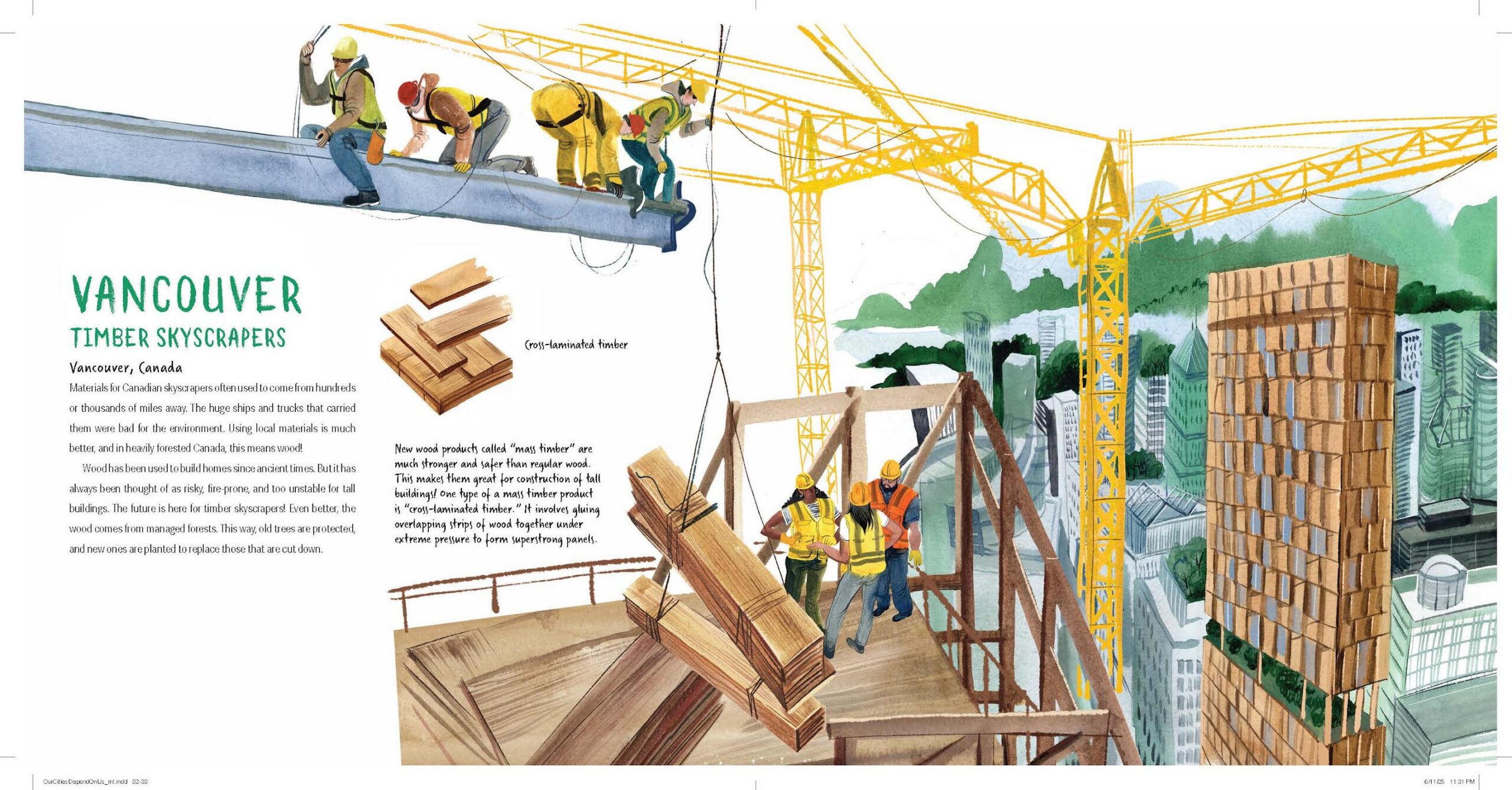
BB: Your watercolors in this book are marvelous (and I was particularly taken with your visualization of what Earth’s atmosphere does for the planet, at the beginning). Some of the cities are straightforward and clear. Others require complex explanatory models and diagrams. Did you have any difficulty with these? And what, by and large, determines whether or not a city is featured from a distance vs. with a p.o.v. on the streets?

Victoria: There was definitely a lot of research that went into the book, but I love research and so I had a great time! As a geek and a recovering architect, I personally enjoy diagrams and technical drawings of all kinds, but I was very aware of the need to make these diagrams clear and compelling for young readers. I hope I succeeded in this! As far p.o.v., it really depended on what I wanted to highlight. For example, with the green roofs in Singapore, it made sense to depict the city from above. With other places, such as the green towers in Milan, I wanted to show not only what they look like from the outside, but also what it feels like to be inside this high-rise jungle! So in each case I really tried to find the most important angles that give the reader a sense of the place and the project. 

BB: Finally, what else are you working on these days? What’s next for you?

Victoria: This is a busy year for me with two books that came out in March, and two more coming out later in the year – all nonfiction. In fact, I find myself working on nonfiction books most of the time! And this is what makes the project I’m working on now especially exciting – it’s a fiction picture book that I am writing and illustrating. The book tells the story of a very creative little boy who goes on a long-awaited outing with his dad – and the day does not go as planned. This book will be very different from everything I’ve done before, but it is still about things that are near and dear to me: cities, art, creativity, and noticing the beauty that’s all around us. That’s all I can say for now, but the project is well underway, and I cannot wait for it to see the world!


After seeing all her other books out, I’d say we’re ready for a lot more. Huge thanks to Victoria for taking the time to answer all my questions about her latest. Our Cities Depend on Us: Rethinking Our Urban Areas to Fight Climate Change is, as I mentioned, out now on shelves and in stores everywhere. Check it out and get just a bit of a dollop of hope about our future as it stands.

Filed Under: Interviews Tagged With: author interviews, illustrator interviews, informational books, interviews, nonfiction, nonfiction picture books, picture book author interviews

The “hopeful dystopian” conclusion. A Firesnake talk with Donna Barba Higuera

May 6, 2026 by Betsy Bird Leave a Comment

You may have seen a video that circulated for a bit on Instagram and Tiktok and YouTube and the like. It featured a fellow complaining about “kids books today” and how it’s all just self-esteem nonsense. He then proceeds to explain that in his day (this man cannot be above the age of 35) they read tearjerkers like Where the Red Fern Grows and Old Yeller. Folks, it took all my restraint to keep myself from recording a response video pointing out the natural flaws in this arguments. First off, no one under the age of 55 has EVER actually read Old Yeller. He just saw the Disney movie as a kid. Second, if you don’t think today’s books for kids have sufficiently dramatic, emotional scenes then you are clearly not familiar with the current crop of books. Ever heard of a little book call The Last Cuentista? The one where a girl wakes up to discover that people with transparent skin are almost the last vestiges of humanity?

Then I launch into a list of all the recent dead dog books, but you get the picture.

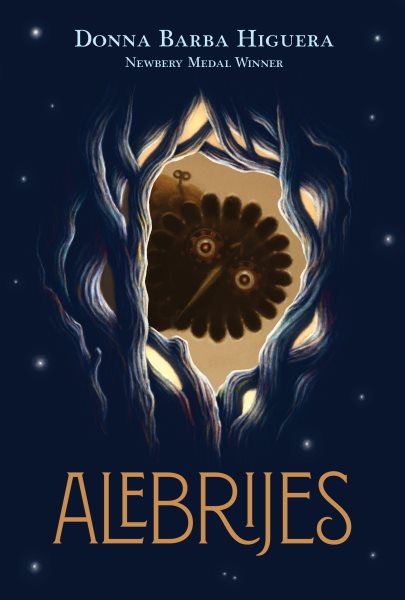
I loved The Last Cuentista when it was released, and when it won the Newbery Award I felt this odd sense of vindication on its behalf. Its sequel, Alebrijes, was unlike any other book I’d ever encountered.

This year, we have a third. Its name is Firesnake and it’s out June 2nd.

Put plainly by the publisher:

“Itzel has never known a life on Earth. Growing up on Sagan, the granddaughter of the Cuentista, her years have been spent among the dactyls, griblets, and billow seeds of their new planet. But when a mysterious message arrives from across the cosmos, Itzel realizes that the home they thought destroyed hundreds of years ago has survived…and with it, another community of humans. Will she and the other Saganites brave the journey back to Earth? And what will they find? For they are not the only ones who have received this message…

Master storyteller Donna Barba Higuera brings her beloved Cuentista trilogy to a close in a book full of old friends and new, jaw-dropping twists, and a journey to the stars and back.”

Today, I have the very great pleasure to speak to Donna Barba Higuera herself about this finale to her epic science fiction trilogy for kids:


Betsy Bird: Donna! Such a pleasure to get a chance to interview you again. In preparing for this interview I figured I’d just read a page or two of Firesnake and be good to go. Next thing I know it’s midnight and I haven’t stopped. When first you wrote The Last Cuentista, was Firesnake even a distant idea in your mind or did the thought of creating this book and plot come later? 

Donna Barba Higuera: Same! You know how chatty I am, so you are brave.

I would love to say I was that insightful. When I finished writing The Last Cuentista, the idea that it would become a series was not remotely in my mind. The second book, Alebrijes, was my sneaky attempt to write a book based on Earth after a “post-apocalyptic” event. I never say what that catastrophe was. But my editor saw right through it. I did not want to write a series. But that second book came about naturally, with its own distinct plot.

Then . . .

Questions from readers arrived.

When I started writing the third book in the series, this theme of the Firesnake, and the story created of how he traveled to another planet to protect humans came through naturally. It was in the very first chapter of The Last Cuentista, and so it seemed natural that this was how the series needed to close. Of course Firesnake would follow them back to their home planet.

But I don’t think my imagining of the Firesnake story and his coexistence with humans for hundreds of years is unique. I believe stories follow us throughout our lives and then generation after generation. The stories of our ancestors become ours.

BB: When you first sat down to write these pages, how clear was the plot in your mind? And was this book any easier or more difficult than the others in the series to write? 

Donna: The plot was a disaster! In that I didn’t have one. I had no idea where this story was going. After The Last Cuentista, I needed to answer the question I got repeatedly from readers, “What happened next?” The second book in the series, Alebrijes, answered that question, but for those left behind on Earth.

It wasn’t so difficult to imagine an entirely new character on a brutal, Mad-Maxish Earth. Then, I thought I was so clever writing an enticing epilogue at the end of Alebrijes, a message sent from the survivors on Earth to the survivors on planet Sagan. Turns out, if you write something like that without a clear plan, you might write yourself into a bit of a corner.

Whose story would this be about? Where would it take place? I owed it to readers not to take any shortcuts.

I started that third book simply with a character, Itzel. A girl who is born and raised on Sagan. A girl who grows up in the shadow of the Cuentista’s stories; stories that are interwoven in Sagan’s culture. A girl who resents the stories in many ways.

How was I going to combine the distinctly strange storylines of the previous two books, and even incorporate the previous main characters from those books, Petra and Leandro? It was a 20,000 piece puzzle with only a few colors. Petra and Leandro would have to be older. Add that traveling across space takes hundreds of years.

What was I thinking!

BB: When last I interviewed you, you mentioned that you were working on this project. In fact, your exact words were, “The task hasn’t been easy. There are so many strange creatures and concepts in each of the first two books, but for the final book, I’m trusting what I’ve discovered. The more bizarre my ideas are, the wilder directions my imagination travels, the more those stories attract young readers.” Could you explain a little bit more about what you’ve discovered in the course of writing these books? How does leaning into your more out there ideas ultimately serve your young audience? 

Donna: I’ve thought a lot about this exact topic recently. I’ve discovered to trust my imagination, the thing as a child I was often discouraged from doing. The daydreaming. The strange ideas I had always made me feel different, alone. But I now wonder if we all have those ideas, but are just afraid to share them. So much so that we lose some of that ability to wonder about all things strange. If this is what I’m finding connects me most to young readers, will my books encourage them to embrace the things that make them feel ‘different’? I hope so. I hope young writers will take it a step further, and create stories using the wildest ideas their imagination can come up with. But if I keep writing that weird stuff, maybe a young reader, who feels different like I did, won’t feel so alone in their love of the weird.

BB: I love that. You know, if there is a through line in each of these books, it’s a distinct dislike of authoritarianism, no matter what the form. To say such messages are timely would be a magnificent understatement. The Last Cuentista was published in 2021. Five years later, the world is a bit different than it was when that book first came out. What is it that you hope readers can take away from these books and use in the current world and political climate? 

Donna: Five years! Holy moly! I have discovered during these past few years that I veer toward writing topics that scare me. I’m not a confrontational person. So, writing is my outlet on how I feel.

Even as I say this, I can already feel my discomfort in stating the obvious. Things in our world today are a mess. And young people feel it. The types of people I wrote about, who scared me, exist. Young people are scared too.

The books in this series have been called ‘hopeful dystopian.’ I love that. I write of harsh worlds. The irony is that the apocalyptic comet-strike on Earth that activated the entire trilogy turned out to not be the scariest part. Much like our world today, in all three books, nature is an antagonist, and an integral part of the characters’ struggle. But in each book, humans, and what they are capable of doing to one another, is far scarier than a comet strike on Earth or cyclic killer winds on a tidal-locked planet.

But throughout the threats of evil, I write of the good; good people who may feel helpless at times in apocalyptic worlds. Sometimes the characters make poor choices, but in the end they have hope for something better. At the moment however, this sense of helplessness feels a little true to life. I guess I still want readers to have that sense of hope. Hope for a better world.

BB: And was there anything you wanted to include in this book that simply didn’t make it out of the editing process? 

Donna: Oh, many chapters ended up on the cutting room floor. I started the final book with Petra’s early days on the new planet, Sagan. I loved those chapters that took us back to Petra from The Last Cuentista. But they were a distraction.

The third book isn’t Petra’s story. It’s Itzel’s story.

But I think most writers have those exercises where you write a lot of backmatter that isn’t necessary, and actually takes away from the reader’s imagination of what they think happened during those times. I also could have continued on and on with the new discoveries Itzel makes on an Earth that is very different than what it once was. What creatures survived? Are there other pockets of humans? But there is a point where you must turn those questions over to readers. Let their imaginations think on what those answers may be.

BB: You know, I don’t think I’ve ever had a chance to ask you about the jackets of your books. Each one is so distinctive and stands apart from whole swaths of fellow middle grade novels released this year. Can you tell us a little bit about your relationship to these covers and your thoughts on each one in this series? 

Donna: One of my favorite topics! The illustrator, Raxenne Maniquiz, lives in the Philippines. She is an artist of many talents. She focuses on nature and botanical art. She is a fabric designer, art instructor, and now has done work for major corporations. My editor, Nick Thomas, discovered Raxenne’s work on Instagram long ago. The cover for The Last Cuentista was the first book cover she ever created. Raxenne has read each of the books, and designs these amazing covers based on her vision of what she reads. Her imagination! It doesn’t hurt that much of my books involve plants and animals. But, she creates imagery far beyond what my mind could drum up. I’m asked to chime in if I feel there’s an element we may want to incorporate on the cover. But, if anything, she finds parts of the stories I’d forgotten. Illustrators are magical. I know to step out of the way and let them do their work.

When I saw the first cover, I gasped. My teen daughter chimed in, “Mom, your book could suck, and people will still buy it because the cover is so beautiful.” Not only do I think my daughter was spot-on, I feel like that quote should be the cover blurb.

BB: Here’s the real question: The book certainly looks like the third in a trilogy. But is there any chance that a fourth might come along? 

Donna: Absolutely not. (I said the same thing after the second book.)

But, truly, I have no intention of writing a fourth. However, when young readers ask questions like, “What was Bioloaf Boy’s life like on the ship?” they send me down a rabbit hole of asking myself, “Yeah, how did he endure being part of the Collective? Did he ever fall in love? Did he ever consider rebellion? Did he regret not escaping with Petra and the other kids?”

But no, no plans for a book called Bioloaf Boy.

And this is just one of the many offshoot topics readers ask about in these worlds and characters.

BB: Justice for Bioloaf Boy!!

Okay, finally, what else are you working on these days? After this release, what’s next for you?

Donna: I have had a handful of books released in the span of one year. That involved a lot of travel. What’s next? I’m going to go outside, talk to my chickens, curse at the weeds in my garden, take hikes in the pines with my local kidlit friends. Then, I will get back to work on the next project.

All I can say at the moment, is that it will be weird.


Oh man. That is all that we could ever ask.

Sandworm-sized thanks to Donna for putting such thought, care, attention, and downright HUMOR (take note, other interviewees) in her answers to me today. Firesnake is, as I mentioned before, out June 2nd. Thanks too to Gina Gagliano for helping to put this whole interview together. Should you need your science fiction fix this year, I think you know where to go now.

Filed Under: Interviews Tagged With: author interviews, Donna Barba Higuera, interviews, science fiction

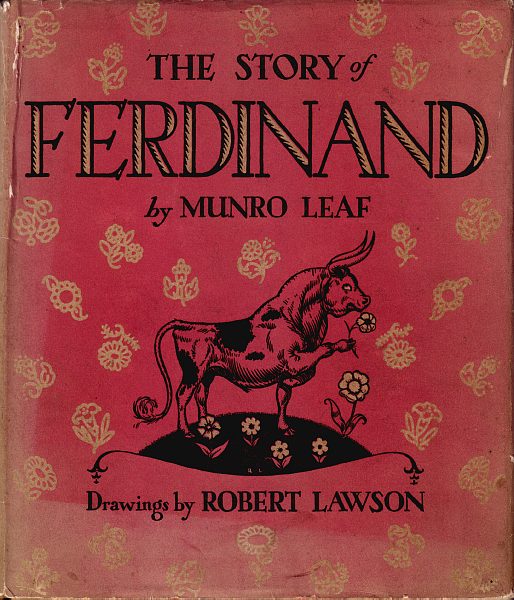
“.. a memorable hero, a compelling setting and a story that captivates multiple generations.” Jane Bayard Curley Discusses the Carle’s Ferdinand Exhibit

May 5, 2026 by Betsy Bird Leave a Comment

It’s not that Ferdinand hasn’t been exploited.

Sure he has. Anyone as sweet and docile as that pacifist bull who first appeared 90 years ago on the pages of a mere picture book was bound to be taken advantage of at some point. The funny thing is, it doesn’t seem to touch him. First there was the Disney animated short based on the book. Then the full-length feature movie in 2017. And yet when we think of Ferdinand, what we think of is his picture book by Munro Leaf and Robert Lawson.

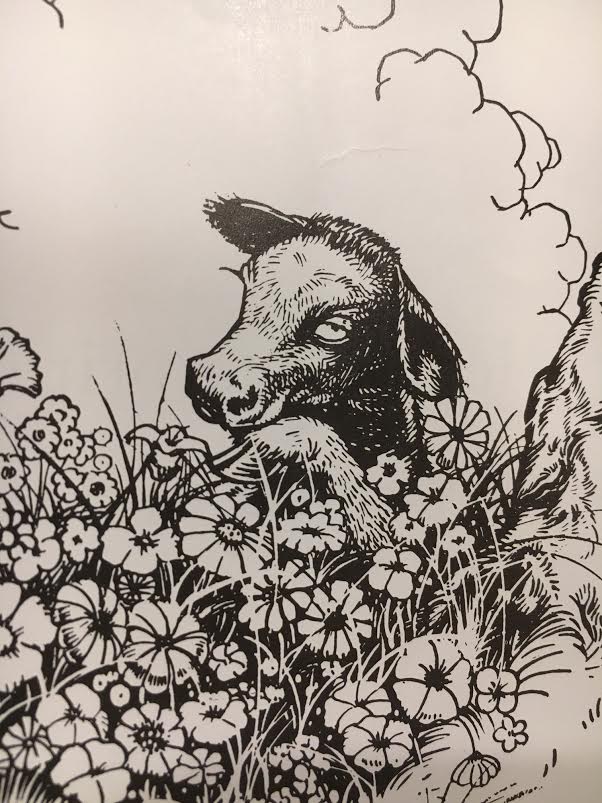
This spring, a special exhibition at The Eric Carle Museum of Picture Book Art celebrates the 90th anniversary of Ferdinand. Opening May 9, Under the Cork Tree: The Story of Ferdinand features the original drawings and manuscript of this legendary work, as well as materials from the Disney animated film and Ferdinand memorabilia. The exhibition gives a rare look at the original drawings, which showcase views of the Spanish landscape, characters like the preening matador, and the cinematic drama of an ill-timed bee sting.

Today, I have a chance to talk with guest curator Jane Bayard Curley about Ferdinand’s legacy, the exhibit itself, and why this quiet bull has become an icon for almost a full century.


Betsy Bird: Jane, thank you so much for taking the time to talk to us today. 90-year-old The Story of Ferdinand has a staying power that any picture book might envy. What drew you to curating this particular book for this particular show? 

Jane Curley

Jane Curley: I had suggested that The Carle might want to do an exhibition on Robert Lawson, and they wisely simplified what would have been a complex production into a one-book version. This is a more focused show, the very best of Lawson and Leaf’s work together. This book sits on my imaginary shelf where I keep my “UPPBs”: utterly perfect picture books, alongside Ludwig Bemelmans’ Madeline, Wanda Gag’s Millions of Cats, and Robert McCloskey’s Make Way for Ducklings. Leaf’s gentle humor and Lawson’s equally amusing response – remember those clusters of corks on Ferdinand’s tree? – have universal and lasting appeal.

BB: Noted. And I will be stealing the acronym UPPB from here on in. Now having curated a fair number of shows over the years, what special considerations had to be taken into account with this work?

Jane: Doing a deep dive into the history of just one book was a new experience for me. I still had to do the same amount of research, but this was laser focused. And here’s the thing: there’s always more work to be done. When you put on a show like this one, you get lots of publicity, and then people come out of the woodwork with great material you didn’t know about. Delightful and frustrating, but that’s the way it is.

BB: Sounds like book fodder to me. But tell us a little bit about the original book dummy. How does it differ from the final product? 

Jane: The book dummy lays the story out pretty much as it is in the finished version. There is one big edit, an entire do-over, however, that took me by surprise. The illustration for the page of “All the lovely ladies had flowers in their hair” had to be entirely redrawn. Why? Because Lawson, in a naughty moment, showed several of the lovely ladies waving a banana and a hot dog in a most suggestive way. I can just see May Massee, the editor at Viking, shaking her finger at Lawson and saying, “No, this will NOT do for children!”

BB: I have never wanted to see an image of a banana in a children’s book more in my life. Oh! And, impressively, you managed to obtain a cel from the Disney animated short based on this book. Why was it important to include this element of Ferdinand’s larger story, and how difficult was it secure this image? 

Jane: Finding a cel was not difficult – there are plenty of them out there from the 1938 Disney film – but finding one in good condition was tough. Cels are extremely fragile, and museums don’t like to lend them for that reason. I was lucky to know a private collector, Bob Forbes, who offered me a choice from his Disney collection, so the show features two cels and a line production drawing in pencil of Ferdinand talking to his mother. There’s also a lot of Disney merchandise on display: games; costume jewelry; records of the Ferdinand song; mechanical toys, even a bar of Castile soap. Disney had a marketing genius, Kay Kamen, who licensed all this. As much as the Academy Award-winning short film made Ferdinand a celebrity, the toys and games took his character to the next level, making him as famous as Mickey Mouse or Donald Duck.

BB: I think it’s also worth noting that the aforementioned Bob Forbes is a Carle Honor winner this year as well. Where do the original manuscript and the book dummy normally live when not on display?

Jane: Both the manuscript and the book dummy are housed in the rare book department of the Philadelphia Free Library. The complete suite of finished drawings in the show comes from the Morgan Library’s collection. I have to say, I’ve never had it easier, pulling works together for this exhibition. Usually, you can find me down in the weeds hunting for artwork. I found an entire bistro by Ludwig Bemelmans in Paris, another one on Long Island, and a third in upstate New York when I did a show on Madeline. The long-lost original Eloise of the Plaza portrait by Hilary Knight I discovered hidden in a cardboard tube with his wrapping paper. Just call me Nancy Drew.

BB: Oh, that portrait has such a fascinating history! But before I’m distracted, there’s something I’ve been curious about when it comes to Ferdinand for years. I’ve seen reports claim that Gandhi loved Ferdinand and Hitler hated him. Is there any truth to those claims that you know of, or are they just convenient stories that were embellished over the years?  

Jane: Think of a much-loved object like a bronze statue of a saint that has had its foot touched so often that it shines like gold. The details have gotten fuzzy from so much polishing. The Story of Ferdinand is like that. Has it really been translated into over sixty languages? No, according to the publishers at Curtis, Brown, it’s probably more like two dozen. Did Hitler ban the book? No, but the Nazi office that oversaw publications of foreign books did, calling it degenerate propaganda. Gandhi may have mentioned admiring Ferdinand – certainly his founding principle of ahimsa, or nonviolence, was in tune with the story, but there is no record of Ferdinand in his writing.

BB: Thank you. I adore clarification. Finally, what do you hope attendees take away from this exhibit? And what, to your mind, gives Ferdinand his longevity? 

Jane: For me, a great picture book is one that has a memorable hero, a compelling setting and a story that captivates multiple generations. Ferdinand rings all those bells. I’d like to think that as visitors exit the show, they will leave with a smile on their faces – and a determination to read more classic picture books.


A better sentiment I could not myself devise.

Huge thanks to Jane Bayard Curley for taking the time to answer all my questions today. As mentioned before, the exhibit Under the Cork Tree: The Story of Ferdinand opens May 9th at the Eric Carle Museum until November 8th. It is the finest paean to our favorite pacifist bull to date. And final thanks to Amanda Domizio who helped to pull this interview together.

Filed Under: Interviews Tagged With: Eric Carle Museum, interviews, Jane Curley, The Story of Ferdinand

Fuse 8 n’ Kate: Doña Flor by Pat Mora, ill. Raul Colón

May 4, 2026 by Betsy Bird Leave a Comment

As it turns out, this is the second time we’ve done a Pat Mora/Raul Colón collaboration. With this book, though, we delve into a moment in children’s book publishing history when multi-ethnic tall tales were the name of the game. It’s been a while since we’ve done a legitimate honest-to-goodness folktale on this podcast. They were once the lifeblood of children’s libraries, and these days they are rare gems. This book came out during a rise of legitimately tall “tall tales” in picture books. I’m talking everything from Big Jabe to Swamp Angel (both of which we need to get to). We discuss the fact that this 2005 publication came out when books still italicized their Spanish language text. We also discuss the fact that this book can’t decide whether or not the potential antagonist of the piece is a puma or a mountain lion.

Listen to the whole show here on Soundcloud or download it through iTunes, Stitcher, Spotify, Google Play, PlayerFM, Audible, Amazon Music, or your preferred method of podcast selection.

Show Notes:

I mention that if you go on Pat Mora’s website you can find this video of her talking about educator responses to this book:

I also mention Bing’s Cherries by Livia Blackburne, illustrated by Julia Kuo, which is this year’s tall person tall tale. You really really should read it!

I feel like this is Danny and the Dinosaur territory because “we can ride you to school” is a similar theme.

And THIS reminds me a lot of Cloudy with a Chance of Meatballs. Mind you, what’s she putting in those tortillas to make them float like this?

Yes. I kept having this song going through my head as we read this.

Kate specializes in sassy suns in books. This one? She’s been suffering so much illness this year that she identifies deeply with “abused sun”.

Question of the Day: What does a giant woman use as a nail file? A mountain? A tree?

Interested in Mem Fox’s recipes on her website? Read on here!

Kate Recommends: How to Get to Heaven from Belfast on Netflix

Betsy Recommends: Zmzms Sweets

Filed Under: Fuse 8 n' Kate Tagged With: Doña Flor, Fuse 8 n' Kate, Pat Mora, Raul Colon, tall tales

  • Page 1
  • Page 2
  • Page 3
  • Interim pages omitted …
  • Page 1047
  • Go to Next Page »

Primary Sidebar