• Skip to primary navigation
  • Skip to main content
  • Skip to primary sidebar
  • About/Contact
  • Fusenews
  • Reviews
  • Librarian Previews
  • Best Books
    • Top 100
    • Best Books of 2022
    • Best Books of 2021
    • Best Books of 2020
    • Best Books of 2019
    • Best Books of 2018
    • Best Books of 2017
    • Best Books of 2016
    • Best Books of 2015
    • Best Books of 2014
    • Best Books of 2013
  • Fuse 8 n’ Kate
  • Videos
  • Press Release Fun

31 Days, 31 Lists: 2024 Fairy Tales, Folk Tales, and Religious Tales

31 Days, 31 Lists: 2024 Fairy Tales, Folk Tales, and Religious Tales

December 14, 2024 by Betsy Bird

One of my favorite lists I produce. Before we begin, I’d like to state that I name this list “folk” AND “fairy” AND “religious” because from what I can tell, one person’s folktale is another person’s religion. It is important to remember that when discussing the traditional tales that dot this list today. At the same time, I’m no stickler. If an original tale strikes me as fantastic, it makes the list too. I have my standards, but I can also recognize quality. The end result is a list that combines the best parts of traditional storytelling and modern mores.

If you’d like a PDF of this year’s list, you can find it here.

And are you interested in seeing past lists of these titles? Then check these out!

  • 2023
  • 2022
  • 2021
  • 2020
  • 2019
  • 2018
  • 2017
  • 2016

2024 Fairy Tales, Folk Tales and Religious Tales

Asgardians: Odin by George O’Connor

You, a fallen warrior, have a front row seat to the tale of Odin and how the Norse gods first came to be. Strap in for fighting, wisdom, and dwarves galore. I’ve always been a HUGE fan of the Olympians series that George O’Connor created, and loved how he integrated all those different Greek Myths into concrete overarching stories. So when I heard he’d decided to do the same with the Norse myths it just sounded like a match made in heaven. I guess I just never realized how downright baffling and bizarre Norse myths are. Nor did I realize (until I read O’Connor’s backmatter here) that all the Norse myths that we do know come from just two sources. The man does what he can with these Odin tales, and they’re really neat, but BOY. The Norse could have taught the Greeks a thing or two about bloodshed in storytelling. There is a LOT of death in this. It’s good, but if you’re going to start a kid on this series then maybe you should go with . . .

Asgardians: Thor by George O’Connor
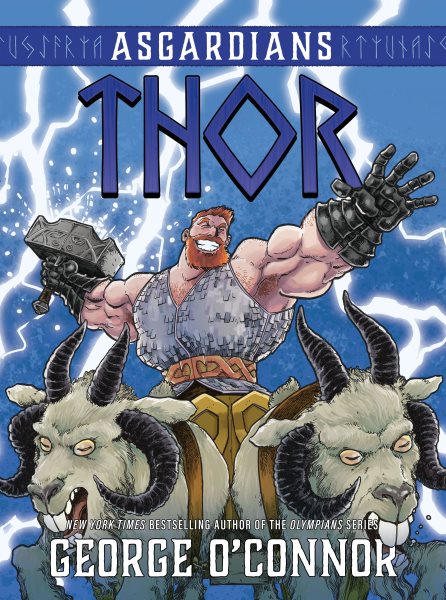
Thor!! Okay, so like I say, maybe start a kid with this book and not Odin. Odin’s great, don’t get me wrong! It’s just incredibly incredibly weird. So weird that I worry it’s going to turn some kids off right at the start. Why not ease them into the series with some humor instead? Where the first book in this new Asgardians series is relatively serious (there are jokes but it ain’t a yukfest) Thor is just naturally funny. That’s partly how George O’Connor renders him, and partly the nature of his stories. There’s also the fact that though Loki has a cameo in Odin, in Thor he really and truly comes into his own. Now an interesting direction that O’Connor took with this particular book, and much more so than anything he did in his Olympians series (except possibly in Hermes), is Looney Tunes-esque visual gags. There are a couple here and I was HERE for them! Sight gags, bulging eyes, etc. My personal favorite joke in the whole book is when Loki has stolen the hair of Thor’s wife and you get this shot of him, eyes wide, holding the scissors with a pile of blonde hair in front of him. I can’t stress enough how much I love this image of him caught in the act. As with his Olympians series, there’s a load of amusing backmatter to pore through.

Beanie the Bansheenie by Eoin Colfer, ill. Steve McCarthy

Every little banshee (or bansheenie) connects itself to a human so that it can warn it when it’ll die. But when Beanie fails to connect to her girl, she finds herself in the role of protector. A sweet, strange Irish tale. It can get a little squidgey when we try to figure out what precisely constitutes “early chapter” or “easy” titles. This is a book that could probably be best described as a “bedtime book” as it is just a little too long to be a picture book and a little too short to be early chapter. Even so, I’m so charmed by it that I felt I had to at least give it a shot. The whole premise is bizarre but oddly sweet. A banshee accidentally becomes a loving creature with a family, and seeks to protect her charge rather than predict her death. It’s got a nice jot of Irish faerie lore in there (making it more of a folktale/fairytale type of story) and just comes off as so exciting and loving all at once. Gotta love that shot of the banshee at her person’s wedding (100 points to artist Steve McCarthy for the depiction of the priest too). I think you’re going to want to see this.

Godfather Death by Sally Nicholls, ill. Júlia Sardà

 In this adaptation of a lesser-known Grimm fairy tale, a poor fisherman sets out to find an honest godfather for his new baby and ends up recruiting Death in the role. But what happens when you try to cheat death out of a deal? It doesn’t exactly shout out that it’s a Grimm Brothers fairy tale adapted to a picture book form, but that’s what this is. So I went out and located the original tale to see how closely it adheres. Pretty darn close, is the answer! Nicholls, however, makes some fairly fascinating changes, ultimately turning this into a story of how the old take advantage of the young in an effort to prolong their own lives. Or at least that’s how I read it. The ending is bleak but it does end with a heckuva bang. Plus you have Sardà doing her best Walter Crane imitation with the art. I think there are only three colors ever used, but boy howdy does she use them! A pretty darn good companion to Klassen’s The Skull, now that I think about it (but darker). 

The Good Game by Arihonni David

When two of the smallest animals in the forest want to play lacrosse, or Twewa’á:raton, with the other animals, they are told they are too small. Fortunately, a bit of ingenuity makes them worthy opponents in this traditional Akwasasne tale. You may have seen a previous Arihhonni David book in the past on this list (Who Will Win?) and I am happy to report that this one’s also pretty darn good. Mr. David (A Member of the Haudenosaunee Kaniekehaka (Mohawk) people) has a talent for synthesizing stories down to their most essential parts, then turning their texts into infinitely easy reading. It doesn’t hurt that the art is really fun as well. And as a co-worker of mine pointed out, this pairs amazingly with with Cynthia Leitich Smith’s middle grade novel, also out this year, On a Wing and a Tear. The two have a lot in common.

Kadooboo! A Silly South Indian Folktale by Shruthi Rao, ill. Darshika Varma

Leaving his friend Anya’s house with a delicious bag of kadooboo, Kabir just can’t remember its name. Is it book-oo-doo or dub-oo-koo or duck-oo-boo? A fun and silly readaloud with a surprise ending. Aw. This is super fun. Rao explains in the back of the book how she adapted the original tale into this fun, silly kid-friendly version. Personally, I think it works really well. I was expecting, with the whole taking-sweets aspect, for the book to veer into a Little Red Riding Hood kind of story, but it’s not that at all. Plus the ending actually made me snort quite loudly in my work lunchroom, which I consider the highest of praises (wasn’t expecting to actually laugh with this book). I warn you, though, that you’ll be quite hungry for kadooboo before the tale is through. Previously seen on the Readaloud List.

Kamau & Zuzu Find a Way by Aracelis Girmay, ill. Diana Ejaita

I like the term “modern folktale”. I particularly like the term “modern folktale about African diaspora, resourcefulness, and intergenerational love.” Most of all, I like a picture book where the emotions are not entirely resolved and the solution is not entirely there. If you are going to talk about people displaced from their homes and loved ones, with no recourse of return, how do you do that in a folktale setting? In the case of this book, baby Kamau and his grandmother Mama ZuZu wake up one day to find themselves on the moon. Naturally, since Kamau can’t remember his home from before, and he doesn’t miss it the way his grandmother does. For him, the moon has always been home. Now, about this point, reading the book you are assuming that it’s going to end with the happy resolution of everyone reuniting back on Earth at some point. Nope. And the writing? So incredible. At one point Mama ZuZu says, “But we will have to find a way to live, as people do,” and the next line is, “Something about the way she said ‘live’ always filled Kamau’s blood up with sun.” Is it any wonder the author is on the editorial board of the African Poetry Book Fund? Add in the truly beautiful art of Diana Ejaita (no word about her medium on the publication page, which is a crying shame) but this book is a jaw-dropper. Previously seen on the Caldenott List.

Kevin and the Blackbirds by David Almond, ill. P.J. Lynch

Raised by monks, Kevin is told he’s grown too big to gambol about in nature all the time. This is quite the blow to him, since Kevin loves spending time outdoors. But when a pair of blackbirds start to construct a nest in his palms, even the monks realize there’s something special going on. You will note that in his little message at the beginning, David Almond essentially says that Kevin is a saint for our times. Like a more blackbird-adjacent St. Francis of Assisi, Kevin’s entire story is about not simply appreciating nature, but the importance of getting out there and experiencing it firsthand. With Almond’s great retelling, it almost feels unfair to bring on Lynch as the artist. That man could illustrate Apple copyright law and make it tantalizing. The shot of the nest just as the birds are hatching works not simply because it’s thrust out towards the reader, but because the only part of Kevin’s face that we can see are his clearly overjoyed eyes. I love how you can get so much emotion from him with so little. We rarely get environmental folktales quite like this, so this is a treat. 

The Magic Callaloo by Trish Cooke, ill. Sophie Bass

The tale of Rapunzel is reimagined as the tale of Lou, a girl with extraordinary hair, and the magical callaloo plant that gets her into trouble. I love a retelling of a fairy tale when the author puts as much thought and care into the telling as Cooke has done here. She’s deftly weaving in elements of hair as both pride and guide, forced relocation and enslavement, and at the same time working it into the format of any classic fairytale or folktale with this type of telling. The art is fun, but the writing was what blew me away. This is one case where you’re gonna be very grateful for that Author’s Note in the front. Smart, but also fun enough that you could see a kid asking for this again and again.

The Midnight Mitzvah by Ruth Horowitz, ill. Jenny Meilihove

A glance at this book and you wouldn’t immediately notice that this book belongs in this category today. However, in the back of the book, Ruth Horowitz has a section entitled, “Where Does Hanina’s Story Come From?” As she explains, “This story is based on a tale from the Talmud.” In the original, a rabbi named Hanina was stopped by an evil spirit one night. When he was asked why the rabbi was out, he explained that it was in order to give a gift in secret, and he was spared. In this version it’s a chipmunk (not a rabbit, which I personally think would have been inspired) named Hanina who wants to help a squirrel. The trouble is the squirrel is older and she has her pride. She can’t gather food like she used to, but she doesn’t want charity. For Hanina to help her against her will, that would shame her. Now this is a pretty complex idea to be conveying to kids, but I thought it was particularly important. Because the squirrel can no longer gather her own food, Hanina makes it look as if additional food has fallen from the squirrel’s tree, within easy reach. At the back of the book is an explanation of many terms (tsedakah, talmud, mitzvah, etc.) including “sadaqah”. This is explained as an Arabic word and that “Islam teaches that secret sadaquah preserves the receiver’s dignity, and prevents the giver from boasting.” Ye gods. Could we get a TON more books on this topic please? Pair this book alongside One Small Spark: A Tikkun Olam Story by Ruth Spiro (which you’ll see later on this list). I think they’d complement one another very well. 

The Midnight Panther by Poonam Mistry

Compared to lion, tiger, and leopard, panther feels left out and dull. It takes the very sky above to teach panther to appreciate what makes him not only special, but dazzling as well. Poonam Mistry always makes me stretch what I consider to be a folktale to its very limits. The copy of this book calls it “a captivating fable” and it is every bit of that. I suspect that it’s an original fable, however. Even so, I have such a hard time resisting Mistry’s style. With its black panther discovering what makes it special, it’s not quite as sophisticated as, say, Beautiful Blackbird by Ashley Bryant, but the telling is smooth, straightforward, and expertly done. And, of course, there’s the gorgeous art to contend with as well.

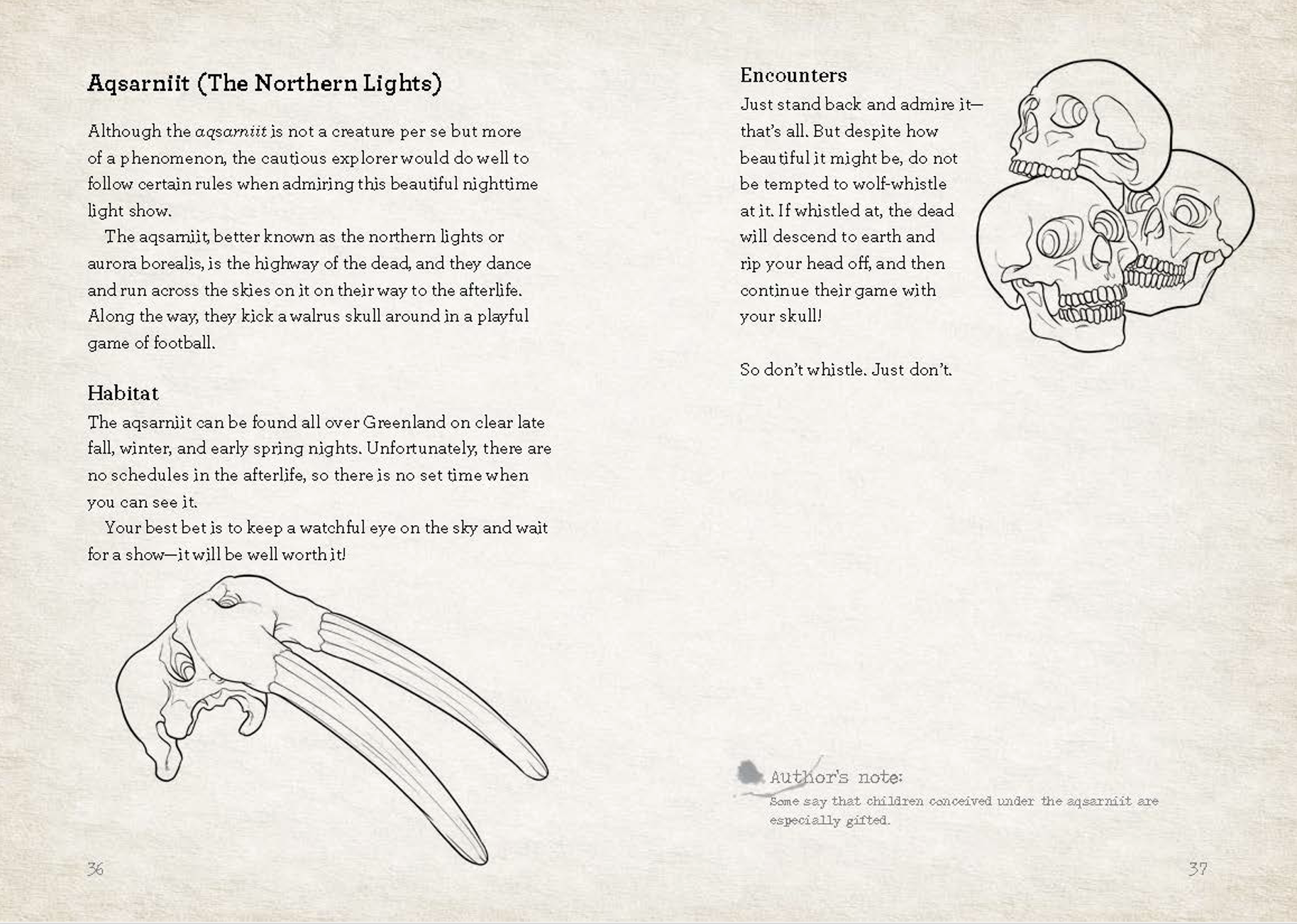
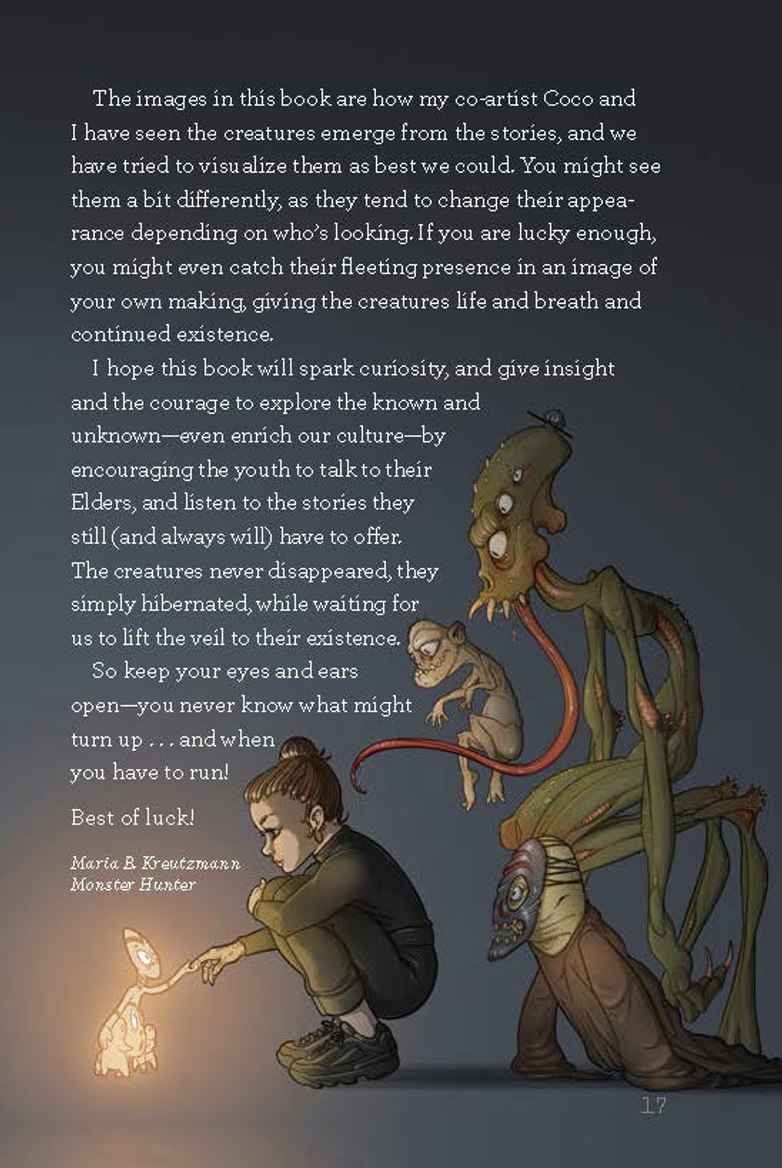
Mythical Monsters of Greenland: A Survival Guide by Maria Bach Kreutzmann, ill. Maria Bach Kreutzmann and Coco Apunnguaq Lynge
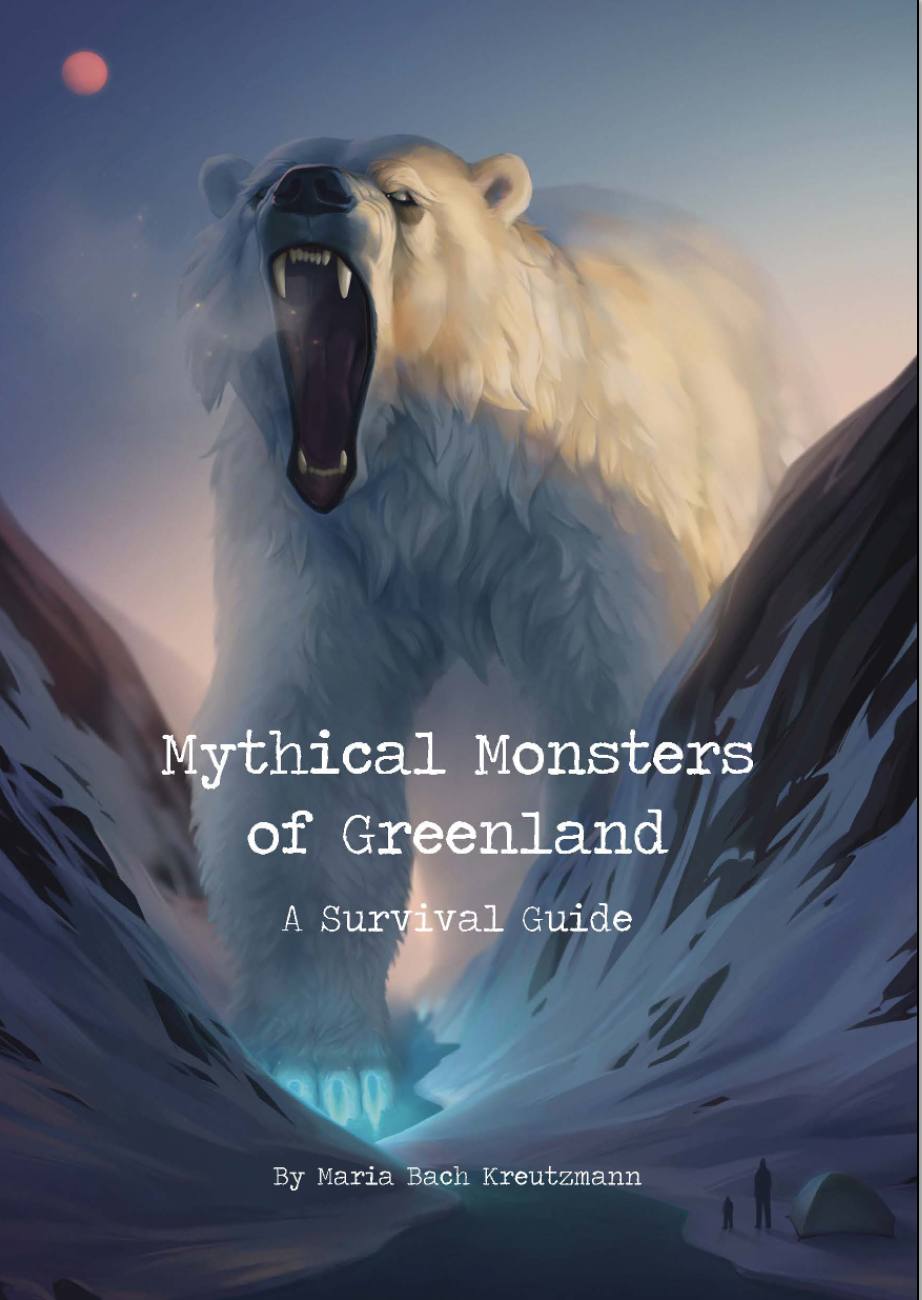
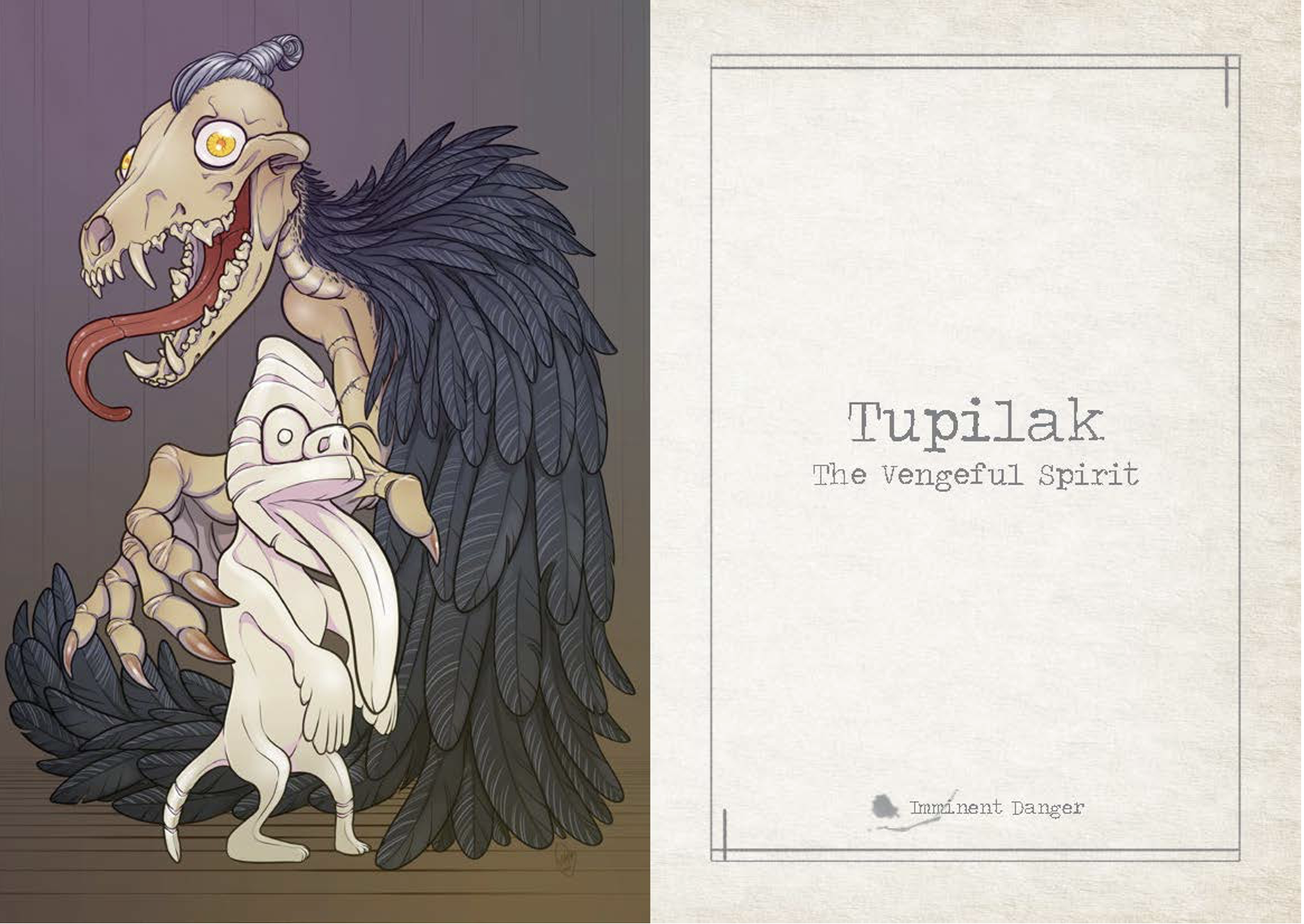
What do you do if a tupilak is sent to attack you? What if your sled dog is an inorruit? How do you escape an ikusik? Get the low down on a wide variety of creatures from the fascinating to the frightening. It’s an interesting take. I’d be the first to admit that I know next to nothing about the mythical creatures of Greenland, but I was wholly unprepared for how utterly unique they all are. Kreutzmann gives a great deal of context and since the publisher, Inhabit Media, specializes in Inuit children’s literature, I was grateful for the Glossary of Inuit Language Words at the end. Ditto the map. Each creature is separated into a quick definition, habitat, and what a typical encounter might entail. The Introduction does a particularly good job of discussing these creatures a little more in the present than in the past. As field guides go, I’d say that this one stands apart. 

Ra Pu Zel and the Stinky Tofu by Ying Chang Compestine, ill. Crystal Kung

Why learn dancing and embroidery when you can learn cooking instead? When Princess Ra Pu Zel locks herself in a tower rather than doing boring princess stuff, it takes some pungent tofu to lure her out once more. Boy, you can really tell when a new illustrator has a background in animation. Sometimes that’s a bad thing, and their art just looks like a series of storyboards they pinned up on a wall. Other times you get something like this book, with its fun twist on an old tale, and some fantastic facial expressions along the way. Ying Chang Compestine’s been in the game for decades now, so when I saw she’d penned this I was already interested. The obligatory Rapunzel-like qualities aren’t really the focus though. More, it’s the origin of stinky tofu that takes center stage. I think that between this book and the century egg in the graphic novel Alterations we are having a deliciously odiferous selection of books for kids out this year. I wouldn’t miss this one, though.

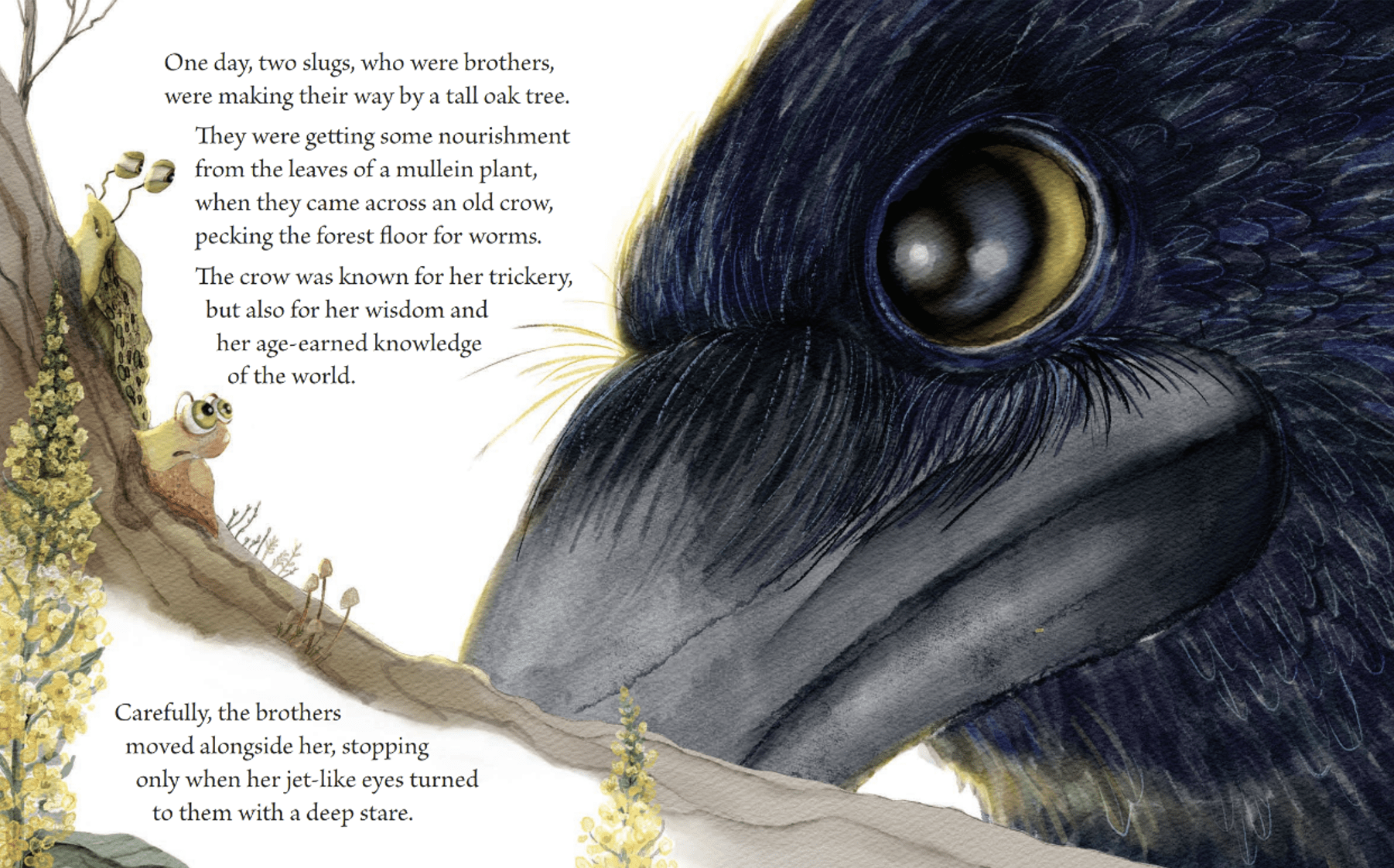
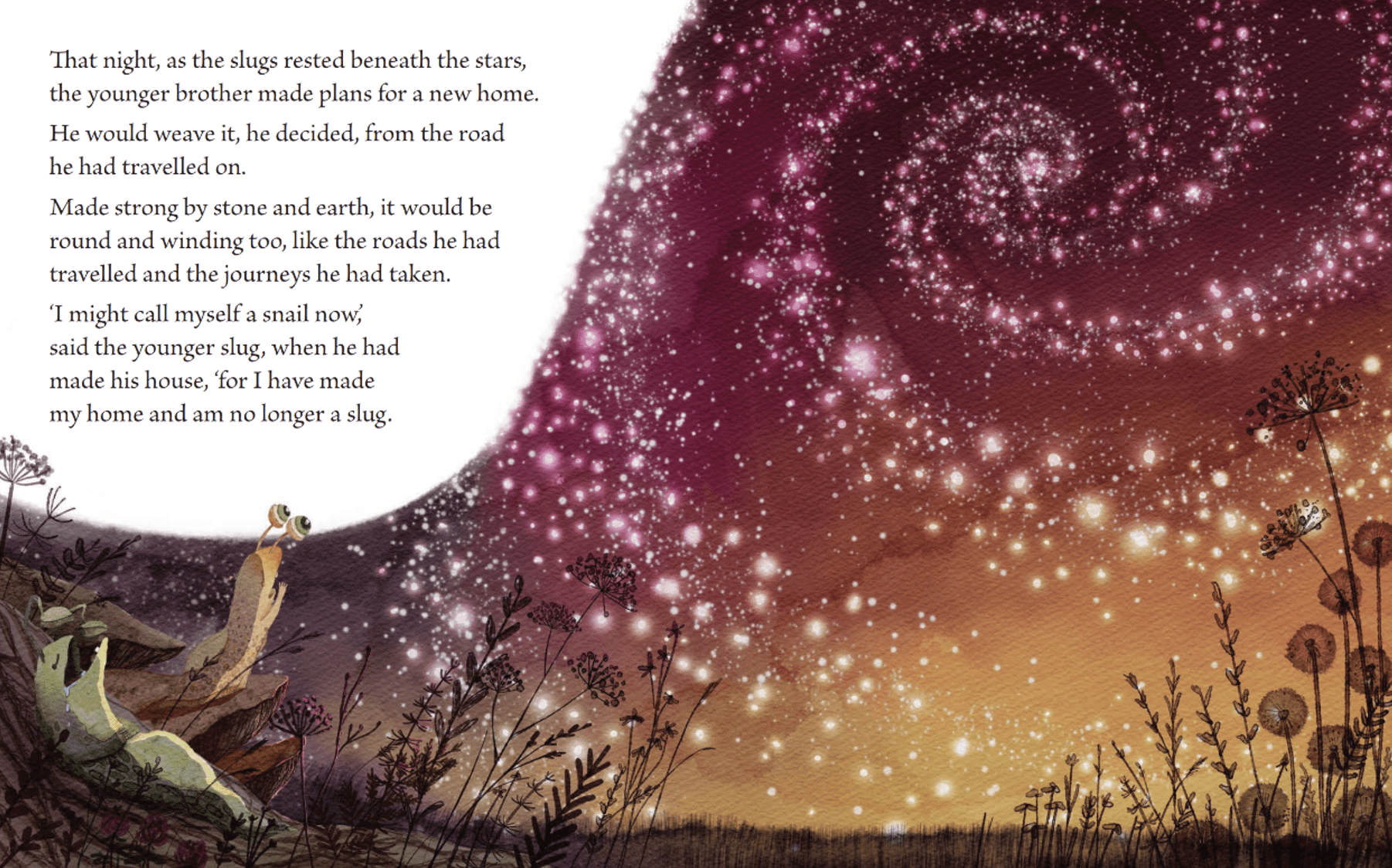
The Slug and the Snail by Oein DeBhairduin, ill. Olya Anima 
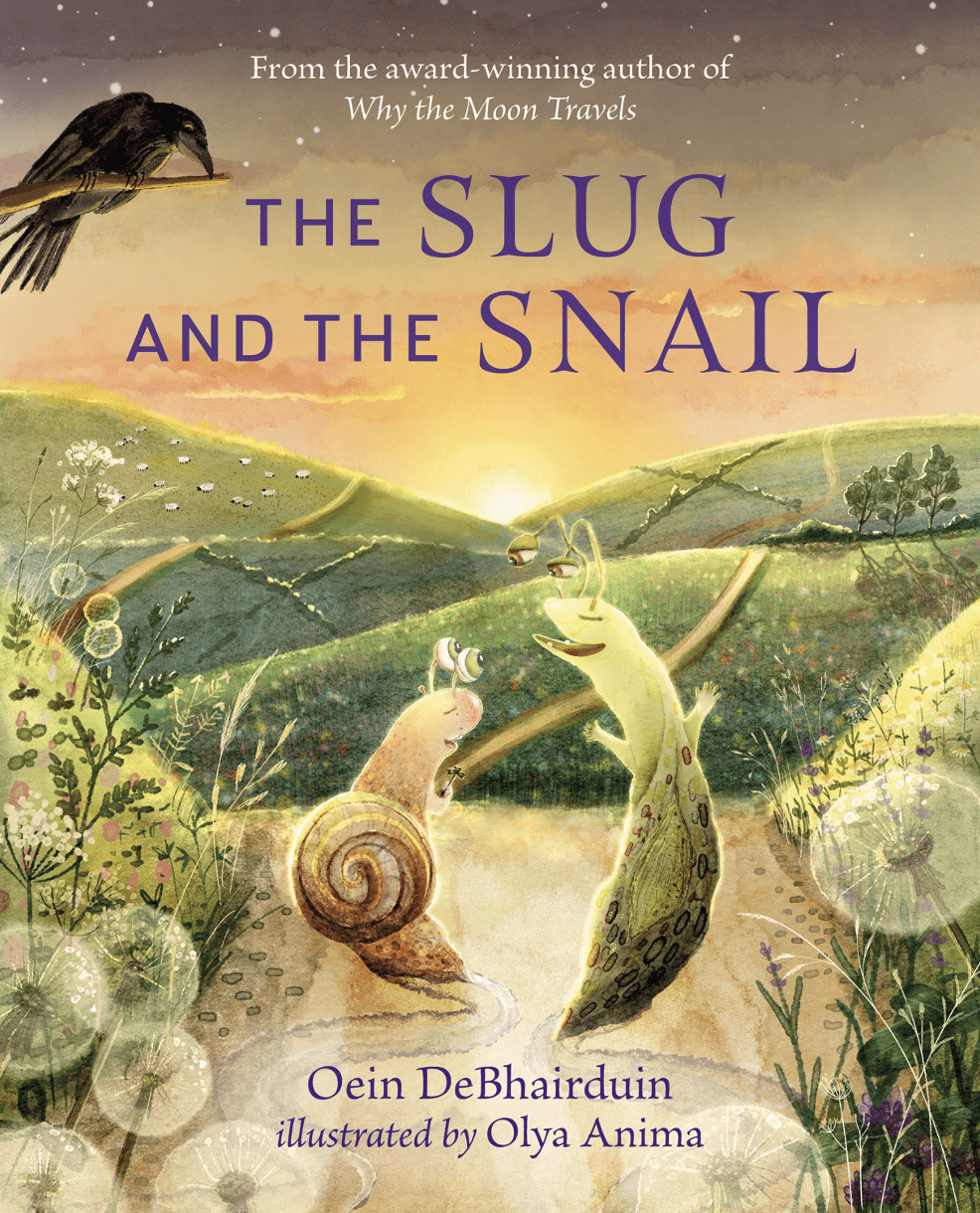
Once, when there were only slugs and no snails, two slug siblings met a crow who demanded to know where they made their home. A Mincéirí about assumptions and “home”. I’m curious whether or not other folks see this as a folktale or not. It never out-and-out says that it is, but it has all the trappings (and a good context for how the author heard it in the first place). We haven’t many tales from Mincéirí on our shelves, and indeed we don’t tend to have many of them in the States. Even so, I found this story intriguing. I think it leaves open to interpretation a lot of really big questions and what does and does not constitute a person’s home when it comes to moving. The crow is neither good nor bad, which is a rare character in a story like this. I keep turning this one over in my mind. There’s a lot to chew on here.

Tales of the Feathered Serpent: The Hero Twins and the Magic of Song by David Bowles, ill. Charlene Bowles
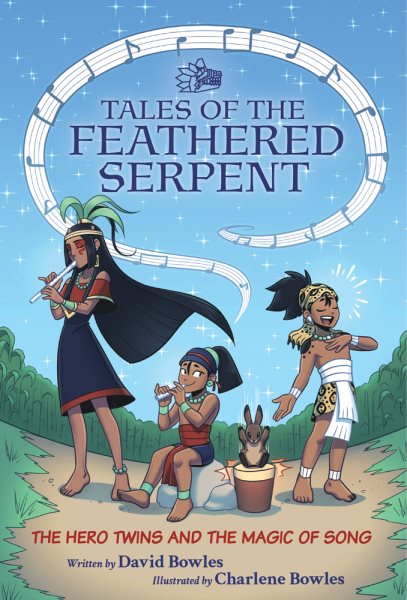
So back in 2020, Bowles & Bowles released the first graphic novel in this “Tales of the Feathered Serpent” series, Rise of the Halfling King. It was great, and I waited eagerly for the next book in the series. Four years later, it has finally come to us. This series is based on classic Mayan tales. As the author explains at the end of this book, these stories come from the Popol Vuh or Book of the People which contained stories collected by Dominican friar Francisco Ximenez and the leaders of the town of Santo Tomas Chichicastenango in Guatemala. They are the most important narratives and chronicles of the K’iche’ Maya people. Now as with George O’Connor’s adaptation of the Norse myths, true stories from the past can be difficult to adapt to a modern audience. That’s where graphic novels have a real leg up. I was particularly amused by this collection of stories about the hero twins, since it has all my favorite things. A girl in love with a skull. Jealous half-siblings. People being turned into monkeys for their sins. The works! Return to Rise of the Halfling King to remember how good it is, then follow that up with this book as well. There is NOTHING else out there like this series today. 

One Small Spark: A Tikkun Olam Story by Ruth Spiro, ill. Victoria Tentler-Krylov
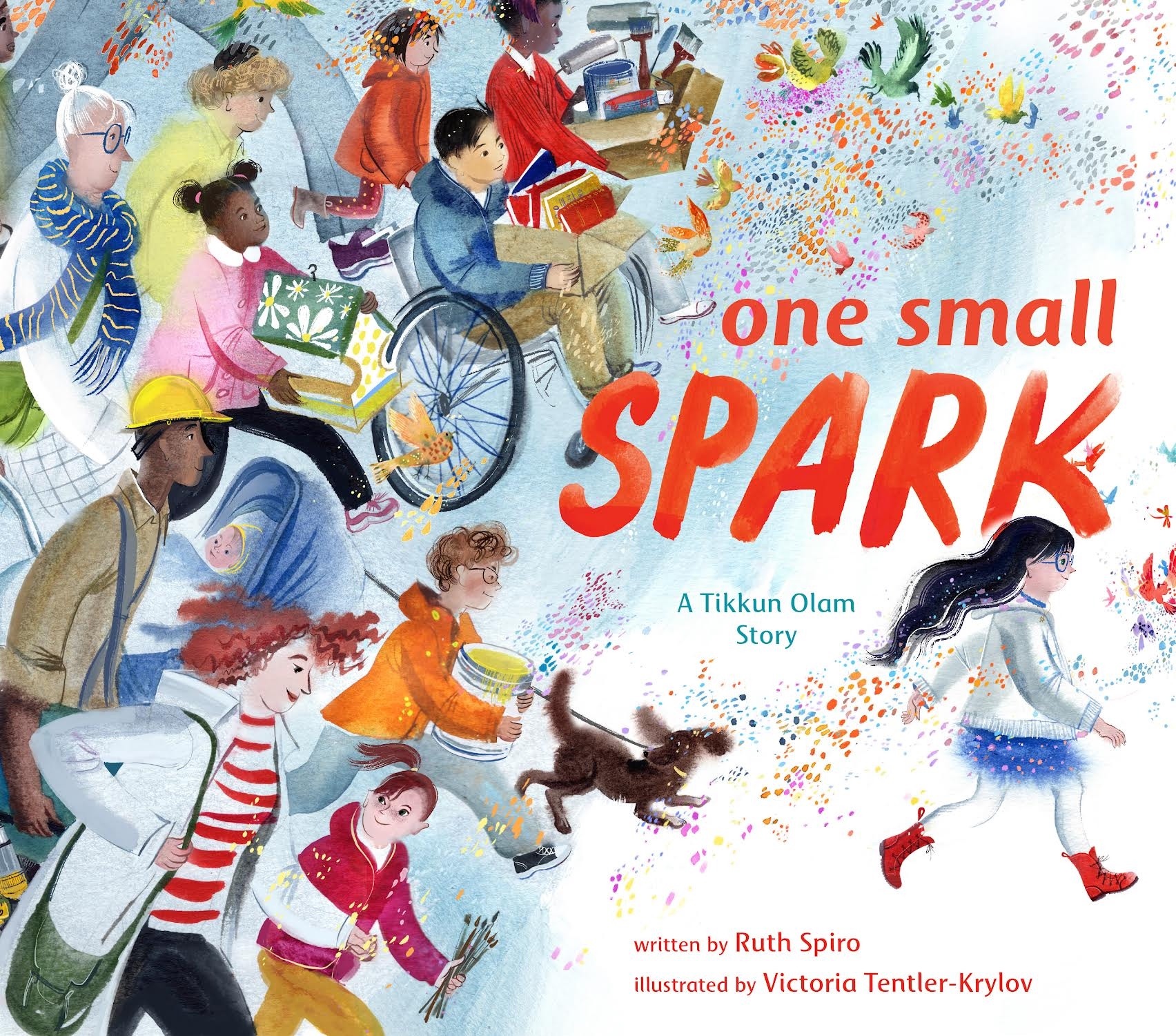
In the interests of complete and utter honesty, I read this book at a time when my own Little Free Library had gotten its glass punched in again (this isn’t a tragedy or anything since it happens on an annual basis, but it’s still kind of annoying). In this book you see a similarly abused Little Free Library, so right there my heart went out to the book. Then I noticed that the illustrator was Tentler-Krylov who is consistently good at what she does. On a regular basis I run across her books and find myself utterly charmed by them. The concept of Tikkun Olam is one that adapts so smoothly to a picture book format that it’s funny I’ve never really encountered it before. As Ruth Spiro explains in her Author’s Note, it roughly equates to, “the belief that we each have a responsibility to make the world a better place.” Spiro discusses how the term appears in the Talmud and also in Aleinu, “a prayer of hope for a better future”. The story in the book follows a busted up playground and the people who work to fix it up. Beautifully told and done. I figure it falls into the category of “Religous Tales” and is on this list for that reason.

Uno Más, One More by Silva López, ill. Olivia Sua

At the house of Don Manuel and Dona Lila there’s always room for uno más/one more… until there isn’t! A marvelous reinterpretation of an old Scottish ballad. This is pretty neat. López has taken that old ballad, then reapplied it through a Latinx lens. There’s a marvelous Author’s Note at the end where the author talks about finding a specific series of folktales in Spanish in libraries when she was a kid (thirty-three altogether) though I wish she’d mentioned what the name of that series was. As for the book itself, it’s lovely. It took a couple reads before I realized that the art was cut paper mixed with acrylic pants and gouache. It’s so seamless you hardly even notice. This is just a lot of fun.

Yours, Befana: A Letter from the Winter Witch by Barbara Cuoghi, ill. Elenia Beretta, translated by Genni Gunn
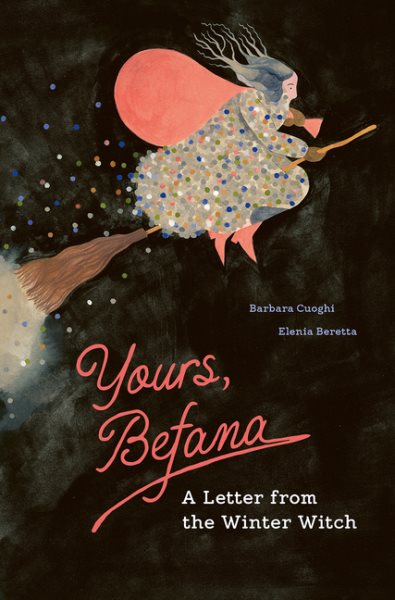
Spice up your holiday purchases around the Christmas season with something a little bit on the odd side of things. So what we have here is nice little Italian import focusing on Befana, a character from Italian folklore, who does her thing on the sixth of January. The book is written as a letter to kids from Befana herself explaining how she goes about doing things. She has a fun tone, explaining, for example, that she takes a potion of invisibility before she arrives. “You are not allowed to look at me; it’s the price of my extraordinary visit.” And, later, “And don’t be fooled by the drawings of me as an old witch. I am all-powerful and unstoppable.” There’s even backmatter (which I always adore) showing “A Few Secrets About Me”. Along the way she even has time to throw some shade on Santa, a fellow she will not name and just calls, “that clumsy oaf dressed in red.” It helps that the accompanying art is just so blooming gorgeous as well. You can’t help but respect this gal. If you didn’t believe in witches before this book, you certainly will now. Previously seen on the Holiday List.


So with all that in mind, here are the other lists for 2024:

December 1 – Great Board Books

December 2 – Picture Book Readalouds

December 3 – Simple Picture Book Texts

December 4 – Transcendent Holiday Picture Books

December 5 – Rhyming Picture Books

December 6 – Funny Picture Books

December 7 – CaldeNotts

December 8 – Picture Book Reprints

December 9 – Bilingual Books for Kids

December 10 – Math Books for Kids

December 11 – Books with a Message / Social Emotional Learning

December 12 – Fabulous Photography

December 13 – Translated Picture Books

December 14 – Fairy Tales / Folktales / Religious Tales

December 15 – Wordless Picture Books

December 16 – Poetry Books

December 17 – Unconventional Children’s Books

December 18 – Easy Books & Early Chapter Books

December 19 – Comics & Graphic Novels

December 20 – Older Funny Books

December 21 – Science Fiction Books

December 22 – Fantasy Books

December 23 – Informational Fiction

December 24 – Gross Books

December 25 – Science & Nature Books

December 26 – Unique Biographies

December 27 – Blueberry Award Contenders (Celebrating the Environment)

December 28 – Nonfiction Picture Books

December 29 – Nonfiction Books for Older Readers

December 30 – Middle Grade Novels

December 31 – Picture Books

Filed Under: 31 Days 31 Lists, Best Books, Best Books of 2024 Tagged With: 31 days 31 lists, Best Books of 2024, fairy tales, fairytales, folk and fairy tale reviews, folk and fairytales, folk tales, folktale comics, folktales, religious tales

31 Days, 31 Lists: 2024 Translated Children’s Books

December 13, 2024 by Betsy Bird

Just now I sat down to work on today’s post and I saw the topic: Translated Children’s Books. Immediately, I gave a bitter chuckle. “Oh ho ho… THAT’s a big list.” And it is, you know. Though they can only win a handful of awards here in America, the sheer plethora of amazing translated works for kids only improves every year. So today I’m going to highlight the ones that stood out to me. The books themselves are good, sure, but let’s make sure to give a shout out as well to the hardworking translators that get these books ready for prime time here in the States. You folks clearly know what you are doing!

You can find the full PDF of today’s titles here.

Interested in other lists of translated children’s books? Then check out these lists from previous years:

  • 2023
  • 2022
  • 2021
  • 2020
  • 2019
  • 2018
  • 2017
  • 2016

2024 Translated Children’s Picture Books

Best Thing Ever! by Beatrice Alemagna, translated by Jill Phythian

[Translation – French]

Pascaline is back! The little hot pink bat first seen in Never! Not Ever! (one of my favorite First Day of School books of all time) returns in a story of a supermarket and a small child who wants EVERYTHING. I have it on good authority that in the past Pascaline was based on Alemagna’s own child, so all I can say is that I hope she never stops getting great material out of her offspring. As with her other books, Alemagna utilizes fluorescent colors to a marvelous degree. That pop of color really draws your eye to Pascaline as she makes her way across pages of natural brown and green tones. There also isn’t a parent alive unfamiliar with what happens when a child melts into “a pile of gloop” on the floor of a store. I’m not even certain that that’s a metaphor when you experience it firsthand. A can’t miss title about a literal meltdown. Previously On the Funny Picture Books list.

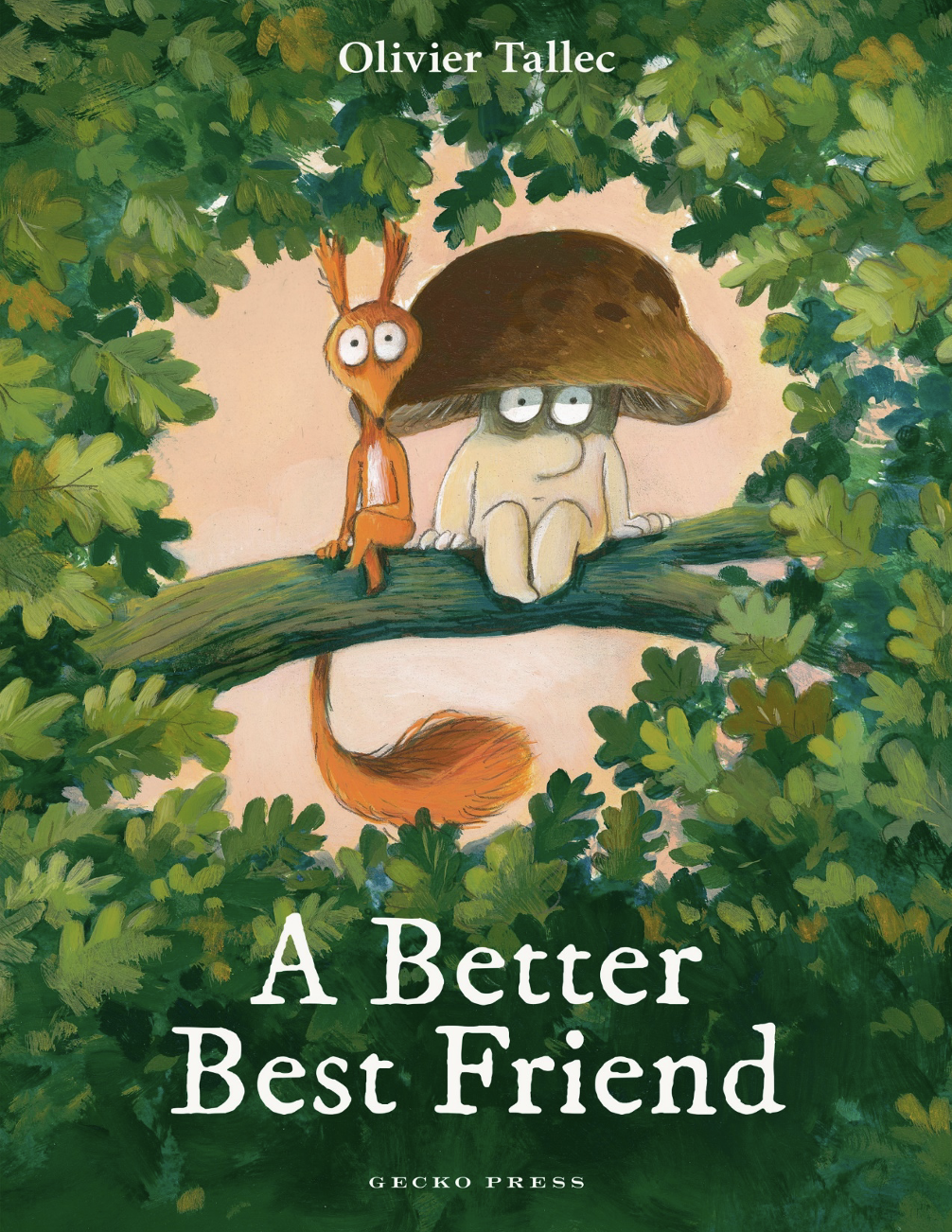
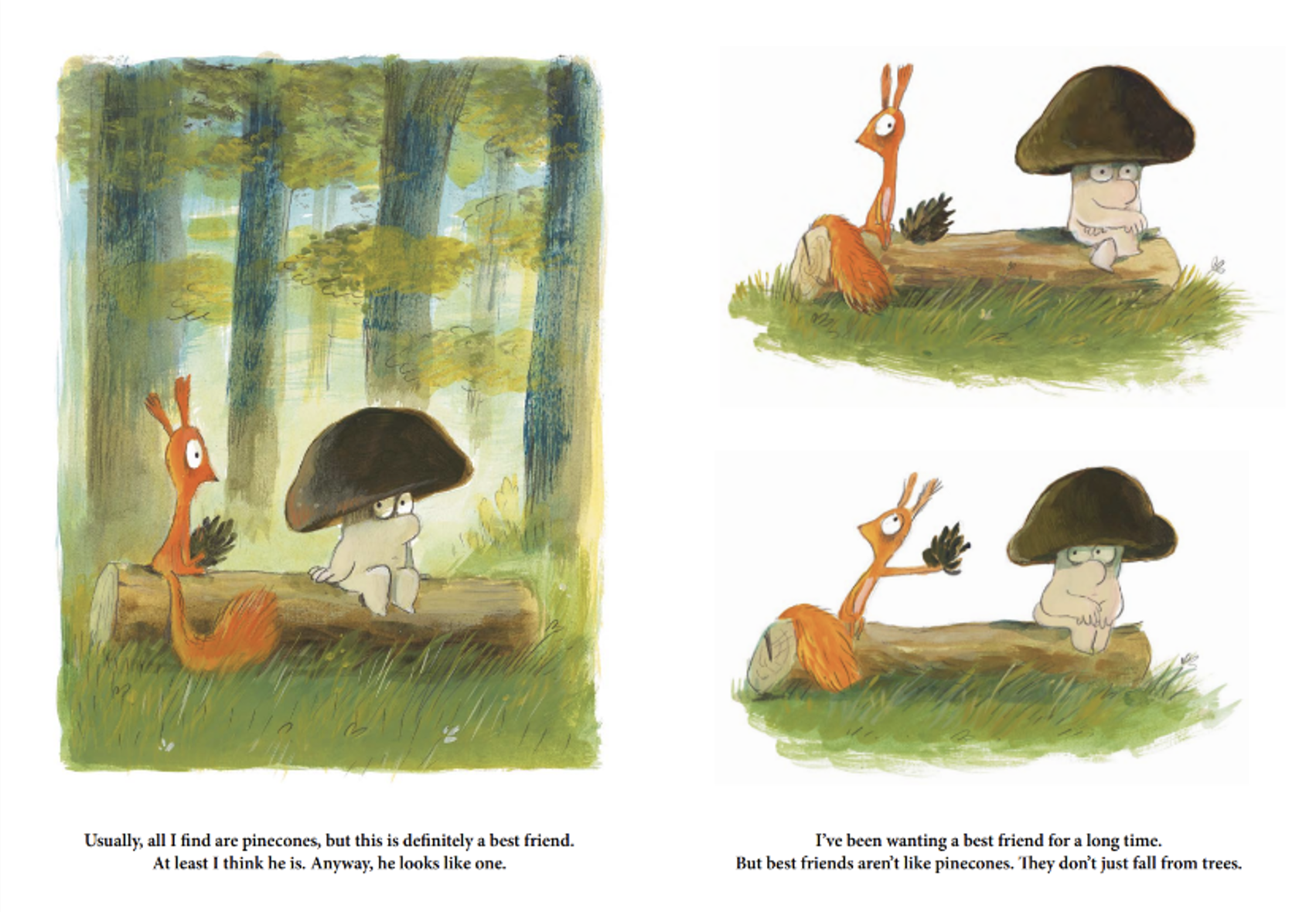
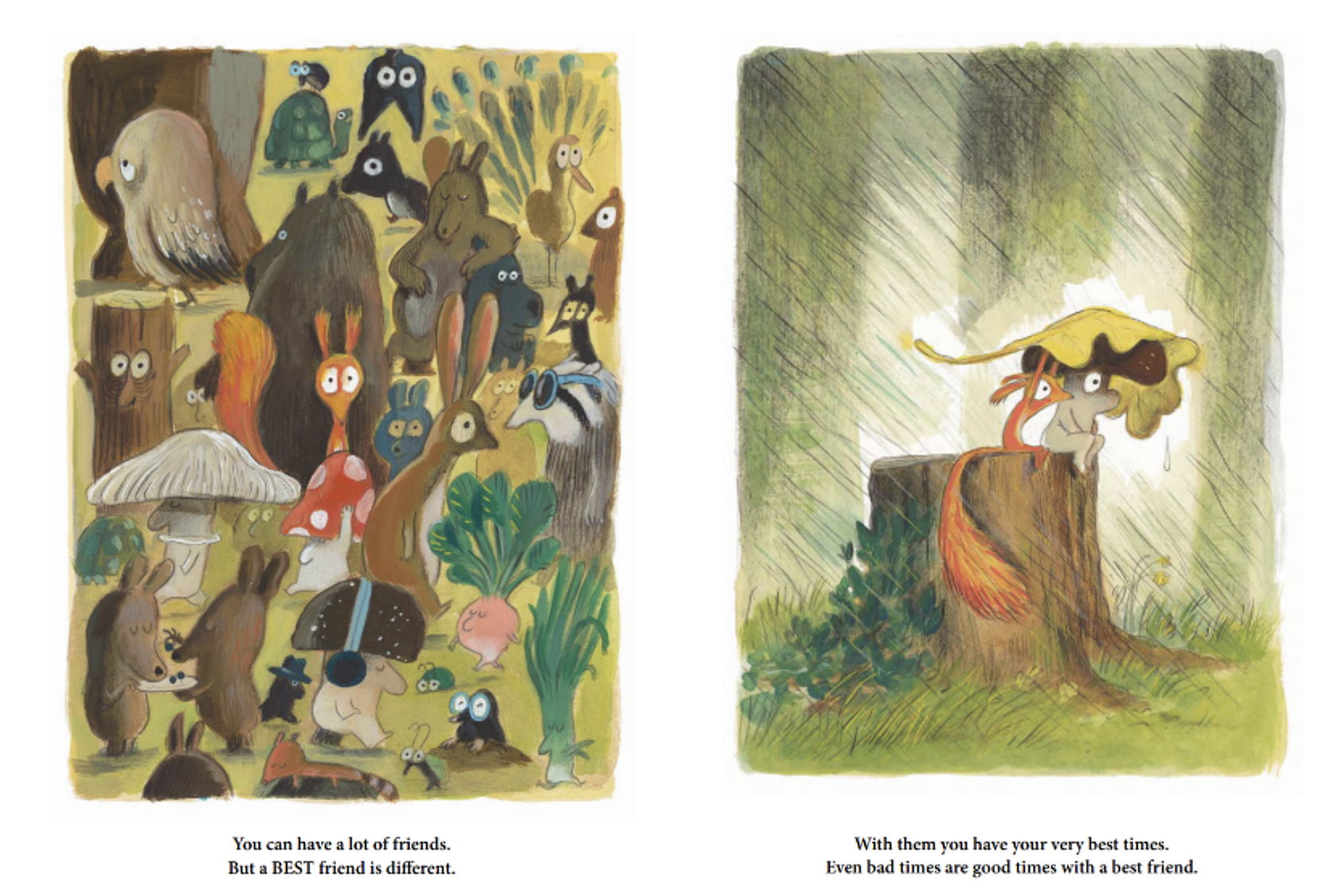
A Better Best Friend by Olivier Tallec, translated by Anthony Shugaar

[Translation – French]

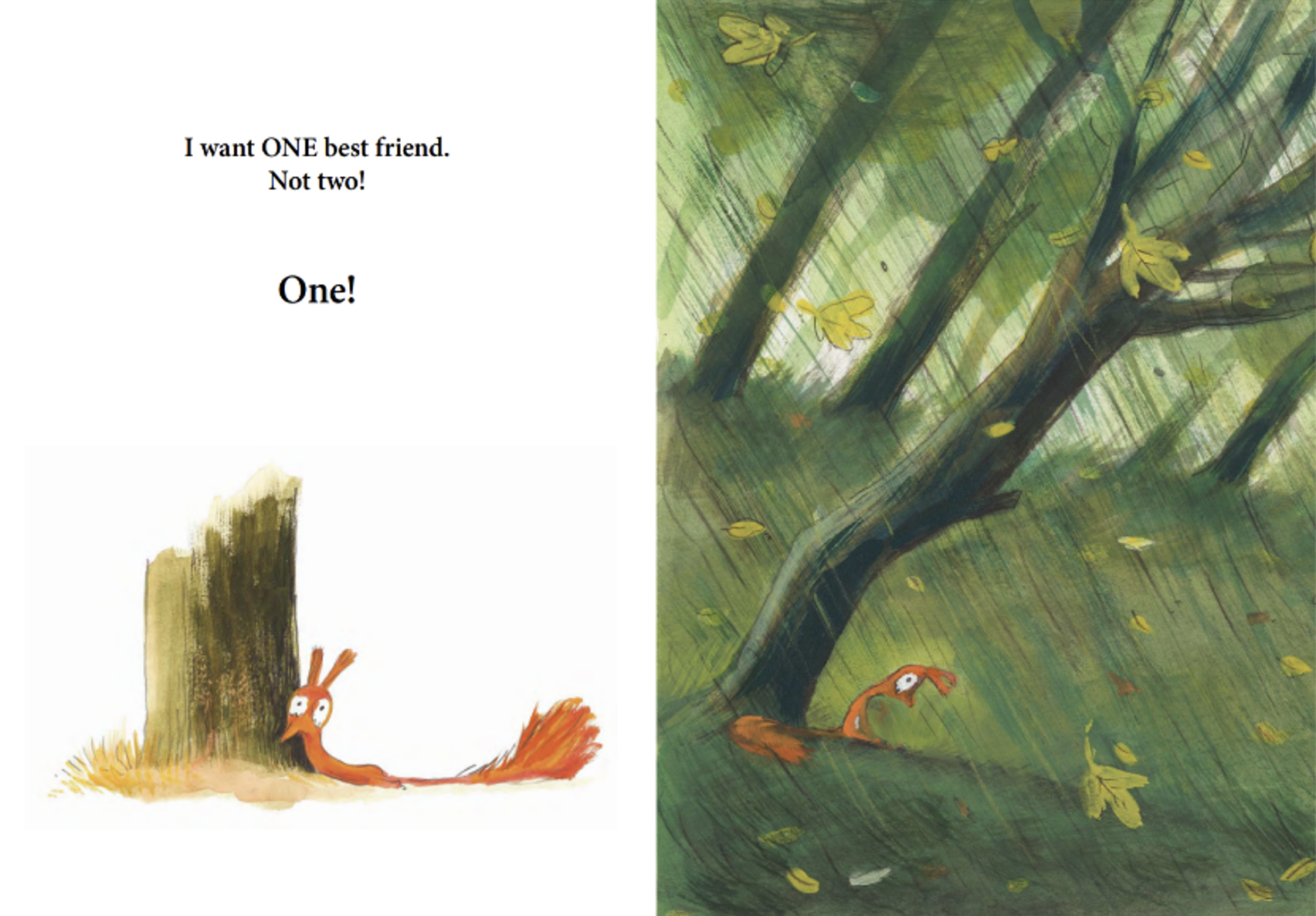
Having a best friend is great! A little red squirrel has just made friends with Pock, a somewhat awkward little mushroom, and things are great. That is, until a third friend comes along. Can someone have TWO best friends?!? Look. Look DEEP into the eyes of this anxious little mushroom on the cover and tell me you’re not intrigued by this book. This little French translation taps into the anxiety of having a best friend. Not acquiring one (though it makes it clear how that can be hard too) but what to do when you have two of them! I dunno. It’s the little details in this that just slay me. The way the squirrel crosses its legs, just so. The rings under Pock (the mushroom guy)’s eyes. I also kind of love that it makes it clear that a quiet person who doesn’t say much can be a very good friend, and that it’s okay to have more than just one. It’s small, slight, subtle, and unmistakably French.

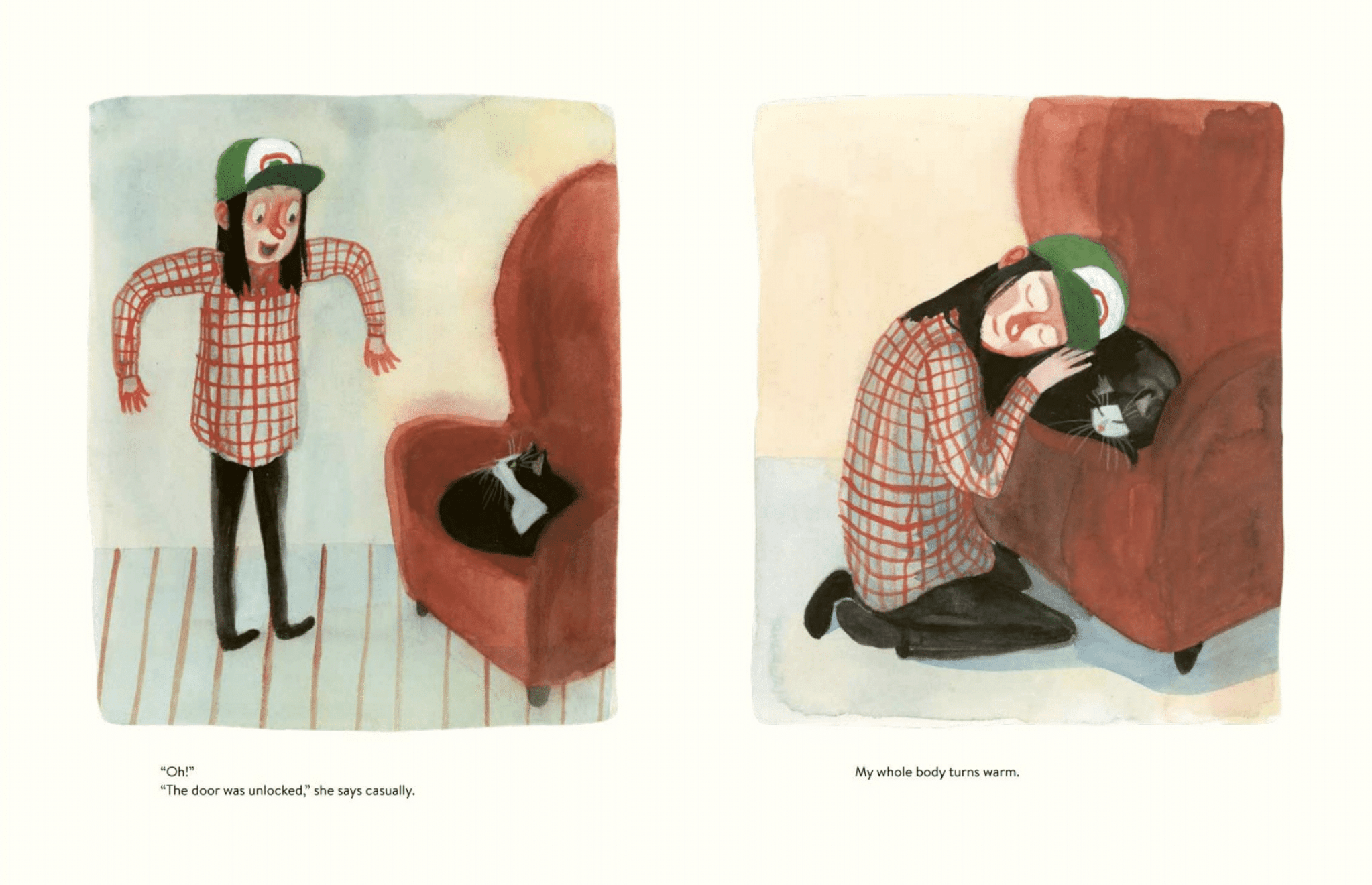
The Cat Way by Sara Lundberg, translated by B.J. Woodstein

[Translation – French]

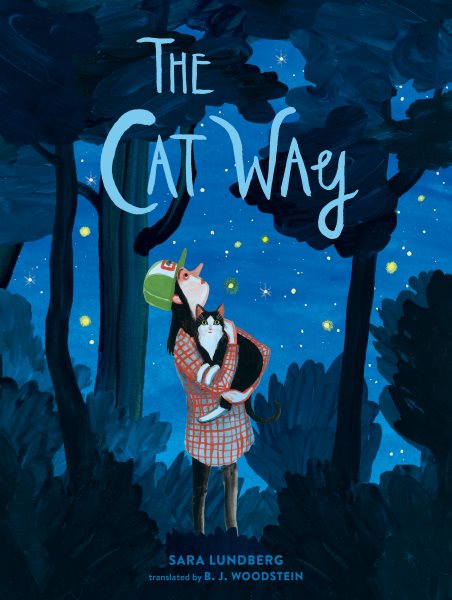
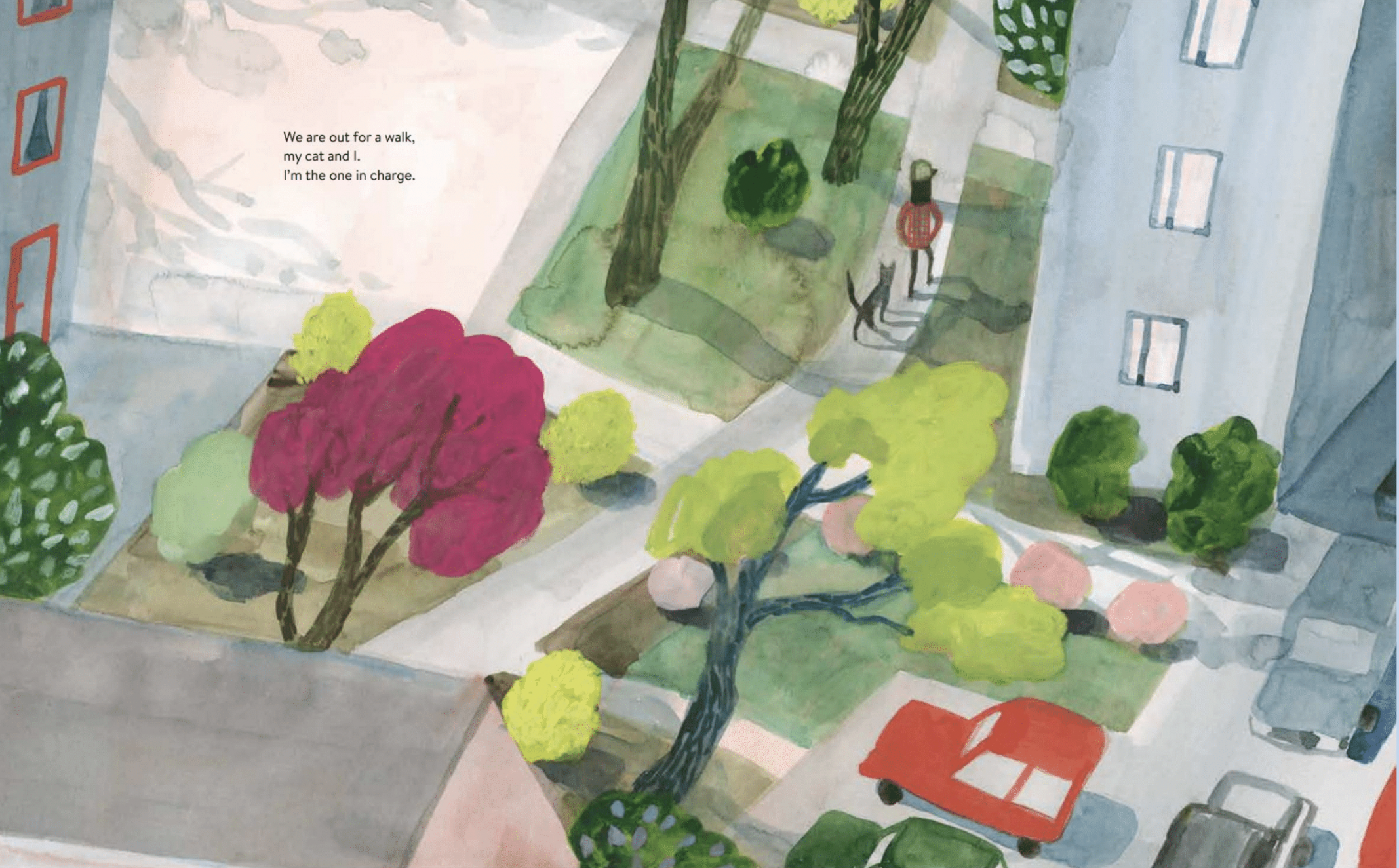
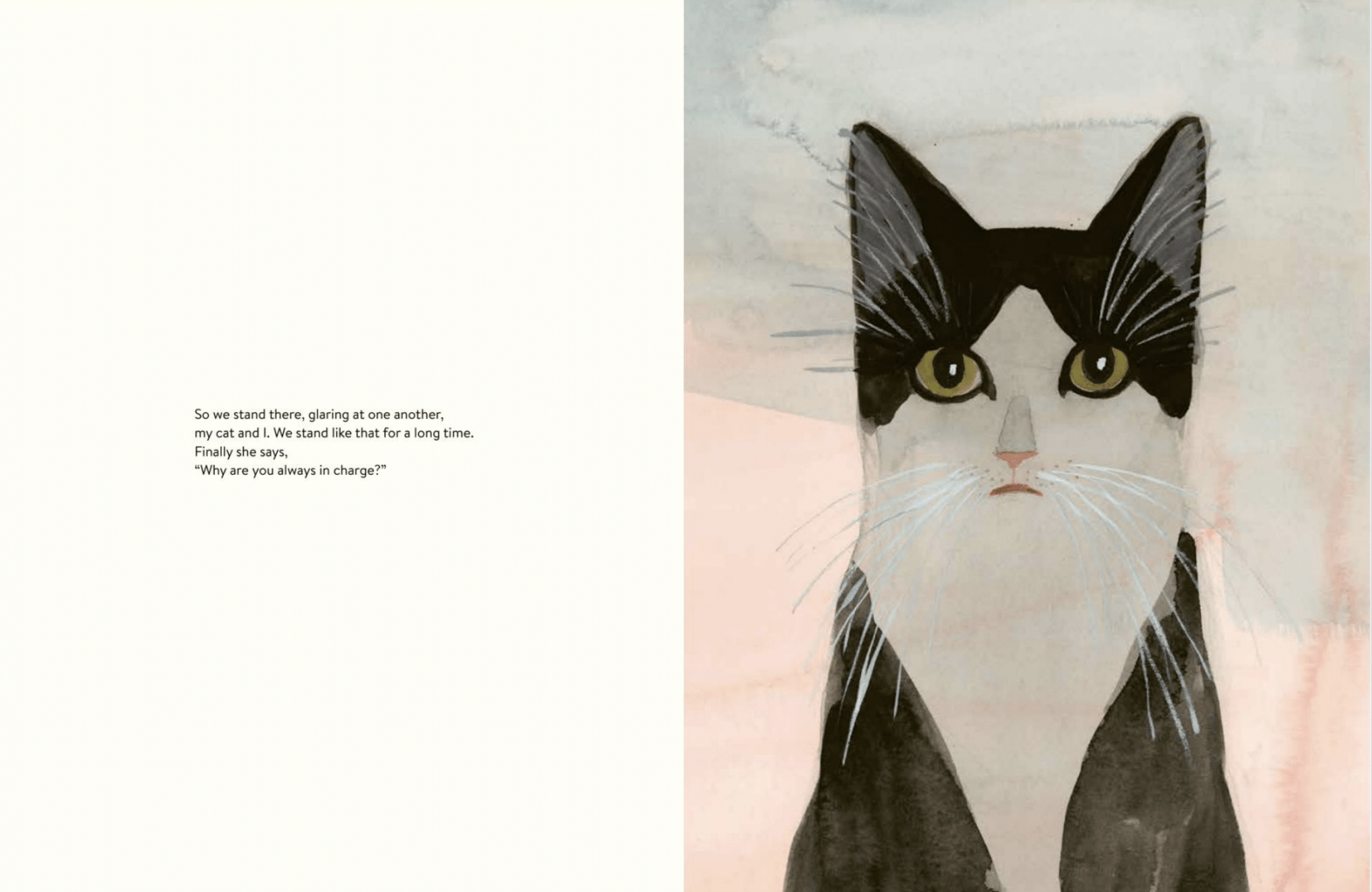
Usually when the human and the cat go walking, the human decides what they should do and where they should go. When things flip and the cat gets to take the lead, it’s the human who begins to see things in a whole new way. First off, it’s very satisfying to see a book where the main character knows how to hold a cat correctly on the cover. I also am intrigued by the fact that this is the rare picture book where an adult is the main character. There’s a funny surreal quality to this story, while at the same time the emotions are so real to me. It’s both telling its own story straight, while also feeling like it’s talking about a lot more than just the relationship between a woman and her cat. The art is fantastic, I love the gatefold (a rare three-page gatefold, no less!) and the simplicity of the telling. GREAT work by translator B.J. Woodstein, by the way! It really gets the tone of the book down JUST right! Previously seen on the Caldenott List.

Champ by Payam Ebrahimi, ill. Reza Dalvand, translated by Caroline Croskery

[Translation – Iranian]

Okay, I don’t know why, but the Iranians are just particularly good at funny children’s books. Don’t believe me? Well, think about some of the titles by Rashin Kheiriyeh (who brought to life one of my favorite fables, Two Parrots). Or what about Daniel Nayeri and his particularly skewed take on life, the world, the universe, and everything in it? Now we add to that list this book from Ebrahimi and Dalvand and it is just boffo. At its core, it’s a story about familial expectations and the ways in which we try to live up to them. In Abtin’s family (the delightfully named Moleskis) you are either a champion or you’re nothing at all. All throughout his house the Moleskis are portrayed with their customary frowns of concentration and seriousness as they win athletic championship after athletic championship. Abtin studies them with all the seriousness of a scholar. Unfortunately it’s all for naught, as his disgusted relatives note that not only has he no mole on his face, “Forget about being a champion, you couldn’t even be a flagman at a race.” His solution? Let’s just say it requires a bit of out-of-the-box thinking (and ends with a delightful silent image of his father’s bright red face screaming, which is not something you see in a picture book every day). You know, books from other countries don’t have any trouble with taking their art to illogical extremes, and this book reminded me (in a way) of this year’s Sleepless Night translated from the Spanish by Micaela Chirif. Good goofy Iranian fun.  Previously seen on the Funny List.

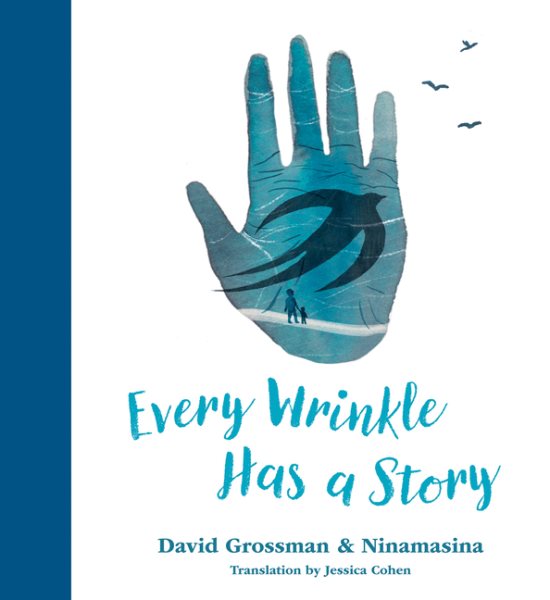
Every Wrinkle Has a Story by David Grossman and Ninamasina, translated by Jessica Cohen

[Translation – Italian]

This may sound a bit odd, but while author David Grossman is an Israeli author, this book initially came out in Italy. And as the person who buys all the adult titles for my library, I was personally previously aware of Grossman’s A Horse Walks Into a Bar but not his children’s book work. Accompanied by the watercolor art of Italian one-namer Ninamasina, the book is a discussion between a grandfather and grandchild about wrinkles. Yotam is picked up by his grandfather every Tuesday and they always stop at a cafe on the way home. I credit the translator on this one with keeping this book just this side of becoming precious. When Yotam asks if getting wrinkles hurts or “how will my face know how to make the wrinkles?” it could come off as just too too cute. Instead, it feels honest. The kinds of questions that kids come up with that adults would never even consider on their own. I suspect Grossman may know a kid or two. In the end, this is a story about not being afraid of getting older. It’s just a natural part of life, and something we all get used to. Gentle and gently done. 

Everyone Gets a Turn by Marianne Dubuc, translated by the VeroK Agency

[Translation – French]

Dubuc specializes in the small. Flashy does nothing for her. When she creates a book, she wants to create a world that your child could just dive into. In this particular tale, four friends discover an egg one day, and everyone wants to care for it. What makes the most sense then is for everyone to care for it equally and to take turns. And that sharing doesn’t end when the egg hatches either. Out comes a fluffy little chick, with four different animals (each with four different personalities) on hand to help it any way they can. Honestly, this is one of the few picture books about communal parenting that you’re likely to find on your shelves these days (if you want to know about gaps in the marketplace, there’s one right there). Sweet, soft, and gentle, but this isn’t pablum. It’s just darned good storytelling. Previously seen on the Message List.

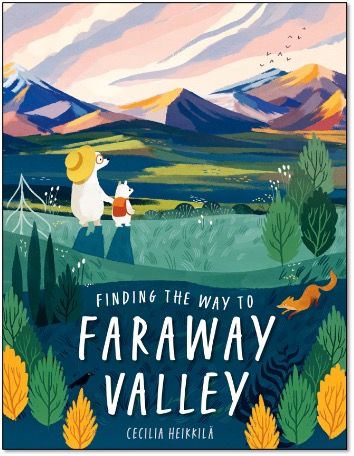
Finding the Way to Faraway Valley by Cecilia Heikkila, translated by Polly Lawson

[Translation – Swedish]

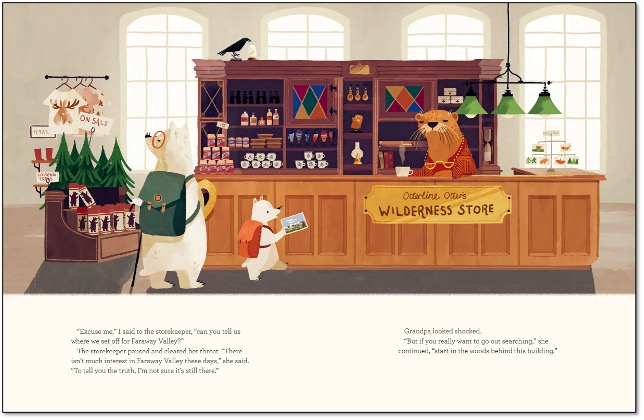
For years Grandpa has been talking about visiting Faraway Valley. Now he and his grandchild are finally making the trip, but when they get there it’s not at all what they imagined… or is it? A tale about preserving our last wild spaces. Who’s up for a Swedish translation? This one really snuck up on me. I’d heard about it earlier in the year but somehow didn’t have a chance to read it until now. The story is very much about tourism, finding wild spots, and their protection. If nothing else, you need to read this book so that you can fully appreciate Otterline Otter’s Wilderness Store (I want to go to there). Definitely give this one a taste.

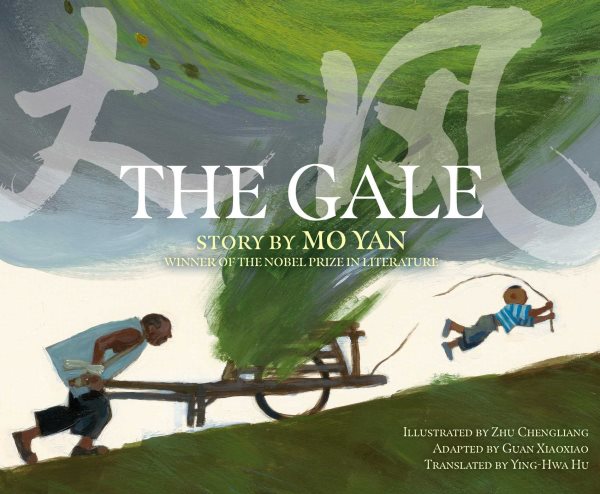
The Gale by Mo Yan, ill. Zhu Chengliang, adapted by Gu Xiaoxiao, translated by Ying-Hwa Hu

[Translation – Chinese]

Having just turned seven, a boy is finally allowed to accompany his grandfather to work, cutting grass for their livestock. But when a massive wind hits them, will they both survive the trip? So the question we lay before you is this: Is this book by Mo Yan, a winner of the Nobel Prize in Literature, appealing to kids at all? I can tell you this much, this book sticks in your brain. I mean, it’s an interesting tale I’ve never really seen before. It reminds me of that old Reading Rainbow book about the farmer whose plow accidentally falls into a hole that becomes an active volcano. Like that book, a farmer must face head on a natural disaster. Only in this case, it’s a real man vs. nature situation, and you don’t know who’s going to win. You might spend a fair amount of time yelling at this book, “It isn’t worth it, man!!!” Still, it doesn’t read like a translation, or even an adaptation, at all. It’s exciting and beautiful to look at. We get a lot of grandparent books in a given year but NONE of them are like this one. Previously seen on the Caldenott List.

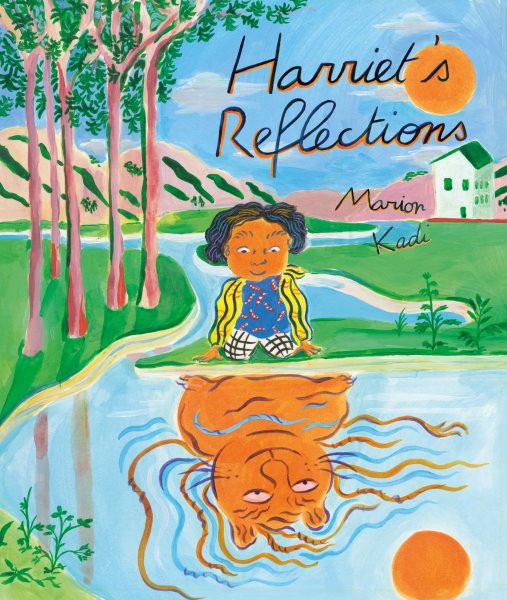
Harriet’s Reflections by Marion Kadi, translated by Marion Kadi and Abram Kaplan

[Translation – French]

One day a lion’s reflection decides to become the reflection of a little girl named Harriet. Initially she’s delighted, but what happens when she wants her old reflection back again? I’m just all about the French translations this year. Maybe that is because I love a book that works by its own illogical logic. The metaphor is strong with this one, no question. I think we’ve known more than one kid in our lives that had a lion inside themselves from time to time. I love fierce little Harriet and how she slowly comes to realize that it’s not a great idea to be wild all the time. I also love shots like the lion reflected in the teacher’s glasses. The solution is unexpected but if we’re carrying this metaphor to its logical end then I think it works rather beautifully. And, of course, it’s hard to resist the beautiful acrylic colors all over these pages. A book unafraid to roar a little. 

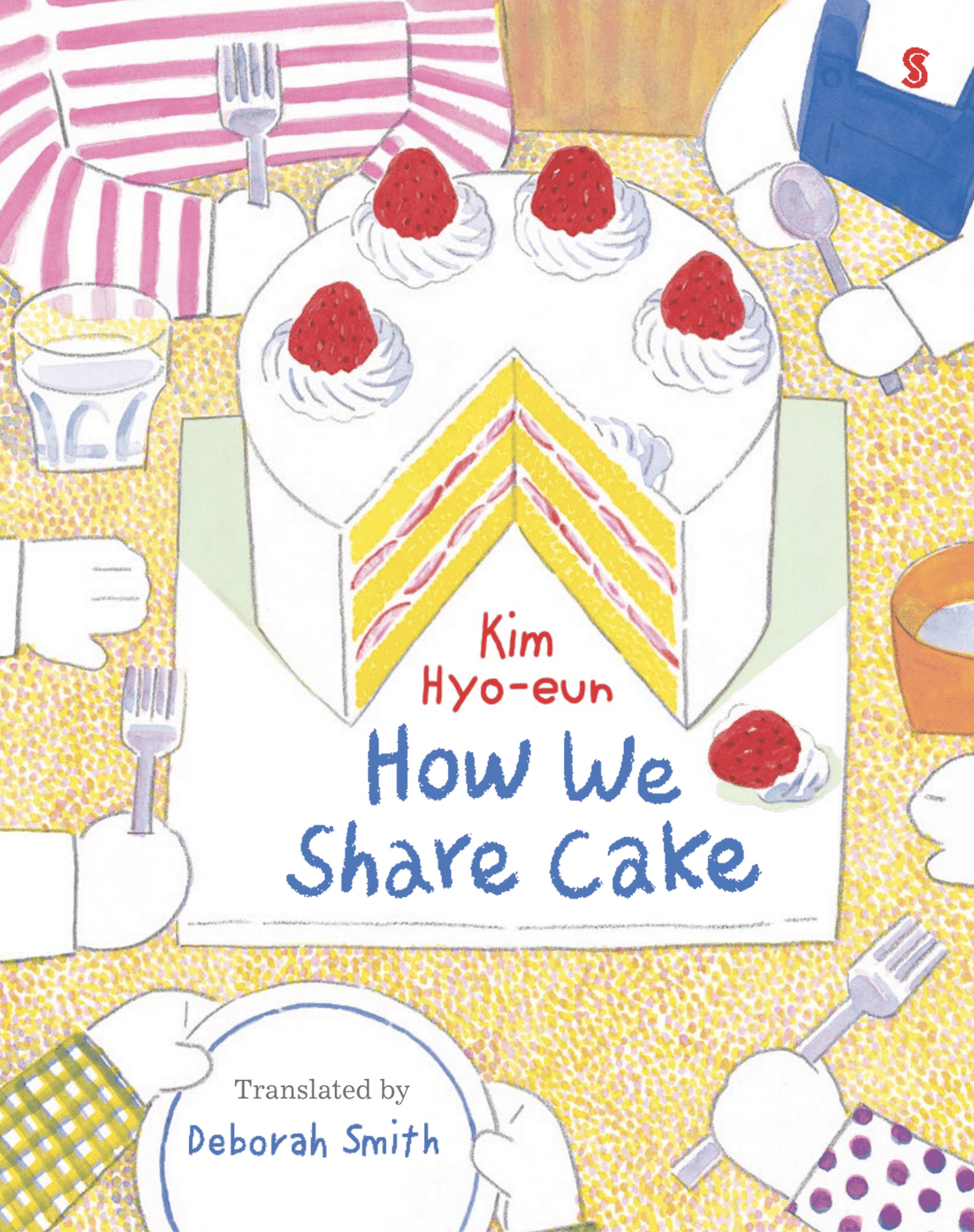
How We Share Cake by Kim Hyo-Eun, translated by Deborah Smith

[Translation – Korean]

The logistics that go into fairness, particularly when you have multiple siblings to contend with. Kim Hyo-eun doesn’t just understand this concept. She’s able to render it on the page with so much verve and humor than even if you grew up an only child you’ll find yourself laughing in recognition time and time again. I particularly loved the logistics of sharing food following by a consideration of how one “shares” an uncle. You do not want to miss this. Previously seen on the Funny List.

Miss Leoparda by Natalia Shalohvili, translated by Lena Taer

[Translation – Russian]

Public transportation takes a blow when bus driver Miss Leoparda loses all her riders thanks to a surge in car purchases. A gentle environmental tale told with wit and humor. It’s also a more overt version of the Lucy Knisley picture book Ride Beside Me, I’d say. Consider this a clever little tale about the encroachment of cars, how much they take over, and the natural way to alleviate some of their problems. Shaloshvili has a lovely artistic style, and if I’m not much mistaken this is her first picture book in America. The expressions on the animals’ faces are fantastic. Love that two-page spread when they’ve seen a car for the first time and they’re acting like Mr. Toad from Wind in the Willows. A book with a message that doesn’t whap you over the head with it. Extra points to the delicious translation from Traer.

Mr. Lepron’s Mystery Soup by Giovanna Zoboli, ill. Mariachiara Di Giorgio, translated by Denise Muir

[Translation – Italian]

Everyone agrees that Mr. Lepron’s soup is simply the greatest, so when he decides to start his own soup factory, folks are delighted. But what happens when a hobby you love turns into a full-time job? Hey, folks. Do you remember that fun wordless picture book from a couple years ago called The Midnight Fair? I read through this entire book, really enjoying it, but it wasn’t until I read the illustrator’s bio that I realized why her style looked so familiar. This one starts slow but once it gets going you just have to appreciate it. As always, I reserve my greatest respect for books that get a little bizarre on the pages. This one has a chaotic nightmare sequence involving mouths and rabbits and soup spoons that may haunt me for the rest of my days. LOVE IT! Great story, great messaging, and art that is simply to die for.

No. 5 Bubblegum Street by Mikolaj Pa, ill. Gosia Herba, translated by Scotia Gilroy

Translation – Polish

Richard Scarry by way of Poland. Are you curious? You dang well should be. I suspect we could make an entire list of picture books from this year alone involving apartment buildings and their residents. For whatever reason, such picture books tend to be more popular as imports. This particular book is keen. That’s the best word I use to describe it: keen. One by one we meet all the different residents at No. 5 Bubblegum Street and what they do for a living. There’s Mouse, who’s a famous rapper, but has to look through a slew of places to find his hat (if translator Scotia Gilroy was the one who came up with the book “Can I Kick It” on his shelf then I hereby humbly request the Batchelder Award committee to give Gilroy All The Things). Then there’s Panther, who is crazy for houseplants, the spider family playing instruments you’ve never heard before (I’m particularly fond of the baritone xylophone or the bass hexagon), and more. The frogs are by far the most fun to look at on the page, though, with their huge yellow eyes, composing songs on typewriters. Is it plot forward? It is not. Will you care? You will not. A delight. 

Out of the Blue by Rebecca Bach-Lauritsen and Anna Margrethe Kjærgaard, translated by Michael Favala Goldman

[Translation – Danish]

A meticulous boy with a well-ordered life finds his house completely turned upside down by a wild bear… and he loves it! A sweet, strange tale of finding unexpected friends.  As I mentioned before, I always like it when a book works on its own internal logic and damned be the consequences. Here we have a boy living entirely on his own, as seen in such books as Bink & Gollie. He’s drawn in rather a standard, illustrated manner. The bear who comes to occupy the house with him reminded me a lot of how someone like Matthew Cordell will suddenly place a highly realistic wild animal into a picture book, surprising and delighting the reader. At its heart, this is a story about loneliness and finding a kindred spirit. Plus who doesn’t want their own bear to play airplane with? A subtle, sweet delight. 

The Remarkables: The Most Incredible Children I’ve Met – So Far! By Clotilde Perrin, translated by Daniel Hahn

[Translation – French]

Trust Clotilde Perrin to be weird. In a good way, naturally! If you enter a children’s room of a library and notice that some of the picture books are not fitting on the shelves, odds are those are Clotilde Perrin books. Alongside Gecko Press, she and her publisher raise a middle finger to typical picture book dimensions. Now this latest title may actually fit the shelves a little better than some of its fellows, but what she lacks in the usual height she makes up for in girth. Which is to say, in text and illustrations. Clocking in at a massive 66 pages, the book lists a slew of remarkable children. And not just because they’re a little different from their fellows either. They are a LOT different. There’s the prickly child, covered in spikes, and the diamond child (where translator Daniel Hahn chose to keep the original “Très ostentatious” on the page to describe). There’s the Grassy Child and the Cloud Child and the Giant Child as well. All told there are 38 children in total and their lives are strange and lovely and odd and fun. I particularly liked the sections that discussed how they interact with one another. The most disturbing? Definitely the Cupcake Child. Not because the kid is particularly weird, but because his parents are continually trying to eat him. It’s a miracle the child is still alive (once you read it, you’ll understand why the child doesn’t, “like hearing my parents talk about me” and why, “I’d like some peace and quiet, even if it meant becoming an orphan”). Ah, translated children’s books. You’re always my favorites. 

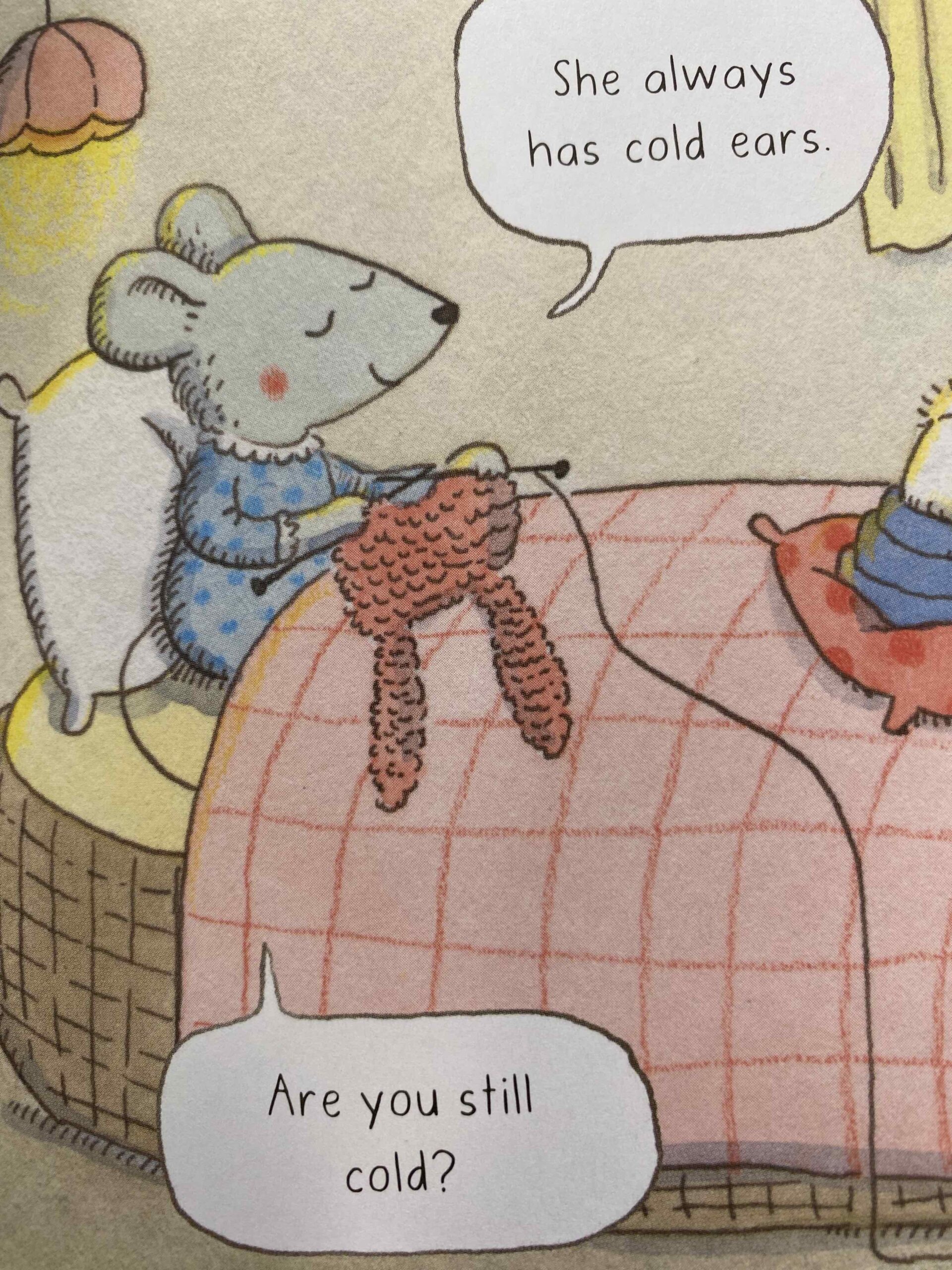
Two Little Red Mittens by Kirin Hayashi, ill. Chiaki Okada, translated by Avery Fischer Udagawa

[Translation – Japanese]

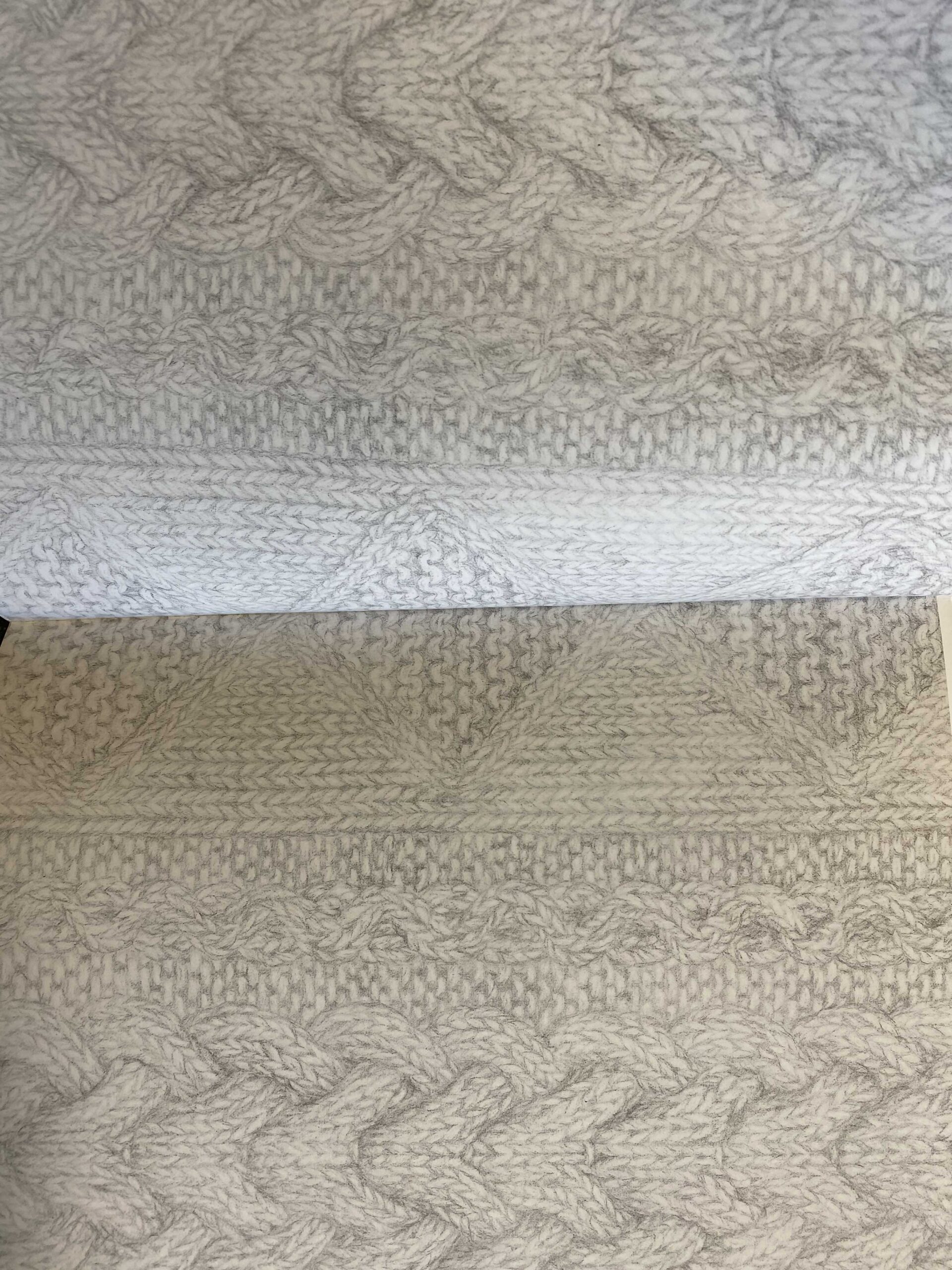
Did you know that folks just send me images of knitting in picture books these days? This is due in large part to the fact that I do an annual round-up of knitting on this site called The Scourge of Upside Down Knitting Needles. This particular book appeared on that list on the plus side, and for good reason. Chiaki Okada doesn’t go halfsies on accuracy. The endpapers of this book consist of this incredible cable stitched pattern, clearly taken from real life. Every single solitary stitch looks insanely on the nose. But then we get to the fact that the story itself is just more than a little charming. It follows the inner life of a lost mitten as it is used and appreciated by animal after animal. The ending isn’t all that different from the ending you find at the end of Sara Varon’s Robot Dreams. It’s a little bittersweet but happy overall, as the former pair of mittens realize that the other has moved on, and are content with where they are in the world. 


Translated Books for Older Readers

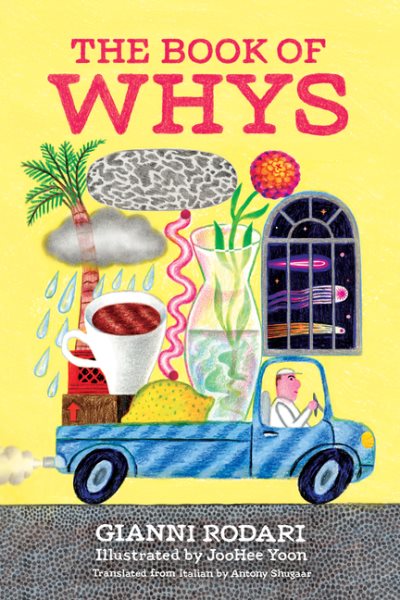
The Book of Whys by Gianna Rodari, ill. JooHee Yoon, translated by Antony Shugaar

[Translation – Italian]

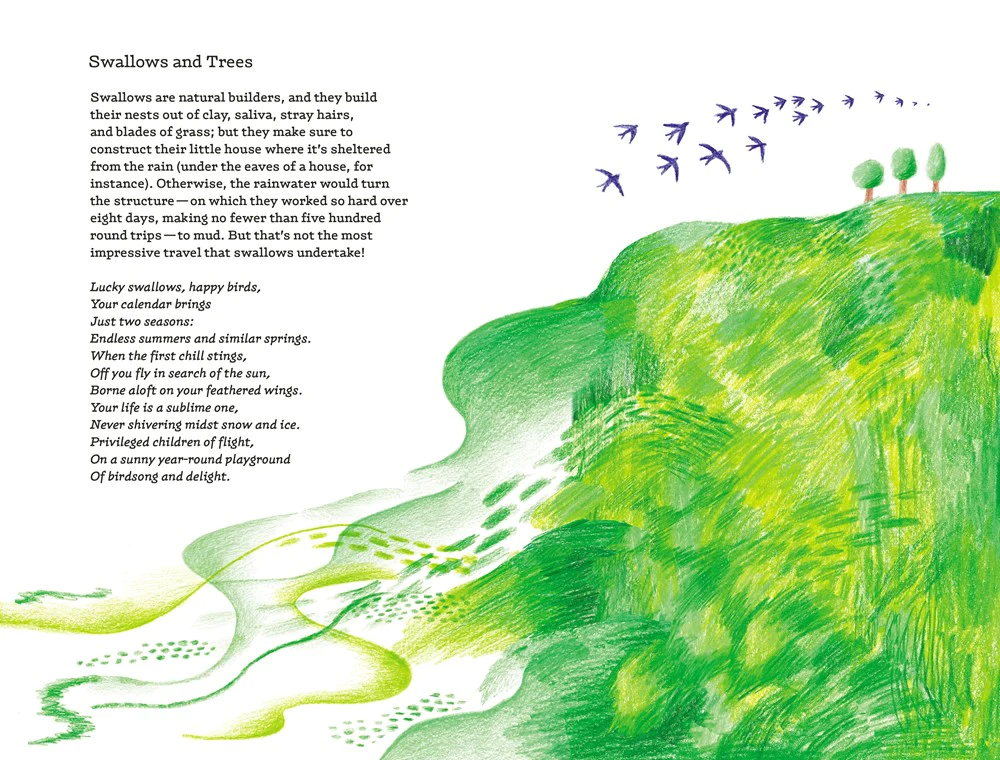
Lest we get too far ahead of ourselves, I would like to say that though I will also be placing this book ostensibly in the “Poetry” section, you could probably justify putting it on any list from middle grade fiction to nonfiction and get away with it equally well. It’s one of those books that crosses genres so frequently that you’re in dire danger of getting a headache. Rodari is a big name in the Italian children’s book scene, but here in the States his moniker will mostly be met with blank stares. This particular book is a series of questions from kids that he would answer in his newspaper column (reminding me of another newspaper serial the Italians love – Pinocchio). But the true star of this show is Antony Shugaar who has the impossible task of having to not only translate into rhyme for many of these poems, but to make the jokes work (even the puns!) too. He can only do so much with the questions that are SO Italian they squeak (example: “Why do people say: ‘It’s like shampooing a donkey’s head’?”) but given what he has to work with the man has gone to Herculean lengths. Well done, sir!!

The Gray City by Torben Kuhlmann, translated by David Henry Wilson

[Translation – German]

Moving to a new city is hard, but it’s even worse when everything is gray. As Robin learns more about her new home, she realizes that there may be something sinister behind the sameness.  I love the work of Torben Kiblmann, but in general I’ve always particularly enjoyed his early chapter book-like picture books because they featured cute mousies. Now, at long last, his heroes are of the human variety and it’s kinda throwing me for a loop. The story is, in our current book banning/you must conform era, a bit on the nose, and I like that. The book has this marvelous dreamlike quality to it, while still somehow invoking both 1984 and Camazotz from A Wrinkle in Time. It’s pretty fun, no matter how you slice it, and definitely worth a read. 

Miss Cat: The Case of the Curious Canary by Jean-Luc Fromental & Joëlle Jolivet, translated by Jill Phythian

[Translation – French]

Miss Cat is desperate for her next case, so when a sad man comes in looking for his kidnapped canary, she’s willing to look into it. But is there more to this feathered fiend than meets the eye? As a fellow librarian told me, this book falls squarely into that sweet spot where the reader wants a chapter book but still needs a load of pictures alongside the slightly more elevated text. When I was a kid I was very keen on detective stories, and this would most certainly have been exactly what I would have enjoyed. Sort of Encyclopedia Brown with magic, if you will. I like the hard-boiled kid detective. I like the octopus tending bar (a milkshake bar, but still). I like that the client isn’t all that they seem. Heck, I like the ending. Very strange. Very French.

Sounds Good by Hans Könnecke, ill. Ole Könnecke, translated by Melody Shaw

[Translation – German]

Discover 50 instruments, accompanied by delightful animal musicians, as they introduce you to a world of music. From glockenspiels to bongos and congas, a marvelous entry point for any kid looking for an instrument to love. Whenever people try to claim that Germans don’t have a good sense of humor, Ole Könnecke’s the one I like to offer up as a counter-example. So this is, at its heart, just a book meant to introduce kids to a range of instruments, but something I really love about it is that it isn’t afraid to take a trip outside the usual European orchestra ones. As a result you get a nice worldview that includes things like the sitar, didgeridoo, steelpan, kalimba, and more. My personal favorite, was definitely the theremin, and for that one I just had to try the QR code that appears on every page. Apparently the author composed a musical piece for each instrument. I didn’t listen to the code where all the instruments play together, but I can attest that that’s one fine theremin at work!


So with all that in mind, here are the other lists for 2024:

December 1 – Great Board Books

December 2 – Picture Book Readalouds

December 3 – Simple Picture Book Texts

December 4 – Transcendent Holiday Picture Books

December 5 – Rhyming Picture Books

December 6 – Funny Picture Books

December 7 – CaldeNotts

December 8 – Picture Book Reprints

December 9 – Bilingual Books for Kids

December 10 – Math Books for Kids

December 11 – Books with a Message / Social Emotional Learning

December 12 – Fabulous Photography

December 13 – Translated Picture Books

December 14 – Fairy Tales / Folktales / Religious Tales

December 15 – Wordless Picture Books

December 16 – Poetry Books

December 17 – Unconventional Children’s Books

December 18 – Easy Books & Early Chapter Books

December 19 – Comics & Graphic Novels

December 20 – Older Funny Books

December 21 – Science Fiction Books

December 22 – Fantasy Books

December 23 – Informational Fiction

December 24 – Gross Books

December 25 – Science & Nature Books

December 26 – Unique Biographies

December 27 – Blueberry Award Contenders (Celebrating the Environment)

December 28 – Nonfiction Picture Books

December 29 – Nonfiction Books for Older Readers

December 30 – Middle Grade Novels

December 31 – Picture Books
Filed Under: 31 Days 31 Lists, Best Books, Best Books of 2024 Tagged With: 31 days 31 lists, Best Books of 2024, translated picture books, translations

31 Days, 31 Lists: 2024 Fabulous Photography Books for Kids

December 12, 2024 by Betsy Bird

I don’t know if you know this, but each year I reserve the right to cancel a topic on this 31 Days, 31 Lists list and replace it with a wholly new one, should my mood dictate such a switcheroo. For example, this year, due to the sad downtick in gross books for kids, I replaced that topic with Bilingual Books for Kids. And, to be perfectly honest with you, I considered getting rid of this year’s Photography list. Now don’t get me wrong, I LOVE photography. I was a photography major in college, after all. I feel it’s the great unsung, untapped genre of children’s books and is vastly deserving of more attention. That said, I had the distinct impression that there wouldn’t be enough notable photography books for my list. I tend to eschew Getty/Shutterstock image photography books, you see. Nothing against them personally, but their stock photography simply can’t compare with the dedicated photographers you’ll find working to make the best possible books. Fortunately, I miscalculated. 2024 had some true photographic beauties and we’re going to experience them firsthand, right now!

So with that in mind, please put your hands together and help me celebrate the great works of children’s literature photography to come out in 2024!

If you’d like a full PDF of today’s list you can find one here.

Curious about the previous years’ collections? Then take a gander!

  • 2023
  • 2022
  • 2021
  • 2020
  • 2019
  • 2018
  • 2017
  • 2016

2024 Fabulous Photography for Kids

Clouds in Space: Nebulae, Stardust, and Us by Teresa Robeson, ill. Diāna Renžina

Nebulae finally get their time to shine (literally, I suppose). You can tell kids all day long that they’re made out of spacedust, but aside from it sounding particularly poetic, it’s kind of a vague term. This book personifies a nebula and explains why it both is and is not like the clouds in our skies. The books does a great job of integrating photographs of the universe alongside the illustrations of Renžina, giving the whole enterprise a fun and otherworldly feel. I thought Robeson did a darned decent job explaining the origins of a nebulae in fairly poetic but still scientific terms: “Sometimes, I am the last burst of breath expelled by a star or a supernova lofting elements into space like dandelion seeds on the wind.” Or, later, “You are grown from scattered stardust sprouted in a stellar nursery. I AM the stardust AND the nursery.” Beautiful backmatter (literally, these photos are jaw-dropping), a bibliography, websites to explore, and more abound. This one’s a keeper.

A Meerkat Diary: My Journey Into the Wild World of a Meerkat Mob by Suzi Eszterhas

Wildlife photographer Suzi Eszterhas takes you up close and very personal with a meerkat family and their various trials and tribulations. Adorable and informative.  I regret to inform you that Suzi Eszterhas does it yet again. To my mind she’s too darn reliable. Every book she creates is just chock full of great research and amazing photography. Now what’s so strange about this book is that this particular mob of meerkats has been specifically groomed, so to speak, to be comfortable around humans. That doesn’t mean the humans intervene and I do wish there were more explanation for why this has occurred, but if I were to hazard a guess it’s for research purposes, so as to study them more closely. The photographs in this book are, as you might imagine, extraordinary. You simply will not find better meerkat images anywhere else. It’s the perfect length and chock full of facts. Resist if you can.

The Mighty Pollinators by Helen Frost, ill. Rick Lieder

“Here come the pollinators, / small and mighty, / holding the world together.” Get up close and personal with the tiny critters that pollinate our world. Breathtaking photography coupled with beautiful verse.  I mean, should we just reserve a permanent slot on our annual lists that says something like [Enter Helen Frost Poetry/Photography Book Here] or something along those lines? Who can compete with her when she pairs with Rick Lieder? No one, that’s who! As visual deep dives into pollination go, I dare say this has no equal. Lieder took the time to make sure that every bug in this book isn’t just showing its good side to the camera, but has copious specks of pollen on its body as well. And, bonus, the poetry itself is pretty darn good (no small thing). Nature at its most beautiful. 

Nature Spy Guide by Shelley Rotner

What does it take to be a nature spy? Well, you’ve got to get outside and listen and taste and look and feel. There’s a whole world out there ready to explore, and this book with its vibrant photographs will help get you excited to do so!  So I was quickly scanning the publication page here to try and see if Shelley Rotner utilized any Getty images or Shutterstock photos for her book. And insofar as I can tell, the answer is NOPE! Not a jot! This is pure Rotner goodness, all the way. I like very much the hook of turning kids into “nature spies”. Gives observations outdoors a sort of extra oomph, don’t you think? This book reads young, encompasses a wide range of seasons, and really makes you want to get outside and observing. If we’re looking for books that inculcate a love of nature in young readers, I can hardly think of a better selection.

Quill the Forest Keeper by Marije Tolman, translated by David Colmer

A lovely little title about a small hedgehog who gives WAY more than it should. In this story, Quill is a hedgehog who wants to keep his corner of his world clean. Yet every time he cleans one area, another one gets dirty. Exhausted by his Sisyphean efforts, he goes to sleep and his friends try to pick up the slack. Here’s the funny thing about the book. Its original title is apparently a portmanteau of the Dutch word for hedgehog along with an ending designated for gods in Dutch mythology. How the heck do you translate a title like that into English? Long story short, you don’t, you find something equally good. From what I can understand, this book was actually created for Children’s Book Week, and using Marije’s signature style it uses a Pantone 5th color to bring out this marvelous bright bright orange in all of the spreads. Marije was apparently with her family on a trip to the Scottish Highlands when she photographed all those beautiful images you’re seeing in her landscapes. Combine that with some gouache for the little animals and you have yourself a book. And is there anything better than fuzzy woodland creatures paired with jaw-dropping landscape art? A lovely follow-up to the beautiful picture book Little Fox (released in the U.S. in 2020)

Rumie Goes Rafting by Meghan Marentette

When we talk about photographic picture books, we too often end up just talking about nature photography. And that’s all well and good but far more dangerous, delicate, and difficult than any book slapped together with Getty Images is a fictional story told with models and photographed in a realistic way. That’s why I was delighted to stumble across Meghan Marentette’s Rumie. So the real danger with models is movement, right? How do you make static figures look like they’re moving on a page? Marentette jumps right in from the title page. There you see Rumie running down a hill towards the water. If there’s any digital trickery at work here, I can’t see it. Then you open the book and boy, it’s lovely. You just can’t fake natural sunlight in the woods, can you? The book tells the story of impatient Rumie and her desire to take a raft for a ride with disastrous consequences. It does a rather delightful job of showing action in a seemingly static form, and I loved how Marentette handled the expressions on the characters’ faces. This one’s a keeper. 

Starlight Symphony by Buffy Silverman

Silverman’s books with Lerner always tend to contain a fair amount of stock photography, but whatta gorgeous collection of it there is. This book takes the reader to the moment when the sun sets and the sounds of nighttime nature come into their own. Each animal has its own particular sound, which is fun to say. Things like “Eee-oh-lay!” for the wood thrush or my personal favorite, the bittern. “Oong-KA-chunk!”. You can hear the readaloud potential here already, can’t you? Imagine a nature-based storytime where you get all the kids to make the sounds with you. Oo! It could be a jammie time in the evening! Or an outdoors evening storytime in the woods! Lots of possibilities here. The text is nice and simple but introduces a whole slew of different animals. And the photography is interesting because it has to confer the idea of taking place at night. I did read this wondering if there was some work done on the edges of some of these photographs. If so, it’s well done. No one would be able to tell. The end result is a fairly consistent visual feel for nighttime critters and their sounds. Previously Seen On: The Readaloud List


So with all that in mind, here are the other lists for 2024:

December 1 – Great Board Books

December 2 – Picture Book Readalouds

December 3 – Simple Picture Book Texts

December 4 – Transcendent Holiday Picture Books

December 5 – Rhyming Picture Books

December 6 – Funny Picture Books

December 7 – CaldeNotts

December 8 – Picture Book Reprints

December 9 – Bilingual Books for Kids

December 10 – Math Books for Kids

December 11 – Books with a Message / Social Emotional Learning

December 12 – Fabulous Photography

December 13 – Translated Picture Books

December 14 – Fairy Tales / Folktales / Religious Tales

December 15 – Wordless Picture Books

December 16 – Poetry Books

December 17 – Unconventional Children’s Books

December 18 – Easy Books & Early Chapter Books

December 19 – Comics & Graphic Novels

December 20 – Older Funny Books

December 21 – Science Fiction Books

December 22 – Fantasy Books

December 23 – Informational Fiction

December 24 – Gross Books

December 25 – Science & Nature Books

December 26 – Unique Biographies

December 27 – Blueberry Award Contenders (Celebrating the Environment)

December 28 – Nonfiction Picture Books

December 29 – Nonfiction Books for Older Readers

December 30 – Middle Grade Novels

December 31 – Picture Books
Filed Under: 31 Days 31 Lists, Best Books, Best Books of 2024 Tagged With: 31 days 31 lists, Best Books of 2024, photography, picture book photography

31 Days, 31 Lists: 2024 Message / SEL Books for Kids

December 11, 2024 by Betsy Bird

The very origins of American picture books are rooted firmly in the tradition of teaching our children strong messages about what is good and what is bad. Those origins are alive and well… in celebrity picture books. Honestly, I swear that 90% of them are trying to instill some kind of a “message” about what kids should do or be. I worry then that people might give up on the whole notion. But if picture books are here to inform and teach then morality is a keen part of that. This year, we’re going to talk about the usual slew of “message” books, while also taking some time to consider those titles that look at social and emotional learning. You’ll see a wide range of titles here today. Hopefully their inclusion will make a certain amount of sense.

For the full PDF of this list you can find it here.

And if you’d like to see previous years’ message books, look no further than here:

  • 2023
  • 2022
  • 2021
  • 2020
  • 2019
  • 2018
  • 2017
  • 2016

2024 Books with a Message / Social and Emotional Learning Titles for Kids

Everyone Gets a Turn by Marianne Dubuc, translated by the VeroK Agency

Dubuc specializes in the small. Flashy does nothing for her. When she creates a book, she wants to create a world that your child could just dive into. In this particular tale, four friends discover an egg one day, and everyone wants to care for it. What makes the most sense then is for everyone to care for it equally and to take turns. And that sharing doesn’t end when the egg hatches either. Out comes a fluffy little chick, with four different animals (each with four different personalities) on hand to help it any way they can. Honestly, this is one of the few picture books about communal parenting that you’re likely to find on your shelves these days (if you want to know about gaps in the marketplace, there’s one right there). Sweet, soft, and gentle, but this isn’t pablum. It’s just darned good storytelling. 

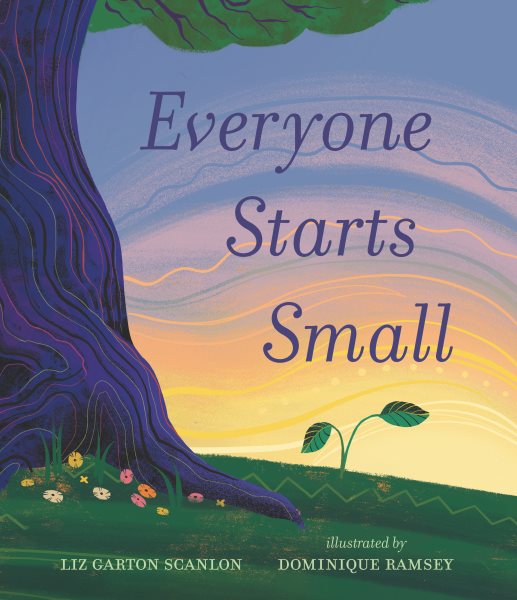
Everyone Starts Small by Liz Garton Scanlon, ill. Dominique Ramsey

Before writing this book up I wanted to do a little bit of digging to see what awards Liz Garton Scanlon has gained in the past. As picture book authors go, her work is often extraordinary. I cannot emphasize enough how difficult it is to do what she does on the page. Unfortunately, we don’t really have all that many awards that credit this kind of skill. Sure, one of her books got a Caldecott Honor, but that’s an award for art, not writing. Long story short, please give this woman more awards for writing, universe. Thank you. Now this particular book, Everyone Starts Small, is an excellent example of a topic that’s been done to death, yet can find new life under a talented picture book author’s hand. I’m putting it in the “message” category today because one cannot talk about small things getting bigger without the obvious implications for our young readers. Here, Scanlon’s “everyone” of the title is really more focused on seeds of one sort or another. “Everyone starts small, in seed or sky or rocky bed.” Great first sentence, there. Top notch. As we watch, we pull back to watch trees and rivers doing their thing, then close up again to see ants “Grass and Sun and Bug and Berry rise and ripen too.” The important thing that sets this book apart is the forest fire that appears more than halfway through. That’s timely, but not scary. It’s just another part of life. I love the Fire whispering “I’m tired” when it’s rained upon. With its lilting text, this is a bedtime message book with a notable mention of forest fires. It’s doing several things at once, in the best way possible. Well done. 

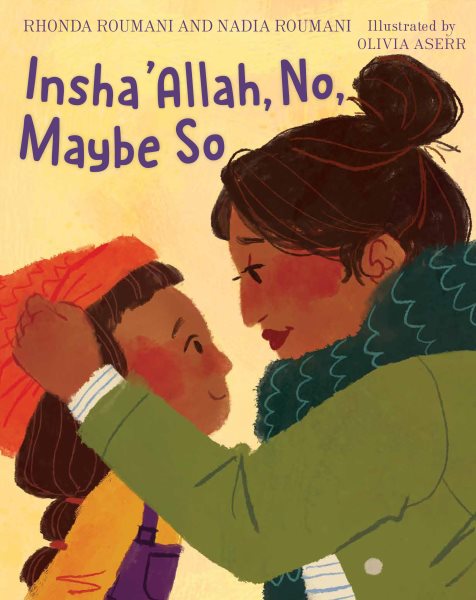
Insha’Allah, No, Maybe So by Rhonda Roumani and Nadia Roumani, ill. Olivia Aserr

Sometimes my favorite books are the ones that take something that’s just incredibly common in one culture and introduce it to another. In their authors’ note, the Roumanis explain that the term “Insha’Allah” is one of those phrases used by Muslims and Arabs incredibly often, though until now I can’t think of a picture book that’s ever centered it in any way. In this story Ranya’s the kind of kid who figured out long ago that if she asks for something and her mom says “Insha’Allah”, that probably means no. At least that’s how she sees it anyway. Mama explains to Ranya that it’s actually a little more complicated than that. It doesn’t really mean “maybe” either, though. More, it’s the kind of phrase it use when you want to make it clear that Allah may have different plans than the ones you do. I’m reminded of the old phrase, “If you want to make God laugh, tell her your plans.” The Roumanis do a good job of showing cases where Ranya both gets what she wants and doesn’t. And as a parent, I, for one, appreciated Mama saying she’ll take Ranya to Disneyworld… “before you turn eighteen. Insha’Allah.” 

Just What to Do by Kyle Lukoff, ill. Hala Tahboub

I cannot be the only one who has been searching for the next The Rabbit Listened, can I? Another book that with an exquisitely simple text is able to use the simplest of words to tell kids (and, let’s face it, their adult readers) what to do when someone is experiencing a kind of grief. The hero of this book (so nicely rendered without any particular gender) starts out overflowing with confidence. They know “just what to do” when their brother’s cactus dies. A homemade sympathy card, right? But when he says he wants a joke instead, their tactics change. And with each person, explaining what they need (a hug, help passing out snacks, the chance to show old photos) the child changes too, until by the time they get to their best friend mourning their grandmother they literally don’t know what to do. So they ask. It’s so simple, and I love that the best friend also has no idea what they can do to help. All they can do is just spend time together and figure it out with one another. Kyle just gets it, man. This is how you write this kind of a book. A book about listening to people and figuring stuff out together. Because lord knows, none of us know. Not really. The perfect message book, simply put. 

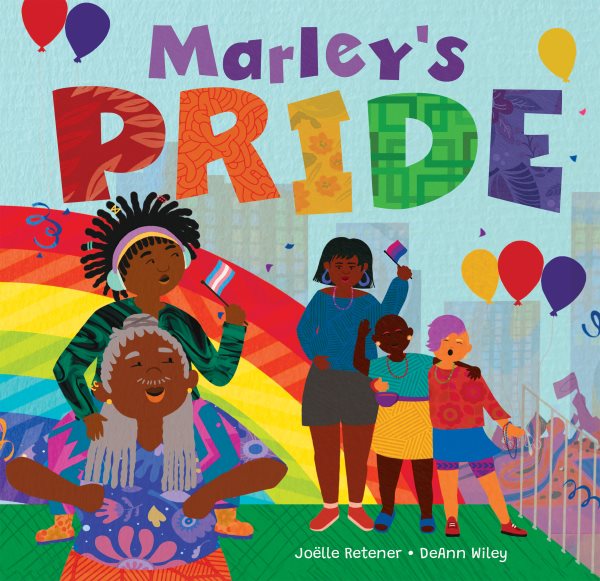
Marley’s Pride by Joëlle Retener, ill. DeAnn Wiley

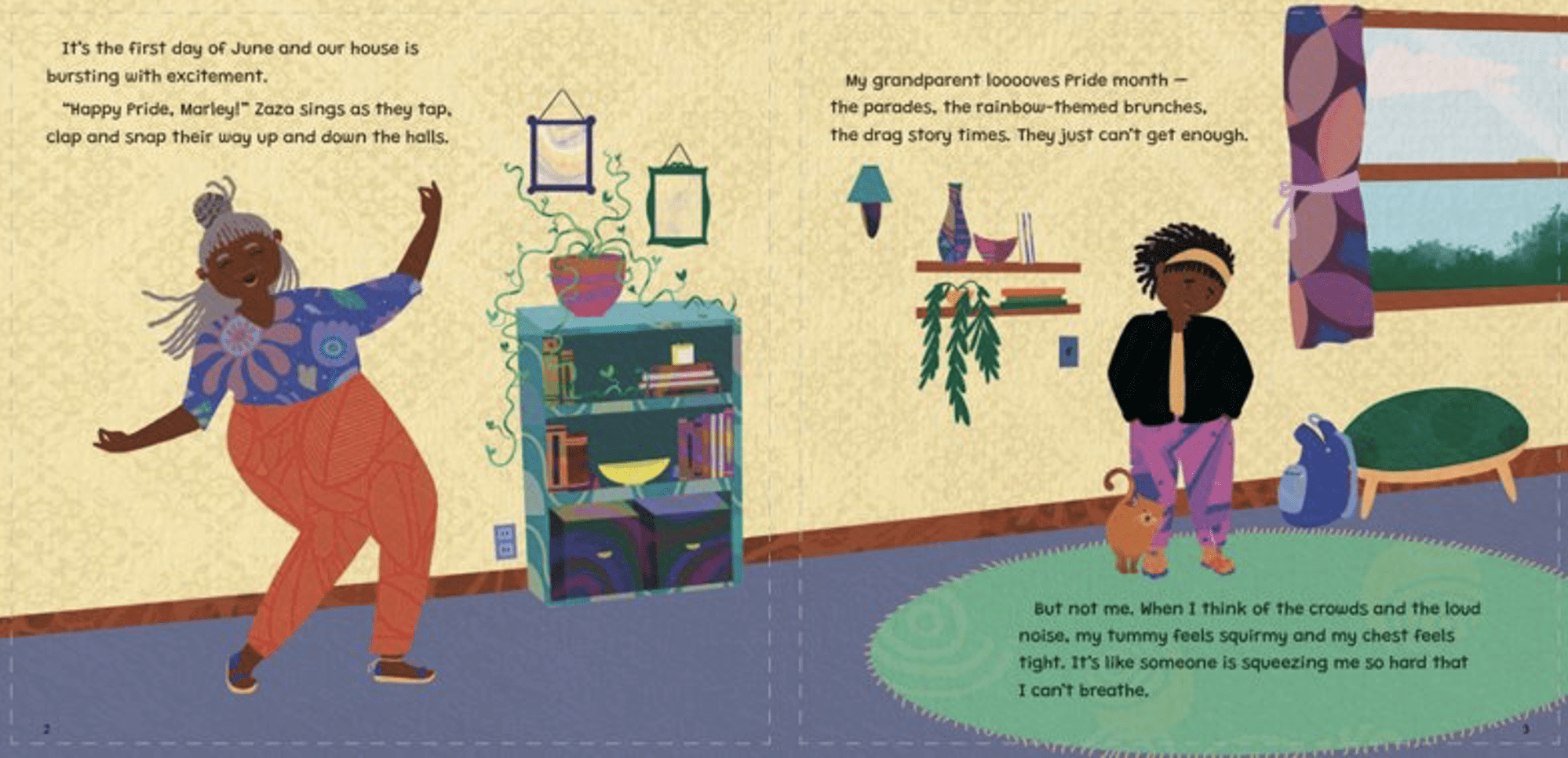
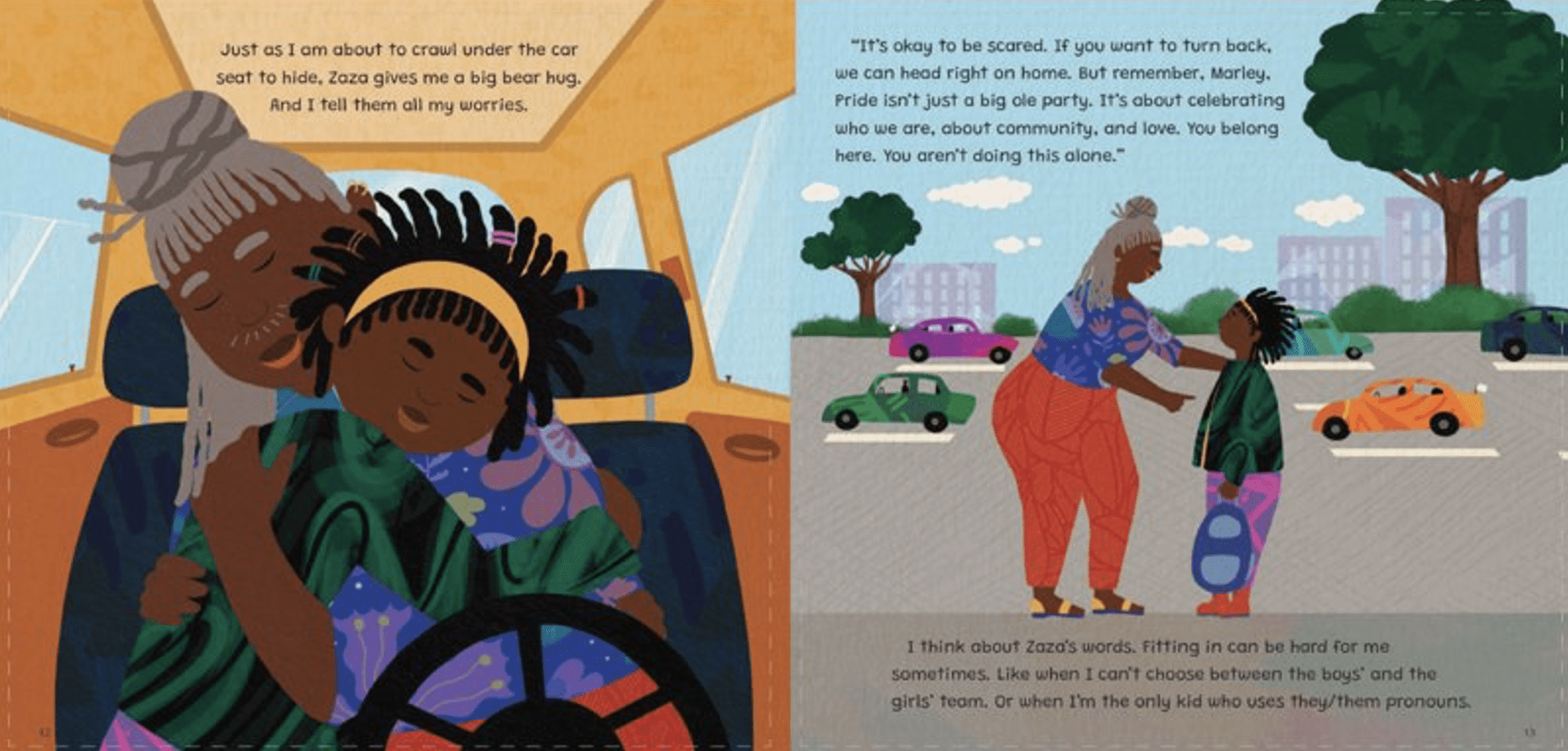
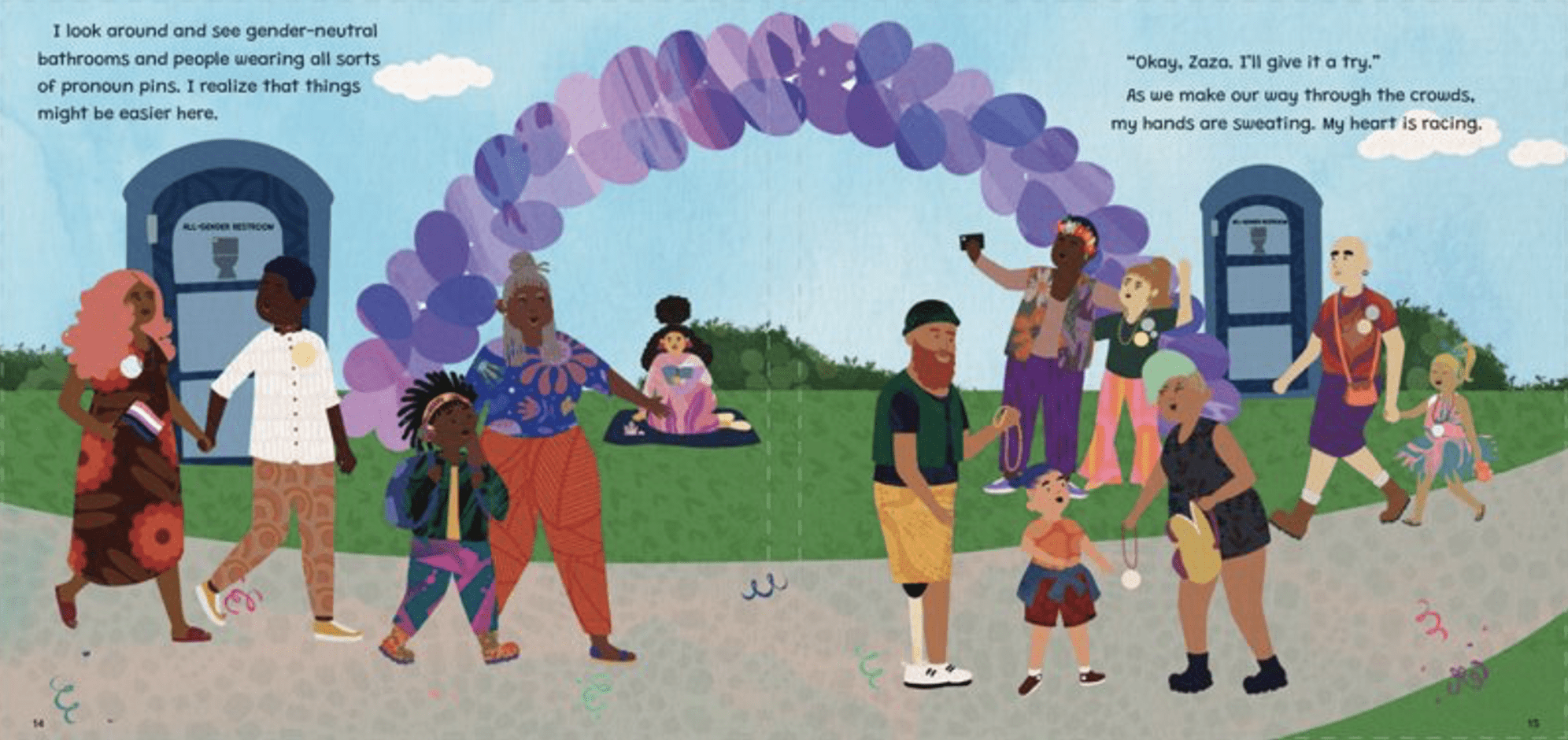
If you are a librarian or a bookseller and someone walks up to you and asks, “What is a picture book that shows intersectionality?” your immediate response should be to pull out a copy of Marley’s Pride and then brandish it proudly. In this tale you’ve Marley, who has some anxiety issues when it comes to crowds. This feeling is seriously getting in the way of their desire to participate in the big Pride celebrations, though. Zaza, Marley’s grandparent, is kind of the star of those festivities, and would really like Marley to come along. So, after doing some yoga and deep breathing (as well as packing noise-canceling headphones, a fidget spinner, and a very necessary lavender bunny), Marley is ready to give it a try. There’s just a really accepting groove to the whole proceedings, and I was reminded of Mermaids On Parade by Melanie Hope Greenberg as I watched the variety of events and people. The backmatter of this book is maybe some of the best I’ve seen too. I was particularly taken with the display of different flags (I didn’t know that the updated rainbow flag was called the “Progress Pride”). Great stuff!

Not a Smiley Guy by Polly Horvath, ill. Boris Kulikov

Wow. I hereby award the Best Last Sentence in a Picture Book Award to (drumroll please) POLLY HORVATH! In this tale, a little boy named Ernest just, as the title says, is “not a smiley guy”. Nothing wrong with that except it freaks the heck out of other people. I love the description of what happens when baby Ernest gives smiling a try. “But aside from the interesting stretchy face sensation it was not for him.” When pressed by his parents to explain what would truly make him happy he confesses that what he really wants is an elephant. When he gets one (named Marcia, no less) his parents are baffled. Why isn’t he happy now? Ernest has to explain that he’s actually happy most of the time. His parents then ask if there was some way that he could show it. So the occasional jig is decided upon. And as the book concludes, “You don’t have to change, but for the people you love you do what you can.” I may have that line embroidered on something someday, it’s such an incredible message. Kulikov, for his part, has a lot of fun working elephant silhouettes into the art long before Marcia’s appearance. This one’s a joy. 

Peggy the Always Sorry Pigeon by Wendy Meddour, ill. Carmen Saldaña

There is a wide range of “messages” that picture books try to teach young children. And while I’m sure I can’t say that I’ve seen them all, I have seen a great swath of them over the years. Yet in all my time, I’ve never seen anyone dare to teach kids (especially girls) NOT to apologize when other people push them around. It’s a nuanced lesson but a necessary one, and while I wouldn’t say that Peggy the Always Sorry Pigeon is the only book you’d ever hand a child on the subject, it certainly does work as a good introduction to the concept. In this tale, Peggy is constantly apologizing whenever anyone else tells her to move or leave. It takes a watching seagull to inform Peggy that she’s not doing anything wrong and should not be apologizing for simply existing. The two then go back to the three places where other animals told her off, and Peggy gets this cathartic series of moments where she gets to yell amusingly oblique statements in her own defense. It’s great fun, and would probably make for a good readaloud, come to think of it. A perhaps necessary tome for kids today.

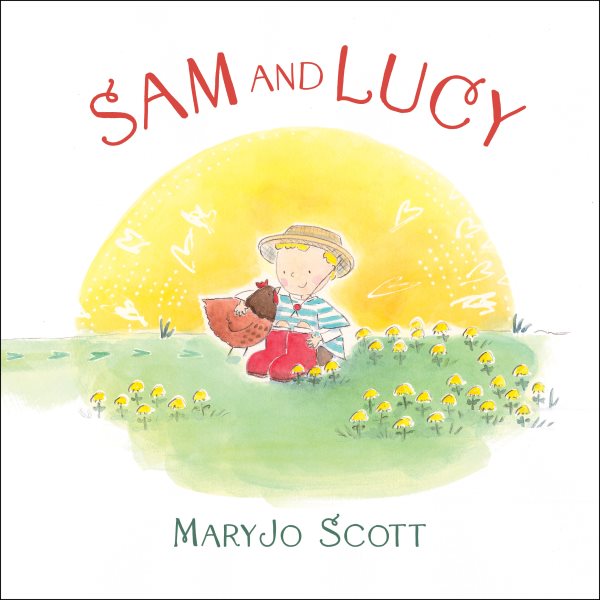
Sam and Lucy by Maryjo Scott

There was a year or two there when you couldn’t walk into a children’s room in a library without stumbling over three or four new dead dog books. Recently, I’ve noticed that we’ve been seeing less new death-of-a-pet tales coming out, and I can’t help but wonder what that says about the publishing industry/the pet industry in this country. Now with a dead pet book you’ve a number of directions you can travel in. You can try to encompass the entire life of the pet and the child who knows them. Usually, if you want to do that, you have to either start the pet small with the kid’s parents or you have to make the kid a teenager or young adult when the pet dies. I guess the advantage of a book like Sam and Lucy is that you don’t need to make that choice when the pet in question has a very short lifespan anyway. Chickens, after all, are not noted for their longevity. And considering how many kids in this country are growing up with chickens these days (urban farming having taken off a little after the pandemic), this may be a legitimate death of a chicken pet book for some kids. The story follows young white blond Sam and his favorite chicken Lucy. You see Lucy from babyhood onwards. When Lucy grows old, the doctor tells Sam to just give her extra love. The book doesn’t end with her death necessarily, though it’s certainly implied. You just end on a hilltop with Sam and Lucy watching the sky together. And did I tear up? Do you even need to ask? A softer, sweeter, more chickeny-er death of a beloved pet story.

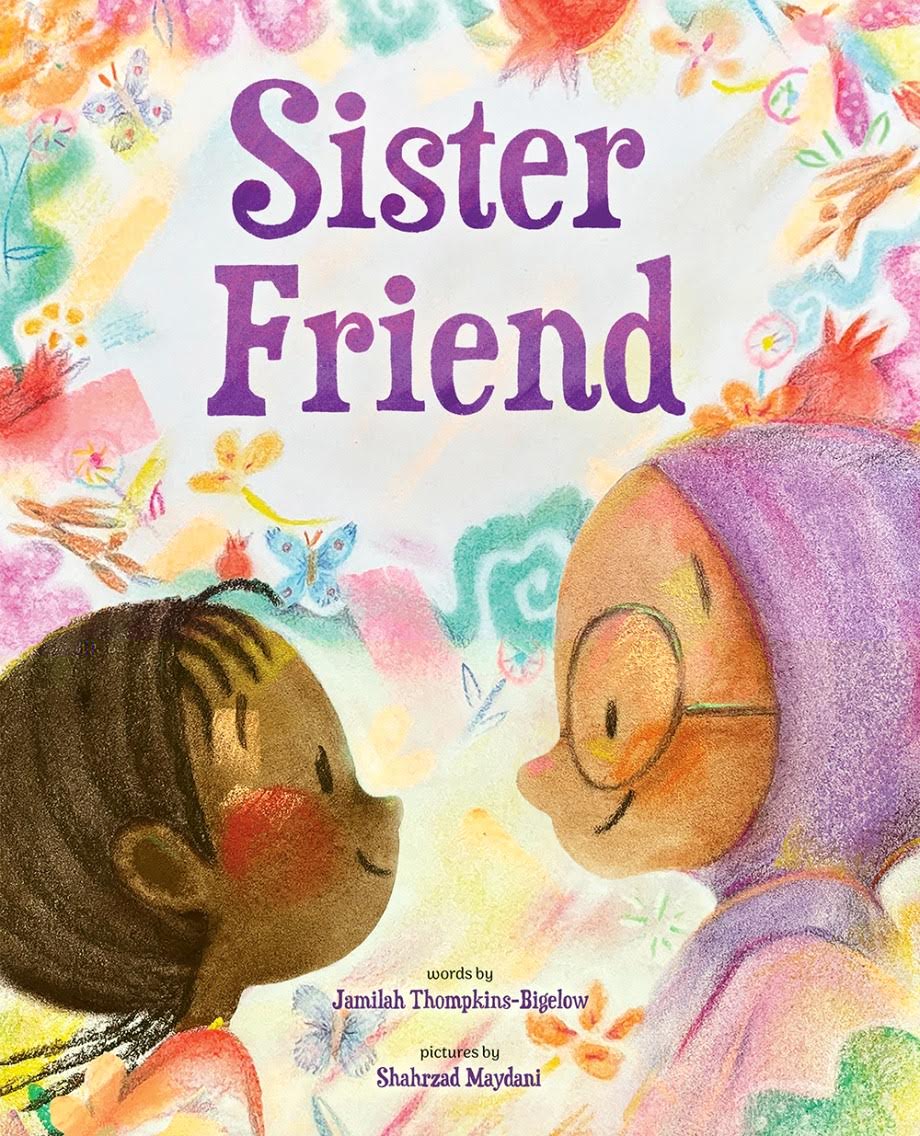
Sister Friend by Jamilah Thompkins-Bigelow, ill. Shahrzad Maydani

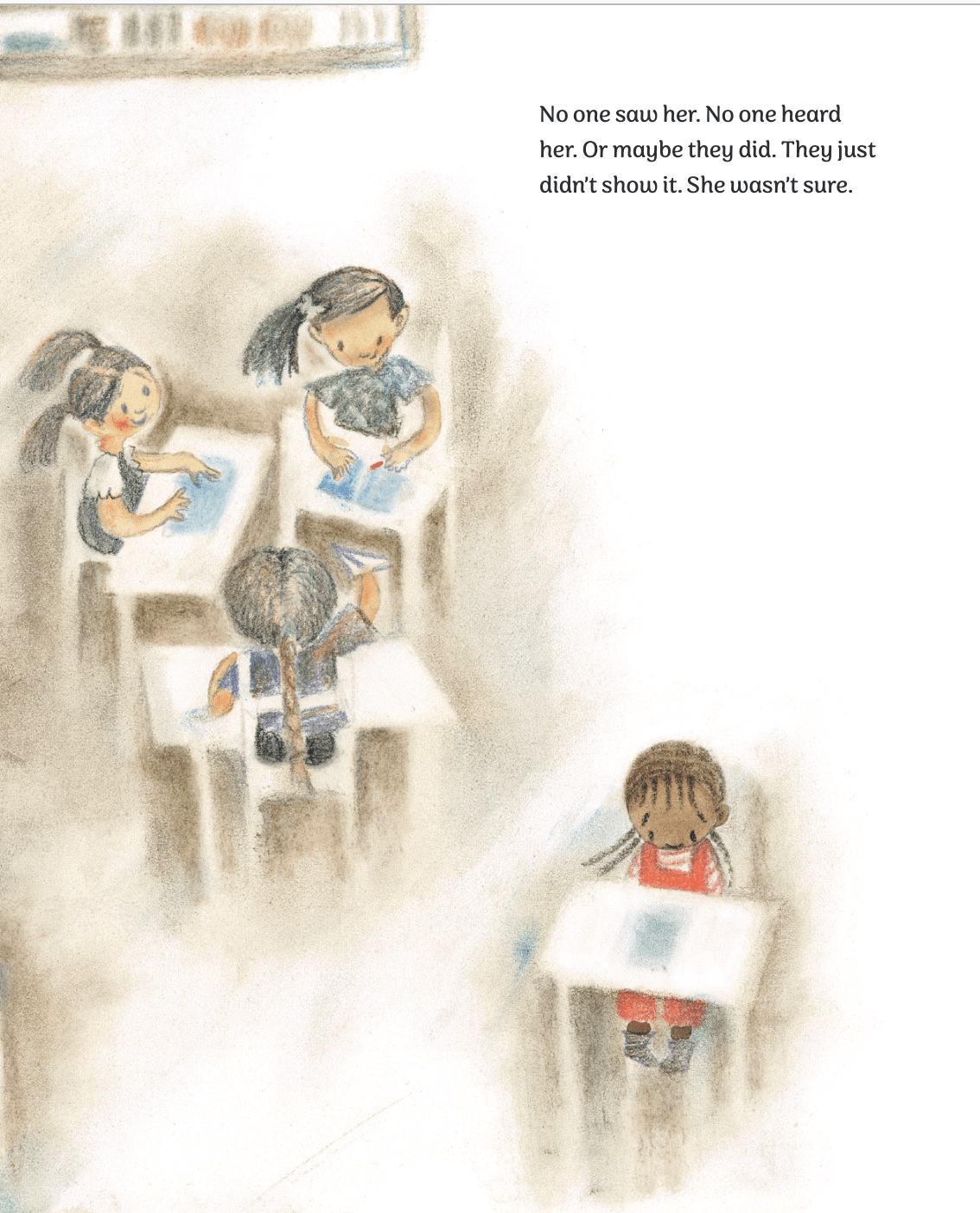
Sometimes it takes the right text for you to be able to see an illustrator in a whole new light. Shahrzad Maydani has illustrated a slew of picture books in the past already, but there’s something about her work on SISTER FRIEND that feels completely different. And not gradually throughout the book but right there at the start. That initial sequence of Ameena playing hopscotch by herself just has so much zip and personality to it! It’s an incredible introduction to a story that’s unafraid to touch on pain. Ameena’s the only Black girl, and certainly the only Muslim girl, in her class. When a new classmate arrives named Sundus, Ameena is delighted. But this isn’t a story of instant friendship or anything. Misunderstandings and miscommunications plague the two girls, keeping them from connecting. And what Ameena takes as rudeness eventually resolves itself as an embarrassment over Sundus’s inability to speak English fluently. Did I tear up at the end? I bloody well did tear up at the end yep. 

Time to Make Art by Jeff Mack

What exactly is art? What can it be? As one small child asks these questions, artists ancient and modern make it clear that art is whatever you want it to be. Inspiring and fun! You know, I didn’t think it could necessarily be done, but Jeff Mack has managed to create a book where a ton of artists are visually referenced and it’s actually really very good! This feels like the second in a series that Mack started with MARCEL’S MASTERPIECE. Like that book, this one is helping kids to question what “art” really is. I like any book that breaks down their objections to creation, and this one is brilliant. I’m also giving it extra points for making it clear that photography is art (Cindy Sherman gets a cameo), which is something that most art books ignore (for adults AND kids). Love the message, love the style, and love how damned inclusive it is. Plus there were quite a few folks in here that I want to now discover for myself. 

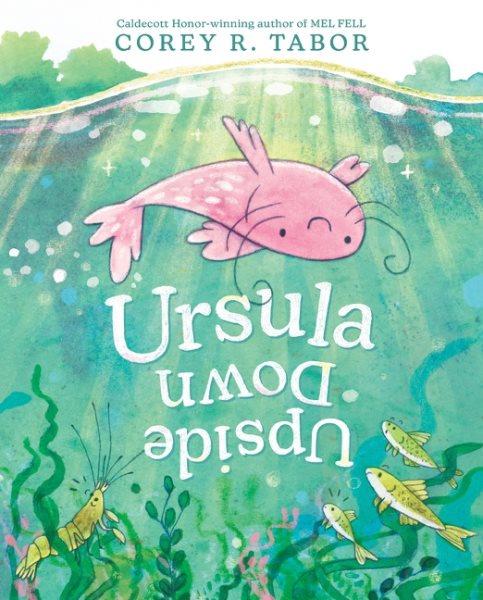
Ursula Upside Down by Corey R. Tabor


Ursula is a merry little catfish, happily swimming about her day, until other creatures try to tell her she’s completely upside down. A flipped-format picture book with a clever bit of messaging inside. Clearly I have the memory of a goldfish myself. I picked this book up, started reading it, and when it started to utilize all these neat ways of twisting and turning it to keep reading I found myself thinking, “This is really neat! It really feels like a book that Corey R. Tabor would do!” At the end I checked out the creator. Oops. So, I guess, the man’s consistent if nothing else. As with his other science-y picture book titles, he’s unafraid to use animals to make larger points. This one could probably be summed up as “Find your tribe” as well as the more pedantic “Don’t be afraid to be yourself”. I have a feeling that there are a lot of little upside-down catfishes out there that are going to relate to it. 

Victor: The Wolf with Worries by Catherine Rayner

Catherine Rayner is one of those British author/illustrators that I wish we could just import to the States. Mind you, that wouldn’t be very fair to Edinburgh, where she lives, but I care not a jot. She has this incredible watercolor style that extraordinarily difficult to explain. Think a cuddly Stephen Gammell, all extra scraggly lines but with an essential core of cute. Victor? I am Victor. You are Victor. WE are Victor. Victor fears that compared to the other wolves he is not very “wolfish”. “In fact, Victor worries about pretty much everything.” I hear ya, buddy. The book goes on to explain that “Victor worries he is not BIG enough. And so he tries pretending to be big. But then he worries that people might think he is big enough to do things he is actually too worried to do.” Are you feeling him yet? Thanks to his friend Pablo he’s able to eventually put some of his wolfish worries aside, “because worries come and go. But that’s OK.” Darn right, little guy. 

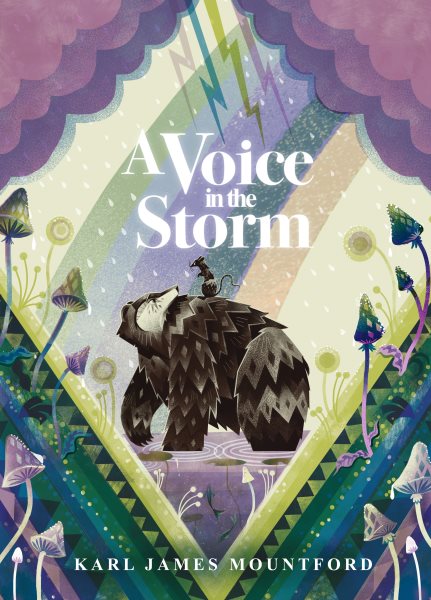
A Voice in the Storm by Karl James Mountford

Rat sometimes feels like the storm inside of her is stronger than the ones in the sky. When she encounters Bear, he lets her know how to let some of those feelings out and also how to ask for help. Aw, I dunno. I’m actually very fond of this. But, the grain of salt that I’d add, is that I was also fond of Mountford’s previous (and somewhat similar) title Circles in the Sky, which came out two years ago. That book was all about death. This one’s all about depression. Fun! Only I just really like what this book has to say on the topic. It’s probably better suited for older readers trying to make sense of what a friend or family member is going through. I’d encourage folks to give it a deep read. It’s not a flashy book, but I like it.


So with all that in mind, here are the other lists for 2024:

December 1 – Great Board Books

December 2 – Picture Book Readalouds

December 3 – Simple Picture Book Texts

December 4 – Transcendent Holiday Picture Books

December 5 – Rhyming Picture Books

December 6 – Funny Picture Books

December 7 – CaldeNotts

December 8 – Picture Book Reprints

December 9 – Bilingual Books for Kids

December 10 – Math Books for Kids

December 11 – Books with a Message / Social Emotional Learning

December 12 – Fabulous Photography

December 13 – Translated Picture Books

December 14 – Fairy Tales / Folktales / Religious Tales

December 15 – Wordless Picture Books

December 16 – Poetry Books

December 17 – Unconventional Children’s Books

December 18 – Easy Books & Early Chapter Books

December 19 – Comics & Graphic Novels

December 20 – Older Funny Books

December 21 – Science Fiction Books

December 22 – Fantasy Books

December 23 – Informational Fiction

December 24 – Gross Books

December 25 – Science & Nature Books

December 26 – Unique Biographies

December 27 – Blueberry Award Contenders (Celebrating the Environment)

December 28 – Nonfiction Picture Books

December 29 – Nonfiction Books for Older Readers

December 30 – Middle Grade Novels

December 31 – Picture Books
Filed Under: 31 Days 31 Lists, Best Books, Best Books of 2024 Tagged With: 31 days 31 lists, Best Books of 2024, message books

31 Days, 31 Lists: 2024 Math Books for Kids

December 10, 2024 by Betsy Bird

Math! It’s beautiful, isn’t it? The perfection of it. Its logic. Cadences. Sublime applications. And yes, many a fine teacher, librarian and bookseller fears it (many of us were English majors after all). Even so, you can’t help but respect the talents of the authors on display today. These are people who have found ways to meld mathematical concepts to kid-friendly texts. Not just kid-friendly either… legitimately good texts! I have infinite loads of respect for anyone who is capable of using both the left and right sides of their brains for books like the ones I am highlighting here today.

Naturally, if you’re in search of good math books your first stop should be the Mathical Book Prize site, where you can see all the winners. After that, check out my selections here today. Please note that these cover books from ages 0-12. I’ll try to indicate an age range for each title.

You can find a PDF of today’s list here.

  • 2023
  • 2022
  • 2021
  • 2020
  • 2019
  • 2018
  • 2017
  • 2016

2024 Math Books for Kids

Calculating Chimpanzees, Brainy Bees, and Other Animals with Mind-Blowing Mathematical Abilities by Stephanie Gibeault, ill. Jaclyn Sinquett

Age range: 10 and up. If you know me then you know that I like a little math in my children’s literature. And, of course, math is something that, when taught incorrectly, leads to children’s librarians avoiding it like the plague. That’s why I love books like this one. The math is there. I mean, no one’s hiding it, but thanks to the topics and the art by Jaclyn Sinquett, it’s darn fun. Essentially, the book examines five instances where animals in the natural world showcase math skills. But what Gibeault does, and what I really love, is that she introduces the concept first, and then shows how one can test animals to see whether or not they understand it instinctively themselves. This includes counting, addition, integers, and more. Lots of lovely activities are in there to do with kids, but it’s also just a really fun look at each of these mathematical concepts. 

Ernö Rubik and His Magic Cube by Kerry Aradhya, ill. Kara Kramer

Age Range: 5-9. A fan of puzzles, Ernö Rubik wondered if he could build a big cube made of smaller cubes that moved around and stayed connected. The true story behind one of our favorite, brain-bending toys. Y’all know that I’ve a weakness for any book that integrates math in a fun way, and I’d say this supremely fascinating book about the guy who came up with the Rubik’s Cube fits the bill. Part of what makes this book so interesting is the concept of someone trying to come up with something that’s never existed before, but that anyone could play with. I’m still a little fuzzy on how precisely a Rubik’s Cube actually, physically works but this book does a good job of explaining it as best as it possibly can. And I absolutely love that Ernö hadn’t really considered the idea of “solving” the cube when he first came up with it. If kids are looking for biographies of people who are still alive today, consider this one of the very few math-related bios of such a subject. Fun and strange.

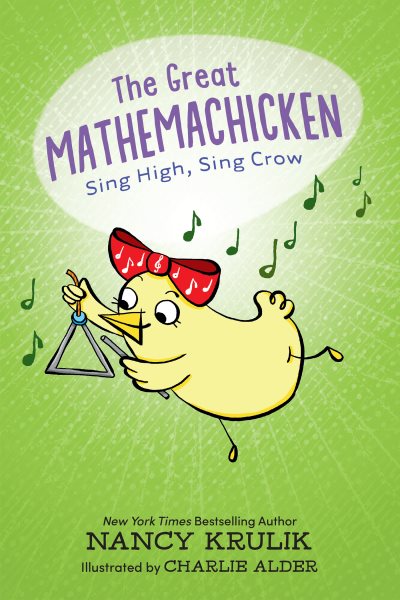
The Great Mathemachicken: Sing High, Sing Crow by Nancy Krulik, ill. Charlie Alder

Age Range: 7-9. Though it’s certainly the third so far, there’s nothing about this particular entry in the Mathemachicken series that doesn’t stand on its own. Each Mathemachicken book shows our heroine, Chirpy, solving problems with math. In this particular case, it’s the math of music. Whole notes, half notes, and quarter notes, to be specific. Part of what I’ve always liked so much about the books is how the math is naturally integrated into the storytelling. When math is separated out into its own little boxes or inserts, it feels as though that math is always separate from our day-to-day lives. And as this story of obnoxious crows shows, that is simply not the case. In this story, a group calling themselves the Crow Family Band have a particular yen for keeping the chickens down below up all night with their music. Chirpy devises a sleepy solution, but it will require the other chickens to understand the rudimentary math basics behind notes. Oddly, the backmatter is not math-related at all but craft related, which seems a bit of a missed opportunity. Even so, it’s probably one of the more successful math-related early chapter book series out there. 

Imagine Counting All the Stars by Raewyn Caisley, ill. Gabriel Evans

Age Range: 4-6. If you’re going to work math into your book, why not put your back into it? This is the story of Maddie who has a mind inclined towards parallel lines, fractions, patterns, and more. Trouble is, she just doesn’t fit in with the other kids. When she has playdates, the other girls are all about dolls, not constructing perfect circles, cones, and cylinders. Fortunately, Maddie is lucky enough to meet Priya, and at a nearby observatory the two of them click perfectly thanks to a love of space and science and math, all combined. We get a lot of picture book biographies about girls like Maddie and Priya, but not a ton of fictional picture books. There’s something about this story’s easygoing nature that’s going to reassure a lot of kids out there that they’re not alone when they realize how much they prefer some subjects to others. This probably could have stood a little backmatter or, at the very least, a brief glossary, but I’m not going to ding it. A tale about finding your people. 

Look by Gabi Snyder, ill. Samantha Cotterill

Glancing at this cover you’d never believe that this was a math book, but if my time on the Mathical Book Prize committee taught me anything, pattern recognition in young children is most definitely a part of coming to love and understand math. And this book is all about patterns, particularly those found in nature. It’s on the younger side, so don’t expect long discussions of fractals or anything. More, it’s about inspiring a love of math in nature naturally. That might be noticing color patterns, designs, circles, zigzags, and more. All this is displayed with Cotterill’s remarkable cut paper and illustration style. She gets such life and depth into her images this way. And the shadows! Can we talk a little bit about how good she is at creating realistic shadows? There’s a shot in this book of a street scene with a taxi car driving down the street and just from the light alone you can tell what time of day it is, simply from the angle of the shadows. The backmatter includes patterns, pattern types, and even some pattern activities as well. A winner!

The Reindeer Remainders by Katey Howes, ill. Marie Hermansson

Ages Range: 4-7. This one caught me by surprise. First off, normally I have a hard time separating reindeer from Christmas picture books. This one, however, is more interested in how close the word “reindeer” is to “remainder”. It’s one of the cleverer stories about remainders out there too. Normally there are twelve reindeer in Miss Feathers’ class, but with the addition of a thirteenth, things start to get tricky. When the class is told to separate into pairs, there’s a “remain-deer” of one. When they’re asked to get into groups of three, once again there’s a different “remain-deer” left over. The book does this very simply, but also with a very clear visualization of each case where someone gets left out. It sort of links the emotions that one has when unpaired to the math. I won’t spoil the ending, but it’s a happy one, and there’s a nice bit of backmatter that dares to talk about prime numbers as well as the social-emotional state of being the one left on the sidelines. A success in both math and emotions.

A Tour of the Human Body: Amazing Numbers – Fantastic Facts by Jennifer Berne, ill. Dawn DeVries Sokol

Age Range: 9-12. I’ve heard a lot over the years about kids that love narrative nonfiction versus the kids that prefer expository nonfiction. This book falls squarely into the latter category, no question. It’s the kind of book that relishes large numbers. Some of this may be familiar to the adults looking it over, like the fact that newborn babies have more bones than adult humans do. But then there are the other facts. Your nose can recognize up to 1 trillion different odors. Every day you are 1/3rd of an inch shorter at the end of the day than you were in the morning. Or there are 15,000 hair cells in your coclea. It’s very much a facts-on-the-page kind of title, but I also appreciate that it reads like a combination of math and science in the most interesting way. Maybe it’s more numbers-based than math-based, but it’s worth consideration just the same. 

A Treasure of Measures by Mike Downs, ill. Joy Hwang Ruiz

Again, I’m so grateful for the time when I served on the Mathical Book Prize committee. I came into that work with a good knowledge of what made a successful picture book, and came away from it with a much more expansive understanding of what can be called a “math book”. As I said before, it’s not just enough to show counting or shapes. A good math book takes into consideration the best ways to instill a love of math. Take units of measurement, for example. Mike Downs, in his uniquely playful way, considers all the different things that one CAN measure, and then considers the other ways in which those same measurements can be calculated. For example, you can measure rain in decibels (lots of nice definitions of terms appear at the back of the book) but also by counting the drops, or measuring the puddles “with skips and with hops”. Oh, and he’s also rhyming this entire time, which sort of feels like he was setting himself up for extra homework. Whatever the reason, the book works, and is a wonderful introduction to math concepts at a really basic level.  Previously seen on the Rhyming List.

Yumbo Gumbo by Keila V. Dawson, Katie Crumpton

I am so pleased that the Storytelling Math series is coming out in both English and Spanish these days. So remember librarians, if someone comes to you asking for math-based picture books in Spanish, you have at least one resource right here at your fingertips. Warning: Do not read this book on an empty stomach. The “Storytelling Math” series from Charlesbridge is one of the very few from a major publisher to actually focus primarily and exclusively on math. But what makes the series so good is that they cover so much more than counting and subtracting. They delve into pattern recognition, and size comparison and, in this particular case, voting, data, and problem solving. It’s actually one of the cleverer books on the subject I’ve seen, and that’s entirely apart from all the delicious gumbo on its pages. In this story Annabelle is learning to cook gumbo but she wants to make it with okra. Her brother (who, to my mind anyway, is correct) thinks okra is too slimy and wants chicken gumbo. When Annabelle takes a vote from her family, she finds it’s three to three. The introduction of seafood gumbo sounds like the solution, except that then the vote becomes two to two to two. The solution? Annabelle has everyone vote on their least favorite. And when that happens, the vote is split in a good way between chicken and okra. Seafood wins! Backmatter delves into the history of gumbo itself, a glossary of some of the Louisiana Creole terms that pepper the text, info on the math and even a “Try This” section care of Dr. Yvelyne Germain-McCarthy (a Consultant and Professor Emerita of Mathematics Education) on voting with your own family. I never really thought of voting as a math related activity, but this book has definitely convinced me otherwise. Previously seen on the Bilingual List.


So with all that in mind, here are the other lists for 2024:

December 1 – Great Board Books

December 2 – Picture Book Readalouds

December 3 – Simple Picture Book Texts

December 4 – Transcendent Holiday Picture Books

December 5 – Rhyming Picture Books

December 6 – Funny Picture Books

December 7 – CaldeNotts

December 8 – Picture Book Reprints

December 9 – Bilingual Books for Kids

December 10 – Math Books for Kids

December 11 – Books with a Message / Social Emotional Learning

December 12 – Fabulous Photography

December 13 – Translated Picture Books

December 14 – Fairy Tales / Folktales / Religious Tales

December 15 – Wordless Picture Books

December 16 – Poetry Books

December 17 – Unconventional Children’s Books

December 18 – Easy Books & Early Chapter Books

December 19 – Comics & Graphic Novels

December 20 – Older Funny Books

December 21 – Science Fiction Books

December 22 – Fantasy Books

December 23 – Informational Fiction

December 24 – Gross Books

December 25 – Science & Nature Books

December 26 – Unique Biographies

December 27 – Blueberry Award Contenders (Celebrating the Environment)

December 28 – Nonfiction Picture Books

December 29 – Nonfiction Books for Older Readers

December 30 – Middle Grade Novels

December 31 – Picture Books
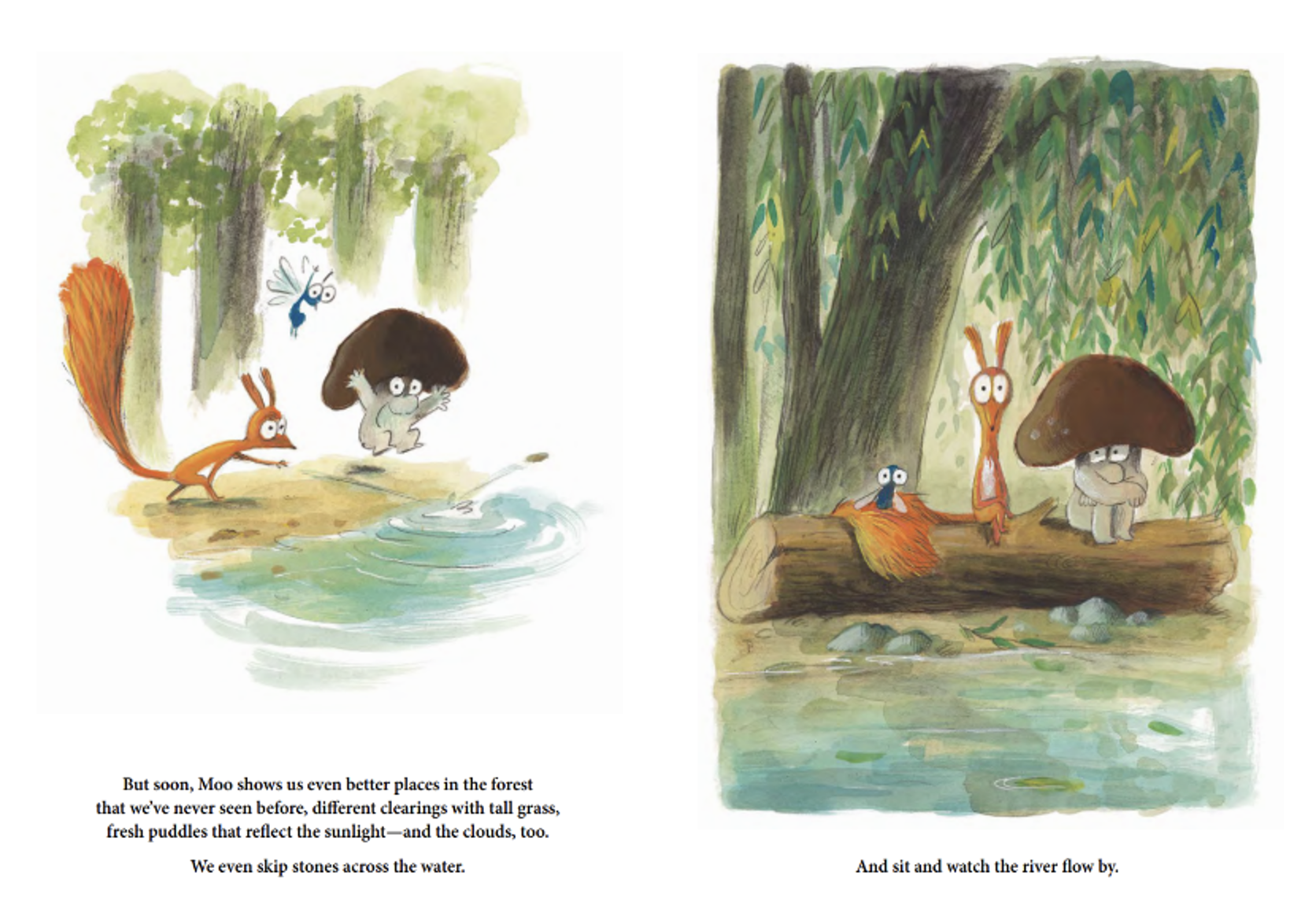
Filed Under: 31 Days 31 Lists, Best Books, Best Books of 2024 Tagged With: 31 days 31 lists, Best Books of 2024, math, math picture books
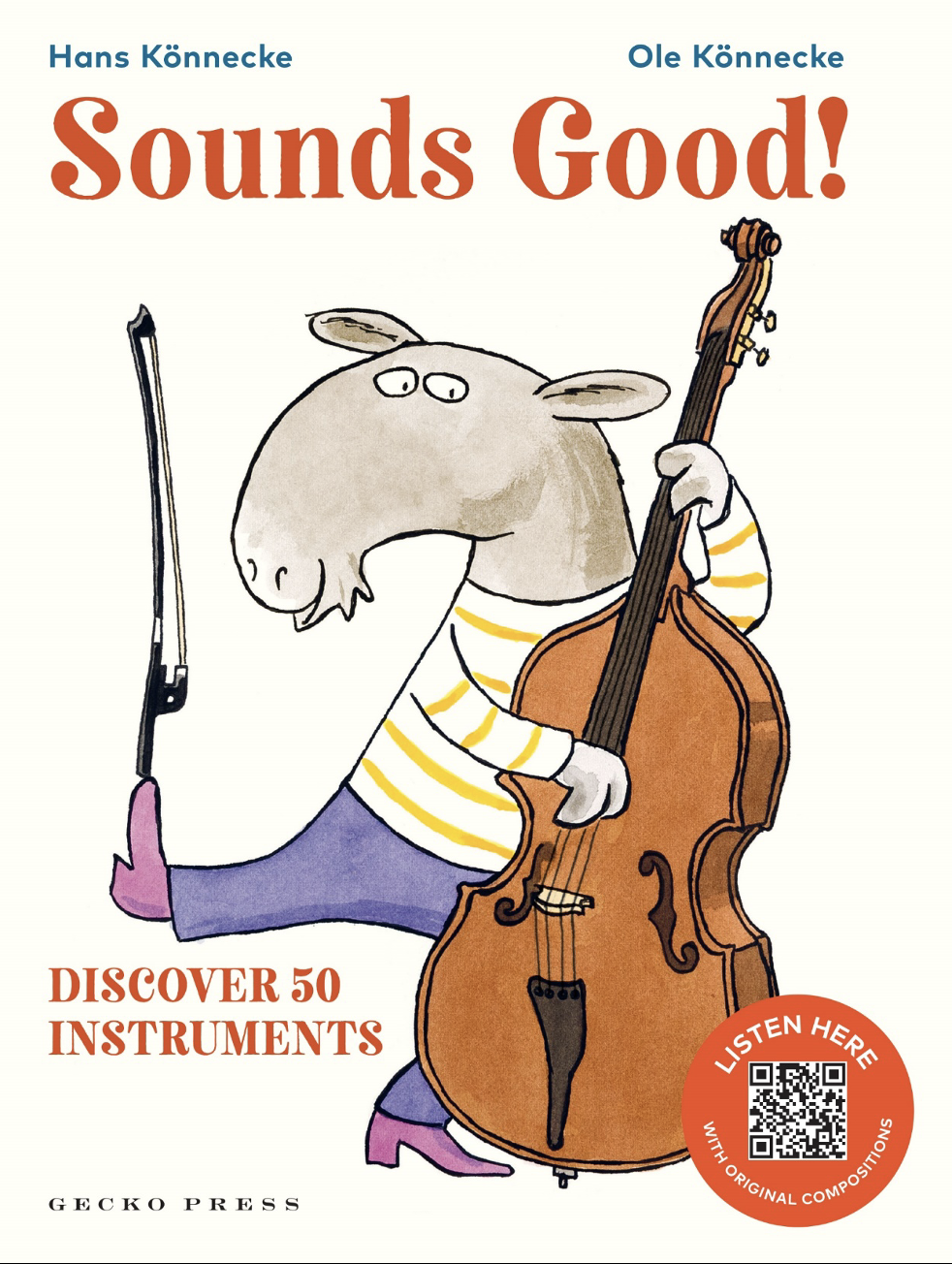
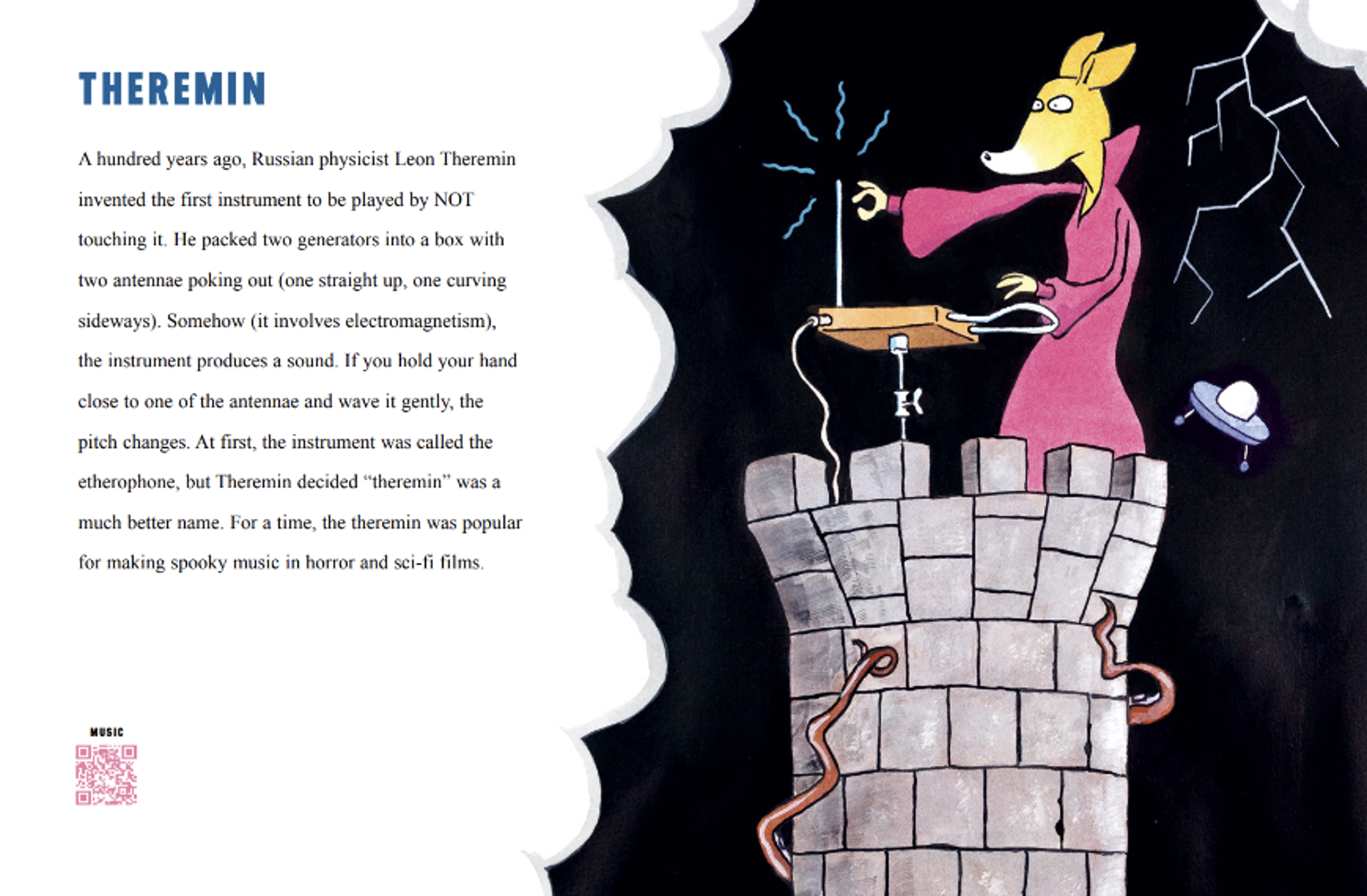
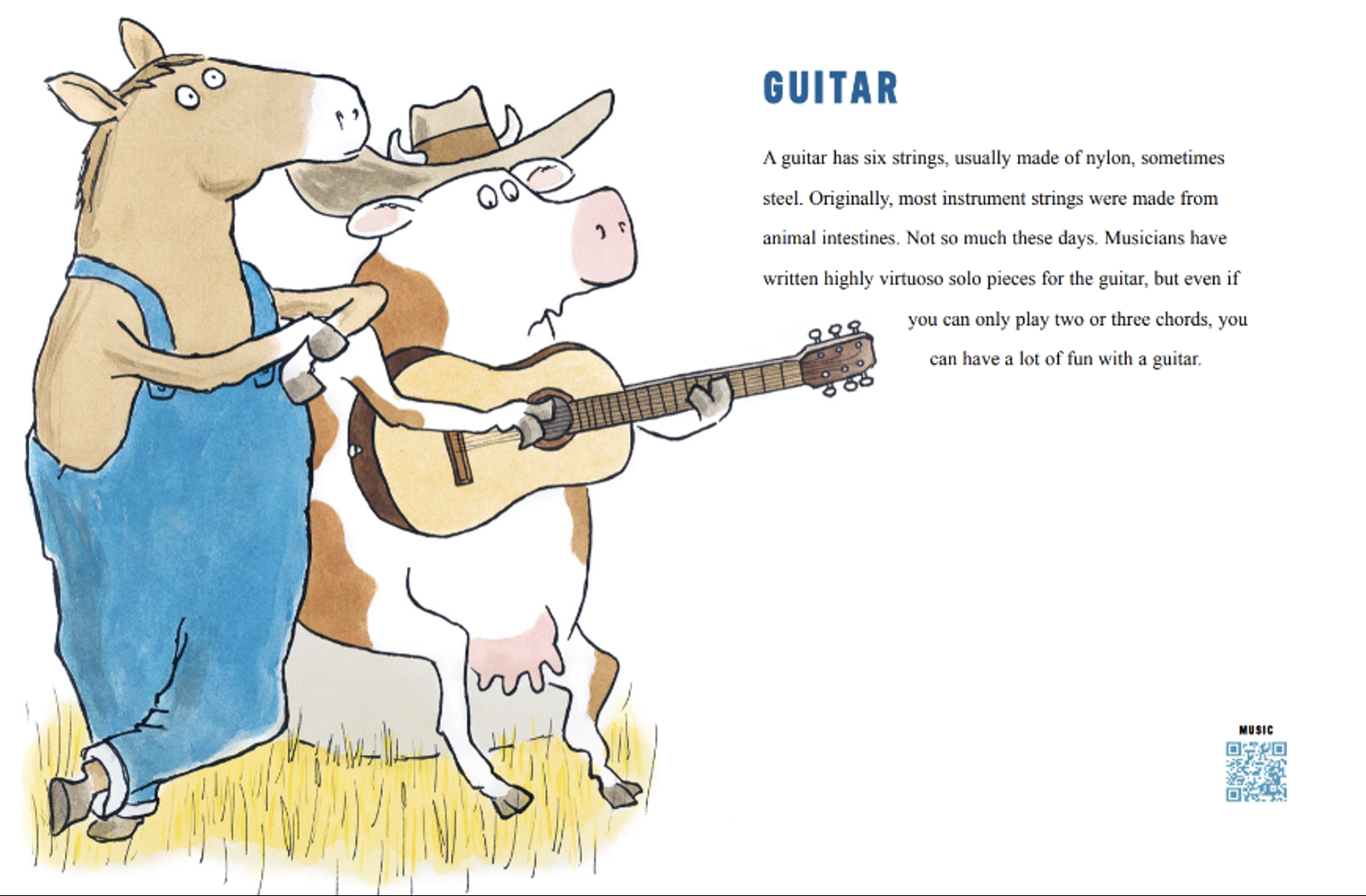
Fuse 8 n’ Kate: The Giant Jam Sandwich by John Vernon Lord and Janet Burroway

December 10, 2024 by Betsy Bird

You may have recollections of this book so vague you almost wonder if it was a fever dream you had a child. Well, wonder no longer! Today we’re taking a trip to Itching Down where four million wasps cause all kinds of commotion. Like a surreal combination of Cloudy With a Chance of Meatballs and maybe Who Needs Donuts?, join us as we determine whether or not it truly deserves to be remembered as a classic or not. Today we discuss the long forgotten Good Witch of the North, the location of this story, and how, for my generation, this book was “a whole thing.”

Listen to the whole show here on Soundcloud or download it through iTunes, Stitcher, Spotify, Google Play, PlayerFM, Audible, Amazon Music, or your preferred method of podcast selection.

Show Notes:

Evidence That This Book Is Set in Britain:

Example A: They brought a kettle on a picnic.

Example B: The Vespa Vulgaris is known as “the European wasp”.

Example C: Even though they are cutting an enormous slice of bread, on top of the scaffolding they all have little cups of tea.

Extra points for the illustrator knowing the correct way to hold knitting needles.

As Kate says, someone really needs to make a Fashion in Kidlit Instagram account. Shots like these could then find a home there.

We adore this lady in the baking bread sequence who is clearly shirking the work by doing a job that does NOT matter. She’s just really really busy… ah… writing numbers on a ladder?

This person freaks us out a little. Why are they look RIGHT at the reader and why are they so upset? Are they Pro Wasp?

Okay, y’all. I don’t think John Deere makes these. Please note that Farmer Seed HAS A TEACUP ON HIS TRACTOR even up here in the sky.

The book at this point says that Itching Down is no longer “a waspish sort of town.” I dunno. Looks like a bunch of WASPs to me.
Kate Recommends: Munchkin the app

Betsy Recommends: The Holiday

Filed Under: Fuse 8 n' Kate Tagged With: Fuse 8 n' Kate, Janet Burroway, John Vernon Lord, The Giant Jam Sandwich

  • « Go to Previous Page
  • Page 1
  • Interim pages omitted …
  • Page 63
  • Page 64
  • Page 65
  • Page 66
  • Page 67
  • Interim pages omitted …
  • Page 1047
  • Go to Next Page »

Primary Sidebar