• Skip to primary navigation
  • Skip to main content
  • Skip to primary sidebar
  • About/Contact
  • Fusenews
  • Reviews
  • Librarian Previews
  • Best Books
    • Top 100
    • Best Books of 2022
    • Best Books of 2021
    • Best Books of 2020
    • Best Books of 2019
    • Best Books of 2018
    • Best Books of 2017
    • Best Books of 2016
    • Best Books of 2015
    • Best Books of 2014
    • Best Books of 2013
  • Fuse 8 n’ Kate
  • Videos
  • Press Release Fun

31 Days, 31 Lists: 2022 Funny Books for Older Readers

31 Days, 31 Lists: 2022 Funny Books for Older Readers

December 20, 2022 by Betsy Bird

I respect funny books so much that I dedicate not simply one list to them every year, but TWO! By now you may have already seen my Funny Picture Books list from earlier this month. Now we’re moving away from that to longer books for kids. Hilarious longer books for kids. Humor being as subjective as it is, if you don’t find one of these books funny then surely another one will do it for you. Something to please everyone, that’s the goal! So get ready for funny poetry, nonfiction, biographies, comics, the works!

Need more older funny titles besides today’s books? Then be sure not to miss these previous titles:

  • 2021
  • 2020
  • 2019
  • 2018
  • 2017

2022 Funny Books for Older Readers

Buzzkill: A Wild Wander Through the Weird and Threatened World of Bugs by Brenna Maloney, ill. Dave Mottram
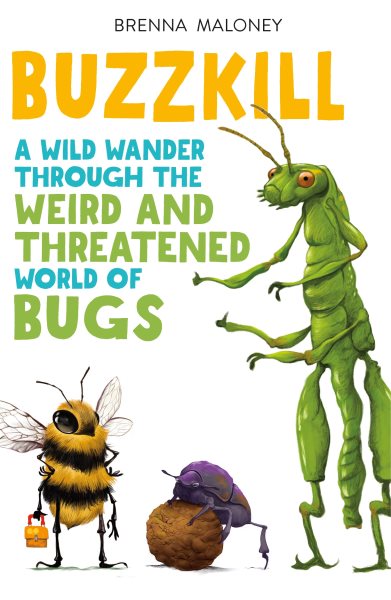
I came this close to missing this book. It was only through the intervention of a friend (and well-respected author) that it even came to my attention. Without revealing this friend’s identity, this person is a much better writer than I will ever be and so I put to you a small portion of the recommendation that convinced me to pick this up:

“She’s [Maloney] not only a very funny writer, doing a kind of stand-up about insects (she’s a big researcher) but she’s an incredibly elegant one with metaphors. For example, she talks about the noise cicadas make and she describes the process as being very like the way you make noise expanding and contracting a bendy straw. What kid hasn’t made that bendy-straw noise? When she talks about molting, she explains that the new exoskeleton has to be bigger than the old one, so it’s like having a heavy winter coat underneath a thin, sweat-soaked tee shirt—you have to peel off that tee-shirt very carefully, and lots of times a leg gets torn off in the process. Everything is explained with the utmost clarity, as if she were standing by your elbow.”

The book itself is a whopper, clocking in at a whopping 378 pages. Your kids will read every word. So it is gross? And how! Whether Brenna Maloney is eating mealworms (not crickets, though), talking about eyelash mites, discussing the loudest animal in the world (the water boatman bug that makes the sound by hitting its penis against its abdomen), or what have you, disgusting details abound and are so funny and so smart. I freakin’ love this book. Bugs, man. Who knew?

It’s the End of the World and I’m in My Bathing Suit by Justin A. Reynolds
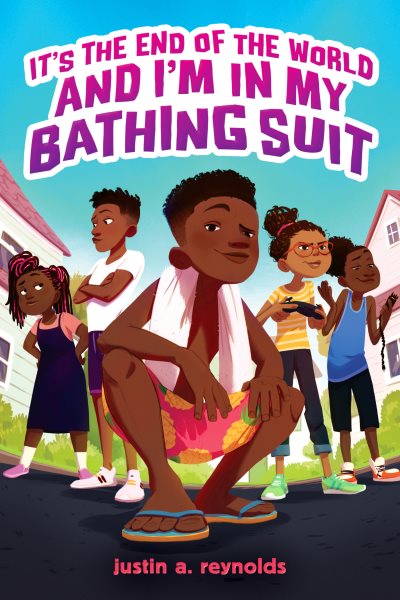
Eddie’s a kid who’s got it all figured out. Then his summer plans go apocalypse-level awry. Prepare for hilarious hijinks from kids unafraid to have some fun. Okay, truth? I don’t think I’ve read a book for kids that made me laugh this hard in a long long time. I’m talking Diary of a Wimpy Kid level guffaws (from me that’s a really big compliment). Man, when Justin A. Reynolds writes a joke it LANDS! I was seriously reading aloud long portions of this book to my kids and THEY were cracking up too. The fact that the entire book hinges on the premise that the hero figured out how to do his own laundry only twice an entire summer is key. There’s just something about the degree to which Eddie is obsessed with his laundry conundrum when, quite possibly, the world has ended that worked for me. Reynolds works in some heart in there too, but then it picks right back up. For a while I thought it might be the first in a series, but now I’m not so sure. It’s actually a more amusing book if you never know if the apocalypse alluded to was real or not. In any case, if you’re looking for funny fare in the middle grade section, this is my top pick. I want more! 

Killer Underwear Invasion! How to Spot Fake News, Disinformation & Conspiracy Theories by Elise Gravel
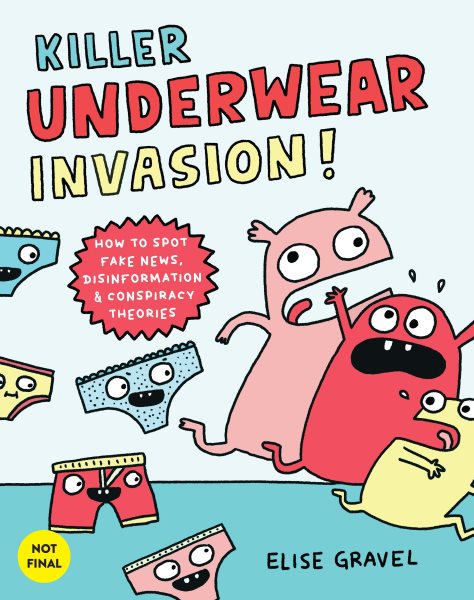
How do you know what to believe when you read something online? Using the fake report that underwear can kill you, this book breaks down all the different ways that you can figure out if news is real or not. You know, at a certain point a person begins to wonder why no one else is doing what Elise Gravel is doing. This isn’t to say that there aren’t other people making books about fake news and conspiracy theories. It’s just that they’re… well… not half as interesting as this book is. And who better to shine a light on the sheer idiocy of fake news than a children’s book creator? This should be required reading in every school and public library in the nation. Seriously! The information in here is invaluable and, let’s face it, the fact that we aren’t teaching this in schools is a crime in and of itself. This isn’t just good. This isn’t just funny. This is imperative.

Quest Kids and the Dragon Pants of Gold by Mark Leiknes
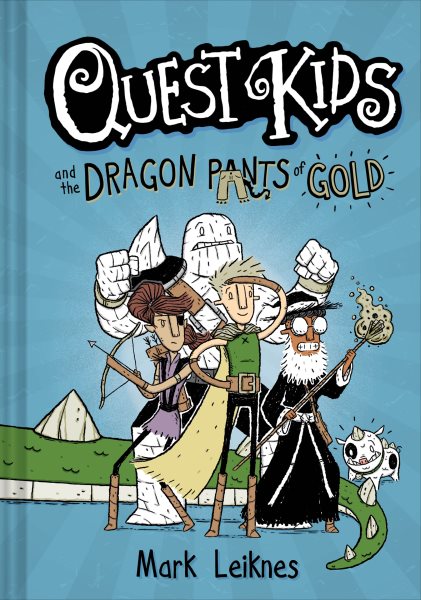
A ragtag group of kid adventurers, in the vein of a classic Dungeons and Dragons set-up, attempt to successfully complete a quest without dying or destroying any villages in the process. A tall order. What we have here is one of those books where the text and the comic-like images mix together on the page nicely ala that Nathan Peirce Max and the Midknights series. I like to read comics to my son but he was perfectly content to change things up a little and read this book as well. And I gotta say, it grew on me. The laughs increase exponentially as the storyline goes along. About the time we got to Crazy Larry’s Acid Swamps of Doom Adventure Cruises I was good to go. And yes, there are slightly more fart jokes on the page than strictly necessary, but it’s all in good fun, with plenty of twists and turns that I didn’t see coming. Good wackadoodle hilarity.

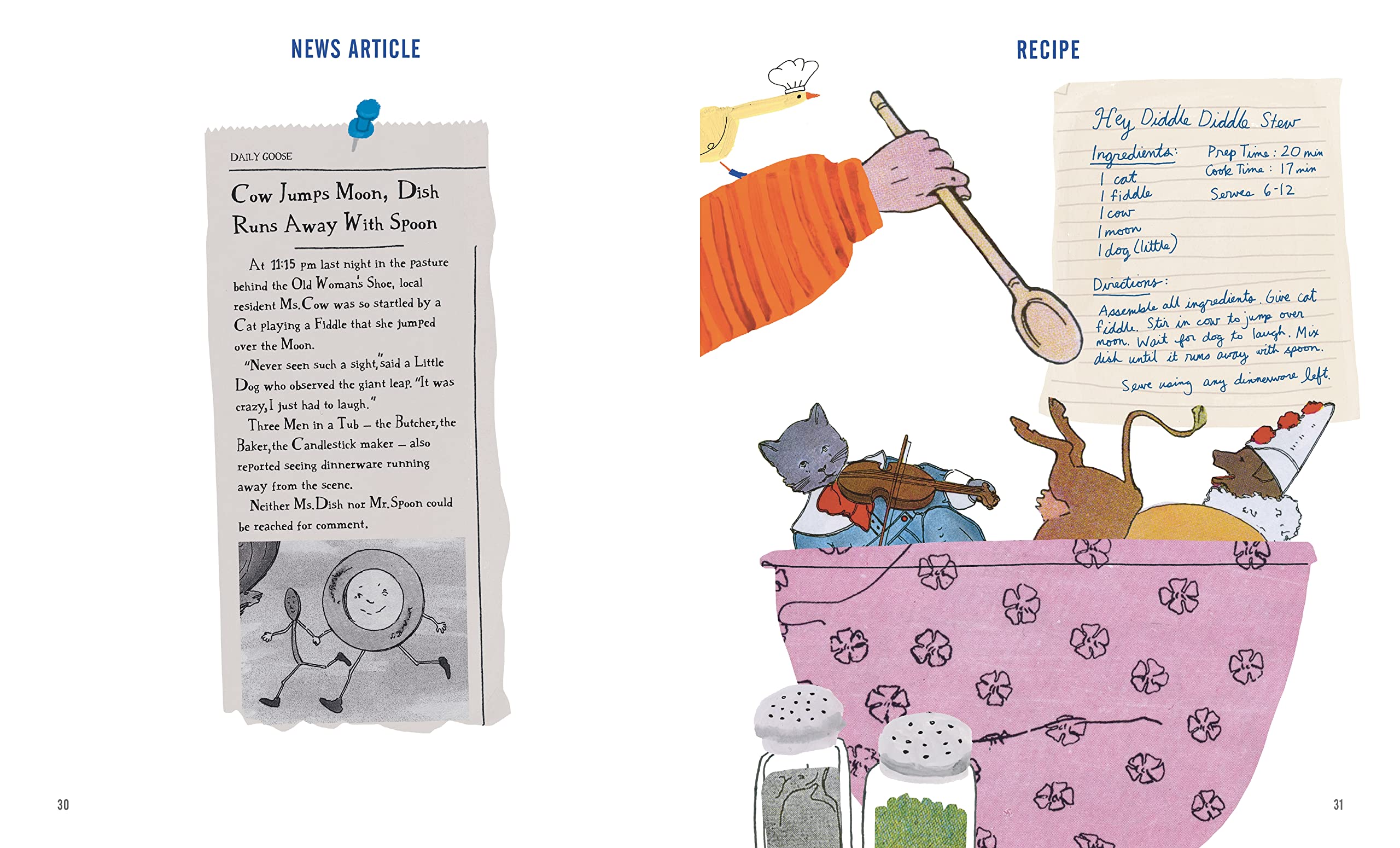
The Real Dada Mother Goose: A Treasury of Complete Nonsense by Jon Scieszka, ill. Julia Rothman
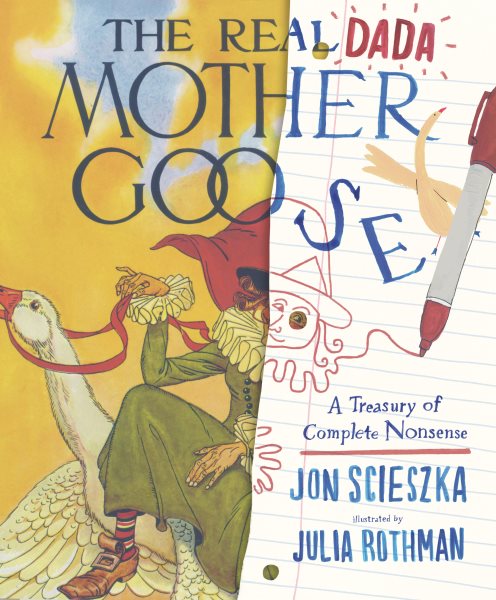
Master funnyman Jon Scieszka reworks classic nursery rhymes in ways that use everything from pig latin to secret codes. A rollicking reworking that’ll have you rolling in the aisles. The man who redefined fractured fairytales with his Stinky Cheese Man is now tearing up the nursery rhymes of the world in what has got to be the most brilliant deconstruction I have ever seen. I mean, first and foremost, it’s apparently a tribute to the Oulipo school’s Exercises in Style by Raymond Queneau. And if that reference isn’t ringing any bells, don’t worry. Me neither. Fortunately there is a ton of backmatter explaining stuff, like how the N+7 code was created by an organization that liked to invent different writing rules. Exercises in Style itself tells a simple story of a man on a bus, retold ninety-nine different ways. This book? It takes the very-much-in-the-public-domain The Real Mother Goose by Blanche Fisher Wright and then reworks six of her nursery rhymes, art and all, six different ways. We’re talking morse code, Esperanto, the military alphabet, anagrams, rebuses, spoonerisms, and way way more. I didn’t really know Julia Rothmann before but she does a great and lovely job of cutting up those old 1916 pictures. A hit, I say! A veritable hit!

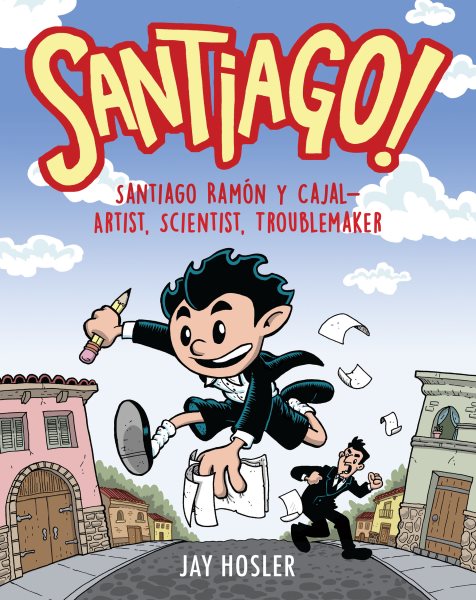
Santiago! Santiago Ramón y Cajal – Artist, Scientist, Troublemaker by Jay Hosler

Santiago just can’t seem to keep out of trouble and his father wants him to stop drawing and study. A fiery look at the life of a mischievous kid who went on to become the father of modern neuroscience. Oop! Here we go. This is one of those books that mixes and melds its fact and fiction together in interesting new ways. That sort of drives me crazy when the book in question is a picture book but I feel an awfully lenient when comics are involved. Particularly comics as fun as this one. Essentially, this is what you’d get if you combined Calvin & Hobbes with Nathan Hale’s Hazardous Tales. I mean, in terms of looks it really resembles the style of Christopher Eliopoulos. But if this is the future of biographies then I am HERE for it! Hosler (remember last year’s The Way of the Hive?) really encapsulates Santiago’s life beautifully while making it clear why he was so essential to the study of cells and the brain. History has been getting great comics for years. Such a thrill to see a bit of biology in there too. 

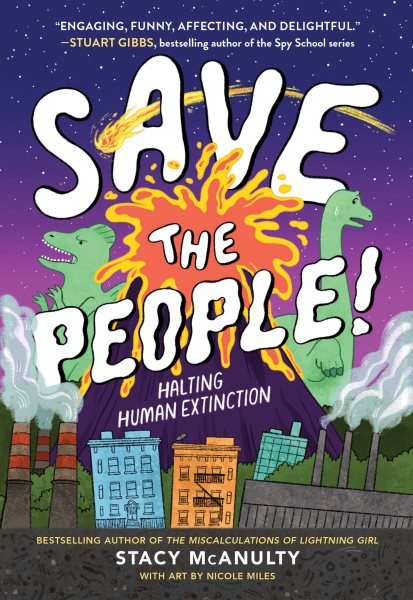
Save the People: Halting Human Extinction by Stacy McAnulty, ill. Nicole Miles

Mass extinction! For kids! And it’s funny! What are all the different ways extinctions have happened in the past and what are the possible ways humans could disappear in the future? A remarkably hilarious look at mass destruction. This is an ideal book for the kind of kid obsessed with all the different ways the human race could go belly up. Failing that, it’s a book for the kid who comes to your desk asking for Titanic/Donner Dinner Party/etc. titles. The catastrophe kid. And believe me, there are a lot of kids out there like that. While I wouldn’t necessarily hand it to an anxious kid, McAnulty’s latest magnum opus really handles its dire material in as enjoyable a way as possible. I had no idea that volcanoes were much more dire than asteroids when it comes to the possible destruction of humanity. Let’s hope that Stacy McAnulty does a lot more nonfiction in the future. Sole downside? I cannot read this title without getting the Godspell song “God Save the People” caught in my head. Every. Single. Time.

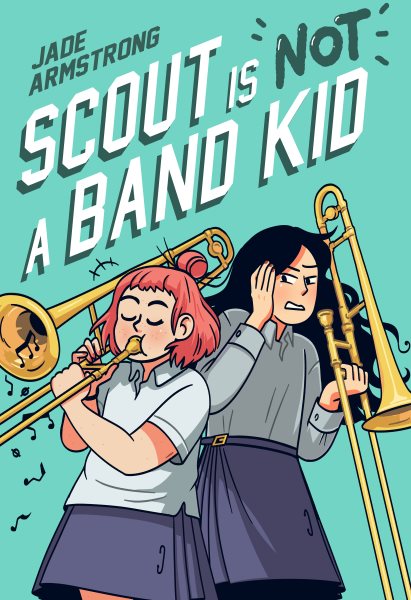
Scout Is Not a Band Kid by Jade Armstrong

Scout’s mission is clear. To get to see her favorite author she must join . . . band! But can this trombone faker convince her new uptight seat leader that she’s worthy enough to stay? I honestly cannot believe that this is Jade Armstrong’s first published graphic novel. This is so funny, so true, and so beautifully put together that I swooned. My daughter liked this book so much that she didn’t even notice that it’s 100% romance free! Loved the translations of all things Canadian in the sidelines. There’s also a really nice manga influence at work here, particularly with some of the character’s small asides. And did I mention it’s funny? Laugh out loud funny, no less. Fantastic from start to finish, I am a HUGE fan of this title. Hoping to see more of Armstrong’s work in the future too.

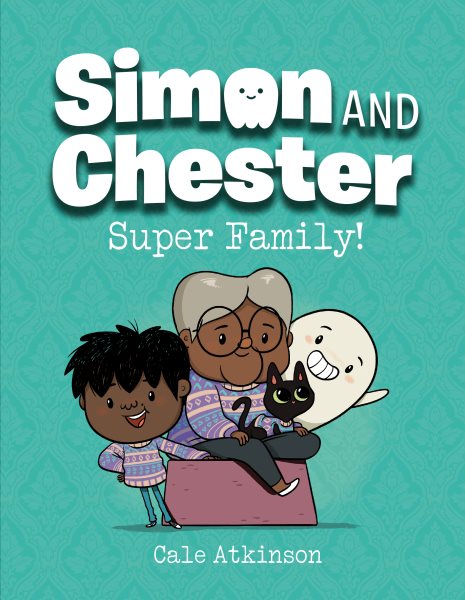
Simon and Chester: Super Family! by Cale Atkinson

I’ve an unspoken rule against putting sequels onto any of these lists. It’s not hard and fast, but just for my own reading I don’t have much time to dedicate to titles I’ve seen before. But rules, even unspoken ones, are meant to be broken. Particularly when they involve a fellow by the name of Cale Atkinson. Now I don’t know if you had the pleasure of seeing his first “Simon and Chester” story but it was a marvelously funny book. This one also doesn’t disappoint, but it also contains a couple melancholy undertones that deepen the characters and lift this above the pack of normally silly/funny gns. In this story Chester has learned through popular culture that his family situation (living with just his grandma) is not a “normal” family. Simon isn’t very sympathetic to this p.o.v. because he’s gearing up for a ghost conference and he’s hoping to rub his new haunting situation (a.k.a. Chester’s home) in the faces of some of the snobbier ghosts. There’s a single moment in this book that solidified its placement on this “Funny” list, when Simon is talking at the ghost convention to a fellow ghost that haunts a bucket that had me snorting way too loud in my staff break room one lunchtime. And with its increasing emotional maturity, this is definitely a series to grab close and hold onto.

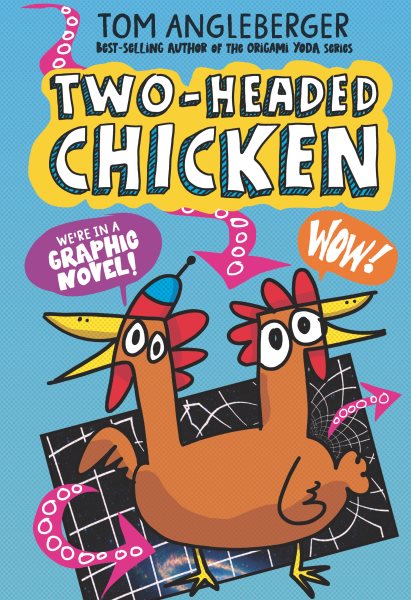
Two-Headed Chicken by Tom Angleberger

Kind of what you’d get if the film Everything Everywhere All at Once switched out its leads for a two-headed chicken and a green Colonel Sanders-suited moose. Clear as mud? Great. I should mention that Tom Angleberger’s book is one of the few comics that I read to my 8-year-old this year that had him literally guffawing out loud as I did so. The concept of a multiverse has started, slowly, to spur on a range of different books for kids. I would argue, however, that few have taken the ball and run with it the way that Tom has here. The entire concept is, quite simply, that you, the reader, are one of the heads of a two-headed chicken. The other head has a hat that allows you to leap from multi-verse to multi-verse. And this would be all well and good were it not for the fact that in every multi-verse you are being chased by the aforementioned moose and his battle cry of “I’m gonna fry you!” It’s an exploration in originality, since Tom literally could do ANYTHING with this book… and he takes things to ludicrous heights and lows. And here’s the thing: Don’t find one sequence funny? No worries! You’re bound to find another one exactly up your alley. It’s a marvelous exercise in different types of humor and how to incorporate them all into one book for kids. And THAT is worth celebrating! 

Wild Ride by Keith Calabrese

Charley knew it was a bad idea when her big brother Greg took her out with her friends in their mom’s boyfriend’s very rare Mustang. But she didn’t know how bad until they found a kidnapped man in their trunk. I really and truly enjoyed this book. First off, look at Evanston getting a major shout out in a book this year! Extra points for getting all the directions right (though they do seem to make it out to Fox Lake in record breaking time, but that’s neither here nor there). Is some of this pushed a little too far into silly, unbelievable territory? Sure. But as someone who has watched many a rich man get away with stuff, I found this book oddly cathartic for our kooky times. Plus, the jokes really land, which I appreciated. This may be the silly book we need in the midst of all the depressing news of the world.

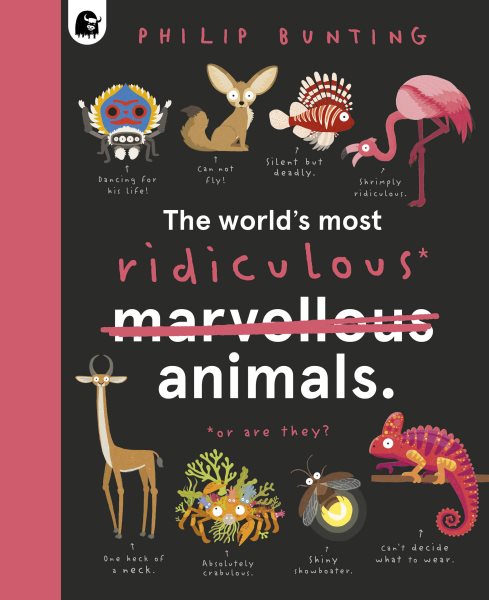
The World’s Most Ridiculous Animals by Philip Bunting

It’s as if Philip Bunting said to himself, “To please Betsy this year, I shall include an entry into my World’s Most series that contains not one but TWO Simpsons references on the same page!” I’m not even kidding. Check out the entry on tardigrades if you don’t believe. Now I included a Philip Bunting book on a previous year’s list as well (in that case it was The World’s Most Pointless Animals) and I was gratified to see that that book must have sold pretty well since Happy Yak tapped the man to write another in the same vein. Here the only impetus is for these creatures to be interesting. As such you’ll get gross critters like the zombie snail and strangely pretty ones like the ribbon eel. Guaranteed you’ll learn something from this, plus the joke density is fairly high. Even if you don’t know The Simpsons (in which case, how are we even friends?) you’ll find a lot to laugh at here.

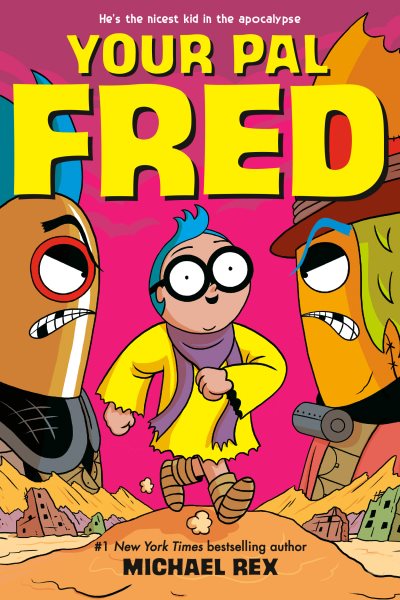
Your Pal Fred by Michael Rex

Post-apocalyptic adorableness! Meet Fred. He wants to be your friend, even if you happen to be a killer robot, a warlord, or entirely covered in spikes. Resist his charm if you dare! Kind of what you’d get if you drop a lovable schmuck in the middle of Mad Max: Fury Road. Fred’s just sweet and there isn’t a drop of real violence in this whole book. Put another way, Fred’s like a little android Ted Lasso, merrily skipping through a hellscape, trying to stop war and violence, and handing out cheery stickers along the way. Niceness is seeing a real uptick in adult programming (how else to explain Our Flag Means Death?) so it makes sense that we’d see a little of that on the children’s side as well. Color me a Fred fan. 


Want to see other lists? Stay tuned for the rest this month!

December 1 – Great Board Books

December 2 – Picture Book Readalouds

December 3 – Simple Picture Book Texts

December 4 – Transcendent Holiday Picture Books

December 5 – Rhyming Picture Books

December 6 – Funny Picture Books

December 7 – CaldeNotts

December 8 – Picture Book Reprints

December 9 – Math Books for Kids

December 10 – Gross Books

December 11 – Books with a Message

December 12 – Fabulous Photography

December 13 – Translated Picture Books

December 14 – Fairy Tales / Folktales / Religious Tales

December 15 – Wordless Picture Books

December 16 – Poetry Books

December 17 – Unconventional Children’s Books

December 18 – Easy Books & Early Chapter Books

December 19 – Comics & Graphic Novels

December 20 – Older Funny Books

December 21 – Science Fiction Books

December 22 – Fantasy Books

December 23 – Informational Fiction

December 24 – American History

December 25 – Science & Nature Books

December 26 – Unique Biographies

December 27 – Nonfiction Picture Books

December 28 – Nonfiction Books for Older Readers

December 29 – Best Audiobooks for Kids

December 30 – Middle Grade Novels

December 31 – Picture Books

Filed Under: 31 Days 31 Lists, Best Books, Best Books of 2022 Tagged With: 31 days 31 lists, Best Books of 2022, funny books, funny graphic novels, funny nonfiction, middle grade funny books

31 Days, 31 Lists: 2022 Comics and Graphic Novels for Kids

December 19, 2022 by Betsy Bird

Would I call this my favorite list? That would be picking favorites, and like any good parent I love all my babies equally. But if I were to admit to the list that feels closest to what my 10-year-old self would have loved back in the day, then yes. It’s this one. Comics are growing increasingly prolific these days, and it’s almost all I can do to keep up with them. Which is wonderful! I dream of a day when they might rival picture books in terms of output. Until that happy day arrives, though, let’s celebrate the ones that do a particularly good job. The cream of the crop! Delightful from start to finish, and very different. We’ve post-apocalyptic hellscapes, hair pride, space cats, OCD, dog walkers, you name it!

Still can’t get enough comics? I can’t blame ya. Here are the round-ups I’ve done in previous years:

  • 2021
  • 2020
  • 2019
  • 2018
  • 2017
  • 2016

2022 Comics and Graphic Novels for Kids

Alte Zachen by Ziggy Hanaor, ill. Benjamin Phillips

Benji and his grandmother are shopping. Along the way she’s cranky and rude with other people, but her memories tell us stories of the way things used to be long ago. A tale of empathy, even for grumpy bubbes. This one’s for those of you worried that all graphic novels are starting to look the same these days. If you’ve ever fretted that the bulk of GNs are just memoirs done in the style o’ Telgemeier, allow me to dislodge that notion from your cranium. What we have here is a very complicated book. A boy walks the city with his elderly grandmother who is, to put it mildly, a lot. She’s cranky and rude and he spends half the time apologizing for her. However, lodged in the crevices of that story are these memories. You get glimpses of her past and her youth and how hard life has been for her. So even when she is being nasty to people, you can simultaneously see another side to her. It helps that her grandson’s a nice guy who has no problem trying (and, admittedly failing) to keep her in line. It’s a melancholy little thing but it ends on a happy note. A sophisticated way to remind kids that grandparents were once young too.

Anne of West Philly by Ivy Noelle Weir, Illustrated by Myisha Haynes, edited by Rachel Poloski

A classic gets an update with remarkable results. Join foster kid Anne Shirley as she navigates the highs and lows of living in West Philly in typical Anne fashion. And yeah, these adaptations and modernizations are so hit and miss. This one? A hit. A bullseye of a hit. Though I liked it from the start it completely had me when it exchanged Matthew buying Anne a dress with puffed sleeves for Matthew buying Anne an ugly second-hand Christmas sweater. I just kinda adored it after that. I should note that my 10-year-old romance-obsessed daughter didn’t like how the book telegraphed one romance with Gilbert with blushing, but then pulls a switcheroo with her liking Diana. She didn’t mind Anne being with Diana. She just felt that the art was purposefully trying to fool the reader and that that was unfair. I don’t disagree. Even so, this is a slick updating that doesn’t just mimic the original but adds and deepens it.

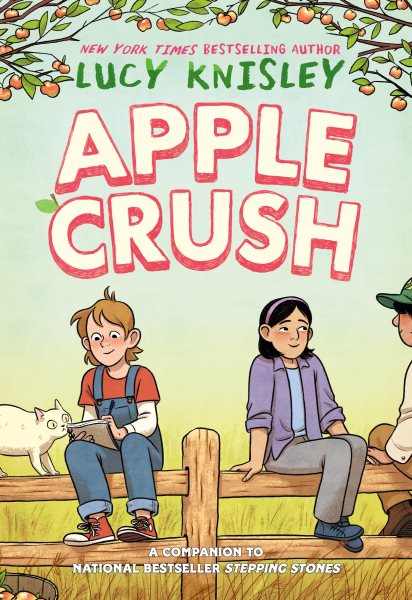
Apple Crush by Lucy Knisley

What could be more fun than working on a haunted hayride? This fall Jen is thrilled to be helping out during her favorite fall season. Trouble is, everyone around her is getting crushes! Could anything be more annoying? What you have right here is a particularly strong autumnal title. A real paean to the season. I mean, I read it in the Spring and found myself yearning for cider and the smell of fallen leaves. I read this with my 10-year-old daughter who requests, nay, demands that all books I bring to her now include romance in some fashion (see: Anne of West Philly). This one was an interesting test since Jen, the heroine of the story, really isn’t getting crushes the way her stepsister is. Happily, my daughter didn’t mind. I think she’s just happy as long as someone is having a crush. A gentle story with a gentle realistic arc.

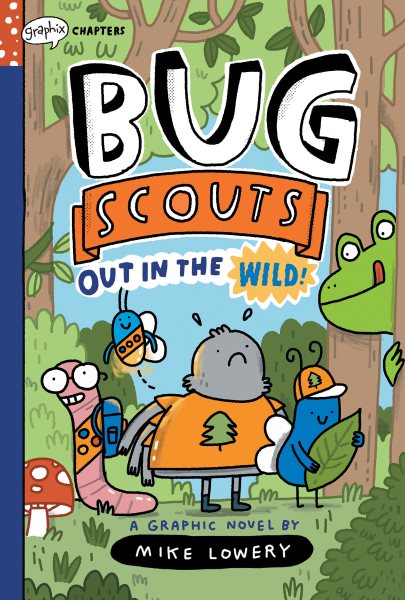
Bug Scouts: Out in the Wild! by Mike Lowery

“I promise to fly, I promise to crawl, or make a cool web, or roll into a ball.” The Bug Scouts are here! They’re on a mission and nothing, not even a hungry frog, will stand in their way! While I freely admit that I’m a #1 Mike Lowery fan over here to begin with, not all of his books are created equal. But this one? It’s lovely. Nature loving bugs, a grumpy spider, a not-so-sneaky frog? This is a case where tone is key. I’ll even ignore the fact that while the frog is seen as a threat the spider is just one of the crew. A rather good pairing with Sir Ladybug (see below), come to think of it! Best of all, it’s great on the younger end of the reading spectrum, and that’s something we can always use more of.

The First Cat in Space Ate Pizza by Mac Barnett, ill. Shawn Harris

Egads! The moon is rapidly disappearing down the gullets of hungry moon rats! First cat in space to the rescue! WILL he save the day? WILL the rats be defeated? WILL he ever get to eat delicious pizza? Find out! So this is shaggy. Definitely very shaggy. As far as I can determine, this is a pandemic book that was cobbled together by kids’ actual suggestions throughout the early days of COVID-19. That may account for the sheer wackadoodle nature of the endeavor, but boy is it a lot of fun. This is just pure silly, heightened a bit by Harris’s art, which occasionally becomes rather lovely. But make no mistake, this is a ridiculous book. One thing I really enjoyed while reading it to my 7-year-old was how you could look up the Spotify playlist with this book’s songs and then play them at key moments during the read. A book that’s kind of going for the DogMan crowd, and kind of creating its own entirely different fans as well.

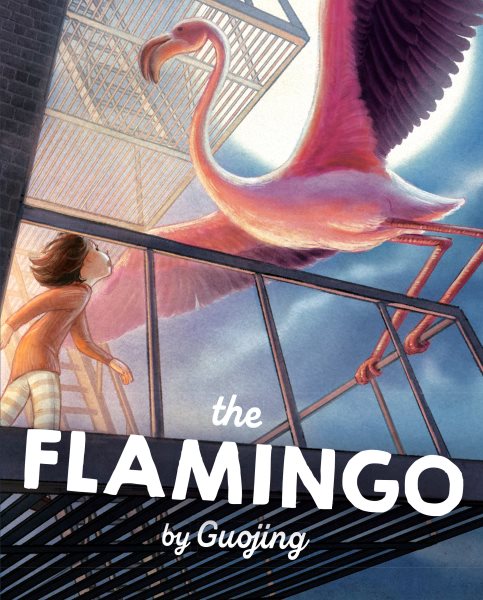
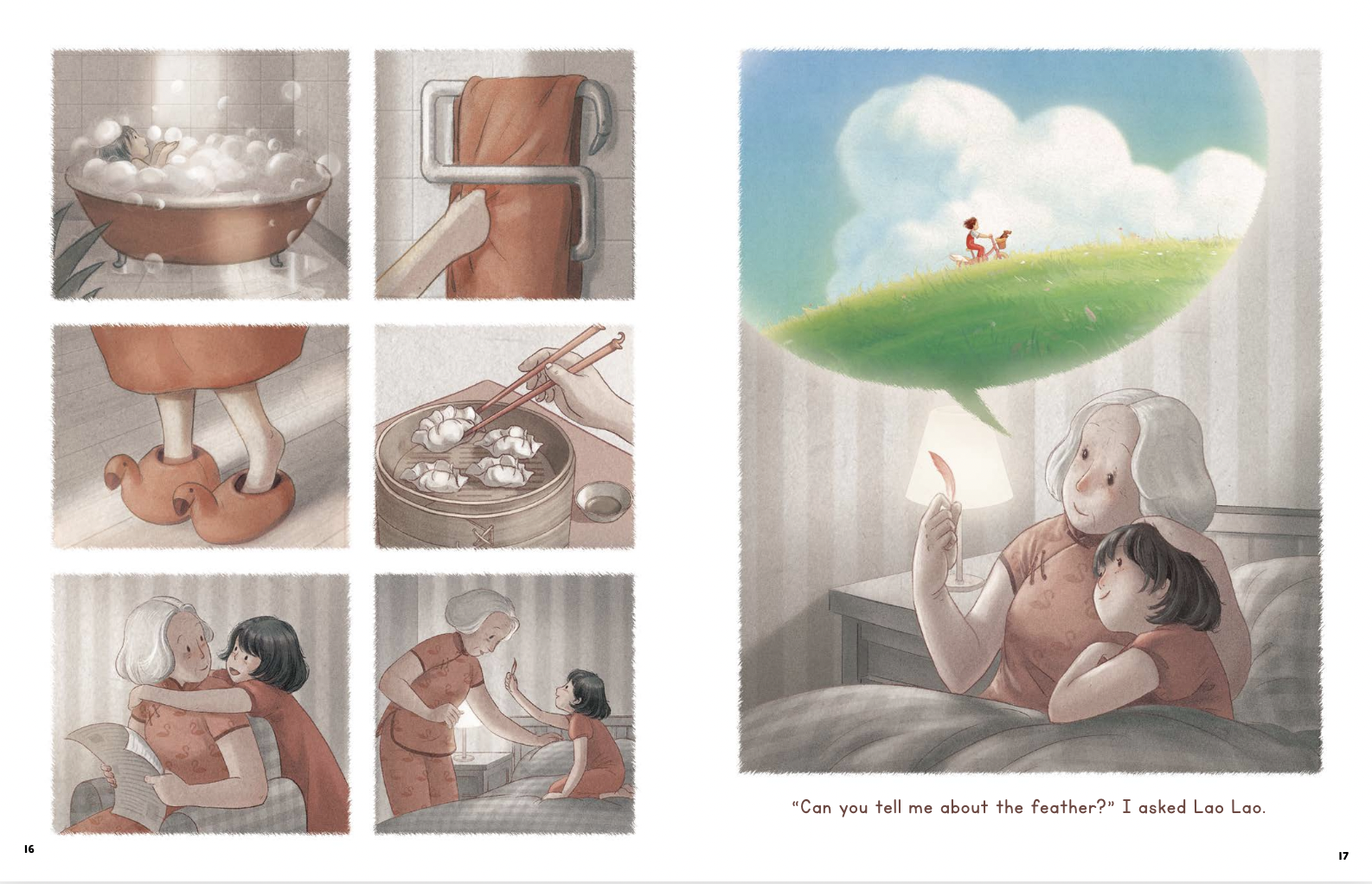
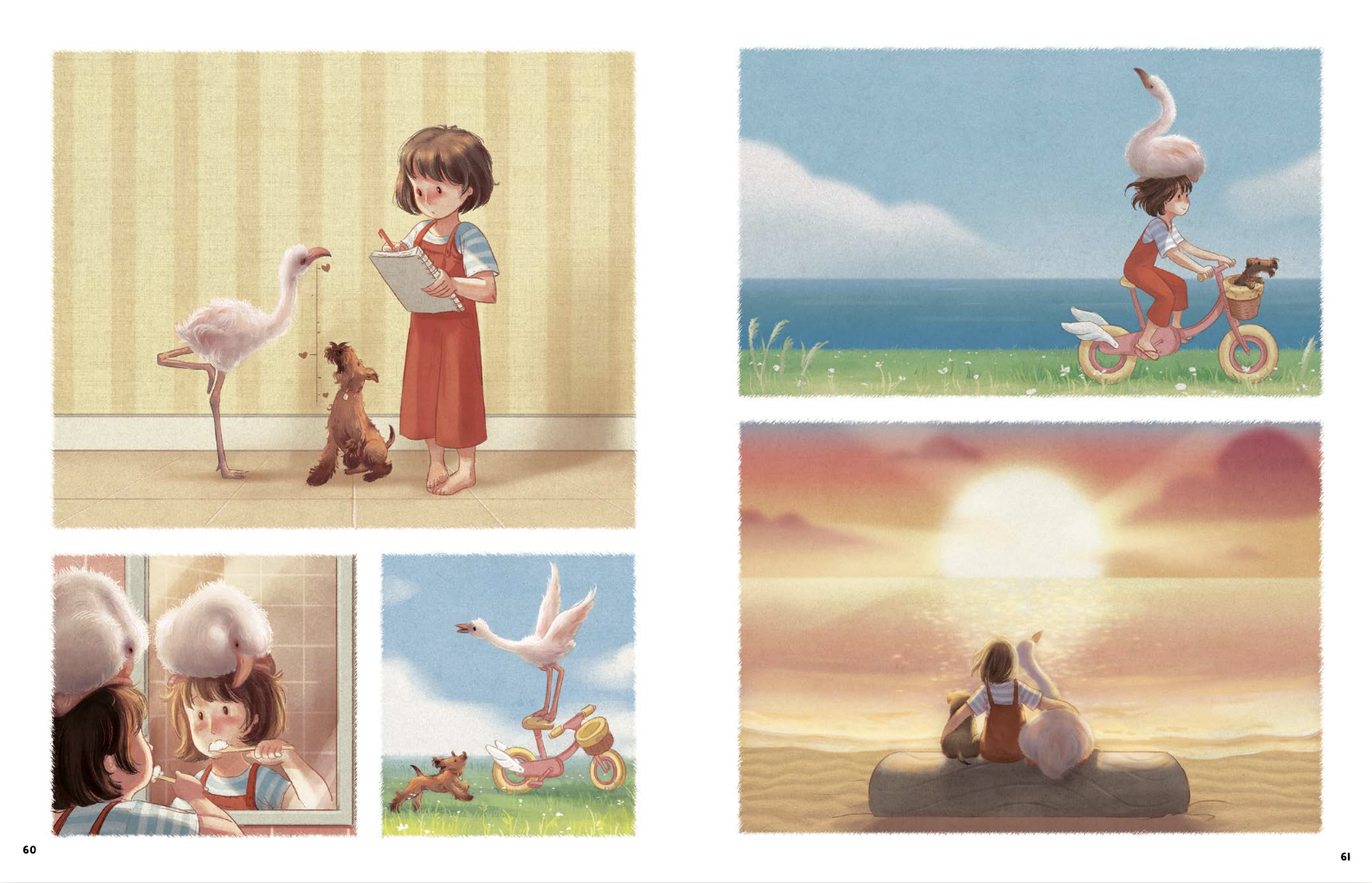
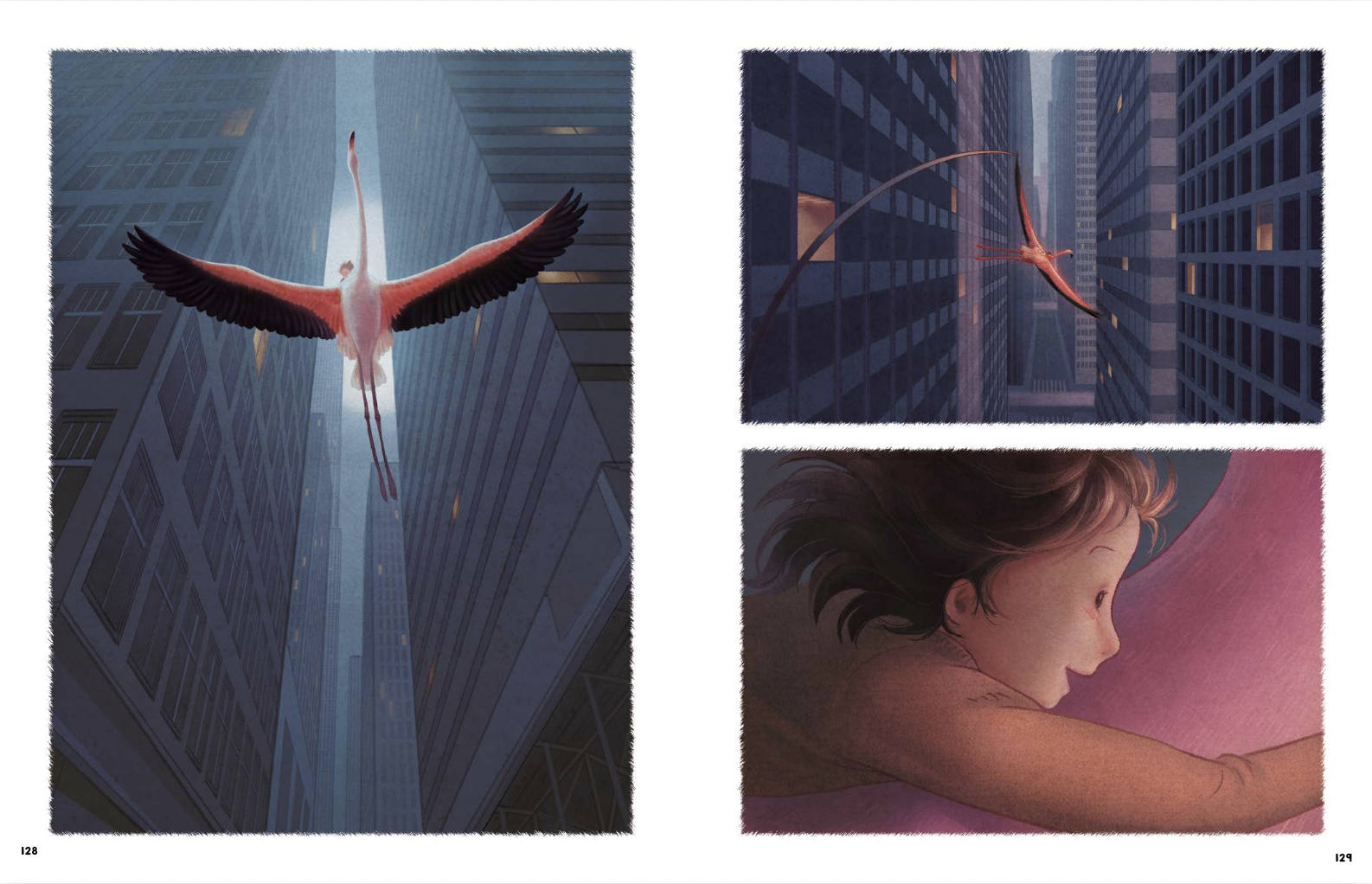
The Flamingo by Guojing

While visiting her grandmother, a child hears story after story about a girl long ago that raised a flamingo chick from an egg. An artful, nearly wordless tale with the feel of a Miyazaki film. Utter gorgeous gorgeousness. Guojing’s the same creator that brought us The Only Child years ago. That story was just soaked in sadness. This one is far happier. I was surprised to see that the book had any text at all. Most of it is wordless, and since Guojing is a master at the sequential wordless sequence, it made sense to assume that the whole book would be like that. Oh, but I loved the storyline. Those sunsets. And though I believe a newly hatched flamingo chick could never, not in a million years, be quite as cute as this one, I loved watching it grow up. This is complete and utter wish fulfillment and I am here for it!

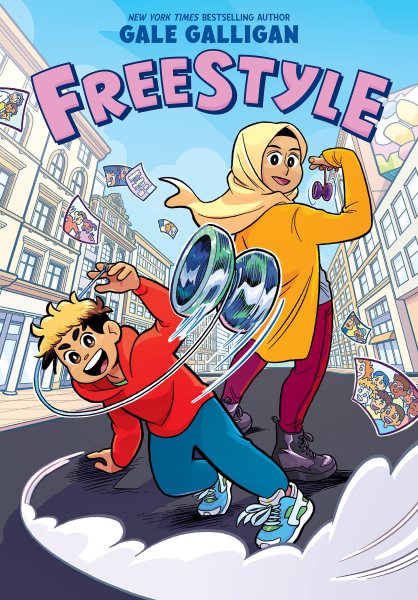
Freestyle by Gale Galligan

It’s bad enough that Cory can’t join his dance crew because he’s been grounded but now he’s being tutored by Sunna his weird lab partner? Then Cory learns Sunna’s yo-yo secret, and the two become an unstoppable dancing/yo-yo team. I would like to personally apologize to the universe for not reading this book immediately when it came into my possession. A mistake! I think I wasn’t giving it proper attention because I still associate Galligan with all those Babysitter’s Club adaptations. Utterly unfair. After all, she did a stand up and cheer job on those. This book is a marvelous example of great storytelling in the graphic novel genre. Dancing + yo-yos does not strike one as a naturally occuring combination but Galligan makes it work. I was taken in by the ups and downs, I thought the characters’ motivations and relationships rang completely true, and the whole thing just sings. Sequential storytelling at its finest.

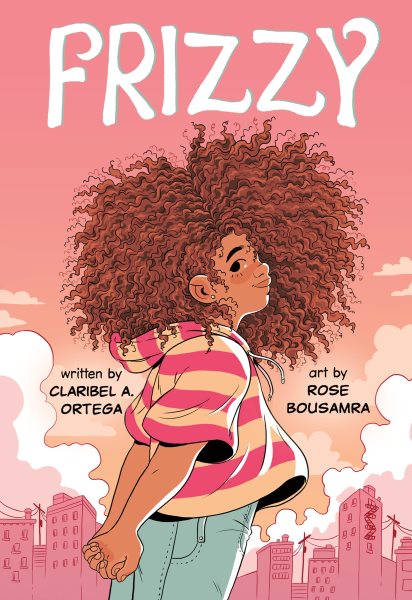
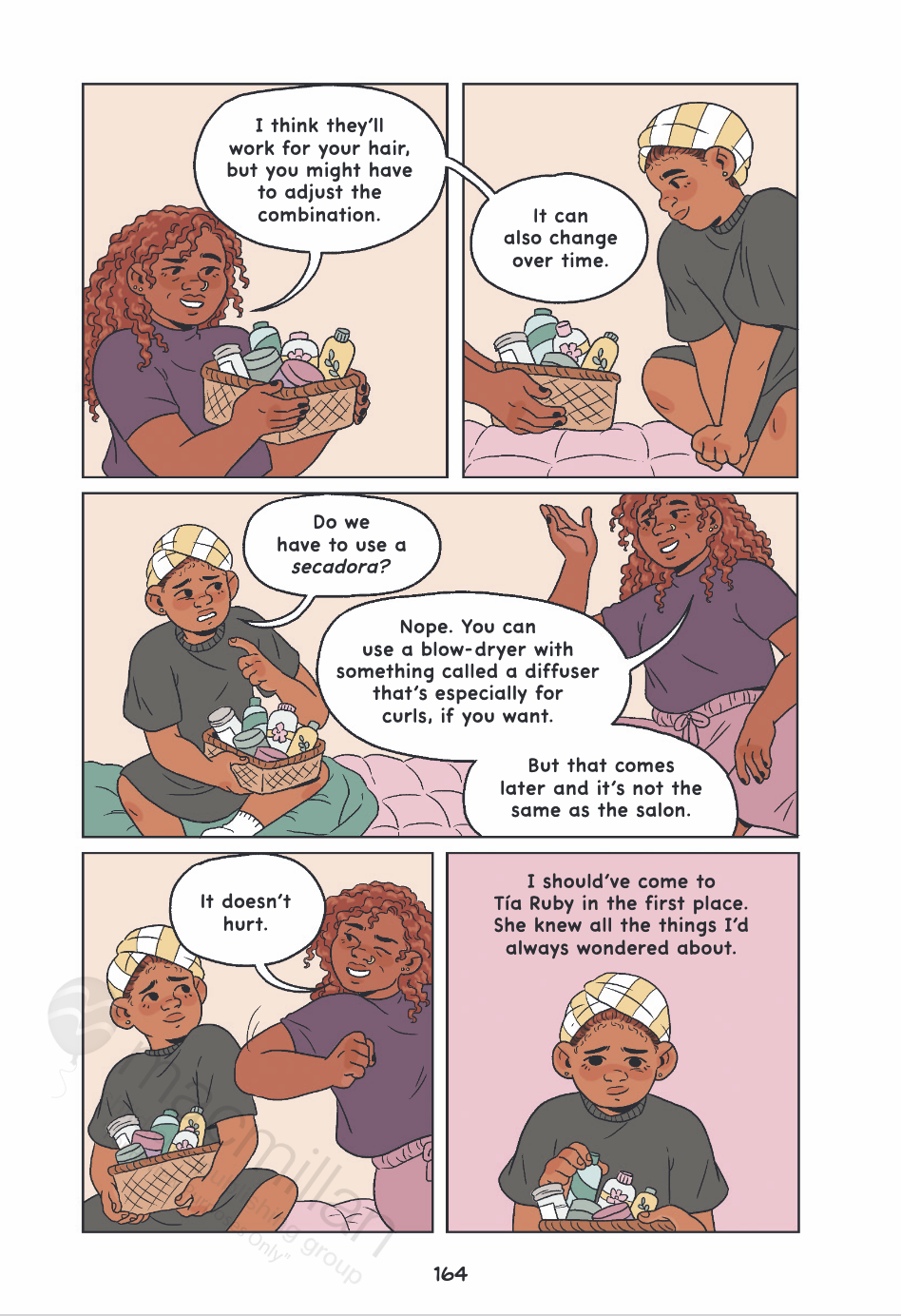
Frizzy by Caribel A. Ortega, ill. Rose Bousamra

Marlene loves a lot of things in life. But hair-straightening weekly visits to the salon–not so much. Why must everyone pick on her beautiful naturally curly hair? Wow! This really works. I worried that a single-topic graphic novel like this one (dealing with your hair when the world, and your mom, want you to change) would feel one-note. No justified fears here. Ortega takes you on a veritable emotional roller coaster ride with Marlene. You LOATHE her cousin. You kinda can’t stand her mom (or at least the messaging her mom is putting out there). And Rose Bousamra’s art really is the perfect complement to the storyline. The aunt character is a little too good to be true, but by the point you get her wisdom you are desperate for her to be there. I am very much on board with this book.

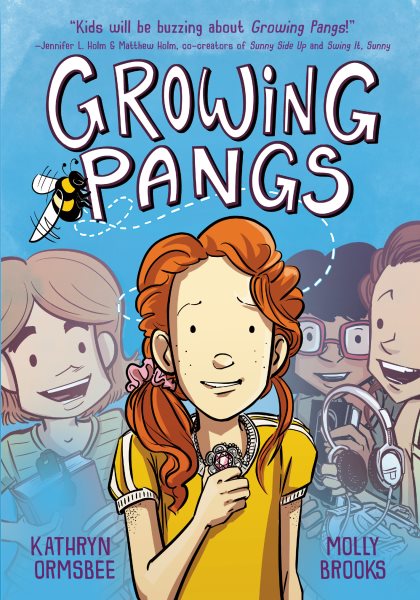
Growing Pangs by Kathryn Ormsbee, ill. Molly Brooks

My 11-year-old daughter has grown quite adept at identifying different neurotypical situations in the graphic novels we read. It wasn’t very far into Growing Pangs that she turned to me and asked “OCD?” I had to concur with the diagnosis, and it wasn’t the first time we’d encountered some form of it in a comic, but this story felt the most familiar to me personally. I had a best friend who experienced OCD in the late 80s and much of what I saw in this book was what I witnessed firsthand. The difference is that Ormsbee makes her OCD into a buzzing insect that is continually telling our heroine Katie, based on Kathryn herself, what she should do and when. Things like tapping things a certain number of times, for example. I was impressed with the book’s willingness to leave things unfinished and open-ended. At one point Katie and her best friend have a fight and the friend moves away before anything can be resolved and . . . that’s it. That’s the end of that particular story. No resolution. Also, as someone who used to run a book group for homeschooled kids out of my public library, I appreciated the depiction of homeschooling in this book. There really aren’t a lot of stories about homeschoolers unless the plot hinges on them going to public school for the first time. Beautifully illustrated with clear cut visual storytelling, definitely add this one to your shelves.

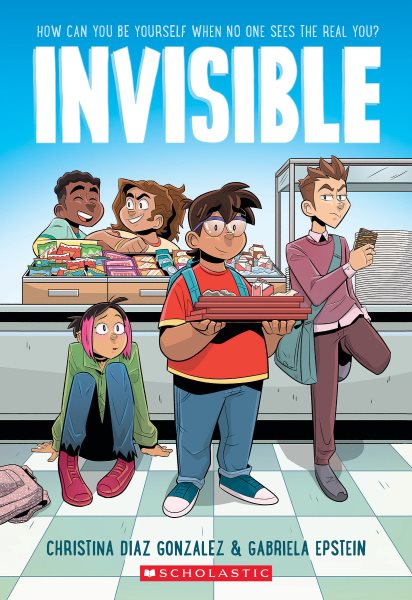
Invisible by Christina Diaz Gonzalez, ill. Gabriela Epstein

They were five total strangers with nothing in common, except their Latinx heritage. But when they find themselves on an early morning volunteer crew at school, they come together to help someone in need, no matter the consequences. Books for kids are really leaning heavily on the 80s tropes these days, aren’t they? Now we’re getting a kind of Breakfast Club homage (they actually name the movie at one point,) but the twist is that these very different kids are all Latinx. For this reason the adults sort of lump them all together. The book’s way of distinguishing them is to give each character their own voice as they tell the story of how they came together to help a woman and child with housing insecurities. What impressed me was that this is one of the few books for kids I’ve seen that doesn’t just lump all these different nationalities into one group. The Spanish is integrated artfully into the text and in a very short amount of time you get the personalities of each and every character. And you want microaggressions? Microaggressions galore! A smart, thoughtful bit of storytelling.

Isla to Island by Alexis Castellanos

How does it feel to be shipped off from the island you love to a city where you know no one and don’t speak the language? A wordless graphic novel explores Marisol’s life in NYC after the rise of Fidel Castro in Cuba. This comes off as an interesting experiment in how much you can communicate wordlessly. There is information in the back to explain who Fidel Castro was and why Marisol leaves Cuba in the first place. Still, just reading it off the shelf, it can be awfully confusing. I did like her attachment to nature and the way her host family connected with her. It would pair rather beautifully with Sonia Manzano’s Coming Up Cuban: Rising Past Castro’s Shadow, also out this year.

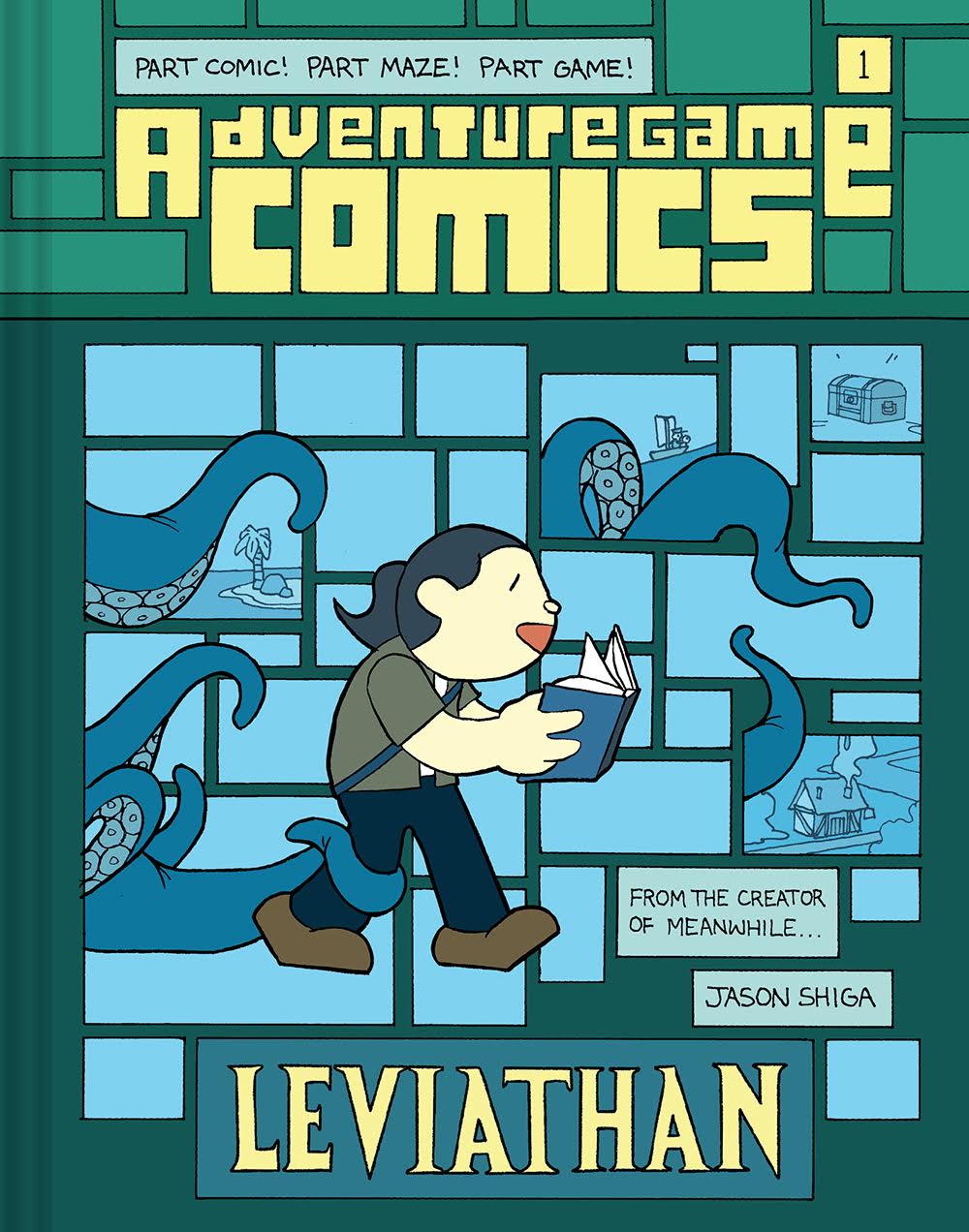
Leviathan (Adventure Game Comics #1) by Jason Shiga

The choices are yours but the answers aren’t simple. Can you crack the code of the Leviathan and the wand that keeps it at bay? Hint: Think outside the box. Oh, Jason Shiga, you mad genius, you. As someone who was head-over-heels crazy about his other book for kids Meanwhile, I’ve been waiting for him to do something else for kids for years. He hasn’t quite put the same amount of energy into this book, but that doesn’t mean it won’t muck with your brain waves a little. It’s one of those pick-your-own-path stories, and so my son and I gamely went along with it. It took us a little while, but we finally cracked the secret of it. If you want to win the book you have to listen VERY carefully to what Kanoxx the sorcerer is saying to you. Ultimately, we won, but in doing so discovered that this is, without a doubt, one of the most subversive bits of messaging we’ve seen in a comic for kids in a long time. I’m so proud. Wouldn’t have it any other way.

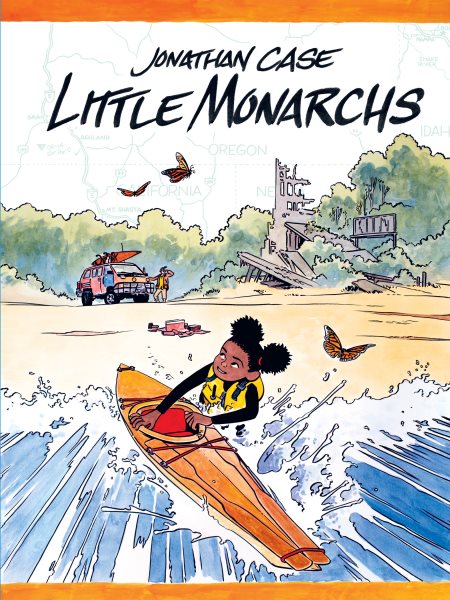
Little Monarchs by Jonathan Case

In a future where very few mammals have survived, a girl and her guardian fight to find the vaccine that will save the human race. The secret ingredient? Monarch butterfly scales! Just watch out for the very people you’re trying to save… This book isn’t messing around. It’s got such a goofy premise for a post-apocalyptic tale that you just sort of go along with it, no matter how strange it is. I worry a bit that the opening might scare some kids off since it looks awfully wordy. Even so, this is one of the most book-talkable titles I’ve encountered in a while. Please note that this is definitely for your older readers (12-14), no question. I got so tense reading it that I had to skip ahead just to make sure everything ends up okay. Hand this to the kids that love them some end of the world storytelling. End of the world slash pretty pretty butterflies.

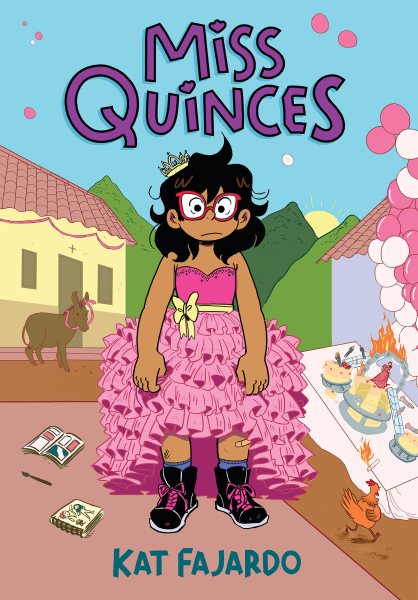
Miss Quinces by Kat Fajardo

Sue’s dream is to go camping with her friends for the first time ever. Instead, she’s being packed off to Honduras with her family where she’ll endure mad turkeys, fire, waterlogged manga, and (worst of all) a quinceañera party she never wanted. How can she make it her own? And does she even want to? Oo! This is a good one. I read this aloud to my daughter who, while completely flummoxed as to why anyone wouldn’t want to wear a pink frilly dress and have a huge party, nonetheless really enjoyed this story of one girl trying to establish her own personality in the midst of major family drama. I thought the relationship between Sue and her mom really worked, and its ups and downs were completely understandable. I probably identified a little too much with the mom (who has, like, 500 things all going on at once), but Sue’s p.o.v. was perfect. Great book. And since I read the galley I can’t wait to see it in color. 

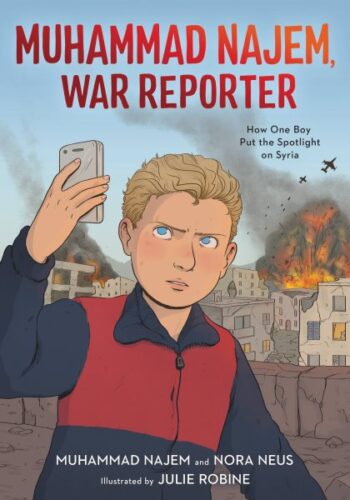
Muhammad Najem, War Reporter: How One Boy Put the Spotlight on Syria by Muhammad Najem and Nora Neus, ill. Julie Robine

What can one boy do in the face of a nation at war? When Muhammad Najem started reporting live from Syria, his bravery brought attention to his country like never before. A harsh, hopeful story. Ever read a work of recent historical events that makes you regretful that you paid them insufficient attention when they happened? This is, by far, not the first autobiographical graphic novel I’ve seen, but it may be the best written/best illustrated. The sheer levels of care and attention that have gone into it just shine through. Publishers are getting increasingly comfortable creating children’s books on tough topics, and living through Syria’s civil war falls squarely in that category. What really impressed me about this wasn’t just how the facts were laid out, but the sheer clarity of the storytelling. I never had any doubts of what was happening from one panel to another. And then there’s Julie Robine’s art. The meticulousness at work here is remarkable. This must have taken years and years to make! A stunner and a fantastic inclusion on any list. Don’t miss it!

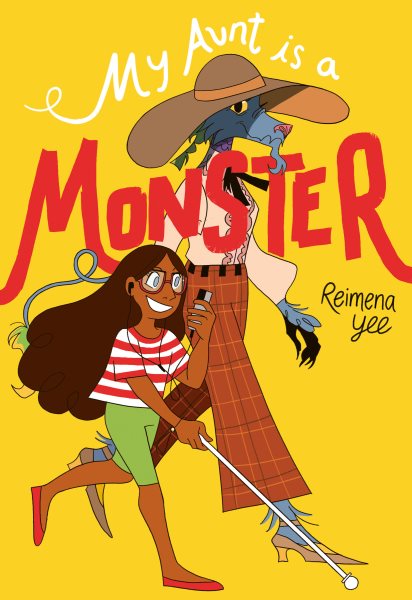
My Aunt Is a Monster by Reimena Yee

You ever read a book starring a child with impaired vision and notice that, in spite of this fact, the kid seems to have some ability to see things they shouldn’t be able to simply because it makes the plot run a little bit smoother? Yeah, there was at least one book out this year that did that and it did not make me happy. What does make me happy? This makes me happy. My Aunt Is a Monster is a much better title with a blind child protagonist and her somewhat unusual aunt. It’s a mildly goofy premise from the start. Newly orphaned Safia is sent to live with an aunt she never met before named Walteranne Hakim Whimsy. A former adventuress, Aunt Whimsy now suffers from a curse that has rendered her form monstrous. She hides this fact from Safia, but she cannot hide from the call of adventure when it comes calling for them all. Aunt Whimsy’s rival from her previous life (a woman she simply calls Pineapple Tart) is close to discovering the very same location that cursed Whimsy in the first place. Now they’re setting off to warn the tart. What they don’t count on is an evil organization dedicated to chaos that has plans for Aunt Whimsy beyond her control. Loved the art and the succinct storytelling. This one gives you a nice bit of bang for your buck. I also very much enjoyed the fact that Safia is just as capable of adventuring as anyone, and is much much more than a stock character. 

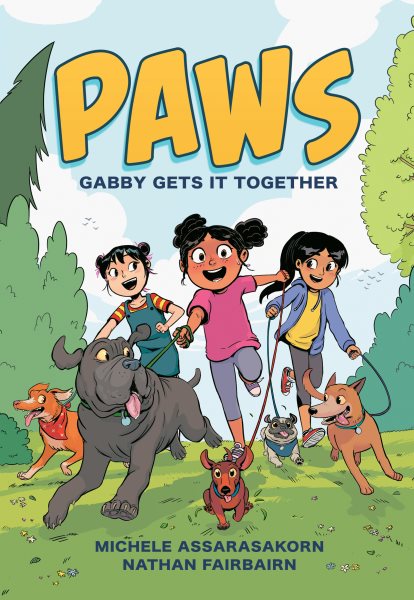
Paws: Gabby Gets It Together by Michele Assarasakorn, ill. Nathan Fairbairn

Three girls. Zero dogs. Gabby, Priya, and Mindy are all desperate to pet and play with dogs of their own, but their families are strict about not having them in the home. Enter PAWS! Think, The Baby-Sitter’s Club but for pets. But who knew a dog walking service could be this much work? Oh, I really like this one! Definitely bound to be a favorite of those kids desperately waiting for the next Baby-Sitter’s Club graphic novel installment. A lot of what I liked about it, though, was that subtle dynamic that you get when kids of different ages are friends. The fact that Gabby is one year younger than Pirya and Mindy really hit home and hit home hard. That casual dismissive attitude they show her is so horrendously realistic. I also loved the way in which the book works in questions of economic privilege and what happens when you bottle up your issues. Bound to be a hit with more than just the dog fans out there.

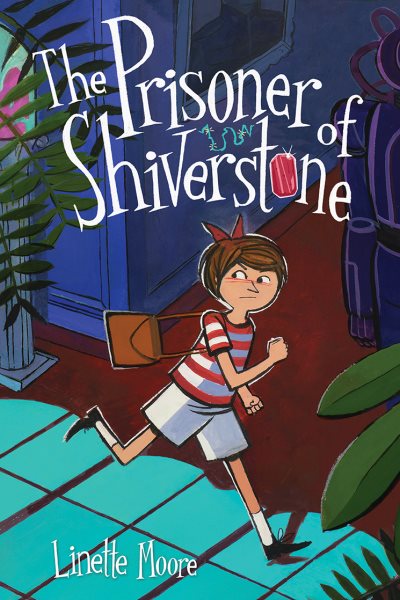
The Prisoner of Shiverstone by Linette Moore

11-year-old Helga has suddenly appeared on the mysterious Utley Island. She claims to have been separated from her parents, but is there more to her story? What is it she’s really looking for? As I often say, I admire comics that take big swings and tell their stories in unique ways. This book most certainly fit the bill. I like how long it takes for you to figure out what our heroine, Helga, is up to. You don’t even know if she’s a good guy or bad guy for much of the book. It also slowly introduces information about this world (a world where all the mad scientists were rounded up and put on one island and now anyone who shows any aptitude or love for science is viewed with suspicion) but in a comprehensible way. One thing I’m increasingly impressed with is how well certain comic authors are at making panel by panel moments logical and something you can follow. Another plus: Cool things go boom! There’s something to be said for that.

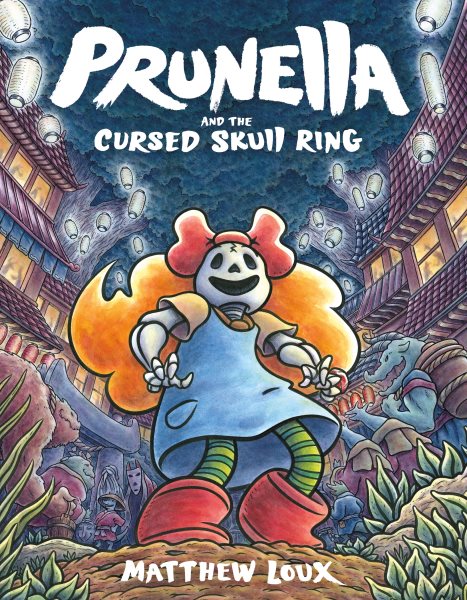
Prunella and the Cursed Skull Ring by Matthew Loux

I like inherently ridiculous concepts in my kids’ comics. This year has seen a bumper crop of weird ideas too. Everything from vampire lumberjacks to cheery post-apocalyptic androids. But for a wacky idea to actually work beyond its pitch it needs a steady hand at the wheel. Now Matthew Loux is the fellow responsible for the two Time Museum books (and my son would like to inform Mr. Loux that we are patiently awaiting the third . . . ahem). Here, a nice girl from a terrible town of nasty, suspicious humans finds a skull ring in her garden. She puts it on and POOF! Now she’s a skeleton girl. Naturally the humans run her out of town, but when she goes to the monsters she’s heard so much about they are, quite simply, lovely. Really sweet. There are plenty of books for children out there where the outsider is rejected summarily and cruelly. This book is quite the opposite. Where Prunella fits in, she is rejected. Where she stands out? She is embraced. It’s a book about finding your people, even if your people happen to be made of skulls and bones.

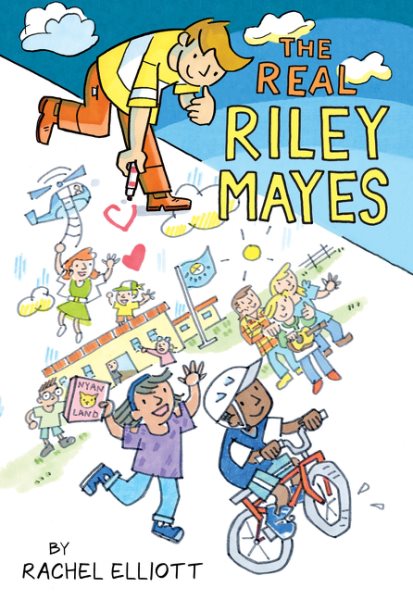
The Real Riley Mayes by Rachel Elliott

Riley would love to be known as a lovable goofball who loves to draw, but too often she’s seen as a disruptive annoyance who doodles on all her homework. When two potential friends come into her life, will she be brave enough to explore who she likes (does she get crushes on girls?) and who she wants to be in the world? I feel like we often see a lot of coming of age comics for boys coming to terms with their sexuality, but far fewer for girls. And there are moments in this book that felt too real to be made up. Additionally, I’d also like to compliment a book where a girl has impulse control and attention issues. There is indeed the usual checklist of middle grade dramatic moments, but I thought there was a bit of complexity as well. Riley is definitely a flawed character but an identifiable one. And her journey is incredibly understandable. This feels very contemporary with the fact that this is a world where kids in middle school are in very different places when it comes to LGBTQIAP+ issues. This isn’t a book that could have come out even 10 years ago. The kids are better informed, but that doesn’t mean the bullying stops, by any means. A lot to chew on with this one.

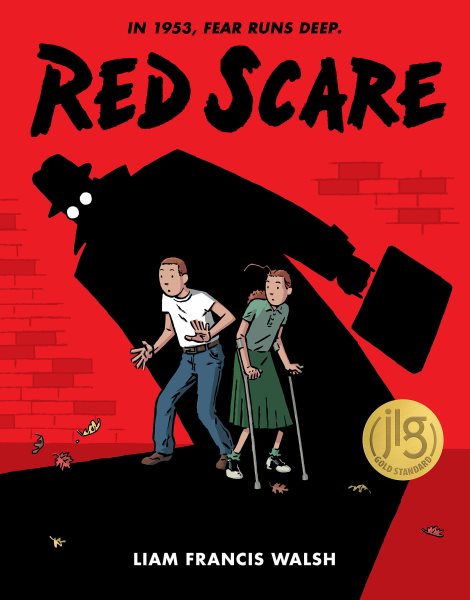
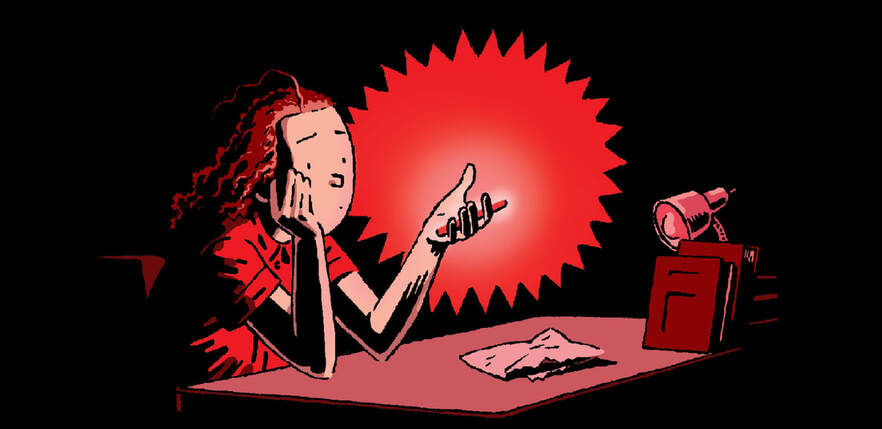
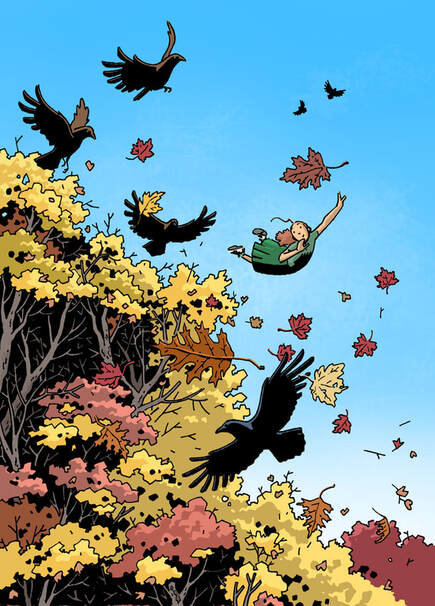
Red Scare by Liam Francis Walsh

What if the solution to all your problems just magically presented itself? It’s 1953 and Peggy is still recovering from polio. And when she finds an unearthly substance that even the government wants, she’ll do anything to keep it safe. Gorgeous. Walsh has really leaned into some of the more noir aspects of the 1950s. Since the creator lives in Switzerland, it’s not surprising that this book would have as many Tin-Tin influences as it does. And boy does it lean into those sweet 50s tropes. Polio, Commies, nasty American agents, and even some science fiction (though I was mighty surprised when that element came up in what I thought was a straightforward bit of historical fiction). What this really reminded me of a lot was Eugene Yelchin’s Spy Runner. This is definitely for older readers since kids get punched, kicked, and shot in the course of things, but it all turns out all right in the end. A fascinating action piece.

Ride On by Faith Erin Hicks

Who is the mysterious new girl at Edgewood Stables? When Victoria shows up one day riding the horses there, she tells the other kids that she does not need new friends. But why is she there then? And what happened at her stable before? I adore Hicks’ books and I’m ashamed that I almost missed this one this year. Rest assured, my daughter is mocking me mercilessly for this error. More to the point, this book is such a delight. Note that I am NOT a horse person. Consider me horse neutral. I thought it was the characters that were wonderfully realized (I think Norrie probably came out of Hicks’ brain wholecloth, she is so realistic and beautifully flawed) and the drama was just the right level of serious for me. No one’s saving the world here. They just wanna ride horses. I can respect that.

Santiago! Santiago Ramón y Cajal – Artist, Scientist, Troublemaker by Jay Hosler

Santiago just can’t seem to keep out of trouble and his father wants him to stop drawing and study. A fiery look at the life of a mischievous kid who went on to become the father of modern neuroscience. Oop! Here we go. This is one of those books that mixes and melds its fact and fiction together in interesting new ways. That sort of drives me crazy when the book in question is a picture book but I feel an awfully lenient when comics are involved. Particularly comics as fun as this one. Essentially, this is what you’d get if you combined Calvin & Hobbes with Nathan Hale’s Hazardous Tales. I mean, in terms of looks it really resembles the style of Christopher Eliopoulos. But if this is the future of biographies then I am HERE for it! Hosler (remember last year’s The Way of the Hive?) really encapsulates Santiago’s life beautifully while making it clear why he was so essential to the study of cells and the brain. History has been getting great comics for years. Such a thrill to see a bit of biology in there too. 

Scout Is Not a Band Kid by Jade Armstrong

Scout’s mission is clear. To get to see her favorite author she must join . . . band! But can this trombone faker convince her new uptight seat leader that she’s worthy enough to stay? I honestly cannot believe that this is Jade Armstrong’s first published graphic novel. This is so funny, so true, and so beautifully put together that I swooned. My daughter liked this book so much that she didn’t even notice that it’s 100% romance free! Loved the translations of all things Canadian in the sidelines. There’s also a really nice manga influence at work here, particularly with some of the character’s small asides. And did I mention it’s funny? Laugh out loud funny, no less. Fantastic from start to finish, I am a HUGE fan of this title. Hoping to see more of Armstrong’s work in the future too.

Shuna’s Journey by Hayao Miyazaki, translated by Alex Dudok de Wit

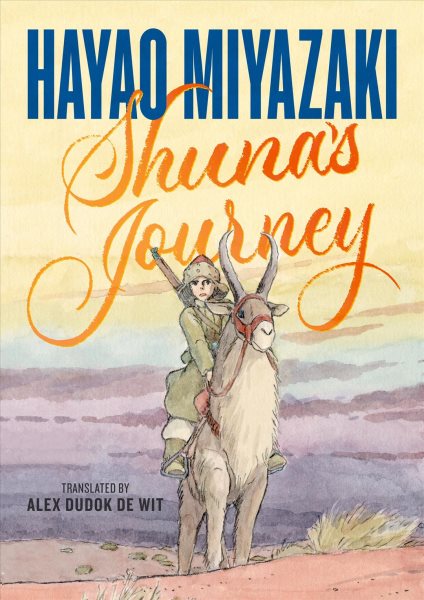
It’s absolutely baffling to me that we received, this year, a fantastic Miyazaki (yes, THAT Miyazaki) graphic novel with all the hallmarks of one of his films and yet the publicity? Almost nil. The story behind this book is nearly as fascinating as the book itself. Apparently this title dates back to 1983 (though it feels fresh and new when you first encounter it). It was published a full two years before Studio Ghibli was established. The story, according to Miyazaki himself in the Afterword, is based on an old Tibetan folktale called “The Prince Who Turned Into a Dog”. In this version, a young man named Shuna is the prince of a poor land. Determined to find a mysterious grain that could feed his people, he sets off on a quest to find this miraculous food. Along the way he runs into slavers, slaves, and an economy based on humans for grain. It actually reminded me of this year’s film Nope a little bit at times, as well as a lot of other Miyazaki films. The book takes an unexpected turn halfway through when its focus shifts from Shuna’s point of view to the formerly enslaved Thea. But the reason I’m placing it on today’s list is that it’s a shocking beautiful book through and through, thanks in large part to the incredible watercolors inside. Apparently this has been popular in Japan since the early 80s, and the translator, Alex Dudok de Wit, speculates that its been ignored by scholars because it had never been translated before. Well, problem solved! One of the more amazing comics of the year. Don’t let it pass you by. 

Simon and Chester: Super Family! by Cale Atkinson

I’ve an unspoken rule against putting sequels onto any of these lists. It’s not hard and fast, but just for my own reading I don’t have much time to dedicate to titles I’ve seen before. But rules, even unspoken ones, are meant to be broken. Particularly when they involve a fellow by the name of Cale Atkinson. Now I don’t know if you had the pleasure of seeing his first “Simon and Chester” story but it was a marvelously funny book. This one also doesn’t disappoint, but it also contains a couple melancholy undertones that deepen the characters and lift this above the pack of normally silly/funny gns. In this story Chester has learned through popular culture that his family situation (living with just his grandma) is not a “normal” family. Simon isn’t very sympathetic to this p.o.v. because he’s gearing up for a ghost conference and he’s hoping to rub his new haunting situation (a.k.a. Chester’s home) in the faces of some of the snobbier ghosts. There’s a single moment in this book that solidified its placement on not just this graphic novel list but my upcoming “Funny” list, when Simon is talking at the ghost convention to a fellow ghost that haunts a bucket that had me snorting way too loud in my staff break room one lunchtime. And with its increasing emotional maturity, this is definitely a series to grab close and hold onto. 

Sir Ladybug by Corey R. Tabor

Evildoers and hungry chickadees beware! Whenever there’s trouble, he’s there on the double. He’s… Sir Ladybug! I’m always talking about how I’d like to see younger comics on my comic book lists. Corey R. Tabor to the rescue! You might remember him from last year’s Mel Fell or from the delightful Snail Crossing. I’m happy to report that a snail does indeed make it into this book (maybe the same one?). And I adore the idea of a sinister chickadee as they are, undeniably, the cutest of the tiny birds. This book just works, man. Tabor’s a master. Extra points for making me really hungry for cake and Sterling’s poem (“so much depends / upon / a slice of / cake / glazed with thick / frosting / beside the video game / console”). The sole flaw? No recipe for lemon layer cake in the back. Tut tut.

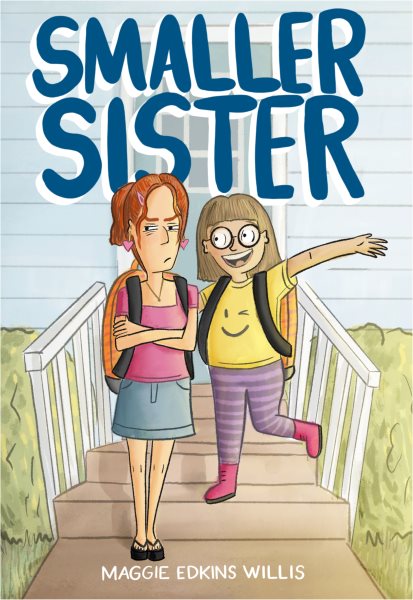
Smaller Sister by Maggie Edkins Willis

Lucy adores her big sister Olivia, but Olivia has problems that Lucy just can’t understand. And while Olivia is dealing with an eating disorder, Lucy begins to slip down the same slope. A loving portrait of family and positive body attitudes. I’m a little influenced by my 11-year-old’s reaction to it. She was instantly drawn to the title and read it in about a night, then told me to read it. Please note that she never tells me to do that. I thought the book captured very well the see-saw effect of eating disorders in a single home. Also, I know the parents were supportive but could these people freakin’ keep a job in a single place for more than a year?!?

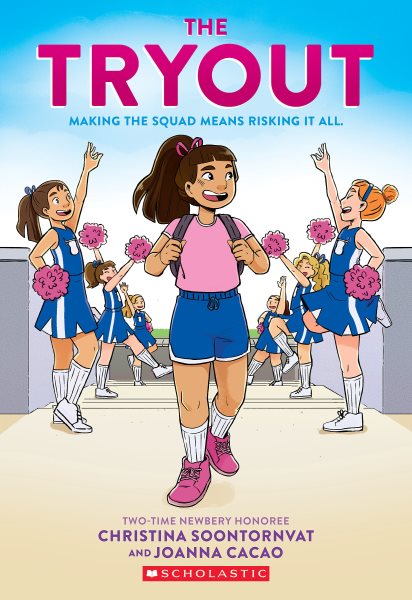
The Tryout by Christina Soontornvat, ill. Joanna Cacao

2022 was the year when I finally stopped reading to my daughter every night. We managed to keep it going until she started middle school, but once she was off and running it just felt like a natural stopping place. Fortunately, I was able to get in a fair number of 2022 graphic novels and comics with her before the switchover. The Tryout was one of those titles and seemed a perfectly timed title for the world she was about to enter. Soontornvat apparently took a dare somewhere to publish as many different types of children’s books in a single year as possible. How else to explain the fact that she has out a picture book bio, a fantasy middle grade, a younger nonfiction picture book about the environment… shall I go on? This is the most autobiographical of her titles and it follows a moment in middle school when Christina and her best friend decided to try out for the cheerleading squad. Interestingly, the thing it reminded me of the most was Jimmy Gownley’s Amelia Rules series, specifically those books where Amelia tries out for cheerleading. Cheerleaders, by and large, get a bad rap in children’s literature and it’s nice to see a realistic look at a specific time and place (complete with plenty of microaggressions) that shows why this is important to so many girls. A complex but not overly complicated view of a young life. 

Twin Cities by Jose Pimienta

Twins Teresa and Fernando have always done everything together. But now, living on the US-Mexican border, Teresa is studying in the States and Fer is staying in school in Mexico. Will their relationship survive the strain of this separation? Nuance! I love it! Like I’ve mentioned before, I read all these emotional middle grades with my daughter and we spend a lot of time trying to predict what one person or another’s deal is. In the case of this book, Fer’s new friend had something going on with him but until he pulled out those joints we weren’t quite sure what it was. I was impressed by the depth and complexity at work here as well. If you’re reading this hoping for black and white issues, for people to be all good or all bad, or for issues to be clear cut, look elsewhere. Both Fer and Teresa are navigating these complicated issues on their own, and the whole basis of their problems lies in the fact that for most of the book they can’t or don’t confide in one another. Plus, I have never ever seen a book about characters that live in Calexico/Mexicali. This entire world and premise was new to me, and Pimienta includes some really helpful backmatter to put everything (including the ease with which they cross the border everyday) into perspective. Just know that there is drug use in this book, so it’s definitely on the upper end of the middle grade spectrum.

Two-Headed Chicken by Tom Angleberger

Kind of what you’d get if the film Everything Everywhere All at Once switched out its leads for a two-headed chicken and a green Colonel Sanders-suited moose. Clear as mud? Great. I should mention that Tom Angleberger’s book is one of the few comics that I read to my 8-year-old this year that had him literally guffawing out loud as I did so. The concept of a multiverse has started, slowly, to spur on a range of different books for kids. I would argue, however, that few have taken the ball and run with it the way that Tom has here. The entire concept is, quite simply, that you, the reader, are one of the heads of a two-headed chicken. The other head has a hat that allows you to leap from multi-verse to multi-verse. And this would be all well and good were it not for the fact that in every multi-verse you are being chased by the aforementioned moose and his battle cry of “I’m gonna fry you!” It’s an exploration in originality, since Tom literally could do ANYTHING with this book… and he takes things to ludicrous heights and lows. And here’s the thing: Don’t find one sequence funny? No worries! You’re bound to find another one exactly up your alley. It’s a marvelous exercise in different types of humor and how to incorporate them all into one book for kids. And THAT is worth celebrating! 

Wingbearer by Marjorie Liu, ill. Teny Issakhanian

A quick word of warning, this book is very much the first in a series and it ends on a cliffhanger. I know some folks like to know about that beforehand. By this point you understand that each book on this list, if my daughter sees it, gets a romance rating. And while this book does not really have any romantic impulses in it, at the very least “the boy is cute” (quoth she) so take that under advisement. I like a book that comes up with a wackadoodle new idea and gives its world building some proper time and attention. Liu delivers on that point. Our heroine, Zuli, has been raised in a magical tree by mystical birds. At this safe haven, birds, when they die in our world, go there to be reborn. Got that? Trouble is, the birds are now dying but their souls are not being reborn again. What gives? Zuli sets out on an epic quest, meets friends along the way, suffers betrayals, comes to understand her own powers, and then there’s a wonderful bad guy twist right at the end. The art is skillfully done and everything that happens is crystal clear from start to finish. Definitely one for your shelves. 

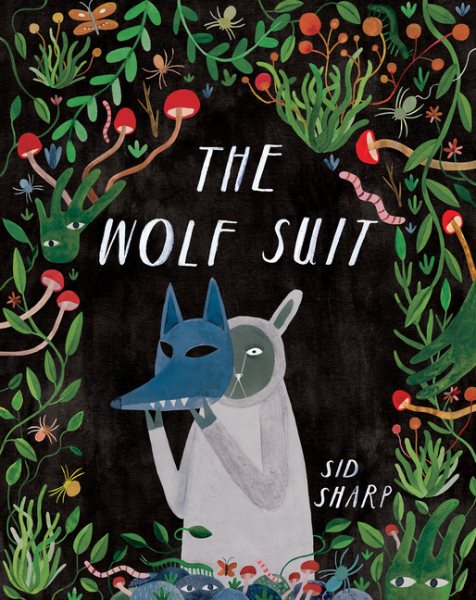
The Wolf Suit by Sid Sharp

I like a book so weird I don’t know where to put it. I like a book so weird it should live in its own little section of the library or bookstore by itself. Maybe someone could build it a tiny apartment out of cardboard underneath a sign that reads This Book Is Too Weird To Live Anywhere Else. Because where exactly do you put this title? In the graphic novels and comics? In the early chapter books? Me, I put it here on this list and I regret nothing. The story is just so strange and charming that I couldn’t help but adore it. Our star is Bellwether Riggwelter (are you not entertained?) a sheep that lives on his own and is perfectly happy about that. Unfortunately, Bellwether is totally terrified of wolves, and with good reason being a sheep and all. One day he decides to go out into the woods to pick some berries but a close encounter with a wolf scares him back home. Once there, he gets the clever idea to create a wolf suit. Now he can get out and about. Trouble is, when he runs into “other” wolves they invite him out that night. Will his secret be revealed? Did I see the twist in this story coming? I did not. Should I have? Probably. But as far as I’m concerned this is a book with a moral that refuses to moralize. It just wants to be weird and wild. I am okay with that.

Your Pal Fred by Michael Rex

Post-apocalyptic adorableness! Meet Fred. He wants to be your friend, even if you happen to be a killer robot, a warlord, or entirely covered in spikes. Resist his charm if you dare! Kind of what you’d get if you drop a lovable schmuck in the middle of Mad Max: Fury Road. Fred’s just sweet and there isn’t a drop of real violence in this whole book. Put another way, Fred’s like a little android Ted Lasso, merrily skipping through a hellscape, trying to stop war and violence, and handing out cheery stickers along the way. Niceness is seeing a real uptick in adult programming (how else to explain Our Flag Means Death?) so it makes sense that we’d see a little of that on the children’s side as well. Color me a Fred fan. 


Want to see other lists? Stay tuned for the rest this month!

December 1 – Great Board Books

December 2 – Picture Book Readalouds

December 3 – Simple Picture Book Texts

December 4 – Transcendent Holiday Picture Books

December 5 – Rhyming Picture Books

December 6 – Funny Picture Books

December 7 – CaldeNotts

December 8 – Picture Book Reprints

December 9 – Math Books for Kids

December 10 – Gross Books

December 11 – Books with a Message

December 12 – Fabulous Photography

December 13 – Translated Picture Books

December 14 – Fairy Tales / Folktales / Religious Tales

December 15 – Wordless Picture Books

December 16 – Poetry Books

December 17 – Unconventional Children’s Books

December 18 – Easy Books & Early Chapter Books

December 19 – Comics & Graphic Novels

December 20 – Older Funny Books

December 21 – Science Fiction Books

December 22 – Fantasy Books

December 23 – Informational Fiction

December 24 – American History

December 25 – Science & Nature Books

December 26 – Unique Biographies

December 27 – Nonfiction Picture Books

December 28 – Nonfiction Books for Older Readers

December 29 – Best Audiobooks for Kids

December 30 – Middle Grade Novels

December 31 – Picture Books

Filed Under: 31 Days 31 Lists, Best Books, Best Books of 2022 Tagged With: 2022 comics, 2022 graphic novels, 31 days 31 lists, Best Books of 2022, comics, graphic novels, middle grade comics, middle grade graphic novels

31 Days, 31 Lists: 2022 Easy Books and Early Chapter Books

December 18, 2022 by Betsy Bird

In no particular order, here are the types of children’s books that I think are the most difficult to write well: Easy Books, Early Chapter Books, and Board Books. You could dash any of these off with a wave of your hand, but would they be any good? Sit down with a Frog and Toad book one of these days and just gape for a while over the perfection of that writing.

The books on today’s list may not all be up to Arnold Lobel standards of literature, but by gum they pack a lot into their tiny packages. You know the drill. Easy Books come first. Then the Early Chapter Books (which go by a myriad number of names, including Young Readers or just plain old “Chapter Books”).

Interested in previous years? Then check out the following. Just note that in the past I’d turn Easy Books into their own list and Early Chapter Books into their own list. Something I may consider doing again someday . . .

  • 2021
  • 2020
  • 2019 & 2019
  • 2018 & 2018
  • 2017 & 2017
  • 2016 & 2016

2022 Easy Books

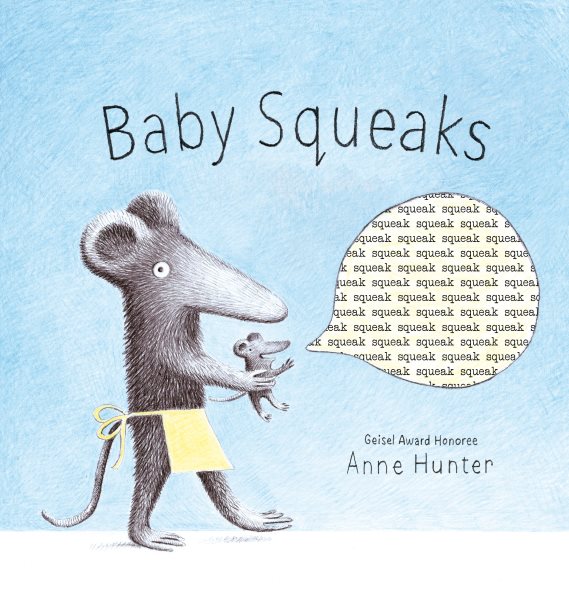
Baby Squeaks by Anne Hunter

Every year a small cadre of librarians around the country try to predict what might win the Geisel Award. This is the award given out by an ALA committee every year for easy readers, basic readers, beginning readers, or whatever it is your library happens to call them. Now the simple way to go would be to just concentrate your efforts entirely on books marketed for these sections. You know the ones I mean. They tend to have dimensions around 9” X 6”. But then there are those picture books that also qualify. And Anne Hunter is certainly a current reigning queen in this area. Baby Squeaks simply marks the latest of her titles and, for me anyway, may be my favorite so far. I mean, just look at that mom’s expression on the cover. So much can be done with such wide eyes. I love that her baby, which is perpetually squeaking, does so with speech balloons that are utterly filled up with a perpetual typewritten page of text, all reading “squeak”. It’s sort of a perfect combo of simple words and art created for the most part with ballpoint pens and colored pencils. I like books to combine charming with strange. This book hits that sweet spot.

Ballet Bruce by Ryan T. Higgins

Bruce’s geese want to learn ballet. That means grumpy old Bruce has to run out and get them what they need. Or does he? Well, I’m not usually a sucker for a series title and I’m not easily charmed by the Bruce books in general. I’ve always admired their art, but something about Bruce has always sort of rubbed me the wrong way. Not so this book. I just think this really works well. It utilizes the rule of three brilliantly, the art is top notch, and all told I’m going to have to go out on a limb and say that this is the strongest Bruce book to date. Best of all, it stands entirely on its own. No need to have read others.

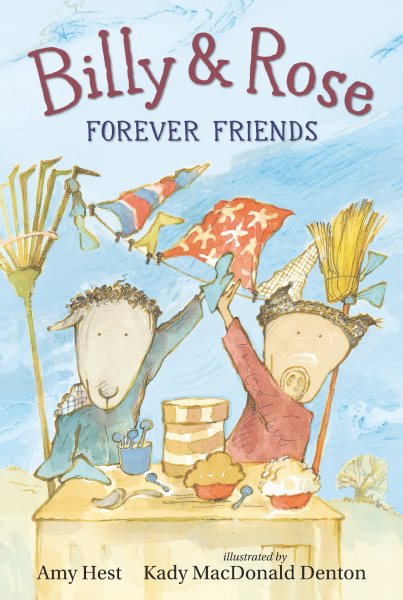
Billy & Rose: Forever Friends by Amy Hest, ill. Kady MacDonald Denton

Two best friends share four small adventures over the course of four seasons. From selling ice cream in the snow to practicing cello with their chores, Billy and Rose may sometimes fight but they are always best friends forever. Any time you see a book illustrated by Kady MacDonald Denton you grab, I mean GRAB, that title as quickly as you can. Denton’s a Canadian illustrator who produces a book once every three years, or so, so don’t blink or you might miss it. She’s also so enormously talented that it’s hard to discuss anything else when I’m in the presence of her art, but I’ll try. But before I do, can I just point out why this cover works as well as it does? Look at Rose here. Notice that she is high fiving Billy not with her right hand, but with a left hand that is reaching across her body. And there is just something about the realism of that awkward move that makes the book look that much more appealing. Pairing Denton with Hest was a clever move too. Their styles complement one another very well, with four short, original stories this feels a little like Bink and Gollie and a little like Charlie and Mouse and a whole lot like nothing but its own original self. 

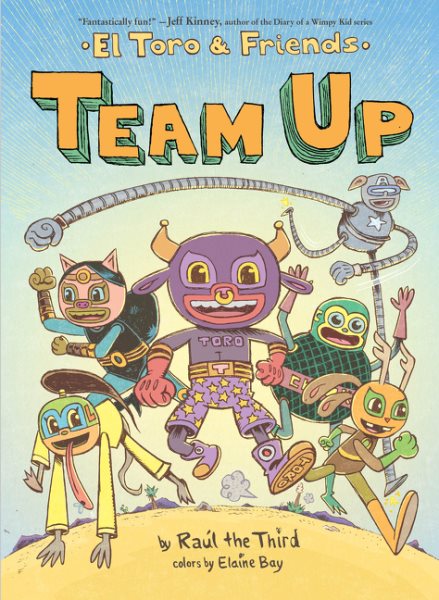
El Toro & Friends: Team Up by Raúl the Third, colors by Elaine Bay

I’ve already included one “El Toro & Friends” book on my lists this year (see: Board Books if you don’t believe me) and like any good marketers, Raúl the Third and Elaine Bay are spreading themselves throughout the different kinds of children’s books out there. Board books? Check. Picture books? Check. Before we get into early chapter fare it’s time to look at easy books as well. I rather enjoyed the amount of plot that they were able to work in with this l’il El Toro title. The characters you might have seen in other books are presented here as kids, learning wrestling moves from the great Ricky Ratón. Of course the joke of this is that Ricky is rat-sized while his students are pig, bull frog, etc. sized. Even so, none of them can beat him in single combat. How will they pass their final test if they can’t defeat him in battle? The action scenes cannot be beat and the ultimate lesson is nicely learned. Looking forward to more in this vein, yep!

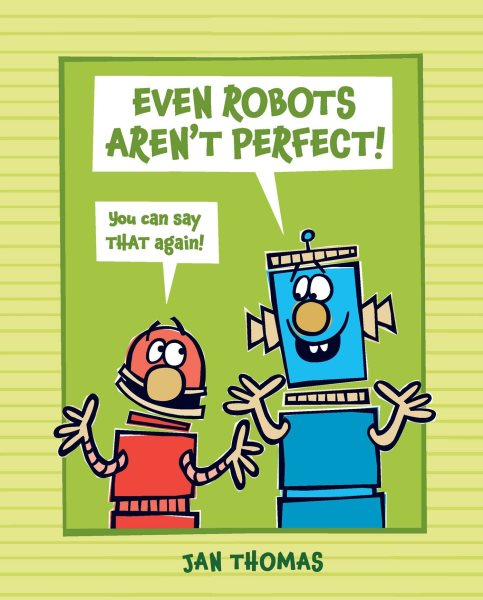
Even Robots Aren’t Perfect by Jan Thomas

Think robots never make mistakes? Think again! Join two best friends as they navigate the ins and outs of friendship and owning up to your own errors. Okay, I love Jan Thomas already, but her easy books have to be taken on a kind of case-by-case basis. I’d say that some are stronger than others. This one? Quite on the strong side. And when considering this book, I’ll tell you right now that of the three stories in this easy reader, my favorite is the second. Probably because it contains the lines “I didn’t MEAN to make you fly away!!! But sometimes we just make each other fly away…” “We DO?” It’s a goofy little exercise with jokes that land and a good payoff.

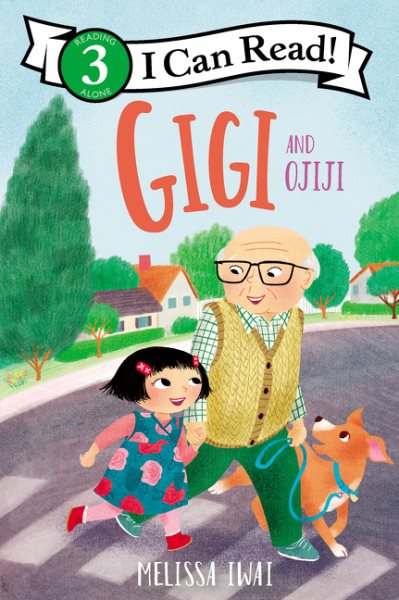
Gigi and Ojiji by Melissa Iwai

It’s so exciting! Gigi’s grandfather is coming to live with her family all the way from Japan. But when he doesn’t immediately live up to what she imagined him to be, can they ever be friends? Big emotions and complex cultural differences are explained with incredibly simple words. I know how hard it is for writers to write books this easy with such a limited word count while also attempting to tackle the big issues that Iwai, anyway, is handling with aplomb. This whole book is about expectation vs. reality. Gigi’s disappointment with her grandfather is understandable, and I thought the parental explanations made a lot of sense too. Worth your consideration.

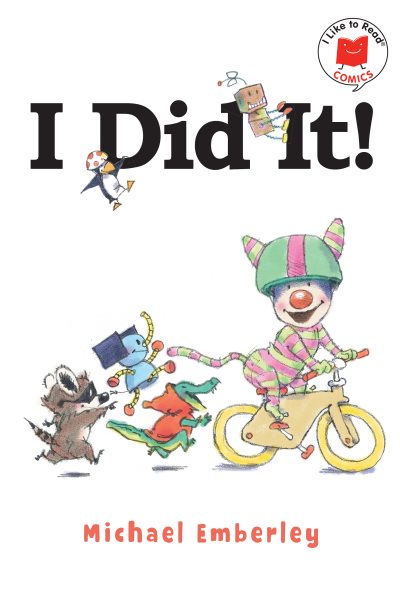
I Did It! by Michael Emberley

A lovable little creature wants to learn how to ride a bike. When it keeps falling and falling will it give up? Very easy language accompanies this ultimately triumphant tale. In many ways an easy book has to take its cues from silent filmmaking. With just a minimal number of words you must indicate whole worlds and ideas. Michael Emberley is a legacy children’s book creator, being the son of Ed Emberley and all, but he’s always utilized his own unique style. Here he creates just the most charming little world, where robots, toys, and kitten-like critters in pajamas live their own lives. The reviews, and even the book’s publication copy itself, refuse to identify what the protagonist of this story even is (relying instead on the term “creature”). What we do know is that it wants to ride a bike but it’s going to take a lot of falls and failures before its eventual success. Love that simple language. Love that it’s an easy book that is actually full of easy words (and doesn’t try to cheat with an extraordinarily long one here and there). Just love it in general.

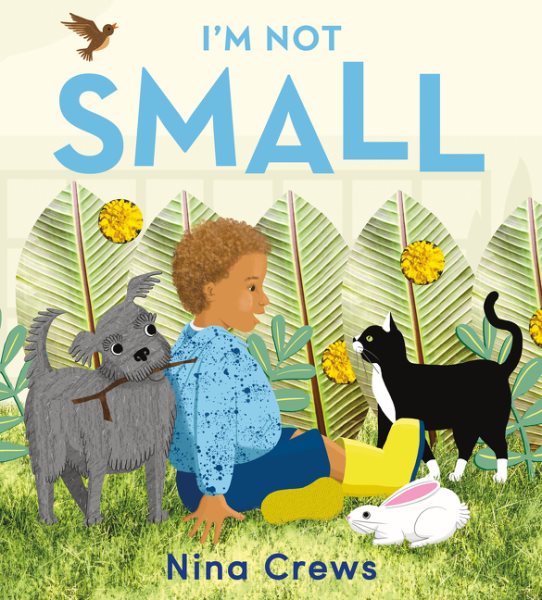
I’m Not Small by Nina Crews

A boy steps into his big backyard and notices what is both bigger and smaller than him. Crisp graphics and concise language explain the concept big and small in a very lovely way. I am on board with putting this picture book in this easy book category. This is another take on the little/big concept for children, but it’s also subtly giving kids the impetus to declare that in a world where they are small, there are still some places where they tower. I would never have known that this was digital, since I’m so used to Ms. Crews collaging her photographic work. Definitely a strong easy title contender and it even manages to do a bit of an emotional punch with those last two lines. Watch out, Geisel committee!

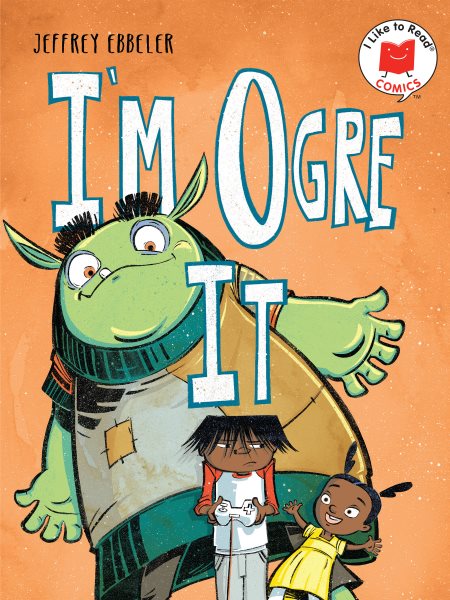
I’m Ogre It by Jeffrey Ebbeler

Boy. Jeffrey Ebbeler got the assignment from Holiday House to write one of their “I Like to Read” books and decided to take a big old swing. And you know what kinds of books I like? I like big swing books, baby. And it doesn’t get much bigger or swingier than an easy book with high fantasy ideals. The whole premise of this book is that a girl’s older brother is video game-obsessed and won’t really play with her anymore. When a family of ogres moves in next door (like ya do) she teams up with their son and the two of them come up with a game so enticing, even her brother can’t resist. It’s a kind of put-down-the-video-games message but not in a preachy way. Plus, any easy book that replicates the feel of a game with different levels is instantly interesting to me. Fun and strange in equal turns. 

It’s a Sign! by Jarrett Pumphrey and Jerome Pumphrey

When starting a club, it’s good for everyone to have a talent. But what happens if everyone has a talent for everything except naming clubs? A colorful tale with easy and funny words. What clever soul figured out that the Pumphreys would make natural easy book creators? This book is an interesting test case. I very much like the art in it, with its colorful … would you call these foxes? Let’s call them foxes. It has the requisite gag at the end, very much in keeping with the usual format of Mo’s “Elephant and Piggie Like Reading” series. It’s neat. And there is room enough in this world (and on this list) for “neat”.

Meet the Super Duper Seven by Tim Hamilton

The Super Duper Seven are here to save the day! Wait, scratch that. Hungry Kitty just ate four members. How can the team stick together when members keep, ah, disappearing? Welp, color me a convert. Have I mentioned enough times how hard it is to write easy books for kids? Let me rephrase that. How hard it is to write GOOD easy books for kids. After all, any joe schmoe can write a book. I swear I’ve seen Tim Hamilton books before but the man has really hit his stride with this title. Part of my love is probably based in how funny I find it when one character eats another. And the moment the team members yell at Hungry Kitty for eating the birds and they say, “You ate them? But they’re on the cover of our book!” I was in love. The repetition is used beautifully here and I legit found it funny. It does beautiful things with the rule of threes. Add in a satisfying ending AND simple words all the way through and you’ve got yourself a new easy reading winner.

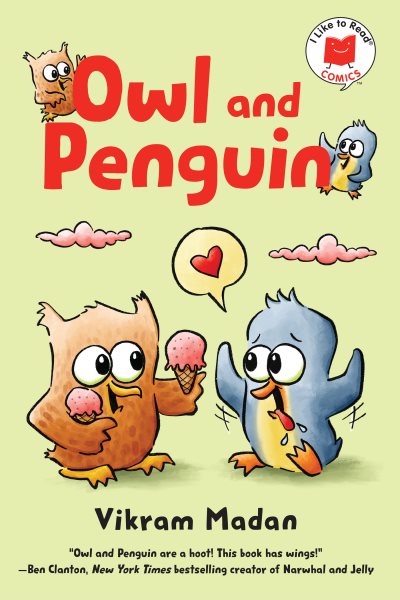
Owl and Penguin by Vikram Madan

Three little stories about two little friends. Owl and Penguin may be different but when it comes to helping one another they love each other exactly the same. Fun Fact: I’ve actually had Madan on one of my lists before when he wrote that fun poetry book A Hatful of Dragons a year or so ago. This book is a departure into deep easy reading territory which is, as I’m sure you know, incredibly difficult to do. I was gratified by the simple storylines, particularly when they went in directions I didn’t predict. The first story about the penguin continually dropping the ice cream is particularly funny. Easy’s hard and these stories are good. Worth some consideration. 

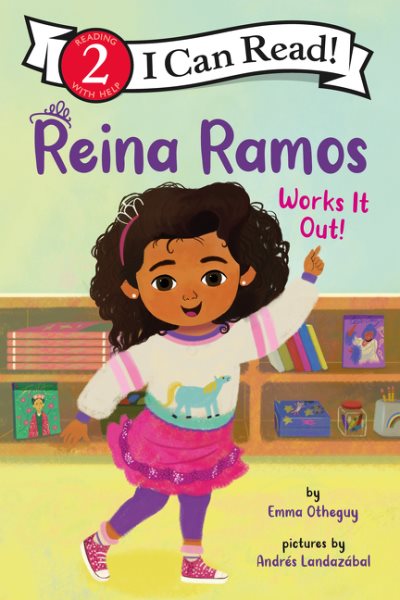
Reina Ramos Works It Out by Emma Otheguy, ill. Andrés Landazábal

Like Gigi and Ojiji, these simple little I Can Read books are really upping their game this year. I stand impressed. Most easy books don’t really bear down and tell a more complex story, in large part because of the age and reading level of the audience. But that doesn’t mean you can’t tell a good tale with ups and downs and misunderstandings and a little conflict. I like a book where my protagonist isn’t always in the right, and I get that with this Reina Ramos book. In this story the kids are doing that wax statues thing that I did when I was a kid, but haven’t seen in books for kids very often. Basically, you dress like a famous person, memorize facts about them, the whole kerschmozzle. Reina wants to be Frida Khalo but when her best friend mistakenly asks for Frida instead, Reina is seriously peeved. It has good strong conflict resolution. Simple words, but not simple ideas. 


2022 Early Chapter Books

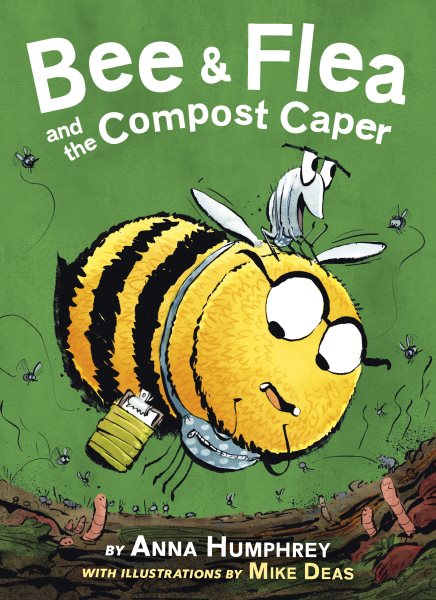
Bee and Flea and the Compost Caper by Anna Humphrey, ill. Mike Deas

Now we leap from older nonfiction books to early chapter fiction titles. Bee is bored. She wants to do more than just collect pollen all day, so when Flea hires her to join her investigation into the local compost heap, she’s on board. A magnificent deep dive (literally) into the ecosystem of compost and soil. I like it! I like how weird it is, and how beautifully it really works in the natural ecosystem of a typical compost heap works. I suppose it’s not technically to scale, but who cares? The science is interwoven seamlessly into the storyline, and while there’s probably a lot more poop in there than I’d personally prefer (which makes it ideal for today’s list), you can’t say it isn’t necessary. Love that Flea and Bee have such strong personalities right from the start too.

Bumpfizzle the Best on Planet Earth by Patricia Forde, ill. Elīna Brasliņa

The great Bumpfizzle of the Planet Plonk is on a mission to Earth so secret that not even HE knows why he’s here! Disguised as a human boy, he must deal with the daily injustices of being a kid. Hijinks definitely ensue. This is a lot of fun. It’s a great unreliable narrator story, and Bumpfizzle has this lovely slow change of heart towards the humans he’s essentially stuck with. It would be easy to think of this book as the delusions of a kid so thoroughly into aliens that he’s convinced that he is one, but by the end it’s pretty clear that he really is who he thinks he is. I was a bit worried about the fate of the cat when he initially got rid of it, but no dead cats in this book. Just some seriously pissed off ones.

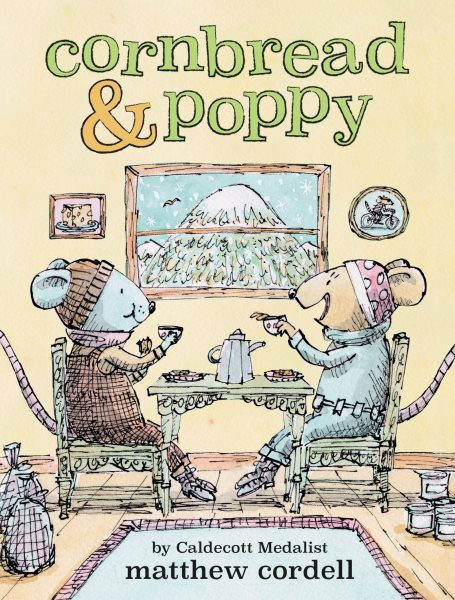
Cornbread and Poppy by Matthew Cordell

This is one of those books that really straddle the line between easy books and early chapter titles. Slightly more advanced than a Frog & Toad, this book is a marvelous kickoff to what has already proven to be a charmer of a series. It begins with your classic Grasshopper & the Ants type situation. Cornbread’s the kind of guy who stores up his food for the winter well in advance of the first frost. Poppy? Yeah, not so much. This little mouse would rather get in one last swing or one last hike before even thinking about food prep. As you might imagine, this goes disastrously when the two discover that there is no more food to be had. Or isn’t there? There’s a possibility of food up on Holler Mountain, though it has a terrifying reputation. Adventure awaits! Cordell manages a really delightful tone with this book, that pairs beautifully with the storyline. He utterly nails the ending too, which is not an easy thing to do in a book of this length. I, for one, welcome more books to this series and your kids most certainly will too!

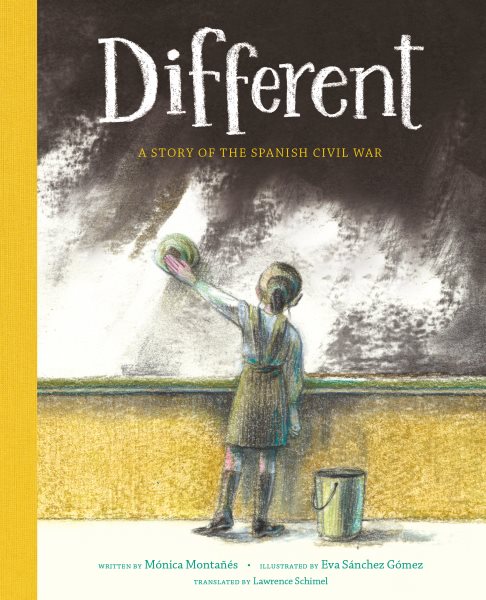
Different: A Story of the Spanish Civil War by Monica Montañés, ill. Eva Sánchez Gómez, translated by Lawrence Schimel

Apt title, I think. Some imports have entirely different lengths than American publishers are used to. Case in point, a fiction title that has the maturity of a work for 9-12 year olds but a page count seemingly ideal for early chapter books. As such, you could consider this a kind of Hi-Lo reader for older kids. The story of how the Spanish Civil War rips a family apart reads almost more like a short story in the New Yorker than a title for children, though there’s nothing inappropriate on the pages. In this tale we follow two siblings, Paco and Socorro. Paco is nine and is always hungry. Socorro is seven and never eats. When their father has to leave Spain because Franco is persecuting everyone who opposes him, they find themselves outcasts in their own country and hungry without their father’s income. The happy ending comes when the family moves to Venezuela and at last finds a place that may be strange, but offers so much food, sunshine, and family that they acclimate. Of course, I got to the end of the book and then immediately wanted to grab a book on Venezuelan history to see what might happen to them next. It’s a good story that invests you so fully in a family’s trials and tribulations that you want to keep the story going long after that last page. 

Esme’s Birthday Conga Line by Lourdes Heuer, ill. Marissa Valdez, edited by Samantha Swenson

What do you do when your grandparents forget to throw you a birthday party with cake and a pinata? Throw your own! Esme is determined to get her neighbors together for the ultimate party time. Can she pull it off? Ooo. I really and truly enjoyed this. It sort of looks like a lot of other older easy/early chapter books out there, but it has it own, strange, quirky take on things. Essentially, this is a bold, tunnel-visioned, unreliable narrator with a TON of enthusiasm and energy. There’s something very appealing about heroes that just boldly go out to solve their own problems, even if they’re entirely oblivious of their effect on other people. I love how the book allows the reader to figure out what’s going on even when Esme has no clue. The art goes a long way to carrying the humor, which is a nice touch. There’s almost a Looney Tunes feel to it too, what with the trials and tribulations that Manny, the building supervisor, has to put up with thanks to Esme (the flames are a nice touch). Two thumbs way way up! 

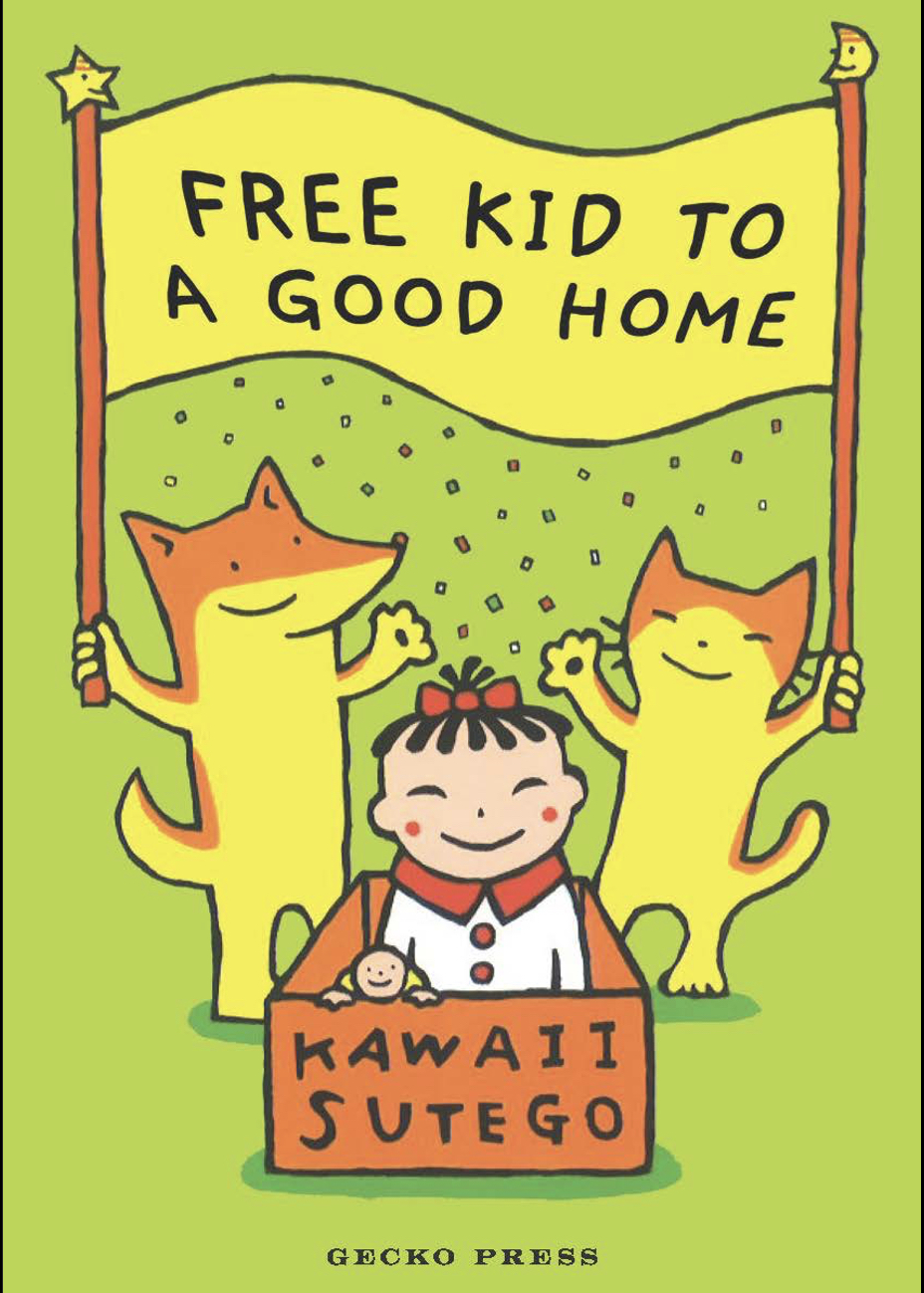
Free Kid to Good Home by Hiroshi Ito, translated by Cathy Hirano

When the new baby (a.k.a. “Potato-face”) sucks away all the parental attention, one determined little girl decides to give herself away for free to a better home. A tongue-in-cheek tale of figuring out where you really belong. This Japanese import is the kind of thing I like to see in a pile of potential easy and early chapter books (categories that this title straddles completely). At first this reminded me of that old Shel Silverstein poem “Sister for Sale” but the premise is more droll than that. It would actually work well as a picture book, come to think of it. I enjoyed its mildly sardonic feel. I do wish that it were just a LITTLE clearer that the parents at the end are her own parents. Otherwise, I’m kind of charmed by the whole enterprise.

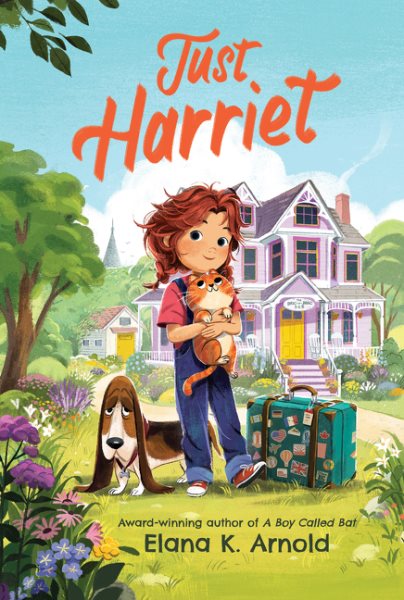
Just Harriet by Elana K. Arnold

Even if she understands why her parents are shipping her off to her grandmother’s bed and breakfast for the summer, that doesn’t mean Harriet wants to go. That is, until she stumbles on a mystery with a connection to her dad when he was just a boy. Elana K. Arnold is so interesting. She really straddles that area between older and younger chapter books. So this book falls into that nowhere’s land, between being comfortable reading on your own, but still needing shorter chapters and the occasional picture to get you through. I thought Harriet was a nicely flawed character, and she does that thing that kids do when they feel horrendously guilty about something relatively small. The mystery is actually pretty darn good, and naturally this made me YEARN for a bed and breakfast to visit on my own. Very sweet.

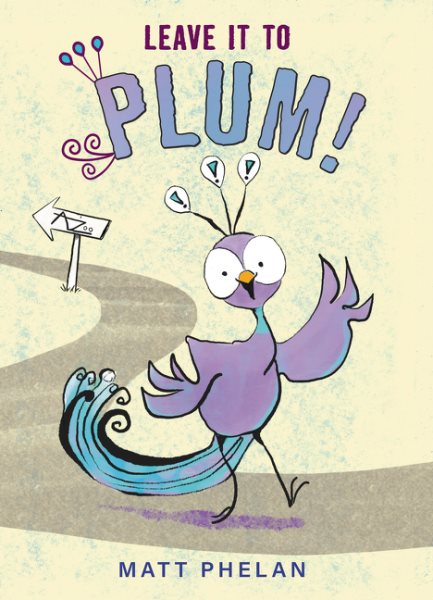
Leave It To Plum by Matt Phelan

When a small mammal with an oversized ego tries to take over the zoo, just leave it to the big-hearted peacock Plum to save the day! I consider this the book that taught me that a ningbing is carnivorous (shudder). You know, if I hadn’t walked into this knowing that Matt Phelan was the creator, I don’t necessarily think I would have recognized it immediately as one of his own. It marks a bit of a contrast from his other 2023 chaptered creation The Sheep, the Rooster and the Duck. Here you have a good-hearted peacock solving mysteries, making friends, and trying to outsmart a Brain-like (ala Pinky and the Brain) ningbing. You can almost hear it voiced by Maurice LaMarche . . .

Maddie and Mabel by Kari Allen, ill. Tatjana Mai-Wyss

Five short stories tell the tales of sisters Maddie and Mabel. Can a big sister and a little sister be friends? Sweet and smart tales with just the right amount of spice. Aww! You know, writing these kinds of books can often devolve into treacle. You gotta admire Ms. Allen’s dedication to getting this heart sans schmaltz onto the page. Plus I love the work illustrator Tatjana Mai-Wyss is putting into this. That shot of Maddie’s wide-open eyes on the final page is perfectly done. It’s not big and flashy or anything but there’s a lot to be said for a book this tight and succinct and, in just the right way, silly.

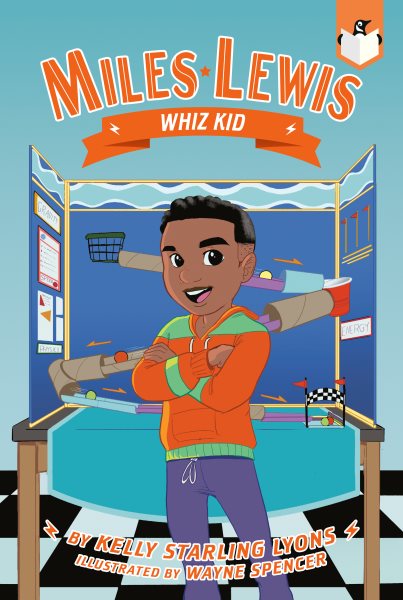
Miles Lewis: Whiz Kid by Kelly Starling Lyons, ill. Wayne Spencer

Whenever a new early chapter book series comes out in a single year and they release two titles at once, I always like to read both to see which one I like better. Now you may see that this new Miles Lewis series has labeled Whiz Kid as #2, but I would have you know that I like it better than its companion title (and technical predecessor) King of the Ice, and that’s a hill I’ll die on. Nothing against King of the Ice, mind you, but there are some big big feelings (to quote Dragon Prince) going on in Whiz Kid that eclipse the other title. You see, Miles is kind of a science guy. He’s got his eyes on making sure that his team’s science fair project going to the regional competition. Trouble is, throughout the course of this book he’s being eaten away with jealousy and self-doubt. Lyons has always been particularly good at making the basic emotional ups and downs of everyday life for third and fourth graders feel real on the page, making this particular title is a primo example of what she does best. I also appreciated how well the project does at the end (which is to say, it actually doesn’t make the topmost slot in the competition) and how that’s okay. A hard level to write for by a writer who knows what she’s doing. 

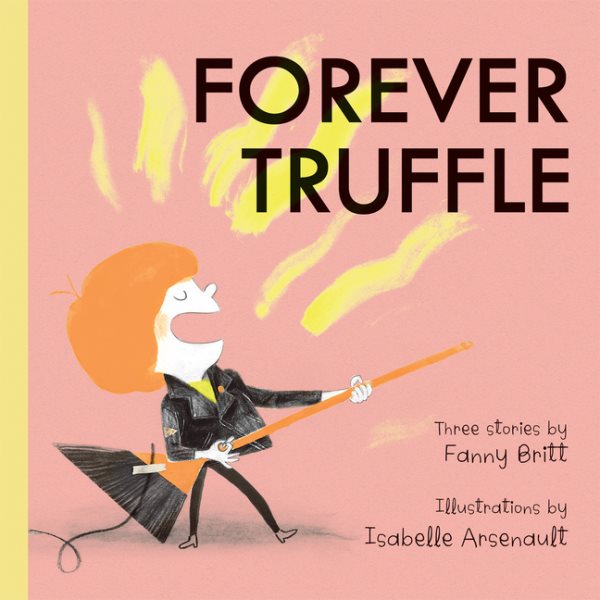
Forever Truffle: Three Stories by Fanny Britt, ill. Isabelle Arsenault, translated by Susan Ouriou

Three little stories introduce us to Truffle, a kid that wants to start a band, adores his classmate Nina, and has some pretty big questions when his great-grandmother dies. It’s a charming, engrossing trio of tales. Initially I looked this book over a couple times, trying desperately to figure out where exactly one would categorize it. Honestly, while I’m placing it in the early chapter book section, it could just as easily be placed in the picture book or even graphic novel sections and would fit just as well. Britt and Arsenault have done books together before, but this is much younger, sweeter, and more innocent than their other titles. It is also charm incarnate. Seriously, this book could teach other authors a thing or two. Truffle is wonderful, his friends are wonderful, and I even like his brother Louis of whom it says, “Now that he’s in high school, he’s into robotics, basketball and sarcasm.” Turns out, Louis was the star of a very serious YA graphic novel by this pair call, easily enough, Louis. That sort of gives this book an entirely different flavor (but only if you’ve read Louis and realize that the dad suffers from severe depression).  I just love love love this little weird book

Pets Rule: My Kingdom of Darkness by Susan Tan, ill. Wendy Tan Shiau Wei

Small dogs that think they are mighty are funny. Small dogs that think that they are evil geniuses? Funnier still. Now we’ve seen variations on this theme over the years. Why on this very list you have Leave It to Plum and its ningbing. And this year there was that film DC League of Super Pets with its hamster set on, you guessed it, world domination. Heck, even Bumpfizzle (also mentioned on this list) is along these lines. The point is that while the basic premise of this book is familiar, it’s what an author does with that trope that’s more important. Here we have a chihuahua bound for badness, but stymied by a couple problems. 1: A loving newly adopted family (particularly the girl child). 2: Friendly fellow pets. 3: A bully squirrel with a gang who may, in fact, be more evil than he is. The book turns, as so many baddies-turned-good tales do these days, into a spy caper eventually. It also has a killer ending involving a poodle that really, truly, and seriously makes me want to read the next book in the series.

Wednesday and Woof: Catastrophe by Sherri Winston, ill. Gladys Jose

When an opera singer’s beloved cat goes missing, never fear, detective Wednesday and her service dog Woof are here! And what’s more, Wednesday won’t let having juvenile arthritis slow her down. A pretty darn classic young mystery story, that’s for sure. Winston works Wednesday’s juvenile arthritis into the story in a careful balancing act, where you can never forget that she has it but, as the character herself is quick to tell you, the true focus is on the mystery itself. I like the extra added element of the overprotective dad who’s acting the way he is because Wednesday’s still a little new to handling her limits. It hits a lot of familiar beats but that’s not a knock. And I like the small encouragements for new readers that show up at the end of each chapter. A book that helps to keep you going, just like Wednesday does.


Want to see other lists? Stay tuned for the rest this month!

December 1 – Great Board Books

December 2 – Picture Book Readalouds

December 3 – Simple Picture Book Texts

December 4 – Transcendent Holiday Picture Books

December 5 – Rhyming Picture Books

December 6 – Funny Picture Books

December 7 – CaldeNotts

December 8 – Picture Book Reprints

December 9 – Math Books for Kids

December 10 – Gross Books

December 11 – Books with a Message

December 12 – Fabulous Photography

December 13 – Translated Picture Books

December 14 – Fairy Tales / Folktales / Religious Tales

December 15 – Wordless Picture Books

December 16 – Poetry Books

December 17 – Unconventional Children’s Books

December 18 – Easy Books & Early Chapter Books

December 19 – Comics & Graphic Novels

December 20 – Older Funny Books

December 21 – Science Fiction Books

December 22 – Fantasy Books

December 23 – Informational Fiction

December 24 – American History

December 25 – Science & Nature Books

December 26 – Unique Biographies

December 27 – Nonfiction Picture Books

December 28 – Nonfiction Books for Older Readers

December 29 – Best Audiobooks for Kids

December 30 – Middle Grade Novels

December 31 – Picture Books

Filed Under: 31 Days 31 Lists, Best Books, Best Books of 2022 Tagged With: 31 days 31 lists, Best Books of 2022, early chapter books, easy books

31 Days, 31 Lists: 2022 Unconventional Children’s Books

December 17, 2022 by Betsy Bird

Recently the internet was all ah-flutter at an AI-created picture praising (you guessed it) AI created products. It was, in the broadest sense of the term, an unconventional children’s book. That kind of schlock, however, will not stand. I prefer my children’s books completely different. Out there. Original. One-of-a-kind. So today, we salute the creators and talents that went into making books that are just a little bit (or, in some cases, a LOT) different. And no, they’re not all European (though, to be honest, quite a few are).

As ever, please check out Travis Jonker’s The Most Astonishingly Unconventional Children’s Books of 2022. We see different books (I still haven’t been able to get my hands on a copy of Typo and Skim), but the love is there just the same.

Curious about other unconventional titles? Then check out these previous lists:

  • 2021
  • 2020
  • 2019
  • 2018
  • 2017
  • 2016

2022 Unconventional Children’s Books

Air Miles by John Burningham and Bill Salaman, ill. Helen Oxenbury

There is no category on any of my lists that this book slots into neatly. How do you categorize a book done in loving ode to your spouse who passed away? This is probably the neatest example I’ve seen this year of finishing a work for a loved one, keeping it in their spirit, and making it an honestly good picture book in and of itself. Without any context at all, you’d probably read this and figure that it was a good book to hand to a child that has an elderly pet die. It is, but it’s a lot more than that. You see, John Burningham (you know him from Mr. Gumpy’s Outing, amongst many many other titles) was married to Helen Oxenbury. In terms of picture book creators, that’s practically royalty. John wrote a picture book years ago called Motor Miles, about their “much-loved but very difficult Jack Russell”. John had intended to write a follow up called Air Miles, but grew too ill to finish it and asked Helen to do it for him. So when John passed, Helen turned to his friend Bill Salaman and asked him to write the story from what he remembered John telling him about it. The end result is as loving an ode to the original Miles as it is to John himself. In her note at the beginning Helen writes as well that “Three of John’s illustrations are also included in the book, and we have used his thumbnail sketches for the endpapers.” Loving and gentle, you don’t need to be a dog lover to enjoy this one.

The Bird Coat by Inger Marie Kjølstadmyr, ill. Øyvind Torseter, translated by Kari Dickson

The danger of creating any kind of list of “unconventional” titles is the question “Unconventional by what standards?” American? Undoubtedly. Americans, as a rule, are desperately uninterested in whatever it is that’s going on in the rest of the world. And even the most open-minded you’ll meet will hem and haw when confronted with picture books from other countries that produce art that feels “odd” to us. This Norwegian import is just the loveliest of examples. The author herself has written a rather fascinating two-page Author’s Note at the end in which she essentially justifies writing a picture book where the protagonist of the story tries something big and bold and dies as a result. She writes, “In this story, there is no place for sentimentality, depression, or darkness, even though death arrives. In this story, life goes on.” There’s something so stirring about that. The tale begins with a boy getting a haircut, remarking to his barber on a portrait of a long-nosed gentleman. Who was he? The barber then launches into the story of Pierre the tailor, who harbored a dream of flying from the Eiffel Tower. It’s such an interesting fable, cut into periodically by the barber trying to get a detail here or there just right. There’s not much of a moral here. Instead, it just feels like a glimpse into another person’s mind, if only for a second. Slot it into the category of picture books where the protagonist dies, and that’s okay.

Blaze and the Castle Cake for Bertha Daye by Claude Ponti, translated by Alyson Waters and Margot Kerlidou

Claude Ponti doesn’t care what you think a picture book should be. Claude Ponti is going to make his own dang, wackadoodle, weirdo, wild, crazed, chick-infused, patisserie-injected book and devil take the hindmost! I mean, I’ve always loved him. My Valley? That book was big and epic and strange and  . . . cozy? This book doesn’t really attempt to replicate that coziness but it sure does work by its own internal logic. The plot, such as it is, follows a group of chicks that are working hard to gather the ingredients to make the world’s largest, most extravagant birthday cake for their friend Bertha Daye. Do not be fooled into believing that Bertha is in any way important to this story. She is not. The chicks then proceed, tiny anuses present on every page, to gather and construct a cake that will make you seriously salivate when the chocolate starts flowing. The true reason to find the book, of course, is the party scene. I don’t know how copyright laws work, exactly. Whatever I thought was illegal is clearly not the case, because Ponti takes this wild joy in presenting everyone from Betty Boop and Superman to Yoda, Maggie Simpson, and (perhaps most fascinating of all) the three chefs from Maurice Sendak’s In the Night Kitchen. If you like books with gigantic delicious French pastries, boy oh boy do I have a book for you!

Boobies by Nancy Vo

Remember that board book from a couple years ago What Does Baby Want? by Tupera Tupera? If you ever want to restore your faith in humanity, check out the reviews on Amazon which, as of this writing, are almost universally positive. That book dared to break the taboo of women’s breast in children’s literature, possibly because it showed them as practical tools for feeding infants. Boobies by Nancy Vo is for an older crowd and has a good strong sense of humor. After all, if you cannot find the funny in a blue-footed booby wearing a snazzy summer hat and a bikini top, we may have to rethink our friendship here. It’s a Canadian creation this book, which probably explains a lot. Chock full of fascinating breast-related facts, this is part of the ever growing trend of helping kids (and, quite frankly, adults) be comfortable with all the different kinds of bodies out there. One stop shopping for all things booby related.

The Curiosities by Zana Fraillon, ill. Phil Lesnie

When the Curiosities choose Miro as their nesting space they give him the ability to sense such wonderful things, but sometimes their presence becomes too much to handle. A celebration of neurodiversity in a Filipino space. On a first read, and without any context at all, I knew right away that this book was smarter than I was. It has a very clear sense of what it’s talking about, but the metaphor is left WIDE open to interpretation. Once you read the backmatter, of course, all is much clearer. But I was so interested in how much of a true collaboration the project was. Fraillon approached this as a way of talking about her child’s Tourette’s syndrome. Then Lesnie found direct links to Filipino culture, the aswang, and the Babaylan. The end product just feels so natural. Like it was a book that was always meant to be. Highly recommended.

Days Like This by Oriane Smith, ill. Alice Gravier, translated by Luba Markovskaia

Depending on the age of the child reading this book, I suspect that there will be two entirely different ways of reading this. For the younger kids, one way will be with mild befuddlement. You see, the book is one text, told twice, one on the left page, and one on the right. And the points of view are different. One is higher than the other. One, in fact, seems to come from a larger creature than the other. As you go through it, you never quite know whose p.o.v. you’re seeing precisely, until you get to the big reveal at the end. That reveal will act as a kind of revelation for the youngers. For the older kids, they’ll catch on more quickly. They may even start to debate what the smaller creature might be. It seems to be in the trees a lot. It leaves significant footprints at one point. The meticulous line drawings are marvelously done, and it’s so much fun to compare one side to another. I was also inordinately pleased with a final Authors’ Note that admits that artistic liberties were taken with the squirrel’s vision. “Factually speaking, squirrels have dichromatic vision, which means they can only make out certain colors.” This fact was elided for this book, but I very much appreciate that they noted it at all. A strange, wonderful telling.

Gotcha! A Funny Fairy Tale Hide-and-Seek by Clotilde Perrin, translated by Daniel Hahn

There is a quote at the beginning of this book. “Perhaps all the dragons in our lives are princesses who are only waiting to see us act, just once, with beauty and courage” – Rainer Maria Rilke, Letters to a Young Poet. Drop the mic, Perrin’s done. If you’ve ever seen a Clotilde Perrin book on American shores then you know that it’s a bit of a wild ride. First off, this book clocks in at a marvelous 15” tall and, at least in this case, contain 40+ flaps. Like her previous title Inside the Villains, you’re playing with familiar fairytale tropes as you try to hide from an array of monsters. Translator Daniel Hahn gets extra points for coming up with terms like “frightful fur and feculent feet.” There’s also so much to find in the corners and crannies that this book is guaranteed to last you a long, long time. Also, there is a monster’s butt on the back of the book, and it’s adorable. Who are you to say no to a cute monster butt?

How to Eat a Book by Mrs. & Mr. Macleod

Ever wondered what it would have been like if Shel Silverstein had played around with layered papers and papercuttings? Me neither . . . until I read this book, which is so clearly one of his successors (in looks and tone alike!). I mean, I urge you to look at the endpapers alone and try to resist. Such a sense of scale! Of three-dimensionality! And then you get to the plot. So there are three Gunions, Sheila, Gerald, and Geraldine. Each one of them is eaten by a different book and, in doing so, all three have completely different reactions to the experience. First, there’s Sheila who’s book leads her towards discoveries. Gerald likes being lost, “and loved being found.” And Geraldine . . . yeah, she’s the wild child. The moral of the story? “Strange it is, strange but true, the way to eat a book, is to let the book eat you!” Classic weirdo workings going on here. From the writing to the images to the whole eating/being eaten concept. In short, a heckuva lot of fun. Highly recommended for anyone into creative book illustration and, for that matter, writing.

In the Neighborhood by Rocio Bonilla, translated by Maya Faye Lethem

As I mentioned in a publisher preview earlier this year, this is not Ferrada’s only publication here in the States in 2022. And that is a good thing. As far as I’m concerned, the more María José Ferrada we see on our shelves, the better. Ferrada hails from Chile and you may remember her best from her 2021 publication niños: Poems for the Lost Children of Chile. My Neighborhood is a very different vibe, focusing on a single older woman during the course of a single day. We follow Ms. Marta. She lives on her own. She is older, and she is completely independent. From the photos on her wall we can tell that she’s had a full life, but she isn’t a grandmother or anything (and finding a picture book about a self-satisfied older woman who isn’t a grandma is like finding a needle in a haystack sometimes). She has a tattoo. She has a framed photo of her friends playing cards. Really, the whole book is this marvelous mix of photos and illustration, all done at the hand of the talented Spanish artist Ana Penyas. The last line sums it all up for me: “By now she knows: lives, like socks, are elastic.”

Leviathan (Adventure Game Comics #1) by Jason Shiga

The choices are yours but the answers aren’t simple. Can you crack the code of the Leviathan and the wand that keeps it at bay? Hint: Think outside the box. Oh, Jason Shiga, you mad genius, you. As someone who was head-over-heels crazy about his other book for kids Meanwhile, I’ve been waiting for him to do something else for kids for years. He hasn’t quite put the same amount of energy into this book, but that doesn’t mean it won’t muck with your brain waves a little. It’s one of those pick-your-own-path stories, and so my son and I gamely went along with it. It took us a little while, but we finally cracked the secret of it. If you want to win the book you have to listen VERY carefully to what Kanoxx the sorcerer is saying to you. Ultimately, we won, but in doing so discovered that this is, without a doubt, one of the most subversive bits of messaging we’ve seen in a comic for kids in a long time. I’m so proud. Wouldn’t have it any other way.

My Uncle Is Coming Tomorrow / Mañana viene mi tío by Sabastián Santana Carmargo, translated by Elisa Amado

I was at the ALA Convention in D.C. this past summer when I first saw this tiny book prominently displayed in the Greystone booth. It was so small. So black and white. I was just going to skip on by when a staff member pulled it out and insisted that I give it a look. Camargo was born in Argentina and this book is dedicated to the disappeared from every nation. In that way it’s not too dissimilar to Niños: Poems for the Lost Children of Chile by María José Ferrada. Simpler, though. In this book a child is waiting for their uncle, who will be living with them. The child, just the barest outline of a person, which you can see on the cover, sits on a stool to wait. As you turn the pages they keep saying all the things that they’ll do together. However, it becomes clear that a great deal of time is passing. The child becomes a teen becomes an adult. The desires of what to do with the uncle change over time depending on the person’s age. The book really gives you a quick jolt of understanding of what it is to never see the person you’re waiting for again. A simplification but an effective one.

Myra and the Drawing Drama by Rosemary Rivera, ill. Mario J. Menjivar

Behold! A book that’s so strange and interesting that I have difficulty parsing it in my head. Essentially, it’s a picture book about a culture that prizes adult panic over childhood creativity. Based on an incident that happened to Rosemary when she was a kid, the book follows a kooky kid who creates a picture that she thinks is marvelous. It also happens to freak out every adult that comes in contact with it. And let me tell you, when you get to that moment where you see the art for yourself, you’ll have this amazing moment of disconnect. The kid part of you will suddenly wrestle with the adult. I’ve never encountered anything quite like it in a picture book before. Utterly unique.

One & Everything by Sam Winston

When the world was full of stories things were lovely. Then came along a story calling itself The One and it started eating all the others. A fable about disappearing languages and the stories we have to save. Actually, I really really liked this book. Even before I got to the backmatter (which is jaw-dropping) I liked the storyline. Understand first, though, that my expectations were probably pretty low. I mean, fables with shapes aren’t really my picture book bag. So imagine my surprise when I found that this story about words and language and how some languages just dominate others, really hit home. I mean, this is basically about colonialism, but in the gentlest way possible. But what I really loved was how well Mr. Winston just stuck that ending. I did not know where this whole thing was going, and I loved the solution. And then I saw the backmatter. The fact that he has worked in fifty different “Scripts” (which is to say, written languages) dead and alive is remarkable. But just looking at the two page spread of everything from Rejang to Myanmar to Cherokee is jaw-dropping. Then you read about how he included specific scripts into different emotional moments of the story, like the Phaistos Disk as the old story. Oh man. This book is so cool. You have to check it out.

The Queen in the Cave by Júlia Sardà

One day Franca decides that she is going to plunge into the unknown to seek a marvelous queen. When her sisters come along, what will they find, and will they ever get back? A hypnotic, cacophony of chaos. I like giving you books that’ll wake you up a bit. We’ve seen a lot of children’s books that ponder the end of childhood, like Peter Pan or that really strange Jerry Spinelli book Hokey Pokey. I don’t remember ever seeing a book that discusses how the younger siblings feel when their older sibling starts to pull away from them and grow apart. This book is essentially one great big metaphor for that, but done in Sardà’s inimitable (which is to say, wackadoodle) style. I really liked it, in a strange way. From a kid’s point of view, this is kind of what happens when adolescence calls your sister away. A lot to chew on here.

So Much Snow by Hyunmin Park 

Ah, the vertical picture book. Every year we get one here and one there, but ultimately they’re risks that a lot of publishers don’t want to make. That’s why, sometimes, you need an import. This book (which is not to be mistaken for a book with the same name that came out this year by Kristen Schroeder and Sarah Jacoby) received a Bologna Ragazzi Award Special Mention last year, and I can see why. The title is actually cut out of the cover, revealing the falling flakes behind. A ton of snow has come from the sky and our narrator tells us that they’ve never seen so much. Right from the start the reader is encouraged to hold the book vertically, and the art really makes use of that by showing a delightfully steep incline through what looks to be a mountain of snow. At this point, Park starts to use negative space to show the characters creating a giant . . . something. The reveal of what that something is (and the sheer scale of it!) is worth the price of admission alone. There’s even a gatefold!! If you’ve the first snowy day of the season and you want to do a memorable storytime that’ll knock the socks off of the attending preschoolers, this is the book you’ll want to grab. 

Supposing… by Alastair Reid, ill. JooHee Yoon

Sometimes you just gotta sit on a book for a while and read it in the right mood. The first time I read this Reid/Yoon collaboration I was in entirely the wrong headspace. I think I was hoping for something rote that could tell me a single story. I wasn’t really prepared for this oddly charming collection of suppositions. This book reads like something Ruth Krauss would have come up with, if she’d been born in 2001 rather than 1901. Each section includes a wild idea, always starting with the word “Supposing”. “Supposing there were 12 of me…”, “Supposing I appeared on television answering questions and there was one question which nobody could answer and although I knew the answer instead of saying it I just burped…”, “Supposing I went bald.” Naturally these sound like nothing so much as writing prompts to me, and I suspect an enterprising creative writing coach could have a field day with this book. But it’s also a perfect title to just set young minds loose. JooHee Yoon must have been so grateful to get this manuscript. It is, in many ways, an illustrator’s dream job, and a mighty wacko result. Hard not to love this one. Just make sure your mind’s in the right space.

The Upside Down Hat by Stephen Barr, ill. Gracey Zhang

Chronicle calls this book a fable. I call it the picture book that made me sit and stare into space for a long time after finishing it. Truth be told, I’m still staring into space. I literally went right back to the beginning of the book again once I was done to see if there was something I’d missed along the way, I was so thrown by what I read. Essentially, this is not a realistic story, but tell that to my brain. It desperately wants this book to follow old established rules of picture book storytelling, a request that Barr and Zhang adamantly refuse. In this tale a boy wakes up with nothing but a hat. Everything else he ever had is gone. As he searches, the hat becomes his lifeline, providing water to drink, food to eat, shade, and more. Then he sleeps, has a dream in which he “turned the mountain upside down” (extra points to Zhang for figuring out how to illustrate THAT one!) and finds everything he lost. Only when he wakes, his hat is gone. And what’s inside of it when he finds it . . . well, you’ll have to see for yourself. I tell you, I don’t quite understand this book but I keep. Coming. Back. There’s something hypnotic about it and, in spite of the fact that the kid is always alone, oddly comforting. Not a book for all children but for the right ones, there’s nothing else out there like this.

The Wolf Suit by Sid Sharp

I like a book so weird I don’t know where to put it. I like a book so weird it should live in its own little section of the library or bookstore by itself. Maybe someone could build it a tiny apartment out of cardboard underneath a sign that reads This Book Is Too Weird To Live Anywhere Else. Because where exactly do you put this title? In the graphic novels and comics? In the early chapter books? Me, I put it here on this list and I regret nothing. The story is just so strange and charming that I couldn’t help but adore it. Our star is Bellwether Riggwelter (are you not entertained?) a sheep that lives on his own and is perfectly happy about that. Unfortunately, Bellwether is totally terrified of wolves, and with good reason being a sheep and all. One day he decides to go out into the woods to pick some berries but a close encounter with a wolf scares him back home. Once there, he gets the clever idea to create a wolf suit. Now he can get out and about. Trouble is, when he runs into “other” wolves they invite him out that night. Will his secret be revealed? Did I see the twist in this story coming? I did not. Should I have? Probably. But as far as I’m concerned this is a book with a moral that refuses to moralize. It just wants to be weird and wild. I am okay with that. 

Yellow Dog Blues by Alice Duncan, ill. Chris Raschka

Where did Yellow Dog go? Did he really hit Highway 61 and keep on running? An ode to the Blues, music, and dogs with stars in their eyes everywhere. Visually, this may be some of Chris Rashka’s best work. For whatever reason he’s decided that the best way to illustrate this book was to do so with paint on fabric and embroidery. The end result is that it definitely has an old-fashioned feel. I can tell why he was attracted to the text too since it’s all about historical markers that are directly tied into the Blues. Now that’s all well and good from a grown-up’s perspective, but how would a kid like this book? Essentially it’s about a dog that runs away and the attempts made to find it. But the dog is never recovered, hence the title. Still, you keep coming back to this story and its storytelling. It’s like nothing else I’ve seen in a long long while.


Want to see other lists? Stay tuned for the rest this month!

December 1 – Great Board Books

December 2 – Picture Book Readalouds

December 3 – Simple Picture Book Texts

December 4 – Transcendent Holiday Picture Books

December 5 – Rhyming Picture Books

December 6 – Funny Picture Books

December 7 – CaldeNotts

December 8 – Picture Book Reprints

December 9 – Math Books for Kids

December 10 – Gross Books

December 11 – Books with a Message

December 12 – Fabulous Photography

December 13 – Translated Picture Books

December 14 – Fairy Tales / Folktales / Religious Tales

December 15 – Wordless Picture Books

December 16 – Poetry Books

December 17 – Unconventional Children’s Books

December 18 – Easy Books & Early Chapter Books

December 19 – Comics & Graphic Novels

December 20 – Older Funny Books

December 21 – Science Fiction Books

December 22 – Fantasy Books

December 23 – Informational Fiction

December 24 – American History

December 25 – Science & Nature Books

December 26 – Unique Biographies

December 27 – Nonfiction Picture Books

December 28 – Nonfiction Books for Older Readers

December 29 – Best Audiobooks for Kids

December 30 – Middle Grade Novels

December 31 – Picture Books

Filed Under: 31 Days 31 Lists, Best Books, Best Books of 2022 Tagged With: 31 days 31 lists, Best Books of 2022, unconventional children's books

31 Days, 31 Lists: 2022 Poetry Books for Kids

December 16, 2022 by Betsy Bird

It always catches me a bit by surprise how soon the poetry books appear on these 31 Days, 31 Lists. While we still have tomorrow’s “Unconventional Books” to go through, poetry is where we really begin to shift from the picture books to the older titles. All too soon we’ll be discussing all kinds of books for the 9-12 year old set. And, truth be told, some of them are on today’s list. Poetry knows no age borders. At the same time, I was delighted by some of the offerings this year. There are books on today’s list that I thoroughly believe should win Newberys and Caldecotts. And if you read them too, you’ll see why . . .

Interested in previous years’ poetry? Then check out these beauties:

  • 2021
  • 2020
  • 2019
  • 2018
  • 2017
  • 2016

2022 Poetry Books for Kids

At the Pond by David Elliott, ill. Amy Schimler-Safford

A whole pond wakes up and goes about its day. From beavers to water striders, dive deep into the ecosystem with luscious art to match. I feel a little bad starting anything off by saying, “Don’t discount this one on sight!” but I feel that caveat has to be stated. After all, this looks like yet another pond poetry book. They’re not exactly uncommon. That said, Elliott is a particularly clever poet, and here’s my favorite example: “Polly! Polly! Pollywog! / Golly! Golly! Golly! Frog!” How has no one ever written that before? Once that poem broke down my defenses I was ready to acknowledge and appreciate this ecosystem-heavy telling of what you can find in this particular landscape. The art is naturally gorgeous but the design is what stood out for me. Consider it with a practiced eye.

Book of Questions / Libro de Las Preguntas by Pablo Neruda, ill. Paloma Valdivia, translated by Sara Lissa Paulson

Neruda’s last great work of poetry is reimagined for kids in this sumptuous collection. 70 questions of the original 320 are presented thematically to kids, and the results are ridiculous thoughtful, and often unanswerable. Oo. Considering how much time and effort and work it often takes to find decent children’s poetry in a year, I was just blown away when I was sent this book at the beginning of the year. It’s so clever in its construction. Neurda’s Book of Questions is taken and the questions are selected, split up, and placed together thematically. It’s a smart way of presenting them, and the result really is more poetic than anything else. Some are philosophical, some practical, and all will make kids think. Meanwhile, it’s on today’s list because artist Paloma Valdivia, who is Chilean like Neruda was, just goes to town with the art. My particular favorite image came when Valdivia interpreted rice like teeth. Be careful not to miss any of the marvelous gatefolds, which are almost hidden throughout the book. I often had to go back and make certain that I wasn’t missing anything. Extra points for the fact that the book is bilingual too. This is a beauty, truly.

Build a House by Rhiannon Giddens, ill. Monica Mikai

Written to commemorate the 155th anniversary of Juneteenth, this song tells the tale of sorrow and joy, pain and triumph, and always with the child reader in mind. A marvelously honest look at how to sing when the world has left you nothing at all. Let the record show that I was into this book even before I watched the video of Giddens performing it with Yo-Yo Ma. As a general rule I don’t like it when celebrities write children’s books. Turns out, I don’t mind it as much as I thought I did. I just don’t like it when they do a crap job. Ms. Giddens, as it happens, has adapted this song perfectly to the 40-page picture book format. I think what it does so perfectly is acknowledge pain and trauma without giving it power. This book is ultimately hopeful but you see the darkness at its edges. Nothing in this storyline or this art (created by the accomplished Monica Mikai) comes across as simplistic. This is a marvelously nuanced adaptation. Whether you put it in the picture book section or the poetry section, it deserves to be on your list.

Listen to it, performed by both Ms. Giddens and Yo-Yo Ma here:

Counting in Dog Years and Other Sassy Math Poems by Betsy Franco, ill. Priscilla Tey

Am I on board with sassy math poems? Yes, I am on board with sassy math poems. The question is how sassy are we talking here? On a scale of one to ten, with ten being the most sassy and one being only mildly sassy, where would this particular book fall? Squarely at five. We’re talking medium level sass. In terms of the poetry and the math itself, though, much higher! While on the Mathical Book Prize committee I’ve always been astounded by math books for children that are afraid of their own math. Franco doesn’t give me that impression. Poems like “How Old Am I?”, for example, go through fractions as they relate to age and birthdays, which I found pretty darn impressive. Meanwhile you’ve these exceedingly delightful gouache pieces of art from Priscilla Tey that can take that poem about fractions and turn it into this rather beautifully rendered side-view of a person’s head as house (trust me, it makes sense when you’re looking at it). The math is strong with this one. The poetry? Strong too!

Free At Last: A Juneteenth Poem by Sojourner Kincaid Rolle, ill. Alex Bostic

The official poem of Juneteenth is brought to life in a stunning adaption for children. June 19, 1865 is truly celebrated in a poem that will last through the ages. Full disclosure, I interviewed Mr. Bostic as part of SLJ’s last Day of Dialog. And what I learned from our talk was the degree to which he meticulously makes sure that the clothing of his subjects is authentic to the time period. He’s part of this larger trend of editors tapping professional Black painters to start illustrating picture books. The history of this poem (and Sojourner Rolle’s own role in the creation of the Juneteenth holiday) is fascinating for adults in the backmatter, but the poem itself, for kids, is good and strong. A neat adaptation to the picture book format worth considering.

Marshmallow Clouds: Two Poets at Play Among Figures of Speech by Ted Kooser and Connie Wanek, ill. Richard Jones

Thirty poems complemented with evocative paints play with images and metaphors, constructing whole new ways to encounter the world. First off, I’m a bit peeved that this book can’t win a Caldecott since its illustrator is inconveniently English. You wouldn’t be able to tell from the cover but the art in this book consists of a series of absolute stunners. I would tentatively propose that the Newbery committee consider this too, though, since Kooser and Wanek have constructed some of the best poetry for kids that you’re going to read in years. My favorite is probably “The World Without Me” which postulates about the mirror world you see in puddles just after the rain has stopped and then saves a worm from drowning. “In the world without me, the worm died. But in this world, I saved the worm.” One of my favorites of 2022.

On the Move: Home Is Where You Find It by Michael Rosen, ill. Quentin Blake

In 49 poems Michael Rosen tells the story of his family, lost to the Holocaust. He also ties their tale into the plight of migrants worldwide today. A book that puts our current world in context for kids. It’s a collection of poems all put together. It’s a memoir. It’s history. It’s not a single solitary type of book which, naturally, makes it all the more difficult to place. Even so, this may be the best thing Michael Rosen has put together in years and years (with apologies to this year’s Sticky McStick). I’ve seen too few books effectively tie the tide of migrants not simply to migrants in the past, but also to our own personal histories. It took me a little while to get into, but once you down this book it makes a huge impact. I keep thinking and thinking about the poem about the woman who thought she was walking around with diamonds in her heels, only to find out years later that it was just glass. 

Out of This World: Star-Studded Haiku by Sally M. Walker, ill. Matthew Trueman

“hugged by gravity / eight planets bask in sunlight / solar family.” Gentle haikus introduce young readers to the cosmos itself while accompanying art makes the concepts palpable and real.  It can be hard to resist space haiku combined with eye-popping mixed media art. Walker’s done haiku collections before (Earth Verse: Haiku from the Ground Up) but I like this particular change of pace. It starts with what I would consider the most easily spotted constellation in the sky, Orion, jumps to the Galileo and Hubble telescopes, and after that we’re off into the stars. Trueman gets to do everything from the Big Bang to Jupiter’s red eye in this book, and I just found it a lot of fun. Copious backmatter tells more (I had no idea that Ultima Thule looked like a space snowman) but you could easily use this book to introduce a lot of these concepts to young readers who are new to our solar system and beyond.

The Real Dada Mother Goose: A Treasury of Complete Nonsense by Jon Scieszka, ill. Julia Rothman
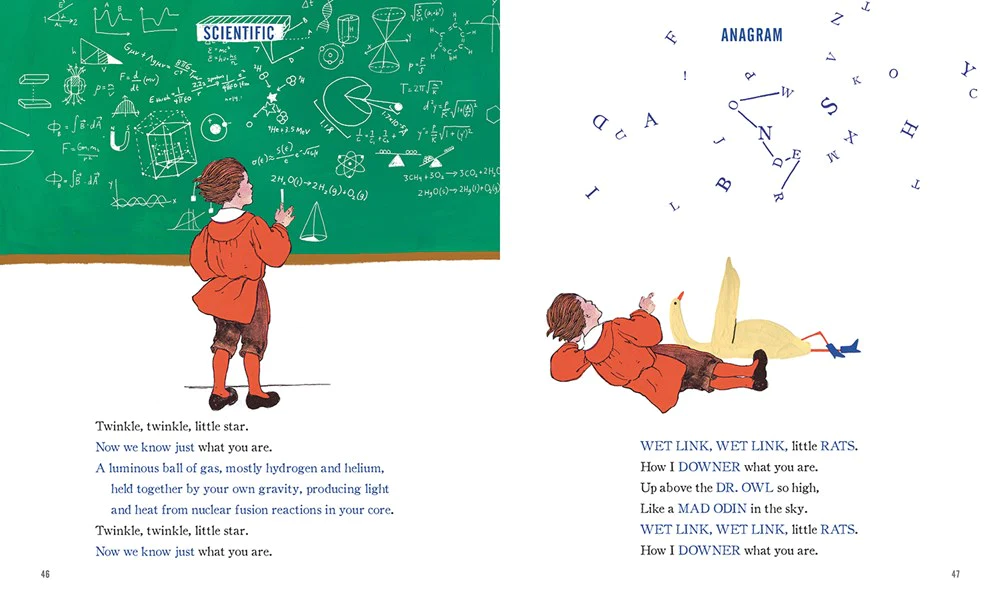
Master funnyman Jon Scieszka reworks classic nursery rhymes in ways that use everything from pig latin to secret codes. A rollicking reworking that’ll have you rolling in the aisles. The man who redefined fractured fairytales with his Stinky Cheese Man is now tearing up the nursery rhymes of the world in what has got to be the most brilliant deconstruction I have ever seen. I mean, first and foremost, it’s apparently a tribute to the Oulipo school’s Exercises in Style by Raymond Queneau. And if that reference isn’t ringing any bells, don’t worry. Me neither. Fortunately there is a ton of backmatter explaining stuff, like how the N+7 code was created by an organization that liked to invent different writing rules. Exercises in Style itself tells a simple story of a man on a bus, retold ninety-nine different ways. This book? It takes the very-much-in-the-public-domain The Real Mother Goose by Blanche Fisher Wright and then reworks six of her nursery rhymes, art and all, six different ways. We’re talking morse code, Esperanto, the military alphabet, anagrams, rebuses, spoonerisms, and way way more. I didn’t really know Julia Rothmann before but she does a great and lovely job of cutting up those old 1916 pictures. A hit, I say! A veritable hit!

Serengeti: Plains of Grass by Leslie Bulion, ill. Becca Stadtlander

“Parched soil bed of volcano ash / roots asleep in a tangled mesh.” Lyrical poetry brings to vibrant life the interconnectedness of bugs, plants, and animals in a singular ecosystem. Hold the phone! Hold your horses! Stop right there and put aside your skeptical raised eyebrows. Yes, this is another Serengeti book. Yes, we are all a little tired of the Serengeti at this point. And yes, this cover, like the stripes on a zebra, camouflages it so that it is indistinguishable from all the other Serengeti books out there. That said, this may well be the best book I’ve seen to really dig down and explain the interconnected nature of life in this particular habitat. Ignore the first page that’s just full of text. I don’t know why that’s there. Should have been in the backmatter. Once you get beyond that you’ll encounter the poems, which are good, and highlight this really cool link between different species in a single space. Kids hear a lot of talk about “the circle of life” and all that. This book makes it a lot more real than I’ve found elsewhere. Evocative and informative.

Star Child: A Biographical Constellation of Octavia Estelle Butler by Ibi Zoboi

With vivid poems and engaging mini-chapters, Zoboi offers a cosmic look at the legendary science fiction writer’s youth and the events that inspired her to create such otherworldly stories. This is great! I checked out a copy from the library and loved everything about it. There are facts about Octavia’s life in here but it’s also just chock full of poems. But what really came through to me throughout the book was just how real Octavia was as a person. Taking archery so that she wouldn’t have to deal with other people? I felt that. A pity she never wrote anything for kids, but who cares? This is some really cool stuff and I want it on every list that there is!

Stopping by Woods on a Snowy Evening by Robert Frost, ill. P.J. Lynch

“And miles to go before I sleep…” The classic Robert Frost sees new life in this adept adaptation to the picture book page. Meanwhile watercolor and gouache illustrations bring Frost’s 100-year-old poem to remarkable life. Certainly if you’ve never seen a P.J. Lynch book before, you’re bound to be wowed by his images here. But of course the thing about Lynch is that he is, ultimately, a very faithful illustrator. I’ve never seen him try to interpret a text in a different image or style. Here, a poem that I normally association with an old white guy is given to a young white girl. Lynch perfectly captures that weird light you get when it’s nighttime and it’s bouncing off of the snow. I found the book strange and rather beautiful, even if I don’t think it breaks too much new ground.

Take Off Your Brave: The World Through the Eyes of a Preschool Poet by Nadim (age 4), ill. Yasmeen Ismail

When Nadim was 4-years-old his mom told him that a poem is “a kind of story of a feeling or a moment.” Delve into Nadim’s 23 poems, each capturing what it means to really and truly be a kid. We all have these prejudices we carry around with us about books, even before we pick them up. One of mine is of books written by kids. I love kids. I love it when kids write books. But that doesn’t mean that they’re any good. The weird thing about this book, however, is that it’s really very good. Some of this is due to the fact that a genius editor thought to give the text to Yasmeen Ismail, who is one of England’s finest illustrators (I’ve always thought of her art as a combination of Quentin Blake and Lauren Tobia). But the poems really and truly do work. They’re cute and are unapologetically British (which may account for a lot of my love because what American can resist the term “baddies”?). It really does feel authentically “kid” and cute without being cutesy, y’know? I guess my bar was low when I read it, but this book completely won me over. Give it a try.

Wait – and See by Helen Frost, photography by Rick Lieder

“If a quick small movement takes you by surprise,/ stop and look – move nothing but your eyes.” Jaw-dropping photography accompanies a delicate poem following the life of an ever patient praying mantis. Mmm. Okay, let’s all decide together whether or not we should place this in the picture book, the poetry, or the nonfiction picture book section. My vote? Poetry all the way. After all, the title page says that the “poem” is by Ms. Frost, and who are we to argue? We’ve seen Helen and Rick put together these remarkable and remarkably simple photograph-heavy picture books before. This one, however, may be my favorite. I know that there are praying mantises in the wild, but I’ve never run into them myself. So you have these magnificent shots of the bug on the one hand, and then there’s this image I have never, ever, even known about of an ootheca (the egg case a mantis creates) with hundreds of mantis nymphs emerging. It’s fascinating and more than a little unnerving and I love it. The poetry is, of course, fantastic as well. Pretty much one of the coolest photo illustrated titles of the year.

Yuck, You Suck! Poems About Animals That Sip, Slurp, Suck by Jane Yolen and Heidi E.Y. Stemple, ill. Eugenia Nobati

I want you to understand that deranged eyeballs on a poetry picture book will, many times, be sufficient to get me interested in the contents therein. Add in the fact that this book is technically a STEM title, but with a delightfully gross twist, and the poetry itself just becomes a helpful bonus. You want poetry with bite? You got it, babe. Mother/daughter team Yolen/Stemple have conjured up 15 different poems on creatures with sucking abilities. You’ll know some of them already, like mosquitoes or vampire bats. But did you know that pigeons have a beak that works like a straw (unlike many other birds)? Or that remoras don’t (actually) suck? There’s plenty of gross qualities to enjoy (I got one word for you: lampreys) and a wide variety of poetic styles ranging from haikus to concrete poems. Add in the great backmatter (“Anatomical Terms for Parts That Suck”, “Animals Suck for a Reason”, “Other Books to Sink Your Proboscis Into”) which also includes additional info on each sucker AND a glossary and you have yourself one heckuva disgusting class act.


Want to see other lists? Stay tuned for the rest this month!

December 1 – Great Board Books

December 2 – Picture Book Readalouds

December 3 – Simple Picture Book Texts

December 4 – Transcendent Holiday Picture Books

December 5 – Rhyming Picture Books

December 6 – Funny Picture Books

December 7 – CaldeNotts

December 8 – Picture Book Reprints

December 9 – Math Books for Kids

December 10 – Gross Books

December 11 – Books with a Message

December 12 – Fabulous Photography

December 13 – Translated Picture Books

December 14 – Fairy Tales / Folktales / Religious Tales

December 15 – Wordless Picture Books

December 16 – Poetry Books

December 17 – Unconventional Children’s Books

December 18 – Easy Books & Early Chapter Books

December 19 – Comics & Graphic Novels

December 20 – Older Funny Books

December 21 – Science Fiction Books

December 22 – Fantasy Books

December 23 – Informational Fiction

December 24 – American History

December 25 – Science & Nature Books

December 26 – Unique Biographies

December 27 – Nonfiction Picture Books

December 28 – Nonfiction Books for Older Readers

December 29 – Best Audiobooks for Kids

December 30 – Middle Grade Novels

December 31 – Picture Books
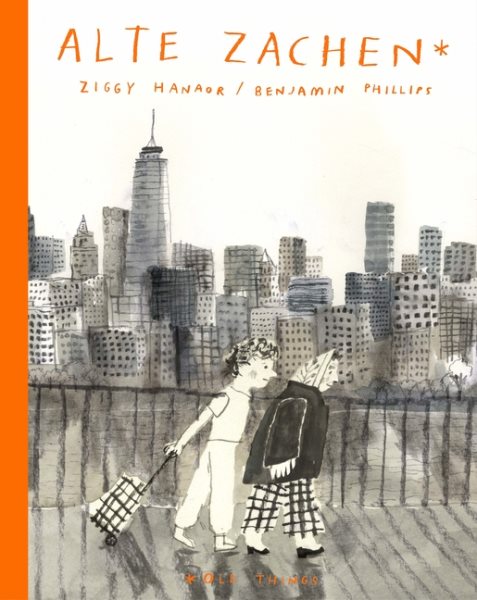
Filed Under: 31 Days 31 Lists, Best Books, Best Books of 2022 Tagged With: 2022 poetry, 31 days 31 lists, Best Books of 2022, funny poetry, middle grade poetry, picture book poetry, poetry

31 Days, 31 Lists: 2022 Wordless Picture Books

December 15, 2022 by Betsy Bird

The older I get, the more and more I love those wordless books. They cross boundaries. They cross time. They’re a method of communication that cannot be tied down. And this year I was delighted to find a wide range of the things. Some are from America. Some from overseas. And each and every last one of them (on this list anyway) worth discovering.

Love wordless titles? Then check out some lists from previous years:

  • 2021
  • 2020
  • 2019
  • 2018
  • 2017

2022 Wordless Picture Books

All Around Bustletown: Nighttime by Rotraut Susanne Berner

Bustletown has appeared on my 31 Days, 31 Lists before, and little wonder. They’re utterly charming! Imported from Germany, this is part seek-and-find, and part Anno’s Journey. In this story you are proceeding to the right, to the right, ever and always to the right. Your companions as you do so vary. There’s a fellow on a bike (identified as Frank on the back cover). There’s Cara and John, a couple taking a nighttime stroll. The book goes from the country to the city. As with other European imports I always worry about a lack of diversity, but this book at least has a variety of people (though not at the beginning). There are fun references to classic children’s books (spend some time looking at the book covers in the library where a sleepover is taking place to see how many you recognize). Just use this book to take a trip to Germany! It’s the cheapest fare you’ll find.  

A Day for Sandcastles by JonArno Lawson, ill. Qin Leng

Lawson’s such an interesting guy. I know of few other picture book authors that have been able to establish themselves as the foremost wordless picture book writers (not illustrators) on the contemporary market. He and Qin Leng paired together last year with the lovely Over the Shop, and now they’re back with a single idea. Kids. At the beach. Making sandcastles. Sounds simple, no? And it is, but there’s an interesting drama to it. Any kid familiar with the damaging effects of the incoming tide on juvenile sand architecture will be able to relate. Heck, kids who’ve never seen a beach a day of their life will relate, since this is a classic story of frustration and a kind of weary inevitability. Tide and time wait for no kids. A good, gentle picture book beach read. 

The Depth of the Lake and the Height of the Sky by Kim Jihyun

A wordless South Korean import celebrates nature, wilderness, and traipsing about on your own. Using a technique of writing ink and a “slow-dry blending medium”, it’s funny to think that when you get right down to it, this is a black and white picture book. Such things are rare on the market when they’re homegrown, so I wasn’t surprised to hear that this came from overseas. When Jules Danielson featured this book on Seven Impossible Things Before Breakfast she mentioned that its original title in Korean was merely “Last Summer”. So somewhere along the lines, someone at Floris Books had the wherewithal to give this book this luscious, loving title. As someone who, as a kid, loved bumming around woods by myself, this book tapped into that feeling beautifully. My favorite moment comes after the kid has been swimming and he simply lies on his back, on a dock, on a sunny day. You get this two page spread of what it looks like when the sun is directly ahead that is this remarkable example of how human hands can paint ink to look like light. It’s marvelous. If I could frame any sequence from this book, it would be that one. A gentle, wonderful example of accomplished wordless storytelling.

Field Trip to Volcano Island by John Hare

The third in the John Hare science fiction picture book series. I’ve read Field Trip to the Moon and Field Trip to the Ocean Deep before and I liked them fairly well. But out of all the books that Hare has done, I think that this one might be my favorite. Why? Honestly, I think he gets a lot more emotional heft and heart out of this story. In this tale a group of kids are wearing their protective hazmat suits and visiting an actual active volcano. One kid, however, is quite taken with the flowers that manage to grow in these harsh conditions. When the child accidentally stumbles on a family of, for lack of a better word, lava monsters, he’s touched by their sadness over being unable to hold the flowers. The solution is as clever as it is touching. Maybe it’s just that Hare does a more touching lava monster than he does an alien, but I really felt this one. A lovely little title without a word on the page.

Finding Fire by Logan S. Kline

Is it at all strange that, having learned that Neanderthals, at least, often sported red hair, it was kind of nice to see red-haired Homo Sapiens in this wordless adventure? I’ve always been intrigued by the lesser-respected (but still very much in demand) genre of wordless action picture books. These truly bridge the gap between books for younger readers and graphic novels. And, certainly in this case, it feels as though it’s only the page count that keeps this book from ending up in the comics section of the library. I was surprised to see that Kline doesn’t, apparently, have any animation experience. The book certainly feels like a Pixar short at times (and that’s a big compliment coming from me). In the story, a boy sets off to find fire and finds a friend along the way. A pretty cool bit of storytelling with ingenuity at its core.

Forever Home: A Dog and Boy Love Story by Henry Cole

There are a few picture book author/illustrators that do exceedingly well when they engage with a wordless format. Henry Cole is amongst them. It’s been so interesting to watch his career over the last few years. Recently he’s been really into black and white, pen-and-ink books that use color as an important accent that’s pertinent to the plot. This story, interestingly enough, is explained at the end, when Cole discusses its inspiration. Even so, kids shouldn’t have a difficult time following along. In this tale a dog needs a home and a boy desperately wants a dog. His dads aren’t particularly convinced, however, since his room is a pigsty and there are chores to be done. Determined, he sets out to do all the chores and, as an extra added measure, takes a leash on a walk, rain or shine. I particularly liked the leash walking scenes. A heartfelt little thing with a dog right up there with the fellow 2022 doggie picture book Hot Dog. 

Gold by Jed Alexander

Three bears set out on their bikes while a little girl in yellow beelines for their house. In this wordless play on the Goldilocks fable, prepare to have expectations of all sorts upset by a story that redefines what a family can be. Also prepare to be utterly charmed or, at the very least, subtly impressed. We see a lot of books that are skewed takes on Goldilocks (look at the bottom of this list to see Bee Waeland’s The Three Bears and Goldilocks) and you kind of get a little sick of them after a while. This book upsets not simply storytime expectations but cultural expectations about who can and cannot be a family unit. I was immediately charmed by the San Franciscan setting and the fact that the bears’ bike helmets are so ridiculously small on their huge heads. Then you get to the beautiful use of the color yellow throughout. And of course the mess Goldilocks makes could be attributed to a child trying to “help”. Mr. Alexander already tried something like this with his previous book Red but I think that was just a warm-up for this little number. Completely, utterly, wonderful (and wordless!). 

Kunoichi Bunny by Sara Cassidy, ill. Brayden Sato

Now if we’re going to get technical about it this book isn’t really wordless. It has words on signs and words that describe actions (like “Roll” and “Fling”). Plus our heroine is calling out, “Kunoichi!” on a regular basis. But you wouldn’t need to speak a word to understand what is happening. Now the plot written could have rendered this book good or bad, based solely on the quality of the illustrations. Fortunately, Brayden Sato appears to have been an absolutely perfect choice. Throughout the story, a girl in a stroller with her dad uses her bunny to, essentially, save lives and prevent injuries and I am NOT even kidding about that. She stops another kid’s stroller from tumbling out a bus door, prevents cats from fighting, and even redirects a baseball on course to beam a child in the head. Best of all, while her aim is spectacularly true, I found it all plausible enough. Kids, of course, will love seeing someone their age or even younger engaging in superheroics. The fact that the art is thoroughly charming doesn’t hurt. Apparently Sato has a webcomic called All That You Are. Guess what I’ll be reading next?

Once Upon a Forest by Pam Fong

One little marmot is determined to use its small garden of baby trees to help undo the damage wrought by fire. But will the little trees be able to survive? Marmots to the rescue! Sometimes a book looks so cute that it’s suspicious. You begin to question its intentions. Can you really be any good if you look this sweet? But don’t be fooled by our wordless marmot friend here. This is a critter with a job to do, and the book does a mighty fine job of showing how gardening can combat deforestation. I love the selective use of green from scene to scene. It’s not preachy, but it does a good job showing how hard work can make a little difference. Not a miraculous huge one. Just a tiny spot of help.

Three Bears and Goldilocks by Bee Waeland

Goldilocks has broken into her last house. A wordless retelling of the classic fairy tale, with some justice sprinkled at the end. Insofar as I can tell, this is a wordless Canadian import. It’s the classic story, clearly, but with a little twist. It’s interesting to ponder how much a child that didn’t already know the story might take from this particular retelling. Waeland is having a lot of fun with these visuals. The nose-picking scene alone takes you a second or two before you quite realize what’s going on. Extra points for the awful muddy footprints around the house (and the Goldilocks drool on the pillow). And don’t worry. No one’s getting eaten here. Just brought their just desserts.


Want to see other lists? Stay tuned for the rest this month!

December 1 – Great Board Books

December 2 – Picture Book Readalouds

December 3 – Simple Picture Book Texts

December 4 – Transcendent Holiday Picture Books

December 5 – Rhyming Picture Books

December 6 – Funny Picture Books

December 7 – CaldeNotts

December 8 – Picture Book Reprints

December 9 – Math Books for Kids

December 10 – Gross Books

December 11 – Books with a Message

December 12 – Fabulous Photography

December 13 – Translated Picture Books

December 14 – Fairy Tales / Folktales / Religious Tales

December 15 – Wordless Picture Books

December 16 – Poetry Books

December 17 – Unconventional Children’s Books

December 18 – Easy Books & Early Chapter Books

December 19 – Comics & Graphic Novels

December 20 – Older Funny Books

December 21 – Science Fiction Books

December 22 – Fantasy Books

December 23 – Informational Fiction

December 24 – American History

December 25 – Science & Nature Books

December 26 – Unique Biographies

December 27 – Nonfiction Picture Books

December 28 – Nonfiction Books for Older Readers

December 29 – Best Audiobooks for Kids

December 30 – Middle Grade Novels

December 31 – Picture Books
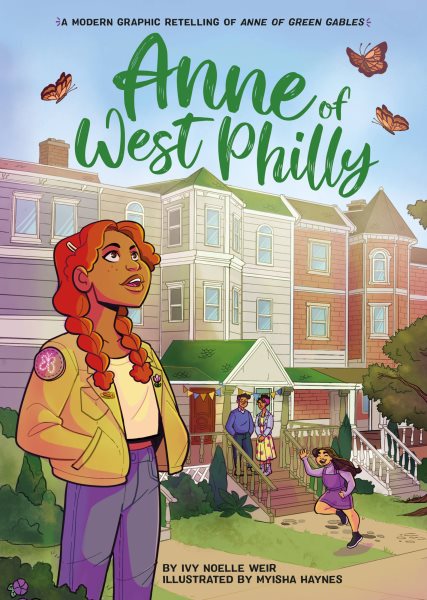
Filed Under: 31 Days 31 Lists, Best Books, Best Books of 2022 Tagged With: 31 days 31 lists, Best Books of 2022, wordless picture books
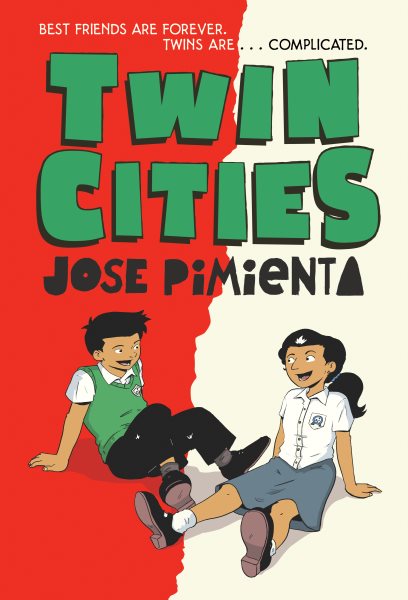
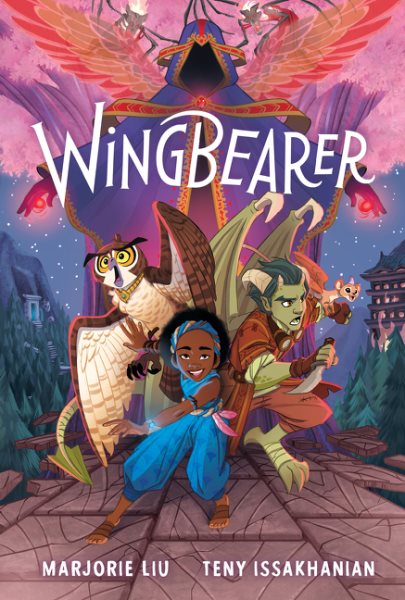
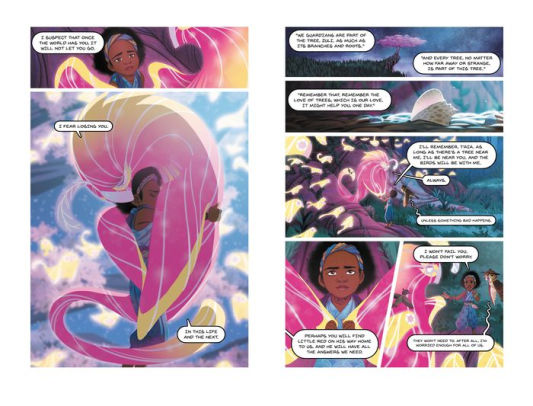
  • « Go to Previous Page
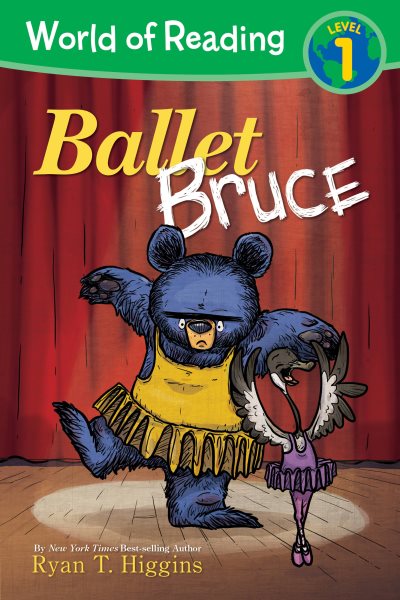
  • Page 1
  • Interim pages omitted …
  • Page 145
  • Page 146
  • Page 147
  • Page 148
  • Page 149
  • Interim pages omitted …
  • Page 1048
  • Go to Next Page »

Primary Sidebar