• Skip to primary navigation
  • Skip to main content
  • Skip to primary sidebar
  • About/Contact
  • Fusenews
  • Reviews
  • Librarian Previews
  • Best Books
    • Top 100
    • Best Books of 2022
    • Best Books of 2021
    • Best Books of 2020
    • Best Books of 2019
    • Best Books of 2018
    • Best Books of 2017
    • Best Books of 2016
    • Best Books of 2015
    • Best Books of 2014
    • Best Books of 2013
  • Fuse 8 n’ Kate
  • Videos
  • Press Release Fun

Cover Reveal (and Excerpt!): Everything Sad Is Untrue (a true story) by Daniel Nayeri

Cover Reveal (and Excerpt!): Everything Sad Is Untrue (a true story) by Daniel Nayeri

January 21, 2020 by Betsy Bird

Arthur A. Levine, Arthur A. Levine. Do you remember Arthur A. Levine?

Silly question. Of course you do. All you need to do is pick up an American edition of any Harry Potter book and you’ll see Arthur’s imprint there on the spine. Arthur has a gift, you see, for seeing the potential in any children’s book. Mind you, I’m not an uninterested party (The Great Santa Stakeout was one of the last books to be published under the Arthur A. Levine imprint with Scholastic) but I’m also not wrong. The world of children’s literature today would be a very different place if not for Arthur A. Levine.

Of course he’s not running that imprint anymore. Arthur, you see, left Scholastic almost a year ago and reappeared at an all new publisher called Levine Querido. His list’s mission:

“… seeking out the writing and artwork of exceptionally talented creators, with a distinct focus on building a platform for previously underrepresented voices. “

Switch focus now. Back it up. I want to tell you about an entirely different guy in children’s book publishing. Don’t worry, we’ll circle back to Arthur here but first I want to tell you a thing or two about Daniel Nayeri.

Daniel Nayeri could sell water to a drowning man and I mean that in the best possible way. I first met Daniel years ago when he was the Director of Children’s Publishing at Workman Publishing Company. If Daniel told you about a book, any book, you would be filled with an undeniable desire to purchase it. Even if you already owned it. Even if you owned two of it, Daniel could get you to want more. It would only later occur to me that this was because Daniel was, at heart, a writer. I’m not being poetic here, he really did write quite a lot of books. His range was incredible. There were YA novels with titles like Another Faust, Another Pan, and Another Jekyll, Another Hyde. There were silly interactive ones like The Most Dangerous Book (look that one up sometime) and the sublime Straw House, Wood House, Brick House, Blow. More recently he’s been writing that Elixir Fixers series I like so much. And now, to top it all off, he’s the publisher of Macmillan’s Children’s Publishing Group Odd Dot (you can read an interview with him at ShelfAwareness about it here). He may even have been a board game designer or pastry chef somewhere in there. I dunno. After a while all this starts to sound a bit mythical.

Okay, let’s head on back to Arthur A. Levine. Why? What could these two men have to do with one another? Well, after we all got over our shock at Arthur’s departure, and reconciled ourselves to his new company, the question was what he was going to produce first. What book would premiere the official Levine Querido list? It would have to be good. Heck, it would have to be exceptional. Epic, even! A book that would get tongues wagging.

You see where I am going with this.

Ladies and germs, it is with great pleasure, that I present to you, not only a view of the first Levine Querido title, but also an excerpt from the book itself. Coming to you August 25, 2020 . . .
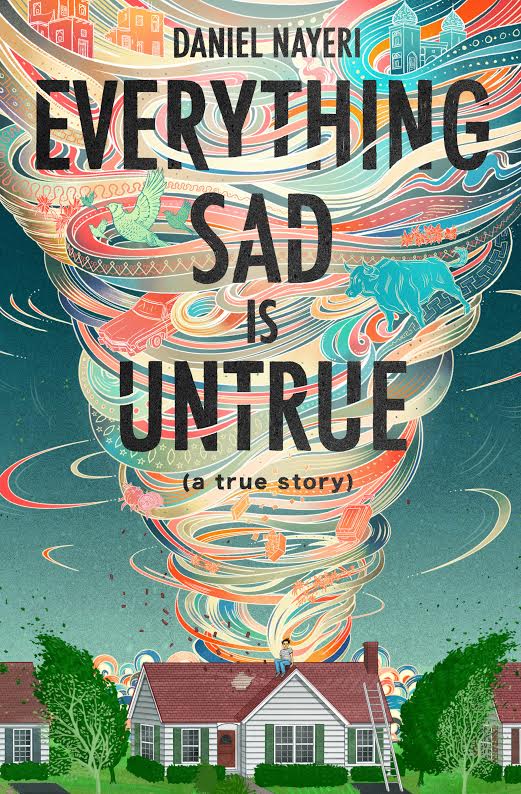
As book jackets go, this is the one to beat in 2020. Full credit to cover artist David Curtis, and jacket designers Elizabeth Parisi and Semadar Megged.

Here is the description of this middle grade novel:

His story is a true one—told from the point of view of middle-school-age Daniel recounting his family’s midnight run from the secret police in Iran, and their experiences as refugees, first in Dubai then a camp in Italy and finally Oklahoma. As young Daniel narrates to his disbelieving American classmates, the story unfolds from the recent past, reaching back to the ancient past. 

But Daniel’s story is not just heart-rending – it is full of humor and hope, a beacon of light in dark times. And most importantly, Daniel is a symbol of what it means to come to America and live out your dreams.

The best news? If you are attending ALA Mid-Winter, there will apparently be an exclusive galley drop of this book. You lucky dogs might have a chance to read this book long before I ever do. Me? No, I’m not jealous. I like sulking in corners. Scout’s honor.

And now, for your reading pleasure, an excerpt from the book itself:


Many thanks to Alex Hernandez, Arthur, and Daniel for the chance to share this book with the world.

Filed Under: Cover Reveal Tagged With: Arthur A. Levine, Arthur Querido, cover lovin', cover reveal, Daniel Nayeri

Fuse 8 n’ Kate: 2020 Caldecott Contenders

January 20, 2020 by Betsy Bird

If you get your kicks out of Kate and I disagreeing about books, today’s episode may not be for you. Each year I present Kate with 2-3 Caldecott contenders. Which is to say, we discuss books that may or may not win the Caldecott Award (which will be handed out a week from today on Monday, January 27th here at 8:00 ET), giving us a chance to discuss the art and, to a lesser extent, the books’ chances. There were actually a fair number I wasn’t able to get my hands on for today’s recording, but happily two of my favorites WERE available!

Listen to the whole show here on Soundcloud or download it through iTunes, Stitcher, Google Play, PlayerFM, or your preferred method of podcast selection.

Show Notes:

When discussing the idea of opening the Newbery and Caldecott Awards to artists from other countries the articles I referred to include Leonard Marcus’s piece in the New York Times, The Caldecott Medal Needs an International Makeover, and the Horn Book editorial Bordering On the Absurd by Martha Parravano

This is the shirt Kate WANTS. I think I need to find it for her. If any of you have any leads, you know where to find me.

This man does chickens better than anyone else has ever done chickens. “These are like Slovakian Easter eggs.”

And this is the spread that just blew Kate away.

That final image of the matriarch of the family, man. It doesn’t get any better than that.

Then we turn our attention to Brendan Wenzel’s book. And when it comes to Kate’s tattoo competitors, there are two major ones. It’s either gonna be the chipmunk . . .

. . . or the owl!

Kate named the one on the left Billy and the one on the right “Billy’s brother”. Hashtag #ImwithBilly

This is my theory of what this bug is. I think it’s a clover mite. And until today, I never quite knew their name.

You can read my official review of Going Down Home With Daddy here.

You can read my Caldecott thoughts on A Stone Sat Still here.

Finally, here’s the Lisa Brown book I was talking up. For your literary adult friends.

Filed Under: Fuse 8 n' Kate, Newbery / Caldecott Predictions Tagged With: A Stone Sat Still, Brendan Wenzel, Daniel Minter, Fuse 8 n' Kate, Going Down Home With Daddy, Kelly Starling Lyons

Unexpected Jolts of Children’s Literature

January 17, 2020 by Betsy Bird

This week has been an odd one for me. Thanks to a piece I wrote on this blog last year called The Quintessential Librarian Stereotype: Wrestling With the Legacy of Anne Carroll Moore, I inadvertently became one of the top Google hits if you typed in her name. This is why, in the last three days, you might have read me in Slate, The Washington Post, on a radio interview with the CBC (which is my personal favorite because host Carol Off was able to tie the entire discussion into the work of children’s librarians today), and there are two more coming out soon.

Foof.

Well, no help for it. I think Leonard Marcus may be out of the country at the moment, else he’d be the fella everyone would want to talk to.

To distract myself from ACM, MWB, and any other acronym you might name, let’s have a round of Unexpected Jolts of Children’s Literature! You know the rules. If I run across a piece of literature or entertainment meant for adults but involving children’s books in some way, I shall mention it here. Eh voila! Consider the following:


Start With a Scribble: Drawing for the Artistically Undiscovered by Quentin Blake and John Cassidy

I suppose the first thing to establish is that this isn’t the first time this particular book has hit shelves. Though this new edition is slated to be released June 9th of this year, it had a previous life as, of all things, a Klutz title:

That doesn’t detract from how nice it is to see Quentin Blake, whatever form he takes.

Harry Potter Knitting Magic: The Official Harry Potter Knitting Pattern Book by Tanis Gray and Laura Flippen

I actually got this book for my sister for Christmas since the likelihood that she would make good use of it was far greater than my own. I’ve no desire to have a Hedwig, but look at that scarf and lovely gloves. This is for the crafty Hogwarts lovers amongst us. I can attest that it is a large, lovely project book. For the Harry Potter lover who has everything.

Girl On Film by Cecil Castellucci

A nonfiction biography/memoir but not one aimed at Castellucci’s usual YA audience. I actually ran into Cecil at C2E2 last year and was so flummoxed to see her in Artist’s Alley that I never even said a word in her presence. I regret that now. She may have been promoting the fact that just this month Little, Brown & Co. released her original Plain Janes series in a book that contains the first two stories as well as a brand new third one. This book is a little different. Here’s the product description:

“Chronicling the life of award-winning young adult novelist, and Eisner-nominated comics scribe Cecil Castellucci (Shade the Changing Girl, Star Wars: Moving Target), Girl On Film follows a passionate aspiring artist from the youngest age through adulthood to deeply examine the arduous pursuit of filmmaking, while exploring the act of memory and how it recalls and reshapes what we think we truly know about ourselves.”

Boing Boing and NPR already like it.

Constitution Illustrated by R. Sikoryak

Ah. This may be my most interesting find. If you’ve ever seen Sikoryak’s Masterpiece Comics then you know the man is a master at imitating different styles. What’s crazy about this book is that it looks to me as if 21st century comics for kids have finally won enough acclaim that their styles are being imitated. This book appears to have versions of Archie Comics, Peanuts, Diary of a Wimpy Kid (if the cover here is to be believed), Raina Telgemeier, and more. Wow!

Here’s the full description:

“R. Sikoryak is the master of the pop culture pastiche. In Masterpiece Comics, he interpreted classic literature with defining twentieth-century comics. With Terms and Conditions, he made the unreadable contract that everyone signs, and no one reads, readable. He employs his magic yet again to investigate the very framework of the country with Constitution Illustrated. By visually interpreting the complete text of the supreme law of the land with more than a century of American pop culture icons, Sikoryak distills the very essence of the government legalese from the abstract to the tangible, the historical to the contemporary.

Among Sikoryak’s spot-on unions of government articles and amendments with famous comic-book characters: the Eighteenth Amendment that instituted prohibition is articulated with Homer Simpson running from Chief Wiggum; the Fourteenth Amendment that solidifies citizenship to all people born and naturalized in the United States is personified by Ms. Marvel; and, of course, the Nineteenth Amendment offering women the right to vote is a glorious depiction of Wonder Woman breaking free from her chains. American artists from George Herriman (Krazy Kat) and Charles Schulz (Peanuts) to Raina Telgemeier (Sisters) and Alison Bechdel (Dykes to Watch Out For) are homaged, with their characters reimagined in historical costumes and situations.

We the People has never been more apt.”

Out June 30th

The Miracle of the Little Prince

Let us end today not with a book, but with a documentary film. Originally released in the Netherlands in 2018, it’s just been released in DVD here in the States, which is how I heard of it. The film concerns itself with languages around the world that are disappearing, and the effort to translate The Little Prince into Tibetan, Tamazight (North Africa), Sámi (northern Finland and Scandinavia) and Nawat (El Salvador). Here is the plot description:

“The Little Prince by Antoine de Saint-Exupery is the most translated book in the world. It has version in over 300 different languages. Marjoleine Boonstra’s The Miracle of The Little Prince is about passionate translators of the book The Little Prince , who fight for the preservation of their endangered languages. Shot in Morocco’s desert, the Sami country of the polar north and the mountains of El Salvador it asks the why do people from so very diverse cultures precisely choose this book to keep their languages and cultures alive?”

Perfect for your translation nerd friends.

Filed Under: Unexpected Jolts of Children's Literature Tagged With: Unexpected Jolts

Review of the Day: Go With the Flow by Lily Williams, ill. Karen Schneemann

January 16, 2020 by Betsy Bird

Go With the Flow
By Lily Williams and Karen Schneemann
First Second (an imprint of Macmillan)
$12.99
ISBN: 978-1-250-14317-4
Ages 9 and up
On shelves now

The nice thing about children’s literature is that it often replicates, on a smaller scale, themes and topics that you’ve find in more mature fare. Take, if you will, the protest novel. Which is to say, a novel in which the kids in the book decide to take a stand against an injustice. Examples that come immediately to mind vary from the fluffy (Frindle and The Homework Strike) to slightly more serious topics ( The Day They Came to Arrest the Book). For a long time that was pretty much as far as a book for children would go when it came to civil disobedience. Then came the election of 2016, the rise of the Black Lives Matter movement, the Women’s March, and any number of other factors that suddenly made those old “protest novels” look downright quaint. Since that time we’ve had book stunners like A Good Kind of Trouble by Lisa Moore Ramée, and other titles in the vein of The Hate U Give. But, Go With the Flow is different. Unusual. And it exhibits a kind of bravery, both on the part of the creators and, to a certain extent, the publisher, that is rather rare. Sometimes you don’t know what you’ve been missing until it’s arrived. I didn’t know I needed a graphic novel for kids on period parity. And now, here we are.

What’s your worst nightmare? There are so many to pick and choose between. How about the one where you get your period one day at school while wearing white pants and it feels like EVERYONE notices? Sasha’s worried enough about making friends at her new school and now this? Fortunately, her misfortune leads to meeting three amazing girls. Abby, Brit, and Christine are exactly the kinds of friends you wish you had in high school. They’re smart, funny, and passionate. Abby in particular sees Sasha’s problem and then starts to notice other issues. Why are the school’s machines in the bathrooms always empty of tampons and pads? What are kids who don’t have access to a lot of money supposed to do when they need them? Why doesn’t the administration care? What starts out as an annoyance quickly grows into a cause, but how do you get the world to notice something it simply doesn’t want to see?

Let’s talk menstruation. I know I haven’t. In the field of children’s literature, if it gets mentioned then it’s a side note or a joke. Feeling cramps tends to be paired with the idea that the heroine is just stressing out about something else. I guess the most famous book for kids to feature periods is Are You There God? It’s Me, Margaret, particularly since Judy Blume had to update the sanitary napkin belt info in its more recent reprints. Even so, I can say with certainty that the idea of linking menstruation to the basic human right of having access to pads and tampons struck me as practically revolutionary. So too is the idea of turning this not into a nonfiction middle grade book (which would be the usual route) but a fun story set between four friends. You can teach the nonfiction book lovers all day long and they’ll howl for more, but comic fans? By the time they realize what the subject matter is, it’ll be too late. They’ll be hooked and (gasp!) learning. Such a smart battle strategy.

The part of this that struck me as particularly keen, however, was that the book is not merely about raising the awareness of the existence of menstruation and the ways in which it can physically hurt those girls and women with endometriosis, adenomyosis, PCOS, and fibroids, but also how Williams ties all this into economic disparities. She makes the choice not to make any of the starring girls in this book lower income. They could afford those 50-cent tampons (if the bathrooms ever bothered to stock them). And everyone but Abby is fairly fine with this fact. She’s the only one consistently bothered that “there are kids here who can’t even afford lunch… How can they afford proper sanitary items for their periods if they cannot afford lunch?” Every woman I know has been in a bathroom where the tampon and pad machine was empty or, more often the case, missing entirely. And like Abby points out, who even carries around quarters all the time? This is one of those rare books that raises awareness not simply for the kids reading it but the parents, teachers, and librarians that find it as well. I’ll say it. I felt smarter after reading it.

Many of us have had that friend like Abby. The one who cares so much about a cause that she brings it up in every conceivable situation (“But have you guys heard about Toxic Shock Syndrome?”) and then plunges forward with bold plans to right the wrongs of the world without thinking about how her choices might affect people closer to home. The authors make the opposition she faces shudderingly believable. When the principal says to her, “It’s not like the boys get free jock itch cream,” it can be mighty hard not to start screaming at the page. Now the real trick to the book, to a certain extent, comes when Abby writes a blog post and it goes viral. I think we’ve seen this plot twist before, and often it’s unbelievable. Due to the nature of the subject matter, I didn’t have that hard a time believing that Abby’s story would catch national attention … except that the blog post doesn’t appear to show any images from the shocking display she made in the school hallways. I can understand why, from a plot perspective, she didn’t include photos of her act of disobedience, but the inclusion of a photo or two in the viral post would have made it MUCH more believable.

So is it fun to read? I mean, face the facts, when I tell you I found this great book on menstruation rights, you’re not going to pick it up hoping for a chucklefest. That’s why it’s such a relief to discover that the book knows how to make a good joke. Long story short, it is very difficult not to fall in love with a comic that contains the line, “WALK AWAY! Ya big ol’ fart bag!” Or to enjoy it when Brit tells everyone that in the event that she can’t have kids, Sasha volunteered to have her children for her. Quoth Christine, “Totally normal high school thoughts.” Or, quite frankly, the sheer number of period puns. Interestingly, the Acknowledgments at the back are where some of the most egregious double entendres lurk. You gotta love a book that ends copious praise with the sentence, “You are all bloody awesome!” Hey, man. Commit to the bit.

In children’s book publishing there’s a general rule out there regarding the age of characters in a book versus the readership. Long story short, if the kids in your book are teenagers then the book will not and cannot be marketed to kids. This rule applies to adult main characters as well, unless they are furry animals (don’t ask). So it was with great surprise that I found the characters in this book weren’t the usual middle school troupe but out and out high schoolers. Wow! I mean, kids love reading books about teens, but rarely are they allowed specifically to do so. And the subject matter being what it is, this book is going to get some adults upset. Sure it is. I mean, it’s about menstruation. There are adults out there that would tell you with a straight face that kids don’t need to know about that stuff when they MOST certainly do! What Go With the Flow does is show not just a range of body types, orientations, races, and belief systems, but it also shows how differently menstruation affects one person or another. If you have kids suffering seriously from cramps, this book is going to offer them some much needed information. They’re going to need to know this and know it early. Honestly, there’s only one moment in the book that I actually found more in the YA sphere of things than anything else. In one scene Christine is studying with a swimming doofus named Ted. Ted digs Christine (Christine does not dig Ted) and as she preps for studying he hops onto the couch and then nonchalantly places a pillow over his crotch. It’s not a big obvious move but its visible enough that I raised one of my eyebrows a good quarter inch higher than its normal resting position. I wouldn’t kick this book out of the kids section, but it sure seemed like a weird thing to just drop in the book casually like that.

Alright. Enough of all that. Art time. This book is coming out of the gate swinging. Sometimes you can have a hard time following the narrative thread of a debut graphic novelist. Not here. Panels connect and flow expertly. But even more impressive to my mind is the color scheme. I don’t think I’m spoiling anything for you to say that it’s red. Red red red red red. Different shades, you betcha, but this isn’t one of those books where the color scheme shifts or adds a new color at a significant point in the proceedings. This drawing style is easygoing and enticing. Any fan of Raina Telgemeier, Shannon Hale, etc. is going to see this cover, completely miss the double meaning behind the title and the subtitle, and want to pick this up for a read. I should know. I’m basically that reader myself.

When an author and artist release their book into the world, they don’t know what effect it may make on the general populace. In the back of this book is information on “How to be a Period Activist.” To a large extent Go With the Flow aims to remove the stigma surrounding periods, but I recall middle and high school really well. The girls who read this book and take it upon themselves to follow in its wake are honestly going to be extraordinary humans. Kids are less afraid these days to speak out and pursue various forms of activism, but this takes it to a whole other level. It opens you up to a new kind of personal shame and embarrassment hitherto unexplored. To those girls that read this book, embrace this book, learn from this book, and use this book, I salute you. And to the women that wrote this book and illustrated this book, I bow to you. You never know what you never know. Now though? No more excuses. This book is one in a million.

On shelves now.

Source: Galley sent from publisher for review.

Filed Under: Best Books, Best Books of 2020, Reviews, Reviews 2020 Tagged With: 2016 middle grade graphic novels, 2020 comics, 2020 graphic novels, 2020 reviews, Best Books of 2020, comics, graphic novels

21st Century Oral Storytelling: How PJ Library Connects Kids to Their Heritage via Podcasting

January 14, 2020 by Betsy Bird

For reasons entirely of my own, I’ve been fascinated recently with the role of speaking stories aloud, as it relates to human creatures. When we talk about oral legends or storytelling, we get visions of ancient humans crouched around a fire while one of them builds whole worlds out of words. You could see the storyteller, sure, but for the most part it was the audible aspects that were the most important.

And now we have podcasts.

That’s a leap. I’ll back up a bit.

I have two children, ages 5 and 8. And like many kids their age, on long car trips I eschew the screens (which, if I’m going to be honest with you, sometimes make them want to throw up) in favor of audiobooks and podcasts. My son could consume every last Captain Underpants uninterrupted if you asked him to (though where the HECK are the Dogman audiobooks, I ask you?) while my daughter loves Adam Gidwitz’s Grimm, Grimmer, Grimmest podcast (which I’ve only just learned has Season 2 only on Pinna, doggone it). The Gidwitz show is a particularly good use of the medium, actually. Think about it. Folktales began as storytelling. How perfect to have kids discover them the same way, right? And not just Grimm brothers stuff. What about stories in a specific tradition? What about stories that connect kids to their heritage?

Meet Have I Got a Story For You!

So every year, this organization called PJ Library ships more than 200,000 books out each month to families raising Jewish children. These books are carefully curated children’s books and are sent, for free, with the hope that they could, “help foster a love of reading along with child-friendly glimpses into Jewish history and culture.” Pretty neat, right? I mean, I’m a librarian. I like free books. I like the idea of someone out there sending good ones to kids. And then PJ Library launched this podcast. To what end?

To answer that I recently spoke with Meredith Lewis, the director of content at the Harold Grinspoon Foundation (which started the PJ Library program).  Not just about the podcast itself, and what it means in the greater, grander scheme of storytelling, but also about that whole giving kids free books thing. What’s up with that?


Betsy Bird: So I love podcasts (I host two, so I’d better). Still, it’s always interesting to me when an organization thinks to start one. So I’ll ask you straight out – Why a podcast? Why now?

Meredith Lewis:  Well, PJ Library is all about families reading stories together but they realize that in 2020 families are on the go more than ever and it’s not always feasible for families to cuddle up. Stories are portable and podcasts can take stories that people love and put them in an even more portable format than books. Some kids even access devices on their own time. As a result, podcasts extend being able to share stories together.

BB: When I read a little into your podcast I saw that in its PR material it said that it, “lifts classic Jewish folk tales from the page, gives them a modern twist and brings them to sparkling life for families seeking an entertaining, enriching diversion from digital life.” Who rewrote these stories?

ML: That would be a group of script writers. Some are screenwriters, and some are comedians. The nice thing about folktales is that we have a lot of information about where they originated. So they’ve taken folktales that they’ve wanted to see but that didn’t work in a picture book format and now benefit from a looser oral translation.

BB: And how do you envision this podcast being used?

ML: Certainly during travel time and in the car. In cases where a parent who has read the same book 50 times before bed and is exhausted and the kid is still ready to hear stories, they could put the podcast on them. Sometimes I listen while I’m driving the kids to carpool and I’ll forget to pause after I drop them off. It really augments the book experience. After all, folktales were an oral tradition before they were a book tradition.

BB: Can you tell me a little more about the Harold Grinspoon Foundation program that sends books to families raising Jewish children? How did that start? How many families partake?

ML: Harold was actually inspired by Dolly Parton’s Imagination Library. Around the same time he was attending his family’s Passover Seder and his daughter-in-law brought whatever books she could find about Passover. Harold had never seen Jewish children’s books before. He wondered if you could do a Jewish program like Dolly’s. The story goes that initially they expected about 200 families in Western Massachusetts to sign up. They got 700 kids. So many families wanted to connect to the community through books! It grew first in North America and now it’s gone beyond that. Currently it’s now in more than 26 countries, 650,000 kids each month. They’ll be going into their 6th and 7th languages in 2020. The program is totally free for families and goes up to age 8 and now has a middle grade program too. Anyone raising Jewish kids or kids with Jewish traditions can go to PJlibrary.org and find out that it’s totally, absolutely free for families. No strings attached. All of their booklists are totally available to the public. Right now there is a lot of talk about Anti-Semitism and they have additional resource guides for people who need them.


A great deal of thanks to Meredith Lewis for speaking to me today and to Beth Blenz-Clucas for connecting us. And just to round us out . . .

About The Harold Grinspoon Foundation/PJ Library

The Harold Grinspoon Foundation operates creative programs to engage the Jewish community by meeting people where they are at key life moments and by providing access to the best of Jewish culture and tradition, while using philanthropy to encourage others to invest in the Jewish community. To learn more, visit: www.hgf.org

PJ Library® is an award-winning program started by the Harold Grinspoon Foundation that engages families in their Jewish journey by giving free Jewish books and music to children ages 6 months to 12 years. PJ Library has partnerships with philanthropists and local Jewish organizations in nearly 200 communities in the U.S. and Canada, and sends books to families in 21 countries around the world. To learn more, visit: www.pjlibrary.org.

Filed Under: Interviews, Uncategorized Tagged With: folktales, Jewish children's books, podcasts

Fuse 8 n’ Kate: Trashy Town by Andrea Zimmerman, David Clemsha, and Dan Yaccarino

January 13, 2020 by Betsy Bird

How old are we all that Trashy Town is 21 years old? Is it just me or does that seem like a very large number? Continuing to attempt to find storytime classics that librarians love, I had Kate take a look at this readaloud classic. And, if you recall, Kate does not always take to storytime books. Many questions are raised in the course of the proceedings. Does Mr. Gilly work for the city? What is the nature of the rat’s open mouth? Is Mr. Gilly picking up syringes and blood behind that doctor’s office? And why the heck did they name their burg “Trashy Town”? Seems a poor choice and could affect the tourism industry. Please see to it that you enjoy our different rhythmic renditions of the chant in this book. The Monty Python one is now my favorite.

Listen to the whole show here on Soundcloud or download it through iTunes, Stitcher, Google Play, PlayerFM, or your preferred method of podcast selection.


Show Notes:

I wasn’t lying. Beavers ARE amazing! Be sure to read the book Beavers: The Superpower Field Guide by Rachel Poliquin, illustrated by Nicholas John Frithto and find out what I meant about what they eat in the winter.

I like that Kate thought that this was a spatula on the cover. These days, a lot of kids might think the same thing.

The great rat debate. Is one narrating this book or not?

Here’s a glimpse at the Weston Woods film that says, definitively, that the rats ARE narrating. However, I have issues with their chant. They’re definitely drawing it out as long as possible to fill time.

I’ll give Kate this. It is funny how Mr. Gilly looks like he’s missing half his head when he’s on a job.

Extra points to Dan Yaccarino for making these old-fashioned, Oscar the Grouch-style trash cans.

The job is done. He has a whole face again.

Kate’s problem with this scene of the dump? Too darn pretty. How are we going to teach our kids about conservation and recycling if the dumps are depicted like this?

Note the endpapers that look so so Seussian.

I am so horrified that Kate associated Mr. Gilly with … with… this:

The board book is now available as of 2018:

And here is the brand new May 1, 2020 sequel . . . SMASHY TOWN! Listen to this podcast if you want to hear my rendition of its chorus.

Want a book about the reality of the trash profession? This adult graphic novel is THE best boon on the subject. Disgusting and very enjoyable.

Filed Under: Fuse 8 n' Kate Tagged With: Andrea Zimmerman, Dan Yaccarino, David Clemesha, Fuse 8 n' Kate, Trashy Town

  • « Go to Previous Page
  • Page 1
  • Interim pages omitted …
  • Page 273
  • Page 274
  • Page 275
  • Page 276
  • Page 277
  • Interim pages omitted …
  • Page 1050
  • Go to Next Page »

Primary Sidebar