• Skip to primary navigation
  • Skip to main content
  • Skip to primary sidebar
  • About/Contact
  • Fusenews
  • Reviews
  • Librarian Previews
  • Best Books
    • Top 100
    • Best Books of 2022
    • Best Books of 2021
    • Best Books of 2020
    • Best Books of 2019
    • Best Books of 2018
    • Best Books of 2017
    • Best Books of 2016
    • Best Books of 2015
    • Best Books of 2014
    • Best Books of 2013
  • Fuse 8 n’ Kate
  • Videos
  • Press Release Fun

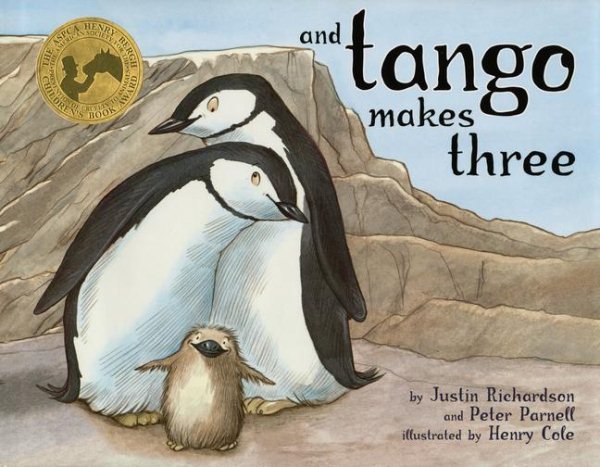
Fuse 8 n’ Kate: And Tango Makes Three by Justin Richardson and Peter Parnell, ill. Henry Cole

Fuse 8 n’ Kate: And Tango Makes Three by Justin Richardson and Peter Parnell, ill. Henry Cole

September 26, 2022 by Betsy Bird

Banned Books Week may have happened last week, but sadly that doesn’t mean that the nationwide scourge of banning has ended. Far from it. As such, I felt like consideration of this, “the granddaddy of the book banned”, was long overdue. Interestingly, even though Kate hadn’t seen the book before, she took one look at it and said it was “the gay penguins book”. So it’s clearly in the cultural zeitgeist. We talk Happy Feet, whether or not Tango was actually named after Tango & Cash (“if she’d been a boy, he totally would have named her Cash”), and why baby penguins that break the 4th wall are unspeakably awesome.

Listen to the whole show here on Soundcloud or download it through iTunes, Stitcher, Spotify, Google Play, PlayerFM, or your preferred method of podcast selection.

Show Notes:

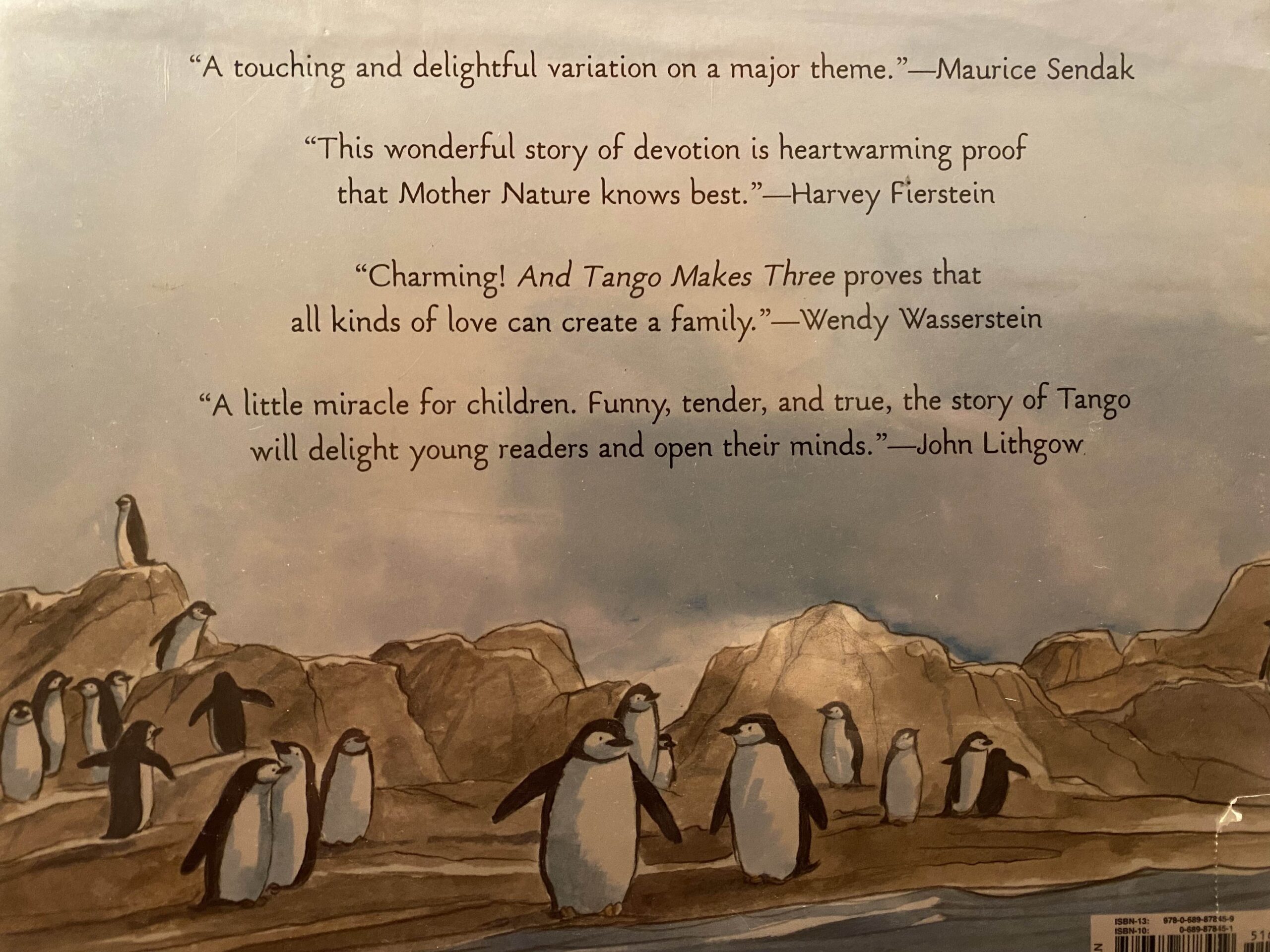
Seriously, this was quite the collection of blurbs. And, as Kate rightly points out, this blurb from Sendak was not exactly his greatest work.
I talk about this on the show, but in April of 2022 I conducted an interview with the authors of this book in a piece called And Tango Gets Banned Again? Book Banning Perspectives from Peter Parnell and Justin Richardson. There’s a lot of good history information about the book there, so feel free to check it out.

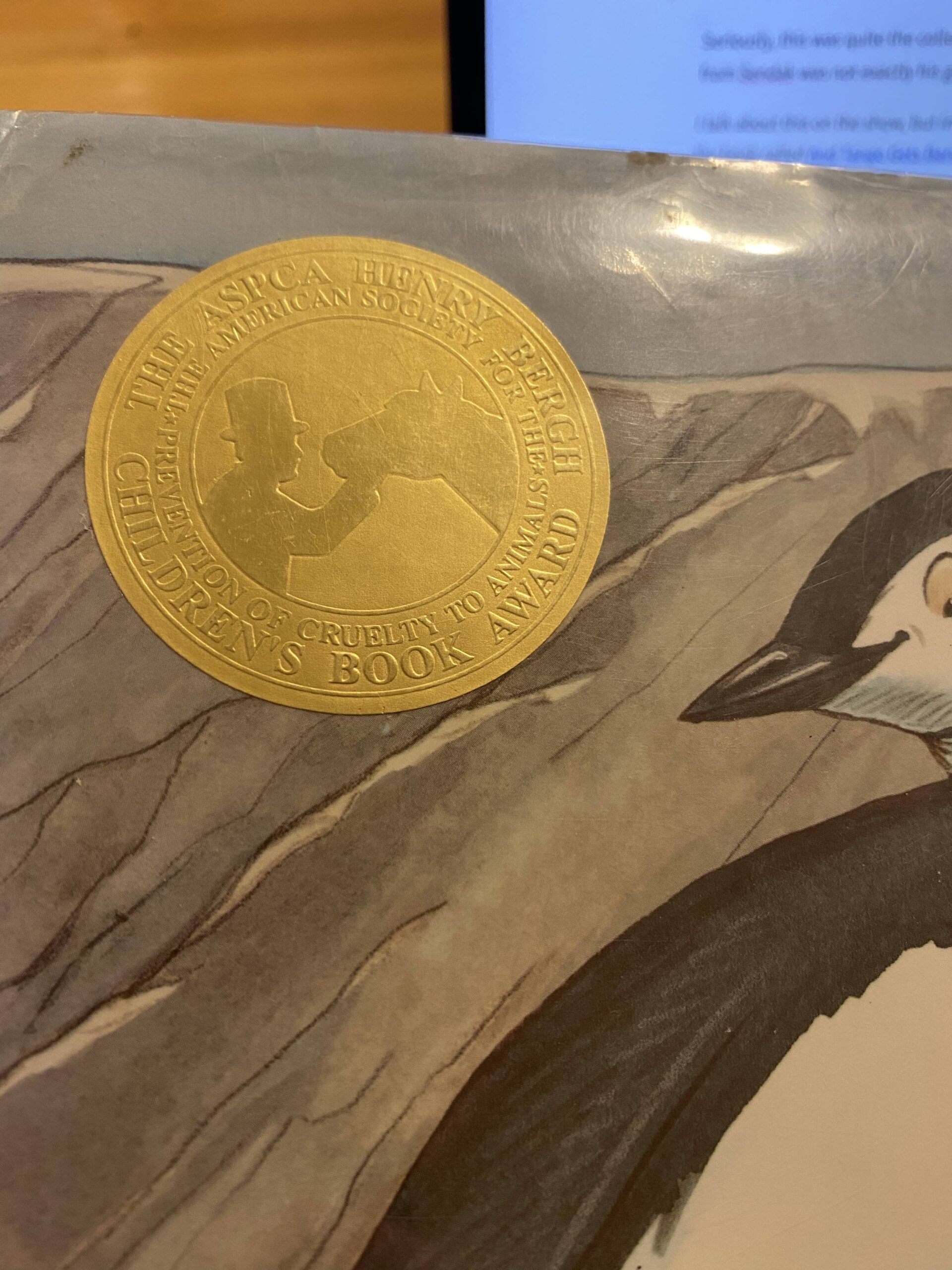
I didn’t even know the ASPCA even gave golden book awards! I literally didn’t know that that existed.
I loved these statues because I regularly collect children’s literature statues from around America. You can check out one of those posts here.

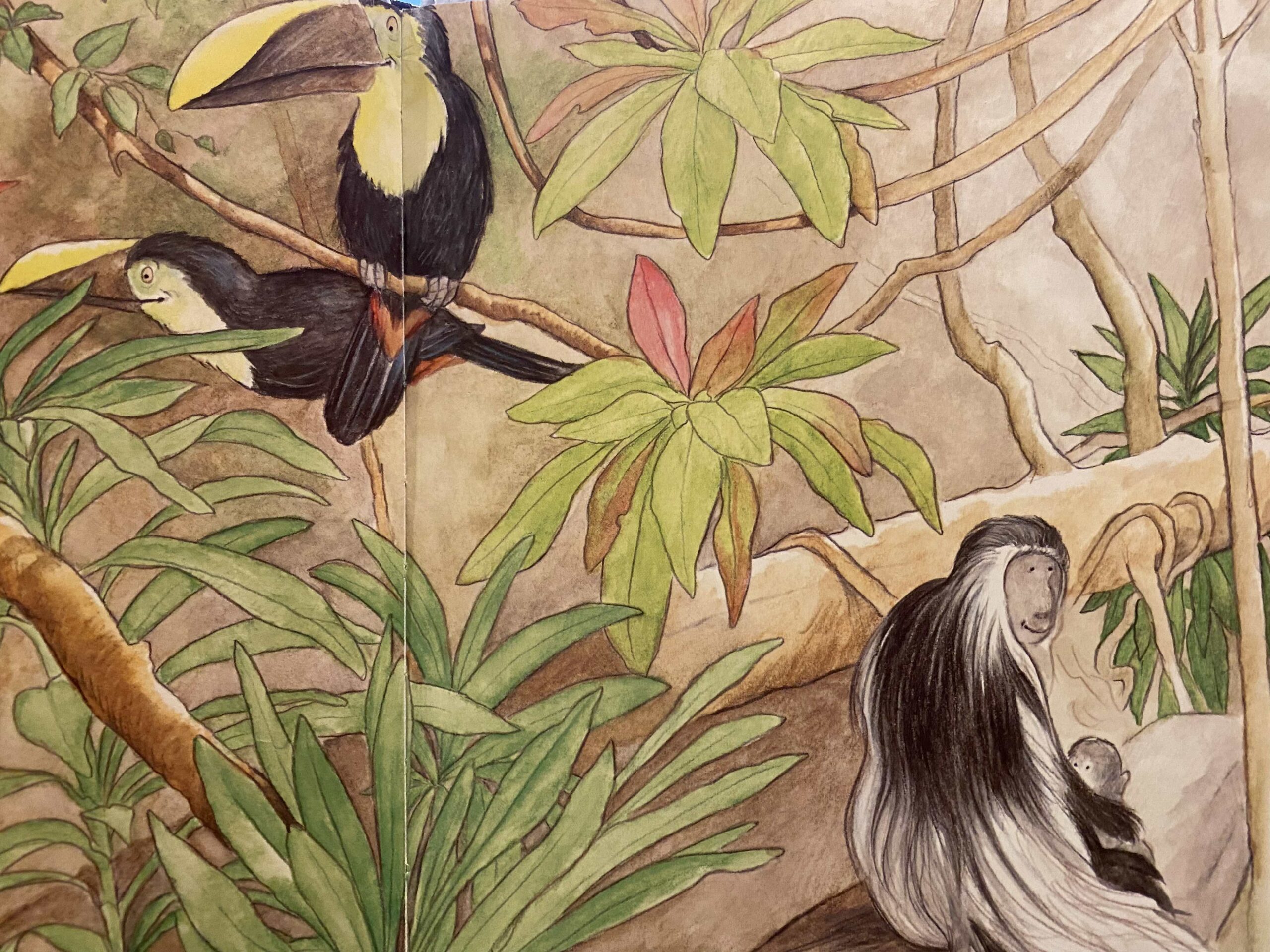
I don’t remember, actually. Do they put the monkeys and birds in the same enclosure at the Central Park Zoo? I honestly cannot recall.
This baby penguin has broken the fourth wall and it is currently Kate’s top pick for a tattoo from this book.
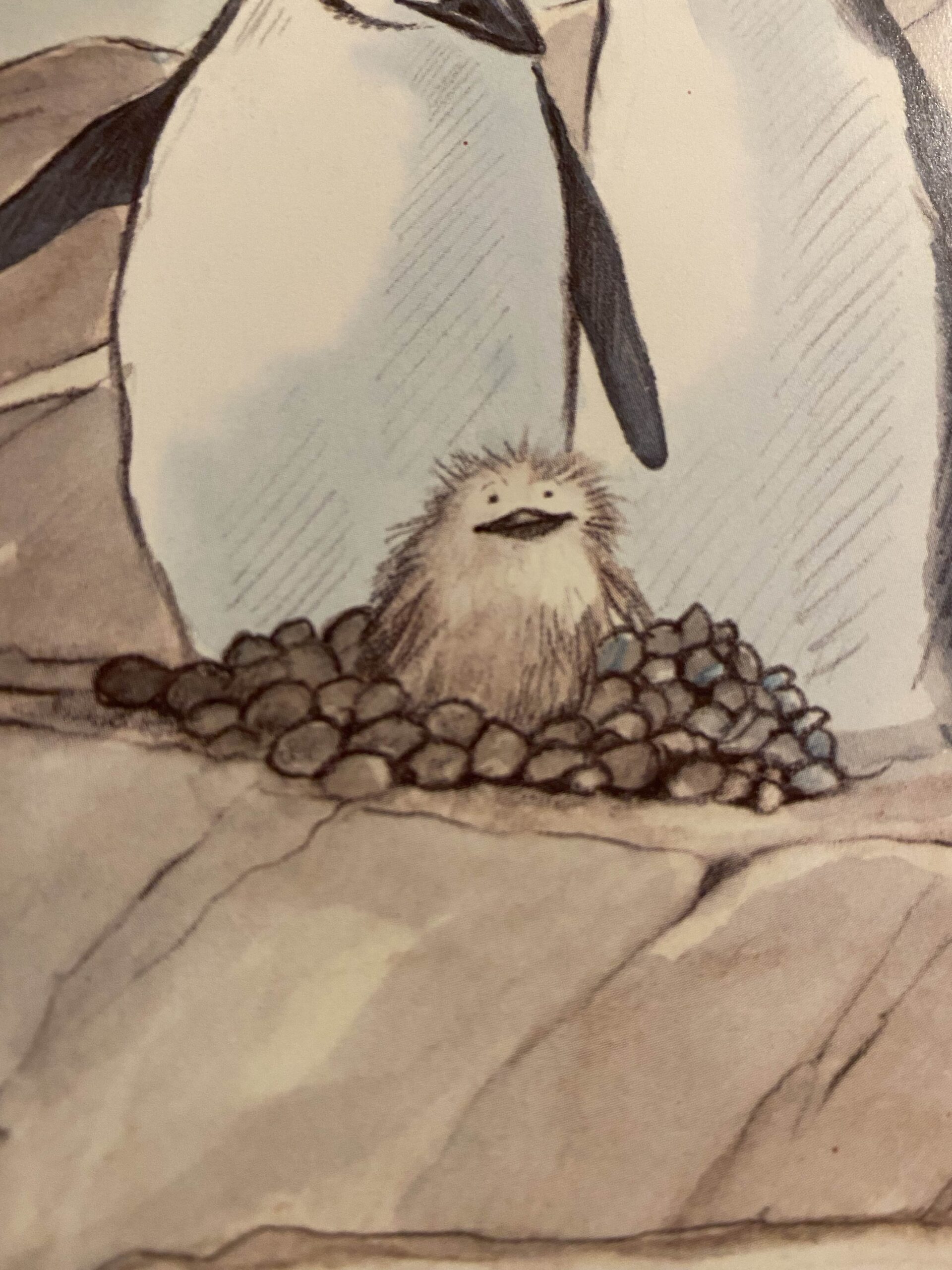
“What?”

“I dunno, man. I dunno.”

12 eggs? 16? Who cares? This is a cool sequence.
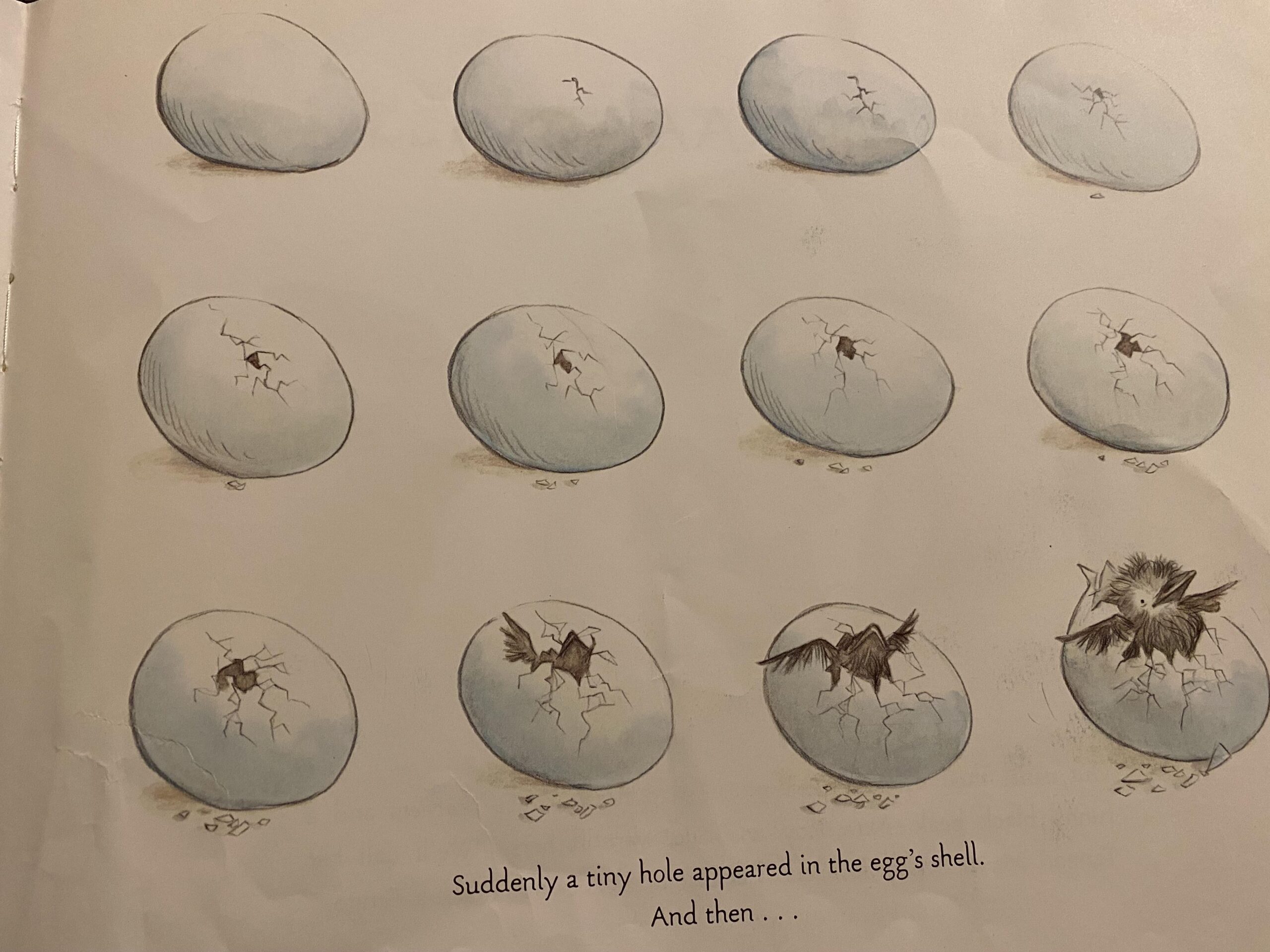
And, once again, Kate recommends Queer Ducks by Eliot Schrefer, which makes it very clear that this is hardly uncommon in the animal world.

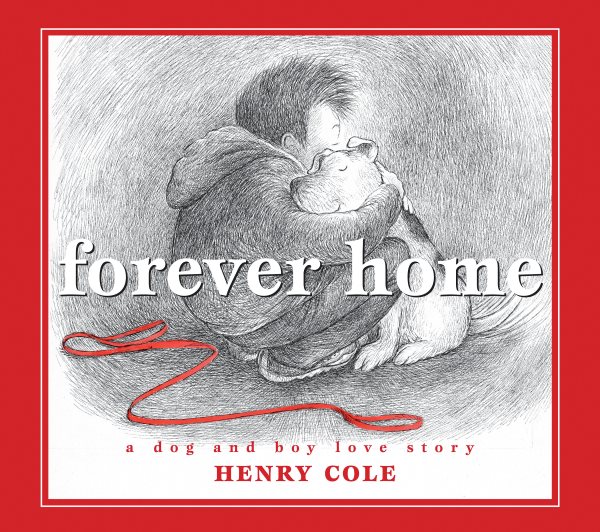
Interested in the latest Henry Cole picture book that features two dads? Then check out his wordless 2022 title, Forever Home: A Dog and Boy Love Story.
And just for fun, check out this recent LeVar Burton video from The Daily Show that features this beloved title.

Here is Don’t Be Afraid of Robert Munsch’s Love You Forever. An article that was very strange, since it sure sounded from the outset like it was about the scarier elements of the title. Thanks to Amy Rooks for the link.

Betsy Recommends: 3,000 Years of Longing

Kate Recommends: CB Strike
Filed Under: Fuse 8 n' Kate Tagged With: And Tango Makes Three, Fuse 8 n' Kate, Henry Cole, Justin Richardson, Peter Parnell

Review of the Day: Pina by Elif Yemenici, translated by Sydney Wade

September 23, 2022 by Betsy Bird

Pina
By Elif Yemenici
Translated by Sydney Wade
Tilbury House Publishers
$18.95
ISBN: 9780884489481
Ages 4-7
On shelves now

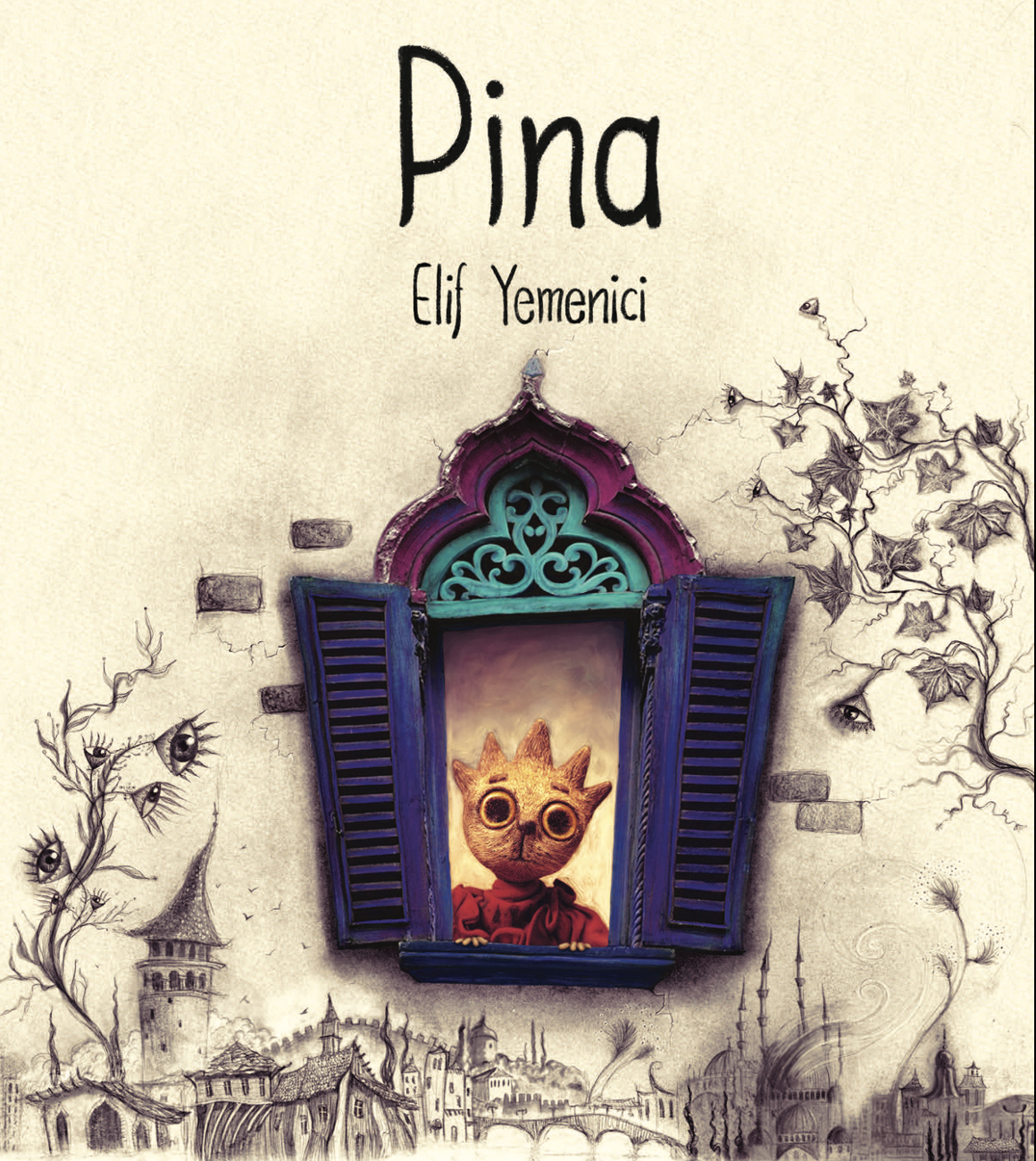
After 9/11 happened, American publishers were faced with a dilemma. How much to put in book form? How soon? Over the years that followed, a number of titles were released, but none were quite as touching and clever as the Caldecott Award winning The Man Who Walked Between the Towers by Mordecai Gerstein. It succeeded perhaps because it acknowledged the tragedy, but didn’t make it its focus. Other national events, good and bad, have rendered similar results. When something big happens there is a pause, some fine but not great books come out, and then something tangentially related that’s just about brilliant comes out. It’s been more than two years, as I write this, since the COVID-19 pandemic forced us all to shelter in place. And, as might be expected, we’ve seen a number of picture books discuss it in some way. From the blatant to the obscure, they vary. Now Pina a little picture book coming out of Turkey, could be about any number of things. Yet for me, and for a fair number of my children’s librarian colleagues, it seems pretty clearly about lockdown, anxiety, mental health, and a world out there where anything could happen to you, good or bad. It is entirely possible that artist and author Elif Yemenici never intended this little tale, about a cat boy with big eyes and even bigger fears, to be about anything more than a trip for cheese on a sunny day. However, for many of us, parents of children who saw their anxieties spike over the last few years, Pina is a balm and a comfort. A gentle reminder that no matter how bad things may seem, there is room in this world for both the snugness of home, and the beauty of the wider world.

Pina is the kind of creature that likes everything just so. A tiny warm house. Cozy blankets. Good books to read. If he had his way he’d stay in his little home forever without ever having to set foot outdoors. Unfortunately, one day he discovers that he’s almost out of his favorite cheese. Food connoisseur that he is, Pina worries and frets about all the horrible things that could happen to him if he left the safe confines of his home. At last, necessity outweighs anxiety, and off he goes. At first, it’s just as terrifying as he feared, but when a small act of kindness cuts through his worries, he realizes that maybe there are reasons to go outside as well as inside. After all, “the stories most worth telling rarely start at home.”

As a parent of children that were confined indoors for long periods of time during the early days of the COVID pandemic, I have personally witnessed the anxiety that can strike a child used to the familiar. There’s a large part in all of us that would prefer to stick with what we know and love over what is unfamiliar and unexpected. Breaking through our comfort zones can be an act of rebellion in a way. What’s remarkable about Pina is that the book can be read any number of ways. If you wish to read it in such a way that Pina himself has anxiety, it certainly lends itself in that direction. If, instead, you want to read it just as someone stuck in their ways, just needing a little nudge in the right direction, that works too. Pina, as he appears on the page, embodies physically both old and young aspects. His habits (and album choices for that matter) are definitely Generation X. But his eyes? His big yellow eyes, so wide and scared and, maybe a little bit, hopeful. They’re young eyes. The art supports the text and the text supports the art. Altogether, it’s a marvelous example of what the best picture books are capable of doing.

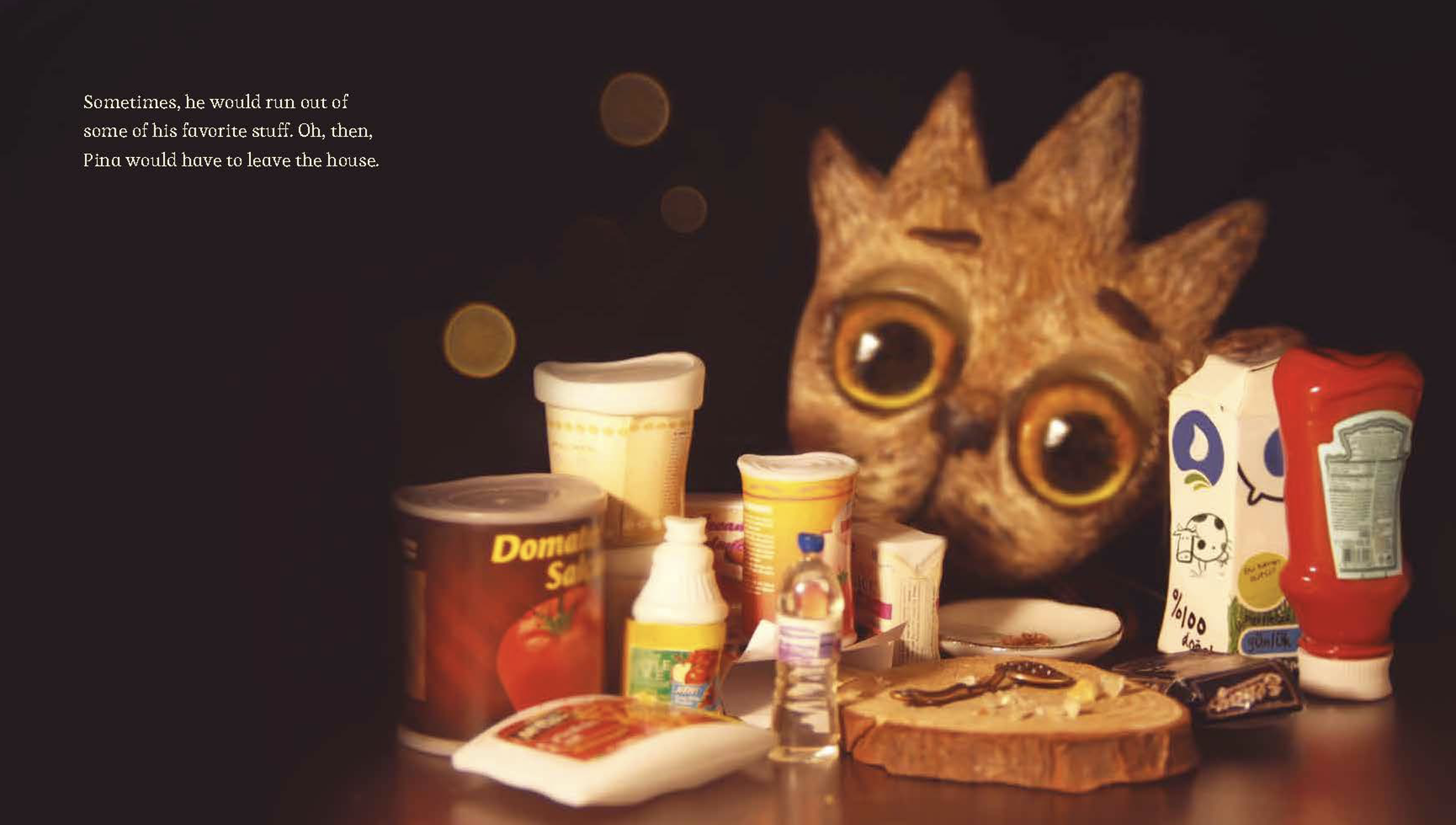
Yemenici makes it even more difficult for herself by mixing up her media. The home is done with models, but when Pina steps out into the city and leaves his cozy abode, the world outside his door is drawn. The people are drawings. The city, sky, and sea are all drawn. The reason for this is quite clear. Pina’s home is the most real to the reader. We’re seeing the world through his eyes, and outside everything seems two-dimensional and unreal. His home, in contrast, is three-dimensional and filled with little nooks and crannies. You just want to dive under that comfy comforter of his and sleep for a long long time as the rain plays against the windowpanes. This clever method of removing not just Pina but the reader as well from the outdoor scenes gives the whole book a certain sense of danger and separation that might be difficult to attain through words alone. It’s a technique that serves the storytelling, which should always be the ultimate goal in a picture book.

Modelwork (or “handcraft figures” as Yemenici’s website calls them) is not simply a case of creating cute mini record covers and delicate teacups for teeny tiny hands (though that is part of it). It’s also about lighting and photography. You might create the loveliest little dollhouse-sized scenes in the world, but unless you know how to wield a lens or two, no one’s going to be able to properly appreciate your work. Allow me to give you an example. In one particularly striking image in this book, Yemenici chooses to make clear visually what a big deal it is that Pina doesn’t have any cheese, creating this marvelous composition with a very narrow depth of field. This scene is the inciting incident that sets the whole plot into action. In the shot you get a fair number of food products (including the cutest miniature water bottle you ever did see) alongside what is clearly a plate filled only with cheese crumbs. The spotlight, as it were, is on these crumbs. A darkness surrounds everything else, with Pina’s large woeful eyes, a little out of focus, staring at the place where the cheese should be. Like a good film, the lighting and lens work is doing a great deal of the emotional heavy lifting. Even if you opened this book to this page and didn’t read a word, you’d know it was a tragic scene. A tragic cheeseless scene.

I scouted about on the internet in the hopes that perhaps an English language translation of an interview with Turkish creator Elif Yeemenici might exist somewhere. Maybe she could explain precisely when she created the art for Pina and what the impetus was. And though I did find a truly delightful video of her creating the props, lighting, settings and scenes, no interview was forthcoming. No matter. You needn’t look any further than Pina’s great big wide eyes to know that this story came from a place near and dear to the illustrator’s heart. One thing I particularly liked about the book was the fact that at the end Pina hasn’t made a friend. Not really. Picture books are often full of raising children’s expectations about how easy friendship is. You just walk into a playground and BLAM! Friend made. Actually, I take it back. I guess Pina kind of does make a friend in this story. He makes friends with a beautiful, unpredictable world. When he sits in that last shot on a bench watching the sea, it’s as if the world is just sitting there right alongside him. And look, no one’s going to tell you that this book will cure your child of their fears or their anxieties. But with its honest look at the essential goodness of the outside world, it’s not a terrible choice for the kid that could identify with what Pina feels. Looking unlike almost any other books for kids out there, Pina is a little treasure worth discovering. Bring it into your home and keep it safe from harm.

On shelves now.

Source: Final copy sent from publisher for review.

Videos: For an utterly charming video that looks at the creation of Pina (and contains both cute cats and some clever stop animation) please go here.

Filed Under: Best Books, Best Books of 2022, Reviews, Reviews 2022 Tagged With: 2022 picture books, 2022 reviews, Best Books of 2022, Elif Yemenici, models, Sydney Wade, Tilbury House

Freedom and Glory: An Interview with The Story of Ukraine creators Olena Kharchenko, Michael Sampson and Polina Doroshenko

September 22, 2022 by Betsy Bird

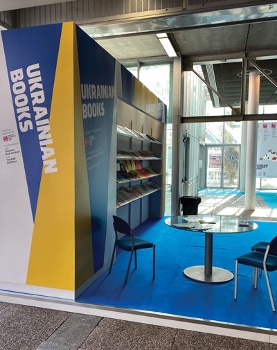
In March of this year I visited the Bologna Book Fair, an international rights fair of children’s literature. Not long before my arrival, Russia had invaded the Ukraine and I was floored by the number of supportive signs, booths, and remembrances the Fair had made in support of the Ukraine. In the intervening half a year since, Ukraine still finds itself at war. In such times, we often turn to children’s books, in the hopes that they teach our children, but honestly we want to be taught too. Taught to know more about the world outside our borders.

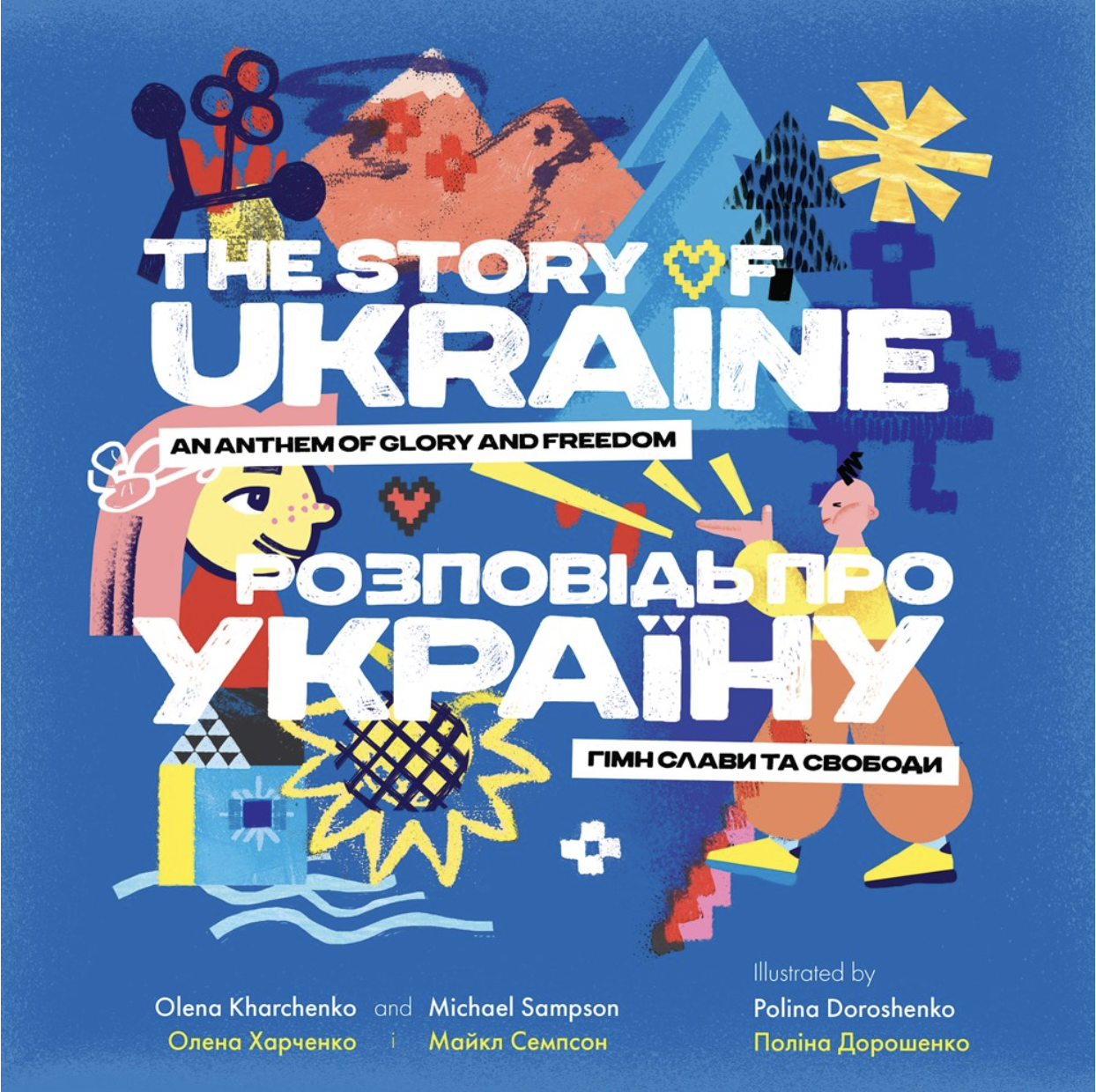
Ukrainian National Olena Kharchenko and New York Times bestselling author Michael Sampson have joined up with illustrator and Ukrainian refugee, Polina Doroshenko on a book slated to hit shelves December 13, 2022. THE STORY OF UKRAINE: An Anthem of Freedom and Glory is unlike any other book for kids here in the States that we’ve seen on the topic. One publisher described it to me this way:

“Michael Sampson was a Fulbright scholar to Ukraine teaching elementary English, and reporting on his work from Poland, once evacuated, as seen in The Chicago Tribune, The New York Post, The New York Daily News, The Tampa Bay Times, School Library Journal ,The Horn Book Magazine, and NPR. Sampson was invited to President Biden’s speech in Warsaw Poland, in which the President honored heroes helping displaced refugee families. As Sampson was attending a peace rally, he had overheard a group of people singing the Ukrainian national anthem and was filled with hope for a better future. He was reminded of a book he’d done with Bill Martin Jr titled “I Pledge Allegiance” about America’s national anthem and wondered if he might be able to do something similar for Ukraine. .

The Story of Ukraine is a much-needed book for the moment we’re facing. As children make sense of what is going on in the world, books are the greatest resource! This English-Ukrainian picture book is bi-lingual, teaches the Ukrainian national anthem, and provides a window into the country’s history for both English and Ukrainian children (rights are currently being sold around the world so that children everywhere can know Ukraine’s story).”

Given the chance to interview the creators, I did so with gusto:


Betsy Bird: Thank you so much for joining me today and answering some of my questions! Michael, the story of how this book came to be intrigues me. You yourself have a whole history with the country of Ukraine. Could you give us a sense of your history with this particular nation?

Michael Sampson

Michael Sampson: I first visited Ukraine in 2003 while I was living and working in Germany and Italy. I had an invitation to visit schools in Zaporizhzhia, Ukraine, and I said yes! I had always been fascinated with the history, geography and people, and could not wait to visit. The reality was even better than my expectations as I met wonderful teachers and children in the schools and had some of the best meals in my life. I have been going back to Ukraine about every year since then, culminating with my Fulbright to Ukraine in 2021–22.

BB: A related (and possibly answered already) question: How did this book come to be? Besides the impetus of the invasion, what does it mean to you to have it out in the world?

MS: When we first arrived in Ukraine on my Fulbright and I heard the Ukrainian national anthem, I shared with Olena that it would make a great picture and information book, much like my prior book I Pledge Allegiance had in the US. Olena told me the anthem would be difficult to explain for children, as it came out of an era in the 19th century when Ukraine was under attack. It was not a pleasant topic, so we passed on the idea. When the Russians attacked Ukraine in February 2022 with their horrible war, killing civilians and destroying cities, the anthem made sense as the people rose up to defend their homes, just as the anthem describes. Suddenly it was relevant and became a passionate story. 

BB: Olena, thank you for answering my questions. How did you first come to hear about this project?

Olena Kharchenko

Olena Kharchenko: Michael was working in Poland with Ukrainian children and adult refugees after the Russian aggression started. He attended many protests there and shared an idea about writing a book about the Ukrainian national anthem that he heard there many times, as he loved the passion people sang it with. Of course, I was excited and supported his idea. I thought it was very good timing for that project and a way to get the truth out about Ukraine’s history.

BB: Olena and Michael, trying to reduce a country’s influence to a limited number of pages has to be difficult. What was your guiding principle on what to include?

Olena & Michael: We placed the Ukrainian national anthem in the center of the book. We led up to the anthem in the first few pages sharing the rich, colorful and brave history of the Ukrainian people. After the telling of the anthem, we share more about the geography, national symbols, food and notable Ukrainians through history. The guiding principle was to combat Russian propaganda with the truth of this centuries old nation and their love of freedom. It was indeed impossible to tell this story in 32 pages, so the publisher generously agreed to expand the book and gave us 36 pages!

BB: Polina, you have a distinct style that separates this book from so many others by your art alone. I love the mix of styles. How do you tend to create your art? What style fit this book best and why?

Polina Doroshenko

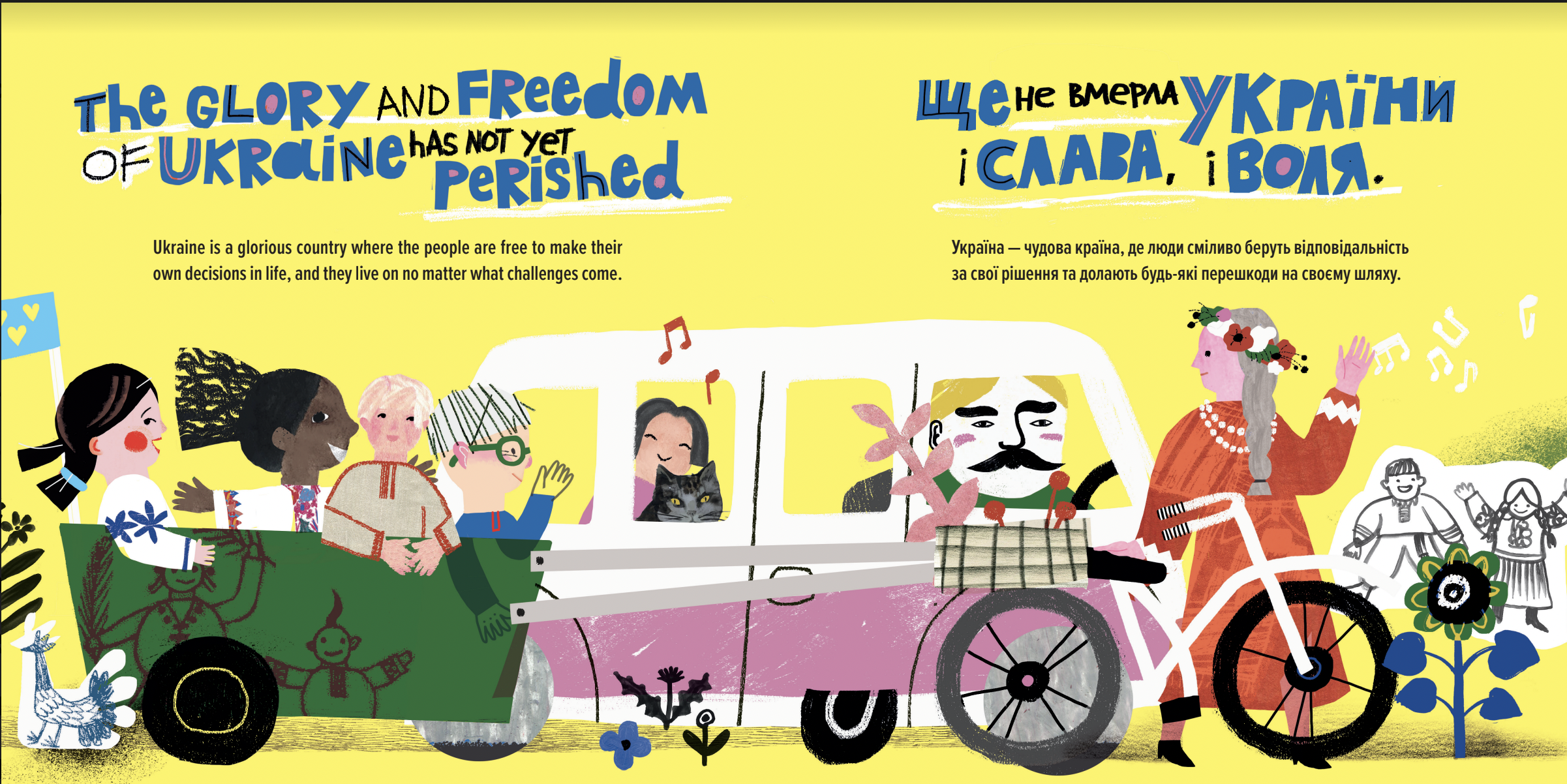
Polina Doroshenko: Thank you for your questions and feedback. The way the final illustrations look are influenced by many factors. I know that I can best show my abilities using a collage approach and layering of techniques. This is inherent in my artistic/visual language. But of course, before each of the projects, I have to analyze for whom this book is addressed in order to use it appropriately. 

Our culture is deep and multifaceted, so for me it is about multiplying and layering. For the book The Story of Ukraine, I wanted to create illustrations that would be understandable to a child and would provide more metaphorical “keys” for older viewers. Therefore, next to bright, simplified forms, we can see realistic contour drawings, and next to those historical fragments … fictional characters.

BB: Olena and Michael, was there anything that you wanted to include and found that you just couldn’t work it in?

Olena and Michael: Yes, it was very hard to do justice to the people and their land given the immenseness of Ukraine — even on 36 pages. Every topic we mentioned we were able to discuss using one expression or a sentence or two. The power of the books is that every one of those topics could be discussed by adults and extended. True, there were several topics we could not include because of the limited space. One of them was the traditional art from central Ukraine called Petrykivka. We are now in the process of writing a different book about it.

BB: Olena, what do you hope that kids take away from this book after reading it?

OK: I hope kids will find similarities between their nation’s values and views and the values that Ukrainians are standing for in this war. Maybe it will help kids to look at different topics from different perspectives and learn something new about the history and culture of Ukraine. 

BB: Michael, finally, what are you working on next?

MS: As a writer, I’m always working on multiple projects. We are finalizing the art on my fun and sweet book Bing! Bang! Chugga! Beep! with Bill Martin Jr and illustrated by Nathalie Beauvois. It’s going to be a great book — one of our best in years. Likewise, we have finished a fun book about idioms and second-language learning, The Pig, the Elephant, and the Wise Cracking Bird, which is in the spirit of Amelia Bedelia, but is culturally sensitive. The amazing art is my first collaboration with Hollywood-based artist Joshua Sampson — my son! Finally, Olena and I are almost finished writing another Ukrainian book about the magical, fairy-tale-like city of Petrykivka, Ukraine.


A great deal of thanks to Olena, Michael, and Polina for answering my questions today. Thanks too to Amy Goppert and the folks at Brown Books Publishing for suggesting this interview in the first place. THE STORY OF UKRAINE is out December 13th, so be sure to look for it then.

Filed Under: Interviews Tagged With: author interviews, illustrator interviews, Michael Sampson, Olena Kharchenko, Polina Doroshenko, Ukraine

“Provocatively Nuanced”: The Humanizing of Jackie Robinson

September 21, 2022 by Betsy Bird

Blessed be the children’s book creators that get that kids can comprehend nuance. And alas that so few do.

Photo Credit: Publishers Weekly

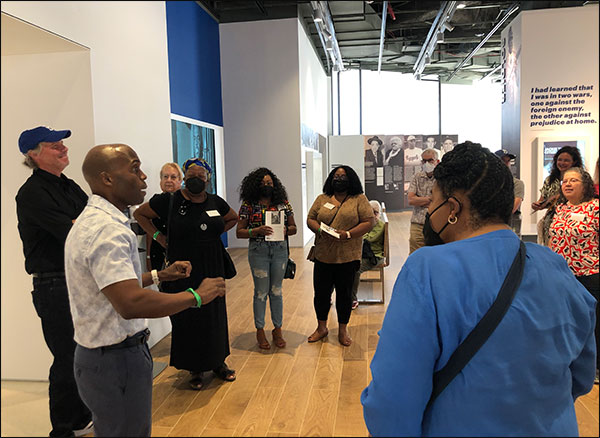
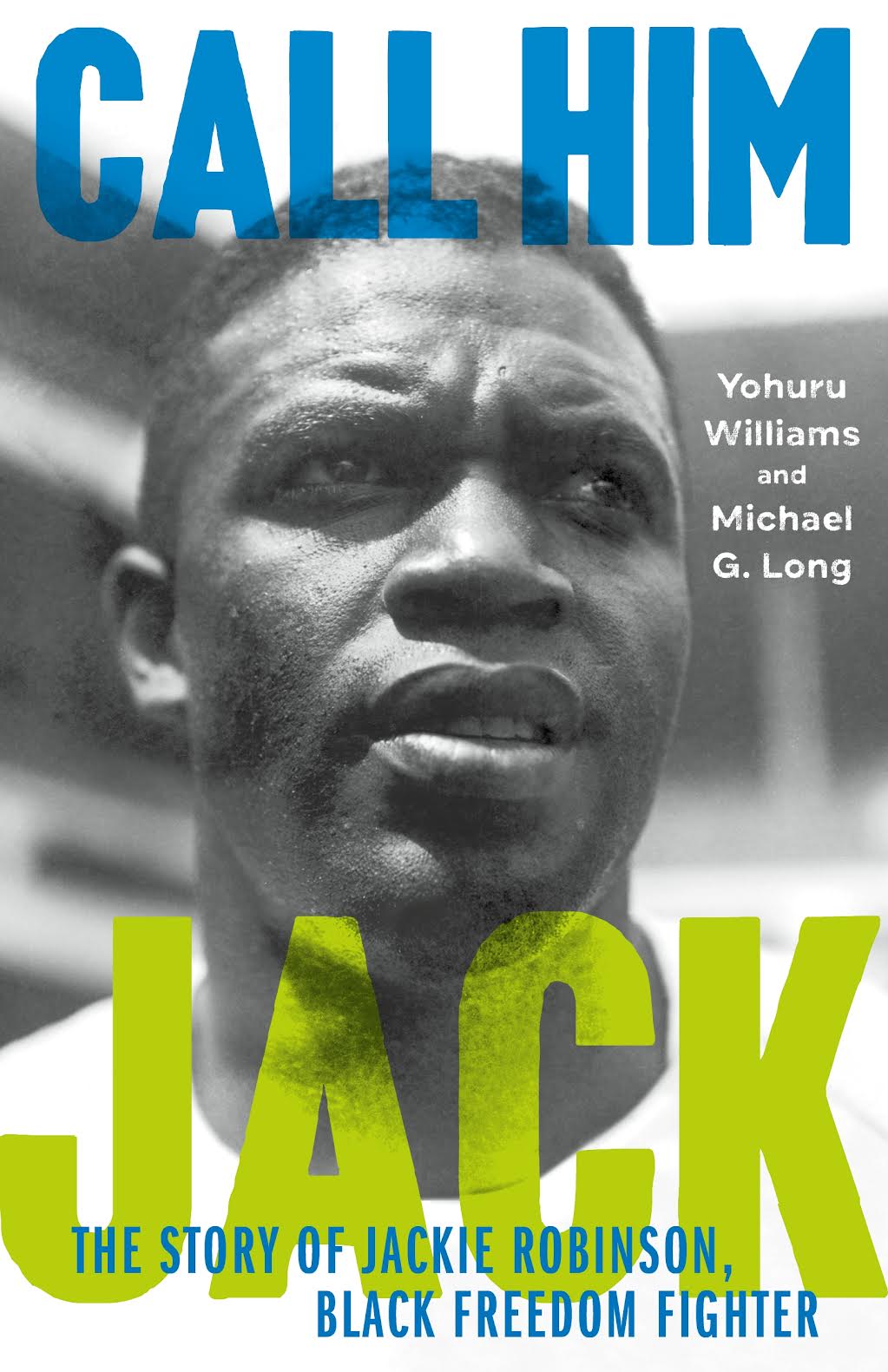
If you were skimming through your PW Children’s Bookshelf newsletter yesterday like me then you might have seen an article in there of note. ‘Call Him Jack’: Jackie Robinson Museum Tour it read. Inside it recounted a recent trip that publishing and library professionals took to the Jackie Robinson Museum located in New York’s Hudson Park. The occasion? The release (as of yesterday) of the middle grade biography CALL HIM JACK by Yohuru Williams and Michael G. Long.

I’ll admit that when I heard that there was another Jackie Robinson biography out for kids I was not impressed. What more is there to say? The man was noteworthy but haven’t all the biographies for kids that have come before covered him sufficiently? Williams and Long make the case that no, they have not. Or, as Kirkus said of the book in their review, this title, “Adds provocative nuances to the usual portrayals of a heroic American.” In short, it shows the activism of Jackie and it show his bull-headed side as well. And THAT was interesting to me. I’ve no time for saints, but give me a hero with flaws as well and you’ve got my eye.

Today I talk with Yohuru and Michael about the book, its impetus, Jackie’s legacy, and what it takes to write a “myth breaker”.

Betsy Bird: Yohuru and Michael, thank you so much for taking the time to talk with me about your latest. Now when I walk into a children’s library and make my way to the biography section, Jack(ie) Robinson is probably one of the better represented folks there. Maybe more so in the picture book bios than those for the 10-14 year old set, but there are still quite a few books. As Robinson scholars yourselves, what inspired you to write CALL HIM JACK for this particular age range?

College of Arts and Sciences dean Yohuru Williams poses for a portrait outside The Arches August 28, 2017.

Yohuru Williams: After surveying many of the books on Jack, we felt it was especially important to write a book about Jackie Robinson that elevated him among the pantheon of African American freedom fighters by recasting the familiar narrative around his integration of the Dodgers through the lens of the human being at the center of that important historical moment. We wanted to decouple Jackie Robinson, the myth and invention, from Jack Robinson the person. Young people in that 10-14 year old age demographic are complex individuals. They understand and appreciate contradictions and nuance perhaps better than anyone–because their lives at that age are very much centered  on navigating similar challenges of principle and identity. I know–I taught 9th and 10th graders early in my career in Washington, DC.  They ask tough questions and they long to see the humanity in their heroes and role models–as they struggle with finding their own path and sources of  inspiration. With the contemporary conversation focusing on athletes and social justice, we felt it was important to show that Jack was not only a baseball player but a freedom fighter–all his life. He was not drafted into the civil rights movement by virtue of his pivotal role in the desegregation of Major League Baseball. Fighting for equal rights was an integral part of his personhood, and he did this with the Dodgers and in every other place he went throughout his life–making less seismic but nonetheless significant change along the way.

Michael G. Long: I agree with Yohuru about the desperate need for a myth-breaking book about Jack, and I trust our young readers will find in our book a Jack Robinson they never knew about, a Black man who fiercely fought for freedom as a child, a youth, a Major League Baseball player, and, yes, a civil rights leader. May I say a bit more about why the middle-grade audience? For me, the answer is personal. I was ten years old when I overheard Mr. Stroup, my fifth-grade teacher, who was famous for cleaning his ears with no. 2 pencil erasers, encouraging my best friend Dean to read biographies. I had a competitive spirit and wanted to keep up with Dean, so on the next trip to the school library, I checked out some biographies of famous leaders in US history. (I’ve since learned the books were part of the “orange biographies” published by Bobbs-Merrill in the 1940s and 1950s.) I’d never been a big reader, but oh my goodness, I was hooked. After my family went to bed, I’d bury myself in the corner of the couch, just under the standing lamp, and travel back in time with George Washington, Betsy Ross, Thomas Jefferson, and more. Those wonderful nights of turning the pages until midnight marked the beginning of my interest in US history and my identity as a reader of nonfiction. So my answer to this part of your question isn’t about Robinson as much as it is about my fervent hope to provide middle-grade readers with a similar experience of feeling embedded in the past and inspired by someone who changed history for the better. I want middle graders to love history as much as I did, and to apply the lessons of history to today’s challenges. Unfortunately, the challenges Robinson faced – racism, police violence, economic injustice, and more – are still with us today.

BB: When Kirkus reviewed CALL HIM JACK it happened to mention that the book contained “provocative nuances”. Aside from that being my new favorite phrase, would you personally agree with that assessment of your title?

YW: I chuckled when I read that as well. I am not sure we were trying to be provocative. We simply wanted to give young readers an opportunity to meet the man behind the legend–unencumbered by the need to deify him in the process. Too many times historical figures morph into superheroes who barely resemble the ordinary people who had the strength and courage to do extraordinary things in their lives. We wanted to write a book about a person who should be very accessible to young people, especially in this moment, when they are faced with very many challenges and questions similar to what Jack faced. 

Michael G. Long, credit Elizabethtown College

ML: Yep, I smiled when I read that phrase.  The Jack Robinson I grew up with was the polite second baseman who “turned the other cheek” when breaking the color barrier in Major League Baseball. He was a nice Black man who integrated baseball.  There wasn’t much more to him than that. So imagine my surprise when a bit of research revealed a Jack Robinson who was not nonviolent, who believed in fighting back (sometimes with his fists), and who was rightly angry with white people who denied Black and Brown people the fruits of first-class citizenship. Really, it was as if I was encountering Robinson for the first time. He was more than a smiling baseball player; he was also a fiery personality who fought for justice before, during, and long after his career with the Brooklyn Dodgers. This Jack Robinson was far from one- or two-dimensional. Like our book, he was provocatively nuanced! 

BB: The title of the book is, in and of itself, interesting. Right from the start you’re calling him Jack rather than Jackie. Moreover, you’re using that name to make a point about how we frame history. Can you talk a little bit more about that?

ML: I didn’t start using the name “Jack” until I heard Yohuru use it in Ken Burns’s excellent documentary, Jackie Robinson. I’ve since followed Yohuru’s lead, and with good reason. When he was a young boy, Jack Roosevelt Robinson called himself “Jack,” and in high school, college, army, and the minor leagues, he signed his name as “Jack.” So when Yohuru and I call him “Jack,” we’re reflecting, and respecting, his own language. But there’s more to the story. In 1947, after Robinson debuted with the Dodgers, he typically referred to himself, in public, as “Jackie”—which is the name that Dodgers manager Branch Rickey and sportswriters, Black and white, bestowed on him—and from then on, only Rachel and their closest friends called him “Jack.” That gives provocative nuance to the story!  By using “Jack,” Yohuru and I aren’t pretending that we’re his close friends. We use the name as part of our concerted effort to unfreeze Robinson from the baseball diamond, where players often refer to one another by putting an “ie” on the end of their names (“Let’s go, Jackieeee!”), especially so that our young readers can see Jack as the important civil rights leader he was long after baseball. Yohuru and I also use “Jack” to unfreeze him from 1947, when he seemed so safe, so unthreatening—so unlike the fierce Black freedom fighter he always was. I don’t want to overstate the point, but in some ways, the name “Jackie” infantilizes Robinson and softens his character to make him more palatable to people who like their heroes uncomplicated, un-nuanced, and nice and sweet.

YW:  I would agree with Michael. On the occasion of his induction into the Baseball Hall of Fame, the Reverend Dr. Martin Luther King Jr. described Jack as a “sit-inner before sit-ins, a freedom rider before freedom rides.” We thought it was really important to introduce the readers to this Jack from the beginning, rather than the more familiar Jackie readers may think they know through books and movies that focus primarily on the integration of baseball.

BB: The time has hardly been better for reexamining the history we’re teaching our children. Too often a historical figure is reduced to a series of easy to repeat stories for kids. The more complicated elements are polished away with the belief that kids can’t handle knowing that someone can be both heroic and, sometimes, have opinions that we don’t always agree with. When putting this book together, how did you decide what elements to leave in Robinson’s life and what to take out?

ML: One of my favorite parts of the book is a photograph of Robinson kicking his glove high into the air. I love that picture because it humanizes him so much. It shows that our hero, our national icon, had moments of intense frustration, just as we do. That’s what we looked for—material that showed Jack in his full humanity. One of the most challenging parts of the selection process was the sheer volume of material. Robinson was involved in so many things—sports, civil rights, politics, entertainment, business, and more. Heck, he even had a men’s clothing shop in Harlem! Beyond considering what was age-appropriate (and not all Robinson stories are appropriate for a middle-grade book), we chose topics that allowed us to tell a good story. His baseball stats are fascinating, for example, but more compelling is the story of Jack leaving behind the “turn the other cheek” period and directly battling those who assaulted his dignity. We were also focused on material that showed Robinson fighting for Black freedom in his childhood and during the civil rights movement, two periods that are often downplayed in Robinson books. Because of this, we felt free to exclude some material from his baseball years.

YW: I couldn’t agree more. It is very important to emphasize this for young readers. There was a time when the biographies of great individuals were molded into simple morality tales to highlight the character and virtues of the subject. In the process, this transformed ordinary women and men into superheroes who seemed beyond the grasp of young people. Reimagining the way that we talk about historical and heroic figures to encompass elements of their humanity, including their flaws, not only makes them more accessible but relieves young people of the expectation and burden that in order to do something meaningful or substantial, they need to be perfect. Jack Robinson was far from perfect, but through the strength of his conviction and the leveraging of his athletic ability and intellect to push for civil rights, he helped to transform the nation. Through his story, every young person can learn that they can also have the same impact–even if in smaller ways–by staying true to their convictions and working toward justice.

BB: Finally, do you have any inclination to make other books for kids?

ML: I love working with Yohuru. We share an enthusiasm for telling stories about civil rights, and we bring such different perspectives to the table. His use of “Jack” is a perfect example of the way that his perspective has energized me and helped me grow as a thinker and writer. We’re hoping to make other books for young readers, especially ones that will inspire them to become freedom fighters in their own communities. Yohuru and I certainly have more great stories to share!

YW: Absolutely. Working with Michael was a pleasure, and there is so much history yet to be explored for young readers. We already have plans to work together again. We agree that young readers need books and stories that not only introduce them to inspiring historical figures, but invite them to imagine a world in which the challenges those individuals faced, such as racism, can be eradicated, and to begin reflecting on how they can be part of that change.


Now that’s what I call an interview.

I want to thank Yohuru and Michael for taking the time to respond to my questions so thoughtfully. Thanks too to Morgan Rath and the folks at Macmillan for the opportunity to dive a bit deeper into this release. CALL HIM JACK is on bookstore and library shelves everywhere as of yesterday. Be sure to give it a read.

Filed Under: Uncategorized Tagged With: author interviews, middle grade biographies, middle grade nonfiction

The Secret of History of Hatteras Island: A Guest Post by Newbery Honor Winning Author Sheila Turnage

September 20, 2022 by Betsy Bird

Each year, thousands of vacationers visit North Carolina’s Outer Banks, whose shores often top Best Beaches lists. People drive over from the mainland, sail across the Pamlico Sound, or putter over on pug-faced ferries. They come for endless beaches and rolling dunes. For fishing and wild ponies. They come to climb the Hatteras Lighthouse.

Maybe, like me, they also come for Hatteras Island’s World War II history—a story I stumbled onto a half-century ago as I strolled a white sand beach with my father. “What’s that?” I asked, pointing to a black patch on the sand.

“Oil,” he said. “In World War II, German U-Boats sat right out there, torpedoing our ships. The ships still sit on the bottom of the sea, leaking oil. That’s our secret history.”

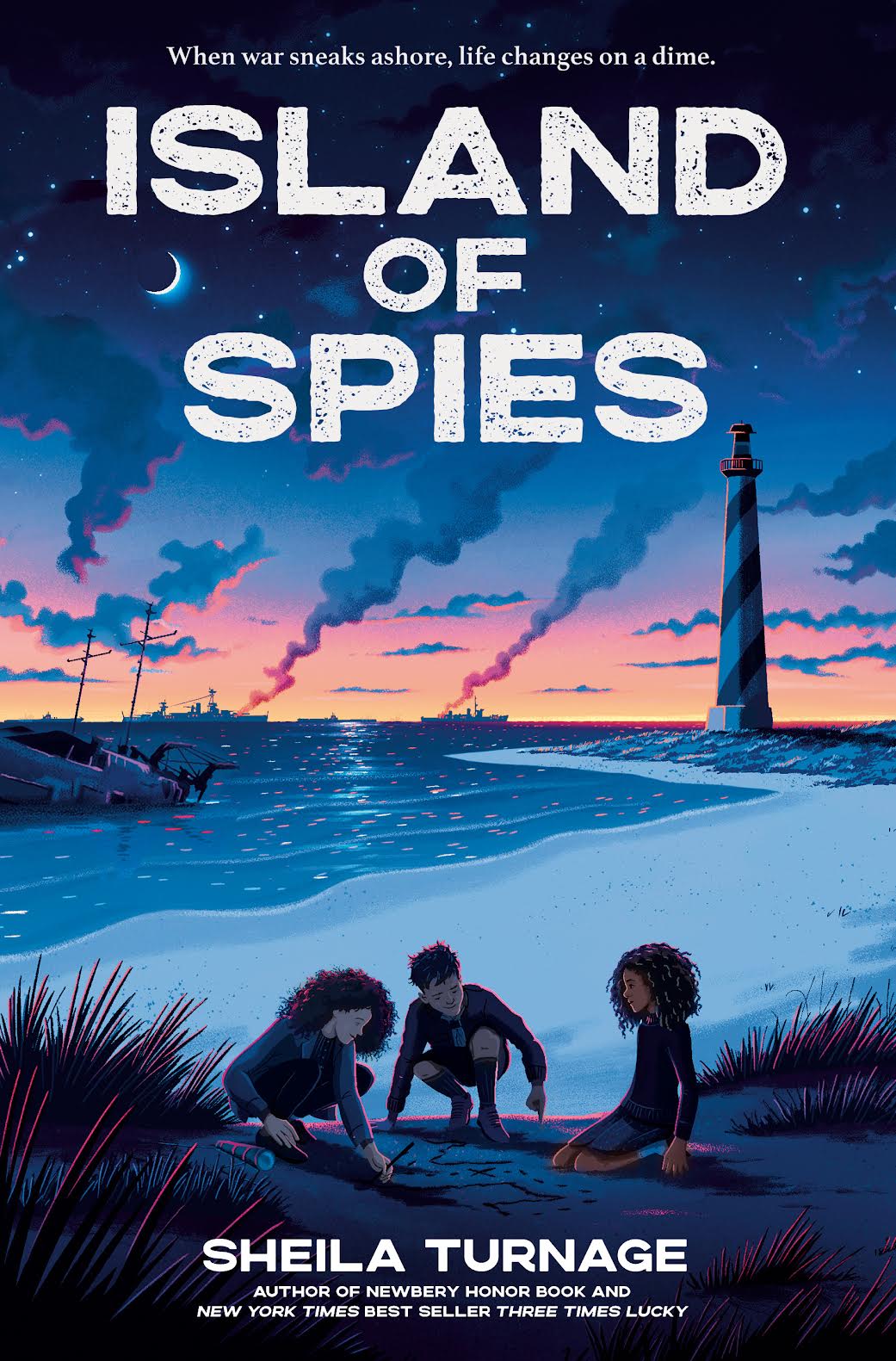
And that’s how I met the backstory for my latest middle-grade novel, Island of Spies, set on Hatteras Island in 1942.In case you’re not familiar, here’s the scoop:

At the start of World War II—before the bridges—Hatteras Island was a world apart. It owned no paved roads. A single bus puttered over the sand, stitching together tiny villages along the Pamlico Sound.  Men fished or traded, women ran households. Children went to combined-grade schools where “quit-uating” was as good as graduating.

Offshore, shifting sandbars and deadly currents created some of the most dangerous waters in the world—”the Graveyard of the Atlantic.”

In January of 1942, as Island of Spies opens, those waters become even deadlier.

Japan has bombed Pearl Harbor just weeks before, crippling America’s navy. While America looks westward, fearing another attack, Nazi Germany strikes from the east—sending German subs, called U-boats, across the Atlantic to Hatteras Island, and into some of the richest shipping lanes in the world.

blam!

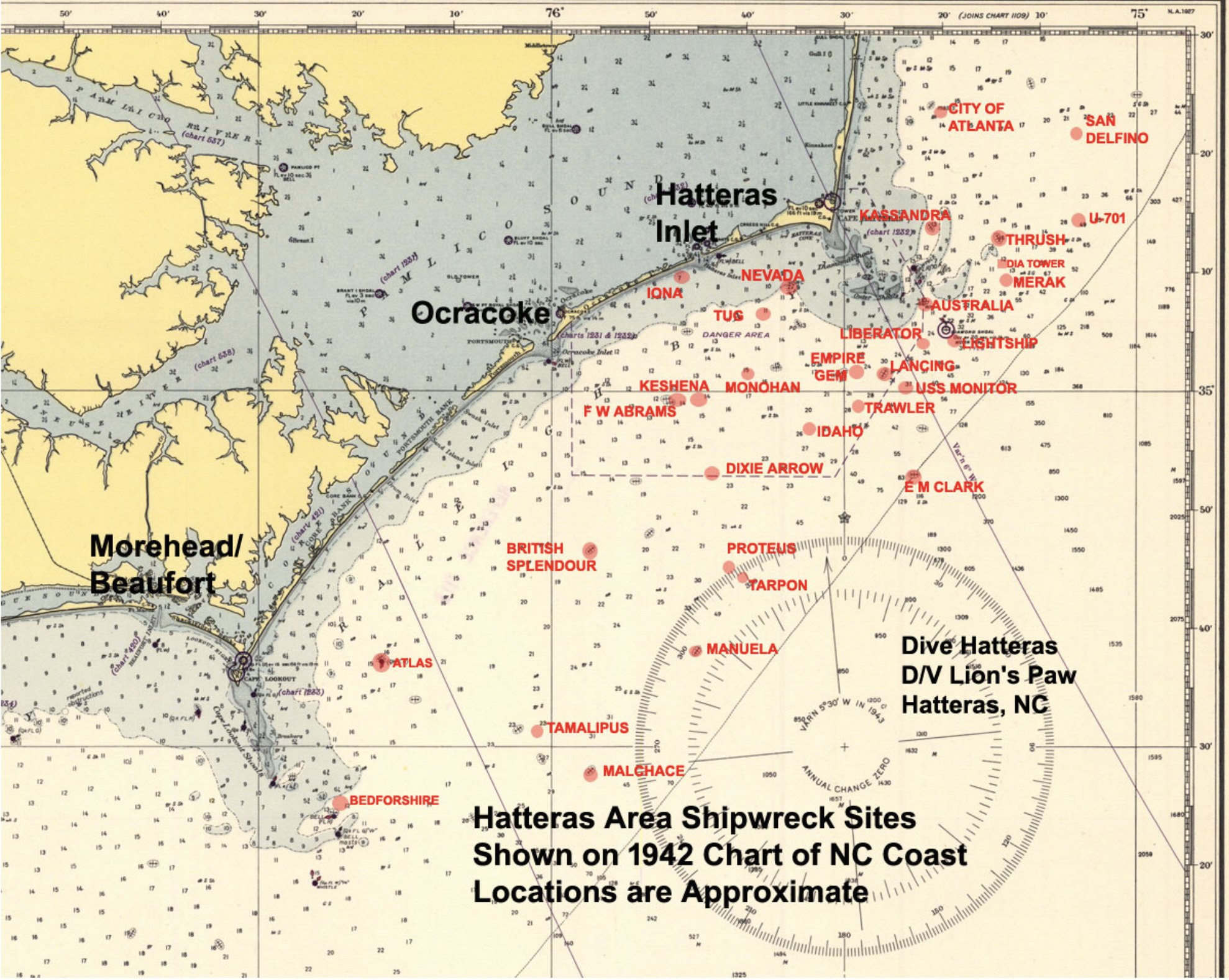
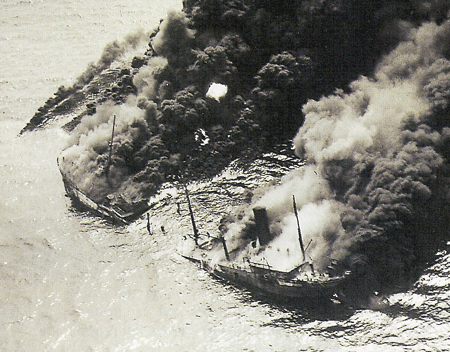
A ship called the City of Atlanta takes a torpedo strike and explodes, rattling windows and shaking islanders’ nerves. As my main characters—Stick, Neb, and Rain—watch the ship sink, protagonist Stick Lawson feels it in her bones: Change has come to Hatteras Island.

Stick and friends wait for help, just as islanders did in real life. But thanks to Pearl Harbor, America has no ships to send. As in history, U-boats pick off oil tankers, trawlers, and freighters at leisure. In six months, U-boats sink more than eighty ships along the North Carolina coast, with hundreds of lives lost. The government marks as muchnews as possible classified, to keep an already frightened nation from panicking.

Hatteras Island is on its own.

In Island of Spies, as rumors of Nazi agents race up and down the coast, Stick and her friends—aka The Dime Novel Kids—assign themselves a tough case: to capture a spy. It’ll help them earn the respect of islanders (unlikely), protect a world they love, and maybe even snag a prime assignment from the FBI, who refuses to write them back.

Island of Spies isn’t a war story, but the war provides a dramatic backdrop for a book about friendship, fathers, and the strangest kids on the island. It’s about being invisibilized and willing yourself visible again. About recognizing friends in enemies and enemies in friends. About standing up to prejudice, keeping your cool undercover, and learning to count on each other—no matter what.

Still, its backstory—the history—is worth a look next time you visit Hatteras Island. There’s no museum dedicated to it, but its footprints lead to scattered museum exhibits, dive shops . . . even to a seafood dinner. If you like history (or even if you don’t and it’s raining on your vacation), it’s a trail worth following.

The Graveyard of the Atlantic Museum, on the island’s southern tip, covers centuries of maritime history, and houses World War II Coast Guard uniforms and artifacts, U-boat armaments, and my favorite item: the U-85’s enigma machine, which encoded and decoded U-boat messages. You can almost feel a young sailor’s fingertips hovering over the keys—a feeling I blended into Island of Spies.

Image Credit: Dave Sommers, Dive Hatteras LLC

Last time I visited, tableaus of furniture, doors, mirrors, and books washed ashore from shipwrecks and used in island homes intrigued me. The exhibit may have rotated on, but you’ll see evidence of that intrigue in Stick’s mother’s library, and in Stick’s encyclopedias—complete except for the missing volume K.

Near Rodanthe, you’ll find the Life-Saving Station, one of the most complete historic life-saving sites in the nation. (If you can’t pronounce Chicamacomico, don’t feel alone. One of my characters can’t, either.) I love the feel, pride, and swagger of this place. Among the displays in this five-building site, you’ll see the World War II uniforms Coast Guard members wore as they watched for attacks during Stick’s time. You’ll see medals and shipwreck artifacts, and you can see and touch the kind of rescue skiff the Dime Novel Kids longed to see as the U-boats’ first victim, the City of Atlanta, went down in the waters off their island in 1942. You’ll hear tales of famous sea rescues involving the islanders who staffed the station. Just ask the docents to point you to the World War II artifacts.

(Confession: I snagged a few details from this site’s Cook House and the 1907 Midgett House for Stick’s home. Check out the floor pattern in the living room of the Midgett House, for instance, and then check Stick’s.)

The Dixie Arrow

With so many ships down in 1942 (and over the centuries, really), the waters off the Outer Banks offer the best wreck diving along the East Coast. Dave Sommers, an owner of Dive Hatteras LLC in Frisco, says certified divers love the Dixie Arrow, both for its history of heroism and easy access. The ship went down in 1942, and lies in ninety feet of water.

But favorites do change. As always, shifting currents rule the Graveyard of the Atlantic. The Australia (1942), in about a hundred feet of water, teemed with divers and sharks until changing currents recently covered ninety percent of the wreck in sand. There’s no lack of sites waiting to take its place, though, including the popular World War II wrecks the Empire Gem and the Kassandra Louloudis.

In the interest of equal time, when it comes to U-boats, the U-352 is popular, but you’ll have to leave the island to dive it. It’s located to the south, across from Morehead City, North Carolina.

If you prefer the restful nature of cemeteries to wreck diving and sharks, as I do, check out the tiny Buxton British Cemetery, which honors men who went down with the British tanker San Delfino in 1942. The last time I visited, people had left an odd but touching collection of gifts—a flower, coins, and a bottle of beer left open in salute.

And if you like a side of history with your dinner, stop by Owen’s Restaurant in Nags Head. You’ll find a museum-worthy collection of artifacts in the lobby and at least one 1946 recipe on the menu. (I’m looking at you, crab cakes.)

Finally, the 30,000-plus-acre Cape Hatteras National Seashore, so often voted a top US beach, offers a chance to explore the island Stick, Rain, and Neb knew in 1942—including the lighthouse they took as their headquarters. Occasionally, World War II artifacts still roll ashore along park beaches, I hear, but you’re much more likely to find seashells. Check out the excellent park programs, and soak in the sound of the rolling surf, the cry of gulls, the wide-open promises of the sea. (Swim only in waters overseen by park lifeguards, and follow the park’s other safety tips.)

You won’t find the globs of oil I stumbled into a half-century ago, park rangers say. They’re a thing of the past.

But Hatteras Island’s secret World War II history shadows almost every inch of this island, offering vacationers a meandering Plan A History Excursion, or a Rainy Day Plan B Tour. And providing me a super backstory for Island of Spies.

See you there.


Growing up in eastern North Carolina, Newbery Honor author Sheila Turnage fell in love with Hatteras Island’s shipwrecks, secret World War II history, and whispered spy stories—which helped inspire her latest middle grade novel Island of Spies. The story is based on real-life U-boat torpedo attacks off Hatteras Island, and invites us into a world of history and mystery.

Filed Under: Guest Posts Tagged With: guest posts, Sheila Turnage

Fuse 8 n’ Kate: Beautiful Blackbird by Ashley Bryan

September 19, 2022 by Betsy Bird

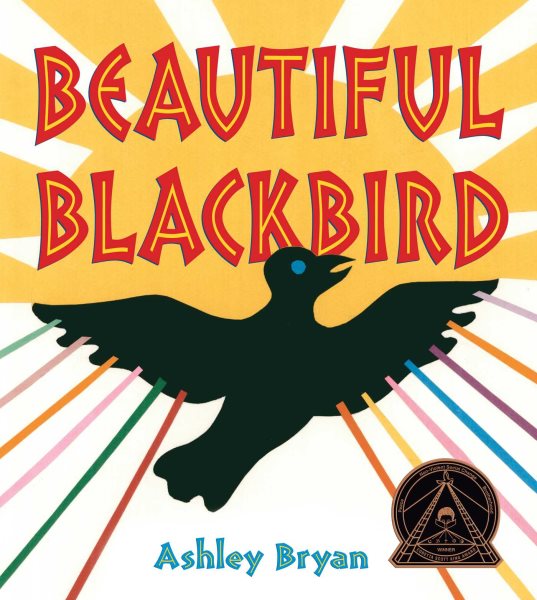
I’m a cheat. A dirty cheat, but for Ashley Bryan I will break ALL the rules! Though normally we limit ourselves on the Fuse 8 n’ Kate podcast to books that were published at least 20 years ago, I am going to have us look at a book today that is (restrain your gasps) 19 years old. Worth it. I mean, who could possibly fault me? Ashley Bryan was a living saint of children’s literature. Now, I can tell you that while I was working on this podcast episode I had this picture book out and my son happened to see it. “Hey! I know that book!” Turns out, his school has used it multiple times with him in both his art and library classes. I’d say that’s a pretty good testimonial right there. Kate points out that with the current racist responses to the Black Little Mermaid, our choice of book today is timely in its cry of “Black is beautiful!” We get into a discussion of what can be considered assimilation or cultural appropriation and things get interesting. Give it a listen!

Listen to the whole show here on Soundcloud or download it through iTunes, Stitcher, Spotify, Google Play, PlayerFM, or your preferred method of podcast selection.

Show Notes:

Kate found the old Laura Ingalls Wilder Award medal to be terrifying. “It looks like Chucky wearing a wig… She’s like a zombie child!” Perhaps you can see why.

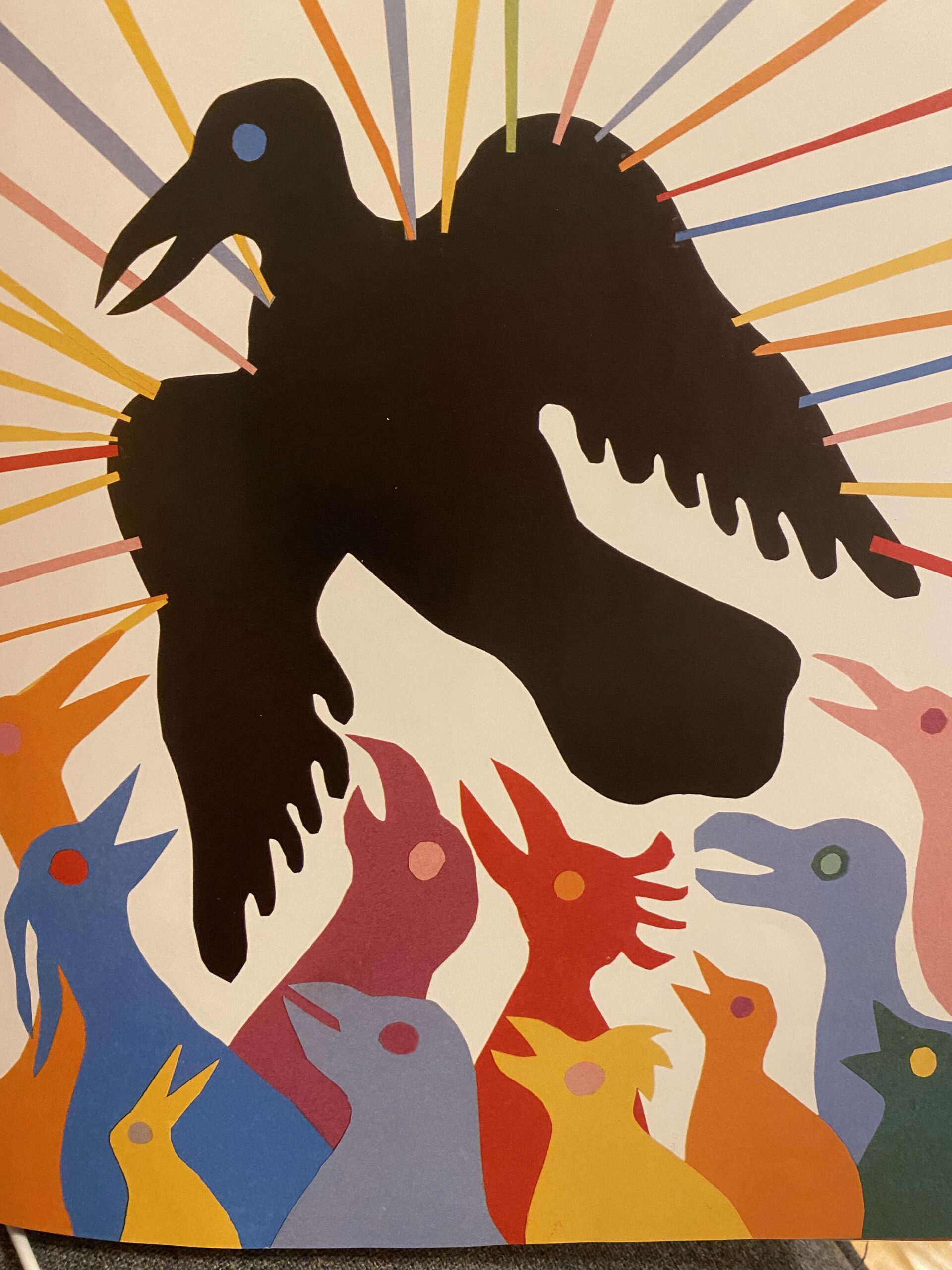
A fun way to show that black encompasses all the colors of the rainbow. I like how the colors are shooting out from him like rainbow lasers.

50 points to anyone who shows a live action version of the Show Claws Slide.

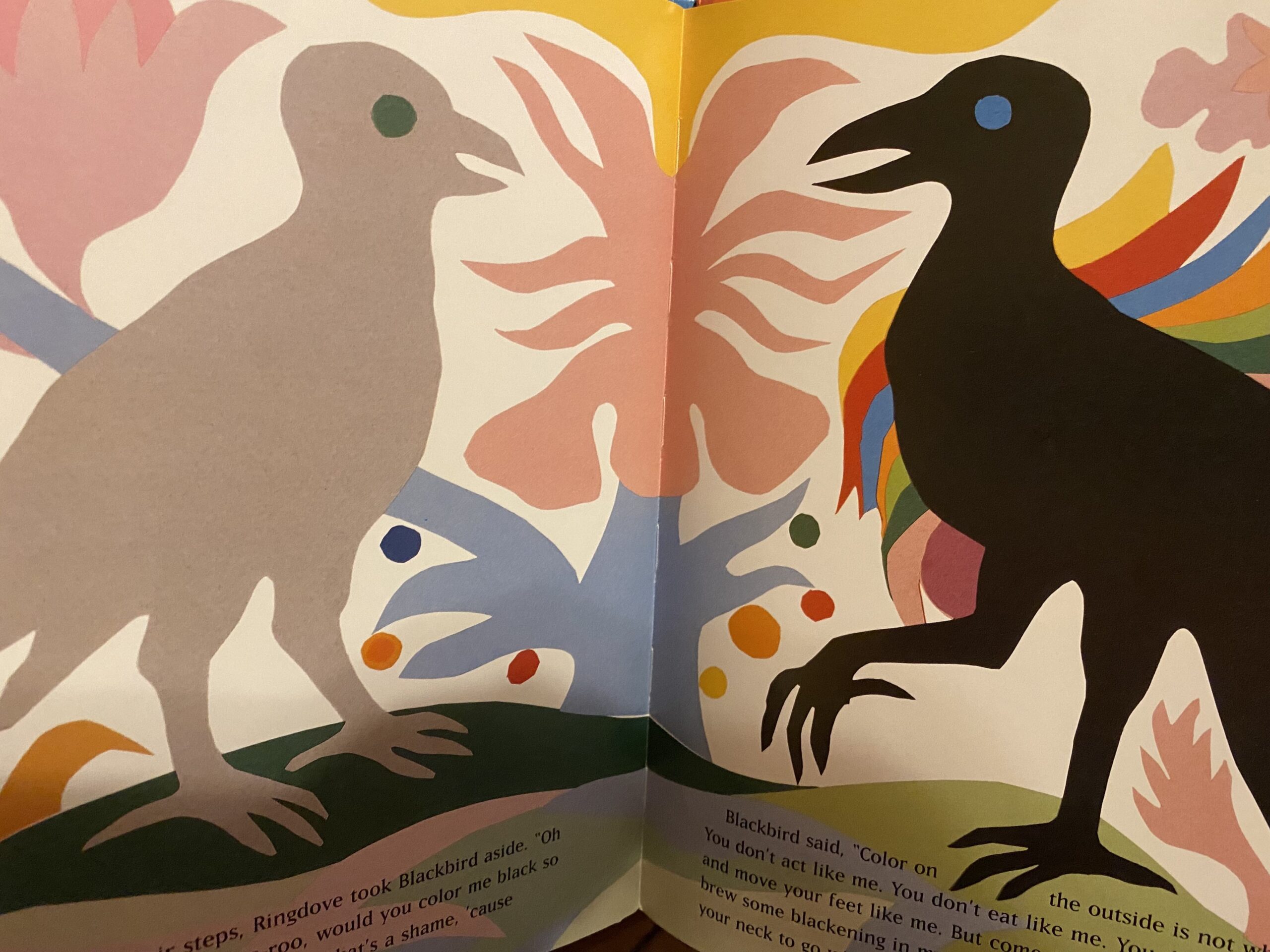
I love the theory that the whole reason Ringdove called all the birds together in the first place was so that it could take Blackbird aside like this and ask for a special favor. Like Blackbird is the godfather or something and it’s his daughter’s wedding. You may kiss the claw.

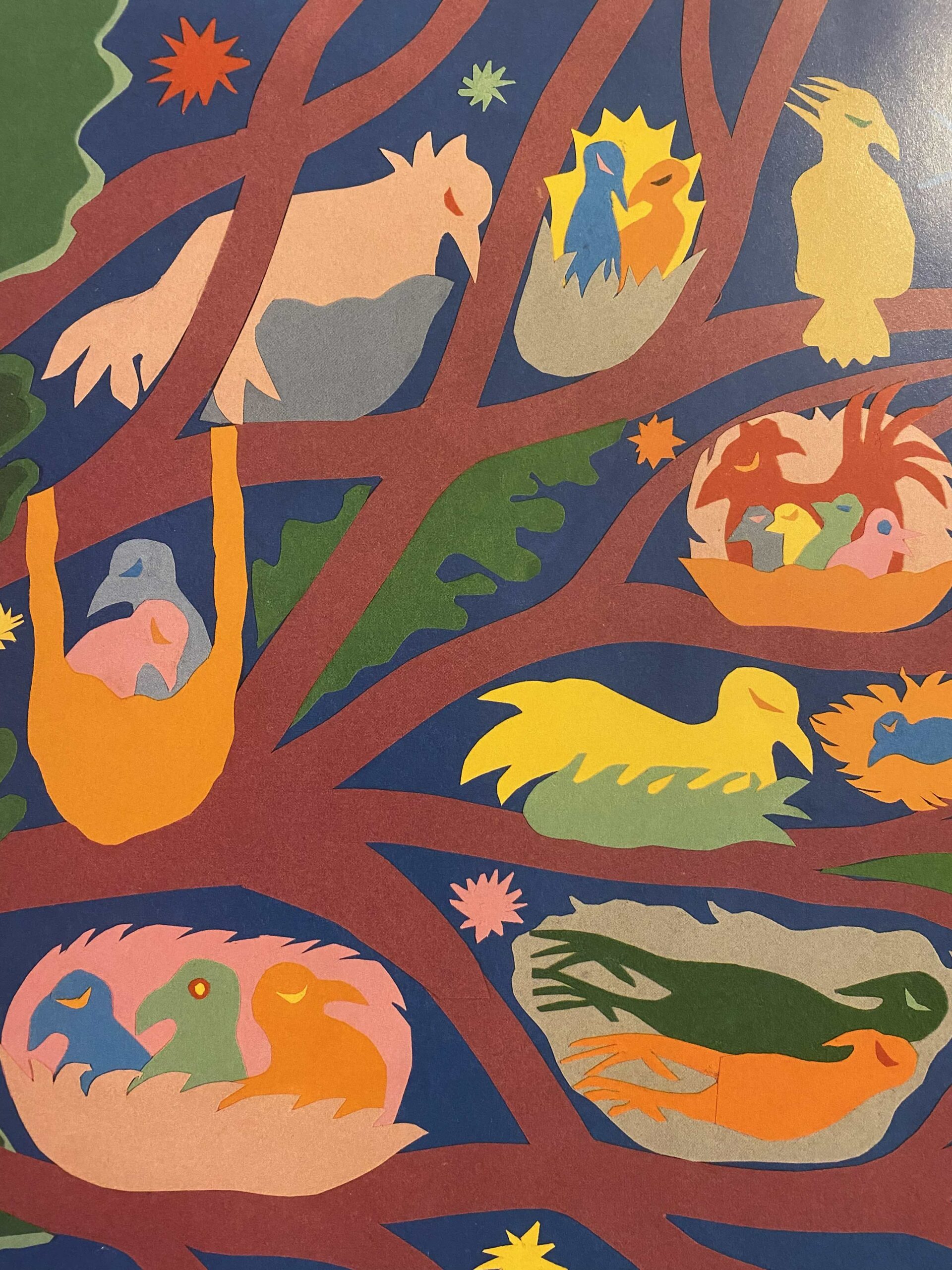
This is where I point out how difficult it is to do what Ashley Bryan has done here. So many different kinds of nests!

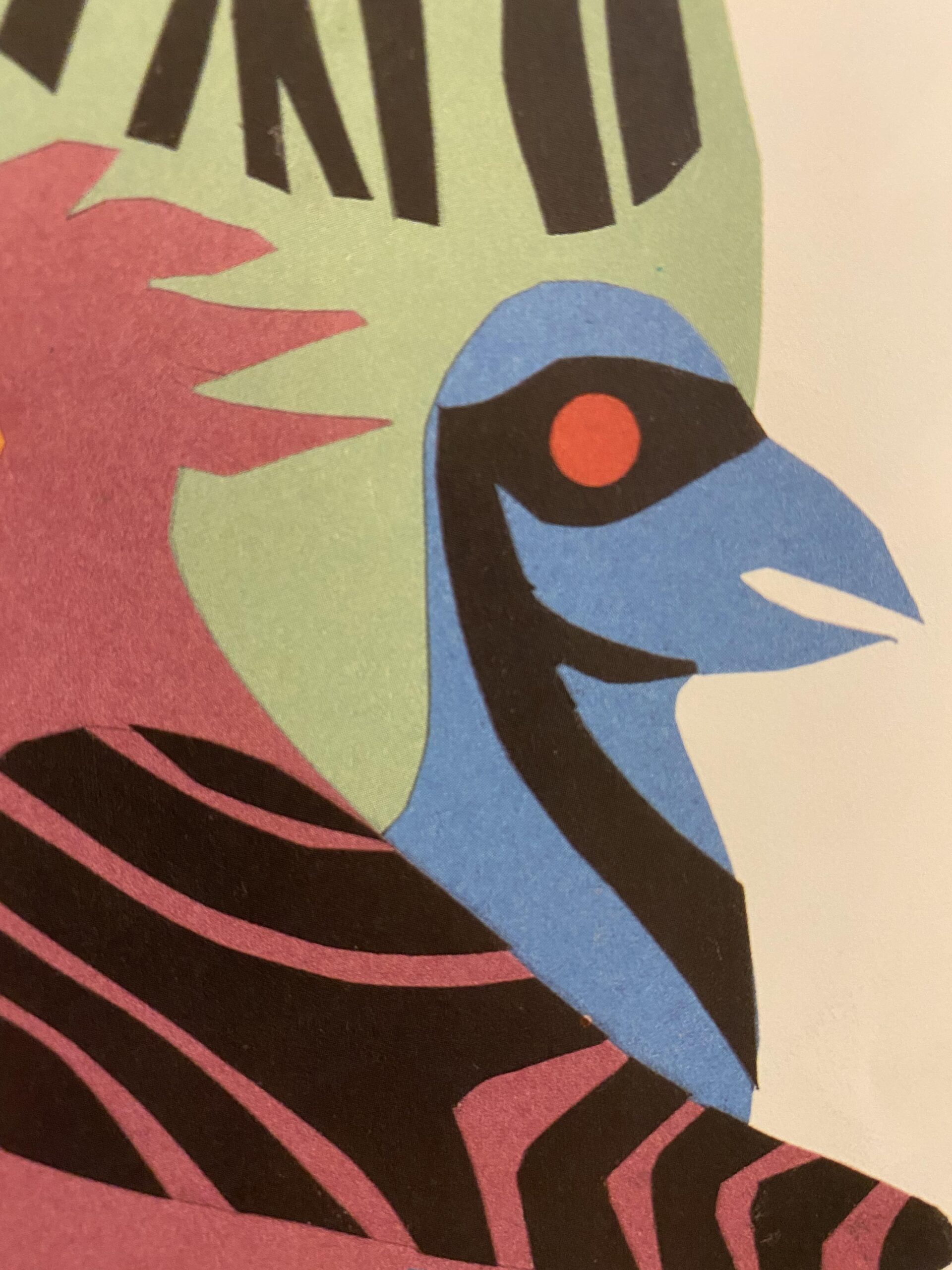
This bird clearly got the best paint job of them all. The rest of you can all go home.

Betsy Recommends: Bluey

Kate Recommends: Harley Quinn

Filed Under: Fuse 8 n' Kate Tagged With: Ashley Bryan, Beautiful Blackbird, Fuse 8 n' Kate

  • « Go to Previous Page
  • Page 1
  • Interim pages omitted …
  • Page 156
  • Page 157
  • Page 158
  • Page 159
  • Page 160
  • Interim pages omitted …
  • Page 1048
  • Go to Next Page »

Primary Sidebar