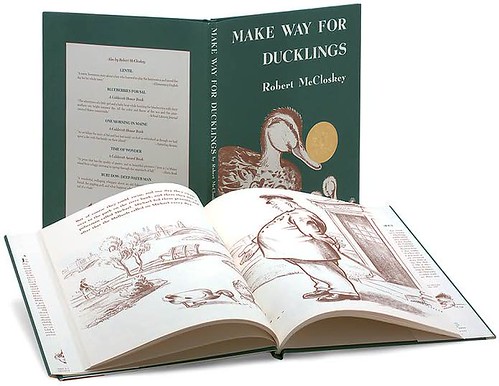
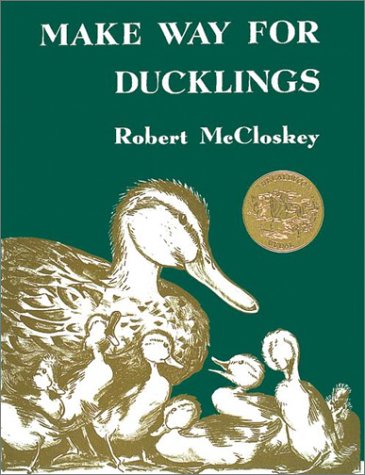
 #6 Make Way for Ducklings by Robert McCloskey (1941)
163 points
McCloskey’s attention to detail and marvelous storytelling are a magical combination. – Heather Christensen
I actually remember, when I was a very little girl, hearing Captain Kangaroo read this book on television. I remember the way the camera panned over the ducks almost getting hit by the cars. Later, I bought the book and read it many times to my sons. Best of all, when we visited the Boston Public Garden when my firstborn son was two years old, we visited the statues of Mrs. Mallard, followed by Jack, Kack, Lack, Mack, Nack, Ouack, Pack, and Quack. I took a picture of my son on Mrs. Mallard’s back, then taped that sweet picture into the front of our book. – Sondra Eklund
Take a back seat, LeVar Burton. Clearly your book recommendation skills still pale in comparison to the Cap’n.
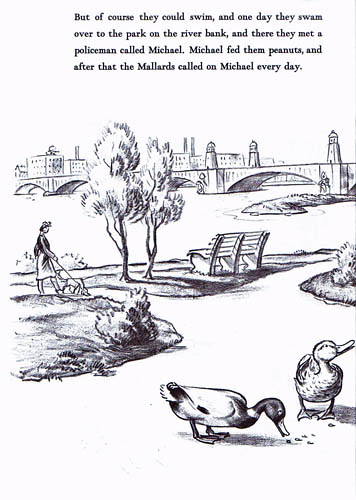
The synopsis from the publisher reads, “The busy Boston streets are too dangerous for eight little ducklings! But with a little help from a friendly policeman Mrs. Mallard and her family arrive safely at their new home. The public garden was no place for ducklings when they were first born, but now they are old enough to brave the raucous crowds and swim with the giant swan boats.”
I once posted that my Interesting Fact of the Day was that Robert McCloskey was 28 when he won a Caldecott for Make Way for Ducklings. In fact, I do believe he was the youngest person to win a Caldecott Award until a certain Ms. Erin E. Stead happened to come along.
Minders of Make-Believe discusses one of the best publicity stunts for a soon-to-be released picture book on record today. “The editors of Life became interested in what McCloskey was up to when they learned (doubtless thanks to a well-placed telephone call from May Massee) that the artist had recently purchased a crate-load of ducklings at a local market and hauled them up to his West Twelfth Street apartment to serve as life models . . . . A reporter and photographer were dispatched to the fourth-floor walkup, and the piece was put to bet complete with candid shots of ducklings scrambling adorably up and down the artist’s sleeve.” Granted the German invasion of Poland scrapped the story, but it would’ve been brilliant! THAT is how you market a book, people.
Since Life digitized its collection onto Google Image, I had hoped to find the shots mentioned here. Maybe it’s because the story never ran, but the only thing I was able to find when I put in “Robert McCloskey” was this image of him playing the harmonica.

We take what we can get. Lovely hands.
100 Best Books for Children reports that the original working title of this book was Boston Is Lovely in the Spring. Had they kept it, imagine the gift this would have been to the Boston Tourism Board. The book also points out that the original names of the ducks were “Mary, Martha, Phillys, Theodore, Beatrice, Alice, George, and John.” The world would be a poorer place indeed without an “Ouack” in it.
There’s an interview with Mr. McCloskey that discusses this book over at The Horn Book from NPR circa 1986. You may either listen or read the recap, as you prefer. I like that those first names of the ducks he used were “names of all the girls I knew, not even in alphabetical order.”
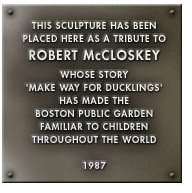
Of course the Boston Public Garden created a duckling statue, that is well worth visiting, back in October 4, 1987. The artist was Nancy Schon who discusses the commission a little on her website. A kind of McCloskey specialist, she also created the Lentil sculptures over in Hamilton, Ohio.
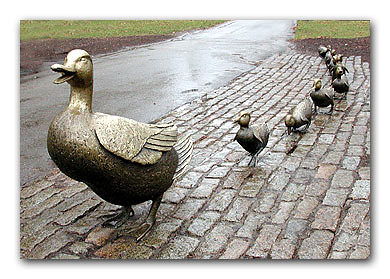
Interestingly, Boston is not the only city containing statues of the ducks. Perhaps you have heard of a little place called Novodevichy Park, Moscow? No? Oh. Well they have some too. A gift from Barbara Bush to Soviet First Lady Raisa Gorbachev. Ms. Schon did that sculpture as well.