• Skip to primary navigation
  • Skip to main content
  • Skip to primary sidebar
  • About/Contact
  • Fusenews
  • Reviews
  • Librarian Previews
  • Best Books
    • Top 100
    • Best Books of 2022
    • Best Books of 2021
    • Best Books of 2020
    • Best Books of 2019
    • Best Books of 2018
    • Best Books of 2017
    • Best Books of 2016
    • Best Books of 2015
    • Best Books of 2014
    • Best Books of 2013
  • Fuse 8 n’ Kate
  • Videos
  • Press Release Fun

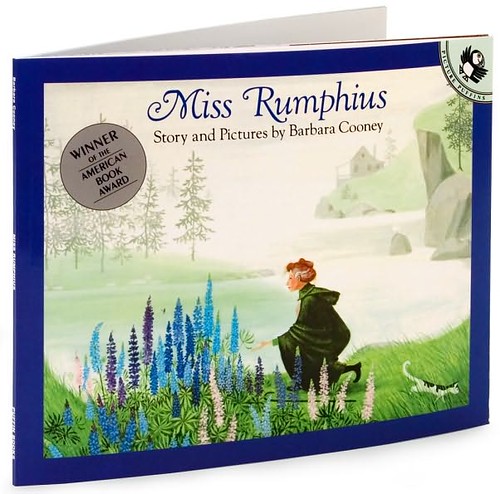
Top 100 Picture Books #13: Miss Rumphius by Barbara Cooney

Top 100 Picture Books #13: Miss Rumphius by Barbara Cooney

June 15, 2012 by Betsy Bird

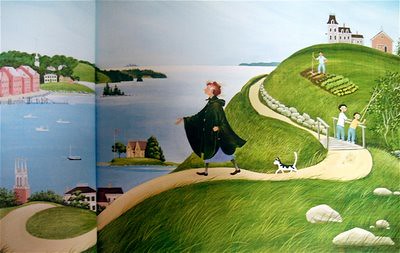
#13 Miss Rumphius by Barbara Cooney (1982)
79 points
This is such a great lesson book without being preachy. I remember my 20 year old son coming home and telling me all about this book after his teacher read it in class. I didn’t have the heart to tell him that I knew all about this book and it was one of my favorite books too. Nothing would do but for us to go right to the store and buy lupine seeds to plant. Alas my thumb is not as green as Miss Rumphius’. My lupine seeds didn’t sprout, but it was okay I will never forget how excited my 9 year old son was to share that book with me. – Amy Miele
Was there ever any question that the Top 20 picture books would consist of titles that were deeply beloved?  Never.  But I admit to you that Miss Rumphius was a surprise to me.  Yet if the quote above is any indication Cooney’s classic is very near and very dear to people’s hearts.
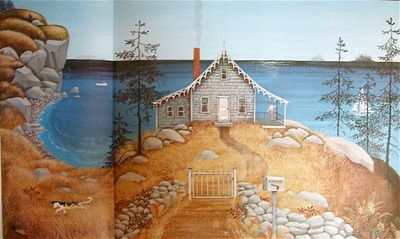
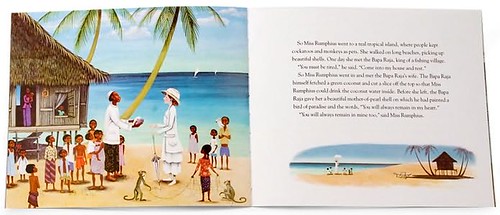
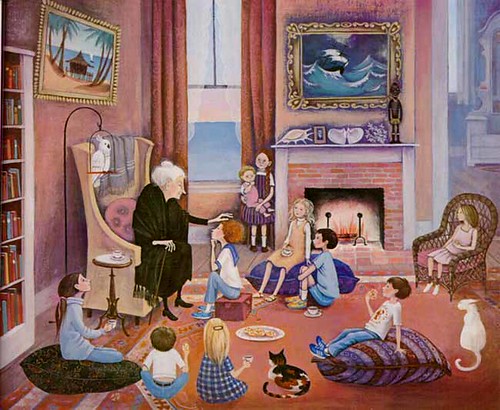
From the B&N plot synopsis: “As a child, Miss Rumphius dreams of traveling to faraway places. Her grandfather assures her that this is possible, but also advises her to do something to make the world more beautiful. As an old lady, Miss Rumphius returns to her home by the sea, but realizes she has yet to fulfill her grandfather’s wish. Inspired by her garden, Miss Rumphius creates a world of loveliness for those who live nearby.”
Finding background info on this book turned out to be mighty hard.  Thank goodness for Anita Silvey’s Book-a-Day Almanac.  In her Miss Rumphius post she says of the origins that, “By the time she worked on Miss Rumphius, she had over forty years of experience in children’s book illustrations. An autobiographical picture book, Cooney drew on the life of her great grandfather, who painted pictures and allowed his young daughter, Cooney’s grandmother, to help. ‘I see that little girl—painting away, making yards and yards of fluffy clouds and sunsets and storms with lightening and rainbows.’ Cooney also based the character of Alice Rumphius on an historical figure who traveled the world planting flower seeds.”
Now according to Ms. Cooney’s obituary, found on Carol Hurst’s Children’s Literature Site, “Barbara Cooney was born in Room 1127 of the Hotel Bossert in Brooklyn, New York in 1917 . . . ‘Of all the books I have done,’ she says, ‘Miss Rumphius (Viking, 1982), Island Boy (Viking, 1988), and Hattie and the Wild Waves (Viking, 1990), are the closest to my heart. These three are as near as I ever will come to an autobiography. There are, of course, many dissimilarities between me and Alice Rumphius, but, as I worked, she gradually seemed to become my alter ego. Perhaps she had been that right from the start.’  Barbara Cooney took her adopted state of Maine to her heart and Maine returned the affection. In 1989, the Maine Library Association created the Lupine Award, named for Miss Rumphius, to recognize outstanding children’s books by state residents or to honor authors whose chosen subjects were about Maine. Their opening ceremony honored Miss Rumphius and its creator.”

Miss Rumphius
also happened to win the American Book Sellers National Book Award in 1983.  So well done there.
And for the record, while you may find plenty of children’s literary blogs that make allusions to Alice in Wonderland, The Wizard of Oz, and other classics The Miss Rumphius Effect is one of the biggies out there that credits this book and this book alone in its title.  A delightful choice.
And talk about inspirational:
Filed Under: Best Books, Top 100 Picture Books Poll Tagged With: Barbara Cooney, Miss Rumphius

Top 100 Picture Books #14: Caps for Sale by Esphyr Slobodkina

June 15, 2012 by Betsy Bird

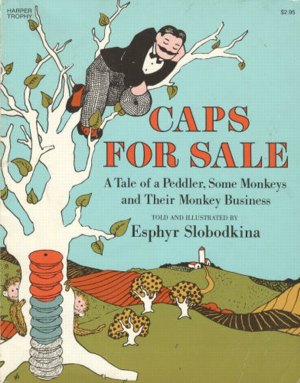
#14 Caps for Sale by Esphyr Slobodkina (1947)
78 points
What I REALLY love about this book is that it is possibly the most fun book to read aloud to a kid (or many kids) ever. I can’t separate my feelings for the book itself from the experience of reading it interactively. What kid doesn’t make a great monkey? – Amy M. Weir
As a first-grade student of mine once whispered of this book in great anticipation, “It has monkeys!” Children are natural pranksters, and the disappearance of the caps delights them almost as much as the reason for that disappearance. Then the peddler has a little tantrum—just like they do! The monkeys copy him, which is even more funny, and then he throws his cap on the ground, so of course we get both a happy solution and a nice little twist. Carefully, the peddler puts his caps on his head once more, framing the narrative with tall stacks of colors. Like the third bowl of porridge Goldilocks ate, it’s just right. – Kate Coombs
By rights I should probably call this book by its proper title.  Not merely a simple “Caps for Sale” the name of this book is actually Caps for Sale: A Tale of a Peddler, Some Monkeys and Their Monkey Business.  *deep gasp of air*  It’s a mouthful.  A mouthful and one of the best readaloud picture books of all time.  Of course, I’ve always been a little torn on how to pronounce the “tsz tsz tsz” that the monkeys are always saying.  Any librarians out there have any Caps for Sale readaloud tips or tricks they’d like to share?  Cause that part always kind of throws me for a loop.  But if you stand in front of a group of kids and announce that you are going to read this book, inevitably hands will shoot into the air and the kids will start telling you how they love that book / have that book / have read that book / etc.  It’s very rewarding.
The B&N encapsulation of the plot reads, “A cap peddler wakes from a nap to find all his caps are gone – a bunch of naughty monkeys have taken them up a tree. Angrily shaking his finger at the monkeys, the peddler demands his caps back, but the monkeys only shake their fingers and say ‘Tsz, tsz, tsz.’ No matter what the peddler does, the monkeys only imitate him. Finally, the peddler is so enraged he throws his cap on the ground-and all the monkeys follow suit!”
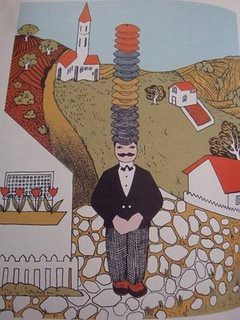
According to 100 Best Picture Books for Children, Slobodkina was a Russian immigrant to America who was part of the American Abstract Artists (some reports say she started it) and showed her work alongside Arshile Gorky, Stuart Davis, and Piet Mondrian.  Picture books supplemented her income and when she decided to illustrate her own tale, this was one of the ones she settled on.  Says 100 Best Picture Books, “The artwork for the first edition used only three primary colors.  But in 1947 Slobodkina revised the book, adding in ocher, red, and robin’s-egg blue.  Both the colors and the style of the art had been inspired by the work of the primitive painter Henri Rousseau.”
This 1947 construct should undoubtedly have dated itself by this point.  So why hasn’t it?  Maybe it has something to do with the construct.  As Literature and the Child by Cullinan and Galda (5th edition) puts it, “the popular old favorite, Caps for Sale, has a cumulative sequence.  Rhyme and rhythm help children predict through sound – the rhyming of words in a regular beat, or rhythm.”  Doesn’t hurt matters any that the book’s a hoot to boot.
Caps for Sale?  Unequivocal success.  The sequel Circus Caps for Sale?  Well, at least one reader recently sent me a note in which they described Circus Caps for Sale (“formerly known as Pezzo the Peddler and the Circus Elephant“) as an unnecessary sequel.  It may have its defenders, but I’ll tell you right now that nobody but nobody put it on their Top 10 Picture Books lists that they sent me.
If you are interested in seeing other books by this author/illustrator, high thee henceward to the Slobodkina Foundation where there is a lovely list of titles, thumbnails of all the covers included.  There are also more than a few Caps for Sale activity pages available for downloading.  Go hog wild with ‘em.
Want the original art?  The site goes on to say that, “At age 90, she designed a mini-museum in Glen Head, Long Island as a place where guests can view more than 500 works of art, handmade dolls and jewelry, and the complete collection of Slobodkina’s children’s books, including some original illustrations. Functioning both as a museum and a reading room for children, the charitable Slobodkina Foundation actively preserves the legacy of Esphyr Slobodkina’s prolific, multifaceted career.”  Long Island!  Who knew?
The New York Times said of it, “From an old folk tale [the author] has fashioned this bright picture book, infusing it with a humor which seems to have sprung from her own hearty enjoyment of the troubles of a peddler with a band of monkeys.”
In terms of pronouncing the author/illustrator’s name, perhaps this next video can be of some use:

Filed Under: Best Books, Top 100 Picture Books Poll Tagged With: Caps for Sale, Esphyr Slobodkina

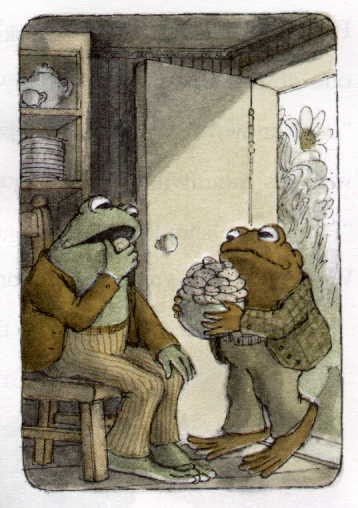
Top 100 Picture Books #15: Frog and Toad Are Friends by Arnold Lobel

June 15, 2012 by Betsy Bird

#15 Frog and Toad Are Friends by Arnold Lobel (1970)
74 points
I put a lot of thought into which Frog and Toad book to put on here. They are all brilliant, but I find Frog and Toad Together a bit trippy with Toad’s crazy dream sequence and the seriously snake in “Dragons and Giants.” Frog and Toad All Year is super lovely, but is almost a seasonal book. And I just find Days With Frog and Toad devastating. Is it me, or are those two seriously starting to grow apart by the end? I know Frog said he just wanted some alone time, but Toad took it really, really hard. I seriously worry that, if there had been a fifth book, they may have had a serious fight and Toad may have been irreparably damaged. I’m not joking. This is something I seriously think about. – Shannon Ozimy
The perfect friendship book, made even more amazing because it is an early reader. Quite frankly, I find most early chapter books and beginning readers to be sleep-inducers, but Lobel’s mastery of language make these a joy to read aloud and to listen to (if you happen to be a parent of a new reader!) – Heather Christensen
I don’t know if this quite counts as a picture book since it’s an easy reader, but I’ve always read it as a bedtime story to my girls. I adore this collection. Seriously. How can you not love Toad’s obsessivenes, and Frog’s Zen-like calm in the wake of Toad’s storm. There are probably some life lessons here, but much like Toad, I just want the cookies. – Melissa Fox
There’s something about the easy reader format that lends itself to tales of true friendship.  Maybe the easy reader format coincides perfectly with the fact that kids of that reading level/age are making big social leaps.  Whatever the case, whether it’s George & Martha, Houndsley & Catina, or the friendship to beat all friendship in Frog & Toad, these are two blokes worth remembering.
The description from Kirkus reads, “A leggy green frog and a squat green toad do for friendship something of what Little Bear does for kinship. Come April Toad’s reluctance to end his long winter nap (“A little more sleep will not hurt me”) prompts lonesome Frog to pull off the calendar pages one by one until he reaches stay-awake May. Then there’s “The Story” Toad can’t think up when Frog is sick which becomes the story–of how Toad made himself sick standing on his head and hitting it against a wall trying–told him by a recovered Frog. “A Lost Button” turns up at home after Frog has found every button but for Toad (who makes suit-able amends). But the best is yet to come–in Toad’s anxiety that he looks funny in his bathing suit (which keeps him shivering in the water) and his brusque “Of course I do” when Frog and the others laugh. At the last, affectingly if more predictably, is “The Letter” that Frog writes to Toad so he’ll get some mail. . . and sends by snail.”
The origin story can be found in Anita Lobel’s 100 Best Books for Children.  She says that on a summer vacation to Lake Bomoseen, Lobel’s children came in with “a large green shiny frog and two dour and dyspeptic toads.”  Years later Lobel felt that “he had been writing at children, rather than for them.”  So he put pen to paper and out came a story about a frog and a toad.  Now at an exhibit at The Carle some years ago there was a great exhibit called Seeking a State of Grace: The Art of Arnold Lobel.  While I examined the man’s art at length I saw that in the original sketches Frog & Toad were originally conceived as male and female.  Somewhere along the lines something changed.  Most interesting.
I was hoping that maybe there would be some unknown tidbits about Frog & Toad in Dear Genius: The Letters of Ursula Nordstrom but alas it was not to be.  Though Nordstrom did indeed work with Lobel, Frog & Toad came too late in the game, I guess.  However, the book does offer some insights into the man’s career.  According to Leonard Marcus’s footnotes, “Lobel began his career in children’s books in the late 1950s as the illustrator of several books of Jewish interest published by Ktav.”

  • A nice piece that includes a discovery of the original manuscript for Frog & Toad Are Friends in the Kerlan collection.

In a starred review Kirkus said of it, “Imperfect friendship or it wouldn’t be true–and most perfectly expressed in their faces.”
If you read the comments up above then you would have seen Shannon’s concerns about Frog and Toad growing apart in later books. This next video is from the Broadway production of A Year With Frog and Toad which includes adventures from all of their books. In fact the scene is the one that worried her in particular. It makes for a lovely song certainly.

Or, if you want a song that relates directly to a story in this book, there was the one for frog’s bathing suit:

That leads nicely into the mildly creepy claymation Frog & Toad series of yore. Here is that same story told a different way:


Filed Under: Best Books, Top 100 Picture Books Poll Tagged With: Arnold Lobel, Frog and Toad Are Friends

Top 100 Children's Novels #16: Harold and the Purple Crayon by Crockett Johnson

June 14, 2012 by Betsy Bird

#16 Harold and the Purple Crayon by Crockett Johnson (1955)
73 points
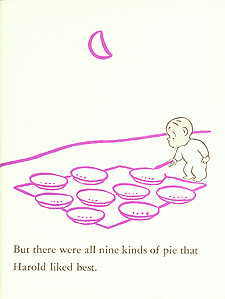
It’s like the best kind of dream! It’s surreal and meta and mindbending! And also funny! I found it haunting when I was a kid, reality being created as you go; now that surrealism is one of my favorite things about it. I love the bits like there being nothing but pie, but it was all nine kinds of pie Harold liked best; and random characters like the very hungry moose and deserving porcupine. It’s so simple and so brilliant! – Amy M. Weir
Because it’s the most succinct expression of imaginative possibility ever created. – Philip Nel
Uh-oh.  Another book has slipped down from the Top Ten.  Previously ranking at #7, Harold manages to cling to the Top 20 but it’s hard to think what might replace him.  The boy is ubiquitous, after all.
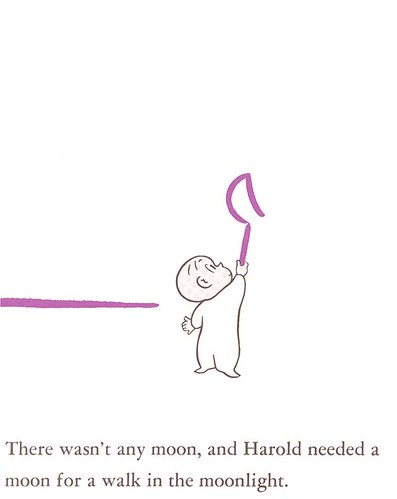
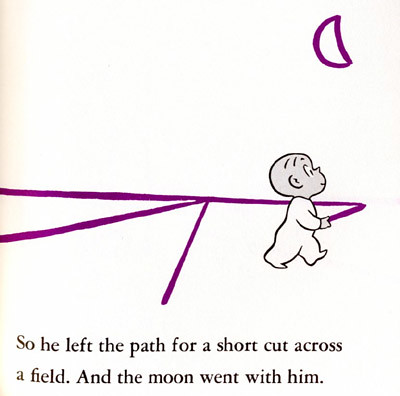
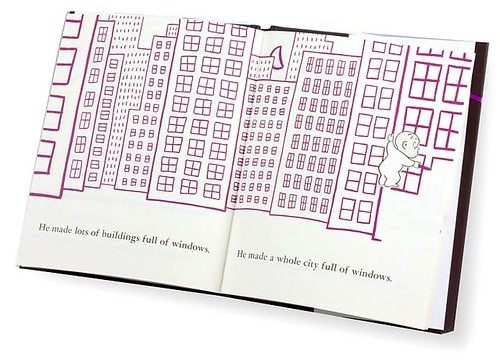
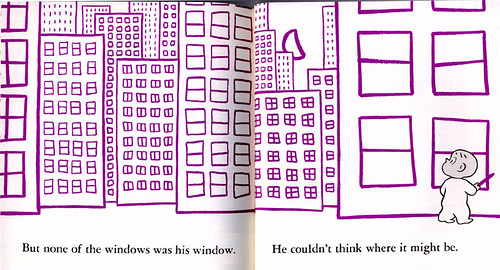
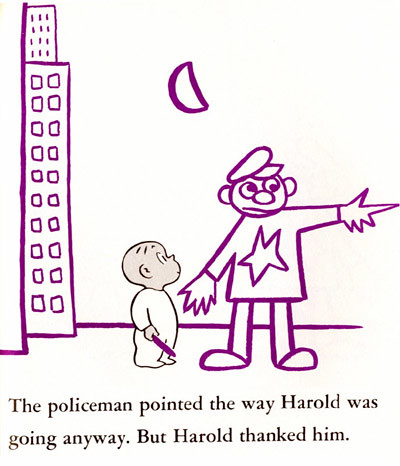
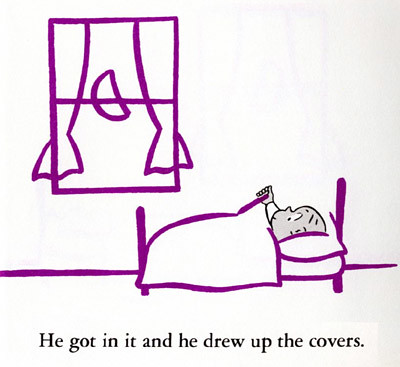
The plot synopsis from B&N reads, “Harold’s wonderful purple crayon makes everything he draws become real. One evening, Harold draws a path and a moon and goes for a walk-and the moon comes too. After many adventures, Harold gets tired and can’t find his bedroom. Finally, he remembers that the moon always shines through his bedroom window. He draws himself a bed, and ‘the purple crayon dropped on the floor, and Harold dropped off to sleep.’ This little gem is filled with visual and written puns.”
Growing up I knew of Harold but had far more of a connection to the rip-off animated series Simon in the Land of the Chalk Drawings.  Odd but true.
There are many things to enjoy in Dear Genius: The Letters of Ursula Nordstrom.  What the book really does best, though, is give us a salty editor talking about the classics she’s editing in her customary off-hand manner.  Take Harold and the Purple Crayon.  In a letter dated December 15, 1954, Ursula has just gotten a revised version of this story and she is writing to Crockett, the author/illustrator.  “I’m awfully sorry my first reaction to Harold was so lukewarm and unenthusiastic.  I really think it is going to make a darling book, and I certainly was wrong at first.  This is a funny job.  The Harper children’s books have had such a good fall, so many on so many lists, etc. etc., and I was feeling a little good – not satisfied, you understand, but I thought gosh I’m really catching on to things, I bet, and pretty soon it ought to get easier.  And then I stubbed my toe on Harold and his damned purple crayon . . . .”
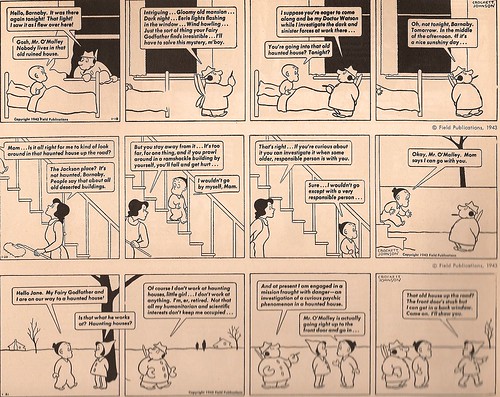
At long last I finally have an excuse to break out my old Smithsonian Collection of Newspaper Comics.  You see if you know anything about Crockett Johnson you know he wrote Harold and the Purple Crayon and illustrated The Carrot Seed.  If you know anything else about him, though, you may be aware that his real name was David Johnson Liesk and that between 1942 and 1946 (after which it was handed it over to others) he created the comic strip Barnaby.  Barnaby has its fans.  People have said it was a predecessor to Calvin and Hobbes, though the premise varies slightly.  As the Smithsonian puts it, the story was really about “a boy and his cigar-chomping fairy godfather, Mister O’Malley.”  Johnson began as a magazine cartoonist, turned to picture books in the 50’s and, “in his later years (he died in 1975) he devoted himself to nonobjective painting.”  I’ve attempted to scan some Barnaby strips for you, in case you’re interested.  I apologize for the shoddy quality of my scanner.

  • Want to read Harold for yourself?  Go here.
  • In September of 2012 we will finally get a chance to see Philip Nel’s highly anticipated Crockett Johnson and Ruth Krauss: How an Unlikely Couple Found Love, Dodged the FBI, and Transformed Children’s Literature.  You can see Phil talk about this book at NYPL on October 27th.
  • Harold wasn’t afraid of a sequel or two either.  If you want to see the full original line-up (everything from Harold’s Trip to the Sky to Harold’s Circus) Kansas State University has a rather lovely collection of variegated covers (from Philip Nel, to be precise).
  • When I first started exploring the scary world of online children’s literature resources, one of the first I stumbled across was Harold D. Underdown’s site The Purple Crayon.  It’s still running too.
  • Feel like listening to something?  All Things Considered had a short piece back in 2005 called The Appeal of “Harold and the Purple Crayon”.  The piece speaks to Maurice Sendak, and also contains a reading of the original letter wherein Nordstrom was unenthused by the initial draft of the story.  I like how she concedes to feeling a little “dead in the head” and that she’d probably pass up Tom Sawyer if it arrived on her desk.
  • Apparently there was an Emmy award winning 13-part Harold and the Purple Crayon series that ran on HBO.  You can even view an episode or two here if you like.  An interesting compare and contrast with the earlier ‘59 version.

And, best for last.  The glitter rock opera version of Harold.  You’ll have it stuck in your head all day now.

Horn Book said, “An ingenious and original picture story in which a small boy out for a walk–happily with crayon in hand–draws himself some wonderful adventures. A little book that will be loved.”
The New York Times Book Review agreed with, “Do we look at art to learn things, or to feel things? I’d vote for feeling, and that’s why the art book I most recommend is Harold and the Purple Crayon.”

Filed Under: Best Books, Top 100 Picture Books Poll Tagged With: Crockett Johnson, Harold and the Purple Crayon

Top 100 Picture Books #17: The Story of Ferdinand by Munro Leaf, illustrated by Robert Lawson

June 14, 2012 by Betsy Bird

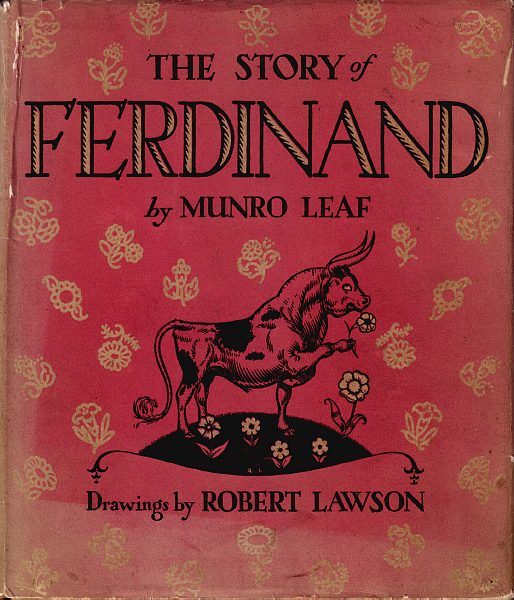
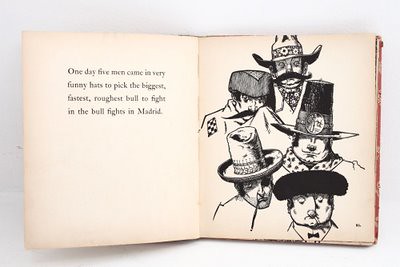
#17 The Story of Ferdinand by Munro Leaf, illustrated by Robert Lawson (1936)
73 points
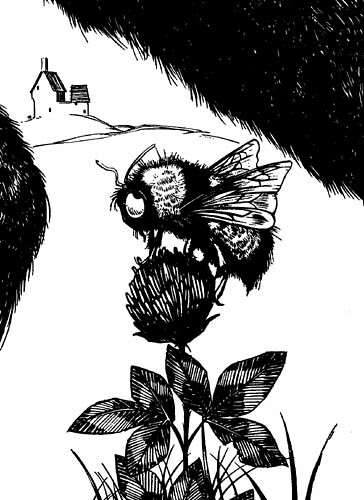
I remember liking this as a child, but I love it even more as a parent, when my children love to listen to it. It’s a gentle story, and can sometimes be calming at bedtime, but they also love to run around the house yelling “Wow! Did it hurt!” regarding the bumblebee scene. – Libby Gorman
What a beautiful message about being true to who you are! The simple sketches by Robert Lawson are fantastic. – Alexandra Eichel
Because, with a mix of humor and gravity, it sustains many very different interpretations. – Philip Nel
I was the Ferdinand in my family of birth. – Laura Gallardo
True story.  I walk into the local Aveda to get my hair styled and the fellow they’ve given me is a chatty sort.  Wants to talk to me about my job, librarianship, that sort of thing.  And in the midst of our conversation I somehow steer it over to the Top 100 Picture Books poll and the books that did particularly well.  He doesn’t remember the names of children’s books, but he brings up (of all things), “That story about the bull with the flowers.”  “Ferdinand?”, I ask.  “That’s the one!”  That leads into a conversation of the book, the fact that his roommate has that bull tattooed onto his back (this is true), and the controversy surrounding it  . . . but I get ahead of myself.  In any case, clearly this book is on the minds of the non-children’s picture book reading public at large as well as the fans of the field.
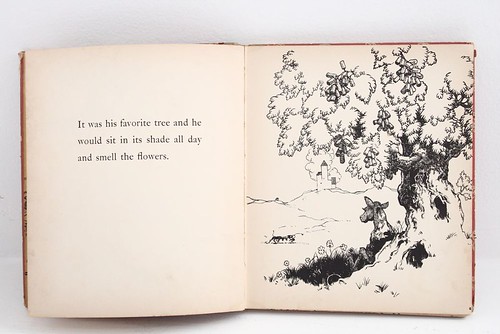
Children’s Literature described the plot as, “Set in Spain, it is about a young bull named Ferdinand. All bulls in Spain aspire to one day fight in the ring with a matador. But not Ferdinand. All day long the young bulls play at fighting in hopes that one day they will be strong enough to be chosen for the bullfights. But Ferdinand prefers to quietly sit in the pasture and enjoy his surroundings. When the bulls all mature, they long to be selected for the bullring…all but Ferdinand. As the other bulls prance and preen, hoping to be selected, Ferdinand ignores the commotion. Suddenly, Ferdinand is stung by a bumblebee. He bellows and dances around like crazy. The matadors are so impressed with his machismo they select him as the strongest bull. He is praised all around for his power, until the day of the bullfight. Poor Ferdinand just sits there. The matadors prod and coax with no luck. Ferdinand is not interested in fighting. Ferdinand is returned to his pasture to live out his life in solitude.”
In any case, this is a lovely banned book to place on the list.  Banned by whom?  Oh, nobody much.  Just a fellow by the name of Adolf Hitler.  You see it was published during the Spanish civil war, Franco banned it in Spain, and then Hitler goes and calls it “degenerate democratic propaganda.”  100 Best Books for Children does say that it had its admirers as well, though.  “Thomas Mann, H.G. Wells, Gandhi, and Franklin and Eleanor Roosevelt.”  So, to sum up.  Hitler hated it and Gandhi loved it.  That’s a fine pedigree for this list, I should think.
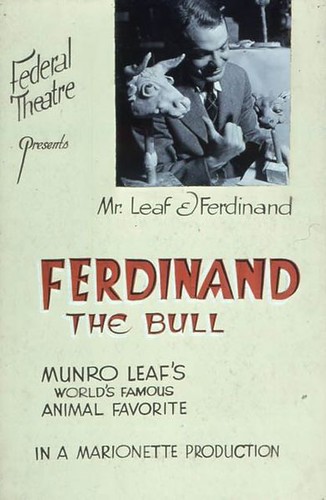
In Tales for Little Rebels, there’s quite the lovely section dedicated to the book.  “When the book was published in the fall of 1936, critics accused Ferdinand of being communist, pacifist, and fascist, and of satirizing communism, pacifism, and fascism. . . . Whatever Ferdinand’s politics, he became a cultural phenomenon, appearing as a balloon ini Macy’s Thanksgiving Parade, as the star of an Oscar-winning Disney cartoon short (1938), and as the subject of a popular song.”
Want to see the Disney short alluded too?  Here it is:
http://www.youtube.com/watch?v=CGTVRbpAuRo&feature=embed
I find the elements of the book, from the cover to the corks, that have been worked into the movie to be fascinating.
In 2011 there was an article in Vulture entitled Fox, Ice Age Director Bullish on The Story of Ferdinand. For a second there it looked as if a new CGI Ferdinand would be hitting theaters. A quick check of IMDB, however, does not reveal anything to be in the works.  A narrow escape?  You be the judge.
But let’s get back to the controversy surrounding the title.  According to Minders of Make-Believe everyone had an opinion on the title.  So much so that the great librarian Anne Carroll Moore finally had to weigh in.  “Far be it from the artist, the author or the critic Owl to read meanings into Ferdinand, that effortless, happy collaboration of Munro Leaf and Robert Lawson.  They have never had any doubt that Ferdinand was designed for sheer entertainment of the ageless.”  Good woman.  But was it true?  Did Leaf really not intend to make any kind of a political statement?  Ferdinand is a Spanish bull and Spain was the center of quite a lot of political activity, after all.  Yet in 1936 in The New York Times Leaf said that the book had just been something he worked out on a rainy Sunday for his friend Robert Lawson.  Lawson had complained that he was feeling limited by the publishers so Leaf said to him, “Rob, cut loose and have fun with this.” The result, as Minders puts it, is that, “If The Story of Ferdinand had any hidden meaning, it lay in the inspiration to be gleaned from the example of a free spirit unleashed against great odds.”
So why a bull?  According to 100 Best Books for Children, Munro Leaf said it was because, “dogs, rabbits, mice and goats had all been done a thousand times.”  Ah yes.  How well we all remember that famous goat . . . um . . . wait, goats?
Choke back your horror when you hear this, though.  In 2000 an edition of the book was produced where Lawson’s otherwise perfect illustrations were colorized.  Oh the horror . . .  the horror . . .

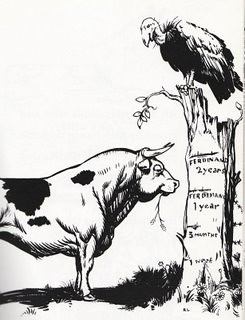
  • Be sure to check out Bottom Shelf Book’s piece on Ferdinand and Lawson’s strange inclusion of vultures in the text.
  • And for a wonderful take on a fellow Robert Lawson title They Were Strong and Good, Collecting Children’s Books had a particularly nice post.
  • Finally, the influence of the book has spread far and wide.  And most strangely, in my opinion, was the fact that it brought about the title of the third Fall Out Boy album From Under the Cork Tree.

Filed Under: Best Books, Top 100 Picture Books Poll Tagged With: Munro Leaf, Robert Lawson, The Story of Ferdinand

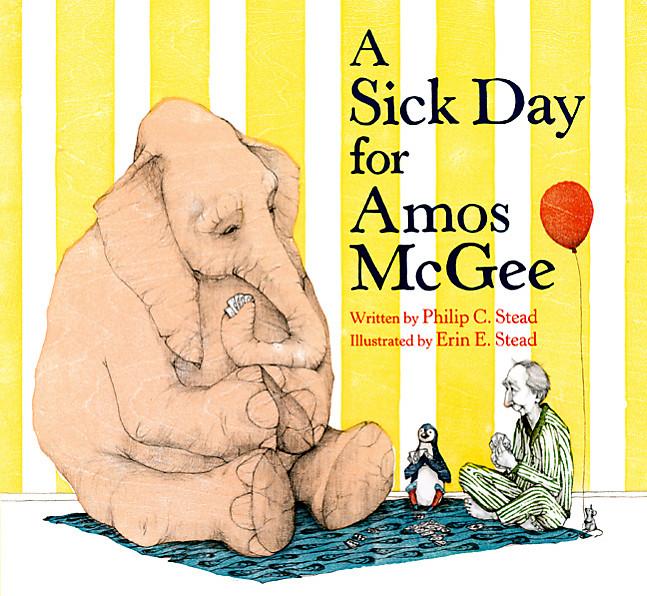
Top 100 Picture Books #18: A Sick Day for Amos McGee by Philip Stead, illustrated by Erin E. Stead

June 14, 2012 by Betsy Bird

#18 A Sick Day for Amos McGee by Philip Stead, illustrated by Erin E. Stead (2010)
71 points
Too soon to appear? I think not. Amos and his friends feel as if they have been with us forever, as they will be. Also because the penguin’s red socks are just so irresistible. – DaNae Leu
This is a recent book, but it’s destined to be a classic. Everytime I read this book I feel the need to hug the book at the end-that’s how much I love it. Amos and his animals feel so real and I love being part of their story for awhile. – Sarah
The last time this poll for picture books was conducted the year was 2009.  That is the sole reason, insofar as I can tell, that A Sick Day for Amos McGee did not make the Top 100.  After all, it’s a modern classic.
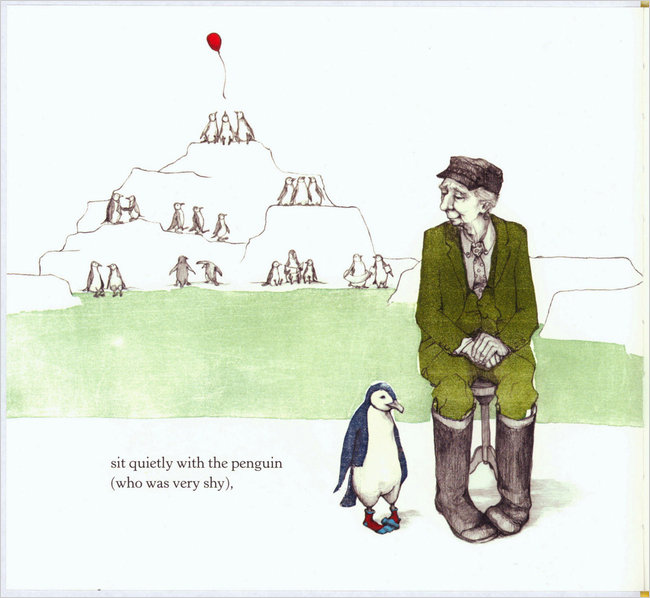
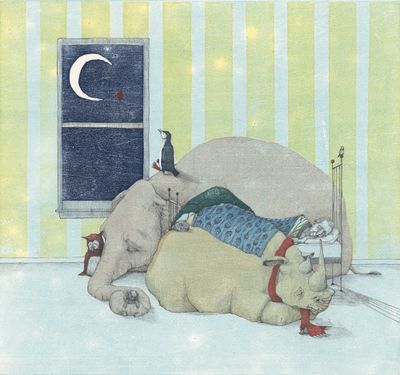
The description from my review reads, “Each morning it’s the same. Amos McGee gets out of bed, puts on his uniform, and goes to his job as zookeeper in the City Zoo. Amos takes his job very seriously. He always makes sure to play chess with the elephant, run races with the tortoise, sit quietly with the penguin, blow the rhino’s runny nose, and tell stories to the owl at dusk. Then one day Amos wakes up sick and has to stay in bed. The animals, bereft of his presence, decide something must be done. So they pick themselves up and take the bus to Amos’s house to keep him company for a change. And after everyone helps him out, Amos reads them all a story and each one of them tucks in for the night.”
In an interview at Seven Impossible Things Before Breakfast, Ms. Stead spoke a little bit about creating this book.  It was her first picture book, written by her husband, and she explained her process to Jules, beginning with “The first tactic I use in order to make a picture is to avoid my drawing table area entirely. I’ll walk the dog, sit on the porch, or bake. There is too much pressure at the drawing table, and I like to get to know my characters before I draw them. Once I feel confident navigating a blank piece of paper, I do a sketch or two. Some are better than others, but most are not very pretty.”

  • You can read the Children’s Book-a-Day Almanac piece on the book here.

PW said, “Newcomer Erin Stead’s elegant woodblock prints, breathtaking in their delicacy, contribute to the story’s tranquility and draw subtle elements to viewers’ attention: the grain of the woodblocks themselves, Amos’s handsome peacock feather coverlet. Every face–Amos’s as well as the animals’–brims with personality. Philip Stead’s (Creamed Tuna Fish and Peas on Toast) narrative moves with deliberate speed, dreaming up a joyous life for the sort of man likely to be passed on the street without a thought.”
Said SLJ, “The artwork in this quiet tale of good deeds rewarded uses woodblock-printing techniques, soft flat colors, and occasional bits of red. Illustrations are positioned on the white space to move the tale along and underscore the bonds of friendship and loyalty. Whether read individually or shared, this gentle story will resonate with youngsters.”
Booklist had an unexpected take, saying, “The extension of the familiar pet-bonding theme will have great appeal, especially in the final images of the wild creatures snuggled up with Amos in his cozy home.”
Kirkus was eloquent, saying “This gentle, ultimately warm story acknowledges the care and reciprocity behind all good friendships: Much like Amos’s watch, they must be wound regularly to remain true.”
And here Ms. Stead discusses her woodblock process for one and all.

Didn’t hurt matters when the President & Fam read the book for Easter.


Filed Under: Best Books, Top 100 Picture Books Poll Tagged With: A Sick Day for Amos McGee, Erin E. Stead, Philip Stead

  • « Go to Previous Page
  • Page 1
  • Interim pages omitted …
  • Page 570
  • Page 571
  • Page 572
  • Page 573
  • Page 574
  • Interim pages omitted …
  • Page 1046
  • Go to Next Page »

Primary Sidebar