• Skip to primary navigation
  • Skip to main content
  • Skip to primary sidebar
  • About/Contact
  • Fusenews
  • Reviews
  • Librarian Previews
  • Best Books
    • Top 100
    • Best Books of 2022
    • Best Books of 2021
    • Best Books of 2020
    • Best Books of 2019
    • Best Books of 2018
    • Best Books of 2017
    • Best Books of 2016
    • Best Books of 2015
    • Best Books of 2014
    • Best Books of 2013
  • Fuse 8 n’ Kate
  • Videos
  • Press Release Fun

Press Release Fun: Children’s Literary Salon – Podcasting Children’s Books

Press Release Fun: Children’s Literary Salon – Podcasting Children’s Books

April 16, 2014 by Betsy Bird

I’m so pleased with this next Salon that I’m fit to burst.  Somehow I managed to wrangle THREE of our best children’s literary podcasters into one place at one time.  If I were a person prone to the term “squee” I would apply it here, now.

New York Public Library is pleased to announce our next Children’s Literary Salon held this Saturday, April 19th at 2:00 p.m.:

Podcasting Children’s Books: Ins and Outs, Ups and Downs


Join podcasters Katie Davis (Brain Burps About Books), John Sellers (PW KidsCast), and Matthew Winner (Let’s Get Busy) in conversation about the world of children’s literary podcasting and their experiences with the form.

Katie Davis is a children’s author/illustrator with titles ranging from picture books like Little Chicken’s Big Day to her latest, a young adult novel called Dancing With the Devil. She’s a video marketing maven and a “writerpreneur” with the #1 podcast in iTunes in the Children’s Publishing category Brain Burps About Books, and teaches tech-wary writers how to build and strengthen their platforms through video. She also coaches on social media and marketing, or as Katie calls it, “making friends and meeting people.”

John A. Sellers is the children’s reviews editor at Publishers Weekly. He also hosts the magazine’s children’s books podcast,PW KidsCast, and edits its cookbooks e-newsletter, Cooking the Books.

Elementary teacher and librarian Matthew Winner blogs at The Busy Librarian and is the creator of the Let’s Get Busypodcast.  In 2013 he was named one of SLJ’s Movers & Shakers.  Citing “his innovative ideas and boundless enthusiasm for student learning and engagement” SLJ also highlighted that Matthew is Maryland’s 2012 Outstanding User of Technology Educator, is a White House “Champion of Change,” and a published author.
This event will take place in the Stephen A. Schwarzman building (the main branch of New York Public Library) in the South Court Auditorium.
Filed Under: Press Release Fun

Review of the Day: Boys of Blur by N.D. Wilson

April 15, 2014 by Betsy Bird

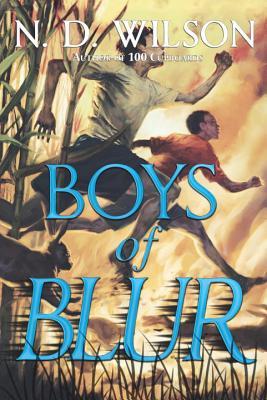
Boys of Blur
By N.D. Wilson
Random House Books for Young Readers
$16.99
ISBN: 978-0-449-81673-8
Ages 9-12
On shelves April 8th.

I like a kid’s book with ambition. It’s all well and good to write one about magic candy shops or goofy uncles or simpering unicorns or what have you. The world is big and there’s room for every possible conceivable type of book for our children you can imagine. But then you have the children’s book authors that aim higher. Let’s say one wants to write about zombies. Well, that’s easy enough. Zombies battling kids is pretty straightforward stuff. But imagine the chutzpah it would take to take that seemingly innocuous little element and then to add in, oh I dunno, BEOWULF. N.D. Wilson is one of those guys I’ve been watching for a very long time. The kind of guy who started off his career by combining a contemporary tale of underground survival with The Odyssey (Leepike Ridge). In his latest novel, Boys of Blur Wilson steps everything up a notch. You’ve got your aforementioned zombies as well as a paean to small town football, an economy based on sugar cane harvesting, spousal abuse, and rabbit runs. It sounds like a dare, honestly. “I dare you to combine these seemingly disparate elements into a contemporary classic”. The end result is a book that shoots high, misses on occasion, but ultimately comes across as a smart and action packed tale of redemption.

There is muck, then sugarcane, then swamps, then Taper. The town of Taper, to be precise, where 12-year-old Charlie Reynolds has come with his mother, stepfather, and little sister to witness the burial of the local high school football coach. It’s a town filled with secrets and relatives he never knew he had, like homeschooled Cotton, his distant cousin, with whom he shares an instant bond. Together, the two discover a wild man of the swamps accompanied by two panthers and a sword. The reason for the sword becomes infinitely clear when Charlie becomes aware of The Gren. A zombie-like hoard bent on the town’s obliteration (and then THE WORLD!), it’s up to one young boy to seek out the source of the corruption and take her (yes, her) down.

I had to actually look up my Beowulf after reading this. The reason? The opening. Wilson doesn’t go in for the old rules that state that you should begin your book with some kind of gripping slam-bang action scene. His first page? It reads like an ode. Like a minstrel has stepped out of the wings to give praise to the gods and to set the scene for you. Only in this case it’s just the narrator telling you what’s what. “When the sugarcane’s burning and the rabbits are running, look for the boys who are quicker than flame.” Read that line aloud for a second. Just taste and savor what it’s saying. It sounds familiar, doesn’t it? Like you’ve read it somewhere else before (particularly that “look for the” part). Then there’s that last line. “Out here in the flats, when the sugarcane’s burning and the rabbits are running, there can be only quick. There’s quick, and there’s dead.” So I looked up the beginning of Beowulf just to see if, by any chance, Wilson had cribbed some of this from his source material. Not as such. The original text is a bit more concerned with great tribal kings past, and all that jazz. That doesn’t make Wilson’s book any less compelling, though. There’s a rhythm to the opening that sucks you in immediately. It’s not afraid to be beautiful. It begs to be heard from a tongue.

And while I’m on the topic of beautiful language, Wilson sure knows how to turn a phrase. If he has any ultimately defining characteristic as a writer it is his complete and utter lack of fear regarding descriptions. He delves into them. Swims deep into them. Can you blame him? Though a resident of Idaho, here he evokes a Florida that puts Carl Hiaasen to shame. Examples of some of his particularly good lines:

“As for the church bell, it crashed through the floorboards and settled into the soft ground below. It’s still down there, under the patched floor, ringing silence in the muck.”

“Charlie looked at the sky, held up by nothing more than the column of smoke he’d noticed during the service.”

“Charlie stopped at the end, beside a boy with a baby face on a body the size and shape of someone’s front door.”

And I’m particularly fond of this line about new siblings: “When Molly had come, she had turned Charlie into a brother, adding deep loves and loyalties to who he was without asking his permission first.”

The book moves at a rapid clip, but not at the expense of the characters. For one thing, it’s nice not to have to read about a passive hero. From early in the book, we know certain things about Charlie that are to serve him well in the future. As the story says, thanks to experiences with his abusive father, “he could bottle fear. He’d been doing it his whole life.” This gives Wilson’s hero a learned skill that will aid him in the rest of the story. And when there are choices to be made, he makes them. He isn’t some child being taken from place to place. He decides what he should and should not do in any given moment and acts. Sometimes it’s the right choice and sometimes it’s wrong, but it is at least HIS choice each time.

The sugarcane fields themselves are explained a bit late in the narrative. On page 64 or so we finally get an explanation about why the boys are running through burning fields to catch rabbits. For a moment I was reminded of Cynthia Kadohata’s attempts to explain threshing in her otherwise scintillating book The Thing About Luck. Wilson has the advantage of having an outsider in his tale, so it’s perfectly all right for Charlie to ask why the only way to successfully harvest cane is to burn it, “Fastest way to strip the leaves . . . Stalks is so wet, they don’t burn.” Mind you, this could have worked a little earlier in the story, since much of the book requires us to take on faith why the rabbit runs occur.

It’s also an unapologetically masculine story as well. All about swords and fighting and football and dangerous runs into burning sugarcane fields. The football is particularly fascinating. In an age when concussions are becoming big news and people are beginning to turn against the nation’s most violent sport, it’s unique, to say the least, to read a middle grade book where small town football is a way of life. Small town football almost NEVER makes it into books for kids, partly because baseball makes for a better narrative by its very definition. Football’s more difficult to explain. Its terms and turns of phrase haven’t made it into the language of the cultural zeitgeist to the same extent. For an author to not only acknowledge its existence but also give it a thumbs up is almost unheard of. Yet Boys of Blur could not exist without football. Charlie’s father went pro, as did his stepfather. The book begins by burying a coach, and there are long seated animosities in the town behind old high school football rivals. For many small towns, life without football would be untenable. And Boys of Blur acknowledges that to a certain extent.

The women that do appear are few and far between, but they are there. One should take care to note that it’s Wilson’s source material that lacking in the ladies (except for the big bad, of course). And he did go out of his way to add a couple additional females to the line-up. It’s not as if Charlie himself doesn’t notice the lack of ladies as well anyway. At one point he ponders the Gren and wonders why there aren’t any girls. The possible explanation he’s given is that much as a selfish man is envious of his sons, so would a selfish woman find her own daughters to be competition. Take that as you may. We veer close to Caliban country here, but Wilson already has one classic text to draw from. Shakespeare can wait.

Charlie’s mother would be one other example of a woman introduced to this story that gets a fair amount of page time. On paper you’d assume she was just a victim, a woman who continues to fear her ex-husband. But in reality, Wilson gives her much more credit. She’s the woman who dared to get out of an untenable situation for the sake of her child. A woman who managed to find another husband who wasn’t a carbon copy of the first and who has done everything in her power to protect her children in the wake of her ex-husband’s threats. And most interesting, Wilson will keep cutting back to her in the narrative. He doesn’t have to. There’s a reason most children’s fantasy novels star orphans. Include the parents and there’s a lot of emotional baggage to attend to. But Wilson’s never liked the notion of orphans much, so when his story cuts back to Natalie Mack and what she’s up to it’s a choice you go along with. In Wilson’s books parents aren’t enemies but allies. It goes against the grain of the usual narratives, wakes you up, and makes for better books.

Where do heroes find their courage and resolve? In previous books Wilson had already gone underground and into deep dark places. In Boys of Blur he explores the dual worlds of cane and swamp alike. Most epic narratives of the children’s fantasy sort are long, bloated affairs. They feel like they can’t tell their tales in anything less than 300 pages, and even then they end up being the first in a series. Wilson’s slick, sleek editing puts the bloat to shame. Clocking in at a handsome 208 pages it’s not going to be understood by every child reader. It doesn’t try for that either. Really, it can only be read by the right reader. The one that’s outgrown Harry Potter and Percy Jackson. The one who isn’t scared off by The Golden Compass and who will inform the librarian that they can’t possibly impress him or her because they’ve read “everything”. This is a book to stretch the muscles in that child’s brains. To make them appreciate the language of a tale as much as the action. And yes, there are big smelly zombies that go about killing people so win-win, right? Some may say the book ends too quickly. Some will wonder why there isn’t a sequel. But many will be impressed by what Wilson’s willing to shoot for here. Like the boys in the cane, this book speeds out of the gate, quick on its feet, willing to skip and hop and jump as fast as possible to get you where you need to go. If you’ve read too much of the same old, same old, this is one children’s book that’s like no other you know out there. Gripping.

On shelves now.

Source: Galley sent from author for review.

Like This? Then Try:

  • Zombie Baseball Beatdown by Paolo Bacigalupi – Lots of similarities, actually. Particularly when it comes to beating down zombies in cane fields / corn fields.
  • Beowulf by Gareth Hinds – Undoubtedly the best version of Beowulf for kids out there, this is Hinds’ masterpiece and is not to be missed.
  • The House of Dies Drear by Virginia Hamilton – Bear with me here. It makes sense. In both books you’ve mysterious African-American men hiding a secret of the past, scaring the local kids. I draw my connections where I can.

First Line: “When the sugarcane’s burning and the rabbits are running, look for the boys who are quicker than flame.”

Other Blog Reviews:

  • Random Musings of a Bibliophile
  • Librarian of Snark
  • Pages Unbound
  • Books and Movies
  • Good Books, Good Wine
  • Fiction State of Mind

Misc: Read some of the book yourself to get a taste.

Videos:
Remember, if you will, that Wilson both shot and narrated the following book trailer. One of the best of the year, too:

Filed Under: Best Books, Best Books of 2014, Reviews, Reviews 2014 Tagged With: 2014 fantasy, 2014 reviews, 2015 Newbery contender, Best Books of 2014, middle grade fantasy, N.D. Wilson, Random House

Children’s Literature Online at a Glance: A Look Back at Friends Long Gone

April 14, 2014 by Betsy Bird

So I was listening to an episode of Pop Culture Happy Hour the other day.  If you happen to unfamiliar with the show it’s just your basic pop culture based podcast where they dissect the trends and news of the day so you don’t have to.  In a recent episode called ‘Captain America’ And The Pitiless March Of Time a discussion was made of websites that have simply disappeared over the years.  The folks over at NPR were concerned about the fact that Television Without Pity is now defunct.  They mentioned how we live in this odd world where things we love and sites that once contained just loads of content can disappear in a day.  It got me to thinking.

I started A Fuse #8 Production as a blog on Blogger back in February of 2006.  At that time I had no idea what I was doing, stringing one word next to another, plucking weirdo news items from the ether, and generally reviewing anything I could get my hot little hands on.  I did a book review a day in my prime.  Now I’m lucky if I can get two out in a week!  That was when I caught some attention for starting a series called The Hot Men of Children’s Literature.  All in good fun, it got attention which was my ultimate goal.  Then SLJ picked me up and the rest is history.

So I took a trip back to my little old blog site and checked out the blogroll on the side.  The blogroll was something I maintained meticulously for a while.  There was even a moment when every day I would systematically check each and every blog there for news I could use.  Looking at it now, I see a lot of familiar faces who are still going strong, but they’re alongside folks I wish were still around.  If we pick a random number and say that the Kidlitosphere has been in existence for a decade, then maybe now is the time to tip our hats to those folks we miss.  In no particular order . . .


Collecting Children’s Books

Well. . . maybe a certain kind of order.  Here’s the thing about that old blogroll of mine.  If you look at it today you’ll see it’s organized in a kind of haphazard method.  That’s because it’s in order of blogs I checked the most to the least (7 years ago . . don’t flog me if you’re low!).  And coming in at #5 was Peter Sieruta and his jaw-dropping Collecting Children’s Books.  I kid you not when I say that for a time Peter was the hardest working man in show business.  His sheer output put me to shame.  I’d mince about with a tiny post here and there and then he’d swoop in with his Sunday Brunch posts and just blow us all away with these insightful, clever, interesting looks into the history of children’s literature.  He was beloved of certain authors like M.E. Kerr, childhood heroes he connected with thanks to the age of the internet.  Peter was so amazing, in fact, that it seemed a bloody frickin’ shame that no one was paying him to do what he did so well.  So I reached out to him and Julie Danielson of Seven Impossible Things Before Breakfast and proposed we all write a book together.  Turns out, I couldn’t have picked two better authors in all my livelong days.  Though our writing styles were diverse we were able to synthesize them into a single unified voice.  That book, Wild Things: Acts of Mischief in Children’s Literature comes out in August (we had to push back the pub date, which is why you’re not seeing it on your shelves this month) and is dedicated to Peter.  You see, after we had turned in our text, Peter passed away unexpectedly leaving a massive gaping hole in the children’s book blogosphere.  He was a kind and witty friend and from time to time I turn back to his old site just to see if there are any updates.  There never will be, but it does the heart good to check.


Just One More Book

On Saturday, April 19th at 2:00 p.m. I’m so pleased to announce that I’ll be hosting the Children’s Literary Salon Podcasting Children’s Books: Ins and Outs, Ups and Downs.  In it, podcasters Katie Davis (Brain Burps About Books), John Sellers (PW KidsCast), and Matthew Winner (Let’s Get Busy) will engage me in conversation about the world of children’s literary podcasting and their experiences with the form.  It’s bound to be a real thrill but it’s also important to remember that before any of these folks started in on the form there was one site that was your automatic go-to kidlit podcast.  Just One More Book was a Canadian creation, the brainchild of Andrea Ross and Mark Blevis.  For a time, it was really the only place to get good podcasting (unless, of course, you were a Harry Potter fan who subscribed to Pottercast).  Then personal problems arose.  Andrea was diagnosed with breast cancer and the site bravely chronicled her fight and recovery.  That was in 2009 and since that time there is the occasional podcast or video but for all intents and purposes the site is no longer updated.  Yet even in its defunct state I was happy to note that the Twitter feed of @JustOneMoreBook rakes in a whopping 6,549 followers.  You can bet I’ll be giving them a shout out at my next Lit Salon.


Big A little a

In an age of countless children’s literary blogs, with more and more cropping up every day, people forget that in the early days there just weren’t a lot of us hanging around.  You had your Tea Cozy and your MotherReader.  Your Educating Alice and your bookshelves of doom.  And then there was Big A little a run by Kelly Herold.  It wasn’t one of those big flashy blogs.  Instead, Kelly just provided really good, steady content for folks who were curious.  She had no problem interviewing Judy Blume one day and Mary Pope Osborne the next.  Sadly the site shuttered in 2009 and though she did try to do an alternate blog for a time it didn’t last.  Fortunately you can follow Kelly on Pinterest if you like, where she maintains four different boards.


The Edge of the Forest

Now my memory is a bit foggy on this one so folks who remember and worked on this will have to correct me when I get my facts wrong.  You see, in the early children’s literature days we had no idea what we were doing.  We knew we had to get organized in some way, so the Kidlitosphere Central was created, a wiki of reviews born, and the yearly Children’s Book Blogger Conference Kidlitcon established (not to mention the Cybils!).  On top of that, there was an idea of maintaining an online magazine with contributions from our community.  Called “The Edge of the Forest” it featured reviews of its own as well as articles and interviews.  Sadly it didn’t last and the site itself disappeared completely from the internet.  This is one of the rare cases of something children’s book blog related completely disappearing, reminding us that no matter how much content we may produce, it could all cease and desist tomorrow.  A blogger momento mori, if you will.


Editorial Anonymous

Ah.  One of the great mysteries of the children’s book blog age.  Created in 2007 and continuing until its demise in 2011, no one ever knew who EA, as she/he was affectionately known, really was.  Many theories raged, and undoubtedly a number of editors of children’s books probably had to field questions from folks wondering if they were “the one”.  EA’s disappearance isn’t hard to explain though.  She (it’s probably a pretty safe bet to call EA a she) was snarky in the good sense of the word.  Suffering no fools she had a whip smart tongue and a great style to boot.  Undoubtedly someone somewhere figured out her secret and so she stopped posting entirely one day.  I harbor two fantasies about EA.  One is that someday she’ll write a book of her own (though she may easily have already done so) and that I’ll see it and recognize her style.  The other is that I’ll be in my gray later years, oh say 85 or so, and one day someone will call me up and say to me and me alone: “Editorial Anonymous was [enter name here]”.  It could happen.  A girl just has to have faith.


Uncommon Corps

Sometimes a blog goes away and you feel sad.  And sometimes they stop posting and you get a bit miffed.  When The Uncommon Corps was created in the wake of the early Common Core State Standards rollout I was thrilled.  With an illustrious group of authors at the helm this was slated to be THE #1 most important blog to talk about CCSS out there.  But as time passed it just couldn’t quite post regularly.  It was started in 2012 and continued through 2013 then died on the vine.  I do maintain a hope somewhere that someday it will be revived, but until then we’ll just have to be content with the archives, such as they are.

Of course there are other blogs that have been pertinent to our business over the years that I miss just as much as well.  Children’s Music That Rocks used to be my one and only source of great new children’s album reviews.  Golden Age Comic Book Stories showed as much classic children’s book illustration as it did comic book panels.  There are others too that just slowed down their postings to one or two a year.

So now that I’ve steeped you in my own unique brand of nostalgia, return the favor.  What are some of the sites you find yourself missing from time to time?

Filed Under: Uncategorized Tagged With: children's book blogs, nostalgia

Review of the Day: Rules of Summer by Shaun Tan

April 10, 2014 by Betsy Bird

Rules of Summer
By Shaun Tan
Arthur A. Levine Books (an imprint of Scholastic)
$18.99
ISBN: 978-0-545-63912-5
Ages 4 and up
On shelves April 29th

When I was a young teen my favorite book was Ray Bradbury’s Dandelion Wine. Steeped in Bradbury’s nostalgia for his youth, I was in the throes of adolescence, probably on some level nostalgic for my own younger days. In this book I reveled in a childhood that was not my own but felt personal just the same. Summer seemed like the perfect time to set such a tale, what with its long days and capacity for equal parts mischief and magic. I loved my summers, even as I failed to know what exactly to do with them. I think of Bradbury’s novel from time to time, though its use for me has long since passed. I found myself going back to it after seeing Shaun Tan’s Rules of Summer. Encompassing a full summer season, Tan indulges his capacity for the odd and extreme while also managing to delve deeply into a relationship between two brothers. The family story is this book’s heart and soul meaning that when all is said and done this is a book for big siblings and little siblings. Miraculously both will see themselves reflected in the pages of the text. And both, if they approach it from the right direction, will find something to pore over in here for years and years to come.

“This is what I learned last summer,” says the book. It’s the kind of statement you might expect to find in an essay on How I Spent My Summer Vacation. Instead, what follows is a series of imaginative, wholly original extremes. Two brothers live in a world of fantastical creatures and gizmos. The younger continually breaks the rules as the elder either berates him or tries to save him from himself. A dinner party of well-dressed birds of prey contains the sentence, “Never eat the last olive at a party” as the older brother pulls his younger away from the potentially deadly entrée. “Never leave the back door open overnight” sees them both facing a living room awash in vegetation and giant lizards, the older boy clearly put out and the younger carrying a bucket and shovel. As the book continues you realize that the younger boy is often at odds with the rules his elder is trying to instill in him. The final straw comes after a massive pummeling, after which the elder brother sells his little bro off to a flock of black birds (“Never lose a fight”). Fortunately, a rescue is made and the book subtly shifts from admonitions to positive statements (“Always know the way home”). The final shot shows the two boys sitting on the couch watching TV, the walls of their living room wallpapered with drawings of the out-of-this-world creatures encountered in the rest of the book.

As a general rule I try to avoid reading other reviews of the children’s book in my hand until I’ve read the stories myself and gotten a sense of my own perspective. In the same frame of mind I avoid reading the bookflaps of books since they’ve a nasty tendency to give away the plot. Usually I’ll even avoid looking at them after I’ve read the book in question, but there are exceptions to every rule. After reading Rules of Summer I idly turned the book over and read this one on the back cover: “Never break the rules. Especially if you don’t understand them.” Huh. Oddly insightful comment. Aw, heck. I couldn’t resist. I looked at the bookflap and there, lo and behold, the book started to make more sense. According to the flap the rules are those seemingly arbitrary ones that younger siblings have to face when older siblings come up with them. Slowly a book that before had seemed to have only the slightest semblance of a plot began to make a lot more sense. Had I not read the flap, maybe I would have come up with an entirely different interpretation of the pages. Not sure. Whatever the case, I like where the flap took me, even as I suspect that some kids will have entirely different takes.

Tan’s strength here lies partly in the fact that these brothers command your equal respect. When I read the book through the first time I thought that the younger brother was the hero. A couple more reads and suddenly the older one started to get more and more sympathetic. Consider, for example, that very first shot of the two after the endpapers. The text reads, “Never leave a red sock on the clothesline.” There, hunched against a fence, the two brothers huddle while a scarlet-hued red-eyed rabbit eyes the sock in question. The older brother has one arm protectively around the younger’s back and his other hand gently cupping his mouth. In later images the younger will mess something up and the older won’t bother to hide his frustrations. The lack of parents in this book is the only way to make it work. When kids deal with one another in the absence of adults, they make their own rules. Even when the elder sells his brother to a flock of birds for a dented crown (his least likable moment) you’re almost immediately back on his side when he rescues his little brother with a pair of bolt cutters a couple pages later. And honestly, what older brother and sister hasn’t fantasized at some point about selling off their annoying little brothers and sisters (see: The great Shel Silverstein poem “Brother for Sale”)? Tan is capable of seeing both sides of the sibling equation. Few picture books even dare.

Tan’s always had a bit of a fascination with the surreal world of middle class life. Suburbia is his Twilight Zone, and he hardly has to add any mechanical monsters or sentient birds to make it unusual. In Tales from Outer Suburbia it was language that primarily painted suburban Australia’s canvass. Here, words are secondary to the art. As I paged through I began to take note of some of the mechanics present on a lot of the pages. Water towers, oilrigs, and even the occasional nuclear power plant. Most beautiful and frightening were the extremely large structures holding the power lines. In one picture the younger brother plays a paddle-based game against a robot opponent while his older brother arbitrates. The sky is an overcast slate gray with these unnerving grids of line and metal towering over them in the background. Extra points if you can find the single black bird that makes an appearance on almost every spread until that climatic moment when it no longer appears.

Even the endpapers of this book have the power to make you sit and stare for long periods of time. They inspire a feeling that is just impossible to put into words. The endpapers are also the place where Tan makes it clear that he’s going to be playing with light quite a lot in this book. For a fun time, try to figure out where the light source is coming from in each and every one of the book’s pictures. Sometimes it’s evident. Other times, the answer could well be its own little story.

The thickness to Tan’s paints also marks this as significantly different from some of his other books. Nowhere is this more evident than the cover. Look at the Picasso-like grassy field where the older brother scowls at his younger sibling. The midday sun, the paints so thick you feel like the cover would feel textured if you stroked it, and even the pure blue of the noonday sky has a different Tan tone than you’re used to.

I don’t know if Tan has sons of his own. I don’t particularly care. For all I know the inspiration behind this book came from a relationship with his own brother at an early age. Wherever it might have appeared, one cannot help but feel that Tan knows from whence he illustrates. Thanks to films like Frozen we’re seeing an uptick in interest in stories about siblings of the same gender. Brothers have a tendency to tricky to render on the page (see: the aforementioned Dandelion Wine) but it can be done. Tan has perfectly rendered one such relationship with all its frustrations, betrayals, fights, complaints and deep, enduring love. This book sympathizes with those kids, regardless of their birth order. The rules of childhood are built on shifting sands, causing children everywhere to look longingly at the seeming sanity of adulthood. It’s only when they cross over that these kids will find themselves nostalgic for a time of outsized rules and their overblown importance. Without a doubt, the best book about what summer means to child siblings I’ve ever read.

On shelves April 29th.

Source: Galley acquired at ALA Conference for review.

Like This? Then Try:

  • Dandelion Wine by Ray Bradbury
  • The Adventures of Beekle: The Unimaginary Friend by Dan Santat
  • Journey by Aaron Becker
  • The Mysteries of Harris Burdick by Chris Van Allsburg

Other Blog Reviews:

  • Bookmunch
  • Slightly Foxed
  • Kids’ Book Review
  • Fiction in Fiction in Fiction
  • Buzz Words

Professional Reviews:

  • The Australian
  • A star from Kirkus
  • A star from Publishers Weekly

Other Reviews: Australian Comics Journal

Interviews: Gillo talks to Shaun Tan about the book here.

Misc:

  • The book is available as an app, with music by the hugely talented Sxip Shirey.
  • Download the Teacher’s Guide for the book here.
  • If you don’t mind knowing as much as Tan himself knows about this book, you can read his commentary about each image here. And yes, he was quite close to his own older brother growing up.  So that solves that mystery.

Video:

Seven videos about this book exist on Tan’s website.  Check ’em out if you’ve half a mind to.

And here’s a sneaky peek at the aforementioned app:

And here’s an interview with him about the book on ABC RN:


Filed Under: Best Books, Best Books of 2014, Reviews, Reviews 2014 Tagged With: 2014 picture books, 2014 reviews, Arthur A. Levine, Best Books of 2014, picture books, picture books for older readers, Scholastic, Shaun Tan

Fusenews: All you need is love (and books before the age of 3)

April 9, 2014 by Betsy Bird

Zounds!

No reason in particular I wrote that word.  I just like to say “Zounds!” from time to time. Onward!

  • I initially misread this post as “Summer Reading Takes a Hit From Online Scanning and Skimming Researchers Say” (which shows you where my mind is these days).  It’s not “Summer” but Serious Reading Takes a Hit From Online Scanning and Skimming Researchers Say.  I am not dead to the irony of linking to such a piece within a post where the entire purpose is to skim and scan.  That said, I’m just grateful that summer reading isn’t taking that hit.  Now THAT would be a catastrophe.  Thanks to Wayne Roylance for the link.
  • This is somewhat related. The New York Times put out an article talking about the necessity of literature for the very young.  Called Books, and Compassion, From Birth it won’t say much that you don’t already know, but hopefully it’ll get some readers aware of what needs to be done.  It also ties in quite beautifully with author Jason Boog’s delightful July release Born Reading: Bringing Up Bookworms in a Digital Age — From Picture Books to eBooks and Everything in Between.  In the interest of transparency, I wrote the introduction for that book, but the content is all Boog.  Consider it the most necessary bit of parental instruction you’ll find.  Hand to folks at baby showers.  Please.
  • I’m about a week behind in all my news, so you probably saw this long ago.  But just in case you didn’t I was amused by this mash-up of Syd Hoff/Richard Scarry and some very adult novels.  Here’s the link and here’s one of the images in question:

Awesome.

  • It wouldn’t be the first time Mac Barnett and Daniel Handler have appeared on the same panel.  Heck, it probably wouldn’t even necessarily be the best time but there’s nothing like an imminent birth to make a person want to attend the 2014 ALSC National Institute. Aside from the great guests, folks get to go to a place called Children’s Fairyland.  I went to see whether or not I’d added the attractions there to my Complete Listing of All Public Children’s Literature Statues in the United States and found that I had not yet.  I think on maternity leave I go back to updating that post.  It’s 75% done.  Just need to keep adding on suggestions (and I see that the Albany Public Library turned it into a Pinterest board, which is rather fascinating in and of itself).
  • I was fascinated by the recent ShelfTalker post To Host or Not to Host?  The gist of it is that local authors will often ask a bookstore to host an event for their book.  No big surprise there, except what do you do when they’ve published through Amazon?  The back and forth in the comments is worth your time and money.
  • Good old Rocco Staino wrote up the recent celebratory 90-Second Newbery hosted at NYPL.  The gist of the article is quite clever too.  I had noticed vaguely, but without putting it together, that this year’s film festival featured a lot of forgotten Newbery book winners.  I mean, does anyone at all remember The Old Tobacco Shop: A True Account of What Befell A Little Boy in Search of Adventure?  And I blush to say it, but I had no idea that Anne Carroll Moore won a Newbery Honor back in the day.  Wowzah.  How is THAT fact not better known?
  • Yay, Tea Cozy!  Liz Burns does a really good and in-depth look at a recent Entertainment Weekly article that discussed the sheer lack of diversity in our child and teen books these days.
  • There are certain authors on this good green globe that make the world a more interesting place by simply being here. Years ago when I read Kate Milford’s The Boneshaker, I knew she was one of those few. The fascinating thing about Kate is that she’s always writing. Even when her characters aren’t making it into books published by traditional publishers, they’re living their lives in books funded by Kickstarter. Now Kate’s got a new book on the horizon called Bluecrowne that I’d be dying to read, and at the same time she has a book that’s kinda sorta related coming out in August called The Green Glass House. I really need to read that August title, but I’d love to see her publish the Bluecrowne book as well. So if you’ve some jingle in your jeans and like her work (or even if you’re just simply interested in what she has going on) check out her Kickstarter project here.
  • Thanks to a push in Britain to stop promoting gendered toys for kids, the focus has moved a bit to books for kids as well.  I know I’m not the only person in the world who shudders every time she sees a book spell out on its cover that it’s just “For Boys” or “For Girls”.  Just as I grind my teeth when the toy store tells me the same dang thing.  A not so hotso article in a Philadelphia magazine yielded a pretty darn good conversation in its comments.  The article itself is one of those rabble rouser pieces that throw words like “Orwellian” around higglety pigglety.  The comments from Let Toys Be Toys focus everything and keep the conversation civil.  Thanks to PW Children’s Bookshelf for the link.
  • And speaking of gender . . . Anyone out there familiar with Sheila Hamanaka’s picture book I Look Like a Girl?  I wasn’t and I only knew Ms. Hamanaka’s name because of her All the Colors of the Earth.  Well over at Bank Street College of Education’s school the kids got a little passionate about the messages they get from books sometimes.  Here’s the part one and part two of the kids and their reactions/interpretations.  Wowzah.
  • Some folks know that before I decided to become a children’s librarian I played with the notion of heading into conservation instead.  Now my worlds collide as I present to you a recent NYPL post on what it takes to take care of Winnie-the-Pooh and friends.  Stuffed Animal Husbandry, for the record, is the perfect title.
  • Daily Image:

I’m actually doing very well on Daily Images these days.  Perhaps too well.  I was all set with the image for today but that was before I saw this.  It’s a link that will instruct you on the finer details of creating your very own one-of-a-kind Hobbes doll.

I ain’t crafty but that, my friends, is just about the cutest thing I’ve ever seen.

Filed Under: Fusenews Tagged With: 90 Second Newbery, Calvin and Hobbes, early literacy, Fusenews, gender stereotypes, Kate Milford, Winnie-the-Pooh

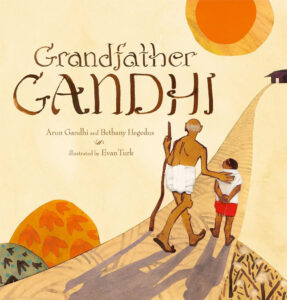
Review of the Day: Grandfather Gandhi by Arun Gandhi and Bethany Hegedus

April 8, 2014 by Betsy Bird

Grandfather Gandhi
Arun Gandhi and Bethany Hegedus
Illustrated by Evan Turk
Atheneum (an imprint of Simon and Schuster)
$17.99
ISBN: 978-1-4424-2365-X
Ages 4-8
On shelves now.

Are you familiar with the concept of booktalking? It’s a technique librarians developed to get people interested in books they might otherwise not pick up. The whole concept is to develop a kind of movie trailer style talk that gives a sense of the book’s allure without giving up the plot. Typically booktalking is done for middle grade and young adult works of fiction, but enterprising souls have had a lot of luck with nonfiction as well. Now with an increased interest in nonfiction in our schools it’s more important than ever to make the books we hawk sound particularly good. It doesn’t hurt matters any when the books actually ARE good, though. Now let’s say I’m standing in front of a room of second and third graders with a copy of Grandfather Gandhi in my hands. How do I sell this book to them? Easy peasy. Some books practically booktalk themselves. Here’s how you sell it:

“Have any of you ever heard of Einstein? Yes? He’s the guy that was a total genius. Now imagine you’re his grandkid and you’re not that smart. Okay now, have any of you heard of the Beatles. Yes? Well imagine you’re one of THEIR grandkids . . . and you’re bad at music. Now here’s the big one. Has anyone heard of Gandhi? He was a great guy. He managed to free his country and stop a lot of oppression and he did it without any violence at all. Martin Luther King Jr. got some of his ideas from Gandhi about nonviolence. All right, well, now let’s image you are Gandhi, the most peaceful man IN THE WORLD’s grandson. What if you get mad? Can you imagine what it would be like to have everyone whispering every time you got a little steamed about something?”

So there you go. Quick. Simple. To the point. I’ve met a fair number of picture book memoirs in my day, but Grandfather Gandhi may well be my favorite. Smartly written with an unusual hook and art that will just knock your socks off, this is one title you are going to have to see firsthand for yourself.

When young Arun and his family first arrive in his grandfather Mahatma Gandhi’s village, he’s mighty shy around his incredibly famous relative. Yet right away Grandfather is warm and welcoming to them, and when he praises Arun for walking the distance from the train station the boy swells with pride. Unfortunately, having Gandhi as your grandpa means having to share him with the 350 followers who also live in the village. Arun struggles with his lessons in Gujarati and the fact that there are no movie theaters around, but there are upsides to village life too. He’s pretty good at soccer with the other kids, and occasionally Grandfather will take him for a walk just mano a mano. But then, one fateful day, Arun gets into a skirmish on the soccer field and his anger is overwhelming. Shamed that the grandson of Gandhi himself would react in anger he confesses to his Grandfather immediately, only to find the man isn’t angry or disappointed in him in the least. Anger, Gandhi explains, is like lightning. You can use it to destroy or you can use it to light the world, like a lamp. Which will you choose?

I think it’s fair to say that there have been a fair number of children’s picture books from family and relatives of famous peacemakers. Most notable would be Martin Luther King Jr.’s clan, where it sometimes seems like every son, daughter, niece, and nephew has his or her own spin on their infinitely famous relative. Gandhi’s a bit different. One wouldn’t expect his own descendants to have much in the way of access to the American publishing industry, so biographies of his life in picture book form have concentrated occasionally on his life and occasionally on The Great Salt March. When I saw that this book was co-authored by his fifth grandson I expected the same sort of story. A kind of mix of “this guy was fantastic” with “and I knew him!”. Instead, Hegedus and Gandhi have formulated a much more accessible narrative. Few children can relate to having a famous relative. But what about controlling their anger in the face of injustice? What’s fascinating about this book is that the authors have taken a seemingly complex historical issue and put it into terms so child-friendly that a five-year-old could get the gist of it. That Gandhi’s anger went on to become what spurned him to make lasting, important changes for his people is the key point of the book, but it takes a child’s p.o.v. to drill the issue home.

Above and beyond all that, this is a book that advocates quite strongly for peace in all its myriad forms. Hardly surprising when you consider the subject matter but just the same I sometimes feel like “peace” is one of those difficult concepts without a proper picture book advocate. I went to a Quaker college where PAGS (Peace and Global Studies) was a popular major, and it was in making Quaker friends that I learned about picture books dedicated to the concepts embraced by that particular religion. Books like The Story of Ferdinand by Munro Leaf, The Table Where Rich People Sit by Byrd Baylor, Thy Friend, Obadiah by Brinton Turkle, and more. I’m sure that many is the Quaker household, or really any household that believes that peace is a practical and attainable solution, that will embrace Grandfather Gandhi as one of their own.

It’s been a long time since I ran across a picture book with as long and lengthy a list of materials used in the illustrations as I have here. On the publication page it reads, “The illustrations for this book are rendered in watercolor, paper collage, cotton fabric, cotton, yarn, gouache, pencil, tea, and tin foil. Cotton hand spun on an Indian book charkha by Eileen Hallman.” Phew! You might think that all that “stuff” might yield something clogged up or messy, but that would be doing Mr. Turk a disservice. Observing how well he gives his pictures depth and texture, life and vitality, you might be shocked to learn that Grandfather Gandhi is his first picture book. From the spinning wheel endpapers to montages of sheer explosive anger, Turk makes a point of not only adhering to some of the more metaphorical aspects of the text, but finding new and creative ways to bring them to visual life. To my mind, the materials an artist uses in his or her art must, in the case of mixed media, have a reason for their existence. If you’re going to use “cotton fabric, cotton” and “yarn” then there should be a reason. But Turk clearly did his homework prior to doing the art on this book. He doesn’t just slap the images together. He incorporates the fibers Gandhi knew so well and turns them into an essential aspect of the book’s art. The art doesn’t just support the text here. It weaves itself into the story, becoming impossible to separate from the story.

It’s Arun’s anger that proved to be the most visually interesting aspect, to me, in the book. Turk deftly contrasts the calm white thread produced by Gandhi’s spinning with the tangled black ones that surround and engulf his grandson whenever his feelings threaten to break free. The scene where he’s tempted to throw a rock at the boy who shoved him down is filled with thread, Arun’s magnificently clenched teeth, and black shadow figures that reach out across the field to the soccer net, dwarfing the three other little figures below. Later you can see the negative space found in cut paper turning from a representation of lightning into a thread of cotton in the hands of Gandhi illuminating a passage about making your anger useful. Yet Turk doesn’t just rely on clever techniques. He’s remarkably skilled at faces too. Arun’s expressions when he gets to see his grandfather alone or makes him proud are just filled with wide-eyed eager hope. And his frustrations and anger pulse off the page from his features alone.

Picture books for kids about dealing with their anger tend towards the fictional. There’s Molly Bang’s When Sophie Gets Angry . . . Really Really Angry and Robie H. Harris’s The Day Leo Said, “I Hate You”. These are two of the good ones. Others veer towards the preachy and paternalistic. Imagine if you started using something like Grandfather Gandhi instead. More than just a memoir, the book offers a broad look at the benefits of channeling your anger. Better still, it’s a true story. Kids respect the true. They’ll also respect young Arun and his uncomfortable position. Fair play to author Bethany Hegedus for hearing him speak more than 13 years ago about this moment in his life, knowing that not only was there a picture book story to be had here, but a lesson kids today can grasp. As she says in her “Note from the Authors” at the end, “We world we live in needs to heal – to heal from the wars that are fought, to the bullying epidemic, to mass killings by lone gunmen, to poverty, to hunger, and to issues that contribute to internal anger being outwardly expressed in violent actions.” Gandhi’s message never grows old. Now we’ve a book that helps to continue his work for the youngest of readers. A necessary purchase then.

On shelves now.

Source: Final copy sent from publisher for review.

Like This? Then Try:

  • Gandhi: A March to the Sea by Alice B. McGinty
  • A Taste of Freedom: Gandhi and the Great Salt March by Elizabeth Cody Kimmel
  • Child of the Civil Rights Movement by Paula Young Shelton
  • The Story of Ferdinand by Munro Leaf

Other Blog Reviews:

  • Sal’s Fiction Addiction
  • Waking Brain Cells

Professional Reviews:

  • A star from Publishers Weekly
  • A star from Kirkus

Interviews:

  • ReaderKidZ speaks with Ms. Hegedus about the book.
  • Meanwhile Kirkus interviewed the two authors and the illustrator here.

Misc: This is a book with a very nicely maintained and updated website of its own.  Some of my favorite posts include this one from Evan Turk on how he got access to the spun cotton fiber featured in the book.  I also light his piece on Light & Shadow and this one on how he chose his art.  Arun even has posts up containing family Gandhi stories that would make an excellent follow up books should the need arise.  Be sure to read the one on pumpkins and eggs when you get a chance.

Video:

One of the top best book trailers I’ve seen in a really long time.  Accomplished and it does a brilliant job of highlighting Turk’s art.

llustration & Animation by Evan Turk

Music: “Ambwa” used by permission of artist Ustad Ghulam Farid Nizami
Voices: Arun Gandhi & Bethany Hegedus
Sound: Evan Turk, Carrington MacDuffie & The Block House, Justin Yelle & Kaotic Studios, and William Dufris & Mind’s Eye Productions.

Project Management: Curious City

And here’s Bethany herself telling some behind-the-scenes stories about working on the book:

Filed Under: Best Books, Best Books of 2014, Reviews, Reviews 2014 Tagged With: 2014 biographies, 2014 nonfiction, 2014 reviews, 2015 Caldecott contender, 2015 Sibert contender, Arun Gandhi, Atheneum, Best Books of 2014, Bethany Hegedus, biographies, Evan Turk, nonfiction, nonfiction picture books, picture book biographies, Simon and Schuster

  • « Go to Previous Page
  • Page 1
  • Interim pages omitted …
  • Page 496
  • Page 497
  • Page 498
  • Page 499
  • Page 500
  • Interim pages omitted …
  • Page 1048
  • Go to Next Page »

Primary Sidebar