• Skip to primary navigation
  • Skip to main content
  • Skip to primary sidebar
  • About/Contact
  • Fusenews
  • Reviews
  • Librarian Previews
  • Best Books
    • Top 100
    • Best Books of 2022
    • Best Books of 2021
    • Best Books of 2020
    • Best Books of 2019
    • Best Books of 2018
    • Best Books of 2017
    • Best Books of 2016
    • Best Books of 2015
    • Best Books of 2014
    • Best Books of 2013
  • Fuse 8 n’ Kate
  • Videos
  • Press Release Fun

31 Days, 31 Lists: 2020 Picture Book Readalouds

31 Days, 31 Lists: 2020 Picture Book Readalouds

December 4, 2020 by Betsy Bird

I’ve told you the story of one of my first storytimes as a children’s librarian, haven’t I? I had just gotten my first gig in a New York Public Library branch and I was desperate to do a good job. I hadn’t done many storytimes by this point, but by gum I was willing to give it a go! I knew the rudimentary basics, after all. How hard could it be? So I had a crew of active 3 and 4-year-olds before me and the book I pulled out to read to them was . . . Horton Hatches the Egg. Folks, I don’t know if you’re aware of it, but old Horton is the longest book ever written in the English language. That, in any case, was how it felt to me when I had to read the dang thing and it would. Not. End. I learned a valuable lesson that day: Never devalue a truly great readaloud picture book when you find it. And never try to force a lapsit book into a starring role in front of a crowd.

Storytimes in 2020 were mostly virtual affairs, I’m afraid. So many children’s librarians gather their energy from the squirmy little balls of life and light and vitality that come to their readalouds. Across a screen? It’s very difficult to maintain that same level of verve and interest. Today’s books won’t solve that problem, but they’ll at least help. Each one is tapered to a different age group, each with its own tips and tricks. Readaloud picture books can win few awards, but they’ll definitely work their ways into the hearts and minds of librarians and booksellers everywhere.


2020 Picture Book Readalouds

Little Baby’s Playtime by Sally Symes, ill. Nick Sharratt

If this looks familiar, I already put it on the list of the best board books of the year. That said, this is really designed for a marvelous Baby Lapsit Program. Baby Lapsits, I should mention, always scared me a little cause babies do not care what you do. This book might tip the balance in the reader’s favor, though. Look at those clean black lines and bright eye-catching colors. Now you may just think I included this book on this list for the sole reason that it involves sticking your fingers in there to make the baby legs . . . and you would be 75% correct. But but but! Sally Symes, an old hat in the baby board book game, accompanies each picture with gently rhyming text and little descriptive wiggles, jiggles, whooshes, ding-a-lings, and more. A librarian doing a storytime could get a real routine going on here with enough practice. A winner from start to finish.

Bunnies On the Bus by Philip Ardagh, ill. Ben Mantle

Yeah. I pretty much took one look at that cover and I was on board. Basically, all I want out of this life is books about bunnies run amok. Now this is a British import, and you get a bit of a sense of that in the verse. When a massive brown bunny grabs a good six of them by their ears the text reads, “DO sit down, or you’ll end up in a pile.” Rhyming text keeps it bouncy from page one onward, while the whizzing action and detail-filled pages make for a roaring good time. I had to double back and reread the whole thing just to find out how the lion got outed as bald by the tabloids at the end. Essentially, this is NOT the wheels on the bus with bunnies. This is what would happen if the Pigeon in Don’t Let the Pigeon Drive the Bus actually got ahold of a vehicle . . . and was a rabbit. Madcap, wild, raucous, and perfect for storytimes everywhere.

Friday Night Wrestlefest by J.F. Fox, ill. Micah Player

Are you ready to RUMBLE??? Where will your loyalties lie when Dangerous Daddoo takes on the Tag Team Twins with Mama-Rama joining in the fun? I like a book that allows me to make a big, booming announcer voice. This one delivers. But I find it so strange that this is the first time I’ve mentioned this book on this blog, because in real life I’m singing its praises constantly. As a readaloud, I think this book is just gonna hit it out of the park. I absolutely love the colors, characterizations, and shifting loyalties. There are twists you won’t see coming. And there’s just this great sense of family. Since I’ve been stuck home with my family, I’ve gotten to really appreciate when we can all play together in some way. This book understands and elevates that concept.

The Hips On the Drag Queen Go Swish, Swish, Swish by Lil Miss Hot Mess, ill. Olga de Dios

A first! By now we’re all probably familiar with the concept of Drag Queen Story Hours (and if you are not, get thee to this website to learn more) but until now there has never been a picture book meant SPECIFICALLY for those events. And one you can sing at that? With a familiar tune and super fun art? Heck, forget just limiting this to DQSHs, you can use this for any storytime you want. I have a request. Please, someone, let me know about a YouTube video where someone is performing this song. I want to watch it at work.

The More We Get Together by Celeste Cortright, ill. Betania Zacarias, sung by Audra Mariel and Kena Anae

Okay. I am adding this book to the readaloud list but there are some caveats involved. Not about the art, which is bright, colorful, and fun. More about the audience. My great fear is that this book will be read (or its CD played) for classes of 2nd, 3rd, 4th, or even 5th graders. Should this happen, the rolling of the eyes will be heard across this great nation. PLEASE do not make older kids listen to this. Not because the message isn’t good, of course. I mean, it’s a clever adaptation of a familiar song and given an environmental twist. But it’s so very earnest that the best possible audience are younger children. Preschool, ideally. For them, this is a perfect complement to Earth Day or any storytime with a green bent. Older kids get real twitchy and irritable if they think you’re talking down to them. So yes, by all means, use this book with preschoolers and maybe even Kindergartners. The right book for the right audience.

Nerp! by Sarah Lynne Reul

When a picky baby wants its pet’s food, nothing’s gonna keep it from its goal. I came into this figuring it was just another average alien pet story. What I didn’t realize was that Reul is as playful with her language as she is her art. First off, this book is a hoot to read aloud. “Squishalicious wumpa glump?” “Picklefishy verp?” So you have the group storytime aspect right there. Then you look at the odd three-dimensionality of it all. This pairs very well with The Secret Rhino Society in terms of eclectic illustration + modeling.

On Account of the Gum by Adam Rex

Oh no. There’s gum stuck in your hair? Don’t worry, I know a surefire solution. A book where things get increasingly, hilariously, catastrophically worse. When it comes to comic timing, Adam Rex may be surpassing Mo Willems and Bob Shea. This is very much like Stuck by Oliver Jeffers, only instead of a tree it’s a kid’s head. And there is just so much to enjoy about it too. Little details like the rabbit’s never changing expression or the band-aids on the aunt’s chin in the final picture (see if you can figure out how they got there). The jokes land and they land hard. My kids were rolling when I got to the line, “Wait, no. I’m thinking of the old cat.” And on top of all of that it RHYMES!? Try reading this aloud to a group (you’ll need to practice beforehand because some of those rhymes aren’t obvious when you’re just reading a book in your head) and see what the results are.

Rita and Ralph’s Rotten Day by Carmen Agra Deedy, ill. Pete Oswald
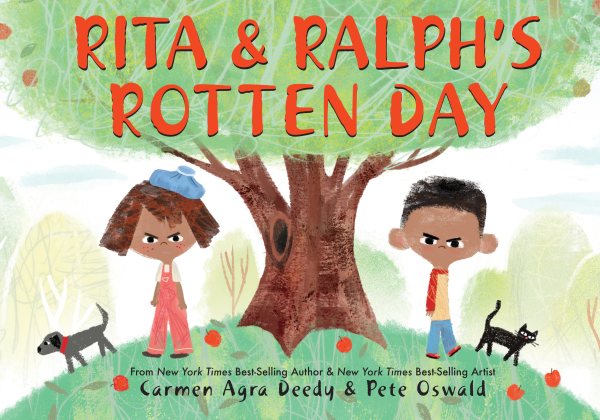
Every day Rita and Ralph run down the hill, and up the hill, and down the hill, and up the hill to see each other. That is, before an accident makes everything bad. A rotten day was never this much fun. Consider it the readaloud book to beat all readaloud books! Deedy’s a storyteller at heart, but I’ve never seen her take a hand rhyme and turn it into a book before. She calls the original handrhyme “Mr. Wiggle & Mr. Waggle” but when you see it in the back of this book you’ll recognize it immediately, no matter what version you do. This book was made for storytimes. Plus Oswald’s art really fits Deedy’s writing so well. Love the color palette and those little noseless, glaring faces. A pretty darn good encapsulation of how things can get out of hand between friends.

Smashy Town by Andrea Zimmerman and David Clemesha, ill. Dan Yaccarino
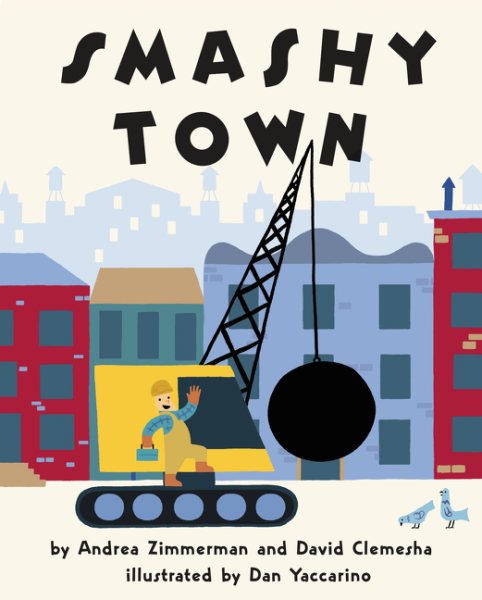
Who’s looking for some serious smash time? Join Mr. Gilly has he smashes, crashes, tumbles and crumbles a great big building down to smithereens. Expect to read this one out loud again and again! While I prefer not to put sequels on my lists, there’s gotta be a 20-year statute of limitations in there, right? Trashy Town was released in 1999 and a whopping 21 years later we now have Smashy Town. It has all the perks of its predecessor, but the extra added benefit of allowing you, the children’s librarians, the chance to yell, “SMASH SMASH SMASH!” and “CRASH CRASH CRASH!” at the top of your lungs during storytime. Amazing!

Ocean! Waves for All by Stacy McAnulty, ill David Litchfield

By now you probably have seen the other book sin McAnulty’s “Our Universe” series. And until now McAnulty has primarily focused on heavenly bodies. With Ocean she switched her focus to something found specifically on earth, and to do so she’s gone an interesting route. The voice of the Ocean in this book is that of a real chill surfer dude. You fall into the accent so naturally that it feels like slipping on a silky robe. This book was born to be read aloud for those environmental storytimes you always promise to do. Tired of trying to adapt books that don’t read well to large groups? Ocean to the rescue. Lots of facts and a killer grab bag of backmatter to boot.

There’s a Skeleton Inside You! by Idan Ben-Barak and Julian Frost

I was such an incredible fan of Ben-Barak and Frost’s previous collaboration Do Not Lick This Book so when I heard that there was a follow-up title I snapped it right up. Though lacking the high-powered microscopic photographs of its predecessor, this book employs a very clever method of showing how your bones, muscles, and nerves all work together in the human body. A floppity alien wants to fix her spaceship. To do so she has to grow bones, muscles, and nerves in her hands. With all the interactive elements you’d expect from the first book, and bright colors to boot, it’s a delightful human body book for rather young readers. Want a science storytime book? This is an ideal choice. ou can even have the kids in the audience high-five the book at the end!


Want to see other lists? Check out what happened this month!

December 1 – Great Board Books

December 2 – Board Book Reprints & Adaptations

December 3 – Transcendent Holiday Picture Books

December 4 – Picture Book Readalouds

December 5 – Rhyming Picture Books

December 6 – Funny Picture Books

December 7 – CaldeNotts

December 8 – Picture Book Reprints

December 9 – Math Books for Kids

December 10 – Bilingual Books

December 11 – Books with a Message

December 12 – Fabulous Photography

December 13 – Translated Picture Books

December 14 – Fairy Tales / Folktales / Religious Tales

December 15 – Wordless Picture Books

December 16 – Poetry Books

December 17 – Unconventional Children’s Books

December 18 – Easy Books & Early Chapter Books

December 19 – Comics & Graphic Novels

December 20 – Older Funny Books

December 21 – Science Fiction Books

December 22 – Fantasy Books

December 23 – Informational Fiction

December 24 – American History

December 25 – Science & Nature Books

December 26 – Unique Biographies

December 27 – Nonfiction Picture Books

December 28 – Nonfiction Books for Older Readers

December 29 – Best Audiobooks for Kids

December 30 – Middle Grade Novels

December 31 – Picture Books

Enjoy!

Filed Under: 31 Days 31 Lists, Best Books of 2020 Tagged With: 31 days 31 lists, picture book readalouds, readalouds

31 Days, 31 Lists: 2020 Transcendent Holiday Picture Books

December 3, 2020 by Betsy Bird

I read with interest a recent Holiday round-up of picture books in the most recent edition of The Horn Book. Of course, unlike the staff of HB, today’s list is not constrained by a single season. I cannot say to have seen most of what came out in 2020, but from what I did see I found a nice array of titles that I’d say are a cut above the rest. These are books that you’d be honored to pull out year after year for your holiday displays.

I should note that when I say “Holiday”, I’m a little bit broad with the term. Essentially, these are books that you could recommend alongside the holiday listed. They may not have been written with a specific holiday in mind, but they adapt oh so well.


2020 Holiday Books

Before We Eat by Pat Brisson, ill. Mary Azarian

[Holiday – Thanksgiving]

Yeah, I already included this book on yesterday’s list, but can I help it that it straddles multiple genres? The original book came out in 2014, and at its heart this book is really about giving thanks for the good things we eat. The kind of book that’ll be welcome equally at Farmer’s Markets as it is Thanksgiving storytimes.

Bear Meets Bear by Jacob Grant

[Holiday – Valentine’s Day]

Uh-oh. I’m doing it again. I’m just sorta sliiiiiiiiiding a book into a Holiday category because I like it so much. So Jacob Grant (Evanston resident – woohoo!) has done a couple of these Bear books already and they’re all cute. I gotta say that this latest title is my favorite so far, though. In this story our hero, Bear, falls hard for a cute delivery bear named Panda. Bear is so flummoxed in her presence that his tongue ties itself into knots. The only way he can see her is if he just keeps ordering more and more teapots for his home. Then one day a teapot is delivered by a gruff raccoon and it’s up to Bear’s spider friend to save the day. The charcoal, crayon, and ink art allows for these funny little moments that all come down to how Mr. Grant illustrates eyes. There’s this shot of a skeptical Bear eyeing a lemonade like he’s half afraid it’s gonna jump up out of the glass and bite him that I’d pretty much kill to have on my wall. In another shot, Spider looks dead at the reader, flabbergasted by something Bear has just said. Not a lotta mouths in these books but whole buckets of charm.

The Christmas Feast by Nathalie Dargent, ill. Magali Le Huche

[Holiday – Christmas]

It’s My Lucky Day by Keiko Kasza but jacked up to 11. When a fox (who lives in a pretty interesting living situation with a wolf and a weasel) steals a turkey for a Christmas dinner he has NO idea what he’s getting himself into. Not only does the turkey immediately take charge, but she’s one smart cookie. She whips those three villains into shape, having them cook and clean and pretty much reassess their sad, sorry lives. And when, at last, it’s time for them to prepare her for Christmas dinner a couple weeks later (“I would like to be flambéed… But the recipe is quite difficult. Will you be able to manage it?”) they don’t want to. Christmas books, I know ALL too well, are supposed to be hopeful and heartening. Here in America the snark gets ironed right out. Leave it to the French to make something satiric with a bit more bite. I’m still chewing over how I felt about that last shot of the turkey reading a book called “The Best Recipes for Stuffed Wolves, Foxes, and Weasels”.

Eggs Are Everywhere by Wednesday Kirwan

[Holiday – Easter]

These board books are brilliant. I’d already gone all kinds of gaga over the previous book in the series (concept by Naomi Kirsten) called Guess Which Hand. This book is a more Easter-themed version and it’s so smart. Essentially, you turn a little wheel on the side of the book until you get to the item you want to find. Then you guess where it is. Is it under the bunny’s left ear or right ear? Lower the flap and sometimes you’re right and sometimes you’re wrong. I’m sure a smart cookie could figure out the pattern after a while but I dunno. Feels fairly random to me. Plus, I just love that the only kid that appears in the book is Black. More of this, please!

Emergency Monster Squad by Dave Horowitz

[Holiday – Halloween]

Is it strictly a Halloween book? It is not. But doggone it, I had to find a way to get this Dave Horowitz delight onto a list SOMEWHERE this year, and this was the only way I could figure to do it. As you may or may not know, Horowitz is the rare children’s book author/illustrator turned EMT turned EMT/picture book author/illustrator. And now, finally, his two loves combine in a rather charming story of a monster and human paramedic and their attempts to help out a variety of ills. The repeated understanding is that you can never ever use the “Q” word around a paramedic. Why? Because the minute someone says how “quiet” it is, that’s when the world goes ka-blooey! I love the eye-popping, incredibly colorful style at work here. The whole kerschmozzle sings. For kids who want “scary” not SCARY.

Gustavo the Shy Ghost by Flavia Z. Drago

[Holiday – Halloween]

And speaking of “scary” not Scary . . . Okay, so naturally not every single book out there starring a ghost is going to be a Halloween or Dia de los Muertos title. In fact, if we’re going to be completely honestly about it, Gustavo kind of feels like a first day of school book more than anything else. Yet Mexican author/artist Drago fills this book with so much life, pep, and detail (I’m 99% sure the Frankenstein monsteresque kid in art class is a Diego Rivera reference) that I had to put it SOMEWHERE! And there are too many pumpkin-headed kids to not make it an unofficial holiday book. Gustavo’s sweetness reminds me of that Mac Barnett/Chrstian Robinson title Leo, a Ghost Story. If you’d like an ultra-sweet not scary Halloween storytime, consider pairing these two together.

The Hanukkah Magic of Nate Gadol by Arthur A. Levine, ill. Kevin Hawkes

[Holiday – Hanukkah]

Busy year for Arthur, eh? On the one hand he’s jumpstarted the Levin Querido publishing house (in the middle of a pandemic, and doesn’t THAT sound like fun?) and on the other hand he has a picture book of his own coming out. And yeah, I looked at the gold and gilt on that cover and was skeptical. But reading the book, with its mix of fantastical holiday spirits gadabouting around, I was won over. In his Author’s Note, Arthur points out that while Christmas gets a whole host of fantasy folks (he calls it “supplementary mythology”) that have little to nothing to do with the religious aspects of the day (the Grinch, Santa, Frosty the Snowman, etc.), Hanukkah doesn’t have any. Enter, Nate Gadol, a snazzy dresser and cheery spirit that can help you make whatever you have last just a bit longer. This is essentially a tale that explains how presents came to be a part of Hanukkah, and the note at the back has this fascinating historical note about how America is the one to blame when it came to THAT little addition. The book gives it a distinctive flair. Fun!

Mistletoe: A Christmas Story by Tad Hills

[Holiday – Christmas]

First and foremost, it is important for me to make clear that in this book Tad Hills does something particularly good: He makes sure that Mistletoe’s knitting needles are pointed down and NOT up when she’s knitting. Well done, sir! Now I am one of those annoying, perpetually cold people out there. So when given the choice between a cozy sofa and a cold blustery day, just slap a #TeamCozy on my forehead. I think there are a lot of kids out there that feel the same way. Heck, after all this COVID lockdown stuff, I wouldn’t be surprised if post-vaccine there are kids that never ever want to leave the house again! If that’s the case, read them this book. It’s sweet and gentle and won’t shame them for that decision. But it will make it clear that sometimes the outside isn’t the cold, scary place you’ve been avoiding all this time.

The Night Before Christmas by Clement C. Moore, ill. Loren Long

[Holiday – Christmas]

Now here’s an interesting challenge. How do you diversify a poem that’s as exacting and precise as old Clement C. Moore’s? Anyone familiar with this classic poem (beloved of picture books because it breaks down easily into a mere 32 or 40 pages) knows that there’s a precision to the actions in the text. What makes Long’s version so remarkable is that he splits St. Nick’s arrival between four very different households. There’s a mobile home, an apartment, a home in a tropical climate, and a house in the country. That means the kids and adults are also diverse, and it’s interesting to see all these adults watching St. Nick on the sly while their children sleep soundly. Long mentions in his Author’s Note that he wanted to adhere a little closer to the text to what St. Nick looks like physically, so you end up with something akin to Tasha Tudor’s “jolly old elf”. Like Tudor, Long’s Santa is small and agile. I was particularly taken with his reindeer and their toylike appearance. Need a new Christmas classic? I think this book has your answer.

The Passover Mouse by Joy Nelkin Wieder, ill. Shahar Kober

[Holiday – Passover]

Coming up with original fables, to say nothing of holiday-specific fables based off of passages from the Talmud, are not as common as all that. I often say that I learn much of what I know about the world from the children’s books I read. In this particular case, I didn’t know at all that not only do you not eat leavened food during the holiday, you can’t have any in your home at all. You find any such bread, you burn it. So the gist of this book is the almost philosophical question of what one does if a mouse enters your house with bread in its mouth. The book comes up with a smart answer, but I really appreciated that when the rabbi consulted the Talmud he discovered that the answer is, “This question is not decided.” Sometimes it’s comforting to know that other people get befuddled as well.

A Sweet Meeting on Mimouna Night by Allison Ofanansky, ill. Rotem Teplow

[Holiday – Mimouna]

Mimouna, the Moroccan Jewish holiday, is the star of this beautiful little book. I’d not heard of Mimouna before, but Ofanansky does a great job of explaining it bit by bit, piece by piece. On the last afternoon of Passover, Miriam’s family is getting ready to bake all kinds of Mimouna treats, like moufletot. The trouble? When the sun goes down, where can you find flour? Like many Jewish families in Morocco, Miriam and her mother go to a Muslim neighbor’s home, where a flour pick-up has already been arranged. There Miriam meets Jasmine, and later she and her family arrive in Miriam’s home for the celebration. But by the time Jasmine’s able to invite Miriam to Ramadan, she’s moved to Israel. A year later Mimouna comes around and Miriam, wistful, thinks of Jasmine and whether or not she’ll be waiting for her that night. It’s a bittersweet ending to a book that does an excellent job of showing the interconnectedness of kind neighbors to one another. An explanation of Mimouna and a recipe for Moufletot appear at the end. Extra points to Rotem Teplow, whose art lends the piece precisely the right feel. You won’t even know you’re reading a translation with this book. It feels just that natural.

12 Days of Christmas by Lara Hawthorne

[Holiday – Christmas]

On its surface, this just feels like a pretty standard rendition of that famous song. We all have our favorite versions, of course (I’ve always liked the LeUyen Pham). What causes the Hawthorne here to stand out, apart from the neat crisp style (gouache and edited digitally) is partly the fact that the “true love” is a woman sending gifts to another woman. How has no one ever had that idea before? And just in case the reader isn’t getting it, the final two-page spread in the book shows the women together, holding hands, with a friggin’ heart over their heads. Ha ha! No two ways around it. I liked that, I like the song in general, and I liked the multi-racial art. So yes, this is my new holiday favorite.

Welcoming Elijah: A Passover Tale With a Tail by Lesléa Newman, ill. Susan Gal

[Holiday – Passover]

For young children, a goodly portion of any religious ceremony is the process of waiting. With this book, the waiting is both part of the story and a part of Passover itself. As a boy and his family gather together, a small kitten waits outside. The boy inside is anticipating his favorite part, where he can finally open the door for Elijah. When he does so, he is greeted by the kitten, who is swiftly adopted, and I suspect you already know what its name is now. The writing is nicely portioned out. It’s a simple text, so appropriate for reading aloud to groups or one-on-one with littles. Gal, meanwhile, keeps everything just beautiful, from the glow of moonlight on a kitty’s white fur to the way light reflects off the boy’s eyes as he breaks his matzo in half. A prettier Passover book you simply couldn’t hope to find.

When Pumpkins Fly by Margaret Lawrence, ill. Amanda Sandland and Margaret Lawrence

[Holiday – Halloween]

It’s not what you’d call #ownvoices, but Inhabit Media is a pretty reliable publisher when it comes to Indigenous tales. Author Margaret Lawrence, born in Japan, has lived in the Canadian Arctic since 1980 and has “been fortunate to learn from four generations of Qikiqtarmiut”. This book does not attempt to speak for that community, but rather gives an accounting of what happens around Halloween when cargo planes of pumpkins arrive in the remote Sanikiluaq community where the author resides. There’s an Inuktitut pronunciation guide at the back and a link to additional resources. And, quite frankly, if you can name me any other Halloween book with an Indigenous focus, I’d love to hear it.


Want to see other lists? Check out what happened this month!

December 1 – Great Board Books

December 2 – Board Book Reprints & Adaptations

December 3 – Transcendent Holiday Picture Books

December 4 – Picture Book Readalouds

December 5 – Rhyming Picture Books

December 6 – Funny Picture Books

December 7 – CaldeNotts

December 8 – Picture Book Reprints

December 9 – Math Books for Kids

December 10 – Bilingual Books

December 11 – Books with a Message

December 12 – Fabulous Photography

December 13 – Translated Picture Books

December 14 – Fairy Tales / Folktales / Religious Tales

December 15 – Wordless Picture Books

December 16 – Poetry Books

December 17 – Unconventional Children’s Books

December 18 – Easy Books & Early Chapter Books

December 19 – Comics & Graphic Novels

December 20 – Older Funny Books

December 21 – Science Fiction Books

December 22 – Fantasy Books

December 23 – Informational Fiction

December 24 – American History

December 25 – Science & Nature Books

December 26 – Unique Biographies

December 27 – Nonfiction Picture Books

December 28 – Nonfiction Books for Older Readers

December 29 – Best Audiobooks for Kids

December 30 – Middle Grade Novels

December 31 – Picture Books

Enjoy!

Filed Under: 31 Days 31 Lists, Best Books, Best Books of 2020 Tagged With: 31 days 31 lists, Best Books of 2020, holiday books

Worldwide Literacy Efforts: A Talk With Jane Kurtz and Ellenore Angelidis

December 3, 2020 by Betsy Bird

It’s not just authors and illustrators that get to talk about what they’re up to these days. Not long ago I was approached by the nonprofit Open Hearts Big Dreams. It was described to me this way:

American nonprofit Open Hearts Big Dreams works to increase literacy rates in Ethiopia—currently estimated at 51.77% for ages 15 and up. On October 9th the group will publish the 100th children’s book in their local language book project, Ready Set Go Books, which are distributed free of charge to schools and libraries throughout Ethiopia. The 100th book, Plow Nation by Worku Mulat, illustrated by Daniel Getahun, will initially be available digitally and print-on-demand around the world. By the end of next year, paperback copies will be donated to schools and libraries in Ethiopia so children can practice reading skills. In just 3 years, Open Hearts Big Dreams is halfway to their goal of publishing 200 uniquely Ethiopian stories for children.

I spoke with author Jane Kurtz and Ellenore Angelidis about the project:


Betsy Bird: Thank you so much for talking with me today. To begin, could you tell us a bit about the American nonprofit Open Hearts Big Dreams? Where did it come from? What was the impetus to start it? And why the specific focus on Ethiopia?

Ellenore Angelidis: I founded Open Hearts Big Dreams (OHBD) in 2016 as part of our on-going efforts to connect our youngest daughter, Leyla, to her birth country of Ethiopia. She joined our family as an infant and we started working on literacy focused efforts in Ethiopia when she was about 2 years old, including building a library in the town of her birth. She started getting actively involved in appeals and other supporting activities when she was three. She and I have co-authored one of the current Ready Set Go Books titles and have a few others on the way. Libraries were a huge outlet for me as a kid. We didn’t have a lot of extra funds growing up but I always felt rich when I could check out as many books as I was able carry home each week. My daughter shares my love of books and libraries and is proud she can help more kids in her birth country to get to experience the love of books. Here is short video about Leyla and my last trip to Ethiopia: https://www.youtube.com/watch?v=h-9cA3Ry50w

BB: How does Ready Set Go Books play a part in all of this? What is it and why is it a “local language book project”?

Jane Kurtz: When I came up with the idea for what became Ready Set Go Books, it was pretty simple. From decades of paying attention to what was happening with literacy in Ethiopia, I knew that Ethiopians were starting to self-publish children’s books (self-publish because there was barely any infrastructure of publishing). But I wasn’t seeing a type of book I’d written for two U.S. publishers—easy readers that provide a bridge to fluent and confident reading. I thought it would be a cool thing to provide some models of that type of book, and I was pretty sure creating a few books would inspire Ethiopian authors and illustrators. I didn’t have a vision that the project could become anything major until Ellenore and OHBD took over production of the books. Here is a short video about the books from a couple years back: https://www.youtube.com/watch?v=qDJCBPCxJy4&t=3s

The Ready Set Go books are bilingual and feature English and one of three common Ethiopian languages: Amharic, Tigrinya, and Afaan Oromo. My commitment to local language books came from decades of listening and observation. Dedicated volunteers had shipped hundreds of thousands of beautiful books in English for children’s libraries in Ethiopia, but I saw kids lined up at the tiny shelves of local language books. My brother—a longtime teacher of English language learners—helped me understand why. If you were someone who managed to decode the puzzle of little black marks and correctly sounded out a word but didn’t know the meaning of that word, how far would you get as a reader? I started reading the research. This quote from World Vision, sums up what studies show: “Children who benefit from mother tongue instruction and learning also perform better in their second language.” Of course, fans of picture books know that illustration is a kind of language. I began to see that producing books with colorful, appealing pictures was also a crucial part of what we were trying to do.

BB: Are these books being made available in America at all?

EA: Ready Set Go Books are available for sale via Amazon.com https://www.amazon.com/Ready-Set-Go-Books/e/B07G171G1M and select titles are available online from Barnes & Noble, Walmart, and other online retailers. Some brick and mortar bookstores carry them, too. All books and languages are also available in Seattle Public Libraries and select titles are available in libraries in Colorado, California, and Minnesota. https://openheartsbigdreams.org/what-we-do/community/  Bookstores, libraries, and schools wishing to buy books at a discount may buy direct from Open Hearts Big Dreams. https://openheartsbigdreams.org/website/wp-content/uploads/2020/10/OHBD-Books-Database-Listing_10.4.20.pdf

BB: Who are the authors and illustrators of these books? Are any written by Ethiopian creators themselves?

JK: In the beginning, my sister and I volunteered to write many of the books, talking to Ethiopian friends and using what we know (our parents worked in Ethiopia for 23 years including most of our childhoods), including Ethiopian proverbs and traditions and animals. Volunteer illustrators came from wherever we could find them, including students in U.S. classrooms working with talented teachers. Now, most of the illustration comes either from Ethiopian professional artists or a group of older adults who are taking watercolor classes in Vancouver, Washington. Ethiopian authors are increasingly doing the writing, too. Even with the books written by non-Ethiopians, our robust translation and review process ensures lots of conversations about cultural and language nuance, lots of laughter and teamwork and (for me) humble listening and learning.

BB: How far have you come since the beginning of the program and where do you plan to go from here?

EA: In less three years, we have created and published over 100 unique titles in three different Ethiopian languages (approaching 300 books total), which is half way to our goal of creating and publishing 200 unique titles – the size of a small library.  Since late 2017, more than 110,000 Ready Set Go Books have been distributed free of charge to hundreds of schools and libraries in Ethiopia. Open Hearts Big Dreams partners with Ethiopia Reads and other NGOs in Ethiopia, the US, and the UK to get the books into children’s hands and to train librarians on the most effective way to share them. Ethiopia Reads is currently working to print and distribute another 60,000 copies of our books in multiple languages. A big goal is to find some larger funders to underwrite more printing for the huge potential impact (Ethiopia has a million first graders, for example).

JK: We are committed to involving more and more creative Ethiopians in the process. For example, I teach in the Vermont College of Fine Arts MFA in Writing for Children and Young Adults program. An alum of that program is now volunteering to coach several of the new Ethiopian writers who want to contribute texts. We are quite rapidly expanding our pool of Ethiopian illustrators. Our best recruiting tool is the books themselves. People see them and ask how to get involved.

BB: How has the current pandemic affected Open Hearts Big Dreams?

EA: The biggest challenge for us is that most of our fundraising has an in-person component – community dinners, larger gala style fundraisers, and book fairs — which we can’t do now.  We are experimenting with on-line only efforts and also working on our YouTube channel https://www.youtube.com/channel/UCo79vI6k2qENVbTekkWrBsg to support parents at home who can’t easily get to a library now.

BB: What is the one takeaway you’d like people to get from this project?

Jane & Ellenore: We want to see our books in all US school and public libraries so kids with ties to East Africa get to celebrate their culture and see themselves in books, so African-American kids get the chance to learn about a fascinating ancient African country that was never colonized, and so kids from all backgrounds get to learn about amazingly diverse Ethiopia, the birthplace of all humanity. We know how critical diversity and inclusion is to ensuring all kids reach their potential; we believe our books can play a role in supporting these important efforts.  And the beauty is, in doing do, our literacy work in Ethiopia will get the vital funding it needs, too.

Thanks so much!

Filed Under: Interviews

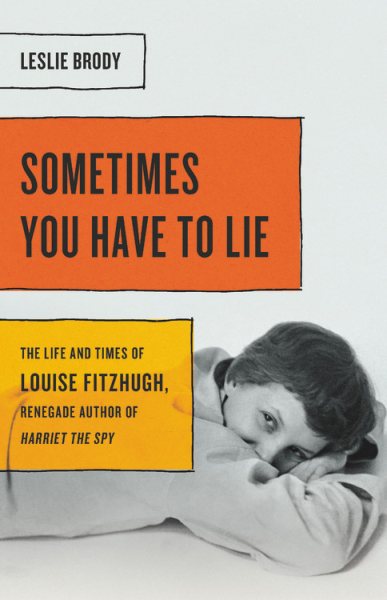
Sometimes You Have to Lie (but not in this interview): A Talk With Author Leslie Brody

December 2, 2020 by Betsy Bird

It’s the talk of the season and I couldn’t be more pleased (or surprised). When I heard that Leslie Brody (playwright, journalist, editor, professor) had penned a biography of Louise Fitzhugh, the author of Harriet the Spy, I was intrigued. It did not occur to me, however, that her book would find popularity above and beyond the children’s literary sphere. Yet even as I type this, Brody has already been reviewed by The New York Times and the book sports more famous blurbs than you can shake a stick at. As such, when the opportunity arose to interview Ms. Brody about the book I leapt at the chance…


Betsy Bird: Thank you so much for joining us today! First off, tell us a little about your own relationship to Harriet the Spy. How did you come to it? And, by extension, to Louise Fitzhugh?

Leslie Brody: I am exactly the same age as Harriet the Spy, that is to say in 1963 when Harriet was 11 years old, so was I. I was born in the Bronx and although Harriet lived in an elite quarter of Manhattan, we still shared lots of the same cultural references around New York City in the 50’s and 60’s.  When the book was published in 1964, I really wasn’t reading kids books anymore and missed the wave. I wouldn’t even hear about Harriet and Louise until working as a playwright in Minneapolis twenty years later. I was hired to write an adaptation of Harriet the Spy for the Minneapolis Children’s Theatre company. I remember reading it through several times, stunned at how lucky I was—after all this time, and the many ways our rendezvous might have gone awry—to find her. Once I began writing biographies, Louise Fitzhugh was high on the list of women whose lives intrigued me, and whom I wanted to find out more about.

BB: Ah. I used to watch Minneapolis Children’s Theater productions when I lived there, long ago. That’s lovely. I wish I’d seen your adaptation. You know, I think that a lot of adults that read Harriet as children, return to it later, and are shocked by the content. Indeed, I have a hard time believing it could have been published as is today. Like Roald Dahl, Fitzhugh wasn’t afraid to get nasty, which I think kids appreciate. That edge gets completely worn away whenever Harriet is adapted into a film or TV show or what have you. Even at the time, though, it was a rarity. Where did Fitzhugh get her style?

LB: Wow. Well, she was a genius. Her writing style wasn’t studied or particularly strategic—though when she first wrote Harriet, she was hoping it would be a commercial success and support her while she continued to paint. As it turned out, Harriet was a fantastic and fortunate confluence of Louise’s absorption and amalgamation of uptown New York life in the early 1960’s (and the era’s popular references like spies and nannies); Louise’s own idiosyncratic childhood, as the only child of a wealthy white family in Memphis, Tennessee—she was Harriet’s age during WW2 (and it should be said, repudiated the Jim Crow milieu and went to New York as soon as she was able), and the guidance of the great editors Ursula Nordstrom and Charlotte Zolotow, whose influence and support helped Louise to expand and refine Harriet the Spy.

BB: I remember with crystal clarity a piece K.T. Horning wrote years ago called “On Spies and Purple Socks and Such” for the Horn Book Magazine way back in March of 2005. It was the first time I’d heard that there was any queer subtext to the book, but once she opened my eyes to it there was no going back. What was the first time that you discovered the subtext of the title?

LB: During my research I also discovered KT Horning’s work. And I admire how she described a “queer subtext” throughout the book. Horning interprets Ole Golly’s advice to Harriet, that “sometimes you have to lie…but to yourself you must always tell the truth,” as evidence of Louise’s embedded instructions to gay kids: You are not alone, come out when it is safe to do so. Homophobes during the culture wars of the late 20th century and early 21st fulminated about coded messages in the media meant to turn schoolchildren gay. Horning suggested that there were secret messages in Harriet the Spy, benign and comforting ones which offer fellowship and reassurance to young people figuring themselves out.  I wish I could say that this advice is obsolete in the year 2020, but unfortunately it still applies. Louise and Harriet’s message continues to be one of love against the odds. “Writing is to put love into the world, not to use against your friends,” Harriet learns, but “to yourself you must always tell the truth.” 

BB: Because of Harriet we’ve always heard a lot about Fitzhugh’s relationship to Ursula Nordstrom. What we don’t hear about as much is her relationship to other editors. You include Charlotte Zolotow, and Michael di Capua in this title. What did they have to say about her? 

LB: She had a wonderful relationship with Charlotte Zolotow, until she didn’t. Zolotow was a brilliant editor with the special talent of helping writers who hadn’t written children’s novels before adapt to the form (she also notably did this with Paul Zindel).  Zolotow recognized Louise’s essential anti-authoritarian nature. (She said Louise saw the adults as “oppressors”) She gave Louise excellent advice and encouragement and in some ways probably helped her embed and preserve that distinctive fierceness in the Harriet character. Zolotow began as Louise’s editor of “The Long Secret,” the second novel in her Harriet sequence; but they soon had a falling out. By then, Louise had a much stronger sense of what she wanted to do with her story and her prose, and she wasn’t as compliant or patient with guidance or advice.

Louise and di Capua had a vexed relationship from early days. She didn’t like working with him and felt he didn’t understand her work or process.

BB: Zindel! Well that’s a whole separate can of worms. And I had no idea that di Capua was the editor on Nobody’s Family Is Going to Change and not Nordstrom. Do we know why Fitzhugh made the switch?

LB: It took Louise a long time to finish a draft of Sport, which was under contract to Harper & Row. She showed it to Charlotte Zolotow –who didn’t think it was finished and wanted Louise to revise. It’s hard to know exactly what happened, but Louise was tired of writing about Harriet and friends and wanted to move on to other projects. When she finished Nobody’s Family is Going to Change (originally called The Changelings) her agent Pat Schartle Myrer pitched the book to a number of publishers, diCapua at FS&G was the highest bidder.

BB: One aspect of Fitzhugh’s life that I’d certainly never heard much about was her art. One of my prized possessions is a copy of Sandra Scoppettone’s Suzuki Beane, which she illustrated. Yet I don’t think I’ve ever heard of Fitzhugh wanting to illustrate for a living. What was the role of art in her life? 

LB: You are so lucky to have a copy of Suzuki Beane! It is sad that that wonderful book is out of distribution. Louise didn’t rate her book illustrations—as unique and influential as they would become—as highly as her painting. She once wrote to a friend of “the depth, the pain, the horror, searching, fumbling,” that distinguished painting from illustration. Alixe Gordin said Louise used to destroy paintings which she considered not up to par.

Louise was a multi-faceted artist: musician, writer, artist. In her last years, she was writing plays and novels for adults, and if she had lived longer, I’ve no doubt she would have produced some more great literary works. 

It is too bad that there is no archive of Fitzhugh’s work. Gordin’s estate has many paintings, and so does the Fitzhugh estate. I’d love to see these and her papers curated and kept safely and available to view somewhere.

BB: I’m a bit fuzzy on my Fitzhugh gossip, but I seem to recall that there was some talk that the brain aneurysm she suffered from was a direct result of a bad review she received. In hindsight this seems ridiculous, but there might be something to the stress she was under at the time. Is this addressed at all in the book? 

LB: Yes, a week before she died, she received a wounding review. She was drinking heavily and had other underlying conditions—high blood pressure, etc. She was incredibly stressed, waiting for the book to be published—it was her first novel to come out in 10 years. The review didn’t kill her, but it made her miserable. If you read it now you see it was just a terribly written review–offhand and casual and snarky. Louise’s friends tried to comfort her, saying better reviews would come, and they did—but all too late. She died a week later, just days before the publication of Nobody’s Family is Going to Change.

BB: Finally, I was unaware that the Fitzhugh estate kept such a tight grip on any and all information about Louise Fitzhugh. In this day and age it seems ridiculous that they’d keep any information from the public. How did you go about researching this work?

LB: I conducted over 60 interviews and spent the first two years of this four-year project researching Louise’s life and loves. I was fortunate to meet some of the friends Louise knew during her life, who all had fantastic stories to tell of their life and times. She was part of a network of extraordinary artists– a social circle of high-flying, mostly queer, career women who in their youth had crashed through ceilings in literary and artistic professions at a rip-roaring velocity: writers of children’s books, mysteries, and crime thrillers; editors at glossy magazines and books; copyeditors, photographers, and illustrators at high-flying ad agencies; theatrical producers and literary agents and casting directors; professors, painters, and actors. Their mutual friend, the playwright and author Jane Wagner characterized this extensive cabal as “successful, creative, pleasure loving, ambitious, knowledgeable lesbians.” It was a world of downtown gay bars and uptown house parties and in the summer, shared Hampton rentals.  and writers in the 1950’s and 60’s in New York. I came away thinking that every one of those women deserves a biography!


I simply cannot thank Ms. Brody enough for speaking with me today. Sometimes You Have to Lie is now available in bookstores everywhere (and would make a mighty fine holiday gift for any book lover you happen to know).


Filed Under: Interviews Tagged With: author interviews, Harriet the Spy, Leslie Brody, LGBTQIA+, Louise Fitzhugh, Suzuki Beane

31 Days, 31 Lists: 2020 Board Book Reprints & Adaptations

December 2, 2020 by Betsy Bird

Whew! After yesterday’s listing of new board books of 2020 I think I need a little breather. Fortunately today’s list is what I’d call “handsome”. Quick and succinct without a drop of fat on it.

Every year publishers attempt to squeeze full picture books into board book formats. The results are singularly mixed. At the same time, some board books get a second chance on the market. We celebrate today those books that really add something special to our bookshelves. Yes, we are happy they exist.


2020 Board Book Reprints & Adaptations

Before We Eat by Pat Brisson, ill. Mary Azarian

Well that little picture book to board book transition worked better than I expected! Not that I disliked the original but I didn’t really know how nicely this peek into where our food comes from would adapt for younger readers. Turns out, quite well. The original book came out in 2014, and at its heart it’s really about giving thanks for the good things we eat. The kind of book that’ll be welcome equally at Farmer’s Markets as well as Thanksgiving storytimes.

Harris Finds His Feet by Catherine Rayner

Considering how big a Rayner fan I am, I was shocked to discover that this book was originally released in 2008. You know a board book is good when you get to the end and then start scouring the publication page to see whether or not it was a full-blown picture book first. It wasn’t until I looked at the author/illustrator’s name that it all began to click. Rayner…. Rayner… why do I know that name. Ah yes! That was the person behind that other rather remarkable picture book One Happy Tiger (which was crowned a Mathical Honor Book not long ago). You won’t find math in this outing but you will find that once again she’s taken a topic or form that’s already been done to death in books for kids and made it feel fresh and nuanced. This book is about a little hare with very large feet. The feet, as it turns out, have a multitude of uses. It’s simple but the art and the writing are more than above par. There’s something infinitely charming about these seemingly simple watercolors. A forward-thinking U.S. publisher would show a whole lotta smarts if they got this Edinburgh-based artist to start making some books for the American market on a more regular basis. Just sayin’.

Hello Hello by Brendan Wenzel

Oh, my goodness me, yes! Naturally I loved the original Hello, Hello but something always felt like it was missing. Now I know what it was. It just needed a tinier format, that’s all! Turns out Wenzel’s style is perfectly suited for board book adaptations. Animals are paired together based on superfluous similarities. The proboscis monkey and the elephant seal have impresses schnozzes, while the tiger salamander and the tiger itself are beautifully striped. The animals are named in the back for adults like myself who might find themselves at a loss when a small child points to a bicolor dottyback and asks, “What’s that one?” Plus it’s gorgeous to page through. Just the most delightful adaptation. Well done, Chronicle!

Snakes On a Train by Kathryn Dennis

Brakesnake, heh heh heh. Classic. I’m sorry I’m such a pushover for a funny snake book, but this title makes a lot more sense in its new board book state than it ever did as a picture book. First off, it pairs brilliantly alongside such books as Freight Train by Donald Crews. Very similar color scheme, size, and look. Second, it’s funny (see: aforementioned Brakesnake). I love how the hisssssss of the train echoes the hissssssss of the passengers. Toddlers love trains. Smarter beings than I could explain to you why that is. Whatever the case, if you’re looking for a new board book train title, this is the one to grab.

This Is a Book of Shapes by Kenneth Kraegel

Okay, I’m gonna give this one to Candlewick, though there is definitely a level of sophistication here that’s gonna go right over the heads of the babies and toddlers that read it. The preschoolers, depending on the reading, might get it, though. Essentially, this presents itself as a very standard shape book. Circle. Square. Triangle. And then . . . . “This is an emu pushing a pancake wagon down a hill.” Now if the grown-up reading this plays it off as incredibly ridiculous and really puts their back into their huffiness (I can already hear them blustering, “Is that a shape? I don’t think that’s a shape. Isn’t this a shape book?”) I’ll bet you that you’ll have some kids utterly amused by the ridiculousness of it all. Did this book HAVE to be a board book? No, but if it amuses the older siblings and, let’s face it, the adults reading as well, I’d say it’s worth it in the end.

CORRECTION: Sharp-eyed reader, Beth, pointed out to me (correctly) that this book is, in fact, a board book first and foremost. At no point was it ever a picture book. Color me baffled! I’m not sure how I got the impression that it had ever been a picture book in its passed. Well, I’m just glad I got it onto SOME list this year, but my face is red. Thanks for the catch, Beth!


Want to see other lists? Check out what happened this month!

December 1 – Great Board Books

December 2 – Board Book Reprints & Adaptations

December 3 – Transcendent Holiday Picture Books

December 4 – Picture Book Readalouds

December 5 – Rhyming Picture Books

December 6 – Funny Picture Books

December 7 – CaldeNotts

December 8 – Picture Book Reprints

December 9 – Math Books for Kids

December 10 – Bilingual Books

December 11 – Books with a Message

December 12 – Fabulous Photography

December 13 – Translated Picture Books

December 14 – Fairy Tales / Folktales / Religious Tales

December 15 – Wordless Picture Books

December 16 – Poetry Books

December 17 – Unconventional Children’s Books

December 18 – Easy Books & Early Chapter Books

December 19 – Comics & Graphic Novels

December 20 – Older Funny Books

December 21 – Science Fiction Books

December 22 – Fantasy Books

December 23 – Informational Fiction

December 24 – American History

December 25 – Science & Nature Books

December 26 – Unique Biographies

December 27 – Nonfiction Picture Books

December 28 – Nonfiction Books for Older Readers

December 29 – Best Audiobooks for Kids

December 30 – Middle Grade Novels

December 31 – Picture Books

Enjoy!

Filed Under: 31 Days 31 Lists, Best Books, Best Books of 2020 Tagged With: Best Books of 2020, board books

31 Days, 31 Lists: 2020 Board Books

December 1, 2020 by Betsy Bird

We start this month with books for the youngest of readers. Board books are some of the most vital and most overlooked children’s books out there. We desperately need them, they sell consistently like hotcakes, but making a good one? I mean a really good one? That’s actually a tricky endeavor.

I have no evidence at hand, but I suspect that board book galleys were particularly difficult to produce during the thick of COVID-19 closures this year. I owe many of the books on this year’s list to the wonderful libraries in my consortium and the meticulous pages and shelvers willing to search amongst those grimy bins to find the titles I needed to review.

As per usual, today’s list is split into two parts. First, you’ll find the board books for the youngest babies. Next, you’ll find board books meant for ever-so-slightly more mature readers.

Would you like to see more? Here are previous years’ round-ups, in case you’d like a truly impressive Board Book Library:

  • 2019
  • 2018
  • 2017

2020 Board Books for Babies

Baby Up, Baby Down: A First Book of Opposites by Molly Magnuson, book design by Hana Anouk Nakamura

From the people that brought you Making Faces: A First Book of Emotions and Baby Loves: A First Book of Favorites comes yet another jam-packed photo-filled beauty of a board book. Remember how babies REALLY like photographs of other little ankle biters? Well, for whatever reason this series is one of the very few out there. At least we can count on a new one every year, eh? I probably spent an inordinate amount of time trying to figure out if the baby in the “Baby is CLEAN / Baby is MESSY” sequence actually made herself messy or if Magnuson had someone strategically mess that little baby up with that gooey applesauce looking stuff. Lots of white space and sturdy pages. This is a must get, no bones about it. 

Little Baby’s Playtime by Sally Symes, ill. Nick Sharratt

Man, there is just something about the art of Nick Sharratt that I really dig. Look at those clean black lines and bright eye-catching colors. Now you may just think I included this book on this list for the sole reason that it involves sticking your fingers in there to make the baby legs . . . and you would be 75% correct. But but but! Sally Symes, an old hat in the baby board book game, accompanies each picture with gently rhyming text and little descriptive wiggles, jiggles, whooshes, ding-a-lings, and more. A parent (or librarian doing a storytime) could get a real routine going on here with enough practice.

Little Fish and Friends: A Touch-and-Feel Book by Lucy Cousins

Yes, this is just one of dozens of other “Little Fish” board books by Cousins out there. But let’s get real for a moment. Touch-and-feel books are simply NOT as common as you might think. And quality touch-and-feel that can stand up for multiple reads by tiny destructive tots? Just look at today’s list. How many can you see? And darn it, this is a good book! Separate it away from its series status and you’ve got yourself beautiful, colorful art and honestly fun touchable elements. It’s the right size for the right age and will be much beloved in many a fine household. I include it and defy the gods!! Come at me!

Mirror & Me: Feelings by Rose Colombe, ill. Charlotte Pepper

Huh! Now here’s a notion. I’m having a hard time coming up with a lot of board books that use mirrors on every page and not just at the end of the book. Why is that? Are mirrors expensive to produce? This books sports a number of them and makes the smart decision to use them to a purpose. The child is to use the mirror to make the faces of different emotions. Now that’s a pretty neat idea. Of course, a very very young child is going to eschew the whole purpose of the book and just enjoy looking at themselves, and that’s okay too. It just means the book will have different uses for different ages. Perfect for a family of small children of varying ages.

My Hair is Beautiful by Shauntay Grant

Gorgeous. The best looking board book of the year, and don’t let anyone tell you otherwise. As we all know, babies love faces. As we also all know, there is a WEIRD lack of board books with photographed faces out there. I swear to you, if I ever start a publishing company then our entire first season is just going to be board books of faces and that’s all. I’ll make a fortune. In the meantime, we have books like this one to rely upon. Grant shows off a wide array of babies and toddler and their magnificent hair. “Natural Knotty,” “Fluffy Frizzy,” “Twisted Tangled,” “Pony Puffed,” you name it, it’s here. And, of course, there’s a mirror in the back for “you”. Buy 100 of these. It will never be enough.

Peekaboo Farm by Camilla Reid, ill. Ingela P. Arrhenius

We know that books with touchable elements are always golden, but what about books with mirrors? Mirrors are touch-and-go (so to speak). Sometimes they’re great and sometimes they age POORLY over time. We’re all familiar with the board books that keep the mirror hidden until the end, but what I like about these two books is twofold. First, that having a mirror under a pull table makes a lot of sense and second, that the mirror is, in a way, protected by having that pull element over it. The colors are bright and, interestingly, on the back of each book is a rather long (for a board book) bio of Swedish artist Ingela P. Arrhenius.

Tummy Time Friends by Pat Brisson

When my children were just little tiny critters, I used to pull out Tana Hoban’s Black & White (the one you can unravel) and prop it up in my children’s cribs or on the floor when they were lying there. And boy, I wish wish wish I could have had this book when they were old enough to be put on their tummies. Like the Hoban book, this one accordions out so that you can prop it around the child. And like the Hoban, it’s specifically designed for very young eyes. Of course where the Hoban did high contrast black and white images, the Brisson gives kids faces. Lots and lots of different faces of other babies on their tummies smiling and generally being adorable. I’m literally going to save this until someone I know has a little tiny baby. Possibly the best board book for babies I’ve seen in years. 

Who’s Hiding in This Box? by Giuliano Ferri

Ah, the rare board book where the first flap is found on the front cover. Lift-the-flap board books can feel old hat after a while. Not to babies, of course. For them, every book is new and amazing. That doesn’t mean you need to feed them the same old same old, though. If only the rarest kind of best is good enough for the young then the same can be said for the ankle biter crowd. As such, why not hand them a board book that is, quite simply, a luminous work of art? Much along the same lines as Dear Zoo, babies and toddlers open the box to find pulsating watercolors in the shapes of their favorite animals. I love how the box is always tiny so that the animals spill out over the sides when they emerge. Just a beauty. 


2020 Board Books for Toddlers & Preschoolers

The Amicus Book of Colors by Isobel Lundie

And now we move onto board books for the older kids!

Lundie has a style that reminds me not a little of the work of Carin Berger, what with her use of brightly colored cut paper. The book is as much a pleasure to look at as is it is to use with a kid learning their colors. And I don’t usually do this, but I think you have to take a look at how she makes shoes in this book. I want ‘em. Should a book be included here for including cute shoes? I sure as heck wouldn’t rule it out . . .

Animals In the Sky by Sara Gillingham

Initially I was wondering why this magnificent book was made into a board book, of all things. The premise is so smart that it’s a wonder no one’s thought of it before. Using lift-the-flap elements, you first see the constellation accompanied with hints as to what kind of animal it’s of. Lift the flap and the answer is the animal itself, with the stars superimposed on the image. Of course by even telling you this, I’ve answered my own question. THAT is why this book is a board book! My sole problem with the title is that when you look at a constellation of a lion it simply calls it the “lion” and not “Leo”. The official names of the constellations are not used. Pisces, and so on are not mentioned. That’s a quibble, though. All told this is the BEST book I’ve ever seen that could possibly teach the kids the constellations. 

Baby Beats: Let’s Learn 4/4 Time by Ellen Stubbings

Baby Beats: Let’s Learn ¾ Time by Ellen Stubbings

Baby Beats: Let’s Learn 2/4 Time by Ellen Stubbings

Ingenious. The Baby Beats book advertise themselves as providing, “a child’s first music lesson, enhancing his or her ability to recognize notes, beats, measures, and songs.” To do this, the book equates counting with beats with the syllables of animals, and finally pairs everything together into a familiar song. For example, at the end of “4/4 Time”, a band performs Mary Had a Little Lamb, making it very clear how some notes are longer because they take up more syllables. It’s rather clever and darned if there isn’t math at work in here in the counting as well. A book that equates counting and music in a practical way that young learners can actually understand. Not easy to do, I don’t need to tell you.

Bugs by Rosie Pajaro

You know how Sesame Street books are inevitably terrible (with the possible sole exception being Jon Stone’s The Monster at the End of This Book)? Well, I guess I just sort of expected that would carryover to this PBS Kids series that Cottage Door Press has been producing. And yes, these aren’t board books I’d hand to a newborn, but as early science board books go this has got to be one of the most successful. I’ve never quite encountered flaps as thick and strong and (most importantly, so I’m going to bold this) EASY TO LIFT, thanks to a space placed around them that allows clumsy or growing fingers to pick them up. So basically, you get all the advantages of a surprise under a flap without the accompanying frustration. The photographs are clear and crisp and the colors of the borders consistently bright. Even the facts are kept simple. I admit it. I’m very impressed. 

Build! by Xavier Deneux

Libraries, look away. This book is not for you. When I started reading build! I was under the mistaken impression that I’d checked it out of my library and so I felt this honest-to-goodness wave of shock when I encountered that first hardhat that you’re supposed to take from one construction worker to give to another. In this book, two white workers operate a bulldozer, stack bricks, lift objects with a crane, the whole kerschmozzle. It’s basically a dream of a title for any small child that loves construction equipment. And yes, when they lose the pieces (as they will / as you will) it will still be fun. Personally, I laughed out loud when I got to the last sentences of the book, “We’ve built a house. We’ve built our home. And now we’ll build our family!” Pick up the piece and how there’s a baby between the two construction workers. Guess they got busy on that too. 

Five Little Ducks: First Book of Nursery Games by Ailie Busby

A godsend of hand rhymes for parents (and, let’s face it, librarians that need something new for their Baby/Toddler Storytimes). Each nursery rhyme in the book comes with subtle instructions on what do to with your hands. They’re there if you need them, but if you just want to read this as a book with a kid, they won’t distract. I liked how quietly inclusive it was, with its multitude of genders, races, and the occasional kid in a wheelchair. They managed to avoid all the potentially problematic rhymes in this book, as far as I could see. Use it for a storytime pronto! Pairs nice with Busby’s other book this year, Pat-a-Cake: First Book of Nursery Rhymes. Consider them a pair. 

I Love My Tutu Too! by Ross Burach

This book is a good example of how down-to-the-wire these lists are sometimes. You see, yesterday I tweeted out the fact that the “31 Days, 31 Lists” series would begin December 1st. And no sooner had my fingertips left the keyboard then longtime friend and reader Eric Carpenter wrote in to ask a question. “Hopefully it is not too late to add our favorite board book of 2020 to tomorrow’s list (if for some crazy reason it’s not already on it)”. Now you have to understand that this list is a tricky one to make because a lot of libraries refuse to lend board books through their consortiums. Why? Because it can be too hard to find them on the shelves. Board books are notorious for ending up messy thanks to little hands. I was 99% certain that even if my library had the book that Eric was referring to, I wouldn’t be able to find it. But sometimes, if you’re lucky, the stars align in just the right way. Scholastic never sent me this book for review, so thank goodness Eric was there to guide me. I’ll leave it to him to describe it. “It’s a rhyming, pun filled, counting book that would make an amazing readers theater performance piece.” He ain’t wrong. If you need a board book that’ll make your kid laugh and (vitally) make YOU laugh, no end of year board book list would be complete without this beauty.

Mail Duck: A Book of Shapes and Surprises by Erica Sirotich, designed by Hana Anouk Nakamura

Oh, man! There is so much going on in this little book! Sure, on the surface it’s a pretty basic story about a postal carrier fowl. Then you add in the different shapes of each object. Then you look at the lift-the-flap elements, which are hiding TONS of tiny fun details (like the “No Shoes” sign in the snail’s home’s ball pit). THEN (are you getting the layers here?) you have the fact that it’s a mystery all leading up to a surprise party at the end for the duck. But wait! There’s more! While the duck has been delivering his own presents, cake, card, etc. to all the denizens in this story, in each of their homes is one object that was gifted to them by another character. Look at the end of the book and you’ll see they have all those objects. Extra points for giving the snake a monocle. Everybody should own a monocle.

Make Me a Robot by Mark Rogalski

Aww. Reminds me of those old Stephen T. Johnson board books. Remember My Little Blue Robot from 2002? It’s still in print! Of course as cool as the Johnson books are, they tend to have little cardboard pieces that go willy-nilly all over the place. The cool thing about Rogalski’s book is that it’s entirely self-contained. Yes, one of those wings or a foot or a rocket is going to get ripped off at some point. That’s just life. But for a while, it’s really fun to transform a book into a bot. Each page turn reveals a new body part that you can pull out with thick flaps. Definitely for the slightly older kid crowd, and a real delight. This is what you give to a toddler when you want to wow them. 

Making Tracks: City by Abi Hall

Making Tracks: Desert by Abi Hall

Making Tracks: Jungle by Abi Hall

Making Tracks: Mountain by Abi Hall

It’s funny how we judge board books, right? I mean, a lot of our criteria comes directly from how we critique books for older children. The innate desire that the book have a beginning, middle, and end is something that can be nice for babies and toddlers, but I would argue that it is by no means something that absolutely needs to be present every time. The “Making Tracks” series bears this theory out. Each book shows a variety of tracks from both nature and humans in four different biomes. The colors are cheery and the text simple, but that’s not its true advantage. The die-cut tracks offer a very nice, very clear, tactile function. There’s a lift-the-flap element as you observe who made the tracks. Now, let’s look at this through an equity lens. In City, one set of tracks shows that they are being made by the wheels on Robert’s wheelchair as he goes to play basketball. In Mountain there are three straight tracks which turn out to belong to Sara, who is skiing with one leg. The two other tracks are skis attached to poles that she can hold with her hands to maintain her balance. Sara, for the record, is the only white person visible in the series. A board book series that looks the same at first but pulls apart from the pack. 

Mama Needs a Minute by Nicole Sloan

Okay, okay, okay. I know some of you just saw this cover and little alarm bells went off in your heads saying “WARNING! WARNING! BOARD BOOK FOR PARENTS! NOT FOR CHILDREN! BE ALERT!” I want you to press down the mute button on those alarms for just a second while I endeavor to explain. Yes, this book bears a resemblance to such titles as Go the F*ck to Sleep and my beloved “Baby Be of Use” series by Lisa Brown (coffee table board books, is what I like to call them). But in spite of the cool tattooed mom on the cover, consider this. When mommy needs three minutes to use the bathroom, THIS could be the book that her partner reads in her absence. Which means, obviously, that if Nicole Sloan isn’t at this moment writing DADDY NEEDS A MINUTE then she is passing up a golden opportunity. I’ve never seen a book that tries to patiently explain to a child why it might be a good idea to allow mommy to put on some clothes by herself, but this one covers all the bases. Now can we get this in a picture book format too? 

My Art Book of Happiness by Shana Gozansky

It’s such an easy idea for a book that one wonders why Phaidon was the first to perfect it. Now we’ve all seen children’s books, be they of colors or numbers or the alphabet, illustrated with art from famous museums. What makes the “Art Book” series by Phaidon different is the curation and design. On the curation side, it’s not just old white masters. It’s new lesser known images and older BIPOC creators. There’s also a note of frenzy and fun to the proceedings. Add in the text, which actually seems interested in engaging kids (not a given), and you’ll want to display it prominently in the home. You kids will actually enjoy it. You may enjoy it more. 

My Favorite Color by Aaron Becker

The follow-up to You Are Light, which sort of blew us all away in terms of defining how beautiful a board book could really be. But just because it’s a companion, that’s no reason to think that this book isn’t every inch a beauty as well. If You Are Light reminded me of the Baháʼí House of Worship of Wilmette, Illinois then My Favorite Color favors more rudimentary architecture. Frank Lloyd Wright? Not sure. In any case, the fun in this is in seeing how the colors combine and blend and change as you flip through. How is it that there isn’t an award out there, anywhere, for board books? Somebody speak to management. We need to get that fixed and stat. 

Numbers by Jacques Duquennoy

My library has a book committee where every year we determine the 101 Great Books for Kids that we’d like to celebrate. To keep the numbers down we always try to avoid sequels, particularly if they’re from a series we’ve honored before. Happily, these rules do not apply to my “31 Days, 31 Lists”. That means, if I’ve previous praised the “Zoe and Zack” books by Jacques Duquennoy in the past, and if those books continue to be high quality and fun, then doggone it I’m going to include them on these lists again and again and again. Textured balls and numbers and flaps you can lift from the side of the book all indicate that this would be a title for itty bitties, but I think this is more of an upper toddler book. Then again, with the die at the top (indicating each number) and hands holding up the appropriate number of fingers, maybe it’s for preschoolers! All I know is, it’s fun to read and beautifully put together. A real classy package. 

One Yellow Sun by Michael Arndt

Sometimes a board book can be so simple that it works because it has shorn away all possible complications. Arndt’s preferred method of illustration in this book lies in its circles. The very first thing you see are “10 silver beads”. These are cut outs that retain their silvery quality even after you turn the page. Next it’s “9 gray pebbles”. With each successive number, the circles get larger and fewer until you finally get to “0 white snowballs”. A chart at the very end shows the numbers as well as the colors and types of round objects listed. Sometimes I tease board book designers for their love of die-cut circles, but you have to admit, they’re effective!

Paper Peek: Animals by Chihiro Tekeuchi

All right, do the count with me. This book is the following:

  • A Board Book with die-cut pages
  • A Seek-and-Find Book with hidden animals
  • A Continents Book – Learn them all
  • An Animal Book – And which continents they inhabit

Two of these taken together would be enough for any poor board book. The fact that we’re looking at four simultaneous jobs is more than just impressive. It’s downright staggering. Now, as with any board book, you begin to wonder who the audience is. Obviously small babes will get a lot more satisfaction out of ripping these relatively slender (some might say, optimistic) die-cut pages than out of knowing what animals inhabit Oceania. Older toddlers and preschoolers are the ones that will enjoy the seeking and the finding. And hey, if they happen to retain in their brains the fact that South America has sloths? All to the good.

Play with Clay! by Jenny Pinkerton

Why is a board book a successful form of media with small children? Because it’s tactile. You can hold it and pick it up and chew on it and bash it. As such, it makes perfect sense that the best kind of board book would be one filled with an equally tactile craft substance: clay. Pinkerton’s book comes with a jolt of creativity and not a little humor to boot. “It was a blob. Until I formed it…” With each different incarnation, the blob is coiled, rolled, smushed, broken, mixed, and more. Extra points for making all the words in the book out of clay as well. A great use of color on white space. I can see this one getting some serious re-reads. 

Play with Your Plate! (A Mix-and-Match Play Book) by Judith Rossell, designed by Hana Anouk Nakamura

I love it! We’ve all seen these flip books where you can lift flaps or pages or images to create different combinations. Rossell makes the idea all the more practical when you must construct different kinds of plates. Separated into four different quadrants, kids are encouraged to “make a plate of only triangles and circles” or “a plate of only vegetables or fruits” or, most fun of all, “a plate of your favorite foods.” Encourages healthy eating without bogging down into didacticism. I can see all kinds of applications for a book this clever. Good for a whole range of ages, from the little littles to the newly picky three-year-olds. 

Rest & Relax: Sleepy Time for Little Ones by Whitney Stewart, ill. Rocio Alejandro

Now there’s a notion. A board book with a purpose. This is part of the “Mindful Tots” series, and whenever I see mindfulness associated with board books I get a little wary. In this case, though, it’s well-incorporated into the story and makes sense. Each body part gets its own two-page spread. It begins, “Let’s choose a spot and lie down. Wiggle your toes then squeeze them – Tight, tight, tight! Now relax your toes and let them rest.” What we have on our hands here, then, is a nap book. A book that a preschool teacher or even parent could use to get their kids ready for nappy time. A smart combination of mindfulness and practicality.

Scales and Tails by Rosie Pajaro

I’ve seen a lot of nonfiction board books that sort of forget who the target audience for this format is supposed to be (Smithsonian Kids I am looking directly at YOU). PBS Kids is admittedly filling this book with an awful lot of text BUT there is a saving element. Touch and feel! So no, you’re probably not going to get every toddler to listen to the fact that bats eat 8,000 insects a night. What you will do is get them enamored of the bright, clear, and colorful photographs and the wonderful interactive feels. Sticky frog tongues! Fuzzy tarantulas! Did I mention they seemed to specifically seek out critters that provoke phobias in this book? Be warned.

Sharing by Yusuke Yonezu

Yonezu should be fairly familiar to the board book connoisseurs out there by this point. These books specialize in thick black lines, bright primary colors, and die cuts so thick it would take a baby with a chainsaw to break them down. And I was, admittedly, feeling a little jaded when I started reading it through. Still, it’s a clever idea of breaking things apart to share them. A fish. A cheese. A carrot. A banana. An apple. Grapes (Yonezu is absolutely enamored of grapes). Then you get to the moment when two kids want mommy. I mean, you know how this is going to end, but there’s just the slightest second there where you honestly wonder if mommy’s going to find herself torn asunder. Doesn’t happen, but I bet a lot of moms will be able to relate to the unspoken threat. 

Stanley’s Toolbox by William Bee

See, the thing I like about Bee’s books is that there is sometimes a wry little detail, wording, or turn of phrase at work. In the case of this little board book, I like how a mallet “bashes” and a glue gun “squiggles” the glue. You can probably tell already that this is a tool-centric title for those kids desperate for any and all tool books, and it delivers pretty well. I do think the nut and bolt could have been depicted slightly more clearly at the end but if you derive pleasure from seeing things fixed and fixed up, this is the title for you. 

Stop That Virus! by Rhiannon Findlay, ill. Susanna Rumiz

Who knew that the most timely pandemic-based book of the year would be an interactive board book? Will wonders never cease? Findlay presents the life (and death) of a virus in the human body in the simplest way possible. Definitely not for babies but toddlers and preschoolers will not only get a kick out of the pages that shift and change as you turn them (anyone know what this kind of book is called?) but also the bright colors and fun art of Susanna Rumiz. There’s one semi-unclear spread that’s supposed to equate a cell with a castle that doesn’t quite work, but on the whole it’s a pretty good breakdown of what happens when you get sick. Slip on a mask and enjoy.

This Is My Daddy by Mies Van Hout

Mies Van Hout may be right up there with Herve Tullet as one of those international uncontested winners when it comes to board books for the young. Her style is unparalleled and, to be frank, downright gorgeous. The conceit is kind of cute too. First you meet a baby animal and then you have to pick between four possibilities of who its father might be. It’s not as easy as you might think, particularly when you’re dealing with a baby rhino looking at a daddy hippo as an option. The key, sometimes, is to get the little littles noticing the similarities in their bodies and coloring. I love how interactive the book is. One quick note: the spine does have a tendency to rip a little since the cover is made of that poofy material you sometimes find with board books. May not be great for libraries, but for gifts there are few to match it. Beautiful. 

Up Cat, Down Cat by Steve Light

If you could just curl up and dive into a Steve Light book, what a pleasant place you’d find yourself. Thick paints never look thicker than when his paintbrush is pushing them about. A very simple opposite book, there’s not really a story here. Just two cats, in a house, sharing space. Little kids will like the cats, adults will like the colors and on the 300th read will pour over the patterns on the couch, the quality of the yellow light streaming through darkened windows, and how just the slightest curl of an eyebrow can change a whole character’s expressions. Once again, Light retains his throne as king of the most beautiful board books. 

A Very Hungry Wolf by Agnese Baruzzi

Know me and know that I’m a big time fan of books in which the protagonist either eats others or is eaten themselves. This book falls squarely in the former category. It’s a lift-the-flap exercise in mastication! As the wolf eats more and more, things begin to get dire until ultimately it eats a hedgehog. Big time mistake. No children’s book, in these situations, ever uses the term “vomit”, preferring (in this particular case) the more gentle “spit it out”. Everyone is freed and the wolf is encouraged to consider veggies in the future. Colorful and kooky by turns. 

Wake Up, Let’s Play! by Marit Törnqvist

Sometimes folks will make excuses for European children’s books and their significant lack of faces that aren’t white by saying that everyone over there IS white. Not hardly. This Dutch import puts that lie to the test with this incredibly sweet playtime between two young friends. It’s one of those little worlds where there are no grown-ups to interfere and plenty of birthday parties, sandcastles, blocks, stuffed animals, snowmen and more. I just love the thick colors and imagination at work in this marvelous little world built for two. People call books “dreamlike” far too often. This is the kind of book that will mysteriously crop up in children’s dreams years and years after they read it. If that appeals, grab it for yourself. 

What’s Up, Fire Truck? by Matthew Reinhart, ill. Toby Leigh

Reinhart is back, babies! And what could be better than a book you can construct? This one’s not so much for the little little ankle biters, but for those older toddlers and preschoolers that find the notion of turning a book into a fire truck pretty neat. They’re calling this a “Pop Magic Book” and the interesting thing is that you can read this as a regular book and then unfold it to turn it into a real little cardboard truck. Not sure how to do it even after reading the instructions? You can watch a step-by-step video at abramsbooks.com/WhatsUpFireTruck. Take a gander! It’s cute. 

The Wheels On the Dump Truck by Jeffrey Burton, ill. Alison Brown

Yeah, okay, so I know it’s part of a larger “Wheels Of” series (“The Wheels On the Fire Truck”, “The Wheels On the Garbage Truck”, etc.) but let’s be honest. Don’t you kind of wish YOU had come up with the idea? And my kids are still young enough that I have crystal clear memories of grabbing every dang truck-related book off of the library’s shelves. I would have been grateful for a book on the topic that I could sing. Granted, we seem to be missing a couple “round and round”s on the first page, but that seems purposeful, and parents can just sing it anyway. I give a lot of leeway to vehicle books, as you can tell.

Who Is Making a Mess? by Maria D’Haene, ill. Charlie Eve Ryan

It’s not very often that I turn the first page on a board book and then just stop and stare for a while at how beautifully constructed that page truly is. Accompanying the words “Who is making a mess?” the first two pages of this book show a pair of legs sticking out from under a car. But look at how artist Charlie Eve Ryan has so artfully splattered her paints all willy nilly. It’s just beautiful. No less beautiful is what you see when you turn the page and find the answer is “Mama is making a mess”, with her daughter looking to fix a scooter nearby. This book is filled with a wide range of families. From kids who live with gay moms and dads to grandparents to moms and dads, the book’s true focus is on messes and how, often, it’s not the kids that are making them. The final spread of everyone eating at a common table, making a mess, takes away the shame from a very human activity. Feel good about your messes. This book sure does. 

Zoom: Space Adventure by Susan Hayes, ill. Susanna Rumiz

Probably not a good thing when you, the adult, don’t feel smart enough for an intelligent board book. Then again, how better to recapture that feeling of wonder and discovery than to experience it firsthand? A little girl named Ava is going on a big space adventure today. In her hand she holds a rocket, and before you know it we’ve zoomed in for the countdown. Don’t see the countdown? Look closer. The die-cut pages on the right-hand side are actually numbers. Slick. Against a color scheme of yellows and blues Ava blasts off, visits an International Space Station, takes a ride on a moon buggy, and tours the planets as well. Thick pages and an enjoyable story make this a title to enjoy multiple times. 


Want to see other lists? Check out what happened this month!

December 1 – Great Board Books

December 2 – Board Book Reprints & Adaptations

December 3 – Transcendent Holiday Picture Books

December 4 – Picture Book Readalouds

December 5 – Rhyming Picture Books

December 6 – Funny Picture Books

December 7 – CaldeNotts

December 8 – Picture Book Reprints

December 9 – Math Books for Kids

December 10 – Bilingual Books

December 11 – Books with a Message

December 12 – Fabulous Photography

December 13 – Translated Picture Books

December 14 – Fairy Tales / Folktales / Religious Tales

December 15 – Wordless Picture Books

December 16 – Poetry Books

December 17 – Unconventional Children’s Books

December 18 – Easy Books & Early Chapter Books

December 19 – Comics & Graphic Novels

December 20 – Older Funny Books

December 21 – Science Fiction Books

December 22 – Fantasy Books

December 23 – Informational Fiction

December 24 – American History

December 25 – Science & Nature Books

December 26 – Unique Biographies

December 27 – Nonfiction Picture Books

December 28 – Nonfiction Books for Older Readers

December 29 – Best Audiobooks for Kids

December 30 – Middle Grade Novels

December 31 – Picture Books

Enjoy!

Filed Under: 31 Days 31 Lists Tagged With: 2020 board books, 31 days 31 lists, Best Books of 2020, board books

  • « Go to Previous Page
  • Page 1
  • Interim pages omitted …
  • Page 239
  • Page 240
  • Page 241
  • Page 242
  • Page 243
  • Interim pages omitted …
  • Page 1051
  • Go to Next Page »

Primary Sidebar