• Skip to primary navigation
  • Skip to main content
  • Skip to primary sidebar
  • About/Contact
  • Fusenews
  • Reviews
  • Librarian Previews
  • Best Books
    • Top 100
    • Best Books of 2022
    • Best Books of 2021
    • Best Books of 2020
    • Best Books of 2019
    • Best Books of 2018
    • Best Books of 2017
    • Best Books of 2016
    • Best Books of 2015
    • Best Books of 2014
    • Best Books of 2013
  • Fuse 8 n’ Kate
  • Videos
  • Press Release Fun

31 Days, 31 Lists: 2020 Unconventional Children’s Books

31 Days, 31 Lists: 2020 Unconventional Children’s Books

December 17, 2020 by Betsy Bird

Isn’t “unconventional” such a nice way of describing today’s list of books? Full credit for the phrase must be handed to Travis Jonker, who has created his own lists of unconventional children’s books in 2017, 2018, 2019, and 2020. The nice thing is that he and I tend to look at entirely different titles. You’ll find a tiny bit of overlap in our lists, but for the most part we’re seeing different types of unconventionality (if that’s a word).

So for those of you keen on trying something a little different, this is the list for you. These are the books that gives you faith in publishing. Because if someone thinks that these can sell in American, things can’t be all that bad. And no, they’re not all European imports . . .


2020 Unconventional Children’s Books

Egg or Eyeball? (Chick and Brain) by Cece Bell

Egg! Eyeball! Egg! Eyeball! Is the white object Brain found a baby chick in its shell or a monster’s peeper? Inane goofiness abounds in this particular easy reader. I love a book that really takes a deep dive into its own wackadoodle rules and regulations. The world Bell has created here operates on a level entirely apart from our own. I always have a vague sense of where things are going, but it’s still a delight to see how she gets there. Predictably unpredictable.

I Wish by Toon Tellegen, ill. Ingrid Godon, translated by David Colmer

What we have here are portraits “inspired by old-fashioned photographs”. The Belgian illustrator, being of sound mind and body, created these portraits because she was inspired by “the Flemish Primitives, the great Italian Renaissance painters, and the photographer Norbert Ghisoland.” Then, at some point in the process, they were handed to the Dutch writer and poet Toon Tellegen who got all kinds of wistful on us. Each person that gets a story also receives something wholly unique and strange and wonderful. As I read these poems, they struck me as mini monologues. To be frank, I think that would be an excellent use of this book. Hand it around the room to a class of kids. Have them each read aloud one of these first person narratives. “This is my last request. When I die, I want them to check how long someone’s still thinking of me.” “If I ever saw an ad like this: ‘Wanted: secretive boy for secret duties.’ I would apply.” “If I think about it, it’s actually pretty weird that I’m me.” I defend American children’s literature all the livelong day, but let’s just face facts. A book as introspective, smart, and thoughtful as this one could not possibly have come out in the States first. And if we have Elsewhere Editions and the Dutch to thank for it, then thank them we should. Loud and strong and long.

In the Half Room by Carson Ellis

If you have a room full of things that are only half (half a table, half a rug, half a floor) then what do you do when the other half knocks at the door? I mean, it’s weird. I don’t think anyone could make the argument that it isn’t. This is sort of what you’d get if Goodnight Moon got high on mushrooms. Illogical logic is Carson Ellis’s happy place and considering a room of half things where the person becomes whole (with an oddly satisfying “SHOOOOOP” sound) while the cat just cuddles up to its own butt… well, this felt oddly real to me. So I like it very much, but then again I’m kind of nutty too.

The Invisible Alphabet by Joshua David Stein, ill. Ron Barrett

You know what? Respect for this idea. Respect indeed. Alphabet books are common creatures. Throw a rock in one direction in a library and you’re bound to hit ‘em. With that in mind, I give double points to anyone that cracks the code to creating a cool one. The elevator pitch for this little beauty is simple: Everything in this book is unseen. That might mean including something as obvious as “N is for Nothing” or it might get a little clever and say “L is for Lost”. It’s a cute enough gimmick, but what makes it stand apart is that somehow towards the end of the book, Stein manages this subtle shift from merely quirky to oddly contemplative. “X is for Extinguished”, “Y is for Yesterday”, “Z is for Zero”. The repeating motif of a bus stop, seen in the final frame empty of both bus and riders, swathed in snow, leaves you with what I can only describe as an unnerving sense of peace. I can’t describe it any better than that.

A Little Called Pauline by Gertrude Stein, ill. Bianca Stone

Plucked from Gertrude Stein’s 1914 book Tender Buttons, artist Stone gives form and plot to a poem of pure whimsy. Now don’t mind me, I’m just going to plant my flag in Weirdo Country over here. This book has an uphill battle to fight. There’s the premise, of course, and then the illustrator used a style that wouldn’t fly with one of the big publishers, I can tell you that. As I am the defender of all things peculiar, I would like to speak in favor of this book. Ideally, this is for kids like my daughter. She loves writing and literature but is a practical child to her soul. With this poem I can kind of break through the shell she’s already built up around herself of sense and reason. In the back of the book Stone writes, “Take lines from this poem and make your own drawings to accompany them! I call this Poetry Comics.” And I call this book incredibly cool.

My Little One by Germano Zullo, ill. Albertine, translated by Katie Kitamura

If one of these days the theme was Books I’m Grateful I Didn’t Read While Pregnant (Because I Would Have Been a Weepy Mess) this would appear in the top slot. On the one hand, it feels like a picture book for adults. On the other hand, what it may actually be is the book everyone claims The Giving Tree to be. You know how everyone says The Giving Tree is about parents’ sacrifices for their children? Keep your aboreal metaphors to yourself then. I prefer my metaphors to grow and shrink in turn. In this story a mother talks to her little one. She is telling him the story of their lives, and the little son grows larger and larger as he swings around her and hugs her tightly. Then, almost imperceptibly, the mother begins to shrink instead. Her son twirls her about but when she has shrunk right down and is gone we get this final shot of the man, standing there. And the only word I can use to describe his facial expression is this: lost. Children will be amused by the growing man and the shrinking mommy. Mothers will sob their blooming eyes out. Adults caring for their elderly parents will find themselves reading and rereading it. And Americans may find themselves at odds with an ending as poignant as this. We like our picture book endings to be bold and quirky. But an ending that leaves you feeling unsettled is good for the brain. Or is it the heart?

Nonstop by Tomi Ungerer

Here’s how good Tomi Ungerer was right up until the end. As I was reading this book, I somehow convinced myself that it must be a reprint of his earlier work. Sure, it was weird, but no stranger than anything else you might find in the experimental 60s (I mean, have you seen Yellow Yellow by Frank Asch and Mark Alan Stamaty?). It was only when I was reading Tomi’s bio on the backflap of the book that I came to this final sentence: “Nonstop is his last picture book.” Wuh? Guess I missed the words “A Master Storyteller’s Final Work” on the cover. When you see the book for yourself you’ll have to agree that it’s pretty amazing. Even more so when you figure the man wrote and illustrated this book without ever seeing how 2020 would play out. Because, honestly, this book feels like the year we just had taken to its next logical extreme. In it a fellow named Vasco is the last person on earth (all the other humans departed for the moon instead). Wandering the streets, Vasco finds that if he takes the advice of his shadow, he can avoid a series of unfortunate events. The book has all the illogical logic of a nightmare, but shifts in tone slightly when Vasco meets two strange creatures and obeys the mother’s wish to take her baby to safety. I got quite invested in Vasco and Poco’s subsequent adventures and while the ending is a happy one, it’s also wistful and sad. The wide variety of near deaths sort of reminded me of Fortunately by Remy Charlip. A perfect capper to a perfectly madcap career.

The Scary Book by Dedieu, translation by Melanie Schöni

In its defense, it’s not called “The Fluffy Bunny Book” or anything. Consider it a board book for 8-year-olds. Don’t believe me? Let’s just say that this little board book represents truth in advertising. It has got to be the most abjectly gross title of 2020, and that’s saying something. But around the time you get to the blood-dripping frog filled with worms and flies, you are aware that this ain’t Goodnight Moon. Honestly, if a baby happened to see it, I don’t think they’d care two bits. But its true audience should consist of those kids that love to be grossed out. They will ADORE this book! They’ll revel in it! They’ll pass it around secretly at school under their desks and horrify the first teacher that lifts one of those dire flaps. Cleverly, Dedieu doesn’t put the worst stuff at the beginning but later on. A clever ruse indeed.

Selma by Jutta Bauer

When American picture books try to be philosophical they often tumble into “twee” along the way. When European picture books try to be philosophical, they begin with dogs staring into cups of wine at a bar, ruminating over the meaning of true happiness. There is nothing all that complicated to Selma. Its message is so overt that even a young child will get it, which I suppose is rather the point. The true meaning of happiness? Actually, you might be able to debate the exact lesson. Is it only doing the things you love? A work/life balance of food, friends, family, and sleep? Not wanting too much? Appreciating what you have? I dunno. I don’t know that the book even knows. But if you want to be that cool relative that gives your niece or nephew a picture book upon graduation that they might actually like, give them this. I ain’t even kidding.

Tell Me: What Children Really Want to Know About Bodies, Sex and Emotions by Katharina von der Gathen, ill. Anke Kuhl, translated by Shelley Tanaka

It’s the page of penises that’ll probably unnerve more American parents than anything else. I’m no prude but you gotta understand, it’s a lot of penises (penisi?). You know all those people that get their panties in a twist over sexual education books like It’s Perfectly Normal by Robie H. Harris? Baby, they didn’t know how easy they had it. Please remember that the Europeans often view Americans as downright puritanical when it comes to the human body in children’s literature. We freak out over the smallest of penises. So when you open up this book and see them on lurid display . . . yeah, it’s something. Behold, the most honest and updated book about sex and bodies you have ever seen. Each question is one that a child has posed, and the answers are pretty straightforward. It starts out with the usual, and then gets quite deep. There are questions like “How do voices break?” on the one hand and others like “How does a man get a vagina if he had a penis?” which offers a strong encapsulation of what it means to be transgender. Sex is not all heteronormative in this book, though due to the succinctness of the answers, people will definitely be left wanting more information. Additionally the book briefly cover rape, sexual harrassment, prostitution, and porn as well. There is a slight mention made of being intersex, but the book makes it sound as if they’ll explain more about it later and then never does, so that’s a problem. Otherwise, it’s worth looking at. It’s a lot, but as books on the subject go, it’s probably one of the more honest and modern titles I’ve seen.

This Thing Called Life by Christian Borstlap

The minute I saw this book in my office I started to laugh. I really couldn’t help it, just look at that title! Have you ever seen a sillier, French-er title in all your lifelong days? The next five minutes consisted of me and co-worker saying in progressively thicker and thicker French accents, “Thees thing . . . . called LIFE!” Eventually I was able to calm down enough to actually sit and read the book and what I discovered under its cover astonished me. Yes, on a very real level, this is a ridiculous little book. It is, at its core, a high-flautin’ graduation book. You would hand this to a new high school graduate to tell them a little about the world they’re about to enter. And yet, and yet . . . it’s much weirder than your average Oh, the Places You’ll Go type title. I credit this to the translation and to the art. The translation because there isn’t a fleck of preciousness to this text. I mean, the last lines in the book are, “Life is something we do together. All of life is connected and dependent on the rest of life.” Meanwhile the accompanying images are having a friggin’ field day. We’re talking mouths with legs, what appears to be a troop of multicolored (and ambulatory) pants, and at least one out-and-out laugh-out-loud moment that caught me by surprise (it discusses whether or not life is fair). It is, as I say EXCEEDINGLY French and weird and really very wonderful. Honestly, if you had a graduate to anything in the coming years, hand them this along with Selma.


Want to see other lists? Check out what happened this month!

December 1 – Great Board Books

December 2 – Board Book Reprints & Adaptations

December 3 – Transcendent Holiday Picture Books

December 4 – Picture Book Readalouds

December 5 – Rhyming Picture Books

December 6 – Funny Picture Books

December 7 – CaldeNotts

December 8 – Picture Book Reprints

December 9 – Math Books for Kids

December 10 – Bilingual Books

December 11 – Books with a Message

December 12 – Fabulous Photography

December 13 – Translated Picture Books

December 14 – Fairy Tales / Folktales / Religious Tales

December 15 – Wordless Picture Books

December 16 – Poetry Books

December 17 – Unconventional Children’s Books

December 18 – Easy Books & Early Chapter Books

December 19 – Comics & Graphic Novels

December 20 – Older Funny Books

December 21 – Science Fiction Books

December 22 – Fantasy Books

December 23 – Informational Fiction

December 24 – American History

December 25 – Science & Nature Books

December 26 – Unique Biographies

December 27 – Nonfiction Picture Books

December 28 – Nonfiction Books for Older Readers

December 29 – Best Audiobooks for Kids

December 30 – Middle Grade Novels

December 31 – Picture Books

Enjoy!

Filed Under: 31 Days 31 Lists, Best Books, Best Books of 2020 Tagged With: unconventional, weirdo children's books

31 Days, 31 Lists: 2020 Children’s Poetry

December 16, 2020 by Betsy Bird

There is no ALA award for comics. Though I might not agree with the idea, I can at least understand its origins. After all, librarians’ dislike of comics has been longstanding and well-documented. How then to explain the fact that ALA gives out no award for children’s poetry? Or for poetry of any sort? I can think of few better ways to appeal to our loftier instincts than with stanzas and villanelles. Certainly poetry is capable of winning major awards (and many times it has) but it is a true pity that the bulk of great children’s poetry published in a given year fades away without even one shiny little medal to adorn its book jacket.

Let us celebrate them ourselves then! Here is my list of some of the best, brightest, loveliest poetry of 2020. Do not let them escape your notice! These books are best read every month of the year (and not just April!). An ode to the 811s . . .


2020 Children’s Poetry

Cast Away: Poems of Our Time by Naomi Shihab Nye

“I couldn’t save the world, but I could pick up trash.” Without wasting a word, poet Naomi Shihab Nye writes words of waste. Don’t be surprised if they make you want to clean up afterwards. This is a thick little sucker, coming it at a whopping 147 pages. Don’t worry, it reads quick and along the way it gives you a lot to think about. Naomi Shihab Nye can’t pass a piece of trash without wanting to pick it up. And sure, the stories behind the discards appeal to her poetic sensibilities, but this book is about far more than just refuse. It’s about the people our society tries to “throw away”. It’s about our individual responsibilities, and what we teach our children. I’ll tell you, for a book about environmental collapse (to a certain extent) this book never guilts you. Instead, you come away from it feeling newly inspired. It made me want to walk the block with a trash bag in my hand. Heartening (and the poems are pretty amazing too!).

A Hatful of Dragons: And More Than 13.8 Billion Other Funny Poems by Vikram Madan

What a delightful surprise! I feel so bad that I put this book off for as long as I did. Don’t make the same mistake I did. The members of my library’s 101 Great Books for Kids committee came to this book one by one and each time someone read it they’d start proselytizing like the newly converted. These poems are fantastic! So inventive and funny. The tongue twister rivals anything you might find in something like Fox in Socks. Plus, how can you resist a poem that has 13,841,287,207 possible answers? It’s incredibly funny, so hand this to your Silverstein/Prelutsky fans.

I Wish by Toon Tellegen, ill. Ingrid Godon, translated by David Colmer

I am putting this book in the poetry section. I am putting this book in the poetry section because that is where the press materials indicate it best belongs. Elsewhere Editions writes, “I Wish pairs 33 poems …” But are they poems? Let me back up a little. What we have here are portraits “inspired by old-fashioned photographs”. The Belgian illustrator, being of sound mind and body, created these portraits because she was inspired by “the Flemish Primitives, the great Italian Renaissance painters, and the photographer Norbert Ghisoland.” Then, at some point in the process, they were handed to the Dutch writer and poet Toon Tellegen who got all kinds of wistful on us. Each person that gets a story receives something wholly unique and strange and wonderful. As I read these poems, they struck me as mini monologues. To be frank, I think that would be an excellent use of this book. Hand it around the room to a class of kids. Have them each read aloud one of these first person narratives. “This is my last request. When I die, I want them to check how long someone’s still thinking of me.” “If I ever saw an ad like this: ‘Wanted: secretive boy for secret duties.’ I would apply.” “If I think about it, it’s actually pretty weird that I’m me.” I defend American children’s literature all the livelong day, but let’s just face facts. A book as introspective, smart, and thoughtful as this one could not possibly have come out in the States first. And if we have Elsewhere Editions and the Dutch to thank for it then thank them we should. Loud and strong and proud. 

Just Like Me by Vanessa Brantley-Newton

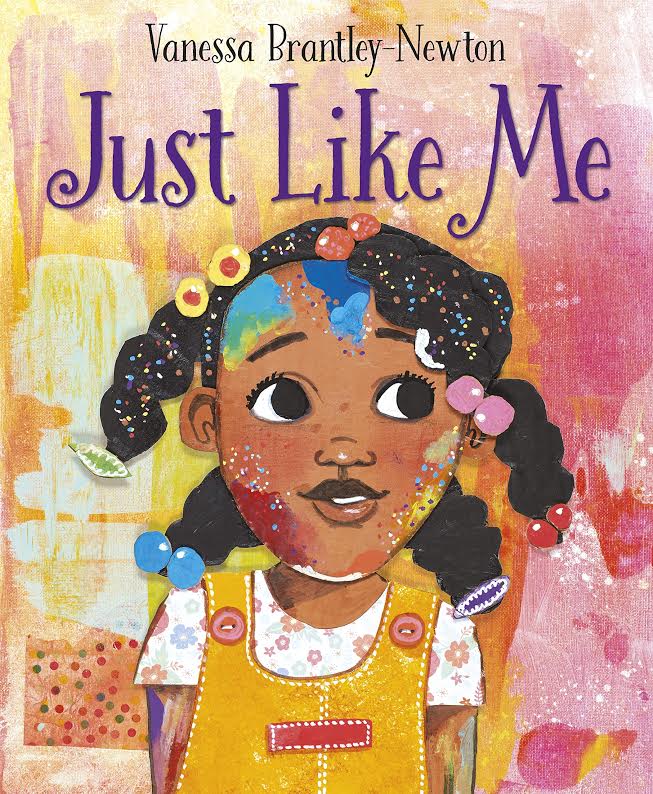
Each poem in this collection is a mini-story of a girl. She might be a drummer, a little sister, shy, or a “door buster”, but each one has something important to say, so you better sit back and listen. I had no idea Ms. Brantley-Newton was as adept at poetry as she was until I picked up this book. What a lovely surprise! The professional reviews journals are using words like “uplifting” and “empowering” to describe this, but so many books are trying to be published in that vein. How many stand out? I’d argue that this one does on a number of levels. From the wistful “A Wish for Daddy” that speaks to a deep abiding sadness to the goofball positive “Weird” to “Sundress Blues” where a girl complains that “My sundress and I are no longer friends” (but ends “the wind began blowing my dress here and there / and showing off my underwear / Well . . . / at least they were cute”) I just really dug the tone of this book. I also liked that the artistic style employed changes a LOT. We already knew that Brantley-Newton was capable of a wide array of different styles, but I don’t think she’s ever collected them into one book before. Extra points for making the first poem in the book “I Am a Canvas” which is all about how others perceive and define you.

Leave a Message in the Sand: Poems About Giraffes, Bongos, and Other Creatures with Hooves by Bibi Dumon Tak, ill. Annemarie van Haeringen, translated by Laura Watkinson 

Would you care to hear a little secret? It clues you in on how I pull these lists together. All year long I read as many books as I can and for the ones I find particularly nice I write out little descriptions and thoughts about them. Then, when the time is right, I pull everything together for these lists. But once in a while there’s a big stack of books that I didn’t get to and in the last days before the list is done I start reading like I’m engaged in a kind of book triage situation. Yesterday I worked my way through a stack of poetry titles that I’d missed and soon discovered that almost all of them were forgettable. Almost all. This import from the Netherlands (original title: Laat een boodschap achtr in het zand) is a funny kind of fiction/nonfiction mix. If you have hooves, you may well find yourself on these pages. But these poems aren’t satisfied with boring you with the same old, same old. One poem is done in the style of an interview. Another as a complaint to an editor. One is a personal ad from a Wild Bactrian Camel (“Male seeks female(s)”). And one is live reporting ala Howard Cosell. The translation is remarkable. You’d have no clue it wasn’t originally published in English if you stumbled upon it. And the watercolors straddle the line between whimsy and a deep and abiding respect for nature that I found quite intoxicating. Plenty of nature poetry books exist. This just happens to be one of the standouts. One that I found just in the nick of time!

A Little Called Pauline by Gertrude Stein, ill. Bianca Stone

Plucked from Gertrude Stein’s 1914 book Tender Buttons, artist Stone gives form and plot to a poem of pure whimsy. A unique way to introduce kids to Stein’s illogical logic. Don’t mind me, I’m just going to plant my flag in Weirdo Country over here. This book has an uphill battle to fight. It has taken a Gertrude Stein poem, and attempted to put a narrative over it. Then the illustrator has used a style that wouldn’t fly with one of the big publishers, I can tell you that. As I am the defender of all things peculiar, I would like to speak in favor of this book. Ideally, this is for kids like my daughter. She loves writing and books but is a practical child to her soul. With this poem I can kind of break through the shell she’s already built up around herself of sense and reason. In the back of the book Stone writes, “Take lines from this poem and make your own drawings to accompany them! I call this Poetry Comics.” I call this book, incredibly cool.

The Lost Spells by Robert Macfarlane, ill. Jackie Morris

Last year Macfarlane and Morris pooled their mutual creative talents and brought into this world the book The Lost Words. It was a uniquely clever collection of those words excised from children’s dictionaries in recent years. This year they return with The Lost Spells, which feels more British than its predecessor, but you’re so wrapped up in the pretty language that you may hardly notice at all. The book tells you that this is where you will be able to find incantations and summoning charms. But what are you summoning? Moths and egrets. Woodpeckers and daisies. Lovely lush watercolors bring Macfarlane’s marvelous poems to life. Many are serious but the aforementioned woodpecker is a hoot and a half. This is for the child that likes to dive into words, or maybe likes to dive into nature. Both would be ideal. Pretty. Fantastic. Pretty fantastic. 

No Voice Too Small: Fourteen Young Americans Making History, edited by Lindsay H. Metcalf, Keila V. Dawson, and Jeanette Bradley, ill. Jeanette Bradley

I like books that show kids in active roles (Kid Blink only gets you so far) but often the books that talk about them are so dull. I like a book that dares to try to be literary as well as informative. Is that so wrong? In this collection of poems about young heroes, fourteen different poets write sixteen poems in total. Some of the subjects you know well (Marley Diaz, Jazz Jennings, etc.) and some are complete surprises. In terms of inclusion, I was impressed by the presence of Judy Adams, the Down syndrome activist, and at least two Indigenous kids. My sole objection, honestly, is that Bradley’s beautiful art has been drawn on sepia-toned paper. And sepia, as as kid will tell you, means “boring” to them. Otherwise, it’s hard to find anything cooler than that image of Viridiana Sanchez Santos in her quinceañera gown, fist raised high.

The Village Blacksmith by Henry Wadsworth Longfellow, ill. G. Brian Karas

“Under a spreading chestnut tree / The village smithy stands.” Longfellow’s classic paean to blacksmiths is updated to the 21st century with this informative look at smithing and what the job entails today. My brother-in-law is a major contributor to his local makerspace, so this particular edition of a 21st century blacksmith range really true to me. I was also surprised at how contemporary Longfellow’s poetry sounded to my modern earns. Apparently this poem originally appeared in the New York Monthly Magazine in 1840, which is kind of neat in and of itself. Karas is a great complementary artist to the words. My sole objection might be the fact that having visited the aforementioned makerspace, I know that safety is taken incredibly seriously. The scene where three little unaccompanied kids (the blacksmith’s kids, it now occurs to me) linger in the doorway while the one wearing gloves tries to pick up a spark just made me a tad nervous. Presumably they’ve been taught to come in no further, but that’s not clear on a first read. Cool facts about the tools of a blacksmith’s trade appear at the end, and how neat is it that Karas thanks, “Marsha Trattner of She-Weld for showing new blacksmiths the way and keeping this art form alive”?

Wannabe Farms: Where Dreams Never Come True at Least Not the Way They Usually Do by Brian McCann, ill. Meghan Lands

What happens to a dream deferred? Well, when you’re a chicken, it goes a little haywire. Farm animals indulge in truly terrible ideas in pursuit of their misguided dreams. Laugh out loud humor combines with wacky poetry to indication the direction of the redirected hopes. You know what? I LIKE this goofy little book! It really benefits from reading it aloud, though, so consider doing that before you judge. Plus, I’m just so desperate for anything legitimately funny these days. We NEED some humor and this book fits the bill. 


Want to see other lists? Check out what happened this month!

December 1 – Great Board Books

December 2 – Board Book Reprints & Adaptations

December 3 – Transcendent Holiday Picture Books

December 4 – Picture Book Readalouds

December 5 – Rhyming Picture Books

December 6 – Funny Picture Books

December 7 – CaldeNotts

December 8 – Picture Book Reprints

December 9 – Math Books for Kids

December 10 – Bilingual Books

December 11 – Books with a Message

December 12 – Fabulous Photography

December 13 – Translated Picture Books

December 14 – Fairy Tales / Folktales / Religious Tales

December 15 – Wordless Picture Books

December 16 – Poetry Books

December 17 – Unconventional Children’s Books

December 18 – Easy Books & Early Chapter Books

December 19 – Comics & Graphic Novels

December 20 – Older Funny Books

December 21 – Science Fiction Books

December 22 – Fantasy Books

December 23 – Informational Fiction

December 24 – American History

December 25 – Science & Nature Books

December 26 – Unique Biographies

December 27 – Nonfiction Picture Books

December 28 – Nonfiction Books for Older Readers

December 29 – Best Audiobooks for Kids

December 30 – Middle Grade Novels

December 31 – Picture Books

Enjoy!

Filed Under: 31 Days 31 Lists, Best Books, Best Books of 2020 Tagged With: 2020 poetry, 31 days 31 lists, funny poetry, middle grade poetry, picture book poetry, poetry

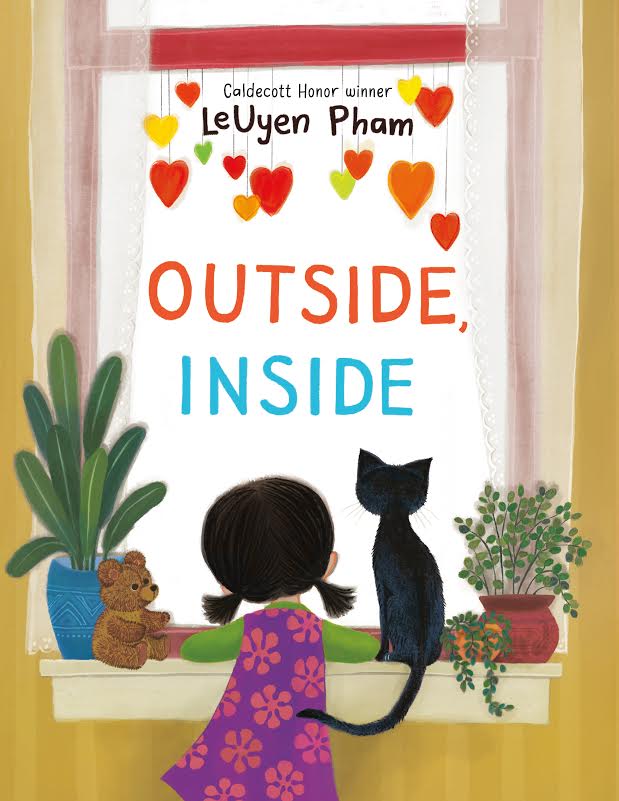
Outside, Inside: The LeUyen Pham Interview and Trailer Reveal

December 15, 2020 by Betsy Bird

Check this little cutie out:

Look familiar? He’s the mouse from A Piece of Cake by LeUyen Pham, of course! I’m no designer, and no one has ever mistaken me for one, but one thing I know is that when it comes to Christmas tree decorations, few things are better than ornaments inspired by children’s books. I’ve always had a soft spot for A Piece of Cake, not simply because I have an ornament for it but also because it was the rare picture book that the Caldecott Honor winning artist Ms. Pham both wrote and illustrated.

Now, LeUyen has a new book that she’s both written and illustrated coming out. Called Inside, Outside, it’s going to strike you as a kind of mirror. This is COVID life writ large on the page. The boredom and the frustration, absolutely, but also the love and connection. I took some time to speak with Ms. Pham about the book and she is allowing me to premiere its book trailer.

But before we get to all that, word type things!


Betsy Bird: First and foremost, how the heck are you doing right now? How’s your family?

LeUyen Pham: Exhausted.  To my already overloaded schedule I’m adding teacher, full time cook, and insomniac.  All this aside, we’re fine, thank you.  The kids, unbelievably, transitioned pretty well to online learning.  And my husband is the best — he’s taking on one kid while I take on the other.  Although lately we’re more like tag-team partners than husband and wife.  Date night?!  What’s that?  But we’re counting our blessings, and trying to make the most out of all of this.  If a few grey hairs and bags under my eyes are the worst I’m getting out of this, I’ll consider myself lucky.

BB: That all sounds eerily similar to my own family. I’m just amazed you can tap into any kind of creativity during all this. When did you first start working on this book? I know it takes a while for something to get to publication. Did you have any worries while creating the book that by the time it came out it wouldn’t be timely anymore?

LP: This was not a normal book experience for many, many reasons.  To begin with, I’m not sure I had much of an idea that this book would come through okay.  It’s earliest forms were hazy to me, unformed, nonsensical.  Just a mass of thoughts that had to go down on paper because I had no place in my brain to keep them.  And mostly they were just visuals, like slices of my mind.  The idea of forming them into a book was almost like a muscle memory — it’s just how my brain makes sense of things.  When I first contacted Connie (Hsu, my editor at Roaring Brook Press) about the idea, it was just a mass jumble of images and incoherent lines.  Connie had to sift through all of that to make sense of it, to make it a book.  I think Connie saw it as a book, and she set a real deadline to it.  I had a month to pull this off, if we wanted to print this in a timely manner.  I know that sounds crazy, but I was up to it. It gave my mind focus during those early days of lockdown, too.  It felt good to put it all onto paper, to make sense of a strange time.  

I didn’t worry at all about the book coming out and not meaning the same thing anymore.  Connie and I had early on talked about making certain that the book worked beyond this timeframe, beyond this moment, that it contained a truth that didn’t rely on current events.  As Connie said, this book had to have a reason beyond the lockdown to exist, that in ten years time a child could still pick it up and find it relevant.  Its main function is the main function of any children’s book — relay a story, find humor in truth as well as poignancy, and to keep a child wanting to turn the pages. I hope the book manages that.

That being said, I think we all had the hopes that by the time of the book’s release, the world would have eased into a more normal state again.  That hasn’t come to pass yet, so I think the book needs to also be able to comfort.

BB: I’m rather fascinated by the range of COVID-related picture books that we’ve seen coming out. There are so many different ways to talk about the virus. Some go through the medical explanations of what a virus is and some offer advice for people who can’t be with their families during the holidays. Yours is just a really simple concept of going from the outside into the inside. Did you always know precisely how you wanted this book to go or was there some trial and error?

LP: I think the books that came out immediately were the ones that were attempting to dispense information.  In some cases, people simply didn’t have enough facts at hand, or were relying on sometimes unreliable sources.  Picture books were a natural conduit — a means of communicating facts in a comforting, instructable manner.  This book really isn’t about the virus.  It’s about what humans do in the face of an enormous international crisis.  All the stories coming out, all the images we were bombarded with from around the world — to me, they all came down to one thing.  We all had to go inside.  That was the universal instruction.  When I realized the simplicity of this one objective, the book fell into place, because it’s an instruction that immediately suggests its counterpart — going outside.  It already sounded like a nursery rhyme.  It set the pace for the book, weaving from one end of a spectrum to another.  I know you’re going to think I’m weird, but I can’t for the life of me remember whether or not we intended anything, whether anything was planned out in the way books normally are.  I didn’t see a pattern, I was just recording things as they happened to make sense of them.  The whole time was a blur.  It was also a book that relied on everyone around me to give me input — from my kids giving me their thoughts on things, to my husband’s observations, to my agent Holly’s encouragement to keep going, to Connie and the whole crew at Roaring Brook Press to relate to me their experiences.  I keep saying this — I really didn’t write this book.  I just recorded what the world was experiencing.  That it came out in coherent form is still a bit of a shock to me.

BB: Oh, I see now! So this may be beating that idea into the ground but much along the same lines, the words “COVID” and “virus” are never named. Even before I understood your reasoning, this felt like a very careful, conscious decision. Can you explain again to me why you made that choice?

LP: I really want to say that yes, it was.  I want to make myself sound like a better put together person than I am, that everything was planned.  But the truth is, those words never found its way into the book, because they weren’t the crux of the story.  I wasn’t recording what Covid is.  I was observing how we should care for each other.  What amazed me during this time was how much it brought out the best in so many people.  Just walking through my own neighborhood, seeing grocery lists scrawled on garage doors so that neighbors would pick up things for each other, the number of chalk drawings, the painting and signs that went up, the teddy bear hunts, the evening whistles and cheers for emergency workers — I can’t remember another time in my life when I felt community so deeply.  Which is so ironic, considering that we were supposed to stay away from each other. In that light, the words “Covid” and “virus” never found a place in this book.  They didn’t even come to mind.

BB: Was there ever a temptation to go wordless or did you always imagine the book with text?

LP: That’s a really interesting question, no one has asked me that.  I don’t think I ever thought of the book being wordless.  But I think you could easily go through the book and not read anything, and it would be the same story.  I think I put words to it, because I was still trying to understand things myself.  I hardly consider myself a very strong writer, and I’m not able to bend words as well as I’m able to bend lines on paper.  But in the same way there’s a visual pattern, there was a verbal pattern.  It all just came together, very organically.  Sometimes words need to fill the space in your mouth just as pictures fill the space in your eyes — all instruments of the heart to communicate.

BB: Was there some aspect of the lockdown that you actively avoided putting into the book in some way? Or something that you cut that just didn’t belong?

LP: I think I tried to include every aspect I could, which made the book hard to do.  We all experienced this time differently — some of us were lucky and had jobs that were amenable to our needs.  Others were going through terrible transitions.  So many feared for their health.  But suffering in India isn’t the same as it is in Los Angeles, and to show all that was hard to do.  I saw so much footage of what was happening in other countries.  And then to experience what was happening in hospitals — if only people could view the footage of what our nurses and EMTs and doctors have to go through, wearing a mask would be a foregone conclusion.  I didn’t want to omit any of that.  I keep hoping this book will be a launching point for discussion, for both adults and children, to understand how far-reaching the effects of this situation are, and how little of us is required to make it better.

There’s probably only one spread that didn’t make the final cut, and that was an image of how wildlife has been thriving during this time.  I was really moved by the idea of animals roaming the streets, populations of wildlife increasing in parks, panda bears finally mating.  In the end, this was too fanciful to put in the book, but it’s a reminder — that life goes one, even if the economy stops.  

BB: This is all marvelous to learn. Finally, what else do you have coming out in 2021?

LP: These past few months have been busy for me, and I’m once again realizing how lucky I am to have chosen this career.  I have three projects with Shannon Hale coming out — Princess in Black #9 (have we REALLY done 9 books now?) about a MERMAID PRINCESS!  The final book in the Friends series FRIENDS FOREVER, about Shannon finding herself at last in the eighth grade.  And finally, ITTY BITTY KITTY-CORN, a picture book that we came up with together while we were touring.  Shannon is my closest friend in the children’s book world, she is the most fun person to work with, and can give a simple idea so much teeth it bites.  Kitty-corn is about a sweet little artistic kitten who knows in her heart that she is something else — a UNICORN.  It’s a book with just the right message about being who you are, and knowing who you’ll be.  And it’s got kittens and unicorns and geckos and parakeets in it.  

Thanks, Betsy, for giving this book attention.  It’s a special one, with a message that I hope resonates.  I hope when the world calms down, we can go hang out and grab a coffee…

BB: Oh, yes please! I would like that very much.


And on that note, may I present to you the trailer for Outside, Inside by LeUyen Pham:

Many thanks to LeUyen for so patiently answering my questions and thanks too to Morgan Kane and the good folks at Macmillan for this premiere.

Outside, Inside hits shelves everywhere January 5, 2021.

Filed Under: Interviews, Videos Tagged With: author interviews, book trailer debuts, illustrator interviews, LeUyen Pham, picture book author interviews

31 Days, 31 Lists: 2020 Wordless Picture Books

December 15, 2020 by Betsy Bird

Every year I contemplate the pros and cons of changing the categories of the 31 Days, 31 Lists sequence. Wouldn’t it be better to replace something with Alphabet Books, maybe? Or perhaps Sports. People would like to know about good books about sports that came out in 2020, right? There’s always a danger that if any category were to be cut, it would probably be Wordless Picture Books. I mean, think about it. How many good ones are released in the course of a year?

Well, I can’t speak for every year, but in 2020 I discovered twelve wordless titles of such variety and complexity that I found myself tongue-tied (no pun intended). Many involve boats and journeys. Some focus on immigration. Others on the great outdoors and nature. Still others on the very nature of art and museums. In a year when so many of us were left speechless at the events of the world, there is comfort in finding books that are just as speechless as we. That doesn’t mean, of course, that they don’t have something to say.


2020 Wordless Picture Books

Bye, Penguin! by Seou Lee

In this charmer a little penguin finds itself on a runaway ice floe for a trip around the world. It’s a Korean import and not, on first glance, a particularly complex or complicated storyline. That said, but it’s hard not be delighted by the way in which Penguin orchestrates his return trip and eventual triumph. There’s beautiful digital art at work inside. You know how some folks use wordless books with children that can’t understand a new language yet? This would be an ideal book for that purpose.

Dandelion’s Dream by Yoko Tanaka

This particular book was created with charcoal and then subsequently colored in digitally. It’s such a goofy little story too. A little dandelion becomes a dandelion-maned tiny lion. In this way he has a series of very small adventures. By the end, you’re not even sure if anything in this book has truly happened, or if the dandelion has been daydreaming the whole time. I’m inclined to think the latter (the title gives that distinct impression). It’s a lovely work, but it’s awful hard to describe it without saying the word “dreamlike” over and over again.

Hike by Pete Oswald

A gender neutral kid has a day out in the great outdoors with their dad. Where are they going? Is there an end goal in mind? Clearly, Pete Oswald has been holding out on us. We thought he was all about goofy books about eggs and seeds and stuff, but it turns out that when you let him loose on a storyline about nature he can really crank up the pretty spreads.

One word: vistas.

The Hunter and His Dog: A Fantastical Journey Through the World of Bruegel by Sassafras de Bruyn

Under normal circumstances, it kind of bugs me when an illustrator tries to replicate the work of a great artist in their own picture books. That said, I have nothing but admiration for what Sassafras (SUCH a good name) has accomplished here. The book is a wordless journey taken by a single man and his dog. A tear in the very fabric of where he stands allows him to travel from one Bruegel painting to another. Not as up on your Bruegel as you might be? Have no fear, there’s a helpful guide at the back that indicates each painting the poor man finds himself in. At first he has a terrible time of it, falling into stories like The Tower of Babel, The Triumph of Death, and The Fall of the Rebel Angels (which have a distinctly Hieronymus Bosch feel) but eventually he finds himself in far more enjoyable scenes like The Wedding Dance, The Land of Cockaigne, and The Hunters in the Snow. A wonderful author’s note at the end fills in additional information about Bruegel. I already knew that he was interesting because he was painting in the 16th century but wasn’t making art of royalty. Instead, he preferred normal, everyday peasant folks. What I didn’t know was how his paintings lasted as long as they did. Two centuries after his death his family was STILL painting! You don’t need words to appreciate what the artist pulls off in this book. It’s just a joy, Bruegel interest or no Bruegel interest.

Mayhem at the Museum: A Book in Pictures by Luciano Lozano

Basically, a book not too dissimilar from Raul Colon’s Imagine. A girl goes to the New York Metropolitan Museum of Art and discovers that the statues and paintings have a mischievous streak a mile wide. Soon, not just the girl but her classmates, and even her teacher, are taking objects from the pictures and parading around with them. If you can peer at the teeny tiny type on the publication page then you’ll see what each of these masterpieces are. It would have been nice if they’d made these credits a bit larger and, perhaps, added a snapshot of what they actually looked life, but whatchagonnado?

Migrants by Issa Watanabe

The darkest book on this list today. Just as the title implies, this is a book about a variety of animal migrants. Their journey is harsh. Many do not survive. And coming up from behind, small and unimposing, is a sympathetic figure of Death. The Death that follows behind reminded me quite a lot of the specter from Duck, Death and the Tulip. Same sorrowful countenance. Same understanding. This book doesn’t exactly have a happy ending. It has an ending that isn’t terrible. Tread softly.

One Little Bag: An Amazing Journey by Henry Cole

As a parent I did not pay a lot of attention to paper bags until I had kids. Suddenly they were lifesavers. And I have tried saving them, to a certain extent, but they just get so darned wrinkly. Cole’s wordless tale of the strangely long lifespan of a single paper bag may strain at the tensile strength of your belief that such a thing could last so long (a couple pieces of tape stand as the sole evidence that the bag has lasted for three generations) but if you put your quizzical nature on hold then you have to admit that Cole sticks the landing with this title. In his Author’s Note he points out that this book is truly about sustainability, more than anything else. He says that when he was a kid he reused a single paper bag seven hundred times. So really this is a sustainability book more than anything else. It’s just done with Micron ink pens alone, so that’s neat. A restrained, sustained wordless title.

One Summer Up North by John Owens

The spiritual companion to the aforementioned Hike by Pete Oswald. Like that book it features a family going out into the wilderness. The difference is that Owens is a little more site specific. Published by the University of Minnesota Press, this is an exploration of the Boundary Waters on the Minnesota-Canada border. More specifically, it’s the Boundary Waters Canoe Area Wilderness (commonly called the BWCA or BWCAW). Essentially, you paddle and portage (carry your vessel and its contents across the portage in multiple trips) your way across lakes and streams. There are more than a thousand of those bodies of water up there. Again, this is one of those books that does a great job of telling kids to unplug their devices without bopping them over the head with the message. And while I think the cozy scene of the family in the tent in the rain in their coats looks a bit like those moments in Calvin & Hobbes when the dad would force his family on wilderness trips, the spirit of the thing is so pure that you’d be hard pressed not to want to try it on your own after you finished reading. You know how you can use this book? Read it to your younger children after telling them you’re going camping. Caveat: May raise expectations too high.

The Paper Boat: A Refugee Story by Thao Lam

Tough but more hopeful than the previously mentioned Migrants. Lam tells an autobiographical wordless tale of her family’s escape from Vietnam in 1980. Cut paper and paint render a difficult storyline accessible for even the youngest of readers. I’d really appreciate a couple more reads on this. Recently I read an interview with Roger Sutton who said that some wordless picture books, “feel too much like a puzzle, on purpose. The challenge is to figure out what’s going on. ” That’s sort of how I felt about this book. As an adult I had a hard time figuring out what was going on, until I read the Author’s Note at the end. That gave me an appreciation for what Lam was attempting to accomplish here. If we’re looking for refugee #ownvoices titles, this is pretty darn good. The ant sequence takes away a lot of the horror a young child might feel. Give it a gander.

The Wanderer by Peter Van Den Ende

A little paper boat goes on an epic journey across the sea in this wordless marvel of visual storytelling. Reminds me so much of David Wiesner’s Flotsam, I can’t even begin to tell you. This is another Dutch import and honestly maybe this belongs in the comics and graphic novels section. I say that because it’s this dreamy, wordless story that follows a little paper boat through all kinds of surreal, wonderful moments and places. This import was brought to us by Arthur A. Levine, the same guy that brought America Shaun Tan’s The Arrival. I was reminded of Tan’s art more than once here. As I read it to my kids we began to pick up on all kinds of tiny details. I enjoyed discussing various theories with them about one character or another. This is a book you can get lost in for vast amounts of time. Stunning.

What a Masterpiece! by Riccardo Guasco

A book that may require that you read what it’s about before you read it cold. This little wordless import from Italy (Fun Italian Title: Che capolavoro!) follows a single boy as he weaves his way in and out of various famous (and maybe not quite so famous) works of art. A lot of these spreads are quite clever, as when the boy sleepily makes his way to Duchamp’s Fountain, his shadow spreading behind him like a Giacometti statue as the light comes in through a Mondrian window. Happily, there’s an extensive section at the back that identifies every single piece, from the recognizable M.C. Escher and Modigliani to the lesser known, and rather awesome, Niki de Saint Phalle. Banksy even makes an appearance. I guess he finally attained “masterpiece” status. I don’t know that the plot will make anyone coo, but as a supplement to an art study (or even a trip to the museum) this book works mighty well.

Window by Marion Arbona

Wow! Sheer stupefying levels of details are at work in this little wordless wonder. Arbona, born in France but resident of Canada, lets her pen go wild with this book of magnificent speculation. A bespectacled girl with double braids walks past a myriad number of windows on her way home. Open their gatefolds and you can see the impossible things she’s imagining may lurk on the other side. Part of the delight of the book is when she disappears into the gutter of the book (I honestly thought it was a publishing gaff when I first saw it) and appears in her own room. Only, the room has all kinds of elements you saw in the previous imaginings. It’s wonderfully clever and entirely black and white. Black and white AND wordless AND full of gatefolds? Who knew classy could ever be this fun?


Want to see other lists? Check out what happened this month!

December 1 – Great Board Books

December 2 – Board Book Reprints & Adaptations

December 3 – Transcendent Holiday Picture Books

December 4 – Picture Book Readalouds

December 5 – Rhyming Picture Books

December 6 – Funny Picture Books

December 7 – CaldeNotts

December 8 – Picture Book Reprints

December 9 – Math Books for Kids

December 10 – Bilingual Books

December 11 – Books with a Message

December 12 – Fabulous Photography

December 13 – Translated Picture Books

December 14 – Fairy Tales / Folktales / Religious Tales

December 15 – Wordless Picture Books

December 16 – Poetry Books

December 17 – Unconventional Children’s Books

December 18 – Easy Books & Early Chapter Books

December 19 – Comics & Graphic Novels

December 20 – Older Funny Books

December 21 – Science Fiction Books

December 22 – Fantasy Books

December 23 – Informational Fiction

December 24 – American History

December 25 – Science & Nature Books

December 26 – Unique Biographies

December 27 – Nonfiction Picture Books

December 28 – Nonfiction Books for Older Readers

December 29 – Best Audiobooks for Kids

December 30 – Middle Grade Novels

December 31 – Picture Books

Enjoy!

Filed Under: 31 Days 31 Lists, Best Books, Best Books of 2020 Tagged With: 31 days 31 lists, wordless picture books

31 Days, 31 Lists: 2020 Fairy, Folk, and Religious Tales

December 14, 2020 by Betsy Bird

Once they ruled children’s libraries. Now we’re lucky if we can find ten in a given year. Yet with the big publishers buying one another out every year, the little ones often squeak through the crevices and find ways to put out all kinds of fun tales for kids to enjoy. This year I was impressed by the sheer variety of the stories on display. Hope you like your tales done in all kinds of styles from all kinds of places! This year was a good one for this category.


2020 Fairy, Folk, and Religious Tales

The Blunders: A Counting Catastrophe! by Christina Soontornvat, ill. Colin Jack

Before they leave the house, the ten Blunder kids are told by their mom to not leave anyone behind. So what happens when they only count nine? This book combines two of my favorite things: classic folktales updated and math. It’s a good old-fashioned fool tale, and illustrating it with the art of Colin Jack (who is never not good) was a clever way to go about things. Not only do the kids count forwards in a foolish, albeit normal, way, but they also count backwards, by twos and by threes. That will make math lovers happy. Beautifully laid out, funny, and kids get to feel smarter than the characters, which is always a nice plus. 

Chia and the Fox Man: An Alaskan Dena’ina Fable adapted by Barbara J. Atwater and Ethan J. Atwater, ill. Mindy Dwyer

A modern retelling of a traditional fable tells the story of a boy who has to determine what the right thing to do is, when faced with a choice. I particularly appreciate the strength and simplicity of the writing. We’ve seen plenty of adapted fables and too often the retellings come across as stilted. Not so here. The careful integration of Dena’ina words and phrases works well and I liked the art. It’s so strong in this category that my library made to sure to add it to our 101 Great Books for Kids list this year.

The Fabled Life of Aesop by Ian Lendler, ill. Pamela Zagarenski

Wraps Aesop’s fables into a possible story of his life. I think it’s fine to put this in the folktale category since it really does contain twelve of his tales, retold alongside Zagarenski’s dreamlike imagery. I would have liked a tiny bit of backmatter about the real Aesop and what we both do and do not know about him, but I think showing how storytelling can be used to manipulate oppression is timely. Please note that it also pairs very well with Mother Goose of Pudding Lane by Chris Raschka from last year. 

The Feathered Serpent and the Five Suns: A Mesoamerican Creation Myth by Duncan Tonatiuh

When the gods of Mesoamerica fail to create human creatures, they give up and hand over the sacred bones of creation to the lord of the underworld. Only Quetzalcóatl, the Feathered Serpent, is brave enough to take back the bones and try again. 2020 is a good year for Mesoamerican myths! Have any of you ever read Lowriders to the Center of the Earth? I kept having flashbacks to that book as I read this one (they share a villain in Mictlantecuhtli). As with his previous book The Princess and the Warrior, Tonatiuh delves deep into Aztec myth. I was rather amused that the word “Tonatiuh” (def: sun or sun god) appears multiple times in the text. Strong writing and a stirring retelling. (Note: Tonatiuh confesses at the end that he had to rearrange things a bit)

Federico and the Wolf by Rebecca J. Gomez, ill. Elisa Chavarri

Big year for Chavarri! One minute she’s illustrating Sharuko El Arqueólogo Peruano / Peruvian Archaeologist Julio C. Tello by Monica Brown. The next she’s illustrating a modernized adaptation of Little Red Riding Hood. It all makes me think how much picture books that incorporate Spanish words into their texts have changed over the last few years. Gone are the days when each one was highlighted to make it seem different from the rest. Gomez’s text rhymes, but it’s not intrusive. Our Red Riding Hood is named Federico and he’s wearing a red hoodie while riding his bike. Alas, the book loses its nerve and goes the old the-wolf-trapped-the-grandparent (a grandpa in this case) route. Does no one old get eaten anymore? Eh, it’s okay. Funny, strange, and with a nice pico de gallo recipe at the end. 

The Generous Fish by Jacqueline Jules, ill. Frances Tyrrell

Young Reuven shares his bread with a tiny golden fish, creating an instant bond. But when the villagers realize the fish’s scales are made of real gold, Reuven has to weigh their needs against the fish’s. Just your average everyday boy and his fish story. This book is a combination of two different Jewish tales (“Cast Your Bread Upon the Waters” from Ellen Frankel’s The Classic Tales and Bin Gorion’s Mimekor Yisrael, and the Hasidic “Revelation; Or, The Story of the Billy Goat” by I.L. Peretz). By combining them, Jules is not just making a comment about human greed, but also on how our actions affect the natural world around us. I found it significant that the fish never tells the humans that they’re taking too much. With its colored borders and realistic art, it has a storytime feel that we don’t always find in our children’s books anymore. Extra points for making it look fun to hug a fishy.

Go and Do Likewise! The Parables and Wisdom of Jesus by John Hendrix

John Hendrix is a rare beast in the world of children’s book publishing. As a general rule there is a great big line in the sand drawn between religious publishers and trade publisher. To create a book that focuses solely on the parables of Jesus is something you might expect from Zondervan, not Abrams. But Hendrix is also the premiere Christian artist working in the children’s field today. Of course, there are applications above and beyond the Christian market. In my own case, I’ve found that having a handy reference tool to Jesus’s parables is incredibly useful. To understand our contemporary culture, it can be a good idea to know references like “The Prodigal Son” or “The Good Samaritan”. This book provides that. Plus it’s purdy. Gorgeously rendered and beautifully told. There’s even a nice section at the end about “Retelling Vs. Translating” and sources citing the Biblical passages. 

Pacho Nacho by Silvia López, ill. Pablo Pino

Unable to agree on a single name, a family calls their first kid Pacho-Nacho-Nico-Tico-Melo-Felo-Kiko-Rico. So what happens when he’s in trouble and his brother Juan has to call for help?  This kind of story originated as a Japanese folktale. If Tikki Tikki Tembo makes you feel guilty because you love the rhymes and hate the racism, good news! This has a lot of the same beats and some pretty amusing rhymes to boot. Probably it would take some extensive practice before you could do it in a storytime, but don’t give up on that dream. It’s interesting because unlike Tikki Tikki Tembo, this book cut out a beat in the story. Originally the sibling with the short name falls in first and THEN the kid with the long one. An interesting change in an interesting book.

The Phoenix of Persia by Sally Pomme Clayton, ill. Amin Hassanzadeh Sharif

A foundling prince is adopted by a kind phoenix (or Simorgh) in this ancient Iranian tale. Jewel-toned scratchboard art also brings this story to life. Oh, this is just great! Loved the scratchboard art and I liked the story too. It has that otherworldly feel you sometimes get with true classic folktales. This book also has such strong ties to classical storytelling with its clever incorporation of music. And you know how some folktales sort of fall flat without an ending? Not this one! A beaut. Do not miss it.

Quill Soup: A Stone Soup Story by Alan Durant, ill. Dale Blankenaar

The old stone soup story gets a kick in the rear with this gorgeously rendered import from South African illustrator Dale Blankenaar and UK author Alan Durant. Blues, yellows and reds are the name of the game, accompanied by a text that stresses the lessons of the original but frames the story in an entirely different way. Here, a porcupine comes to a small village of other animals. Being a stranger they won’t even give him the time of day, let alone any food. To start the soup, he uses his own quills as a base, and the tale takes off from there. Durant’s storytelling is good but you’re going to stay for Blankenaar’s art if nothing else. I sort of went down the rabbit hole of looking into his past work and now all I want to do is find his book Rhinocephants on the Roof. Anyone want to help a gal out? One of the most vibrant books of the year. 

Reynard the Fox by Renate Raecke, ill. Jonas Lauströer

Years ago I attended the Bologna Book Festival. It was a wonderful experience, and I was entranced by the crazy wild variety of illustrations on display. If ever you despair at the state of picture book illustration today, get thee to the fair. While there, the announcements of the Bologna Ragazzi Awards were made and to my delight one winner was this marvelous noir-influenced alphabet book where all the animals wore suits and ties. Alas, it would never be translated and brought to America, but I retained its memory in my mind. This year, I was flipping through a book that promised to do something with the medieval trickster character Reynard the Fox, when I saw that all the animals in this book were wearing suits and ties and fancy dresses. It wasn’t the same artist, but by gum it had the same feel! In this book, Raecke cleverly weaves together a number of different Renard stories to create a single overarching tale of a fox on trial for his many misdeeds. Lauströer’s art often outdoes itself and the book has all the wonder and fear you’d want out of these tales. This is a collection of folktales at their absolute best. Because if you can’t be charmed by a fox in shirtsleeves, you don’t deserve to be charmed at all. 

Sacred Song of the Hermit Thrush: A Mohawk Story by Tehanetorens, ill. David Kanietakeron Fadden

It’s a story that some of us may have heard before, if not this exact version. When the earth was created the people could sing, but the birds could not. The Good Spirit decided that each bird should have a song, and to determine the sweetest, they would see who could fly the highest. And hermit thrush, clever creature, got a ride to the top via the bald eagle’s back. Unfortunately this was cheating, so while it may have the loveliest song today, it also hides from everyone out of shame. The backstory to the author of the book is almost as interesting as the book itself. Tehanetorens is described in the About the Author section as a teacher who was adopted into the Mohawk Wolf Clan and given the name Tehanetorens. In the 1930s he was a schoolteacher at the St. Regis Mohawn School in Hogansburg, NY and spent much of his time publicizing the technological innovations and democratic traditions America owes to the Mohawk Nation. He established the Six Nations Indian Museum in Onchiota, NY. This story was first published as a pamplet by the Akwesasne Mohawk Counselor Organization, a fact that is prominently stated at the book’s start. Illustrator David Kanietakeron Fadden is the author’s grandson, an Akwesasne Mohawk artist raised in a traditional Mohawk household. I was very taken with the thick paints used to illustrate this story. There’s this moment when the hermit thrush lifts off the back of the bald eagle and the eagle shoots the bird this seriously pissed off face that felt enormously true. Bald eagles already look permanently peeved as it is. This just put the truth to the glare. A great book.

The Secret of the Tattered Shoes by Jackie Morris, ill. Ehsan Abdollahi

A weary soldier encounters a castle with a mystery. The king needs to know why his daughters’ shoes are tattered and torn every night. But is the answer worth dying for? To be perfectly honest, when I was a kid I had a copy of The Twelve Dancing Princesses illustrated by Errol le Cain that I still consider to be the best ever done. No other version has ever really captured the surreal beauty of the gold, silver, and diamond trees that the princesses pass on the way to their illicit rendezvous . . . until now. Ehsan Abdollahi is an Iranian artist who makes these fascinating choices throughout the story (luminescent mother-of-pearl petals are stand-ins for diamonds, for example). But Jackie Morris really won my heart because she taps into the question in the story that no one else ever seems to want to talk about: Why would you marry a princess who was perfectly willing to kill you without a second thought? The ending changes the original, and the story’s better for it by far. Plus, the writing itself is brilliant.

Seven Golden Rings: A Tale of Music and Math by Rajani LaRocca, ill. Archana Sreenivasan

Faced with a conundrum of how to pay his way at an inn, a clever boy uses binary numbers in an eclectic manner to win the day. You guys know that I serve on the Mathical Award every year (I’m chairing it this year) and that I usually try not to let that influence the books  propose for my 31 Days, 31 Lists. That said, I’m just charmed by this book. It’s a folktale that teaches binary in an exceedingly clear cut way. It could well be that the book is almost too smart for its own good, but honestly it reminded me a lot of that classic One Grain of Rice by Demi. Good writing, fun art, and a slick incorporation of math into fiction.

Sootypaws: A Cinderella Story by Maggie Rudy

I’m a sucker for models. They’re ridiculously hard to pull off, to say nothing of all the lighting techniques and photography that goes into making them look halfway decent. Still, there is this steadfast cadre of author/illustrators out there that have mastered the form. Maggie Rudy is one of these and I found it oddly gratifying to see that a big publisher had picked up her latest. I know we’ve had more Cinderella stories than we can shake a fist at, but there’s something so charming about Rudy’s latest. The writing actually manages to be both romantic and 21st century (Cinderella and her prince decide to literally kick off their shoes and see the world together rather than wed right away). As for the art, the rose petal gown that Sootypaws wears to the ball truly looks like it fell from a flower. A treat for both eye and ear.

The Sorcerer’s Apprentice by Gerda Miller

According to this book, the famous German writer Johann Wolfgang von Goethe wrote the original poem of “The Sorcerer’s Apprentice” in 1791, “inspired by a story told to him by his maid.” One ponders how this came up in the first place. I, for one, want to know more about that maid. In lieu of that, I’ll have to be content with this meticulously rendered edition of the old tale. If you’ve watched your Fantasia then you may have seen Mickey Mouse try to get out of his chores by enchanting a broom. That’s fairly faithful to the original tale, but rather than set the tale in a castle, Miller puts the boy and the low-key sorcerer named Alfred in a homely little house in a village. When the water really gets going there’s a kind of Strega Nona vibe to the calamity. All ends well, and the sorcerer forgives the apprentice. I just love the last sentence in the book: “After many years of listening and learning, Oliver became the village sorcerer. And he was almost as wise as Alfred.” Certainly the best version of this tale I’ve seen to date. Accessible and enjoyable. 

Tales of the Feathered Serpent: Rise of the Halfling King by David Bowles, ill. Charlene Bowles

Sayam’s just your average half-human boy in this Mayan tale. When he popped out of an egg and was raised by a kind witch, he had no idea he’d be challenging a tyrant for his throne. Author David Bowles is hugely invested in the foundation of #DignidadLiteraria, a movement that campaigns for a bigger inclusion of Latinx people throughout the publishing/literary industry. He loves Mesoamerican myths and this is the first in a series of them. Honestly, besides Duncan Tonatiuh’s books, we do not see a great many Mesoamerican myths in a given year. This book is peppy, has fun art, and there’s a nice Afterword that gives some background information on the Maya. And did I mention that it’s a comic?

Three Billy Goats Buenos by Susan Middleton Elya, ill. Miguel Ordóñez

A beautiful blend of Spanish and English retells the classic story of three plump little cabritos and the hungry gigante who wants to munch them up. I’m naturally suspicious of any retelling where the troll doesn’t get bashed into the river at the end (see: Jerry Pinkney’s retelling of the tale). Worse still, this version takes out the delightful “trip-trap” along the bridge. So why do I like it so much? Because Elya more than makes up for this alliterative lack with rhymes that actually work and work well. Her troll is female (which is awesome) and the Spanish words are so effortlessly worked in that while you may turn to the Glossary at the front once in a while, but context is key for most of them. There is a happy ending, but it’s not treacly, so I’ll let it slide. 

The Three Billy Goats Gruff: The Full Story by Richard Jackson and Katherine Tillotson

It’s been a good year for gruff! One is inclined to consider whether the story of a bully and a bridge reflects at all our current political situation. Probably not in this case. Here, the troll is not redeemed. Indeed, it’s walloped clean into space in a strangely satisfying sequence. Tillotson’s art, a sumptuous combination of fiery oranges and deep, cool greens, enthralls. Dick Jackson may have left us but as posthumous tributes go, this may actually be one of his best. Best of all, I like that the focus of the book is on how the smallest billy goat is the one that is capable of telling not just his own story but the stories of his siblings as well. The true point of the book is to celebrate those folks that tell better stories by seeing and telling the whole, rather than just a part. So cool. 

Waa’aka’: The Bird Who Fell in Love with the Sun by Cindi M. Alvitre, ill. Carly Lake

“Fell in love” is a bit of a misnomer here, but it makes for such a good title I wouldn’t change it. Probably a more accurate title would have said something along the lines of “The Bird Who Fell in Love with Concept of What the Sun Could Do For Her”, but that’s a tad on the wordy side. Alvitre, aside from teaching American Indian Studies at California State University, Long Beach, is a descendant of the Tongva and in 1985 cofounded Mother Earth Clan, a collective of Indian women who created a model for cultural and environmental education. This is a Tongva creation story, exquisitely rendered by artist Carly Lake. In this tale, Wiyot, the creator, forms the earth and the animals, including the beautiful white bird, Waa’aka’. When he creates the sun, it falls in love with the bird. She, on the other hand, only likes him for his light because without it she couldn’t see her own reflection. You see where this is going. Alvitre tells the tale splendidly while the art soars from page to page. I dearly hope more folks get to see this one, as it’s one of the best tales of the year. No exaggeration there. 

The Weather’s Bet by Stephen Cowan, ill. Ed Young

I wonder if Ed Young ever gets tired of being cool.  Aesop gets a reinterpretation under the guise of Young’s expert art. Torn paper collage and Chinese pictograms retell the story of a contest between the sun, the wind, and the rain to convince a shepherd girl to remove her hat and cloak. All the art you’ll find in this book was apparently made from a combination of “torn handmade and magazine paper”. And there’s a portion at the beginning that explains not just why Young has chosen to include certain pictograms in the art, but also the origins of those pictograms and how they apply to this tale. The idea of subtly tying in a love of conservation to this age old story about earth, water, and wind is smart as a whip and the end result is beautiful. I mean, his art. Example: I love how the shepherd on the cover looks as those she’s dripping with water. That’s friggin’ paper!


Want to see other lists? Check out what happened this month!

December 1 – Great Board Books

December 2 – Board Book Reprints & Adaptations

December 3 – Transcendent Holiday Picture Books

December 4 – Picture Book Readalouds

December 5 – Rhyming Picture Books

December 6 – Funny Picture Books

December 7 – CaldeNotts

December 8 – Picture Book Reprints

December 9 – Math Books for Kids

December 10 – Bilingual Books

December 11 – Books with a Message

December 12 – Fabulous Photography

December 13 – Translated Picture Books

December 14 – Fairy Tales / Folktales / Religious Tales

December 15 – Wordless Picture Books

December 16 – Poetry Books

December 17 – Unconventional Children’s Books

December 18 – Easy Books & Early Chapter Books

December 19 – Comics & Graphic Novels

December 20 – Older Funny Books

December 21 – Science Fiction Books

December 22 – Fantasy Books

December 23 – Informational Fiction

December 24 – American History

December 25 – Science & Nature Books

December 26 – Unique Biographies

December 27 – Nonfiction Picture Books

December 28 – Nonfiction Books for Older Readers

December 29 – Best Audiobooks for Kids

December 30 – Middle Grade Novels

December 31 – Picture Books

Enjoy!
Filed Under: 31 Days 31 Lists, Best Books, Best Books of 2020 Tagged With: 2020 religious tales, 31 days 31 lists, fairy tales, fairytales, folk and fairy tale reviews, folk and fairytales, folk tales, folktale review, folktales, religious tales

Fuse 8 n’ Kate: Latkes and Applesauce by Fran Manushkin, ill. Robin Spowart

December 14, 2020 by Betsy Bird

Happy Hanukkah! Having read the recent PW Children’s Bookshelf announcement that a new edition of Latkes and Applesauce by Fran Manushkin is due to be republished in 2022, I thought this might be the perfect time to revisit the old book. The announcement said it was a classic, so we figured we’d check and see how well it had stood up so far. Along the way we also cover how “Big Latke” got to Kate, TBD dogs and cats, what Daveed Diggs has to do with Hanukkah, and why I probably shouldn’t confuse “Maccabee” with “Mennonite”.

Listen to the whole show here on Soundcloud or download it through iTunes, Stitcher, Spotify, Google Play, PlayerFM, or your preferred method of podcast selection.

Show Notes:

Font specialists, lend me your talents. What font creates question marks that look like this? It is new to us.

Oh yeah. We had to include “Puppy for Hanukkah” with Daveed Diggs song in here. I think we just found something to oust “8 Crazy Nights” from its throne.

Curious about PJ Library and the free books they provide? Check out my interview with Meredith Lewis about them in the piece 21st Century Oral Storytelling: How PJ Library Connects Kids to Their Heritage via Podcasting.

Feel free to listen to our previous Hanukkah episodes about Hershel and the Hanukkah Goblins and The Latke Who Couldn’t Stop Screaming.

Are you as horrified by my family’s new tradition of test tasting different gross pops on Christmas Day? Then perhaps this next image is not for you. This is what Kate found for us.

Filed Under: Fuse 8 n' Kate Tagged With: Fran Manushkin, Fuse 8 n' Kate, Latkes and Applesauce, Robin Spowart

  • « Go to Previous Page
  • Page 1
  • Interim pages omitted …
  • Page 236
  • Page 237
  • Page 238
  • Page 239
  • Page 240
  • Interim pages omitted …
  • Page 1051
  • Go to Next Page »

Primary Sidebar