• Skip to primary navigation
  • Skip to main content
  • Skip to primary sidebar
  • About/Contact
  • Fusenews
  • Reviews
  • Librarian Previews
  • Best Books
    • Top 100
    • Best Books of 2022
    • Best Books of 2021
    • Best Books of 2020
    • Best Books of 2019
    • Best Books of 2018
    • Best Books of 2017
    • Best Books of 2016
    • Best Books of 2015
    • Best Books of 2014
    • Best Books of 2013
  • Fuse 8 n’ Kate
  • Videos
  • Press Release Fun

Enchanted Lion Publisher Preview (Spring 2026)

Enchanted Lion Publisher Preview (Spring 2026)

November 29, 2025 by Betsy Bird

Due to the line of work I find myself in, I sometimes have to field this question: Who is your favorite small publisher?

Naturally I hem and I haw as an answer. How could I ever choose? There are so many small publishers out there today, plying their wares, truly believing in the value and possibility inherent in children’s literature. And when I do this, when I refuse to give a straight answer, inevitably the person I’m speaking with gives me a look, that I can only ascribe with pity, and will say (as if trying to help me along), “Well, what about Enchanted Lion Books?”

What indeed. Since its inception this publisher has a tendency to win countless New York Times Best Illustrated inclusions. And can you name me a small NYC publisher that has a more beautiful series of About Us photos on their website? One gets the distinct feeling that the poor folks tolling away at the big guys, look at Enchanted Lion with undisguised hunger. Who wouldn’t want to work there? Their list is consistently thoughtful AND beautiful (not something you tend to see together). They have an uncanny eye for quality. Honestly? I’m just a humble librarian, but if I were looking to work in the publishing industry, you can BET where I’d send my resume first.

This season, Enchanted Lion presents us with an incredible array of topics, art styles, and creators from across the globe. Check this out:


Chirri & Chirra, Among the Cherry Blossoms by Kaya Doi, translated from Japanese by David Boyd

ISBN: 9781592704828

Publication Date: March 3, 2026

This one’s so new, we don’t even have a cover online with an English title that I can site here. THAT is new news!

Now can we just stop and take a moment to appreciate just how popular this little Japanese import series has become around America today? That’s the kind of thing that I think is actually worth celebrating. This particular book will actually be the 9th book in the series so far. That’s significant. Families adore these books. One man even came up to the Enchanted Lion reps recently and told them that he grew up with them. Heck, one of the books in this series was even chosen as a best book of the 21st century by Kirkus. Here’s another fun fact: This book will be out just in time for cherry blossom season. Why is that important? Because cherry blossoms play an outsized role in this book’s storyline. Interestingly, this is the first Chirri & Chirra book to include a note in it from the translator about sakura and what they are. And, as you can see, they’re quite wonderfully rendered on the page:


Tama and Baby by Kaya Doi

ISBN: 9781592704613

Publication Date: May 12, 2026

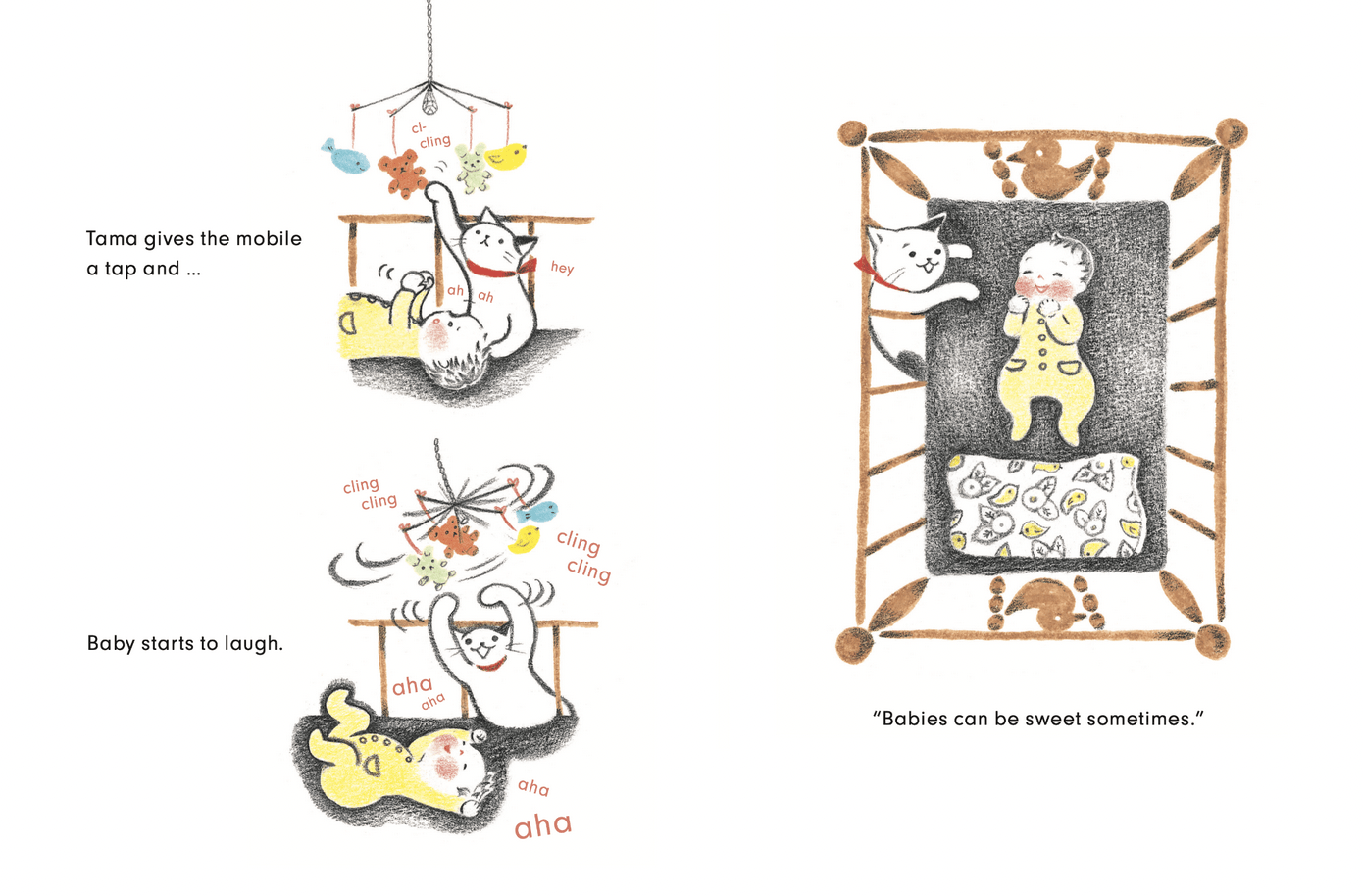
It’s Kaya… again! I mean, she’s been doing the Chirri & Chirra series for years, so it’s not as though she’s new to the States. That said, this is actually Kaya’s first non-Chirri & Chirra book to come out in America. When Enchanted Lion told me this they confessed that there were kind of surprised that no one else had had the wherewithal to pick up her books. This latest is a good cat lover book too. Tama, the cat, has a baby come into her home and family. As a result, she’s the one who has to acclimatize to it and adjust. At the beginning it’s cute but in time it makes noise and demands attention. Cleverly the book shows that adjustment and how the two become good “siblings”. Tama, in time, realizes that she’s the older sister and that she needs to exhibit a tolerance for the baby. Then the baby grows big but to Tama she will always be her little sister.

I Forgot How to Sleep by Bruno Zocca

ISBN: 9781592704835

Publication Date: April 28, 2026

Italian Bruno Zocca actually received a Maurice Sendak Foundationship in the past. Now he has a title coming out in the States and I can guarantee you that it will get sold on that title alone. In this story a girl, no matter what she does, cannot get to sleep. She redoes her entire routine to no avail. Then she goes outside and meets a bear in the woods who is also suffering from insomnia. GREAT bear eyes on that guy, by the way. Ten outta ten. In the course of helping him get some sleep she realizes she didn’t get her bedtime story that night. She returns home, wakes up dad, and tells him what needs to be done. Charming and funny and successful in doing what it needs to do as a bedtime book. A hijink-free telling, perfect for bedtimes everywhere.


B Is for Bibliophile by O.E. Zelmanovich and Lauren Simkin Berke

ISBN: 9781592704323

Publication Date: March 10, 2026

Boy, I bet you’re looking at this cover right now wishing this book was out right now so that you could give it away this holiday season. You’re going to definitely think that after I tell you that this book was written by two friends working at the Strand Bookstore in NYC. So this is for already existing bibliophiles and for the bibliophiles you wish to grow. Essentially, this tells the reader about all the different parts of the book. We’re talking gatefolds, dog earring, marginalia, the spine, “wormholes” (from bookworms), etc. Oh. It’s also an alphabet book. For example, B is for Bibliophile. “A person who loves books (someone like us and possibly someone like you)”. I like that the bookstore in the book kind of looks like the Strand too. Also consider it for anyone who wants to go analog and away from AI.


The Trolls of the Turkey River by Ahana Ganguly, ill. Arthur Geisert

ISBN: 9781592704187

Publication Date: April 21, 2026

Okay. A lot going on with this book. First and foremost, we need to gauge your Arthur Geisert knowledge. How familiar are you with the man and his work?

Welp, here’s your Geisert 101. He’s considered by many to be a living legend. He lives exclusively in Elkader, Iowa. If you wanna meet him? Gotta go to Iowa. And for years he’s been the King of Etchings. Copper plate etchings to be exact. This new book he’s worked on, which is the third in his Clayton County Trilogy (after Pumpkin Island and How the Big Bad Wolf Got His Comeuppance) sure as heck looks like it’s made with copper plate etchings. However, apparently Mr. Geisert was in a horrible etching accident in which he actually officially died for something around four minutes. When he was conscious again he was told not to use those chemicals again. As such, he’s now drawing, but in such a way where it looks like etchings. This book was written by Ahana Ganguly, a young queer Indian woman MFA from Pratt in creative writing, who is both an author and editor. Theirs is not, perhaps, the most common pairing, but together they apparently work really well. The story found here is set in Iowa and is about the trolls who have lived below the ground for ages. When flooding forces them up, they have to come together with the humans to save their city. The text has a spirit that really encompasses the author’s view that all the world is alive. For example, towards the end of the book it’s clear that it wasn’t just the humans and trolls working together that held back the flooding, but the very sand in the sandbags as well. Holistic and unusual.


Odds and Ends by Maija Hurme, translated by Mia Spangenberg

ISBN: 9781592704798

Publication Date: June 9, 2026

And now something from Finland. This will be Enchanted Lion’s first time working with this particular creator. The book follows a girl who collects different “lasts”. It could be something as esoteric as the last day you wear a woolly hat before it’s spring (clearly the creator of this book isn’t from Chicago) or the last migrating birds as they make their way south. The tone is heartwarming, funny, and thoughtful. Just the right kind of SEL book to prompt conversations between teachers/students & parents/children on the lasts that they have had over their own lives. Think of it as an oddball memory book. This is how kids look at the world and what they notice.


The Yellow Hats by Kelly Matathia-Covo

ISBN: 9781592704750

Publication Date: July 28, 2026

With author/illustrator Kelly Matathia-Covo is Greek the translation from the Greek was actually done by Kelly herself. As the daughter of Holocaust survivors, her family has a story of how they survived the war by sending a telegram to a professional friend on a Greek island. That friend ended up being a decent human being who risked his own life to bring this family to safety. Then, everyone in the town shielded them. This book tells that story through a sheep family. Creatures (unnamed) that live up in the hills, descend and begin to persecute the sheep. As you can probably tell, this is a bit of a rough story though it does ultimately become a hopeful story of rescue and survival. Originally Enchanted Lion contracted for this book in 2018, and then COVID came. They didn’t realize when it was first selected just how complicated the world would be when it finally released. Certainly Kelly feels that she is writing a more universal story than just that of the Jewish people and their history. You can think about this book in broader frame than just one group. Notice too in the art how the purity of the color yellow is key. You can see it on the cover as well.


Nantucket Woodcuts: A Microcosm of American History by Fritz Eichenberg, ill. Naoko Matsubara

ISBN: 9781592704811

Publication Date: May 26, 2026

A reissue of a nonfiction children’s book that celebrates the history of Nantucket the island. That sounds fairly niche, but this is much more a story of how you can take a single location and show how it represents a great swath of a nation’s history (you can tell that they added the subtitle for the reissue). Kind of a microcosm/macrocosm situation. The book starts with the Indigenous tribes that lived on Nantucket for centuries. Then it moves on from there. The artist herself is Japanese-American. Decades ago she came to learn from a woodcut artist and she stayed. Matsubara is in her 90s these days, and it turns out that Fritz actually wrote this book for her. She rendered these stunning illustrations as a result, all hand-colored, and very different from digital art and how people make art today.


Gravity and Other Substances by Daniel Lievano

ISBN: May 19, 2026

Publication Date: 9781592704354

Our final book today is also the last Unruly book (the Enchanted Lion imprint for older readers) due to come out for a while. It comes from an artist from Colombia who, amongst his other talents, has worked with the Folio Society and illustrated Murakami’s novels. This creator has received various awards from the Society of Illustrators in New York, and this book is an artist’s philosophical contemplation on happiness and dreams and gravity. It’s visual notation for thinking through these concepts in both word and image. Think of it as an existential title with appeal to teens. It’s about how to be a person in the world, presented with a fascinating approach to philosophical thinking through representation. Or, as Enchanted Lion puts it, “It’s a weird and interesting book,” with appeal to both adults and teens. The author will come to NYC to share it in person at some point. It is, also, as I said, their last Unruly book for now. They don’t have anything signed up now for the future. As they put it, there’s not a groove in the world for this kind of imprint. Strange and wonderful and artistic and odd.


Big thanks to Claudia Zoe Bedrick, Emilie Robert Wong, and the Enchanted Lion team for taking the time to show me their incredible 2026 titles.

Filed Under: Publisher Previews

Bob Rossify Your Life: A YOU CAN MOVE MOUNTAINS Cover Reveal and Talk with Richard Ho and Daniel Miyares

November 28, 2025 by Betsy Bird

There’s a Blick Art Materials store in my town where you can find any number of silly little knick knacks and doodads (perfect as stocking stuffers). It was at Blick that, not long ago, I started noticing the sheer number of Bob Ross-related fare that was out there. Coloring books and card games and all kinds of stuff. Bob Ross has, over the years, grown to be a kind of Mr. Rogers-like nice guy in the eyes of the public. Now there’s a picture book biography of the guy? I mean, that feels like a no-brainer.

You Can Move Mountains: The Artful Life of Painter Bob Ross by Rich Ho, illustrated by Daniel Miyares, won’t be out until June 16, 2026, but it’s never too soon to start thinking about a legend. Here’s a quick recap of what the book will entail:

“A blank canvas is your world. A limitless sky. A new horizon. You are the creator, adding blotches of blue and circular strokes of white.

You might not like it at first. You might call it a mistake. But there are no mistakes…only happy accidents. For you are experiencing the joys of painting.

You Can Move Mountains is a touching picture book biography about the American artist and icon Bob Ross, the joys of painting and creativity, and the life lessons we can learn from a blank canvas.”

Today, I not only have the cover reveal of this book, I have a chance to talk to its author and illustrator about it as well:


Betsy Bird: Richard! A million thanks for talking to me about YOU CAN MOVE MOUNTAINS today! A book with a subject like Bob Ross sounds both daunting and obvious. But let’s lean into the daunting aspect. How do you even begin to figure out how to frame his story?

Richard Ho

Richard Ho: Thanks so much for having us, Betsy! And yes, “daunting” is exactly right. Bob Ross is such an icon, and I knew any attempt to capture his magic in picture book form would come with a risk of disappointing his legions of fans (myself included). But ultimately, I latched onto this message of empowerment that he infused into every episode of The Joy of Painting. When he said “you’re the creator,” he truly believed it. Each of us has the ability to shape our world, whether that world is a simple painting or the canvas of our life. And what better way to convey that message than to present Bob’s own life as a painting?

BB: And Daniel! Thank you for joining us as well! Tell us a bit about how you were introduced to this manuscript. What drew you to take it on? And, for that matter, how familiar were you with Bob Ross prior to taking this on? 

Daniel Miyares

Daniel Miyares: Hi Betsy! Thank YOU for the opportunity to share about our new book. It’s always such an honor to get to talk with you.

I received the manuscript through my agents at Studio Goodwin Sturges. The wonderful Emily Feinberg reached out and shared Richard’s story. Right off the bat I was intrigued. I had seen Richard’s book THE LOST PACKAGE that he made with Jessica Lanan and loved it. I was so curious to see how a writer would approach telling the story of Bob Ross’s life, but Richard didn’t just write a biography. He also wrote a letter of encouragement to the reader as the book unfolds. That was Bob’s thing wasn’t it? I used to watch The Joy of Painting as a kid and I was enthralled with how something so abstract like a scrape of paint across a canvas could almost instantly become water. It was this new philosophy for me that in art, if you weren’t beholden to your “mistakes” then anything was possible. Risk is so much easier when you’re not fretting the outcome. I should also say that one year growing up a family member got me a Bob Ross oil painting set. It was my first experience with oil painting. I remember getting everything out and working all afternoon on my first oil painting in my bedroom. I made such a big mess and absolutely hated what I painted so much I hid it in my closet (I’ve always been hard on myself). It got paint all over everything! I could have used some encouragement in that moment I think…maybe even a book about it?  

BB: Well, let’s talk about that! Richard, part of what makes the book so interesting is your text. Like Daniel just said, it’s seemingly instructions for making a painting, but Daniel then couples those instructions alongside scenes from Bob’s life. Was that how you envisioned the book? What did your manuscript look like when you wrote it? 

Richard: For an author, this is where the true joy of making a picture book shines through: witnessing an incredible illustrator elevating a story far beyond what l originally intended! I had sort of envisioned a book in which the text can be read on the surface as painting instructions, but the visuals would focus on the biographical story of Bob’s life. And that’s what the art notes in the manuscript reflect. But Daniel came up with the brilliant side-by-side structure, with Bob’s life unfolding on one side and an actual painting springing to life on the other. It was such an inspired choice, and absolutely perfect for the book’s central theme!

BB: Let’s delve into that. Daniel, at one point you wrote this to me: “Richard wrote this beautiful story and somehow wove Bob’s life into the process of working on a painting in a way that seeks to invite readers on their own journey. In a desperate attempt to have the art do both Bob Ross’s legacy and Richard’s manuscript justice I imagined having one side of the book be Bob’s life and the other side a painting that develops as you turn the pages much like The Joy of Painting.” Talk to us a bit more about how you came to this decision to split the focus between the biographical subject matter and the image taking shape. 

Daniel: There’s something magical about how a piece of art develops from a blank page or canvas into a thing that we emotionally connect with. That has always enthralled me and I think that’s one of the reasons people connect with The Joy of Painting so much. I wanted to try and structure the physical book like an episode of the show. For years I’ve been sitting on this idea of making a book out of one piece of artwork. What I mean is I imagined documenting the painting or drawing in stages so that each spread is only one moment of time in the lifecycle of that piece of art. Kind of a nod to the fleeting nature of moments in our own lives. When I thought about Richard’s manuscript, this idea seemed to fit right into the idea of Bob’s landscape painting developing with each page turn. The only trick was I wasn’t sure how I was going to differentiate between Bob’s life over the years and the painting developing. In the end I figured using a more stylized ink line and wash for the biographical pages on the left and a full bodied painted style for the landscape canvas on the right hand side might work. Setting up a cadence like that seemed important. I didn’t expect a picture book biography about Bob Ross to be such a big experiment with form but that’s where it led and I’m really glad for it.

BB: Awesome. Richard, you’ve written a mix of fiction and nonfiction picture books over the years on wildly varying topics (including my personal favorite, THE LOST PACKAGE). Specific to informational books for kids, what kind of topics do you tend to incline towards? And how does YOU CAN MOVE MOUNTAINS play into that? 

Richard: First of all, I’m so honored that you enjoyed THE LOST PACKAGE! As you mentioned, my books touch on a wide range of topics, mostly because my interests are all over the place. When deciding which of these interests to turn into a book, I’ve found that there needs to be a personal connection. For THE LOST PACKAGE, it was the fact that my dad worked for the U.S. Postal Service and I grew up around mail. For a book like IF LIN CAN (a biography of Asian basketball star Jeremy Lin), it was my lifelong fandom of the New York Knicks and my personal memories of watching Linsanity unfold. And for YOU CAN MOVE MOUNTAINS, it was a childhood spent watching Bob Ross on PBS and dreaming of making art like him. 

But beyond the personal connection, I also try to look for the “wow” element: is there something about this topic that makes kids stop and say, “Wow, that’s amazing!” For Bob Ross, it was the overall experience of watching one of his paintings come to life on the screen. The masterly ease of his technique, and the soothing affirmation of his words. It’s a warm feeling that I hope we can replicate in the pages of our book.

BB: I think you have. And Daniel, Bob notably used a very distinctive painting technique. Did you change anything about your illustration style for this book and, if you did or did not, why?

Daniel: Bob’s painting technique was very distinctive. The more I learned about him and his creative journey, the more I saw that what we as the viewers experienced was very methodical and practiced. Painter, teacher, and TV personality Bill Alexander was Bob’s mentor and former boss. He taught Bob his painting technique and Bob ran with it. Those two were brilliant at breaking the process down into digestible bites. I absolutely love landscape painting and always have, but my painting style is generally different than Bob Ross’s. It just didn’t feel right to try and make oil paintings out of nowhere, but I definitely didn’t want my paintings in the book to pull the reader out of the story. It needed to feel as if Bob might have done something like that, but not really. It was a weird line to walk but in the end I didn’t change my image making approach all that much, I usually don’t get to focus on just detailed landscape paintings in my books. I used ink and gouache to make my images.

BB: Cool. Richard, tell us a little bit about the kind of research you did on this book. Did you watch a slew of Bob Ross episodes? Or read up on him in some way? What was your process?

Richard: Oh yes, LOTS of marathon viewings of Joy of Painting episodes. (A more pleasant form of research, I cannot fathom.) A lot of familiar Bob-isms from the show are woven into the manuscript, from “happy little tree” to the title itself, “you can move mountains.” I also looked for sources of information about his life, but these are few and far between (I did find a somewhat obscure biography and a documentary that proved helpful). From all of these, I gleaned enough details to piece the story together.

BB: And Daniel, what kind of research did you do on your end for this title? You’ve done picture book biographies in the past, of course, but they’ve all been a bit more historical. Bob’s almost contemporary in contrast. What did that mean for your illustrations and choices?

Daniel: I don’t know why it is, but I’m always shocked at how much research I have to do for a book before I feel comfortable making art for the story. It shouldn’t surprise me at this point, but it does. No matter the subject, I just have to walk through that long tunnel to get to where I can see the story with any sort of confidence and freedom. It’s tricky sometimes to figure out what even needs to be researched at first. Kind of like the whole you don’t know what you don’t know thing, but with YOU CAN MOVE MOUNTAINS I knew pretty quick that I should first try and tap into the things that excite me about making art. I mean also of course there’s Bob’s life and work, but I thought I had to get my art making heart in the right place before any of that. So, I spent a lot of time going outside and drawing in my sketchbook and making landscape paintings in my studio. Exploring subject matter that was life giving for me. Then I got into rewatching episodes of The Joy of Painting and reading about Bob’s life as well as watching the documentaries that are out there about him. The cool thing about making art is the basic traditional tools haven’t changed drastically for centuries. Dipping a brush into pigment and making marks on a canvas is very similar today as it was in the 1500’s. It’s just that I wanted to make sure that my approach to my illustrations rang true to the way Bob would have worked in the nineteen seventies to nineties.   

BB: Finally, Richard, is there a kind of children’s book you haven’t tackled yet but that you’d really like to? 

Richard: My picture books so far have been more on the introspective and “quiet” side. I would love to try my hand at a funny, somewhat sillier book! I’m also expanding into middle grade, with my first MG nonfiction book coming out next year (Stories of the Rabbis). And I hope there are some novels in my future!

BB: Oo! I’m already intrigued. And Daniel, what else do you have going on these days? What else are you working on?

Daniel: I’m currently doing a lot of promotion for my newly released graphic novel HOW TO SAY GOODBYE IN CUBAN and I just wrapped up artwork for another picture book written by the dream team Liz Garton Scanlon and Audrey Vernick, plus edited by none other than Taylor Norman. It is called HOMESICK. The list goes on, but I will stop there. 🙂


Boy, I just cannot thank these two guys for taking so much time and energy to talk to me today.

And finally, I think I promised the cover.

Enjoy!!

You Can Move Mountains: The Artful Life of Painter Bob Ross is on shelves everywhere June 16, 2026. Pre-order a copy or two today!

Filed Under: Cover Reveal, Interviews Tagged With: author interviews, cover reveal, Daniel Miyares, illustrator interviews, picture book author interviews, Richard Ho

Taking Play and Whimsy Very Seriously: Meet the Smushkins and Claudia Rueda

November 26, 2025 by Betsy Bird

You know what’s going to save us from AI? Specifically, AI picture books?

Weirdness.

I’m not talking uncanny valley, AI hallucination-type stuff. I’m talking books that no machine could have thought up. Books that fill the gaps that our brains didn’t even know were there.

I’m talking Smushkins, people. The kind of creations that only people like creator Claudia Rueda could come up with.

Now I know I’m going to sound like a bit of a broken record to some of you when I begin to wax eloquent on the fine art of the simplest picture books. I’m an adult. You (probably) are an adult. Consequently, we like it when our picture books show a little wit and sophistication. All well and good except that it completely forgets about our youngest of picture book readers. Whence the books for them? That’s where the Smushkins come in. They’re multicolored and just a bit… odd. Not in a bad way. More in a way where you tilt your head at them and wonder what brain could have come up with such a pack of oddities.

That brain? It’s Claudia Rueda’s. And we’re talking to her today:


Betsy Bird: Claudia! Congrats and hooray for the appearance of The Smushkins into the world! 

Claudia Rueda

Claudia Rueda: Thank you, Betsy. And thanks for inviting me to have this conversation!

BB: So I’m just going to take you back to the very beginning. Where did the idea for this book come from in the first place? Whence the Smushkins?

Claudia: I was doodling for fun one day, and these creatures simply emerged on the page. I loved them at first sight because they embodied the playfulness and curiosity I often see in children, but I had no idea what to do with them. I saved those drawings until I was preparing my portfolio to submit to editors. I selected some of the characters, created two concept books, and named them The Smushkins. Candlewick acquired the two books and suggested adding a picture book to introduce The Smushkins. Around that time, I was in the middle of a discouraging apartment search in New York City. Thinking of the Smushkins while working at the library, I began imagining the kind of place they would love to live in, and that was the beginning of the first story. Once I started creating stories for them, I realized how kind, open-minded, curious, joyful, and creative they were and how inspiring that can be.

BB: Shoot, I should have asked you which library branches you tended to hang out in. No matter. Moving on.

I’m asking this question as both a librarian who reads books for kids and as an author myself. Coming up with a single character is always a big deal for me. You, however, have come up with a CREW of characters. Each one is distinct. Each one with its own personality. There’s no elegant way for me to ask this, so I’ll just say it: How do you do that?

Claudia: The initial sketches were already revealing their personalities. I’m aware it might sound unusual because we’re accustomed to the authoritative role of the text in matters like these, but it happened quite naturally. When I’m not working on a specific book project, my sketches are free of purpose, and my dormant memories and recollections emerge on the paper in an unusual manner. In a way, I believe I was recalling a celebration of childhood.

Later on, I created a visual “manual” for each of my characters and compiled a list of the personality traits revealed by the images. However, it was only when I began creating scenarios for these creatures and making them interact in the books that I came to know them much better. I would answer questions like What would each of them do if they were at the beach? What do they do on their own? How do they face danger? The process lasted more than a year. 

BB: Let’s dig a little more into that and talk about the look of the Smushkins. And I don’t just mean their physical appearance, but also the choices you made with the colors and design of the book itself. Was there a lot of trial and error when figuring out their precise look? Do you have sketchbooks full of ideas, or did they come to you fairly quickly?

BB: The evolution from the initial pencil drawings to the final illustration took many months and tons of sketches, as is always the case for me. I first need to familiarize myself with the character in a way that allows me to draw it spontaneously. I also enjoy trying a variety of different options. I have hundreds of sketches, a pile of sketchbooks, and more than 20 different storyboards. Once I had chosen my main characters, I began to develop their traits and bring them to life. Rendering also takes time, and you have to be careful not to lose the initial spirit of the sketch. The color choice was very intuitive. I wanted the characters to have different colors as a celebration of diversity and also be bright with an organic tone. At that point, I was already working on the picture book with Candlewick, and they helped me refine and improve its coherence.

BB: Recently I’ve been hyper-focused on how difficult it is to create a simpler picture book for younger readers. Adult reviewers seem to prefer complexity, which can be hard when you want to get something for the littlest littles. What is your general attitude when writing picture books for kids just out of board books?

Claudia: I’m so glad you are asking this question. I agree with you on the preference for complexity – and I would add realism– coming from reviewers and how this approach might not be a good fit for small children. The minds and perceptions of small children are extraordinary and quite different from those of adults. Some very serious grown-ups might not be aware that childhood playfulness is what makes us creative and open-minded as adults. Imagination and learning are a child’s job and allow them to think about possibilities and not just the facts. Our human capacities for imagination and adaptation stem from our childhood. That’s why we have to take play and whimsy very seriously. 

I’ve been quite inspired by developmental psychologist Alison Gopnik, who suggests that in the past, we thought young children were irrational, egocentric, and amoral, when in fact they are smarter, more imaginative, more caring, and more conscious than adults. That’s what the Smushkins books wish to celebrate.

BB: I love that. You know, when I was a kid, I always gravitated towards stories where a bunch of friends all lived together. I completely see that in MEET THE SMUSHKINS! What, to your mind, is the appeal of characters that exhibit childlike sensibilities but also get that whiff of independence as well?

Claudia: I love that you noticed that. I’m a big fan of empowered and curious characters like Alice in Wonderland and Pippi Longstocking, both symbols of child independence. But most importantly, the Smushkin’s world is mainly related to children’s play; they create a parallel universe where adults cannot get in. That’s the world of The Smushkins. In their free play, they are totally independent, but they also face challenges that require them to be creative, make choices, and care for one another.

BB: The Smushkins do seem poised to do so much more in this world. Can we hope to see more of them in the future? 

Claudia: Oh yes! As I mentioned earlier, creating the first books in the series has allowed me to get to know each of them much better, and that’s such a great advantage when developing new stories for them. There are two concept books coming out next March – a book on colors, and an onomatopoeic alphabet book – and also two more fun and whimsical board books for the following season.

Additionally, I have already written and created the dummy for four new picture book stories. Now, the Smushkins must face obstacles, fear, and challenges. I can’t wait to share those stories with all of you, but I will have to wait.

BB: Finally, what else are you working on these days? What else is in your future?

Claudia: I’m writing a nonfiction book on the art of picture book writing, which is something I’ve taught for several years. I want to write -and illustrate- how crucial the role of an evocative picture is for creating meaning when combined with the text and how powerful that is to promote active reading.


Well, that certainly sounds like a plan to me. Happily, you’ll be able to pick up a copy of Meet the Smushkins quite soon indeed. The first book will be released December 2nd for one and all to see. Special thanks to Claudia for answering my questions and to Anna Abell and the team at Candlewick for helping to put this together today.

Let’s end with a slew of sketches Claudia made for the Smushkins early on. Big thanks to her and the team for sharing them with us today:

Filed Under: Interviews Tagged With: author interviews, Claudia Rueda, illustrator interviews, picture book author interviews, simple picture books

Publisher Preview: Norton Young Readers (Spring 2026)

November 25, 2025 by Betsy Bird

The end of November draws near and, by extension, the end of the year, but there’s still time for previews, I say! Still time for previews from smaller publishers, at that. Today is our very first from Norton* Young Readers, which is delightful to me. They recently acquired a middle grade novel from my friend James Kennedy, so I was already quite inclined to be keen on their work. James’s book won’t be out for a while, but these titles are slated for the Spring. Give them the old once over, if you’ve half a mind to. I’ll tell you what you need to know…


The March for Hope by Valerie Bolling, ill. Monica Mikai

ISBN: 9781324053903

Publication Date: January 20, 2026

So about 15 years ago I had a friend who worked for an NYC publisher who occasionally got to go through their files to look at their older books. At one point, she found a series they’d done in the 90s called the “Coping” series. And the title that amused us the most was called Coping With Parents Who Are Activists. I thought of that title recently when I saw this image:

Aw, we feel you, kid.

Out in time for the anniversary of the Women’s March (which was the inspiration for this book) Hope and her mom are going to a protest. She’s not exactly thrilled about it. “Mama and I are on our way to the Women’s March. I wish we were going somewhere else. Some place fun.” Women-centric, the book looks at the impact women, specifically, have had in protesting over the years. Meanwhile, Hope’s been dealing with being overlooked in her own class, so what she encounters on the march (all the women along the protest route) serves to inspire her. I appreciate a book where the kid isn’t on board with something their parents is dragging them to at the start. Feels a little more real to me that way.


Codebreakers #1: The Wish Ring Cipher by Alexandra Ott

ISBN: 9781324083559

Publication Date: February 3, 2026

See, for me, the kid you need to keep your eye on here is the one on the far far right. I don’t know that dude but he is most definitely up to something.

Here you’ll find something for you young action/adventure readers. It stars Emma Avery, a seventh grader recently diagnosed with autism. Transferred to a new school, she’s the kind of person who’s obsessed with codes. Much to her delight, she joins up with similar kids and together they find a whole other world involving ancient codes in a park nearby. Now this new team has to track down a ring that grants wishes, and they need to do it before the nefarious “Division” gets their hands on it instead. Codebreaking + magic = something I haven’t really ever seen before. Color me curious!


La Golondrina by Sonia De Los Santos, ill. Teresa Martinez

ISBN: 9781324082767

Publication Date: February 24, 2026

One thing that I noticed in 2025 was the number of titles about the Latino experience coming out in the children’s book realm. Graphic novels, nonfiction titles, middle grade novels, they were there (and good!). This was particularly true of picture books, and it appears that 2026 is maintaining that energy. Author Sonia de los Santos is a Grammy nominated Latin singer/songwriter and this book is based on a song. The golondrina birds (swallows, in English) are known for being migratory. A girl sees this bird and sings this song to it as it migrates, even as her father migrates too. In time, she’s able to follow behind him. This book is, at its heart, about finding new homes and the travel it takes to get there. There are lyrics and sheet music with guitar and ukelele chords included. When I heard that, it reminded me of something. As it turns out, this book shares something significant with the 1950 Caldecott Award-winning Song of the Swallows. In both cases you’ve picture books that include the lyrics and sheet music to a song called “La Golondrina.” That said, I’m sure the words in both are significantly different. Might be fun to pair the two together in a school unit, though.

Now please enjoy Sonia discussing the inspiration behind the song and a performance of the song itself:


Where I Grew by Jashar Awan, ill. Rahele Jomepour Bell

ISBN: 9781324016618

Publication Date: March 24, 2026

Oh ho! Here’s an interesting title! One written by the great Jashar Awan (he of this year’s Every Monday Mabel) but NOT illustrated by him! No no. That honor goes to the also great Rahele Jomepour Bell. This book caught my eyes because it sports a subtle migration/immigration feel , though the text is exceedingly simple. Essentially, the story follows a girl from childhood and then later as she’s an adult. The text discusses all the different places where you grow and where you establish yourself. And yes. If you’re looking at this and thinking it could potentially be a graduation picture book (which is to say, a picture book you give to a graduating senior) I doubt very much that Norton would disagree with you. It appears to be doing several things all at once.


Ripples by Katie Yamasaki

ISBN: 9781324053941

Publication Date: April 7, 2026

And finally, what a delight to end with Ms. Katie Yamasaki. No doubt you’ve seen some of her books, like Dad Bakes, though my personal favorite was the picture book biography she made of her grandfather in Shapes, Lines and Light. Generally speaking, Katie is a celebrated muralist and in her spare time she works with incarcerated populations by doing crafts with incarcerated parents and their kids. Her latest title will be coming out just in time for Earth Day (and so it’s a perfect Blueberry book, perhaps!). This is a story about nature, sure, but also about mothering. And by that I mean, how we mother each other and how we mother the Earth. In the tale, a girl and her auntie travel down a river and say hello to people along the way, pick up trash, etc. Think Three Days on a River in a Red Canoe but with more of an environmental lilt.


And that’s that! Many thanks to Naomi Duttweiler, Golda Rademacher, and the team at Norton for this sneak peek today.


* I have a big backlog of images on this site, and I thought I might already have the Norton logo (I didn’t). But when I typed in “Norton” to find it, this is what I found instead. This:

And this:

And (of course) this:

Filed Under: Publisher Previews Tagged With: Norton Young Readers, publisher previews

Fuse 8 n’ Kate: Alligator Arrived with Apples: A Potluck Alphabet Feast by Crescent Dragonwagon, ill. Jose Aruego and Ariane Dewey

November 24, 2025 by Betsy Bird

Oh. Full credit goes to graphic novelist Ursula Murray Husted for today’s find. You know, we’ve done a lot of feast-adjacent picture books in conjunction with Thanksgiving in the past (Green Eggs with Ham, for example). But today’s book is a bit of an outlier in that respect. Aside from Cranberry Thanksgiving, I can’t think of the last time we did a legitimately Thanksgiving-themed picture book. Today we do our first Crescent Dragonwagon title (complete with a marvelous explanation of her name), our second Aruego/Dewey title (after Leo the Late Bloomer) and our latest abecedarian book. Will it pass muster? Only time will tell.

Listen to the whole show here on Soundcloud or download it through iTunes, Stitcher, Spotify, Google Play, PlayerFM, Audible, Amazon Music, or your preferred method of podcast selection.

Show Notes:

For the full and true story behind Crescent Dragonwagon’s name, read on here.

Interestingly, while there is no “V” food included, there are three “K”s.

Kate’s right. They really should have come in on one foot on rollerskates.

This is so odd. Up until we got to “M”, every sentence began with that letter. But around “M” they stop starting the sentences with the letters. Why???

Kate likes that there’s a wordless spread of all the animals admiring the quetzel’s tail, but I find it a bit odd. Shouldn’t this have been the “R” page?

The unicorn is friggin’ named “Uncle Umberto”?!? All is forgiven. No notes.

I’m convinced that this is a gay couple and that the whole reason they’re only named as Pig and Pig II is so that they can get away with that in 1987.

And yes. Tony really and truly did send me… sardines of my very own.

Betsy Recommends: Wicked for Good

Kate Recommends: The Great American Baking Show

Filed Under: Fuse 8 n' Kate Tagged With: abecedarian delights, Alligator Arrived with Apples, Ariane Dewey, Crescent Dragonwagon, Fuse 8 n' Kate, Jose Aruego

“… to tell the truth they must create an artifice.” We Discuss Memoirs, Comics, and I Wish I Didn’t Have to Tell You This with Eugene Yelchin

November 21, 2025 by Betsy Bird

This past weekend I had the great delight in partaking in a Tomi Ungerer Symposium at The Rabbit hOle in Kansas City. If you’re unfamiliar with the location, it’s essentially the world’s first interactive picture book museum (and a lot more hands on than you’ll usually find with similar institutions). While tooling about its bookstore I happened to notice the book The Genius Under the Table prominently displayed in the middle grade fiction area. It instantly sent me back. When that book was first released it was something of a revelation. Part fiction, part memoir, and all interesting. I’d never really seen anything like it.

Now I have seen something like it. And it’s a YA graphic memoir.

I Wish I Didn’t Have to Tell You This picks up where The Genius left off. Eugene is still our focus, and he’s still in Russia (though no word on whether or not he’s still wearing Baryshnikov’s old blue jeans) but now he’s a long-haired, jaded teenager. A long-haired, jaded teenager… in love.

Look, here’s the plot synopsis:

“No longer the creative little boy under his grandmother’s table, Yevgeny is now a young adult, pursuing his artistic dreams under the constant threat of the KGB’s stranglehold on Russia’s creative scene. When a chance encounter with an American woman opens him up to a world of romance and possibility, Yevgeny believes he has found his path to the future—and freedom overseas. But the threat of being drafted into the military and sent to fight in Afghanistan changes everything in a terrible instant, and he takes drastic measures to decide his fate, leading to unthinkable consequences in a mental hospital. With bold art bringing a vivid reality to life, National Book Award Finalist and Newbery Honoree Eugene Yelchin’s sequel to the acclaimed memoir The Genius Under the Table returns to Yevgeny’s saga, balancing the terror and oppression of Soviet Russia with the author’s signature charm and dark wit. I Wish I Didn’t Have to Tell You This shines a stark spotlight on history while offering a poignant, nuanced, and powerfully resonant look at growing up in—and ultimately leaving—Cold War Russia in the early 1980s.”

If you know anything about me then you know that I don’t touch YA materials on this blog. But how often does a middle grade novel yield a YA comic? Plus, it’s Eugene Yelchin. I would be a fool not to talk to him in some capacity:


Betsy Bird: Eugene! By all appearances you have a book out! And, as you once told me, “It is probably the best book I’ve done so far and the most important given the state of our State”. Having just finished it myself, I am forced to agree. It’s the exceedingly rare case of a middle grade prose memoir (and Sydney Taylor Award nominee) being followed by a YA graphic novel memoir. Let’s back everything up to the beginning then. Where did this book come from, precisely, and why is it a graphic novel and not, say, a work of prose fiction/nonfiction?

Eugene Yelchin

Eugene Yelchin: Thank you, Betsy, for speaking to me about I Wish I Didn’t Have to Tell You This.

This is how the book came about. Some years ago, I mentioned to my therapist that when I describe this or that episode of my Russian childhood in the company of friends or strangers, the uncomfortable pause always follows. What does it mean, doctor?

“Eugene,” the therapist answered, “if you think your childhood was normal . . . it wasn’t.”

I relayed his answer to my agent and friend, Steven Malk, who suggested that I write a book about my childhood behind the Iron Curtain. A year later, Steven sent my manuscript to a number of editors, and I received a corresponding number of very nice letters telling me why their publishing houses would be the perfect places to publish my story. One of the letters was from the amazing Elizabeth Bicknell at Candlewick Press. There was no doubt in my mind that she was the perfect editor for what would become The Genius Under the Table. The last chapter of my manuscript briefly described my departure from the USSR. “No, no, no,” Elizabeth objected. “I want a whole new book about that.” We published The Genius, and a year later, I handed her the manuscript for the second book. Elizabeth rejected it. Given the gravity of the subject matter and my age at the departure, what I wrote was hardly a book for young readers. She suggested the graphic novel format for teens. I could create the world without much explaining; show, not tell; and get away with darker stuff (and those were the darkest of my Russian years) by focusing on the romance with Libby (not her real name), who — and it’s true — saved my life.

BB: That was a smart move on Liz’s part, since this book works exceedingly well in its current format. Of course, you’ve a double difficulty with this title. On the one hand you have to take your own life and sculpt it into a narrative that manages to not only make sense but to serve our storytelling demands. On top of that, you have to clean it up enough to make it understandable to younger readers. How do you tackle these dual complications? 

Eugene: Between the two years it took me to complete The Genius Under the Table and the four years of working on I Wish I Didn’t, etc., I have learned a great deal not only about writing a memoir but more importantly, about myself. The purpose of any memoir is to make sense of the past. It is, by definition, an explanatory narrative. Written for the younger readership it also must be dramatically engaging. In other words, I was telling a dramatic story in which I was a protagonist. As a result, everything I apply to a piece of fiction, I was applying to a piece of nonfiction. The characters and the events are real, but the orchestration of the events on the page is subjected to a causal progression; one event causes the next event to happen. In each event, your expectation is subverted, the outcome is surprising, but it moves the protagonist a little closer to self-discovery. The mode of operation in writing about one’s past is searching for the hidden patterns. They are there in the first place but only the hindsight examination avails them to you. And if you’re brutally honest with yourself — the one and only requirement for a memoir author —the pattern you’ve discovered becomes the engine of your story. It moves your story toward the recognition of who you really are. As far as making it understandable to younger readers, I am a stingy writer. I only provide enough exposition for the reader to turn the page. I dramatize, yes, but I do not explain.

BB: Not to be pedantic, but that quality (only providing enough exposition for the reader to turn a page) is what makes you an ideal candidate for penning graphic novels. Now let’s talk a little bit about that process (doing a straight graphic novel). Many of your books have contained graphic novel elements in their inseams. Insofar as I can determine, this is your first gn proper, yes? Interestingly, while the story focuses on your artistic influences, comics don’t come up. How did you discover comics at all? 

Eugene: I still don’t know comics. I understand (and teach) the sequential storytelling to film students in the form of storyboards, so in the case of I Wish I Didn’t, I was imagining my scenes, as if I were to film them. When that was done, I added speech balloons. I’ve always had problems enjoying the comics because of my inability to multitask. I either read the text or I look at the pictures. To do both at the same time makes me feel guilty, as if I am not giving appropriate attention to either the writer or the artist.

BB: As someone who grew up reading comics practically from birth I find this methodology to be understandably fascinating. In writing your own story, what did you find you were able to keep and what did you have to lose along the way? 

Eugene: This is a very interesting question, Betsy, because it touches upon telling the truth in art. Artmaking is highly selective. Out of many possibilities of how a piece of art can be created, artists choose those which best elucidate the meaning of what they are trying to convey. The fact that they are making choices proves that to tell the truth they must create an artifice. It is as true of a memoir as of news reporting, documentary filmmaking, informational writing, etcetera. Choices are made as to what to include and what to exclude. I did not change the events as far they occurred, but I chose only those that would guide the reader to experience intellectually, emotionally, sometimes even physically, what I had experienced while those events were in progress.

BB: This is a bit of an odd question, since it’s only tangentially related to this book and its predecessor, THE GENIUS UNDER THE TABLE. Even so, I’m curious. While working at New York Public Library I was privy to seeing some of the incredible Russian picture book art of the late 1920s in the collection. Yet I’ve no sense of what you yourself were aware of from a literary perspective growing up in Russia. In this book the primary influence over you is WAR AND PEACE, but what else did you read growing up? 

Eugene: Yes, there was a limited number of picture books made by the authors and illustrators who had survived Stalinist purges available in some libraries. By Vladimir Lebedev, for example, a brilliant illustrator. All art students knew his work very well. But overall, by the late 1920s, the Russian-Soviet avantgarde was replaced by the officially sponsored socialist realism, and all the traces of that extraordinary movement were made to disappear. It is a tragedy of the Russian art and literature that from the late 1920s to the late 1980s, we did not even know the names of those remarkable artists, writers, and poets. I grew up reading mostly what my father had in his library — 19 century Russian classics (Pushkin, Gogol, Turgenev, Tolstoy, Dostoevsky, Chekhov, etc.), and the translations of foreign classics (Dickens, Dumas, Verne, Twain, Cooper, etc.) But by the mid 1970s, some works of the giants of the Russian 20th century literature (Pasternak, Bulgakov, Akhmatova, Mandelstam, Tsvetaeva, etc.) began to appear in the underground circles. Those banned works were published abroad and smuggled to the USSR. To be caught copying, even reading them would almost certainly guarantee a criminal charge. I’m proud to say that I have managed to avoid being caught.

BB: I read this book as an advanced reading copy, then immediately went out to find a final version as well. You end the book leaving me with further questions about your life. THE GENIUS UNDER THE TABLE was for kids. This is for teens. Is there any chance of you continuing the story for adults? 

Eugene: Oh, I don’t know. Next installment could only be my blundering efforts to infiltrate the American culture, but Sacha Baron Cohen as Borat and the Wild and Crazy Guys of the SNL had done it wonderfully already.

BB: Good answer, honestly. Finally, what else are you working on these days? What’s next for you? 

Eugene: Next year, I will have a new book published by Candlewick Press, Girl Made of Iron, a middle grade novel set in the Jewish shtetls of Ukraine where everyone in my family except my brother and myself were born. It’s a funny book but a sad one too. I’m working on the art for it now. And I’m hoping to have another manuscript completed next year, also middle grade, which focuses on the children of the Russo-Ukrainian war, which will be in its fourth year this coming February. It is a very hard subject to work on, but a necessary one for me to make a book about.


And now, a special treat. Before this interview Eugene wrote to me, saying, “I had my book launch at the Wende Museum of the Cold War in LA and made a short film for the event from the illustrations in the book and some documentary footage. The film has music and sound effects, but the characters’ voices were delivered live in front of the audience by six actors (one of them was my youngest, Ezra, who is now a freshman at Berkeley).”

Today, we’ve a chance to premiere this video. I hope you enjoy it as much as I have:


I’d like to thank Eugene today for not only taking the time to talk to me about his book, but for showing us that incredible film as well. I Wish I Didn’t Have to Tell You This is most certainly out in bookstores and libraries now, with stars from Kirkus, Booklist, Bulletin of the Center for Children’s Books, and the Horn Book. Like I say, I don’t read much YA, but when I do, I want it to be extraordinary. This book fits the bill.

Happy reading!

Filed Under: Best Books of 2025, Interviews Tagged With: Eugene Yelchin, YA graphic memoirs

  • « Go to Previous Page
  • Page 1
  • Interim pages omitted …
  • Page 17
  • Page 18
  • Page 19
  • Page 20
  • Page 21
  • Interim pages omitted …
  • Page 1043
  • Go to Next Page »

Primary Sidebar