
Diverse Scholarship and the Islamic Golden Ages: A Q&A with M.O. Yuksel About The Prince of Stars
You know me? You know I’m a fan of many things when it comes to books for kids. Today, I’m zeroing in on two of those things:
- Books unafraid of math
- Biographies where the author doesn’t make up a slew of dialogue.
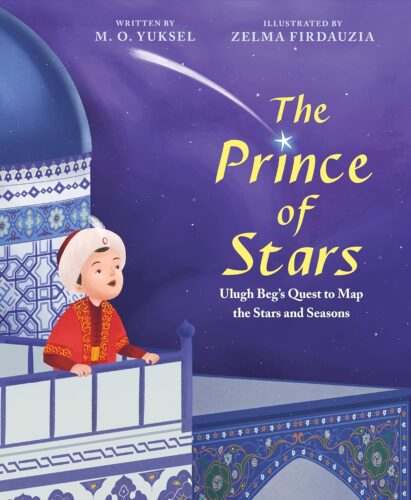
And lest you say to yourself, “Betsy, that sounds pretty easy. I’m sure lots of books fall into those categories,” nope. Not really. Fortunately, once in a while I come across a book that restores my faith in life, the universe, and everything else. Now usually I don’t do interviews with folks who did books in the previous year, but, if you’ll recall, I included The Prince of Stars by M.O. Yuksel, illustrated by Zelma Firdauzia, on my 31 Days, 31 Lists for both Science and Nature as well as Unique Biographies. That means it’s a known entity and that also means that I’ve a description of the book here for you today:
From M. O. Yuksel, author of In My Mosque, One Wish, and Ramadan Kareem,comes the first picture book biography of Ulugh Beg, an extraordinary Muslim man who charted the stars and discovered why seasons change and the length of a year, illustrated by Zelma Firdauzia.
Ulugh Beg’s curiosity burned as bright as the stars. He yearned to count every star in the sky, every day in a year, and to know why the seasons change. Fueled by his deep faith, Ulugh Beg’s quest for knowledge led to the creation of new schools, the world’s largest observatory and star catalog, and innovative tools to better chart the secrets of the skies. Although some doubted him, he never stopped searching for answers. And because of his determination, our understanding of the world has changed—forever.
With lyrical text by award-winning author M. O. Yuksel and captivating illustrations by Zelma Firdauzia, this portrait of a trailblazing Muslim astronomer reminds us just how far curiosity can take us.
Today, we’re talking with author M.O. Yuksel about her illustrious 2025 title The Prince of Stars:
Betsy Bird: Mindy! Thank you so much for answering my questions today! I just found THE PRINCE OF STARS to be some of what I love best in my picture book nonfiction. Here you have a story that whole swaths of the world probably know well, but that in the American picture book informational text market comes across as a whole new story. How were you, personally, introduced to the life of Ulugh Beg and what about his life seemed right for a book for kids?
ADVERTISEMENT
ADVERTISEMENT

Mindy Yuksel: Hi Betsy! Thank you so much for having me on your blog. I’m a big fan of Fuse 8!
You’re correct, many people have never heard of Ulugh Beg. We all grew up learning about famous scientists like Copernicus, Galileo, and Einstein in school, but unfortunately, not about scientists from other parts of the world. History is filled with so many amazing scholars from across the world, why aren’t they included in our curriculum too?
I first learned about Ulugh Beg when I traveled to Samarkand, Uzbekistan. I was blown away by this brilliant scientist who accomplished so much in the field of astronomy and contributed to our understanding of the universe. For example, what I found astounding is that, prior to telescopes or other modern technology, Ulugh Beg built one of the largest and most advanced observatories, mapped over a thousand stars, calculated the Earth’s axial tilt with stunning accuracy, and wrote one of the most accurate star charts. His star chart, Zij-i-Sultani, or Sultan’s Astronomical Tables, have been used for centuries across the world and continue to be a source of reference for scientists today.
This was a perfect STEM-focused story for kids, and I knew I had to write it!
BB: For me, the coolest part of the book was the Observatory. I can see why visiting it would have been inspirational to you. What can you tell us about the space today and how preserved it is today?
Mindy: Unfortunately, the observatory was destroyed after Ulugh Beg’s death. But its foundation still remains, along with a section of an enormous meridian arc, called the Fakhri sextant. This instrument that Ulugh Beg built was so big that its radius was equivalent to a 12-story building. The portion of the sextant that was built underground can still be seen today at the Ulugh Beg Observatory in Samarkand, Uzbekistan.
There’s also a museum nearby that contains the most amazing exhibits that trace the history of the observatory, Ulugh Beg’s work, the development of the sextant, and the early foundations of modern navigation.
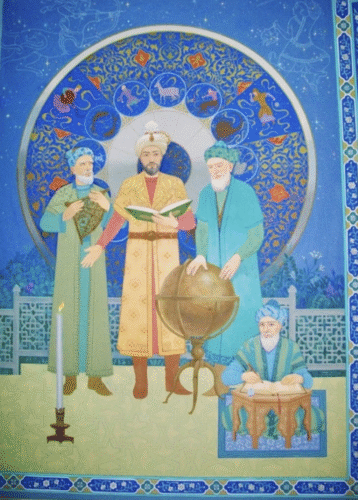
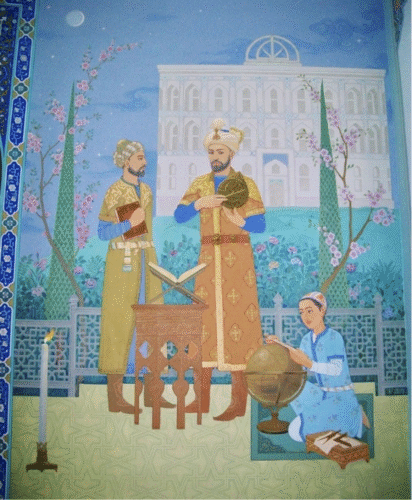
One of the most serendipitous moments for me while working on this book was meeting the painter Khurshid Nazirov, who created the murals inside the observatory museum. Mr. Nazirov generously shared his knowledge with me, provided resources, and volunteered to review the book’s illustrations to make sure it authentically reflected the subject matter and period.
Here are some of his murals of Ulugh Beg from the museum. Can you spot the similarities in the book?
BB: A bit! Speaking of which, there’s an art to adapting a life to a picture book format. Sometimes you have to avoid certain topics or make the ones you have interesting to your child readership. How easily did Beg’s life acclimate itself to the nonfiction bio limitations? Were there things you had to cut out that you wish you could have kept?
Mindy: This is so true! I wish I could have included so much more about Ulugh Beg and the Timurid Empire. For example, I wanted to share that Ulugh Beg spoke several languages like Chagatai Turkic (his mother tongue), Arabic, Chinese, Persian, and Mongolian. I also wish I included the fact that he was of Turkic-Mongol descent, with ancestors that included notorious figures like Chingiz Khan and Amir Timur (Tamerlane). Even his name has a story! Ulugh Beg, which means “great prince” in Chagatai Turkic, wasn’t his real name but a nickname given to him by his grandfather, Amir Timur.
But it would have been too much information in a story focused on his scientific achievements. Instead, I moved most of this information to the backmatter. Except one detail I regret leaving out there is his Turkic-Mongol heritage. Because Ulugh Beg was born in Sultaniyya, in present-day Iran, many readers may assume he is Persian. However, the Timurid Empire was so vast that it encompassed modern day countries like Iran and stretched all the way from Türkiye to China, and from Russia to India.
I also had to cut out some of the bibliography due to space limitations, and I wish I could have included more images. One example is a portrait of Ulugh Beg shown alongside scholars like Ptolemy and Tycho Brahe in Johannes Hevelius star catalog, Prodromus Astronomiae (see picture below).

As you can tell, there’s so much information I wanted to include but not enough room to fit it all in a picture book!
BB: That’s not enough for me, though. Tell me more about your research! For example, you have a map of the Timurid Empire from 1370-1507 that can’t have been that easy to locate. What sources did you turn to when writing this book?
Mindy: During my research, I reached out to scholars in Uzbekistan, Türkiye, and here in the US to find resources. I had to dig through lots and lots of dense, technical, and scholarly textbooks about physics, math, and astronomy to research Ulugh Beg and his scientific endeavors. Many were written in foreign languages like Russian, Turkish, and Uzbek, with a few in English. Luckily, I speak both Turkish and Uzbek, so I was able to understand these resources. Others, I had to translate.
Regarding the map, I was able to find resources in several books and online resources including Historical Atlas of Central Asia by Yuri Bregel, and World History Encyclopedia.
In the process, I learned a lot of scientific facts about the obliquity of the Earth, the tropical year, orbital mechanics, and astronomical tools, and tons of history about the Timurid Empire.
As I dug deeper and learned more about the history of the Islamic Golden Ages, I realized how Euro-centric our education system is and how many gaps exist when it comes to learning about scholars from other parts of the world. So, picture books about diverse scholars are even more important to incorporate into our curriculum.
BB: The art of Zelma Firdauzia really brings the whole book to life. Were you aware of Zelma’s work prior to being paired with this book? And how do you feel about the final product?
ADVERTISEMENT
ADVERTISEMENT
Mindy: I wasn’t familiar with Zelma’s work before we collaborated on this book, but her illustrations in The Prince of Stars are absolutely stunning! I love all the details. The book would not be nearly as effective without the artwork that brings the story to life so beautifully. Because this is a nonfiction book, I know there was a lot of fact checking involved to ensure the illustrations were accurate and authentic to the subject and time period.
BB: Makes sense. Finally, what else are you working on these days? What’s next for you?
Mindy: I’m currently working on several new picture book manuscripts, and while they haven’t been announced yet, I’m also a part of a few middle grade anthologies and I’m really excited about them.
Beyond writing, I love giving back to the community. I’m a mentor for the Highlights Foundation Muslim Storytellers Program, and the Picture Book Rising Stars program. I’m also on the board of the Muslim Literary Festival, the 12×12 Picture Book Challenge DEI Committee, and I’m a member of Story Sunbirds and KidLitSoul, an inclusive group of children’s book creators working together to honor and advocate for all children.
Thank you so much for having me on your blog, Betsy!


Big big thanks to Mindy for taking the time to answer my questions here today. Thanks too to Anna Ravenelle and the team at Harper Collins Children’s Books for helping to put this talk together. The Prince of Stars is on shelves now, so if you’d like to give it a whirl and learn more about Ulugh Beg, this is a great place to begin.
Filed under: Interviews
About Betsy Bird
Betsy Bird is currently the Collection Development Manager of the Evanston Public Library system and a former Materials Specialist for New York Public Library. She has served on Newbery, written for Kirkus, and has done other lovely little things that she'd love to tell you about but that she's sure you'd find more interesting to hear of in person. Her opinions are her own and do not reflect those of EPL, SLJ, or any of the other acronyms you might be able to name. Follow her on BlueSky at: @fuse8.bsky.social
ADVERTISEMENT
ADVERTISEMENT
SLJ Blog Network
The Mind of The Henk
Earth to Chris Cleevy | This Week’s Comics
From Policy Ask to Public Voice: Five Layers of Writing to Advance School Library Policy
Fast Five Interview: Caleb Roehrig
Rex Ogle on His New Book Absent
ADVERTISEMENT
What a vast world we live in and know so little about! Thank you for uncovering this fascinating person.