• Skip to primary navigation
  • Skip to main content
  • Skip to primary sidebar
  • About/Contact
  • Fusenews
  • Reviews
  • Librarian Previews
  • Best Books
    • Top 100
    • Best Books of 2022
    • Best Books of 2021
    • Best Books of 2020
    • Best Books of 2019
    • Best Books of 2018
    • Best Books of 2017
    • Best Books of 2016
    • Best Books of 2015
    • Best Books of 2014
    • Best Books of 2013
  • Fuse 8 n’ Kate
  • Videos
  • Press Release Fun

Tentacles and a Mullet: A Saki Tanaka Interview About the Ethereal BETWEEN WORDS

Tentacles and a Mullet: A Saki Tanaka Interview About the Ethereal BETWEEN WORDS

July 3, 2024 by Betsy Bird

This past weekend I had the pleasure of attending an American Librarian Association Annual Conference in none other than San Diego, California. It was my first trip to the region and I came away a big time fan. Who could resist it? The temperature. The sea. The fact that I got to watch crows and mockingbirds fighting in the streets like it happens every day. It was great!

Now at one point in the course of my travels I was explaining to an agent why it is that my librarians, when considering which of the hundreds and hundreds of children’s books to read for our best books committee, pay the most attention to Kirkus Reviews. I explained that Kirkus reviews come out the earliest, they focus on small publishers and books from overseas better than anyone else, and they give honest reviews. Like this one, for example: “Through powerful visual storytelling, this exquisite tale makes clear that words aren’t necessary to develop a truly lasting bond… A pitch-perfect tale for shy friend-makers everywhere.” That little starred review is linked to none other than the brand new picture book by Saki Tanaka, Between Words: A Friendship Tale. You might also describe it this way:

“Kai is used to following the seasons with Pa from place to new place where people speak languages unfamiliar to his ears. When they finally settle in a valley full of pools, Kai tries to invite the other children to join in his play, but the strangeness of his words drives them away. Frustrated, he kicks his most treasured stone into one of the pools and in his search for it, finds something even more valuable.

Dive into a whimsical tale of unexpected friendship, told with compassion and warmth.”

Today, now fully recovered from the conference experience, I am pleased to take some time to talk to Saki Tanaka about this book and its curious origins:


Betsy Bird: Saki! Thank you so much for talking with us today about BETWEEN WORDS! I know that you grew up moving around a lot as a kid, but can you tell us a little bit about that aspect of your own personal history, and how it inspired this picture book?

Saki Tanaka: Betsy! Thank YOU for this Q&A. I couldn’t be more excited to dive in!!

I grew up moving from country to country, raised by a Mexican mother and Japanese father. Being multiethnic and a perennial “foreigner” often made me feel out of place. In Japan, I looked the part but couldn’t speak the language, in Mexico I stuck out like a sore thumb even though I spoke Spanish fluently, then when my family moved to France I grappled with looking and sounding different! 

The memory at the heart of BETWEEN WORDS is of my first day at a school in France. I was feeling lost, standing alone on the playground surrounded by unfamiliar words, when I noticed a girl looking at me. She smiled, giving me the courage to wave at her—and she waved back! This wordless exchange opened the doors for me to find belonging, and is recreated beat by beat in the pages where Kai meets his first friend. The relief I felt urged me to share this courage with anyone who’s ever felt like an outsider or struggled to forge friendships. I also wanted to celebrate acts of kindness that help us embrace our differences and connect without a common language.

BB: So if you had to estimate, how much of BETWEEN WORDS is truly a depiction of your own personal story?

Saki: It’s 100% a depiction of little Saki’s struggles and triumphs as a third culture kid. It didn’t start out this way though, and took nearly a decade from idea to publication! The initial spark that got me writing was a radio story about the world’s deepest freshwater cave. It made me wonder what magical realms and creatures this pool concealed.

Around that time I also became intrigued by a friend’s insatiable need for travel, and started writing a story about a boy who was always looking toward new horizons. I tinkered with this manuscript for years, but it never quite clicked. It finally started to work when I realized that this was the opposite of my lived experience, and flipped the script to make it about a boy who yearns for belonging. 

At this point, I did wonder if I should make the protagonist a girl. The answer came to me when I heard a radio story about how male identifying humans (starting at a heartbreakingly young age) struggle to connect with each other and make friends. Hearing this convinced me to keep Kai a boy. Yay for radio!

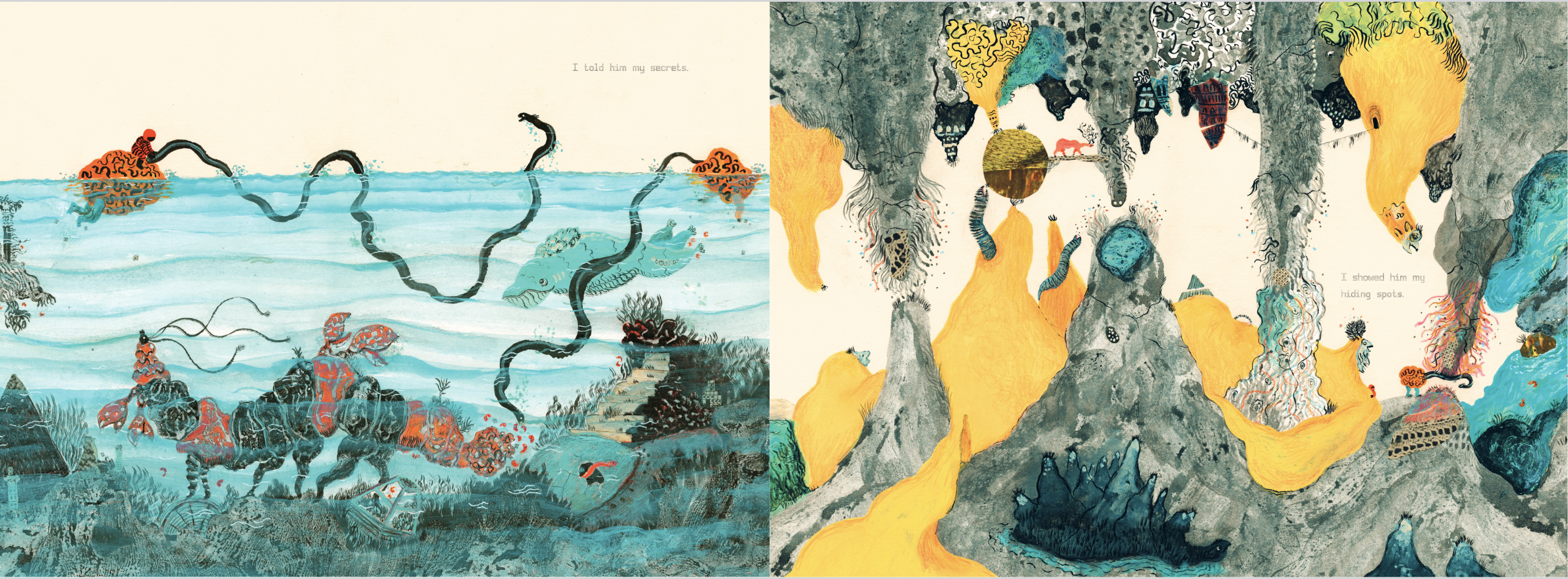
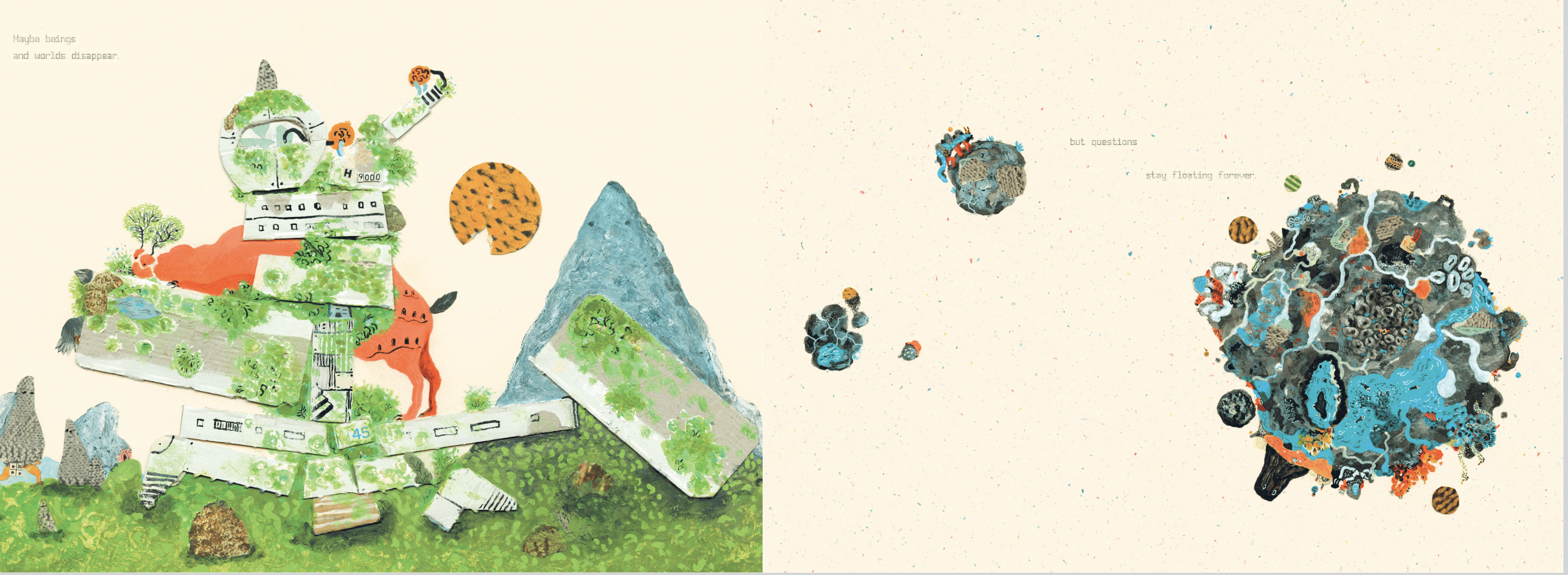
BB: Yay indeed! Talk to us a little bit about the art in this book. Part of what I like about it so much is how it’s set in landscapes that will be unfamiliar to a lot of child readers themselves. It reminds me, in a way, of a younger version of Shaun Tan’s THE ARRIVAL. Where did you draw your inspiration for these locations?

Saki: THANK YOU. I spent an excessive amount of time developing these settings, so it’s incredibly gratifying that you noticed them (and were reminded of Shaun Tan’s inimitable work)! Every time my family moved to a new country, the unfamiliar sights and sounds evoked a mix of curiosity and anxiety for me. In an effort to simulate these feelings, I made the landscapes unrecognizable for readers by dreaming up various civilizations of an imagined anthropocene. Worldbuilding has been an obsession since childhood, so I had a field day with this. 

The thematic inspiration for these locations began with the line “For as long as he could remember, Kai had followed the seasons with Pa.” I was mulling over how I might show this passage of time when I rediscovered the Islamic proverb “many different flowers make a bouquet,” scribbled in my old journal. This gave me the idea to base the villages on flowers that represented autumn (kikyo/Japanese balloon flowers), winter (snowdrops), spring (cherry blossoms), and summer (hibiscus). 

In addition to the colors, textures and forms found in these flora and their native ecologies, I sourced inspiration from my Mexican and Japanese heritage. I loved finding unexpected similarities in the thatched houses that exist in both Yucatán and Ryukyuan building practices, as well as a shared craft of traditionally woven textiles and baskets. I fused these as sartorial and architectural details in the various cultures Kai encounters. When I showed my process book documenting these studies to the Scholastic team, I received the most beautiful sentiment from my creative director, Patti Ann Harris, who wondered if I might be nurturing future anthropologists!

BB: There’s also a lot of, what I can only describe as, magical realism to the images. From the tent that Kai and his Pa live in to the luminous, almost iridescent pools near their eventual home (they look like something out of Yellowstone National Park) to the sea creature he befriends. In the various drafts that you made of this book, was it always the plan to have this mixing and melding of fantasy and reality?

Saki: Blurring the lines between fantasy and reality was a part of BETWEEN WORDS from the get. And good eye! The pools are, indeed, partly inspired by the geothermal springs of Yellowstone National Park. I have a tendency to meld real-world inspiration with my imagination—a product of desperately wanting “magic” to be real. I was one of those kids who was always looking for portals into fantastical realms, spending hours writing and drawing them into existence. In a lot of ways, building worlds I could escape into was how I found belonging. Some could interpret that Kai is doing the same, imagining the encounter and world he finds inside the pool. I like to think his magical experience was real, though I’ll leave that up to the reader to decide.

BB: Reviewers have called the friend Kai makes in the sea a “mermaid”, but to my mind it’s almost more interesting than that. The tail, for example, looks more octopus or squid inspired than fishy. How did you come up with the look of this friend for the book?

Saki: I love that you saw this. Keen-eyed kiddos have also pointed this out, asking if this being is a “seahorse or octopus person.” This delights me because I studied footage of these animals’ movements for reference. I wanted Kai’s friend to feel ethereal and otherworldly—perhaps subliminally conjuring an image of someone who’s “out of place” in the best way possible. She went through various permutations and ultimately landed on a form inspired by the aforementioned animals and sea anemones, a species classified as both animal and plant. 

BB: Oh, I love that. Both animal and plant. Beautiful. You know, it took a second or third read before I realized that the moment Kai drops into the sea and meets his new friend, the words of the text disappear entirely. It essentially becomes a wordless book for a little while. It’s a clever way to bypass the language barrier too. Did you always plan to cut the language out of this part of the book? Why, to your mind, do you think it works?

Saki: How better to impart the wonders of wordless communication than with wordless pages in an otherwise worded book (say that ten times fast)? The medium becomes the message! I love how the underwater illustrations carry the plot alone for a while, nonverbally sharing the universal languages of connection I used as a kid to make friends: playing, laughing, and building together without any words. 

I’d initially gone back and forth between adding text to these underwater scenes or keeping it textless as a purely stylistic choice. It was one of my editors, the amazing Kait Feldmann, who pointed out that it made more sense to go wordless so that readers could experience these scenes the same way Kai and his friend were (without the ability or need to use words). It was a brain explosion moment that I’ll forever be grateful for, because it seems to be resonating with readers who love how the book uses both worded and wordless pages to viscerally bring this point home.

BB: BETWEEN WORDS already has a Kirkus star, and maybe more accolades on top of that. Where do you go from here now? What’s next for you?

Saki: DAW SHUCKS. Thanks for this kind comment, Betsy. And thank you for your thoughtful questions that made my soul feel deeply seen! I just finished final art for my second picture book, NIMBUS PLAYS ALONE, about an introverted rain cloud who navigates letting others in while remaining true to themselves. Now that that’s wrapped, I’ve turned my attention to my next picture books which have happily found an amazing new home; one is about my grandmother who nurtured my love of reading (with a whimsical twist of its own, of course), and another that we’re discussing that might be based on a Japanese mythical creature that I’ve been working on since before BETWEEN WORDS. Whenever I can, I also tinker with my middle grade sci fi/fantasy graphic novel that explores the nature of time and relativity. Here’s hoping I have enough lifetimes to bring these into the world!

BB: Introverted rain clouds are my favorite kinds of rain clouds. Thanks so much for the peek into the future!


I’d like to offer big thanks to Saki for taking the time to answer my questions today. I am happy to report that Between Words: A Friendship Tale is in bookstores and libraries right now, as we speak. Run on out and grab yourself a copy if you have a yen.

Filed Under: Interviews Tagged With: author interviews, illustrator interviews, picture book author interviews, Saki Tanaka

Fuse 8 n’ Kate: Apple Pie Fourth of July by Janet S. Wong, ill. Margaret Chodos-Irvine

July 2, 2024 by Betsy Bird

Ha ha! I am pleased to announce that with its 2002 publication date we are finally able to celebrate the upcoming Independence Day with a book that I’ve been sitting on for years. It can be exceedingly hard to find books for this particular holiday. Even better, our consideration of this book marks the very first time we have ever done a Janet Wong or Margaret Chodos-Irvine. Ms. Wong hasn’t published since 2015 and Margaret Chodos-Irvine hasn’t since 2006, but in their heyday this book marked a dream pairing. It’s not our first picture book to mention pie recently (remember Enemy Pie?) which means Kate’s weary, wary, and woozy. Will this book win her over? Let’s see!

Listen to the whole show here on Soundcloud or download it through iTunes, Stitcher, Spotify, Google Play, PlayerFM, Audible, Amazon Music, or your preferred method of podcast selection.

Show Notes:

Here’s that Janet S. Wong website I gush over for such an extraordinarily long amount of time.

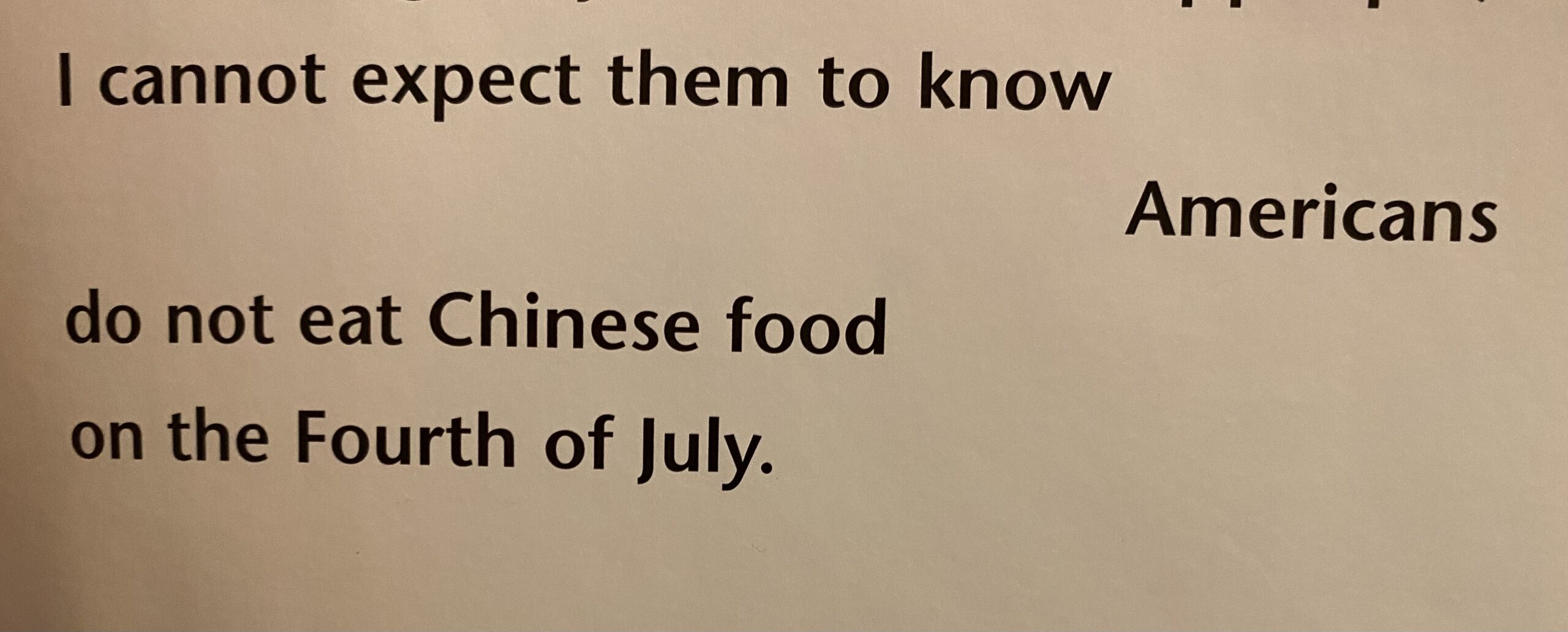
Kate points out correctly that I usually hate it when lines are broken up between pages, but I feel like in case Wong is doing it for a dramatic page turning effect. My problem with it is usually just that it’s unintentional or done without thought. This book? Not an issue.

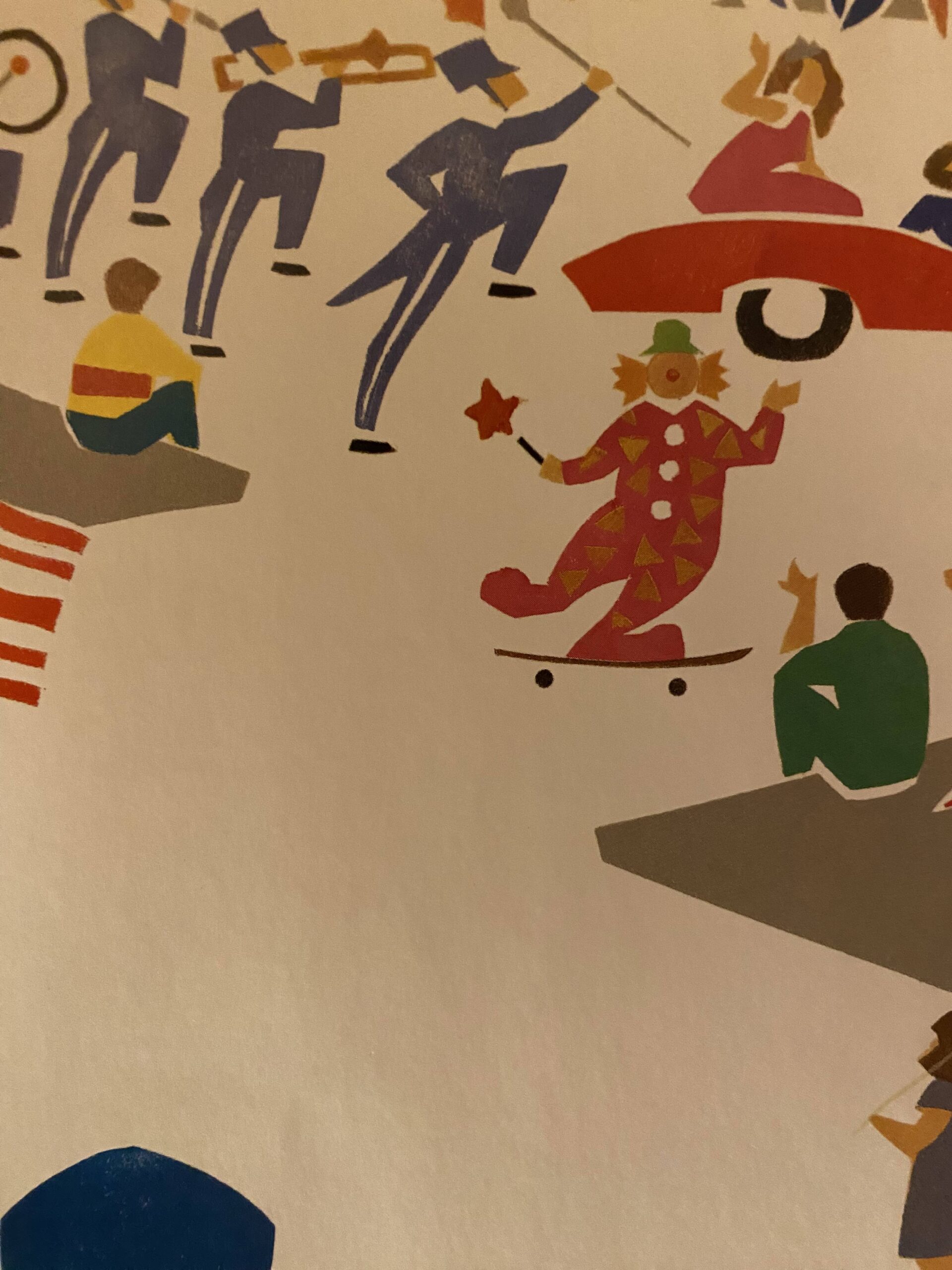
Clown alert!!! And it doesn’t have a face. It just has a nose. “The Clown Without a Face” would, you must admit, be a great creepy picture book title.

Without knowing Ms. Wong’s history as a poet, Kate picked right up on the fact that she is poetical. This is Kate’s favorite passage. I love the different ways you can read this.

The book is made entirely in cut paper, so how cool is it that you can see the reflection of the fireworks in the kid’s eyes?

Janet S. Wong explains why she wrote this book on TeachingBooks.net. You can see her explanation here.

For the record, this was not the first Wong/Chodos-Irvine collaboration. That honor falls upon Buzz.

Kate Recommends: The Seven Husbands of Evelyn Hugo by Taylor Jenkins Reid

Filed Under: Fuse 8 n' Kate Tagged With: Apple Pie 4th of July, Fuse 8 n' Kate, Janet S. Wong, Margaret Chodos-Irvine

The Perfect Conduit for Stories: Amy Hest & Erin Stead Discuss Big Bear and Little Bear Go Fishing

June 27, 2024 by Betsy Bird

Like any good children’s librarian I bristle when I hear layman say casually that stale line that they-don’t-make-picture-books-like-they-used-to. Oh really? I assume you mean that books today can use more than two or three colors in the printing process. Or perhaps you’re referring to the fact that our books today are doing such a great job of highlighting a wider range of voices and perspectives. Is that what you mean?

It’s not, of course. They’re talking about some ineffable, magical time that may or may not have ever existed. In other words, they want to read a picture book and get that feeling they got when they read picture books as children. But you aren’t the same person today that you were as a child. As such, it can be hard to reconstitute such feelings.

Far better, to my mind, is the adult who wants to find new picture books that will instill that same love of literature in small children that they experienced once upon a time. Adults often cling a little too tightly to the “classics” and don’t spend enough time exploring what’s newly released and amazing out there. This is all just a long-winded way of me saying that today’s book, Big Bear and Little Bear Go Fishing is precisely what parents have been looking for all these years. They just didn’t know it was coming yet.

Already a Junior Library Guild Gold Standard selection, here’s a plot description from the publisher:

One day Big Bear says to Little Bear,
I’m just in the mood for fishing.
Me, too, says Little Bear. Just in the mood.

With this decided, Big Bear and Little Bear are off… almost. First they need the right attire, poles in a red wagon, a basket of freshly-baked scones, and a good book to read. It’s unclear how much real fishing will get done today, but one thing’s for sure: there will be a cozy nap in the hammock at the end. 

Adults who grew up with classic stories about friendship and caring will feel an immediate resonance in the low-stakes adventures of these two adorable bears. Amy Hest’s wry text sets a pitch-perfect mood, and Caldecott Medalist Erin Stead brings fine art to each bucolic illustration. Big Bear and Little Bear Go Fishing is a treat for all ages and is sure to find a treasured place on shelves for years to come.
It’s too good a book not to talk about. To be perfectly frank, I’d be a fool not to discuss it with the creators. It is, therefore, my sincere delight to speak today with Amy Hest and Erin E. Stead.


Betsy Bird: Amy, thank you so much for allowing me to pepper you with questions today. As I may have mentioned, BIG BEAR AND LITTLE BEAR is well and truly one of my favorites of the year, bar none. Did you have other bear-ish picture book classics on your mind as you wrote this? If so, did you find that helpful or a problem as you wrote the text?

Amy Hest

Amy Hest: Usually when I write a story, the only thing on my mind will be that story, those characters, and my next sentence.  Trust me, that’s plenty!  I have to block out everything else (including other bear-ish picture books, in this case) and somehow see what’s happening, hear the conversations, figure out the story.  I am quite possessive!  I kind of have to own the whole thing, make every small moment in the text, every sentence, every comma, my own.

BB: That makes sense. And Erin, thank you too for answering some of my questions! You’ve done many a lovely book with editor Neal Porter in the past, but this is the first time he’s paired you with Amy Hest, that I can tell. How did you come to hear about BIG BEAR AND LITTLE BEAR? And what appealed to you about it?

Erin E. Stead: Thanks for asking! I’m always happy to talk about children’s books, although I usually like talking about other people’s books more than my own. As an artist who doesn’t write, I am constantly looking for good manuscripts to illustrate. I am married to a very good writer, but sometimes his dance card is a little full. Neal sent me Amy’s manuscript and I was really charmed by it. Amy has a way of writing that is direct, simple, and sensitive without being cloying or bossy. She wrote a real story—describing a small moment in time that could be pushed in the back of a grownup’s mind. But these small, quiet days are often the type of days that shape the front of a child’s mind.

BB: Well, that leads nicely into my next question, actually. Amy, when you write a manuscript, do you allow yourself to imagine what the accompanying art may entail or do you keep that entirely separate, focusing only on the text itself?

Amy: The only way I get involved in the art is to write specifically.  Yellow coats for fishing, for example, or blueberry scones (not cranberry).  And in most cases, I don’t even know – when I’m deep into writing the story – who the illustrator is going to be.  I’m a pretty bossy person in general, but when it comes to the art for my stories, I butt out.  And look what happens!  (Thank you, Erin!) 

BB: Thank you, Erin, indeed! Speaking of which, Erin, so many children’s picture books feature bears in some way. I’ve enjoyed your own bears in books like BEAR HAS A STORY TO TELL and in AND THEN IT’S SPRING, but the bears in Amy’s book are a little different. They’re remarkably well dressed, for one thing. What, for an artist, is the appeal of illustrating a bear? Are you fond of drawing them yourself at all?

Erin E. Stead,
photo by Nicole Haley Photography

Erin: Bears really are fun to draw. I could pretend to get intellectual about it here, but honestly, they’re just fun. They are easy to move around and anthropomorphize without making it seem unnatural or scary. I think when we can take a bear and put it in an imaginary setting, it’s as though we’re able to make them giant magical dogs. There’s something about their faces, fur, and maybe even their fierceness that makes them the perfect conduit for some stories (or perfect stuffed animal for bedtime). 

BB: Aww. and Amy, this is, from what I can tell, your first book with Erin Stead. Was she someone you had in mind to work with someday or was she paired to your manuscript unexpectedly? And what do you feel Erin’s art brings to this particular story? 

Amy: I love Erin’s work.  Have always loved her work.  And never even dreamed she would one day be illustrating a book of mine.  Lucky me, right?  What she brought to the book is – well – everything.  This book is about a very special relationship.  It may look to be about fishing (and some other things), but it’s really a love story, of course, and on every page, their love for each other comes shining through. (Again, thank you Erin.) Their body language, the way they look at each other, and the stunning setting … I am dazzled and grateful and happy … every time I look at these pictures.  Which is often!

BB: It’s fast becoming my favorite activity too. Erin, my favorite moment in this book is a visual one that just stops me cold every time I see it. You’ve a sequence where Little Bear is afraid to jump into the boat and Big Bear assures him that he’ll catch him. There are just two images on the page. In the first you’ve Little Bear on the dock, and in the next he’s safe in the embrace of Big Bear in the boat. These images could have been on separate pages or you could have shown the moment of the jump itself, but something about this particular coupling hits much harder emotionally. When you illustrate a moment in a book like that, do you see it in your mind’s eye the minute you read the manuscript or is it something you workshop, try out, and hone over time?

Erin: Well, thanks. That’s a nice thing to say. 

I’m going to preface this response by admitting it might be a little long winded. Let’s see how this goes. 

For the reader of this interview, let me start by saying that even though this book is titled “Big Bear and Little Bear Go Fishing,” the time spent fishing is only about half. The first half of the book is about the attempt to go fishing. We spend a lot of time with these two bears getting ready, then forgetting something, the prepping, then doubling back. Truthfully, the book has very little to do about fishing and is more about the time we spend together. 

The manuscript is simple and rhythmic in a way I am not coming across very much lately in books, but, in my opinion, makes for such a nice read aloud to a smaller audience. Within that simple structure, moments of (seemingly small) emotional tension are snuck in. One of them is this moment Betsy (may I call you Betsy?) Is referring to, where Little Bear has to get into the boat from the dock. Little Bear is uncertain here, and I draw him paused at the dock thinking about the leap. Underneath that drawing, there is another panel where the jump is over. He’s landed in the boat and is safely celebrated in Big Bear’s arms. 

I’ve recently become a mother. It was actually almost 7 years ago, but time has moved so quickly without my consent that it still seems recent. As a children’s book maker, a lot of the difficulty of the job comes from adults who don’t remember what it’s like to be a kid. Adults with good intentions but who tend to paint all children with a broad brush. Kids are all the same, and if you do this and this and this then eventually they’ll get out of this terrible childhood phase and become grownups who love…I don’t know…what’s something adults like? Finance? So, before my daughter was born, there was a small worry, amongst all the real concerns, that something in my children’s literature brain would switch off. Suddenly I’d be on the adult’s side of things.

It didn’t. I’m still on the kids’ side.

So, I considered this moment where Little Bear is standing on the dock, hesitating, thinking about the wobbliness of the boat on the water, and trying to calculate the jump into the boat. I think as grownups we see the actual leap as the big thing here. That’s where the accomplishment is. You jumped! Those are the things we adults tend to celebrate for kids, too. I’ve noticed it in my own parenting. But I think it is sometimes a miscalculation. I thought about how I’d feel, standing at the dock, wondering if the boat would drift away just as I let my feet leave the wooden boards. To me, the emotional resonance is there. We have all stood wondering if we should do the next thing. And we have all wanted assurance once we’ve landed. 

The pleasure in illustrating this book was taking these quiet moments and establishing a (hopefully warm) relationship between these two characters. It’s not the adult-version big moments that are celebrated in this book. The idea here is the quiet, simple day is all a big moment when you are little.

BB: I’m a bit disinclined to say anything at all after that. I’ll probably be turning over the idea of remaining “on the kids’ side” in my own head for a while, honestly. That’s just so succinctly put. It makes my next question to Amy sound a bit, ah, trivial. Even so, I just wanna know. Amy, I need to include at least one hard hitting question in this Q&A so watch out, here it is: Do you fish yourself? If so, do you enjoy it? And if you don’t, have you ever felt a yearning to do so?

Amy: The closest I come to fishing is my early morning swim.  The pool is about a mile from my apartment, and I usually leave home before the sun comes up.  (I guess that part is a little like being a legitimate fisherman.) I swim a bunch of laps.  Honestly, I don’t care for lake swimming (quite concerned about what kind of squirmy thing might be swimming with me) and I don’t care for ocean swimming (again, who might be in there with me?).  A nice, clear pool, where I can see the bottom, that’s as close as I get to fishing.

BB: Erin, just to get back to the book a bit, please tell us a little bit about the role that Neal, your editor, plays when you illustrate a book of this sort. What kind of input does he provide? Was he mostly hands off with BIG BEAR AND LITTLE BEAR or did he have any suggestions along the way? 

Erin: I’d be really curious to see how Neal would answer this question. 

I wouldn’t be an illustrator without Neal Porter, plain and simple. We have worked together for fifteen years, and he has tolerated me almost the entire time. 

Neal and Amy went through a few rounds of edits with the manuscript, but what is different (and probably sometimes infuriating) about me is that I sit in on the edits most of the time. Neal is a wonderful line editor—careful to let the writer fix a line in their own way and respectful of the rhythm of the text. I love editing manuscripts and am very appreciative that he lets me throw in my two cents, especially if I think a moment can be described with a picture at a certain point in the story instead of writing too many words on top of a moment.

It’s hard to answer about Neal’s input briefly because his biggest editorial gift is somewhat abstract. Neal tends to trust the people he hires. He gives us all a lot of rope. But he does reel us back in when we go too far in any direction. My main goal for this book was to play with the simplicity and sincerity of this story in both the illustrations and design. I don’t remember him having to tug that rope too hard at any junction for Big Bear and Little Bear Go Fishing.

Perhaps he remembers otherwise.

BB: Well, this has been lovely, but I should be winding it down a bit. What do you both have coming out next? Amy, in 2024 alone you’ve the picture books WHEN ROSIE WALKS GEORGE and BUNNY SHOULD BE SLEEPING. Can you talk at all about these titles?

Amy: BUNNY SHOULD BE SLEEPING and WHEN ROSIE WALKS GEORGE just happened to be published, along with BIG BEAR AND LITTLE BEAR GO FISHING, this year.  What are the odds of that happening!  I love that all three books have such a different tone.  Even though all three are picture books.  Even though all three are about loving relationships and trust.  All three are cozy and comforting, with young characters who are beloved … and beyond.  And let’s not forget, these three new picture books are indeed gloriously illustrated by the best of the best.

BB: No argument there. Erin, what else will you have coming out soon? What else is on your plate (that you can talk about)?

Erin: I am working on finishing a third Amos McGee book and I am having such a good time doing it. It’s called A Snow Day for Amos McGee and it will be out next fall.


All I can say is that this is the kind of interview that I wish I could take some kind of credit for. It’s fairly obvious, though, that it’s the subjects who have brought their all. As such, I would like to sincerely thank Erin and Amy for the sheer swaths of time and thought and attention they brought to this discussion today. Thank you too to Sara DiSalvo and the team at Holiday House for helping to put all this together. Big Bear and Little Bear Go Fishing is out now. I’m afraid I must insist that you go out and read it for yourself. It’s not overstating it to say that this is a book that will stay with you for a long, long time.

Filed Under: Best Books, Best Books of 2024, Interviews

From Grumpiness to Love: An Emma Full of Wonders Interview with Elisha Cooper

June 26, 2024 by Betsy Bird

“… the epitome of a summertime tale with its warm, scenic views and bounding dogs.”

You know, you’ve gotta hand it to the publicity team at Macmillan. Here we are on the cusp of summer, a moment when it still retains a hint of the romance we felt for it back in March, and here they are knowing just how to talk up a picture book that, as they say, epitomizes lush green hills, blue skies, and sunny days.

Recently I was in New York City with my family for a three day trip. Naturally, I couldn’t help but drag my poor offspring to Greenwich Village where my first library branch, the Jefferson Market, towers. Inside, we made our way to the children’s room where large murals painted by Elisha Cooper oversee everything that happens inside. There is something about the style of Mr. Cooper that fits a library so well. In my own location now, the Evanston Public Library in Illinois, we have wooden signs everywhere by Mr. Cooper, highlighting our picture book, nonfiction, DVD and other sections. In a library setting, the man simply fits.

Now he has a new book out as well. Some of you may know Elisha best from his Caldecott Honor winning Big Cat, Little Cat, but he’s done amazing things beyond that book. Now he’s releasing the truly delightful Emma Full of Wonders, full of dogcentric fare. It’s the kind of quiet, smart little book that defies description. So, naturally, I had to ask Elisha about it myself.


Betsy Bird: Elisha! So good to talk to you again! And I’m entranced by your latest. EMMA FULL OF WONDERS is such an interesting complement to your previous dog and cat-related fare. I never knew you to be a dog man, but this book belies that assumption. Can you tell us a bit about where it originated?

Elisha Cooper

Elisha Cooper: Hello to Chicago! I’m writing to you on a porch, looking out over Long Island Sound, the same porch where I painted some signs for the Evanston Public Library. This feels right, connecting with you again in this way, and I’m so glad you were “entranced” by Emma. Now, to your question. The origin of this book was grumpiness. Children’s books sometimes make me grumpy, especially when they dance around facts, or brush over reality. That grumpiness motivated me to write about death in Big Cat, Little Cat, and with this new book I’m hoping to do the same with birth. Since stories have multiple origins, Emma also came about because of Elise. Watching her give birth to our daughters — she was so strong and powerful — I wanted to acknowledge and celebrate that. I wanted to celebrate all mothers. And then, write a story in such a way that would show children that birth is normal and natural. So, that’s the origin! From grumpiness to love.

BB: THAT, my friend, is an origin story for a book. You know, you’re one of the few author/artists I know of who vacillates between dogs and cats in his picture books. I know that this question is going to traipse dangerously close to who-do-you-love-more territory, so I’m going to rephrase it slightly. For you, how does writing a picture book featuring a dog differ from when you write a picture book that centers a cat?

Elisha: Can I go back to what you said about me being a dog man? Because, I am not! I’m a goat man. Oh my goodness, have you ever held a baby goat? It’s a life-changer. They’re cute and capricious (much respect to anyone who recognizes the Latin root of “capricious”). Bouncing all over, getting into trouble, stubbornly butting their heads against things (mmm, this sounds a little close to home). I think children’s book authors generally stick to cats and dogs because they’re a known quantity (I’m guilty of that myself), and play on type (cats are aloof, dogs are goofy, etc…). I have respect for authors who write about less familiar animals (like the spider in Jessica Lanan’s beautiful Jumper; or the owls our friend Matt Cordell is painting for his upcoming book). I also have respect for authors who write about cats and dogs, but do so in a more substantive way, where the character almost becomes a different animal altogether. I’m thinking of the pup in Doug Salati’s Hot Dog. Or of the kitten in Kevin Henkes’s Kitten’s First Full Moon. Because it’s a kitten, but really it’s a child. And, unavoidably, it’s the author. That’s who’s centered. I suppose this means that I am Emma, except for the giving birth to seven puppies part. Hmm, I traipsed dangerously close to not answering your question.

BB: I’ll overlook it, but only if this means that a goat-related Cooper title may be slated for the future someday. Emma appears to be a bloodhound, if I don’t miss my guess. And much of the book focuses on her dreams. To your mind, do dogs dream in the way that Emma dreams in this book?

Elisha: Bloodhound, you are right! I’m sure that choice was influenced by Best in Show, the hilarious mockumentary. Watching Christopher Guest’s character talk to his bloodhound just cracked me up. That dog, its presence. Then when I thought about mothers being strong and powerful, from birth onward, I wanted to play against stereotypes of motherhood, and a bloodhound just felt right. As for dreams — and I bet I’m misremembering this — but I think E.B. White wrote that when dogs dream they dream they’re chasing rabbits. I think it’s important not to anthropomorphize animals, even as we children’s book authors do that to some degree (the genius of Kitten’s First Full Moon is how Henkes pulls off a neat trick; you never doubt the character’s “catness,” yet she speaks to us emotionally as human). Before I wrote Emma, I talked with Alexandra Horowitz, a professor of dog cognition at Barnard, to get all the dog pregnancy details right. What does a pregnant dog understand? Can they conceive of the future? That said, I’ve always been drawn to dreamy characters in my books, ones who imagine the world without leaving their front porch. Like Ferdinand under his tree (my illustration of Emma under her tree is pretty clearly an homage). I like to imagine what animals imagine, possibly because we can’t know. There’s something lovely about not knowing.

BB: Just as there’s something lovely in knowing that Barnard has a “professor of dog cognition” on its staff. Reading this book, I admit that I thought the plot might go along the same route as your previous book HOMER. In fact, reading through it, I was fairly convinced that poor Emma was old and going to die. After all, we get a fair number of dead dog books in a given year. What happens instead caught me entirely off guard. Do you feel that you purposely lead your readers to expect one thing and then deliver another, or was this just me?

Elisha: Oh, damn. I’m so sorry. That’s on me. I think I messed up a little with the tone in the build-up, where maybe if I finessed a few words, or painted more clearly, I could have guided the reader better. I think I was trying to get across the ambivalence an expectant mother must feel, both her hope and worry. Those swings in emotion. It’s possible that I, and my amazing editors Emily Feinberg and Beth Clark, having read over the book proofs a thousand times, leaned more into the worry part because it added tension. You’re not the first person who mentioned that they thought Emma was a goner (I’ve found that if a few people have the same criticism, they’re usually on to something). Though, I did want the birth to be a surprise. Give readers an ohhh-so-that’s-what-was-happening reaction after the reveal. My sly hope is that this book gets better with re-reading. Where the clues I hid, her daydreams, her expanding belly, now make sense. Being a children’s book author is a humbling thing, something I take seriously (and I’m neither humble nor serious!); whenever a parent tells me they’ve read a book of mine fifty times with their child, I always say, “Sheesh, I’m sorry.” And I mentally remember that it’s almost a responsibility to add layers to my books, put in wordplay, hidden details, random Easter eggs that can make reading the book a pleasure on that fifty-first time. But look, books are living things. Messy, imperfect. Something I’m aware of, maybe even more aware of now after writing a bunch of them. Our authorial intent doesn’t always land where we thought.     

BB: That is true, but I should clarify that I preferred being wrong! It was like I thought the book was directing me in one way, and then it did the best possible U-turn instead. I see that as a bonus! My assumptions are probably just based on what I’m used to already seeing in books for kids. What does it say, I wonder, that a person who reads loads of picture books makes the assumption of death and not life when they read a book of this sort?

In any case, in many of your books, animals live on farms or in the country with wide open spaces. And if I’m not too much mistaken, you yourself grew up on a farm. Can you tell us a bit of that? And do you find yourself returning increasingly to this setting over the years for any particular reason?

Elisha with (you guessed it) a baby goat

Elisha: Yes, I grew up on an apple orchard in Connecticut. It was a childhood of climbing trees, taking care of goats, and reading books on a hill looking out over fields. I spent a lot of time observing the natural world. But where do I live now? In Manhattan! Sitting outside a café on Lafayette Street, I watch rivers of New Yorkers pass by in all their wildness and diversity. I spend a lot of time observing the natural world. I guess I’m saying there’s beauty in both. They’re not dissimilar to me. What unites both is looking, connecting with something, whether it’s nature or people. What I don’t love is…. can I go on a tangent here? A rant? And before I do, can I also say how much I miss Julie Danielson and 7-Imp (I miss her blog terribly, how she let authors share our bookmaking process, and flesh out ideas about children’s books). I was about to say that I don’t love the suburbs. I already take that back; I’m sure many of your fine readers live in the suburbs; it’s complicated. To be more exact, I don’t love walled-off spaces. Communities with gates or walls, metaphorically or not. Places of isolation. Inside our cars. Or the confines of our phones. And I wonder if good art can come from these spaces? (art that isn’t in opposition to those spaces, I mean). Or can a good children’s book? And if the goal of books is to connect, and I believe that it is, then don’t we need books that make us curious about the wide open world beyond our walls? I realize my rant has turned into a series of questions, for which I have no answer. Okay, back to the interview.

BB: Well, for the record, I miss Jules too. I sometimes feel like I’ve filled in some of the gaping hole where her interviews once stood, but only slightly. No one has ever taken her place. So we’re going back to the interview, what else are you working on? What do you have coming out next?

Elisha: My next book is called Here Is a Book. It’s about how a book gets made. It’s very meta! I’ve always loved children’s books that show how things work — I loved all of David Macaulay’s books as a kid — and when I visit schools, I often get the question “how did you make this book?” This book is my answer. It starts with an artist in her studio, then follows the bookmaking process —bringing her art to the publisher, the book to the printer, a school, a library. Am I pandering to you? Well, of course. I’m pandering to librarians everywhere. To bookstore folks and everyone in our larger community. I will say this though — and maybe this makes it not pandering — I spend much of my life being grumpy, opinionated, a little cynical (i.e. I’m a New Yorker), but there is one thing I’m not cynical about and that is books (to be fair, I’m also not cynical about my family, apple trees, and raspberry jam). I love everything about a good book. How they feel, the turn of the page, the thought and care that goes into them. And when I see something beautiful as I go about my days — the light on watertowers at dusk, or a dog giving birth — and I am able to put that image into a book, well, that is the best feeling. A rush to the heart. A connection where, through some sort of alchemy, I am able to reach out, from me in New York, to you in Chicago, and to readers who I will never meet.


God, what a class act that man is. The best dang interviewee you may encounter this season, that’s for sure and for certain. The kind of fella who makes me want to go over all my picture book manuscripts and make them so much better.

For the record, if you enjoyed this, please check out my 2021 interview with Elisha about his book Yes & No, and which features (amongst other things) a photograph of his preternaturally attractive cats. As for Emma Full of Wonders, I’m happy to report that it’s on bookstore and library shelves right now. Find it! And thank you to Elisha for the sheer gobs of care and time and attention he poured into this interview. Thanks too to Kelsey Marrujo and the folks at Macmillan Children’s Publishing Group for helping to put this all together.

Filed Under: Best Books, Best Books of 2024, Interviews Tagged With: author interviews, Elisha Cooper, illustrator interviews, picture book author interviews

Publisher Preview: Transit Children’s Editions (Fall 2024)

June 25, 2024 by Betsy Bird

It’s that time again!

Now you may be a touch unfamiliar with the publisher Transit Children’s Editions, and that is completely understandable. They’re still relatively new! An imprint of Transit Books (which has really only been around since 2015 itself), their focus is, “to inspire a younger generation to read beyond our borders, to bring joy and wonder, to challenge and excite, with a list that features a diversity of languages, perspectives, and literary approaches of the highest artistic quality.” Not too shabby, eh?

Here then are the three titles they have coming out this fall, and one title coming out in the winter of 2025. Take a gander and enjoy them all! I guarantee that they’re like nothing else you’ve read recently:


Sleepless Night translated from the Spanish by Micaela Chirif, ill. Joaquin Camp, translated by Jordan Landsman (who is also a stand-up comedian).

ISBN: 9798893389050

Publication Date: September 24, 2024

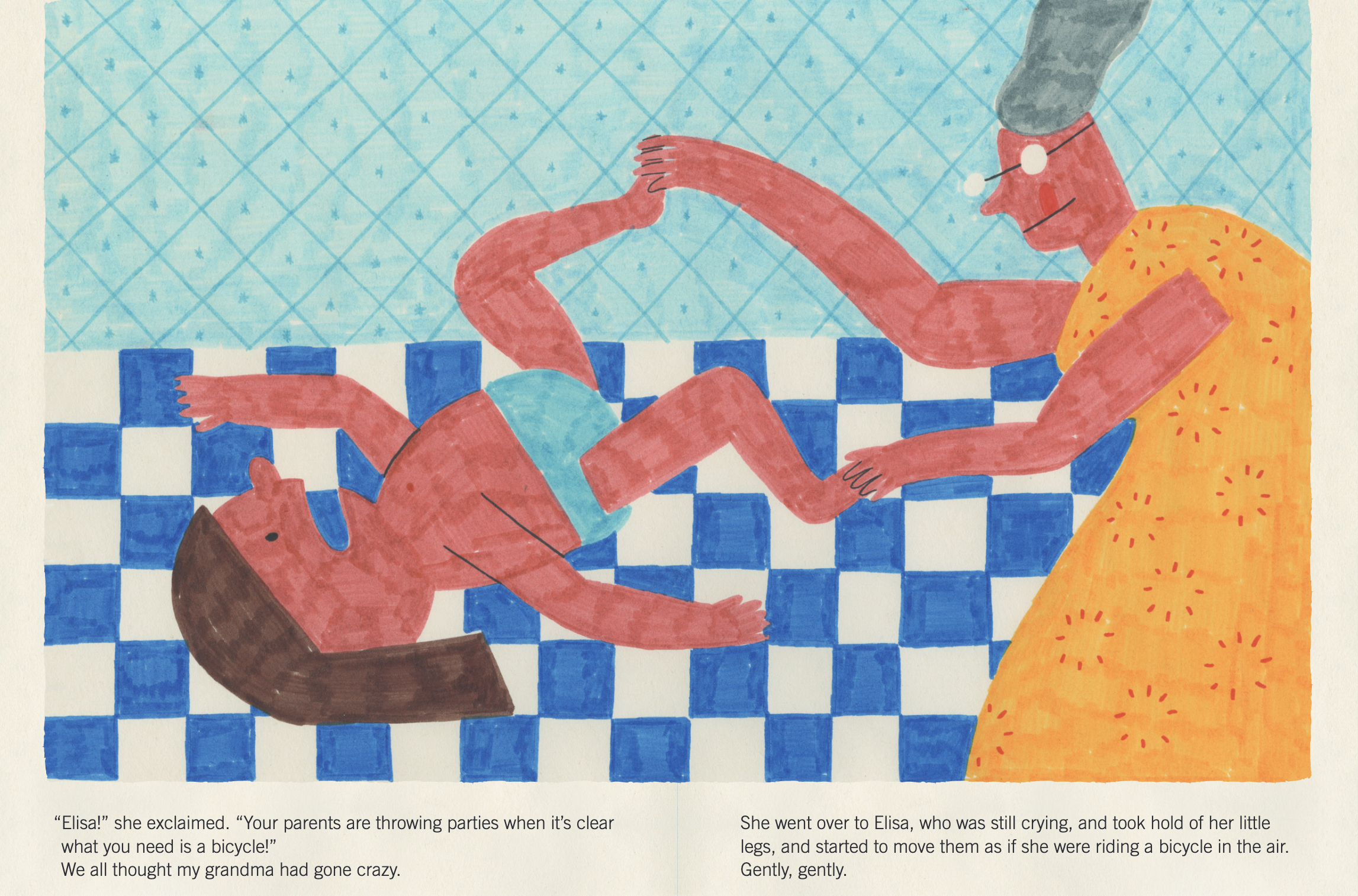
Consider this a fun book to lead off the season. The story is narrated by an older sibling whose little sister just won’t stop crying. You know the kind of baby we mean. She cries all night which, in turn, ends up waking up the entire apartment block. To get some shut eye they all come to sooth her to keep her from crying. Finally, Grandma comes over the next morning and looks at the baby. She does the classic bicycle legs move with the babe, releasing, you’re reading this correctly, an enormous fart. No no. You don’t understand. When I say “enormous” we’re talking the kind of far that literally takes the apartment building all the way into space. If you’re a parent then you’ve been there, man. As Transit told me, this book marks their first venture into fartinalia. This is the fart book that managed to win this publisher over. The best way to describe the art is to say that it’s funny and fanciful. It’s a little bit of fun and a little bit of nonsense, and also a great book for older siblings.


A Day with Mousse by Claire Lebourg, translated by Sophie Lewis from French

ISBN: 9798893389067

Publication Date: October 8, 2024

Behold! An an early chapter book! This is the first in a series of four by Lebourg about this adorable little unidentifiable creature (a theme in her work) named Mousse. He’s a somewhat misanthropic guy who resides on a lovely little sandy beach. His favorite time of day is the morning and he sticks to a very detailed routine. Told in a gentle style, the reader watches as every day he has coffee, puts on his socks, and waits for the tide to literally come into his home. Why? Because with the tide comes the day’s treasures. You see Mousse apparently runs an Etsy shop where he can sell the things that wash up into his house. And everything is just going great until the day that a walrus washes in. Named Barnacle, the big guy sticks around and clearly wants to befriend Mousse. Mousse is, to say the least, not into this plan, but when Barnacle gets sick, the two develop a close friendship. Eventually Barnacle does take off, but don’t worry. In the end he returns with his wife and family of little walruses. Lebourg creates all these scenes in her gently humorous watercolor pen-and-ink style. As I mentioned, this is more in the early chapter book vein, but while it does share some Frog & Toad DNA, it is its own beastie entirely.


Like This by Claire Lebourg, translated by Sophie Lewis from French

ISBN: 9798893389029

Publication Date: November 12, 2024

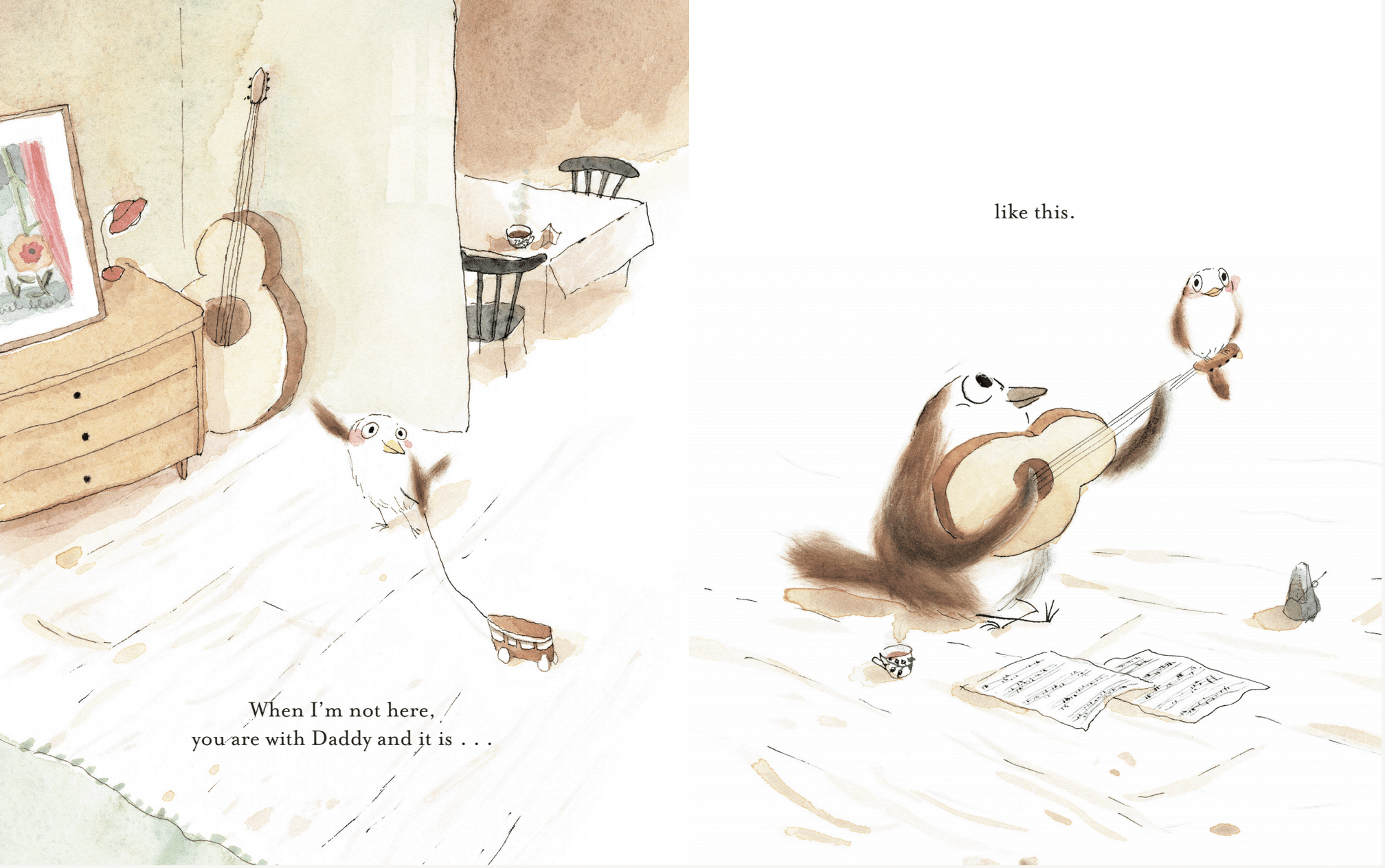
Another entry into the Lebourgian Universe! But seriously, how can you resist her style? This book, coming out a little later in the season, is a story about a mother bird and her baby. The mama bird tells the little one what it was like when she was even littler than she is today. The end result is sweet but not overly sentimental. What sort of separates this from similar books that cover the same ground is that the little bird is growing up in the course of the book. In the end, she and her parents all fly off together. It’s a combo of beautiful watercolors and a lovely little telling.


Astro by Manuel Marsol, translated from the Spanish by Lizzie Davis

ISBN: 9798893389043

Publication Date: February 18, 2025

Believe it or not we’re ending today with a book coming out next year. It’s an odd one too. The kind of book that feels both different and new in ways that are special to Transit. I guarantee that nothing else for sale in American right now quite looks or feels like this book. In the story, a little astronaut touches down on a new planet and begins to explore. The astronaut, named Astro, then meets a strange, long-necked creature and the two immediately hit it off and strike up a friendship. They having an intergalactic blast, just the two of them. Unfortunately, and about halfway through the book, a large creature stomps on the long-necked creature “rendering it no longer alive”. Now what makes this all very interesting is that for the rest of the book, the action is narrating by that same deceased creature. We see the astronaut go through the stages of grief as he works through the loss of his friend. Certainly we’ve plenty of picture books on death, but books where death is seen from the p.o.v. of the deceased are particularly rare. This kind of telling has a pulled back view of the process. It de-centers it in a way that makes it palatable and allows for more conversation with kids while also taking some of the sentimentality out of it. You don’t feel the loss quite as acutely, but you still witness the astronaut’s grief. In a truly bold move, the book, clocking in at 64 pages, ends with 10-16 pages of wordless spreads. Astro ultimately decides that he has to move on with his mission, and the only way to move on is to leave this planet.

And that’s all there is! Thanks to the folks at Transit Editions for taking the time to show me their next season!

Filed Under: Publisher Previews Tagged With: publisher previews, Transit Children's Editions

Fuse 8 n’ Kate: Baby, Come Out! by Fran Manushkin, ill. Ronald Himler

June 24, 2024 by Betsy Bird

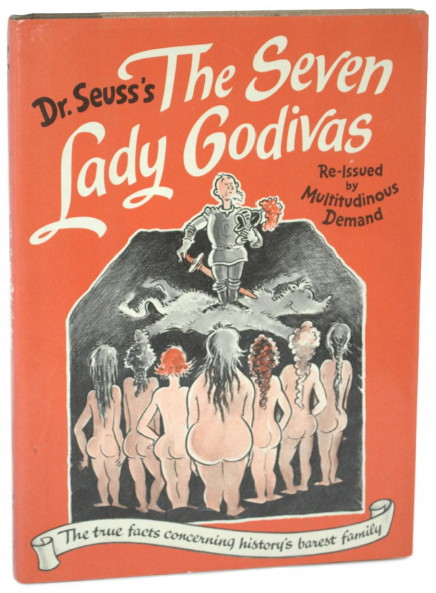
My logic behind this week’s choice is that it is hot outside right now, so why not do a picture book featuring nudity? Now we currently live in a country where so much as a bare butted goblin picture book can get banned by Moms for Liberty at the drop of a hat. May as well go all in and do a book that unapologetically doesn’t care about such puritanical mores. This book is an odd one, but I’ve an equally odd affection for it. With this podcast episode we talk about screaming at women’s stomachs, the fact that babies lose hair when they’re born, and I incorrectly state that this book is probably out of print (Correction: the paperback is going strong!!).

Listen to the whole show here on Soundcloud or download it through iTunes, Stitcher, Spotify, Google Play, PlayerFM, Audible, Amazon Music, or your preferred method of podcast selection.

Show Notes:

Here is an image that Kate created. Me, as alpaca. This is what sisters are for, folks. Now who wore it better?

Here is the book Kate did NOT select. I don’t blame her, as it’s a long one. Also, it’s not actually for kids (though it shows up regularly in children’s picture book sections of libraries by accident all the time).

And here is the information, and most complete online information, you will find about the Billy Budd Button and Huck Finn Pin. Created by School Library Journal’s Lillian Gerhardt, it was a kind of Golden Raspberry Award for children’s books. One award went to worst writing. The other to worst art. Of course you’ll find the world’s only complete list of the “winners” on pp. 170-171 of my own book Wild Things: Acts of Mischief in Children’s Literature. Not that I compiled them. That credit goes to co-writer Peter Sieruta, who tracked them down for years.

We do find it a touch odd that when Mrs. Tracy goes into, what is essentially, the solarium, we get this odd shot of her through a window. A choice.

This is the kind of grandmother that grandmothers these days dislike as representing the whole of the age. Very classic look. Clearly she’s on the lookout for Sylvester and Tweety Bird.

Affectionate fellow, this Mr. Tracy. I know few men who kiss their in-laws every time they come home from work.

This is my favorite shot. You think you’re coming out butt first, kid? Not happening! She should have done a swan dive, but here it’s more like jumping off a building.

So did Baby leave the wig in the womb? That sounds painful in a different way.

Kate Recommends: Death Becomes Her, now playing in Chicago

Betsy Recommends: The new Nicole Kidman opening to AMC theater films. Turns out, there are THREE new Nicole Kidman ads out there. Who knew?!?

Filed Under: Fuse 8 n' Kate Tagged With: Baby Come Out, Fran Manushkin, Fuse 8 n' Kate, Ronald Himler

  • « Go to Previous Page
  • Page 1
  • Interim pages omitted …
  • Page 77
  • Page 78
  • Page 79
  • Page 80
  • Page 81
  • Interim pages omitted …
  • Page 1044
  • Go to Next Page »

Primary Sidebar