• Skip to primary navigation
  • Skip to main content
  • Skip to primary sidebar
  • About/Contact
  • Fusenews
  • Reviews
  • Librarian Previews
  • Best Books
    • Top 100
    • Best Books of 2022
    • Best Books of 2021
    • Best Books of 2020
    • Best Books of 2019
    • Best Books of 2018
    • Best Books of 2017
    • Best Books of 2016
    • Best Books of 2015
    • Best Books of 2014
    • Best Books of 2013
  • Fuse 8 n’ Kate
  • Videos
  • Press Release Fun

31 Days, 31 Books: 2021 Older Funny Books

31 Days, 31 Books: 2021 Older Funny Books

December 19, 2021 by Betsy Bird

In 2017 I published the anthology Funny Girl. The concept was clear. My attempt was to gather together the funniest women writing funny books for kids. Would I change things if I made it today? Absolutely. I didn’t, for example, include any funny trans women, and had I thought about it I would have included Dana Simpson in a red hot minute. In any case, over the years I’ve made sure to collect the funny books for kids that come out each year. As you know, I already tackled funny picture books this year. It is time now to turn our attention to funny books for older readers. Because heaven knows that this year we need humor desperately. And who better to appreciate that fact than our kids?

On today’s list you’re going to find comics mixed with early chapter books mixed with middle grade fiction, and even the occasional memoir. Don’t fret it. Each is funny and worthy of the time and attention of your young readers. Cause if we can’t bring them the funny once in a while, what good are we?


2021 Funny Books for Older Readers

Amethyst: Princess of Gemworld by Shannon Hale and Dean Hale, ill. Asiah Fulmore

I’m always a little baffled when a property gets remade, but this new book appears to be desperately hiding that fact from its reading public. When Shannon and Dean did a young Wonder Woman story last year, we weren’t all that surprised. Now the DC Graphic Novels for Kids line (which, when it isn’t being penned by the Hales, gets a little wonky) has redone Amethyst: Princess of Gemworld. One would be forgiven for thinking it an original tale. Certainly when I hear “Amethyst” I think of Steven Universe’s character first. In this case, however, the Hales have a bit of a challenge. They have a svelte 156 pages with which to establish character development and change, world building, a bad guy, and fancy ballroom gowns. What can I say? These guys know what they’re doing. My daughter in particular appreciated the jokes which come fast and tight on an inside curve. Hard not to like this book. She may be a recycled property, but this Amethyst will make loads of new fans.

Cardboardia: The Other Side of the Box by Richard Fairgray and Lucy Campagnolo, ill. Richard Fairgray

[Previously Seen on the Unconventional List]

Okay, one of these days I’m just gonna have to meet Richard Fairgray once and for all. The man has such a keenly skewed sense of humor. It’s the kind of humor we need to see more of in our children’s literature. Now I know that when you look at this book you might, like me, wonder how similar it is to Cardboard by Doug TenNapel (a comic creator that could give Fairgray a run for his money in the weirdness department). There are some similarities in the logistics of a cardboard world, but I’d say this book has an entirely different feel and take. I also adored the hidden jokes. Fairgray cannot physically draw a sign on a wall in a school without making it funny. Some personal favorites: “Make Every Day Spaghetti Wednesday”, “Name Calling Is for Dweebs”, “Viva La Evolution”, and a personal favorite of “Comedy = Tragedy + Time” made into a pyramid. Wherever this crazy train is going, I wanna ride it to the end.

It also wins the Best Dedication of the Year Award:

The Dire Days of Willowweep Manor by Shaenon K. Garrity, ill. Christopher Baldwin

Marketed as YA, I say bah to all of that. I’ve got a 5th grader in my home that loves anything with even a hint of romance, and this book is so perfectly midl that it more than suits the bill. Certainly someone who has read gothic romances will get more out of it, but I’m hoping that it proves to be a gateway drug to Jane Eyre and all the others. In this story, a girl with a deep and abiding love of all things gothic is accidentally transported to a small dimension straight out of one of her books. There’s a haunted mansion, a surly housekeeper, three brothers, and The Bile. The Bile, for the record, is the part that doesn’t fit. Suddenly she must aid the brothers in defeating The Bile, all while vacillating between Maiden and Heroine. The jokes in this book land with a solid frequency that I truly enjoyed. Loved the art style, the writing, and the weirdness. Just an all around good egg.

Dog Man: Mothering Heights by Dav Pilkey

Okay, we all know Dog Man, so there’s not much point even really putting it on a list. I acknowledge that freely. Also, the poop jokes get really cranked up in this book. I’m talking European poop joke levels here (though, unlike the Europeans, while you do see a plentiful amount of pee, you’re only getting poop-related jokes and not any visuals of the real thing). So why even mention it? Because the whole reason to even read Dog Man, as far as I’m concerned, is to find that moment when Pilkey breaks out of the silly jokes and includes something meaningful. And nine times out of ten you’ll find that moment if you follow Petey. Not L’il Petey. Petey Senior. The formerly evil cat. In this book we discover that after a mishap in his youth, Petey served his time and tried to go straight. Trouble was, because of his prison record he couldn’t get a job or a place to live. There’s a part where he’s being booted out of the 2nd Chance Diner where a sign in the window reads, “No Recidivists”. So yeah. Petey’s my guy. And doggone it, I’m including this book here. Ain’t like it isn’t funny, after all.

The Genius Under the Table: Growing Up Behind the Iron Curtain by Eugene Yelchin

Poor Yevgeny. Growing up in Cold War Russia, all he wants is to find his talent, the way his figure-skating older brother has. But nothing Yevgeny does ever seems to turn out well. Will he ever find his genius gift? It took me a while but I’ve really warmed up to Eugene Yelchin’s wacky style. I wasn’t a huge fan of Breaking Stalin’s Nose back in the day, but ever since then it’s like the man can do no wrong. Now he’s lightly fictionalized his own memoir for kids and it is FASCINATING. Particularly the part where Mikhail Baryshnikov defects and Eugene ends up with his blue jeans. I interviewed him about this and asked him if that was true and it most certainly is. Probably the funniest, most accurate depiction of living in Cold War Russia you’re ever going to see in a children’s book.

Jojo Makoons: The Used-To-Be-Best-Friend by Dawn Quigley, ill. Tara Audibert

[Previously Seen on the Easy Book / Early Chapter Book List]

What do you do when your best friend doesn’t want to sit with you at lunch anymore? Meet Jojo Makoons, an Ojibwe seven-year-old just trying to navigate school and her own kooky inclinations. A slam dunk on representation, and a perfectly good set of stories. Jojo as a character is very much in the Ramona tradition of flawed heroines you identify with. She’s one of those gals that has some work to do, but you still find yourself kind of rooting for her all the way. Love her hair, by the way. Just fantastic.

Long Road to the Circus by Betsy Bird

[Previously Seen on the Middle Grade Novel List]

Yeah yeah. I know. Second list I’ve added this book to this month. What can I say? I’m shameless. If you haven’t heard of it before, this book was born out of a crazy coincidence. You see, my grandmother’s no good uncle used to skip out on his farm chores when she was a kid. Why? Because he’d walk on over to an elderly ex-circus performer’s house to try to learn how to teach the farm horses circus tricks. The name of this performer? Madame Marantette. Fast forward to the future and Caldecott Award winning illustrator David Small actually lives IN the Marantette House! I thought a picture book might come out of this story. David, however, saw it as a novel. The end result? A kooky story about Suzy, a girl determined to get out of small town Michigan and into the big bright world. And how’s she gonna do it? Well… you ever seen a lady ride an ostrich side saddle? You will. It’s a goofy little thing, but I’m fond of it.

The Losers at the Center of the Galaxy by Mary Winn Heider

[Previously Seen on the Middle Grade Novel List]

Siblings Louise and Winston encounter a series of weird happenings at their school. Do these oddities have anything to do with why their teachers are behaving so oddly? Additionally, the two hope their football player dad returns home after disappearing suddenly. Consider this a Chicago-based mix of absurd humor and heartbreak. Readers of this book get to take a deep dive into a truly wacky series of unpredictable events. Mind you, the whole reason that this works is that Heider never abandons the heart of the novel, even in the midst of chaos. Loved the jokes. Loved the characters. Loved how prevalent Darth Vader’s “Imperial March” was. Like nothing else out there.

Otto: A Palindrama by Jon Agee

I have a proposal. Years from now, when Jon Agee has left us, and the world has turned around the sun for a while, I propose that someone write a retrospective biography of him called something like FEARLESS: THE LIFE AND CHOICES OF JON AGEE. I say this because I can think of few people working in the field of children’s literature that try, so consistently, to do their own thing, regardless of the trends of the world. That may sound like a backhanded compliment, but part of what I love about Agee’s books is their strange timelessness. Nobody does what he does or produces books that look like his. And now, as if answering a prayer we didn’t even know we could have prepared, he has given us a graphic novel. A comic! A big long comic predicated on a premise so ludicrous that were it any other author/illustrator I would have said it couldn’t be done. He’s written a comic book entirely in palindromes. A “palindrama” if you will. Now that sounds like a joke that could get old fast, but you’re only saying that because you haven’t read it. With hints of Alice in Wonderland to it, we follow Otto. He’s trying to find his dog Pip and he runs into an array of wild adventures searching the world. The kicker is how funny the book is. I kept guffawing loudly in my workroom lunchroom when I came across the page of characters like Evil Cara Clive or Regan Amy Trapp, Party Manager. But he really shines when it comes to advertisements. Feeble Tom’s Motel Beef. Lonely Tylenol. Feilert: Safe Fast Relief. In his Acknowledgments, Agee pays full tribute to each and every person or source he used to find some of these. Many, however, are his own creation like “No one made killer apparel like Dame Noon” or my personal favorite “Oozy rat in a sanitary zoo.” Not sure if I should dock him half a point for his cheat on “Museseum” but it seems petty. This book is a joy to go through with kids. My 7-year-old can attest to that.

Pity Party by Kathleen Lane

[Previously Seen on the Middle Grade Novel List]

A deft and daring collection of stories, quizzes, advertisements, and more. A book for anyone who has ever wanted a funny, strange, sad book to soothe their anxieties. I’d call this a pretty good example of not judging a book by its cover. This is essentially “Black Mirror” for kids. Or maybe it’s more Ray Bradbury. Whatever it is, it’s short fiction and a lot of fun. Some stories circle around and around. Some come up and then disappear again. This is the rarest of all beasts: child satire. It has a dry sense of humor, and embraces nonsense in a rather refreshing way. My favorite story is probably “Imposter” because it feels specific enough to be eerie, and is so universal at the same time.

Too Small Tola by Atinuke, ill. Onyinye Iwu

[Previously Seen on the Easy Book / Early Chapter Book List]

Tola lives in an apartment in Lagos, Nigeria with her Grandmommy, brother, and sister. Smaller than everyone, Tola soon learns that it isn’t size that makes you mighty, and that tiny isn’t bad. Atinuke is at the top of her game with this book and that’s all there is to that. And what a treat to discover the art of Onyinye Iwu! Atinuke always gets the best illustrators and this book is no exception. The stories are quick, funny, and always incredibly interesting. But even better than all of that is the fact that you get this emotional connection to the main character that grows and grows with each subsequent story. Raises the bar for all the other early chapter books out there, I can tell you that much.

Trubble Town: Squirrel Do Bad by Stephan Pastis

Little actions have big consequences when Wendy the Wanderer feeds sugar to a squirrel and ultimately ends up with her whole town in shambles. It’s very difficult for me not to recommend a new Stephan Pastis book. Even better than the Timmy Failure series, this is a book that pushes the envelope on absurdity. It’s as if Pastis wants to consistently see how far he can push his jokes. Remarkable in its ridiculousness, it’s also one of the few comics that consistently made me laugh out loud. I completely understand if it’s not your cup of tea, but I cannot in good conscience keep it out of contention. It’s just too much fun. 

The Wild Huntsboys by Martin Stewart

[Previously Seen on the Middle Grade Novel List]

Set in a futuristic England at war, three boys find themselves in danger when they anger the fairies and must battle enemies on every side. I just regret it took me this long to read this book. After reading a lot of “meh” fantasies this year, I needed a book with great writing that was funny and smart. This book fits the bill. Few authors could successfully meld dystopia with fairies in a middle grade title, but Mr. Stewart manages it. I highly recommend that you listen to the audiobook as well. Right from the get-go you’ll enjoy the reader. He has to do a wide range of accents and rarely disappoints. We’re going to need some fun fantasies on our shelves and this gets my vote.


Enjoy these older funny titles? Would like to see more lists of the same? Then be sure not to miss these:

  • 2020
  • 2019
  • 2018
  • 2017

And here’s what else we have happening this month:

December 1 – Great Board Books

December 2 – Board Book Reprints & Adaptations

December 3 – Transcendent Holiday Picture Books

December 4 – Picture Book Readalouds

December 5 – Rhyming Picture Books

December 6 – Funny Picture Books

December 7 – CaldeNotts

December 8 – Picture Book Reprints

December 9 – Math Books for Kids

December 10 – Books with a Message

December 11 – Fabulous Photography

December 12 – Wordless Picture Books

December 13 – Translated Titles

December 14 – Fairy Tales / Folktales / Religious Tales

December 15 – Unconventional Children’s Books

December 16 – Middle Grade Novels

December 17 – Poetry Books

December 18 – Easy Books & Early Chapter Books

December 19 – Older Funny Books

December 20 – Science Fiction Books

December 21 – Fantasy Books

December 22 – Informational Fiction

December 23 – American History

December 24 – Science & Nature Books

December 25 – Autobiographies *NEW TOPIC!*

December 26 – Biographies

December 27 – Nonfiction Books for Older Readers

December 28 – Nonfiction Picture Books

December 29 – Best Audiobooks for Kids

December 30 – Comics & Graphic Novels

December 31 – Picture Books

Filed Under: 31 Days 31 Lists, Best Books, Best Books of 2021, Booklists Tagged With: 31 days 31 lists, Best Books of 2021, funny books, funny early chapter books, funny graphic novels, middle grade funny books

31 Days, 31 Lists: 2021 Easy Book and Early Chapter Titles

December 18, 2021 by Betsy Bird

In the old days I used to separate out my Easy Book lists from my Early Chapter Book ones. The difference between the two? Easy Books are Beginner Books right up until they start doing simple chapters ala Frog & Toad. Early Chapter Books are the next phase, when you’re not ready for a full novel, but you’re above the Easy level. And now, looking at how many luscious lovely books made this year’s lists, I’m beginning to regret that I didn’t separate these out too! Ah well. Too late now. Enjoy the bounty and be sure to catch ’em all:


2021 Easy Books

Burt the Beetle Doesn’t Bite by Ashley Spires

Burt’s just your average ten-lined june beetle and there’s very little that’s interesting about him. Yet even the most average bug can be a hero if it uses what it’s got. And what Burt has are … hugs! I had this book all wrong. When it was first sent to me, I think I tried to tackle it like a work of nonfiction. And sure, there are plenty of fun facts spotted throughout the text. But the long and short of the matter is that this book is more story than expository text. And look at Burt. Isn’t he cute? Loved the set-up, the characterizations, and the fact that a sweety beetle can be a hero. Best line ever: “I have foiled you with my warm embrace.”

Ducks Run Amok! by J.E. Morris

Can’t a turtle get some peace and quiet around here? Not when a flock of exuberant ducks comes on the scene. This is easy reading for kids with a sense of humor. To my mind, any book that drives uptight turtles mad is worth at least a little consideration. And I tried this one out on my 7-year-old to see if it played fair with the wording and it does! Pure easy book territory.

Fitz and Cleo by Jonathan Stutzman and Heather Fox

Ghost siblings Fitz and Cleo star in a hilarious and charming graphic novel series for early readers. Follow their adventures through 11 short chapters chock full of action and silliness. And for my 7-year-old (who, you will now notice, is sort of my guinea pig in this category this year) this was the perfect reading level. Also, from the sheer peals of laughter he emitted as he read, I’m going to declare this book a success. The harder words are never too hard, and the jokes land. I even liked the fart joke (and I’m a hard sell on those, normally).

Flubby Will Not Go to Sleep by J.E. Morris

Flubby Will Not Take a Bath by J.E. Morris

Where can I lodge a complaint against my spellcheck? Repeatedly, as I attempted to write the word “Flubby”, it wanted to turn it into “Flabby”. But Flubby is the star of this show, and serves as a rather nice child stand in. This easy book keeps things pretty simple. The words never get much more complicated than “shower”. Flubby had already gained fame and fortune when it won a Geisel award for Flubby Is Not a Good Pet. I would argue that these later chapters in the Flubby pantheon are even better, though. Both have wonderful moments of cats being cats, whether they’re sitting directly on your face as you’re trying to sleep or refusing to be put in a tub, keeping the water at bay, limbs spread-eagled. You can like these books for the easy words, but it’s the art and stories that bring ‘em on home. 

I’m On It! by Andrea Tsurumi

When goat is on, frog is on. When goat is under, frog is under. Zany hijinks ensue as these two friends embody a wide range of increasingly tenuous positions. It is just SO nice to see Tsurumi returning to her completely madcap chaotic roots this year! Honestly, she’s at her best when things have gone utterly out of control (and if you don’t believe me, check out her work on Mr. Watson’s Chickens). Easy books, as we often say, can be the most difficult to write but I think Ms. Tsurumi just did an out-of-this-world stellar job with the simplicity of this text. The only parts that didn’t jive with me (and I use that term on purpose) were the old 70s phrases that Mo Willems insisted on putting at the beginning and the end out of the mouth of Gerald. “Right on!” and “Far out” are little jokes that probably didn’t need to be there, but the overall success of the book renders that tiny problem moot. 

Kraken Me Up by Jeffrey Ebbeler

When a little girl brings her pet to the county fair pet show, no one thinks much of it. That is, until they notice that it’s a kraken! A sweet, subtle tale of acceptance and calamari. Who is Jeffrey Ebbeler and why has he been hiding his easy book writing skills from us until now? Well the jig’s up now, Jeffrey! You made the classic mistake of creating a near perfect easy book. And extra points to Holiday House for publishing this book as the standard 9 X 6 inches. I’ve been trying to tell them that their I Like to Read series didn’t work in a lot of libraries because easy book shelves are significantly smaller than picture book shelves. This book is just as adorable as its cover implies, and you’ll be hoping for more Kraken books real soon. I know I am.

Over, Bear! Under, Where? by Julie Hedlund, ill. Michael Slack

Every year, when I try to predict the Geisel Awards for easy books, I completely forget to take into account the picture books with simple texts. They’re not particularly abundant, so you’d think my radar would be sufficiently pinged whenever I come across one. That is, sadly, not usually the case… until now! Now the cover of this book makes it look as though it’s just one of the hundreds of bear-in-underwear books out there, and you could be forgiven for that assumption. That said, this is a book that tries something a little different. You’re getting the simple text on the one hand, but at the same time there’s a slew of compound words sort of hidden in there as well. You see, our two heroes’ names are Under and Over. As a result you end up with words like Undergo, (“Under, go!”) or Overrun. You get the picture. The full list of compound words in the book is found in the back, making this a kind of seek-and-find book for words, as well as a fun story about two friends and the bear that gets in their way. Here’s hoping the Geisel committee takes a nice long look at some of the cleverness on display on these pages. 

See Bip Grow! by David Milgrim

It’s Milgrim’s sheer consistency that astounds. The difficulty in perfecting the art of the easy book cannot be overstated. It is a deeply hard thing to do on a consistent basis. Yet here we find David Milgrim somehow managing to crank out astounding Zip book after astounding Zip book. Just to ante up how good the books are, helpful charts appear at the beginning. There’s a “Word families” chart, one for “Sight words” and one for “Bonus words”. I don’t have any beginning readers in my household anymore, but if I did I’d probably just go to the library and grab every last Zip book on the shelves in one fell swoop. Probably the best beginning reader book series (for kids that are ACTUALLY beginning to read) out there today. 

Shelby & Watts: Tide Pool Troubles by Ashlyn Anstee

Ah! Here we have a book that traverses that tricky territory between the beginning easy books and the early chapter ones. It’s riiiiiiight on the cusp between the two, which is often the hardest kind of book to find. If you’re a librarian then I must warn you that you’re going to have a hard time figuring out where to put this one, but it’ll be worth it for those kids that need it. Best of all? It’s a mystery! An intrepid fox and her best badger friend are on the lookout for shells. The hermit crabs need new ones but they keep disappearing from the beach. Who is the thief? Considering how slight this book is, it’s admirable that Anstee still manages to work in red herrings and an environmental message along the way. Plus, who amongst you can resist forlorn hermit crabs? One must assume that they must be particularly fun to draw.

The Sleepover and Other Stories by Sergio Ruzzier

Aw, you know I’m a pushover for this series. It probably doesn’t hurt that Ruzzier’s just gotten so darn good at the three act structure. As with the other Fox & Chick books, this one contains three small stories. In this case they are called “The Sleepover”, “The Hammer”, and “The Surprise”. Chick, in each tale, is the adorable bane of kindly Fox. Their relationship vacillates between a kind of Ernie & Bert schtick to a more parent/child relationship, and then back to friends once more. Best of all, Ruzzier is capable of the short-story-in-an-easy-book twist ending. Not many folks can brag of that. A wonderful new inclusion in a series that is consistent in surprising us. 

Tag Team (El Toro and Friends) by Raul the Third, colors by Elaine Bay

The wrestlers from the hilarious Vamos books star in their very own easy reader spinoff that mixes Spanish with English words and serves up a lot of hilarious action. For years, when anyone ever asked me where the gaps in the library collection were, I’d always say it was in the Mexican wrestler section. And while we’re still not seeing that bilingual DK collection of Most Famous Mexican Wrestlers (seriously, dudes, how hard would that be to put together?) at the very least we can get books like these. I took particular note of how the story makes very sure to show that El Toro isn’t calling up the female La Oink Oink to help him clean up just because she’s a girl. That could have been incredibly awkward. Instead, it’s about being a team through the good and the bad. I think this one is impossible to deny.

Time for Kenny by Brian Pinkney

I don’t think Pinkney originally intended this to be an easy book for emerging readers, but that’s sure as heck how I took it. That isn’t to say there aren’t some challenging words in here. “Vacuum”, for example. But considering the fact that this book is split into separate sections (and would have benefited from some chapter headings) it really feels like easy book territory. Greenwillow should look into some simultaneous easy book size publishing in the future. As for the art itself, it’s Pinkney, man. You know how well he does the things that he does. Nobody but nobody makes motion purr on the page the way that Brian Pinkney does. Joyful and careful with a simple text for all. 

Training Day by Raúl the Third, colors by Elaine Bay

Alongside Tag Team, this is the other “El Toro & Friends” easy book coming from Raúl and Elaine. In this one El Toro is looking forward to facing an opponent that looks like nothing so much as a slightly modified The Thing, called The Wall. To do so, he’ll have to up his training program. However, when his trainer comes to rouse him from his slumber, El Toro doesn’t feel up to the challenge. Only after a great deal of persuasion does he finally give in, and we are treated to a workout sequence that would put Rocky to shame. The inclusion of Spanish words and phrases alongside English will give some new readers just the right kind of challenge, and who can resist that art? Another winner. 

We Have a Playdate by Frank W. Dormer

Three friends must navigate playground equipment and the addition of a fourth friend in this hilarious series of misunderstandings and hijinks. I read through this entire book before I realized that it was written and illustrated by Frank Dormer. MAN, what a strange fellow he is! In the best possible way, of course. I swear, he never does the same kind of book twice. This gentle story (straddling the line between easy and early chapter titles) is a hoot. There are misconceptions, failures to read the room, and general misunderstandings between friends. Plus, how can you resist a book that has the line, “Swinging is fun!” followed by the line, “Except when the drag coefficient causes the end of fun.” Plus, I think Noodle might be non-binary. Worth a read anyway. 

Wildflowers by Liniers

After having crash landed on a mysterious island, three sisters are determined to explore. But is there more to this island than meets the eye? It’s a comic but I think that with its easy reading level it’s more appropriate to put it here in the Easy and Early Chapter Books. Now the trick to this title is to read it twice. The first time you go through it you may have the reaction I did. Initially I just thought it was way too explain-y. I didn’t like how the characters kept describing everything that was either happening or around them. Then you get to the end and it all falls into place. So read it two times and then linger for a while over that image of the tiny gorilla. This is surprisingly beautiful and a lot of fun. Does a good job of really tapping into how siblings play with one another too. It’s a kid-friendly version of Lord of the Flies meets the TV show Lost, with a satisfying ending.

Have some fun and watch my interview with Liniers about the book here:


2021 Early Chapter Books

Aven Green: Sleuthing Machine by Dusti Bowling, ill. Gina Perry

Aven, the armless charmer first introduced in Insignificant Events in the Life of a Cactus, now stars in her own early chapter book series. Here she becomes a sleuth trying to solve not one but two lighthearted mysteries! Man, are kids gonna be thrilled to see that Aven’s gotten her own series. Granted, it’s a bit younger than her previous novels, but Bowling has really perfected Aven’s voice. It’s so freakin’ nice to read a book about a girl without arms who actually has a life. Books where the character is the plot (you know what I mean) are so boring. This telegraphs its solution to the primary mystery just broadly enough so that the kids that solve it on their own will feel pleased and those that don’t won’t feel cheated. Some jokes land and some don’t, but at least it gives ’em a try. Goofy and good.

Can You Whistle, Johanna? by Ulf Stark, ill. Anna Höglund, translated by Julia Marshall

[Previously Seen on the Translations List]

Need a grandfather? Why not hop over to the retirement home to pick one out for yourself? A remarkably sweet story,  funny and moving by turns. And I just have to say that this has gotta be the sweetest, most moving little story I’ve seen in a while. It’s not, weirdly enough, the first import we’ve seen that discusses sneaking old people out of nursing homes to have fun, but I like the strange internal logic of this one in particular. Of course, now I really want to know how the tune of “Can You Whistle, Johanna?” goes! A heartfelt story that never feels cloying.

Einstein: The Fantastic Journey of a Mouse Through Space and Time by Torben Kuhlmann, translated by David Henry Wilson

A small mouse is so distraught when it realizes that it has missed an important cheese festival that it dives deep into discovering the secrets of time travel itself. But when it gets caught in the past, will Einstein himself help with the calculations? This is where “early chapter” and “bedtime reading” fare sort of blurs and runs together. If you’ve seen Kuhlmann’s previous books (Armstrong, Edison, etc.) then you know what to expect. I think I once called him a Steampunk Beatrix Potter, and I’d stand by that. In this book he combines the H.G. Wells version of The Time Machine with some literal explanations of Einstein’s theories. There are a lot of detailed explanations of these in the back of the book, which kids and parents can totally skip if they want to (or, if they’re a certain kind of kid, obsess over). The art is luminous. I also kind of love that at the beginning it takes place in what appears to be the late 80s/early 90s, which is sort of cool.

Franklin Endicott and the Third Key by Kate DiCamillo

A very good book in spite of the fact that somehow I got it into my head for most of it that Franklin was Horace Broom (because apparently I can only hold one boy character at a time in my noggin). By this point in the proceedings the “Deckawoo Drive” books are taking on an entire life of their own. You sink into them and find yourself in a small town where the local economy is such that it can support a store that sells the strangest of used goods. And, as ever with the Decakawoo books, DiCamillo is in top form. My favorite moment is when our hero, Franklin, picks up an old frayed magic set. “Frank shook the box. Something inside of it rattled in a forlorn way.” Naturally, there’s a bit of name dropping of great authors, and so we get a bit of O. Henry and Langston Hughes and H.G. Wells. And extra bonus to the clever dickens that thought to get actor William Jackson Harper (a.k.a. Chidi from The Good Place) to do the audiobook. 

J.D. and the Great Barber Battle by J. Dillard, ill. Akeem S. Roberts

What would you do if your mom gave you the worst haircut of your life? J.D. turns a personal tragedy into a thriving business when he picks up some clippers and taps into his true talent. That is, until someone tries to shut him down… Love it. I listened to the audiobook myself and it’s well worth a listen. With this book we are in serious kid fantasy wish-fulfillment territory. That said, it’s just chock full of personality and humor. You really feel like you know, not just the characters, but the town as well. A great entrepreneurial alternative to The Toothpaste Millionaire.

Jojo Makoons: The Used-To-Be-Best-Friend by Dawn Quigley, ill. Tara Audibert

What do you do when your best friend doesn’t want to sit with you at lunch anymore? Meet Jojo Makoons, an Ojibwe seven-year-old just trying to navigate school and her own kooky inclinations. A slam dunk on representation, and a perfectly good set of stories. Jojo as a character is very much in the Ramona tradition of flawed heroines you identify with. She’s one of those characters that has some work to do, but you still find yourself kind of rooting for her all the way. Love her hair, by the way. Just fantastic. 

Jop and Blip Wanna Know: Can You Hear a Penguin Fart on Mars and Other Excellent Questions by Jim Benton

Just because a question is silly doesn’t mean you shouldn’t ask it. Join two intrepid robots as they give strangely straightforward answers to some seriously silly queries. After much long and studied consideration, I thought maybe this could be the only category where this book makes sense. Sure, we could put it in the graphic novel section, but I think it would just get lost there. I don’t always like Jim Benton’s books (Catwad left me cold) but the jokes seriously land in this one. Aside from the science itself being quite good, I liked the running gags. If you’re looking for something silly that has a bit more of a science-y edge to it, this might be an ideal inclusion. Kind of like XKCD’s book What If, but for kids.

The Mailbox in the Forest by Kyoko Hara, ill. Kazue Takahashi, translated by Alexandrea Mallia

[Previously Seen on the Translations List]

I’ve no doubt I’ve run across the art of Kazue Takahashi before, but I’m less certain that I’ve ever read anything written by Kyoko Hara. This book is the first in the “Forest Friends” series and follows a little girl who gets to spend some time alone with her grandparents. While she lives in a high-rise building in the city, they live next to a great big forest that she gets to explore on her own whenever she wants. The book does a delightful job of invoking the smells and senses of autumn. While exploring, the girl finds a little mailbox and strikes up a correspondence with whoever made it. But who is the mysterious letter writer? And will they still be able to write when she’s gone back home? It’s slight and spare and reminded me just a little of Tea Party in the Woods by Akiko Miyakoshi in terms of tone. A charmer. 

Maybe Maybe Marisol Rainey by Erin Entrada Kelly

Introvert Marisol loves her family, best friend, silent movies and cats. But she worries a LOT about things, like learning how to climb the backyard tree. Will she ever rise above her fears? Aww, it’s so good! Ms. Kelly really taps into a very specific kind of reading level with this book with a very nicely flawed heroine. Her particular kind of anxiety is hard to write, but Ms. Kelly lets the reader be even more patient with Marisol than Marisol is with herself. This is a book that really shows how to write emotions without feeling pandering. Well done! 

The Middle Child by Steven Weinberg

Middle kids of the world, rejoice! At last, a book made just for you that shows the highs and lows (mostly lows) of being stuck right smack dab between your siblings. At long last, middle children have a chance to acquire sweet sweet revenge. Or, at the very least, vindication. Based on true stories from Steven’s own middle childhood (and that includes the whole getting-locked-in-a-trunk-by-your-brother part) this has hints of Alexander and the Terrible, Horrible, No Good, Very Bad Day in it but with less moaning and more drawing. Love the mixed media in the illustrations and the sheer sense of unfairness that permeates the text. And as one is quick to learn, once a middle child is slighted they never ever forget.

Pizazz by Sophy Henn

Being a superhero isn’t as much fun as it looks, particularly when you’re saddled with a superhero family and a power that is incredibly embarrassing. But what’s Pizazz to do when it’s up to her to save the day? Far and away the most British thing I’ve ever read published here in the States with (what seems to be) little to no editing on the Britishisms. Honestly, as I read this aloud to my daughter it became apparent that I needed to slip in an accent to read lines like, “Aunty Blaze sent him to the naughty step for a jolly good think”. All told, I found this little young superhero story charming.

The Secret of the Magic Pearl by Elisa Sabatinelli, ill Iacopo Bruno, translated by Christopher Turner

[Previously Seen on the Translations List]

For kids that watched the Pixar film Luca this past summer, this book offers a very different glimpse of an Italian seaside community. In this story, Hector and his family used to run a tourist destination where they’d give tours of the sea. That all changed when a greedy developer drove them out of business with his own, bigger enterprise. So when Hector and his father find a legendary local gem known as “The Pearl” you can bet that developer will stop at nothing to get his hands on it. But at what price? You have undoubtedly stumbled across the exceedingly distinct artistic style of Mr. Bruno some place or another. I’d wager that he’s one of our most popular Italian artists (though Sergio Ruzzier remains the reigning champ). In this book he invokes books like David Wiesner’s Flotsam and he takes care to inject a funny little magical realism detail into the art. Each person depicted has a small, floating creature in their vicinity. Our hero has a small red fish. His father, a crab. His mom, a dolphin. And the villain? A skeleton of a fish… until he has a change of heart. Mr. Turner has done a good job with the translation. It feels exceedingly natural from start to finish. You might never know it came from overseas. 

Starla Jean Which Came First: The Chicken Or the Friendship by Elana K. Arnold, ill. A.N. Kang

“If you catch it, you can keep it!” says Starla Jean’s dad when they discover a chicken in the park. So what happens when his intrepid daughter not only nabs it but loves it and names it Opal Egg? I thought this was particularly strong! The writing was fun (I loved how you got to track the dad’s nervousness throughout) and had a keen sense of humor. Overall I was very into it. I liked how Kang gave Starla Jean this kooky look of anticipation when she first spotted the chicken. Alas, I had a tiny problem with the art. You see, the chicken facts at the end talk about the egg tooth on the beak of baby chicks and then the art shows this highly misleading image of a beak with actual teeth inside of it. Not the same thing at all! But this flub is not nearly enough to sink the book. Super fun!

Teaflet & Roog Make a Mess by Jeanne Birdsall, ill. Jane Dyer

[Previously Seen on the Photography List]

Two good friends find themselves in an escalating series of fiascos when they try to simultaneously clean their home for the inspector of neatness AND prep for their annual Strawberry Jam Party. You know, there’s something to be said for making sure that books don’t all look the same. Birdsall and Dyer are definitely going for an old-fashioned feel with this title. Now if this were a Dyer only affair, I think it would look too twee, but Birdsall’s got a bit of bite to her writing that cuts through the treacle (apologies for the mixed metaphor). I happen to like models, so that was a no-brainer for me (I like the animals in this book). Give yourself an open mind when you read this. You may find that it’s a charmer. At the very least, worth more reads.

Too Small Tola by Atinuke, ill. Onyinye Iwu

Tola lives in an apartment in Lagos, Nigeria with her Grandmommy, brother, and sister. Smaller than everyone, Tola soon learns that it isn’t size that makes you mighty and tiny isn’t bad. Atinuke is at the top of her form with this book and that’s all there is to that. And what a treat to discover the art of Onyinye Iwu! Atinuke always gets the best illustrators and this book is no exception. The stories are quick, funny, and always incredibly interesting. But even better than all of that is the fact that you get this emotional connection to the main character that grows and grows with each subsequent story. Raises the bar for all the other early chapter books, I can tell you that much.


Interested in previous years? Then check out the following:

  • 2020
  • 2019 & 2019
  • 2018 & 2018
  • 2017 & 2017
  • 2016 & 2016

And here’s what else we have happening this month:

December 1 – Great Board Books

December 2 – Board Book Reprints & Adaptations

December 3 – Transcendent Holiday Picture Books

December 4 – Picture Book Readalouds

December 5 – Rhyming Picture Books

December 6 – Funny Picture Books

December 7 – CaldeNotts

December 8 – Picture Book Reprints

December 9 – Math Books for Kids

December 10 – Books with a Message

December 11 – Fabulous Photography

December 12 – Wordless Picture Books

December 13 – Translated Titles

December 14 – Fairy Tales / Folktales / Religious Tales

December 15 – Unconventional Children’s Books

December 16 – Middle Grade Novels

December 17 – Poetry Books

December 18 – Easy Books & Early Chapter Books

December 19 – Older Funny Books

December 20 – Science Fiction Books

December 21 – Fantasy Books

December 22 – Informational Fiction

December 23 – American History

December 24 – Science & Nature Books

December 25 – Autobiographies *NEW TOPIC!*

December 26 – Biographies

December 27 – Nonfiction Books for Older Readers

December 28 – Nonfiction Picture Books

December 29 – Best Audiobooks for Kids

December 30 – Comics & Graphic Novels

December 31 – Picture Books

Filed Under: 31 Days 31 Lists, Best Books, Best Books of 2021, Booklists Tagged With: 2021 early chapter books, 31 days 31 lists, Best Books of 2021, early chapter books, easy books

31 Days, 31 Lists: 2021 Poetry for Kids

December 17, 2021 by Betsy Bird

Oh poetry, you funny little beast, you. You don’t get an ALA Award. You do get a Young People’s Poet Laureate but if you ask the average person on the street to name you some children’s poetry, do you know what they say? Shel Silverstein. Like, seriously, that’s the only person that they can come up with off the top of their heads. It would be disheartening if there weren’t also so many dang wonderful poetry books for kids out in 2021.

Here then are the titles that made my little poetry lovin’ heart go pitta-pat this year. Hopefully they’ll do the same for yours.


Beautiful Day! Petite Poems for All Seasons by Rodoula Pappa, ill. Seng Soun Ratanavanh

“Look in the sky / they blossomed again, / the kites!” Delicate, succinct poems summarize the seasons from Spring to Winter, accompanied by beautifully patterned art. And that subtitle promising “Petite Poems” is right. I’m not really used to a poetry book that doesn’t brag about how it’s written entirely in obscure poetic forms or that it upsets normal expectations. This is just . . . poems. About seasons. That’s the long and short of it. It’s banking pretty heavily on the charm of Seng Soun Ratanavah (whom you may recall from Roxane Marie Galliez’s charming “Miyuki” series) but you can’t begrudge it that. Lovely and simple.

Bright Brown Baby: A Treasury by Andrea Davis Pinkney, ill. Brian Pinkney

“Sparkling eyes blink hello / Bright brown baby, you will GO!” Five sweet rhyming poems celebrate Black babies, making this treasury the perfect lapsit book. Here, Andrea Davis Pinkney has constructed fun rhymes. These are then couched between big chunks of text aimed at new parents. You can see the need but you should probably be aware that these inclusions do make the experience of reading the book a little tricky, particularly if you’re reading it to a bouncy tot. Have no fear, though. Some of these rhymes are also published as board books (which you can find here). And look for the board book PEEK-A-YOU! in 2022. Hey! That rhymed!

Dear Treefrog by Joyce Sidman, ill. Diana Sudyka

Slip into the secret spots of your garden and meet a coy creature unafraid to be silent and stealthy. This book contains lovely poems and delicious facts about the tiny treefrog. It is just blooming wonderful! On so many levels too. Not only is this illustrated by a local Evanston artist (local to me anyway) but it’s some of her best work. Look at that image of the greenery in the poem “Such Quiet Feet”. It’s like a lush river of foliage. And Sidman’s poetry is in top form as well. The book takes care to feature factual captions about tree frogs in the corners of each two-page spread. As such, it manages to not simply convey the rote information but also works a little wonder in there as well. Very successful.

The Dirt Book: Poems About Animals That LIve Beneath Our Feet by David L. Harrison, ill. Kate Cosgrove

Take a deep dive into the dirt you walk upon and meet the myriad creatures that collect there. This is a title packed full of clever info and even cleverer verse. You know, a science-related work of poetry can have all the best intentions in the world but unless those poems really sing, it’s never going to be anything more than science wrapped in lightly coupled verse. It’s books like this one that really remind you how pleasant it is to read GOOD poetry about nature. Like MEL FELL, this one reads vertically (and, also like MEL FELL, there’s a reason for that). The poems go through the wide range of animals that occupy the space beneath our feet and, while I don’t want to give anything away, I would like to state for the record that Mr. Harrison is NOT a fan of grubs. Nor am I after reading the scientific backmatter at the end. Loved the Bibliography and I’m still blown away by that information about bumblebee queens. Those dames are hardcore. Read the book. You’ll see why.

Girls and Boys Come Out to Play by Tracey Campbell Pearson


“Girls and boys come out to play / the moon doth shine as bright as day.” Nursery rhyme characters flock outside to party alongside a pack of happy children and a bespectacled Mother Goose. The thing to know about me is that I get a little goofy about nursery rhymes. When my kids were itty bitties I indulged in every nursery rhyme collection out there (there are fewer to choose from than you might think). This book puts the bulk of the rhymes on the endpapers and then focuses on the titular rhyme for “Girls and Boys Come Out to Play” as its central storyline. My daughter took a look at this book while it was in our home and commented that it was unfortunate that the language was as gender exclusionary as to limit itself to “girls and boys” which is a fair point. Beyond that, I like what Pearson has done with the text.

Honey for You, Honey for Me: A First Book of Nursery Rhymes collected by Michael Rosen, ill. Chris Riddell

Your youngest readers will bounce with glee when read this array of rhymes both old and new. Big beautiful art is sure to entrance toddlers far and wide. Man. When my kids were small I must have read them every single nursery rhyme book I could get my hands on. Seriously, I read the Arnold Lobel one and the Tomie dePaola ones to death. There is nothing better for a small child than the rhythmic fun of nursery rhymes. Now Rosen and Riddell, who have done books of rhyme together before, have put together a seriously cool collection. This is perfect for small children! The picture are big and the rhymes are really fun. I knew a bunch, but there were a couple in here that surprised me (always key in a good collection of nursery rhymes). Some of these you can sing, and some you can chant, and some just rhyme on their own. Absolutely adore it. Come read!

Hoop Kings 2: New Royalty by Charles R. Smith Jr.

“Shimmy, shake, spin, stride / dribble in, step back, dribble out, slide.” Meet 12 of today’s hottest basketball champs as Charles R. Smith Jr. makes their poetry on the court into poetry on the page. You know, I needed a jolt of fun in the Poetry section this year. For a while, nothing had really been doing it for me, and then Charles R. Smith Jr. came to the rescue. If you’ve read his Hoop Kings or Hoop Queens then I think you’ll be pleasantly surprised by how Mr. Smith has upgraded his visual style. For those of you worrying that this is a sequel, rest assured that that’s in name alone. The original Hoop Kings, which praised individual professional players, came out in 2007, so it’s been a while. This book is fast and tight and I love the explanations at the end for why the poet went in one direction with a player’s verses or another. This is a must have for any basketball fan, since all the guys featured here are current. Plus the poetry is really good. I’d call this one (forgive me but I have to say it) a slam dunk! 

The Last Straw: Kids Vs. Plastics by Susan Hood, ill. Christiane Engel

 Seventeen smart poems introduce readers to the activists and science working hard to combat our problems with plastic. From jellyfish snot to a call to arms, you don’t want to miss this smart read. Absolutely. And while the science is great, I’d like to point out that the poetry itself is actually incredibly strong. It scans beautifully. At my library we’ve started a new book committee that will focus primarily on science-related children’s books. Guess which book I’m proposing to them first…

Legacy: Women Poets of the Harlem Renaissance by Nikki Grimes

Award-winning poet and author Nikki Grimes introduces the poems of women from the Harlem Renaissance then answers them with poems of her own. There’s a level of sophistication to some of the poems you’ll find in this book, but overall I came away with the impression that it was definitely more children’s than YA. Older kids will get more out it, I’ll admit, though. But I think a teen would look at some of the images inside and balk. The selection of original Harlem Renaissance poets was keen, and I thought Nikki’s “Golden Shovel” poetry (which I’ve seen her use before in other books) made a great amount of sense here. A poetry boon. 

Niños: Poems for the Lost Children of Chile by María José Ferrada, Ill. María Elena Valdez, translated by Lawrence Schimel

Thirty-four poems honor the thirty-four children killed during the dictatorship of General Pinochet. Poignant, loving, beautiful words display each child full of life and hope and wonder. It can be difficult figuring out how an author could make the lost children of Chile an appropriate topic for kids to learn about. But Ferrada’s clever because she doesn’t concentrate on their death but on their life. At the beginning she writes, “… we tell this story knowing that at this moment, many children feel afraid, suffer tragedies, and even lose their lives because of political violence. To those children, and to the memory that helps us defeat monsters, we dedicate this book.” 2021 is a good year for defeating monsters, I think. And the poems found here are just wonderful. In a lot of ways this reminded me of last year’s I Wish. Only, perhaps, with quite a bit more poignancy. 

Photo Ark ABC: An Animal Alphabet in Poetry and Pictures by Debbie Levy, photographs by Joel Sartore

[Previously Seen on the Photography List]

The delightful animals of Photo Ark are paired with playful poetry to show off the alphabet in all its abecedarian glory. I’m a sucker for photography and a sucker for baby animals, so perhaps I’m not the best judge of character when I read this book. The poems themselves are good, if a bit inconsistent. I think Levy’s trying a variety of different styles, including poems that don’t rhyme. They’re serviceable though, and more than made up for by the photography of Sartore, the Photo Ark guy. It’s an alphabet/poetry book too, and it’s quite lovely to see something for “X” that isn’t your same old X-ray fish (no shade on the fish, but you’d think that they were a much bigger deal than they are, considering how often they show up in children’s books). Here X is for “Xenarthra” which is an animal with joints in its back (including sloths, anteaters, and armadillos). The poem with that one is quite clever too. This reminds me a lot of that gorgeous alphabet/photography book called Creature ABC by Andrew Zuckerman. I think they’d pair together particularly well.

Poems from When We Were Very Young by A.A. Milne, selected with pictures by Rosemary Wells

Hm. Two pandas on two covers in a row. Guess it’s going to be that kind of a list. You know, frankly I’m a little surprised that Wells was the first person to re-illustrate Milne. I guess nursery rhymes and poetry for the very young aren’t considered a big moneymakers in the world of book publishing. As a result, I see very few in a given year. One can only assume that it was because Rosemary Wells is a big name that she was able to persuade Norton Young Readers (NOT one of the big five publishers, you’ll note) to put this out. Now a whole book of all the poems in When We Were Very Young would be a bit much for anyone. Wells selects the ones that have the most 21st century appeal for the youngest of readers and then goes to town on them with her familiar bunnies and foxes and mice and such. She also includes humans, and that’s a new one on me. I’m sure she’s done humans before, but seeing them on the page was a bit of a shocker. For the most part she does a decent job of diversifying her cast. Alas, the colors on the skin tones of “Christopher Robin” in the poem “Buckingham Palace” have a very strange tendency to lighten and darken between page turns. I was also a bit surprised to see that while the text of “Disobedience” (or, as you might know it “James James Morrison Morrison”) is untouched, while the pictures give it a happy ending. Now that poem is one of the greatest bouncy rhythms in the annals of children’s poetry, and I suppose I should be miffed that James gets his mom back, but honestly I always found it a bit of a downer at the end there (“James Jeams Morison’s mother hasn’t been heard of since”) so if Rosemary Wells wants to have mom home safe and sound, I say let her. A strong addition to any nursery collection.

The Poet of Piney Woods by Bob Raczka, ill. Kevin & Kristen Howdeshell

A sensitive wolf poet, with a penchant for crisp pears, yearns for the other animals to read his work. Short, elegant poems encourage young readers not to judge a book by its cover. Seems to me like a lot of books this year are straddling the line between Poetry and Picture Book. Raczka’s been in the children’s poetry game for a number of years, and while this book does tell an overarching story, each page contains at least one self-sustaining poem (for the most part). I like the tale but I was particularly impressed by the art of the Howdeshells. This is their debut and they do a stellar job of rendering each page and image. It’s an interesting combination of cartoony and thoroughly artistic.

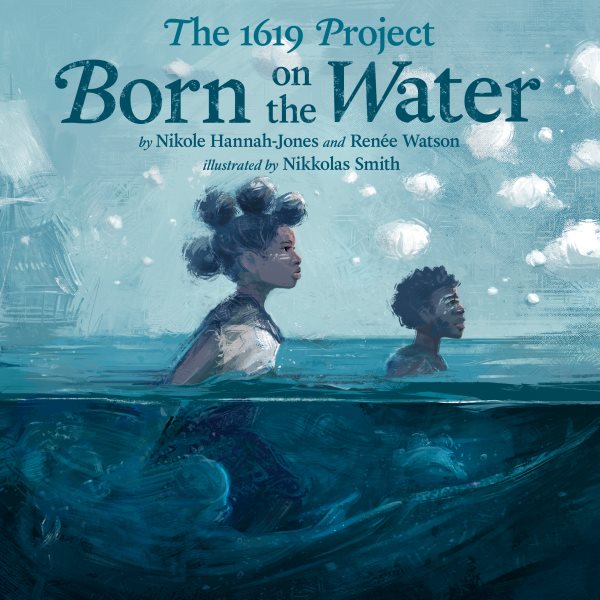
The 1619 Project: Born on the Water by Nikole Hannah-Jones and Renée Watson, ill. Nikkolas Smith


A class assignment to “trace your roots” leads one Black child to ask her grandmother about their family history. Grandma tells the story of Black pride and what it means to come from a resilient people that have loved, resisted, and persevered. I’d argue that with its mix of history alongside a fictional framing sequence, this book is more poetry than anything else. Each section is a poem, and the author even calls it as such in the back. This first came to my attention all thanks to our friends at New York Public Library. They were highlighting it first and I decided to see what all the fuss was about. What I found was an engrossing history of Black Americans from 1619 onward. But as author Nikole Hannah-Jones and Renée Watson say in their Author’s Note at the end, the intention here was to, “show that Black Americans have their own proud origin story, one that does not begin in slavery, in struggle, and in strife but that bridges the gap between Africa and the United States of America. We begin this book with the rich cultures of West Africa and then weave the tale of how after the Middle Passage, Black Americans created a new people here on this land.” The poems are strong, the history good, and the art is extraordinary. Definitely a good strong book for this section. 

The World Below the Brine by Walt Whitman, ill. James Christopher Carroll

Taking a poem and adapting it to a picture book format is a risky proposition. After all, poems rarely adapt to the 32-page format particularly well. Yet small independent publisher Creative Editions has always prided itself on doing precisely that. Sometimes it’s a gamble that doesn’t pay off, and sometimes you get something like this book. Here, artist James Christopher Carroll apparently decided that Marc Chagall was the way to go with his artist style. Chagall by way of Peter Sis, I should say, since the technical artistry on display here is highly detailed. I’ve been very good this year and limited my use of the term “luminous” as much as humanly possible, but I’m afraid I may have to pull it out for this particular book. The story (such as it is) watches as a boy and his sea creature pal dive deep down below the titular brine, seeing all the strange sites, and dangers, that lurk there. It’s a remarkably lovely bit of storytelling and must have taken ages to finish even one of these paintings. A different kind of poetry book, but a worthy inclusion to any shelf. 


Interested in previous years’ poetry? Then check out these beauties:

  • 2020
  • 2019
  • 2018
  • 2017
  • 2016

And here’s what else we have happening this month:

December 1 – Great Board Books

December 2 – Board Book Reprints & Adaptations

December 3 – Transcendent Holiday Picture Books

December 4 – Picture Book Readalouds

December 5 – Rhyming Picture Books

December 6 – Funny Picture Books

December 7 – CaldeNotts

December 8 – Picture Book Reprints

December 9 – Math Books for Kids

December 10 – Books with a Message

December 11 – Fabulous Photography

December 12 – Wordless Picture Books

December 13 – Translated Titles

December 14 – Fairy Tales / Folktales / Religious Tales

December 15 – Unconventional Children’s Books

December 16 – Middle Grade Novels

December 17 – Poetry Books

December 18 – Easy Books & Early Chapter Books

December 19 – Older Funny Books

December 20 – Science Fiction Books

December 21 – Fantasy Books

December 22 – Informational Fiction

December 23 – American History

December 24 – Science & Nature Books

December 25 – Autobiographies *NEW TOPIC!*

December 26 – Biographies

December 27 – Nonfiction Books for Older Readers

December 28 – Nonfiction Picture Books

December 29 – Best Audiobooks for Kids

December 30 – Comics & Graphic Novels

December 31 – Picture Books

Filed Under: 31 Days 31 Lists, Best Books, Best Books of 2021, Booklists Tagged With: 2021 poetry, 31 days 31 lists, Best Books of 2021, poetry

31 Days, 31 Lists: 2021 Middle Grade Novels

December 16, 2021 by Betsy Bird

This is a little unorthodox, but a nice librarian recently asked if I could move this list up in the roster this month because it would help her with her ordering. In retrospect, I suppose it would have made more sense to just email her today’s list directly, but what’s done is done. Consider it a holiday miracle!

Now comes the caveat. I simply haven’t read all the books on this list. But but BUT I have read most of them. The rest I’ve entrusted to the librarians at my workplace, who put in blood, sweat, tears, and more to make sure that they read some of the best books on offer. I trust them completely and the end result is a list that contains some truly remarkable books. Like so . . .


2021 Middle Grade Novels

Aftermath by Emily Barth Isler

Considering the fact that my kids have to participate in active shooter drills on a regular basis, it stands to reason that the plot of this book should touch on the reality behind it. Lucy and her family move to a town that experienced a massive school shooting a couple years before. Now entering the 8th grade, Lucy is the same age as the kids that witnessed and survived the shooting firsthand. And since no one really ever moves to this town, her status as the new kid is unique. Lucy, as it turns out, is living in the wake of her own family trauma. Her younger brother had a heart defect and died not long before her move. Now indulging in her love of math and joining an afterschool mime group, Lucy has a chance to make a new life for herself and for her classmates. It’s a dark premise but Isler keeps things nicely balanced throughout. Of course, for my part I was impressed by how well the author worked Lucy’s love of math into the basic text. It’s a tricky subject, and maybe I don’t agree with every choice the writer made, but on the whole it’s unique, full of math love, and emotionally balanced. Something to look out for then.

Amari and the Night Brothers by B.B. Alston

Men in Black meets Harry Potter! When Amari Peters discovers that her brother has nominated her to attend the Bureau of Supernatural Affairs she discovers powers she never knew she had. First and foremost, do NOT listen to the audiobook of this title. Whatever actor they hired, I found myself initially disliking the book thanks to her read (her terrible Irish accent alone is a crime against man). It was only when I read the book itself that it won me over. Amari’s a bit passive at the beginning and the end has a bit of the old deus ex machina to it, but there’s a lot of fun packed in these pages. It has some smart things to say about assumptions and though it piles the messaging on a bit thick, if you want something fun and fast, this is a darn good choice. Worth considering anyway.

Amber and Clay by Laura Amy Schlitz

A girl as precious as amber. A boy as common as clay. Two children in ancient Greece dance with bears, play with ghosts, and live in a time of gods and philosophers. I’m going to spend a long long time thinking about this one. To call it “ambitious” is to sell it short. Schlitz is incapable of merely writing a book set in ancient Greece. She has to write it in a wide variety of different styles, in keeping with the time period. She includes images of objects that would have had special significance to the main characters, thereby tying the storyline to the bits and pieces you might see in a museum. It really reminded me of A Single Shard in that respect (particularly the pottery). It looks like a brick but reads quite quickly. Plus any book where Hermes gets to interrupt continually is going to be fun. Like no other book you’ll ever read.

Here’s my interview with Laura about the book:

Ancestor Approved: Intertribal Stories for Kids edited by Cynthia Leitich Smith

An amazing group of Native writers contribute interconnected short stories about young people (and one cool rez dog, which is clearly a theme of 2021) heading to the University of Michigan Dance for Mother Earth Pow Wow – a real-life Pow Wow that has been going on for 48+ years. The stories in this book go a long ways towards providing much-needed windows into some of the struggles and joys of Indigenous youth identity development and experiences. It’s also nice to see something contemporary here. My librarians did feel that the book would have benefited from some visual elements. Often short story collections do a bit better if you can break up the blocks of text in some way with comics or art. Still, it’s a strong piece overall and a very nice addition to any collection.

The Beatryce Prophecy by Kate DiCamillo, ill. Sophie Blackall

A young girl, hunted by the king, is found in a monastery, bathed in blood, where she is nursed back to health by a monk. So begins this particularly epic medieval tale. Lyrical narration is supported by gorgeous black and white illustrations along the way. Has anyone else noticed that the medieval era is producing a whole host of award-winning children’s books lately? There was Gidwitz’s The Inquisitor’s Tale and Catherine Gilbert Murdock’s The Book of Boy. Now DiCamillo throws her hat into the ring. The book? It’s very good. I much prefer her all-human casts (with the exception of a singular goat) to her animal ones. Some of the best writing of her career, with everything that makes kids love her, as well as everything that makes adults love her too.

Being Clem by Lesa Cline-Ransome

If you are an author, it is good to find fellow contemporary authors to aspire to. Me? I aspire to someday lasso even a tenth of the emotional power of a Lesa Cline-Ransome novel. In a sense she’s sort of painted herself into a corner. This book is a companion to her previous books Finding Langston and Leaving Lymon. And yet it had been a long time since I read either of those books. Having completely forgotten their plots, I came into Being Clem cold and I can tell you for sure and for certain that it stands entirely on its own. There isn’t so much of a whiff or a hint that there are other books out there. And this book may be one of the best written, most enjoyable of this year. Seriously. You other authors out there need to read this to get a sense of how to write with the least amount of fat. There’s not an excess sentence or superfluous scene in this book. I had the distinct pleasure of listening to the audiobook and reader Dion Graham KILLS IT with his rendition. He made the jokes work. He put real emotion into every page. Sometimes I have to drag myself back to continue listening to an audiobook. Not this one. I kept finding excuses to listen to more. I certainly hope the Newbery committee puts aside the whole this-is-a-companion-novel nonsense and judges this book on its own merits because it is far and away high time Ms. Cline-Ransome got herself some shiny gold. This book would completely deserve it.

Black Boy Joy: 17 Stories Celebrating Black Boyhood, edited by Kwame Mbalia

Look at that cover! Did you know that Kadir Nelson could paint happy people too? That’s a good sign. Inside the book, seventeen stories by acclaimed Black authors celebrating joy form a collection that has humor, heart, science fiction, action, a story in verse, and even a new comic by Newbery-winner Jerry Craft. All short story collections are going to have their highs and lows, but I was impressed by how consistently high the quality was on these stories. Some are a bit complicated, while others breeze by. And in the past year that we’ve had, we desperately need a book that includes a little joy into our lives, wouldn’t you say?

The House That Wasn’t There by Elana K. Arnold

This book is about Southern California, magic, and strong ties of family. Oh, and feline teleportation. It starts out when Alder gets a new neighbor. Alder is determined not to be friends with her, but it seems the universe is bringing them together. The thing you can always say about Elana K. Arnold is that she is adept at gentle boys. I always feel a certain level of safety with an Arnold book. This is a bit more sophisticated than her “Bat” series, though. I did find that the story takes a strange right-hand turn midway through that I didn’t expect. I’d call this less realistic fiction and more magical realism, but that didn’t bug me. Likewise, normally when someone engages in too many coincidences in the storytelling I get bugged, but here it just seemed like a fun series of twists. I enjoyed how it all came together.

It Doesn’t Take a Genius by Olugbemisola Rhuday-Perkovich

 If he’s not guaranteed to win then super smart Emmett doesn’t want to play. But when Emmett’s beloved older brother Luke says he’s going to work at a fancy Black summer camp, Emmett finds a way to tag along. Will he still be a boy wonder or something a lot more complicated? Oo! I like this one! Granted, Olugbemisola likes to pack a LOT of words on a page, so this one took me longer to read than I would have necessarily liked. Even so, this is a real fun book. Emmett is both smart as a whip and really good at self-sabotage. There are moments where it feels like the author just wants to pack as much history and current talking points into the narrative as possible (even the problematic nature of Dr. Seuss makes it into this book) but you stick with it because you’re invested in Emmett. I found the ending satisfying and that cover image by Gordon James? He must have read the book cover to cover because that IS Emmett. You literally couldn’t imagine him any other way if you tried. Big time fan over here. 

The Last Cuentista by Donna Barba Higuera

When Petra escaped Earth with her family for a new life, she had no idea what would happen when she awoke. Now it’s 300 years later and she’s the only person left with memories and stories of the past. What went wrong? And how can she survive? Oh, I like this one very very much! You might not be able to tell from the cover but this is straight-up science fiction with a Latinx heroine. It even works in a couple classic Southern American folktales along the way (including a rendition of Blancaflor that you may have already seen on my Fairy/Folk/Religious Tales list). I was surprised to find that I could never quite figure out where it was going or what was going to happen next. Higuera keeps you guessing and so I was completely unprepared for a huge twist that happens not too long before the end. If you’re looking for something completely different and completely enthralling, this is your best bet.

The League of Picky Eaters by Stephanie V.W. Lucianovic

I come from a long, storied line of picky eaters. It’s not something folks usually talk about, and to this day I cannot eat beets. Can’t do it. If I were a judge on a Food Network television show and the challenge was for the contestants was to create some delicious beet-based recipe, I’d be outta there in a flash. All this is to say that I am very on board with Stephanie’s middle grade novel. In case you didn’t know, she’s the author of the adult work of nonfiction Suffering Succotash: A Picky Eater’s Quest to Understand Why We Hate the Foods We Hate. Performing poorly in her “eating placement test” at her school, our heroine Minerva is sent to the Remedial Eaters class. For any kid that’s felt completely misunderstood when it comes to what they feel they can and cannot eat, this book is going to sing to them. Now keep them dang beets away from me!

Long Lost by Jacqueline West

A middle-grade, ghostly mystery about two young sisters who move to a secretive, small town — the streets are quiet, the houses are old, and whispers echo in the corners. When younger sister Fiona seeks refuge in the town’s ancient library, she finds a book which tells the legend of a local girl who went missing nearly 100 years ago. Some say she died; others say a monster called the Snatcher got her. No one knows for sure, but Fiona is determined to finally give this story an ending. Talk about nicely atmospheric! And just get a look at that cover. Stunning. This is a smartly done fantasy/mystery with a strong, solid foundation in the main character’s relationship with her own sister. I liked the pacing, the clues, and I particularly liked the setting. West has really grown into her own over the years as a fantasy writer for kids. This will prove quite alluring to our fantasy fans.

Long Road to the Circus by Betsy Bird

So I run this marvelous committee out of my library every year that determines the 101 Great Books for Kids. It’s something I stole from my former employer New York Public Library, and I absolutely love running it. Now here’s the problem. I also write books for kids. And putting your own book on the committee that YOU created and help run… that’s a bit skeezy, isn’t it? It’s a little “Oh wow! What a coincidence! A book I wrote made it onto this list I run!” Yech. So it was with a tiny bit of sadness that we made sure that Long Road to the Circus, my debut novel, didn’t make it onto our list. That said, I suffer no such compunctions with today’s list. Why? Because unlike my work’s committee, this is a one-woman show. And as such, I actually think my book is kind of good. If you haven’t heard of it before, it was born out of a crazy coincidence. You see, my grandmother’s no good uncle used to skip out on his farm chores when she was a kid. Why? Because he’d walk on over to an elderly ex-circus performer’s house to try to learn how to teach the farm horses circus tricks. Her name? Madame Marantette. Fast forward to the future and Caldecott Award winning illustrator David Small actually lives IN the Marantette House! I thought a picture book might come out of this story. David, however, saw it as a novel. The end result? A kooky tale about Suzy, a girl determined to get out of small town Michigan and into the big bright world. And how’s she gonna do it? Well… you ever seen a lady ride an ostrich side saddle? You will. It’s a goofy little thing, but I’m fond of it. And the New York Times recently included it on their list of 25 Best Children’s Books of the Year, so that’s something.

The Losers at the Center of the Galaxy by Mary Winn Heider

Siblings Louise and Winston encounter a series of weird happenings at their school. Do these oddities have anything to do with why their teachers are behaving so oddly? Meanwhile, the two hope their football player dad returns home after disappearing suddenly. Consider this a Chicago-based mix of absurd humor and heartbreak. Readers of this book get to take a deep dive into a truly wacky series of unpredictable events. Mind you, the whole reason that this works is that Heider never abandons the heart of the novel, even in the midst of chaos. Loved the jokes. Loved the characters. Loved how prevalent Darth Vader’s “Imperial March” was. Like nothing else out there. 

Lotería by Karla Arenas Valenti

Each year Life and Death play the card game Lotería with a single soul held in the balance. Unknowingly, young Clara plunges deep into a fantasy world, determined to save her missing cousin, not knowing that her fate rests in the cards. I’ve enjoyed watching the slow burn of this novel as it catches interest throughout the year. It’s rare to find a middle grade novel with an ending quite as bittersweet as this one too. I loved the way in which the magic realism just filtered through this storyline from the start. There’s something so enticing about any story where Life and Death play at such enormous stakes. Valenti does a marvelous job of taking a large number of ideas and plot points, weaving them together expertly by the end. How can one even resist?

Maya and the Robot by Eve L. Ewing, ill. Christine Almeda

Wanting to show off her serious science prowess, Maya fixes up an old robot and gets more than she bargained for. Let me just pause here and draw up some of the adjectives I’ve heard my children’s librarians use in tandem with this book. Let’s see… we have “sweet”, “funny” and “heartfelt” right off the bat. I’m also seeing “cute” and “positive” with a special emphasis placed on how great it is to see a book with a Black girl science genius at its core. All told, it’s hard to resist a book with this much heart and good humor. Deserving of a special place on any list.

Much Ado About Baseball by Rajani LaRocca, ill. Chloe Dijon

Being the only girl on a new baseball team is tough enough, but Trish never expected to be playing alongside rival math prodigy Ben. Can the two become friends in spite of their competition or will it take a bit of magic? I am constantly on the lookout for sports sports sports! Trouble is, they’re actually rather hard to find (especially starring girls). So to find a book that combines baseball, math, and Shakespeare in equal parts is rather amazing. Though I read Rajani’s previous companion book to this one (Midsummer’s Mayhem), I don’t think you need to have read it to appreciate this one. And to confess, I’m a bit of a nerd about the math in books forwarding the plot and being good. This book incorporates it expertly

Pity Party by Kathleen Lane

A deft and daring collection of stories, quizzes, advertisements, and more. A book for anyone who has ever wanted a funny, strange, sad book to soothe their anxieties.  I’d call this a pretty good example of not judging a book by its cover. This is essentially “Black Mirror” for kids. Or maybe it’s more Ray Bradbury. Whatever it is, it’s short fiction and a lot of fun. Some stories circle around and around. Some come up and then disappear again. This is the rarest of all beasts: child satire. It has a dry sense of humor, and embraces nonsense in a rather refreshing way. My favorite story is probably “Imposter” because it feels so specific as to be eerie, and is so universal at the same time.

Playing the Cards You’re Dealt by Varian Johnson

Ant hopes to impress his dad by becoming the next in his family to win a card tournament. However, he must deal with some surprising truths that throw him off his game. I think that any book that has managed to attain the impossible Jason Reynolds / Christopher Paul Curtis dual blurb (one on the front and one on the back) has already floated to upper echelons that we mere mortals cannot hope to attain. And then there’s, y’know, the actual book itself. Varian’s juggling so many different ideas, all at the same time. There’s what it is to be a man, should you try to help someone you love even if they’ve hurt you, hyperbole, a big card game, grief, and joy. Put simply, this is an impressive next step in Varian’s perpetually interesting career.

The Raconteur’s Commonplace Book by Kate Milford, ill. Nicole Wong

Twelve guests, trapped at the Blue Vein Tavern by floodwaters, tell stories to pass the time.  An infinitely clever tale of the crossover between storytelling and reality. I am happy to report that even though this book is set in the universe of Greenglass House it is not a sequel. There are neat little details for fans of Milford’s other books to pick up on, but they’re more like Easter eggs than anything else. The book itself is marvelously skilled. It starts out by feeling like a series of unrelated stories. Then, as it proceeds, the stories grow closer and closer together, and the people in the inn get more and more interesting. After I finished I had to go back and reread all the parts between the stories just to see what I’d missed (and I’d missed a lot). An ideal book for new and old fans of Milford alike.

Rez Dogs by Joseph Bruchac

During the pandemic, Malian has to shelter in place with her grandparents. While doing so, she learns fascinating truths about her family and the struggles they endured. And then a mysterious dog arrives. Bruchac does the audiobook and it hardly takes any time to listen to since it’s so short. On the day that I listened to it I needed a gentle book about family and history, and this one provides precisely that. A good and quiet novel.

Root Magic by Eden Royce

If any of you ever teach a course on How to Write a Great First Chapter, I hope you use this book as one of your examples. Eden Royce grips you with her writing and turn of phrase right at the start and that passage echoes so beautifully later in the last chapter as well. I would advise you NOT to listen to the audiobook, though, if only because the reading is a bit too slow for my tastes. Brought up to speed this book is a skilled mix of folklore and American history. I was a bit worried that the defeat of the villain would feel cheap if it was solved via magical means, but then Royce EARNS that ending. Color me seriously impressed.

Sorry for Your Loss by Joanne Levy

Quilling, grief, and Jewish funeral traditions come together in Levy’s slight, spare, tight novel. Evie doesn’t want friends. Nope. Not happening. This decision is made all the easier by some of the girls at school who call her “Evil” and “Zombie Girl”. Why? Because her parents run the local Jewish funeral home. Evie’s determine to become a funeral director herself someday, but when her family handles the death of two young parents she starts to wonder if she’s cut out for the job. Into her life comes Oren, the son of the dead. He’s traumatized, refuses to speak, and Evie has no idea how to handle him. After a while, though, the two grow close, each harboring secrets from the other that are bound to come out. Lotta tears and a lotta hugging in this one, but you won’t mind. Levy comes by her emotions honestly and with blurbs on the back from folks like Adam Gidwitz and Lisa Brown, you know I’m not the only one who likes it. I found Levy’s writing to be incredibly easygoing, even a pleasure. Kids with curiosity about what happens to our dead will get a very specific answer with this look into Jewish funeral traditions. Some of these I’d heard about from Dancing At the Pity Party, like the black ribbons you rend. Some were new, like the use of unpainted broken pottery pieces. And this book really commits to its Jewish characters. It’s not briefly mentioned and then forgotten, like in some books. Really well done from start to finish. 

Thanks a Lot, Universe by Chad Lucas

Music-loving Ezra has developed a crush on his shy, nervous friend Brian and cannot tell anyone. Meanwhile, Brian has to land on his feet after a major family crisis. Good audiobook! So I should mention right off the bat that this is an amusing book to read if you’re not aware that it’s set in Canada. Initially, there’s nothing to give that fact away, but then as it progresses you start to have your suspicions. I must say that in a year when bullying has been the go-to for too many middle grade novels, here it’s not a central focus of the plot at all. I thought this was a very mature look at the complexity behind trauma and, fascinatingly, the different rates at which kids mature when it comes to emotional relationships. Sweet and careful. 

Too Bright to See by Kyle Lukoff

Bug’s house has always been haunted but it wasn’t until Uncle Rodrick died that things started to get weird. Is Rodrick trying to tell Bug something? And is it something Bug’s ready to hear? “Doll Bones meets a trans narrative.” That’s how this book was sold to me and, I gotta admit, it hooked me cause I like both of those things. If the name “Kyle Lukoff” sounds familiar then you may be thinking of his Max books and the Stonewall Award winning When Aidan Became a Brother. This book does go full on horror, but does have a couple deliciously creepy moments. The remarkable blending of haunting and trans discovery is expert. I really think Kyle’s tone here is pitch perfect. No one writes uncertainty better than he does. Plus, considering how many middle grade novels I read in a given year, I loved the moments where Bug would say stuff like, “If this were a book then . . .” and immediately zero in on some trope that I hate. Honestly, the best trans middle grade book I’ve ever read. 

Trouble in the Stars by Sarah Prineas

Trouble has no memory of his past but he knows one thing: He’s a shapeshifter, the only one in the galaxy, and now he’s just stowed away on a spaceship to who knows where. Oh yes! I’ve finally found a science fiction novel that I can seriously promote today! And talk about economics of the writing. This book knows how to do character development in a shockingly short amount of time. What could feel like you’re watching a play (since for a lot of this book the characters are on a very small spaceship) instead manages to keep the action hopping. Trouble is such a likeable character, and I was getting a real Guardians of the Galaxy vibe from his motley crew. This is space scoundrel lit at its best. Highly recommend!

The Wild Huntsboys by Martin Stewart

Set in a futuristic England at war, three boys find themselves in danger when they anger the fairies and must battle enemies on every side. I just regret it took me this long to read this book. After reading a lot of “meh” fantasies this year, I needed a book with great writing that was funny and smart. This book checks off each and every last one of those boxes. Few authors could successfully meld dystopia with fairies in a middle grade title, but Mr. Stewart manages it. I highly recommend you get the audiobook as well. Right from the get-go you’ll enjoy the reader. He has to do a wide range of accents and rarely disappoints. We’re going to need some fun fantasies on our list and this gets my vote. 

The Year I Flew Away by Marie Arnold

I HIGHLY recommend that you check out this book’s audiobook. Arnold reads it herself and when she gets to the part where Gabrielle gives up her accent, she stops reading in an accent as well. It’s subtle and smart. Loved the telling overall. Pairs nicely with Root Magic, but from an entirely different angle.


Curious about past middle grade lists? Then check out the ones from previous years!

  • 2020
  • 2019
  • 2018
  • 2017
  • 2016

And here’s what else we have happening this month:

December 1 – Great Board Books

December 2 – Board Book Reprints & Adaptations

December 3 – Transcendent Holiday Picture Books

December 4 – Picture Book Readalouds

December 5 – Rhyming Picture Books

December 6 – Funny Picture Books

December 7 – CaldeNotts

December 8 – Picture Book Reprints

December 9 – Math Books for Kids

December 10 – Books with a Message

December 11 – Fabulous Photography

December 12 – Wordless Picture Books

December 13 – Translated Titles

December 14 – Fairy Tales / Folktales / Religious Tales

December 15 – Unconventional Children’s Books

December 16 – Middle Grade Novels

December 17 – Poetry Books

December 18 – Easy Books & Early Chapter Books

December 19 – Older Funny Books

December 20 – Science Fiction Books

December 21 – Fantasy Books

December 22 – Informational Fiction

December 23 – American History

December 24 – Science & Nature Books

December 25 – Autobiographies *NEW TOPIC!*

December 26 – Biographies

December 27 – Nonfiction Books for Older Readers

December 28 – Nonfiction Picture Books

December 29 – Best Audiobooks for Kids

December 30 – Comics & Graphic Novels

December 31 – Picture Books

Filed Under: 31 Days 31 Lists, Best Books, Best Books of 2021, Booklists Tagged With: 31 days 31 lists, Best Books of 2021, middle grade, middle grade fiction, middle grade novel

31 Days, 31 Lists: 2021 Unconventional Children’s Books

December 15, 2021 by Betsy Bird

We’re almost halfway through our 31 Days, 31 Lists series, and today things are getting weird! Or, put more politely, unconventional. In the old days I wasn’t sure what to name this list. Weirdo books? Odd books? It was Travis Jonker who came up with the term “unconventional” and so, as with all good things, I up and stole it from him. You are hereby encouraged to go to Travis’s blog and read his post on The Most Astonishingly Unconventional Children’s Books of 2021. Some of these books are on there and some are most certainly not.

Now prepare to enjoy some books that upset your expectations in all the best ways.


2021 Unconventional Children’s Books

Alien Nation by Sandro Bassi

All I can say is thank goodness for Travis Jonker’s regular post on The Most Astonishingly Unconventional Children’s Books of 2021. Where else would I have encountered this wordless work by Venezuelan artist Sandro Bassi? Created entirely in black and white, it’s a little bit Shaun Tan, a little bit Brian Selznick, and a whole lot the movie They Live. On the outset it sounds dull. Commuters ride the subway trains to work. But visually this is an eye-popper. Each person has a bizarre concoction for a head. It might be tentacles or crystals. It might be all eyes, no eyes, interlocked wooden puzzle pieces or free floating balls. The bodies themselves are normal and contemporary and slowly you come to realize that everybody is looking at their cell phones. Everybody, that is, with the exception of a child in a stroller. The kid has a prism for a head, and manages to locate an old cordless phone. When the subway enters a tunnel the lights go dim, the cell phone service is disrupted, and the child’s head opens like the demi-gorgon in Stranger Things. That’s when everyone’s head starts to disengage. It’s a trip (pun intended) to say the least. A marvelous mix of the mundane and fantastical.

Before I Grew Up by John Miller, ill. Giuliano Cucco

I like a book that reads like a dare. As I may have mentioned before, I prefer to come into a picture book relatively blind. I read this title cover to cover and liked it, but found it so very strange. The text was relatively straightforward, though. In this story, Giuliano reminisces about his life and how, in a sense, he ultimately became an artist. The art, meanwhile, always relates to the text, no matter how wacky that art may be. It wasn’t until I got to the end and discovered the story behind the story that things got interesting. Apparently this is all posthumous. Cucco created this art, but it never saw the light of day. When he died in a traffic accident, John Miller reached out to the family and discovered that Cucco’s son Giovanni was cataloging everything left. Taking some of these pictures, Miller weaves together a story that adapts the surreal nature (and it does get surreal) of the images to the life of an artist as a young man. This is a book for dreamy children, for incipient artists, and for kids that like a little quiet beauty in their stories.

Black Sand Beach: Do You Remember the Summer Before? by Richard Fairgray

I don’t put a lot of sequels on my lists but, to be fair, there are very few people working in the field of children’s comics right now with the guts to go weird. And Fairgray has never, to the best of my knowledge, disappointed in this respect. Now if you decide to read this latest in the Black Sand Beach saga, be warned. There is a price to pay for not reading or rereading the first book in the series just before reading this book. It’s just as weird. Just as gross. It’s got a vibe no one can match. I adore this horrible horrible world.

Cardboardia: The Other Side of the Box by Richard Fairgray and Lucy Campagnolo, ill. Richard Fairgray

Okay, one of these days I’m just gonna have to meet Richard Fairgray once and for all. The man has such a keenly skewed sense of humor. It’s the kind of humor we need to see more of in our children’s literature. Now I know that when you look at this book you might, like me, wonder how similar it is to Cardboard by Doug TenNapel (a comic creator that could give Fairgray a run for his money in the weirdness department). There are some similarities in the logistics of a cardboard world, but I’d say this book has an entirely different feel and take. I also adored the hidden jokes. Fairgray cannot physically draw a sign on a wall in a school without making it funny. Some personal favorites: “Make Every Day Spaghetti Wednesday”, “Name Calling Is for Dweebs”, “Viva La Evolution”, and a personal favorite of Comedy = Tragedy + Time made into a pyramid. Wherever this crazy train is going, I wanna ride it to the end.

It also wins the Best Dedication of the Year Award:

Have You Seen Gordon? by Adam Jay Epstein, ill. Ruth Chan

Usually when I’m discussing unconventional picture books I tend towards the visually eclectic and wacky. But there’s a subsection to this category that could easily go missed if we aren’t careful. That relates more to those books that defy conventions. The nice thing about Epstein and Chan’s book is that it’s really zeroing in on seek-and-find books while also, somehow, miraculously, being a book about consent. That’s a kooky combination that takes a certain level of finesse. At the start it’s pretty standard. The reader is asked to find a purple (anteater? elephant?) fellow by the name of Gordon. Then, at a certain point, Gordon just doesn’t really care about hiding anymore. Frustrated the narrator decides we’ll be trying to follow Jane, a blue rhino construction worker, instead. But Jane has even less interest in being “found”, particularly as she is (in her own words) “kind of shy. I don’t like a lot of attention.” It’s Gordon who has to interrupt and explain that maybe the best course of action here is to find someone who WANTS to be found, for a change. I love the way the book turns what looks so seemingly simple at the start on its head. There are some pretty keen in-jokes for parents in Chan’s art too, like a spider shop in the mall of high end clothes called (I kid you not) “Arachnopologie”. Also, if a certain cheeky axolotl gets its way, we may be seeing it in a sequel in the future (inspect the pictures carefully to see why).

Infinity by Pablo Bernasconi, translated by Evelia Romano

[Previously Seen on the Translations List]

Initially I mistook this book for a work of poetry, and even after I finished reading it through, I wasn’t wholly convinced that I was wrong. This little Argentinian import attempts to define the infinite via the mundane. Thus you end up with little conundrums like “It’s a carpenter waiting for the love of his life in the wrong life.” Each phrase is accompanied by an illustration that’s this amazing mix of models, photography, paint, digital tinkering, and more. With a hat tip to mathematicians, some of the pages have equations in their corners that “capture and represent a take on the concept of infinity”. It is overwhelmingly an import and not of American make or design. Why do I say that? Because it’s so incredibly original. A lot of Americans won’t get what it’s doing, but some might. I think the dreamy kids, the dreamy teens, the dreamy college students, and beyond will get a lot out of this title. Or, at the very least, they’ll stretch their minds to their fullest as they attempt to figure out riddles like, “It’s the formula for happiness hidden in a cow’s hide. But on the inside.”

The Lost Soul by Olga Tokarczuk, ill. Joanna Concejo, translated by Antonia Lloyd-Jones

[Previously Seen on the Translations List]

The one and only time I made it to the Bologna Book Festival I was awed by the plethora of massive, beautiful, and strange (to my eyes) art that was submitted from countries whose books never make it to American shores. And while I am sure that this isn’t the first Polish picture book I’ve ever encountered, I certainly won’t be able to forget it. I suppose I should have been warned when the blurbs on the back were from folks like Annie Proulx. You know. Novelists.  But that’s just because Olga Tokarczuk is, herself, a professional writer for adults. I do believe I once purchased her novel Drive Your Plow Over the Bones of the Dead (good title) for my library. This particular book already received a special mention of the Bologna Ragazzi Award in 2018. To read it is to feel as if you’ve fallen into a work that is equal parts Shaun Tan and Sebastian Meschenmoser. The story is one we’ve seen many times here in America, however. The message is to slow down and enjoy life. Why? Because if you move too fast you’ll leave your soul behind you and it may take a while to catch up. A reread of this title rewards the reader since you can catch glimpses of the hero’s soul long before you realize that that’s what it is. It has a surreal touch and an interesting use of color. It’s also a very soothing book. Odd. But soothing. Recommended indeed.

The Museum of Everything by Lynne Rae Perkins

“If you like to be in a quiet place sometimes (even if it’s only in your mind), or if there is a lot that you wonder about, or if you like to make things, I made this book for you.” Boy, man. That Lynne Rae Perkins. I swear, whole years can go by and she won’t write a picture book, and then when she does it’s just so completely from left field that you never see it coming. This book is a passion project of hers, that’s clear from the outset. In this book, a kid speculates on the ephemeral things in life you might be able to build a whole museum around. Basically, it’s like if you calmed a Dr. Seuss book way way down, took out the rhymes, and then gave it a shot in the arm of Heavy Introspection. The narrator is almost perfectly genderless, or either gender depending on your preference (though the summary on the publication page says they’re a girl, which I reject as merely a possibility). Eventually it’s all skirts made of bushes, hiding places, variations in shadows, and the transient nature of Sky Museums. Don’t mistake this book for one that’s asking “Big Questions” because the questions here meander onto the page the same way your mind meanders on a hot day. Perkins mixes up her media with plenty of (as she calls it) “odds and ends” alongside her usual watercolors. The end result isn’t really like other books out there. It’s for the dreamy kid. You know the one.

No One Is Angry Today by Toon Tellegen, ill. Marc Boutavant, translated by David Colmer

[Previously Seen on the Translations List]

There goes Toon Tellegen again. Writing in his inimitable style. Confusing Americans everywhere. Don’t get me wrong, because I really like the weirdness in his tales. And when you combine such words with the art of Marc Boutavant (who is clearly giving this book 100% of his attention) then you’re bound to end up with a pretty product. But the same guy that brought us The Squirrel’s Birthday and Other Parties back in 2009 is now going full on wackadoodle here. There is no better way of showing this than you give to you the first and last stories in his latest collection No One Is Angry Today. The first story The Firebelly Toad and the Hedgehog has a lot less to do with the hedgehog in question than it does with the toad. In the story the toad abuses a number of his neighbors, questioning whether or not they’re really angry. In the end, they all come to the conclusion that maybe the toad’s right. Maybe none of them can even hold a candle to how angry he is. How can you ever know what another person is truly feeling? The last story is the strangest of the book. Called “The Scarab”, consider this the anti-epistolary story. In it, you watch a scarab and a dung beetle write one another letters. You never hear what is in these letters. You just see how they react to them. The last image is of the dung beetle’s letter ot the scarab sitting in the snow, forlorn and unread, while the dung beetle waits in vain for a response that will never come. Americans like myself are used to happy endings. Hand this book to the child that isn’t afraid of a book to end a little mournfully once in a while too.

Off the Beaten Track by Maylis de Kerangal, ill. Tom Haugomat, translated by Helen Mixter

[Previously Seen on the Translations List]

Here’s the thing about the publisher Greystone Kids: That’s a company that isn’t afraid to take a risk once in a while. Some publishers of overseas picture books want a guaranteed win and sell. Greystone? They aren’t afraid to get a little weird once in a while. Case in point, this book. I read it cover to cover but it wasn’t until I read the “How this book was made” section at the end that things started to fall into place. Apparently artist Tom Haugomat was given free reign to just make his art without the impediment of pesky things like words or a plot. Once he’d finished the images for this book it was up to Maylis de Kerangal to construct a story. What could have been a rote tale of a boy’s heroism when his adult friend is injured becomes something much more dreamlike and strange in her hands. There are many mysteries to the story. What happened to the boy’s parents? With whom does he live now? And how do things go so wrong so quickly for the mountaineers? The use of negative space on the pages is almost as fascinating as the boy’s interior life, hope, dreams, and fears. It’s not just the art that uses negative space either. The text does as well. You have to read around the missing facts. A truly captivating title. Hand it to slightly older readers (the ones who feel they’re too old for picture books) to get their take on it.

Once Upon a Time There Was and Will Be So Much More by Johanna Schaible

[Previously Seen on the Translated Titles and Caldenott Lists]

I’ll confess that I knew that this book was an import when first I saw it. Why? Because it feels like a Bruno Munari redux, baby! Schaible is doing something particularly keen and original with this title. This is a book that pulls back right at the start, zooms in, and then pulls back again. The first page shows the early Earth. “Billions of years ago, land took shape.”. We see this gorgeous spread of thick paints that look like volcanic rocks as well as the splatter of lava as it surges on the page. These acrylics, mixed with the cut paper technique, are truly beautiful, evocative of Ed Young. But what’s cool is that as you turn the pages the time period shrinks. Now we look at images from “millions of years ago”. Then it’s “hundreds of thousands”, right on down until you get to “A minute ago” and then “Now!”. As the time shrinks, so too do the pages. Then (and this is particularly cool) it expands. We look to the future. To a minute from now, a day, a week, a year. And the pages expand as well until the child is considering what it is that they’ll look back on when they’re old. “What do you wish for the future?” We don’t always expect our books to become quite so philosophical and vast. This one is a wonder that makes you wonder.

Sato the Rabbit by Yuki Ainoya, translated by Michael Blaskowsky

[Previously Seen on the Translations List]

“One day, Haneru Sato became a rabbit.” After putting on a bunny suit, a boy engages in a series of small, charming adventures in this  beautifully rendered Japanese import. This book is dreamlike but with a strange internal logic and energy that I really dig. And yes, it does seem a little like Where the Wild Things Are since it begins with Sato putting on his rabbit suit. But just as Max transformed into a Wild Thing thanks to wearing the suit of a wolf, so Sato transforms into this calm, Zen, unperturbed bunny dude. The book consists entirely of small, sweet adventures. My favorite is when he looks at a puddle of water, reflecting the sky and realizes it is actually a window TO the sky. It’s not your usual book, and that’s why it works.

The Sea by Piret Raud

And they don’t get any more unconventional than Estonian author/illustrator Piret Raud. How odd is it? Let’s just say that the negative space of the water takes on a personality of its own while fish and shells become its facial features. That’s cool in and of itself, but when the sea takes off for parts unknown and leaves the fish behind, those fish are some kinda marvelous nightmare seafood, that’s for sure. I think this has something to do with the fact that you can pretty much see their innards at all times. Or maybe it’s that shot of them weeping with their mouths full of teeth. In any case, this is a tale of a group of fish that love stories so much, they’d trade their own lives just to hear them. I found it unnerving and lovely (and one does not preclude the other).

This Is Still Not a Book! by Jean Jullien

It’s not a party until a Jean Jullien board book has entered the room. For those of you familiar with Jullien’s board book outing This Is Not a Book, I can at least promise you a significant decrease in butts. This book is a butt free zone. Yet like its predecessor it takes a certain childish glee in upsetting expectations. I enjoyed the surprise that comes even after you just open the front cover, but the pages that I loved the most involve an elephant. It’s not intuitive. You don’t know that it’s an elephant at first. But when you unfold the pages and hold them correctly, there’s nothing else it could be. Jullien, being a French creator to his core, gets away with ideas and creative measures that I’m sure some American illustrators would envy. Thank goodness for imports. As weird as its predecessor, and that’s saying something.

The Two Fridas, memories written by Frida Kahlo, ill. Gianluca Folì

[Previously Seen on the Translations List]

Well, that’s an interesting idea. I don’t think I’ve ever seen anyone do this before. Have you? Have you ever seen someone take a famous person’s words from their diary about their youth and then turn them into a 32-page picture book? A bit ballsy, wouldn’t you say? Without reading the premise beforehand, when I started reading this book I had the very keen sense that the writing was not intended for young readers. Here, I’ll show you what I mean: “I must have been six years old when I formed an intense imaginary friendship with a girl…” Not that a kid wouldn’t necessarily understand this. You just don’t find the phrase “intense imaginary friendship” in picture books all that often. The book is strange and dreamlike and quite enjoyable. It’s a little difficult to determine if the person breaking up the text was Folì or the Editorial Director Fernando Diego García. Whatever the case, it makes for a wholly unique book. Could be nice if it were part of a series. Just saying.

What You Don’t Know: A Story of Liberated Childhood by Anastasia Higginbotham

Had you asked me if I thought I’d see a picture book out this year that contained multiple inclusions of Billy Porter, Jesus, and Mitch McConnell I might have believed you but I might also have backed away slowly as I did so. Higginbotham is known for tackling downright impossible issues in her books. Whiteness (and all that that entails), Death, Sex, and Divorce have already been clear cut, so what else is there to do? How about something for the queer kids? Lest you imagine this to be your standard 32-page fare, this is 143 pages in total. Baker & Taylor is selling it as Fiction, though it could just as easily be labeled YA or a graphic novel or an early chapter book. Since there’s a fair amount of asterixed swearing, I suspect most libraries will put it in places for their older readers, but you never know. Considering that the art is a mix of cut paper and photography and fabric and what have you, I cannot even imagine how long it even took to make. In the end, this is the kind of book that melds genres as often as it melds artistic mediums. But with its story of Demetrious who only wants to smash stereotypes, you’ll understand why it’s being called a picture book for 8-12 year-olds.


Curious about other unconventional titles? Then check out these previous lists:

  • 2020
  • 2019
  • 2018
  • 2017
  • 2016

And here’s what else we have happening this month:

December 1 – Great Board Books

December 2 – Board Book Reprints & Adaptations

December 3 – Transcendent Holiday Picture Books

December 4 – Picture Book Readalouds

December 5 – Rhyming Picture Books

December 6 – Funny Picture Books

December 7 – CaldeNotts

December 8 – Picture Book Reprints

December 9 – Math Books for Kids

December 10 – Books with a Message

December 11 – Fabulous Photography

December 12 – Wordless Picture Books

December 13 – Translated Titles

December 14 – Fairy Tales / Folktales / Religious Tales

December 15 – Unconventional Children’s Books

December 16 – Middle Grade Novels

December 17 – Poetry Books

December 18 – Easy Books & Early Chapter Books

December 19 – Older Funny Books

December 20 – Science Fiction Books

December 21 – Fantasy Books

December 22 – Informational Fiction

December 23 – American History

December 24 – Science & Nature Books

December 25 – Autobiographies *NEW TOPIC!*

December 26 – Biographies

December 27 – Nonfiction Books for Older Readers

December 28 – Nonfiction Picture Book

December 29 – Best Audiobooks for Kids

December 30 – Comics & Graphic Novels

December 31 – Picture Books

Filed Under: 31 Days 31 Lists, Best Books, Best Books of 2021, Booklists Tagged With: 31 days 31 lists, Best Books of 2021, unconventional, unconventional children's books, weirdo children's books

31 Days, 31 Lists: 2021 Fairy Folk, and Religious Tales

December 14, 2021 by Betsy Bird

Back in the day, say 30-40 years ago, this list would be a mile long. It would rival my Translations or Board Books lists in terms of sheer length. Now? Often I feel lucky if any of these books make it to the general market. Too often religious tales belong to small religious presses with their own in-grown distribution. Meanwhile fairytales and folktales are like mushrooms. You have a general sense when they’ll crop up but you never know quite where. Well, folks, they’re cropping up here today and I certainly hope you enjoy them. I did. Each and every last one.


2021 Fairy, Folk, and Religious Tales

Baby Moses in a Basket by Caryn Yacowitz, ill. Julie Downing

You know a picture book’s good when you read it, come back to it later, and can’t remember whether it was based on an old hymn or was an original work. By gum, if some smartie doesn’t set this book to music and pronto, they’ll be missing out on a huge opportunity. This is the story of Baby Moses floating down the Nile and encountering a wide array of different reptiles, birds, and animals along the way. I was charmed by the gentle rhymes and the art that is all at once hyper-realistic and cartoonishly sweet, but what really struck me was the choice of animals Moses encounters. Ibis. Hippo. Crocodile. Each is marvelously rendered. And then that incredibly sweet shot of Pharaoh’s daughter holding the baby to her chest . . . Julie Downing’s outdone herself. If her name sounds familiar you may have seen her work on Linda Sue Park’s The Firekeeper’s Son or Ji-li Jiang’s Lotus & Feather. Pretty much the prettiest baby Moses book I’ve ever cast mine eyes upon. 

Blancaflor, The Hero With Secret Powers: A Folktale from Latin America by Nadja Spiegelman, ill. Sergio García Sánchez

Can true love triumph when you’re dad’s an ogre? Only daughter Blancaflor can defeat his tricks and traps as she aids a young prince on his daring quest. This book works best if you know from the start that the prince is a supreme doofus. I enjoyed that the ogre was at least partially responsible for that doofus’s nature (though the prince definitely reminded me of Jon Hamm’s character on 30 Rock). This story is just jam packed with elements from other tales too. There was a bit of Baba Yaga in there and some Master Maid and a smidgen of Tam Lin. As ever, I adored the front matter info from F. Isabel Campoy as well as the art in the back by the illustrator’s kids. Incredibly fun and original. Feel free to watch me interview the author here:

Boo Stew by Donna L. Washington, ill. Jeffrey Ebbeler

[Previously Seen on the Readaloud List]

Nobody in Toadsuck Swamp can stomach the food Curly Locks dishes up. But when three Scares invade the Mayor’s home, her oddball cooking comes to the rescue. Donna L. Washington is a professional storyteller and with this “fracturing of a well-known tale” she’s given us a truly unique reverse Goldilocks story. Honestly, this reminds me of one of my childhood favorites (Liza Lou and the Yeller Belly Swamp Creature by Mercer Mayer). This book has huge readaloud potential. I love the repetition and the attitude of the whole thing. Kinda pairs well with the middle grade novel Root Magic too. Overall, fun from start to finish.

The Little Blue Bridge by Brenda Maier, ill. Sonia Sánchez

Are any of you out there fairytale fans like me? If so then you might remember the last Maier/Sánchez combination, The Little Red Fort. That clever creation was a feminist retelling of The Little Red Hen story, only with younger sisters rather than barnyard animals. The Little Blue Bridge continues the story of young Ruby and her simply awful brothers, with a retelling of The Three Billy Goats Gruff. Only instead of three goats, it’s three brothers. And instead of a troll, it’s an antisocial kid who guards passage over the creek to the blueberry bushes. He’s an odd kind of bully too. The dog tags he wears around his neck hint at an absent parent and lonely hours. Ruby’s three brothers promise him snacks ala the goats gruff, but the last one of them suggests to the bully that Ruby will provide the feast. Nasty brothers. Ruby, fortunately, solves her problem (crossing the creek) by building a strong and sturdy bridge with the bully’s help. As for the brothers, they are told to go make her a blueberry pie. Bully befriended and pie for everyone. What else could you want? There’s even backmatter covering different types of common bridges AND an Author’s Note that not only discusses the original story (yay, Asbjørnsen!) but also recommends other versions by folks like Pinkney, Galdone, and more. When I do this fairytale list, this is the kind of stuff I love to include.

Living Ghosts & Mischievous Monsters: Chilling American Indian Stories by Dan Sasuweh Jones, ill. by Weshoyot Alvitre

This collection of 32 ghost stories gathered from American Indians across the U.S. will chill your bones and ignite your paranoia. Deliciously eerie and perfect for fans of Schwartz’s Scary Stories to Tell in the Dark this book seriously freaked me out. Now the nice thing about it is that Mr. Jones makes it clear right from the start that he has permission to tell each tale. Indeed, the stories are vetted closely, sourced, and permissions are presented to the reader. Another point that I enjoyed was the fact that while some are old, a lot of these are very recent. There’s a story in here of a mom driving with her two daughters in the backseat that made the hairs on the back of my neck stand up straight. I’d have a hard time choosing which one is my favorite. Maybe the one about the possessed doll? Extra points to Weshoyot Alvitre for the art, by the way. Many is the book of scary stories ruined by not scary art. Not a problem this time.

Osnat and Her Dove: The True Story of the World’s First Female Rabbi by Sigal Samuel, ill. Vali Mintzi

Almost five hundred years ago, Osnat defied tradition and became the world’s first female rabbi. This beautifully illustrated book mixes fact with surreal folk tale touches when telling her story. The “True Story” claim made on the cover is unfortunate but not a game changer for me. And after reading it, I came to the conclusion that the Religious Tales section of this list is where this book truly belongs. I was quite fond of both the art and the storytelling. It’s a colorful and original method of telling a tale with the story set in the 1600s and facts are hard to come by. Stick around for the Author’s Note, which is almost as fascinating as the book itself. There you get to read some of the Osnat stories that Sigal Samuel had to leave out. Altogether, a worthy inclusion. It would pair well with Bruchac’s A Peacemaker for Warring Nations, actually.

A Peacemaker for Warring Nations: The Founding of the Iroquois League by Joseph Bruchac, ill. David Kanietakeron Fadden

This book is a doozy. Honestly, I’m not entirely certain how to approach it. From the cover alone I assumed it was a straightforward history of the Haudenosaunee League, also known as the Iroquois Confederacy. Instead, it’s this sprawling, epic, philosophical consideration of the difficulties of peace and what it costs to bring wars to an end. Bruchac prefaces the whole book by discussing how he owes this telling to the late Chief Jake Tekaronianekwen Swamp and Tom Sakokwenionkwas Porter, particularly Jake’s 1996 audio tape of the Peacemaker’s story called “The Peacemaker’s Journey”. Unfamiliar with the story, I came to this and was surprised to find that I identified with its story, but my lens was Christian. The story itself is about the birth of a child dubbed The Peacemaker who grows up to align the Mohawk, Onondaga, Oneida, Cayuga, and Seneca nations. The art is by David Kanietakeron Fadden, who is an Akwesasne Mohawk artist, and grandson of the founder of the Six Nations Indian Museum in Onchiota, New York. If I can give you a spot of advice about reading it, set aside some time. If you’re reading it to kids, maybe read it over the course of a couple days. It’s the kind of story that you finish and then wonder if it’s really for kids or not. Honestly, a lot of this felt very adult, with its themes of peace and proof, miracles and doubters. You’ll feel as if you’ve been watching a movie by the time you get to the end. Only, it’s a movie where the big climax is a fight that doesn’t happen, rather than does. Entirely one-of-a-kind. 

The Robin and the Fir Tree by Hans Christian Andersen, retold by Jason Jameson

I mean, this is Hans Christian Andersen we’re talking about. One way or another, somebody’s going to die in the course of this fairy tale. That’s just his way (except bizarrely in “The Emperor’s New Clothes”, but that’s neither here nor there). Jameson’s version captures that melancholy (even the happy moments are pierced with sadness) but the real standout here is his art. This is like Steampunk Andersen. The bird, the tree, the neck of a stag, they’re all retrofitted with Irish crosses that turn gearlike at times. It’s a gorgeous and confounding style, and inconsistent enough to keep you paying attention. Though it looks like a Christmas story at the outset, don’t fall for it. This would be better served as a circle of life kind of tale. And hey, unlike in “The Happy Prince”, the bird at least gets to live in this one! I call that progress.

Run, Little Chaski! An Inka Trail Adventure by Mariana Llanos, ill. Mariana Ruiz Johnson

Entrusted with a royal message, Little Chaski longs to be  strong, swift, and sharp. But when different animals need help on his route, will he stop to aid them or continue on his way? Okay, I’m on board. Mariana Llanos isn’t interested in defining all the Quechua words she sprinkled throughout the text. The Glossary at the end should be more than enough to help native English speakers figure out the best way to read it aloud (though I recommend you give it a spin on your own before you debut it with a kid or group). And the eye-popping illustrations follow the classic folktale Rule of Threes. There are three qualities Chaski must exhibit and each time he exhibits one of those qualities the text quietly takes note. I enjoyed the explanation of what a chaskis was and the spelling of “Inka” rather than “Inca” is noteworthy. Definitely needs more reads.

Saint Spotting or How to Read a Church by Chris Raschka

There are only a few mainstream Christian authors that can get away with overt religion influencing their works. Shannon Hale. John Hendrix. [And for the record where are all the BIPOC Christian religious authors hiding, hmmm?] Add Chris Raschka to the mix. This book reads like a clever, and surprisingly beautiful, addition. When I was younger I was quite obsessed with books that cataloged every saint, what they represented, where they were from, their life stories, etc. This book is much younger, but it gives a good foundational understanding of some the basics of “saint spotting” in the art of a large church. We all have our favorites (Raschka’s childhood preference for Saint Sebastian probably has a fair amount to do with his easily spotted arrow accoutrements) is both understandable and amusing. Consider this the saint-equivalent of Elise Gravel’s Mushroom Fan Club (an inspired pairing). 

The Sea-Ringed World: Sacred Stories of the Americas by María García Esperón, ill. Amanda Mijangos, translated by David Bowles

[Previously Seen On the Translations List]

A compilation of over 50 stories from Indigenous civilizations across the Americas. Be sure to check out the audiobook, since it does a delicious job of going through the individual tales. Sometimes when you encounter a collection of stories you have a hard time following the editor’s organization. In this case, I think Esperón did an expert take on including a few longer stories that dip in-between the shorter tales. I particularly enjoyed the note at the beginning that explains that contemporary listeners may not agree with some of the lessons these stories impart. It’s true, and that’s okay.

The Sister Who Ate Her Brothers: And Other Gruesome Tales by Jen Campbell, ill. Adam de Souza

Dark, disgusting fairy and folktales abound in this global collection of the grisly and grotesque. Took a while but I found a nice, gross folktale book for everyone to enjoy. And man, some of these stories really are repulsive! They aren’t lying. The art from de Souza lightens it a little, but some is just difficult to gloss over. Now Campbell has changed a number of these tales to correct for past and historical inequities, so don’t come to this book for the strict retellings. That said, I really liked Campbell’s attitude towards the differently abled and she even works in a woman marrying a woman, at least once. I am less enamored of the lack of sources at the end. Would have loved at least one bibliography. Ah well. Can’t ask for everything.


Interested in seeing past lists of these titles? Then check these out!

  • 2020
  • 2019
  • 2018
  • 2017
  • 2016

And here’s what else we have happening this month:

December 1 – Great Board Books

December 2 – Board Book Reprints & Adaptations

December 3 – Transcendent Holiday Picture Books

December 4 – Picture Book Readalouds

December 5 – Rhyming Picture Books

December 6 – Funny Picture Books

December 7 – CaldeNotts

December 8 – Picture Book Reprints

December 9 – Math Books for Kids

December 10 – Books with a Message

December 11 – Fabulous Photography

December 12 – Wordless Picture Books

December 13 – Translated Titles

December 14 – Fairy Tales / Folktales / Religious Tales

December 15 – Unconventional Children’s Books

December 16 – Middle Grade Novels

December 17 – Poetry Books

December 18 – Easy Books & Early Chapter Books

December 19 – Older Funny Books

December 20 – Science Fiction Books

December 21 – Fantasy Books

December 22 – Informational Fiction

December 23 – American History

December 24 – Science & Nature Books

December 25 – Autobiographies *NEW TOPIC!*

December 26 – Biographies

December 27 – Nonfiction Books for Older Readers

December 28 – Nonfiction Picture Books

December 29 – Best Audiobooks for Kids

December 30 – Comics & Graphic Novels

December 31 – Picture Books

Filed Under: 31 Days 31 Lists, Best Books, Best Books of 2021, Booklists Tagged With: 31 days 31 lists, Best Books of 2021, fairy tales, fairytales, folk and fairy tale reviews, folk and fairytales, folk tales, folktale review, folktales, religious tales

  • « Go to Previous Page
  • Page 1
  • Interim pages omitted …
  • Page 189
  • Page 190
  • Page 191
  • Page 192
  • Page 193
  • Interim pages omitted …
  • Page 1048
  • Go to Next Page »

Primary Sidebar