
Review of the Day: Watermelon Pool by Bonsoir Lune

Watermelon Pool
By Bonsoir Lune
Translated by Frances Cha
Dial (a former imprint of Penguin Random House)
$19.99
ISBN: 9798217111787
Ages 3-6
On shelves now
I just finished reading Make Believe: On Telling Stories to Children by Mac Barnett. It was in the news quite a bit and I figured it would probably behoove me to read the book in its entirety to see what was what. Originally published for an Italian readership (and subsequently picked up by other Western and Eastern European nations) the book offers a critique of contemporary American children’s book publishing. Considering the intended readership at the book’s start, this makes quite a bit of sense. American books have always been considered by Europe to be stuffy, moralistic, and to proselytize (we don’t even like to include boobs!). Mind you, one glance at Rainbow Fish (a Belgian spawn) and you can toss the whole American-books-are-the-only-didactic-ones idea right out the window. Neglected in this discussion, though, is the Asian book market. Books from Japan, China, Korea, Taiwan, and other nearby nations are far more likely to reach Barnett’s platonic ideal of fictional picture book perfection. Though they rate no mention in Make Believe (Barnett, while well-versed in the past, has not an equal footing in the contemporary children’s book scene), these countries are (in additional to a great many American creators) producing inventive, incredible, and innovative works. Suzy Lee! Heena Baek! To say nothing of the work of Taro Gomi, Shinsuke Yoshitake, Guojing, Akiko Miyakoshi, and countless others. Add Bonsoir Lune to that list, by the way. Not that she’s a new creator or anything. Back in 2015, she published a book in Korea called Watermelon Pool. Now, at a sloth-like pace, it has crawled its way to our American shores and bookstores. Utterly silly, kid-friendly, and downright delightful, it is precisely the kind of title to restore anyone’s faith in the state of modern picture book publishing today.
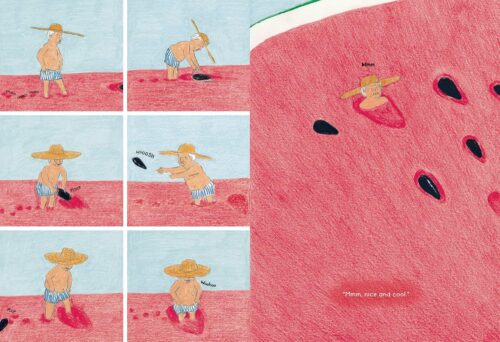
A single watermelon ripens under a blazing hot sun. All at once a crack appears, and the next thing you know it has deepened so much that the watermelon has fallen entirely into two separate pieces. “It’s opening day at the watermelon pool,” the text reads, and the first person there is an old man in a sun hat, who carefully leans his ladder against its side while remarking, “Hmm, looks like no one’s here yet.” After removing a large seed, he sinks down into the space it made commenting, “Mmm, nice and cool.” His placid solitude doesn’t last for long, though. Soon children and adults, young and old, clamber up the ladder, stalks, and leaves, to take advantage of the pool’s opening. A full day ensues of slides, stomps, and a bit of sinking into the cool watermelon flesh. And when at last the day is done, the pool is closed for the season. Just waiting until summer comes again.
ADVERTISEMENT
ADVERTISEMENT
In many ways, Watermelon Pool falls neatly into the category of picture books that fulfill children’s deepest fantasies of diving into enormous piles of food in some way. Consider Cloudy With a Chance of Meatballs or The Giant Jam Sandwich or (a personal favorite) Who Made This Cake?. There’s some innate human desire in all of us to subsume ourselves in the edible. And one of the things I liked best about Watermelon Pool specifically was its logistics in this matter. One does not simply dive into a watermelon, after all. Its flesh may be permeable, but it’s not fully liquid. Lune acknowledges this fact so that even when characters do dive in (feet first) there is this satisfying “PLOP!” that occurs when they pierce but do not sink. In many ways, the watermelon comes across as a kind of kiddie pool. And thanks to its own internal logic, we never bother to wonder about the logistics of where it came from and what it truly is. Admit it. On a hot summer’s day, would you worry about such things either?
So much of the book’s charm, though, lies in its internal logic. With very little effort, Lune has managed to think through the logistics of what a world filled with an annual watermelon pool might encompass. Two older folks walking down the road mention that the “coconut pool” in the next town is already open, so logically the watermelon pool must be opening soon. They kvetch, as old people are wont to do, about previous years when there were problems like too many seeds (followed by a silent two-page spread of some poor schmuck floundering amidst a sea of seeds). When the children get to the watermelon itself, they proceed to stomp their feet, and the text reads, “Everyone stomps together and the clear, crimson watermelon juice starts to pool.” Occasionally an adult will even carve a slide out of the outer rind from one half of the watermelon to the other. Somewhere amidst the images of kids patting watermelon flesh into snowman shapes you just have to stop and admire the creator’s imagination. Maybe she didn’t think of absolutely everything one can do with a giant watermelon, but she at least came pretty darn close.
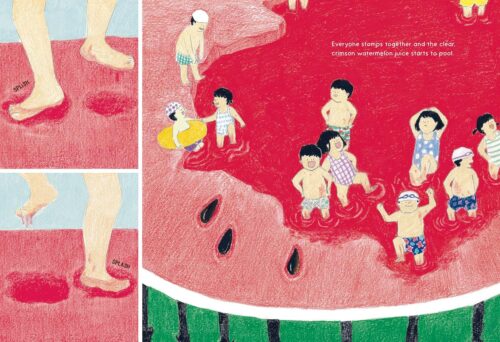
Naturally, this brings us to the art itself. The publication page is nicely coherent about what exactly is going on here. It says, “The illustrator of this book created the art with colored pencil and drawing paper.” I think a lot about things that illustrator Shawn Harris has said over the years about illustrating books in mediums that kids themselves can use. Children have access to colored pencils sometimes, and to see Lune really going to town with them here is impressive. Admittedly, I can’t immediately imagine any kid looking at this book and realizing that they too might someday create art of their own with similar tools. Then again, it is easy for adults to underestimate kids. And this book has the potential to linger in the minds of its young readers for many decades to come.

Why would it take eleven years for this picture book charmer to finally arrive on American shores? Who’s to say? One thing I will point out, though, is that if you are looking for great summer books for your Fourth of July displays (and I’m looking at you, children’s librarians and bookstore workers) this title is a brilliant and obvious inclusion. It has a droll little attitude towards the illogically logical nature of its world. Charm is that ephemeral quality sometimes found in picture books, but impossible to teach. This book has an abundance of the stuff. Sweet, strange, and maybe the teensiest bit delicious, it defies categorization, managing to straddle that line between high quality literature/art and kid-friendliness. A book not to miss. A beauty to its core.
On shelves now.
Filed under: Best Books, Best Books of 2026

About Betsy Bird
Betsy Bird is currently the Collection Development Manager of the Evanston Public Library system and a former Materials Specialist for New York Public Library. She has served on Newbery, written for Kirkus, and has done other lovely little things that she'd love to tell you about but that she's sure you'd find more interesting to hear of in person. Her opinions are her own and do not reflect those of EPL, SLJ, or any of the other acronyms you might be able to name. Follow her on BlueSky at: @fuse8.bsky.social
ADVERTISEMENT
ADVERTISEMENT
SLJ Blog Network
Aaron Reynolds on The Jasper Rabbit Universe
Warriors New Prophecy | This Week’s Comics
From Policy Ask to Public Voice: Five Layers of Writing to Advance School Library Policy
Fast Five Interview: Alfredo Cáceres
ADVERTISEMENT