
Review of the Day: Twelve Daring Grays by Nora Nickum, ill. Elly MacKay
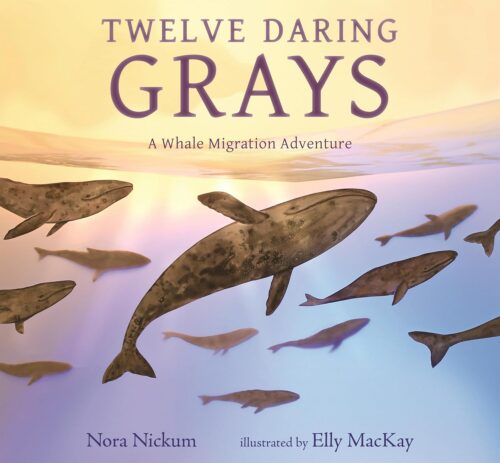
I’ve had animal ingenuity very much on the brain recently. What animals are capable of learning. What they pass down. And I’ve been thinking too about the assumptions we humans make about them. We expect a lot from animals… but not too much, right? Like, we expect a dog to understand that when we point at something they should look that way, but we don’t expect them to problem solve or anything. It gets a little more complicated when we’re talking about large intelligent species that dwell in the oceans. Humans have a vague sense that whales are intelligent, but since we can’t talk to them yet (AI or no AI) our respect only goes so far. So what are we to make of it when a small group of whales finds a dangerous but potentially life-saving solution to a problem that has plagued them for years? And when that situation is placed in a picture book for kids, suddenly we adults are in the funny position of presenting our children with an example of intelligent problem solving that has nothing to do with us in any way, shape, or form. A humbling moment. A brilliant book.
Here is the problem: Each year gray whales eat shrimp in the Arctic and then, when it gets cold, they migrate to Baja California in Mexico to birth their calves. That done, they return to the Arctic, but they’re not eating anything along the way. Sure, their blubber gives them energy, but sometimes it’s not enough. So what caused twelve of these gray whales to suddenly start to do everything differently? While other whales flirted with starvation, thirty years ago a couple of these whales figured out another way. They split off from the group and took a 170 mile detour to the Salish Sea. There, they found shallow waters that, when the tide is high, allow them to plow the ocean floor for a feast of millions of ghost shrimp. If they wait too long, the tide is out and they’re stranded. But if they time it right, day after day, they’ll be healthy, fit, and ready to head over to the Arctic as planned. Accompanied by artist Elly MacKay’s incredible cut paper artistry, Nickum’s text highlights the risk, the bravery, and the ingenuity of creatures facing a difficult world.
ADVERTISEMENT
ADVERTISEMENT

I feel like a broken record in my nonfiction reviews this year, but I just can’t stop thinking about what it means to write a nonfiction book for kids that appeals to adult gatekeepers vs. kids. And if I discover a really cool fact in a book that I’ve never encountered before, how much does that influence my final consideration of the book? It really all comes down to the writing, right? A book can be a true wonder to an adult, but if the writing can’t make a compelling story or set of facts (all depending on whether or not your book is narrative or expository) then even the most interesting subject in the world is going to land like a ton of bricks on the page. Author Nora Nickum, however, has an ace up her sleeve. A talent, if you will, that many would kill for. A truly great nonfiction picture book author, to my mind, is one that can pare a story down to its most essential parts without losing lyricism. Now listen to the opening lines of this book: “In February, gray whales begin a long, hard, necessary journey. Twenty thousand whales in all. Hidden among them are twelve with an extra dose of bravery and a daring plan.” Aside from being a cracking good starter, these three sentences are broken up on the page into seven lines. And that, my dears, in a nutshell is a lot of why this book works as well as it does.
Okay, but it’s still nonfiction, right? And it was originally published in America, yes? Well, if reading loads of nonfiction from other countries has taught me anything, it’s a deeper appreciation for authors and illustrators that can back up their storylines with facts and research. Now look at this book’s Bibliography, in addition to information on who was consulted (John Calambokidis, Cascadia’s senior research biologist), as well as even more information on the original grays. But does the book suffer from the problem of being more interesting in the backmatter than the frontmatter (a sadly common occurrence in this day and age)? It. Does. Not. As I mentioned before, Nickum has a natural propensity for a simplified but still highly informative text. Here’s a new quiz: Can you understand the book without the backmatter? If you read this to a child, would they still understand what was going on? Maybe they’d miss some of the nuances, but to my mind Nickum retains the danger, the risks, and the rewards. Plus the happy ending feels deserved. The twelve make it. Bellies are full. Babies are raised. Success all around, and it’s done in such a way that kids will entirely enjoy it on their own terms.

At this point in the review we’re five paragraphs in. Anyone who has read this far is an outlier, right? So I feel weirdly free at this point to say something that might rankle some. You know how there are authors and artists of children’s books out there who are really talented, but they have yet to find that perfect pairing that highlights their skills? Many is the future Caldecott winner who labored for years with mediocre texts, only to be paired with just the right wordsmith that could best highlight their skills. Welp… that’s how I always felt about artist Elly MacKay. It’s not that I haven’t enjoyed her past books. I have! I can think of one right off the top of my head that was a literal delight, both visibly and audibly (when read aloud). But at the same time, I’ve been waiting for some smart editor out there to pair MacKay with a text worthy of her skills. Something that would allow her to stretch a little, try new things, and yet also retain what it is that makes her so unique amongst illustrators. Hat tip to you then, Candlewick. Looks like someone there knew precisely what they were doing.
Because it’s not simply that MacKay knows how to use cut paper. Look, let’s take a trip to this book’s publication page for a moment, and I’ll show you what I mean. A lot (though certainly not all) publication pages will tell you how the illustrator did what they did. MacKay has cut paper, sure, but look at the cover of this book. How on earth does she manage to make it look as if light is filtering through water in luminous beams? Alas, the publication page here will offer you only perfunctory answers. “The illustrations are photographs of scenes created with paper, ink, wire, colored filters, and light.” Insufficient? You might say. Happily, we live in the era of the internet. On her website, MacKay writes, “Since I am dealing with 3 dimensional scenes, I’ve had to learn a lot about depth, lenses and scale. The nice part about working this way, is that if something isn’t quite working, I can adjust it, and rephotograph it. I can also play with the lighting, and find the right atmosphere for a scene.” Thus she creates little sets for her books. “With layers to create the setting, individual characters, lighting, filters, camera lenses and settings, there is lots of play that goes into getting my images and sometimes interesting surprises.” And when the book is deserving of this process, and its topic AND writing lend themselves to this kind of care and attention, the results can be truly magic.

The trouble with humans studying other species is that we see everything through a very human lens. That’s natural. I mean, it’s not like we’ve had the ability to look through anything else for quite a while. So when I started off by talking about whale ingenuity and how incredible it seems in this book… I mean, is it? I’m no whale expert. I don’t really know what they are and are not capable of. One thing the book doesn’t say directly (but is mentioned in the backmatter) is that part of the reason whales are starving on their route back to the Arctic is that the world is changing (thanks to humans) and they’re not getting the amount of food that they used to. Hence the need for some whales to (literally) change course and try something new. And if that feels human to us, it probably isn’t. That’s where this book becomes so useful. With a subtlety bred of great writing and jaw-dropping art, it’s teaching our kids that we’re not alone in this world when it comes to using our brains and having the guts to take a risk. And maybe if kids can understand that, they’ll understand why protecting other species (even the ones who aren’t capable of such massive intelligence) is the right thing to do. A tall order for a little book, sure, but me? I’d say it’s up to the challenge.

On shelves now.
Source: Galley sent from publisher for review.
Filed under: Best Books, Best Books of 2026, Reviews, Reviews 2026
About Betsy Bird
Betsy Bird is currently the Collection Development Manager of the Evanston Public Library system and a former Materials Specialist for New York Public Library. She has served on Newbery, written for Kirkus, and has done other lovely little things that she'd love to tell you about but that she's sure you'd find more interesting to hear of in person. Her opinions are her own and do not reflect those of EPL, SLJ, or any of the other acronyms you might be able to name. Follow her on BlueSky at: @fuse8.bsky.social
ADVERTISEMENT
ADVERTISEMENT
SLJ Blog Network
Off to ALA Annual 2026
Paw And Order | This Week’s Comics
From Policy Ask to Public Voice: Five Layers of Writing to Advance School Library Policy
Teens Read YA: Scout Jensen Reviews the 2 Newest Bleak Haven Novels by Ralph Vincent
ADVERTISEMENT