
A “glimpse of the unseen self through the medium of motion.” Helen Yoon Discusses Donutrina in the Nutcracker Sweet

Meet the best thing you’re going to read today.
So I bet that there are a lot of authors of picture books that keep a little list in their head of the illustrators they most admire. I know I do. Andrea Tsurumi. Eliza Kinkz. Jenn Harney. I tend to incline towards those creators that combine humor with real skill on the page. And one of the artists I most admire, though I’ve never met her in person, is Helen Yoon.
It was the post-pandemic picture bookOff-Limits that first drew my attention to her talent. After that, I noticed that with each subsequent book, her style seemed to grow more distinctive. I know that my job entails discussing picture book art, but Yoon’s methodology challenges my ability to describe her work adequately. It’s… her line. I can’t put it any better than that. Yoon has a command of line that is like no one else’s. And when I heard that she had a book coming out this year called Donutrina In the Nutcracker Sweet, I was curious. Now you might wonder at the fact that I want to talk today about what sounds so clearly to be a Christmas-season book (though it’s out September 22nd). That’s only because you haven’t seen it for yourself. In many ways, this innocuous-sounding book is my favorite Helen Yoon title to date. It tells the story of a small mouse who wishes to become a ballerina and, with the help of a donut around her midriff, her dreams become true in a most unexpected way.
ADVERTISEMENT
ADVERTISEMENT
Helen Yoon, I am so very very pleased to report, was willing to talk to me. It’s my first interview with her.
I. Am. Psyched.
Betsy Bird: Helen! It is a treat and an honor to get a chance to get to lob questions in your general direction today. I’ve been such a fan of your work for years, and I was admittedly a little surprised when I saw you’d done a book called DONUTRINA IN THE NUTCRACKER SWEET. On the outset it seemed a little different from your other books. That is, until I read it myself. Holy moly, this is really, remarkably, fantastically GOOD! But it must have some kind of killer origin story. So, please. Spill the tea. Why are you doing this book?
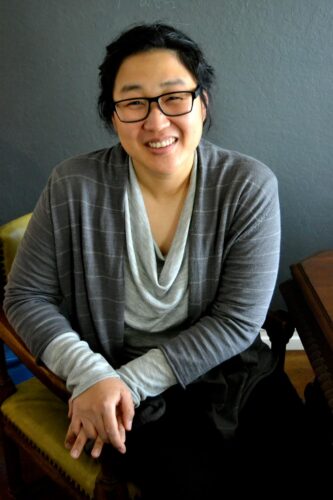
Helen Yoon: I thought I knew the answer to this one, but then it struck me how similar Donutrina’s un-self-consciously indomitable personality is to that of my friend’s daughter, who factors into this story. I dunno. The longer I do this, the less I understand inspiration. At the very least, I can timestamp the moment for you: while playing with aforementioned indomitable friend’s daughter (then 5ish), I’d stuffed an animal plushie into a donut plushie and said “Look, a donutrina!” immediately followed by “Crap (censored for 5ish-year-old ears), I can’t not write that.” It was about as epiphanous as catching a cold. The whole thing surprised me, as well.
BB: Don’t mind me, I’m just gonna go steal the phrase “as epiphanous as catching a cold” for myself now. Dang, that’s good. Okay. Sorry. Back to the interview. So when one thinks of baked goods doing pas de deuxs and pliés, there’s really only one ballet that comes to mind: The Nutcracker. And while I have seen Nutcracker-related picture books before, none have ever taken proper advantage of the fact that the second half of the show is just a parade of deliciousness set to dance. Tell us a bit about your own relationship to this show. What’s your own personal history with it?
Helen: Aside from being a 90’s kid with Christmases set to the theme of Home Alone against a backdrop of Candyland (TM) and Fantasia‘s VHS? No particular history, I think. I actually have a tremendous fondness for the original story by E.T.A. Hoffman: I have maybe 4 copies of the English translation – one illustrated by the immortal Maurice Sendak, another by the legendary Gennady Spirin (what a time to be alive and have a library so casually littered with this stuff). I love that story. I don’t know why. But clearly I wasn’t the only one as it inspired Dumas to retell it, which seeded the ballet, which resonated with John Williams, whose score I’m listening to right now. That I can add my pebble to an already extraordinary corpus of work that revives itself ever year and reiterates itself in all sorts of evergreen ways is a staggering privilege.
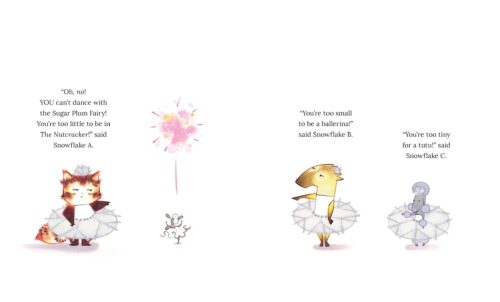
BB: Honestly, I’m still stuck on the fact that Gennady Spirin illustrated the story. Gonna have to try to find that. You know, you’ve done so many fine picture books, that when I realized that you had never done one involving dance, I was stunned. Characters in your books move with such style, verve, and poise that it’s almost as if they’re dancing anyway. Now they get to do it officially. Watching the quality of your line bring these characters to life and movement is entrancing. Did you sketch dancers at all as you came up with these dance sequences or was it all entirely out of your own head?
Helen: Your knee-jerk impression doesn’t surprise me. Each illustration is, after all, a quick snapshot into the bigger lives and feelings of these characters before they disappear again into the page-turn. How much more so with dance, this glimpse of the unseen self through the medium of motion? All that is preamble to try to explain, yes, I do it backwards – sketch first, then research (Youtube, books on the history of ballet, biographies of famous dancers, archives of photographs galore) – that, in my best approximation of the psyche of dance, I amalgamate enough visual vocabulary to introduce you, the reader, to Donutrina.
As I was writing this and thinking over how Donutrina is, in a way, a kind of medium herself – an embodiment of this zeal and zest for life that compels a mouse to unapologetically wear a donut – it struck me again how it might actually be the other way around: maybe I’m the medium. Less creator, more conduit; a host body for the two-centuries-old Nutcracker virus. Perhaps my next iteration of The Nutcracker will be less Calico Critters and more Resident Evil. It can be autobiogaphical.
BB: Okay, you gotta stop saying brilliant things in succession like that. And by the way, I must congratulate you. I do believe you are the very first picture book I have ever encountered to include the word “umwerfend” in your text. It’s pronounced by a character that I believe may be a gazelle of some sort. You’ve such a nice wide array of animals in this story. Is there one particular animal you like to draw more than the others (for example, the punk zebra was particularly choice)?

Helen: I’m not sure, actually. It wasn’t until you mentioned it that I remembered the punk zebra is a throwback to my art school days: I’d painted a very serious portrait of a heavily-tattooed, piercings-arrayed zebra. Is he a favorite? I didn’t think I liked zebras especially much. I don’t really find myself thinking about zebras at all actually. Even thinking about them now, I feel no particular bias towards them…they’re fun to draw – because stripes. But they also suck to draw – because stripes. I wonder if I just like whatever animal I’m drawing in the moment. That sounds like a cop-out “every color is my favorite color” but I think it’s the whole illustration-is-like-dance-which-are-both-mediums thing again: how do I make this specific anatomy express what that particular animal is feeling or the funny things it’s thinking? Drawing Donutrina was fun because I was able to cheat a little with the tail; it gave me an extra line to add fluidity to her movements. But that was an accidental advantage; drawing mice isn’t a particular favorite thing. I really don’t know…
BB: Shoot. I hadn’t even noticed how her tail played into things. Good call. Now the hard hitting question (the kind I’m known for). In this book characters select some kind of food item and embody it fully in their dance. Given what you know about yourself…(very little, it seems) what kind of food would bedeck you, had you a choice in the matter?

ADVERTISEMENT
ADVERTISEMENT
Helen: This I can answer. You have to dress to your body. My figure, unfortunately, can’t rock a tutu, so I’d probably direct my fashion daring-do towards that churro flapper dress. I don’t have the figure for that either, but I really like churros: if the reflection in the mirror disappoints, I’ll just eat it.
BB: As coincidence would have it, the churro flapper dress is also my own choice too. Finally, what else do you have going on these days? What’s next for you?
Helen: More of this, I hope. Keep chipping away at stories. Keep chipping away at life. File my taxes. Keep you guessing, maybe. Keep me guessing, definitely. Continue being surprised by it all, probably. Candlewick actually coordinates and makes sense of my scribbled backlog; they’re contractually privileged with picking the project, so it really is a surprise sometimes. What’s next! I ask that, too.

See, this is a problem. I like interviewing Helen Yoon A LOT now. I think I would like interviewing Helen Yoon to be my official job from here on in. Is that something I could get paid for? I’ll look into it. In the meantime, thanks beyond measure to Helen for elevating my dinky interview questions into something divine with her answers. Donutrina In the Nutcracker Sweet comes out September 22nd and I know it’s early in the season but if you get only one holiday book this year, this is the one you should get. Additional thanks to Rachel Kirby and the Candlewick marketing team for making this thing happen.

Filed under: Best Books, Best Books of 2026, Interviews

About Betsy Bird
Betsy Bird is currently the Collection Development Manager of the Evanston Public Library system and a former Materials Specialist for New York Public Library. She has served on Newbery, written for Kirkus, and has done other lovely little things that she'd love to tell you about but that she's sure you'd find more interesting to hear of in person. Her opinions are her own and do not reflect those of EPL, SLJ, or any of the other acronyms you might be able to name. Follow her on BlueSky at: @fuse8.bsky.social
ADVERTISEMENT
ADVERTISEMENT
SLJ Blog Network
My Thoughts on The Science of Reading
Film Nerds | Review
From Policy Ask to Public Voice: Five Layers of Writing to Advance School Library Policy
Games and Reading: Friends Forever, a guest post by Josh Hicks
ADVERTISEMENT
What a combination of fun topics with so many underlying layers – love hearing from the author.