
Holding Their Systems Together: Katy Duffield and Hannah Salyer Discuss Their Upcoming WE ARE THE KEYSTONES

Anyone else go to the movie theater and watch the new Pixar film Hoppers recently? As a #1 beaver enthusiast over here, that was my kinda movie! My favorite part? I would be hard to pick, but maybe it was the moment when the scientists are talking about beavers and refer to them as “a keystone species”.
Keystones! Heard of ’em? As National Geographic defines them, “a keystone species is an organism that helps hold the system together. Without its keystone species, ecosystems would look very different.” That’s a notion that’s been getting a lot more attention in children’s books these days. And no book is quite as focused on the concept as the upcoming We Are the Keystones: Animals that Hold Habitats Together by Katy Duffield, illustrated by Hannah Salyer (out September 1st). Some of the keystones in this book you’ve heard of before (the wolves of Yellowstone, for example). Some? Folks, I will never unlearn what I learned in the cassowary portion of this book.
ADVERTISEMENT
ADVERTISEMENT
Both Katy AND Hannah were willing to answer some questions on the topic of producing picture book nonfiction in this day and age, so we’re just gonna dive on in:
Betsy Bird: Katy! Thank you so much for answering some of my questions about WE ARE THE KEYSTONES today! I’ve noticed a real uptick in the number of books for kids centered on appreciating nature in some capacity in the last couple years. Tell us a bit about where the idea came from.
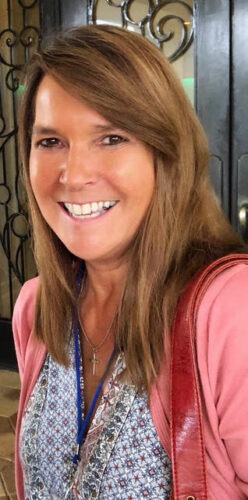
Katy Duffield: Hi, Betsy! Thank you so much for chatting with us.
Most everyone who knows me knows I have a big soft spot in my heart for creatures of all kinds (as do many young readers!), so I’m always on the look-out for fascinating “animal” topics. In KEYSTONES’ case, when I was researching for CROSSINGS: EXTRAORDINARY STRUCTURES FOR EXTRAORDINARY ANIMALS (illus. by the fab Mike Orodán!, S&S/Beach Lane), I ran across some information on keystone species that intrigued me, so I added it to my Ideas List, and then promptly forgot about it—until my agent happened to mention the topic a little while after CROSSINGS came out. That’s when I decided to dive in deeper and learn more about keystone species.
And dive in, I did! When my research process was fairly far along, I decided how I wanted to approach the book. Believe it or not, it was epistolary—a humorous manuscript full of thank-you notes to keystone species and from the animals they help. When the manuscript was ready, my agent sent it along to Andrea, my S&S/Beach Lane editor, who had acquired CROSSINGS. Andrea liked the idea of a picture book about keystone species, but she wasn’t as on board with the epistolary format. (Bummer! I still love that version!). Even though the first version wasn’t right for her, Andrea said that if I wanted to rewrite, she’d take a look at the next one. So, I rewrote and rewrote and rewrote until I landed on the final version—which Andrea acquired.
BB: Oh man. You are anticipating all my questions about revision and process there, Katy. And Hannah! Thank you too for answering my questions here today! Your work on WE ARE THE KEYSTONES is, to be perfectly blunt, stunning. What was it about this particular project that appealed to you?
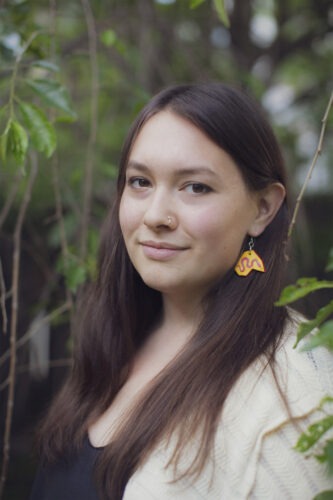
Hannah Salyer: That’s very high praise coming from you, Betsy Bird! Thank you for taking an early look. WE ARE THE KEYSTONES was a no-brainer for me after reading through Katy’s manuscript. I was able to visualize how I wanted the illustrations to feel right off the bat, as she deftly wove the information into a brilliant tapestry rich with images and lots of atmosphere. She also did it in such a way that emphasized the importance of biodiversity in the broader sense, which I really appreciated. Keystone species play crucial roles in maintaining the structure of the ecosystems that they are a part of. It can be a tricky line to toe when introducing this concept, as one could easily misunderstand it to mean that the keystone species are more important than others. Rather, in the book, Katy highlights how while these animals are unique and are fundamental members of their ecosystems, they also serve as reflections of the significance of all of their cohorts who are able to survive and thrive due to their presence.
BB: A keen distinction, Hannah, thank you. Katy, as Hannah alluded to here, the book focuses on a number of keystone critters in different environments. How did you settle on these specific creatures? And were there any that you wanted to include but couldn’t?
Katy: I spent a lot of time considering which animals to include. I wanted to highlight a variety of habitats, and I also wanted to show a range of methods keystones use to “help”—by building, by eating, by hunting, etc. Two that I distinctly remember planning to include, but we didn’t have room for, are the snowshoe hare and African termites. Interestingly, the snowshoe hares’ way to “help” is by being eaten!
There are also many plants that play roles as keystone species—fig trees, oaks,mangroves, willows, saguaro cactus, coral, and others. Initially, I planned to include keystone plants in the main text, but, in the end, it felt more cohesive to focus solely on animals. At the same time, it was important for readers to know that keystone plants exist, so we touched on that in the backmatter in the “Other Keystones to Explore” section.
BB: Ah, you’re singing that sweet sweet song of backmatter, and I appreciate it. You also utilize a technique that I’m noticing in more and more nonfiction picture books these days, though I don’t know if anyone has ever come up with a formal term for it. On many of these pages you have a younger text in a larger font, meant for reading aloud to a kid or a group of kids. Then, somewhere in the margins or along the side, you’ll see a smaller block of text that explains the more complex science to, perhaps, slightly older readers. Was this the format of the book from the start and why did you choose to go this route?
Katy: I’m not sure there is a formal term for it, but I’ve heard them called “layered texts.” For me, these smaller font inclusions are a subtle way to introduce additional information. They aren’t the same as traditional sidebars which feel more prominent, and maybe a bit more intrusive, on the page.
When I started working on the draft that would become KEYSTONES, I made the decision to use layered text. I’d used the technique in CROSSINGS and thought it worked well, so I felt it would be a good fit for this manuscript, too. I love how layered text does double-duty in a book. For story time read-alouds for younger listeners, the main text has enough information to be engaging and understandable, and for older readers, that smaller font text dives a little deeper into the subject matter to answer questions they have and to, hopefully, inspire them to research on their own to learn even more. Some might argue that layered text interrupts the book’s flow (especially as a read-aloud), but in my mind, it’s the best of both worlds.
BB: Huh. “Layered texts”, eh? I think I’ll stead that phrase, thank you. Now let’s examine that art a bit again. Hannah, could you tell us a little bit about your techniques? How did you make the art for this book? And did you change your style at all to match the text?

Hannah: Absolutely. I pushed myself to new places and adopted techniques that felt right for this particular story. Early on, I envisioned that these spreads would be very cinematic and have lots of depth. I was always thinking about where the sun would be in the sky for each scene, because I wanted the reader to be visiting different habitats at different times of day when the creatures mentioned might be most active. I have experience using gouache, but I had never used it in this way for a book project. I used thicker, lusher layers, painted on top of watercolor paper primed with chunky acrylic medium. This gave the paintings a grainy and textural foundation. There is a push and pull going on in each spread: the hyper focused details of a creature in the foreground pulling the eye inward, versus the pushing moments that become increasingly unfocused and impressionistic the further back you look into the scene. I suppose in this sense I was emulating a lens. There were times where I heard the great Sir David Attenborough’s narration in my head while working, which I took as a good sign.
BB: Always. And naturally, you’ve done other nonfiction picture books before. There was PACKS: STRENGTH IN NUMBERS and ANCESTORY, to name just two. Even when you do fictional picture books there is some kind of animal component involved. Is this something you evolved into doing or is something you’ve actively chosen? And can you talk a bit about what it is from your own life and experience that makes these titles so enticing to you?
Hannah: It’s something that I am very intentional about. I am an only child, and I had many companion animals growing up who were formative in shaping the way I saw the world. I always understood other creatures, both wild and domestic, to be individuals with interior lives, emotions, histories, families, and daily experiences. Experiences different from my own to be sure, but certainly as complex and meaningful. At times it was almost easier for me to feel a kinship with animals rather than, say, adults, or other children and in my experience this is true of many kids! Other animals have always helped me understand where I fit, what it means to be human, and to quote a favorite title by author Sy Montgomery, “How to Be a Good Creature”. Unsurprisingly, books in this vein were often the ones that resonated for me when I was a kid. Inviting my young self into the room is a big part of my bookmaking process and guides a lot of my early decision making when taking on or laying the foundations for new projects.
BB: And then there’s the text again. The species featured in this book also speak in rhyme, which just feels like an extra added challenge on top of everything else at work here. Katy, why was rhyme the best possible medium for this text? What does it allow you to do that simple prose wouldn’t?
Katy: It was definitely an extra added challenge! More than one time in the process I kicked myself for attempting it. I typically try not write in rhyme, but sometimes lines just pour out on the page in rhyme and force me to follow the lead and see where it goes. Also, after sending my editor a couple of prose drafts and one super-spare rhyming draft, she encouraged me to pursue a rhyming version.
As for how rhyme serves the story, first, I think rhyme lends itself well to the layered text technique we talked about above. Rhyme can create interest and typically has a strong read-aloud-ability that appeals to young listeners. I also think, for both younger and older readers, that rhyme can package facts in a playful, accessible way, and can make them more feel more alive and dynamic than purely informational. So, I hope that the rhyme in the story not only delivers facts, but also preserves a sense of wonder that prose may not have evoked as strongly.
BB: Hannah, in reading the manuscript for the first time, were there any facts that surprised you? For example, I had no idea about cassowaries swallowing whole fruits (and, if I may offer a compliment, you have what may be the subtlest pooping illustration in any book coming out in 2026).
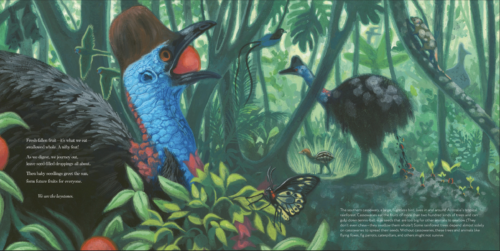
Hannah: Well shucks. I admittedly spent a lot of time watching, rewatching, and scrubbing through videos of cassowaries pooping in slow-mo for this painting so I hope I did the ceremony justice.
I think there were two that I loved in particular, those being the grizzlies fertilizing the forest with fish carcasses, and the tiger sharks keeping the sea ecosystem healthy by largely preying upon creatures who aren’t flourishing or are ill. These two are examples of animals who humans have historically villainized. Learning about them in this way helps dispel those myths– they are not evil or malicious, they are just trying to survive like the rest of us. They have crucial roles to play in the larger picture and it’s important for us to respect their space and admire what they do from afar. Death has a significant role to play in the health and vitality of ecosystems. When organisms die, they give vital nutrients back to their habitats and neighbors, and while that idea isn’t necessarily new to me, I still find it to be both astonishing and reassuring.
BB: Katy, you were paired with illustrator Hannah Salyer for this book. The art could have gone in any direction, all dependent on the artist chosen for the project. What does Hannah bring to these pages that no one else could?
Katy: Oh, where do I start? To say that I was thrilled when I heard that Hannah would be illustrating is an understatement. When Andrea told me who would be illustrating, I yelled: “OH! I love [her book] PACKS!” Hannah has such a fabulous style that’s so distinctive. When I first saw the covers of ANCESTORY (written and illustrated by Hannah) and RAIN AND THE READING HORSE (written by Maria Gianferrari and illustrated by Hannah), I knew just by seeing the the cover art who illustrated them. Her dynamic sense of color and detail creates such a presence, and her art has this almost ethereal feel—with its own feeling and movement and emotion. Just stunning!
I knew the KEYSTONE art would be fantastic, but I was absolutely blown away when I saw it. I mean, just look at that cover! The way she chose to put some of the animals that are “affected” by the keystones as a “part” of the keystones themselves is not only beautiful, but also brilliant.

The interior art is just as impressive. You just want to linger on every page. There are so many things to see! And I feel like every time I go back through, I discover new things. I keep trying to decide on my favorite spread. It’s impossible, but if I were forced to choose, it might have to be the cassowary (or the grizzly! or the alligator! or the sea otter!). I feel so blessed and so grateful that Hannah agreed to illustrate.
BB: Well, shoot! That leads perfectly into my next question. Hannah, I know you’re not supposed to have favorites, but are there any animals from this book that you most prefer to draw?
Hannah: It’s quite honestly hard to choose . . . But maybe it would come down to the Cassowaries and Elephants. I had an interesting experience while visually researching the cassowary. I watched all the footage I could find, read many articles, and scoured the web for pictures. Once I got to painting them and really spending time on their forms, it hit me what magnificent and mysterious creatures they are. Not far off from dinos, really. Though they have a reputation for being the “most dangerous bird” because of their defensive kicking capabilities, from what I have read, they are actually quite shy and not outwardly aggressive towards people who let them be. The elephants were a joy because they have such delightful and iconic anatomy. I was also treated to a treasure trove of photographic reference that isn’t broadly available to the public, courtesy of a dear friend, Amanda Stronza, who is an anthropologist and wildlife photographer. She works directly with neighboring elephant and human communities in Botswana, and through her lens I was able to get an intimate sense of the daily goings-on of the herd that she spends time with. She captured various photos where the elephants were exemplifying the exact behaviors that Katy writes about in our book, which obviously made for fantastic reference material.
BB: Magnificent. I love it when a plan comes together. Finally, what’s next for you two? What else do you have coming out in the future?
Katy: I’m currently promoting START YOUR ENGINES! (illustrated by Chiara Galletti, Sourcebooks/Jabberwocky), our fictional, rhyming picture book that came out recently. It’s a sweet, good-sportsmanship story about a win-at-all-costs ATV named Frankie who has a tough decision to make—Win? Or help a friend?
I also have a couple more critter-related projects in the works, and I’ve been hard at work on, and excited about, a new narrative nonfiction manuscript in a new and different topic area—space!
Hannah: I have two books in the works right now, both quite different from each other, that I’m very excited about. One being The Flight of the Bats written by Evan Griffith, and brought to you by the same editorial team at Beach Lane/S&S that worked on WE ARE THE KEYSTONES. The book is about the largest urban bat colony in the world: roughly 1.5 million Mexican free-tailed bats who spend half the year living under the Congress Ave bridge in downtown Austin, TX. Then there’s Not Everything, written by Mk Smith Despres, coming out from Neal Porter Books/Holiday House. It’s a profound story about how life can’t (and shouldn’t) be broken down into black and white binaries. It’s fictional and it’s written as a poem, with masterfully balanced moments of vastness and quietude, and it’s like nothing I’ve ever worked on before. As of now, these titles are set to tentatively release in the latter half of 2027. I also have a handful of my own stories who have been waiting very patiently for my attention. They are becoming more insistent and starting to act out, though. Once I finish illustrating my current slate, I look forward to turning back towards them.


Whew! Isn’t it great when authors and artists don’t hold back about their process? Like a breath of fresh air, it is. And that’s not a terrible way to describe this book as well. As I mentioned before, We Are the Keystones: Animals that Hold Habitats Together is out September 1st, so make sure you get your pre-orders in now. Extra thanks to both Katy Duffield and Hannah Salyer for taking so much time to answer my queries today!
Filed under: Best Books, Best Books of 2026, Interviews
About Betsy Bird
Betsy Bird is currently the Collection Development Manager of the Evanston Public Library system and a former Materials Specialist for New York Public Library. She has served on Newbery, written for Kirkus, and has done other lovely little things that she'd love to tell you about but that she's sure you'd find more interesting to hear of in person. Her opinions are her own and do not reflect those of EPL, SLJ, or any of the other acronyms you might be able to name. Follow her on BlueSky at: @fuse8.bsky.social
ADVERTISEMENT
ADVERTISEMENT
SLJ Blog Network
Over on the Yarn: Nancy Hugins and N. West Moss
Papercutz to Publish ‘Three Bee Honey’ | News and Preview
Bring on the JUNE Mock Newbery suggestions!
From Policy Ask to Public Voice: Five Layers of Writing to Advance School Library Policy
ADVERTISEMENT
Thanks again, Betsy, for sharing our new book! Much appreciated!
I am always so happy when a new Katy Duffield book comes out! What a terrific topic. I can’t wait to read it and see those gorgeous illustrations for myself. (The pooping cassowary is pure gold!)