• Skip to primary navigation
  • Skip to main content
  • Skip to primary sidebar
  • About/Contact
  • Fusenews
  • Reviews
  • Librarian Previews
  • Best Books
    • Top 100
    • Best Books of 2022
    • Best Books of 2021
    • Best Books of 2020
    • Best Books of 2019
    • Best Books of 2018
    • Best Books of 2017
    • Best Books of 2016
    • Best Books of 2015
    • Best Books of 2014
    • Best Books of 2013
  • Fuse 8 n’ Kate
  • Videos
  • Press Release Fun

Review of the Day: How Many Guinea Pigs Can Fit On a Plane? by Laura Overdeck

Review of the Day: How Many Guinea Pigs Can Fit On a Plane? by Laura Overdeck

August 18, 2017 by Betsy Bird

HowManyGuineaPigsPlaneHow Many Guinea Pigs Can Fit On a Plane? Answers to Your Most Clever Math Questions
By Laura Overdeck
Feiwel and Friends (an imprint of Macmillan)
$17.99
ISBN: 978-1-250-07229-0
Ages 9-12
On shelves now

Geez. How I ended up in this position I’ll never know. Me. A born and bred liberal arts major. The kind of person who managed to go an entire four years in college avoiding any classes that had even the faintest whiff of math to them. I wasn’t one of those kids traumatized by it or anything. In many ways math was, for me, more of a non-starter. It didn’t figure into my worldview or daily life or really much of anything above and beyond the classes I was required to take to graduate. When I grew up I used some of it. Most of it? Not a jot. I became a children’s librarian and pretty much figured my time with math was over and done with. Fast forward to 2013 and suddenly I’m serving on a committee. Not just any committee either. A math committee (the Mathical Award). A committee dedicated towards getting good, fun, high-quality math books into the hands of kids. Hunhuna? Hubba wha? How did this happen? Who knows, but here I am and now I find that I not only like math books for kids, I’ve a nose for sniffing out the ones that are actually interesting. Little wonder that I recently picked up Laura Overdeck’s latest math-related fare How Many Guinea Pigs Can Fit On a Plane? Picked it up, I say, and haven’t looked back since.

Some of you are looking at the cover of this book and rolling your eyes heavenward. Not because you don’t like math, but because you figure you’ve seen this kind of thing before. Something that declares that it makes math fun, huh? Lemme guess. You open it up and it has all the glitz and flair of your standard school textbook, with a dry as dirt text to match. Or, much worse, it tries too hard, filling its pages with a kind of forced gaiety, as if by acting excited it might transfer that feeling through the very fibers of the pages themselves. Those kinds of books come out every single year and they are, to put it plainly, intolerable. Well put aside your prejudices and give this book a second glance, my friends. In How Many Guinea Pigs Can Fit On a Plane? Overdeck hands readers a wide variety of curious questions. “How many pieces of gum can stick me to the wall and hold me there?” “When will I be a billion second old?” “If I were as strong as an ant, how much could I pick up?” Her answers come complete with math, wittily presented, beautifully designed. At the end Overdeck provides “7 Slick Tricks to Amaze Your Friends” for a little mental math, as well as copious sources and backmatter. Math done right.

In many ways, it appears that Guinea Pigs has borrowed a page or two out of National Geographic’s playbook. I don’t know if you’re familiar with National Geographic’s books for kids but through much hard work and clever use of white space, NG has established itself as the go-to place for quickie facts. Whether they’re churning out joke books, early chapter series about animal rescues, or big hardcover beauties filled with lush full-color photos (this is National Geographic we’re talking about, after all) there’s something for everyone in those pages. And yet fascinatingly they’ve never even attempted books that discuss math. Not once, as far as I can determine. Into, what I can only describe as, a gaping void comes Laura Overdeck and her jam-packed guinea pigs. Like NG books there are abundant photographs to be seen here (though they’re more of the stock photo variety). And almost more importantly than that, like NG a clever book designer (in this case one Raphael Geroni) took pains to make the insides as enticing as possible. As a result, at the beginning of each page is a nicely delineated question portion, surrounded by pertinent images.

HowManyGuinea2 copyConsider now the case of Laura Overdeck. A rare bird, to say the least. Outfitted with a BA in astrophysics from Princeton University and an MBA from the Wharton School of Business, her resume would not normally allow you to peg her as some kind of children’s book guru. And yet, even as I say this, the woman has pretty much cornered the market on children’s books that seamlessly integrate math into the everyday lives of children. With her Bedtime Math series, for example, she has worked to give math a natural space in a child’s brain. Math so casually created that a kid would never dream that you could go for years without coming up with such equations. In many ways Guinea Pigs feels like a natural output of the Bedtime Math series, with one important difference. Visually, the book is leaps and bounds better than the books that made Overdeck a hero to so many. Now I like the Bedtime Math books just fine, but even as I found the content intriguing I found the art and illustrations unmemorable. That’s part of what I like so much about this new book (series?). Not only do the questions confound in a right pleasing way, but the design of the pages make you want to keep turning them.

But let’s talk text for a moment here. I keep getting distracted by the images when what I should really be praising as well are the words that surround them. You can look as pretty as a picture all you want, but if your text is a snorefest don’t expect kids to follow you to the wide and wonderful world of mathamania. Overdeck splits her book into six chapters, each with a different nonfiction theme. The last chapter, “Now Do It In Your Head!” ups the ante, daring the kid readers to take their math to the next level. As for the questions in each chapter, I was reminded of the XKCD book What If?: Serious Scientific Answers to Absurd Hypothetical Questions. This is essentially a younger, slightly less silly, book along the same lines. Some of the questions don’t require much outside information, but most require Overdeck to provide some research. For example, to the question “How many raindrops does it take to fill a glass of water?” we have to be told that a raindrop is 2 mm across with a radius of 1 mm. Overdeck then works out its volume and goes from there. Since this isn’t a textbook, Overdeck doesn’t make the reader figure out the math themselves but it would be easy to adapt this to a home or school (or fun, darn it) curriculum, if needs be. And I should probably note that some of the questions really don’t have much math to them at all. “Which wind blows faster, a tornado or a hurricane?” is answered by facts more than anything else. So there is a bit of filler here and there, that’s for sure.

It seems crazy to say, but I honestly feel that for all that we children’s librarians like to believe that we’re living in some kind of a golden age of children’s literature (particularly when it comes to nonfiction) math books for kids lag horribly behind the times. Why is this? It’s quite simple. To write a good math book you have to care about the material. And sad as it is to say, most writers aren’t math enthusiasts, for all that they can string two words together. That sometimes leaves the mathematicians to try to fill in the gaps, but without a true literary bent to fall back on, their books can sometimes come across as dry and bland. This is why we need more folks like Laura Overdeck. The math is good and the writing charming. Neither one of those two factors is ever a given. When you can run across them together, though, grab on with both hands and don’t let go. And when you give this book to an interested kid, don’t expect them to let go either.

On shelves now.

Videos:

Still not so sure? Let this charming video for the book help in some way:

Now if someone would be so kind as to give this woman her own PBS show . . .

Filed Under: Best Books, Best Books of 2017, Reviews, Reviews 2017 Tagged With: 2017 nonfiction, 2017 reviews, Best Books of 2017, Feiwel and Friends, Laura Overdeck, macmillan, math

The Artful Book Display: Getting It Right

August 17, 2017 by Betsy Bird

The other day I posted my most popular tweet of all time. I didn’t really mean to but, as with most things on the internet, it’s never the tweet or the post that is most important to you that catches on like wildfire. In this particular case I was at Anderson’s Bookstore in Naperville to see Jason Reynolds speak about his new Spiderman/Miles Morales book series. Naperville isn’t particularly close, but these days that man’s worth driving hundreds of miles to see. Until this day I’d only ever been to Anderson’s location in LaGrange, and at one point I had a little time to kill. I wandered about and saw this book display:

HogwartsBookDisplay1

Which led to this tweet:

HogwartsBookDisplay

What’s so clever about a display like this is that it allows the bookstore to sell a wide variety of new books in an eye-catching display done, you have to admit, with very little work. All the employees had to do was print out the little signs and select the books. Batta bing, batta boom.

At my public library I do the adult book displays and having to come up with original collections can be tricky. Surprisingly, I haven’t been able to locate a website or blog that brings together all the different kinds of displays that are out there. There are some Pinterest pages, absolutely, but I would love a site entirely dedicated to them.  Maybe one exists.?Public, I put it to you! Does such a thing exist? I know that the blog Library Displays is now defunct.  Has anyone plucked up the mantle?

I’m also quite fond of children’s book displays located in places where children’s books are not a given. For example, here is a display I discovered recently at my local bike shop Bucephalus Bikes:

BikeShopDisplay

It was Eti Berland who saw this and wrote to me, “Celebrating literacy found in community spaces. Sounds like a blog post that needs to exist :)”  She’s absolutely right, of course, but it’s tricky.

In no way can this blog be the site for all those great displays. . . . but, if you wanted to send me some that you think are particularly keen I’d be more than happy to include them here. In the meantime, here are some links you might find helpful in your display-ing:

  • Twenty Rules for Better Book Displays
  • 13 Awesome Library Displays – From Bookriot
  • How to Create Awesome Book Displays – Also from Bookriot
  • 27 Insanely Clever Ways to Display Your Books – From Buzzfeed

It’s a start.

Filed Under: Uncategorized Tagged With: book displays

Surprising Jolts of Children’s Literature: Of Bunnies, Cats, Monsters and More

August 16, 2017 by Betsy Bird

It continues! As ever, folks just can’t seem to write books without slipping references to children’s books into them, left, right, and center. And while it seems an odd exercise to collect these titles, it’s also oddly informative. I’m still trying to piece together a unified theory about why this happens at all. No answers thus far but I live in hope. While I’m pondering and postulating then, here are some surprising jolts of the month:

My Mother, the Bunny, and Me by Edith Kunhardt Davis

MyMotherBunny

There is a story that they tell about the great children’s librarian Anne Carroll Moore. Apparently when confronted with interactive or tactile books (titles that she considered little better than toys) she would dismiss them with a cursory insult of “Truck!”  There is no known record of how she felt about Pat the Bunny, but I think we can make a pretty good assumption from that anecdote.  The daughter of Dorothy Kunhardt, author of the aforementioned bunny book, tells the story of her mother, the book, and her own life. PW says the book contains “casual insights into children’s book publishing” which is the most intriguing element to me.

Was the Cat in the Hat Black? The Hidden Racism of Children’s Literature, and the Need for Diverse Books by Phil Nel

WasCatHatBlack

I am incapable of conveying to you the degree to which I am delighted that this book is finally coming out. Slated to appear on bookstore shelves right now, it may well be the one adult title I read in 2017 (sad but true). As Kirkus describes it, “An acclaimed children’s literature scholar picks up the mantle of Walter Dean Myers, Nancy Larrick, and others by exploring the ways in which the lack of diversity in children’s literature negatively affects American culture as a whole.Working off of the premise that America has entered a new era of civil rights, Nel … asserts that the ‘cultures of childhood play a prominent role in replicating prejudice’ and that stereotypes within literature are maintained and replicated through a combination of nostalgia, structural racism, fervent belief in the myth of American exceptionalism, and lack of exposure to varied minority life experiences.”

Did I mention I was excited?

Night Shift by Debi Gliori

NightShift

This one’s sneaky because the brief glance at the cover and author might well make you think it was just another one of Deb Gliori’s charming picture books (my personal favorite being Dragon’s Extraordinary Egg, of course).  A quick glance at the subject heading, however, confirms that it’s actually shelved in the adult Self-Help section instead. On the one hand it’s a picture book about battling dragons. In actuality it’s Debi’s story about battling depression.

Monsters by Derrick Jensen

Monsters

Not a pleasant looking book but I’m including it here for the sole reason that apparently amongst its many short stories it includes one called “The Murdered Tree,” which “tells Shel Silverstein’s The Giving Tree from the tree’s perspective as a vicious boy slowly kills a majestic tree for his own gain.” Alrighty then.

Dear Fahrenheit 451: Love and Heartbreak in the Stacks by Annie Spence

DearFahrenheit

This one appears to be getting a fair amount of in-house love. And why not? A librarian writes letters to famous books. Some she likes. Some she can’t even pick up. And since children’s literature often appears in cases such as this you’ll be sure to find letters addressed to Judy Blume. How could there not be?

Autobiography of a Family Photo by Jacqueline Woodson

NoImage

Did you know that they were reprinting Ms. Woodson’s 1995 adult novel once again? As it was originally described by the publisher: “It is the Vietnam era, the ‘Brady Bunch’ era, a time when men walk on the moon and families unravel. Brooklyn pulses with African American and Latino life, a world separated by invisible barriers from the white world. Through the eyes and ears of the unnamed narrator, we come to know – in all its sensuality and brutality – a world that is held together by a young girl’s fragile perceptions and cautiously emerging desires. Autobiography of a Family Photo is a coming-to-consciousness, coming-of-age story of a young girl, told with passion and poetry, honesty and clear vision.”

Alas the new jacket image hasn’t been released yet, but I sure do like the old one:

AutobiographyFamily

CarlaHaydenFinally, I enjoy reading the book review section of the Sunday New York Times every week. The “By the Book” section is of particular interest, and I’m cultivating some theories about it. As far as I can tell, the only time an author will confess to having read something as a child is when they can either pull out adult novels they loved when they were ten, or they’ll mention stuff like Swift Family Robinson or Robinson Crusoe (or some other book with the name “Robinson” in the title somehow).  Librarian of Congress Dr. Carla Hayden was interviewed in this very section recently.  The question she received was “Is there one book that made you a reader?” Here was her response:

“I often talk about my favorite book, which is Bright April by Marguerite de Angeli. It was about a young African-American girl who was a Brownie with pigtails. And that was me. It was the first book I remember where I really saw myself. I think books are so important as windows to other worlds, but they can and should also be mirrors. For young readers to see themselves in something important like a book, that really makes an impression.”

And THAT is how it’s done.

Filed Under: Surprising Jolts of Children's Literature Tagged With: Debi Gliori, Dorothy Kunhardt, Dr. Carla Hayden, Jacqueline Woodson, Pat the Bunny, Phil Nel, Unexpected Jolts

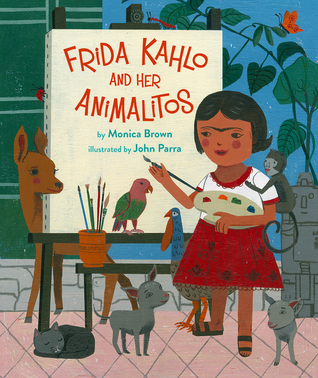
Book Trailer Premiere: Frida Kahlo and Her Animalitos by Monica Brown, ill. John Parra

August 14, 2017 by Betsy Bird

Every generation gets the Frida Kahlo picture book biography it deserves.  Now at some point here I’m going to write an article about why some female figures get picture books biographies while others do not, and what trends in the greater pop culture landscape control these choices.  Happily, I am of the opinion that the more Frida Kahlo bios we have, the better.  Up until now my heart was squarely in the camp of Frida by Jonah Winter, ill. Ana Juan, as well as Viva Frida by Yuyi Morales. That was then. This is now. Today I am pleased beyond measure to present to you the latest from Monica Brown and John Parra.  Both have floored me repeatedly over the years. I’m so very fond of Frida Kahlo and Her Animalitos, on sale in September. If you’re feeling down over the news from this past weekend, at the very least listen to the music in this trailer. There is good yet in this world:

Many thanks to the good people of North South for allowing me to premiere the video here.

FridaKahloAnimalitos

Filed Under: Videos Tagged With: book trailer debuts, book trailers, John Parra, Monica Brown

New Fuse 8 n’ Kate Episode: Are You My Mother? by P.D. Eastman

August 14, 2017 by Betsy Bird

AreYouMyMother1Sometimes in the course of running through the classics Kate and I are in danger of looking at books for kids with too clinical an eye. For example, I might easily forget that Are You My Mother by P.D. Eastman is, at its core, a very sad little book. Fortunately Kate’s there to remind me, so we ratchet up the sadness quotient to 11. For the first time we’re considering an Easy Book. Should we have started with Go, Dog, Go instead? I’ll leave that up to you to decide.  You can listen to our latest podcast recording/debate at: https://soundcloud.com/user-745466600/episode-7-are-you-my-mother

Happily, if you listen to our podcast in your car at all, you’ll notice that the stereo setting we were using that made Kate’s voice sort of disappear into the mist is now gone.

Answer to the Mufaro’s Beautiful Daughters Question: According to the book Dear Genius, John Steptoe was about 18 years of age when he first met with Ursula Nordstrom. A hat tip to Kathryn Leahey for getting it right!

Show Notes:

  • In terms of feedback from Monica Edinger, please check out her blog post John Steptoe’s Mufaro’s Beautiful Daughters. Extra Bonus: A member of the Caldecott committee that awarded Steptoe the Honor makes a comment at the end!
  • This is the Alison Bechdel book I keep referring to (it’s really good!):

AreYouMother

  • Here’s what the “party edition” looks like. Sorta. Imagine more with the shiny:

AreYouMotherParty

  • This is the hen that Kate said freaked her out. I have no idea what she’s talking about:

AreYouMother2

  • Interested in reading the post on my Top 100 Picture Books Poll from 2012?  Here’s the one I did for Are You My Mother?
  • Here’s the car that convinced me that this book takes place in post-apocalyptic Cuba.

AreYouMyMother4

  • Make sure you read the entire text of the Mallory Ortberg Are You My Mother? rendered horrific here.
  • God, I love Robin Sparkles (though I still think she peaked with “Sandcastles in the Sand”):

  • Not sure if my description of The Big Sick proved enticing enough? Then read the New Yorker piece Kumail Nanjiani’s Culture-Clash Comedy.
  • Kate’s not wrong. That’s one big rubber stamp:

free_stamp_in_cleveland

  • And finally, next time you’re in Cleveland, that Christmas Story House really does exist.

Filed Under: Fuse 8 n' Kate Tagged With: Are You My Mother?, Fuse 8 n' Kate, P.D. Eastman

Review of the Day: Patina by Jason Reynolds

August 11, 2017 by Betsy Bird

patina-9781481450188_lgPatina
By Jason Reynolds
Atheneum, an imprint of Simon & Schuster Books
$16.99
ISBN: 978-1481450188
Ages 9-12
On shelves August 29th

You cannot be a children’s librarian or an adult children’s book reviewer if you do not constantly remind yourself that you have to read outside your comfort zone on a regular basis. Our current National Ambassador of Young People’s Literature, Gene Luen Yang, put this far more eloquently when he urged people to partake in the Reading Without Walls Challenge. The rules are simple. You can read about a character that doesn’t look like your, a topic you don’t know much about, and/or a format you don’t usually pick up. I often wonder what would have happened if I’d encountered this challenge as a child. When I was a 9-12 year old I went out of my way to avoid works of realistic fiction that could potentially depress me. But having finished the latest Jason Reynolds title in the Track series called Patina, if I could go back in time and hand my younger self one book that fell squarely outside her comfort zone, I’d probably hand her this. A companion novel to Ghost, Reynolds’s latest takes a long hard look at what it sometimes takes to trust the people around you. Even when they’ve given you absolutely no reason to do so.

Patina has lost a race. Patina is not a good loser. Not good at all. If you knew Patina, this would probably be the first thing you knew about her. The thing is, Patina’s already lost a lot of things in her life. Her dad died when she was pretty young, and her mom nearly died of diabetes after that. She lives with her aunt and uncle, helps take care of her younger sister, and attends this hoity toity school that may be good for her future but is death on her friendships. At least there’s track, though, right? Only now Patina has lost a race and, stranger still, she and her fellow runners are going to be forming relay teams. Now the trick to any team is to synchronize yourself with the people around you. Patina, however, can’t afford to synchronize with anyone in her life. She’s a loner (isn’t she?). Someone who doesn’t need help (are you sure?). And she’s not easily surprised. Not easily, but when it happens then maybe a lot of other things in her life will start to change as well.

Before we go any further today I would like us to consider the case of The Mighty Miss Malone. Author Christopher Paul Curtis was at the top of his game. Sure he’d had the occasional misfire here and there (his YA never really hit the heights and his Mr. Chickee series wasn’t quite up to his usual standards) but when it came to historical fiction nobody could match him. Bud Not Buddy? The Watsons Go to Birmingham? Elijah of Buxton? The dude was on fire! Of course, there was one thing that ALL his books had in common. They all starred boys. This is, of course, a good thing. Curtis knows boys. Also, do you know how many middle grade novels for 9-12 year olds star African-American boys in a given year? You can usually count the number on your own two hands. So we needed those boys on our shelves. But as he is an artist, Mr. Curtis felt compared to push himself into new territory. So in 2012 he produced the book The Mighty Miss Malone. The hope was to fully flesh out a minor character from Bud Not Buddy. The result was disappointing. Deza, the heroine, is never allowed to save the day. Instead she’s a fairly passive character who watches as her troublemaking younger brother single-handedly rescues the family from despair. So it was with great trepidation that I picked up Patina. The similarities were already in place. Like Curtis, Mr. Reynolds is an award-winning African-American author who had done us the great good of providing us with a plethora of memorable, wonderful black boy characters. And like Mr. Curtis, Jason decided to write a book from a girl’s perspective. So the question I hand to you today is this: Did it work?

Let’s talk a little bit about why Mr. Reynolds wrote Patina in the first place. When Jason was initially approached by a publisher to write a sports book, he was offered “street ball”. A different publisher offered him a series deal where he could pick the sport himself. Sold! So right from the start it was clear that there were four kids in these books that would go on personal journeys. Ghost kicks it off, and Patina makes it clear that Reynolds isn’t afraid to dive into his first female heroine right from the start. Along the way he makes some very specific choices. For example, while there are men and boys in the book, the bulk of the focus, as well as the characters themselves, is on girls. Patina is surrounding by a strong support network of women. She has a birth mother and an adopted mom. She has female track friends, female school friends (by the end), old female friends with whom she keeps in touch, and a sister. At the same time, her life isn’t what you’d necessarily call easy. Patina has to keep an eye on her younger sister, deal with her fancy school, and try not to worry too much about her mom. The author once said about this book (and here I’m paraphrasing), “Patina is about someone who deserves to be a little girl and can’t be.” He’s purposefully working to make Patina the hero of her own book, and happily there are moments in the story where she takes steps to be proactive and solve her own problems.

There was one aspect of the book that bothered me though, and you might well write it off entirely. Now as a character Patina has a dead daddy, a mom with diabetes, and loving stepparents. But as a children’s librarian I’m very used to these overused, very regular, very predictable middle grade tropes. So when I see a female character with a tricky home life going to a posh private school, I’m going to expect one thing: bullying. Reynolds has all the right pieces in place, but he doesn’t go in that direction. It made me pause and think. Bullying in children’s books is all about the mustache twirling (so to speak). But there are different levels in reality. In this book there is a kind of unspoken assumption that Patina is going to shoulder the bulk of the group project she’s assigned. Sometimes the merest of assumptions are the most effective methods of keeping people under your control.

Which is all well and good but it doesn’t lead to a whole lot of conflict for Patina. In Ghost we had a boy trying to outrun his own demons (and failing). Patina, in contrast, isn’t running away from anything specifically. Cleverly, Reynolds changes the focus slightly so that her challenge is working well with others. When you’ve been micromanaging your life, you may have a hard time relinquishing power (or what you interpret to be power) to others around you. The struggle to trust is inherently less exciting than the struggle to maintain control over the self. As a result, Patina” is significantly less exciting than Ghost. In Ghost you had shoplifting, past trauma, bullies at school, fights, and showboating. In Patina there’s a car crash, but very little in the way of interpersonal problems. Patina is told from the start of the book to get a handle on her anger. Which she does. You might expect there’d be a scene where she goes off on someone, and there is one on the track. That moment is then resolved neatly and almost immediately with no long-term repercussions. Heck, her family is 100% supportive of her track running. Even the early chapter book Izzy Barr, Running Star by Claudia Mills made it so that Izzy has to compete for parental interest and attention. So Reynolds is very big on the learning and growing with this book. Not so much the immediate conflicts before that.

Not that it isn’t still a great book. You know that palpable sense of relief you feel as an adult when you’re reading through a title for kids and you come to a part where you realize the book is packed full of amazing writing? I got that here. Owing to its aversion to conflict Patina probably couldn’t be called Mr. Reynolds’s strongest work to date, but at the same time it’s enormously satisfying to read an author that works hard to give a female character a voice, impetus, smarts, and insecurities. In other words, he makes her a real person. A great book for kids that are into realistic fiction, as well as those kids that are willing to trek out of their comfort zones a little to look at a truly great read. A book with a kick.

For ages 9-12.

Source: Galley sent from publisher for review.

Like This? Then Try:

  • Izzy Barr, Running Star by Claudia Mills
  • Nothing But Trouble: The Story of Althea Gibson by Sue Stauffacher
  • The Girl Who Ran: Bobbi Gibb, the First Woman to Run the Boston Marathon by Frances Poletti & Kristina Yee, ill. Susanna Chapman

Filed Under: Best Books, Best Books of 2017, Reviews, Reviews 2017 Tagged With: 2017 middle grade fiction, 2017 reviews, African-American authors and illustrators, Best Books of 2017, diverse fiction, middle grade fiction, middle grade realistic fiction

  • « Go to Previous Page
  • Page 1
  • Interim pages omitted …
  • Page 374
  • Page 375
  • Page 376
  • Page 377
  • Page 378
  • Interim pages omitted …
  • Page 1051
  • Go to Next Page »

Primary Sidebar