• Skip to primary navigation
  • Skip to main content
  • Skip to primary sidebar
  • About/Contact
  • Fusenews
  • Reviews
  • Librarian Previews
  • Best Books
    • Top 100
    • Best Books of 2022
    • Best Books of 2021
    • Best Books of 2020
    • Best Books of 2019
    • Best Books of 2018
    • Best Books of 2017
    • Best Books of 2016
    • Best Books of 2015
    • Best Books of 2014
    • Best Books of 2013
  • Fuse 8 n’ Kate
  • Videos
  • Press Release Fun

Winnie-the-Pooh Celebration Week: Day 5 – New Pooh-Related Titles Worth Exploring

Winnie-the-Pooh Celebration Week: Day 5 – New Pooh-Related Titles Worth Exploring

January 23, 2026 by Betsy Bird

You may not have heard it, but this coming Saturday, January 24th is Winnie-the-Pooh Day. And not just any Winnie-the-Pooh Day either! All over the world people are celebrating the silly old bear’s 100th anniversary since the publication of his first books. This week, we celebrate him in different ways.

For our final delve into Poohdom this week, I thought briefly about going into the fact that Pooh is now technically in the public domain. It was a thought, but I think the nicest way to end instead is by looking at two new Pooh-related releases and what they say about Pooh in the 21st century.
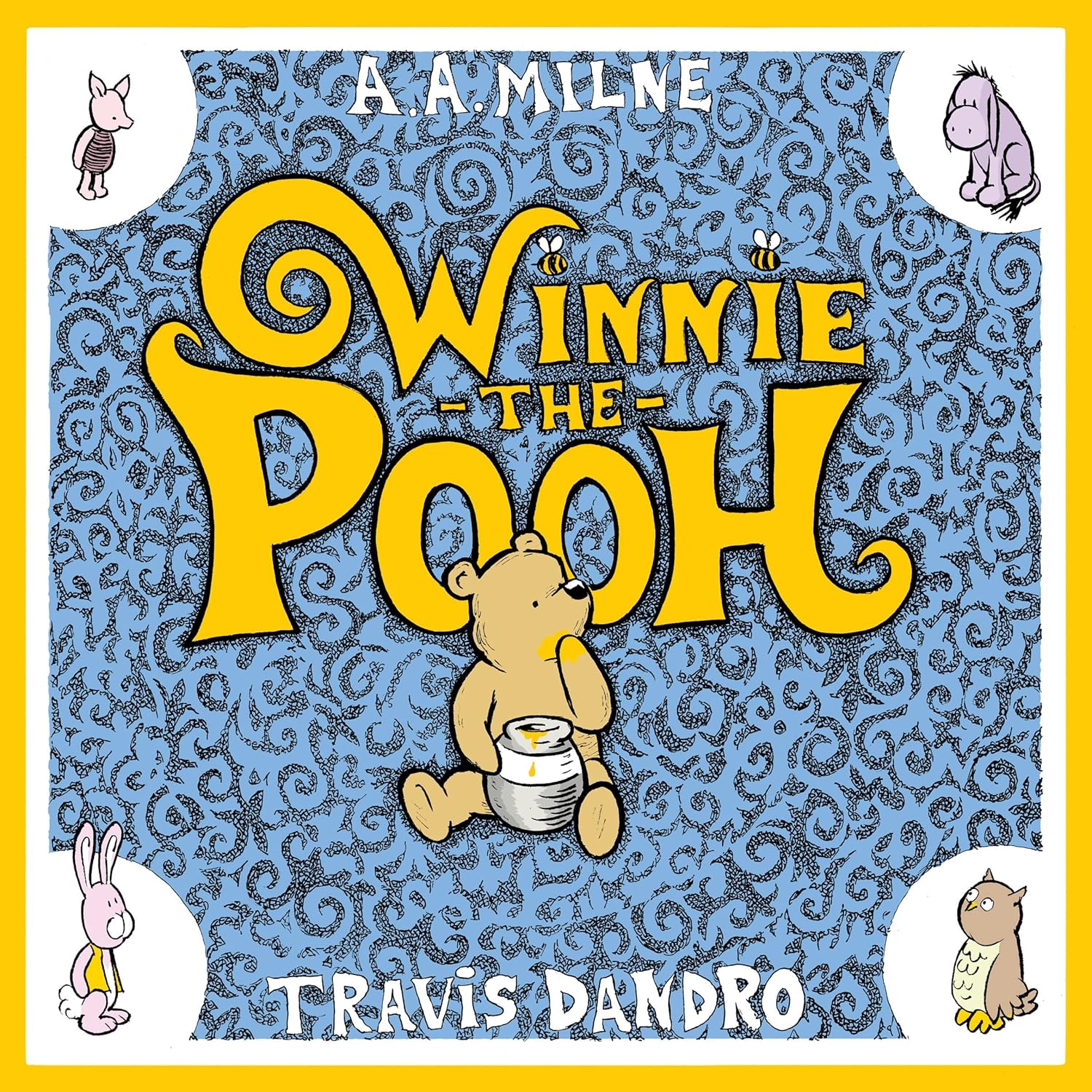
When Drawn & Quarterly released this Winnie-the-Pooh graphic novel in 2024 I was, admittedly, a bit wary of it. Drawn & Quarterly typically does some very adult work in the comics world, so the thought that they’d take on the silly old bear made me uncertain (see previous statement about Pooh now being in the public domain). I needn’t have worried. Travis Dandro (a native of Leicester, MA rather than Leicester, England) took a great deal of time and care to render the original tales in a new format, and nothing else. As Kirkus said so succinctly, “No public-domain tomfoolery here; this adaptation is an act of love.” School Library Journal, meanwhile, called it, “A cottagecore graphic novel for all ages that is sure to please during story time or while young readers choose to explore the Hundred Acre Wood on their own.” Whatever one cares to call it, it is very much in the same vein as the original.

The other book today was just released on January 6, 2026. Imagine, if you will, a cover that feels soft and fuzzy to the touch:

This is the 100th Anniversary Edition of Winnie-the-Pooh, put out by Aladdin books. What’s remarkable about it isn’t what it does (though the fuzzy cover is a definite plus) but rather what it doesn’t do. It doesn’t include a Forward by a famous author, for example. Such inclusions are almost de rigueur in this day and age. Then again, who on earth is our contemporary Milne? No, the book simply is… the book. No updates that I can detect. No changes. I was, admittedly, a little amused by the note on the publication page that, “The illustrations for this book were rendered in pen and ink.” That’s at least one element not in the original.

Otherwise, if you happen to be looking for a classic gift version of the book, this is the title to go for. Small. Cute. And just a little bit furry.

Filed Under: Uncategorized Tagged With: Winnie-the-Pooh

Winnie-the-Pooh Celebration Week: Day 4 – The Strange Case of Lottie the Otter a.k.a. The Bane of My Existence

January 22, 2026 by Betsy Bird

You may not have heard it, but this coming Saturday, January 24th is Winnie-the-Pooh Day. And not just any Winnie-the-Pooh Day either! All over the world people are celebrating the silly old bear’s 100th anniversary since the publication of his first books. This week, we celebrate him in different ways.

I’m going to tell you a personal Winnie-the-Pooh story today. This is a fun one. I haven’t thought about it for a while, but going through my files on Pooh and my time alongside him, I realized that I never accounted for one of the more peculiar incidents in the life and times of the stuffed Pooh animals. A time, indeed, when their sanctuary was invaded by an interloper… wearing pearls.

In 2009, this was the invite that went out:

PENGUIN YOUNG READERS GROUP WILL UNVEIL AND PRESENT A PERMANENT MURAL FOR THE ORIGINAL WINNIE-THE-POOH STUFFED ANIMALS THAT LIVE IN THE NEW YORK PUBLIC LIBRARY
CHILDREN’S CENTER AT 42 STREET

Join Winnie-The-Pooh and Friends as They Reveal Several Surprises and Begin a New Chapter in the Classic Winnie-The-Pooh Legacy

Jim Dale, Grammy Award-Winning Reader, to Give First Official Reading from the Newly Published RETURN TO THE HUNDRED ACRE WOOD. On October 5, in conjunction with the publication of Return to the Hundred Acre Wood, the first authorized sequel to the last Winnie-the-Pooh novel in more than 80 years, Penguin Young Readers Group will unveil and present a permanent mural for the original Winnie-the-Pooh stuffed animals that inspired the books — adding another chapter to its long history with Winnie-the-Pooh and the Library. Pooh, Eeyore, Piglet, Kanga, and Tigger have lived at The New York Public Library since 1987 and currently find their home in the Children’s Center at 42nd Street. Jim Dale, Grammy Award-winning reader who voiced all of the characters in Return to the Hundred Acre Wood, will give the first official read from the new book to school children before the unveiling.  WHO:            

  • Paul LeClerc, President of The New York Public Library
  • Don Weisberg, President, Penguin Young Readers Group
  • Jim Dale, award-winning voice for countless audio books
  • Children from New York City’s schools
  • …And a SURPRISE SPECIAL GUEST!

 WHEN:          

Monday, October 5
Press Check-In: 10:00 AM 
Welcome: 10:30 AM
Jim Dale Reading: 10:45 AM
Surprise Unveiling / Photo Opportunities: 10:55 AM
                                            
WHERE:        
Children’s Center at 42nd Street
The New York Public Library Stephen A. Schwarzman Building
(Fifth Avenue and 42nd Street)
 
ALL PRESS MUST RSVP IN ORDER TO BE CREDENTIALED

It was all very interesting and I wrote up the entire event here, complete with ample photographs. And if you’re wondering who the surprise special guest was, I misremembered it as Mary-Louise Parker, but that was actually a different event a month later. No, as it happens the special guest was someone a bit shorter and a bit furrier. Meet… Lottie:

a.k.a. My nemesis.

I’m going to endeavor to explain.

So in 2009, I was a children’s librarian working in the Central Children’s Room on 42nd Street. And, as I may have mentioned before, I worked alongside the original Winnie-the-Pooh dolls. We were originally in the Donnell Library on 53rd Street, but then NYPL sold the Donnell and moved the whole Central Children’s Room to the main location on 42nd and 5th. Which was unspeakably cool. We were now just down the hall from the original children’s room where Anne Carroll Moore herself used to traipse about.

In the room was an odd little room within a room. It was there that we placed the Winnie-the-Pooh toys, after the conservators got their hands on them and patched them up a bit (trust me when I say that Eeyore and Piglet sorely needed it). The room was nice but the walls were a bit bland. It’s hard to find images from that time, but it basically looked something like this.

See? Kind of boring.

That’s when someone at Penguin had a brilliant plan. I have to give them full credit. As press release events go, it was inspired. What if, in conjunction with this book they were releasing (called Return to the Hundred Acre Wood, now long since forgotten) Penguin were to paint the walls of that little room to look like the maps and other original illustrations by E. H. Shepard? AND what if they threw a big party to reveal the painted room alongside this new book AND they invited Jim Dale to do a reading?

It was absolutely the smartest thing in the world. Penguin was happy because it was a great way to highlight this book and NYPL was happy because they were getting more attention for the original Winnie-the-Pooh toys AND a free painted room! Miraculously, it all worked too. The room was revealed. Jim did his reading. Everyone was happy.

Almost.

You will remember the “special guest” that was touted. Well, in this new Winnie-the-Pooh book (“for the first time approved by the Trustees of the Pooh Properties”) author David Benedictus added an all new character. Her name was Lottie the Otter, and Jim Dale read her as if she were Lady Bracknall in The Importance of Being Earnest. On the page she was quite cute, thanks to the art of Mark Burgess:

And had she stayed on the page, I wouldn’t have had any problems with her. The trouble was that she didn’t remain two-dimensional. That photo I just showed you earlier? That was the unveiling of a stuffed animal version of Lottie by Don Weisberg, President of Penguin Young Readers Group.

That’s right. They gave her a cute little display case of her very own alongside an open copy of the new book. As you can see, she was outside of the room where the original toys were housed. And that was honestly just fine! They had their space. She had her own….

… until they put her in the case with Winnie.

*sigh*

Look. I’m no purist, all right? I understand how the world works. Some people were incensed that Lottie the character even existed at all. Like the new book was trying to improve upon Milne. I never felt that way. I liked that Burgess thought he could add a new playful element to the stories. That was fine. But our Library Director was hugely amused by Lottie. He just got a real kick out of that otter. So on his order, not long after this party, she ended up in the SAME CASE as all the original toys.

Where’s your photographic proof of this, Betsy? you may be asking. All I can say is, thank god for Roadside America. While I was foaming slightly at the mouth every time I even looked in the room, they took this shot:

Can you spot her? She’s second from the left, just behind Kanga.

And they had this to say:

“But who is that new, pearl-wearing, fresh-from-the-factory addition next to Kanga? Why, its Lottie the Otter, created long after Milne was dead, for the 2009 “authorized sequel” Return to Hundred Acre Wood.

In other words…the coveted position of sidekick is a donated product of the Disney/Penguin Books marketing machine.”

Now imagine you are an employee of the library and you have to answer the question, “Who is THAT?” over and over, day after day. My favorite response to her was a child who took one look at the case and asked, “Is that the groundhog from the movie?” Yes, kid. And that groundhog loved him some pearls.

At one point Pooh and friends went on display as part of an exhibit in another part of the library building. I missed them but was relieved to see that Lottie was not part of that exhibit as well. I thought that I’d finally seen the last of her! Hooray!

When they returned to our room we were ecstatic. And then, I kid you not, THEY PUT THE DING-DANG OTTER BACK INTO THE CASE!!!

I used to joke with my colleagues that one of these days I was going to break into the case with a hammer, grab that otter, and then run for the library’s exits, holding her like the furry little football she was.

All this madness ended, I think, when the toys went on display as part of Leonard Marcus’s The ABC of It exhibit. When they came back over 2 years later, Lottie was finally gone for good (possibly because the Library Director who had loved her so dearly went off to work for the Library of Congress). So where is Lottie today? Well, NYPL has ended up with a lot of odd promotional materials over the years. I distinctly remembering have to bypass a gigantic Eragon egg, that was supposed to hum when you plugged it in, that sat gathering dust in our stacks. Lottie, I have no doubt, has been carefully packaged, labeled, and put away in a box somewhere in either the Schwarzman or BookOps in Queens. She may never surface again, honestly. Her story, even a mere 17 years later, is well and truly forgotten.

Even so, I like to think that someday, someone is going to find that pearl-wearing little interloper and wonder what is to be done with her. Maybe they’ll take her home and give her to an actual child. It’s not the NYPL way to give away their archives, but maybe in her case they’ll make a furry little exception.

Filed Under: Uncategorized Tagged With: Pooh -- Winnie-the-Pooh, Winnie-the-Pooh

Winnie-the-Pooh Celebration Week: Day 3 – Statues and Lesser Known Histories

January 21, 2026 by Betsy Bird

You may not have heard it, but this coming Saturday, January 24th is Winnie-the-Pooh Day. And not just any Winnie-the-Pooh Day either! All over the world people are celebrating the silly old bear’s 100th anniversary since the publication of his first books. This week, we celebrate him in different ways.

There are as many ways of celebrating Winnie-the-Pooh as there are stars in the sky. This week, I’m eschewing the Disney adaptations, though not out of spite. For all that they were curious oddities that eclipsed the books for quite a while (there was even a time when Pooh was Disney’s second most valuable character) I’ve a childhood fondness for anything involving Sterling Holloway.

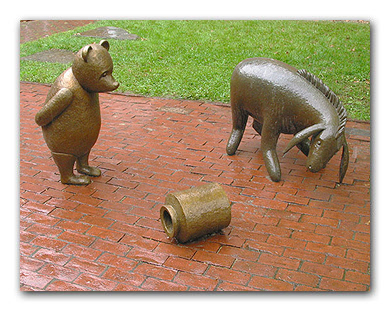
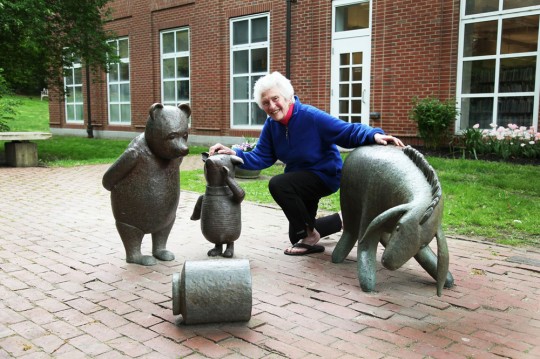
Instead today I’m plucking two different Pooh-related items from my archives. As you may know, I periodically make a round-up of A Complete Listing of Children’s Literature Statues. Such round-ups only include statues in the United States that are publicly available to one and all and don’t require any kind of a fee. So far, I’ve only found one Pooh-related inclusion to date:

Book: Winnie-the-Pooh
Location: Newton Free Library of Newton, MA
Sculptor: Nancy Schön

As the story goes, Eeyore was established in 1991. But he looked so sad that Pooh was made in the memory of Sarah Oliver who had written the mayor asking for Eeyore to have a friend.  Later on Piglet joined.  Read this little article on the characters for more information (and thanks to J.L. Bell for the tip about Piglet).

Statues are cute, but books about Pooh can be cuter.

I’m certain you’re all well and truly familiar with Sophie Blackall’s Caldecott Award winning work on Finding Winnie: The True Story of the World’s Most Famous Bear (and its slightly lesser known sequel, Winnie’s Great War). What you may not know is that in 2015, that was not the only book to come out on the topic of the little bear that inspired Christopher Robin. There was another book out at the same time, and I reviewed it. Today, we consider a different kind of take on the original “Winnie”.

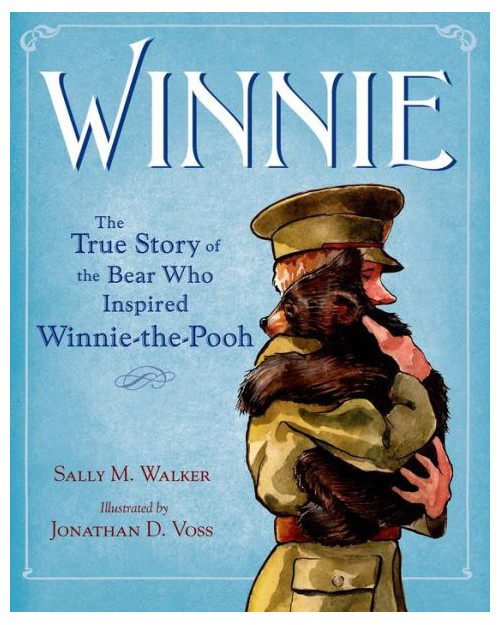
Winnie: The True Story of the Bear Who Inspired Winnie-the-Pooh
By Sally M. Walker
Illustrated by Jonathan D. Voss
Henry Holt (an imprint of Macmillan)
$17.99
ISBN: 978-0805097153
Ages 4-7
On shelves now

I worked in close proximity to the real Winnie-the-Pooh for five years. From 2006 to 2011 he was a daily delight. To clarify, I was working alongside the original Winnie-the-Pooh toys owned by the real Christopher Robin, son of A.A. Milne in New York Public Library’s Central Children’s Room. We had Piglet, Tigger, Kanga (no Roo), Eeyore, and Winnie himself. Though ironically I never read his books as a child, in my time as a children’s librarian working in the Children’s Center at 42nd Street I became well versed in his story. Winnie was purchased at Harrods for Christopher Robin who eventually named him “Winnie” after some bear he’d seen in a zoo. If pressed to conjure up facts about that zoo bear I might have been able to tell you that its name was Winnipeg, but that was about as far as my knowledge on the matter went. Sometimes it takes a children’s book to learn about a children’s book character. Winnie: The True Story of the Bear That Inspired Winnie-the-Pooh relates the true history of a man and his bear. Illustrated with aplomb by Jonathan D. Voss, the book’s charm is the true measure by which you can assess how well it lives up to its namesake. Accuracy and adorableness in one small, furry package.

There are many things Harry Colebourn could have purchased as his troop passed through the small train station, but what did he end up with? A baby bear. A baby black bear, if you want to be precise about it. Good natured and orphaned, Harry promptly names her “Winnie” after his company’s hometown “Winnipeg” and she becomes the darling of his troop. When WWI calls his company across the wide ocean, Winnie comes along. But killing fields are no place for a baby bear so it’s to the London Zoo that Winnie goes. Once there, Harry promises her that when the war is done he’ll take her back to Winnipeg. It’s a promise he doesn’t keep. Upon his return Harry sees that Winnie is not only happy but a star of the zoo. She’s so gentle that children everywhere come to see her. Even a boy by the name of Christopher Robin . . . Copious photographs of the real Winnie and Harry grace the front endpapers while Christopher Robin graces the back. There is an additional Author’s Note on Harry, Winnie, and black bears as well as a Bibliography of sources.

As I began reading the book I wondered if the story of Winnie would be akin to other military animal tales out there. Would Winnie aid the Allies much in the same way as Voytek in Poland or was she more of a mascot like Stubby? Neither, as it happens. Though Winnie did make it onto a boat headed for France, her keeper was smart enough to recognize that while some bears would thrive in a war zone (see: Voytek), Winnie was not one of them. Really she was just a baby and after seeing her playing and cuddling with Harry the thought of her existing in a place where bullets would fly is terrifying. This is a sweet wartime tale, perfect for reading to younger children who take things on face value and aren’t aware of what WWI really entailed.

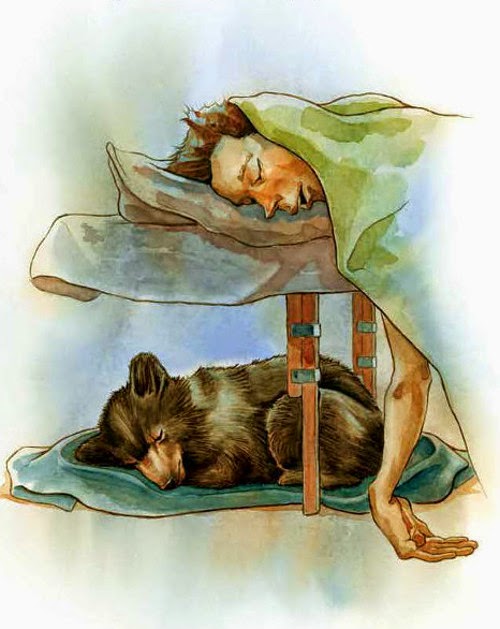
The art of Jonathan D. Voss caught me by surprise. With just a half glance at the cover I initially though the illustrator was Amy June Bates (who illustrated the somewhat similar Christian, the Hugging Lion back in 2010). An understandable mistake but once I actually went so far as to, oh I dunno LOOK at the book, I could see that Voss has a crisper line as well as a sure and steady grasp on the material. This being the first picture book that he has illustrated, he does a good job of making some really iconic images. The view on the cover of Harry hugging Winnie to his chest, as one might cuddle an infant, is downright heartwarming. Likewise the image of Winnie asleep under Harry’s cot as his long arm drapes down, his wrist bending in sleep, works. And if the four shots of Harry playing with Winnie were a YouTube video they’d get more hits than any other cute animal video to date. There is the occasional misstep, I’m afraid. A boy riding Winnie later in the book bears the slack-jawed look of a very small grown man and not a little boy. Indeed Voss appears to be most comfortable when Winnie is his focus. There’s not a single image where that bear doesn’t feel 100% authentic. One suspects the artist spent a great deal of time studying baby black bears and how they move. He also does a decent job of rendering the stuffed Pooh accurately. The arms are admittedly a bit long but the stance and nose are on target.

One objection I’ve heard to the story is that there isn’t enough Christopher Robin / real Winnie-the-Pooh info included in this story. I can see where this critic is coming from but I respectfully disagree. To my mind, Winnie’s story is fascinating in and of itself regardless of what famous literary character she ended up inspiring on some level. Hers is a story of tragedy turned to great good luck. Few orphaned bears in the WWI era would have found such a caring owner, let alone one that let them travel to Europe. Her life was notable at the time and makes for no less an interesting story today.

For my part, the book gets into tricky territory when we view the quoted dialog. Now Ms. Walker is a known entity. She does this stuff for a living. Wins big nonfiction awards like the Sibert for Secrets of a Civil War Submarine and the like. So when we get to a section where Harry is quoted saying “I’ll feed her condensed milk. She can stay with me in camp. Winnipeg can be our mascot,” then we have to naturally assume that the quote comes from one of the listed sources Walker provides at the back of the book. The quotes are not sourced but since Harry’s diary is one of those aforementioned sources, there’s a strong likelihood that the quotes come from there. I’m giving the book the benefit of the doubt in this matter, since faux dialog is the bane of the modern nonfiction picture book.

Read this book and few will wonder that after seeing Winnie in person, Christopher Robin wanted a bear of his very own. Indeed, the vast majority of children who are read Winnie may think to themselves (or say out loud) at some point, “When do I get my own?” Sorry, kids. If it’s any consolation you can see the Winnie-the-Pooh toys in the main New York Public Library location anytime the building is open. Maybe it won’t be the same as getting to ride a sweet bear in the zoo, but it’s still a part of this story on some level. Cute, not saccharine, and pleasing to boot, this is one story-behind-the-story kids will definitely appreciate. Lovers of Pooh welcome but not required.

On shelves now.

Source: Final copy sent from publisher for review.

Like This? Then Try:

  • The Journey That Saved Curious George by Louise Borden
  • Stubby the War Dog: The True Story of WWI’s Bravest Dog by Ann Bausum
  • Christian, the Hugging Lion by Justin Richardson

Interviews: Julie Danielson interviews Sally M. Walker about the book over at BookPage.

Misc: For more interior illustrated spreads, go to Seven Impossible Things Before Breakfast.

Video: Forgot a movie was made out of this story as well, didn’t you?  You’re forgiven.  It came out in 2004 and was made for TV after all.  That said, it had some big name cast members.  Michael Fassbender starred.  Stephen Fry shows up.  David Suchet. And someone put the whole thing up on YouTube so if you’ve an hour and a half to kill . . .

Filed Under: Reviews, Reviews 2015 Tagged With: 2015 reviews, children's literature statues, Pooh -- Winnie-the-Pooh, Winnie-the-Pooh

Winnie-the-Pooh Celebration Week: Day 2 – How a Bear Became a Book: A Q&A with Annette Bay Pimentel and Faith Pray

January 20, 2026 by Betsy Bird

You may not have heard it, but this coming Saturday, January 24th is Winnie-the-Pooh Day. And not just any Winnie-the-Pooh Day either! All over the world people are celebrating the silly old bear’s 100th anniversary since the publication of his first books. This week, we celebrate him in different ways.

Truth be told, the idea to do a Winnie-the-Pooh Celebration Week only came to me after Macmillan pitched me the idea for today’s Q&A.

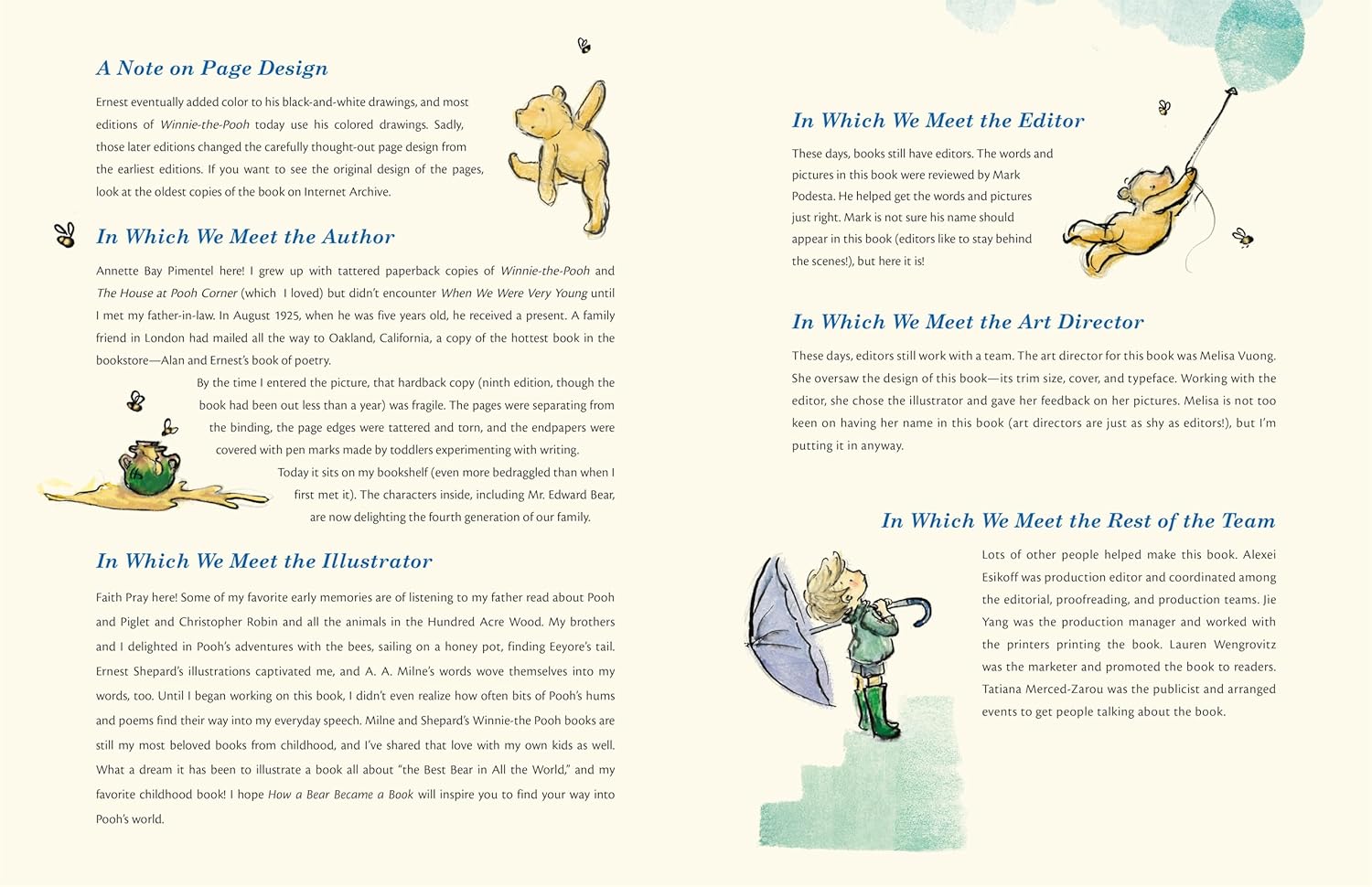
Now it’s not as if we haven’t seen a whole slew of picture book bios of children’s book creators recently. Personally, I like it when they do something a little different. Think, Jim! and its way of presenting James Marshall in the style of his own books. So I will admit freely that when I heard that someone was doing a picture book on the creation of Winnie-the-Pooh I had this knee-jerk reaction to it. Friends, I assumed it would be dull. Friends, I could not have been more wrong. And it’s all because of how author Annette Bay Pimentel and artist Faith Pray decided to get creative with the material. The book in question? How a Bear Became a Book: The Collaboration That Created Winnie-the-Pooh, out March 31st.

Now I could cut and paste the description of the book here from the publisher (as is my usual wont) but I actually really liked how publicist Tatiana Merced-Zarou sold this to me in her pitch. She wrote:

This explores how a writer, illustrator, and editor brought Pooh’s first adventure to life — but deeper than that, it introduces our youngest readers to how stories begin and where they can go. In a starred review, Kirkus calls it “a thoughtful, beautifully crafted title that honors a literary classic on the eve of its centennial and introduces ‘The Best Bear in the All the World’ to a new generation.” And in another starred review, School Library Journal, says it’s “a stunning tribute to a classic that also offers insights into the bookmaking process.”

With Faith’s breathtaking and nuanced visual storytelling (as Pooh’s voice enters the text, he slowly comes to life in the art) and Annette’s delightful text, this is a picture book about the making of picture books, but it is also a masterful exploration of ideas, storytelling, collaboration, art, and most importantly, honey.

And after reading the book I realized that what it’s really doing is showing kids that just because someone’s name is on a book, they’re just one of a large group of people, all working in tandem to make it the best possible literary experience. Isn’t that something?

Naturally, questions abound:


Betsy Bird: Annette! Thank you so much for answering my questions today! First and foremost, let’s get your Winnie-the-Pooh bonafides in place. What’s your own personal connection to Pooh bear? 

Annette Bay Pimentel

Annette Bay Pimentel: I grew up reading Winnie-the-Pooh and The House at Pooh Corner in highly-tattered paperback copies. Years later, I met the earliest incarnations of Pooh in Milne’s poetry books through my father-in-law. When he was 5, in 1925, a family friend in London sent him a copy of the publishing sensation of the year—When We Were Very Young. He loved the book and when he had kids, recited the poems to them. My husband continued the tradition, reciting them to our kids. Grandpa’s book is pretty bedraggled these days and several toddlers have doodled in it, but I love it and keep it next to my desk.

BB: Okay, those bonafides seem fairly rock solid Now Faith! Such a pleasure to talk to you today as well. And what great work you’ve done on this book! Tell us a little bit about how you were approached to work on this manuscript. What was it that appealed to you about this story? 

Faith Pray

Faith Pray: Thank you, Betsy. It is an honor to chat with you about our book. 

My favorite books from childhood were the Winnie-the-Pooh stories and poems. I especially loved them because my dad read them to my brothers and me in all the different characters’ voices, stopping at every page turn to let us soak up Ernest Shepard’s magical illustrations. I’ve always been a huge fan of both Milne and Shepard. Also, I had been wanting to push myself as a storyteller and illustrator beyond my known world for awhile, so when Annette’s manuscript showed up, I was captivated. 

BB: Naturally. Myself, I’m endlessly fascinated by how a picture book creator centers the work of another picture book creator/creation. Annette, there are so many different directions you could have gone with this book. You could have done a rote biography of A.A. Milne, after all. Instead, you artfully mimic a kind of discussion aspect of the books themselves. I mean, walk us through your process. Did you have a clear cut understanding of how you wanted to write this book from the beginning or did it become that in the editorial process? 

Annette: At the beginning, I thought I was writing a picture book biography of E. H. Shepard. There are several great A. A. Milne books out there, but I couldn’t figure out why nobody ever talks about what Shepard brought to the books. When I was a kid, I read the books to myself, without a grown-up’s helpful explanations, and a lot of Milne’s humor went over my head. I relied heavily on Shepard’s illustrations to understand what was happening and what was funny.

Writing with a single focus on Shepard, though, turned out to be tough. He was a brilliant illustrator but led a quiet life, especially in comparison to Milne’s flashier existence. My critique group suffered through many bad drafts, but they kept asking me probing questions until I finally realized that what interests me most in the books is the interplay between words and pictures.

At the same time, my friend and neighbor Eija Sumner was finishing her brilliant metafiction picture book The Good Little Mermaid’s Guide to Bedtime. Although my sweet Pooh is nothing like her salty Mermaid, reading her manuscript and discussing it with her is what helped me shape the give-and-take interaction between Pooh and the narrator. And of course I dove back into Milne’s text so I could echo his voice.

BB: Well, and that entirely different take that you did with the text, Annette, had to be matched by art that was original in its own way. To be honest, Faith, I would not have initially believed that a book about the creation of Winnie-the-Pooh could lend an artist to such creative experimentation on the page. Yet what you’ve done with Pooh here is really interesting. You’ve given yourself such a wide and interesting way to play with text, type, color, and words. Was this something you knew you’d want to do with the book from the start or did you slowly come around to it in the process of creating the book? 

Faith: I love mysteries and puzzles, and Annette’s text was the best sort of challenge. 

Annette and our editor Mark Podesta wrote that they wanted our Bear to emerge out of  words, gradually becoming solid until he was recognizable as Winnie-the-Pooh. When I read that, I could instantly picture how I wanted it to look. The hard part would be figuring out how to make that happen. 

One fun thing about working on How a Bear Became a Book is that we were making a book about making a book, but also about the making of a beloved character, and the magic of collaboration, told in multiple voices. My brain hurt in all the best ways trying to puzzle it all out. When I read through the text, I pictured each voice or piece of the story weaving together, layered over each other in different mediums. So yes, I did know ahead of time what I wanted to achieve, but the process of getting there was a lot like the book we were making – it needed lots of trial and error and experimentation until it felt just right.

BB: Oh, let’s lean into that a little. What was your process for this book? How do you create a bear out of words? And was there a lot of trial and error in the process? 

Faith: Oh, so much trial and error! Let’s just say I experimented with a LOT of techniques before solving the puzzle of what belonged where, and I wrecked a lot of paper in the process. 

Since we were deconstructing and reconstructing the idea of story, I wanted the art to feel collaborative, like each thread of story was its own visual voice. I made the artwork in layers with traditional mediums on different art papers.  The spreads that represent E.H. Shepard’s work are made with tools Shepard used, beginning with pencil, then adding ink, then watercolor. 

Every bear in the book also has a doppelgänger made out of words. I loved the idea of a bear made out of words, but I wanted him to have a chaotic dreaminess, using Milne and Shepard’s actual loopy handwriting and notes as well as pages from my own childhood copy of Winnie-the-Pooh for the words. So I bought a reproduction of  Milne’s handwritten Winnie-the-Pooh manuscript, obtained scans of other papers, art, and letters written by Milne and Shepard, then scanned and printed them in reverse onto freezer paper, finally rubbing the inked pages through the screen-print stencils to form bears made out of words.    

Bears made of words alone were a bit hard to see, and I also wanted to bring in an etherealness to represent imagination becoming tangible. So I created stencils from each bear and some of the other elements in the book, then used a brayer to screen-print those elements onto mulberry paper, which created fibrous, speckled shapes that I could layer into each spread and give them a depth with this faint, airy shape behind the words.  

BB: Amazing. And not something one can figure out by reading the art info on the publication page either. Now you mentioned earlier the challenge of all those multiple voices in the text. Annette, one of the most interesting parts of the book for me was how you continued the discussion of all the people involved in a book by doing it with this book itself! In the back you’ve a section where readers meet the author, the illustrator, the editor, the art director, and the rest of the team. Where did that idea come from? Because it’s mighty neat. 

Annette: With all my books, I’ve felt uneasy that only two of us have our names on the cover. So many people have helped shape them! As soon as I realized I was writing about collaboration, I realized I might have a chance to spotlight other collaborators. I included the back matter section you refer to in my original submission (with placeholders for the names, of course), but I was worried it would get cut in the editorial process. Luckily, the whole publication team agreed to keep it in. 

BB: Well, let’s get into what you were just saying about realizing that you were “writing about collaboration”. I mean, your subtitle even name checks “collaboration”. And I love that you show how many people had to be involved to get Pooh to where he needed to be. And you don’t shy away from some spiky moments (which I really appreciated) like Milne poo-pooing (if I may) the art of Shepard. I think that’s a key component to the book, the disagreements. Was it always in the original manuscript? 

Annette: Yes! The fact that the collaboration wasn’t always easy or obvious was important to me. In fact, in my early drafts, Milne came across as just plain nasty. I find it remarkable how the tense relationship between Milne and Shepard mellowed and matured as the two creators worked across their differences to create something delightful and enduring. I am especially moved that Milne ended up going to bat for Shepard to get him a better royalty deal. I think that’s clear evidence that he came to understand the significant role Shepard’s illustrations played in the success of his books. 

BB: Speaking of collaboration, Faith, your art director on this book was Melisa Vuong. Can you tell us something about what it was like working with her and what her process was? 

Faith: Working with Melisa was a dream. In the beginning, we talked about what we envisioned – heft and height, texture and layers, a hand-lettered title – and she was totally up for trying adventurous things with book design. I have a hard time making decisions, so it was a relief to have Melisa’s expert guidance throughout. The pacing was so tricky! When should our Bear of words turn into a finished Bear? About halfway through the process, I sent Melisa and Mark something like three or four versions of illustrations in states of dress so they could help me choose when the Bear should begin to have pencil, ink, and finally, full color. The book is so much better thanks to all the extra design touches Melisa brought in to make it feel so special.     

BB: Let’s also give a little love and attention to your editor, Mark Podesta. Annette, can you talk a little bit about what it was like to work with him on this book? 

Annette: My other books are straight nonfiction, but this manuscript does quirky metafictional things to tell a true story. I am very lucky that it crossed Mark’s desk because he was totally game for engaging with that weirdness. When he first read it, some of the metafictional elements weren’t totally working, and he suggested that we do a revision together before he committed to acquiring the manuscript. That revision ended up being really fun, both because his emails made me laugh and also because he asked such good questions. He pushed me to give Pooh lots more lines. I recently read the book to a class of second-graders and they laughed the hardest at the parts that had Mark’s fingerprints on them. Collaboration, baby!

BB: And speaking of collaborations, how incredible to see you paired alongside Faith Pray! Faith is doing such incredibly interesting things with the art here. She manages to evoke Shepard without imitating him. And, at the same time, as the Pooh in the story of his creation becomes more clear, the Pooh on the page becomes more clear. Were you aware of Faith’s work before this book? How do you feel about the end product? 

Annette: I didn’t know Faith’s work until the publishing team sent me to her portfolio. Her art is absolutely central to how the book works. Before we landed on Faith, another artist considered illustrating it but ended up passing because, she told us, my manuscript was fundamentally un-illustratable. How, she asked, can you design a character who has to change shape across the book? I panicked, thinking she might be right. But then I saw Faith’s sketches. Faith did the impossible in this book: she created a character who remains recognizable and adorable even as he shifts and morphs throughout the book.

BB: I want to get into that a little. Faith, one thing I admired about your style here was that you were capable of evoking Shepard’s classic style without replicating him. Was that a conscious move on your part?

Faith: I deliberately wanted to pay homage to Shepard because I love his work so much, but I didn’t want to exactly copy it. I studied heaps of books about Shepard and his art, and sketched and inked at least a hundred master studies until I felt I had caught onto an essence of his work, while still keeping a little bit of myself in the styling as well. 

BB: And were there any challenges or unexpected problems in the course of making this, or was it all smooth sailing? 

Faith: I think the trickiest part of this project for me was figuring out how to visually map out different layers of the story and find the right look for each of them. Once I settled on the mediums I wanted, I tried to illustrate each spread on one piece of paper, but when I tried screen-printing onto my watercolor paintings, the paper got mangled and torn. I had to give up on my first idea, and separate the process onto different sheets of paper – drawing, inking, and painting on watercolor paper, then transfer-printing words and shapes onto mulberry paper, and layering them together, which made my paper (and me) much happier.

The historical research part of this project was also a challenge. It required deep dives into books, requesting copies of manuscripts, sketches, and letters from archives, digging up old films of Milne and Shepard writing, talking, making art, walking around near the Hundred Acre Woods, and then sketching all of that to get a better idea of my sense of person and place. 

I love learning, so every puzzle, every new piece of history, every art experiment kind of lit me up.     

BB: That’s awesome. Okay, final question for the two of you: What else is on your plate these days? What else are you up to?

Annette: I have a picture book for very young readers about a migrating turtle who ends up in a dangerous place, Turtle on the Tarmac, coming out in 2027 with Abrams; and Numbers Tell Stories Too, a picture book biography about Florence Nightingale’s pioneering statistical work, coming out in 2028 with Beach Lane. 

Faith: In September, we get to meet my next author-illustrated picture book The Woodland Nutcracker, which is a book of cutie pie animals in the Nutcracker ballet. It’s sweet and sparkly, and comes out September 8, 2026 with Abrams. I have another Woodland book coming out in 2027, and a few of the things I’m cooking up haven’t been announced yet. I can tell you I am planning zoo trips and visiting cat cafes, all for research. I also recently stumbled onto mono-printing and am trying to learn all the things there are to learn about that.   


That’s how it’s done, people!

HUGE thanks to Annette and Faith for taking all this time, love, and attention in answering my questions today. And thank you too Tatiana Merced-Zarou and the team at Macmillan for helping to put all this together. How a Bear Became a Book: The Collaboration That Created Winnie-the-Pooh is out March 31st absolutely everywhere. You’re literally going to love it.

Filed Under: Best Books, Best Books of 2026, Interviews Tagged With: author interviews, illustrator interviews, picture book author interviews, Pooh -- Winnie-the-Pooh, Winnie-the-Pooh

Fuse 8 n’ Kate: Caldecott Contenders 2026

January 20, 2026 by Betsy Bird

Every year, Kate and I do one Caldecott prediction post for our podcast. I hand over to her THREE books that I think are contenders (she claims I do four sometimes, which sounds wrong to me, but I’m too lazy to check if that’s right). Then we discuss and predict which ones might win the big awards. I usually manage to get at least one Honor (and last year I got two!). I’m pretty confident that at least one of these three books will win something on Monday. Trouble is, Kate never seems to have the same reactions to these stories that I do. Her predictions? VERY different from my own. Listen up and you’ll see why. We discuss the significance of cardinals, font sizes, and how one of these books is clearly sponsored by Big Monday.

Listen to the whole show here on Soundcloud or download it through iTunes, Stitcher, Spotify, Google Play, PlayerFM, Audible, Amazon Music, or your preferred method of podcast selection.

Show Notes:

Here’s the book where I got my Cricket Brownie recipe!

Bug Snacks by Jess French, illustrated by Zoë Ingram. And no, I wasn’t able to make them. Somehow I have managed to loose my cricket flour. *sigh*

First up, Our Lake! And as I say, this ain’t a diving board in a kiddie pool.

“He’s not afraid of heights. He’s afraid of depths.” Love how his feet are turned inwards.

I was so happy when Kate also pulled out this image as her favorite. We ARE related after all!!

I’ve read this book multiple times, but it was Kate who noticed the red bird that appears at key moments in this book. The same red as the dad’s old hat.

Full credit to Colby Sharp. I believe, after conversing with him, that we should now say that an out-of-left-field award winner has “chooched” the win (after last year’s Caldecott winner). “To Chooch” is to win it all unexpectedly. What do you think? Do we have a new turn of phrase?

Kate was not actually impressed by this two-page spread of Central Park, thereby making her the first person in history not to be impressed by Fireworks.

Check out the cool typography alongside the eating of the watermelons.

Here Kate and I disagree again. Kate doesn’t think the font is big enough here. I would like to point out that even if that’s a point (and I don’t agree with that) the Caldecott doesn’t even go to the font in the first place!

She also had an issue with the limited color scheme. Again, allow me to point out that I disagree with her. And she still wanted a big font.

Fortunately, she at least was able to agree that this final shot is a helluva good way to end a book.

I have a whole theory about this teenager. I think that she used to be just as into the garbage truck as Mabel is, but now she thinks it’s babyish. And can we get some real respect here for Awad’s ability to make someone look like they’re rolling their eyes with just an upside down comma?

This woman goes forest bathing at least once a week.

For much of this book, Mabel bears some surface similarities to a determined Mario in Super Mario Brothers.

I’d never noticed this before, but there is a very intentional choice here not to show the garbage workers. So this is not like Trashy Town or anything.

Kate Recommends: Broadchurch available on Netflix

Betsy Recommends: Jay Kelly available on Netflix

Filed Under: Best Books, Best Books of 2025, Fuse 8 n' Kate Tagged With: Fuse 8 n' Kate, Newbery/Caldecott predictions

Winnie-the-Pooh Celebration Week: Day 1 – The Complicated History of a Silly Old Bear

January 19, 2026 by Betsy Bird

You may not have heard it, but this coming Saturday, January 24th is Winnie-the-Pooh Day. And not just any Winnie-the-Pooh Day either! All over the world people are celebrating the silly old bear’s 100th anniversary since the publication of his first books.

Now, as it turns out, I knew Pooh.  Quite well, actually. Once upon a time I worked at New York Public Library’s Central Children’s Room turned Children’s Center at 42nd Street, and had the unique privilege of working beside the famous toys of Pooh, Tigger, Piglet, Eeyore, and Kanga (Roo was lost by Christopher Robin in the woods long ago).  Not everyone knows that the toys inspired the books. The toys are currently on exhibit at the main branch of NYPL as part of the Polonsky Exhibition of the New York Public Library’s Treasures.  I’ve seen people weep beside them, propose in front of them, and write all manner of things in their guestbook.

This week, for each day, I’m going to share something Winnie-related that you may not have seen and certain may not have known. For example, what famous trans writer knew Pooh when she worked for Dutton decades ago? Is there a music box in Winnie’s tummy (and what does it play?). How many picture books have been written about his namesake? Where can you find statues of him in America? By the end of this week you’ll have all the answers.

Today, I’m reprinting an updated article that appeared on the Wild Things: Acts of Mischief in Children’s Literature website where Jules Danielson, Peter Sieruta, and I placed all the fun stories that we couldn’t fit in our book. We’re going to start off this week with a serious consideration of Pooh and then work our way into more of the reasons he’s beloved as the week goes on. Today’s tales concern the complicated feelings Pooh’s creators felt towards him when his success became extraordinary, as well as the later fights over where he’d make his permanent home.

It also, for some reason, involves Rudy Giuliani.

Now consider the following:

It’s one of the most famous photographs of children’s literature, the one of A. A. Milne, the original Winnie-the-Pooh, and Christopher Milne in 1926. Hanging in the National Portrait Gallery in Washington, D.C., this image by Howard Coster is certainly the best known photo of the author of the Winnie-the-Pooh tales.

But what most people don’t know is that Christopher Robin Milne himself came to resent not only this picture — with his father, he asserted, in an unnatural pose, forcing an intimacy that didn’t really exist between them — but to also begrudge the reputation the character of Christopher Robin brought him in his lifetime. As Brian Sibley has written, “{g}rowing up burdened with the name of a child who had once gone ‘Hoppity, hoppity, hoppity, hoppity, hop’ and who was famous throughout the world for saying his prayers was anything but easy.”

It was August 1921, and Mrs. Daphne Milne purchased for her son, Christopher Robin (called Billy Moon in the family), a handsome bear from Harrods’ toy department in London as a present for his first birthday. The adult Christopher was to later recall that “the bear took his place in the nursery and gradually he began to come to life.” It was when A.A. Milne first put Christopher Robin’s name into print (in his poem about the child praying at the foot of his bed) that Billy Moon’s literary reputation was born. Subsequently, it was no time at all until his toys, including this bear of golden mohair, were incorporated into Milne’s writing. The toy became the most famous bear in the world, brought to life in A. A. Milne’s tales as the Bear of Very Little Brain, though his first appearance in print was as “Teddy Bear” in the pages of Punch in 1924. (The drawings of the bear were done, as was Winnie-the-Pooh at a later date, by E. H. Shepard, though barely. “What on earth do you see in this man? He’s perfectly hopeless,” Milne told the magazine staff about Shepard. And, interestingly, the bear who posed for the Punch verses was Growler, a favorite teddy bear of the artist’s son, not Christopher Robin’s beloved bear, known then as Big Bear, Mr. Edward, or simply Teddy Bear.)

Winnie, the Bear of Very Little Brain, turned the Milne family into a household name. “Everybody’s Talking about this Book” ran a headline in the New York Telegraph in November 1925 – and right above a photo of Christopher Robin himself. Eventually, A. A. Milne, also a novelist and playwright, came to resent the fact that his children’s stories garnered more attention than his writings for adults. After The House at Pooh Corner, he ceased writing about Pooh and his friends, stating, “I gave up writing children’s books. I wanted to escape from them . . . In vain.”

But it was Christopher Robin who truly experienced the burdens of fame. He was almost eight when The House at Pooh Corner was published, and as biographer Thomas Burnett Swann noted, his days for inspiring and listening to stories about a little boy and his teddy bear were waning. He was already feeling the stress at his boarding school of his classmates identifying him as the boy with Pooh Bear, and tiring of the expectation to be the whimsical child of the book.

He and his family eventually drifted apart, and in 1974 he wrote a memoir called The Enchanted Places in which he documented some of his bitterness over having felt like a showpiece in his father’s eyes: “In pessimistic moments, it seemed to me, almost, that my father had got to where he was by climbing on my infant shoulders, that he had filched from me my good name and had left me with nothing but the empty fame of being his son.” And it was in The Path Through the Trees that he wrote again of the shyness, self-consciousness, and awkwardness he felt as a child, embarrassed by his name as well as his appearance. To be sure, he had also said, “I also quite liked being Christopher Robin and being famous. There were indeed times… when it was exciting and made me feel grand and important.” But clearly a glaring spotlight had been placed on the child, whose name had been taken for the books, and he would have to come to terms, as an adult, with this life-long publicity. In 1929, Christopher’s father wrote:

…Pooh is a Bear of Very Little Brain, Tigger Bouncy, Eeyore Melancholy and so on. I have exploited them for my own profit, as I feel I have not exploited the legal Christopher Robin. All I have got from Christopher Robin is a name which he never uses, an introduction to his friends . . . and a gleam which I have tried to follow. However, the distinction, if clear to me, is not clear to others; and to them, anyhow, perhaps to me also, the dividing line between the imaginary and the legal Christopher Robin becomes fainter with each book. This, then, brings me (at last) to one of the reasons why these verses and stories have come to an end. I feel that the legal Christopher Robin has already had more publicity than I want for him. Moreover, since he is growing up, he will soon feel that he has had more publicity than he wants for himself.

Indeed, his father was right, Christopher once having stated that, if the Pooh books had been less in number and published only occasionally, the spotlight may have been less glaring. “Unfortunately,” he added, “the fictional Christopher Robin refused to die and he and his real-life namesake were not always on the best of terms. For the first misfortune (as it sometimes seemed) my father was to blame. The second was my fault.” Eventually, however, perhaps by writing his two-volume autobiography, Christopher Robin came to terms with his legacy. He wrote in the second volume that the reception to the first memoir lifted him from under the shadow that was the character Christopher Robin and his father, “and to my surprise and pleasure, I found myself standing beside them in the sunshine able to look them both in the eye.”

To say that you hate the original Winnie-the-Pooh books, even if you’re starring in them, does not win you universal love and praise (though, in sharp contrast, saying you hate the Disney version of Winnie-the-Pooh may lead to love and approbation in certain circles). Interestingly, when the classic books penned by A.A. Milne started selling like hotcakes, the backlash was almost immediately evident.

First came the professional critics, none whom were more notorious than that Algonquin Roundtable wit, Dorothy Parker. A sometimes reviewer for The New Yorker, it must have been a particularly gleeful editor that handed her a copy of The House at Pooh Corner so that she might have her way with it. Nor did Ms. Parker disappoint. She begins by describing the first story in full until she breaks down with a wry, “Oh, darn – there I’ve gone and given away the plot. Oh, I could bite my tongue out.” She continues to recount the book, often word-for-word to convey Milne’s particular style until at last Pooh says that he entered the word “Pom” into his song “to make it more hummy.” Says Parker, “And it is that word ‘hummy,’ my darlings, that marks the first place in ‘The House at Pooh Corner’ at which Tonstant Weader Fwowed up.” This by page five alone. She immediately ends the review there and goes on to critique Charles Pettit’s Elegant Infidelities of Madame Li Pei Fou, mentioning at one point that “He has, so to speak, put in things to make it more hummy.”

Contemporary authors of the time weren’t universally overwhelmed by the title’s delights either. In a letter to his friend L.J. Potts, the author T.H. White spoke about his future classic The Sword in the Stone, unable to resist working in a couple digs at the stuffed bear. “Writing books is a heart breaking job. When I write a good one it is too good for the public and I starve, when a bad one you and Mary are rude about it. This Sword in the Stone (forgive my reverting to it and probably boring you sick–I have nobody to tell things to) may fail financially through being too good for the swine. It has (I fear) its swinish Milneish parts (but, my God, I’d gladly be a Milne for the Milne money)…”

In what might be the most crushing blow, even the books’ illustrator grew less than entirely entranced with what, to a certain extent, was his own creation. E. H. Shepard had no dreams or aspirations of being the acclaimed genius behind the illustrations of beloved children’s books like The Wind in the Willows or Winnie-the-Pooh. Rather, he wanted to be known as a political cartoonist, a job that he held from 1921 to 1953 in spite of his granddaughter noting, “He neither found it easy to get a likeness nor could he manage the sheer indignation which gives political satire its weight.” It is interesting to note, though, that even his political cartoons would make reference to literary folks like the Alice in Wonderland illustrator (and fellow political cartoonist) Sir John Tenniel. Just the same, he was less than thoroughly entranced to be considered merely a man behind Pooh.

As for the author himself, in his autobiography Too Late Now, Milne answers these critics, noting that any time a book gets popular it is instantly suspect. “It is inevitable that a book which has had very large sales should become an object of derision to critics and columnists . . . If any other artist goes into twenty editions, then he is a traitor to the cause, and we shall hasten to say that he is not one of Us.” Said he of Parker’s barb in particular, “No writer of children’s books says gaily to his publisher, ‘Don’t bother about the children, Mrs. Parker will love it’.” Unfortunately, rather than leaving well enough alone he goes one to say that “there is no artistic reward for a book written for children other than the knowledge that they enjoy it.” A surprise, no doubt, to those authors and illustrators laboring under the impression that artistic satisfaction and popularity with youth can be attained simultaneously with talent.

So what happened to the real Winnie-the-pooh toys if Christopher Robin felt such conflicted emotions about them?  Well, in 1947 A.A. Milne gave the toys to the American publisher E.P. Dutton. And when Milne died, his widow sold them to the same company. Around 1981, John Dyson (who had run for the Senate the previous year) bought Dutton, and in 1985 he took Pooh and his friends home with him. Indeed, many believed that this would be the last they would ever hear of Pooh.  In her touching New York Times article “The Library at Pooh Corner,” author and professor Jenny Boylan writes of the handover and the effect it had on the toys’ caretaker Elliot Graham.  She writes, “the glass case in the E. P. Dutton lobby was empty afterward, and Elliot Graham had no animals to shepherd any more. Some days you’d see him just standing there, looking into the empty case. It was sad.”

Yet as it happens, Dyson decided to donate the toys to the library so that they could be “possessed by all the people who ever read and loved the stories.” Awww. A sweet ending to a sweet story.

But wait. There’s more.

That Pooh and friends continue to exist is nothing short of extraordinary. With the possible exception of Misty of Chincoteague (a different kind of stuffed animal), Pooh is a very rare artifact: A literary character based off of a real world toy that is now on display for one and all to see. However, there is one little point of interest that has not eluded notice. Pooh is a British bear and he lives, not in the Ashdown Forest of East Sussex, England, but rather in New York Public Library in America.

By 1998 Winnie-the-Pooh had been safely ensconced in the Donnell Library Branch of NYPL for a good eleven years. That’s when British Labour MP Gwyneth Dunwoody took a trip to New York City and was shocked to find England’s beloved animals housed in a U.S. children’s room. Upon her return, and in tabling a Commons question to Chris Smith, the Secretary of State of Culture, she asked for the dolls back. “I saw them recently and they looked very unhappy, indeed,” Dunwoody reported to the press. “I’m not surprised, considering they have been incarcerated in a glass case in a foreign country for all these years. Just like the Greeks want their Elgin Marbles back – so we want our Winnie the Pooh back, along with all his splendid friends.” One might point out that the Greeks never quite did get their Marbles back (and that Pooh was given up willingly by its owner whereas the Marbles . . . not so much), so it is probably not too surprising that when Americans heard what Dunwoody had to say, they grew incensed.

Here’s where the story gets particularly weird. The MP brought up this issue during the term of Mayor Rudolph (Rudy) Giuliani. And for whatever reason, he decided that this was a hill to die on. The New York Post reported with glee, “Giuliani to Brits: POOH ON YOU!” A tongue-in-cheek release from the mayor’s office at the time declared proudly, “MAYOR GIULIANI MEETS WITH WINNIE THE POOH AND ASSURES HIM THAT HE IS SAFE AND SOUND IN NEW YORK CITY: Mayor Also Meets With Tigger, Kanga, Piglet and Eeyore And Warns British Not To Interfere With Legal Immigrants.” I kid you not. Indeed, Giuliani did actually visit with Pooh and friends, posing for multiple press pieces.

So that happened. And then it got even sillier. The Express in London reported that they had contacted Stormin’ Norman (if that dates it any) and that his aides told them, “Like all good battles, the success is in the planning. He’s going to spend time looking at your idea before committing himself. I’m sure this will appeal to his sense of fair play.” New York Governor George Pataki went on the record saying, “There’s no better place in the world for this kind of exhibit.” Westchester/Queens Congresswoman Nita Lowey next introduced a resolution that would keep the toys in New York City. President Bill Clinton and Prime Minister Tony Blair were scheduled to meet during this time anyway, and a spokesperson for the White House did say, “We do not expect this to be on the formal agenda of the meeting between President Clinton and Prime Minister Blair, although we would not exclude that it could come up in discussions.” Later, Bill Clinton’s press secretary Mike McCurry said, “The notion that the United States should lose Winnie is utterly unbearable.” Groan. Finally on Good Morning America Tony Blair himself went so far as to proclaim for one and all to hear, “I’m sure they’re perfectly well looked after where they are.” As for the claim that they were unhappy, the PM simply said, “I seem to remember from the stories they always did look a bit unhappy.”

Of course, New Yorkers are known for their oddly (some might say, ridiculously) long memories. In 2007 reporter Danny Freeman decided to return to the old debate by seeking out Pooh’s guestbook in the Donnell Library. “Still, nearly a decade later, tourists continue to trade barbs on the pages of Pooh’s guest book, where recent entries like ‘Free the Winnie-the-Pooh 5!’ and ‘Please send winnie & friends home to the UK’ clash with retorts of ‘Never to the UK – we are his home now.’” I remember that guest book. I used to have to keep an eye on it. Little wonder they don’t have one near Pooh these days.

As for where the bear truly “prefers” to be, as Gyles Brandreth, former Tory legislator and founder of the Teddy Bear Museum in Stratford-on-Avon, commented, “Neither A.A. Milne nor Christopher Robin had any regrets about them living permanently in the United States.”

No word on how Giuliani feels about these “immigrants” anymore.

Sources

Barry, Dan. “Back Home to Pooh Corner? Fuhgetdaboudit, Mayor Says.” The New York Times 5 Feb. 1998

Barry, Dan. “Pooh-Cornered, Blair Cedes Bear: Britain Won’t Demand That New York Return Stuffed Animals.” The New York Times 6 Feb. 1998

Benson, Tim. “The man who hated Pooh.” BBC News 6 Mar. 2006. http://news.bbc.co.uk/2/hi/uk_news/magazine/4772370.stm

Boylan, Jennifer Finney. “The Library at Pooh Corner.” The New York Times 21 Dec. 2010.

“Campaign to free the Pooh Five: A Scandal That Would Rock Seven Acre Wood.” The Independent (London) 6 Feb. 1998

Freedman, Danny. “A Trans-Atlantic Dust-Up That Never Seems to End.” The New York Times 12 Aug. 2007: 10. Print.

Gallix, Francois (ed). Letters to a Friend: The Correspondence Between T.H. White and L.J. Potts. Gloucester: A. Sutton, 1984.

Giuliani, Rudolph. “Mayor Guiliani Meets With Winnie The Pooh And Assures Him That He Is Safe And Sound In New York City: Mayor Also Meets With Tigger, Kanga, Piglet and Eeyore And Warns British Not To Interfere With Legal Immigrants.” 5 Feb. 1998

Harmerman, Don. “Oh, Pooh: A Tempest in Winnie’s Honey Pot.” International Herald Tribune (Paris) 6 Feb. 1998

Massarella, Linda. “Giuliani to Brits: POOH ON YOU!: Trans-Atlantic battle over original ‘Winnie’ dolls.” New York Post 5 Feb. 1998: 4-5.

Milne, A.A. It’s Too Late Now: The Autobiography of a Writer. London, England: Methuen & Co. LTD, 1939.

Morris, Edmund. “Deport the Bear!.” The New York Times 9 Feb. 1998: n. pag.

O’Flynn, Patrick, and Ivor Key. “I’ll help rescue Winnie vows Stormin’ Norman.” The Express (London) 6 Feb. 1998

Orin, Deborah, Robert Hardt Jr., and Tracy Connor. “Much Ado About Pooh: Washington gets into the act.” New York Post 6 Feb. 1998: n. pag.

“Oh, Pooh, A Tempest in Winnie’s Honey Pot.” International Herald Tribune (Paris) 6 Feb. 1998: n. pag.

Parker, Dorothy. “Reading and Writing: Far From Well.” The New Yorker (1928): 98.

Sibley, Brian. Three Cheers for Pooh: The Best Bear in All the World. Dutton Children’s Books: New York, 2001.

Thwaite, Ann. A.A. Milne: The Man Behind Winnie-the-Pooh. Random House: New York, 1990.

White, T.H. Letters to a Friend. New York, NY: G.P. Putnam’s Sons, 1982.

Filed Under: Uncategorized Tagged With: NYPL, Pooh -- Winnie-the-Pooh, Winnie-the-Pooh

  • « Go to Previous Page
  • Page 1
  • Interim pages omitted …
  • Page 8
  • Page 9
  • Page 10
  • Page 11
  • Page 12
  • Interim pages omitted …
  • Page 1043
  • Go to Next Page »

Primary Sidebar