

You Can Never Have Too Many Cats: It’s a Black Cat Island Q&A with Casey Cep, Kathryn Schulz, and Aaron Becker

No. You don’t understand. This book? This is a 2027 book that I want you to be excited about now. Not tomorrow. Not in the new year. Right now. That’s partly because it’s one of my favorite kinds of books. The kind that take true stories and then twist them in interesting fictional ways. And then on top of all that you’ve an artist doing some keen, cool things as well… but I’m getting ahead of myself.
Meet Black Cat Island by Casey Cep and Kathryn Schulz with art by Aaron Becker (out April 6, 2027). Now I know that you may believe that 2026 was the “Year of the Black Cat” (thanks to The New Cat and The Skeleton and the Cat and soooo many others) but it looks like they’ve bled into the coming year. And not just one black cat. Hundreds of them.
ADVERTISEMENT
ADVERTISEMENT
Here’s the publisher’s description:
“When a clever cat named Millicent is whisked away to a mysterious island, she discovers thousands of other black cats living there under the watchful eye of a man called Mr. Hiss. He claims to love these beautiful creatures, but Millicent suspects otherwise. As the coldest winter in memory sets in, and Millicent discovers his sinister plan, she realizes she must find a way to lead the cats to safety before it’s too late. This timeless tale of courage and ingenuity proves that hope will always lead us home.”
By the way, this thing already has blurbs from Katherine Applegate, Brian Selznick, Rosanne Parry, Dashka Slater, The Fan Brothers, Dave Eggers, and Carl Hiaasen. So in the face of this veritable onslaught of love, I thought it might be a good idea to talk to the creators. Not one of them. Not two. All THREE of the creators together! Why not?
Betsy Bird: Casey and Kathryn! I’m just pleased as punch to ask you questions about BLACK CAT ISLAND. In fact, I’m going to need some clarifications right from the start. You’re both New Yorker contributors and authors in your own right. Insofar as I can tell, neither of you has ever penned a picture book before. And rather than go the easy route, you’ve brought to life an old Maryland tale involving greedy men and cats cats cats. Was this a book you both came up with simultaneously together, or did one of you get the idea first?

Casey: We’ve both wanted to tell the story of the black cats of Poplar Island for years, and at various points, one or the other of us toyed with the idea of writing it up as a little short story or essay for The New Yorker.
Kathryn: But once we had children and started reading to them, it seemed obvious that this story was just absolutely meant for children. We’ve always loved this funny category we call “Animal Epics”—books like “Homeward Bound” and “Watership Down” and “101 Dalmatians,” where the hero who goes on a journey is a creature of some kind—and this tale clearly wanted to be a part of that genre.
BB: But how did you first hear about Mr. Hiss and his cats in the first place?
Casey: I was born and raised on the Eastern Shore of Maryland and I love local history, so I’ve read basically every book ever published about the region. Years ago, when I was in college, I found one that included a very brief mention of the real-life cat farm on Poplar Island. I loved the story, and who wouldn’t? It has thousands of cats, a crazy get-rich-quick scheme, and a bonkers bit of forgotten economic history, when black fur was briefly a global commodity.
Kathryn: I, meanwhile, was born in Ohio and could barely place the Eastern Shore of Maryland on a map before I met Casey. But the story of its intrepid black cats was one of the first tales she ever told me about the place where she’s from, and I loved it, too. Neither of us could forget it, and just before we got married, she took me for a tour of Poplar Island, where the whole improbable tale unfolded.
BB: Aww. Well this seems as good a time as any to bring Aaron into the conversation. Aaron! Such a delight to see a new book from you again. You don’t often illustrate other authors’ books, but when you do they tend to have a nonfiction bent to them in some way. Survivor Tree, for example, comes to mind. Of course Black Cat Island isn’t nonfiction, but it has some basis in a true story. What was it about this manuscript that appealed to you?

Aaron Becker: First of all, it’s a delight to hear from you again too! In a time before influencers, you were the first one to champion my books and I will always be grateful. As to what brought me to Black Cat, it was actually the afterword that grabbed me – to think that this story actually happened in some shape or form sort of blew me away. Plus, it takes place in my home state of Maryland, so there was an instant connection to the geography and history from having grown up there. In the 1840s. Yes, I am that old.
BB: So am I, man. So am I. And thank you for the kind words. Now while this book is undeniably Becker-esque, you’re doing some interesting things here that I’ve not seen you do before. Let’s talk about the color scheme for starters. You’re never purely sepia, but there are some sepia-adjacent colors working to give this book a historical feel. When working on a book like this one, how do you go about finding the right color palette for the project?
Aaron: The tricky thing for this project was handling two distinct time periods PLUS moving through the seasons as well as night and day. I knew straight away that color was going to play a big part for grounding the reader in where they needed to be. That said, I didn’t want the past to appear faded, as the story that takes place long ago is really the heart of things and I didn’t want it to feel less distant or relevant to the reader than the present day. In the end, it was a matter of warming things up a bit and leaning into darker reds for linework instead of blacks. It was a subtle choice but it helped tie the past sequences together even as we moved into the cool winter nights of the climax. Saho Fujii, the art director, must have picked up on this, because she used that same red as part of the title treatment.

BB: God, I love process. Speaking of which, Kathryn and Casey, once you had determined to write this book, what did your process look like? Who made the first draft? And how does a married couple go about writing a picture book together in the first place?
Kathryn: One night, when I was procrastinating on a piece for the magazine, I sat down and finally started writing this story that we’d been talking about for so long. Almost right away, I called Casey over to join me, and then we just … wrote it. It wasn’t like one person drafted part of the story and the other revised it; we sat next to each other in our office, imagining scenes, writing lines, and making suggestions until suddenly the whole thing seemed to come alive. Then, for weeks afterward, we read it aloud, at first to one another, and eventually to our older daughter, changing a word here or a passage there until we felt like it had become the story we’d always imagined.
BB: Well, speaking of your kid, I know you have two daughters. This indicates that you’ve spent a great deal of time reading to them over the years. This had to have informed your writing to a certain extent. Were there any particular books you turned to, or that had a bit of influence over how you wrote this book?
Casey: We have so loved falling through the trapdoor of children’s literature again. The books you read as a child burrow into your mind and memory and heart, and then if you’re lucky, your adult life gives you an opportunity to spend time with children, and you have occasion to revisit these great works of literature, and that’s been a blessing these past few years. Who doesn’t want to wander around the Hundred Acre Wood with Pooh, get into trouble with Peter Rabbit and the Cat in the Hat, or puzzle over impossible things with Alice? On top of those old favorites, we’ve had the great joy of meeting some of the more recent geniuses who have emerged in children’s book land, including Sandra Boynton, Carson Ellis, Jon Klassen, and Sophie Blackall.
Kathryn: One thing that became clear to us from reading to our children is that they have an insatiable appetite for more. There’s this somewhat pernicious sense right now that young kids don’t have the attention span for longer works—whether that’s more words per page or more pages per book—but our own experience is that kids always want more. So we were grateful for classics like “Make Way for Ducklings” and “Many Moons” and “Horton Hears a Who” which reminded us that you can defy contemporary standards and still write a book children will want to read to the end. One of our early readers was the great Kate DiCamillo, and we were so encouraged when she didn’t balk at all at the length.
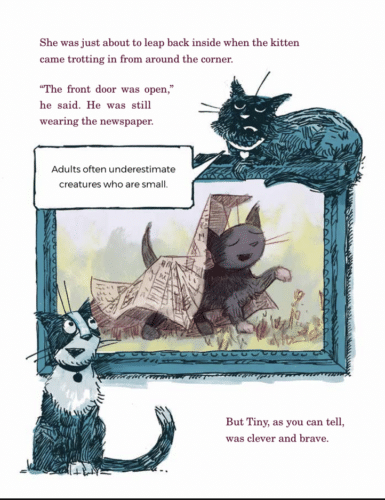
BB: Sort of raising the bar on readers, weren’t you? Okay, let’s talk some more about the art. Aaron, you accompany the framing sequence with our two narrator cats alongside actual frames, which is consistently interesting to look at. I don’t know much about your process to know if this was an idea you had from the beginning or if you came to the idea over time. How do you plan out images for a manuscript like this one?
Aaron: I was working on this book while at Sophie Blackall’s Milkwood retreat and so I had the good fortune of being able to ask the master herself how she handled the framing device of the mom and child narrators in Finding Winnie. What she told me that really stuck with me was that, because the narrators appeared throughout the manuscript, she realized she needed to use a distinct and consistent approach for whenever the story comes back to the present day narrators.
BB: Sophie appears to have been a real influence on this book in multiple ways. It’s also interesting to watch where things are looser and where they’re more deliberately drawn. For example, our narrator cats are done in a kind of pen-and-ink style. Mr. Hiss, in contrast, is often rendered very realistically. How did you come to decide on these separate looks?
Aaron: Exactly – and this ties in to your previous question. I had to do as much as I could to distinguish these two pairs of cats visually or the reader would lose their way. So I not only went with a different medium for the narrator cats but chose a more stylized, cartoony feel for them. Even trying to explain it makes me remember just how difficult it was to get it right. It would have been very easy for this book to have had too many cats! I’ll also call out Saho again for her excellent advice to bring the narrators closer to the viewer when they showed up in the text, and to repeat the black frame around them now and then to help them have their own space in the layouts.

BB: Can one ever have too many cats? Worth pondering. Particularly when they’re all in such dire peril. You know, Kathryn and Casey, there’s a certain moment when our cat narrators reassure the reader by saying, “But you do not need to worry. I promise.” It’s perfectly timed, honestly. Was this reassurance always in the original draft or did it appear at some point in the writing and editing process?
Kathryn: It was always there. We knew, of course, that the story had the potential to be a little scary, and our older daughter was only three when we first read it to her, so it was clear that some of our littlest readers would need reassurance right at the point when things seem like they could take a turn for the scary.
Casey: I think parents instinctively add this parenthetical all the time to stories, but also to thunderstorms and doctor’s appointments and all of life, really, for their children. “You do not need to worry” is a necessary piece of plot for young readers: they want to worry, but not too much. So yes, this was always there, as was that basic assurance of the narrative frame: these cats have descendants, so someone has survived to tell us this story. Scary but not too scary is a wonderful category of literature.
BB: Speaking of which, how much does the final draft resemble the first? Was there anything you lost along the way that you miss? Or any changes that you’re particularly glad you made?
Casey: It’s not a change, exactly, but one of the most satisfying additions was the final line of the book; as soon as we typed it, we knew it was exactly right. Beyond that, I honestly think the degree to which we agonized over specific words might sound unbelievable, but we always hoped this book would be read aloud, so we read it to each other over and over—and then all over again when we started thinking through the choreography of the text with things like page breaks and illustrations.
BB: Aaron, let’s ask you a similar question. Was there anything you initially tried for this book that ultimately didn’t take?
Aaron: Yes indeed. My early drafts had a lot more white space. The speech bubbles alone took several drafts to figure out. Our editor Andrea Spooner really understood this book in a way that gave me faith as I worked to solve the inherent visual challenges of keeping two sets of cats clear in a book about thousands of other cats!
BB: Man, I love that. You know, Casey and Kathryn, I can’t help but think that it was a bit of a coup to get the one and only Aaron Becker to illustrate this book. Aaron doesn’t often illustrate other people, after all. Did you always have him in mind, or was he brought in later in the process? And how do you feel about his work on this?
Casey: I was still pregnant with our first child when dear friends sent us a package with all their favorite kids’ books, and we adored You Are Light from the moment we turned it over in our hands. It was so beautiful and intricate and complex. I remember being so moved by the way our daughters poked their fingers through the die-cut holes and traced the color wheels of stained-glass-like panes, and hooted whenever we got to the gorgeous moon page. It brought this arresting experience I’d had at churches and cathedrals around the world right into their nursery.

ADVERTISEMENT
ADVERTISEMENT
Kathryn: And that’s to say nothing of the Journey trilogy! Aaron is so gifted at telling a story through art, and his work is genuinely beautiful, so we were overjoyed when he agreed to illustrate the book. We were even happier when he came to visit so we could show him where the story is set. And we are over the moon about the result, which captures the story as it existed in our minds: comic, lovely, and hair-raising, in all the right proportions.
BB: Finally, considering just how good this book is (and it really is remarkable) can we hope for more books for kids from you two in the future?
Casey: That’s so kind of you. I’m delighted to say we’ve been working on a second children’s book for some time now—in a certain sense, longer than we worked on Black Cat Island. It’s another local story, and I hope it will be just as magical and meaningful when we’re all done with it.
BB: And Aaron? Tell us about some of your other projects coming out. I know you have a slew!
Aaron: My next wordless picture book, The Water Beast, comes out in February with my editor at Candlewick, Mary Lee Donovan. I think fans will feel some real Journey vibes on that one which is exciting. I’m also working on something for Random House Studio with Annie Kelley there, Rachael Cole art directing. It’s a gorgeous text called The Spaces Between by Kathryn Erskine. And beyond that, I’ve been doing lots of writing these days. If the stars align, I’ll have an adult fairytale novel in my future. Wish me luck!
BB: Good luck!
Thanks cannot be given enough to Casey, Kathryn, and Aaron for taking all that time and energy to answer my questions today. As mentioned before, the honestly incredible Black Cat Island is out April 6th. That may sound like a long ways away, but trust me when I say that the wait? Worth it.

Special thanks to Victoria Stapleton, Orlane Dubreus, and the whole team and Little, Brown Books for Young Readers for making this interview a reality.
Filed under: Best Books, Best Books of 2027, Interviews
About Betsy Bird
Betsy Bird is currently the Collection Development Manager of the Evanston Public Library system and a former Materials Specialist for New York Public Library. She has served on Newbery, written for Kirkus, and has done other lovely little things that she'd love to tell you about but that she's sure you'd find more interesting to hear of in person. Her opinions are her own and do not reflect those of EPL, SLJ, or any of the other acronyms you might be able to name. Follow her on BlueSky at: @fuse8.bsky.social
ADVERTISEMENT
ADVERTISEMENT
SLJ Blog Network
Go-Man Vol. 2: Go-Man vs. The Star Dragon | Review
From Policy Ask to Public Voice: Five Layers of Writing to Advance School Library Policy
Sunrise on the Reaping Movie Review
Luke Pearson Made a Picture Book!
ADVERTISEMENT