
Even the Smallest Actions Can Have Vast Importance: It’s a Grace Lin Q&A on The Little Stone Buddha

I get intrigued by change. Particularly when you rely on an author or illustrator to do one thing, and then they turn right around and do something different. Take Grace Lin. When I think of Grace Lin I certainly think of an array of books. Easy books like the Ling and Ting titles and early chapter books like The Year of the Dog. But where I think of her most often is in bringing elements of Chinese mythology to life. As such, a realistic picture book based on a true story wasn’t what I would have ascribed to her. Yet here we are with the four starred Little Stone Buddha (out October 29th), which is a quiet, thoughtful book of reclaimed spaces. Or, as its publisher describes it:
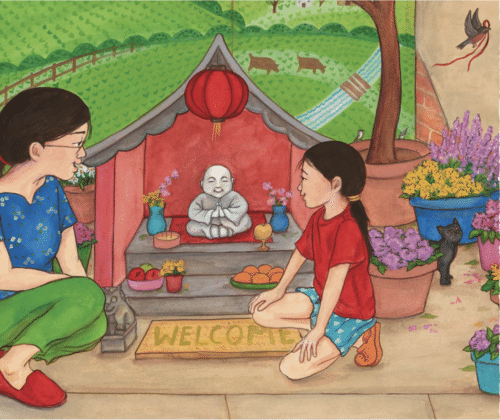
When a small stone Buddha falls off a cyclist’s wagon, he lands in a neglected part of a busy city street. People often throw trash here, turning this part of the city into a rather unpleasant sight. But as passersby begin to notice the little stone Buddha, they start to wonder: what if we each made a small change that brightened this shared part of our community?
Inspired by a true story, The Little Stone Buddha shows us how a small action—or, in this case, a small Buddha—can change a moment, which can change a decision, which can change the spirit, which can, in the end, change everything.
And since I’m in the business of figuring out how things come to be, I asked Grace to give a little more information about this book’s origins:
Betsy Bird: Grace! How lovely to get a chance to ask you about your latest today. Because this book has two distinct inspirations, I want to kick this off by talking about each of them separately. So first and foremost, can you tell us a little bit about the story of the Oakland Buddha and what it was about that news item that particularly caught your eye?
ADVERTISEMENT
ADVERTISEMENT

Grace Lin: Hi Betsy! It’s been a while, so glad to be in touch.
A friend of mine send me an article about the Oakland Buddha year ago, maybe in 2014. She said she thought I’d like it–and I did! The article told about how a traffic meridian in Oakland, CA was subject to constant illegal dumping and crime, blighting the neighborhood. Even though the city repeatedly came and hauled away the trash, the dumping continued. One day, one of the neighbors was so disgusted by the meridian that he glued a Buddha statue onto it. Strangely, after he did so, the dumping stopped. A local Vietnamese group “adopted” the statue and began to build a shrine around it. Now that Buddha statue is accompanied by many others and the meridian is a beautiful, brightly colored shrine full of flowers and fruit. Not only that, crime in the area went down more than 80%!
I just thought it was such a lovely, magical story about how the simple act of placing a statue changed a whole neighborhood. It felt like it should be a book.
BB: It does seem like it was destined to be. You also mention that this tale was inspired in part by THE LITTLE HOUSE by Virginia Lee Burton. I think a lot of people would hear that and think about picture books about other abandoned structures that are fixed up in the course of a storyline. But what makes this book so interesting is that you zero in on the void that the Little House left behind when it was moved to the country. Tell us a little bit about Burton’s influence on this book.
Grace: Yes, this book was also inspired by THE LITTLE HOUSE. That was one of my favorite books when I was a child, I was always so moved by how sad the Little House looked as the city grew up around her–and I was happy when the Little House was moved out of the city and back into the countryside she loved. But, the book just ends with her happy in the country. Maybe because I was a child of immigrants, I always wondered about the city that the Little House left behind. What happened to the place she used to be–did they build another house there that was also unhappy? Or a skyscraper that loved being there? Or was it just an empty hole, waiting for her to come back? I remember, as a child, whenever I visited a city and passed an empty lot I would think, “Maybe that’s where the Little House used to be?”

So when I read the news story of the Oakland Buddha, the question came back–accompanied by other questions. What if the place the Little House left behind had become just an empty lot? What it became an empty lot that became a sad dumping ground? And what it a Little Stone Buddha found its way there?
BB: Now I’m going to think of this as an unofficial Little House sequel. And you’re doing such interesting things with your panels and white space in this story. For example, there’s this moment early on where a mother and her daughter are stepping out of the white space of the borders and onto the space occupied by the Buddha and the trash surrounding it. This is mirrored later when the space has been cleaned up and people are pulling carts to decorate and party from the white space beyond the picture. Can you tell us a little bit about these decisions in the art?
Grace: This book is also a bit of an homage to “Miss Rumphius” by Barbara Cooney. I really loved how she had images in that book that kind of spilled over the gutter onto part of the next page, as if the landscape she was painting just would not be confined to one page and wanted to do something similar in mine.
So, in the first pages of my book, I wanted to give the feeling that as more and more people neglect the area, the dreariness of the dumping ground can’t be contained on one page. It’s so gloomy that the landscape takes over part of the other page, as well.
On the page you mention, the girl (who, in a way, symbolizes hope) is on white because the gloom has not reached her yet. She affects the area by turning the statue upright and when she leaves, the gutter separates her from the Little Stone Buddha to indicate that now each are on their own.
But, as the Little Stone Buddha smiles at the gloom, the area stays contained on a single page. And when the gloom is transformed to hope; the hope begins to grow to where it also cannot be contained on one page and spills over the gutter (the mirrored white space you mentioned above). It then grows so great that it takes over the entirety of the next two pages, which is why those are full bleed two page spreads.
I hope that was clear–it feels very clunky to explain visual choices with words!
BB: Actually, that’s quite beautiful. And also entirely clear when you see the book firsthand. While we’re on the topic, the colors! From the muted browns and grays at the start to that spot of red that appears on everyone who helps the Buddha (even if it’s just a red Coke can in a man’s hand). It’s not just how you introduce color, but also the timing of it. When you work on a book like this, do you know right from the start when the dramatic color shifts will occur storywise, or is that something you have to work out in the course of your process?

Grace: I had a pretty good idea that the illustrations would become much more colorful at the end and where the color shifts would happen, even with illustrating I am a “plotter” not a “pantser”! Initially, I had thought of doing the first part of the book in black and white and then gradually making it more colorful, but it felt kind of cliche and just a touch too gimmicky. But I did think that it was important for the color palette to shift and become more vibrant as the story progressed.
BB: Okay, this one’s just for me. THE LITTLE HOUSE actually makes a cameo in this book in a shot of three people sitting in the newly renovated space. On the far right a girl is reading Burton’s book. Then there’s a woman and on the far left a boy. He’s reading something too, but zoom in as I try, I can’t make out what it is. Can’t you give us a bit of insight into that title?
Grace: Oh, he is reading my upcoming Ling and Ting book, I had that project next on queue so it was on my mind! Unfortunately the cover did not end up looking like that. But I thought it was going to!
BB: Ah! Then I feel a little better. I wonder if you could please speak a little about what these stories of renovation, helpers, cleaning up, and improvement mean to a young child reader. What kind of reception to this book would you most like to see?
ADVERTISEMENT
ADVERTISEMENT
Grace: I feel like it’s really easy to feel helpless in this world. And not just helpless, but powerless. However, when you feel that way it’s easy to become cynical and give up because it seems so pointless. But I have to believe that it’s possible that even the smallest actions can also be important; and I want young readers to believe that too. Because if they do, we will all keep trying–which gives us all a much better chance!
Also, I do feel that stories in general tend to emphasize the big, grand action or gesture that changes everything (no shade to storytellers, I am guilty of that as well), but the small choices made here and there are also quite important. So, I did want to tell a story that shared that as well.
So, if any reader comes away with that understanding–I will consider the book a success!
BB: Beautiful. Finally, what else are you working on these days? What’s next for you?
Grace: Well, in Fall 2027 I have a Ling and Ting book coming out (“Ling and Ting: Ready for School”) which should be a lot of fun; but recently I have been deep in writing a new novel that I am super excited about. It’s one of the few times where the writing came out fairly easily, so I’m taking it as a good sign. It’s a kind of sequel to “Where the Mountain Meets the Moon,” it tells the Goldfish Man’s story so I hope that gets people interested! If all goes well, it should come out in 2028.

Well, there you go! Copious classic picture book references AND a sneak peek at a future Grace Lin novel. I’d say that’s worth celebrating. Little Stone Buddha is out, as I mentioned, October 29th, so you haven’t long to wait. And a big thank you to both Grace and to Victoria Stapleton and the team at Little, Brown Books for Young Readers who helped to put all of this together.
Filed under: Interviews

About Betsy Bird
Betsy Bird is currently the Collection Development Manager of the Evanston Public Library system and a former Materials Specialist for New York Public Library. She has served on Newbery, written for Kirkus, and has done other lovely little things that she'd love to tell you about but that she's sure you'd find more interesting to hear of in person. Her opinions are her own and do not reflect those of EPL, SLJ, or any of the other acronyms you might be able to name. Follow her on BlueSky at: @fuse8.bsky.social
ADVERTISEMENT
ADVERTISEMENT
SLJ Blog Network
Read Aloud Hall of Fame #22: Broken
Exclusive: Dracula’s Brunch Club Is Back! | News and Preview
From Policy Ask to Public Voice: Five Layers of Writing to Advance School Library Policy
Five places that inspired PARADISE, a guest post by Claudia Gabel
ADVERTISEMENT