
“Don’t scream if you meet a Cow.” A Bike Is Not a Bike Q&A with Brenna Jeanneret
You know all the recent talks about children’s literature and what’s good and what’s crud? Lord, it’s such a limited conversation. The world of books for kids is vast and has so many disparate and diverse pathways. You’ve the Big Five publishers, sure (Harper Collins, Macmillan, Penguin Random House, Simon & Schuster, and Scholastic) and then you’ve the second tier big guys (Little Brown/Hachette n’ such) and then all these itty bitty publishers out there, churning out incredible fare but without the same publicity dollars. Ever heard of Gloo Books? Nor had I. But they’re a small independent publisher with a diverse focus and they’ve got this book coming out July 21st that really caught my eye.
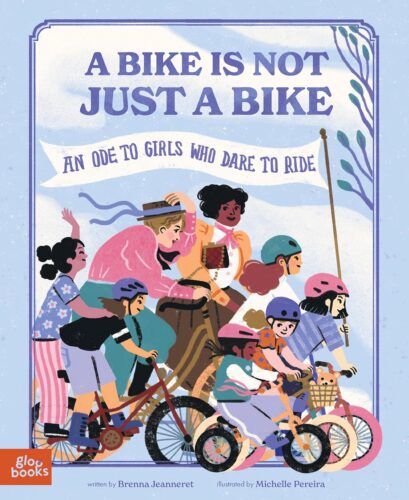
A Bike Is Not Just a Bike: An Ode to Girls Who Dare to Ride by Brenna Jeanneret, illustrated by Michelle Pereira, did not, upon first glance, entice me. A history of women riding bicycles? Sure. We’ve seen that before. And I’m not going to be interested in a picture book work of nonfiction unless it does something new, interesting, and fun. Welp, turns out this was the book I’ve been waiting for. Look, here’s the description from its publisher:
ADVERTISEMENT
ADVERTISEMENT
“A Bike Is Not Just a Bike is the inspiring story of how the ordinary bike came to represent freedom for women and girls.
In the 1880s, a bike was just a bike—unless you were a girl. Then it was considered dangerous, unladylike, even scandalous. But some dared to ride anyway. Pedal by pedal, they defied expectations. Riding a bike became a revolutionary act offering independence, challenging fashion norms and moving women one step closer to the right to vote.
This lyrical celebration honors the fearless women who refused to stay in their lane and spotlights modern-day heroes like Ayesha McGowan and Dr. Lynnea C. Salvo. Complete with historical footnotes, A Bike Is Not Just A Bike celebrates girls riding everywhere and moves us all toward freedom, equity, and joy.”
This is precisely the kind of nonfiction I like. A little bit unexpected. Quite a lot a bit of fun. And beautifully illustrated besides. Even so, I needed to hear from the author herself…
Betsy Bird: Brenna! I appreciate so much your taking the time to answer my questions today. A BIKE IS NOT JUST A BIKE is one of those books that makes me take into consideration how easy it is for nonfiction authors to get stuck in ruts of too often telling stories in the least interesting way. Your book, in contrast, took subject matter that sounds simple on paper (the history of women and bikes) and takes this wholly innovative method in its storytelling. Before we get into how you told this story, I want to know the why. Where did you get the idea for this book?

Brenna: Betsy, hi! First, thank you so much for your kind words and for having me on the blog. As a kid with ADHD growing up in the 90s there wasn’t as much awareness or support as there is now. Once I started school my extra energy started to become an issue. I was a good student but I couldn’t sit still, or keep quiet. My parents had me tested and when the results came back so did the recommendation for Ritalin. But it just zonked me out. I was a totally different kid. My mom asked for a re-evaluation and they said no. So, the very condensed version is, she took me off meds and gave me a bike. Physical exertion has been my coping mechanism ever since and this book is an ode to all the women that made riding a bike for little me an option. I think my life would look much different if I hadn’t been given the chance to channel my energy in this way.
BB: As a fellow 90s kid who had a friend on Ritalin, that hits hard. Thank you. And you do something with this book that doesn’t (to the best of my knowledge) have an official name, but that I credit with allowing books like your own to appeal to a wide range of ages. You’ve both the main text, which reads younger, and then additional information in a smaller font that gives context to the simple words for older kids. Was this format the plan from the start or did it come up naturally in the course of your book’s creation?
Brenna: I actually had to go back to look at the early drafts in order to answer this. The information was always the same but the format shifted from being in the back matter to instead being a part of the book’s main text. I remember waffling about that choice because I wanted older and more curious readers to have access to more robust information but I also didn’t want to clutter the text. Gloo Books and the illustrator Michelle Pereira did a great job of spacing things out in a way that invites the reader to read as much or as little of the extra sidebars as they like.
BB: We’ll get to Michelle’s other contributions in a minute, but first, to what extent does the final product of this book resemble its earliest drafts?
Brenna: The original version was quite a bit shorter. I expanded it to add several pages along with an arc so it wasn’t just a list. The spot in the book where the statements become empowering rather than oppressing along with the ending nod to all the amazing female cyclists who have fought through barriers, was all added in later drafts.
And because we made the decision to move the really interesting facts from the back matter to the sidebars I had to come up with new back matter. The mini overview of Annie Londonderry, the first woman to circumnavigate the globe was only part of the last few drafts.
BB: Lord, I love process. Thank you for spelling this out. Did you have any particular children’s book influences in mind as you wrote this? For example, something about the rhythmic storytelling found here felt like A GIRAFFE AND A HALF by Shel Silverstein to maybe just me. What were your favorite books as a kid, and what might have had a hand in the book’s final form today?
Brenna: Several years ago I was watching a webinar where Miranda Paul spoke about her book Water Is Water illustrated by Jason Chin. I found the water cycle and alchemy of it fascinating as a structure for a book. At the time I was kicking around the idea for this book and it occurred to me that the alchemy of the bicycle happens based on the rider, especially during the bike’s advent. The more I thought about it, the more sort of outraged I became that the simple act of riding a bike was so staunchly opposed just because you were a girl. The first line, “A bike is just a bike unless…”, was born from that rage!

BB: You have so much fun in this book with all the crazy theories that used to circulate on why riding bikes would be bad for women (“bicycle face” is my own personal favorite). But this is a book for kids, so surely there were facts you would have loved to include and simply couldn’t. Care to tell us any of your favorites you couldn’t use?
Brenna: Haha! Okay, I love this question for so many reasons. Bicycle face is also one of my favorites. As you might have guessed there was a LONG list of things women weren’t allowed to do on a bike. Most of them so ridiculous that connecting the dots for young readers would have taken us down some weird roads. Here’s a quick list of a few of my favorites that were included in the back matter of early drafts.
- Don’t be a fright.
- Don’t faint on the road.
- Don’t criticize people’s “legs.”
- Don’t race. Leave that to the scorchers.
- Don’t wear laced boots. They’re tiresome.
- Don’t use bicycle slang. Leave that to the boys.
- Don’t ask, “What do you think of my bloomers?”
- Don’t scream if you meet a cow. If she sees you first, she will run.
- Don’t appear to be up on “records” and “record smashing.” That is sporty.
- Don’t appear in public until you have learned to ride well.
The circular thinking of that last one is truly a next level loophole to keep women in the house and off the bicycle.
ADVERTISEMENT
ADVERTISEMENT
BB: Oh, 100% So talk to us a bit about the accompanying art of Michelle Pereira. I swear she has an image in this book that seemed straight of Kate Beaton’s Stand Aside, Pops. Were you aware of Michelle’s work prior to this book? How do you feel about the final product?
Brenna: Oh gosh, yes, let’s talk about Michelle! What a magician. I was not aware of her work before this book. But I do remember having an early conversation with Karen Chan, the editor, about what the art might look like. Straddling two very different and opposing time periods felt like such a cool way to go about telling the story and also, as a non-illustrator, like a big ask! But as we were talking through it Karen was like, “I know the perfect illustrator for this project!” And as far as I know there were no other choices. Michelle was always going to be the best option and you can see why. She floats the reader between past and present with such ease while adding so much nuance to each illustration all without overwhelming the reader. I absolutely love the final product. Michelle, through alchemy of her own, turned this story into a work of art.
BB: Beautifully put. Finally, what else are you working on these days? What’s next for you?
Brenna: I’ve drafted a few more ideas in the same vein as Bikes about women pushing boundaries and making history that I hope to get polished soon.
I also have another book coming out towards the end of this year illustrated by Gabi Moraes called The Dudes Of Disposal. It’s kind of like the forest animal version of Captain Planet where they must band together to defend their park from harmful trash. The book is a picture book graphic novel which was a really fun challenge!
Thanks so much for having me on the blog, Betsy!


And huge thanks back to Brenna. Thanks too to Clay Lee and the folks at Gloo Books for helping to put this all together. A Bike Is Not Just a Bike: An Ode to Girls Who Dare to Ride will be out July 21st so be sure to look for it then! I’d say it is well worth the wait.
Filed under: Interviews
About Betsy Bird
Betsy Bird is currently the Collection Development Manager of the Evanston Public Library system and a former Materials Specialist for New York Public Library. She has served on Newbery, written for Kirkus, and has done other lovely little things that she'd love to tell you about but that she's sure you'd find more interesting to hear of in person. Her opinions are her own and do not reflect those of EPL, SLJ, or any of the other acronyms you might be able to name. Follow her on BlueSky at: @fuse8.bsky.social
ADVERTISEMENT
ADVERTISEMENT
SLJ Blog Network
Top 10 Circulated Graphic Novels of the ’25-’26 School Year
Bug Ego, vol. 1 | Review
Early May Update: Our list of possible Newbery contenders according to Heavy Medal readers
From Policy Ask to Public Voice: Five Layers of Writing to Advance School Library Policy
Fast Five Interview: Joy McCullough
ADVERTISEMENT