
Reflections of Identity: An Opting Out Conversation with Creators Maia Kobabe and Lucky Srikumar

Each year my library (Evanston Public Library) produces a list of 101 Great Books for Kids. And because this list releases in late-October/early-November, it is important that we discuss potential titles for inclusion all year long in monthly meetings. Just yesterday was our meeting to discuss the 2026 Fairytales/Folktales/Religious Tales AND Poetry AND Graphic Novels we’ve enjoyed as of late. And though I didn’t really mean to, I had a whopping eight new GNS to talk about (and that doesn’t even take into account the seven OTHER comics for kids that I think are above par). One of the titles that I got to present to the group?Opting Out by Maia Kobabe and Swati “Lucky” Srikumar (out now).
You may perhaps recall hearing the name “Maia Kobabe” somewhere in the past. It just so happens that Maia wrote a book by the name Gender Queer: A Memoir that, aside from winning a Stonewall Honor and an Alex Award in 2020, also became the nation’s most banned book from 2021-2023. Opting Out, in contrast, is Maia’s first middle grade graphic novel, and is being created along with Lucky Srikumar, who is also debuting.
ADVERTISEMENT
ADVERTISEMENT
The publisher describes it this way:
“Bodies are the worst. I wish I didn’t have a body.
Saachi is a storyteller. At school, she’s surrounded by kids she’s known forever — including her best friend, Lyla, who shares Saachi’s love of fantasy novels and creating new worlds.
But as seventh grade starts, kids are changing. Suddenly, it matters who you like and if you can find a boyfriend or girlfriend. Even Lyla seems more interested in hanging out with her new boyfriend than in writing and drawing with Saachi anymore. Saachi’s not interested in any of that boy/girl stuff. Why can’t things just stay the way they were?
Saachi also doesn’t love all the ways her body is changing. What if she doesn’t feel like a girl — or like a boy, either? In a world where there is so much either/or, Saachi is going to need to find her own options . . . and create her own story.”
And here are my own thoughts on the title from my own personal write-ups:
“A keen examination of the nebulousness of self that comes during adolescence. This drills into that time when people are slotting themselves into very distinct categories and where any deviation from those categories makes it difficult for the person in question. I cannot recall another middle grade or graphic novel that really dove into a person’s complete and utter disgust with the human body itself. Maia and Lucky do a great job with examining that aspect of Saachi’s experience.”
I’m downright honored to host both creators on this site today:
Betsy Bird: Maia! Such a delight to speak with you today! After working in the world of adult graphic novels it’s great to see you moving towards children’s for the first time. Why write OPTING OUT now? Where did the book come from?

Maia Kobabe: When I was touring with Gender Queer all the way back in 2019, I had many parents of nonbinary or gender questioning kids tell me how much the book meant to them and how useful and encouraging it was in thinking about their kids’ potential futures. But often their kids were a little too young to read the book themselves, and so many parents asked me if I would consider making a “young reader” version of Gender Queer. I wasn’t interested in redoing the book I had just finished or in abridging my memoir, but that planted the idea in my head of writing a new book that covered many of the same themes and questions as Gender Queer but aimed at middle grade readers.
BB: Saachi’s ethnic identity could have been any number of things. I believe (and please correct me if this is inaccurate) she’s presented as Desi or Indian-American. I wonder if the both of you could answer if that always the plan from the start, or did you come to that decision later in the creative process? And Lucky, thank you too for taking my questions today. As far as I can tell, this is your first book for kids so far. How’d you get paired on the project, and did you know Maia personally previously?

Lucky Srikumar: Hi! Thank you for having me! This is my first ever book and I’m so excited! Maia and I met over ten years ago through their sibling and my best friend, Phoebe Kobabe.
Maia had about 20 pages of a script written when e approached me, e actually paid me to give my opinion on whether the best friend character could be written as an Indian character.
I had a lot of thoughts but I did say that I would want the main character and their family to be Indian and Maia’s reaction was to invite me to join in and work on it with em and of course I couldn’t say no.
After that I ended up contributing to the art as well, helping with character designs and taking the lead on coloring the whole thing.
I feel so blessed to have gotten to work on this especially because I can’t picture the story without all these cultural elements anymore. It became it’s own thing and I’m so incredibly proud of it!
Maia: Lucky and I have known each other for over twelve years! They went to college with my younger sibling, Phoebe Kobabe, who helped with the colors on both this book and my first book, Gender Queer. Within one month or less of their friendship, Phoebe called me and said “I met the coolest person, you have to meet them!” That was the very beginning, and then about seven years after that we started working on this book together. I’m so so so happy with the result, in part because Lucky and I made a book together that could have only been created by the two of us together.
I asked Lucky if they would do a read of the book at a very early stage because I wanted to make at least one character Indian-American and I wanted their opinion on what I would need to change in the story to make that work. My initial idea was for the Indian character to be the best friend. Lucky suggested that the story would be much more interesting if the Desi character was the main character, and I agreed, but I knew I could only do that if Lucky was willing to join me as a co-author on the book. Happily, they said yes! Lucky then renamed everyone in Saachi’s family and wrote a lot of new scenes, including the majority of the scenes in which Saachi talks to her parents, and when they visit the temple, as well as many other contributions to the story.

BB: I always like to know an artist’s influences. Lucky, were you into comics as a kid and, if you were, which ones? And who are your influences these days?
Lucky: I have always loved comics and grew up reading the funnies in the newspaper, Tintin by Herge, Asterix and Obelix by Goscinny and Uderzo.
I also loved the webcomics era of the internet, the early aughts! Where people of all kinds of levels of skill made weekly strips, people could draw stick figures and gave extremely influential comics like XKCD by Randall Munroe. I also love Evan Dahm and I’ve been reading his comics online since I was 13 in Singapore all the way through college and even now. I also cite animated cartoons among my favorites and big influences, Steven Universe and Avatar: The last Airbender for example!
I actually grew up watching an Japanese animated version of the Hindu Epic Ramayana which I actually made Maia watch with me while writing this book. It is so good.
BB: And Maia, tell us a bit about your writing process. Did you have a clear cut sense of the direction of the book from the start with a couple tweaks along the way or did it come to you a bit slower than that?
Maia: I wrote an initial outline in spring 2020, and let it sit for a few weeks. That outline was probably somewhere between a third and half of the story that eventually made it into the book. Then I asked Lucky for advice, and once they joined me as a co-author they took a pass at the script and added a bunch of new scenes. Then they passed it back to me and I added more, and passed it back to them, and it went back and forth between us many many times.
BB: Was there anything you wanted to include and ultimately had to lose?
Maia: We really didn’t cut anything! The book never got shorter, it only grew longer and longer over our process of working.
BB: Interesting. So, Lucky, what was it about OPTING OUT that spoke to you personally and made you want to take on the project?
Lucky: So many things! I’m a queer artist who cares a lot about queer youth. I know that hearing transphobia come from places of authority can be so damaging for me as an adult and I can’t imagine how children are feeling about it, especially when it’s more complex than they understand and it feels ubiquitous.
When I was young I would get lost in fantasy worlds to escape from my own and I saw that in the main character. But when I grew up I learned how to turn making art into my way of processing the world around me instead of escaping it. It’s a character arc that Saachi goes through in Opting Out as well, that she can’t escape the fact that she has a body that is changing but she can parse through it and express those feeling through her writing and through stories.
I also think it’s important to show kids that there’s always a chance that their parents might be really accepting and they might not have to hide themselves as much as they think!

BB: Somewhat along those lines, at one point Saachi gets a very nice and up-to-date book on gender and sexuality after she starts her period. One wishes more kids had access to that kind of information. As I read it, I realized that for some kids, this book will actually be doing that book’s job. Maia, was that on your mind at all as you created it?
Maia: There are at least a few puberty books for young readers which are inclusive of queer, trans, and gender-questioning folks, such as Sex is a Funny Word by Cory Silverbery and Fiona Smyth. It was really important to Lucky and I that all of the sex-ed information in Opting Out be accurate and thoughtfully presented, just in case our book was the first time a reader encountered such information.
BB: While I’ve read characters averse to discussing anything to do with gender and sexuality, Saachi is so averse that it’s interesting for the reader. I’ve never seen anyone with these preferences in a book before. Where did you get the idea for her to be this disgusted by the whole discussion?
Maia: Saachi’s horror at learning about sex, specifically reproduction and periods, is exactly how I felt at that age! I wanted to hide from the information, as if by ignoring it I could stop puberty from happening to me. I spent at least the first year of having a period in deep denial.

BB: You’re both credited equally with the writing and the art of this book. Lucky, tell us a little bit about what that process entailed. What does collaborating look like for you?
Lucky: I loved collaborating with Maia. It’s wonderful to work on a project that gets you to spend more time with a beloved friend.
Maia came to me with that original script, about 20 pages of basic story, and we talked a lot about what we would want to add. We would talk about the basic scenes and where they would go and then divvy them up between us. Then we’d read each other’s scenes and futz with them and talk about throughlines, things we wanted to address and how to foreshadow them or wrap them up at the end.
We would also pass tasks back and forth if we were stuck or struggling or out of ideas. I could reach out and say I didn’t know how to write a scene and Maia would offer to take it off my plate. Maia was at one point really burnt out on some character designs and I was able to do some in their stead.
This all started in 2020 so as you can imagine there was a lot of emailing back and forth.
Maia drew up thumbnails and then from there drew and inked every single page.
I went in and changed things if I wanted, for example the scenes where the family is having dinner together, I wanted to redraw all the food and make it more accurate to a South Indian home-cooked meal.
I started coloring the book and realized that it might have been too big a job for me on my own so after I’d done about 50 pages or so, we called in a team of our friends (it ended up being an all non-binary team, which I love) I made color palette and style guide and then lead Maia, eir sibling and my best friend Phoebe, and two other friends in coloring the rest of the book. In the end we had to do a full consistency pass, to make sure it all looked the same across the whole book.
I love collaborating and I love that I know so many talented people! I hope they will also call me in when they need help on their books!
BB: So did you have a clear cut vision of what Saachi would look like at the start or did that change over time?
Lucky: I mentioned wanting Saachi to have a “Mushroom Cut” almost a bowl cut which to me is a quintessential Indian immigrant haircut. We also knew we wanted her to dress mostly neutral but with a few bright colors because she’s a kid and maybe to hint at some flamboyance she won’t let herself enjoy because it feels too “girly”.
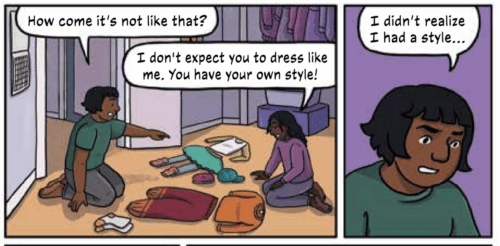
A lot of transgender people who are assigned female go through an arc of rejecting feminine-feeling things, and then learning to enjoy them on our own terms. There’s a stereotype of transgender people looking back at our childhood photos and noticing a preference for baggy shapeless clothing. These things happen subconsciously before we even start questioning our gender and we definitely wanted to show that.
For the other characters, I remember having a lot of fun designing Saachi’s family drawing inspiration from my own parents and cousins. Balding Indian uncles with moustaches are a staple! And I knew I wanted dark skinned characters as well. There are so many different kinds of people and I wanted to show that variety within our cast of characters.
BB: It’s funny, but pretty much the very first thing I noticed about the book was its cheeky title page. I’m not in the habit of calling title pages “cheeky” but it’s such a cleverly clear reference to Gender Queer‘s cover, and I had to wonder. Maia, was that your idea or was it Lucky’s?
Maia: Neither of us! That title page was the idea of our Scholastic book designers. I believe it was Carina Taylor who suggested it, though Maddy Price also contributed to the book design as well. What I can say is that, as an illustrator, I seem to return to the image of a character peering into water as a metaphor for reflecting on identity.

BB: By any chance, will you be doing more books for kids? And what are you up to otherwise these days after this?
Maia: I would love to do more books for kids! I’m not quite ready to commit to what my next project is, but I want to write and draw many, many more books and probably all of them will include themes of gender, sexuality, identity, and characters learning to live as their true authentic selves.
BB: And Lucky? What else are you working on these days? And do you think you might do more books for kids in the future?
Lucky: I needed a break from digital art after making Opting Out and I have been really enjoying ceramics lately! It’s a good feeling after making art with the very precise medium that is digital art to get into a muddy mess and sink my hands into some clay.
I will always make slice of life comics because it’s a big way I process and communicate my big feelings. If I am struggling with gender, disability, even my identity as an artist, I will always explore these themes in little strips first.
As for more books, I absolutely have plans! I want to write a children’s book about disability, and reconciling with the fact that the world isn’t always built for someone with a physical ailment who uses mobility aids. I think children are so curious about my wheelchair and have such refreshing questions about it, I would love for kids to be able to picture themselves losing ability and not see it as an exclusively bad experience. It happens to all of us eventually and I want kids who are struggling with their own disabilities to feel seen and to feel important.
I also would love to write a memoir, probably for adults, perhaps in a mix of prose, poetry and comics!


I just can’t thank Maia and Lucky enough for taking so much time and attention with these answers today. As I mentioned before Opting Out is out now and I urge you to find it and soon. Thanks too to Tessa Meischeid and the whole team at Scholastic for helping to bring this together. Want to know more about the book? As it just so happens, the folks at Good Comics for Kids just released their own review of Opting Out. Look it over!
Filed under: Best Books, Best Books of 2026, Interviews
About Betsy Bird
Betsy Bird is currently the Collection Development Manager of the Evanston Public Library system and a former Materials Specialist for New York Public Library. She has served on Newbery, written for Kirkus, and has done other lovely little things that she'd love to tell you about but that she's sure you'd find more interesting to hear of in person. Her opinions are her own and do not reflect those of EPL, SLJ, or any of the other acronyms you might be able to name. Follow her on BlueSky at: @fuse8.bsky.social
ADVERTISEMENT
ADVERTISEMENT
SLJ Blog Network
The 2026 Children’s Lit Animal Rankings
Opting Out | Review
Early May Update: Our list of possible Newbery contenders according to Heavy Medal readers
From Policy Ask to Public Voice: Five Layers of Writing to Advance School Library Policy
Fast Five Interview: Priya Swaminathan
ADVERTISEMENT