

Dog Lovers Alert! It’s a Things I Learned From My Dog Q&A with Victor Santos and Dena Seiferling
Thanks to the conversation converging around our current National Ambassador of Children’s Literature, I’ve been particularly drawn to the recent debates regarding the topic of “didactic children’s books”. To sum the whole discussion up, our Ambassador recently professed a dislike of the form. And, thanks in large part to his statement that the bulk of children’s literature (past? present? unclear) is “crud”, and that some of this is due to books that are “didactic”, the online backlash has stated that there is nothing wrong with didactic literature for kids. Now if we are to bring in some historical context, American children’s literature was born TO BE didactic (“In Adam’s fall we sinned all” and all that). I would state for the record, however, that it is important to distinguish between that which is didactic (by definition, preachy and self-serving) and books that simply convey a message of some sort (which is why I celebrate “Message” books in my 31 Days, 31 Lists round-ups each year).
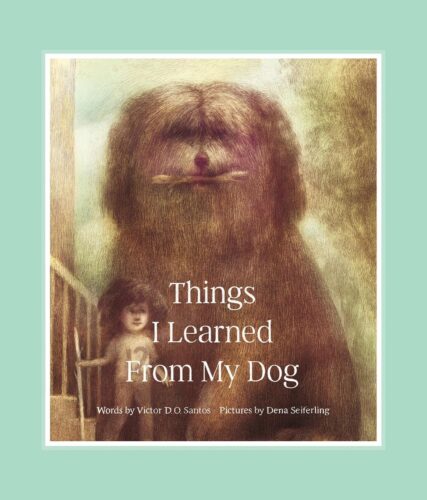
Today’s book is an excellent example of all of this. Is it “didactic” or a “message” book? I’d incline towards the latter definition. The title itself, Things I Learned From My Dog (out May 26th), states pretty clearly from the get-go that it’s going to fall into one category or another. But then you hear the description:
ADVERTISEMENT
ADVERTISEMENT
“Out with his mother at the Sunday market, a six-year-old boy asks her if they can buy a dog—and the answer reshapes his entire childhood. Over the course of the next decade, Luna, his best friend and the dog from that fateful day, is not only by his side during the most important moments, but also unknowingly the one who teaches him some of the most valuable lessons he’ll ever learn. Things I Learned From My Dog shows us the extent to which friendship, love, and loss can guide our paths and shape us into the people we will become.”
Yep. It’s a dog book. And maybe the prettiest one you’ve seen in a long long time. I talk to its author and illustrator about its creation today:
Betsy Bird: Victor! Always a delight to speak to you, and I must say that THINGS I LEARNED FROM MY DOG is an absolutely beautiful read. Though I have an inkling to the answer, could you tell us a little about where this book came from? It feels autobiographical, but is it?

Victor D.O. Santos: Thank you so much, Betsy! I am delighted to hear you enjoyed it. Your intuition is correct: the book was inspired by my own experience growing up with a dog –a poodle called Tuchinha– in my life (I mention her in my acknowledgements). She came into my life in the same way the dog in the book comes into the young boy’s life: at a Sunday market. And just like in the book, Tuchinha was also full of fleas that day of our first encounter, and I had wanted the other, picture-perfect dog instead. However, my mom fell in love with her at first sight and said I could only have a dog if it was her. We had her with us for eleven beautiful years and she played a huge role in my childhood, adolescence, and in the development of my character. Being by her side and seeing her become so frail during her last days was something that gave me my first experience of real grief in life.
When my son turned seven, he asked me for a dog, just like we see in the book. So, to some extent, I think it would be fair to say that the book was a way for me to honor the memory of Tuchinha and to pour my heart, feelings, and memories into a book that is a sort of an ode to the added value that a family pet can have for so many people, and how they can enrich our lives.
BB: Ach. Even cat lovers like myself have to be moved when we read something like that. And Dena! It is such a pleasure to get a chance to ask you some questions today too! Your work on THINGS I LEARNED FROM MY DOG has both a dreamlike essence and also a real reality at its core. What was it about this particular manuscript that appealed to you?
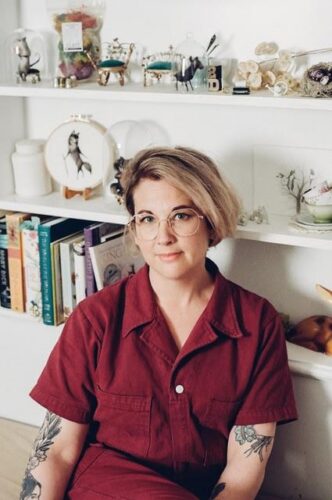
Dena Seiferling: Thank you Betsy, I love reading your interviews and I’m honoured that you’re asking me questions about this book! Having a dog in our family growing up taught me a lot, I could really related to what Victor wrote. I was excited to work with Milky Way Picture Books being a fan of Comme des géants (in Québec). It looked like a lot of fun to illustrate. I was excited that it gave me an opportunity to draw from life, at the dog park where we take our dog Penny for walks. There are apparently 160 dog parks in my city, which is funny to me because there were no dog parks in the more rural area where I grew up. One more thing that appealed to me about this story was that I hadn’t worked on a book like it before or anything as realistic. I had to try hard not to day dream so much!
BB: That I can understand. Now Victor, the lessons the boy learns from his dog are woven seamlessly into the storytelling, tying up rather nicely at the end with that one final lesson in the present day. Was this always the format of the original manuscript or did you do any significant changes from first draft to final product?
Victor: For some reason, the main idea for most of my books – including My Dad, My Rock and People Are Weird, for instance – comes to me in this format: a beginning that has a strong tie to the ending, usually requiring just a few sentences to make that connection. That “seamless weaving”, as you put it, is what takes so long to come by and why I sometimes can go months without writing anything, just letting ideas organically brew in my mind. But when it does come and I like it, it’s then a matter of just creating a middle part that will allow that beginning and ending to be woven in a way that feels natural in the context of the book. So, this format was there from the very first draft.
There were only minor, mostly stylistic changes from the manuscript Milky Way Picture Books was initially pitched to the text that readers will find in the book. Nadine (Milky Way’s publisher) and I did some surgical sentence-level tweaks – in fact, up to the very last day before the book was sent to the printer – but nothing that significantly changed the meaning of any sentences, for example. Besides that, the only other thing that changed is that three of the lessons I had originally included in the manuscript were not included in the final book and some of the order for those that did stay changed in relation to their original order. Dena had the freedom to pick and choose so that things made sense to her as well in the end in view of her sensibility and vision, while working on the illustrations.
BB: Speaking of those lessons, picture books walk this delicate line when it comes to instilling values in child readers. Tip too far one way and the book becomes didactic. Tip too far the other way and it runs the risk of being cynical. When writing literal life lessons on the page. how do you thread that needle? How do you instill straightforward values without sounding preachy?
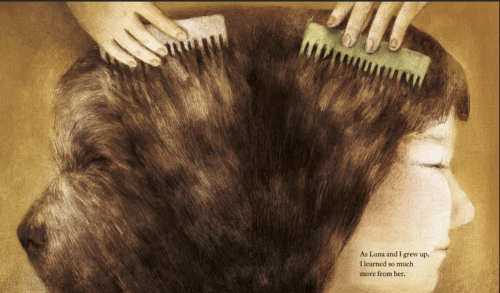
Victor: I love that question! I think three main factors contribute to “Things I Learned from my Dog” not sounding preachy.
First is the fact that in the book it’s not an adult preaching life lessons to a child, as we sometimes see in children’s books; it’s the boy himself (at different stages of his life) who is telling the reader about the lessons he learned.
Secondly, the life lessons are inserted within the context of an actual story, with an actual timeline and characters. Also, all lessons are learned in a context that involves a dog (or dogs), making these nuggets of life wisdom, if you will, more palatable and engaging to children, and hopefully easier to process and reflect about.
Thirdly, the lessons are written in a more lyrical way, trying to draw the reader in through situations children will be able to relate to and avoiding sounding like life advice. So, the book is more descriptive rather than prescriptive.
BB: Now for Dena, I’m so pleased that I get to ask this next question, because I’ve been wondering it for years. What is your artistic process? How do you create art with this glowing quality on the page?
Dena: Thank you, it’s important that the colours retain a sense luminosity from the screen to paper and I’m always aiming for that. I use pencil to create a soft image and then I add colour (usually in Photoshop). My drawings look low in contrast so I use colour luminescence to direct focus and add depth. I love thinking about colour theory and how colours interact to create energy. It’s also the most difficult part for me but it’s something I think I’m getting better at.
When I begin a new book project I research by reading about the subject matter or related topics, it helps me visualize and build the world around the story. I read on and offline, listen to podcasts, take notes. I’m trying to be more conscious of where I source the influence and inspiration that support my ideas, and this time I needed more reference because of the realism in the story. I really try to make my research stage thorough because the best ideas come from expanding on or moving beyond the first impressions. I try to identify an overarching theme or message that I can bring in from my own point of view. For example, I wanted to tie the lessons that Victor wrote together somehow with a theme about how the lessons we learn here parallel other valuable lessons in life about care and relationships.
BB: That’s love. And Victor, was there anything you originally wanted to include in this book and ultimately had to cut?
Victor: Not that I can remember. I mean, I could have thought of many other lessons to include, but since I always do an initial pagination of my manuscripts to have a rough idea of how many pages the book would have – even if things end up changing a little later – I forced myself from the beginning not to include too many things that later might need to be cut.
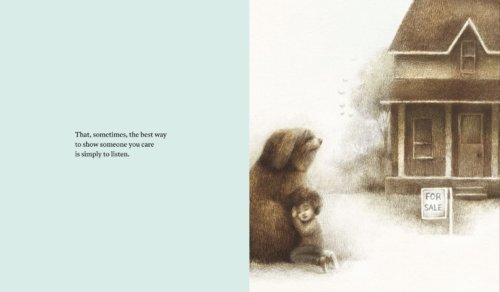
BB: Ah! A technique other picture book authors might wish to emulate. Back to Dena, though, much of what I love so much about the child/dog relationship here is the sheer scope in size. The dog is this large, almost guardian alongside its small child owner. Why did you select the specific dog breed that you did?
Dena: Thank you! I’m glad you felt that way! The child and dog scale relationship (on the cover and through the beginning of the story) was intended to feel protective toward the vulnerable. Also to echo the words in the story – slightly overwhelming, as welcoming a new dog into your home often is. The scale relationship between the two changes along with each of their perspectives as they grow older. My kids and I talk a lot about how strange it is that the life spans of dogs and humans are so different, because we consider them so much like family. It’s bittersweet to think about them aging quicker than us when we love them so much.
In regards to the type of dog we chose for the book, I presented options to our Editor, Nadine Robert, who I worked closely with during the process, and we agreed to feature a dog similar to a Bearded Shepard – although it is lovely and iconic, has specific needs.
BB: I love that. Victor, generally speaking, an author and an illustrator are kept quite separate from one another in the picture book process. That said, an author can write some illustration notes, just so the artist understands what the writer was thinking at any given time. At one point in the story, the book’s kid says that one of the lessons learned from his dog was, “we should do what is right even when no one is watching.” In the art, the kid is carefully bagging up the dog’s poop. Was that something you asked Dana to do, or did she come up with that corresponding image herself?
Victor: When Nadine at Milky Way was pitched the manuscript, it did have some art notes that I thought could be interesting for her to share with the illustrator, given that at that point I still did not know who was going to illustrate the book and how much contact we would have during development of the book (spoiler: Dena and I were indeed kept completely separate during the process). The art notes simply served to indicate the mood I had in mind for the book and a few suggested scenes I thought could resonate well with children.
When the publisher shared the manuscript with Dena, the publisher decided which art notes to leave in and which to remove, so as not to influence Dena’s conception of the artwork and her vision for it. That specific scene of the boy bagging up the dog’s poop during an evening walk was indeed an art note I had in the original manuscript, so I am assuming Dena had access to it and liked the idea. On the other hand, many of the scenes Dena illustrated differ from my original art notes, so either those were not included in the manuscript she received from the publisher or Dena decided to completely ignore them, which I am glad she did since I love the choices she went with.
BB: The right attitude! And Dena, for your part, was there anything in this book that you found a little difficult or challenging? Or things that you had to rework because they didn’t turn out quite the way you’d planned?
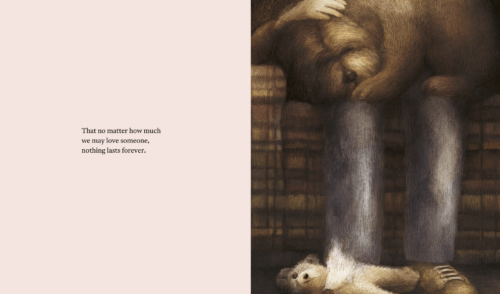
Dena: I had to give a lot of thought to staying within the boundaries of realism for this book. Many of the picture books I have worked on anthropomorphize animals but this one doesn’t which was a nice change, it’s more realistic.
I would also say that an ongoing challenge for me is consistency which is especially important when narrating a sequential story. Examples of that are: keeping the way things look consistent from one image to the next, smooth transitions when showing change take place etc. The things that I have found helpful are good reference, patiently re-working, and taking enough breaks or doing something to gain a fresh perspective. I am appreciating how consistency is an important thing in many aspects of life, especially with taking care of a dog.
BB: Okay. Big questions for the both of you. Do you have a dog now?
Victor: Yes, after months of thinking and debating with my wife, we ended up saying yes to my son’s wish to get a dog when he turned seven. Today, we have a sweet (and way too active!) bernedoodle called Teddy, also seen in my acknowledgements in the book. I wanted my kids to also have the opportunity to grow up with a dog in their lives and experience everything that comes with that, just like I did and for which I am so thankful.
Dena: I do love dogs. We had family dogs growing up, Katie our wiry haired terrier, lived to be very old. She was really wonderful. She was a talented mouse catcher. My dog Pickle was with me for 16.5 years. He weighed 13 pounds. He was an adorable and gentle soul but he thought he was huge and intimidating. I miss him so much! We now have a French Bull Dog named Penny, my kids named her! We love her unique personality.
BB: Awww! I love that. Okay, finally, I know you both always have a lot of different irons in the fire. What are you working on next? What else can we see from you?
Dena: Right now I’m working on a book written by Susan Campbell Bartoletti, published by Penguin Random House Young Readers, called The Book of Bee: A Tale of Great Peril and Stout Hearts to be published Spring 2027. I’ll be sharing more about that later this year! Thank you for taking the time to interview us and for your support, Betsy.
Victor: You know me too well, Betsy! (laughs). I recently finished the development of a picture book called FINITO –selected for the 2026 PICTUS Outstanding Picturebooks Showcase at the Bologna Children’s Book Fair– on the finitude of life and the importance of fully living every minute of it. The book was illustrated by Polish illustrator Iwona Chmielewska, a finalist for the Hans Christian Andersen Award in 2018, 2020, 2022, and 2024, and a three-time winner of the Bologna Ragazzi award. The book came out in Korean in March 2026 and I hope an English-language publisher will at some point decide to publish it in English.
I am also currently working on three picture books, including a more humorous one with celebrated Argentinean illustrator ISOL (winner of the 2013 Astrid Lindgren Memorial Award and author-illustrator of Loose Threads) as well as my first wordless picture book, illustrated by Italian illustrator Mara Cerri (winner of the 2025 Premio Andersen in Italy). As for the illustrator of the third picture book I have in the works, stay tuned for a later announcement either through my author website or my Instagram account.

Brilliant stuff all around.

Special thanks to Victor and Dena for taking so much time and attention when answering my questions today. Things I Learned From My Dog is out May 26th. It is, as you can see, just a lovely piece all around. For dog lovers, and the dog neutral, alike, this has a little bit of something it for everybody. And that’s the messageI want to convey.
Filed under: Interviews
About Betsy Bird
Betsy Bird is currently the Collection Development Manager of the Evanston Public Library system and a former Materials Specialist for New York Public Library. She has served on Newbery, written for Kirkus, and has done other lovely little things that she'd love to tell you about but that she's sure you'd find more interesting to hear of in person. Her opinions are her own and do not reflect those of EPL, SLJ, or any of the other acronyms you might be able to name. Follow her on BlueSky at: @fuse8.bsky.social
ADVERTISEMENT
ADVERTISEMENT
SLJ Blog Network
One Star Review, Guess Who? (#235)
Biker Mice Intergalactic Odyssey | This Week’s Comics
From Policy Ask to Public Voice: Five Layers of Writing to Advance School Library Policy
Appealing to Reluctant YA Readers, a guest post by April Henry
ADVERTISEMENT